Archive
Ephemeris: 02/27/2025 – The spring constellations are rising
This is Ephemeris for Thursday, February 27th. Today the Sun will be up for 11 hours and 5 minutes, setting at 6:28, and it will rise tomorrow at 7:21. The Moon is new today, and won’t be visible.
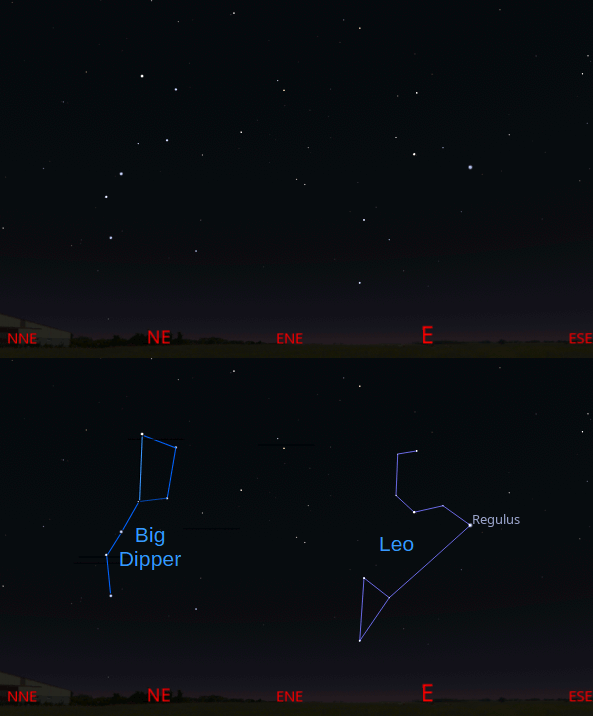
Today, we are exactly 3 weeks from the start of spring. The temperatures this week are rising. Even though at 8:00 PM Orion is high in the south, looking off to the east the spring constellation of Leo the lion has risen, and the Big Dipper is standing on its handle in the northeast. To the Anishinaabe native peoples of this area the Big Dipper is part of Ojiig, the Fisher, who brought summer to the Earth and when he’s in this position in the northeastern skies standing on his tail it is a sign of the spring to come and the start of the maple sugaring season. This next week or so is especially the best time, all year, to see the planet Mercury in the evening twilight due west, shortly after sunset. Its greatest separation from the Sun will come March 8th.
The astronomical event times given are for the Traverse City/Interlochen area of Michigan (EST, UT – 5 hours). Times will be different for other locations.
Addendum
Ephemeris: 02/26/2025 – Where are the naked-eye planets this week?
This is Ephemeris for Wednesday, February 26th. Today the Sun will be up for 11 hours and 2 minutes, setting at 6:26, and it will rise tomorrow at 7:23. The Moon, 1 day before new, will rise at 7:25 tomorrow morning.
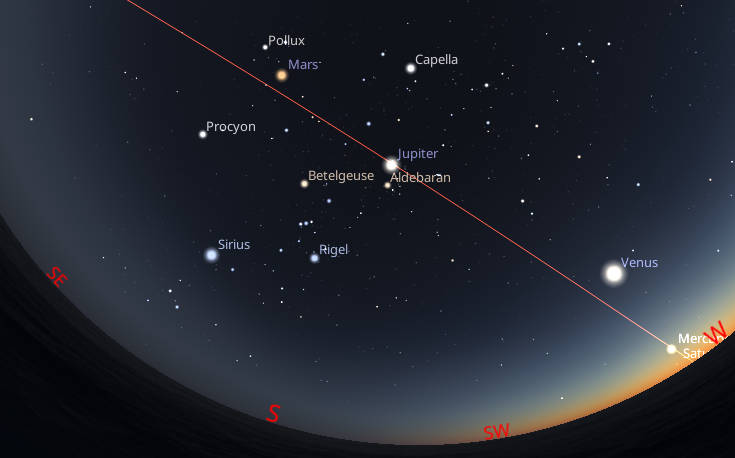
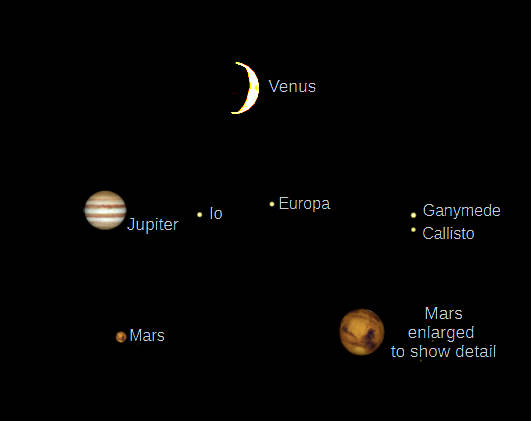
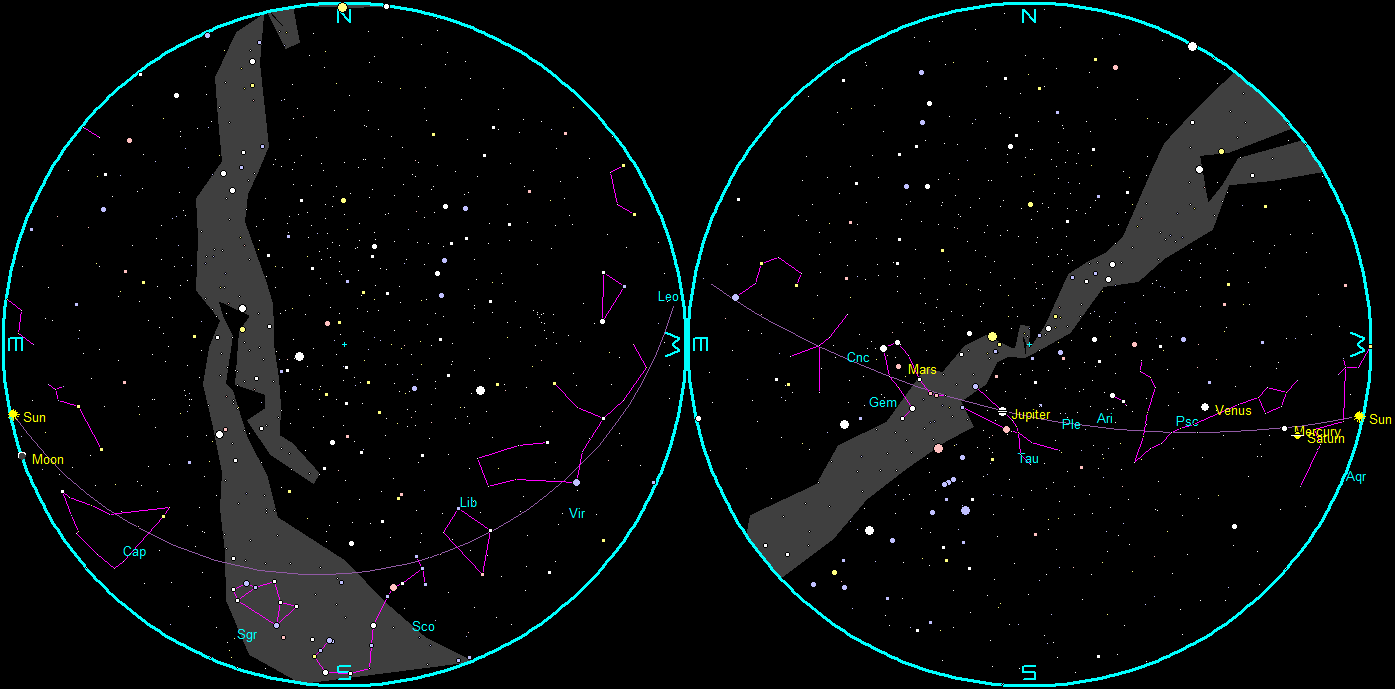
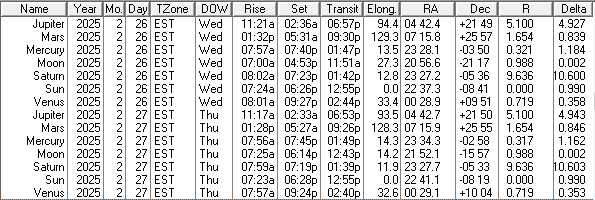
Let’s take our weekly look at the whereabouts of the naked-eye planets. At 7:15 PM this evening four of the five naked eye planets will be out. Starting from the west we have Venus the brightest of all. Far below it, near the horizon, will be the much dimmer Mercury, making its evening appearance, replacing Saturn. Jupiter, the second-brightest planet will be high in the south. It is slowly heading eastward now above the star Aldebaran. Farther below and left of it is the spectacular constellation of Orion the hunter. The 4th planet out is Mars, the third-brightest planet now, with its distinctive reddish hue in the east-southeast, to the right of the stars Castor and Pollux in Gemini.
The astronomical event times given are for the Traverse City/Interlochen area of Michigan (EST, UT – 5 hours). Times will be different for other locations.
Addendum
Ephemeris: 02/25/2025 – Eridanus, a river in the sky
This is Ephemeris for Tuesday, February 25th. Today the Sun will be up for 10 hours and 59 minutes, setting at 6:25, and it will rise tomorrow at 7:24. The Moon, 2 days before new, will rise at 7:00 tomorrow morning.
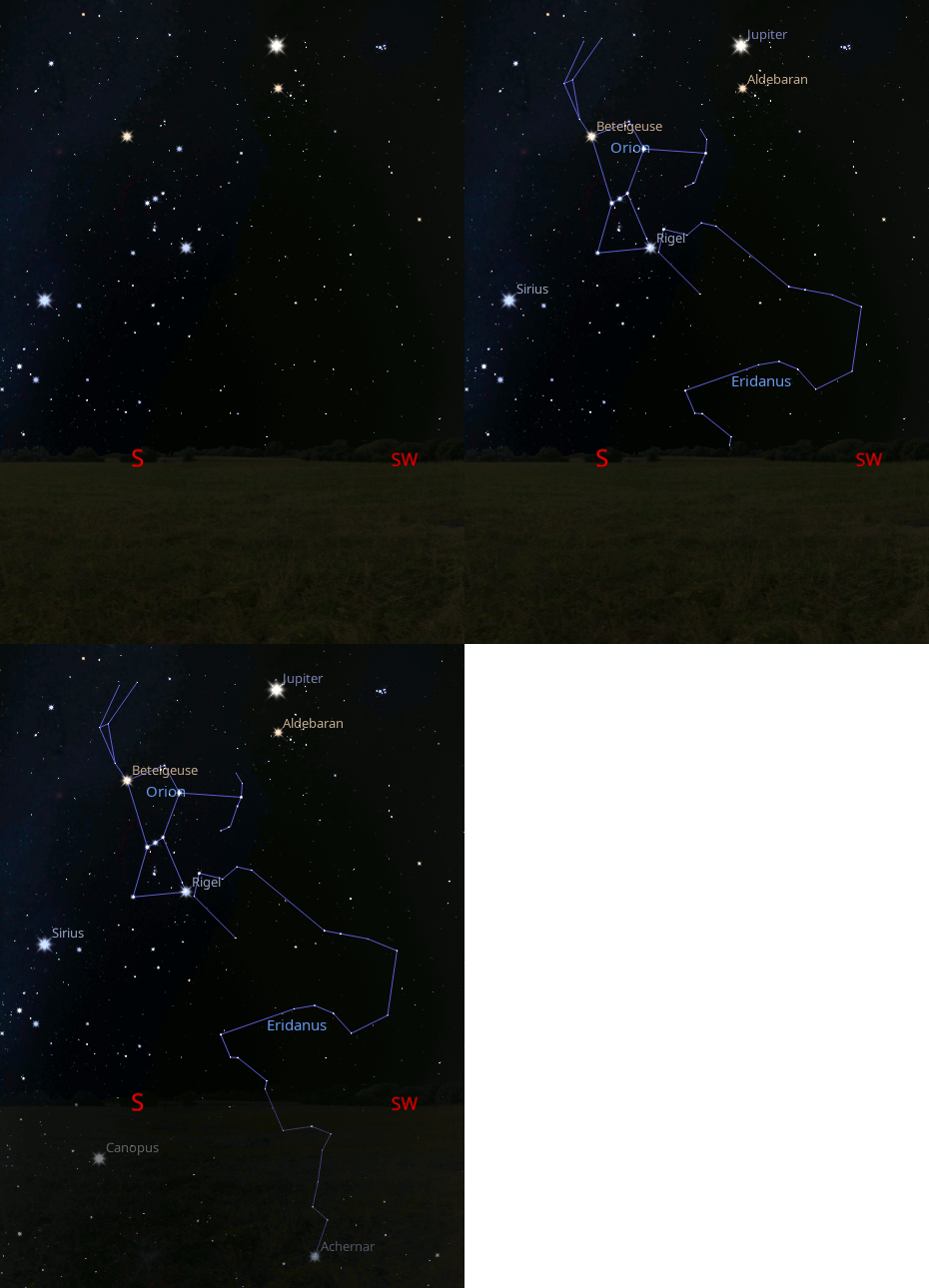
One of the more obscure constellations around is Eridanus, which depicts a river. At 8 PM the river starts near the lower right corner of Orion, near the bright star Rigel and flows to the lower right then zigzags back down to the south-southwestern horizon, it then heads below the horizon. One has to travel to the far south to see the southern terminus of the river, the bright star Achernar. Writers over the ages have seen here the Nile and the Earth circling river Ocean of the ancient flat earth days. Achernar is actually two stars, the brightest was discovered to be the flattest star known, due to its rapid spin. The dimensions of Achernar A has been determined to be twice as wide across its equator than from pole to pole. It’s 139 light years away.
The astronomical event times given are for the Traverse City/Interlochen area of Michigan (EST, UT – 5 hours). Times will be different for other locations.
Addendum
Ephemeris: 02/24/2025 – Mars stopped in its tracks!
This is Ephemeris for Monday, February 24th. Today the Sun will be up for 10 hours and 55 minutes, setting at 6:24, and it will rise tomorrow at 7:26. The Moon, 3 days before new, will rise at 6:30 tomorrow morning.
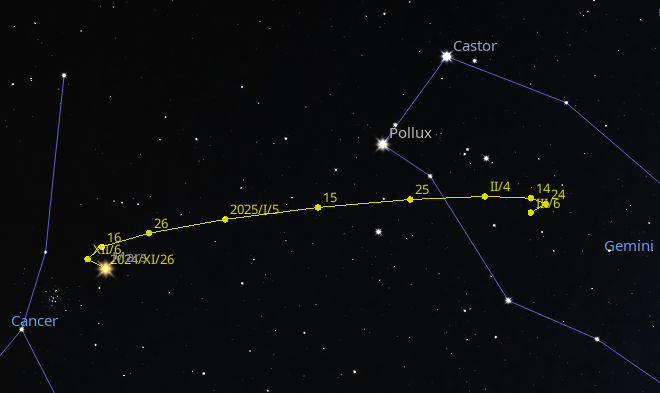
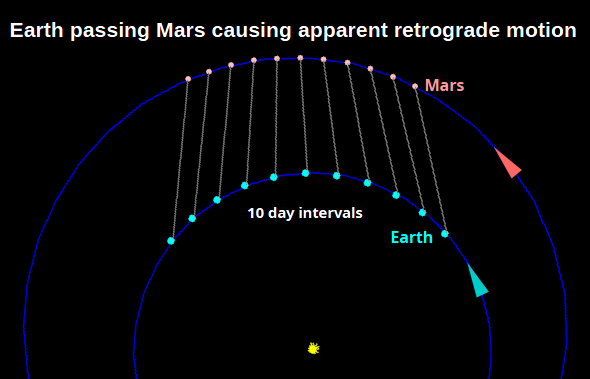
Today the planet Mars is said to be stationary. No, planets do not stop in their orbits of the Sun. It is because we are viewing them from the moving planet Earth. For the last few months Mars has been moving to the west, which is not its normal motion, so we call it retrograde motion. It does that because the Earth, moving faster on an inner orbit, is passing Mars moving slower on an outer orbit. This was a problem for the ancients of the western world because they thought all the moving objects, all seven of them, moved around a stationary Earth. Of those seven, two of them never went backwards, or westward against the stars. They were: the Moon which does orbit the Earth and the Sun which the Earth orbits.
The astronomical event times given are for the Traverse City/Interlochen area of Michigan (EST, UT – 5 hours). Times will be different for other locations.
Addendum
* For non astronomers: Inferior doesn’t refer to quality, but that the planet’s orbit is inside the Earth’s orbit. Superior planets orbit farther out from the Sun than the Earth.
Ephemeris: 02/21/2025 – Orion’s most distinctive feature
This is Bob Moler with Ephemeris for Friday, February 21st. Today the Sun will be up for 10 hours and 46 minutes, setting at 6:20, and it will rise tomorrow at 7:31. The Moon, 1 day past last quarter, will rise at 4:09 tomorrow morning.
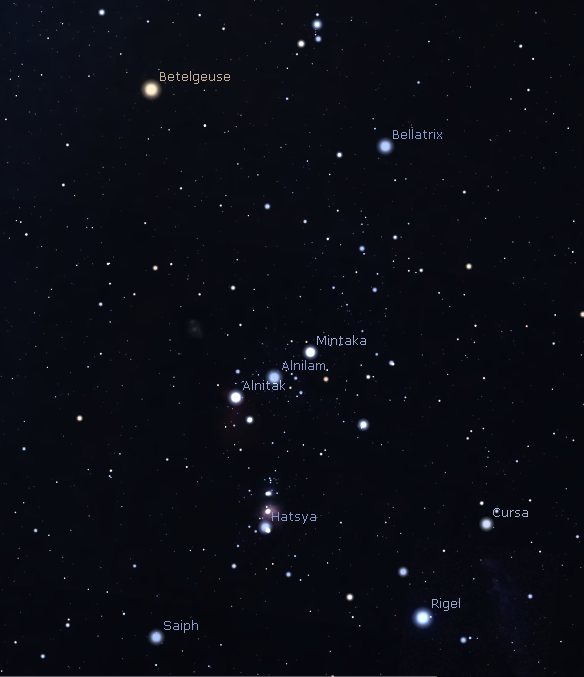
Orion’s belt of three stars is one of the most noticeable star groupings in the sky. There are no other groups of three bright stars in a straight line visible anywhere else in the sky. The star’s names from left to right are Alnitak, Alnilam and Mintaka. They are actually a bit farther away than the other bright stars of Orion. Alnilam, the center star, is over three times the distance of red giant Betelgeuse above it and over twice as far as blue white giant star Rigel below it. Alnilam is 375 thousand times brighter than the Sun. These three stars were also known as Frigga’s Spindle by the Norsemen. Frigga, also known as Freya, is the goddess from whom we get the name of the day of the week we call Friday.
The astronomical event times given are for the Traverse City/Interlochen area of Michigan (EST, UT – 5 hours). Times will be different for other locations.
Addendum
Ephemeris: 02/20/2025 – Can you find the celestial unicorn?
This is Bob Moler with Ephemeris for Thursday, February 20th. Today the Sun will be up for 10 hours and 43 minutes, setting at 6:18, and it will rise tomorrow at 7:33. The Moon, at last quarter today, will rise at 3:06 tomorrow morning.
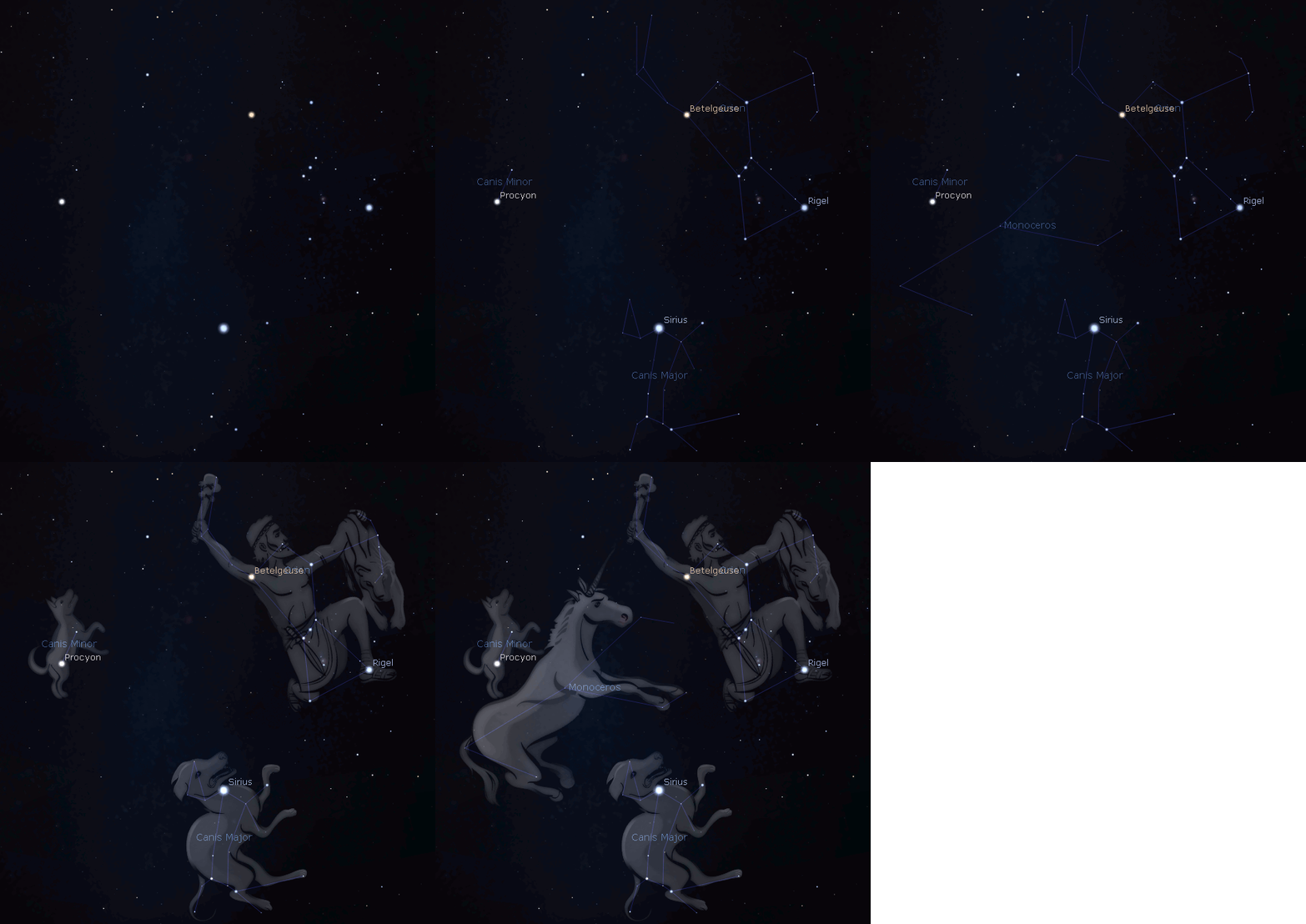
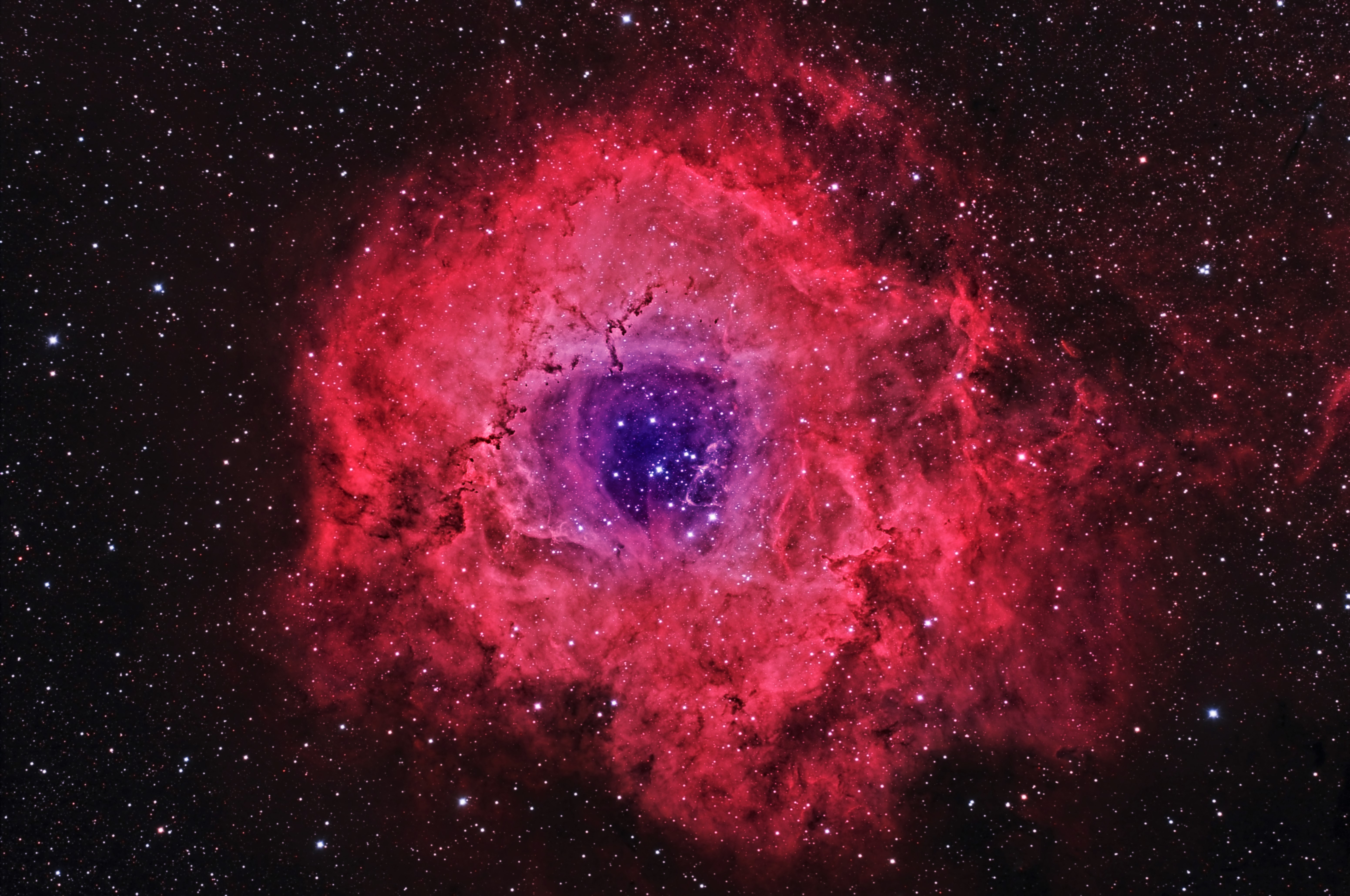
Among all the constellations in the sky of animals real and mythical, there is also a unicorn. It’s called Monoceros, and inhabits the southeastern sky at 8 p.m. mostly bounded by Orion on the right, Canis Major, the great dog below and Canis Minor, the little dog to the left and above. Unfortunately for observers without a telescope Monoceros, is devoid of any but the faintest stars. Maybe that’s why no one can find unicorns anymore. It has many faint stars because the Milky Way runs through it. For the astrophotographer it is a feast of star clusters and faint nebulae or clouds of gas and dust, the birthplace of stars, including the red rose of the Rosette Nebula. It also contains a beautiful telescopic triple star system, Beta (β) Monocerotis.
The astronomical event times given are for the Traverse City/Interlochen area of Michigan (EST, UT – 5 hours). Times will be different for other locations.
Addendum
Ephemeris: 02/19/2025 – All the naked-eye planets are seen in the evening this week
Ephemeris: 02/19/2025 – Where have the naked-eye planets wandered off to this week?
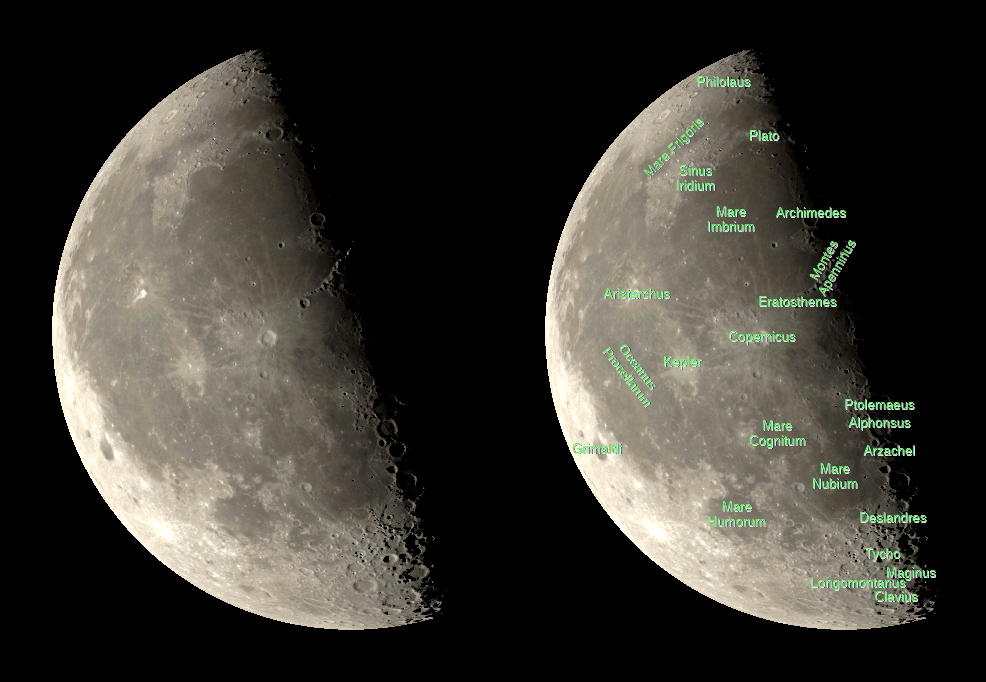
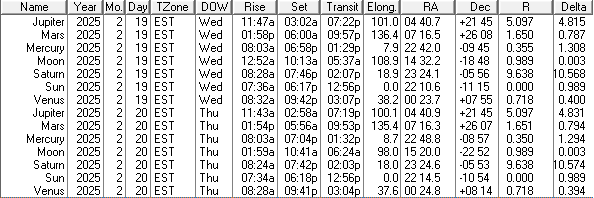
This is Ephemeris for Wednesday, February 19th. Today the Sun will be up for 10 hours and 40 minutes, setting at 6:17, and it will rise tomorrow at 7:34. The Moon, 1 day before last quarter, will rise at 1:59 tomorrow morning.
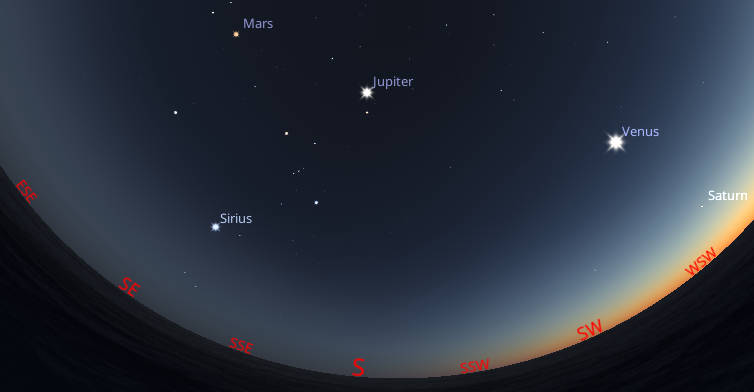
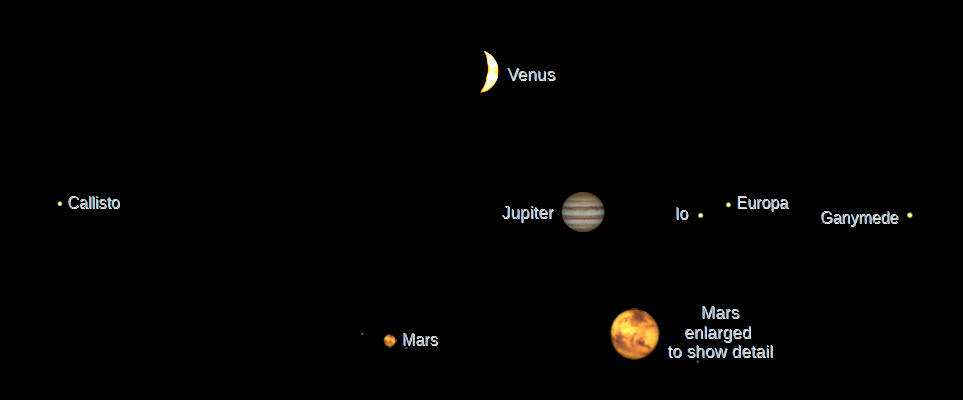
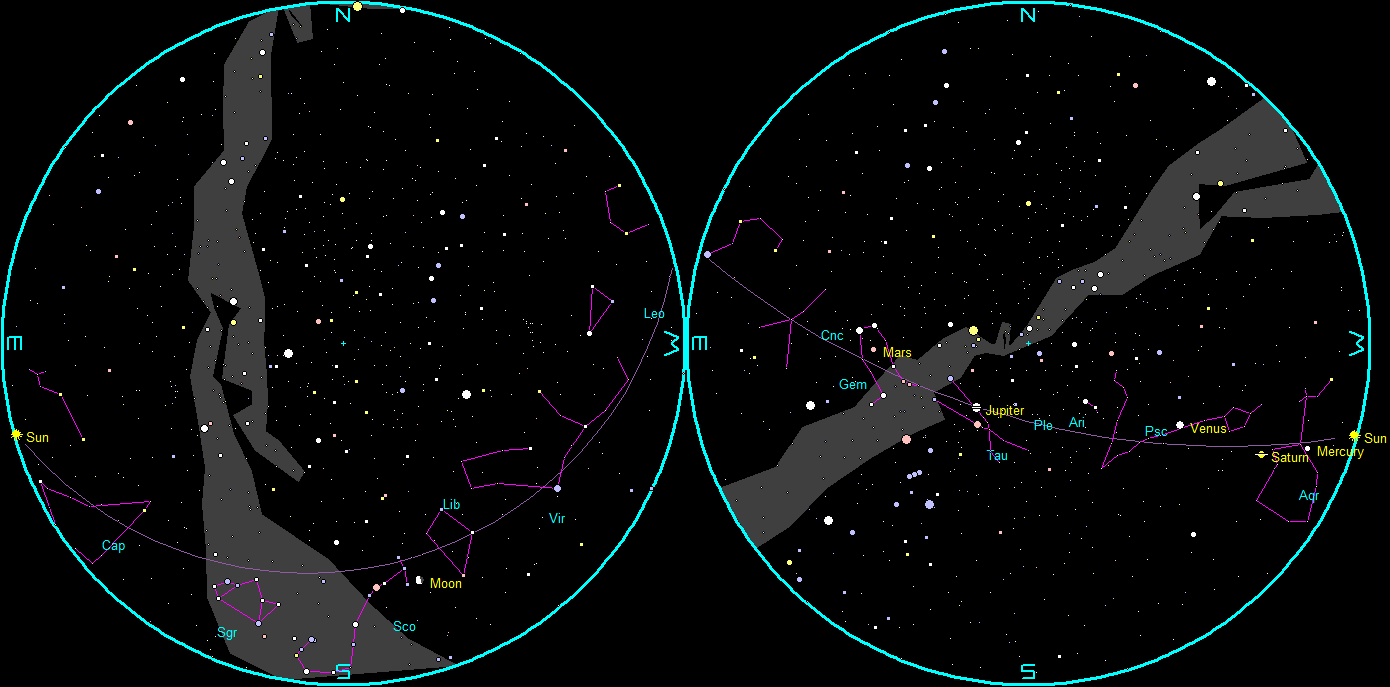
Let’s take our weekly look at the whereabouts of the naked-eye planets. At 7 PM this evening four of the five naked eye planets will be out. Starting from the West we have Venus the brightest of all in the west southwest. Far below it, near the horizon, will be the much dimmer Saturn, which we are about to lose, or may already have, to the evening twilight. Jupiter, the second-brightest planet will be high in the south. It has reversed course and is heading back eastward now. Farther below it is the spectacular constellation of Orion the hunter. The fourth planet out is Mars, the third-brightest planet now, with its distinctive reddish hue, west of the stars Castor and Pollux in Gemini, and in the east-southeast.
The astronomical event times given are for the Traverse City/Interlochen area of Michigan (EST, UT – 5 hours). Times will be different for other locations.
Addendum
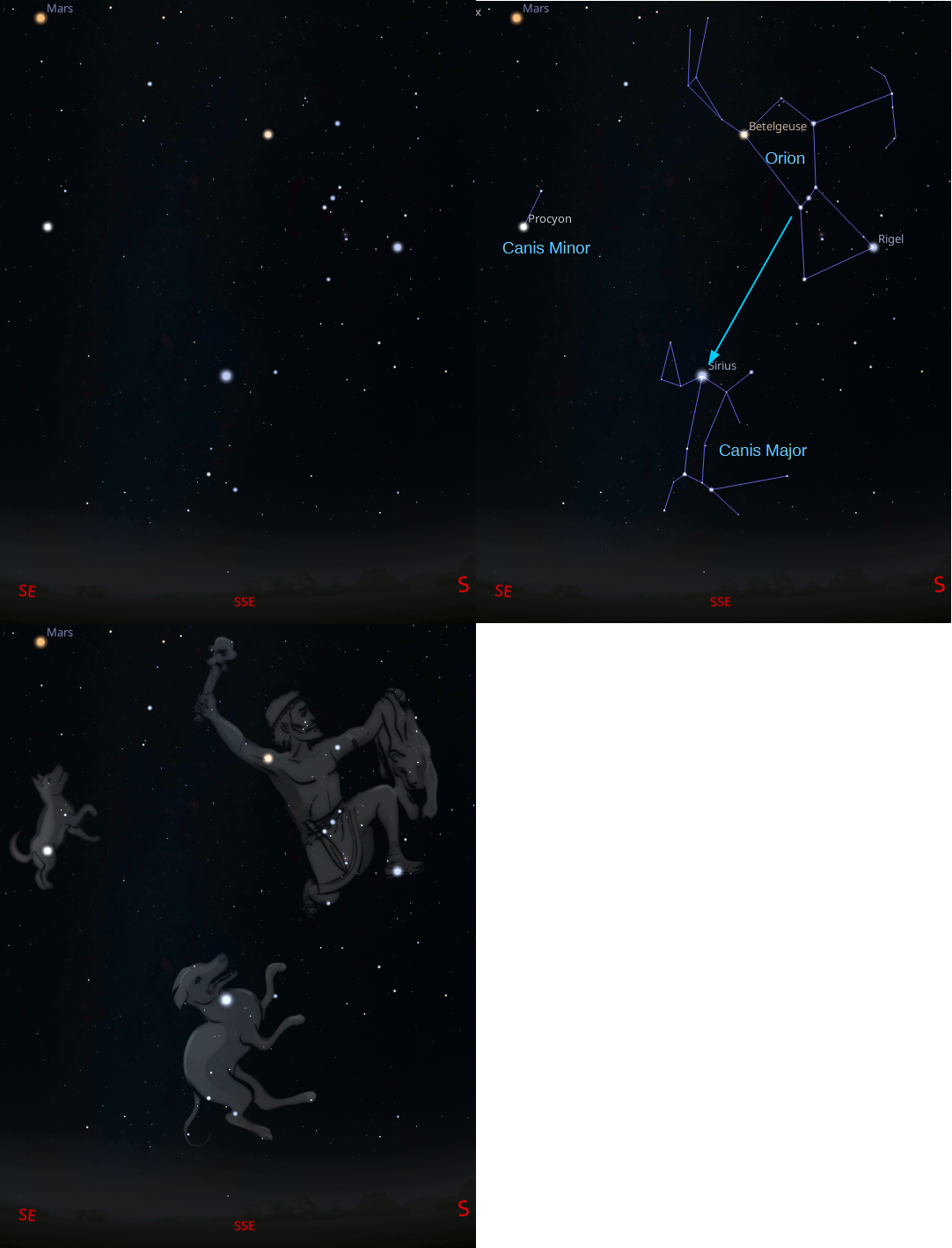
Ephemeris: 02/18/2025 – Finding Orion’s greater hunting dog
This is Ephemeris for Tuesday, February 18th. Today the Sun will be up for 10 hours and 37 minutes, setting at 6:15, and it will rise tomorrow at 7:36. The Moon, 2 days before last quarter, will rise at 12:52 tomorrow morning.
The great winter constellation or star group Orion the Hunter, is located in the south-southeastern sky at 8 p.m. His elongated rectangle of a torso is almost vertical. In the center of the rectangle are three stars in a line that mark his belt. As a hunter, especially one of old, he has two hunting dogs. The larger, Canis Major can be found by following the three belt stars of Orion down and to the left. There lies the brilliant star called Sirius, also known as the Dog Star. It’s in the heart of a stick figure dog low in the southeast, facing Orion, that appears to be begging. There’s a fine star cluster, called M41, at the 5 o’clock position from Sirius, easily visible in binoculars or a small telescope.
The astronomical event times given are for the Traverse City/Interlochen area of Michigan (EST, UT – 5 hours). Times will be different for other locations.
Addendum
Ephemeris: 02/17/2025 – Follow the Drinking Gourd
This is Ephemeris for President’s Day, Monday, February 17th. Today the Sun will be up for 10 hours and 35 minutes, setting at 6:14, and it will rise tomorrow at 7:38. The Moon, 3 days before last quarter, will rise at 11:47 this evening.
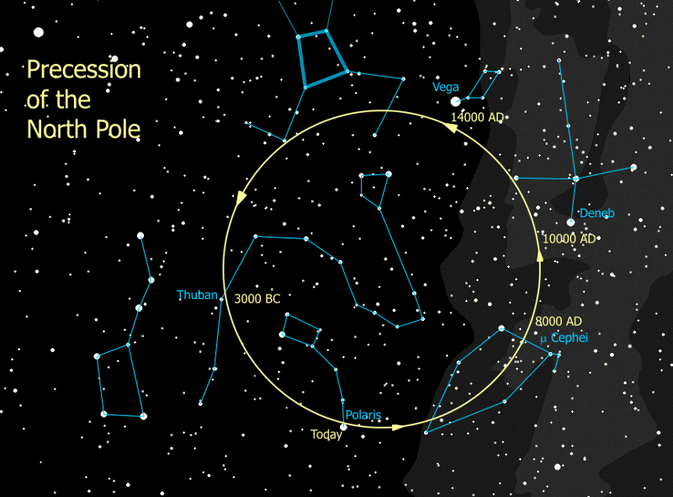
In the decades before the Civil War, runaway slaves would travel, often at night, northward from the slave states in the south to the northern free states and Canada over the metaphorical Underground Railroad following the Drinking Gourd, the Big Dipper as their compass. For millennia, the North Pole of the sky had been passing near the handle of the Big Dipper or Great Bear’s tail and now up to the star Polaris in the Little Dipper. As an amateur astronomer, who loves the dark, starlit skies, I’ve noticed that everyone is the same color in the dark! This year the Grand Traverse Astronomical Society will, once again, team with the Sleeping Bear Dunes for more Sun and star parties.
The astronomical event times given are for the Traverse City/Interlochen area of Michigan (EST, UT – 5 hours). Times will be different for other locations.
Addendum

Ephemeris: 02/14/2025 – A Valentine’s Day Rendezvous
This is Ephemeris for St Valentine’s Day, Friday, February 14th. Today the Sun will be up for 10 hours and 26 minutes, setting at 6:10, and it will rise tomorrow at 7:42. The Moon, 2 days past full, will rise at 8:34 this evening.
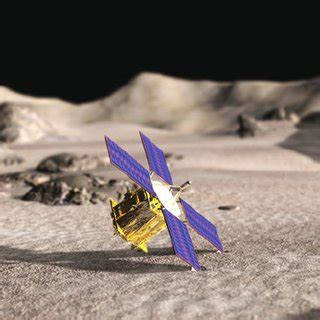
Twenty-five years ago to the day, the NEAR-Shoemaker* spacecraft entered into orbit of the near Earth asteroid 433 Eros. It wasn’t originally planned to enter orbit of the asteroid named after the Greek god of love on Valentine’s Day, 2000. It arose after an aborted course correction a year earlier. After solving the problem, a new course was plotted and NEAR-Shoemaker was gently inserted into orbit of this 21 mile long asteroid, shaped like a bent bread stick with a bite taken out of the center of it. The spacecraft spent almost a year orbiting Eros at various altitudes. The spacecraft ended its mission by gently dropping onto the middle of the asteroid, where it stayed alive for ten days before succumbing to the cold.
The astronomical event times given are for the Traverse City/Interlochen area of Michigan (EST, UT – 5 hours). Times will be different for other locations.
* The spacecraft was launched as NEAR for Near Earth Asteroid Rendezvous. It was renamed en route NEAR-Shoemaker after Eugene Shoemaker’s death in 1997. Shoemaker was a geologist who trained Apollo astronauts and proved that the Barringer Meteor Crater was indeed an impact site and not a volcanic caldera, and that most of the Moon’s craters were also caused by impacts. He with his wife Carolyn and David Levy discovered Comet Shoemaker-Levy 9, which crashed into Jupiter in 22 pieces in July 1994, gaining worldwide attention.
Addendum
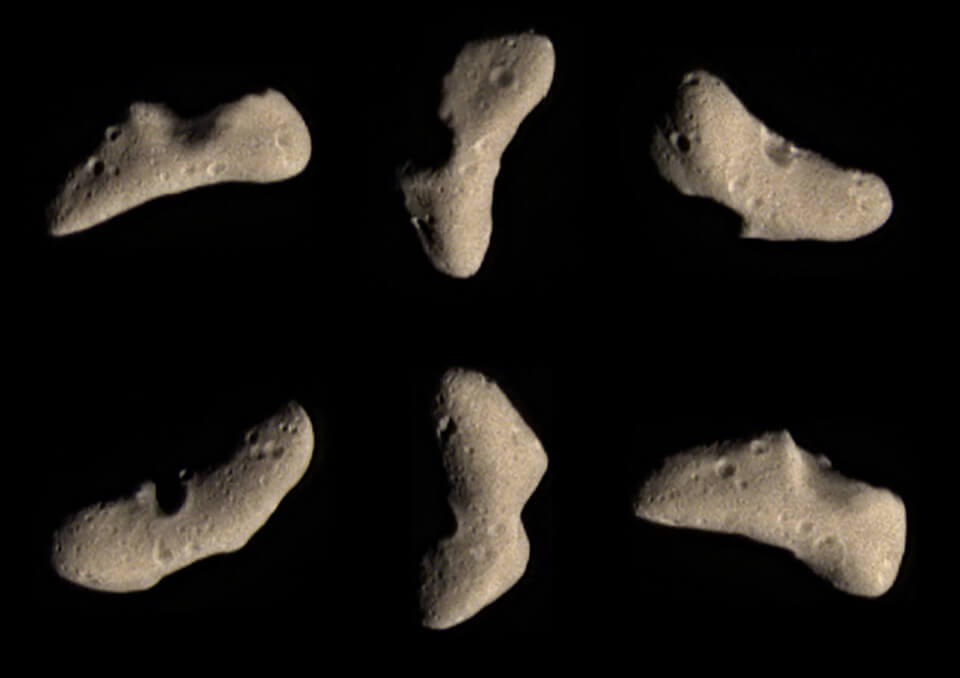
NASA/JPL/JHUAPL. Caption from: https://eros2019.imcce.fr/eros.html via Google Translate.
 Bob Moler's Ephemeris Blog