Archive
10/03/2014 – Ephemeris – Sundials and Fall Astronomy Day on tap tomorrow at the NMC Observatory
Ephemeris for Friday, October 3rd. The sun will rise at 7:42. It’ll be up for 11 hours and 36 minutes, setting at 7:19. The moon, 2 days past first quarter, will set at 3:01 tomorrow morning.
Tomorrow is Fall Astronomy Day. To celebrate the Grand Traverse Astronomical Society will move its first Friday of the month meeting and star party to Saturday the 4th. At 8 p.m local landscape architect and sundial expert Dean Connors will talk about, of course, sundials and the myriad of forms they take. Starting at 9 p.m. the star party portion of the night will begin with the moon as the featured celestial object. Members of the society will also provide information on this month’s two eclipses and how to observe a solar eclipse safely. The meeting and star party will be held at Northwestern Michigan College’s Rogers Observatory located south of Traverse City on Birmley Road. Between Garfield and Keystone roads.
Times are for the Traverse City/Interlochen area of Michigan. They may be different for your location.
10/02/2014 – Ephemeris – The gibbous Moon tonight
Ephemeris for Thursday, October 2nd. The sun will rise at 7:41. It’ll be up for 11 hours and 39 minutes, setting at 7:21. The moon, 1 day past first quarter, will set at 1:50 tomorrow morning.
Tonight the moon will be featuring some of my favorite lunar landmarks, and if you spend any time looking at the moon with a small telescope, they become yours. The place to look is at the terminator, the sunrise line on the moon. In the north not far from the terminator is the walled plain called Plato. A bit farther away is a gash in the lunar Alps mountains caller the Alpine Valley. Near the center of the terminator and split by it is the fabulous crater Copernicus with a triple central peak which should poke into sunlight. Near the south pole is the large crater Clavius with an arc of decreasingly smaller craterlets on its floor. A bit north of that is the crater Tycho, which is more prominent when the moon is full than it is now.
Times are for the Traverse City/Interlochen area of Michigan. They may be different for your location.
Addendum
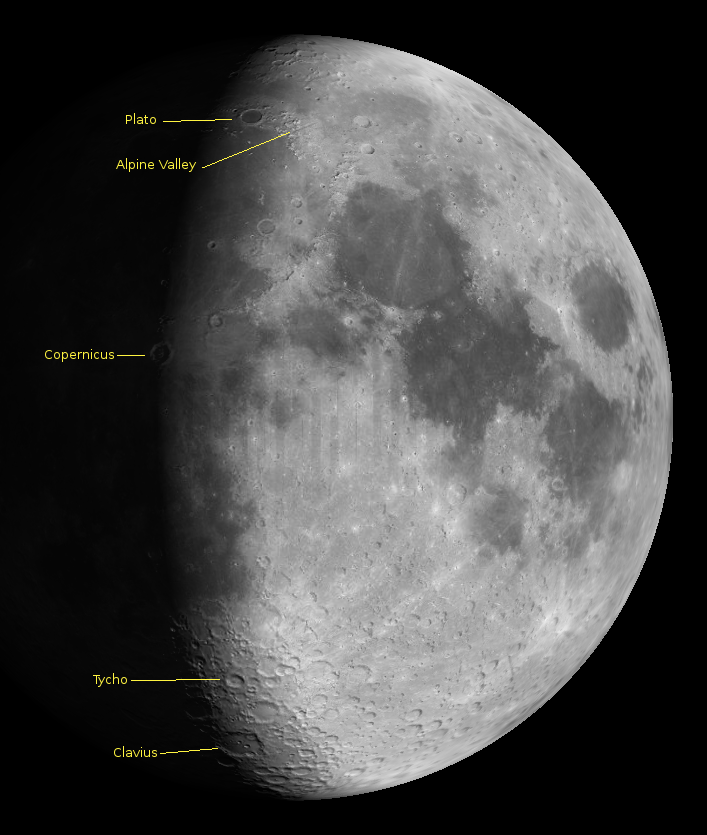
The gibbous Moon one day after first quarter at 9 p.m. October 2, 2014. Created using Virtual Moon Atlas.
10/01/2014 – Ephemeris – Let’s start off the month with a look at the bright planets
Ephemeris for Wednesday, October 1st. The sun will rise at 7:40. It’ll be up for 11 hours and 42 minutes, setting at 7:23. The moon, at first quarter today, will set at 12:43 tomorrow morning.
Let’s check out the bright planets for this week. Mars and Saturn are in the southwestern sky at 8:30 p.m. with Mars above the equally bright and red star Antares with Saturn a ways right of them and as high in the sky as Antares. Saturn will set at 9:16 p.m. Mars is in the constellation of Ophiuchus as astronomers draw constellation boundaries, though it looks to be in Scorpius. Mars will set at 10:04. In the morning sky brilliant Jupiter will rise in the east-northeast at 3:02 a.m. Venus will rise about a half hour before the sun, so it will not be visible. On the 25th of this month Venus will be in superior conjunction with the sun, that is it will move behind the sun, and will then enter the evening sky.
Times are for the Traverse City/Interlochen area of Michigan. They may be different for your location.
Addendum
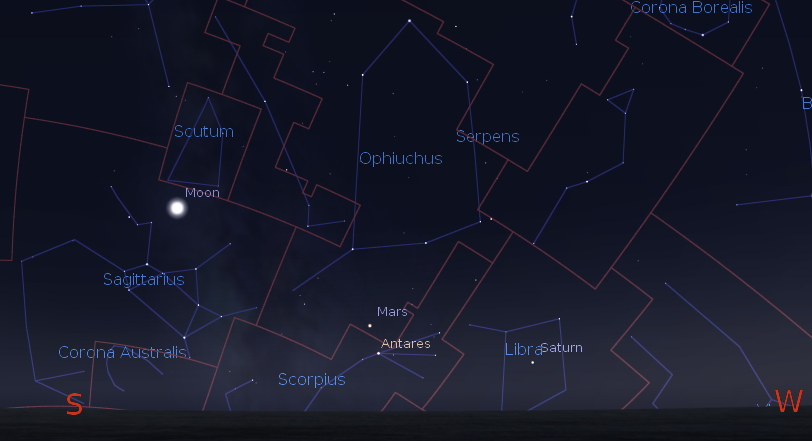
Saturn and Mars with the evening constellations, showing constellation boundaries in red at 8:30 p.m. on October 1, 2014. Created using Stellarium.
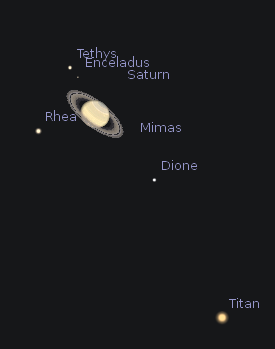
Saturn through a telescope. Of the satellites only Titan should be visible with Saturn so low in the sky at 8:30 p.m. Created using Stellarium.
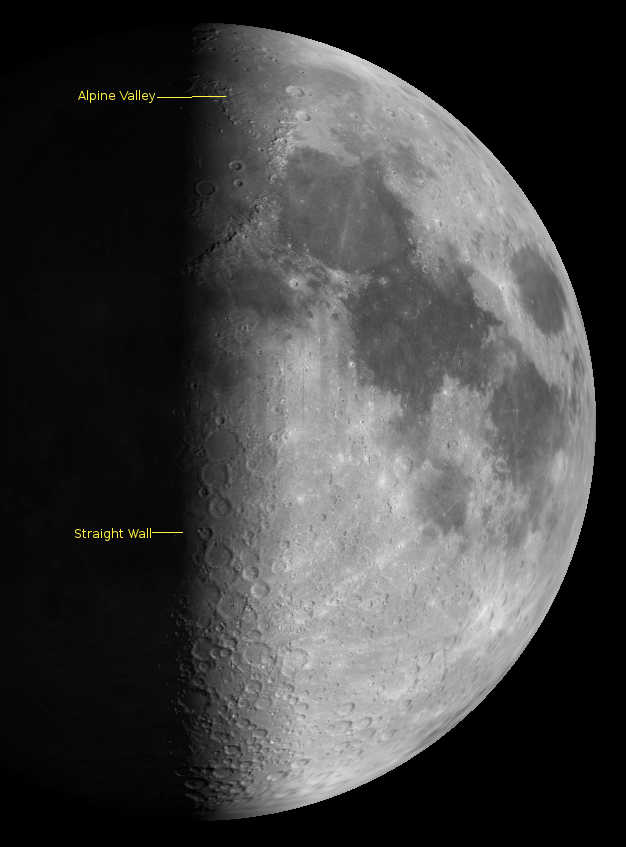
The first quarter Moon tonight at 8:30 p.m. with some interesting locations. Created using Virtual Moon Atlas.
Points of interest on the moon tonight:
- Alpine Valley – This is a fault valley some 79 miles (130 km) long and 7 miles (11 km) wide through the lunar Alps.
- Straight Wall – This is a fault that runs north-south on the moon and is only seen either one day after first quarter or one day after last quarter. It is 67 miles (110 km) long and 900 feet (300 meters) high. But instead of being a wall, it has only a 7 degree slope, which explains its brief appearance. Tonight it will cast a shadow. One day after last quarter the sun will shine directly on the slope, which is covered by lighter material and will show as a bright line.
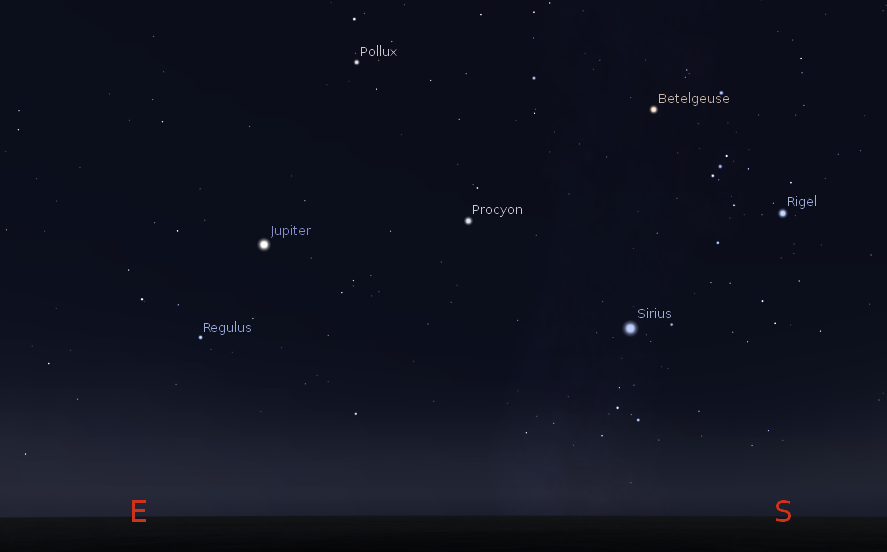
Jupiter and the winter stars at 6:30 a.m. on October 2, 2014. Created using Stellarium.
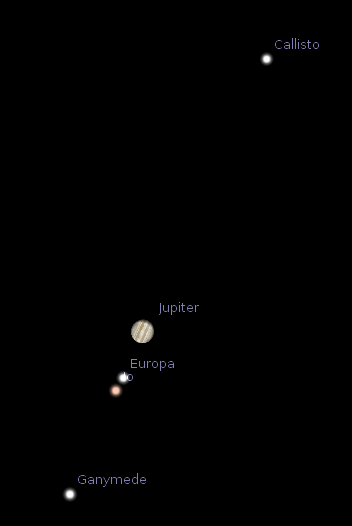
Jupiter and its satellites as seen through a telescope at 6:30 a.m. October 2, 2014. Created using Stellarium.
09/30/2014 – Ephemeris – Previewing October skies and events
Ephemeris for Tuesday, September 30th. The sun will rise at 7:39. It’ll be up for 11 hours and 45 minutes, setting at 7:24. The moon, 1 day before first quarter, will set at 11:43 this evening.
Let’s look at the skies for the month of October. The sun will still be moving south rapidly. Daylight hours in the Interlochen/Traverse City area and will drop from 11 hours and 42 minutes tomorrow to 10 hours, 14 minutes at month’s end. The altitude of the sun above the southern horizon at local noon will be 42 degrees tomorrow in the Interlochen area, and will descend to 31 degrees on Halloween. This month will see two eclipses visible from our area plus a close encounter that a comet will have near Mars and our assets on and around Mars. We will be able to see, weather permitting a total lunar eclipse in the morning a week from today, the 8th and a partial solar eclipse on the 23rd, just before sunset.
Times are for the Traverse City/Interlochen area of Michigan. They may be different for your location.
Addendum
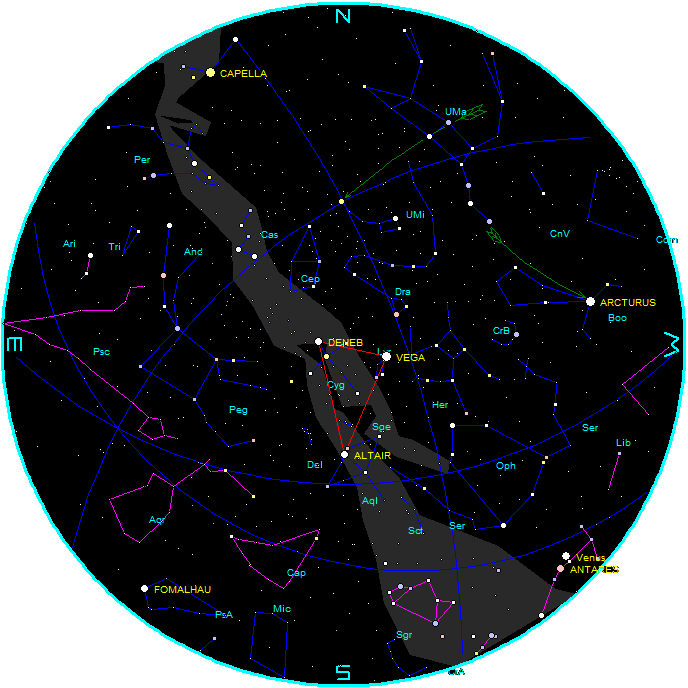
Star Chart for October 2014. Created using my LookingUp program.
The Moon is not plotted. The planets and stars are plotted for the 15th at 8 p.m. That is chart time.
Astronomical twilight ends at 9:00 p.m. on October 1st, decreasing to 8:11 on the 31st.
Add a half hour to the chart time every week before the 15th and subtract and hour for every week after the 15th.
For a list of constellation names to go with the abbreviations click here.
Also shown is the Summer Triangle in red. Clockwise from the top star is Deneb in Cygnus, Vega in Lyra and Altair in Aquila.
The green pointers from the Big Dipper are:
- Pointer stars at the front of the bowl of the Big Dipper point to Polaris the North Star.
- The arc of the dipper’s handle points to Arcturus.
Information on the total lunar eclipse on the 8th will be posted starting Monday October 6th.
09/29/2014 – Ephemeris – The Moon, Mars and Antares will line up tonight
Ephemeris for Monday, September 29th. The sun will rise at 7:37. It’ll be up for 11 hours and 48 minutes, setting at 7:26. The moon, 2 days before first quarter, will set at 10:49 this evening.
Tonight we’ll still have Mars hanging around the star Antares. However we’ll have the Moon joining the party. The three will nearly be in line at 9 p.m. with the fat crescent Moon on top, Mars below it and Antares below Mars. They will be in a straighter line but the Sun out makes them impossible to see. With binoculars or a small telescope the lunar seas visible, kind of in order from the Moon’s sunlit edge are Crises, Fertility, Nectar, Tranquility and half of Serenity. If you’re looking for the Man in the Moon, you’ll have to wait until the Moon is nearly full to completely discern his face. However most of the upside down rabbit is visible. The seas of Fertility and Nectar make up his ears, Tranquility, his head, and Serenity his body.
Times are for the Traverse City/Interlochen area of Michigan. They may be different for your location.
Addendum
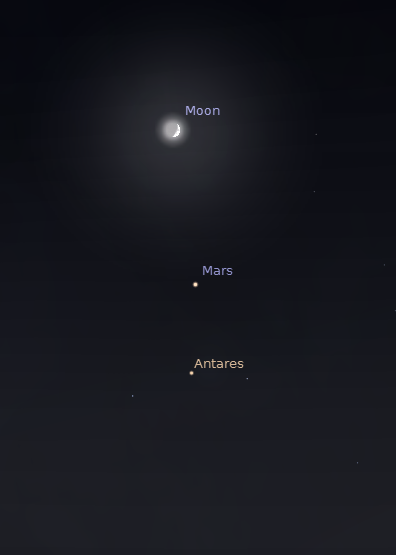
The Moon, Mars and the bright red star Antares line up on the evening of September 29, 2014. Created using Stellarium.
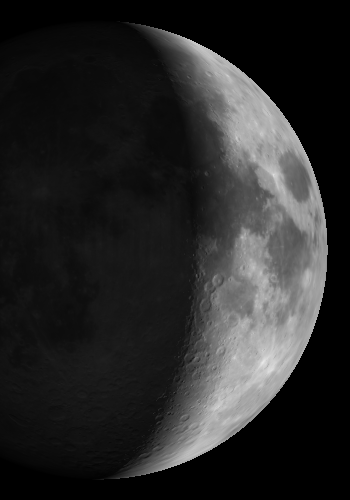
The moon tonight September 29, 2014. Created using Virtual Moon Atlas.
09/26/2014 – Ephemeris – Mars meets its rival
Ephemeris for Friday, September 26th. The sun will rise at 7:34. It’ll be up for 11 hours and 58 minutes, setting at 7:32. The moon, 2 days past new, will set at 8:45 this evening.
The planet Mars and the bright star Antares will appear at their closest tomorrow night. The name of the star Antares means “Rival of Mars”. “Ant” meaning anti, “Ares”, the Greek equivalent to the Roman god Mars. This is about a 26 month recurrence, give or take. Usually Mars is way brighter than Antares, or way dimmer. This time Mars and Antares are the same brightness. Both planet and star have the same color, kind of a faded orange color, made redder by being low in our sky which drains even more of the blue out. The reason Mars is red is that its surface is rusty. Antares is another matter. It is a cool red giant star. Well, cool on the outside by hotter than the sun’s interior on the inside where it’s changing helium into carbon and oxygen for power. Hint: Mars is always on top. Also tomorrow night the crescent Moon will be just to the right of Saturn.
Times are for the Traverse City/Interlochen area of Michigan. They may be different for your location.
Addenda
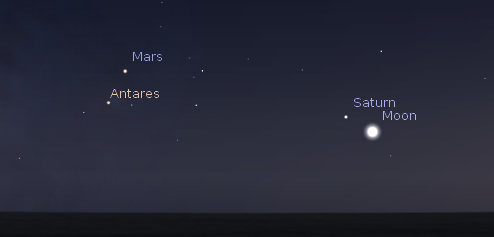
Mars appears its closest to Antares. Here seen low in the southwest at 8:30 p.m. on September 27, 2014. The Moon, near Saturn is too small to show a phase. Created using Stellarium.
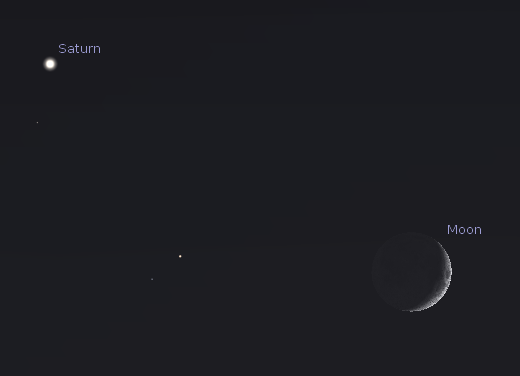
Saturn with the crescent moon. Earthshine may still be visible on the three day old Moon’s night side. Created using Stellarium.
Acme Fall Festival
The Grand Traverse Astronomical Society will be at the Acme Fall Festival at Flintfields Horse Park on Bates Rd, North of M72, which runs from 10 a.m. to 4 p.m. Saturday the 27th. The society will bring telescopes, including the 25 inch Dobsonian telescope and the Solar Telescope to view the Sun in white light and the light of the element hydrogen. There will also be exhibits and free stuff from NASA for the kids.
09/25/2014 – Ephemeris – Capella rising
Ephemeris for Thursday, September 25th. The sun will rise at 7:33. It’ll be up for 12 hours and 1 minute, setting at 7:34. The moon, 1 day past new, will set at 8:13 this evening.
A bright star called Capella has slowly been rising in the northeastern sky in the evenings for the past few months. At 9 p.m. now it is low in the north-northeast far below the letter “W” shaped constellation of Cassiopeia. This winter Capella will be overhead the highest of winter’s seven brilliant first magnitude stars. Capella never quite sets for anyone north of Ludington. It is what is called a circumpolar star. Due to its brightness, and being the closest first magnitude star to the north pole, Capella appears to move slowly as the earth rotates, and spends summer and autumn evenings close to the horizon, and has in years past elicited a few phone calls and other queries about that ‘bright object in the northeast’. When it’s higher the rest of its constellation Auriga the Charioteer will be visible.
Times are for the Traverse City/Interlochen area of Michigan. They may be different for your location.
Addendum
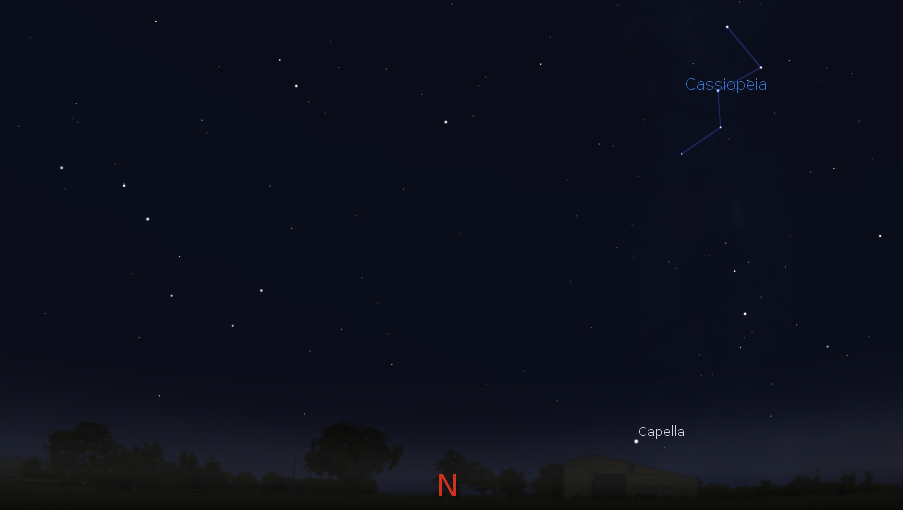
Capella cruising up from the north (thanks to the Earth’s rotation) on September 25 at 9 p.m. Created using Stellarium.
09/24/2014 – Ephemeris – Where are the bright planets this week?
Ephemeris for Wednesday, September 24th. The sun will rise at 7:31. It’ll be up for 12 hours and 4 minutes, setting at 7:36. The moon is new today, and won’t be visible.
Let’s take our weekly look at the bright planets. Mars and Saturn are in the southwestern sky at 9 p.m. with Saturn to the right and a bit below Mars by 17 degrees, about the two widths of your fist held at arm’s length. Saturn will set at 9:38 p.m. Saturn is in Libra, while Mars is in Scorpius. Mars is closing in on a star that has the identical color, and this year the same brightness, its rival Antares. Indeed that’s what the star’s name means: Ant as in anti, Ares the Greek god of war, and the counterpart of the Roman Mars. They will be closest Saturday. Mars will set at 10:13.. In the morning sky brilliant Jupiter will rise in the east-northeast at 3:23 a.m., while Venus, will rise in the east at 6:51 a.m. only 42 minutes before the sun. I’m not sure you’ll see it.
Times are for the Traverse City/Interlochen area of Michigan. They may be different for your location.
Addendum
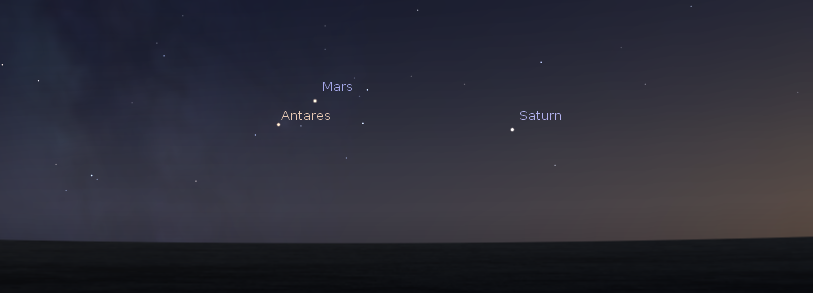
Saturn with Mars approaching Antares low in the southwest at 8:30 p.m. on September 24, 2014. Created using Stellarium.
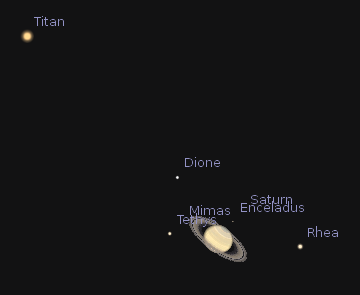
Saturn in a telescope on September 24, 2014. Of the satellites, only Titan should be visible. Created using Stellarium.
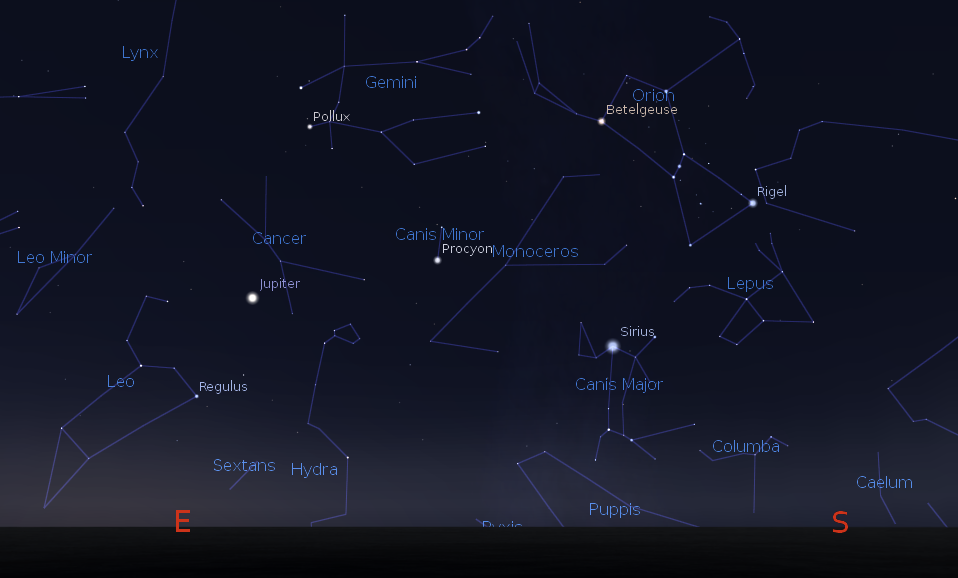
Jupiter and the winter and the western most spring constellations at 6:30 a.m. on September 25, 2014. Created using Stellarium.
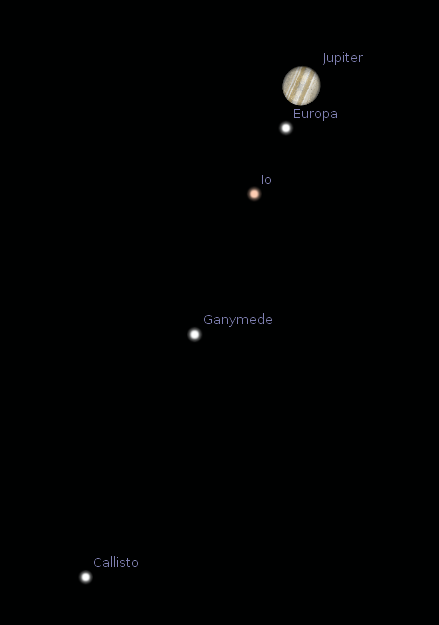
Jupiter and its moon through a telescope at 6:30 a.m. on September 25, 2014. Created using Stellarium.
09/23/2014 – Ephemeris – NASA’s MAVEN satellite is in orbit of Mars
Ephemeris for Tuesday, September 23rd. The sun will rise at 7:30. It’ll be up for 12 hours and 7 minutes, setting at 7:37. The moon, 1 day before new, will rise at 7:53 tomorrow morning.
Last Sunday evening the MAVEN spacecraft fired its six main engines in alternating pairs for 33 minutes and was captured by Mars, entering orbit around the Red Planet. MAVEN is one of those NASA acronyms, it stands for Mars Atmospheric and Volatile EvolutioN Once in a capture orbit, the orbit will be changed from a 33 hour orbit to a 4 ½ hour a science orbit. It will investigate how Mars lost its original atmosphere which was dense enough to support liquid water to the thin carbon dioxide atmosphere it has today. It has several duties October 19th when Comet Siding Spring passes Mars to detect the interaction of the comet’s atmosphere with that of Mars. There are no cameras* on Maven, just hard data will be returned.
Times are for the Traverse City/Interlochen area of Michigan. They may be different for your location.
Addendum
* Actually I was mistaken. There is an Imaging Ultraviolet Spectrograph aboard which will take images in the ultraviolet of Mars upper atmosphere.
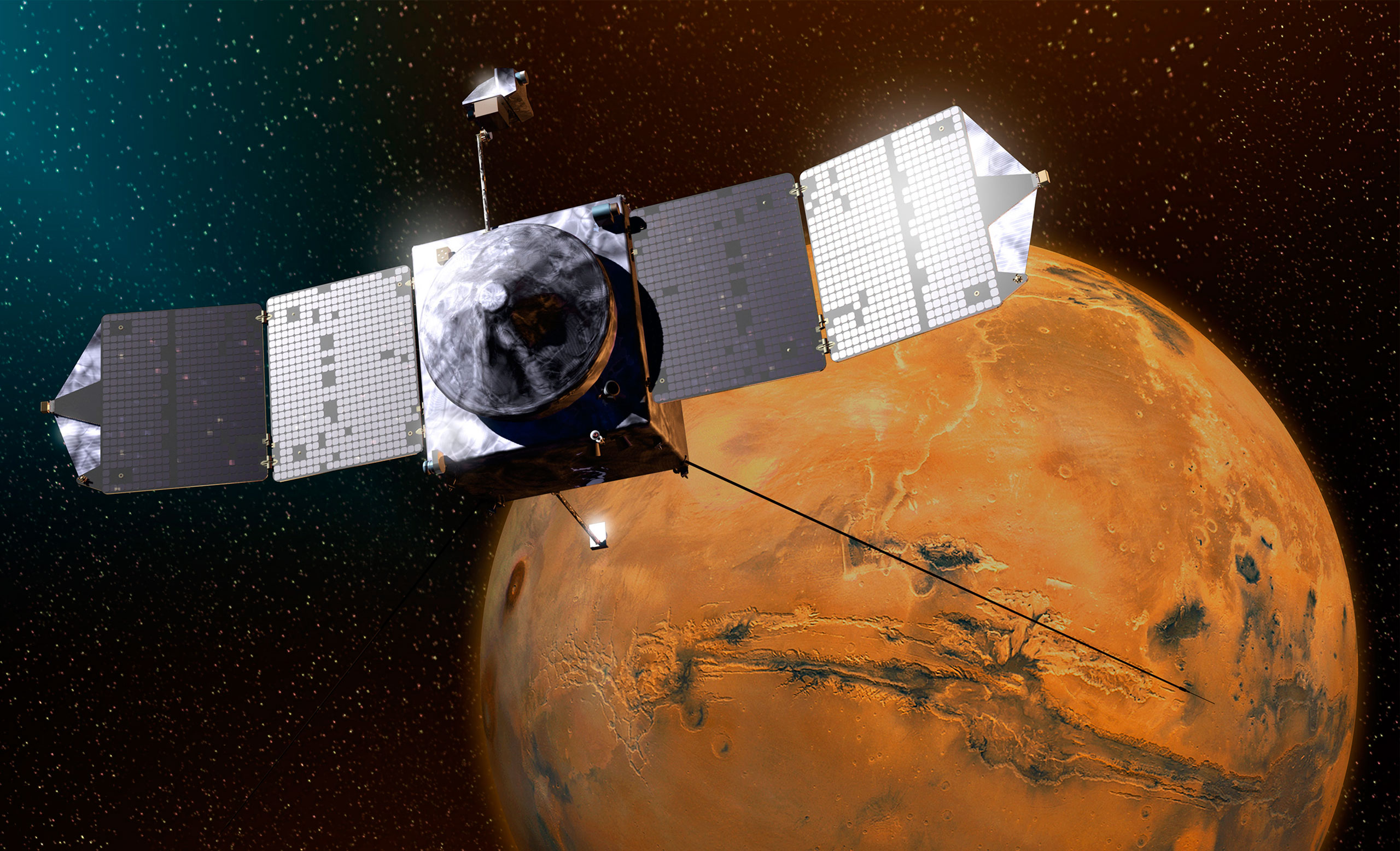
Artist’s rendition of the MAVEN spacecraft in Mars Orbit. Credit: Lockheed Martin/NASA.
09/22/2014 – Epmemeris – Autumn begins tonight
Ephemeris for Monday, September 22nd. The sun will rise at 7:29. It’ll be up for 12 hours and 10 minutes, setting at 7:39. The moon, 2 days before new, will rise at 6:54 tomorrow morning.
Welcome to the last, almost full, day of summer. The Sun will reach the autumnal equinox point in the sky at 10:30 this evening. At that moment the Sun will cross the celestial equator, a projection of the Earth’s equator, heading southward. All locations on the earth except two will experience 12 hours of daylight and 12 hours of night. Well they would if the Earth didn’t have an atmosphere and sunset and sunrise were defined differently. The two locations that don’t experience equal night, which is what equinox means, are the north pole where the sun will be setting and the south pole where the sun will be rising. For us in the northern hemisphere daylight hours will be shorter and the Sun will peak lower in the south each day until the December solstice.
Times are for the Traverse City/Interlochen area of Michigan. They may be different for your location.
Addendum

The Earth as seen from the direction of the Sun as it crosses over the Earth’s equator heading south. Created using Celestia.

