Archive
10/05/2012 – Ephemeris – Tonight’s astronomical events in Traverse City
Ephemeris for Wednesday, October 3rd. The sun will rise at 7:43. It’ll be up for 11 hours and 35 minutes, setting at 7:18. The moon, 4 days past full, will rise at 8:59 this evening.
Let’s see how many bright planets we can find this week. Mars and Saturn now set too close to the sun to be easily seen in the evening sky. Both are in the west southwestern sky and very low in twilight. Saturn sets at 8:10 p.m., while Mars sets at 9:08. The planetary action moves to later in the evening and the morning. Jupiter, will rise at 10:09 p.m. in the east northeast. It is located in the constellation of Taurus. The last bright planet of the night is the morning star Venus which will rise at 4:13 a.m. also in the east northeast. Venus is now in Leo outshining the star Regulus next to it. The planets Venus and Jupiter and the winter constellations are a great sight for early risers. You can enjoy them without danger of frost bite.
Times are for the Traverse City/Interlochen area of Michigan. They may be different for your location.
Addendum
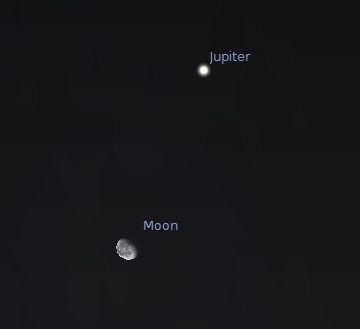
Jupiter and the waning gibbous moon at 11 p.m. October 5, 2012. Created using Stellarium.
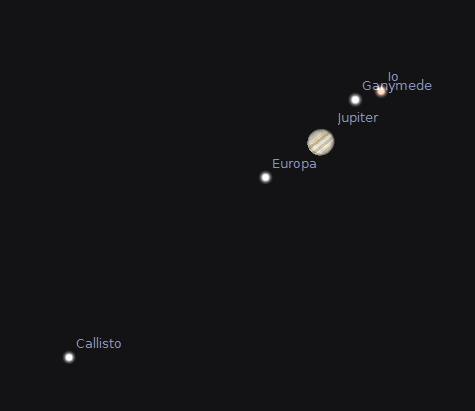
Jupiter with its moons at 11 p.m. October 5, 2012. Created using Stellarium. Stellarium shows the moons much brighter than they actually appear. compared to Jupiter.
10/04/2012 – Ephemeris – The lonely autumn star Fomalhaut
Ephemeris for Thursday, October 4th. The sun will rise at 7:44. It’ll be up for 11 hours and 32 minutes, setting at 7:16. The moon, 4 days before last quarter, will rise at 9:40 this evening.
There’s a bright star that appears for only seven and a half hours on autumn evenings. It’s appearance, low in the southeast at 10 p.m., is a clear indication of the autumn season. The star’s name is Fomalhaut, which means fish’s mouth. That’s fitting because it’s in the constellation of Piscis Austrinus, the southern fish. At our latitude it’s kind of the fish that got away, because Fomalhaut appears to be quite alone low in the sky. The dimness of the constellation’s other stars and location close to the horizon make the faint stars hard to spot. The earth’s thick atmosphere near the horizon reduces their brightness by a factor of two or more, so Fomalhaut, one of the brightest stars in the sky, keeps a lonely vigil in the south.
Times are for the Traverse City/Interlochen area of Michigan. They may be different for your location.
Addendum
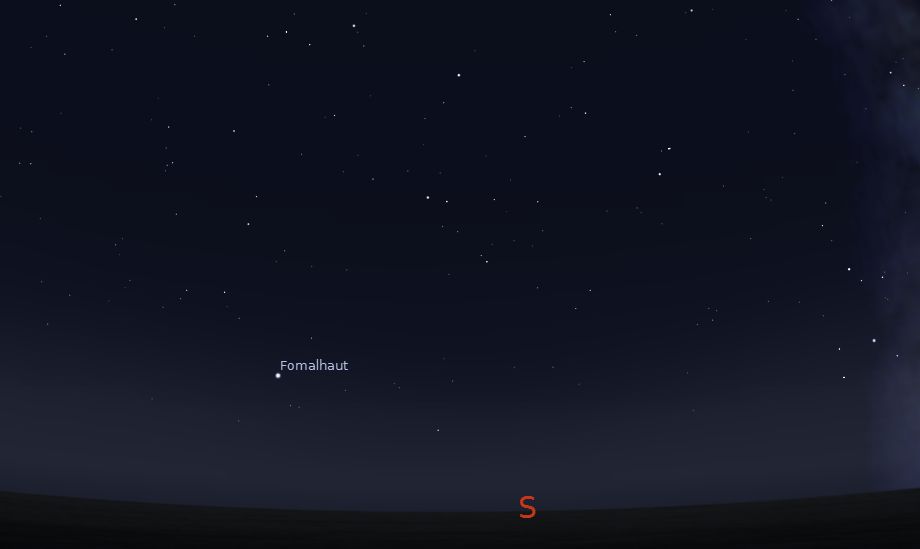
The bright star Fomalhaut all alone at 10 p.m. on October 4, 2012. Created using Stellarium.
Click image to enlarge.
10/03/2012 – Ephemeris – Where are the bright planets this week?
Wednesday, October 3rd. The sun will rise at 7:43. It’ll be up for 11 hours and 35 minutes, setting at 7:18. The moon, 4 days past full, will rise at 8:59 this evening.
Let’s see how many bright planets we can find this week. Mars and Saturn now set too close to the sun to be easily seen in the evening sky. Both are in the west southwestern sky and very low in twilight. Saturn sets at 8:10 p.m., while Mars sets at 9:08. The planetary action moves to later in the evening and the morning. Jupiter, will rise at 10:09 p.m. in the east northeast. It is located in the constellation of Taurus. The last bright planet of the night is the morning star Venus which will rise at 4:13 a.m. also in the east northeast. Venus is now in Leo outshining the star Regulus next to it. The planets Venus and Jupiter and the winter constellations are a great sight for early risers. You can enjoy them without danger of frost bite.
Times are for the Traverse City/Interlochen area of Michigan. They may be different for your location.
Addendum
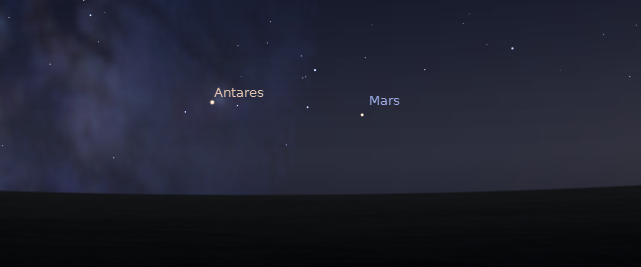
Mars and Antares low in the southwest at 8:20 p.m. on October 3, 2012. Created using Stellarium.
Mars is moving towards Antares, whose name means Rival of Mars. They have the same color. Mars, though will be dimmed and will pass north of the red giant star.
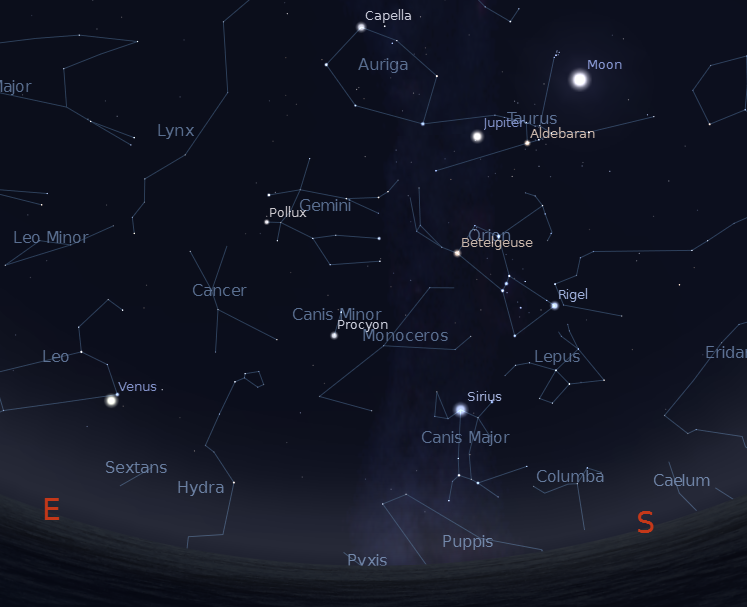
Morning skies including Jupiter and Venus at 6 a.m. on October 4, 2012. Created using Stellarium.
Click on the image to enlarge.
10/02/2012 – Ephemeris – Two bright comets next year, maybe?
Ephemeris for Tuesday, October 2nd. The sun will rise at 7:42. It’ll be up for 11 hours and 38 minutes, setting at 7:20. The moon, 3 days past full, will rise at 8:23 this evening.
It looks like we’ll have possibly two comets to grace our skies next year. These are first time comets and there is trouble with predicting their brightness. We can make a guess when we see them far from the sun, but that doesn’t always pan out. The first comet to be seen will be Comet 201l L4, named PANSTARRS. It will reach its closest to the sun on April 17th. It was discovered with the Pan-STARRS telescope in Haleakala, Hawaii. It could optimistically be as bright as the star Vega. The second was Comet 2012 S1 ISON (I hope that’s how it’s pronounced) discovered on September 21st, 10 days ago. This comet has the added problem. On November 29th, 2013 it will pass a million miles from the center of the sun, and may not survive.
Times are for the Traverse City/Interlochen area of Michigan. They may be different for your location.
Addendum
Here’s some information on these comets from Gary Kronk’s Cometography: http://cometography.com/current_comets.html
10-01-2012 – Ephemeris – Previewing October daylight changes
Ephemeris for Monday, October 1st. The sun will rise at 7:40. It’ll be up for 11 hours and 41 minutes, setting at 7:22. The moon, 2 days past full, will rise at 7:51 this evening. | Let’s look at the skies for the month of October. The sun will still be moving south rapidly. Daylight hours in the Interlochen/Traverse City area and will drop from 11 hours and 41 minutes today to 10 hours, 12 minutes at months end.. The altitude of the sun above the southern horizon at local noon will be 42 degrees today, and will descend to 31degrees on Halloween, also in the Interlochen area. The Straits area will have the sun a degree lower. Local noon, when the sun is due south will be about 1:30 p.m. in Interlochen. Sunrise times will increase all the way to 8:19 a.m. in Interlochen on the 31st. Sunset times will decrease from 7:22 p.m. today to 6:32 when the trick or treaters haunt our neighborhoods.
Times are for the Traverse City/Interlochen area of Michigan. They may be different for your location.
09/28/2012 – Ephemeris – Harvest moon tomorrow
Ephemeris for Friday, September 28th. The sun will rise at 7:37. It’ll be up for 11 hours and 50 minutes, setting at 7:27. The moon, 1 day before full, will set at 7:10 tomorrow morning.
Tomorrow is the Harvest Moon, the nearest full moon to the autumnal equinox. Here the path of the moon in the sky against the stars is shallow causing the moon to rise only a little later each night. Back before electricity was available to farms this gave extra time for farmers to gather in their crops each day. This effect lasts for a bit less than a week both before and after the full moon. We astronomers aren’t big fans of the effect because the sky stays bright longer and masks the faint things they want to see. Not all astronomers are bummed by bright moonlight. There’s plenty to study when the moon is out: planets and reasonably bright stars. It’s just that the fainter objects are lost.
Times are for the Traverse City/Interlochen area of Michigan. They may be different for your location.
Addendum
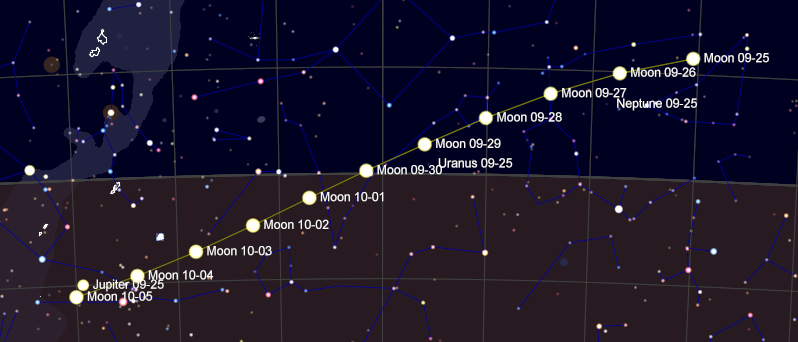
Shallow path of the moon for 11 nights centered on the Harvest Moon in 2012. Created using Cartes duCiel (Sky Charts).
Click on the image to enlarge.
09/27/2012 – Ephemeris – The Fisher in the stars
Ephemeris for Thursday, September 27th. The sun will rise at 7:36. It’ll be up for 11 hours and 53 minutes, setting at 7:29. The moon, 2 days before full, will set at 6:06 tomorrow morning.
The Big Dipper is swooping low in the northwestern sky in the evening now. The Big Dipper is not a constellation but part of the Great Bear for most peoples, and is enshrined by the International Astronomical Union as Ursa Major. To some of the Anishinabek peoples native to our region the stars of the Big Dipper belonged to a small weasel like animal call the Fisher. In a story I can’t relate here Fisher brought summer to the earth, and for his trouble was killed by an arrow to his only vulnerable spot, his tail. The Great Spirit would not let Fisher fall to earth, but placed him in the sky. His rising in the northeast signals the coming of spring, and when his bloody tail brushes the horizon in autumn his blood paints the maple trees red.
Times are for the Traverse City/Interlochen area of Michigan. They may be different for your location.
Addendum
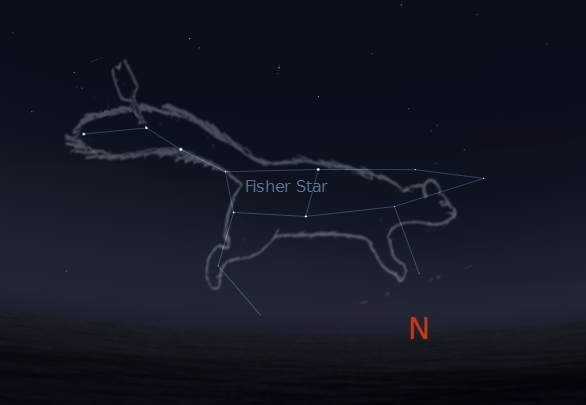
The Fisher heads towards the northern horizon. Created using Stellarium and an unknown artist which I took liberties with.
The Fisher is also known as the Fisher Star (Ojiig’anung). I’ll have my version of the story posted soon.
The Fisher heads towards the northern horizon. Created using Stellarium and an unknown artist which I took liberties with.
09/26/2012 – Ephemeris – Where are the bright planets this week
Ephemeris for Wednesday, September 26th. The sun will rise at 7:34. It’ll be up for 11 hours and 56 minutes, setting at 7:31. The moon, 3 days before full, will set at 5:00 tomorrow morning.
Let’s see how many bright planets we can find this week. Mars and Saturn now set too close to the sun to be easily seen in the evening sky. Both are in the west southwestern sky and very low in twilight. Saturn sets at 8:36 p.m., while Mars sets at 9:21. The planetary action moves to later in the evening and the morning. Jupiter, will rise at 10:40 p.m. in the east northeast. It is located in the constellation of Taurus. The last bright planet of the night is the morning star Venus which will rise at 3:56 a.m. also in the east northeast. Venus is now moving between Cancer and Leo. The planets Venus and Jupiter and the winter constellations are a great sight for early risers. You can enjoy them without danger of frost bite.
Times are for the Traverse City/Interlochen area of Michigan. They may be different for your location.
Addendum
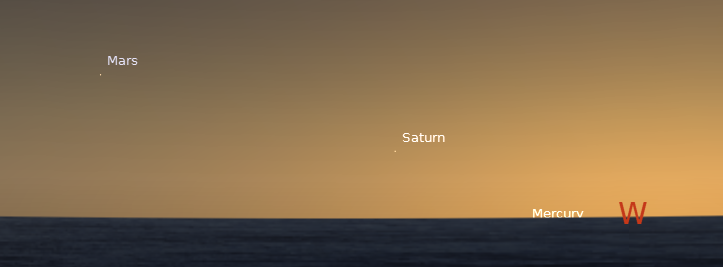
Mars and Saturn low in twilight September 26, 2012 8 p.m. Created using Stellarium.
Note that Mercury has already set.
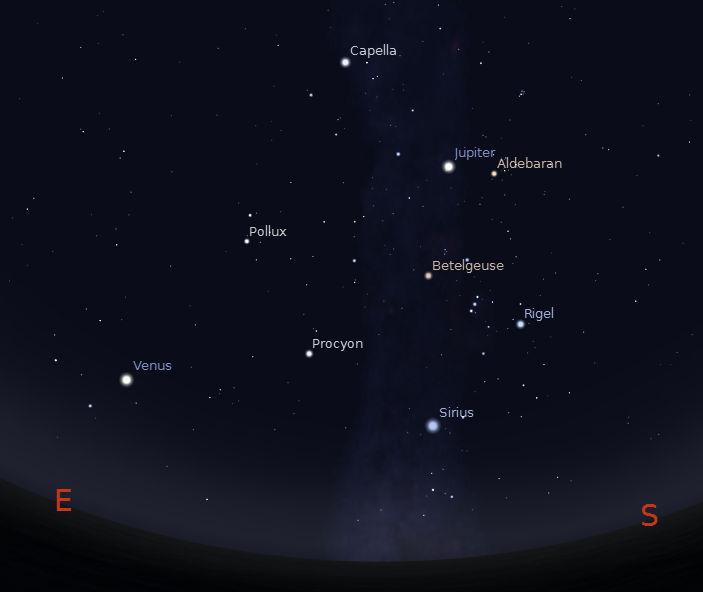
The winter stars in the morning with Jupiter and Venus on September 27, 2012 at 6 a.m. Created using Stellarium.
09/25/2012 – Ephemeris – Sinus Iridium greets the sun
Ephemeris for Tuesday, September 25th. The sun will rise at 7:33. It’ll be up for 11 hours and 59 minutes, setting at 7:33. The moon, 3 days past first quarter, will set at 3:53 tomorrow morning.
Lets look at the moon again tonight. One of my favorite formations is coming into light it is called Sinus Iridium or Bay of Rainbows. Sorry there’s no color here. But if caught at right time this ruined crater will appear as a hook out into night off the upper left edge of the moon. Officially its a bay to the Sea of Showers or Mare Imbrium. The north edge of the bay are mountains called the Jura Mountains. The south edge disappears into Mare Imbrium. The floor of the Sinus Iridium is about twelve hundred feet lower than Imbrium. The transition is gradual because it isn’t very noticeable. The formation is large enough to be seen in binoculars. Sinus Iridium is 242 miles wide, a good tenth the diameter of the moon itself.
Times are for the Traverse City/Interlochen area of Michigan. They may be different for your location.
Addendum
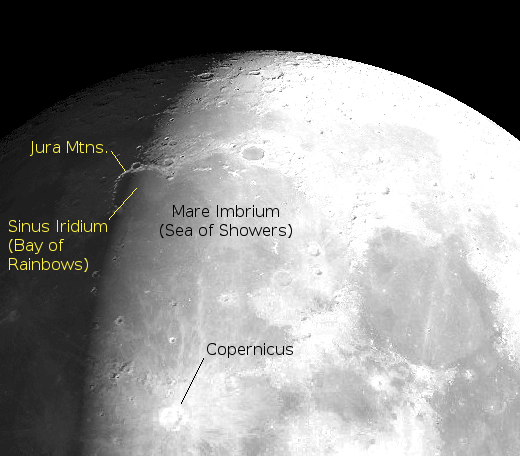
Bay of Rainbows and the crater Copernicus. Created using Virtual Moon Atlas.
09/24/2012 – Ephemeris – The lunar crater Copernicus
Ephemeris for Monday, September 24th. The sun will rise at 7:32. It’ll be up for 12 hours and 2 minutes, setting at 7:35. The moon, 2 days past first quarter, will set at 2:44 tomorrow morning.
Since the International Observe the Moon Night was cloudy in our area if its clear tonight there are still great views of the moon. You’re on your own, so dig out those binoculars and dust off that telescope for a great view of the moon. The sun will have risen on one of the great craters Copernicus. It’s near the terminator, the sunrise line on the moon on the left, close to half way from north to south. Copernicus was named for the Polish astronomer who put forth the heliocentric solar system in the 16th century. The crater is 56 miles in diameter with a vaguely hexagonal form and two miles deep. It has terraced walls and three central peaks. It may look deeper than that due to the low sun angle exaggerating its depth.
Times are for the Traverse City/Interlochen area of Michigan. They may be different for your location.
Addendum
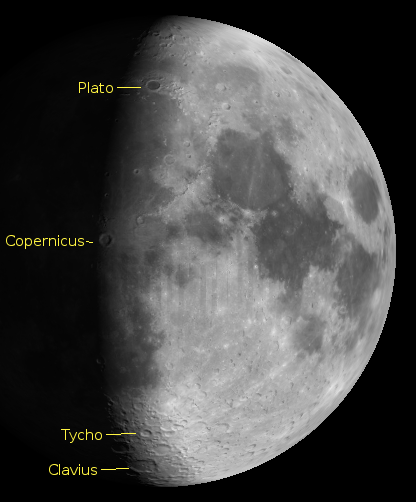
The moon on showing Copernicus and other large craters on the terminator. Created using Virtual Moon Atlas.
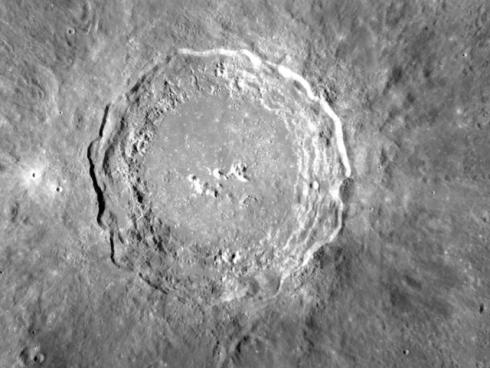
The crater Copernicus. Credit: NASA/GSFC/Arizona State University.

