Archive
09/07/2012 – Ephemeris – Star Parties in the Grand Traverse Region this weekend
Ephemeris for Friday, September 7th. The sun will rise at 7:12. It’ll be up for 12 hours and 54 minutes, setting at 8:07. The moon, 1 day before last quarter, will rise at 11:44 this evening.
This evening the Grand Traverse Astronomical Society will hold its monthly meeting at Northwestern Michigan College’s Rogers Observatory at 8 p.m.. On tap will be viewing the amazing videos of the sun by the Solar Dynamics Observatory and other satellites. A star party will begin at 9 p.m. at the observatory, running til 11 p.m. There will be an alternate program if it’s cloudy. Saturday night the will be a star party at Sleeping Bear Dunes National Lakeshore. That will star around 8 p.m. and last til 10 p.m. It will take place at the Dune Climb parking lot off highway M109 south of Glen Haven. Both if these star parties will feature the wonders of the summer Milky Way.
Times are for the Traverse City/Interlochen area of Michigan. They may be different for your location.
09/06/2012 – Ephemeris – Cassiopeia the queen
Ephemeris for Thursday, September 6th. The sun will rise at 7:11. It’ll be up for 12 hours and 57 minutes, setting at 8:08. The moon, 2 days before last quarter, will rise at 11:01 this evening.
The constellation Cassiopeia looks like the letter W in the northeastern sky at 10 p.m. My mother taught it to me as my grandfather taught her as the Flying W. Cassiopeia represents a queen of Ethiopia in a grand story that has had at least a couple of movies made as the Clash of the Titans. A dim star above the middle star makes the constellation in to a crooked backed chair. Cassiopeia is circumpolar in Michigan since it is near the north pole of the sky. It revolves around and around the pole star Polaris. In late autumn it’s overhead, in the spring its low in the northwest and in early summer it’s scraping the northern horizon.
Times are for the Traverse City/Interlochen area of Michigan. They may be different for your location.
Addendum
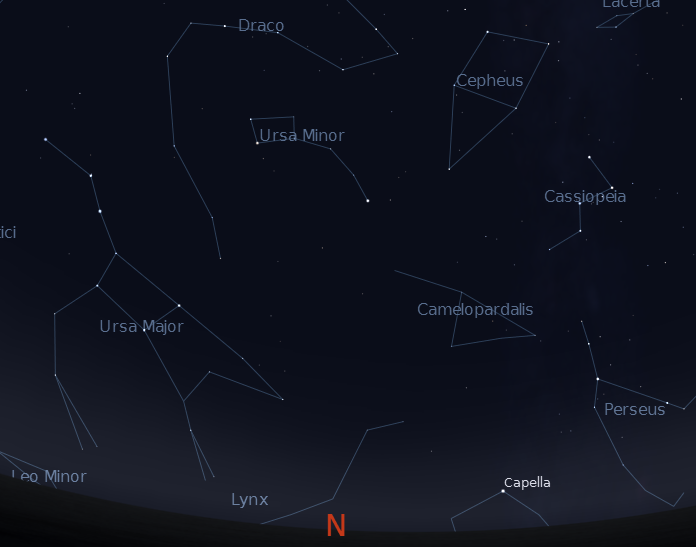
Cassiopeia and the other circumpolar constellations. Created using Stellarium.
09/05/2012 – Ephemeris – Where are the bright planets this week?
Ephemeris for Wednesday, September 5th. The sun will rise at 7:10. It’ll be up for 13 hours exactly, setting at 8:10. The moon, 3 days before last quarter, will rise at 10:24 this evening.
Let’s see how many bright planets we can find this week. Mars, Saturn and the star Spica make an elongated triangle in the west southwest in twilight after sunset. Mars is on the left with Saturn on the upper right and Spica below. Spica will set first at 9:24 followed by Saturn at 9:57 and Mars at 10:07. This will be about the last week you’ll see Saturn and Spica in the evening until next year.. The morning sky features the two brightest planets: Jupiter, which will rise at 11:54 p.m. in the east northeast and Venus, which will rise at 3:23 a.m. also in the east northeast. Jupiter is near the head of Taurus the bull, while Venus is moving between Gemini and Cancer.
Times are for the Traverse City/Interlochen area of Michigan. They may be different for your location.
Addendum
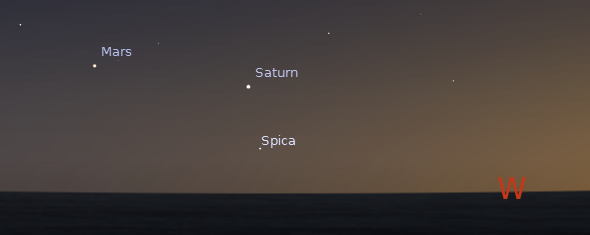
Mars, Saturn and the star Spica at 9 p.m. Created using Stellarium.
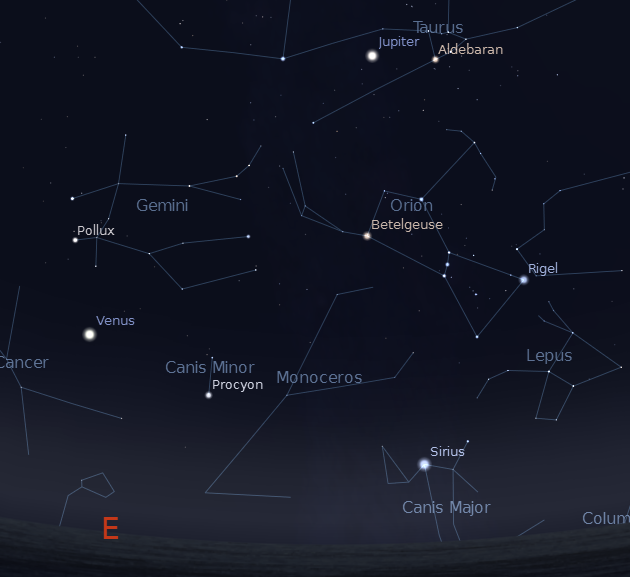
Jupiter, Venus and a preview of the stars and constellations of winter. Created using Stellarium.
09/04/2012 – Ephemeris – The Great Square of Pegasus
Ephemeris for Tuesday, September 4th. The sun will rise at 7:09. It’ll be up for 13 hours and 3 minutes, setting at 8:12. The moon, half way from full to last quarter, will rise at 9:51 this evening.
Rising ever higher in the east at as it gets dark around 9:30 p.m. can be found one of the great autumn constellations: Pegasus the flying horse of Greek myth. Its most visible feature is a large square of four stars, now standing on one corner. This feature, called the Great Square of Pegasus, represents the front part of the horse’s body. The horse is quite aerobatic, because it is seen flying upside down. Remembering that fact, the neck and head is a bent line of stars emanating from the right corner star of the square. Its front legs can be seen in a gallop extending to the upper right from the top star of the square. From the left star extend, not hind legs but the constellation of Andromeda, a fascinating constellation in its own right. We’ll be checking out Andromeda this fall.
Times are for the Traverse City/Interlochen area of Michigan. They may be different for your location.
Addendum
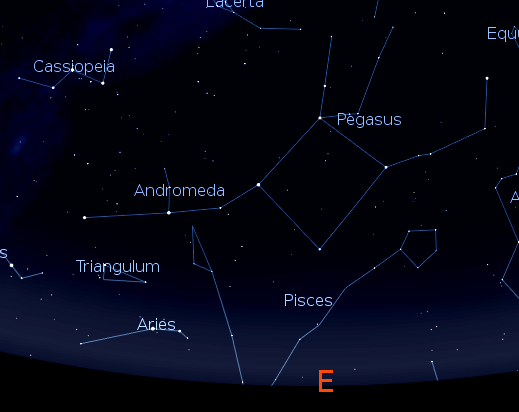
Pegasus at 9 p.m. Chart created using Stellarium.
09/03/2012 – Ephemeris – Almost the Harvest Moon
Ephemeris for Labor Day, Monday, September 3rd. The sun will rise at 7:07. It’ll be up for 13 hours and 6 minutes, setting at 8:14. The moon, 3 days past full, will rise at 9:21 this evening.
Last Friday’s full moon wasn’t the Harvest Moon. That honor is reserved for the closest full moon to the autumnal equinox, which will occur on the 29th. Still we have the same effect of taking quite a few days for the waning gibbous moon to clear the evening twilight. So tonight the moon, some three days past full still rises within an hour and a half of sunset. In the spring the day after full, the moon will rise an hour and a half after sunset. The reason for the slow advance of rise times is that the moon’s path at this time is at a low angle to the eastern horizon, so the moon moves more horizontally than vertically with respect to the horizon each night. On average the moon moves about 26 times its diameter each day in its orbit of the earth.
Times are for the Traverse City/Interlochen area of Michigan. They may be different for your location.
Addendum
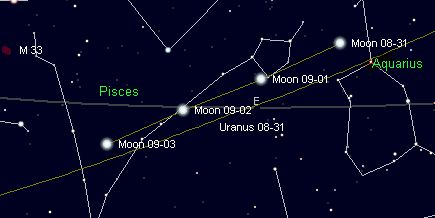
Almost the Harvest Moon Effect over 4 nights. Created using Cartes du Ciel (Sky Charts)
The shallow path of the moon rising from night to night allows the moon to rise much less than the 50 minutes average night to night moonrise interval.
08/31/2012 – Ephemeris – Once in a blue moon
Ephemeris for Friday, August 31st. The sun will rise at 7:04. It’ll be up for 13 hours and 15 minutes, setting at 8:19. The moon, at full today, will rise at 8:01 this evening.
Tonight’s moon has been dubbed by some to be a Blue Moon. No the color of the moon isn’t really blue. But it is as rare as a blue moon. Let me try to explain. Currently the label blue Moon is given to the second full moon in a month. August’s first full moon was on the first. This blue moon rule wasn’t always the case. Early American almanacs apparently gave the title of blue moon to the 4th full moon in a season. So could the moon ever appear blue? Yes it can. If seen through a lot of dust in a dust storm. A totally eclipsed moon can appear very dark and even have a blue tinge if there’s a lot of volcanic ash in the atmosphere. I’ve seen two of these eclipses and the moon didn’t appear blue to my eyes, but it was so dim the I could barely make it out without binoculars.
Times are for the Traverse City/Interlochen area of Michigan. They may be different for your location.
08/30/2012 – Ephemeris – Previewing September skies
Ephemeris for Thursday, August 30th. The sun will rise at 7:03. It’ll be up for 13 hours and 18 minutes, setting at 8:21. The moon, 1 day before full, will set at 7:12 tomorrow morning.
Let’s look ahead at the skies for September a couple of days early. The sun is moving at its greatest speed in its retreat to the south. Daylight hours in the Interlochen/Traverse City area and will drop from 13 hours and 12 minutes Saturday to 11 hours 44 minutes on the 30th. The altitude of the sun above the southern horizon at local noon will be 54 degrees Saturday, and will descend to 42 degrees on the 30th. Folks in the straits area will see the sun a degree lower than that. The official season of summer is getting short too, so enjoy it while you can. Summer ends and autumn begins at 10:49 a.m. on September 22nd. That Harvest Moon will be on the 29th. Tomorrows full moon will be the rare Blue Moon – More on that tomorrow.
Times are for the Traverse City/Interlochen area of Michigan. They may be different for your location.
08/29/2012 – Ephemeris – Where are the bright planets this week?
Ephemeris for Wednesday, August 29th. The sun will rise at 7:02. It’ll be up for 13 hours and 21 minutes, setting at 8:23. The moon, 2 days before full, will set at 6:04 tomorrow morning.
Let’s see what’s happening with the bright planets for this week. Mars Saturn and the star Spica make a bright but elongating triangle in the west southwest after sunset. Mars is on the upper left with Saturn on the upper right and Spica below. They are located in the constellation Virgo the virgin. Saturn will be setting in the west at 10:20 p.m, and Mars will set 3 minutes later. The morning sky features the two brightest planets: Jupiter, which will rise at 12:23 a.m. in the east northeast and Venus, which will rise at 3:16 also in the east northeast. Jupiter is near the head of Taurus the bull, while Venus is moving between Gemini and Cancer. Early morning is a good time to get a preview of winter stars.
Times are for the Traverse City/Interlochen area of Michigan. They may be different for your location.
Addendum
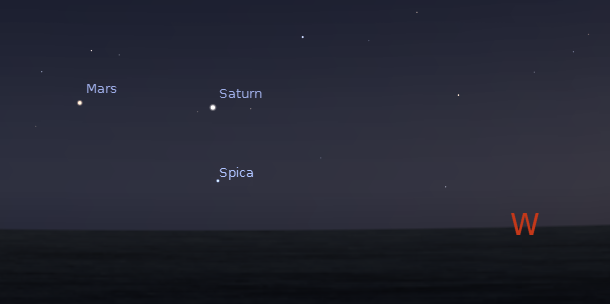
Mars, Saturn and Spica at 9:30 p.m. on August 29, 2012. Created using Stellarium.
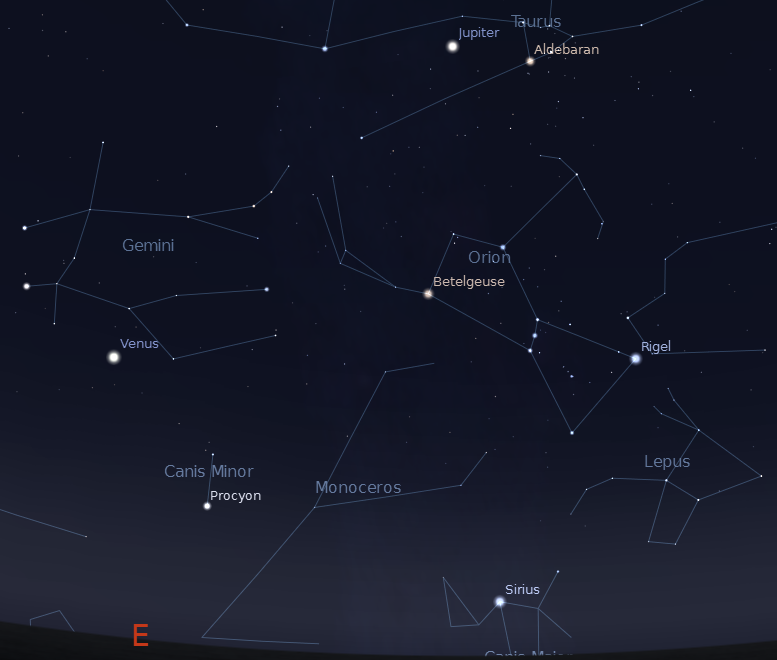
Jupiter, Venus and the stars of winter rising at 5:30 a.m. on August 30, 2012. Created using Stellarium.
08/28/2012 – Ephemeris – Altair, fatter in the middle
Ephemeris for Tuesday, August 28th. The sun will rise at 7:00. It’ll be up for 13 hours and 24 minutes, setting at 8:25. The moon, 3 days before full, will set at 4:54 tomorrow morning.
The southernmost star of the Summer Triangle is Altair, high in the south. The other two stars of the triangle are Vega nearly overhead, and Deneb high in the east. Altair is the closest of the three at a distance of 16.8 light years away. One light year is nearly 6 trillion miles. Altair is 10 times the brightness of the sun. If seen at Altair’s distance, the sun would only be as bright as one of the two stars that flank it. What is rather different about Altair is it’s rapid rotation. While its almost twice the sun’s diameter, it rotates once in only 9 hours, and has a decidedly squashed appearance when seen close up. There are techniques that can actually accomplish this. Our sun’s a slow poke, taking nearly a month to rotate once.
Times are for the Traverse City/Interlochen area of Michigan. They may be different for your location.
Addendum
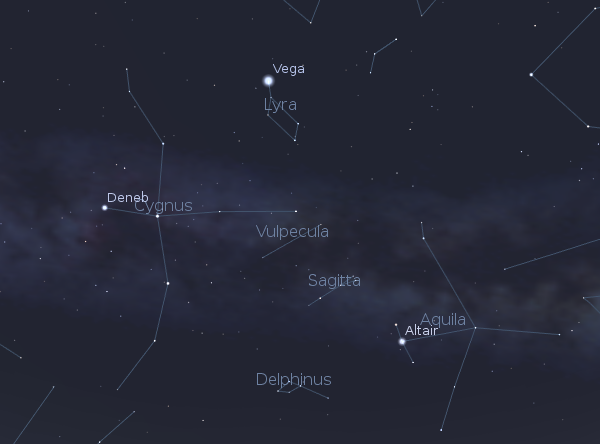
The constellations Lyra, Cygnus and Aquila. Created using Stellarium.
Check out Altair to the lower right.
08/27/2012 – Ephemeris – RIP: Neil Armstrong
Ephemeris for Monday, August 27th. The sun will rise at 6:59. It’ll be up for 13 hours and 27 minutes, setting at 8:27. The moon, 3 days past first quarter, will set at 3:44 tomorrow morning.
Over the weekend we learned that Neil Armstrong, the first human to step on the moon, passed away at age 82. I am old enough to remember all of the space age from Sputnik to Curiosity’s landing on Mars. The Apollo 11 landing and subsequent lunar EVA or moon walk were riveting to me and all the world. Neil was an engineer and understood the flying machines he flew implicitly, whether it was the X15, Gemini, Apollo Command Module or the Lunar Module. He stayed an engineer and became a college professor after he returned to earth, not cashing in on his fame. He is a hero in a time that has no true heroes. He will be remembered as long as humanity strives to reach the stars.
Times are for the Traverse City/Interlochen area of Michigan. They may be different for your location.

