Archive
08/24/2012 – Ephemeris – A star party tomorrow night
Ephemeris for Friday, August 24th. The sun rises at 6:56. It’ll be up for 13 hours and 36 minutes, setting at 8:32. The moon, at first quarter today, will set at 12:32 tomorrow morning.
Tomorrow evening there will be a star party at Northwestern Michigan College’s Joseph H. Rogers Observatory. On tap if it’s clear will be Saturn and the moon plus the brighter deep sky objects, that is telescopic objects that are beyond the solar system. Saturn is the planet to see in a telescope with it’s fantastic rings. We will soon lose it into the setting sun. The moon will reveal its wonders including its great craters and lava seas. Members of the Grand Traverse Astronomical Society and the NMC Astronomy Club team up for these star parties. The observatory is located south of Traverse City on Birmley Road between Garfield and Keystone roads.
Times are for the Traverse City/Interlochen area of Michigan. They may be different for your location.
08/23/2012 – Ephemeris – A belated salute to Curiosity
Ephemeris for Thursday, August 23rd. The sun rises at 6:55. It’ll be up for 13 hours and 38 minutes, setting at 8:34. The moon, 1 day before first quarter, will set at 11:41 this evening.
It’s been two and a half weeks since the Curiosity Rover landed on Mars. I finished the prior two weeks programs less than an hour before Curiosity landed and before heading off for vacation, so this is my first opportunity to talk about the landing. The so-called “Seven Minutes of Terror” went without a hitch. Either receiving transmissions directly from the spacecraft or through the Odyssey Mars orbiter, tones from the spacecraft ticked off the landing milestones right on time. As I’m recording this Curiosity hasn’t moved, however it’s already zapped a rock with its laser, its delivered a panorama of its surroundings, and is still sending frames of the descent movie it took when the heat shield was dropped, until it touched down.
Times are for the Traverse City/Interlochen area of Michigan. They may be different for your location.
Addendum
Here’s a mix from the Seven Minutes of Terror video created before landing cut with actual Jet Propulsion Laboratory (JPL) Mission Control footage as Curiosity actually landed.
Here’s another video of the landing cut with scenes of gatherings around the country including Times Square, and video from the landing imager and Curiosity descending on the parachute from the Mars Reconnaissance Orbiter.
Here is a hi-res descent and landing from the MARDI landing imager. Hat tip to the Bad Astronomer. Play at full screen for best effect.
08/22/2012 – Ephemeris – Where are the bright planets this week?
Ephemeris for Wednesday, August 22nd. The sun rises at 6:53. It’ll be up for 13 hours and 41 minutes, setting at 8:35. The moon, 2 days before first quarter, will set at 10:58 this evening. | Let’s see what’s happening with the bright planets for this week. Mars Saturn and the star Spica make a bright triangle in the west southwest after sunset. Mars is on the upper left with Saturn on the upper right and Spica below. They are located in the constellation Virgo the virgin. Mars will be setting in the west at 10:41 p.m, and Saturn will set at 11:46. The morning sky features the two brightest planets: Jupiter, which will rise at 12:47 a.m. in the east northeast and Venus, which will rise at 3:11 also in the east northeast. Venus’ rising times are now getting later after its greatest elongation last week. The bright star Aldebaran in Taurus the bull will appear just to the right and a bit below Jupiter tomorrow morning
Times are for the Traverse City/Interlochen area of Michigan. They may be different for your location.
Addendum
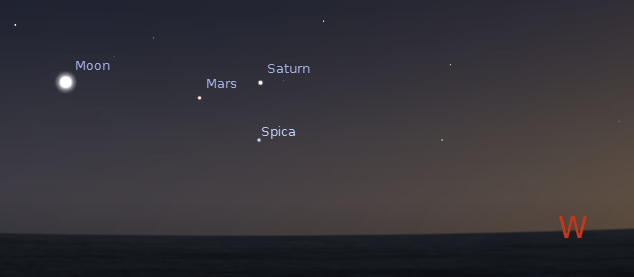
The planets and the moon low in the west southwest at 9:30 p.m. Created using Stellarium.
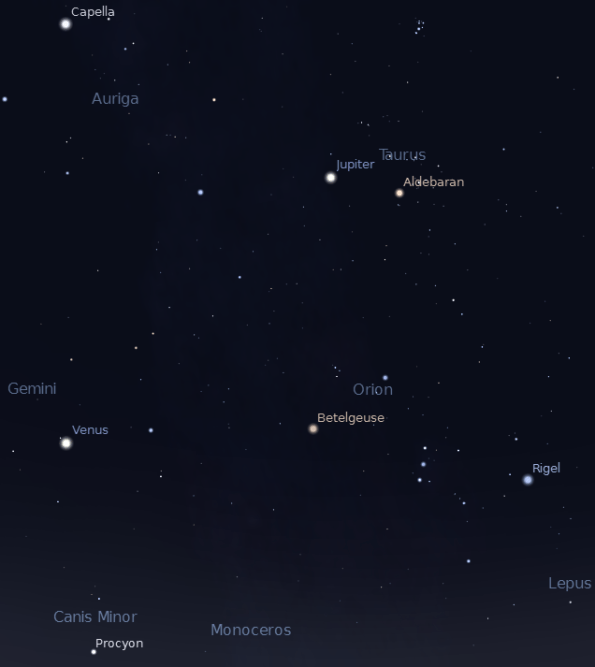
Venus, Jupiter and the winter stars at 5:30 a.m. on August 23rd. Created using Stellarium.
08/21/2012 – Ephemeris – The moon, the planets Mars, Saturn and the star Spica get together tonight
Ephemeris for Tuesday, August 21st. The sun rises at 6:52. It’ll be up for 13 hours and 44 minutes, setting at 8:37. The moon, 3 days before first quarter, will set at 10:21 this evening.
Tonight the moon will join the triangle of the planets Saturn, Mars and the star Spica. Mars is the dimmest of the three star-like objects and is nearly directly above the moon. Saturn is yellowish and to the upper right, while the star Spica is the bluest of the 21 brightest first magnitude stars. Mars gets its color from rust, good old iron oxide. Saturn has a yellowish tinge due partly to the color of its cloud tops. The color of the rings is much more white of ice. But since Saturn reflects the sun, some of that yellowness come from the sun itself. While the daylight sun appears white to us, our night vision shifts to the blue, so sunlike stars appear yellowish. This shift to the blue also enhances the color of a blue star like Spica.
Times are for the Traverse City/Interlochen area of Michigan. They may be different for your location.
Addendum
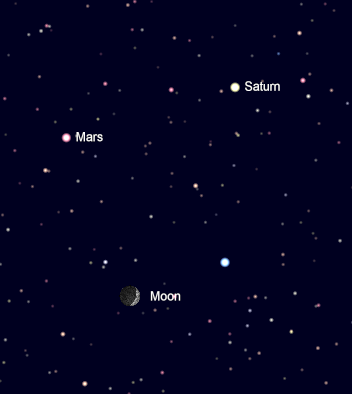
The moon and the planets Mars and Saturn plus the bright star Spica before 10 p.m. Created using Stellarium.
Spica is the unnamed star to the right of the moon.
08/20/2012 – Ephemeris – Celestial Dolphin and Cupid’s dart
Ephemeris for Monday, August 20th. The sun rises at 6:51. It’ll be up for 13 hours and 47 minutes, setting at 8:39. The moon, 3 days past new, will set at 9:48 this evening.
Located below the eastern edge of the Summer Triangle of three of the brightest stars in the sky, which is nearly overhead sky at 10 p.m., is the tiny constellation of Delphinus the dolphin, which is seen high in the south. Delphinus’ 6 stars in a small parallelogram with a tail, really does look like a dolphin leaping out of the water. The parallelogram itself has the name Job’s Coffin. The origin of this asterism or informal constellation is unknown. Of the dolphin itself: the ancient Greeks appreciated this aquatic mammal as we do, and told stories of dolphins rescuing shipwrecked sailors. There’s another tiny constellation to the right of Delphinus, Sagitta the arrow, which represents Cupid’s dart. [Off the tail of Sagitta binoculars will find a cute inverted coat hanger in the stars.]
Times are for the Traverse City/Interlochen area of Michigan. They may be different for your location. Bracketed text was removed from the audio program due to time constraints.
Addendum
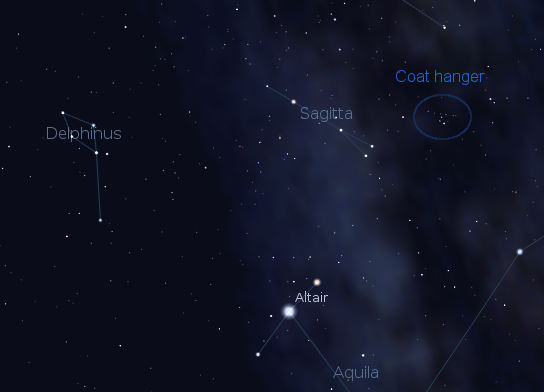
Delphinus, Sagitta and the Coat hanger. Diagram created using Stellarium.
08/17/2012 – Ephemeris – The constellation Aquila the eagle
Ephemeris for Friday, August 17th. The sun rises at 6:47. It’ll be up for 13 hours and 56 minutes, setting at 8:43. The moon is new today, and won’t be visible.
Aquila the eagle is a constellation that lies in the Milky Way. It’s in the southeastern sky as it gets dark. Its brightest star, Altair is one of the stars of the Summer Triangle, a group of three bright stars seen now in the eastern sky in the evening. Altair, in the head of the eagle, is flanked by two slightly dimmer stars, the shoulders of the eagle. The eagle is flying northeastward through the Milky Way. Its wings are seen in the wing tip stars. A curved group of stars to the lower right of Altair is its tail. Within Aquila the Milky Way shows many dark clouds as part of the Great Rift that splits it here. The other summer bird is Cygnus the swan, which I talked about earlier this year, above and left of Aquila, flying in the opposite direction.
Times are for the Traverse City/Interlochen area of Michigan. They may be different for your location.
Addendum
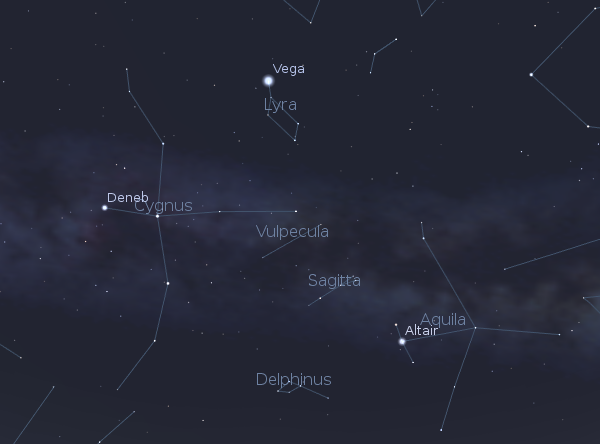
The constellations Lyra, Cygnus and Aquila. Created using Stellarium.
08/16/2012 – Ephemeris – The constellation of Scutum
Ephemeris for Thursday, August 16th. The sun rises at 6:46. It’ll be up for 13 hours and 58 minutes, setting at 8:45. The moon, 1 day before new, will rise at 6:53 tomorrow morning. | In the evening sky, in the south after it gets dark can be seen part of the Milky Way. There is actually a constellation here located between Sagittarius the archer, which really looks like a teapot, below and Aquila the eagle above. It’s Scutum the shield of John Sobieski the Polish king who stopped the advance of the Turks at Kalenberg in 1683. Scutum is the only official constellation I know of which is related to a real person. The Polish half of me is very proud. However the stars here are so dim and embedded in the glow of the Milky Way as to be nearly impossible to discern. Scutum lies in one of the richest portions of the Milky Way, wonderful to scan with binoculars and telescopes for star clusters and nebulae or clouds of dust and gas.
Times are for the Traverse City/Interlochen area of Michigan. They may be different for your location.
Addendum
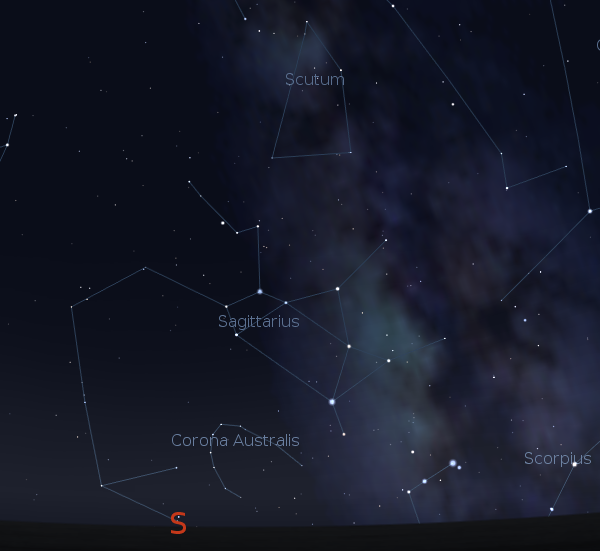
The constellations Sagittarius and Scutum. Created using Stellarium.
08/15/2012 – Ephemeris – Where are the bright planets this week
Ephemeris for Wednesday, August 15th. The sun rises at 6:45. It’ll be up for 14 hours and 1 minute, setting at 8:47. The moon, 2 days before new, will rise at 5:45 tomorrow morning.
Let’s see what’s happening with the bright planets for this week. Mars Saturn and the star Spica make a bright skinny triangle in the west southwest after sunset. Mars is in the middle between Saturn on the top and Spica. They are located in the constellation Virgo the virgin. Mars will be setting in the west at 10:59 p.m. Saturn will set at 11:12. The triangle is going to fatten up over the next week as Mars heads eastward. The morning sky features the two brightest planets: Jupiter, which will rise at 1:12 a.m. in the east northeast and Venus, which will rise at 3:08 also in the east northeast. The bright star Aldebaran in Taurus the bull will appear just to the lower right of Jupiter tomorrow morning, but Venus will be at greatest elongation from the sun.
Times are for the Traverse City/Interlochen area of Michigan. They may be different for your location.
Addendum
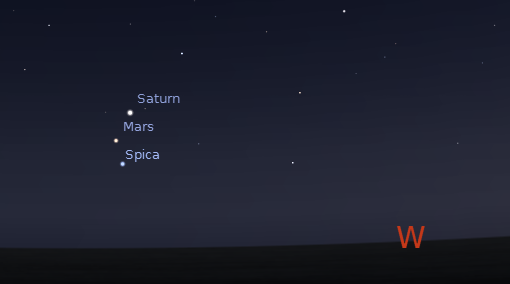
Looking west at 10 p.m. on August 15, 2012. Created using Stellarium.
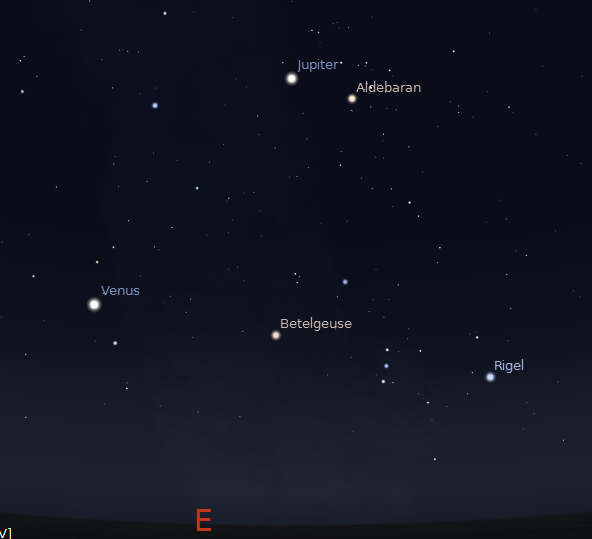
Looking east at 5 a.m. August 16, 2012. Created using Stellarium.
08/14/2012 – Ephemeris – The asterism of the Teapot (Sagittarius)
Ephemeris for Tuesday, August 14th. The sun rises at 6:44. It’ll be up for 14 hours and 4 minutes, setting at 8:48. The moon, 3 days before new, will rise at 4:40 tomorrow morning. | If the ancient Greeks had teapots the constellation we call Sagittarius might have been Teapotius or something. It’s low in the south at 11 p.m. with the Milky Way rising like steam from its spout. Sagittarius is supposed to be a centaur with a bow and arrow. However to us the dearth of centaurs around outside of Harry Potter movies, and lots of teapots, and that great children’s song that perfectly describes the Sagittarius teapot that’s what we imagine. So the teapot is an asterism, like the Big Dipper, not one of the official constellations. A pair of binoculars is all you need to spot many fuzzy objects in and around Sagittarius. Pay special attention to that steam of the Milky way above the teapot’s spout for many fuzzy objects.
Times are for the Traverse City/Interlochen area of Michigan. They may be different for your location.
Addendum
The constellations Sagittarius and Scutum. Created using Stellarium.
08/13/2012 – Ephemeris – Saturn, Mars and Spica line up
Ephemeris for Monday, August 13th. The sun rises at 6:43. It’ll be up for 14 hours and 7 minutes, setting at 8:50. The moon, half way from last quarter to new, will rise at 3:38 tomorrow morning.
This evening the triangle of the planets Mars and Saturn plus the star Spica has momentarily disappeared. They are, this evening only, practically in a straight line. Mars has moved to be between Saturn and Spica. The reason Mars moves so fast and Saturn has been hanging around Spica all year is that Mars is closer to the sun, so it moves faster. It takes a bit less than two or our years to orbit the sun. Saturn takes nearly 30 years to do the same. Saturn averages 9.5 times the earth’s distance from the sun. While Mars averages one and a half times the earth’s distance. Mars will hang on in the western sky for a few more months, getting dimmer as it moves around behind the sun. Saturn and Spica will soon be lost in twilight.
Times are for the Traverse City/Interlochen area of Michigan. They may be different for your location.
Addendum
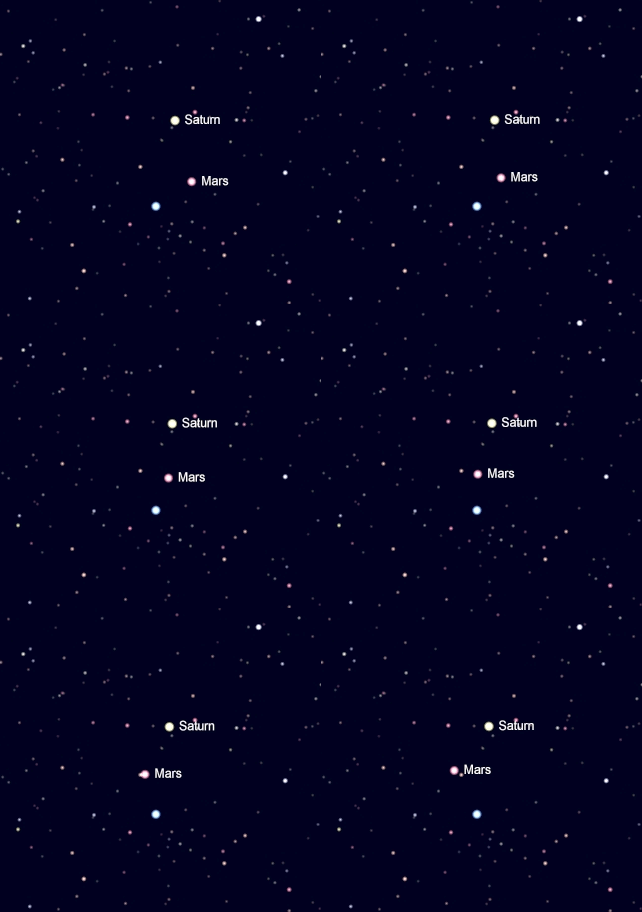
The trio of Mars, Saturn and the star Spica from August 11th through the 18th. Created using Cartes du Ciel (Sky Charts)

