Archive
08/10/2012 – Ephemeris – Weekend Meteor Watches
Ephemeris for Friday, August 10th. The sun rises at 6:39. It’ll be up for 14 hours and 15 minutes, setting at 8:54. The moon, 1 day past last quarter, will rise at 1:04 tomorrow morning.
There are two events this weekend to view the heavens and the Perseid meteor showers. First, part of the Port Oneida Fair the Grand Traverse Astronomical Society will work with the rangers of the Sleeping Bear Dunes National Lakeshore to hold a star party and meteor watch at Thoreson Farm on South Thoreson Road of M22, a couple miles north of Glen Arbor. That will start at 9 p.m. It will be about 10:30 when it’ll be dark enough spot the meteors. Sunday evening there’s a Meteors and S’mores event at the Leelanau State Park, at the tip of the Leelanau Peninsula. That event starts at 10:30 p.m. The society will participate there also. The moon won’t interfere with the meteor shower It’s been banished into the morning sky.
Times are for the Traverse City/Interlochen area of Michigan. They may be different for your location.
08/09/2012 – Ephemeris – Viewing the Perseid meteor shower
Ephemeris for Thursday, August 9th. The sun rises at 6:38. It’ll be up for 14 hours and 17 minutes, setting at 8:56. The moon, at last quarter today, will rise at 12:24 tomorrow morning.
Lets take a look at what will happen this weekend with the Perseid meteor shower. We seem to have two meteoroid streams intercepting the earths. The earth will pass through the classic stream Saturday night, Sunday morning. The earth is expected to pass through a second stream Sunday Night, Monday morning. In the early evening the meteors are fewer, but the trails will be longer. The meteors will seem to come from the constellation of Perseus which lies below the W shaped constellation of Cassiopeia in the northeast. At two or three in the morning will see the greatest numbers of meteors, up to 60 meteors an hour. Tomorrow I’ll tell you about two events and places to go to join others in viewing the shower.
Times are for the Traverse City/Interlochen area of Michigan. They may be different for your location.
Addendum
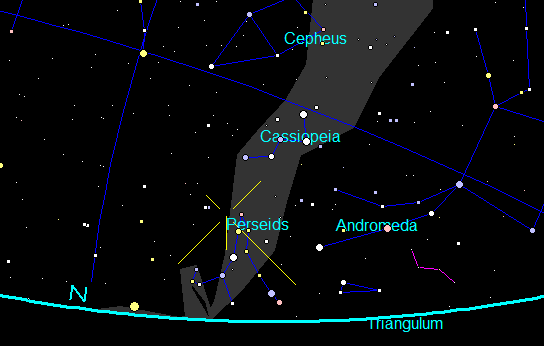
Perseid radiant at 10:30 p.m.
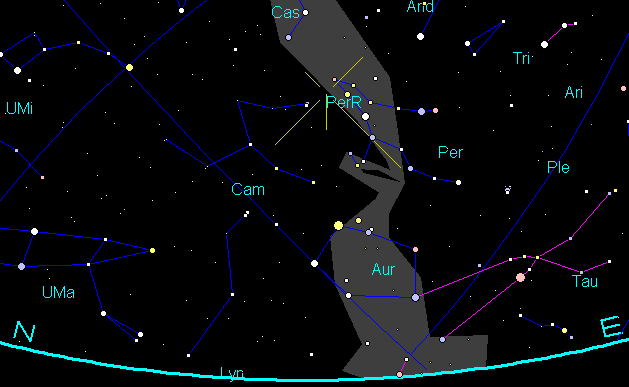
Perseid Meteor Shower radiant after midnight
08/08/2012 – Ephemeris – Where are the bright planets this week?
Ephemeris for Wednesday, August 8th. The sun rises at 6:37. It’ll be up for 14 hours and 20 minutes, setting at 8:57. The moon, 1 day before last quarter, will rise at 11:50 this evening.
Let’s see what’s happening with the bright planets for this week. Mars Saturn and the star Spica make a bright triangle in the west southwest after sunset. Mars is on the lower right and Saturn is the topmost of the three. They are located in the constellation Virgo the virgin. Mars will be setting in the west at 11:17 p.m. Saturn will set at 11:39. Next Monday Mars will pass between Saturn and Spica. The morning sky features the two brightest planets: Jupiter, which will rise at 1:32 in the east northeast and Venus, which will rise at 3:09 also in the east northeast. The bright star Aldebaran in Taurus the bull will appear just to the lower right of Jupiter tomorrow morning, but Venus will have dropped farther below Jupiter, as it stays near the sun.
Times are for the Traverse City/Interlochen area of Michigan. They may be different for your location.
Addendum
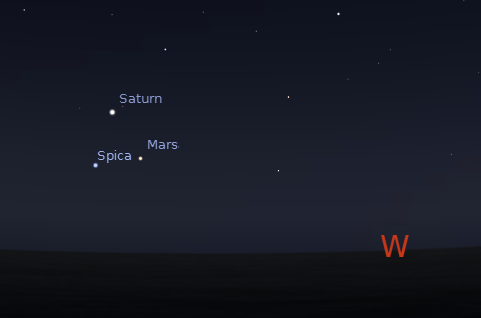
Looking west at 10:30 p.m. on August 8, 2012. Created using Stellarium.
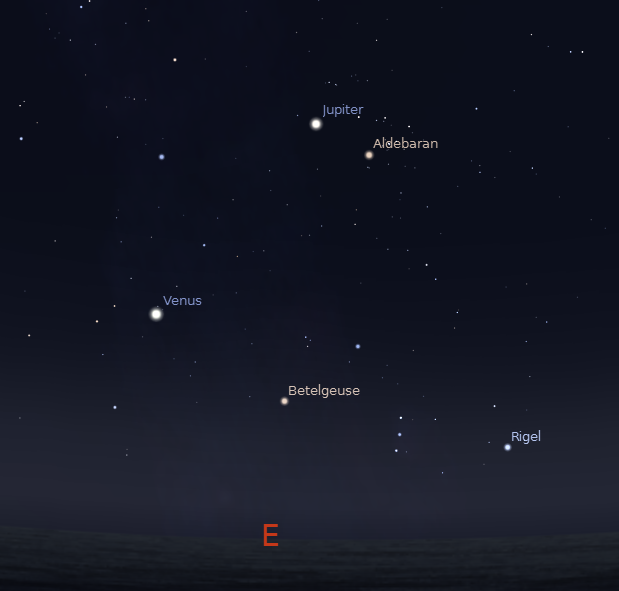
Looking eastward at 5 a.m. on August 9, 2012. Orion is also rising along with Jupiter and Venus. Created using Stellarium.
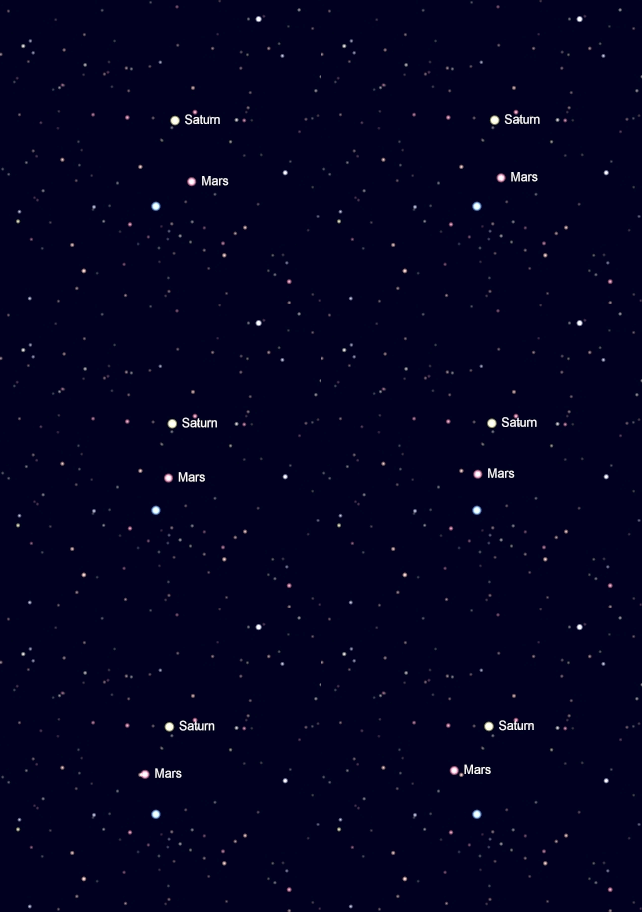
The trio of Mars, Saturn and the star Spica from August 11th through the 18th. Created using Cartes du Ciel (Sky Charts)
08/07/2012 – Ephemeris – the comet responsible for the Perseid meteor shower
Ephemeris for Tuesday, August 7th. The sun rises at 6:36. It’ll be up for 14 hours and 22 minutes, setting at 8:59. The moon, 2 days before last quarter, will rise at 11:20 this evening.
The Perseid meteor shower is so named because the meteors seem to come from the direction of the constellation of Perseus which starts in the evening low in the northeast and rotates up throughout the night higher and higher. The comet responsible is Comet Swift-Tuttle, discovered in 1862 by Lewis Swift and Horace Tuttle. The comet has a 130 year orbit and returned in 1992. It’s orbit intersects ours at a 113 degree angle, which is why the radiant point is so far north. The Perseids have been recorded for 2,000 years so the comet has been around much longer than that. It’s nucleus is 17 miles in diameter, about twice that of Halley’s Comet. While Comet Swift-Tuttle won’t be back this century, we can see bits of it tonight.
Times are for the Traverse City/Interlochen area of Michigan. They may be different for your location.
08/06/2012 – Ephemeris – The Perseid Meteor Shower this weekend
Aug 6. This is Bob Moler with Ephemeris for Monday, August 6th. The sun rises at 6:35. It’ll be up for 14 hours and 25 minutes, setting at 9:00. The moon, 3 days before last quarter, will rise at 10:52 this evening.
Saturday night through Sunday morning will be the period of the maximum number of meteors in the Perseid meteor shower. There are many meteor showers but a few very active ones. Of these the Perseids are the most famous. Meteor showers occur the same dates during the year because meteoroid streams are debris left near the orbits of comets. If a comet passes near the earth’s orbit the debris it sheds when close to the sun will end up in orbits similar to the comet and when the earth passes the spot we experience a meteor shower. Thus in late July through mid August we pass through the meteoroid stream of debris of Comet Swift-Tuttle, whose sand to pea sized particles hit the atmosphere at 40 miles per second providing us a celestial show.
Times are for the Traverse City/Interlochen area of Michigan. They may be different for your location.
08/03/2012 – Ephemeris – Weekend events here and on Mars.
Ephemeris for Friday, August 3rd. The sun rises at 6:31. It’ll be up for 14 hours and 32 minutes, setting at 9:04. The moon, 2 days past full, will rise at 9:34 this evening.
The Northwestern Michigan College’s Rogers observatory will be open this evening starting at 9 p.m. For views of the heavens including the planet Saturn and the moon. There’s some bright deep sky objects also visible. Mars though up is a very tiny planet and is quite distant. What can’t be seen in a telescope will be visible shortly. Monday at 1:31 a.m. The Curiosity Mars Science Laboratory will land in Gale Crater. If the landing is successful the new rover will be bringing a new arsenal of scientific instruments to probe the martian past. From our vantage point on the earth Mars looks like a tiny yellowish orange disk. We will be back to two operational rovers joining the three operational satellites now orbiting Mars.
Times are for the Traverse City/Interlochen area of Michigan. They may be different for your location.
Addendum
Here’s a movie from the Jet Propulsion Laboratory (JPL) of Curiosity’s entry descent and landing called Seven Minutes of Terror: http://youtu.be/ISmWAyQxqqs
08/02/2012 – Ephemeris – The sun’s kicking up again this week
Thursday, August 2nd. The sun rises at 6:30. It’ll be up for 14 hours and 35 minutes, setting at 9:05. The moon, 1 day past full, will rise at 9:05 this evening.
With the sun really being active, there’s a good chance we’ll see several displays of the northern lights of aurora borealis. Those south of the equator will see the southern equivalent, the aurora australis. There’s an active group of sunspots rotating onto the earth-side face of the sun that should give us a chance to see the aurora in the next week or so. Sunspots are caused by tremendous magnetic fields generated below the bright photosphere we rather improperly call the sun’s surface. The sun has no solid surface, it’s all gas. The magnetic fields cool the gas, making it darker. The spots are maybe at a temperature 2,000 degrees cooler than the rest of the photosphere which is about 10,000 degrees Fahrenheit. In complex sunspot groups there is a potential for huge explosions.
Times are for the Traverse City/Interlochen area of Michigan. They may be different for your location.
Addendum
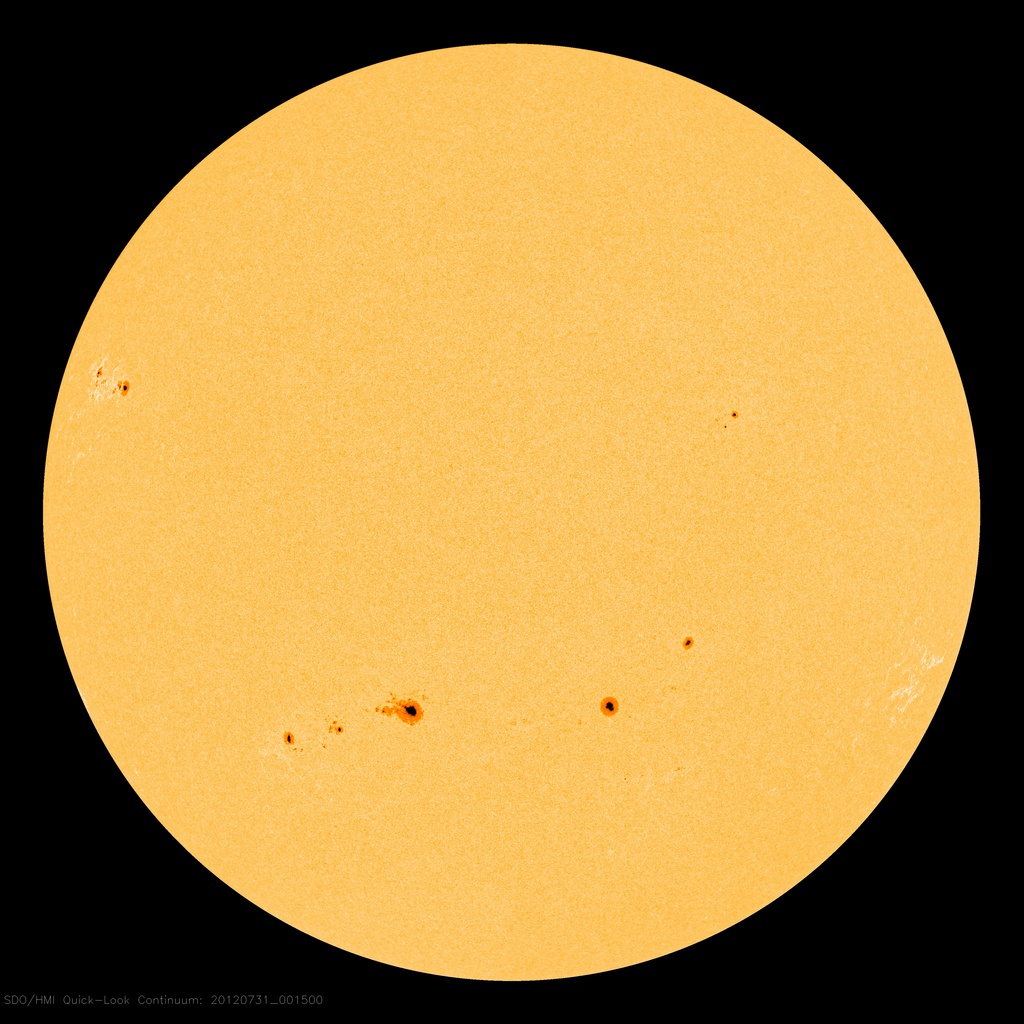
Solar Dynamics Observatory white light image of the sun from Monday. Credits NASA / SDO. Click on image to enlarge.
08/01/2012 – Ephemeris – Where are the bright planets this week?
Ephemeris for Wednesday, August 1st. The sun rises at 6:29. It’ll be up for 14 hours and 37 minutes, setting at 9:07. The moon, at full today, will rise at 8:33 this evening.
Let’s see what’s happening with the bright planets for this week. Mars Saturn and the star Spica make a bright triangle in the west southwest after sunset. Mars is on the right and Saturn is the topmost of the three. They are located in the constellation Virgo the virgin. Mars will be setting in the west at 11:38 p.m. Saturn will set at 12:05 a.m. At mid-month Mars will pass between Saturn and Spica. The morning sky features the two brightest planets: Jupiter, which will rise at 1:59 in the east northeast and Venus, which will rise at 3:13 also in the east northeast. The bright star Aldebaran in Taurus the bull will appear just to the right of Jupiter tomorrow morning, but Venus will have dropped farther below Jupiter, as it stays by the sun.
Times are for the Traverse City/Interlochen area of Michigan. They may be different for your location.
Addendum
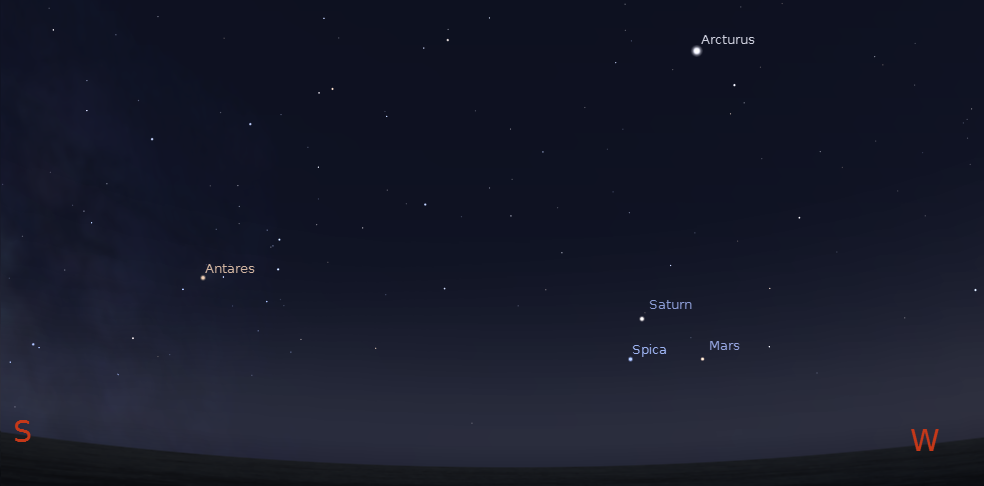
Looking southwest at 10:30 p.m. on August 1, 2012. Created using Stellarium. Click on the image to enlarge.
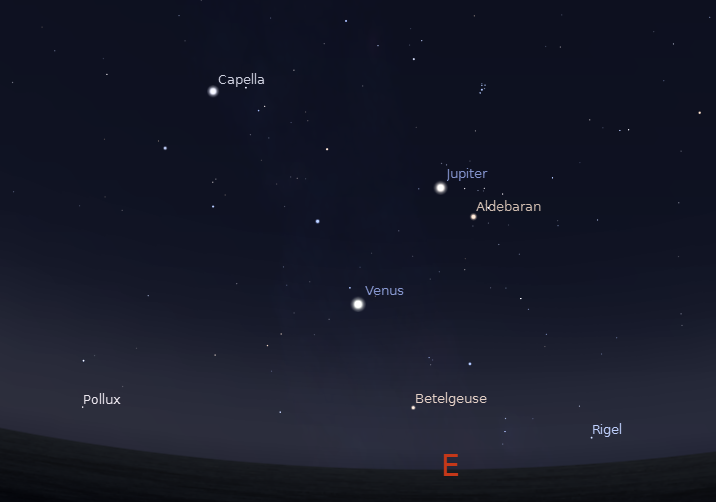
Looking east at 5 a.m. August 2, 2012. That’s Orion rising below Jupiter and Venus. Created using Stellarium. Click on the image to enlarge.
07/31/2012 – Ephemeris – Previewing August Skies
Ephemeris for Tuesday, July 31st. The sun rises at 6:28. It’ll be up for 14 hours and 40 minutes, setting at 9:08. The moon, 1 day before full, will set at 5:59 tomorrow morning.
Let’s look ahead at the month of August in the skies which begins tomorrow. Daylight hours will decrease from 14 hours and 37 minutes tomorrow to 13 hours 15 minutes on the 31st. The altitude of the sun at local noon, that is degrees of angle above the horizon will decrease from 63 degrees today to just over 53 degrees on the 31st. Straits area listeners can subtract one more degree from those angles. Local noon, when the sun is due south, is about 1:43 p.m. The big event of the month will be the Perseid meteor shower will reach its peak on Sunday morning the 12th. Head out as soon as it gets dark, about 10:30 Saturday evening to watch the show. At that early hour the meteors may be few, but they will leave long tails in the sky, coming from the northeast. [Later as the meteor source or radiant rises more and more meteors will be visible.]
Times are for the Traverse City/Interlochen area of Michigan. They may be different for your location.
07/30/2012 – Ephemeris – A closeup look at the bright star Deneb
Ephemeris for Monday, July 30th. The sun rises at 6:27. It’ll be up for 14 hours and 42 minutes, setting at 9:09. The moon, 2 days before full, will set at 4:47 tomorrow morning.
At 10:30 this evening the bright star Deneb in Cygnus the swan will be high in the east in the tail of Cygnus the swan. Deneb is the dimmest star of the summer triangle. Of the other stars of the triangle, Vega is nearly overhead, and Altair to the south. While Deneb’s apparent magnitude, or brightness as seen from earth, makes it the dimmest of the three bright stars, Deneb’s vast distance of possibly 1,500 to 2,600 light years makes it nearly 100 times the distance of Vega. If brought as close as Vega, Deneb would be several time brighter than Venus. For all this it is only 13-21 times the mass of the sun. It will have an extremely short life and it will explode, go supernova, in perhaps a few million years.
Times are for the Traverse City/Interlochen area of Michigan. They may be different for your location.
Addendum
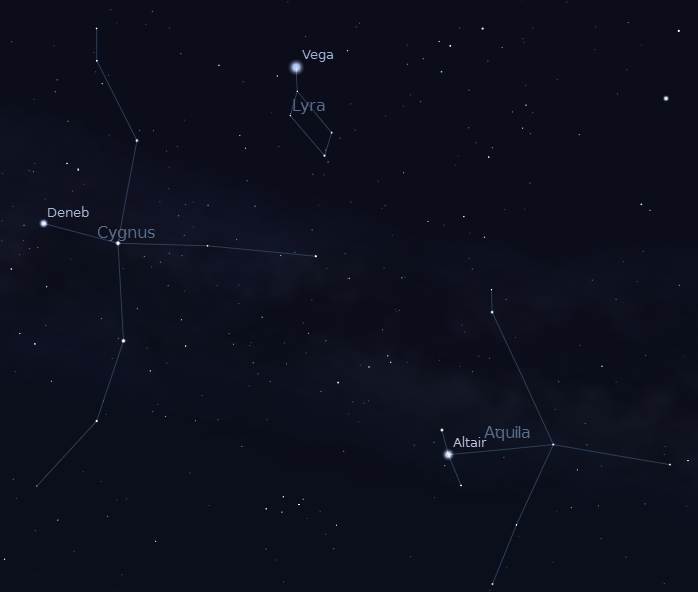
Summer Triangle. Created using Stellarium.

