Archive
07/27/2012 – Ephemeris – I’ll be giving a presentation at the Eyaawing Museum & Culture Center in Peshawbestown tomorrow
Ephemeris for Friday, July 27th. The sun rises at 6:24. It’ll be up for 14 hours and 49 minutes, setting at 9:13. The moon, 1 day past first quarter, will set at 1:41 tomorrow morning.
Tomorrow yours truly will be giving a presentation Stars and Stories of the Summer Night Skies This will be a talk illustrated by a fantastic planetarium type program called Stellarium which is actually free from the Internet. There won’t be a planetarium dome however. I’ll be exploring the stars and constellations visible in the summer sky and how various cultures saw them and some of the wonderful stories of those who counted on the heavens to be their calendar in order to plant their crops and prepare for winter.. There’s the Greek constellations I tend to talk about on these programs, and others, especially those of the local Indian peoples. The presentation is at 1 p.m. at the Eyaawing Museum and Cultural Center in Peshawbestown.
Times are for the Traverse City/Interlochen area of Michigan. They may be different for your location.
07/26/2012 – Ephemeris – Why is a half illuminated moon called a quarter moon?
Ephemeris for Thursday, July 26th. The sun rises at 6:22. It’ll be up for 14 hours and 51 minutes, setting at 9:14. The moon, at first quarter today, will set at 12:56 tomorrow morning.
The moon was at the exact first quarter a few hours ago. By tonight the sunlit side of the moon will be a bit fuller, but might be at the half moon phase to the casual eye. So why do we call the half illuminated moon a quarter moon? The moon is a quarter the way around the earth from new moon. When it goes half way around the earth from new, we ave a fully illuminated moon from our vantage point, Another quarter the way around we have a half illuminated moon from our vantage point, but the moon is at third quarter position or last quarter. Another quarter way around and the moon is new again. The ancients unlike astronomers today called the first sighting of the moon’s crescent in the west after sunset new moon.
Times are for the Traverse City/Interlochen area of Michigan. They may be different for your location.
Addendum
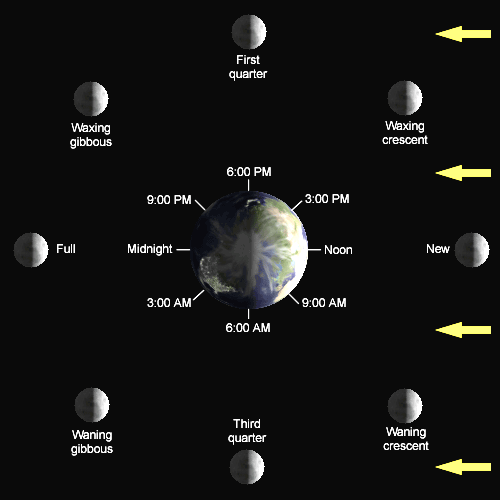
Lunar phase diagram. From Wikimedia Commons.
The arrows in the diagram is light from the sun far off to the distant right.
07/25/2012 – Ephemeris – Where are the bright planets this week?
Ephemeris for Wednesday, July 25th. The sun rises at 6:21. It’ll be up for 14 hours and 53 minutes, setting at 9:15. The moon, 1 day before first quarter, will set at 12:17 tomorrow morning.
Let’s see what’s happening with the bright planets for this week. Mars, with its unmistakable bright reddish color, is in the west southwest in the evening in the constellation of Virgo the virgin. Mars will be setting in the west at 11:55 p.m. It is approaching Saturn and Spica just to its left. Saturn will be in the west southwest above the bright star Spica now. It will set at 12:32 a.m. The moon passed the group last night as is just east of them now. Jupiter will rise at 2:22 a.m. in the east northeast. Venus, is now seen below Jupiter after it rises at 3:20 a.m. Tomorrow morning, the bright star Aldebaran will appear below and right of Jupiter. Venus is falling off to the lower left of Jupiter as Jupiter moves away from the sun.
Times are for the Traverse City/Interlochen area of Michigan. They may be different for your location.
Addendum

Mars, Saturn and the moon at 10:30 p.m. 07/25/2012. Created using Stellarium.

Jupiter and Venus with bright morning stars including those of Orion at 5:30 a.m. on 7/26/2012. Created using Stellarium.
07/23/2012 – Ephemeris – The star Vega up close
Ephemeris for Monday, July 23rd. The sun rises at 6:19. It’ll be up for 14 hours and 57 minutes, setting at 9:17. The moon, 3 days before first quarter, will set at 11:14 this evening.
The star Vega, which is high in the east, near overhead or the zenith is a special star for astronomers. It’s part of the small constellation or Lyra the harp, which includes the parallelogram of stars near it. Vega is kind of a standard calibration star. It is the 5th brightest night time star with a brightness of 0.0 magnitude, although recent measurements place it at 0.03. Of the spectral types which denote the star’s color and surface temperature, Vega comes out to be pure white, with a surface temperature nearly twice the sun’s. It’s almost exactly 25 light years away, and so is one of the closer stars. It’s a tenth the sun’s age and 40 times the sun’s brightness. [It has perhaps a Jupiter sized planet, and a Kuiper belt of Pluto like objects.]
Times are for the Traverse City/Interlochen area of Michigan. They may be different for your location.
Addendum
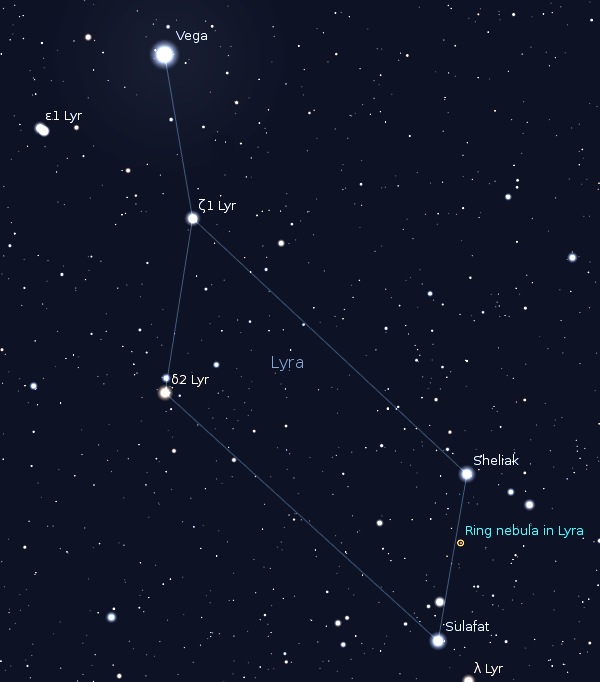
Lyra in Binoculars. Created using Stellarium.
07/24/2012 – Ephemeris – The star Antares up close
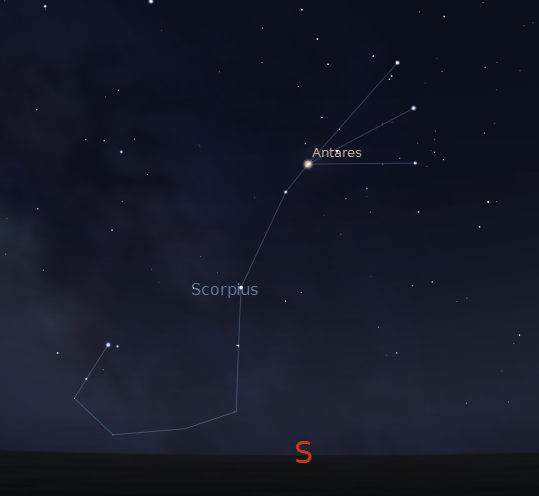
The constellation Scorpius with Antares. Created using Stellarium.
Ephemeris for Tuesday, July 24th. The sun rises at 6:20. It’ll be up for 14 hours and 55 minutes, setting at 9:16. The moon, 2 days before first quarter, will set at 11:44 this evening.
Antares is a most interesting star. It’s low in the south and red in color. Its the heart of the Scorpius the scorpion. Its name means Rival of Mars with which it shares its color. Antares is a huge star, a red giant star. Its mass is 12 times the mass of the sun, but it’s bloated out to a diameter somewhat larger than the orbit of Mars, over 300 million miles. This what happens to a star that has exhausted hydrogen in its core and is now fusing helium to produce energy and even more massive elements. Its surface temperature is close to the temperature of the filament of an incandescent light bulb, about 2/3rds the temperature of the sun. Antares also has a dim companion star.
Times are for the Traverse City/Interlochen area of Michigan. They may be different for your location.
07/19/2012 – Ephemeris – The constellation Cygnus the swan
Ephemeris for Thursday, July 19th. Today the sun will be up for 15 hours and 5 minutes, setting at 9:21. The moon is new today, and won’t be visible. | Tomorrow the sun will rise at 6:16.
High in the east northeast as it gets dark flies the constellation of Cygnus the swan. This constellation is also known as the Northern Cross. The cross is seen lying on its side with the bright star Deneb at the head of the cross to the left. The rest of the cross is delineated in the stars to the right. As a swan, Deneb is the tail, the stars of the crosspiece of the cross are the leading edges of wings as Cygnus flies south through the Milky Way. There are faint stars that also define the tips and trailing edges of its wings. It is a very good portrayal of a flying swan, like the mute swans we see on the wing. In Greek mythology this was the disguise of the god Zeus who seduced the young lady Leda and fathered the immortal of the Gemini twins Pollux.
Times are for the Traverse City/Interlochen area of Michigan. They may be different for your location.
Addendum
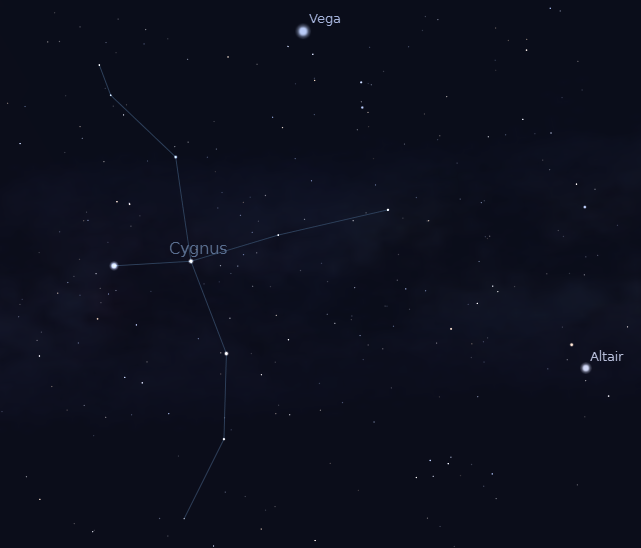
Cygnus and the stars of the Summer Triangle at 11 p.m. on July 19th. Created using Stellarium.
07/18/2012 – Ephemeris – Where are the bright planets this week?
Ephemeris for Wednesday, July 18th. Today the sun will be up for 15 hours and 7 minutes, setting at 9:22. The moon, 1 day before new, will rise at 6:53 tomorrow morning. Tomorrow the sun will rise at 6:15.
Let’s see what’s happening with the bright planets for this week. Mars, with its unmistakable bright reddish color, is in the west southwest in the evening in the constellation of Virgo the virgin. Mars will be setting in the west at 12:14 a.m. It is approaching Saturn and Spica just to its left. Saturn will be in the southwest above the bright star Spica now. It will set at 12:59 a.m. Jupiter, now a morning planet will rise at 2:45 a.m. in the east northeast. Venus, is now seen just below Jupiter after it rises at 3:31 a.m. Tomorrow morning, the bright star Aldebaran will appear between the two before twilight gets too bright before 5 a.m. All these planets except Mars, which is too small, are great to view in a telescope.
Times are for the Traverse City/Interlochen area of Michigan. They may be different for your location.
Addendum
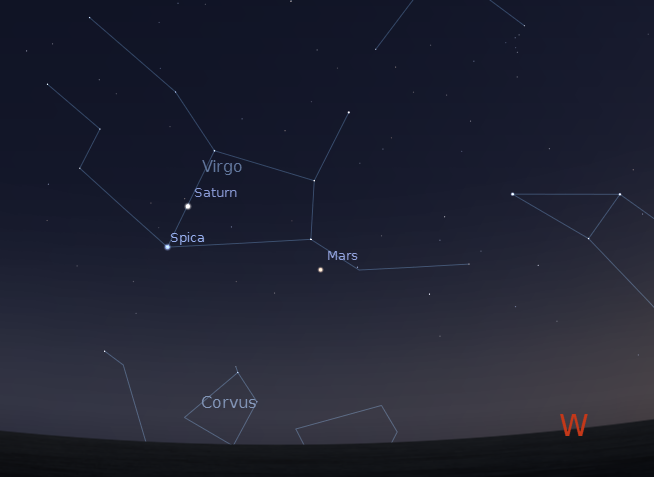
Mars and Saturn in Virgo at 10:30 p.m. on July 18, 2012. Created using Stellarium.
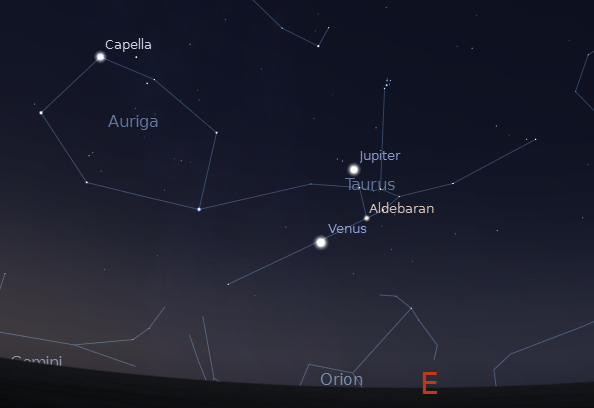
Jupiter and Venus at 5 a.m. on July 19, 2012. Created using Stellarium.
Venus and Jupiter are noticeably separating.
07/17/2012 – Ephemeris – Scorpius and Orion
Ephemeris for Tuesday, July 17th. Today the sun will be up for 15 hours and 9 minutes, setting at 9:22. The moon, 2 days before new, will rise at 5:50 tomorrow morning. Tomorrow the sun will rise at 6:14.
Crawling just above the southern horizon at 11 p.m. is the zodiacal constellation of Scorpius the scorpion. His heart is the red giant star Antares. Its facing the west or right with a short arc of three stars as its head. His body and tail drop to the left and scrape the horizon before curving up to the critter’s poisonous stinger of two stars. One story of the scorpion concerns Orion the hunter the great winter constellation. In that story Orion was supposedly killed by the sting of a scorpion. Therefore Orion and Scorpius are never seen in the sky at the same time. That is certainly true around here and for the Greeks, whose legend it is. However if one travels far enough south that is no longer true.
Times are for the Traverse City/Interlochen area of Michigan. They may be different for your location.
Addendum
The constellation Scorpius at 10:30 p.m. on July 17, 2012. Created using Stellarium.
07/16/2012 – Ephemeris – The constellation Draco the dragon
Ephemeris for Monday, July 16th. Today the sun will be up for 15 hours and 10 minutes, setting at 9:23. The moon, 3 days before new, will rise at 4:50 tomorrow morning. Tomorrow the sun will rise at 6:13.
High in the northern sky at 11 p.m. lies a twisted constellation, that of Draco the dragon. This dragon is more like the snake-like Chinese dragon than the dinosaur like Hungarian Horntail of Harry Potter fame. At least that’s how I see it. I find it better to start at the tail of Draco, to trace him out in the stars. Draco’s tail starts between the bowl of the Big Dipper and the Little Dipper. The Dragon is seen in a line of stars that extends parallel to the handle of the Big Dipper before curving around the bowl of the Little Dipper then bends back toward the south. The head of Draco is an odd box of stars near the bright star Vega, nearly overhead. Though not made up of very bright stars, Draco has an easy shape to trace.
Times are for the Traverse City/Interlochen area of Michigan. They may be different for your location.
Addendum
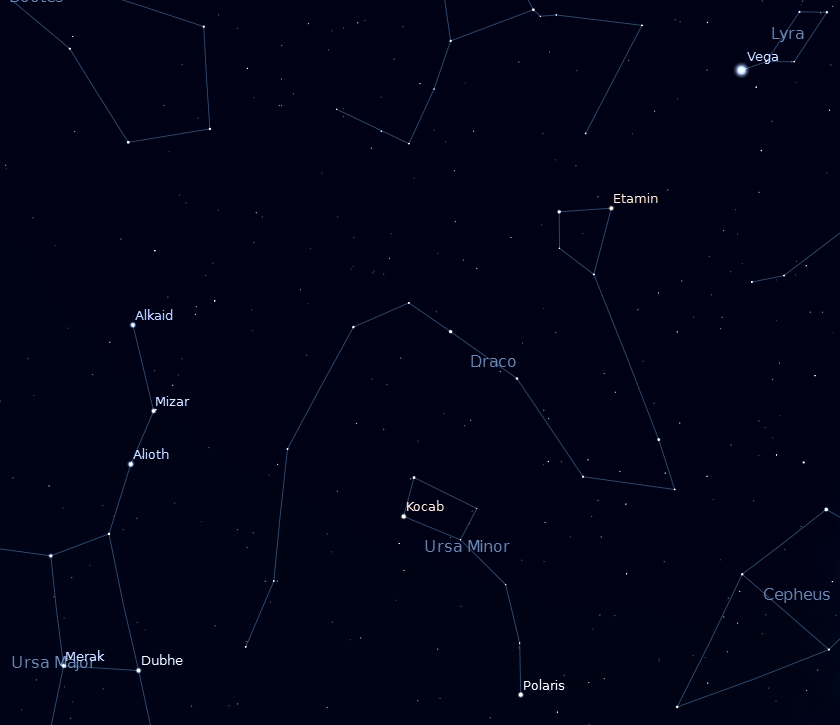
Draco the dragon at 11 p.m. July 16th looking high in the north. Created using Stellarium.
Click on the image to enlarge.
07/13/2012 – Ephemeris – The moon will join Venus and Jupiter Sunday morning
Ephemeris for Friday, July 13th. Today the sun will be up for 15 hours and 15 minutes, setting at 9:25. The moon, 3 days past last quarter, will rise at 2:26 tomorrow morning. Tomorrow the sun will rise at 6:11.
Sunday Morning maybe isn’t the most convenient time to get up early, but this Sunday it may be worth it. At 5 a.m. or so Jupiter will appear above Venus, as they have for the last few weeks. But Sunday morning the crescent moon will appear right between the two. For other parts of the world the moon will actually pass in front of Jupiter, an event called an occultation. This will occur before sunrise for us. But still the planet and moon group should be a beautiful sight in the twilit sky. Venus and Jupiter will soon separate, Venus to stay near the sun, while Jupiter due to the earth’s orbital motion moves away to rise earlier and earlier by somewhat less than a half hour a week. Jupiter lies in the constellation Taurus now.
Times are for the Traverse City/Interlochen area of Michigan. They may be different for your location.
Addendum
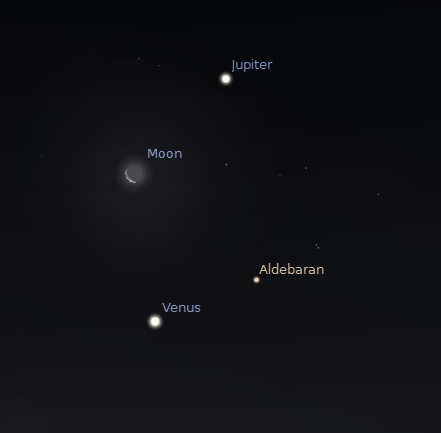
Jupiter, Venus and the moon on July 15, 2012 at 5 a,m, Created using Stellarium.

