Archive
12/05/12 – Ephemeris – Comet C/2011W3 (Lovejoy)
Monday, December 5th. The sun will rise at 8:03. It’ll be up for 8 hours and 59 minutes, setting at 5:02. The moon, 3 days past first quarter, will set at 4:16 tomorrow morning.
Four days ago an amateur astronomer discovered a new comet. These discoveries by amateur astronomers are getting rarer these days with all the near earth asteroid searches going on now. This comet was discovered by Australian Terry Lovejoy. It turns out that Comet Lovejoy is a sun-grazing comet which will come only 110,000 miles from the sun’s surface on the 16th of this month. At that distance it’s a good bet that the comet will be vaporized. There have been over 2,000 comets discovered by observers studying the SOHO satellite’s images of the vicinity of the sun, Lovejoy. found the comet when it was just inside Venus’ orbit Looks like SOHO’s LASCO C3 images will be the place to view the passage of the comet by the sun. Google SOHO and NASA to locate the site on the internet.
* Times, as always are for the Traverse City/Interlochen area of Michigan.
Bad Astronomy Link to the story: http://blogs.discovermagazine.com/badastronomy/2011/12/04/amateur-astronomer-discovers-sungrazing-comet/
Update 9:27 p.m.
More from NASA: http://sohowww.nascom.nasa.gov/pickoftheweek/old/03dec2011/. It contains the expected path of the comet as seen from the earth and SOHO
The comet should enter the field of SOHO’s LASCO C3 imager early on December 14th!
Latest (Real time L)ASCO C3 images are here: http://sohowww.nascom.nasa.gov/data/realtime/c3/512/
In the LASCO C2 and C3 images the face of the sun is covered by an occulting disk. The white circle in the center is the actual size of the sun.
12/02/11 – Ephemeris – Astronomy events this weekend
Friday, December 2nd. The sun will rise at 7:59. It’ll be up for 9 hours and 3 minutes, setting at 5:03. The moon, at first quarter today, will set at 1:14 tomorrow morning.
This evening yours truly will present one of his biannual Christmas programs, Biblical Cosmology, at Northwestern Michigan College’s Rogers Observatory starting at 8 p.m. It is the monthly meeting of the Grand Traverse Astronomical Society. In the Bible, in Genesis and elsewhere we have descriptions of the earth and the heavens. We’ll look at what the ancient Hebrews thought of the structure of the universe from the Bible and other writings. Tomorrow evening we will also have a Public Viewing Night from 8 to 10 p.m. This will be the last viewing night of the year. If it’s clear we’ll look at the moon and Jupiter. The observatory is located south of Traverse City on Birmley Road between Garfield and Keystone roads.
* Times, as always are for the Traverse City/Interlochen area of Michigan.
12/01/11 – Ephemeris – December preview
Thursday, December 1st. The sun will rise at 7:58. It’ll be up for 9 hours and 4 minutes, setting at 5:03. The moon, 1 day before first quarter, will set at 12:12 tomorrow morning.
December is the month with the shortest daylight hours. Winter will officially arrive at the winter solstice on the 22nd at 12:30 a.m. There will be little movement in the sunset times: In the Traverse City/Interlochen area this will be from 5:03 tonight, down to 5:02 and then advancing to 5:11 at the end of the month. There is more movement in the sunrise times which will advance from 7:58 tomorrow to 8:19 on the 31st. There is also little movement of daylight hours. The noontime sun will dip from 23 ½ degrees to a bit less than 22 degrees above the southern horizon on the 22nd, before ascending to 22 1/3 degrees on New Years Eve. For the straits area the sun will be a degree, or two sun widths lower than these.
* Times, as always are for the Traverse City/Interlochen area of Michigan.
11/30/11 – Ephermeris – The location of the planets tonight
Wednesday, November 30th. The sun will rise at 7:57. It’ll be up for 9 hours and 6 minutes, setting at 5:04. The moon, 2 days before first quarter, will set at 11:08 this evening.
It’s Wednesday and time again to take a look at the whereabouts of the bright planets. The planet Venus is low in the southwestern sky just after sunset setting at 6:44, and should be visible by 5:45. Jupiter is now the prominent planet of the evening sky located in the southeast and is seen against the stars of the constellation Aries. It will pass due south at 10:33 p.m. In a telescope it will be accompanied by its 4 brightest moons. It will set at 4:48 a.m.. Mars will rise at 12:07 a.m in the east northeast and will be left of the star Regulus in the constellation Leo tomorrow morning.. It is 122 million miles away and closing. Saturn will rise at 4:10 a.m. just to the left of the bright star Spica in the east southeast.
* Times, as always are for the Traverse City/Interlochen area of Michigan.
11/29/11 – Ephemeris – The moon tonight – The craters Messier A and B
Tuesday, November 29th. The sun will rise at 7:56. It’ll be up for 9 hours and 8 minutes, setting at 5:04. The moon, 3 days before first quarter, will set at 10:02 this evening.
The moon tonight is a fat crescent with the small circular Sea of Crises visible near the upper edge. Below that is the larger Sea of Fertility. In a small telescope a double light streak will be visible on the floor of Fertility. At the head of the streaks are two small odd shaped craters named Messier A and B. Named after Charles Messier, comet hunter, and creator of the Messier catalog of some of the best deep sky objects for the amateur astronomer. Anyway, the craters though small are distinctive and relatively new, less than a billion years ago. The pair of small asteroids that hit the moon did so at a low angle to cause the spray of material to form those linear streaks. A most interesting feature to explore on the moon,
* Times, as always are for the Traverse City/Interlochen area of Michigan.
Addendum
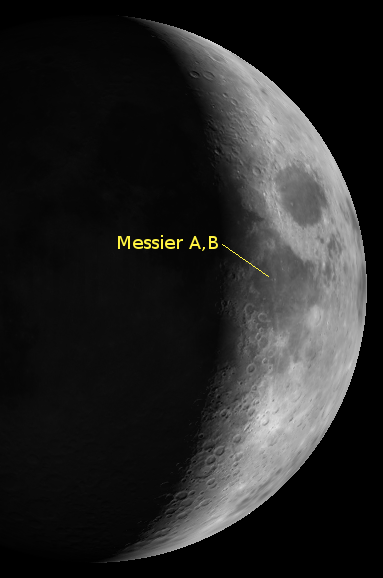
The moon featuring the craters Messier A and B. Chart created using Virtual Moon Atlas
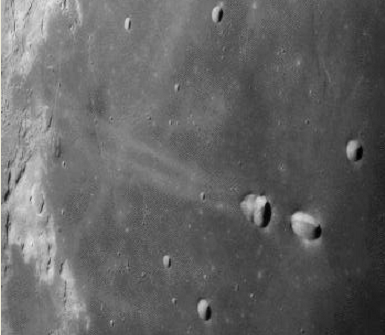
The Craters Messier A and B from Apollo 11. NASA
11/28/11 – Ephemeris – There may be an aurora tonight
Monday, November 28th. The sun will rise at 7:55. It’ll be up for 9 hours and 9 minutes, setting at 5:05. The moon, 3 days past new, will set at 8:53 this evening.
Last Saturday afternoon the sun let loose with an explosion that is sending a cloud of particles toward the earth. It was called a Coronal Mass Ejection or CME for short. As usual for these things, it takes about 48 hours give or take for the cloud of particles to reach the earth. The expected arrival time for the cloud is about noon, give or take 7 hours. If the cloud is a bit late we could get a display of the northern lights or aurora borealis. The sun is getting more active now after a prolonged minimum that lasted over 2 years. The sun is ramping up for a peak in sun spot numbers possibly in 2013. Although the numbers of aurorae occur mostly after peak, so we’re just starting our auroral season, so there will be more opportunities to come.
* Times, as always are for the Traverse City/Interlochen area of Michigan.
11/25/11 – Ephemeris – The mythology of Taurus the bull
Friday, November 25th. The sun will rise at 7:51. It’ll be up for 9 hours and 15 minutes, setting at 5:06. The moon is new today, and won’t be visible.
Low in the east at 9 p.m. is the constellation of Orion the giant hunter. Above him is Taurus the bull. His face is a letter V shape of stars lying on its side with the bright orange-red star Aldebaran at the bottom tip of the V as its angry blood-shot eye. Orion is depicted in the sky facing with club in one hand and a shield in the other the approaching and in some depictions charging Taurus. The V of stars is a star cluster called the Hyades. The Pleiades are in his shoulder above. Taurus in Greek mythology was the guise the god Zeus when he carried off the maiden Europa. Europa’s still with him, sort of, as the intriguing satellite orbiting Zeus’ Roman equivalent Jupiter. In fact the moons around the planet Jupiter are generally named for Jupiter’s lovers and friends.
* Times, as always are for the Traverse City/Interlochen area of Michigan.
Addendum
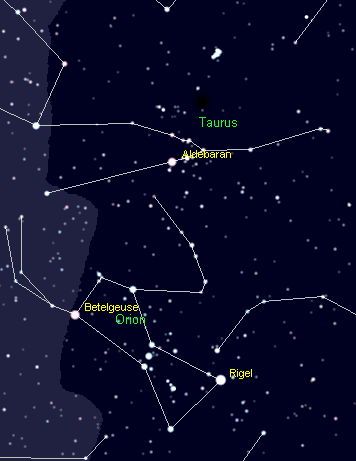
The constellations Taurus and Orion and the Pleiades. Created using Cartes du Ciel.
11/24/11 – Ephemeris – The Pilgrim’s voyage
Thanksgiving Day, Thursday, November 24th. The sun will rise at 7:50. It’ll be up for 9 hours and 16 minutes, setting at 5:07. The moon, 1 day before new, will rise at 8:22 tomorrow morning.
We get the celebration of Thanksgiving from the Pilgrims who celebrated their first harvest, but at the wrong place. They were originally heading for the mouth of the Hudson River, which was considered North Virginia in back then. Navigation in those days was rather imprecise. Latitude was easy to determine at night or at noon but only if it was clear. Longitude was a guess. Generally in the age of sail sailors picked a latitude where the winds blew in the right direction to take them to the Americas, then would sail north or south to the latitude they wanted to go. Storms pushed the Mayflower off course and the Pilgrims ended up near Cape Cod several hundred miles north of their target, an easy mistake to make back then. Have a happy and safe Thanksgiving.
* Times, as always are for the Traverse City/Interlochen area of Michigan.
11/23/11 – Ephemeris – Where are the bright planets this week?
Wednesday, November 23rd. The sun will rise at 7:49. It’ll be up for 9 hours and 18 minutes, setting at 5:08. The moon, 2 days before new, will rise at 7:09 tomorrow morning.
It’s Wednesday and time again to take a look at the whereabouts of the bright planets. The planet Venus is still rather close to the sun in the evening setting at 6:33, and should be visible by 5:45 low in the southwest. Jupiter is now the prominent planet of the evening sky located in the southeast and is seen against the stars of the constellation Aries. It will pass due south at 10:33 p.m. In a telescope it will be accompanied by its 4 brightest moons. It will set at 5:18 a.m.. Mars will rise at 12:18 a.m in the east northeast and will be left of the star Regulus in the constellation Leo tomorrow morning. [It is 128 million miles away and closing.] Saturn will rise at 4:34 a.m. just to the left of the bright star Spica in the east southeast.
* Times, as always are for the Traverse City/Interlochen area of Michigan. Bracketed passage was omitted from the audio program due to time constraints.
11/22/11 – Ephemeris – The constellation Auriga the charioteer
Tuesday, November 22nd. The sun will rise at 7:47. It’ll be up for 9 hours and 20 minutes, setting at 5:08. The moon, 3 days before new, will rise at 5:51 tomorrow morning.
Rising in the east northeast is the bright star Capella and its pentagonal constellation Auriga the Charioteer. Auriga appears to be hunched down in his chariot carrying 4 goats. Capella is the mother goat, and a slim triangle of stars near her are her kids. Perhaps the kids in the chariot were such a distraction that he crashed. So maybe the gods placed them in the sky as a warning. In fact that triangle is an asterism widely known as the Kids. The Milky Way runs through Auriga and it is the home of several star clusters that appear as fuzzy spots in binoculars. Capella for us in northern Michigan never sets. It is a winter star that can be seen year round. It’s disconcerting to spot it scraping the northern horizon in July.
* Times, as always are for the Traverse City/Interlochen area of Michigan.
Addendum
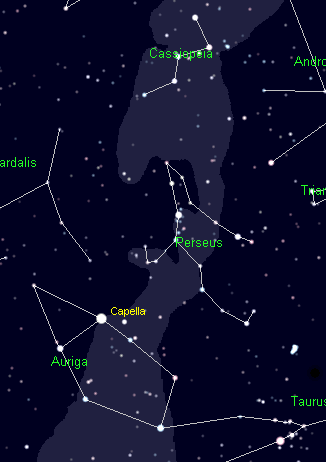
The Constellations Cassiopeia, Perseus and Auriga. Cartes du Ciel

