Archive
11/15/2022 – Ephemeris – Finding the constellation of Aquarius the water bearer
This is Ephemeris for Tuesday, November 15th. Today the Sun will be up for 9 hours and 34 minutes, setting at 5:14, and it will rise tomorrow at 7:41. The Moon, 1 day before last quarter, will rise at 11:13 this evening.
One of the constellations of the zodiac is in the southern sky at 8 in the evening, between Jupiter and Saturn. It’s the constellation of Aquarius, the water bearer. The image that is supposed to be depicted in the stars is that of a fellow spilling a stone jar of water. Aquarius is fairly hard to spot because it is made of faint stars. One part of him, though, is easy to spot. That is the Water Jar, an asterism or informal constellation. It is a distinctive small nearly equilateral triangle of stars with another star in the center. Stars extending to the right from the water jar are the yoke he’s holding the water jar with. The Water jar is above and centered on a line drawn between Jupiter and Saturn. The water is flowing down a line of stars to the lower left.
The astronomical event times given are for the Traverse City/Interlochen area of Michigan (EST, UT -5 hours). They may be different for your location.
Addendum
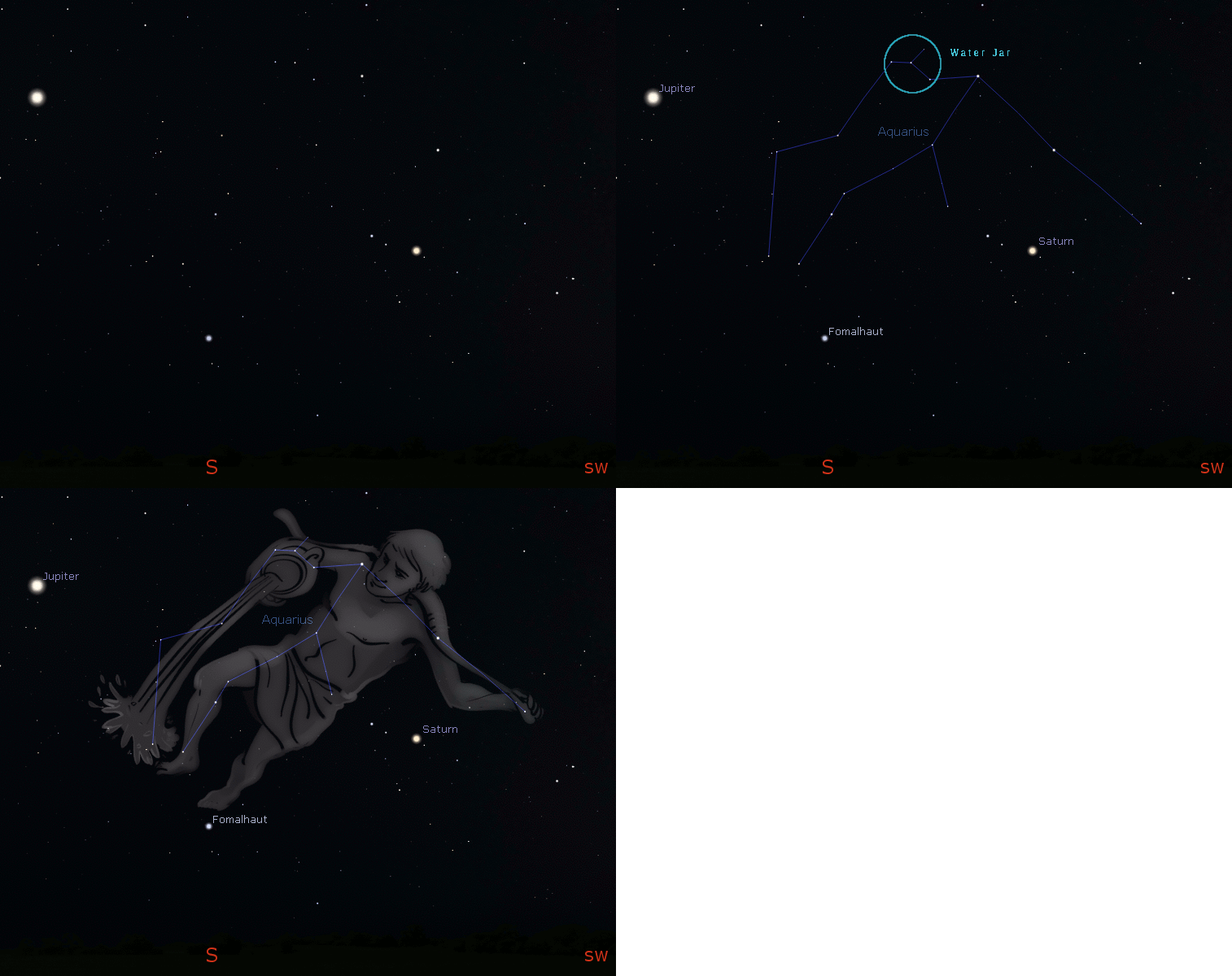
How to find Aquarius this autumn. It’s between Jupiter and Saturn. The image is set for 8 pm tonight, November 15, 2022. Created using Stellarium and GIMP.
11/14/2022 – Ephemeris – Psyche spacecraft to launch to its namesake asteroid next October after a 14-month delay
/
This is Ephemeris for Monday, November 14th. Today the Sun will be up for 9 hours and 37 minutes, setting at 5:15, and it will rise tomorrow at 7:39. The Moon, 2 days before last quarter, will rise at 10:07 this evening.
The launch of the Psyche spacecraft to the asteroid of the same name this past August was canceled due to problems with the spacecraft itself, not the SpaceX Falcon Heavy rocket. NASA thinks they have a handle on the problem and are now wanting to launch in October of next year. If they launched this year, they could have gotten a gravity assist by passing close to Mars on their way to the asteroid belt, where the asteroid Psyche resides. Next year’s launch will not have a Mars flyby and take 2 more years to reach Psyche, a total of 6 years, arriving in 2029. The long flight time is because of the attempt to orbit Psyche rather than just flying by the asteroid. To handle such a maneuver, the spacecraft will also use ion thrusters like the Dawn spacecraft did last decade, which orbited both the asteroids Vesta and Ceres. Psyche is a special metal rich asteroid that may have been the core of a protoplanet.
The astronomical event times given are for the Traverse City/Interlochen area of Michigan (EST, UT – 5 hours). They may be different for your location.
Addendum
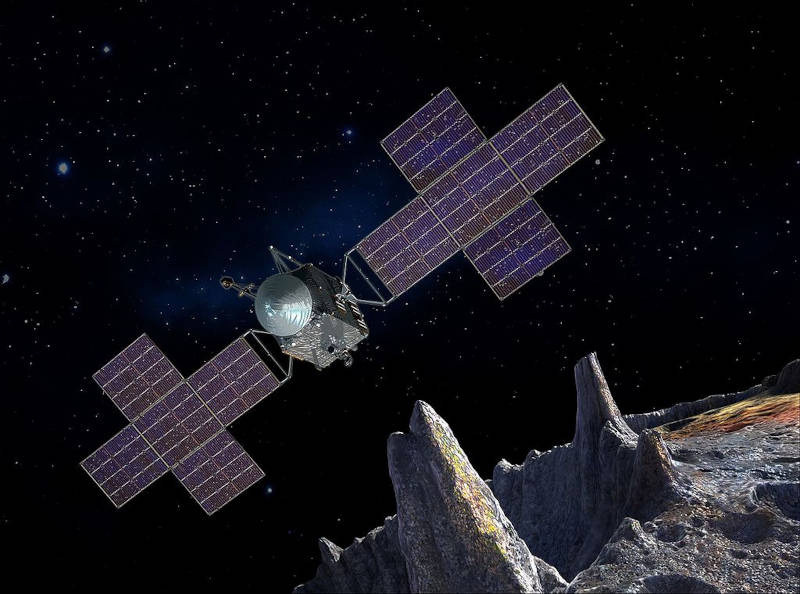
An artist’s rendition of the Psyche spacecraft at the asteroid Psyche. Credit: NASA.
11/11/2022 – Ephemeris – Family Night at the Rogers Observatory tomorrow night
This is Bob Moler with Ephemeris for Veterans Day, Friday, November 11th. Today the Sun will be up for 9 hours and 44 minutes, setting at 5:18, and it will rise tomorrow at 7:35. The Moon, 3 days past full, will rise at 7:15 this evening.
Tomorrow evening the 12th, the Northwestern Michigan College’s Rogers Observatory will hold a Family Night starting at 8 pm, but only if it’s clear or mostly clear. Visible in telescopes will be the waning gibbous Moon, and the planets Jupiter, its cloud bands and four of its moons, and Saturn with its rings and its large moon Titan. The observatory is on Birmley road, south of Traverse City. It can be reached from either Garfield or Keystone roads. This is in celebration of the NASA Kiosk that’s at the Dennos Museum Center through December. There will also be a special Family Day with activities at the Museum Center on December 3rd.
The astronomical event times given are for the Traverse City/Interlochen area of Michigan (EST, UT – 5 hours). They may be different for your location.
Addendum
One of the problems of scheduling an observing event is the inability to guarantee clear skies. And looking at the family night, 48 hours away from when I’m writing this, the weather forecast is for snow, and temperatures near freezing for Saturday, and Saturday and for the next few days. It looks like we’re getting our first real taste of winter. I will post the status of the event on the gtastro.org website several hours before the event on Saturday, and also on this blog as an Ephemeris Extra post.
11/10/2022 – Ephemeris – Artemis I launch scheduled for next week
This is Ephemeris for Thursday, November 10th. Today the Sun will be up for 9 hours and 46 minutes, setting at 5:19, and it will rise tomorrow at 7:34. The Moon, 2 days past full, will rise at 6:32 this evening.
As I’m writing and recording this last Sunday, the Artemis I launch to send the Orion spacecraft, without crew, around the Moon is scheduled for Monday the 14th. However, there is a developing tropical storm (Now named Hurricane Nicole) that is expected to strengthen and hit Florida about now actually, or maybe tomorrow or Saturday. (It’s today!) NASA has two weeks to launch this lunar month, the 14th through the 27th, with three embedded dates in there that they cannot launch because Orion’s solar panels will be in Earth’s shadow too long during the journey. It will really mess up the schedule if NASA has to roll the spacecraft back to the Vertical Assembly Building again, as they did for Hurricane Ian. (They did not roll it back.) Here’s hoping all goes well.
The astronomical event times given are for the Traverse City/Interlochen area of Michigan (EST, UT – 5 hours). They may be different for your location.
(Comments in parentheses were added last night as is the addendum, and were not part of the broadcast)
Addendum
According to the National Hurricane Center, the eye of Hurricane Nicole will pass south of Cape Canaveral by a fair distance and shouldn’t receive hurricane force winds, but should receive 2-4 inches of rain. It will delay the launch until at least the 16th.
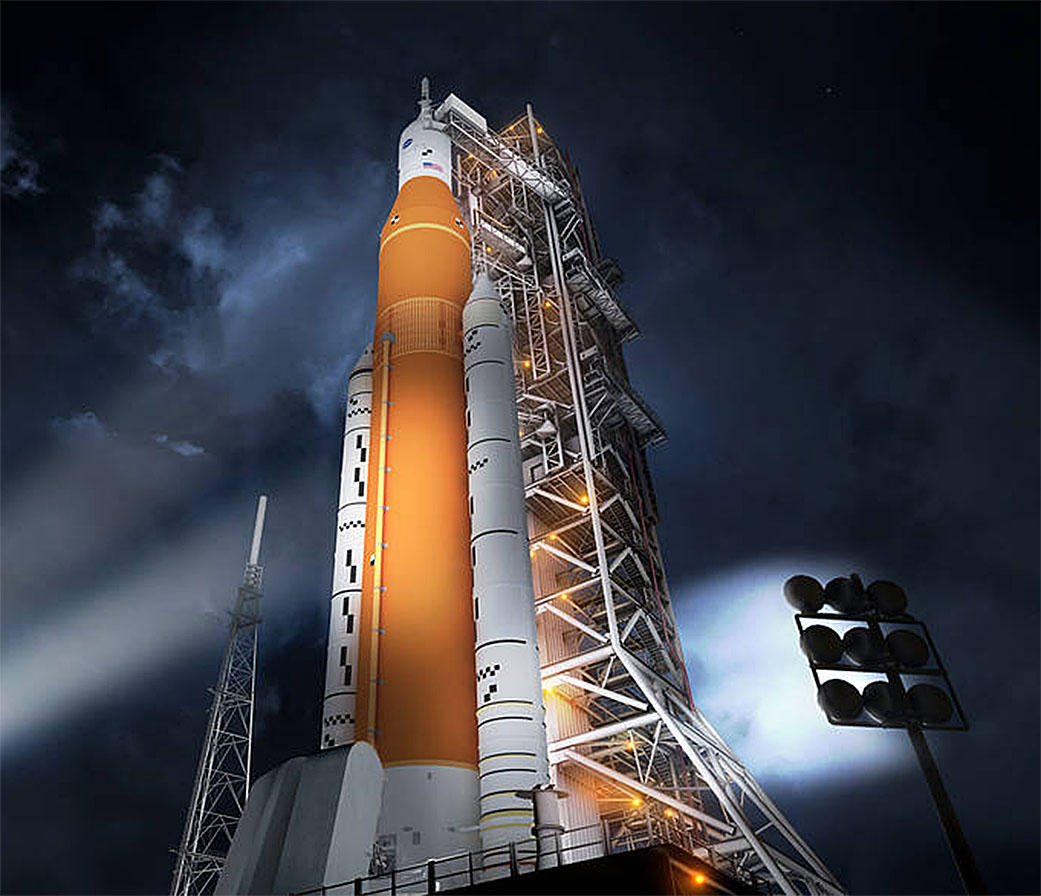
Block 1 Space Launch System with Orion Capsule. Credit NASA.
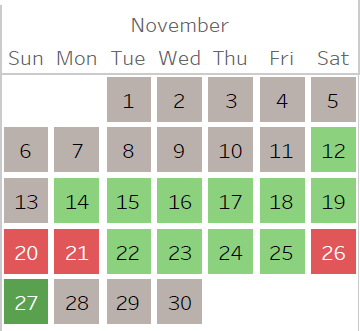
Artemis I November launch calendar. Dates in green are possible launch dates. I’m not sure, but red dates are also forbidden because the Orion Capsule will experience more than 90 minutes in shadow at a time. It’s powered by solar panels. Light green dates allow a long mission of 1 1/2 orbits of the Moon in the distant retrograde orbit (DRO). The dark green dates can only have 1/2 a DRO. Source: NASA.
11/09/2022 – Ephemeris – Let’s see where the naked-eye planets have wandered off to this week
This is Bob Moler with Ephemeris for Wednesday, November 9th. Today the Sun will be up for 9 hours and 49 minutes, setting at 5:21, and it will rise tomorrow at 7:33. The Moon, 1 day past full, will rise at 5:57 this evening.
Let’s see where the naked-eye planets have wandered off to this week. Jupiter and Saturn will be visible this evening, in the southeastern sky, as soon after sunset as it will be dark enough to see them, which would be by 6:30 pm, now that we’re back on standard time. Jupiter is the brighter of the two to the left, in the southeast, while dimmer Saturn is in the south. The red planet Mars, though a morning planet, will rise tonight at 7:13 pm in the east-northeast. It’s located between the tips of the long horns of Taurus the bull. Those stars may be hard to spot with the bright Moon nearby. Mars is beginning to move westward in its retrograde motion as the Earth is beginning to pass it. Which it will do in a month’s time.
The astronomical event times given are for the Traverse City/Interlochen area of Michigan (EDT, UT – 5 hours). They may be different for your location.
Addendum
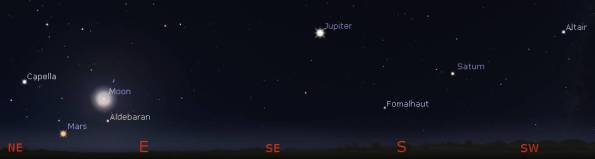
Planets and the Moon visible at 8 pm this evening. Jupiter and Saturn in the south with Mars, rising in the east-northeast. Mars is not yet an evening planet. It’s a month away from rising before sunset and becoming one. Created using Stellarium.
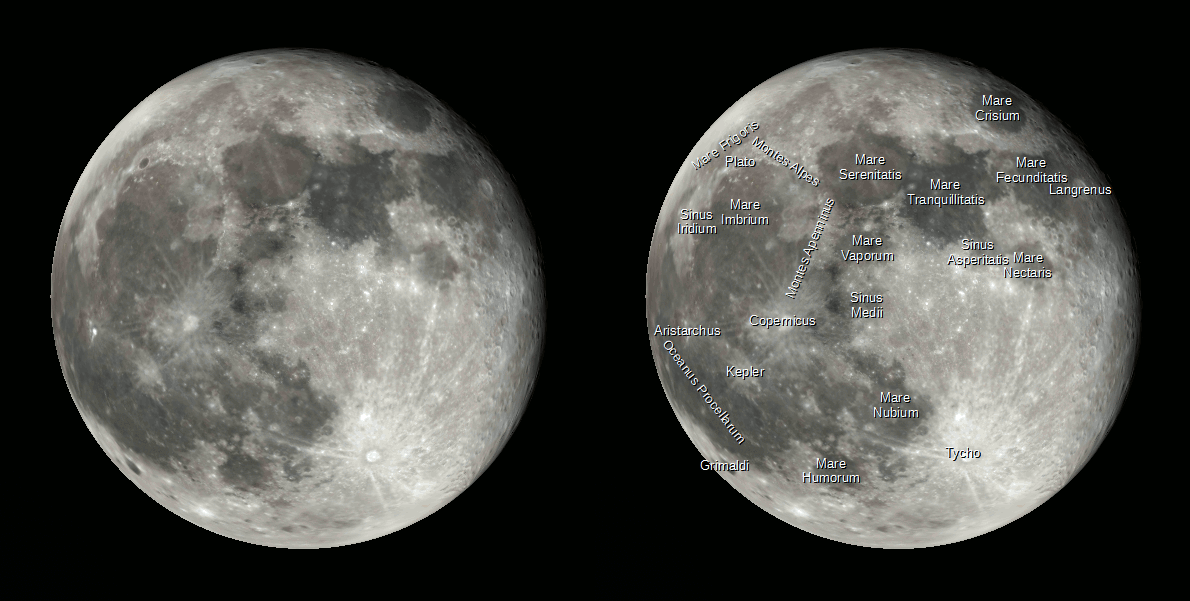
Annotated waning Gibbous Moon Animation for tonight, November 9, 2022, as it might look like in binoculars or a small telescope. Created using Stellarium, LibreOffice Draw and GIMP.
Translations of some lunar feature names according to Virtual Moon Atlas
Mare Crisium – Sea of Crises
Mare Frigoris – Sea of Cold
Mare Humorum – Sea of Moisture
Mare Imbrium – Sea of Showers
Mare Nubium – Sea of Clouds
Mare Serenitatis – Sea of Serenity
Mare Tranquillitatis – Sea of Tranquility
Mare Vaporum – Sea of Vapors
Montes Alpes – Alps Mountains
Montes Apenninus – Apennines Mountains
Oceanus Procellarum – Ocean of Storms
Sinus Asperitatis – Golfe des Asperites
Sinus Iridium – Bay of Rainbows
Sinus Medii – Central Bay
Craters are generally named after astronomers, people of science, or explorers
Note that Mare is pronounced Mar-é
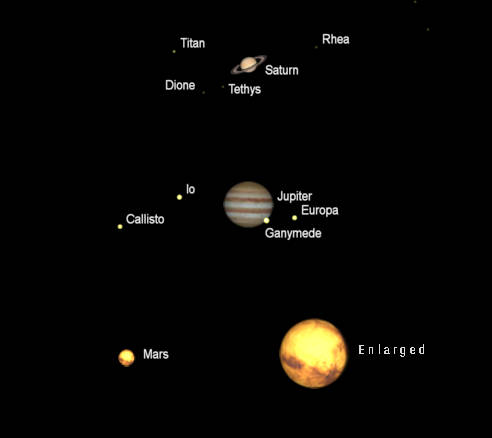
Telescopic views of Saturn Jupiter and Mars (north up) as they would be seen in a small telescope, with the same magnification. The image of Mars doesn’t show it, but the white north polar cap will appear at the top or north limb of Mars. The planets are shown at 10 pm. Apparent diameters: Saturn 17.00″, its rings 39.60″; Jupiter 46.50″; Mars 16.04″. Mars’ distance is 54.3 million miles (87.4 million kilometers). The ” symbol means seconds of arc (1/3600th of a degree.) Click on the image to enlarge it. Created using Cartes du Ciel (Sky Charts).
A note on Jupiter’s moon Ganymede: It will end its transit of the face of Jupiter at 10:04 pm.
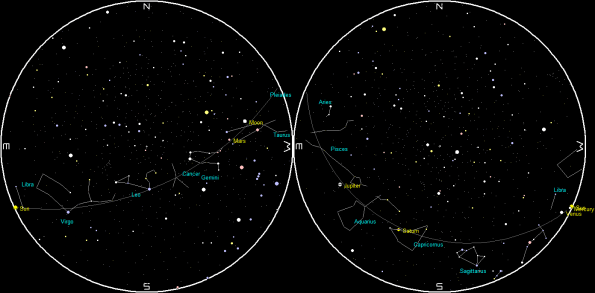
The naked-eye planets and the Moon at sunset and sunrise on a single night, starting with sunset on the right on November 9, 2022. The night ends on the left with sunrise on the 10th. Click on the image to enlarge it. Created using my LookingUp app and GIMP.
11/08/2022 – Ephemeris – Solar Eclipses in our future
This is Ephemeris for Election Day, Tuesday, November 8th. Today the Sun will be up for 9 hours and 51 minutes, setting at 5:22, and it will rise tomorrow at 7:31. The Moon, at full today, will rise at 5:28 this evening.
If you are listening to me early this morning, and it’s clear there is a lunar eclipse in progress. The eclipse will be total before 6:41 am, and partial until the Moon sets at 7:40 am. We will have to wait until March 2025 to see the next total lunar eclipse from our area.
However, we will be able to see two partial solar eclipses in the next year and a half. The first is October 14th, 2023. Nearly half of the Sun will be blocked by the Moon for us. The next one is the big one! April 8th, 2024 is a total eclipse less than a day’s drive away. The path of totality runs from Texas to Maine, just clipping the southeast corner of Michigan. Here in Northern Michigan, nearly 90% of the Sun will be covered by the Moon, so it will get noticeably dark at the peak of the eclipse.
The astronomical event times given are for the Traverse City/Interlochen area of Michigan (EDT, UT – 5 hours). They may be different for your location.
Addendum
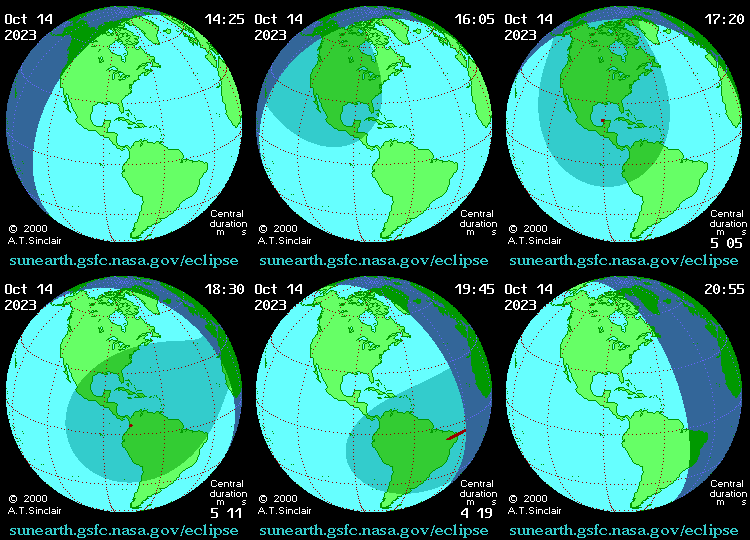
Areas on the Earth where the solar eclipse of October 14, 2023 can be seen via animation. The gray area is where the partial eclipse is visible. The dot is the place where the ring of the annular eclipse can be seen. Credit: NASA, A. T. Sinclair.
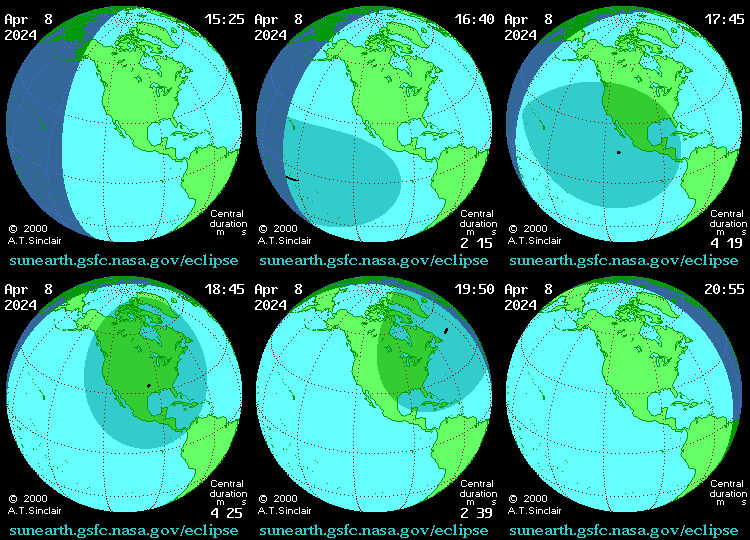
Areas on the Earth where the solar eclipse of April 8, 2024 can be seen via animation. The gray area is where the partial eclipse is visible. The dot is the place where the totally eclipsed Sun can be seen. Credit: NASA, A. T. Sinclair.
For more information on solar and lunar eclipses past and present, go here, NASA’s Eclipse Website.
11/07/2022 – Ephemeris – There will be a total eclipse of the Moon in the hours before sunrise tomorrow morning
This is Bob Moler with Ephemeris for Monday, November 7th. Today the Sun will be up for 9 hours and 54 minutes, setting at 5:23, and it will rise tomorrow at 7:30. The Moon, 1 day before full, will set at 7:40 tomorrow morning.
There will be a total eclipse of the Moon tomorrow morning. We in Michigan are near the eastern edge of the part of the Earth that can see the eclipse. The partial phase will begin at 4:09 am. More and more of the Moon will enter the Earth’s inner shadow, until 5:16 am, when the Moon will be completely eclipsed. We expect the Moon to have a reddish hue from sunlight leaking and bent through Earth’s atmosphere into the shadow. This total phase will last until 6:41 am, when the Moon will begin to emerge into sunlight to start the ending partial phase of the eclipse. By this time, the Moon will be getting low in the west. The Moon will set around 7:40 am, just before the end of the eclipse and a few minutes after sunrise.
The astronomical event times given are for the Traverse City/Interlochen area of Michigan (EDT, UT – 5 hours). They may be different for your location.
Addendum
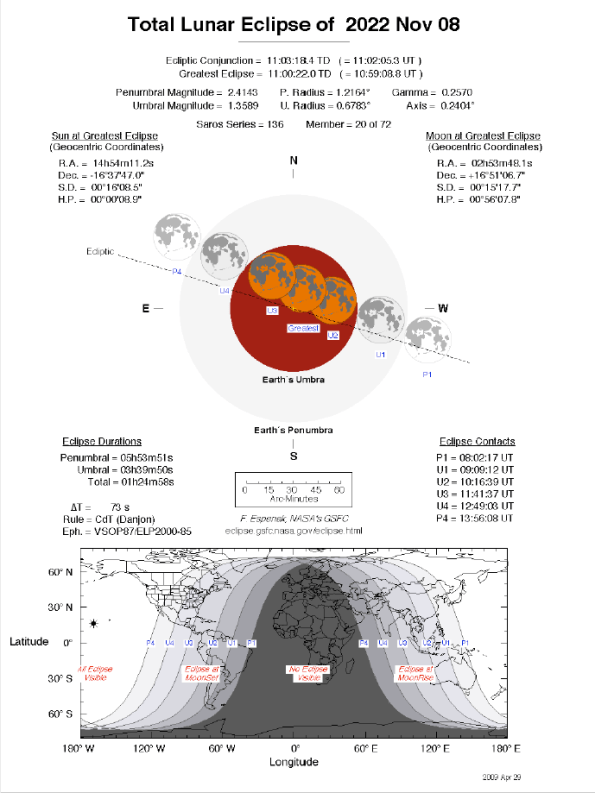
Credit: NASA/GSFC, Fred Espenak. Click on the image for the full size PDF file from the NASA eclipse site.
The contact times again for Eastern Standard Time
Contact                     Time EST
U1 Partial eclipse starts...4:09 am
U2 Totality starts..........5:16 am
   Mid-eclipse..............6:00 am
U3 Totality ends............6:41 am
U4 Partial eclipse ends.....7:49 am
P1 and P4 are not noticeable, so are not listed. The penumbral shadow will be noticeable, generally for a half hour or so before U1 and again for a half hour or so after U4, if you are located far enough west of here to see the complete eclipse.
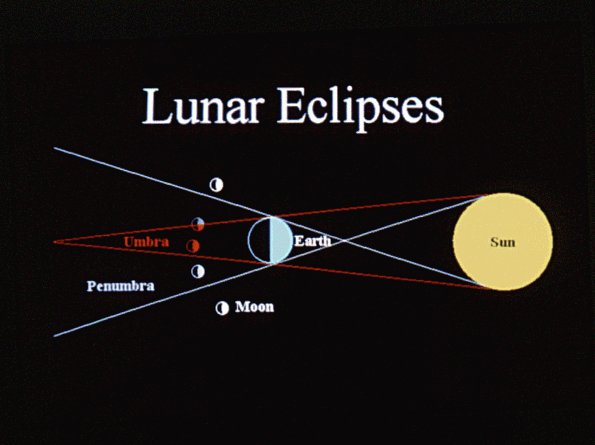
This is a not-to-scale diagram of the motion of the moon through the Earth’s shadow during a lunar eclipse. Assume we are looking down from the north, the motion of the Moon will be counterclockwise. The Moon will enter the shadow from the west or right, so the first “bite” of the shadow will be on the left side of the Moon. The penumbra is a gradually increasing shadow from the outer edge to the umbra, where the Sun is partially blocked by the Earth.
The Moon’s appearance in totality
The Moon will normally appear to have a dull reddish hue during totality, though the edge of the umbra will normally appear gray. When there is a spectacular volcanic eruption, the volcanic dust in the atmosphere can produce an especially dark eclipse. The normal red color is due to all the sunrises and sunsets occurring on the Earth during the eclipse. The atmosphere scatters out the blue component of the sunlight, giving us red sunrises and sunsets. Also, the atmosphere refracts or bends the sunlight into the Earth’s inner shadow, the umbra, at the Moon’s distance, so the totally eclipsed Moon isn’t completely dark.
11/04/2022 – Ephemeris – The GTAS meeting topic tonight is the history of the constellations
This is Ephemeris for Friday, November 4th. The Sun will rise at 8:24. It’ll be up for 10 hours and 2 minutes, setting at 6:27. The Moon, 3 days past first quarter, will set at 5:06 tomorrow morning.
Tonight at 8 pm, the Grand Traverse Astronomical Society (GTAS) will have their monthly meeting at Northwestern Michigan College’s Rogers Observatory. The meeting will also be available via Zoom. The program will be presented by Becky Shaw. Her presentation will be The History of the Constellations. From time immemorial, people have looked at the night sky and tried to give meaning to the random scattering of stars on the dome of the sky. The official constellations of the International Astronomical Union in most cases date back to the Babylonians, and Greeks. If it’s clear, there will be a star party following the meeting. The observatory is located south of Traverse City off Birmley Road, between Garfield and Keystone roads. A Zoom link will be available at gtastro.org before the meeting. All are welcome.
The astronomical event times given are for the Traverse City/Interlochen area of Michigan (EDT, UT – 4 hours). They may be different for your location.
Addendum
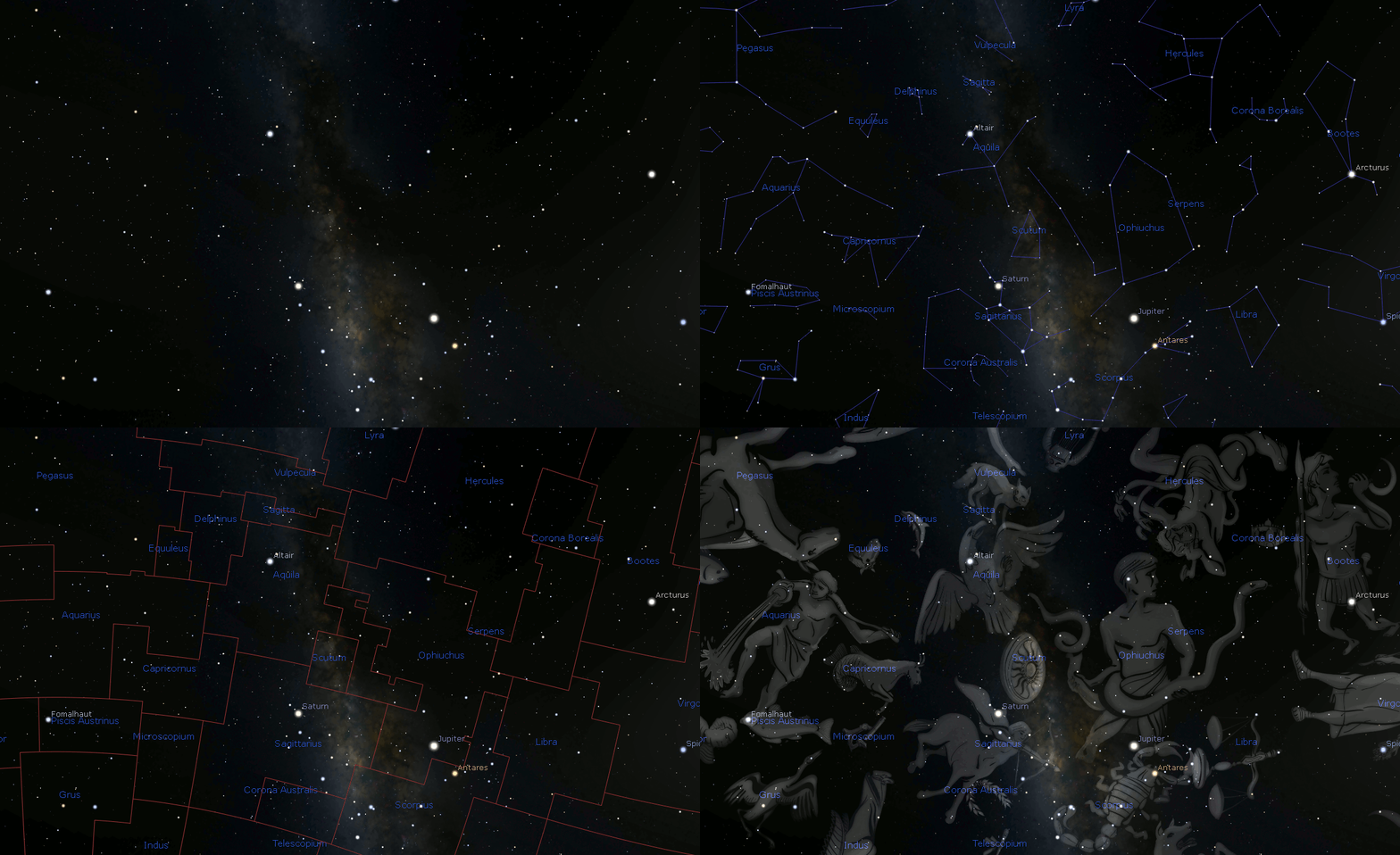
Summer Constellations showing stars, lines, boundaries, and figures in succession. Click on the image to enlarge it and be able to read the labels. This image shows the stars and planets three years ago in 2019, when Jupiter and Saturn were seen against the summer constellations. Slow poke Saturn has moved into eastern Capricornus. Jupiter is just off the left of the image in Pisces. The head of one of the fish is seen there. Created using Stellarium and GIMP.
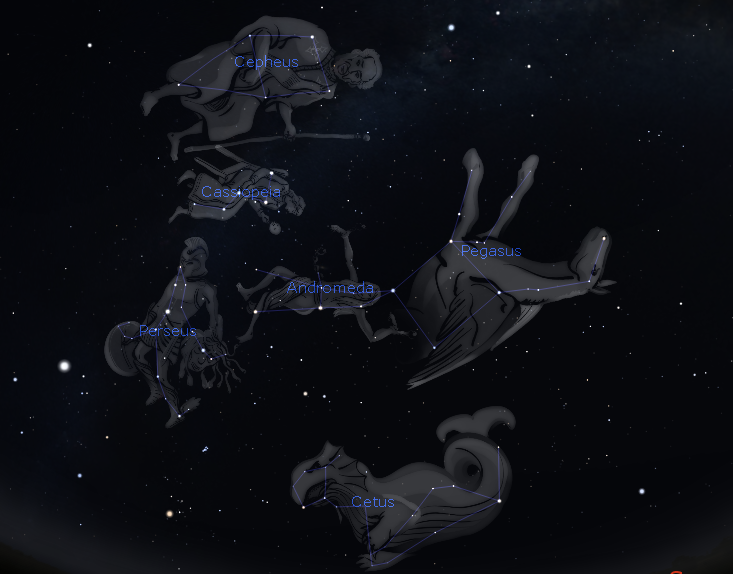
The constellations of the great star story of autumn. Looking southeast on October 31 at 10 p.m. Not all the constellations in this area are shown. Created using Stellarium.
11/03/2022 – Ephemeris – The Persephone Period
This is Ephemeris for Thursday, November 3rd. The Sun will rise at 8:23. It’ll be up for 10 hours and 5 minutes, setting at 6:28. The Moon, 2 days past first quarter, will set at 3:53 tomorrow morning.
The Moon, tonight, is spending its second night between Saturn and Jupiter. Tomorrow night will find it just above Jupiter. Down in our area, the Persephone period is starting. I didn’t find out about this until recently. According to Greek myth, Persephone, daughter of Zeus and Demeter, was abducted by her uncle the god Hades to be made his queen of the underworld. When she was in the underworld, the crops died. An arrangement had to be made by her father Zeus, so she would spend part of the year above ground, so that crops would flourish, and part of the year below. When the daylight hours drop below 10 hours, which it is doing in our area now, we are entering the Persephone period, where there is too little sunlight for plants to thrive. This period will last until around February 5th. When daylight hours advance past 10 hours.
The astronomical event times given are for the Traverse City/Interlochen area of Michigan (EDT, UT – 4 hours). They may be different for your location.
Addendum
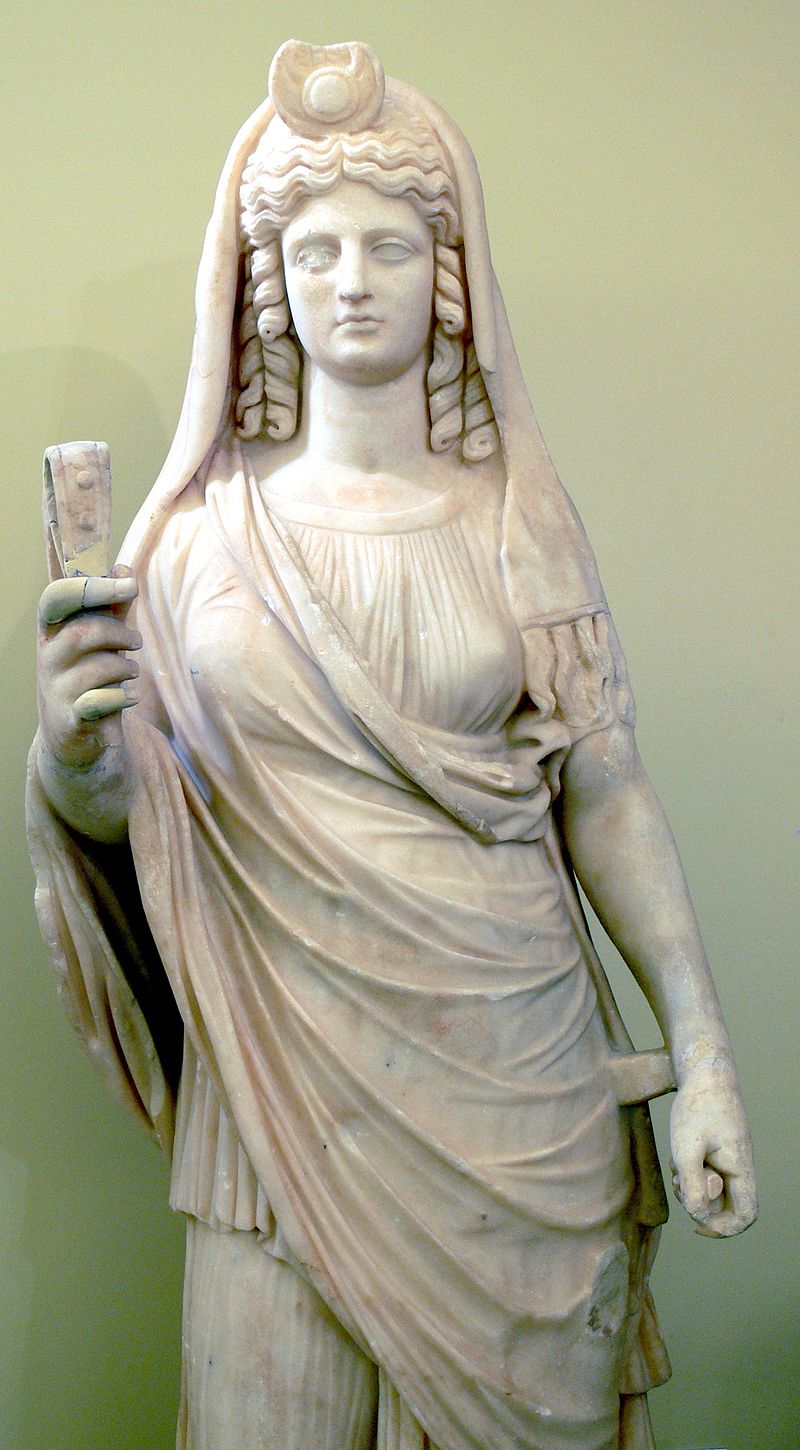
Statue of Persephone-Isis at the Heraklion Archaeological Museum, Crete. Credit: Wolfgang Sauber
Around here, in the Grand Traverse Region of Michigan, and indeed the whole state, the Persephone period generally starts after the first killing frost, though this year only the tenderest plants have succumbed to whatever frost there was so far at my place. Daytime temperatures this week have reached the high 60s, which is unusual. The end of the Persephone period comes way early for us. Snow could persist for another two and a half months.
11/02/2022 – Ephemeris – Let’s see where the naked-eye planets have wandered off to this week
This is Bob Moler with Ephemeris for Wednesday, November 2nd. The Sun will rise at 8:22. It’ll be up for 10 hours and 7 minutes, setting at 6:29. The Moon, 1 day past first quarter, will set at 2:38 tomorrow morning.
Let’s see where the naked-eye planets have wandered off to this week. Jupiter and Saturn will be visible this evening, in the southeastern sky with the bright moon between them, as soon after sunset as it will be dark enough to see them, which would be by 7:45 pm. Jupiter is the brighter of the two to the left of the Moon, while dimmer Saturn is closer to the Moon on the right. The red planet Mars, though a morning planet, will rise tonight at 8:46 pm in the northeast. It’s located between the tips of the long horns of Taurus the bull, slowly moving northward between those horn tip stars in its big torn to the west among the stars. By seven tomorrow morning, the red planet Mars will be fairly high in the southwestern sky, above and right of the winter constellation of Orion.
The astronomical event times given are for the Traverse City/Interlochen area of Michigan (EDT, UT – 4 hours). They may be different for your location.
Addendum
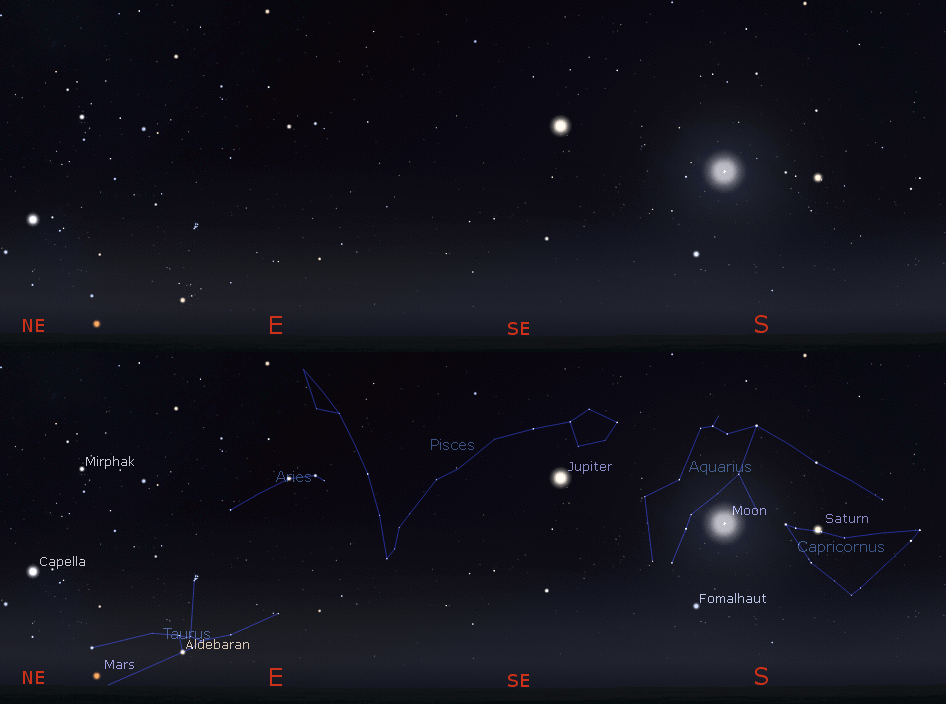
Planets and the Moon visible in the evening. Jupiter and Saturn in the south with Mars, rising in the northeast. Mars is not yet an evening planet. It’s still more than a month away from rising before sunset and becoming one. Click on the image to enlarge it. Created using Stellarium and GIMP.
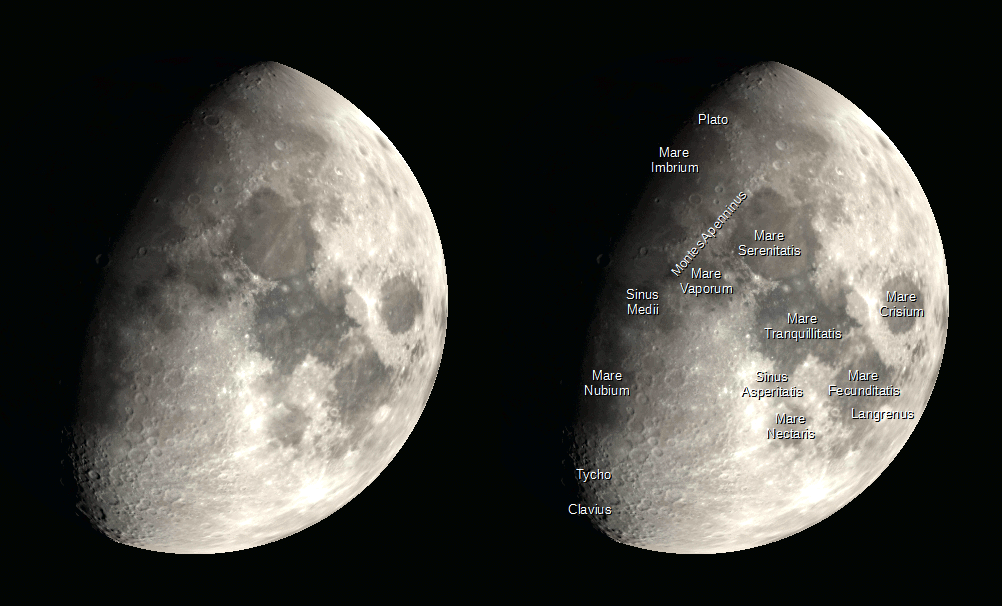
The Moon as it might be seen in binoculars or small telescope tonight, November 2, 2022 with labels of prominent features. Created using Stellarium, LibreOffice Draw and GIMP.
Translations of some lunar feature names according to Virtual Moon Atlas
Mare Crisium – Sea of Crises
Mare Fecunditatis – Sea of Fertility
Mare Imbrium – Sea of Showers
Mare Nubium – Sea of Clouds
Mare Serenitatis – Sea of Serenity
Mare Tranquillitatis – Sea of Tranquility
Mare Vaporum – Sea of Vapors
Montes Apenninus – Apennines Mountains
Sinus Asperitatis – Golfe des Asperites
Sinus Medii – Bay of the Center
Craters are generally named after astronomers, people of science, or explorers
Note that Mare is pronounced Mar-é
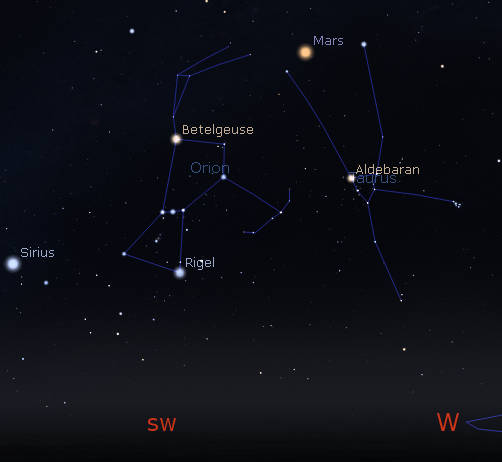
Mars in the at 7 am tomorrow morning, November 3, 2022. Created using Stellarium.
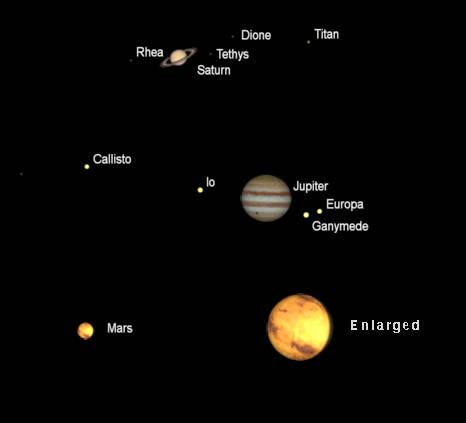
Telescopic views of Saturn Jupiter and Mars (north up) as they would be seen in a small telescope, with the same magnification. The image of Mars doesn’t show it, but the white north polar cap will appear at the top or north limb of Mars. Saturn and Jupiter are shown at 9 pm, Mars at 11 pm. Apparent diameters: Saturn 17.20″, its rings 40.07″; Jupiter 47.37″. Mars 15.34″. Mars’ distance is 56.7 million miles (91.4 million kilometers). The ” symbol means seconds of arc (1/3600th of a degree.) Click on the image to enlarge it. Created using Cartes du Ciel (Sky Charts).
A note on Jupiter and its moons: Before 7:56 pm, Io will be in Jupiter’s shadow. At 8:22 pm, Ganymede’s shadow will begin to cross the face of Jupiter. In the image above, the shadow, a small dot, is seen on the lower left of the disk. Europa’s shadow was on the disk prior to 9 pm. Ganymede’s shadow will leave the disk at 11:08 pm. Shadows cross Jupiter’s disk from east to west (right to left) in this view.
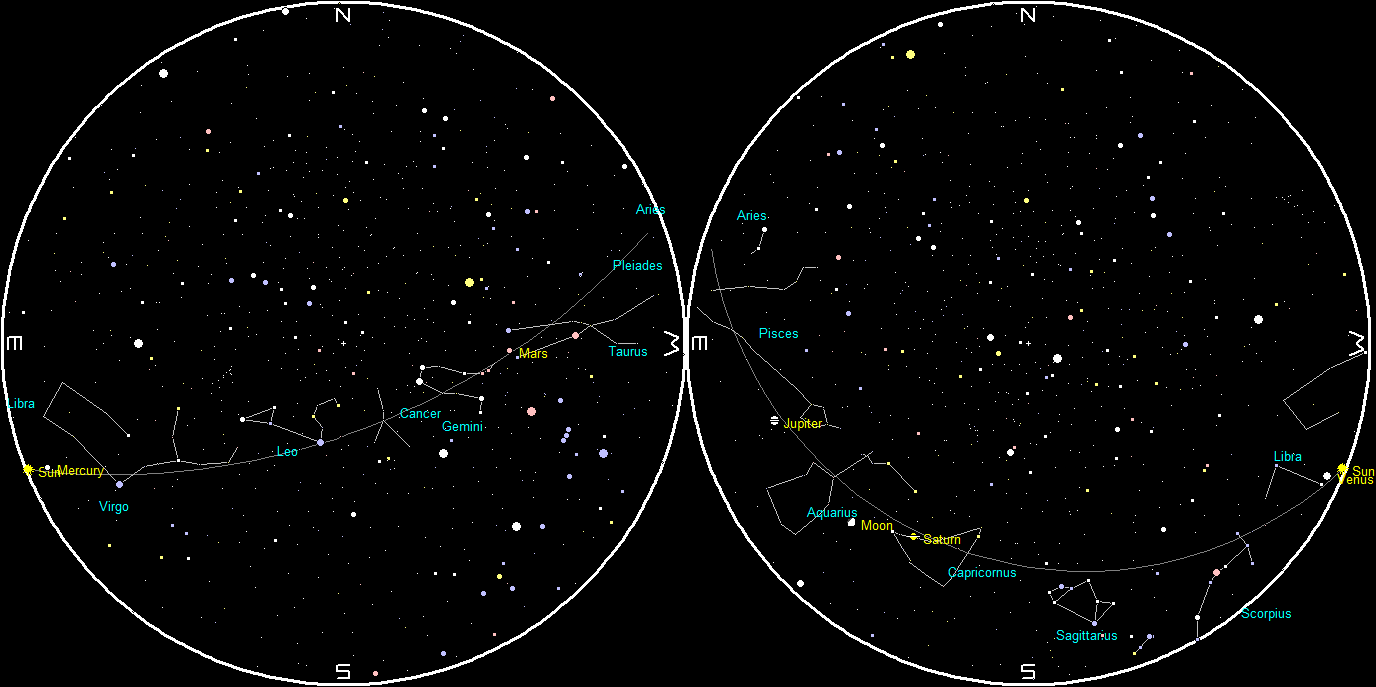
The naked-eye planets and the Moon at sunset and sunrise on a single night, starting with sunset on the right on November 2, 2022. The night ends on the left with sunrise on the 3rd. Click on the image to enlarge it. Created using my LookingUp app and GIMP.
 Bob Moler's Ephemeris Blog