Archive
Ephemeris: 07/25/2024 – The Milky Way as it will appear tonight
This is Ephemeris for Thursday, July 25th. Today the Sun will be up for 14 hours and 54 minutes, setting at 9:16, and it will rise tomorrow at 6:23. The Moon, 2 days before last quarter, will rise at 11:43 this evening.
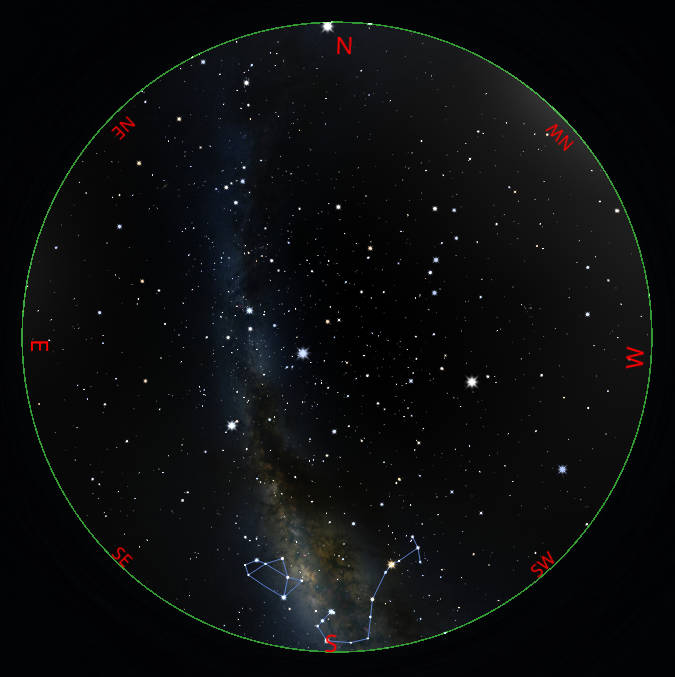
With the Moon out of the sky until almost 11:30 PM we get our first look at the summer Milky Way in the evening. The Milky Way will stretch from the east-northeast, high in the east to the South. The asterism of the stout little Teapot in Sagittarius, low to the south, is near the bottom end of the Milky Way. The milky stream appears as steam coming out of the spout. With more stars there, one might be able to see the Centaur with a bow and arrow. The front part of the teapot is the bow. The bottom left, and the far right star are the back and the tip of the arrow which is pointing at the heart of Scorpius the scorpion in the south-southwest. We’ll be exploring the wonders of the summer Milky Way this month and next.
The astronomical event times given are for the Traverse City/Interlochen area of Michigan (EDT, UT–4 hours). They may be different for your location.
Addendum
Ephemeris: 09/11/2023 – Scutum, an almost invisible constellation in the Milky Way
This is Ephemeris for Monday, September 11th. Today the Sun will be up for 12 hours and 44 minutes, setting at 8:01, and it will rise tomorrow at 7:17. The Moon, 3 days before new, will rise at 4:32 tomorrow morning.
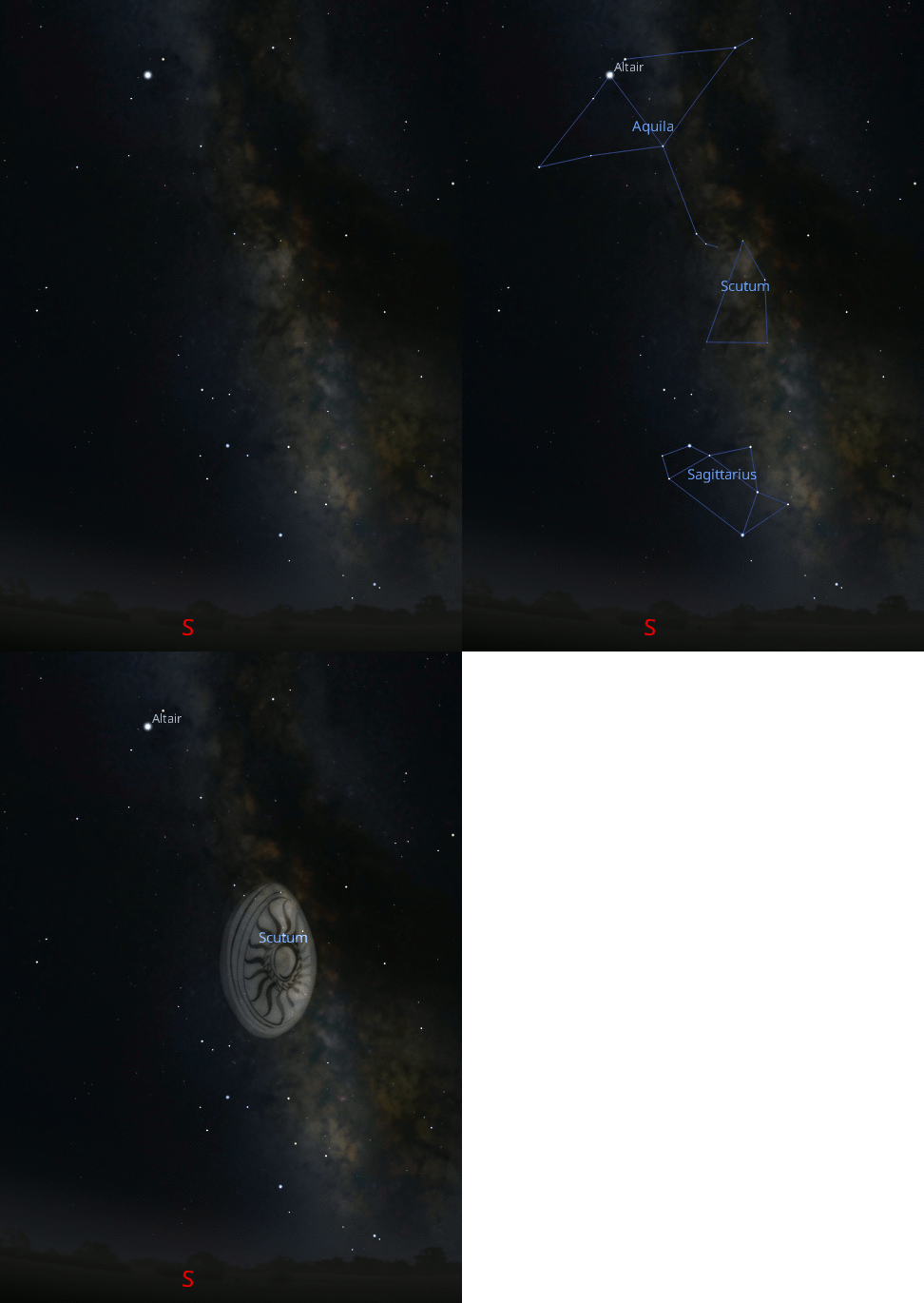
In the southern sky between the Teapot of Sagittarius below and Aquila the Eagle above, with Altair the southernmost star of the Summer Triangle, lies Scutum the shield of John Sobieski the Polish king who stopped the advance of the Turks at Kalenberg in 1683. The Polish half of me is very proud. Scutum is one of two official constellations which are related to real persons. The other one is Coma Berenices, a hank of the Egyptian Queen Berenice’s hair. However, the stars here are so dim and embedded in the glow of the Milky Way as to be nearly impossible to discern. Scutum lies in one of the richest portions of the Milky Way, wonderful to scan with binoculars and telescopes for star clusters and nebulae, clouds of dust and gas.
The astronomical event times given are for the Traverse City/Interlochen area of Michigan (EDT, UT –4 hours). They may be different for your location.
Addendum
Ephemeris: 08/15/2023 – The Great Rift
This is Ephemeris for Tuesday, August 15th. Today the Sun will be up for 14 hours and 3 minutes, setting at 8:48, and it will rise tomorrow at 6:46. The Moon, 1 day before new, will rise at 6:41 tomorrow morning.
Once one finds the Milky Way which is pretty hard to miss this month, it becomes obvious that the Milky Way is split lengthwise starting near Deneb, the northernmost star of the Summer Triangle, almost all the way to the Teapot of Sagittarius low in the south. That dark split is called the Great Rift. Galileo first discovered that the hazy clouds of the Milky Way we’re actually made of faint stars, so it was thought the dark areas were due to a lack of stars. The great 18th century astronomer William Herschel did star counts all over the sky with his telescope. A map drawn of the shape of the Galaxy shows the lack of distant stars in the direction of the Great Rift. It’s not really fewer stars, but interstellar clouds of dust blocking the light of stars behind them.
The astronomical event times given are for the Traverse City/Interlochen area of Michigan (EDT, UT –4 hours). They may be different for your location.
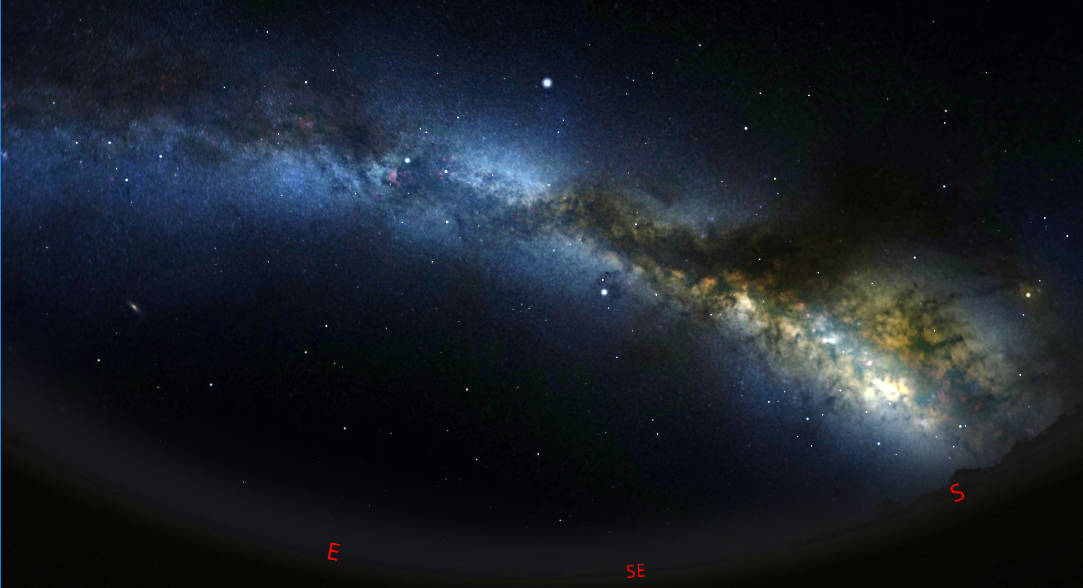
The span of the Milky Way across the summer sky as seen in the free Stellarium app. Specifically August 15th at 10 pm from Northern Michigan. The Milky Way has been set to its maximum brightness to show as much detail as possible. It really isn’t that bright. The horizon is only delineated by the compass points. The dark clouds of the Great Rift are also visible. The Milky Way, in Stellarium, is photo-realistic. The triangle of three bright stars above center is the Summer Triangle, Specifically, clockwise from the top star: Vega, Altair and Deneb. Large images can be truncated on the right. Click or tap on the image to enlarge and display the complete image.
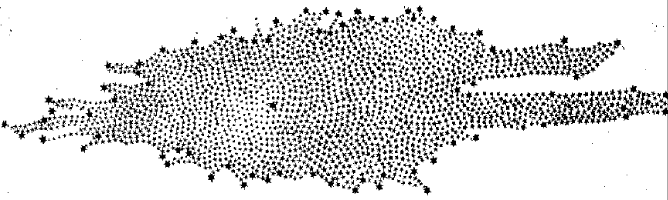
William Herschel’s vision of the cross-section of the Milky Way from 1785, drawn by his sister and collaborator, Caroline Herschel. The Great Rift is seen as the gap between the fingers of stars on the right. Herschel thought the rift was caused by a lack of stars. Other than that, he got the flattened shape right, for what he could see within ten thousand light years. The center of the Milky Way lies 27,000 light years to the right. The spiral structure of the Milky Way wasn’t determined until the advent of radio telescopes in the mid-twentieth century.
Ephemeris: 08/14/2023 – August is the month to explore the Milky Way
This is Ephemeris for Monday, August 14th. Today the Sun will be up for 14 hours and 6 minutes, setting at 8:50, and it will rise tomorrow at 6:44. The Moon, 2 days before new, will rise at 5:35 tomorrow morning.
Now is the time the summer Milky Way is displayed to its fullest to the southern horizon. We have a week and a half before the Moon begins to encroach on our dark skies after 10 pm. City folk come to our area and are sometimes fooled by the brightness and expanse of the Milky Way and think it’s a cloud. Yes, those are clouds indeed, but they are clouds of stars. Binoculars will begin to show them to be millions of stars, each too faint to be seen individually to the eye, but whose combined glow give the impression of a luminous cloud. Binoculars are the ideal tool to explore the Milky Way. Objects still too fuzzy can be checked out with a telescope to reveal their true nature. The dark nights of August and September are my favorites.
The astronomical event times given are for the Traverse City/Interlochen area of Michigan (EDT, UT –4 hours). They may be different for your location.
Addendum
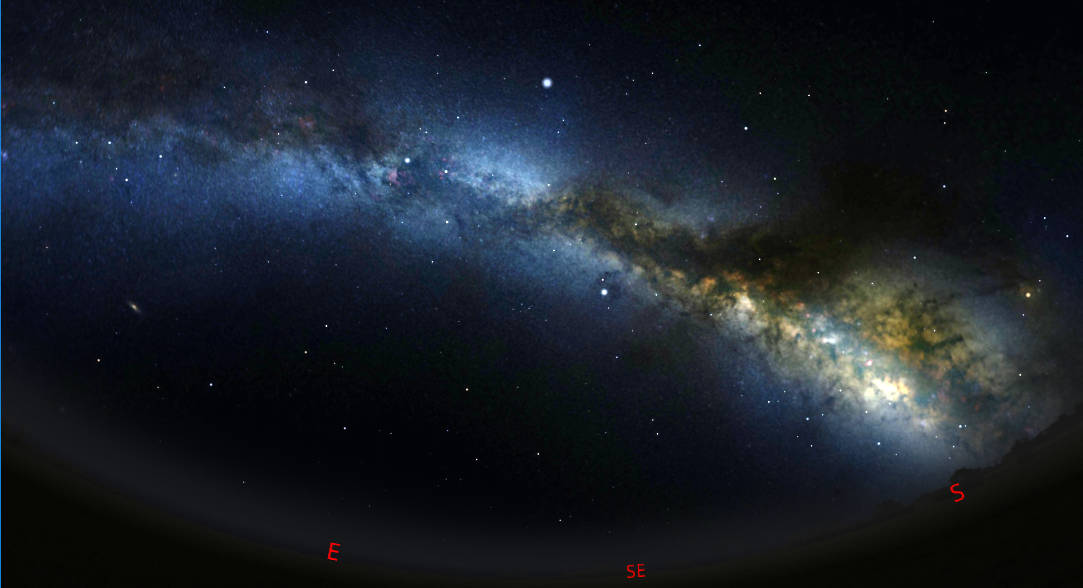
The span of the Milky Way across the summer sky as seen in the free Stellarium app. Specifically August 15th at 10 pm from Northern Michigan. The Milky Way has been set to its maximum brightness to show as much detail as possible. It really isn’t that bright. The horizon is only delineated by the compass points. The dark clouds of the Great Rift are also visible. The Milky Way, in Stellarium, is photo-realistic. The triangle of three bright stars above center is the Summer Triangle, Specifically, clockwise from the top star: Vega, Altair and Deneb. Large images can be truncated on the right. Click or tap on the image to enlarge and display the complete image.
08/25/2022 – Ephemeris – Looking to the heart of the Milky Way
This is Bob Moler with Ephemeris for Thursday, August 25th. Today the Sun will be up for 13 hours and 34 minutes, setting at 8:31, and it will rise tomorrow at 6:58. The Moon, 2 days before new, will rise at 5:52 tomorrow morning.
Behind a dark cloud in the Milky Way, just above the spout of the teapot asterism or informal constellation that we see of the zodiacal constellation of Sagittarius, lies the very center of our Milky Way Galaxy. It cannot be seen in visible light, but can be detected with radio waves and infrared light that can penetrate the clouds of dust between. In 1932 Bell Laboratory physicist and radio engineer, Karl Jansky, discovered a source of radio static that came from that region of sky. It was subsequently given the designation Sagittarius A. It turns out that within that source there is an object called Sagittarius A* (Pronounced Sagittarius A Star), invisible in the near infrared, but with the mass of four million suns. It was recently imaged as the black hole at the center of our galaxy.
The astronomical event times given are for the Traverse City/Interlochen area of Michigan (EDT, UT – 4 hours). They may be different for your location.
Addendum
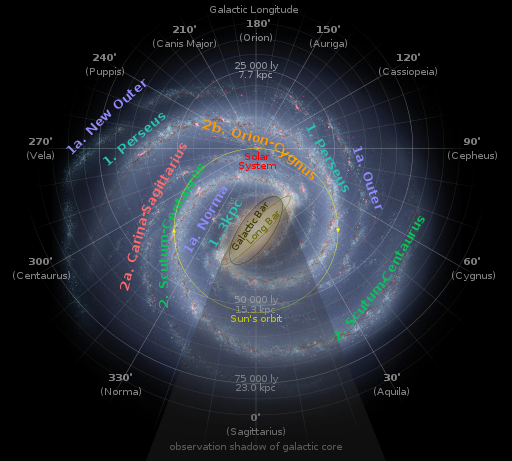
Our place in the Milky Way. Note that we appear to be in a barred spiral galaxy. The arms are numbered and named. 3kpc is the 3 kiloparsec arm. 3kpc = 9,780 light years. The Sun is about 27,000 light years from the center. Credit NASA and Wikimedia Commons, via EarthSky.org
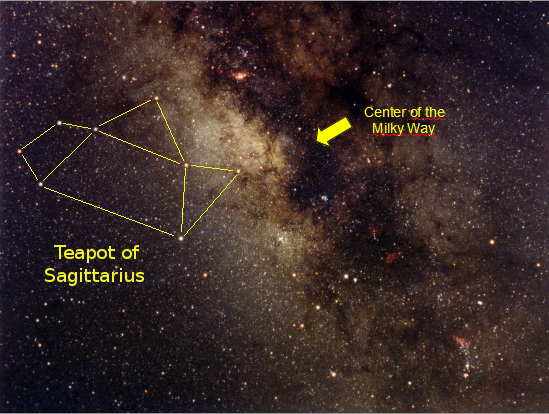
Location of the center of the Milky Way and the Teapot of Sagittarius. It’s behind that dark cloud.
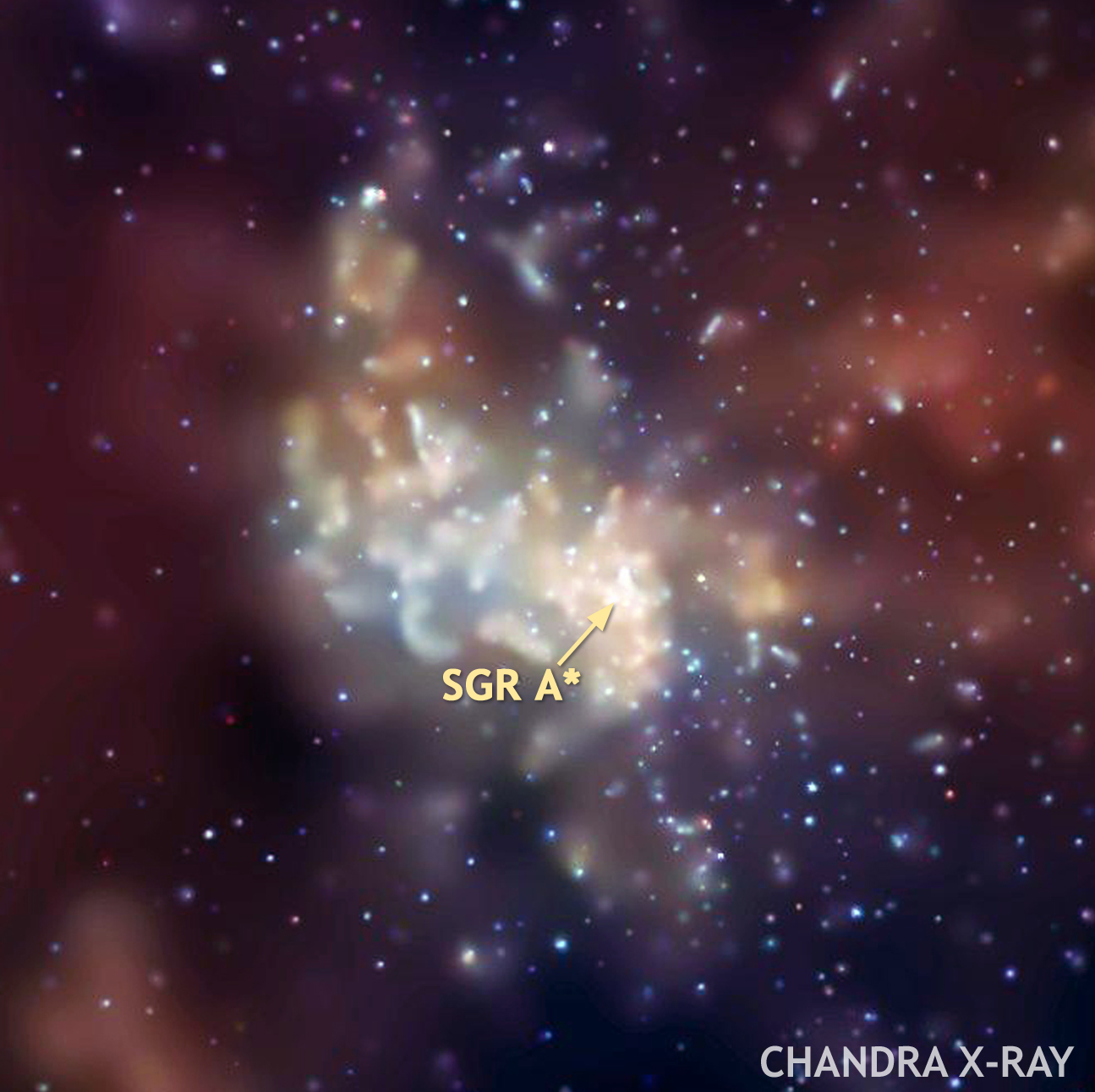
An image from the Chandra X-ray Telescope of the center of the Milky Way. SGR A or Sagittarius A is a radio source. SGR A*, pronounced Sagittarius A Star, is the 4 million solar mass black hole in the center of the Milky Way Galaxy. Credit NASA.
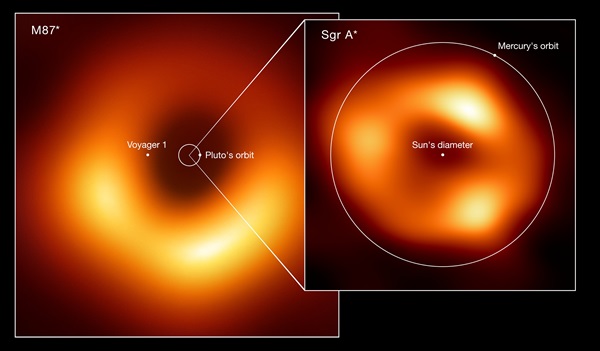
M87* size compared to Sagittarius A*. The size of a black hole is directly related to its mass. The asterisk * is pronounced “Star”. Credit: Event Horizon Telescope Collaboration.
The black hole images were reconstructed from data from 8 sub millimeter radio telescopes and arrays of the Event Horizon Telescope Collaboration. The telescopes were located from Greenland to the South Pole and From Hawai’i to Europe. The data from the telescopes, observing the black holes simultaneously, were combined to act like a single telescope with the diameter of the Earth in order to resolve the black holes.
08/18/2022 – Ephemeris – The Great Rift
This is Ephemeris for Thursday, August 18th. Today the Sun will be up for 13 hours and 54 minutes, setting at 8:43, and it will rise tomorrow at 6:49. The Moon, 1 day before last quarter, will rise at 12:02 tomorrow morning.
High overhead, the Milky Way is seen passing through the Summer Triangle of three bright stars. Here we find the Milky Way splits into two sections. The split starts in the constellation of Cygnus the Swan or Northern Cross very high in the east. The western part of the Milky Way ends southwest of Aquila the eagle. This dark dividing feature is called the Great Rift. Despite the lack of stars seen there, it doesn’t mean that there are fewer stars there than in the brighter patches of the Milky Way. The rift is a great dark cloud that obscures the light of the stars behind it. Sometimes binoculars can be used to find the edges of the clouds of the rift, as star numbers drop off suddenly. This is especially easily seen in Aquila.
The astronomical event times given are for the Traverse City/Interlochen area of Michigan (EDT, UT – 4 hours). They may be different for your location.
Addendum
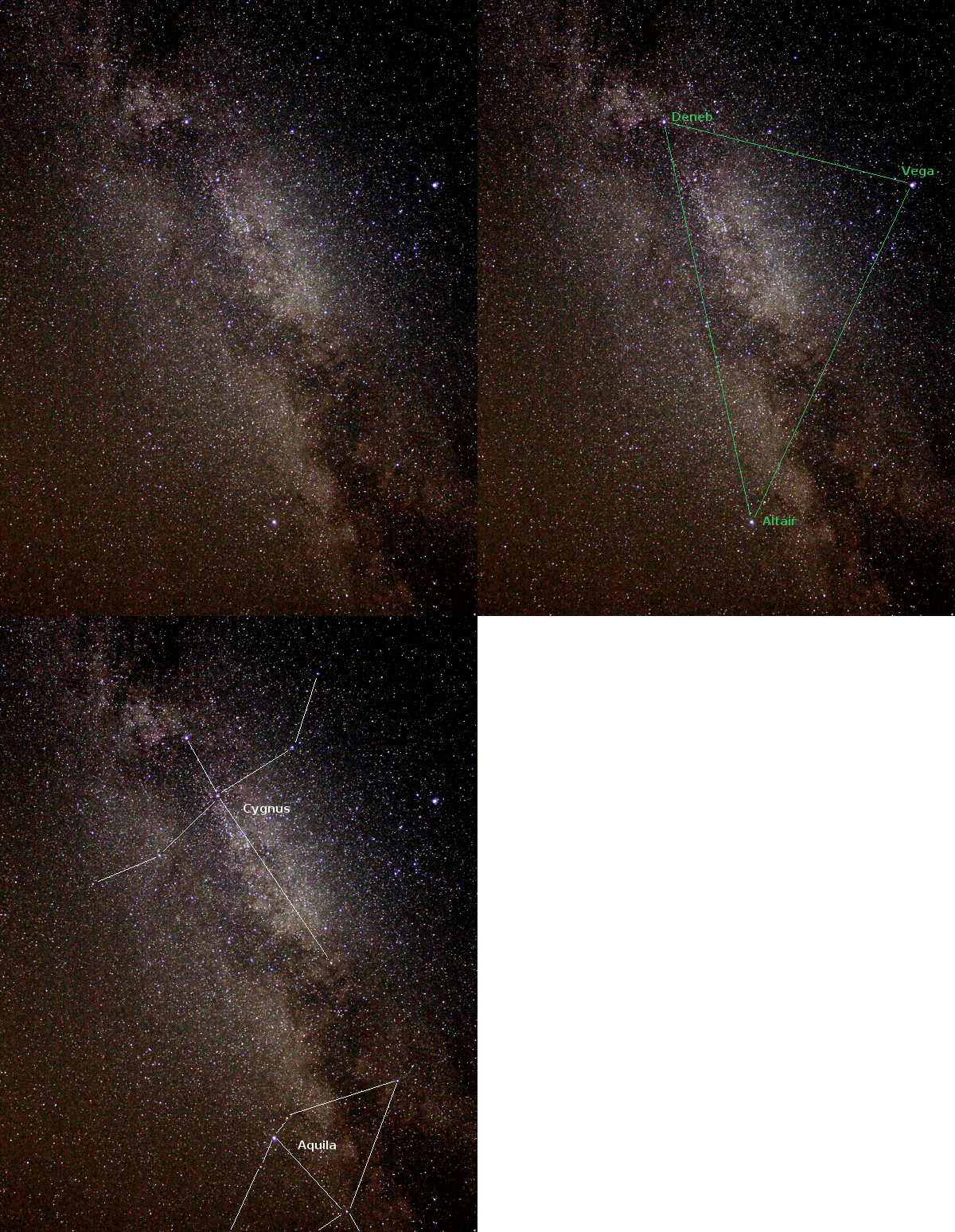
The Great Rift finder animation as seen in the Summer Triangle, also showing the constellations of Cygnus the swan and the northern part of Aquila the Eagle. This image a stack of 5 30 second exposures taken the morning of the Perseid meteor shower the is year in a vain attempt to capture some meteors.
08/16/2022 – Ephemeris – Scanning Sagittarius with binoculars
This is Bob Moler with Ephemeris for Tuesday, August 16th. Today the Sun will be up for 14 hours to the minute, setting at 8:46, and it will rise tomorrow at 6:47. The Moon, 3 days before last quarter, will rise at 11:15 this evening.
The Moon has left the evening sky, so let’s take another look at the constellation of Sagittarius. Its bright stars make a follow the dots image of a stout little teapot. In, around and above the teapot is a wealth of nebulae, which are clouds of gas and dust and clusters of stars. Stars are born in bunches from a cloud of gas. When enough stars are born, their stellar winds blow away the nebulosity leaving a star cluster. Use a pair of binoculars or a very low power telescope and just wander around and above the teapot, including and especially the spout on the right side. In binoculars, star clusters appear fuzzy like nebulae, however a small telescope with magnification of 20 times should resolve most of them.
The astronomical event times given are for the Traverse City/Interlochen area of Michigan (EDT, UT – 4 hours). They may be different for your location.
Addendum
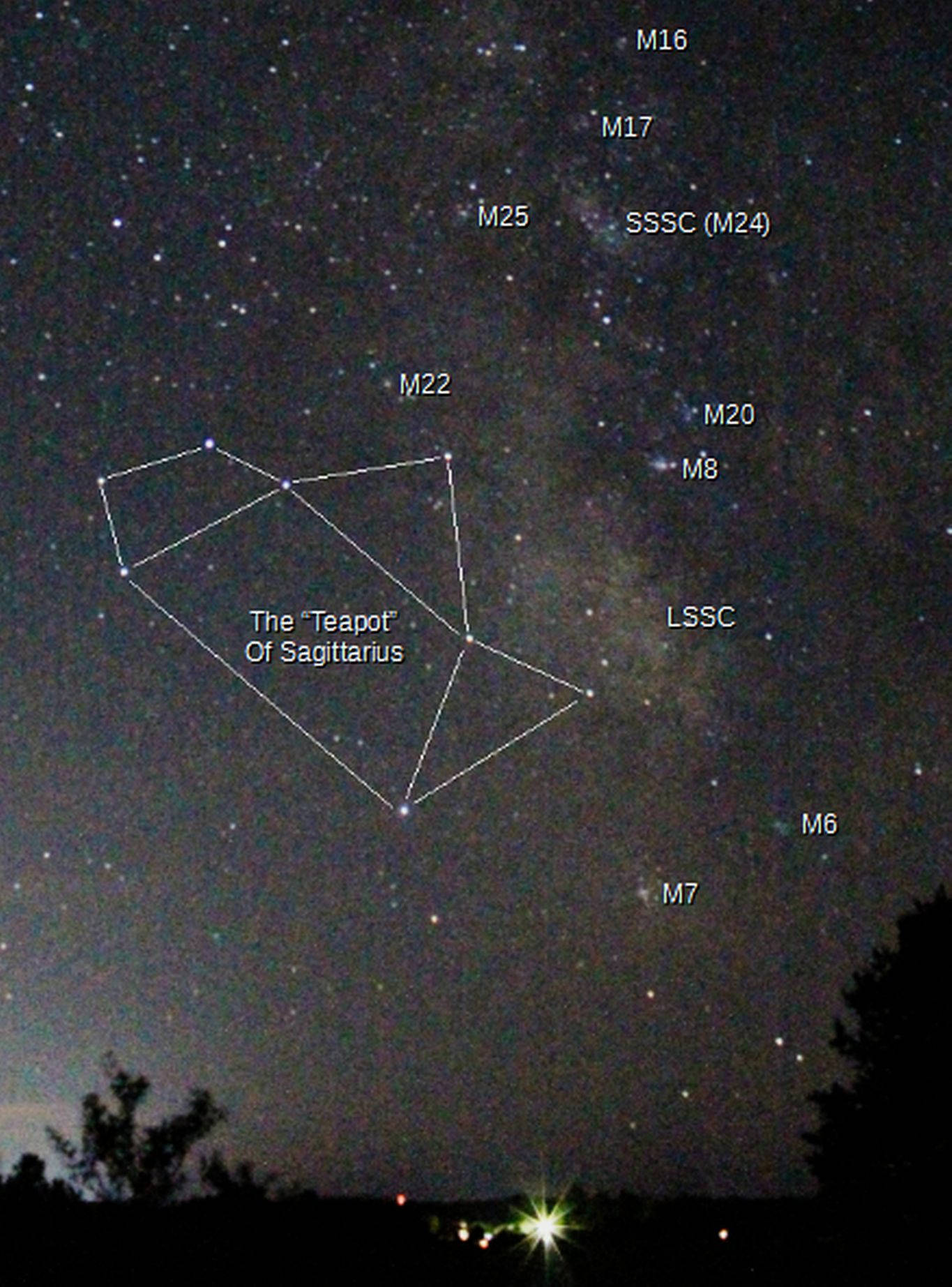
Sagittarius in a short time exposure with added annotations. The “M” designations are objects in Charles Messier’s catalog created in the latter half of the 18th century. LSSC is the Large Sagittarius Star Cloud, SSSC is the Small Sagittarius Star Cloud. Labels are to the right of the objects they name. Credit Bob Moler.
This is the short radio program version of the August 8, 2022, Ephemeris Extra post Wandering through Sagittarius
Ephemeris Extra – Wandering through Sagittarius
Sagittarius in a short time exposure with added annotations. The “M” designations are objects in Charles Messier’s catalog created in the latter half of the 18th century. LSSC is the Large Sagittarius Star Cloud, SSSC is the Small Sagittarius Star Cloud. Credit Bob Moler.
Sagittarius is seen low in the south in August. It’s between Scorpius to the west, and Capricornus, rising in the southeast. The name Sagittarius simply means archer. It doesn’t describe the fact that the archer isn’t just any old bloke with a bow and arrow, but is, indeed, a centaur, one of the two in the list of constellations. The other, Centaurus, is too far south to be seen from Michigan. And whose brightest star, Alpha Centauri, is in the closest star system to our solar system.
Centaurs, as a rule, were a rowdy bunch, the ancient Greek equivalent to a modern motorcycle gang. However, the centaur depicted by Sagittarius can be thought to be Chiron, though it can also be ascribed to Centaurus. Chiron was learned, a teacher and physician. I’ve noticed that in some artist’s depictions of Chiron, he is teaching Achilles how to use the bow and arrow. He also taught medicine to Asclepius, the great physician, who is seen in the heavens as the constellation Ophiuchus, above and right of Sagittarius.
What most of us see in the stars here is maybe a bow drawn to shoot at the heart of Scorpius, or a stout little teapot as in the children’s song. It even has the Milky Way seeming to rise from the spout like steam. The teapot rises in the southeast as if standing upright, and as the night wears on, it rises and move westward, slowly tilting to pour out its tea on the southwestern horizon.
The area of Sagittarius and the Milky Way is a fantastic part of the sky to explore with binoculars or a low power telescope on moonless nights. At the head of this post is a photograph of Sagittarius and the Milky Way taken from my home, with lines and labels. It’s somewhat spoiled by the sky glow from Chum’s Corner, a small commercial center 3.6 miles away, from the lower left. Most binoculars will show open or galactic star clusters as fuzzy spots like nebulae, which are fuzzy because they are clouds. The older globular star clusters require larger amateur telescopes to resolve.
I’ve only pointed out one in the image, that’s M22, whose designation, we have fun with at star parties at the Sleeping Bear Dunes National Lakeshore, since the road M22 runs through the park. Which came first? That’s easy, Charles Messier cataloged his 22nd object before Michigan was a state or even had roads. Well, maybe there were a few, around Detroit and Sault Ste. Marie, back when the major “roads” were the Great Lakes, and the rest Indian trails.
A telescope, even a small one, will resolve open clusters, showing individual stars. Telescopes will show the shapes of nebulae if they are bright enough.
One nebula with a distinctive shape is M17. The descriptive name I first knew it as was the Omega Nebula, and also the Horseshoe Nebula. To me, it never looked like either. It looked like a check mark, or a somewhat short necked swan. And it also goes by those names too. The planetarium program I use a lot, Stellarium, also calls it the Lobster nebula. I’m not much for seafood, but it doesn’t look like a lobster, or maybe I’m not hungry enough.
M16, is the Eagle Nebula. It has an associated star cluster. My eyes are drawn to the star cluster. The nebulosity is very faint, and I usually can’t see it. Part of the nebula was famously photographed by the Hubble Space Telescope and called the Pillars of Creation. In actuality, they are the Pillars of Destruction as they are being blown away by the stellar winds of the star cluster.
M8 is the Lagoon Nebula, it also has an associated star cluster. In telescopes, it is crossed by a narrow dust cloud suggestive of a lagoon. Nearby M20 is the Trifid nebula, which has a low surface brightness and can easily be missed. It is crossed by three narrow dust clouds dividing it into three, or on closer inspection, four wedges.
These just scratch the surface. So with or without optical aid wander through the celestial wonders and star clouds of Sagittarius. You have August and September to do it in the evening before they set for another year.
Based on an article I wrote for the August 2022 issue of the Stellar Sentinel, the Newsletter of the Grand Traverse Astronomical Society.
10/05/2021 – Ephemeris – Can you spot the North American Nebula?
This is Bob Moler with Ephemeris for Tuesday, October 5th. Today the Sun will be up for 11 hours and 29 minutes, setting at 7:15, and it will rise tomorrow at 7:47. The Moon, 1 day before new, will rise at 7:46 tomorrow morning.
Most of what we see in the Milky Way are just masses of stars, but there are bright clouds of gas, or to name them properly: emission nebulae. These bright clouds are areas of star formation. It is the ultraviolet light from young massive stars that light up the clouds they were formed from. A bright one, easily visible in binoculars, is just about overhead at 9 p.m. Called the North American Nebula, a glow, that in photographs is shaped much like our continent, is just east of the star Deneb which is practically overhead in the evening. Deneb is the northernmost star of the Summer Triangle, and brightest star in Cygnus the swan or Northern Cross. There are many other nebulae in the Milky Way, visible in binoculars and small telescopes. Many enjoyable hours can be spent sweeping the Milky Way for nebulae and star clusters.
The astronomical event times given are for the Traverse City/Interlochen area of Michigan (EDT, UT-4 hours). They may be different for your location.
Addendum
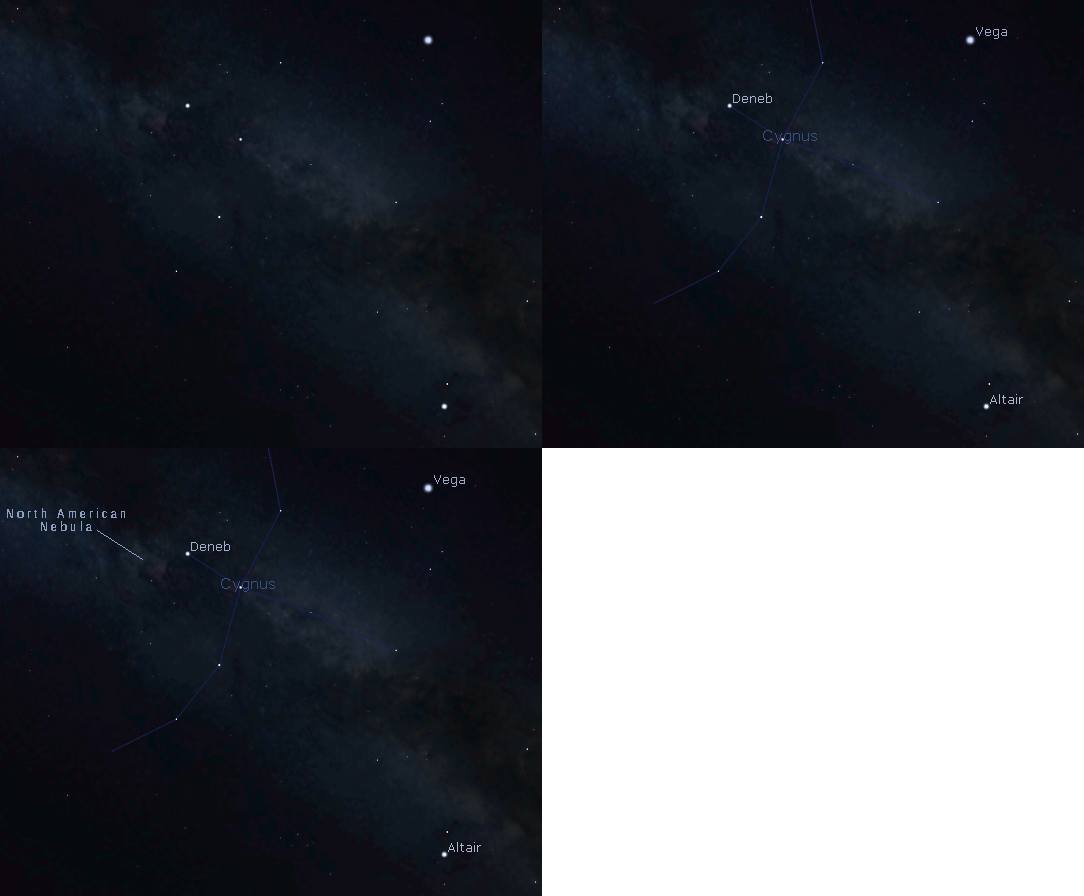
North American Nebula finder animation. I’ve dimmed down the stars a bit and increased the brightness of the Milky Way to aid in spotting the nebula. It requires dark skies to see it. I believe I can make it out with the naked eye too. Click on the image to enlarge it. Created using Stellarium and GIMP.
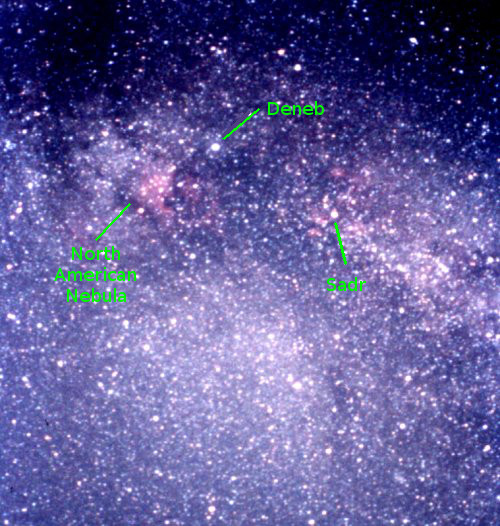
One of my old photographs of Deneb and the North American Nebula, digitized from a slide.
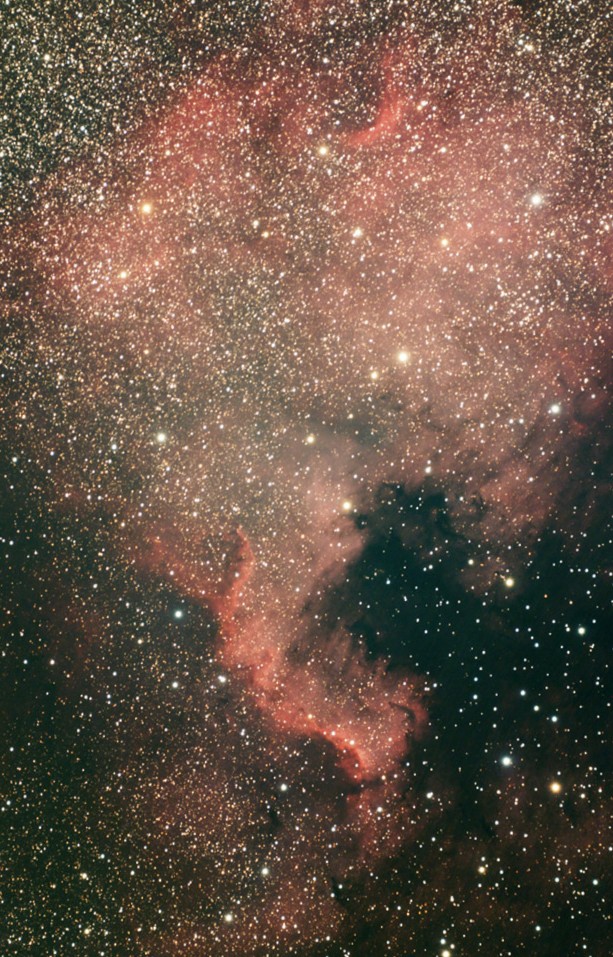
Better view of the North American Nebula taken by Scott Anttila.
08/13/2021 – Ephemeris – Rescheduled virtual star party tonight
This is Bob Moler with Ephemeris for Friday, August 13th. Today the Sun will be up for 14 hours and 8 minutes, setting at 8:51, and it will rise tomorrow at 6:44. The Moon, 2 days before first quarter, will set at 11:36 this evening.
The Grand Traverse Astronomical Society will try again to hold a virtual star party starting at 9:30 pm tonight via the Zoom app on the Internet. We were clouded out last Friday night. Jerry Dobek, professor of astronomy at Northwestern Michigan College, will host the event with the 16-inch telescope at the College’s Observatory and an imager, but only if it’s clear in Traverse City. It should feature a look at Venus and the crescent Moon to start. Saturn and Jupiter will be up by then, but they’re quite low in the sky. We might take another look at them later on when their images are steadier. The wonders of the Milky Way are all available. Instructions and a link can be found on the society’s website, www.gtastro.org.
The astronomical event times given are for the Traverse City/Interlochen area of Michigan (EDT, UT – 4 hr). They may be different for your location.
Addendum
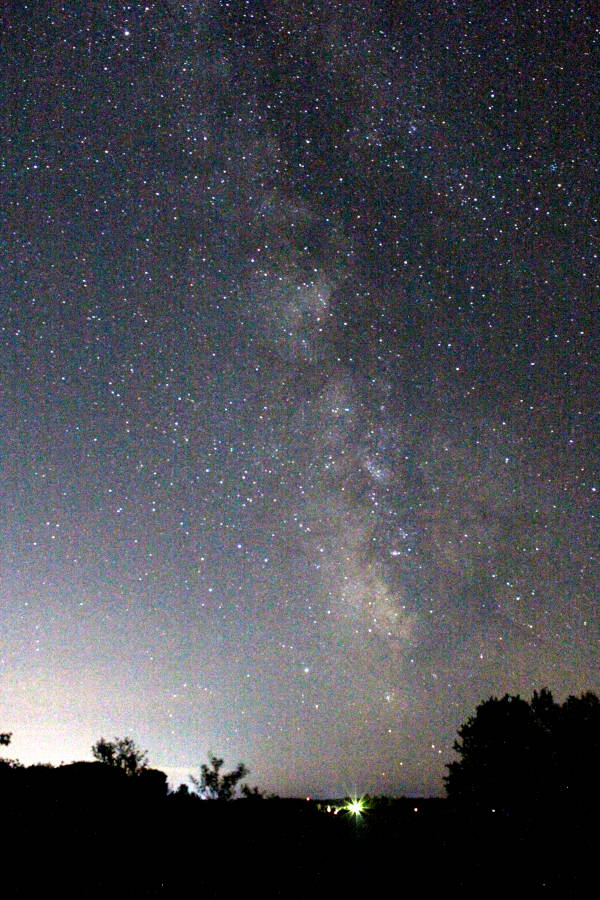
The southern Milky Way from Aquila to Sagittarius taken from my backyard with light pollution from businesses on US 31 in Chums Corners and Grawn south of me. I live about 7 miles west of the NMC Observatory. These bright lights are to its southwest and farther away. Click on the image to enlarge it.

