Archive
10/17/2012 – Ephemeris – Autumn wonders for binoculars or small telescope: The Alpha Persei Association
Ephemeris for Wednesday, October 17th. The sun will rise at 8:00. It’ll be up for 10 hours and 52 minutes, setting at 6:53. The moon, 2 days past new, will set at 8:21 this evening.
Let’s see how many bright planets we can find this week. At 8 p.m. Mars can be seen low in the southwest approaching another red star Antares, whose name means rival of Mars. They will be closest in a few days. The moon will be nearby too. Mars will set at 8:45. The planetary action moves to later in the evening and the morning. Jupiter, will rise at 9:17 p.m. in the east northeast. It is located in the constellation of Taurus. It will transit or pass due south at 4:52 a.m. The last bright planet of the night is the morning star Venus which will rise at 4:44 a.m. also in the east. Venus is now below the hind end of Leo. The planets Venus and Jupiter and the winter constellations are a great sight for early risers. You can enjoy for a few more weeks without danger of frost bite.
Times are for the Traverse City/Interlochen area of Michigan. They may be different for your location.
Addendum
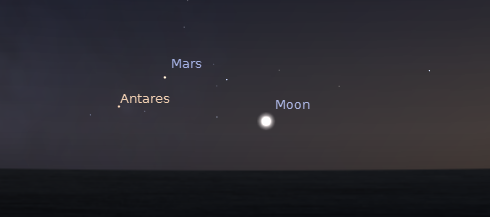
Mars, Antares, and the moon at 7:50 p.m. on October 17, 2012. Created using Stellarium.
The moon at this scale is over exposed.
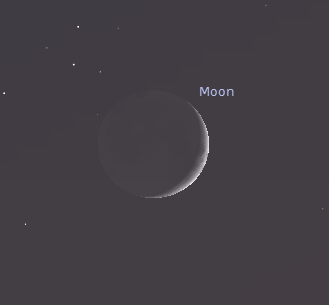
The actual phase of the moon in the chart above. Created using Stellarium.
The morning sky.
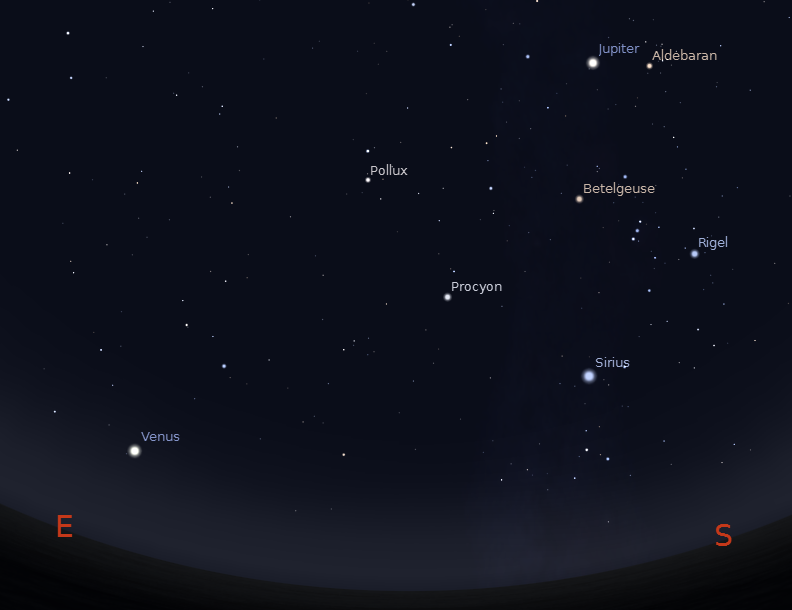
The morning skies including Jupiter and Venus at 6 a.m. on October 18, 2012. Created using Stellarium.
10/16/2012 – Ephemeris – Autumn wonders for binoculars or small telescope: The Pleiades
Ephemeris for Tuesday, October 16th. The sun will rise at 7:59. It’ll be up for 10 hours and 55 minutes, setting at 6:55. The moon, 1 day past new, will set at 7:33 this evening.
The most magnificent star cluster of the autumn sky is the Pleiades or Seven Sisters. At 10 p.m. It will appear as a close group of stars of a nebulous fuzz, depending your eyesight or sky conditions low in the east. It is the perfect binocular object, showing under good conditions a hundred more than the 7 brightest stars. Some mistake it for the Little Dipper because the stars do make a nearly handle less dipper. I tend to call it the Tiny Dipper. The stars in the Pleiades are less than half the age of the stars in the Double Cluster I talked about yesterday. The stars in the is cluster are about 100 million years old. Compared to the sun, these guys aren’t out of diapers yet. I’ll have lots more to to talk about the Pleiades as autumn wears on.
Times are for the Traverse City/Interlochen area of Michigan. They may be different for your location.
Addendum
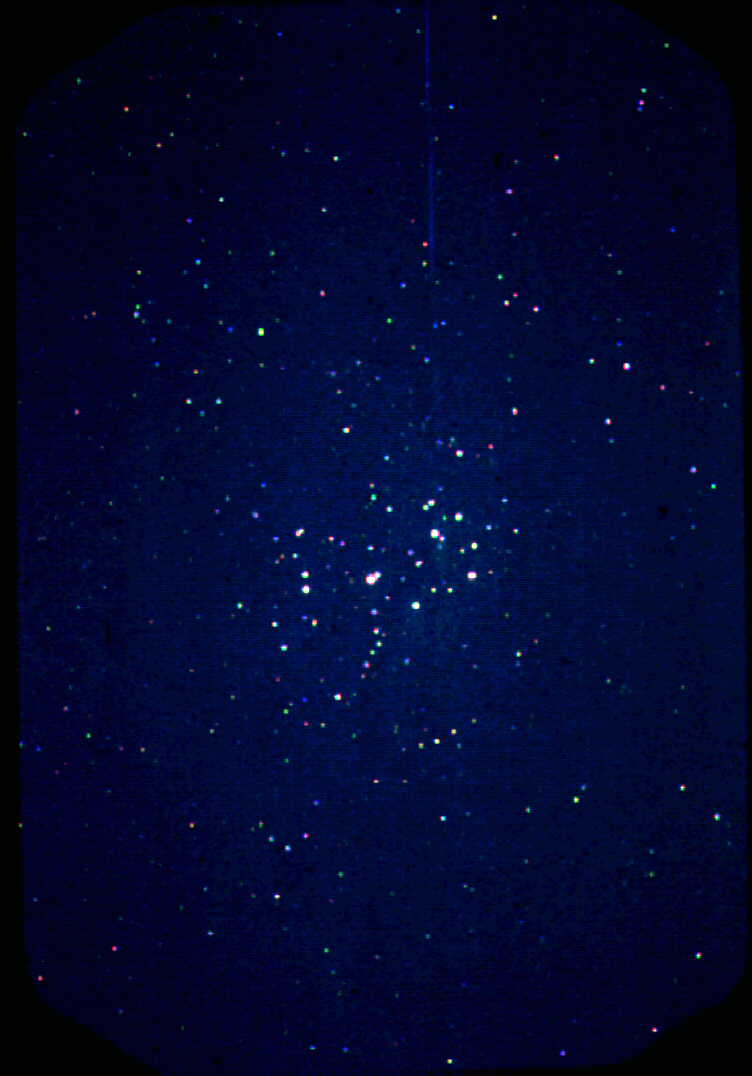
The Pleiades, about what you’d see in binoculars.
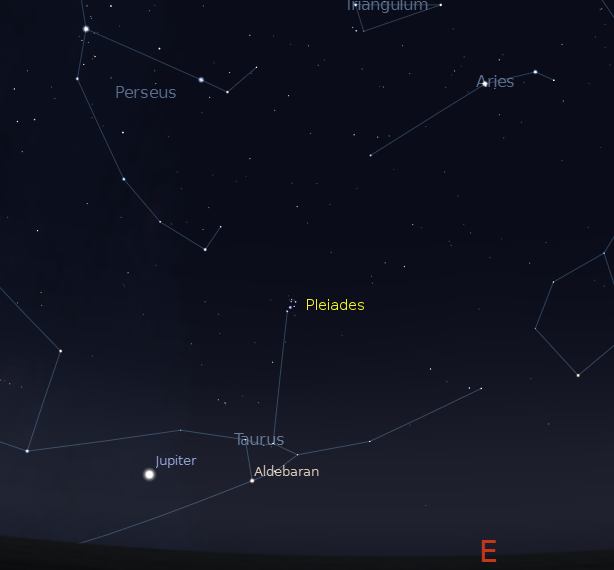
Pleiades and Jupiter at 10 p.m. October 16, 2012. Created using Stellarium.
10/15/2012 – Ephemeris – Autumn wonders for binoculars or small telescope: The Double Cluster
Ephemeris for Monday, October 15th. The sun will rise at 7:58. It’ll be up for 10 hours and 58 minutes, setting at 6:57. The moon is new today, and won’t be visible.
This week we’ll be looking at some of the wonders of the autumn sky that might better be seen in binoculars or a small telescope. Tonight we turn our attention to the Double Cluster, a fine pair of star clusters just below the W of the constellation of Cassiopeia the queen located in the northeast. Draw a vertical line down from the middle star of the W through the next star into the glow of the Milky Way. The Double Cluster appears to the unaided eye as a brighter glow of the Milky Way. This is confirmed with binoculars. But in a small telescope it becomes two piles of sparkling diamonds. The clusters are much younger than the sun so their brightest stars are blue-white to our eyes. The average distance of the two from earth is 7,200 light years and the are 1200 light years from each other.
Times are for the Traverse City/Interlochen area of Michigan. They may be different for your location.
Addendum
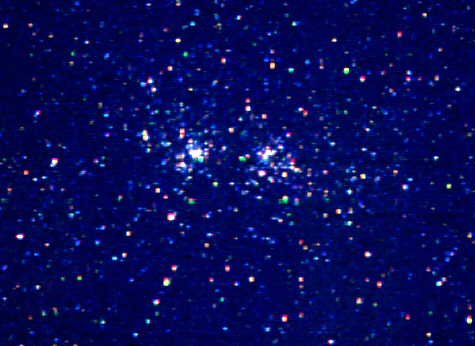
Double Cluster as it would be seen in a small telescope.
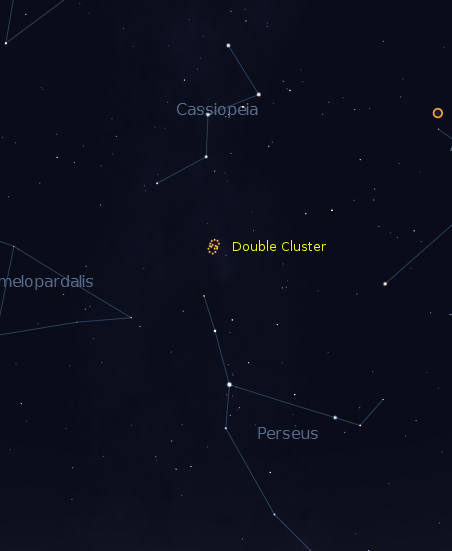
Chart for finding the Double cluster in October. Created using Stellarium.
10/12/2012 – Ephemeris – The constellation of Andromeda and its great galaxy
Ephemeris for Friday, October 12th. The sun will rise at 7:54. It’ll be up for 11 hours and 7 minutes, setting at 7:02. The moon, 3 days before new, will rise at 5:42 tomorrow morning.
In the east at 9 this evening can be found a large square of stars, the Great Square of Pegasus the flying horse. The square is standing on one corner. What look like its hind legs stretching to the left from the left corner star is another constellation, Andromeda the chained maiden. She is seen in the sky as two diverging curved strings of stars that curve upward. She was rescued by the hero Perseus, a nearby constellation, riding his steed Pegasus. Andromeda’s claim to astronomical fame is the large galaxy seen with the unaided eye just above the upper line of stars, the Great Andromeda Galaxy, nearly 2 and a half million light years away. To the unaided eye the galaxy appears as a small smudge of light. In binoculars the galaxy is a delicate spindle of light.
Times are for the Traverse City/Interlochen area of Michigan. They may be different for your location.
Addendum
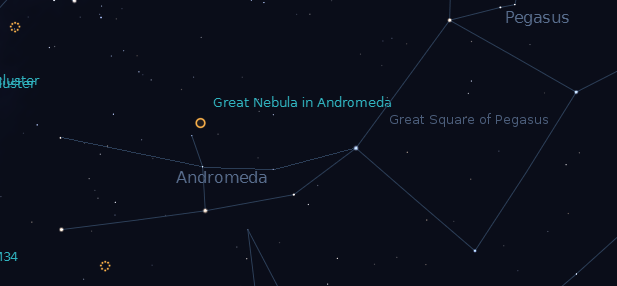
Andromeda at 9 p.m. with the Great Andromeda Galaxy. Created using Stellarium.
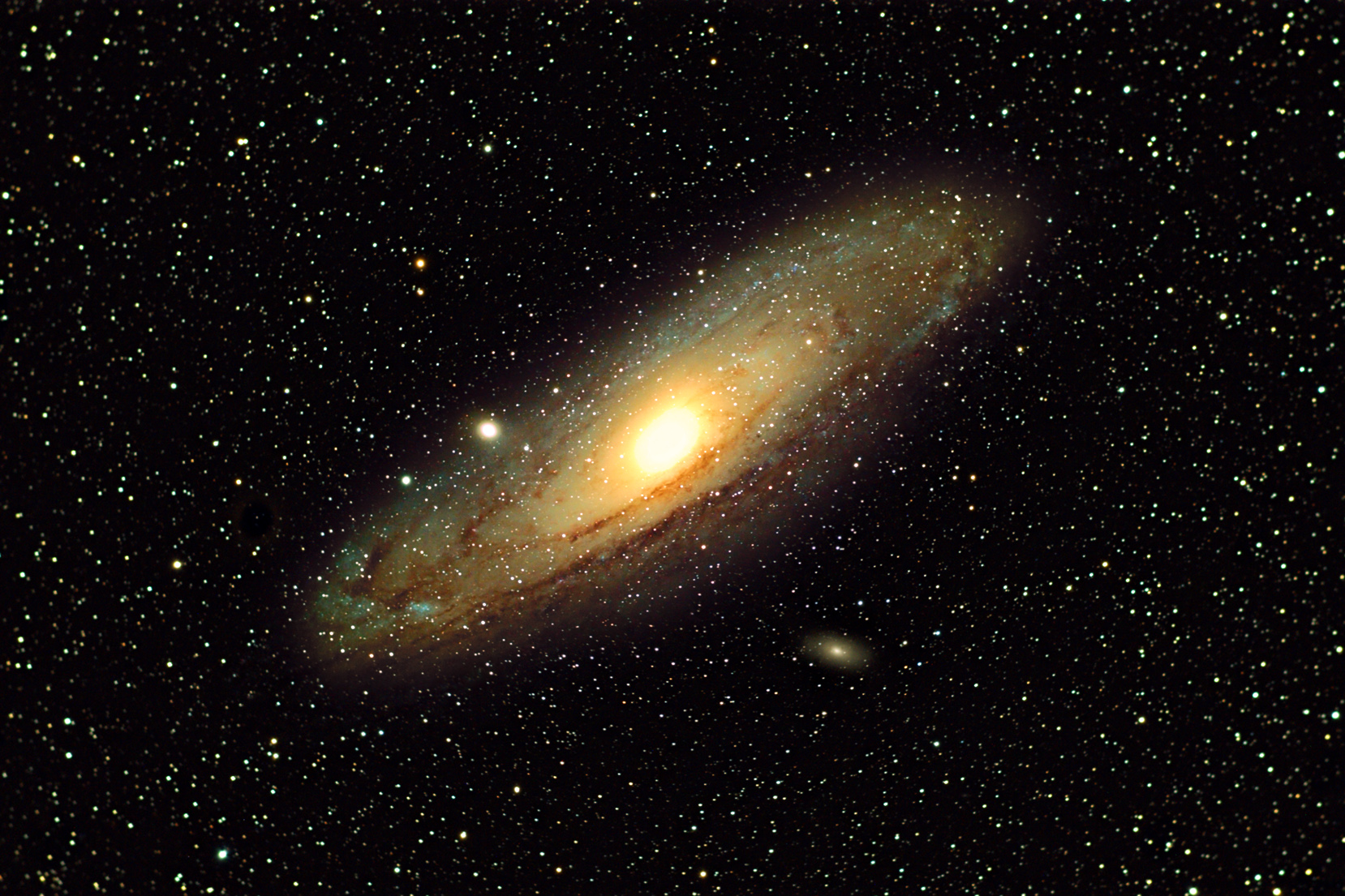
The Great Andromeda Galaxy (M31). Image taken by Scott Anttila.
10/08/2012 – Ephemeris – The Draconid Meteor Shower
Ephemeris for Columbus Day, Monday, October 8th. The sun will rise at 7:49. It’ll be up for 11 hours and 19 minutes, setting at 7:09. The moon, at last quarter today, will rise at 1:13 tomorrow morning.
The peak of the Draconid meteor shower is about now, (6-7 a.m. when the program airs) as the radiant point for these meteors is low in the north. They will be visible for the next few days seeming to radiate from the head of the constellation Draco, near the star Vega high in the west. These meteors are best about every 7 years, the last was last year. So maybe we may see 15 to 20 of these meteors per hour this time. These meteors are debris shed by Comet Giacobini-Zinner a short period comet of only 6.6 years. These meteors are very slow moving, about a third the velocity of the Perseid meteors of August. Meteors are the light given off by tiny bits of material sand grain to pea size as a rule as they burn up by friction due to their great speed.
Times are for the Traverse City/Interlochen area of Michigan. They may be different for your location.
Addendum
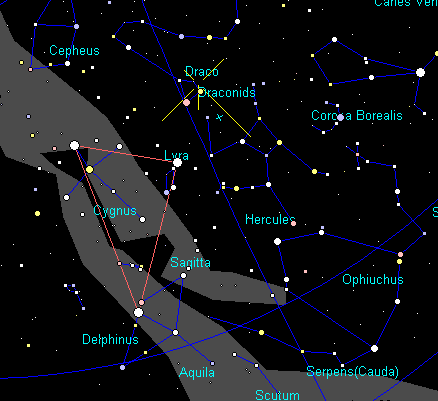
Draconid Meteor Shower Radiant
09/25/2012 – Ephemeris – Sinus Iridium greets the sun
Ephemeris for Tuesday, September 25th. The sun will rise at 7:33. It’ll be up for 11 hours and 59 minutes, setting at 7:33. The moon, 3 days past first quarter, will set at 3:53 tomorrow morning.
Lets look at the moon again tonight. One of my favorite formations is coming into light it is called Sinus Iridium or Bay of Rainbows. Sorry there’s no color here. But if caught at right time this ruined crater will appear as a hook out into night off the upper left edge of the moon. Officially its a bay to the Sea of Showers or Mare Imbrium. The north edge of the bay are mountains called the Jura Mountains. The south edge disappears into Mare Imbrium. The floor of the Sinus Iridium is about twelve hundred feet lower than Imbrium. The transition is gradual because it isn’t very noticeable. The formation is large enough to be seen in binoculars. Sinus Iridium is 242 miles wide, a good tenth the diameter of the moon itself.
Times are for the Traverse City/Interlochen area of Michigan. They may be different for your location.
Addendum
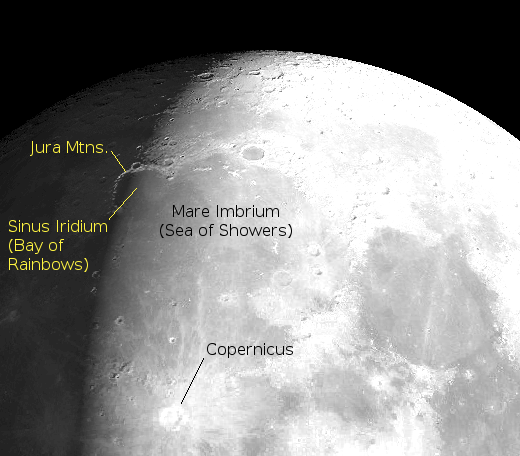
Bay of Rainbows and the crater Copernicus. Created using Virtual Moon Atlas.
09/24/2012 – Ephemeris – The lunar crater Copernicus
Ephemeris for Monday, September 24th. The sun will rise at 7:32. It’ll be up for 12 hours and 2 minutes, setting at 7:35. The moon, 2 days past first quarter, will set at 2:44 tomorrow morning.
Since the International Observe the Moon Night was cloudy in our area if its clear tonight there are still great views of the moon. You’re on your own, so dig out those binoculars and dust off that telescope for a great view of the moon. The sun will have risen on one of the great craters Copernicus. It’s near the terminator, the sunrise line on the moon on the left, close to half way from north to south. Copernicus was named for the Polish astronomer who put forth the heliocentric solar system in the 16th century. The crater is 56 miles in diameter with a vaguely hexagonal form and two miles deep. It has terraced walls and three central peaks. It may look deeper than that due to the low sun angle exaggerating its depth.
Times are for the Traverse City/Interlochen area of Michigan. They may be different for your location.
Addendum
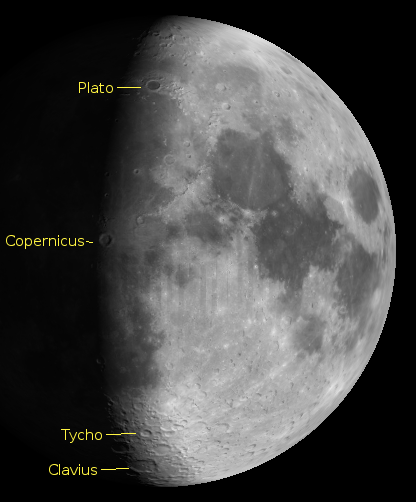
The moon on showing Copernicus and other large craters on the terminator. Created using Virtual Moon Atlas.
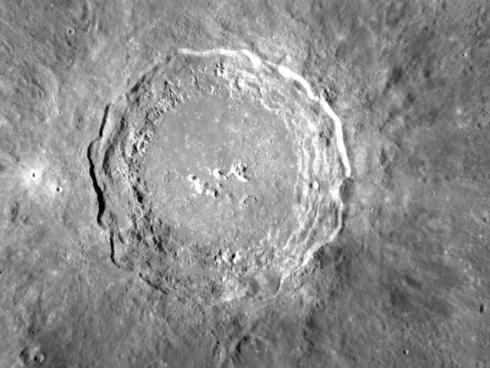
The crater Copernicus. Credit: NASA/GSFC/Arizona State University.
08/20/2012 – Ephemeris – Celestial Dolphin and Cupid’s dart
Ephemeris for Monday, August 20th. The sun rises at 6:51. It’ll be up for 13 hours and 47 minutes, setting at 8:39. The moon, 3 days past new, will set at 9:48 this evening.
Located below the eastern edge of the Summer Triangle of three of the brightest stars in the sky, which is nearly overhead sky at 10 p.m., is the tiny constellation of Delphinus the dolphin, which is seen high in the south. Delphinus’ 6 stars in a small parallelogram with a tail, really does look like a dolphin leaping out of the water. The parallelogram itself has the name Job’s Coffin. The origin of this asterism or informal constellation is unknown. Of the dolphin itself: the ancient Greeks appreciated this aquatic mammal as we do, and told stories of dolphins rescuing shipwrecked sailors. There’s another tiny constellation to the right of Delphinus, Sagitta the arrow, which represents Cupid’s dart. [Off the tail of Sagitta binoculars will find a cute inverted coat hanger in the stars.]
Times are for the Traverse City/Interlochen area of Michigan. They may be different for your location. Bracketed text was removed from the audio program due to time constraints.
Addendum
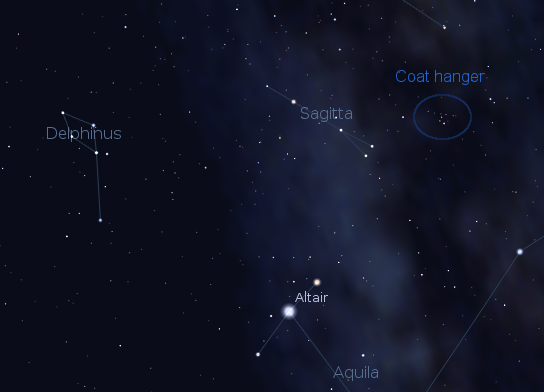
Delphinus, Sagitta and the Coat hanger. Diagram created using Stellarium.
08/14/2012 – Ephemeris – The asterism of the Teapot (Sagittarius)
Ephemeris for Tuesday, August 14th. The sun rises at 6:44. It’ll be up for 14 hours and 4 minutes, setting at 8:48. The moon, 3 days before new, will rise at 4:40 tomorrow morning. | If the ancient Greeks had teapots the constellation we call Sagittarius might have been Teapotius or something. It’s low in the south at 11 p.m. with the Milky Way rising like steam from its spout. Sagittarius is supposed to be a centaur with a bow and arrow. However to us the dearth of centaurs around outside of Harry Potter movies, and lots of teapots, and that great children’s song that perfectly describes the Sagittarius teapot that’s what we imagine. So the teapot is an asterism, like the Big Dipper, not one of the official constellations. A pair of binoculars is all you need to spot many fuzzy objects in and around Sagittarius. Pay special attention to that steam of the Milky way above the teapot’s spout for many fuzzy objects.
Times are for the Traverse City/Interlochen area of Michigan. They may be different for your location.
Addendum
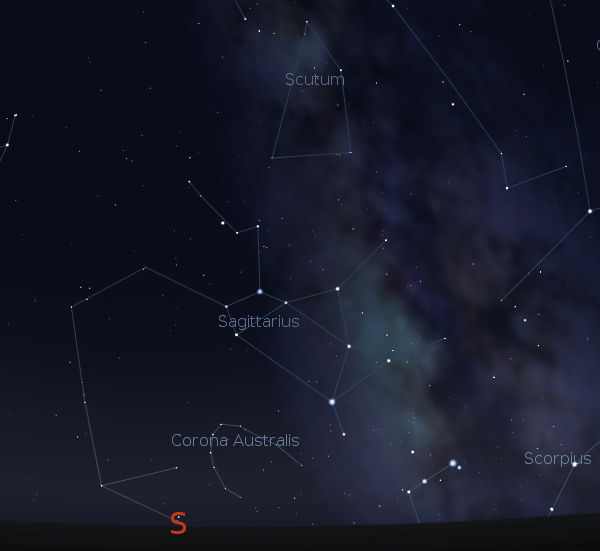
The constellations Sagittarius and Scutum. Created using Stellarium.
08/10/2012 – Ephemeris – Weekend Meteor Watches
Ephemeris for Friday, August 10th. The sun rises at 6:39. It’ll be up for 14 hours and 15 minutes, setting at 8:54. The moon, 1 day past last quarter, will rise at 1:04 tomorrow morning.
There are two events this weekend to view the heavens and the Perseid meteor showers. First, part of the Port Oneida Fair the Grand Traverse Astronomical Society will work with the rangers of the Sleeping Bear Dunes National Lakeshore to hold a star party and meteor watch at Thoreson Farm on South Thoreson Road of M22, a couple miles north of Glen Arbor. That will start at 9 p.m. It will be about 10:30 when it’ll be dark enough spot the meteors. Sunday evening there’s a Meteors and S’mores event at the Leelanau State Park, at the tip of the Leelanau Peninsula. That event starts at 10:30 p.m. The society will participate there also. The moon won’t interfere with the meteor shower It’s been banished into the morning sky.
Times are for the Traverse City/Interlochen area of Michigan. They may be different for your location.

