Archive
12/07/11 – Ephemeris – Where are the planets this week?
Wednesday, December 7th. The sun will rise at 8:05. It’ll be up for 8 hours and 57 minutes, setting at 5:02. The moon, 3 days before full, will set at 6:16 tomorrow morning.
It’s Wednesday and time again to take a look at the whereabouts of the bright planets. The planet Venus is low in the southwestern twilit sky sunset setting at 6:57, and should be visible by 5:45. Jupiter is now the most prominent planet of the evening sky located in the high in the southeast and is seen against the stars of the constellation Aries. It will pass due south at 9:33 p.m. In a telescope it will be accompanied by its 4 brightest moons. It will set at 4:18 a.m.. Mars will rise at 11:55 p.m in the east northeast and will be in the constellation Leo. Mars will be due south at 6:34 a.m. It is 117 million miles away and closing. Saturn will rise at 3:46 a.m. just to the left of the bright star Spica in the east southeast.
* Times, as always are for the Traverse City/Interlochen area of Michigan.
11/23/11 – Ephemeris – Where are the bright planets this week?
Wednesday, November 23rd. The sun will rise at 7:49. It’ll be up for 9 hours and 18 minutes, setting at 5:08. The moon, 2 days before new, will rise at 7:09 tomorrow morning.
It’s Wednesday and time again to take a look at the whereabouts of the bright planets. The planet Venus is still rather close to the sun in the evening setting at 6:33, and should be visible by 5:45 low in the southwest. Jupiter is now the prominent planet of the evening sky located in the southeast and is seen against the stars of the constellation Aries. It will pass due south at 10:33 p.m. In a telescope it will be accompanied by its 4 brightest moons. It will set at 5:18 a.m.. Mars will rise at 12:18 a.m in the east northeast and will be left of the star Regulus in the constellation Leo tomorrow morning. [It is 128 million miles away and closing.] Saturn will rise at 4:34 a.m. just to the left of the bright star Spica in the east southeast.
* Times, as always are for the Traverse City/Interlochen area of Michigan. Bracketed passage was omitted from the audio program due to time constraints.
11/17/11 – Ephemeris – The constellation Pisces
Thursday, November 17th. The sun will rise at 7:41. It’ll be up for 9 hours and 31 minutes, setting at 5:12. The moon, 1 day before last quarter, will rise at 11:37 this evening.
High in the south at 9 p.m. are the four bright stars of the Great Square of Pegasus, the upside down flying horse. Lying along the left and bottom sides of that square is the constellation of Pisces the fish, one of the 12 constellations of the Zodiac that lie along the path of the sun, moon and planets. Even though the constellation is called the fish, the fish themselves are not represented in the stars. What can be traced in the stars is the rope, that’s tied to their tails, anchored at the extreme southeastern part of the constellation. Jupiter now is located just left of Pisces. The right or western end of the Pisces is the asterism, or informal constellation, of the Circlet. It’s the loop of 5 stars, the rope around the tail of one of the two fish.
* Times, as always are for the Traverse City/Interlochen area of Michigan.
Addendum
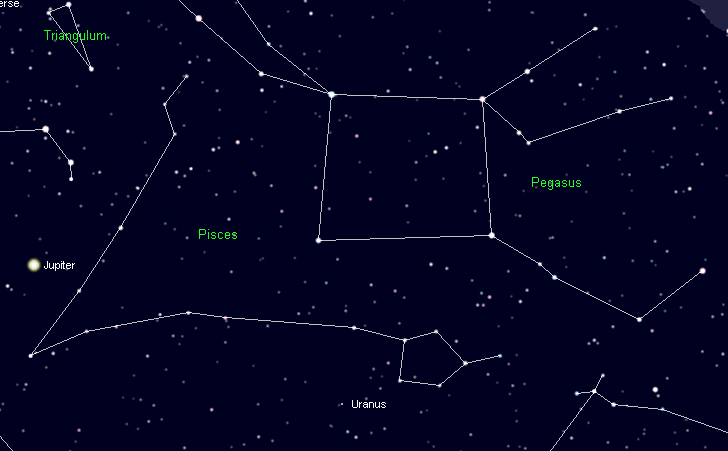
Pisces and Jupiter. Created using Cartes du Ciel (Sky Charts)
11/15/11 – Ephemeris – Prospects for the Leonid meteor shower
Tuesday, November 15th. The sun will rise at 7:38. It’ll be up for 9 hours and 36 minutes, setting at 5:14. The moon, 3 days before last quarter, will rise at 9:22 this evening.
This is an off peak year for the Leonid meteor shower but astronomers are finding more and more Leonid dust streams. These dust streams are created when the comet, in this case Tempel-Tuttle passes its closest to the sun. They end up preceding or following the comet near its orbit but are affected by the tiny force of sunlight and end up diverging more and more from the comet itself. Three dust streams are expect to be encountered by the earth this year. The stream from the1800 passage of the comet is expected to pass the earth tomorrow afternoon to be picked up as radio echos only. Also Thursday and Friday afternoon there are also expected peaks. All invisible from here, but possibly visible from Asia.
* Times, as always are for the Traverse City/Interlochen area of Michigan.
Information gleaned from the International Meteor Organization Meteor Shower Calendar 2011: http://imo.net/calendar/2011.
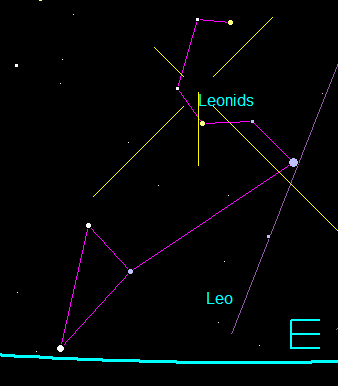
Leonid meteor radiant
11/14/11 – Ephemeris – The moon tonight
Monday, November 14th. The sun will rise at 7:37. It’ll be up for 9 hours and 38 minutes, setting at 5:15. The moon, half way from full to last quarter, will rise at 8:19 this evening.
The moon will be a waning gibbous phase tonight. The terminator is now the sunset line sweeping slowly across the moon. To the unaided eye or binoculars darkness will be falling across the Sea of Tranquility on the moon’s equator and will start to cross the Sea of Serenity above it. Below Tranquility is of my favorite craters Theophilus with its central peak will again stand out in shadows. It won’t be very close to the terminator tonight, but by tomorrow night it will be in the moon’s night and gone from our sight. The moon’s days and nights last nearly 15 days each. We are lucky to have a large satellite orbiting the earth. We may never know how important the role it had to play in establishing life on the earth.
* Times, as always are for the Traverse City/Interlochen area of Michigan.
Addendum
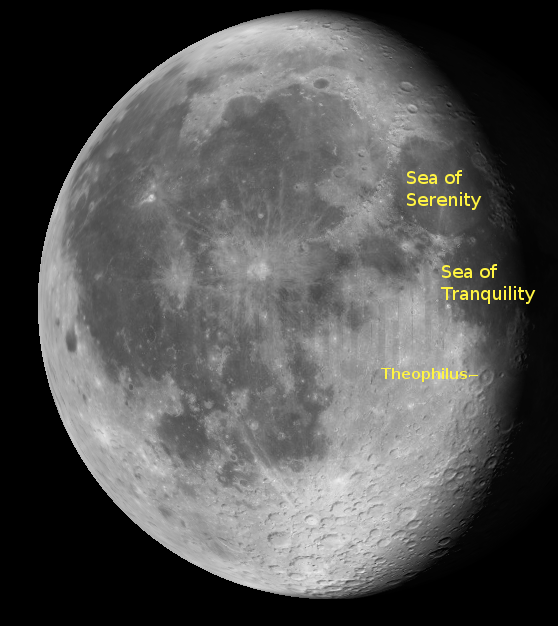
Waning Gibbous Moon 11/14/11 9 p.m. Created with Virtial Moon Atlas.
11/10/11 – Ephemeris – The planet Venus
Thursday, November 10th. The sun will rise at 7:32. It’ll be up for 9 hours and 48 minutes, setting at 5:20. The moon, at full today, will rise at 5:05 this evening.
The planet Venus is about to become visible low in the southwest after sunset. It might be visible a half hour after sunset. Venus is way beyond the sun now and coming around toward the earth. It will take some months to move around the sun toward the earth. As it does it will grow in size and its phase will wane. In white light Venus appears as a featureless cloud covered ball. It is illuminated by the sun, and so its appearance will change as it moves around the sun. And when it passes between the earth and the sun on June 6th next year, it will do so in grand style by passing in front of the sun as a transit of Venus which will not reoccur for 105 years. From our location, we will be able to see he start of that transit in the late afternoon.
* Times are for the Traverse City/Interlochen area of Michigan. They may be different for your location.
11/03/11 – Ephemeris – The moon tonight
Thursday, November 3rd. The sun will rise at 8:22. It’ll be up for 10 hours and 6 minutes, setting at 6:28. The moon, 1 day past first quarter, will set at 2:21 tomorrow morning.
In a telescope the moon will present some interesting features and craters. They will be seen near the terminator, the sunrise edge of the moon, where the shadows are longest. The moon is gray on gray, so the best way to see detail is by shadow. At the top or north end of the moon is a mountainous arc called the Alps. Mountain ranges on the moon are names after earthly mountain ranges. Cutting through the range is a fault called the Alpine Valley. Along the Alps at the terminator a crater will be coming into view this evening. It is the crater Plato. It is sometimes called a walled plain, since its floor is flat, or rather is slightly convex conforming to the shape of the lunar sphere. It’s cool watching the shadows of the walls recede as the sun rises.
* Times are for the Traverse City/Interlochen area of Michigan. They may be different for your location.
Addendum
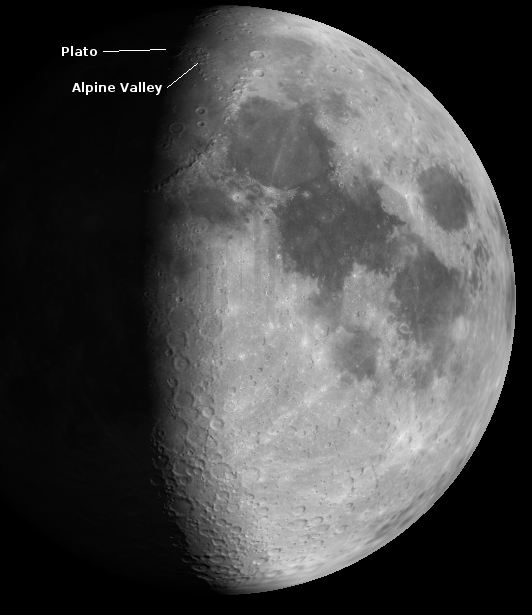
Moon 1 day after first quarter. Created using Virtual Moon Atlas
10/28/11 – Ephemeris – The Great Andromeda Galaxy
Friday, October 28th. The sun will rise at 8:14. It’ll be up for 10 hours and 23 minutes, setting at 6:37. The moon, 2 days past new, will set at 7:53 this evening.
The Great Andromeda Galaxy is the closest large spiral galaxy to our own Milky Way Galaxy. It’s visible to the unaided eye in the east off the left star of the Great Square of Pegasus. Move left two stars and up two stars to the fuzzy spot. That is the heart of a galaxy that’s actually 6 moon diameters wide. It’s close too as galaxies go, only two and a half million light years away. Andromeda appears to be be somewhat larger than our galaxy, though may be less massive than the Milky Way because our galaxy seems to have more dark matter. It is approaching us at somewhat less than 100 miles per second, and will collide with the Milky Way in four or five billion years, about the time the sun will begin to bloat toward a red giant. Mark those down on your calendar.
* Times are for the Traverse City/Interlochen area of Michigan. They may be different for your location.
Addendum
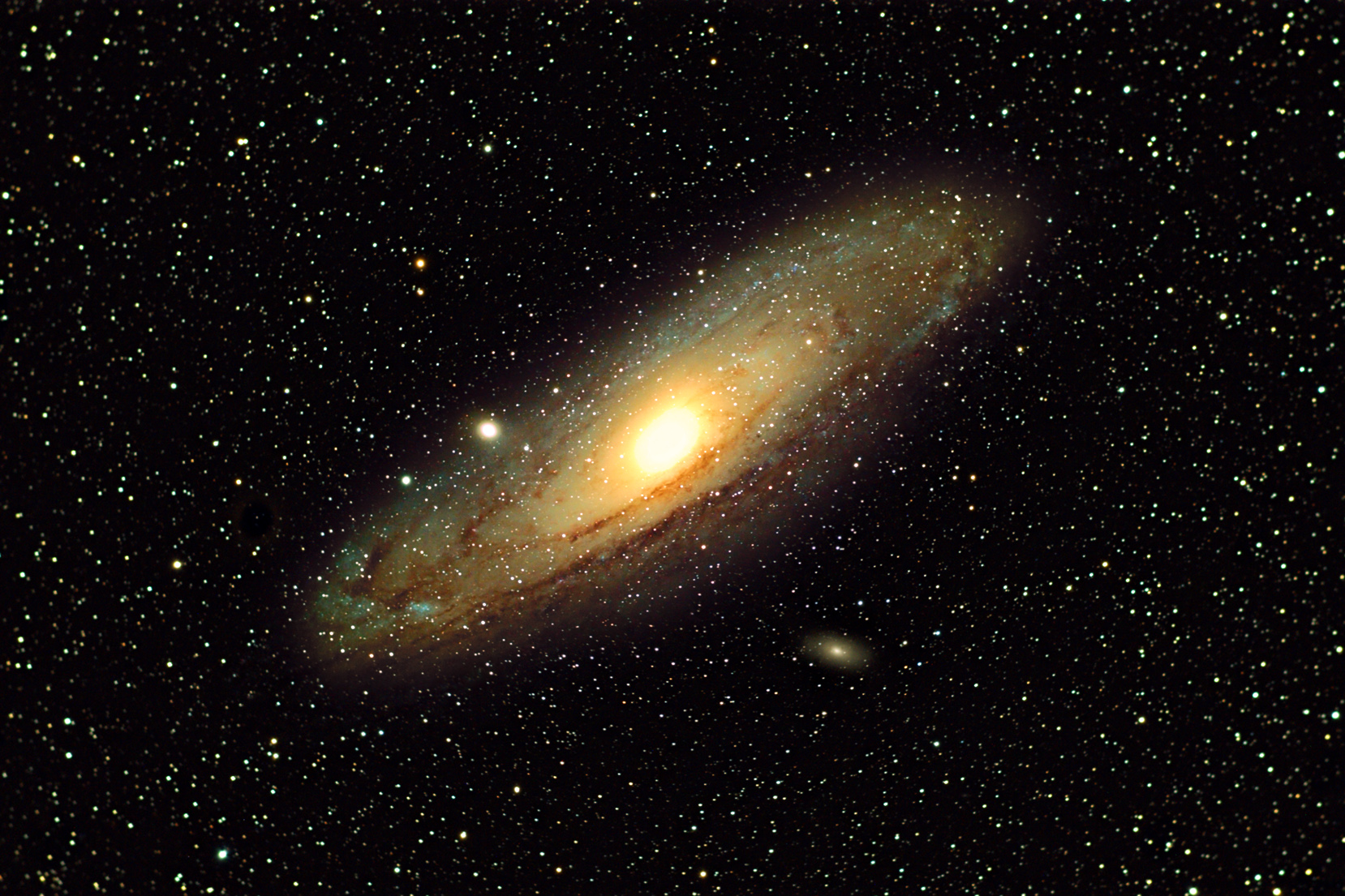
The Great Andromeda Galaxy (M31). Image taken by Scott Anttila.
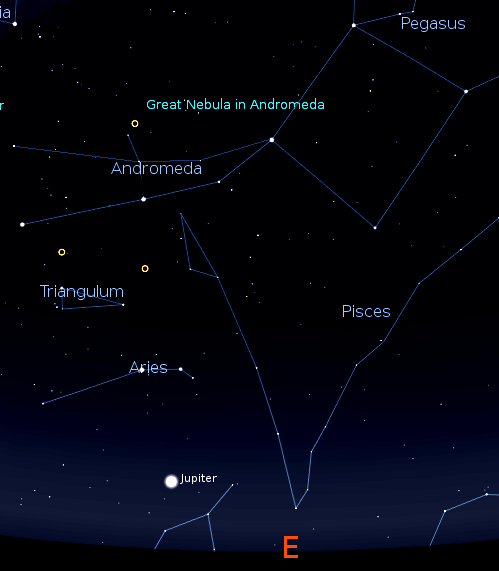
The Constellation Andromeda. Created using Stellarium.
10/27/11 – The Harbinger of Winter – Capella
Thursday, October 27th. The sun will rise at 8:13. It’ll be up for 10 hours and 25 minutes, setting at 6:39. The moon, 1 day past new, will set at 7:02 this evening.
A bright star called Capella has slowly been rising in the northeastern sky in the evenings for the past few months. At 9 p.m. now it is low in the north northeast far below the letter “W” shaped constellation of Cassiopeia. This winter Capella will be overhead the highest of winter’s seven brilliant first magnitude stars. Capella never quite sets for anyone north of Ludington. Due to its brightness, and being the closest first magnitude star to the pole Capella appears to move slowly as the earth rotates, and spends summer and autumn evenings close to the horizon. In the sky Capella represents a mamma goat held on the shoulders of a charioteer. There’s a thin triangle of three stars to Capella’s lower right. It’s a group of stars called the Kids. Her kids.
* Times are for the Traverse City/Interlochen area of Michigan. They may be different for your location.
Addendum
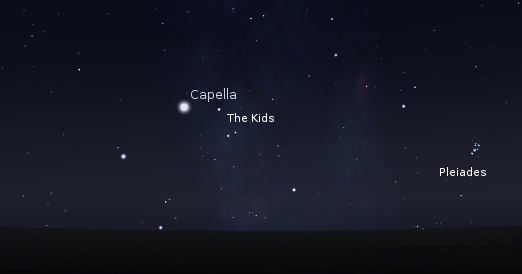
Capella and the Kids in the early evening. Created using Stellarium.
Aurora visible tonight 10/24/11
Check out this image:
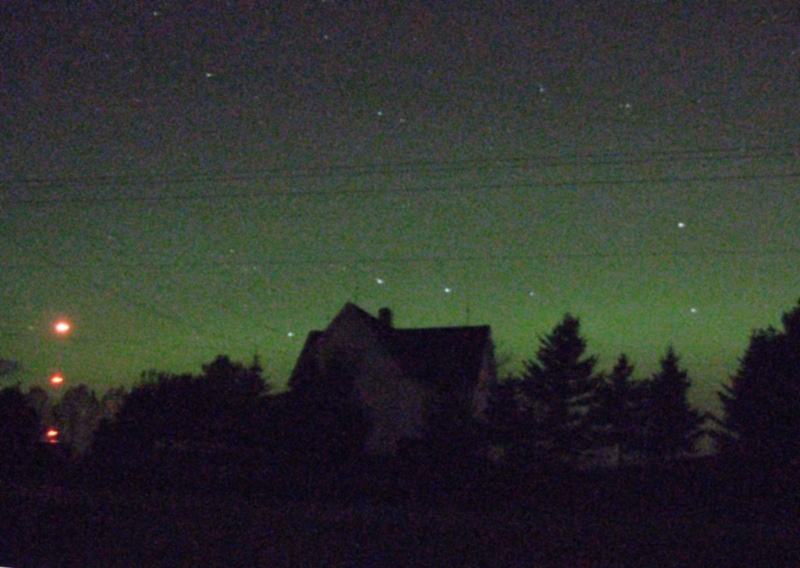
Aurora looking north at 10/24/2011 at 10:52 p.m.
According to SpaceWeather.com the earth was hit by a CME (Coronal Mass Ejection) at 2 p.m. eastern time. My thanks go to Sarah Johnson of Greenspire School for giving me the heads up on this. I’ve been busy working on my blog entries for later this week and was oblivious to the outside world.
Bad.

