Archive
01/13/2012 – Ephemeris – The moon passes Mars tonight
Friday, January 13th. The sun will rise at 8:17. It’ll be up for 9 hours and 8 minutes, setting at 5:25. The moon, 3 days before last quarter, will rise at 10:52 this evening.
This evening the moon will pass below the planet Mars after the moon rises near 11 p.m. Mars is rather distant now, and it won’t be really near in its next close approach to us on March 5th when it will be slightly under 63 million miles away. In telescopes Mars is and will remain a tiny disk with a hint of a white polar cap on one end. Photographers with large telescopes and CCD cameras can capture Mars even better and show some surface detail. We have even closer views of Mars. Of course there is an operating rover called Opportunity still active on the planet and the Curiosity rover on its way plus three orbiting satellites, two US and one European. The satellites will be cruising overhead as Curiosity lands August 5th.
* Times, as always are for the Traverse City/Interlochen area of Michigan.
Addendum
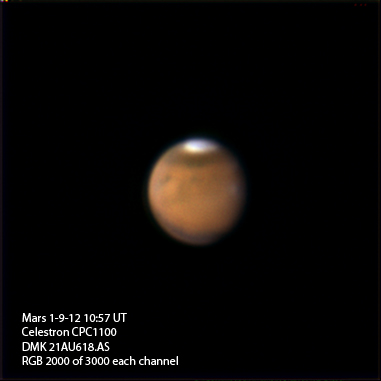
Mars on the morning of January 9, 2012. By Scott Anttila
Here’s Scott Anttila’a image of Mars from Monday morning, the 9th. Note Mar’s gibbous phase. Mars will become full when it’s at opposition from the sun March 3rd. It is only 9.7 seconds of arc in diameter. Also note, beside the northern polar cap that’s quite obvious, there is a hazy patch near the right edge of Mars. It is what telescopic astronomers of a hundred years ago called Nix Olympica, the Snows of Olympus. When the Mariner 9 spacecraft reached Mars in 1971 it found that there was a real mountain there. So the feature was renamed Olympus Mons or Mount Olympus. The white haze isn’t snow but water ice clouds that condense over the mountain peak. Mount Olympus is 14 miles high, three times taller than Mt Everest. The closest earth analog to it is the volcanic peak Mauna Kea on the island of Hawaii. Actually you’d have to throw in the entire island of Hawaii itself from the sea floor on up.
01/11/2012 – Ephemeris – Where are the planets tonight?
Wednesday, January 11th. The sun will rise at 8:17. It’ll be up for 9 hours and 5 minutes, setting at 5:22. The moon, 2 days past full, will rise at 8:29 this evening.
It’s time again to take a look at the whereabouts of the bright planets. Venus is brilliant in the southwestern sky after sunset and will set at 8:25. Jupiter is the most prominent planet of the evening sky, once Venus sets. It’s located high in the south and is seen against the stars of the constellation Aries. It will pass due south at 7:15 p.m. It will set at 2:00 a.m.. Jupiter is a great sight in a small telescope with its four moons which change position from night to night. Mars will rise at 10:27 p.m in the east northeast and is below the hind end of the constellation Leo the lion. It is 88 million miles away and closing. Mars will pass due south at 4:54 a.m. Saturn will rise at 1:41 a.m. just to the left of the bright star Spica in the east southeast.
* Times, as always are for the Traverse City/Interlochen area of Michigan.
Addendum
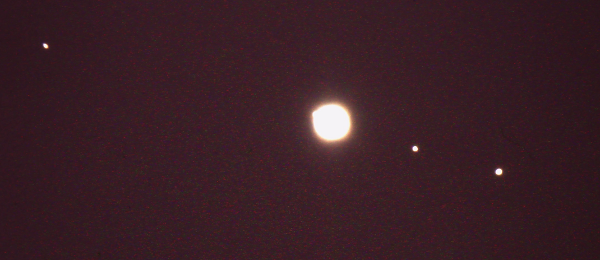
Overexposed Jupiter and its moons. My archival image.
The four Galilean satellites or moons of Jupiter are in order of distance from Jupiter Io, Europa, Ganymede and Callisto. They all orbit near Jupiter’s equator, and Jupiter itself has a very small axial tilt of about 3 degrees so the satellites seem to shuffle from one side to the other of Jupiter. The pattern is different night.
The programs Stellarium, Cartes du Ciel, and other sources including http://www.calsky.com can be used to determine the positions of the satellites. But there are clues by just looking at them.
- Io is closest to Jupiter and generally appears so. In the photograph above it appears as a bump on the left edge of Jupiter. It has a slight reddish tinge.
- Europa is dimmer than Io and also is usually close to Jupiter.
- Ganymede is easy. It’s the brightest.
- Callisto is usually found the farthest from Jupiter and is also the dimmest of the four.
Based on the photograph alone, which is undated, I’d guess that from left to right we have Callisto and Io to the left of Jupiter, Europa and Ganymede to the right.
Sometimes fewer than four satellites can be seen. They can hide in front of Jupiter, usually casting their shadow on the planet, behind Jupiter or in its shadow. Calsky will give you the times for your location.
Update
I located the date of the above image. It was taken the evening of March 17, 1989. A check with Cartes du Ciel (Sky Charts) confirm the satellite’s locations and order. Io was just ending a transit (passing in front ) of Jupiter.
01/10/2012 – Ephemeris – Venus, the evening star
Tuesday, January 10th. The sun will rise at 8:18. It’ll be up for 9 hours and 3 minutes, setting at 5:21. The moon, 1 day past full, will rise at 7:18 this evening.
Venus is getting brighter and is appearing higher in the southwest after sunset. This is our sister planet of the earth in size only. It is now nearly 115 million miles away, but it is getting closer. Venus is in an orbit inside the earth’s and is currently 67 million miles from the sun. It orbits the sun in 225 days, compared to earth’s 365 days. Right now Venus appears as a small gibbous orb. On March 27th it will appear at its greatest separation from the sun. It then will appear as half illuminated. Thereafter as it gets closer to the earth Venus will grow in size as its crescent gets thinner and thinner. When Venus passes between the earth and sun on the evening of June 5th, it will pass directly in front of the sun, an extremely rare event.
* Times, as always are for the Traverse City/Interlochen area of Michigan.
01/03/2012 – Ephemeris – The Quadrantid meteor shower tomorrow morning
January 3rd. The sun will rise at 8:19. It’ll be up for 8 hours and 55 minutes, setting at 5:14. The moon, 2 days past first quarter, will set at 4:04 tomorrow morning.
Tomorrow morning will see the peak of the Quadrantid meteor shower. They will be best seen after 4 a.m. and before twilight starts at 6:34. The radiant will appear high in the sky then near the handle of the Big Dipper. The meteors or shooting stars will appear to come from there but will appear all over the sky. The shower is named for the constellation that they appear to come from, unfortunately the constellation didn’t survive. It was supposed to represent a mural quadrant, and old astronomical measuring tool that was built into a north-south wall to measure the altitude of stars as the crosses due south before the advent of the telescope. The Quadrantids can be a spectacular shower and viewing can be endangered by cold feet and hands.
* Times, as always are for the Traverse City/Interlochen area of Michigan.
Addendum
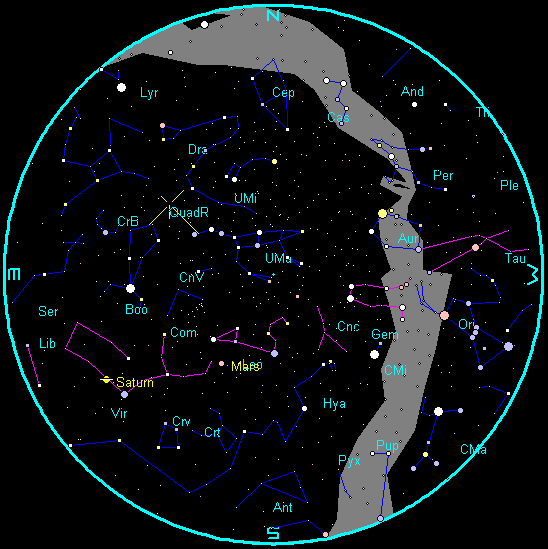
All sky Quadrantid radiant finder chart for 4 a.m.
01/02/2012 – Ephemeris – The moon and Jupiter and telescope tips
Monday, January 2nd 2012. The sun will rise at 8:19. It’ll be up for 8 hours and 54 minutes, setting at 5:13. The moon, 1 day past first quarter, will set at 3:04 tomorrow morning.
Tonight the bright planet Jupiter will appear below the moon. This is a great time to try out that new telescope or binoculars, or dig that old one out of the closet or attic. With a telescope use the lowest power to locate the moon and get an overview. The bright southern part of the moon, which may appear at the top of the image, because telescopes normally invert the image is heavily cratered. The other part has several dark nearly flat structures called seas. These are really huge craters that caused the internal lava to well up, making the smooth floors. Recently some astronomers hypothesized that a second moon was created with ours and that it crashed into our moon creating the lunar seas.
* Times, as always are for the Traverse City/Interlochen area of Michigan.
Addendum
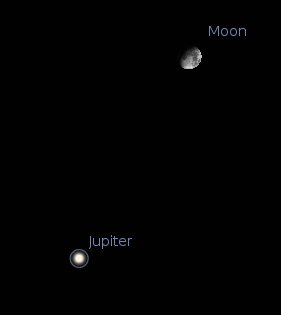
Jupiter appears below moon Jan 2, 2012 9 p.m. Created using Stellarium.
12/28/11 – Ephemeris – Where are the planets this week?
Wednesday, December 28th. The sun will rise at 8:18. It’ll be up for 8 hours and 50 minutes, setting at 5:09. The moon, half way from new to first quarter, will set at 9:56 this evening.
It’s Wednesday and time again to take a look at the whereabouts of the bright planets. The planet Venus is prominent in the southwestern twilit sky after sunset setting at 7:48 after the end of twilight. Jupiter is the most prominent planet of the evening sky, once Venus sets. It’s located high in the south and is seen against the stars of the constellation Aries. It will pass due south at 8:08 p.m. It will set at 2:53 a.m.. Mars will rise at 11:08 p.m in the east northeast and will be in the constellation Leo. Mars will be due south at 5:38 a.m. It is 98.4 million miles away and closing. Saturn will rise at 2:32 a.m. just to the left of the bright star Spica in the east southeast. Of all the planets, Jupiter and Saturn look best in that new Christmas telescope.
* Times, as always are for the Traverse City/Interlochen area of Michigan.
12/27/11 – Ephemeris – The constellation of Eridanus the river
Tuesday, December 27th. The sun will rise at 8:18. It’ll be up for 8 hours and 50 minutes, setting at 5:08. The moon, 3 days past new, will set at 8:49 this evening.
One of the more obscure constellations around is Eridanus, which depicts a river. The river starts near the lower right corner of Orion, near the bright star Rigel and flows to the right then down near the southwestern horizon, then it meanders along the horizon to the south before turning below the horizon. One has to travel to the far south to see the southern terminus of the river, the bright star Achernar. Writers over the ages have seen here the Nile and the earth circling river Ocean of the flat earth days. Achernar was recently discovered to be the flattest star, due to its rapid spin. The dimensions of Achernar have been determined to be twice as wide across its equator than from pole to pole. It’s 139 light years away.
* Times, as always are for the Traverse City/Interlochen area of Michigan.
Addendum
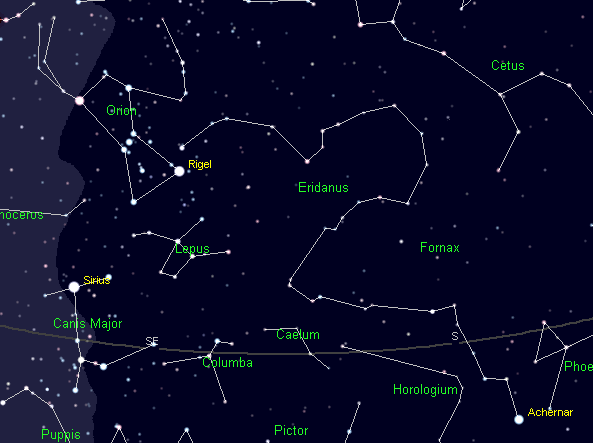
The constellation Eridanus the river, both above and below the horizon. Created using Cartes du Ciel.
The light curved line with the directions SE and S s the horizon from Traverse City, MI.
12/16/11 – Ephemeris – The constellation Orion rising
Friday, December 16th. The sun will rise at 8:12. It’ll be up for 8 hours and 50 minutes, setting at 5:03. The moon, 1 day before last quarter, will rise at 11:49 this evening.
At 9 p.m. the constellation of Orion the giant hunter will be rising in the east southeast, with its belt stars nearly vertically aligned. The belt stars are contained within a tilted rectangle of four bright stars that’s leaning to the left. The brightest of the top stars is Betelgeuse a bright red star. It’s a huge red giant star. Both top stars are Orion’s shoulders. The other shoulder star is Bellatrix. The bottom stars are Orion’s knees. The brightest, diagonally opposite from Betelgeuse is Rigel, a bright blue-white giant star. The other knee star is named Saiph. Orion is home to a beautiful nebula or cloud of gas, which we’ll explore later this winter, visible in binoculars it is located right and below Orion’s belt stars.
* Times, as always are for the Traverse City/Interlochen area of Michigan.
Addendum
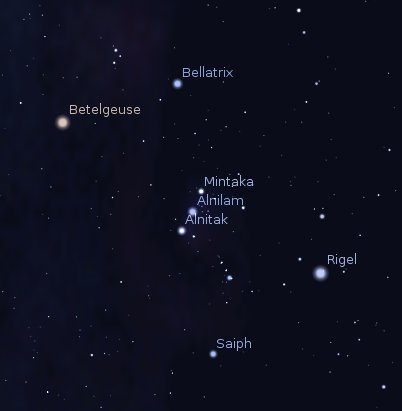
Orion with star names
12/14/11 – Ephemeris – Where are the bright planets this week?
Wednesday, December 14th. The sun will rise at 8:11. It’ll be up for 8 hours and 51 minutes, setting at 5:02. The moon, 3 days before last quarter, will rise at 9:29 this evening.
It’s Wednesday and time again to take a look at the whereabouts of the bright planets. The planet Venus is prominent in the southwestern twilit sky after sunset setting at 7:12[, and should be visible by 5:45]. Jupiter is now the most prominent planet of the evening sky located in the high in the southeast to south and is seen against the stars of the constellation Aries. It will pass due south at 9:04 p.m. It will set at 3:48 a.m.. Mars will rise at 11:41 p.m in the east northeast and will be in the constellation Leo. [Mars will be due south at 6:17 a.m.] It is 111 million miles away and closing. Saturn will rise at 3:22 a.m. just to the left of the bright star Spica in the east southeast. Remember Comet Lovejoy will enter SOHO’s LASCO C3 frame today.
* Times, as always are for the Traverse City/Interlochen area of Michigan. Text in brackets deleted from the program due to time constraints.
Update 6:16 a.m.
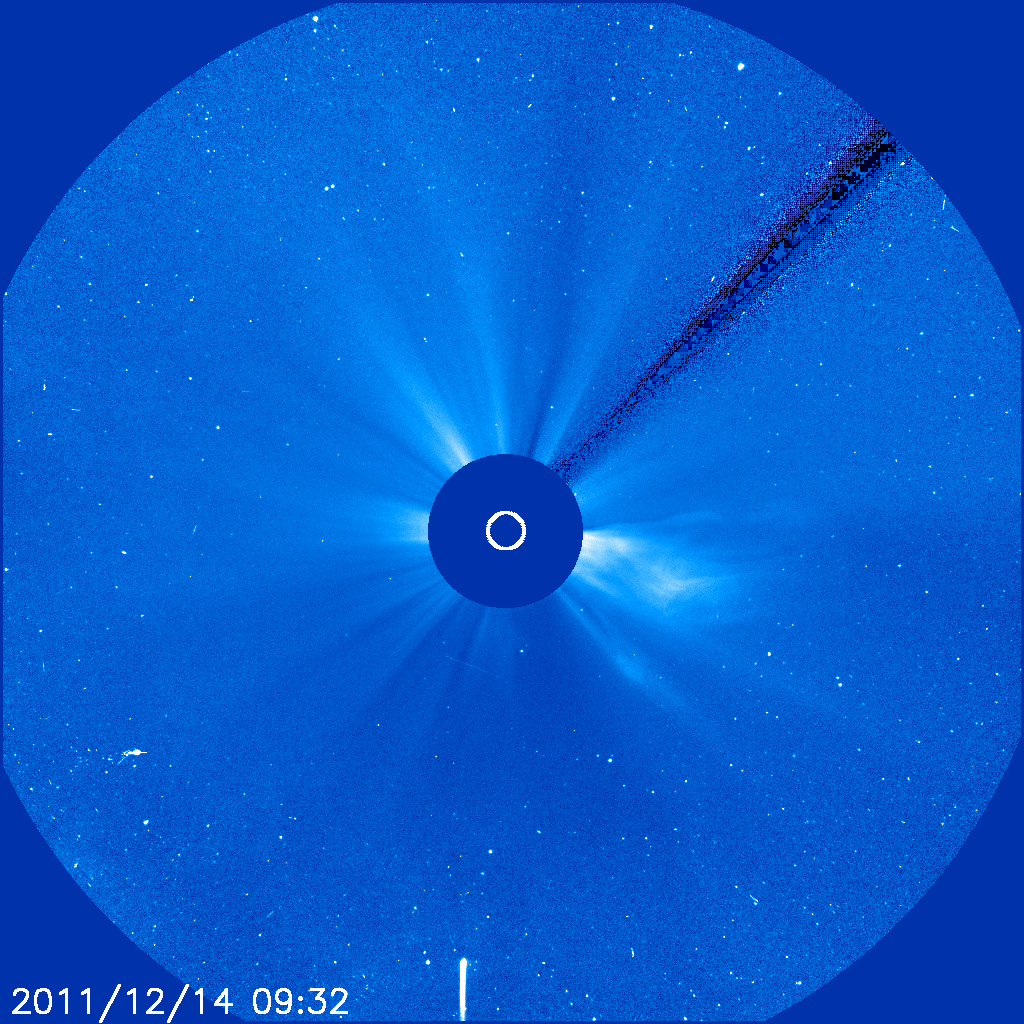
Comet Lovejoy entering at the bottom of the LASCO C3 frame. Courtesy SOHO, ESA, NASA. Timestamp on image.
Click to enlarge.
12/13/11 – Ephemeris – Comet Lovejoy and Kreutz sungrazing comets
Tuesday, December 13th. The sun will rise at 8:10. It’ll be up for 8 hours and 51 minutes, setting at 5:02. The moon, 3 days past full, will rise at 8:21 this evening.
Comet Lovejoy which will pass close to the sun Thursday is not alone. It belongs to the Kreutz sungrazing group of comets. They are named after Heinrich Kreutz the 19th century astronomer who discovered some of the great comets of history were sungrazers and had similar orbits. Astronomers , trying to backtrack the comets, think the original comet broke up maybe in the 4th century AD into two unequal fragments, that have continued to fragment during close approached to the sun. The SOHO spacecraft can detect these comets toward the sun. Over 1,500 Kreutz sungrazer comets have been found on SOHO photographs. Comet Lovejoy should enter SOHO’s LASCO C3 image frame starting tomorrow morning. Google SOHO and NASA to locate the site on the internet.
http://sohowww.nascom.nasa.gov/data/realtime-images.html
* Times, as always are for the Traverse City/Interlochen area of Michigan.
Addendum
Here’s something like what we’ll see in the next two days.

A Kreutz Sungrazer in 1996 seen by SOHO. Credit: LASCO, SOHO Consortium, NRL, ESA, NASA

