Archive
Ephemeris Extra: 03/12/2025 – Almost everything you wanted to know about lunar eclipses

What is a lunar eclipse?
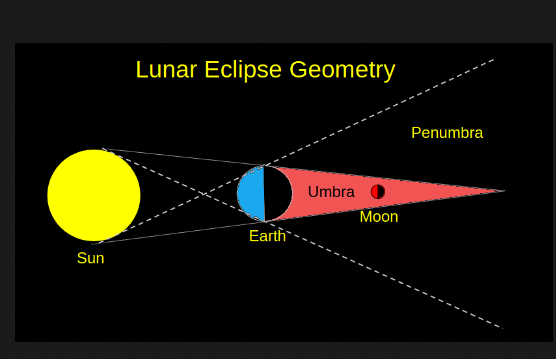
There are two types of eclipses. Eclipses of the Sun or solar eclipses, and eclipses of the Moon, or lunar eclipses. They are both related, in that they involve the Sun the Earth and the Moon. In the solar eclipse the Moon casts its shadow on the Earth at new moon. The lunar eclipse is the Earth casting its shadow on the full Moon. Since the Sun is an extended object, that is not a point, it has two shadows according to astronomers. If you take a look at your shadow in the sunlight cast on the ground, you will notice that your shadow is fuzzy. The fuzziness comes from the fact that your body is only blocking out part of the sunlight on the edges. That part of the shadow is called the penumbra.
There are three types of lunar eclipses. The penumbral eclipse is when the Moon is too far north or south of the umbra and just enters the penumbra. A partial eclipse is where the moon again is too far and south but close enough to have part of it skirt the umbra. And total eclipse is when the Moon becomes completely immersed inside the earth’s umbral shadow.
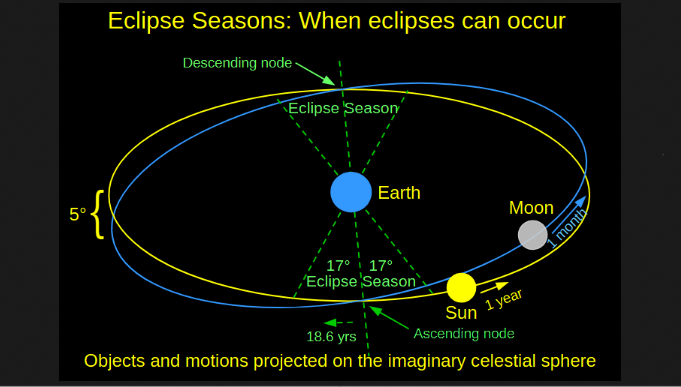
If one checks an almanac, one would find that eclipses generally come in pairs, one of each type, about two weeks apart separated by about six months. The times when eclipses can appear are called eclipse seasons lasting 35 days, about six months apart. They occur as often as they do, because the Moon has an orbit around the Earth that is more aligned with the Earth’s orbit of the Sun than it is the Earth’s equator like most moons of planets. The moon’s orbital plane deviates from the Earth’s orbit by 5 degrees. The intersection of those two orbital planes is called the line of the nodes. Eclipses can only occur when the Sun and the moon are near those nodes at the same time this could occur when the Sun is within 17° of the node.
Lunar eclipses throughout history
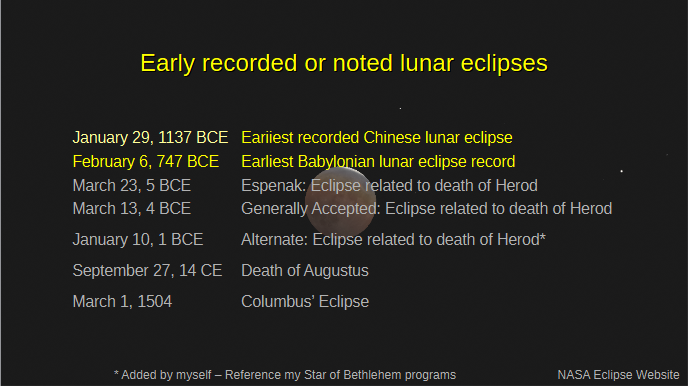
Humans have been observing eclipses both lunar and solar for millennia. And as they got more sophisticated they recorded them. The Chinese were especially good at this. The earliest recorded Chinese lunar eclipse was January 29th 1137 BCE. No, obviously they did not use the dating system we use today. It was usually in whatever year of a particular monarch’s reign that it happened in, and historians had to go back and figure out when that was. I found out that at least two that I know of the earliest lunar eclipses were actually solar eclipses. I found out using the app Stellarium by actually setting the date back to then, and finding out what kind of eclipse it was.
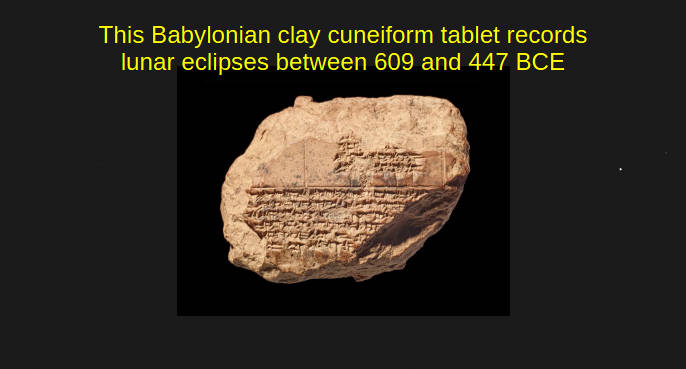
The Babylonians became astute observers and recorders of astronomical events including of course eclipses. By the 4th century BCE they had discovered a method to compute when eclipses occurred by a specific cycle of when they reoccurred, which I will talk about shortly.
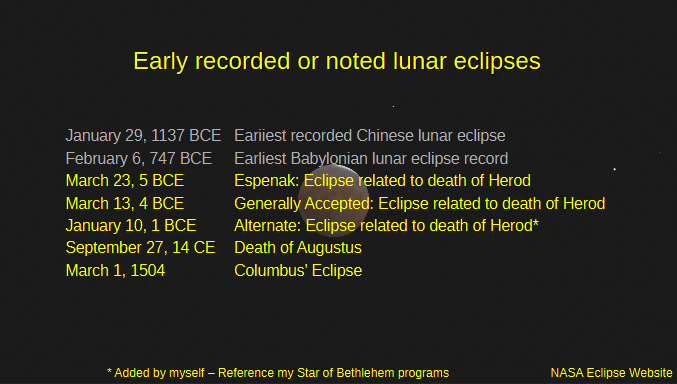
Continuing with our early recorded or noted lunar eclipses, we have 3 eclipses in 5, 4 and 1BCE, which are related to the death of King Herod the Great in Judea, around the time of the birth of Christ. In my biennial programs to the Grand Traverse Astronomical Society at Christmastime, where I discuss the Star of Bethlehem I referenced the latter two. They are also mentioned by David Hughes in his book The Star of Bethlehem. The first one is provided by Fred Espenak, recently retired from NASA, and now owns the website called MrEclipse.com. Most historians place the death of King Herod in 4 BCE, after the March 13th 4 BCE lunar eclipse. The source for this is the Jewish historian Josephus in his work Antiquities of the Jews. In it, he relates that King Herod died after a lunar eclipse but before Passover. The Jewish Calendar is a lunar calendar and Passover occurs at full moon, so the period during when Herod died is an integral number of lunar months before Passover. The 4 BCE eclipse occurs 1 lunar month before Passover. Josephus also records two chapters worth of palace intrigue of Herod’s court between the eclipse and Passover. To my mind and to many others, that is too short a period for all the events to have taken place, and the eclipse was partial visible early in the morning. The 1 BCE eclipse is total and allows 3 to 4 months for the palace intrigue to take place as Josephus describe it. I’ll get to Columbus’ eclipse in a bit, but first we’ll take a look at how eclipses can be predicted, which is the essence of the Columbus’ eclipse.
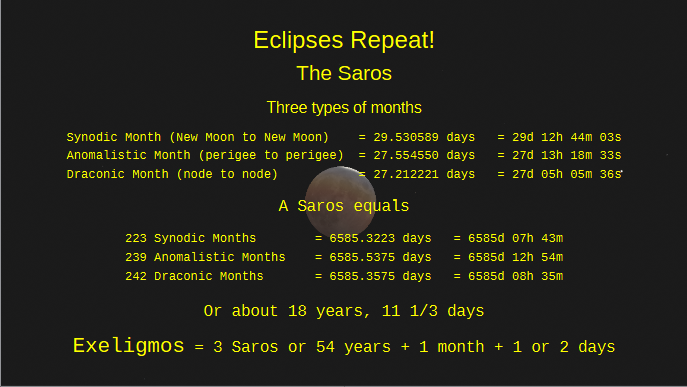
We know the Babylonians have been observing and recording eclipses since the 8th century BCE from their cuneiform tablets. By the 4th century BCE they had figured out that eclipses repeat themselves every 18 years and 11 and a third days. It seems they did this by observing lunar eclipses because that one third day in the saros. It keeps solar eclipses from being visible from the same location until 3 saros periods elapse that’s where we get the exeligmos where three saros periods equals 54 years and a month. With lunar eclipses if one sees a lunar eclipse in the early evening, one saros later, the next eclipse of the series will be visible in the morning before dawn.
The saros happens to be the confluence of three separate kinds of lunar months. The first is the synodic month which is also called a lunar month, is from new moon to new moon. It is the period that lunar calendars are based on. The next kind of month is the anomalistic month which is perigee to perigee that is this is the closest point to the earth back to its closest point to the earth one orbit later this is two days shorter than the synodic month. The third kind of month is the draconic month, which is the moon’s orbit from one node back to the same node.
Over the period of saros these separate months coincide within a very few hours. But since they don’t coincide exactly, the eclipses of the Cerro series the moon or the moon’s shadow actually moves northward or southward each saros period. And since we see more than one set of eclipses every 18 years, actually at least two of each a year, there are 36 or so separate saros series running at the same time.
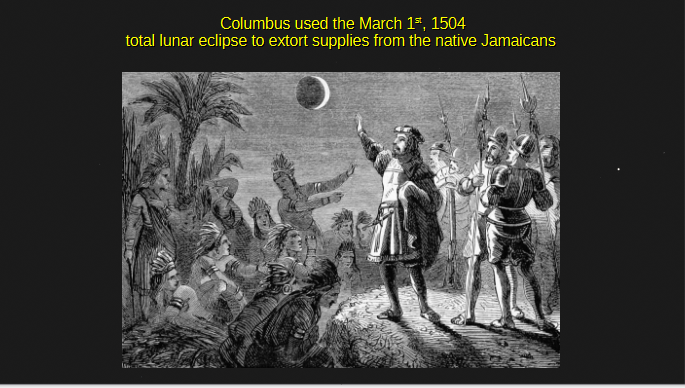
Columbus’ 4th voyage to the new world started out with four ships. After exploring the islands in I think the coast of South America, he ended up on Jamaica with no ships. At first, he had friend relations with the native Jamaicans, however over time that worsens when this crew began to harass, attack, and kill the native peoples, so they refused to give Columbus any more food or supplies. Columbus’s crew were on the brink of starvation when he checked an almanac and found out that soon there would be a total eclipse of the Moon. And on that fateful night he told the natives that unless he was given some supplies his God was going to take away the Moon. And that night the Moon did indeed begin to be devoured, that is the Moon began its entry into the Earth’s shadow. Columbus told them that unless they provided him with food and supplies his God was going to take away the Moon, and if they did provide him with supplies immediately he would consult with his God and see what he could do. The natives acquiesced and brought him food and supplies. Eventually within a couple of hours the Moon did indeed emerge from the earth’s shadow, and it was restored just as Columbus had said.
Notable modern lunar eclipses
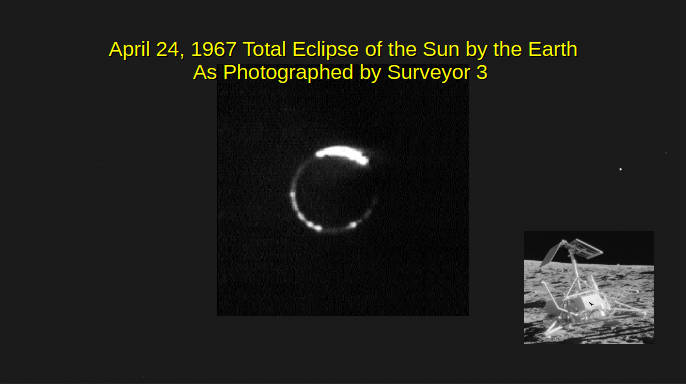
When we have a lunar eclipse, entities on the Moon see a solar eclipse. However, the Earth is 4 times larger than the Moon so that the totality of the solar eclipse lasts a long time, and the Earth covers much more than just the disk of the Sun. The Surveyor program was a lunar exploration program in preparation for the Apollo manned landings. Surveyor 3 landed on the moon just before a lunar eclipse, so one of its photographs was to look back at the Earth and take a look at it during totality of the solar eclipse. We know the Moon appears red, generally, when it’s eclipsed, and what Surveyor saw was the Earth with a red ring around it showing the combined sunrises and sunsets all around the earth at that time. The atmosphere of the Earth bends sunlight into the earth’s shadow. Blue light is scattered out, so we have red sunsets, and sunrises, so that is the color of the light that reaches the Moon. The amount of light we see on the Moon during totality depends on how clear the Earth’s atmosphere is at that time.
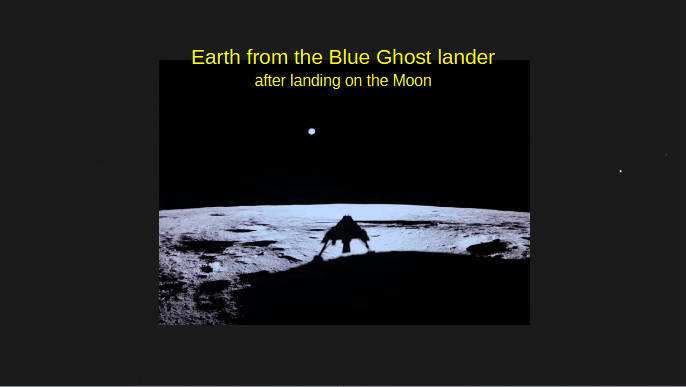
Firefly Aerospace’s Blue Ghost Lander, which is spending this lunar day on the Moon will be attempting to photograph the Earth and the solar eclipse while we are enjoying our lunar eclipse this Friday morning.
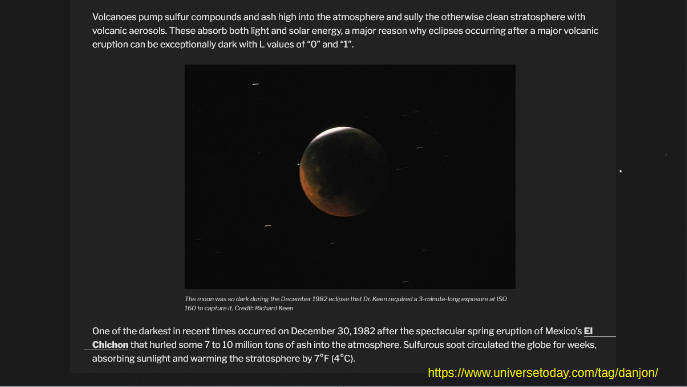
There were two total lunar eclipses visible from northern Michigan in 1982. Also that year, in April, a volcano named El Chichon, in southern Mexico erupted in a massive explosion sending a great deal of volcanic ash into the stratosphere. The earth’s shadow during the July 6th total lunar eclipse, to my eyes, didn’t look as uniform as it usually did, I assume because of the amount of dust in the atmosphere, and not being spread out quite as much as it would be later on. The second lunar eclipse was in the early morning hours of December 30th. And amazingly, here in Northern Michigan the sky was clear. I got out and looked over in the west to the Moon and didn’t see it at all. There was kind of a very faint glow in the constellation of Gemini, but that was all. I went to the Joseph H Rogers observatory to observe the Moon with the telescope. The moon was there but very, very dim. I could not see any of the red that shows up in the image above with the Moon being so dark. With the Moon being in Gemini, there were a lot of background stars since it was adjacent to the Milky Way. I was able to see many occultations of the stars as the moon moved against the background stars of the sky.
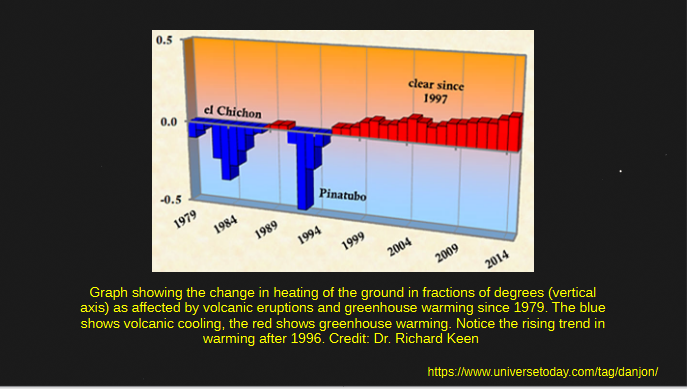
Above is a chart of the heating of the ground or lack of it caused by volcanic ash in the atmosphere in the 80s and 90s. We had two massive volcanic explosions the first El Chichon, in 1982, which I’ve already mentioned, and in 1991 Mount Pinatubo in Philippines, and how the volcanic ash caused cooling. It would also cause the dark lunar eclipses we saw. Since then even though this graph only goes to 2014 our lunar eclipses have been fairly bright, the red coloring obviously showing very well during totality.
The March 14, 2025 total lunar eclipse
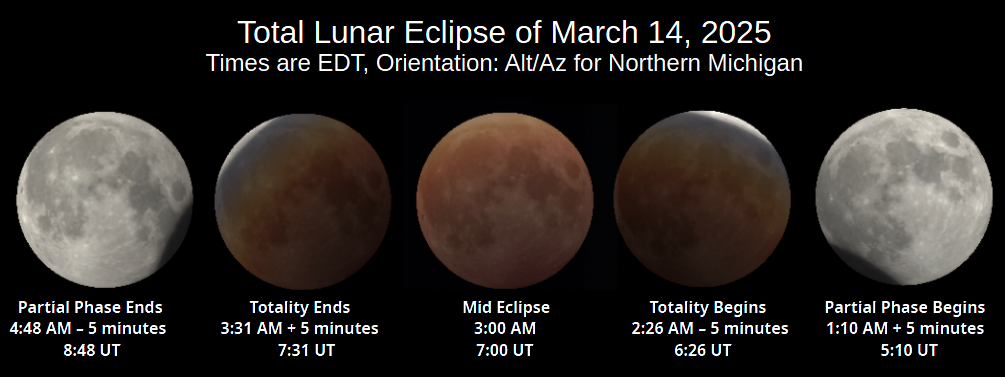
The image above shows the progress of the March 14th 2025 total lunar eclipse, at least the phases having to do with the Earth’s inner shadow, the umbra. The sequence moves from right to left as it moves through the Earth’s shadow. The penumbra will show itself about half an hour before the partial phase begins, as a sort of a dimming of the Moon in the side towards the umbra, so it will not appear uniformly illuminated. The partial phase begins at 1:10 AM, The next image is taken 5 minutes before totality, which will begin at 2:26 AM. We’re looking at just before totality begins, so you can tell where the shadow is. Mid eclipse is at 3:00 AM. I’ve increased the brightness of that image so it actually shows better, but it will be dimmer than the outer edges of the umbra. Totality will end at 3:31 AM and that image is what it should look like 5 minutes after that time. And the partial phase will finally end at 4:48 AM. For the next half hour you might be able to see the effects of the penumbra. Seeing the slight shading of the penumbra is easier if one uses sunglasses, which will reduce the glare of the still bright Moon and enhancing the shadow effect.
Ephemeris: 03/12/2025 – Last chance to see four naked-eye planets in the evening
This is Ephemeris for Wednesday, March 12th. Today the Sun will be up for 11 hours and 45 minutes, setting at 7:45, and it will rise tomorrow at 7:58. The Moon, 2 days before full, will set at 7:49 tomorrow morning.
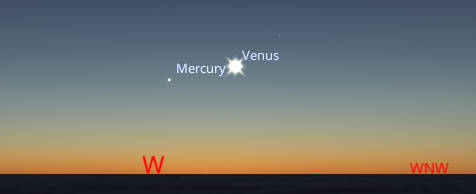
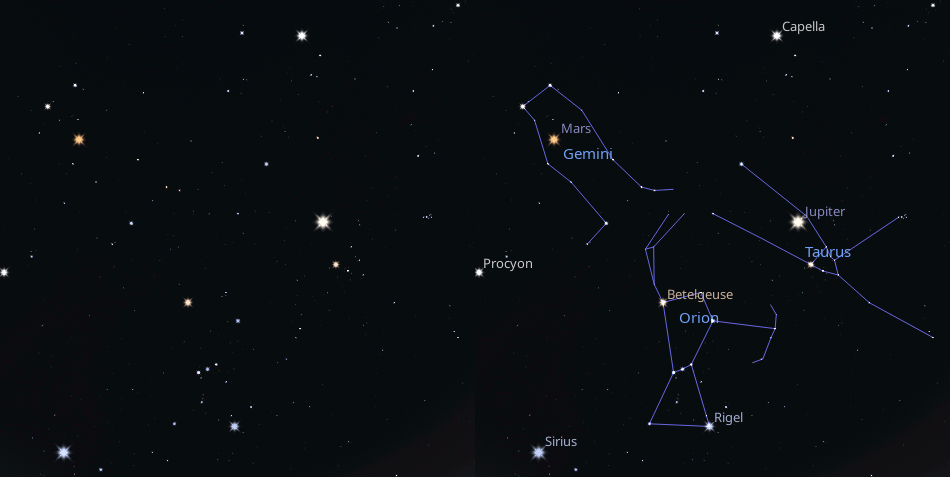
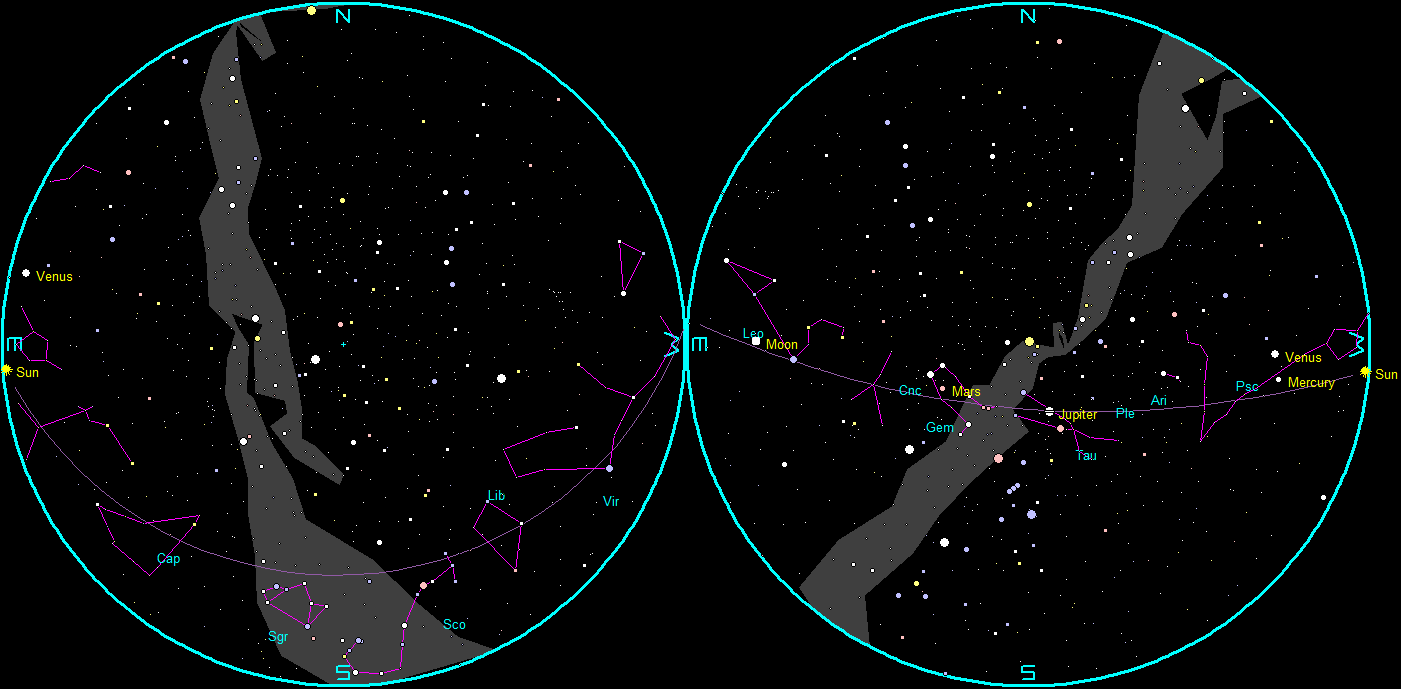
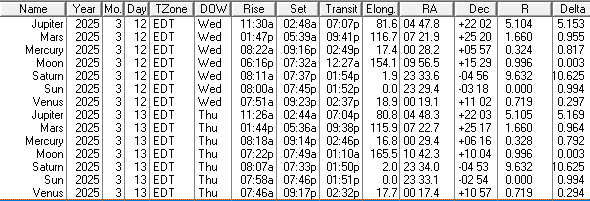
Let’s take our weekly look at the whereabouts of the naked-eye planets. At 8:30 PM this evening four of the five naked eye planets will be out. Starting from the West we have Venus the brightest of all. Left and a bit below is the much dimmer Mercury. Both will rapidly disappear in evening twilight in a less than a week. Venus will pass in conjunction with the Sun on March 22nd, Mercury will do the same two days later. Jupiter, the second-brightest planet will be high in the southwest. Mars, the third-brightest planet now, with its distinctive reddish hue, is high in the south-southeast, below and right of the stars Castor and Pollux in Gemini. By the end of the month only two planets, Mars and Jupiter will be left in the evening sky.
The astronomical event times given are for the Traverse City/Interlochen area of Michigan (EDT, UT – 4 hours). Times will be different for other locations.
Addendum
Ephemeris: 03/10/2025 – Aristarchus, the brightest spot on the Moon, but not tonight
This is Ephemeris for Monday, March 10th. Today the Sun will be up for 11 hours and 39 minutes, setting at 7:42, and it will rise tomorrow at 8:01. The Moon, 4 days before full, will set at 7:11 tomorrow morning.
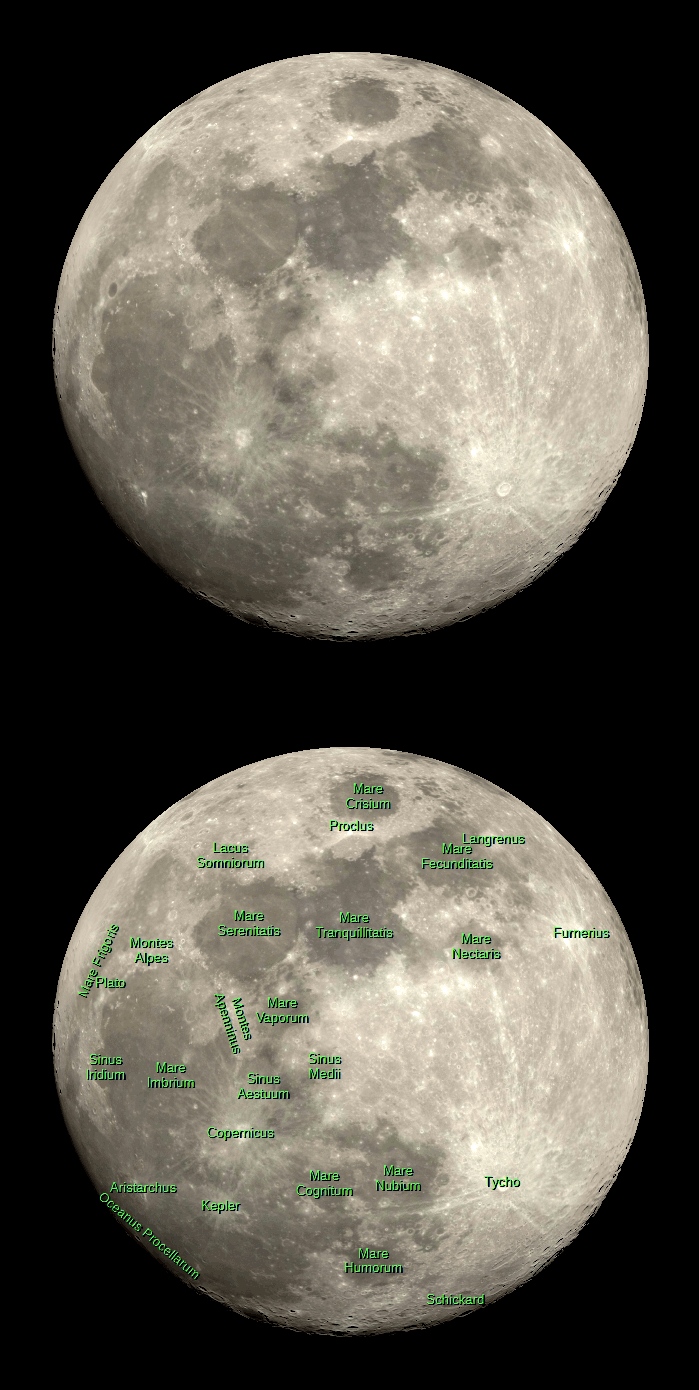
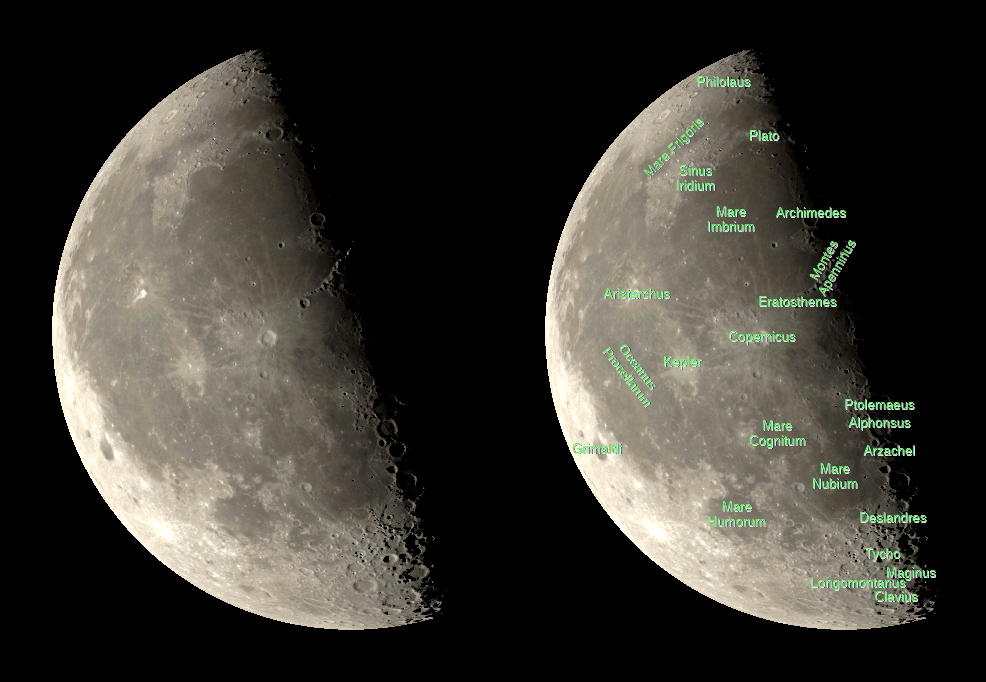
The moon tonight is bright. The sunrise line or terminator on the moon is crossing the large gray plain called Oceanus Procellarum, the largest of the moon’s seas. These seas were figments of the first telescopic observer’s imagination. They are really huge impact basins into which interior lava flowed. On the left edge of the Moon, just below center, this evening, at the terminator is a small shadow filled crater that might be visible in binoculars, but definitely telescopes. It’s called Aristarchus. It is a fairly new crater, probably less than a billion years old. As a rule the brighter the crater the newer it is. Aristarchus is the brightest spot on the Moon, when it is full. Visual astronomers have seen hazes and bright spots on rare occasions in and near Aristarchus.
The astronomical event times given are for the Traverse City/Interlochen area of Michigan (EST, UT – 5 hours). Times will be different for other locations.
Addendum
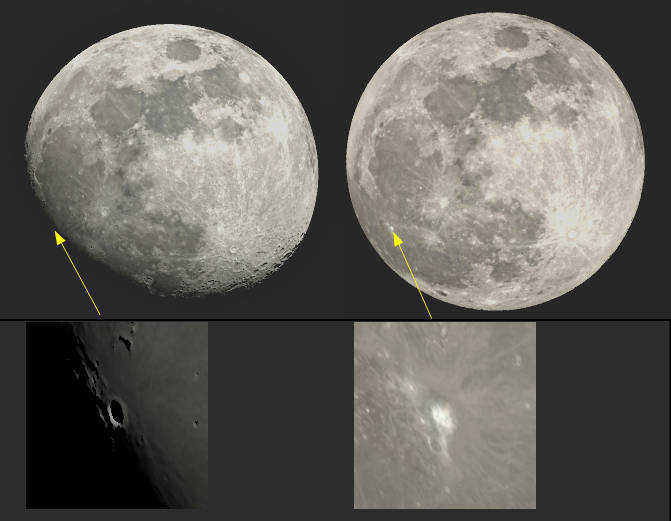
Aristarchus tonight, March 10, 2025, on the terminator (left), and Friday night, the 14th, before the total lunar eclipse starts. The enlargements show the telescopic view. Created using Stellarium, LibreOffice Draw and GIMP. The Moon doesn’t actually appear larger on the 14th. Apparently my field of view changed while getting the 14th’s image.
Ephemeris: 03/05/2025 – Taking our weekly look at the whereabouts of the naked-eye planets
This is Ephemeris for Ash Wednesday, March 5th. Today the Sun will be up for 11 hours and 23 minutes, setting at 6:36, and it will rise tomorrow at 7:10. The Moon, 1 day before first quarter, will set at 2:21 tomorrow morning.
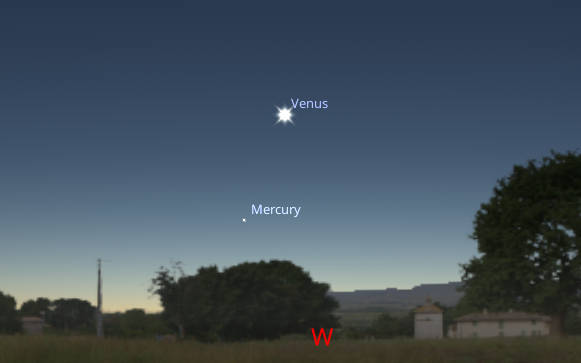
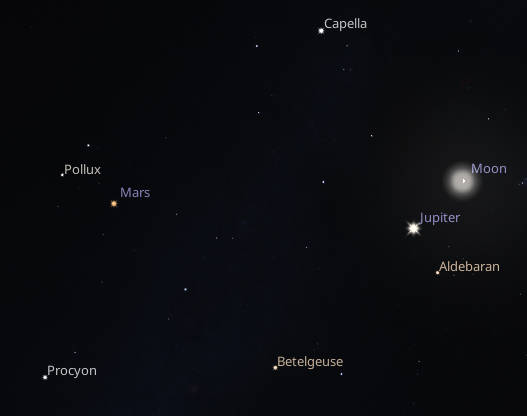
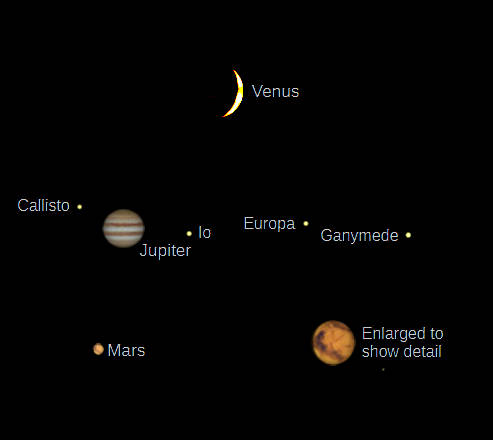
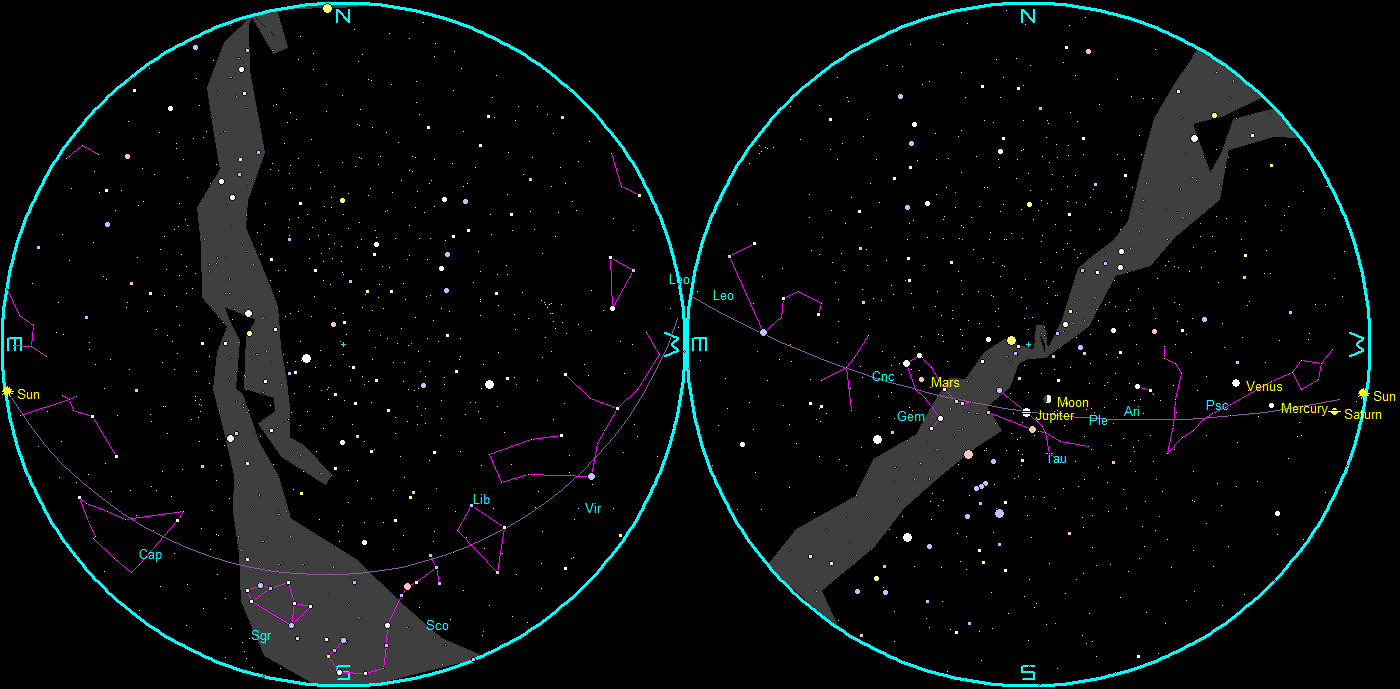
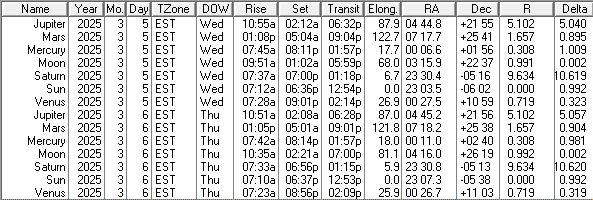
Let’s take our weekly look at the whereabouts of the naked-eye planets. At 7:10 PM this evening four of the five naked eye planets will be out. Starting from the West we have Venus the brightest of all. Below it at the 7 o’clock position and halfway to the horizon is the much dimmer Mercury, three days from its greatest separation from the Sun. Jupiter, the second-brightest planet will be high in the south-southwest below and right of the Moon tonight. The 4th planet out is Mars, the third-brightest planet now, with its distinctive reddish hue, west of the stars Castor and Pollux in Gemini, and in the southeast. By the end of the month both Venus and Mercury will be gone out of the evening sky, leaving only two, Mars and Jupiter.
The astronomical event times given are for the Traverse City/Interlochen area of Michigan (EST, UT – 5 hours). Times will be different for other locations.
Addendum
Ephemeris: 03/03/2025 – The Moon tonight
This is Bob Moler with Ephemeris for Monday, March 3rd. Today the Sun will be up for 11 hours and 17 minutes, setting at 6:33, and it will rise tomorrow at 7:14. The Moon, 3 days before first quarter, will set at 11:40 this evening.
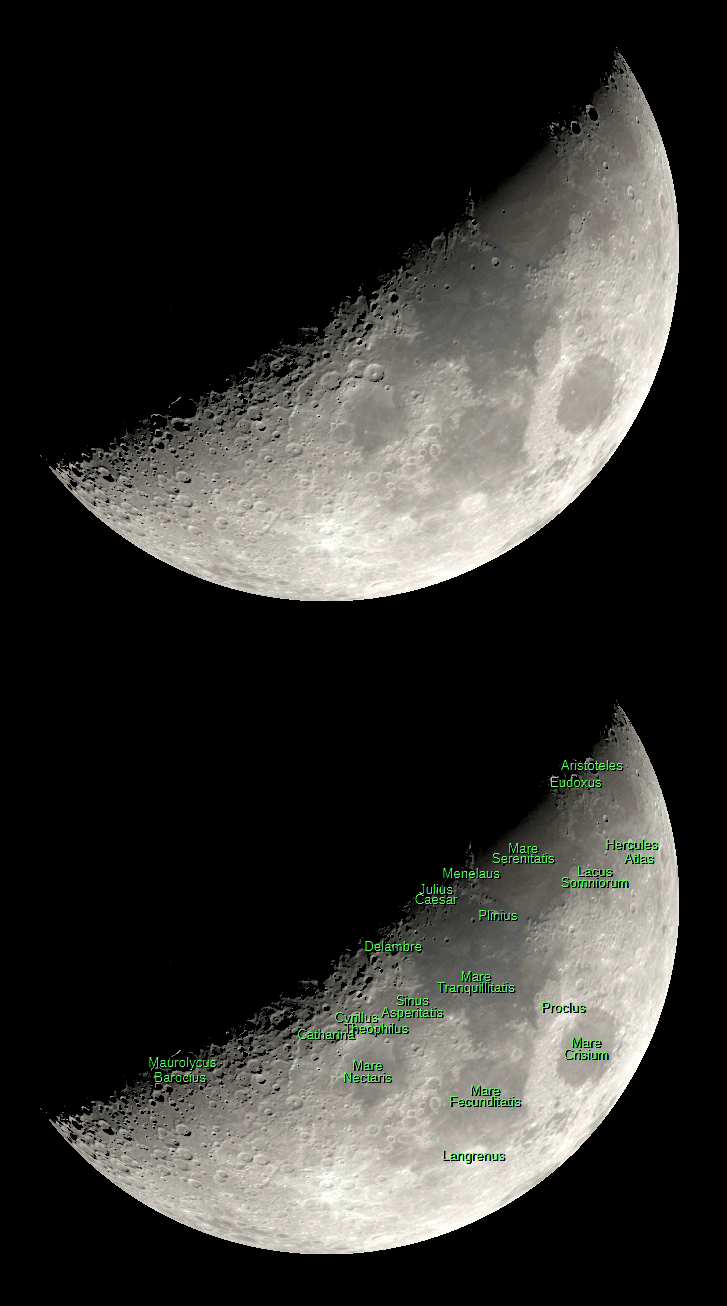
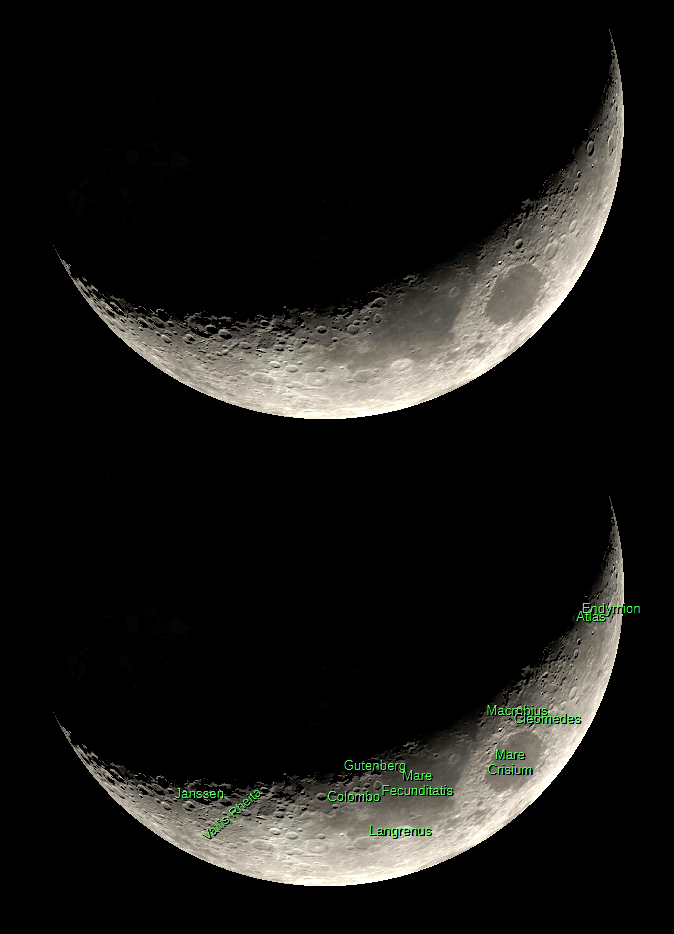
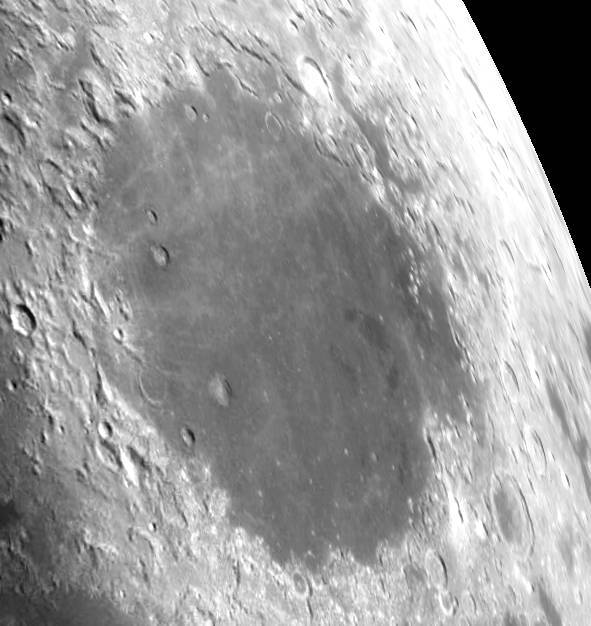
Tonight the moon will be four days old. The age of the moon is the number of days since the new moon which ranges from 1 to 28 or 29 for the lunar month. I usually don’t use that, being more concerned with the phase of the Moon so at the top of the program I give the moon’s relation to its new, quarter, or full phase. Being in its waxing crescent phase right now, the only features to the naked eye on the Moon besides the crescent itself are the dark Sea of Crises, Mare Crisium, target of Firefly Aerospace’s Blue Ghost Lander, and the larger Sea of Fruitfulness, Mare Fecunditatis. The Moon rotates about 1/28th the speed of the Earth, and it’s also smaller, about a quarter of the Earth’s diameter. So one would have to use a supersonic jet to fly around the Earth to keep up with the rotation, but on the Moon one could do that with the Apollo moon rover.
The astronomical event times given are for the Traverse City/Interlochen area of Michigan (EST, UT – 5 hours). Times will be different for other locations.
Addendum
Ephemeris: 02/27/2025 – The spring constellations are rising
This is Ephemeris for Thursday, February 27th. Today the Sun will be up for 11 hours and 5 minutes, setting at 6:28, and it will rise tomorrow at 7:21. The Moon is new today, and won’t be visible.
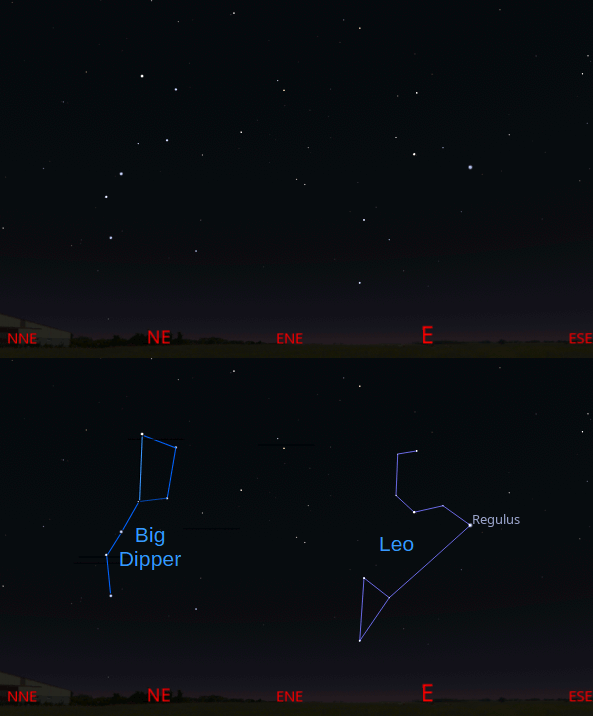
Today, we are exactly 3 weeks from the start of spring. The temperatures this week are rising. Even though at 8:00 PM Orion is high in the south, looking off to the east the spring constellation of Leo the lion has risen, and the Big Dipper is standing on its handle in the northeast. To the Anishinaabe native peoples of this area the Big Dipper is part of Ojiig, the Fisher, who brought summer to the Earth and when he’s in this position in the northeastern skies standing on his tail it is a sign of the spring to come and the start of the maple sugaring season. This next week or so is especially the best time, all year, to see the planet Mercury in the evening twilight due west, shortly after sunset. Its greatest separation from the Sun will come March 8th.
The astronomical event times given are for the Traverse City/Interlochen area of Michigan (EST, UT – 5 hours). Times will be different for other locations.
Addendum
Ephemeris: 02/26/2025 – Where are the naked-eye planets this week?
This is Ephemeris for Wednesday, February 26th. Today the Sun will be up for 11 hours and 2 minutes, setting at 6:26, and it will rise tomorrow at 7:23. The Moon, 1 day before new, will rise at 7:25 tomorrow morning.
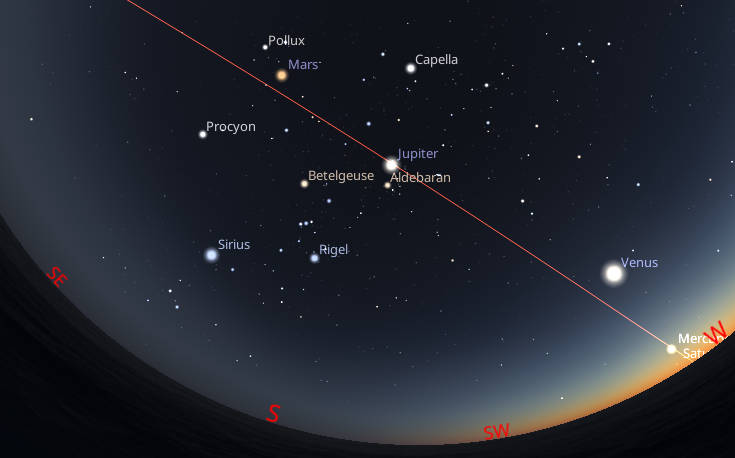
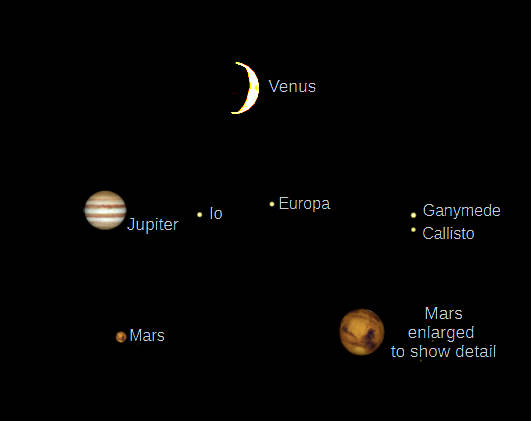
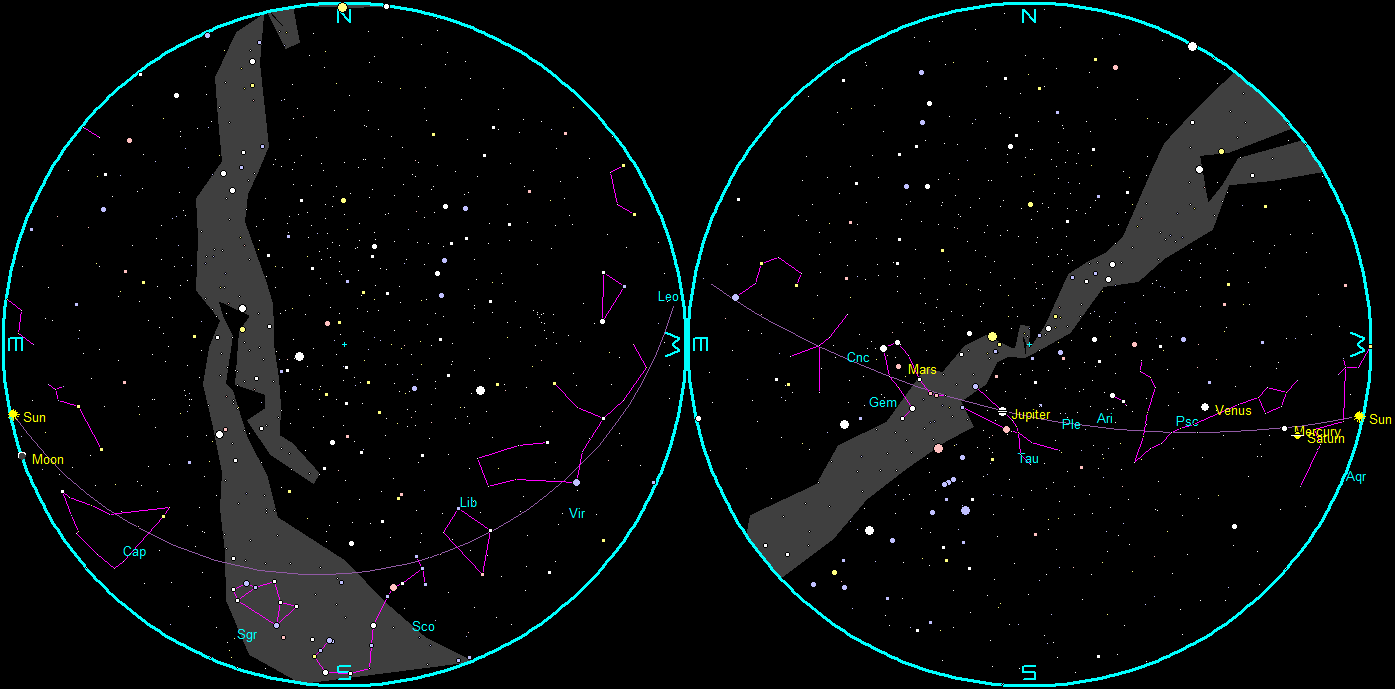
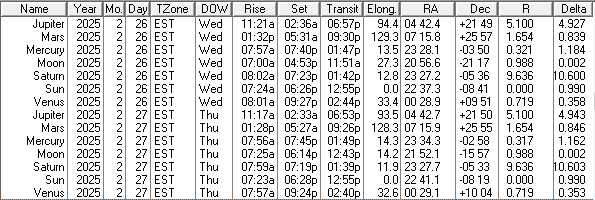
Let’s take our weekly look at the whereabouts of the naked-eye planets. At 7:15 PM this evening four of the five naked eye planets will be out. Starting from the west we have Venus the brightest of all. Far below it, near the horizon, will be the much dimmer Mercury, making its evening appearance, replacing Saturn. Jupiter, the second-brightest planet will be high in the south. It is slowly heading eastward now above the star Aldebaran. Farther below and left of it is the spectacular constellation of Orion the hunter. The 4th planet out is Mars, the third-brightest planet now, with its distinctive reddish hue in the east-southeast, to the right of the stars Castor and Pollux in Gemini.
The astronomical event times given are for the Traverse City/Interlochen area of Michigan (EST, UT – 5 hours). Times will be different for other locations.
Addendum
Ephemeris: 02/25/2025 – Eridanus, a river in the sky
This is Ephemeris for Tuesday, February 25th. Today the Sun will be up for 10 hours and 59 minutes, setting at 6:25, and it will rise tomorrow at 7:24. The Moon, 2 days before new, will rise at 7:00 tomorrow morning.
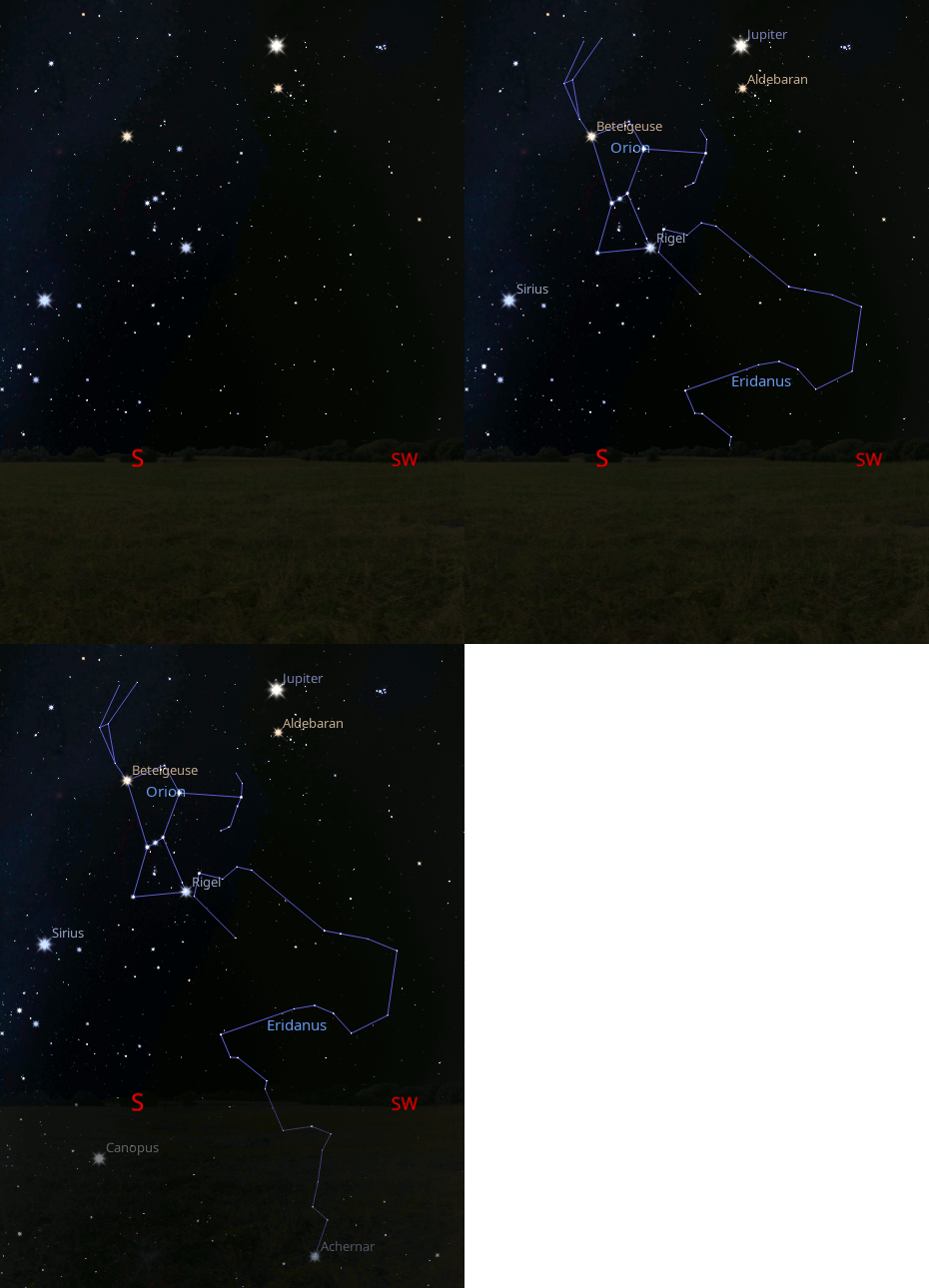
One of the more obscure constellations around is Eridanus, which depicts a river. At 8 PM the river starts near the lower right corner of Orion, near the bright star Rigel and flows to the lower right then zigzags back down to the south-southwestern horizon, it then heads below the horizon. One has to travel to the far south to see the southern terminus of the river, the bright star Achernar. Writers over the ages have seen here the Nile and the Earth circling river Ocean of the ancient flat earth days. Achernar is actually two stars, the brightest was discovered to be the flattest star known, due to its rapid spin. The dimensions of Achernar A has been determined to be twice as wide across its equator than from pole to pole. It’s 139 light years away.
The astronomical event times given are for the Traverse City/Interlochen area of Michigan (EST, UT – 5 hours). Times will be different for other locations.
Addendum
Ephemeris: 02/21/2025 – Orion’s most distinctive feature
This is Bob Moler with Ephemeris for Friday, February 21st. Today the Sun will be up for 10 hours and 46 minutes, setting at 6:20, and it will rise tomorrow at 7:31. The Moon, 1 day past last quarter, will rise at 4:09 tomorrow morning.
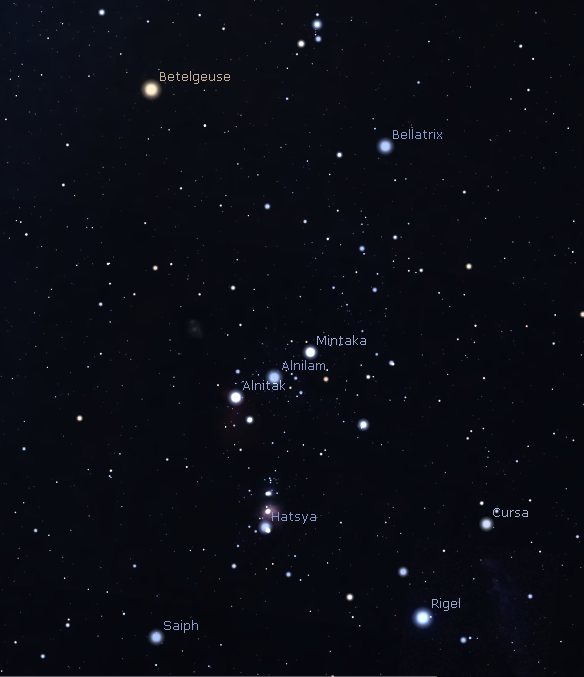
Orion’s belt of three stars is one of the most noticeable star groupings in the sky. There are no other groups of three bright stars in a straight line visible anywhere else in the sky. The star’s names from left to right are Alnitak, Alnilam and Mintaka. They are actually a bit farther away than the other bright stars of Orion. Alnilam, the center star, is over three times the distance of red giant Betelgeuse above it and over twice as far as blue white giant star Rigel below it. Alnilam is 375 thousand times brighter than the Sun. These three stars were also known as Frigga’s Spindle by the Norsemen. Frigga, also known as Freya, is the goddess from whom we get the name of the day of the week we call Friday.
The astronomical event times given are for the Traverse City/Interlochen area of Michigan (EST, UT – 5 hours). Times will be different for other locations.
Addendum
Ephemeris: 02/19/2025 – All the naked-eye planets are seen in the evening this week
Ephemeris: 02/19/2025 – Where have the naked-eye planets wandered off to this week?
This is Ephemeris for Wednesday, February 19th. Today the Sun will be up for 10 hours and 40 minutes, setting at 6:17, and it will rise tomorrow at 7:34. The Moon, 1 day before last quarter, will rise at 1:59 tomorrow morning.
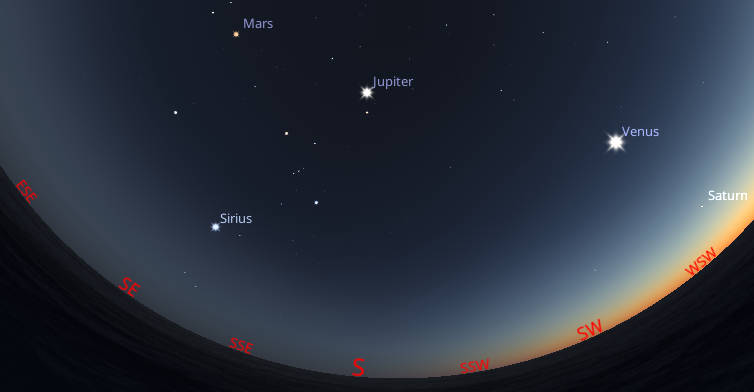
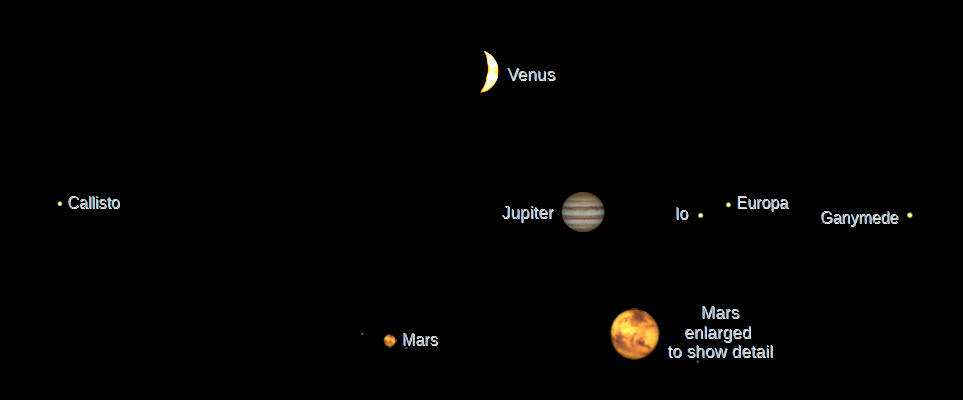
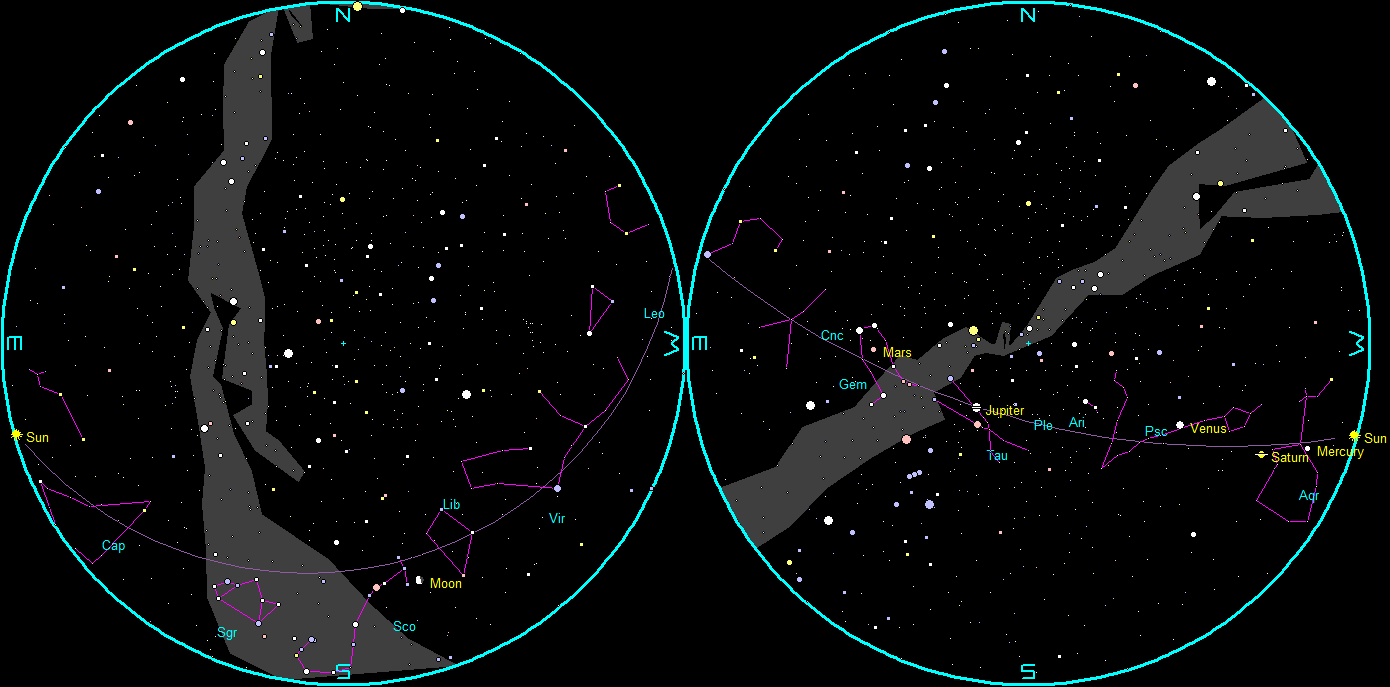
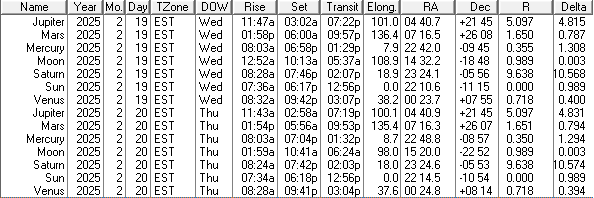
Let’s take our weekly look at the whereabouts of the naked-eye planets. At 7 PM this evening four of the five naked eye planets will be out. Starting from the West we have Venus the brightest of all in the west southwest. Far below it, near the horizon, will be the much dimmer Saturn, which we are about to lose, or may already have, to the evening twilight. Jupiter, the second-brightest planet will be high in the south. It has reversed course and is heading back eastward now. Farther below it is the spectacular constellation of Orion the hunter. The fourth planet out is Mars, the third-brightest planet now, with its distinctive reddish hue, west of the stars Castor and Pollux in Gemini, and in the east-southeast.
The astronomical event times given are for the Traverse City/Interlochen area of Michigan (EST, UT – 5 hours). Times will be different for other locations.
Addendum
 Bob Moler's Ephemeris Blog