Archive

Archive for the ‘Observing’ Category

Ephemeris: 04/22/2026 – Taking our weekly look at the whereabouts of the naked-eye planets

April 22, 2026 Comments off

This is Ephemeris for Earth Day, Wednesday, April 22nd. Today the Sun will be up for 13 hours and 50 minutes, setting at 8:36, and it will rise tomorrow at 6:45. The Moon, 1 day before first quarter, will set at 3:07 tomorrow morning.

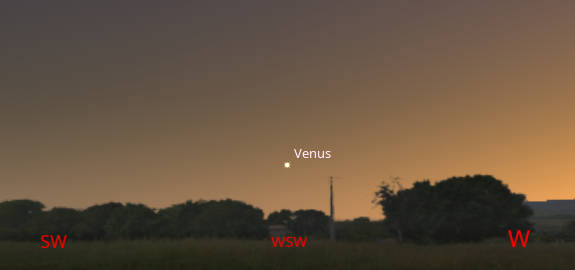
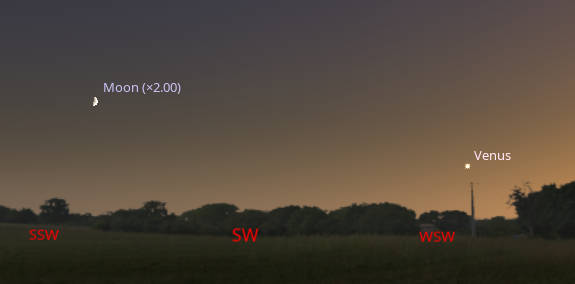
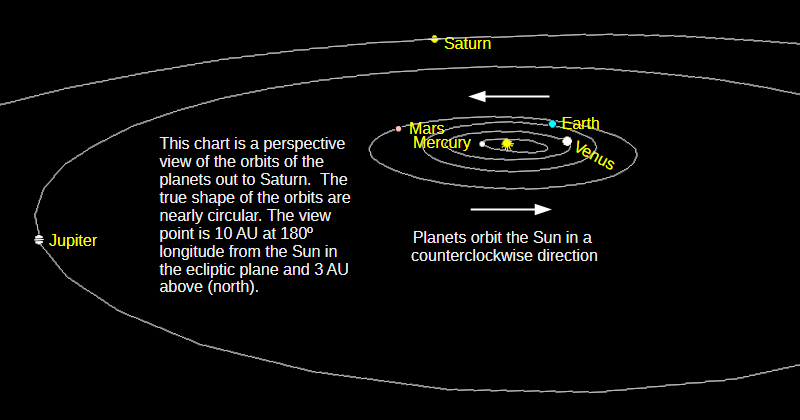
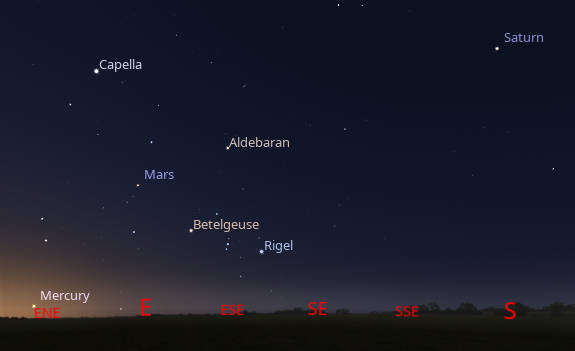
Let’s take our weekly look at the whereabouts of the naked-eye planets. By 9 PM tonight or about 30 minutes or so after sunset, Venus may be seen very low in the West. A telescope will show a very tiny disc on Venus, because it is still pretty much beyond the Sun, 138 million miles (222 million kilometers) away from us. Over the next 6 months it will be moving closer to us and becoming much larger. Jupiter is the brilliant star-like object high in the west-southwestern sky before 10 PM. It will appear just below the crescent Moon tonight. Venus will set at 10:54, while Jupiter will hold out until 2:30 AM. Meanwhile, Mercury, Mars and Saturn are still bunched up just west of the Sun, but are overwhelmed by bright morning twilight.

The astronomical event times given in this blog are for the Traverse City/Interlochen area of Michigan (Lat 44.7° N, Long 85.7° W; EDT, UT – 4 hours) unless stated otherwise. Times will be different for other locations.

Addendum
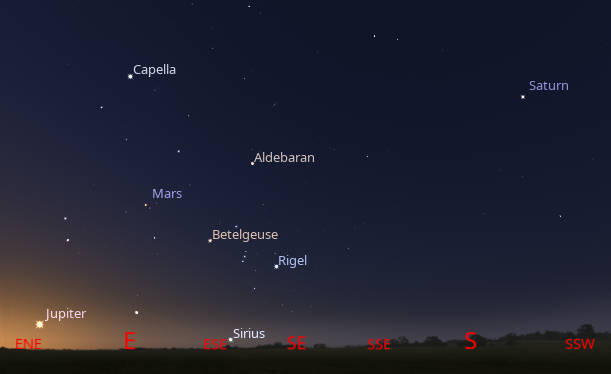
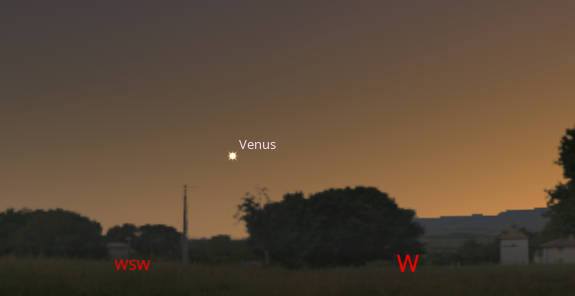
Jupiter, and Venus with the Moon and Sirius at 9 PM tonight.
Jupiter, and Venus with the Moon and Sirius at 9 PM tonight, April 22, 2026. Created using Stellarium.
A closer look at Jupiter and the Moon at 9 PM tonight.
A closer look at Jupiter and the Moon at 9 PM tonight, April 22, 2026. Created using Stellarium.
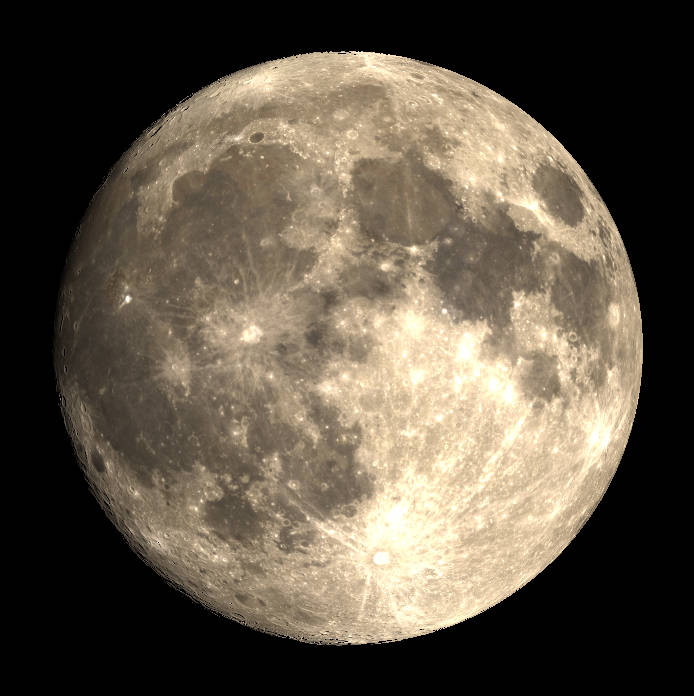
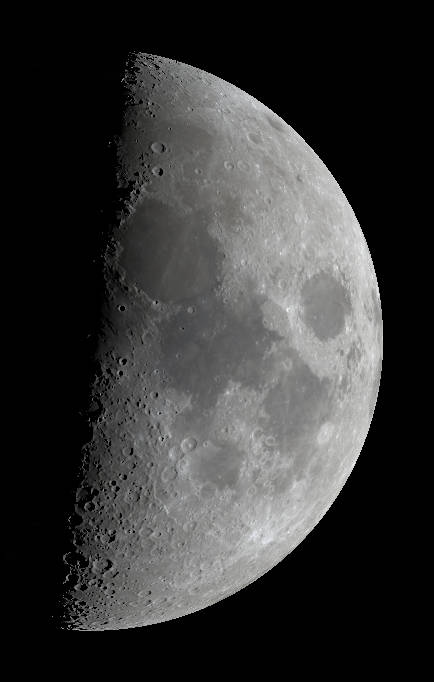
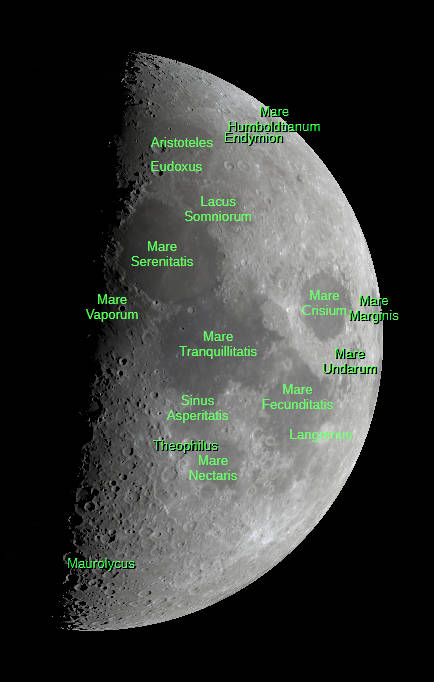
The Moon, a day before first quarter, as seen at 9:30 PM tonight, April 22, 2026. A view visible in small telescopes showing an image with and without selected features labeled. Created using Stellarium, LibreOffice Draw, and GIMP.
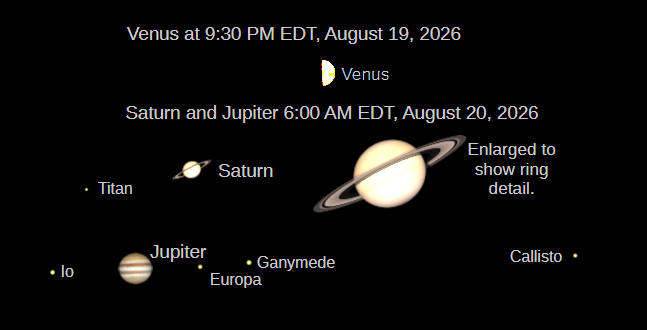
Telescopic Jupiter and Venus (north up) as they would be seen in a small telescope with the same magnification.
Telescopic Jupiter and Venus (north up) as they would be seen in a small telescope with the same magnification. Venus will be visible for a short time near the western horizon, while Jupiter is visible most of the night. Venus’ apparent diameter will be 11.3″, and be 89.7% illuminated. It’s on the far side of the Sun, 1.5 times the Sun’s distance from us. Jupiter will be 36.4″ in diameter, with its moons shown here for 9:30 PM, tonight April 22, 2026. The moons can shift noticably over an hour, especially Io and Europa. The (”) symbol means seconds of arc, or 1/3600th of a degree. Created using Cartes du Ciel (Sky Charts), LibreOffice Draw and GIMP.
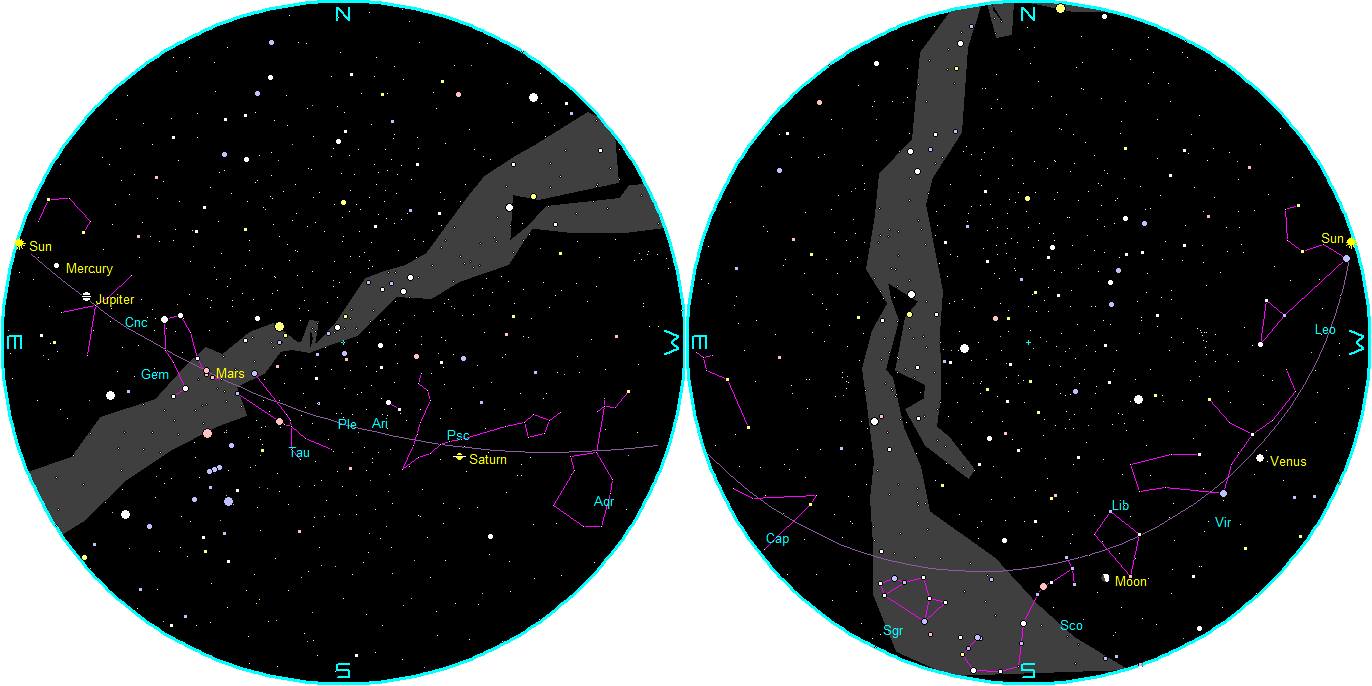
The naked-eye planets at sunset and sunrise on a single night, starting with sunset on the right on April 22, 2026. The night ends on the left with sunrise on the 22nd.
The naked-eye planets at sunset and sunrise on a single night, starting with sunset on the right on April 22, 2026. The night ends on the left with sunrise on the 22nd. Click or tap on the image to enlarge it. Created using my LookingUp app and GIMP.
A low precision ephemeris of the Sun Moon and naked eye planet positions for today and tomorrow.
This is a low precision ephemeris of the Sun Moon and naked eye planet positions for today and tomorrow, April 22 and 23rd, 2026. Some of the columns are self-explanatory, others are not. The transit column is the time that the body crosses the meridian and is due south. Elong, for elongation, is the angle between the Sun and that body. RA is right ascension, which is the object’s east-west position on the celestial sphere in hours and minutes. Dec is declination which is the north-south position of the object on the celestial sphere in degrees and minutes. R is the distance of that object from the Sun in astronomical units. An astronomical unit is about 93 million miles or 150 million kilometers. And Delta is the distance of that object from the Earth, also in astronomical units. I omit the ‘m’ in am and pm for compactness. The data was generated using my LookingUp for DOS app and displayed as a table by my Ephemeris Helper app.

Ephemeris: 04/21/2026 – The Lyrid meteor shower reaches its peak tomorrow

April 21, 2026 Comments off

This is Ephemeris for Tuesday, April 21st. Today the Sun will be up for 13 hours and 47 minutes, setting at 8:35, and it will rise tomorrow at 6:46. The Moon, 2 days before first quarter, will set at 2:21 tomorrow morning.

The second major meteor shower this year will reach its peak tomorrow afternoon around 3 PM (~19h UT). The best time to see it will be tomorrow morning after moonset at 2:21 AM. Astronomical twilight will begin to interfere after 5 AM. The other is tomorrow night starting 45 minutes later. The meteor shower is called the Lyrids, because they seem to come from near the constellation Lyra the harp and the bright star Vega. By 3 AM Vega will be high in the east. The radiant of the meteors is to the west of Vega, between Lyra and the dim constellation of Hercules. Though a major shower, the peak hourly rate is expected to be about 20 meteors an hour.

The astronomical event times given in this blog are for the Traverse City/Interlochen area of Michigan (Lat 44.7° N, Long 85.7° W; EDT, UT – 4 hours) unless stated otherwise. Times will be different for other locations.

Addendum
Lyrid meteor radiant.
Lyrid meteor radiant (LyrR) is near Lyra and the bright star Vega. The bright star by “Lyr” is Vega. Create by my LookingUp app.

Ephemeris: 04/15/2026 – Taking our weekly look at the whereabouts of the naked-eye planets

April 15, 2026 Comments off

This is Ephemeris for Wednesday, April 15th. Today the Sun will be up for 13 hours and 29 minutes, setting at 8:28, and it will rise tomorrow at 6:56. The Moon, 2 days before new, will rise at 6:15 tomorrow morning.

Let’s take our weekly look at the whereabouts of the naked-eye planets. By 9:15 PM tonight or about 45 minutes or so after sunset, Venus may be seen very low in the West. A telescope will show a very tiny disc on Venus, because it is still pretty much beyond the Sun, 141 million miles (226 million kilometers) away from us. Over the next 6 months it will be moving closer to us and becoming much larger. Jupiter is the brilliant star-like object high in the southwestern sky at the same time. Venus will set at 10:35, while Jupiter will hold out to 3 AM. Meanwhile, Mercury, Mars and Saturn are lined up just west of the Sun, but unfortunately are overwhelmed by bright morning twilight. Southern Hemisphere observers will them bunched up next week.

The astronomical event times given in this blog are for the Traverse City/Interlochen area of Michigan (Lat 44.7° N, Long 85.7° W; EDT, UT – 4 hours) unless stated otherwise. Times will be different for other locations.

Addendum

Jupiter and Venus with fading constellations of winter in the west at 9:30 PM.
Jupiter and Venus with fading constellations of winter at 9:30 PM tonight, April 15, 2026. Created using Stellarium.
Telescopic Jupiter and Venus as they would be seen in a small telescope with the same magnification (north up) as they would be seen in a small telescope with the same magnification.
Telescopic Jupiter and Venus as they would be seen in a small telescope with the same magnification (north up) as they would be seen in a small telescope with the same magnification at 9:30 PM tonight, April 15, 2026. Venus will be visible for a short time near the western horizon, while Jupiter is visible most of the night. Venus’ apparent diameter will be 11.1″, and be 91.2% illuminated. It’s on the far side of the Sun. Jupiter will be 37.1″ in diameter. Io will be behind Jupiter and in its shadow until 12:16 AM, when it will appear near Europa. The (”) symbol means seconds of arc, or 1/3600th of a degree. Created using Cartes du Ciel (Sky Charts), LibreOffice Draw and GIMP.
The naked-eye planets at sunset and sunrise on a single night, starting with sunset on the right on April 15, 2026. The night ends on the left with sunrise on the 16th. Click or tap on the image to enlarge it. Created using my LookingUp app and GIMP.
A low precision ephemeris of the Sun Moon and naked eye planet positions for today and tomorrow.
This is a low precision ephemeris of the Sun Moon and naked eye planet positions for today and tomorrow, April 15 and 16th, 2026. Some of the columns are self-explanatory, others are not. The transit column is the time that the body crosses the meridian and is due south. Elong, for elongation, is the angle between the Sun and that body. RA is right ascension, which is the object’s east-west position on the celestial sphere in hours and minutes. Dec is declination which is the north-south position of the object on the celestial sphere in degrees and minutes. R is the distance of that object from the Sun in astronomical units. An astronomical unit is about 93 million miles or 150 million kilometers. And Delta is the distance of that object from the Earth, also in astronomical units. I omit the ‘m’ in am and pm for compactness. The data was generated using my LookingUp for DOS app and displayed as a table by my Ephemeris Helper app.

Ephemeris: 04/13/2026 – How the Greeks saw the constellation Leo

April 13, 2026 Comments off

This is Bob Moler with Ephemeris for Monday, April 13th. Today the Sun will be up for 13 hours and 23 minutes, setting at 8:25, and it will rise tomorrow at 7:00. The Moon, 3 days past last quarter, will rise at 5:35 tomorrow morning.

The constellations that we know are mostly those that come from the Sumerians and other civilizations who lived around what is now modern day Iraq. They were adopted and adapted by the ancient Greeks, and to us. Foremost of these was Leo the lion, seen high in the south-southeastern sky at 10 PM. It is easily found by imagining the bottom of the Big Dipper leaks. It will drip on the back of Leo, with its distinctive backward question mark as his front with his head and mane. To the Greeks he was the Nemean Lion, whose coat was impervious to arrows or spears. Heracles (Hercules) was able to kill it by first stunning it with a club then strangling it with his bare hands. It was the first of his Twelve Labors.

The astronomical event times given in this blog are for the Traverse City/Interlochen area of Michigan (Lat 44.7° N, Long 85.7° W; EST, UT – 5 hours) unless stated otherwise. Times will be different for other locations.

Addendum

Leaky Dipper drips on Leo.
Leaky Big Dipper drips on Leo. Created using mu LookingUp program.
Hercules killing the Nemean Lion as the first of his Twelve Labors. An image generated by Google's AI.
Hercules killing the Nemean Lion as the first of his Twelve Labors. Image generated by Google’s Gemini AI (Nano Banana 2).

Ephemeris: 04/09/2026 – Finding Leo the lion

April 9, 2026 Comments off

This is Ephemeris for Thursday, April 9th. Today the Sun will be up for 13 hours and 11 minutes, setting at 8:20, and it will rise tomorrow at 7:07. The Moon, 1 day before last quarter, will rise at 3:58 tomorrow morning.

At 10 p.m. the spring constellation of Leo the lion will be high in the south-southeast. It can be found by locating the Big Dipper high in the northeast and imagining that a hole were drilled in the bowl to let the water leak out. It would drip on the back of this giant cat. The Lion is standing or lying facing westward. His head and mane are seen in the stars as a backwards question mark. This group of stars is also called the sickle. The bright star Regulus is at the bottom, the dot at the bottom of the question mark. A triangle of stars, to the left of Regulus, is the lion’s haunches. Leo contains some nice galaxies visible in moderate sized telescopes. The stars in Leo’s part of the sky are fewer than those in the winter sky.

The astronomical event times given in this blog are for the Traverse City/Interlochen area of Michigan (Lat 44.7° N, Long 85.7° W; EST, UT – 5 hours) unless stated otherwise. Times will be different for other locations.

Addendum

Leaky Dipper drips on Leo
Leaky Big Dipper drips on Leo. The positions in the sky are for early evening local time, or about 1½ hours after sunset. The little distorted cross at the top of the image marks the zenith. Look high in the east and east-southeast to see these stars. Created using my LookingUp program, GIMP and LibreOffice.

Ephemeris: 04/08/2026 – Taking our weekly look at the whereabouts of the naked-eye planets

April 8, 2026 Comments off

This is Ephemeris for Wednesday, April 8th. Today the Sun will be up for 13 hours and 8 minutes, setting at 8:19, and it will rise tomorrow at 7:08. The Moon, 2 days before last quarter, will rise at 3:20 tomorrow morning.

Let’s take our weekly look at the whereabouts of the naked-eye planets. By 9 PM tonight or about 40 minutes or so after sunset, Venus may be seen very low in the West. Binoculars or a telescope will show a very tiny disc on Venus, because it is pretty much behind the Sun, 145 million miles (231 million kilometers) away from us. Over the next 6 months it will be moving closer to us and becoming much larger. Jupiter is the brilliant star-like object high in the southwestern sky at 9:30 PM. Venus will set at 10:15, while Jupiter will hold out to 3:30 AM. Meanwhile, Mercury, Mars and Saturn are lined up just west of the Sun, but unfortunately are overwhelmed by bright morning twilight. The Artemis II astronauts reported seeing them during their solar eclipse.

The astronomical event times given in this blog are for the Traverse City/Interlochen area of Michigan (Lat 44.7° N, Long 85.7° W; EST, UT – 5 hours) unless stated otherwise. Times will be different for other locations.

Addendum

Jupiter and Venus with fading constellations of winter at 9:30 PM tonight.
Jupiter and Venus with fading constellations of winter at 9:30 PM tonight, April 8, 2026. Created using Stellarium.
The Moon, a day before last quarter as seen at 6 AM tomorrow morning, April 9, 2026. A view visible in small telescopes showing an image with and without selected features labeled. Created using Stellarium, LibreOffice Draw, and GIMP.
Telescopic Jupiter and Venus as they would be seen in a small telescope with the same magnification.
Telescopic Jupiter and Venus as they would be seen in a small telescope with the same magnification.Telescopic Jupiter and Venus (north up) as they would be seen in a small telescope with the same magnification. Venus will be visible for a short time near the western horizon, while Jupiter is visible most of the night. Venus’ apparent diameter will be 10.9″, and be 92.5% illuminated. It’s on the far side of the Sun. Jupiter will be 37.9″ in diameter, with its moons shown here for 10 PM, tonight April 8th, 2026. The moons can shift noticably over an hour. Io will emerge from Jupiter’s shadow at 10:21 PM. The (”) symbol means seconds of arc, or 1/3600th of a degree. Created using Cartes du Ciel (Sky Charts), LibreOffice Draw and GIMP.
The naked-eye planets at sunset and sunrise on a single night.
The naked-eye planets at sunset and sunrise on a single night, starting with sunset on the right on April 8, 2026. The night ends on the left with sunrise on the 9th. Click or tap on the image to enlarge it. Created using my LookingUp app and GIMP.

Ephemeris: 04/06/2026 – A Ghostly pyramid of light

April 6, 2026 Comments off

This is Ephemeris for Monday, April 6th. Today the Sun will be up for 13 hours and 2 minutes, setting at 8:16, and it will rise tomorrow at 7:12. The Moon, 4 days before last quarter, will rise at 1:38 tomorrow morning.

The evening sky will stay dark for the rest of the week, so it’s time to look for the zodiacal light in the evening. It is a faint but towering glow that can be seen after the end of astronomical twilight on moonless nights. It is seen in the west in the evening in late winter and early spring. The axis of the glow is the ecliptic, the apparent annual path of the Sun in the sky, along which lie the constellations of the zodiac. It’s a glow whose wide base is in the west that extends upwards and tilted to the left. Right now, the end of astronomical twilight is about 10 PM and advancing at a rate of a minute or two each night. Go to a spot with a dark western sky, with no big cities or towns out that way. Zodiacal light is caused by dust spread out around the Sun.

The astronomical event times given in this blog are for the Traverse City/Interlochen area of Michigan (Lat 44.7° N, Long 85.7° W; EST, UT – 5 hours) unless stated otherwise. Times will be different for other locations.

Addendum

Zodiacal Light
Much enhanced Zodiacal Light from the my back yard at 9:31 p.m. March 16, 2018, 5 minutes after the official end of astronomical twilight. The Pleiades are at the top, and the three stars that look like a hockey stick at the right edge of the glow are part of Aries the ram. Canon EOS Rebel T5 18mm f.l., f/3.5, 6 sec. ISO 12,800 . The clouds on the left appear to be illuminated by the lights of the towns of Honor, Beulah, Benzonia and Frankfort 20+ miles away.

The photograph above has been increased in brightness and contrast, and of course compressed into a small picture. The zodiacal light encompasses a fairly large part of the sky. It is difficult to see. It wasn’t until my 20s that I was able to get to a dark enough spot to actually see it. But once you have spotted it, and know what you’re looking for, it is easy to detect again. A good way to find it is to scan near the horizon from northwest to southwest and notice the darkness of the sky. You’ll probably notice that towards the center of that scan the sky is not as dark as it is at the edges. Then you can follow it up into the sky and leaning to the left. This time of year the Pleiades will be at the apex of the left leaning pyramid of light. It is easiest seen on mornings near the vernal equinox, and in the mornings near the autumnal equinox where it leans to the right.

Ephemeris: 04/01/2026 – No fooling, we’re looking at the bright planets for this week

April 1, 2026 Comments off

This is Ephemeris for April Fools’ Day, Wednesday, April 1st. Today the Sun will be up for 12 hours and 47 minutes, setting at 8:10, and it will rise tomorrow at 7:21. The Moon, at full today, will rise at 8:06 this evening.

Let’s take our weekly look at the whereabouts of the naked-eye planets. By 8:40 PM tonight or about a half hour or so after sunset, Venus may be seen very low in the West. Binoculars or a telescope will show a very tiny disc on Venus, because it is pretty much behind the Sun, a good way from us. Over the next 7 months it will be moving closer to us and becoming much larger. Jupiter is the brilliant star-like object more than halfway up in the southwestern sky at 9 PM. At that time Venus will still be visible, setting at 9:57 PM. Mercury, Mars and Saturn are lined up just west of the Sun, but unfortunately are overwhelmed by bright morning twilight.

The astronomical event times given in this blog are for the Traverse City/Interlochen area of Michigan (Lat 44.7° N, Long 85.7° W; EST, UT – 5 hours) unless stated otherwise. Times will be different for other locations.

Addendum

Jupiter and Venus with the constellations of the Zodiac at 9 PM.
Jupiter and Venus with the constellations of the Zodiac at 9 PM, or 50 minutes after sunset tonight, April 1, 2026. Created using Stellarium.
The full Moon as seen at 10 PM tonight, April 1, 2026. A view visible in small telescopes showing an image with and without selected features labeled. Created using Stellarium, LibreOffice Draw, and GIMP.
Telescopic Jupiter and Venus as they would be seen in a small telescope with the same magnification.
Telescopic Jupiter and Venus (north up) as they would be seen in a small telescope with the same magnification. Venus will be visible for a short time near the western horizon, while Jupiter is visible most of the night. Venus’ apparent diameter will be 10.7″, and be 93.6% illuminated. It’s on the far side of the Sun. Jupiter will be 38.8″ in diameter, with its moons shown here for 9 PM, tonight April 1st, 2026. The moons can shift noticably over an hour. The (”) symbol means seconds of arc, or 1/3600th of a degree. Created using Cartes du Ciel (Sky Charts), LibreOffice Draw and GIMP.
The naked-eye planets at sunset and sunrise on a single night.
The naked-eye planets at sunset and sunrise on a single night, starting with sunset on the right on April 1, 2026. The night ends on the left with sunrise on the 2nd. The Moon is missing. It is full today but is south of the ecliptic, while we are viewing from a northerly location. So the full mon rises a bit after sunset and sets a bit before sunrise. Click or tap on the image to enlarge it. Saturn is not visible, being too close to the direction of the Sun. Created using my LookingUp app and GIMP.
A low precision ephemeris of the Sun Moon and naked eye planet positions for today and tomorrow.
This is a low precision ephemeris of the Sun Moon and naked eye planet positions for today and tomorrow, April 1st and 2nd, 2026. Some of the columns are self-explanatory, others are not. The transit column is the time that the body crosses the meridian and is due south. Elong, for elongation, is the angle between the Sun and that body. RA is right ascension, which is the object’s east-west position on the celestial sphere in hours and minutes. Dec is declination which is the north-south position of the object on the celestial sphere in degrees and minutes. R is the distance of that object from the Sun in astronomical units. An astronomical unit is about 93 million miles or 150 million kilometers. And Delta is the distance of that object from the Earth, also in astronomical units. I omit the ‘m’ in am and pm for compactness. The data was generated using my LookingUp for DOS app and displayed as a table by my Ephemeris Helper app.

Ephemeris: 03/31/2026 – Previewing April Skies

March 31, 2026 Comments off

This is Ephemeris for Tuesday, March 31st. Today the Sun will be up for 12 hours and 43 minutes, setting at 8:09, and it will rise tomorrow at 7:23. The Moon, 1 day before full, will set at 7:00 tomorrow morning.

The 4th month of the year begins tomorrow. Daylight hours in the Interlochen/Traverse City area will increase from 12 hours and 47 minutes tomorrow to 14 hours and 12 minutes on April 30th. The altitude, or angle, of the Sun above the southern horizon at local noon will be 50 degrees tomorrow and will ascend to 60 degrees on April 30th. The altitude of the Sun in the Straits area will be a degree lower, but their daylight hours will be a bit longer. The actual time of local apparent noon, when the Sun passes due south at mid-month, will be about 1:42 PM. The Lyrid meteor shower will reach its peak on the afternoon of the 22nd. So the hours after 2 or 3 AM on the 22nd and 23rd will be the best time to see them in dark skies.

The astronomical event times given in this blog are for the Traverse City/Interlochen area of Michigan (Lat 44.7° N, Long 85.7° W; EDT, UT – 4 hours) unless stated otherwise. Times will be different for other locations.

Addendum
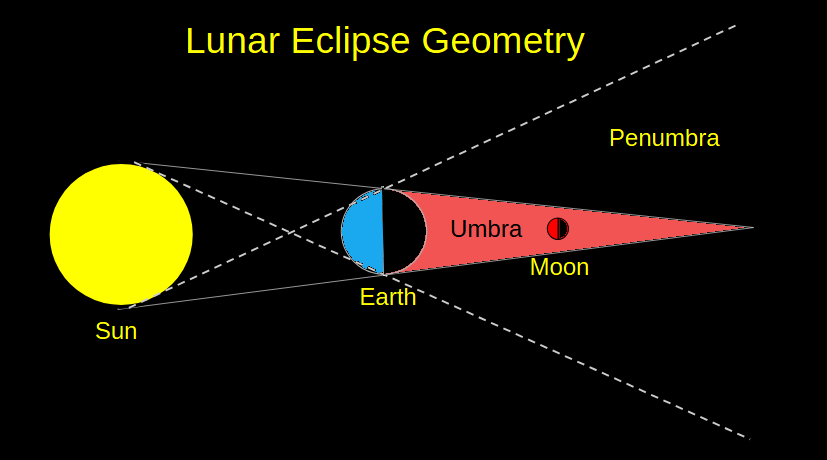
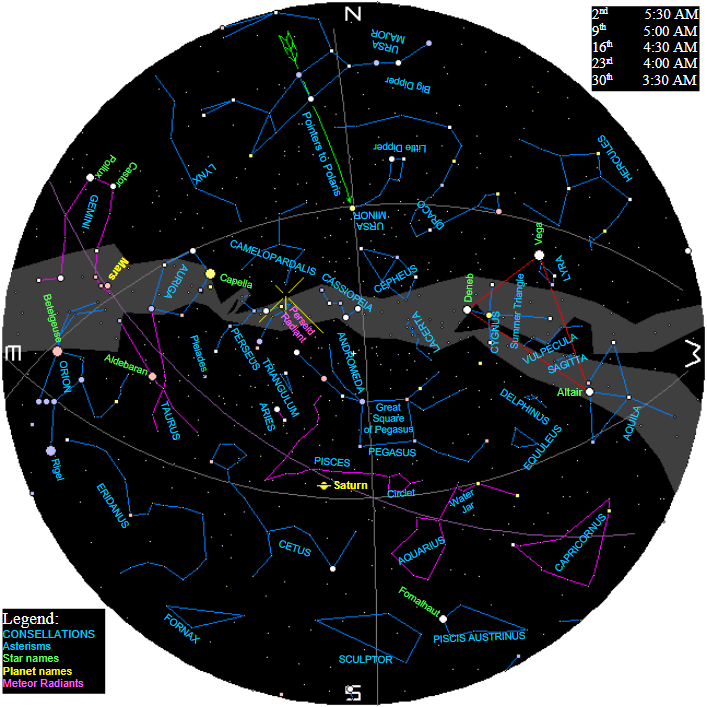
April Evening Star Chart

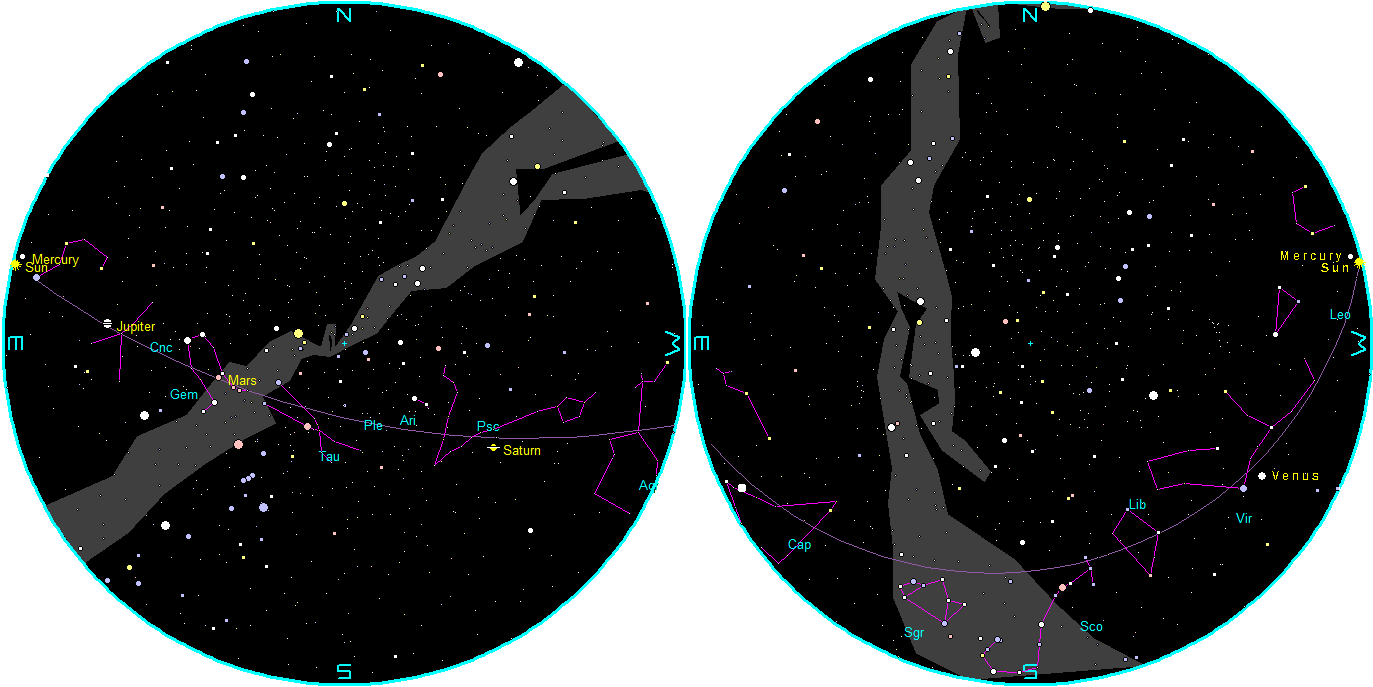
Star Chart for April 2026
Star Chart for April 2026 (10 p.m. EDT, April 15, 2026). Click or tap on the image to enlarge it. Created using my LookingUp app.

The planets and stars are plotted for the 15th at 10 PM EDT in the evening and 5 AM for the morning chart. These are the chart times. Note that Traverse City is located approximately 45 minutes behind our time meridian. (An hour 45 minutes behind our daylight saving time meridian during EDT). To duplicate the star positions on a planisphere (rotating star finder) you may have to set it to 45 minutes or one hour 45 minutes (Daylight Time) earlier than the current time.

Note the chart times of 10 PM and 6 AM are for the 15th and 16th. For each week before these dates, add ½ hour (28 minutes if you’re picky). For each week after, subtract ½ hour. Planet positions on dates other than the 15/16th can be found in the Wednesday planet posts on this blog.

April Morning Star Chart

Star Chart for April mornings, 2026
Star Chart for April mornings, 2026(5 a.m. EDT, April 16, 2026). Click or tap on the image to enlarge it. Created using my LookingUp app.

Twilight Limits, Nautical and Astronomical

EDT
MorningTwilightEveningTwilightDarkNightMoon
DateAstro.NauticalNauticalAstro.StartEndIllum.
2026-04-015h43m6h19m21h17m21h54m100%
2026-04-025h41m6h17m21h19m21h56m99%
2026-04-035h39m6h15m21h20m21h57m21h57m22h23m96%
2026-04-045h36m6h13m21h22m21h59m21h59m23h30m91%
2026-04-055h34m6h11m21h23m22h00m22h00m85%
2026-04-065h32m6h09m21h24m22h02m22h02m0h36m77%
2026-04-075h30m6h07m21h26m22h04m22h04m1h38m69%
2026-04-085h28m6h05m21h27m22h05m22h05m2h34m60%
2026-04-095h25m6h03m21h29m22h07m22h07m3h20m50%
2026-04-105h23m6h02m21h30m22h08m22h08m3h58m41%
2026-04-115h21m6h00m21h32m22h10m22h10m4h29m31%
2026-04-125h19m5h58m21h33m22h12m22h12m4h54m22%
2026-04-135h17m5h56m21h35m22h14m22h14m5h16m14%
2026-04-145h14m5h54m21h36m22h15m22h15m5h14m7%
2026-04-155h12m5h52m21h38m22h17m22h17m5h12m2%
2026-04-165h10m5h50m21h39m22h19m22h19m5h10m0%
2026-04-175h08m5h48m21h41m22h21m22h21m5h08m1%
2026-04-185h06m5h46m21h42m22h22m22h43m5h06m4%
2026-04-195h03m5h44m21h44m22h24m5h03m11%
2026-04-205h01m5h42m21h45m22h26m0h06m5h01m19%
2026-04-214h59m5h40m21h47m22h28m1h20m4h59m29%
2026-04-224h57m5h38m21h48m22h30m2h21m4h57m40%
2026-04-234h54m5h36m21h50m22h31m3h08m4h54m51%
2026-04-244h52m5h34m21h51m22h33m3h42m4h52m62%
2026-04-254h50m5h32m21h53m22h35m4h09m4h50m72%
2026-04-264h48m5h30m21h54m22h37m4h30m4h48m81%
2026-04-274h46m5h29m21h56m22h39m88%
2026-04-284h43m5h27m21h57m22h41m94%
2026-04-294h41m5h25m21h59m22h43m98%
2026-04-304h39m5h23m22h01m22h45m100%

Twilight calendar was generated using Cartes du Ciel (Sky Charts).

See my blog post: Twilight Zone for the definitions of the different periods of twilight here: https://bobmoler.wordpress.com/2019/09/27/

NASA Calendar of Planetary Events

Apr  1  We            Venus: 20.5° E
1 We 10:12 PM Full Moon
2 Th 9:32 PM Moon-Spica: 1.9° N
3 Fr 6:59 PM Mercury Elongation: 27.8° W
6 Mo 3:21 PM Moon-Antares: 0.7° N
7 Tu 4:32 AM Moon Apogee: 405000 km
8 We 1:01 AM Moon South Dec.: 28.3° S
10 Fr 12:52 AM Last Quarter
13 Mo 7:43 PM Moon Ascending Node
15 We 8:45 PM Moon-Mars: 3.8° S
17 Fr 7:52 AM New Moon
19 Su 2:57 AM Moon Perigee: 361600 km
19 Su 4:48 AM Moon-Venus: 4.7° S
19 Su 12:28 PM Moon-Pleiades: 1° S
19 Su 3:04 PM Mars-Saturn: 1.2° N
20 Mo 5:41 AM Mercury-Saturn: 0.5° N
20 Mo 6:15 PM Mercury-Mars: 1.7° N
21 Tu 7:12 AM Moon North Dec.: 28.2° N
22 We 3:02 PM Lyrid Shower: ZHR = 20
22 We 6:06 PM Moon-Jupiter: 3.6° S
23 Th 10:32 PM First Quarter
24 Fr 12:15 AM Venus-Pleiades: 3.5° S
24 Fr 3:46 AM Moon-Beehive: 1.1° S
25 Sa 8:37 PM Moon-Regulus: 0.2° S (Occultation possibility)
26 Su 10:36 AM Moon Descending Node
30 Th 4:17 AM Moon-Spica: 2° N
May 1 Fr Venus: 27.8° E

Sky Events Calendar by Fred Espenak and Sumit Dutta (NASA’s GSFC),
http://eclipse.gsfc.nasa.gov/SKYCAL/SKYCAL.html

If you go to the above site you can print out a list like the above for the entire year or calendar pages for your time zone.

Sun and Moon Rising and Setting Events

LU                  Ephemeris of Sky Events for Interlochen/TC
April, 2026 Local time zone: EDT
+-----------------------------------------------------------------------+
| DATE | SUN SUN DAYLIGHT| TWILIGHT* |MOON RISE OR ILLUM |
| | RISE SET HOURS | END START |PHASE SET** TIME FRACTN|
+=======================================================================+
|Wed 1| 07:23a 08:10p 12:47 | 09:15p 06:18a |Full Rise 08:06p 100%|
|Thu 2| 07:21a 08:11p 12:50 | 09:16p 06:16a | Rise 09:14p 99%|
|Fri 3| 07:19a 08:13p 12:53 | 09:18p 06:14a | Rise 10:22p 96%|
|Sat 4| 07:17a 08:14p 12:56 | 09:19p 06:12a | Rise 11:30p 92%|
+------+-----------------------+----------------+-----------------------+
|Sun 5| 07:16a 08:15p 12:59 | 09:21p 06:10a | Rise 12:36a 86%|
|Mon 6| 07:14a 08:16p 13:02 | 09:22p 06:08a | Rise 01:38a 79%|
|Tue 7| 07:12a 08:18p 13:05 | 09:23p 06:06a | Rise 02:33a 70%|
|Wed 8| 07:10a 08:19p 13:08 | 09:25p 06:04a | Rise 03:20a 61%|
|Thu 9| 07:08a 08:20p 13:11 | 09:26p 06:02a | Rise 03:58a 52%|
|Fri 10| 07:07a 08:21p 13:14 | 09:28p 06:00a |L Qtr Rise 04:29a 42%|
|Sat 11| 07:05a 08:23p 13:17 | 09:29p 05:58a | Rise 04:54a 33%|
+------+-----------------------+----------------+-----------------------+
|Sun 12| 07:03a 08:24p 13:20 | 09:31p 05:57a | Rise 05:16a 23%|
|Mon 13| 07:01a 08:25p 13:23 | 09:32p 05:55a | Rise 05:35a 15%|
|Tue 14| 07:00a 08:26p 13:26 | 09:34p 05:53a | Rise 05:55a 8%|
|Wed 15| 06:58a 08:28p 13:29 | 09:35p 05:51a | Rise 06:15a 3%|
|Thu 16| 06:56a 08:29p 13:32 | 09:37p 05:49a | Rise 06:38a 0%|
|Fri 17| 06:54a 08:30p 13:35 | 09:38p 05:47a |New Set 09:17p 1%|
|Sat 18| 06:53a 08:31p 13:38 | 09:40p 05:45a | Set 10:42p 3%|
+------+-----------------------+----------------+-----------------------+
|Sun 19| 06:51a 08:33p 13:41 | 09:41p 05:43a | Set 12:05a 9%|
|Mon 20| 06:49a 08:34p 13:44 | 09:43p 05:41a | Set 01:20a 17%|
|Tue 21| 06:48a 08:35p 13:47 | 09:44p 05:39a | Set 02:21a 27%|
|Wed 22| 06:46a 08:36p 13:50 | 09:46p 05:37a | Set 03:07a 38%|
|Thu 23| 06:45a 08:37p 13:52 | 09:47p 05:35a |F Qtr Set 03:42a 49%|
|Fri 24| 06:43a 08:39p 13:55 | 09:49p 05:33a | Set 04:08a 60%|
|Sat 25| 06:41a 08:40p 13:58 | 09:50p 05:31a | Set 04:30a 70%|
+------+-----------------------+----------------+-----------------------+
|Sun 26| 06:40a 08:41p 14:01 | 09:52p 05:29a | Set 04:49a 79%|
|Mon 27| 06:38a 08:42p 14:04 | 09:53p 05:28a | Set 05:06a 87%|
|Tue 28| 06:37a 08:44p 14:07 | 09:55p 05:26a | Set 05:24a 93%|
|Wed 29| 06:35a 08:45p 14:09 | 09:57p 05:24a | Set 05:42a 97%|
|Thu 30| 06:34a 08:46p 14:12 | 09:58p 05:22a | Set 06:03a 99%|
+-----------------------------------------------------------------------+
* Nautical Twilight
** Moonrise or moonset, whichever occurs between sunset and sunrise

Created using my LookingUp for MS-DOS app.

Ephemeris: 03/26/26 – Jupiter compared to Earth and its visible features

March 26, 2026 Comments off

This is Bob Moler with Ephemeris for Thursday, March 26th. Today the Sun will be up for 12 hours and 28 minutes, setting at 8:03, and it will rise tomorrow at 7:32. The Moon, 1 day past first quarter, will set at 5:07 tomorrow morning. | The planet Jupiter rules over the night sky with the Moon after Venus sets. Jupiter, 11 times the diameter of the Earth, has the volume of 1,300 earths, however it is only 318 times the mass of the Earth. It is made-up mostly of hydrogen and helium, so it is called a gas giant planet, rather than a terrestrial or rocky planet like the Earth. Jupiter is the most viewable of the planets in a small telescope. It has 2 dark bands across it called belts of darker appearing clouds. The famed Great Red Spot is an anticyclone embedded in the southern of those belts. The spot is not as red anymore. I remember it being brick-red back in the late 1950s and early 60s. Jupiter spins very rapidly, its day lasts only 10 hours.

The astronomical event times given in this blog are for the Traverse City/Interlochen area of Michigan (Lat 44.7° N, Long 85.7° W; EDT, UT – 4 hours) unless stated otherwise. Times will be different for other locations.

Size comparison: Earth Moon and Jupiter
A size comparison between Jupiter the Earth and Moon. Feel insignificant yet? Credit: NASA.