Archive
Ephemeris: 02/04/2024 – The rabbit at the feet of Orion
This is Ephemeris for Tuesday, February 6th. Today the Sun will be up for 10 hours and 1 minute, setting at 5:57, and it will rise tomorrow at 7:55. The Moon, 3 days before new, will rise at 6:44 tomorrow morning.
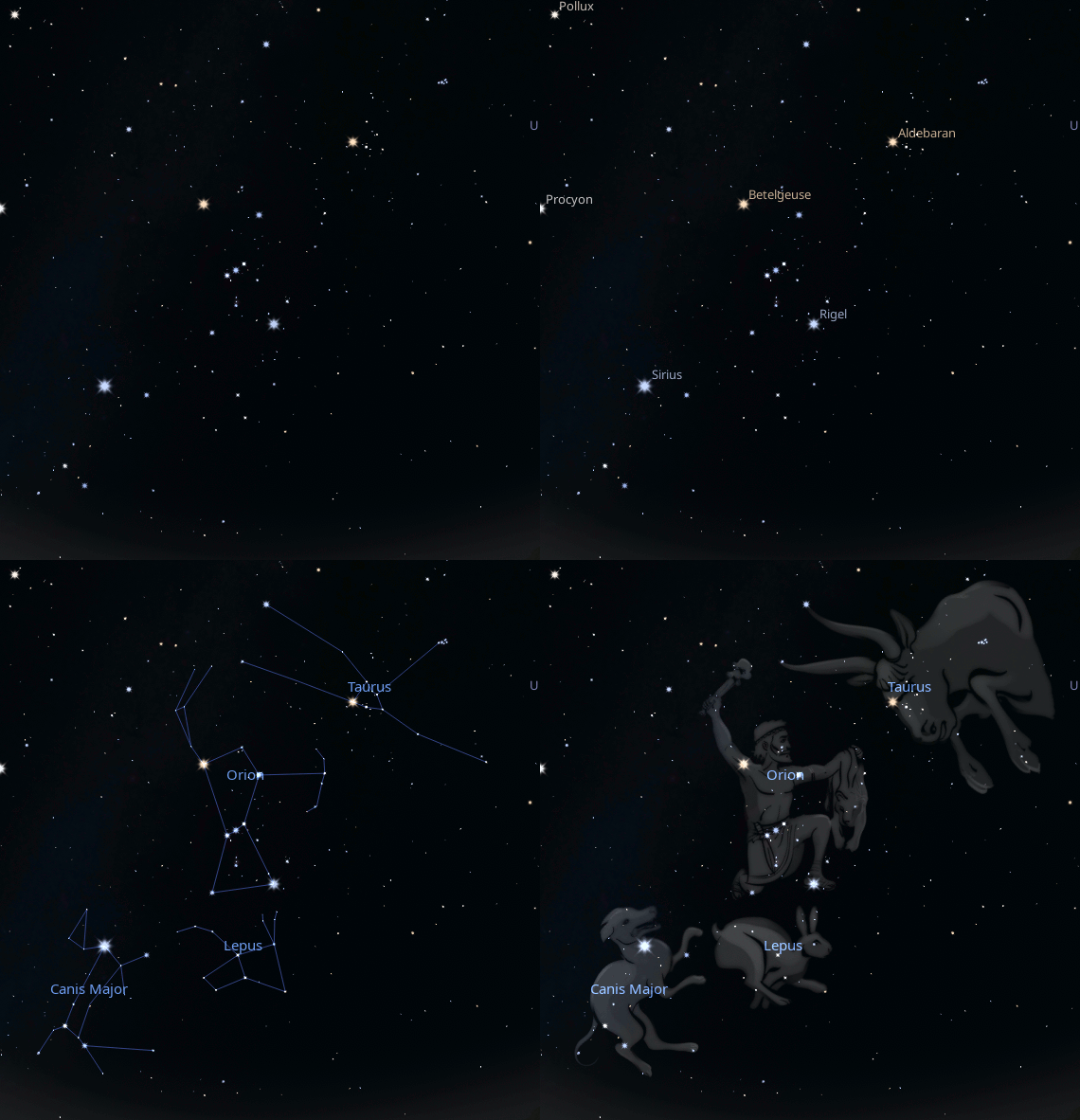
The constellation of Orion the hunter is in the south in the evening, and he seems to be preoccupied with the charge of Taurus the bull to his upper right. Unnoticed by him and below him is a small constellation called Lepus the hare, made of very dim stars. Good luck trying to make a rabbit out of those stars. In the constellation art that comes with the free application Stellarium. It displays the sky like a planetarium. The artistic constellation of the figure of Canis Major, Orion’s large hunting dog seems to be taking notice of Lepus and is beginning to chase it Lepus the hare is a nice addition to the tableau presented in the winter sky. Stellarium-web.org is a web based version of Stellarium that doesn’t have to be installed on your device.
The astronomical event times given are for the Traverse City/Interlochen area of Michigan (EST, UT –5 hours). They may be different for your location.
Addendum
Ephemeris: 02/05/2024 – Looking at the star Procyon
This is Ephemeris for Monday, February 5th. Today the Sun will be up for 9 hours and 59 minutes, setting at 5:56, and it will rise tomorrow at 7:56. The Moon, 3 days past last quarter, will rise at 5:44 tomorrow morning.
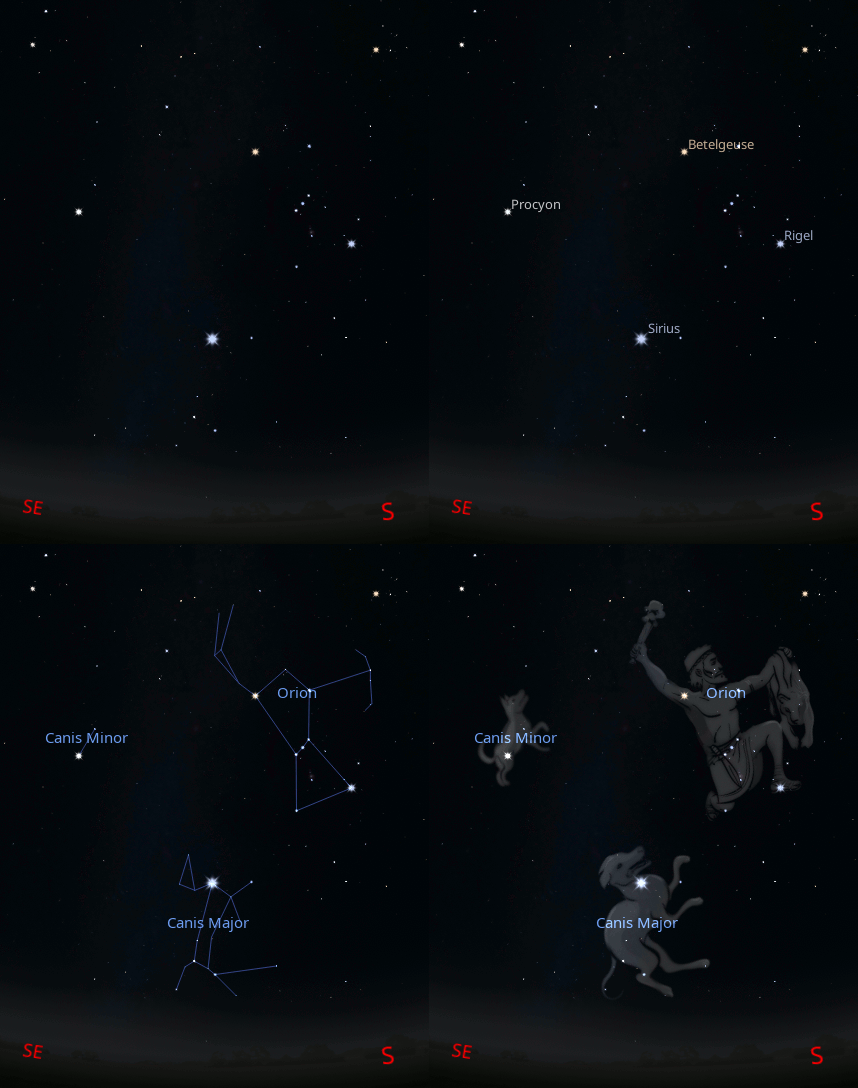
The star Procyon is in Orion’s little hunting dog Canis Minor, which contains only one other star. It can be found by using the shoulder stars of Orion, Bellatrix and Betelgeuse, pointing to the left and down a bit to Procyon in the evening. The word Procyon appears to mean “Before the Dog” meaning that rises before the Dog Star, Sirius, even though it is east of it. Procyon is also north of Sirius, which for observers above 30° north latitude does indeed rise before the Dog Star. It is a star like Sirius, though it’s not as bright, or white. Procyon is 11.5 light years away while Sirius is 8.4 light years away. Both have tiny white dwarf companion stars.
The astronomical event times given are for the Traverse City/Interlochen area of Michigan (EST, UT –5 hours). They may be different for your location.
Addendum
Ephemeris: 01/31/2024 – Where have the naked-eye planets wandered* off to this week?
This is Ephemeris for Wednesday, January 31st. Today the Sun will be up for 9 hours and 46 minutes, setting at 5:49, and it will rise tomorrow at 8:02. The Moon, 2 days before last quarter, will rise at 11:56 this evening.
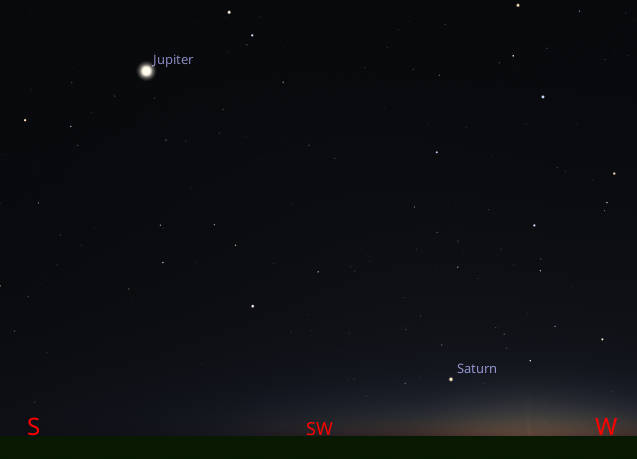
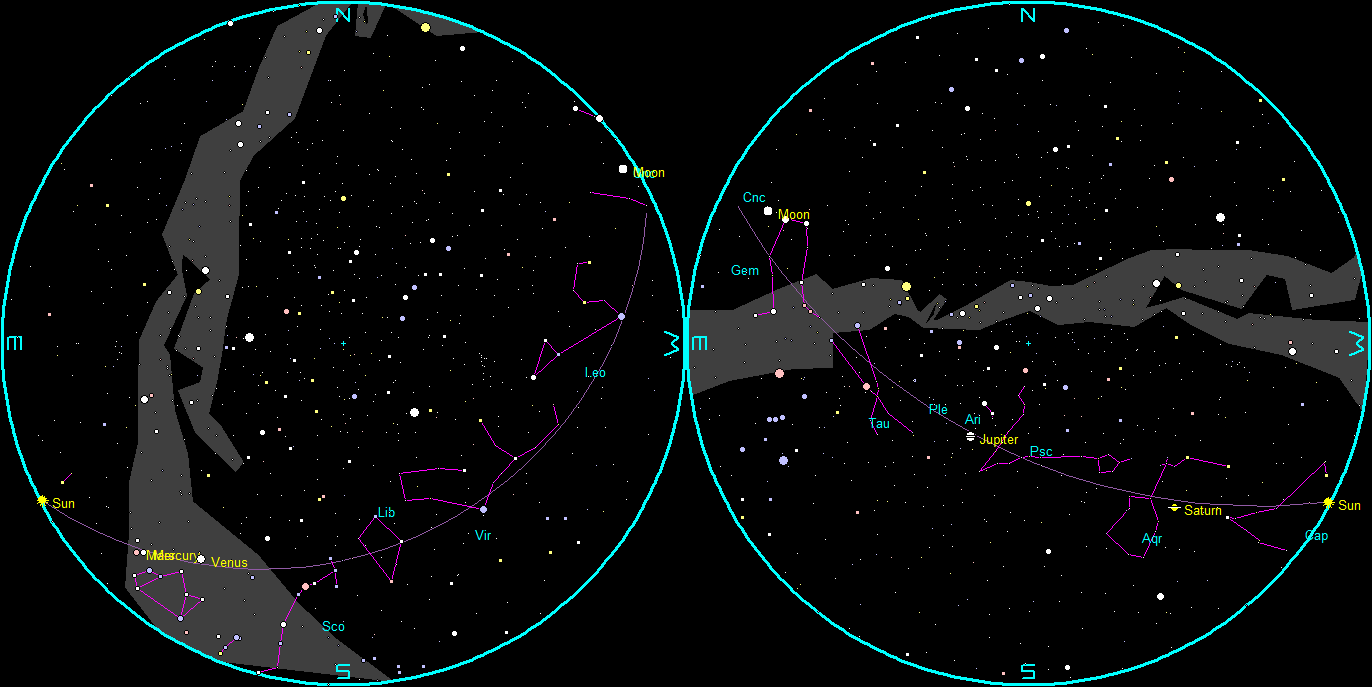
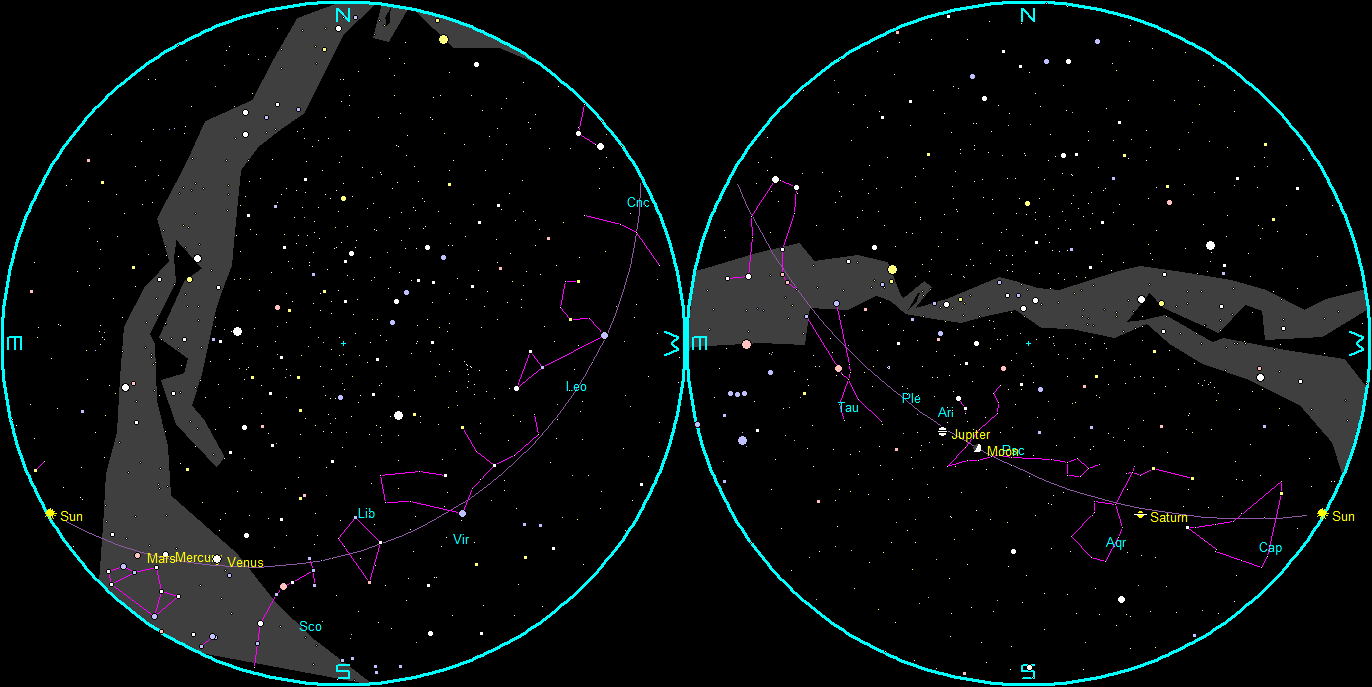
Let’s find out where the naked-eye planets have wandered off to this week. Three of those five planets are now visible. Saturn and Jupiter are the evening planets. Saturn is getting harder to spot low in the west-southwest, nearly succumbing to evening twilight, setting at 7:59 pm. Jupiter will move from high in the south to low in the west by midnight, and will set in the west-northwest at 1:20 am. Venus, the brilliant morning star, will rise in the east-southeast at 6:18 am, and be a brilliant beacon in the morning, shining in the southeast before the bright morning twilight claims it around 7:45 am. As we advance through winter into spring Venus is going to be harder to spot before sunrise.
The astronomical event times given are for the Traverse City/Interlochen area of Michigan (EST, UT –5 hours). They may be different for your location.
Addendum
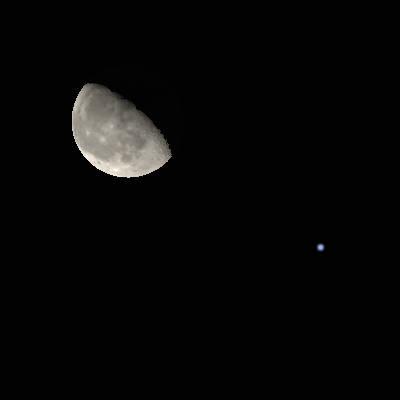
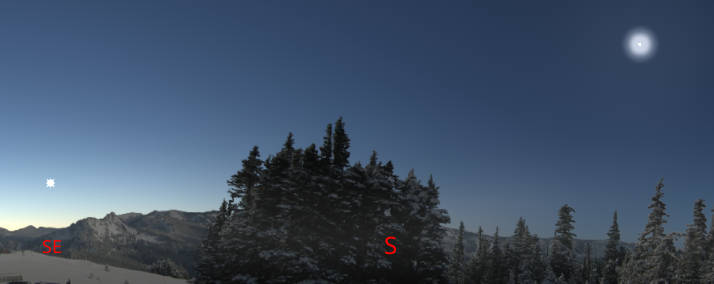
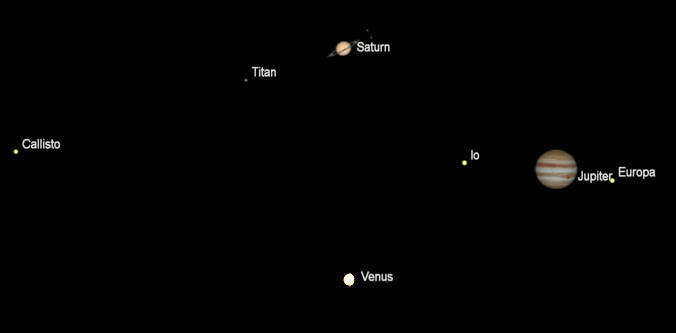
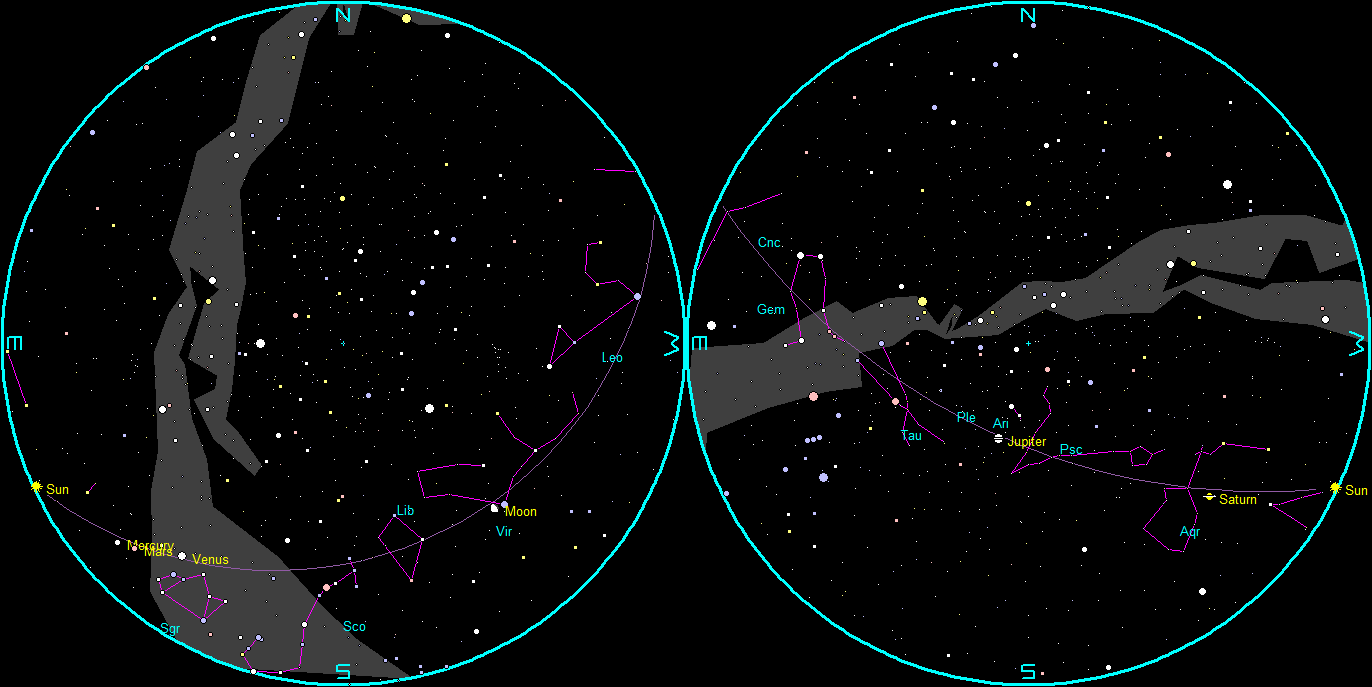
* The Greeks called the moving objects in the sky Planetes meaning Wanderers, from which we get the name Planet. In reality the planets do not wander, or move aimlessly, but move in orbits, discovered by Johannes Kepler, in accordance with the laws of gravitation discovered by Isaac Newton and Albert Einstein. The ancients considered the Sun and Moon planets, because they also moved against the “fixed” stars in the sky. This made seven, adding to the five naked eye planets we know today. These seven objects became the names of the days of the week in many countries. We have retained three of them: Sun’s day, Moon’s day, and Saturn’s day. The rest are named for Norse gods and a goddess.
Ephemeris: 01/25/2024 – Where is the full moon in winter?
This is Ephemeris for Thursday, January 25th. Today the Sun will be up for 9 hours and 31 minutes, setting at 5:41, and it will rise tomorrow at 8:08. The Moon, at full today, will rise at 5:30 this evening.
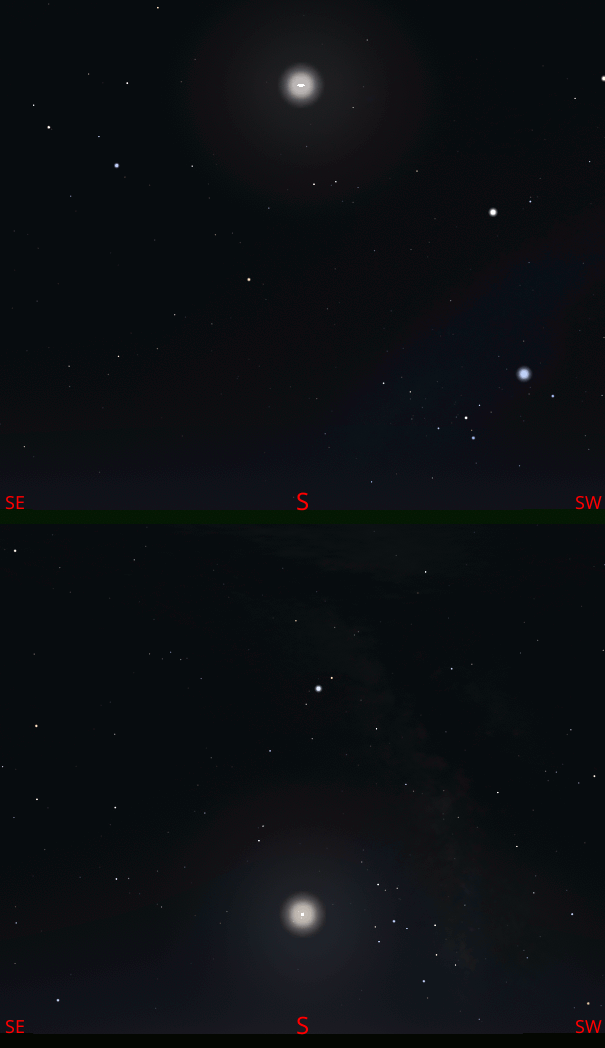
The exact time that the Moon will be full, at least to the nearest minute is 12:54 this afternoon. Have you ever noticed the placement of the full moon in the sky between winter and summer? The full moon near the winter solstice moves very high at midnight, while the full moon near the summer solstice is seen quite low in the south. For the Moon to be full, it must be nearly opposite the Sun in the sky, so we see it fully illuminated as the Sun does. The Moon’s orbit is close to the Sun’s apparent path in the sky, the ecliptic, which is the projection of the Earth’s orbit of the Sun. So the Moon now is near, and actually a bit north of, where the Sun will be 6 months from now in mid to late July.
The astronomical event times given are for the Traverse City/Interlochen area of Michigan (EST, UT –5 hours). They may be different for your location.
Addendum
Ephemeris: 01/24/2024 – Where have the planets wandered off to this week?
This is Ephemeris for Wednesday, January 24th. Today the Sun will be up for 9 hours and 29 minutes, setting at 5:39, and it will rise tomorrow at 8:09. The Moon, 1 day before full, will set at 8:36 tomorrow morning.
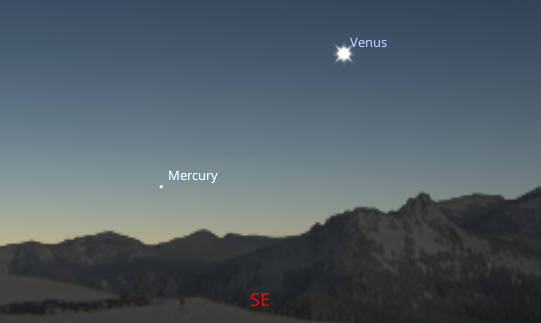
Let’s find out where the naked-eye planets have wandered off to this week. Three of those five planets are now easily visible. Saturn and Jupiter are the evening planets. Saturn is getting harder to spot low in the west-southwest, setting at 8:19 pm. Jupiter will move from high in the south to low in the west by midnight, and will set in the west-northwest at 1:40 am. Venus, the brilliant morning star, will rise in the east-southeast at 6:09 am, and be a brilliant beacon in the morning, shining in the southeast before the bright morning twilight claims it around 8 am. Mercury, which rises by 7:03 am might just be visible below and left of Venus by 7:30 am.
The astronomical event times given are for the Traverse City/Interlochen area of Michigan (EST, UT –5 hours). They may be different for your location.
Addendum

Ephemeris: 01/19/2024 – Finding the Dog Star
This is Bob Moler with Ephemeris for Friday, January 19th. Today the Sun will be up for 9 hours and 18 minutes, setting at 5:33, and it will rise tomorrow at 8:13. The Moon, 2 days past first quarter, will set at 3:59 tomorrow morning.
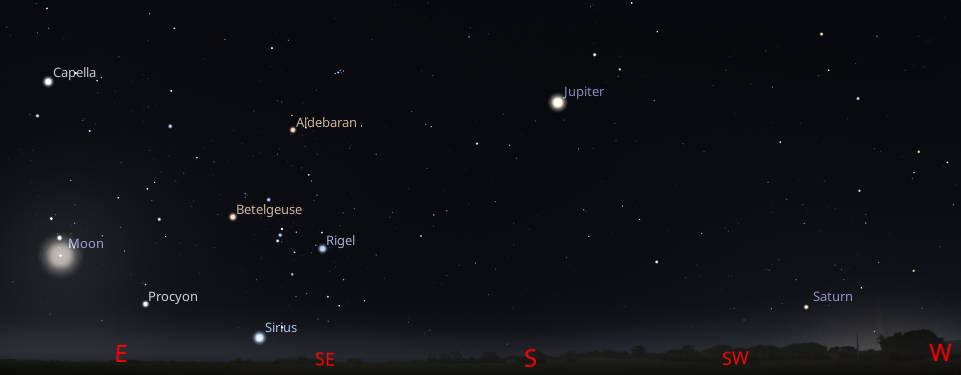
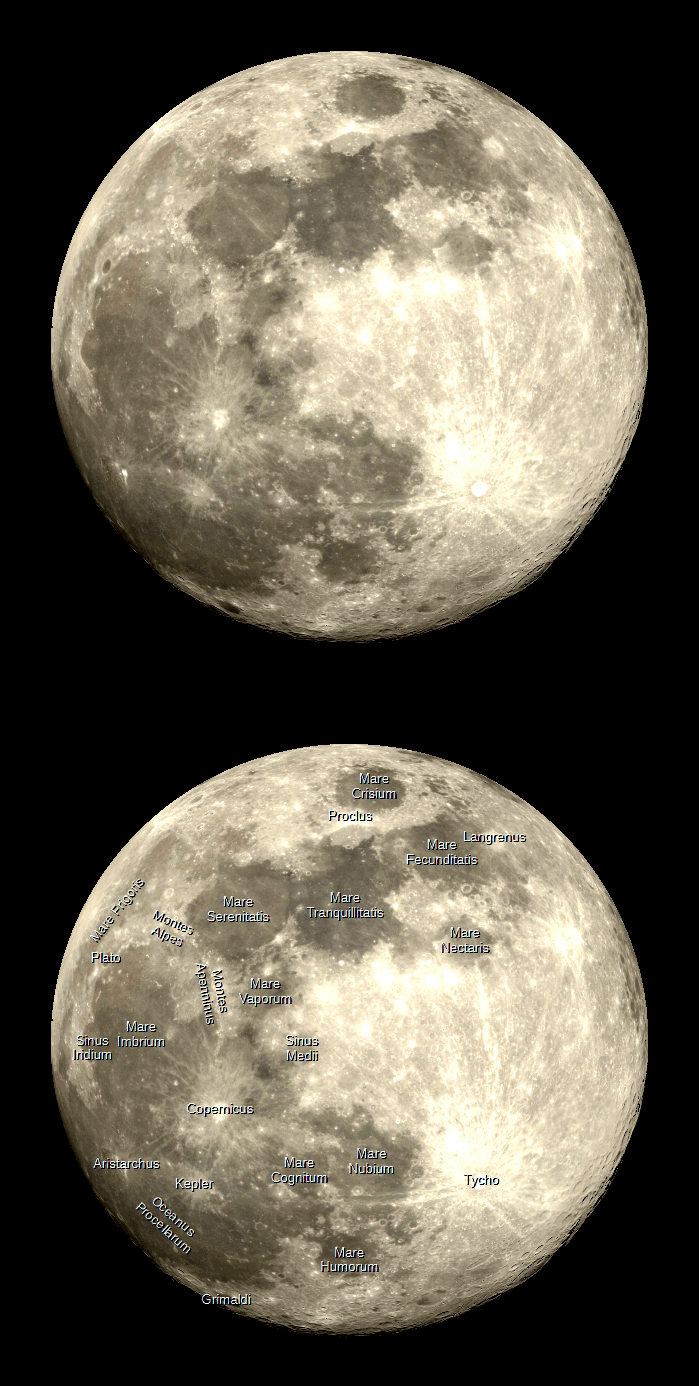
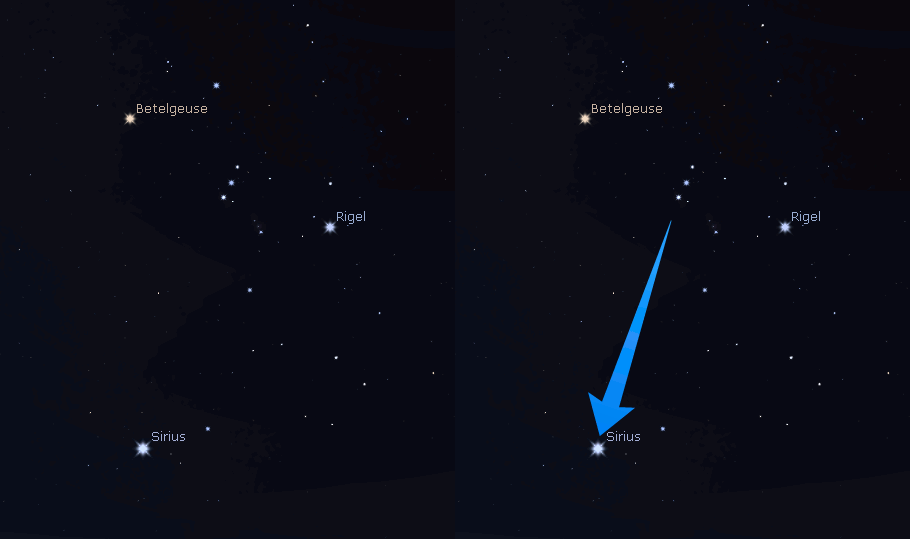
In the evening, the great constellation of Orion the hunter can be seen to slowly move from the south-east to the south. Its large rectangle of bright stars is easily visible, even with a full moon. The three stars in a straight line, his belt, tilt downward to the left to a very bright star merrily twinkling lower in the sky. This star is called Sirius, also known as the Dog Star because it’s in the heart of Orion’s larger hunting dog, Canis Major. It is an arc light white star as seen in binoculars or telescope. It is the brightest star in the night sky, and a neighboring star, just twice the distance of the closest star to the Sun at 8.6 light years. Its name, Sirius, has nothing to do with a dog, but is from the Greek meaning scorching for its brightness and sparkling, due to its intense twinkling.
The astronomical event times given are for the Traverse City/Interlochen area of Michigan (EST, UT –5 hours). They may be different for your location.
Addendum
Ephemeris: 01/18/2024 – A quick guide to Jupiter for the small telescope
This is Ephemeris for Thursday, January 18th. Today the Sun will be up for 9 hours and 16 minutes, setting at 5:31, and it will rise tomorrow at 8:14. The Moon, 1 day past first quarter, will set at 2:43 tomorrow morning.
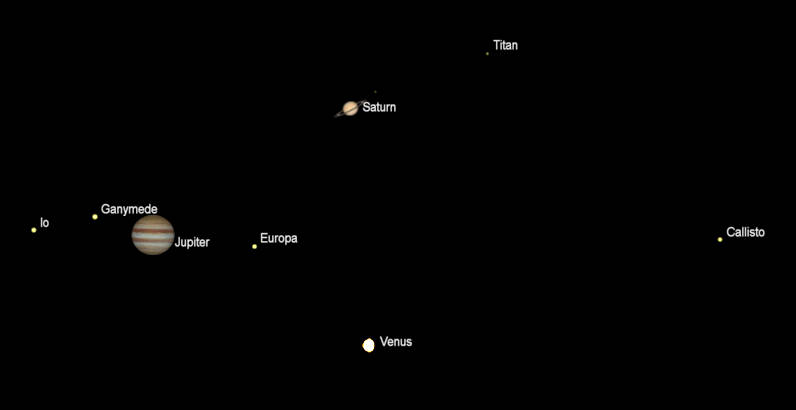
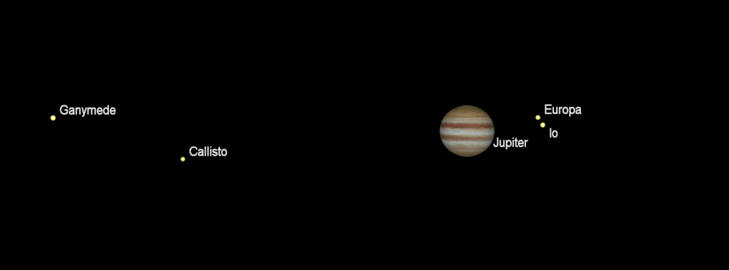
Jupiter is the largest planets and is generally the largest appearing planet in a telescope. Venus appears a bit larger than Jupiter only for about four months when it’s the closest it gets to us. There’s always something going on with Jupiter and its 4 Galilean moons which appear to shuffle back and forth from one side to the other of the planet. Jupiter has cloud bands which run parallel to its equator and to the plane of the moon’s orbits. And it has the Great Red Spot, but that spot is not easily visible in small telescopes. Back in the 1950s it was big and brick red. It is since lost a great deal of its redness and size. The moons can hide behind Jupiter or in its shadow or cross in front of the planet. Tonight Jupiter will appear below and right of the Moon.
The astronomical event times given are for the Traverse City/Interlochen area of Michigan (EST, UT –5 hours). They may be different for your location.
Addendum
Ephemeris: 01/17/2024 – Where have the naked-eye planets wandered off to this week?
This is Ephemeris for Wednesday, January 17th. Today the Sun will be up for 9 hours and 14 minutes, setting at 5:30, and it will rise tomorrow at 8:15. The Moon, at first quarter today, will set at 1:28 tomorrow morning.
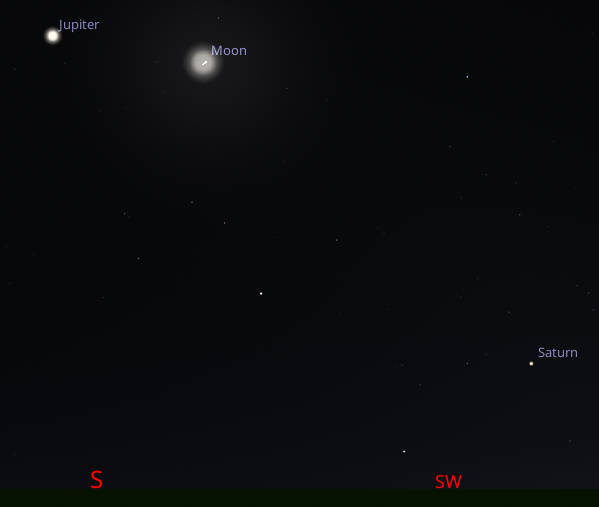
Let’s find out where the naked-eye planets have wandered off to this week. Four of those five planets are now visible. Saturn and Jupiter are the evening planets. Saturn can be seen moving from low in the southwest to setting in the west-southwest at 8:42 pm. Jupiter, left of the Moon tonight will move from high in the south to set in the west-northwest at 2:05 am. Venus, the brilliant morning star, will rise in the east-southeast at 5:58 am, and be a brilliant beacon in the morning, shining in the southeast before the bright morning twilight claims it around 8 am. Mercury will also be visible below and left of Venus, and should be visible by 7:30 am. Mars is below left of Mercury, but really is too dim to be seen.
The astronomical event times given are for the Traverse City/Interlochen area of Michigan (EST, UT –5 hours). They may be different for your location.
Addendum
Ephemeris: 01/16/2024 – Watch Saturn’s rings continue to narrow this year.
This is Ephemeris for Tuesday, January 16th. Today the Sun will be up for 9 hours and 12 minutes, setting at 5:29, and it will rise tomorrow at 8:15. The Moon, 1 day before first quarter, will set at 12:12 tomorrow morning.
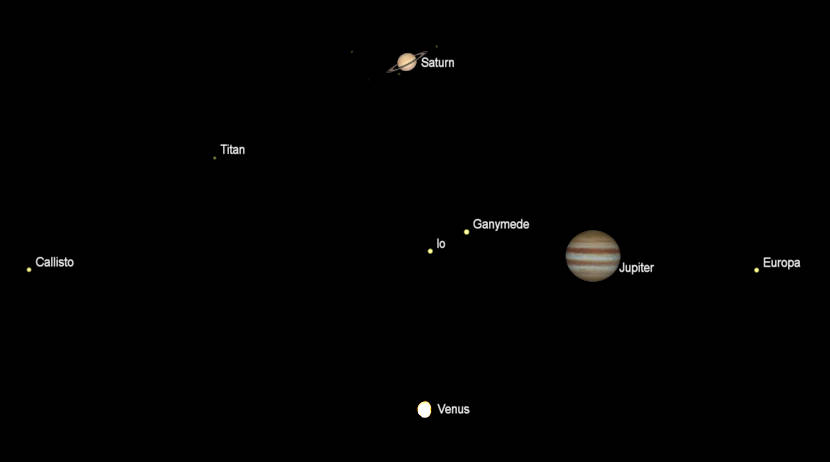
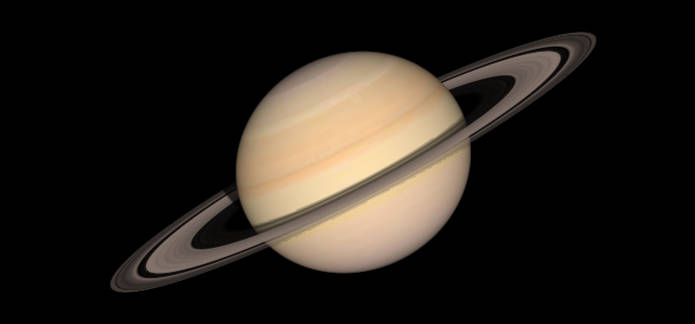
After the Moon, the next targets for the small telescope are the planets. Saturn is getting pretty low in the southwest now so there’s only about another month when it’s really visible in steady skies. Of course Saturn has those beautiful rings which are now getting very thin and by the end of March next year they will be edge on to us and then begin to open up through the rest of 2025. One’s first impression of Saturn is generally that besides the rings it’s really tiny. It averages almost a billion miles from the Earth, and even though it’s the second-largest planet it looks very tiny at that distance. Saturn’s largest moon Titan can be seen near the planet it is the second-largest moon in the solar system.
The astronomical event times given are for the Traverse City/Interlochen area of Michigan (EST, UT –5 hours). They may be different for your location.
Addendum
Ephemeris: 01/15/2024 – The Moon is a great first target for that new telescope
This is Bob Moler with Ephemeris for the Martin Luther King Jr. Holiday, Monday, January 15th. Today the Sun will be up for 9 hours and 11 minutes, setting at 5:27, and it will rise tomorrow at 8:16. The Moon, 2 days before first quarter, will set at 10:55 this evening.
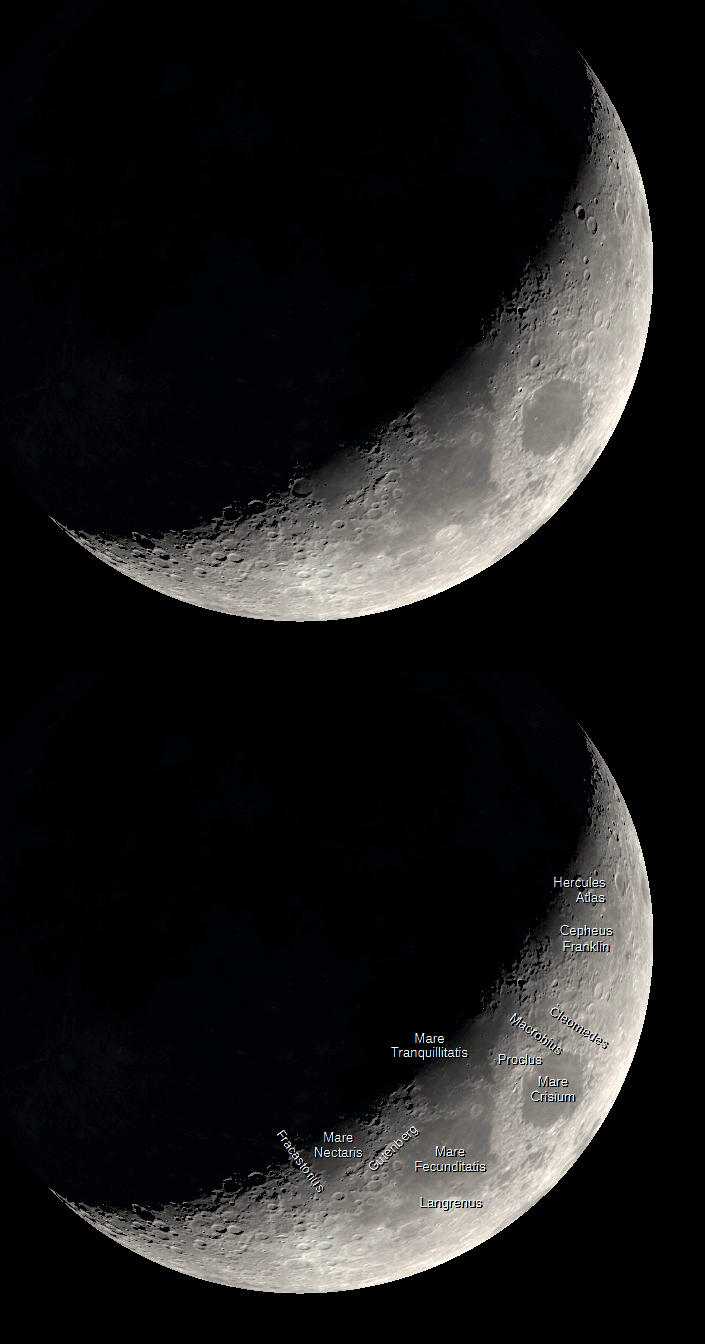
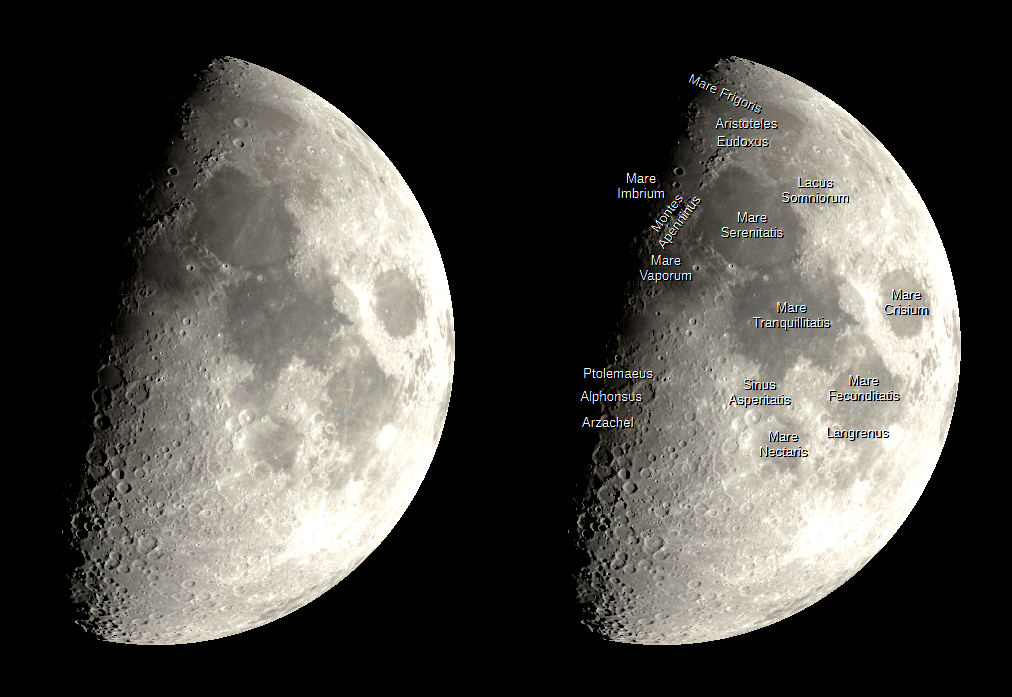
The Moon is a great first target for that Christmas telescope. Over the weekend we began a new lunar month so that the Moon appears as a crescent in the southwestern sky after sunset. The first time I looked at the Moon with the telescope or looked at anything in the sky, actually, I found it very difficult to aim the telescope correctly. The field of view of the telescope is very small compared to what you can see with the naked eye. Always start with the lowest power eyepiece because it gives the widest field of view for finding what you’re looking for. It does take a little practice to learn how to aim a telescope, but the moon is a wonderful object to look at because it’s really big and very bright.
The astronomical event times given are for the Traverse City/Interlochen area of Michigan (EST, UT –5 hours). They may be different for your location.
Addendum