Archive
08/15/2022 – Ephemeris – Saturn moves into the evening sky
This is Ephemeris for Monday, August 15th. Today the Sun will be up for 14 hours and 3 minutes, setting at 8:48, and it will rise tomorrow at 6:46. The Moon, halfway from full to last quarter, will rise at 10:55 this evening.
Yesterday, Saturn was in opposition to the Sun. I’m not implying an argument here. Opposition is when a planet is opposite the Sun in the sky, so it rises around sunset and sets around sunrise. That means Saturn is the closest it can get to us this year. For the record, that’s 836 million miles (1,345 million kilometers). Saturn will first appear tonight in the southeast when it gets dark enough, say around 9:15 to 9:30 pm. It is in the constellation of Aquarius now. It is moving northeastward in our skies, or it would if it weren’t at opposition, and moving backward or retrograde as the Earth is, in effect, lapping Saturn in our eternal race around the Sun. Saturn’s rings appear to slowly get skinnier as the planet moves to an equinox, where its rings, which orbit its equator, will tilt edgewise to the Sun, and the Earth in 2025.
The astronomical event times given are for the Traverse City/Interlochen area of Michigan (EDT, UT – 4 hours). They may be different for your location.
Addendum
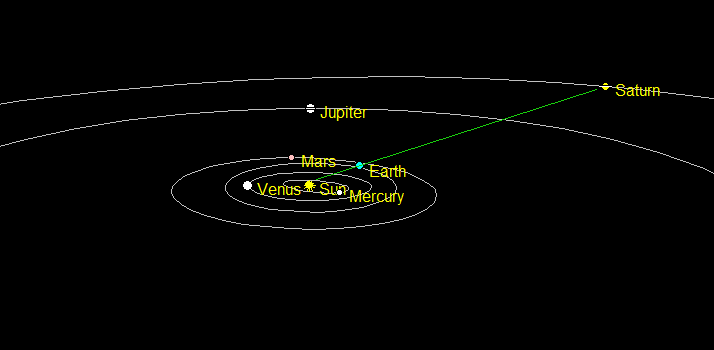
Display of the solar system out to Saturn, with added line showing Saturn’s location opposite the Sun from the Earth. This make the Earth nearly in line from the Sun to Saturn. This is the time that Saturn would be closest to the Earth. Credit: my LookingUp app. I wanted to use NASA’s Eyes, but there were too many interplanetary spacecraft near the Earth. The Earth was crowded out by spacecraft labels.
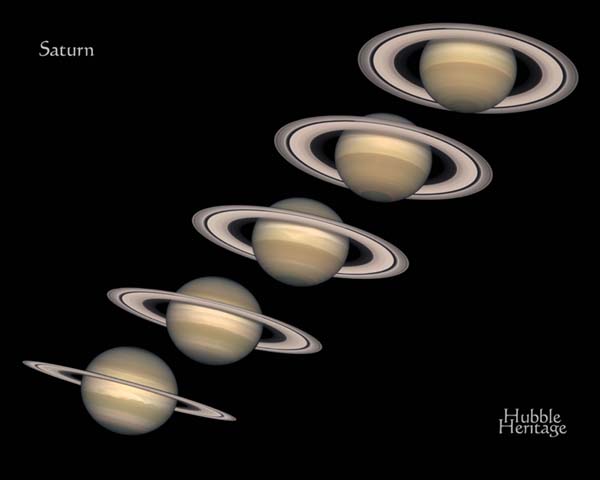
How the appearance of the rings change as Saturn orbits the Sun. Credit: NASA Hubble.
08/12/2022 – Ephemeris – The Perseid meteor shower reached its peak tonight with a bright moon
This is Ephemeris for Friday, August 12th. Today the Sun will be up for 14 hours and 11 minutes, setting at 8:53, and it will rise tomorrow at 6:42. The Moon, 1 day past full, will rise at 9:48 this evening.
The Perseid meteor shower will reach its peak tonight as the nearly full Moon rises. Only the brightest of these meteors will be visible in the bright moonlit sky. Next year the Moon will be less bright and will only interfere in the early morning hours. Comet Swift-Tuttle is responsible for shedding the tiny bits of rock that end up orbiting the Sun near its path. The Earth plows through these particles every year at this time, giving us a great sky show, which at peak on a dark morning provide 60 or more of these so-called shooting stars per hour. The members of the Perseids will all seem to come from the northeastern sky, from the top of the constellation of Perseus the hero. The star figure to me instead looks like the cartoon roadrunner running up the sky.
The astronomical event times given are for the Traverse City/Interlochen area of Michigan (EDT, UT – 4 hours). They may be different for your location.
Addendum
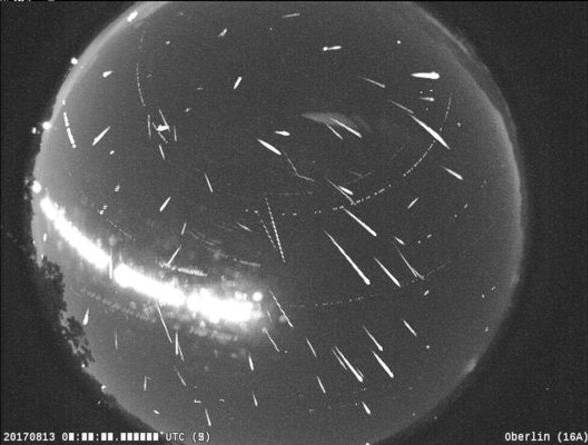
Perseid fireballs in one of NASA’s all sky cameras during the morning hours of August 13, 2017. This is a long time exposure. The bright swath in the image is the Moon that morning. Since it is a time exposure, the radiant is also moving with the earth’s rotation, so the meteors only seem to come from the northeastern sky. North is at the top, and East is to the left. The Moon that morning was 1 day before last quarter, so tonight’s Moon will be even brighter. Credit NASA.
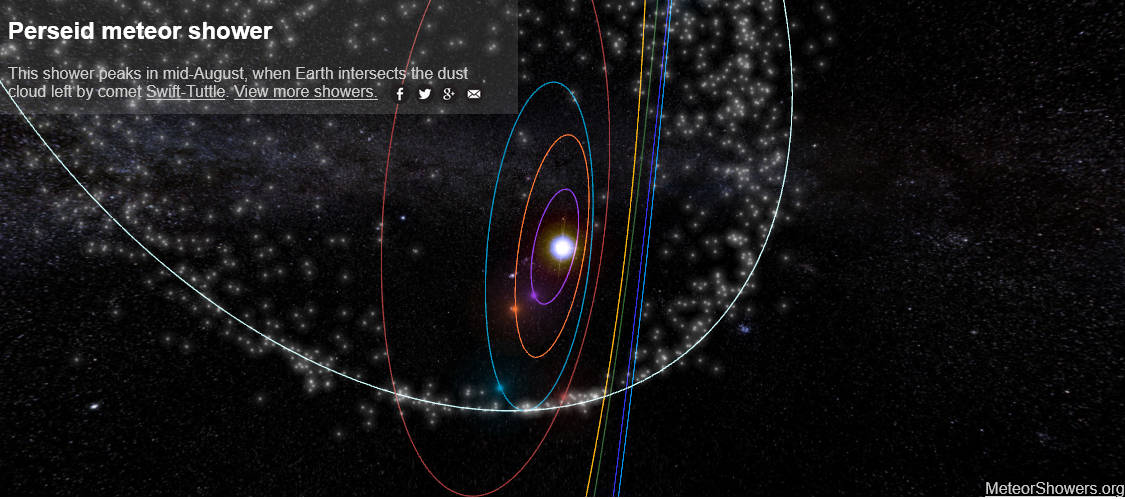
Screen capture of an interactive animation of the orbits of the Perseid meteoroids and the inner planets. The planets move counterclockwise, while the meteoroids move clockwise and cross the Earth’s orbital plane at a high angle. Image taken from the International Meteor Organization, imo.net. Interactive animation by MeteorShowers.org.
08/10/2022 – Ephemeris – Let’s search for the naked-eye planets for this week
This is Bob Moler with Ephemeris for Wednesday, August 10th. Today the Sun will be up for 14 hours and 16 minutes, setting at 8:56, and it will rise tomorrow at 6:40. The Moon, 1 day before full, will set at 5:37 tomorrow morning.
Let’s search for the naked-eye planets for this week. All but one of the naked-eye planets are in the morning sky, That one is Mercury, too close to the Sun to be seen in the evening. At 6 am tomorrow, the planets will be spread out from brilliant Venus low in the east-northeast to Saturn in the west-southwest. Mars will be a lot higher than Venus in the southeast. Jupiter is farther to the right in the south-southwest. Mars is dimmer than Jupiter, but is slowly getting brighter as the Earth creeps up on it. Saturn ends the line of planets much lower than Venus in the west-southwest. Tonight, Saturn will rise about 9:12 pm in the east-southeast. It won’t be in the morning sky next week, having moved into the evening sky.
The astronomical event times given are for the Traverse City/Interlochen area of Michigan (EDT, UT – 4 hours). They may be different for your location.
Addendum
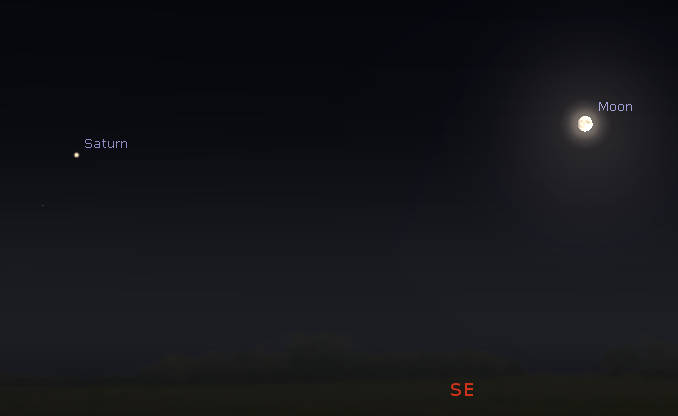
Saturn and the Moon at 10 in the evening. Saturn is not officially in the evening sky, but it rises shortly after sunset. Created using Stellarium.
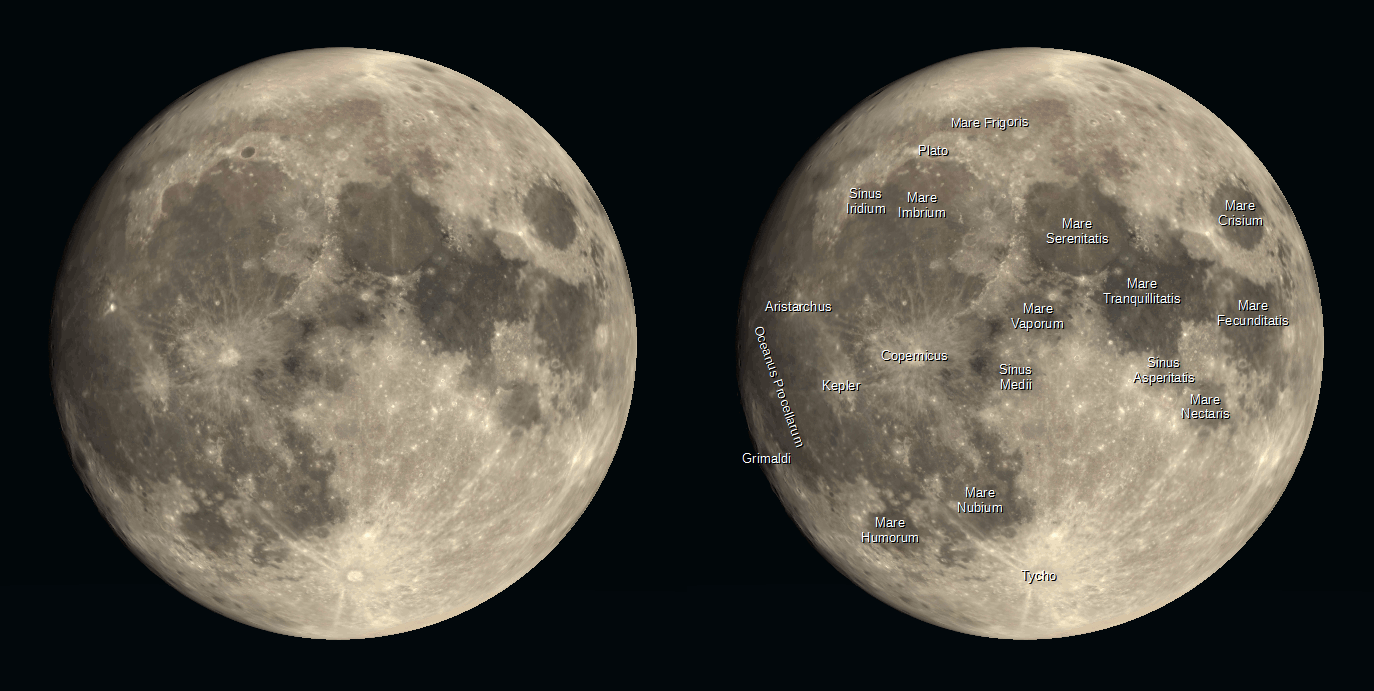
The Moon tonight with animated labels for 10 pm, August 10, 2022. Created using Stellarium; Labels, LibreOffice Draw, animation, GIMP.
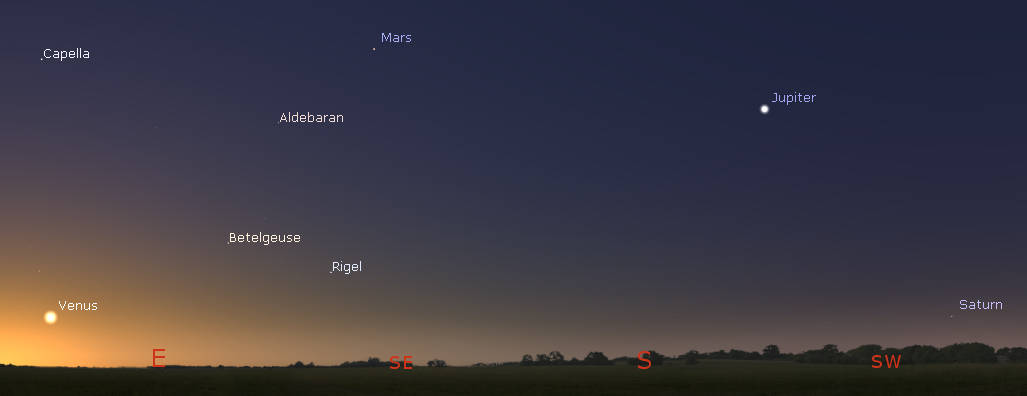
Morning planets at 6 am tomorrow morning, August 11, 2022. With six weeks left in summer, the bright winter stars begin to appear in morning twilight, along with the planets. Click on the image to enlarge it. The span of the planets from Venus to Saturn is 158 degrees. Click on the image to enlarge it. Created using Stellarium.
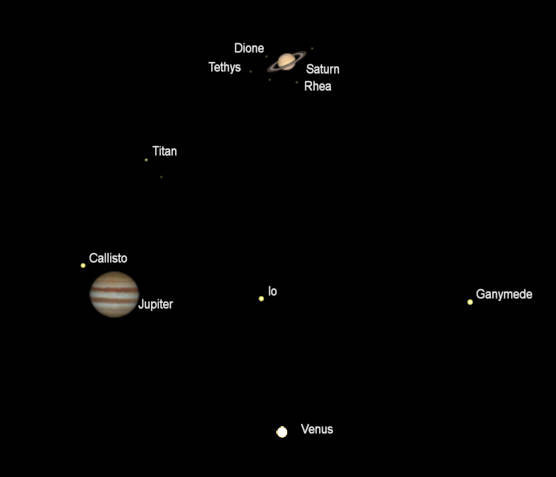
Views of Saturn, Jupiter, and Venus (north up) as they would be seen in a small telescope, with the same magnification. Saturn is shown at 10 pm EDT (UT -4) on August 10, 2022. Jupiter and Venus are shown for, tomorrow morning at 6 am. I do not show planets less than 10 seconds of arc in diameter. Apparent diameters: Saturn 18.76″, its rings 43.70″; Jupiter 46.47″. Mars is not shown, its apparent diameter is 8.71″, 84.7% illuminated; Venus 10.46″, 94.3% illuminated. Jupiter’s moon Europa is in the planet’s shadow at that time. The ” symbol means seconds of arc (1/3600th of a degree.) Click on the image to enlarge it. Created using Cartes du Ciel (Sky Charts).
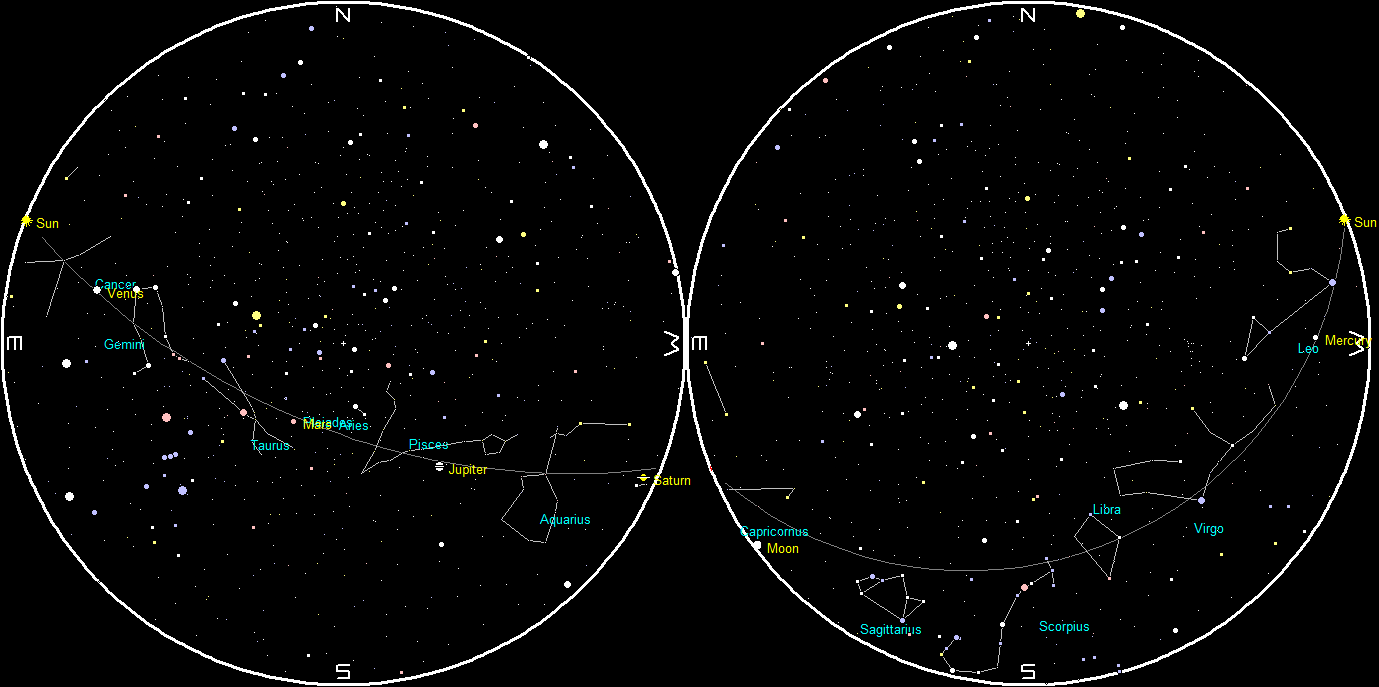
The naked-eye planets and the Moon at sunset and sunrise on a single night, starting with sunset on the right on August 10, 2022. The night ends on the left with sunrise on the 11th. Notice that all the naked-eye planets except Mercury are in the morning sky now. That’s about to change in a week and a half, when Saturn moves into the evening sky at opposition on the 14th. Click on the image to enlarge it. Created using my LookingUp program.
08/03/2022 – Ephemeris – Let’s search for the naked-eye planets for this week
This is Ephemeris for Wednesday, August 3rd. Today the Sun will be up for 14 hours and 34 minutes, setting at 9:05, and it will rise tomorrow at 6:32. The Moon, 2 days before first quarter, will set at 11:56 this evening.
Let’s search for the naked-eye planets for this week. All but one of the naked-eye planets are in the morning sky, That one is Mercury, too close to the Sun to be seen in the evening. At 5:30 tomorrow morning, the planets will be spread out from brilliant Venus low in the east-northeast to Saturn in the southwest. Mars will be a lot higher than Venus in the southeast. Jupiter is farther to the right in the south. Mars is dimmer than Jupiter, but is slowly getting brighter as the Earth creeps up on it. Saturn ends the line of planets much lower than Jupiter in the southwest. Tonight, Saturn will rise about 9:33 pm in the east-southeast, though it won’t be an official evening planet until it rises before sunset, which is 11 days away.
The astronomical event times given are for the Traverse City/Interlochen area of Michigan (EDT, UT – 4 hours). They may be different for your location.
Addendum
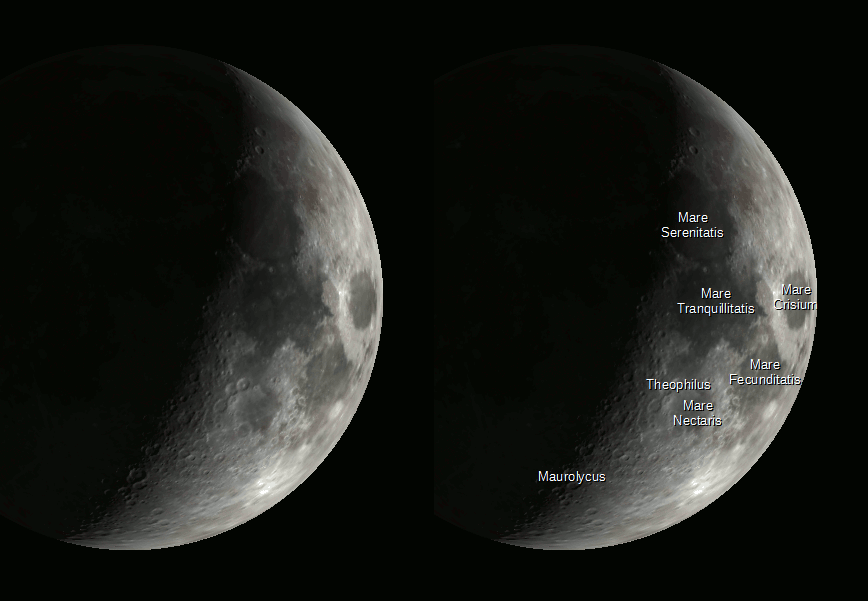
The annotated Moon for 10:30 this evening, August 3, 2022. Labels are centered on the feature they name. The crater Theophilus isn’t as prominent as it would have been 12 hours earlier, when it was nearer the terminator, the sunrise line. Search for it in the box above, right on this page, where I have more to say about it. It’s one of my favorite craters. Created using Stellarium, Libreoffice Draw, and GIMP.
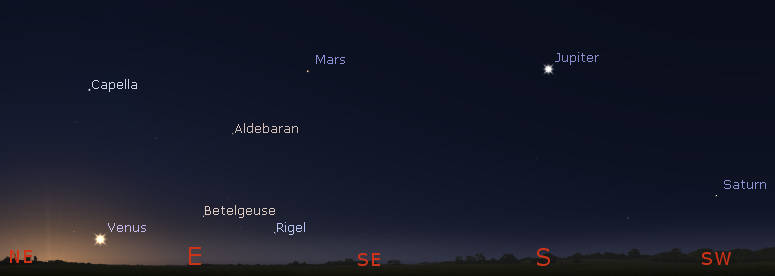
Morning planets at 5:30 am tomorrow, August 4, 2022. With summer almost half over, the bright winter stars begin to appear in morning twilight along with the planets. Click on the image to enlarge it. The span of the planets from Venus to Saturn is 148 degrees. Click on the image to enlarge it. Created using Stellarium.
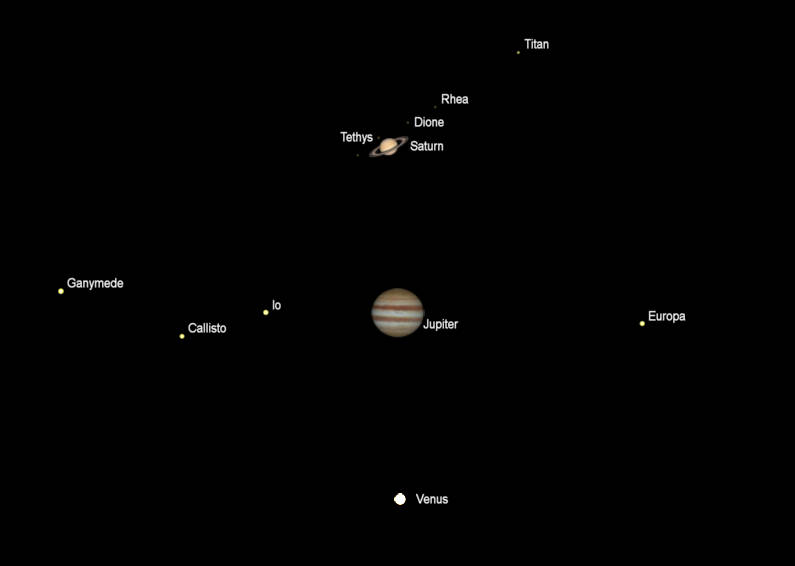
Views of Saturn, Jupiter, and Venus (north up) as they would be seen in a small telescope, with the same magnification, tomorrow morning at 5:30 am, August 4, 2022. I do not show planets less than 10 seconds of arc in diameter. Apparent diameters: Saturn 18.73″, its rings 43.63″; Jupiter 45.54″. Mars is not shown, its apparent diameter is 8.41″, 84.7% illuminated; Venus 10.64″, 93.2% illuminated. The ” symbol means seconds of arc (1/3600th of a degree.) Click on the image to enlarge it. Created using Cartes du Ciel (Sky Charts).
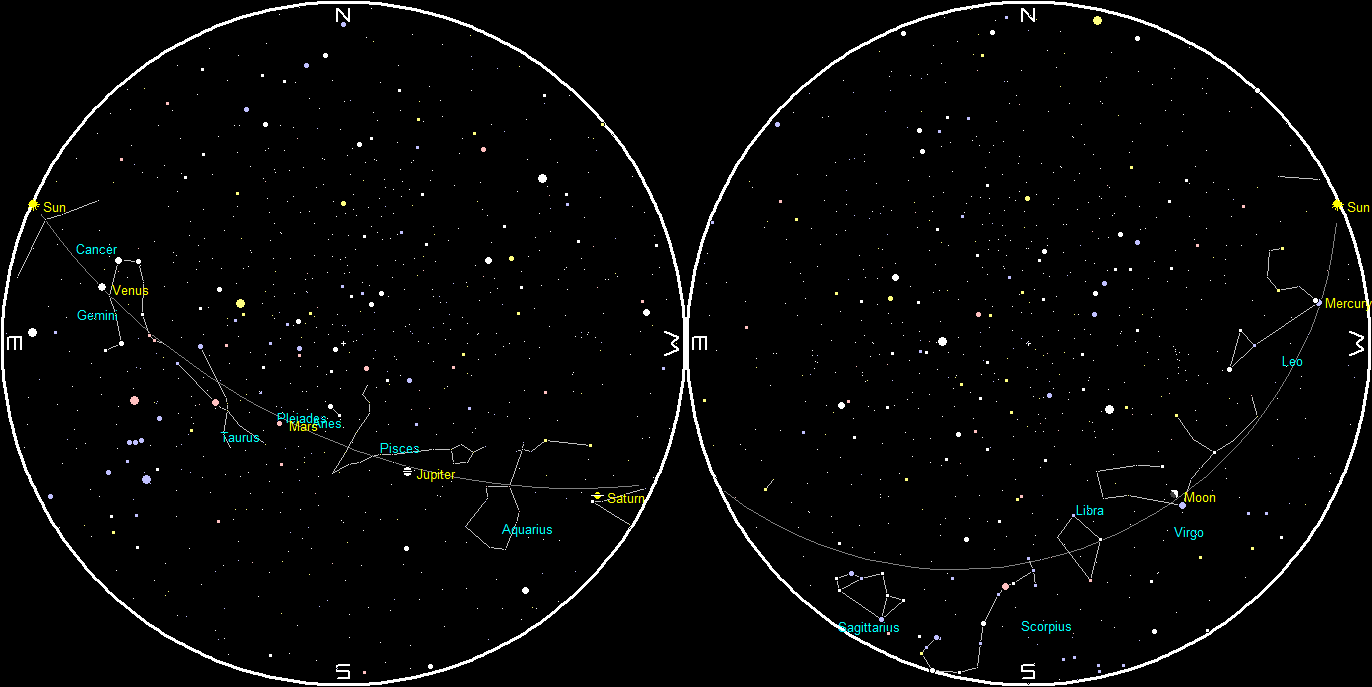
The naked-eye planets and the Moon at sunset and sunrise on a single night, starting with sunset on the right on August 3, 2022. The night ends on the left with sunrise on the 4th. Notice that all the naked-eye planets except Mercury are in the morning sky now. That’s about to change in a week and a half, when Saturn moves into the evening sky when it reaches opposition from the Sun on the 14th. Click on the image to enlarge it. Created using my LookingUp program.
07/29/2022 – Ephemeris – The celestial Sand Hill Crane
This is Ephemeris for Friday, July 29th. Today the Sun will be up for 14 hours and 46 minutes, setting at 9:12, and it will rise tomorrow at 6:26. The Moon, 1 day past new, will set at 10:14 this evening.
Let’s look again at the constellation called Cygnus the swan and the informal constellation or asterism made from most of its stars, the Northern Cross. Cygnus is the official International Astronomical Union constellation name. However, the indigenous Anishinaabe people of our area had another bird in mind when seeing these stars, which are now fairly high in the east in the evening: Ajijaak, (pronounced a-ji-jock) a Sand Hill crane. While the swan is flying, neck outstretched to the south through the Milky Way, the crane is flying northward with its long legs trailing behind. The bright star Deneb is at his head. Where I live, I see and hear the cranes with their creaking-door-like calls, and see a pair from time to time in a field south of where I live.
The astronomical event times given are for the Traverse City/Interlochen area of Michigan (EDT, UT – 4 hours). They may be different for your location.
Addendum
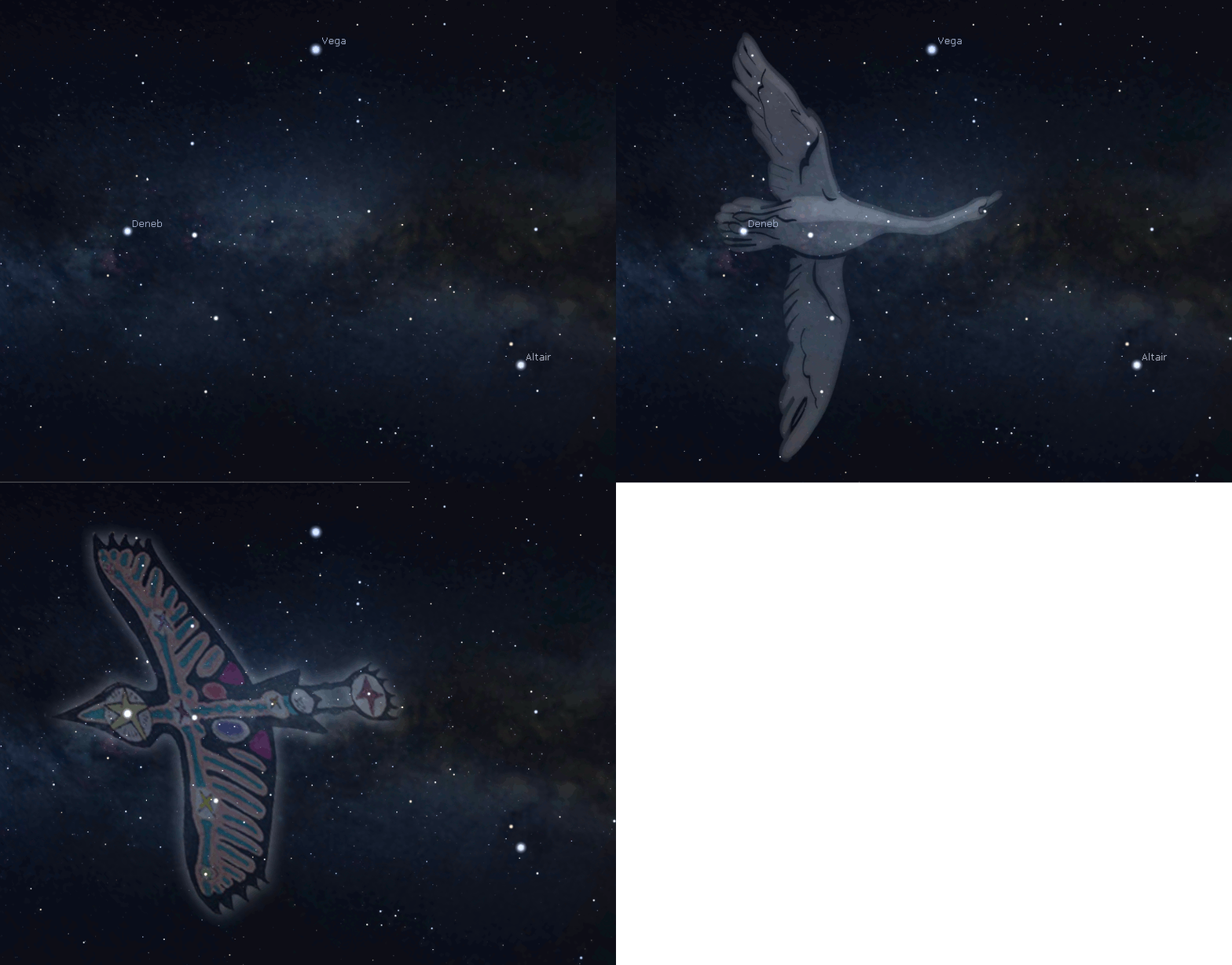
The IAU Cygnus the swan and the Anishinaabe Ajijaak the Sand Hill crane constellations demonstrated via an animated GIF image. Credit Stellarium (both star lore images are embedded in Stellarium). The Anishinaabe image is from Ojibwe Giizhig Anung Masinaaigan – Ojibiwe Sky Star Map created by A. Lee, W. Wilson, and C. Gawboy.
07/27/2022 – Ephemeris – Let’s search for the naked-eye planets for this week
This is Bob Moler with Ephemeris for Wednesday, July 27th. Today the Sun will be up for 14 hours and 50 minutes, setting at 9:14, and it will rise tomorrow at 6:24. The Moon, 1 day before new, will rise at 5:52 tomorrow morning.
Let’s search for the naked-eye planets for this week. All but one of the naked-eye planets are in the morning sky, That one is Mercury, too close to the Sun to be seen in the evening. At 5:30 am tomorrow, the planets will be spread out from brilliant Venus low in the east-northeast to Saturn in the southwest. Mars will be a lot higher than Venus in the east-southeast. Jupiter is farther to the right in the south. Mars is dimmer than Jupiter, but is slowly getting brighter as the Earth creeps up on it. Saturn ends the line of planets much lower than Jupiter in the southwest. Tonight, Saturn will rise about 10:06 pm, though it won’t be an official evening planet until it rises before sunset, which won’t happen until August 14th.
The astronomical event times given are for the Traverse City/Interlochen area of Michigan (EDT, UT – 4 hours). They may be different for your location.
Addendum
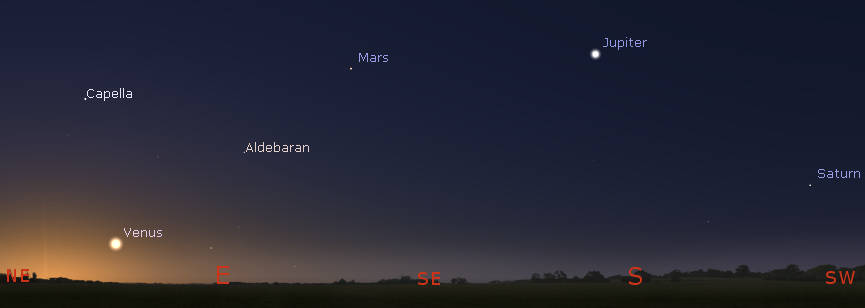
Morning planets at 5:30 am tomorrow , July 28, 2022. The planets and Moon actually appear in a straight line in the sky, being placed along the ecliptic, or path of the Sun in the sky. The ecliptic is a great circle on the celestial sphere. Click on the image to enlarge it. The span of the planets from Venus to Saturn is 140 degrees. Two of winter’s first magnitude stars, Aldebaran and Capella, are now visible in morning twilight. Click on the image to enlarge it. Created using Stellarium.
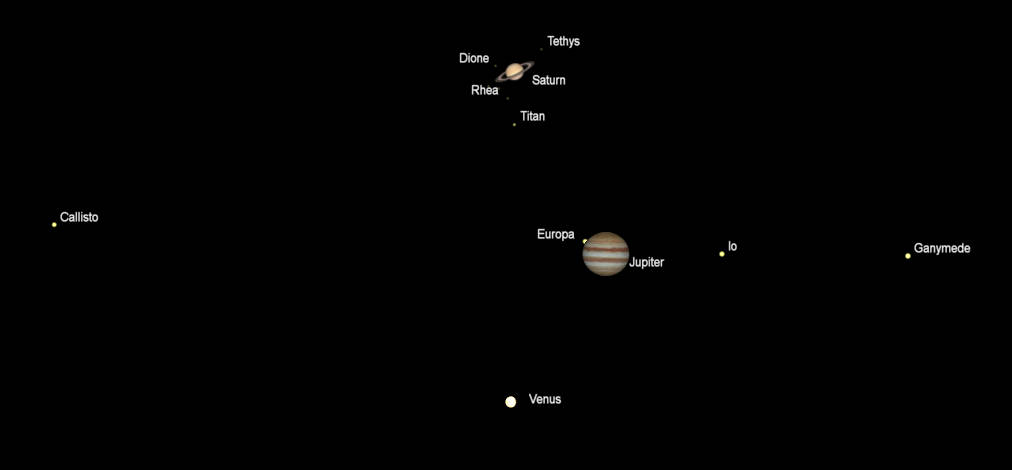
Views of Saturn, Jupiter, and Venus (north up) as they would be seen in a small telescope, with the same magnification, tomorrow morning at 5:30 am, July 28, 2022. I do not show planets less than 10 seconds of arc in diameter. Apparent diameters: Saturn 18.67″, its rings 43.49″; Jupiter 44.58″. Mars is not shown, its apparent diameter is 8.13″, 84.8% illuminated; Venus 10.84″, 91.9% illuminated. The ” symbol means seconds of arc (1/3600th of a degree.) Click on the image to enlarge it. Created using Cartes du Ciel (Sky Charts).
Noting Jupiter and moons image: Europa has just appeared from being behind Jupiter’s disk at 5:27 am (8:27 UT). It had disappeared into Jupiter’s shadow earlier at 12:23 am (4:23 UT).
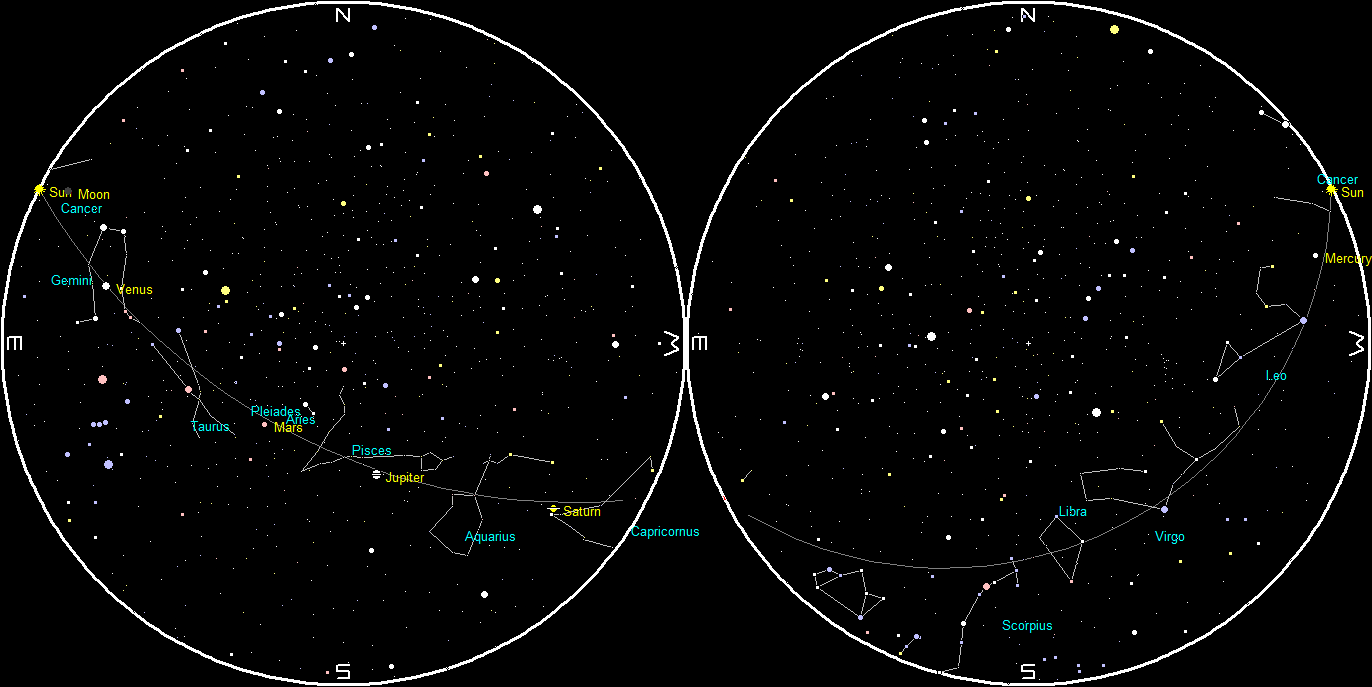
The naked-eye planets and the Moon at sunset and sunrise on a single night, starting with sunset on the right on July 27, 2022. The night ends on the left with sunrise on the 28th. Notice that all the naked-eye planets except Mercury are in the morning sky now. Click on the image to enlarge it. Created using my LookingUp program.
07/26/2022 – Ephemeris – An Anishinaabe hero is in the sky
This is Ephemeris for Tuesday, July 26th. Today the Sun will be up for 14 hours and 53 minutes, setting at 9:15, and it will rise tomorrow at 6:23. The Moon, 2 days before new, will rise at 4:51 tomorrow morning.
Scorpius the scorpion is now seen low in the southern sky in the evening. To me, the stars here make a very good scorpion. Scorpius was invented by the people of the Middle East, where scorpions are plentiful. The Anishinaabe native peoples of our area, however, saw one of their legendary hero figures, Nenabozho*. In the sky, the arc of three stars at the front of the scorpion and to the right of the bright star Antares is his bow. He is shooting an arrow toward the receding Great Panther or Curly Tail a constellation of spring whose curl of a tail is the head of the constellation Leo, now lost in the evening twilight in the west. Nenabozho was a hero in their creation stories, and a trickster who was sometimes seen as a rabbit.
The astronomical event times given are for the Traverse City/Interlochen area of Michigan (EDT, UT – 4 hours). They may be different for your location.
* Nenabozho is pronounced like Nana-bouz-hou, though different tribes pronounced it differently. I could not find Nenabozho and its various other transliterations, one of which was Nanaboozhoo in the Ojibwe People’s Dictionary (https://ojibwe.lib.umn.edu/). However, since he occasionally shape-shifted into being a rabbit his name includes a part of the name for rabbit, waabooz. That entry had several audio examples. That’s how I got the pronunciation for the radio program.
Addendum
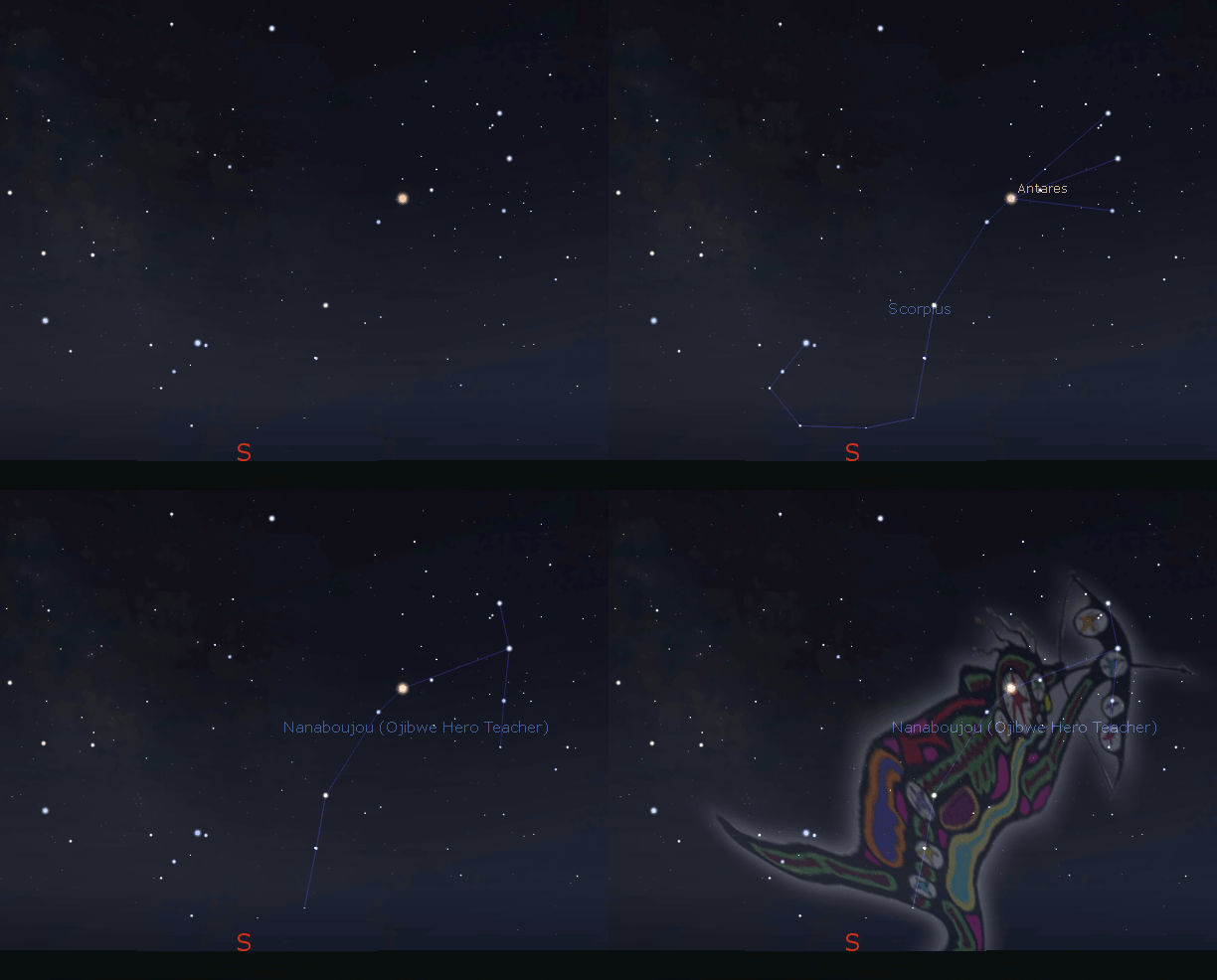
Animated finder for the Anishinaabe constellation of Nenabozho showing the unannotated star field, the Western constellation of Scorpius and Nenabozho. On the chart, it’s spelled Nanaboujou. Created using Stellarium (both star lore images are embedded in Stellarium). The Anishinaabe image embedded in Stellarium is from Ojibwe Giizhig Anung Masinaaigan – Ojibiwe Sky Star Map created by A. Lee, W. Wilson, and C. Gawboy.
A story of Waynaboozhoo (same fellow) is told in a book recommended by the curator of the museum of the Grand Traverse Band of Ottawa and Chippewa Indians. It’s The Mishomis Book – The Voice of the Ojibway by Edward Benton-Banai, University of Minnesota Press.
07/25/2022 – Ephemeris – Getting an early look at the Perseid Meteor Shower
This is Ephemeris for Monday, July 25th. Today the Sun will be up for 14 hours and 55 minutes, setting at 9:16, and it will rise tomorrow at 6:22. The Moon, 3 days before new, will rise at 3:57 tomorrow morning.
The annual Perseid meteor shower, which will reach its peak on the evening of August 12th has the full moon to contend with. So the best time to spot these meteors is before the peak. Members of this meteor shower can be spotted from July 17th to August 24th, but in much reduced numbers. They are best seen after midnight, however since the point in the sky they seem to come from, the radiant, is always above the horizon, they can be spotted any time at night. They will seem to come from the northeastern part of the sky, and below the letter W shaped constellation of Cassiopeia. The Southern Delta Aquariid meteors coming from the southeast after 11 pm will predominate. Its radiant, the point from which the meteors will seem to come from, will be near the Moon. The Southern Delta Aquariids will reach their peak on the 30th of this month, with dark skies. The Southern Delta Aquariid radiant will rise about 11 pm now, and it will be possible to spot one of its meteors until the Moon rises. The hourly rates of the Perseids will increase each night until the Moon starts to interfere with the shower in early August.
The astronomical event times given are for the Traverse City/Interlochen area of Michigan (EDT, UT – 4 hours). They may be different for your location.
Addendum
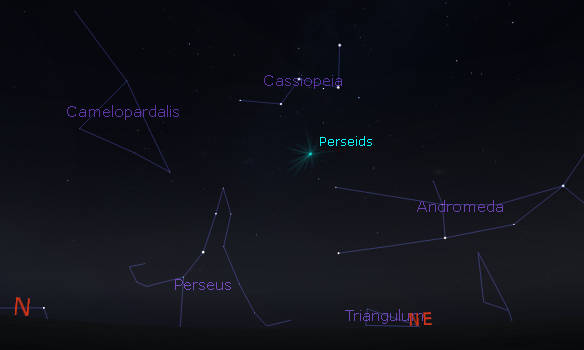
Finder chart for Perseid Radiant for August 25, 11pm. The radiant point will move slowly to the left for the duration of the meteor shower over the next month. By August 12th, the shower’s peak, the radiant will be just left of the top star of Perseus. Created using Stellarium.
07/21/2022 – Ephemeris – Observing the heavens from the shore of Sleeping Bear Bay
This is Ephemeris for Thursday, July 21st. Today the Sun will be up for 15 hours and 3 minutes, setting at 9:20, and it will rise tomorrow at 6:18. The Moon, 1 day past last quarter, will rise at 1:35 tomorrow morning.
There’s an observatory on the shores of Sleeping Bear Bay near Glen Arbor that is open to the public twice a week on clear nights. It’s the Leelanau School’s Lanphier Observatory, which is open Wednesday and Thursday evenings weather permitting from 10 p.m. to midnight through August 25th. The Leelanau School is located at 1 Old Homestead Road, off M22, just north of Glen Arbor. The Observatory is behind the Student Center and across the Crystal River. It’s a bit of a hike. It will help to take a flashlight for heading back in the dark. The observatory dome contains a 14-inch telescope on a computerized mount, and smaller telescopes may be available on the observatory deck. The observatory is run by Norm Wheeler, retired instructor of the school. Get there early to enjoy the sunset on Lake Michigan.
The astronomical event times given are for the Traverse City/Interlochen area of Michigan (EDT, UT – 4 hours). They may be different for your location.
Addendum
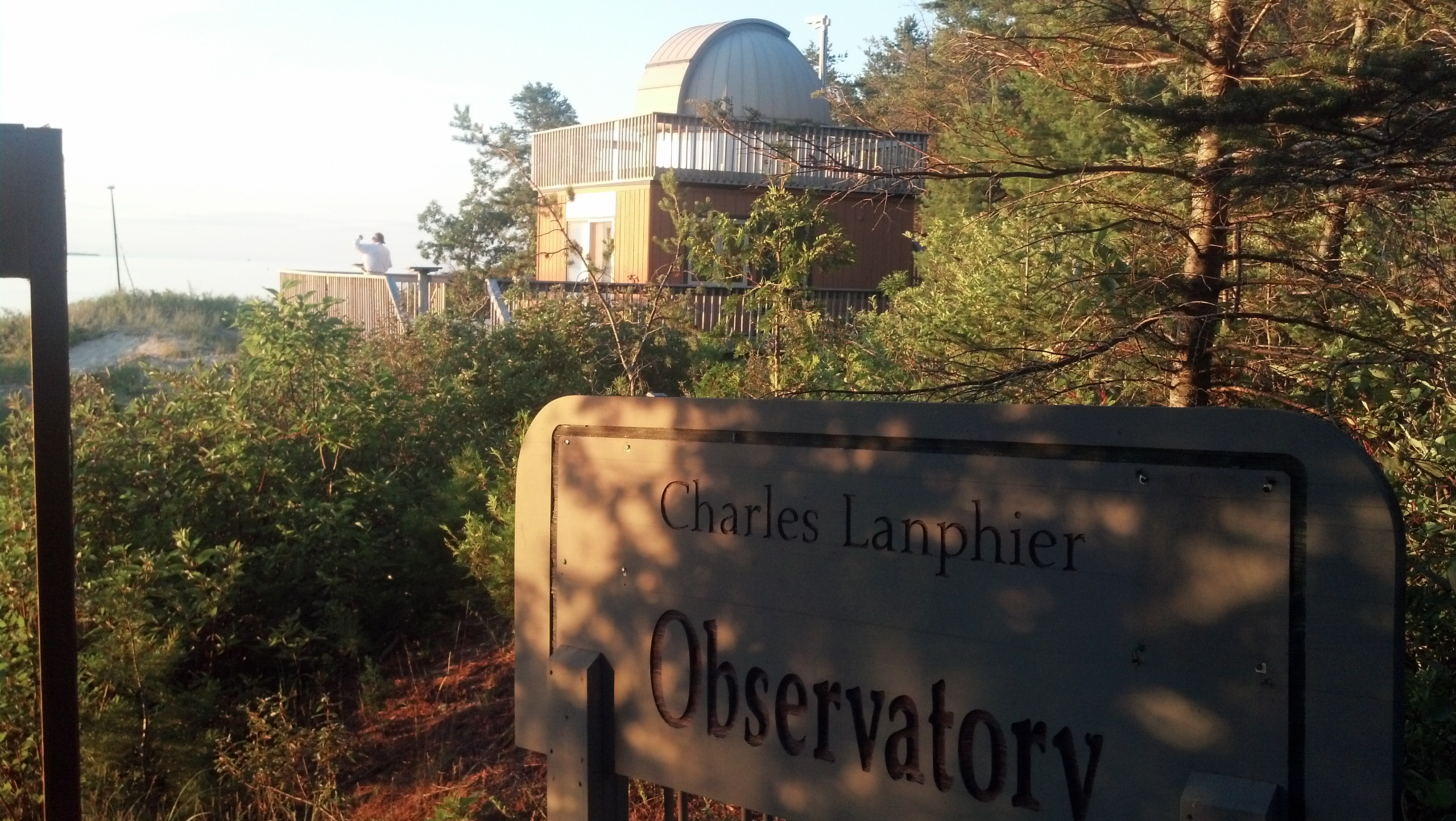
Lanphier Observatory from the trail leading up to it. It’s just off the beach. Beside observing from the main telescope in the dome, there is observation of the constellations and Milky Way from the deck. Credit: Bob Moler.
07/20/2022 – Ephemeris – Let’s search for the naked-eye planets for this week
This is Ephemeris for Wednesday, July 20th. Today the Sun will be up for 15 hours and 5 minutes, setting at 9:21, and it will rise tomorrow at 6:17. The Moon, at last quarter today, will rise at 1:13 tomorrow morning.
Let’s search for the naked-eye planets for this week. All but one of the naked-eye planets are in the morning sky, That one is Mercury, too close to the Sun to be seen in the evening. At 5:15 am tomorrow, the planets will be spread out from brilliant Venus low in the east-northeast to Saturn higher in the south-southwest. Mars will be a lot higher than Venus in the east-southeast. The waning crescent Moon will be just right of Mars. Jupiter is farther to the right in the southeast. Mars is dimmer than Jupiter, but is slowly getting brighter as the Earth creeps up on it. Saturn ends the line of planets lower than Jupiter in the south-southwest. Tonight, Saturn will rise about 10:30 pm, though it won’t be an official evening planet until it rises before sunset, which won’t happen until mid-August.
The astronomical event times given are for the Traverse City/Interlochen area of Michigan (EDT, UT – 4 hours). They may be different for your location.
Addendum
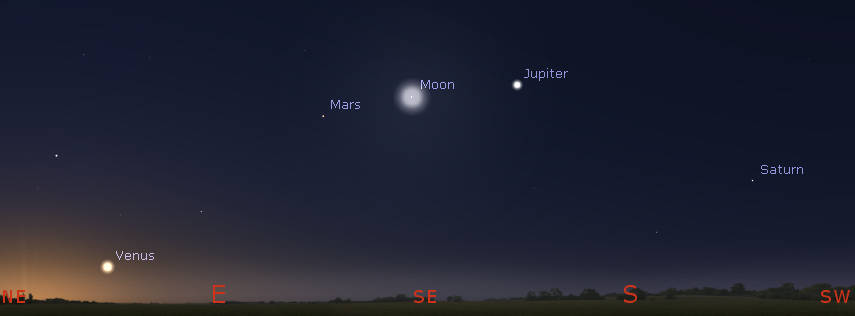
The morning planets and the Moon at 5:15 am tomorrow morning, July 21, 2022. The planets and Moon actually appear in a straight line in the sky, being placed along the ecliptic, or path of the Sun in the sky. The ecliptic is a great circle on the celestial sphere. Click on the image to enlarge it. The span of the planets from Venus to Saturn is 129 degrees. Click on the image to enlarge it. Created using Stellarium.
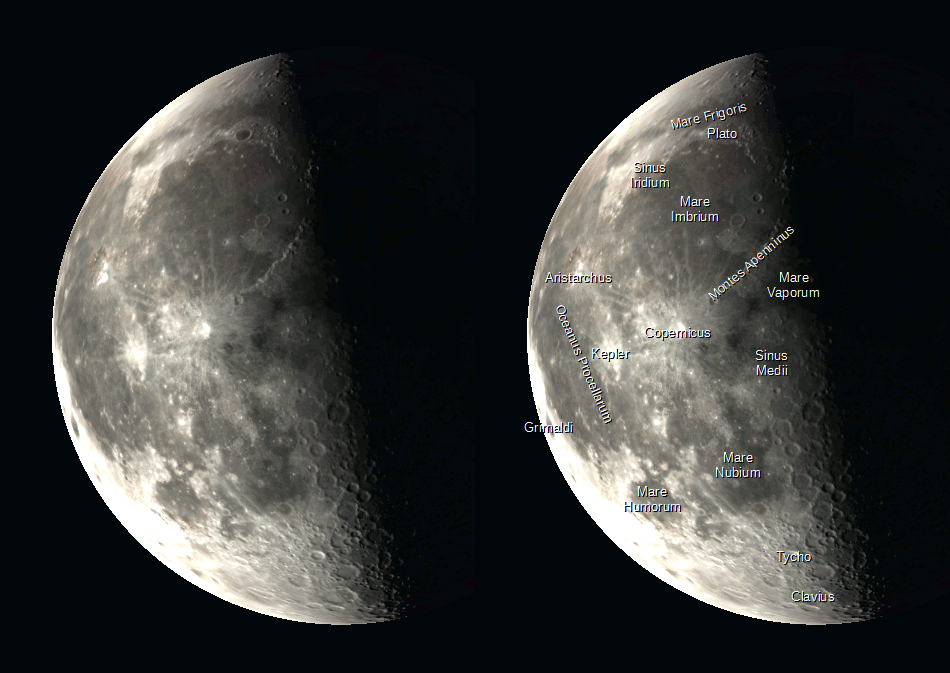
Animated last quarter Moon at 5:15 tomorrow morning, July 21, 2022, with labels. Created using Stellarium and LibreOffice.
Translations
Mare Frigoris – Sea of Cold
Mare Humorum – Sea of Moisture
Mare Imbrium – Sea of Showers
Mare Nubium – Sea of Clouds
Mare Serenitatis – Sea of Serenity
Mare Vaporum – Sea of Vapors
Montes Apenninus – Apennine Mountains
Oceanus Procellarum – Ocean of Storms
Sinus Iridium – Bay of Rainbows
Sinus Medii – Central Bay
Note that Mare is pronounced Mar-é
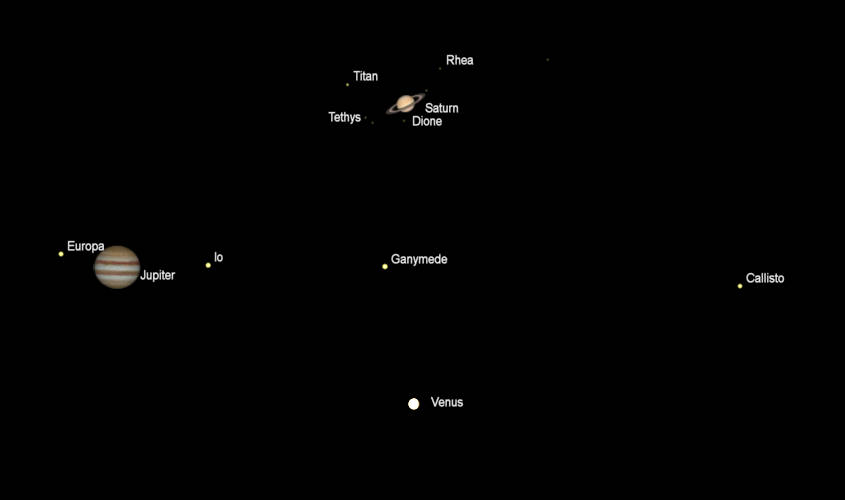
Views of Saturn, Jupiter, and Venus (north up) as they would be seen in a small telescope, with the same magnification, tomorrow morning at 5:15 am, July 21, 2022. I do not show planets less than 10 seconds of arc in diameter. Apparent diameters: Saturn 18.56″, its rings 43.24″; Jupiter 43.47″. Mars is not shown, its apparent diameter is 7.84″; Venus 11.10″. The ” symbol means seconds of arc (1/3600th of a degree.) Click on the image to enlarge it. Created using Cartes du Ciel (Sky Charts).
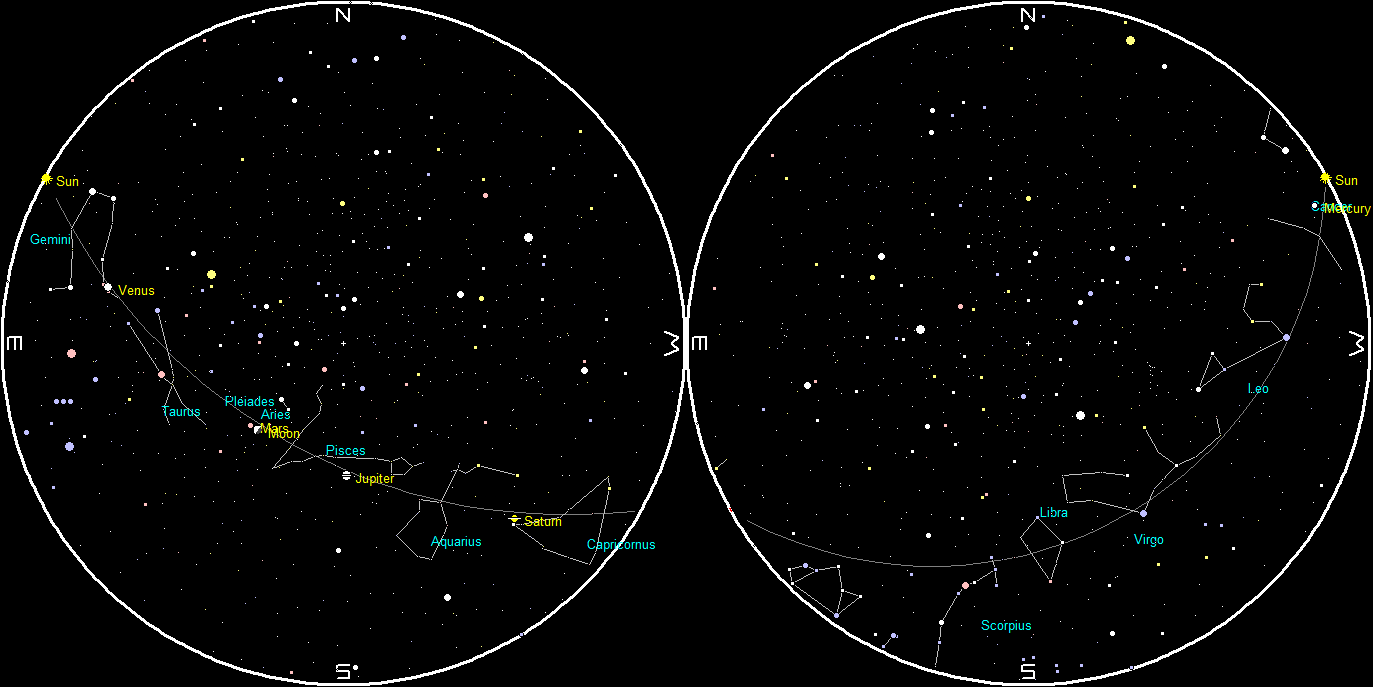
The naked-eye planets and the Moon at sunset and sunrise on a single night, starting with sunset on the right on July 21, 2022. The night ends on the left with sunrise on the 21st. Notice that all the naked-eye planets except Mercury are in the morning sky now. Click on the image to enlarge it. Created using my LookingUp program.

