Archive
07/19/2022 – Ephemeris – How to find the constellations of the man with the snake
This is Ephemeris for Tuesday, July 19th. Today the Sun will be up for 15 hours and 7 minutes, setting at 9:22, and it will rise tomorrow at 6:16. The Moon, 1 day before last quarter, will rise at 12:52 tomorrow morning.
The red star Antares shines in the south at 11 pm, in the constellation of Scorpius. In the area of sky above lies a large constellation of faint stars called Ophiuchus, the serpent bearer. The constellation shape is like a large tilted bell, which reminds me of the head, shoulders and arms of a fellow that’s holding the snake, like a weight lifter pulling up a heavy barbell. The serpent he’s holding is Serpens, the only two-part constellation in the heavens. The head rises to Ophiuchus’ right, and the tail extends up to the left. In Greek legend Ophiuchus represents a great physician, educated by the god Apollo, and the centaur Chiron, who is also found in the stars as Sagittarius, now rising in the south-southeast below and left of him.
The astronomical event times given are for the Traverse City/Interlochen area of Michigan (EDT, UT – 4 hours). They may be different for your location.
Addendum
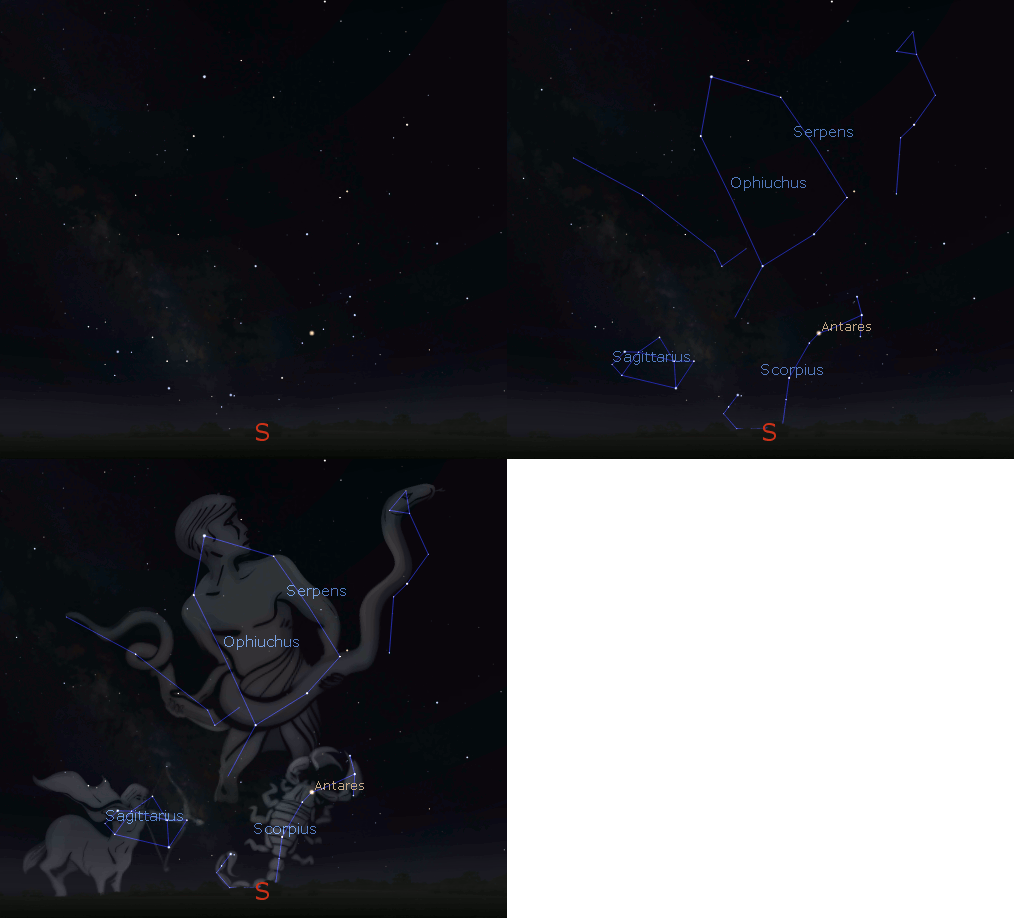
Ophiuchus finder animation for mid-July at 11 pm. Created using Stellarium and GIMP.
07/14/2022 – Ephemeris – The dimmest Summer Triangle star is actually the brightest
This is Ephemeris for Thursday, July 14th. Today the Sun will be up for 15 hours and 15 minutes, setting at 9:26, and it will rise tomorrow at 6:11. The Moon, 1 day past full, will rise at 10:49 this evening.
This evening, when it gets dark enough, the bright star Deneb in Cygnus the swan will be high in the east-northeast. I’ll cover Cygnus tomorrow when the sky is darker. Deneb is the dimmest star of the summer triangle. Of the other stars of the triangle, Vega is higher in the east, while Altair is lower in the southeast. Deneb’s apparent magnitude, or brightness as seen from Earth, makes it the dimmest of the three bright stars. That’s because of its vast distance of maybe 1,550 light years, 57 times the distance of Vega. If brought as close as Vega, Deneb would be as bright, at least, as the first quarter moon. It is possibly as bright as 196 thousand Suns; and it’s a huge star, possibly as large in diameter as the orbit of the Earth. For all this, it is only 23 or so times the mass of the Sun.
The astronomical event times given are for the Traverse City/Interlochen area of Michigan (EDT, UT – 4 hours). They may be different for your location.
Addendum
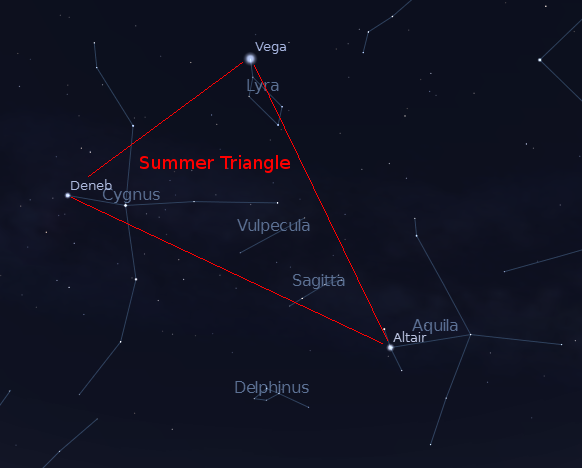
The Summer Triangle. Created using Stellarium and The Gimp.
If you put Deneb in the search box, you will find that the content of the posts, over the years, about the star are nearly identical. However, the distance estimates vary widely. It is too far away for trigonometric parallax measurements by earth based telescopes. Though in the range of ESA’s Hipparcos and Gaia satellites, it is too bright. So other less accurate measurements are used. I don’t think it involves coin flipping. The assumed distance also affects estimates of luminosity, and mass.
07/13/2022 – EPHEMERIS – Let’s search for the naked-eye planets for this week
This is Ephemeris for Wednesday, July 13th. Today the Sun will be up for 15 hours and 17 minutes, setting at 9:26, and it will rise tomorrow at 6:10. The Full Buck Moon, also a supermoon, will rise at 10:05 this evening.
Let’s search for the naked-eye planets for this week. All the naked-eye planets are in the morning sky, although Mercury is too close to the Sun to be seen. On the Saturday it will leave the morning sky crossing over to the evening sky. At 5 am tomorrow, the planets will be spread out from brilliant Venus low in the east-northeast to Saturn higher in the south-southwest. Mars will be a lot higher than Venus in the east-southeast. Jupiter is a bit higher in the southeast. Mars is dimmer than Jupiter, but is slowly getting brighter as the Earth creeps up on it. Saturn ends the line of planets in the south-southwest. Tonight, Saturn will rise about 11:03 pm, though it won’t be an official evening planet until it rises before sunset, which happens in mid-August.
The astronomical event times given are for the Traverse City/Interlochen area of Michigan (EDT, UT – 4 hours). They may be different for your location.
Addendum
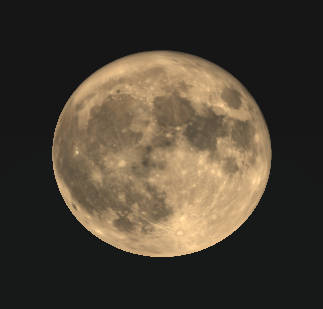
Tonight’s full supermoon shortly after it will rise at 10:30 pm July 13, 2022. Created using Stellarium.
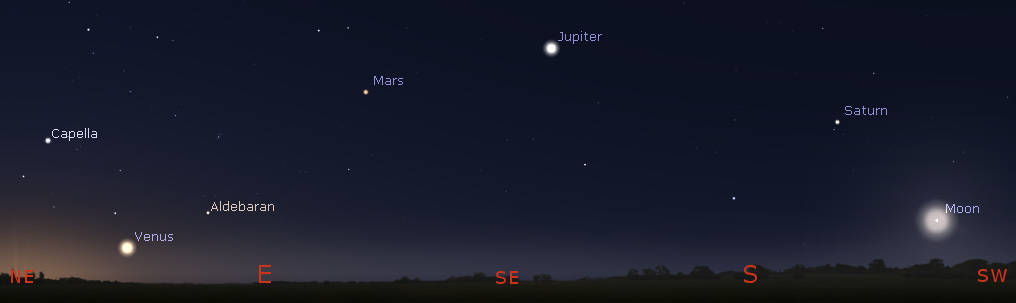
The morning planets and the Moon at 5 am tomorrow morning, July 14, 2022. The planets and Moon actually appear in a straight line in the sky, being placed along the ecliptic, or path of the Sun in the sky. The ecliptic is a great circle on the celestial sphere. Click on the image to enlarge it. The span of the planets from Venus to Saturn is 122 degrees. Two of winter’s first magnitude stars, Aldebaran and Capella, are now visible in morning twilight. Click on the image to enlarge it. Created using Stellarium.
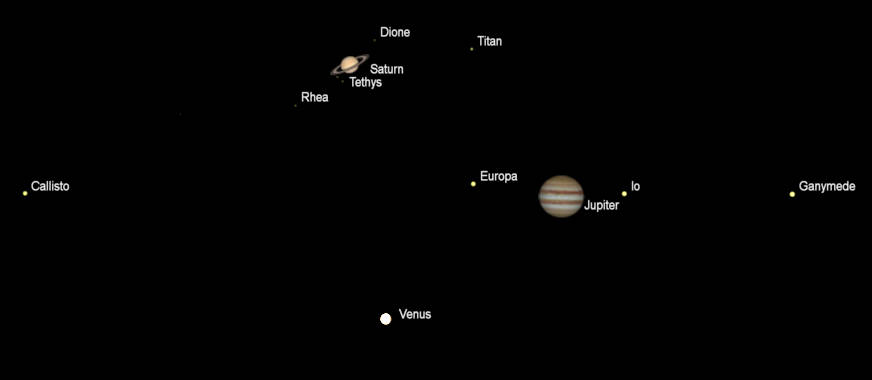
Views of Saturn, Jupiter, and Venus (north up) as they would be seen in a small telescope, with the same magnification, tomorrow morning at 5:00 am, July 14, 2022. I do not show planets less than 10 seconds of arc in diameter. Apparent diameters: Saturn 18.46″, its rings 43.01″; Jupiter 42.63″. Mars is not shown, its apparent diameter is 7.63″; Venus 11.31″. The ” symbol means seconds of arc (1/3600th of a degree.) Click on the image to enlarge it. Created using Cartes du Ciel (Sky Charts).
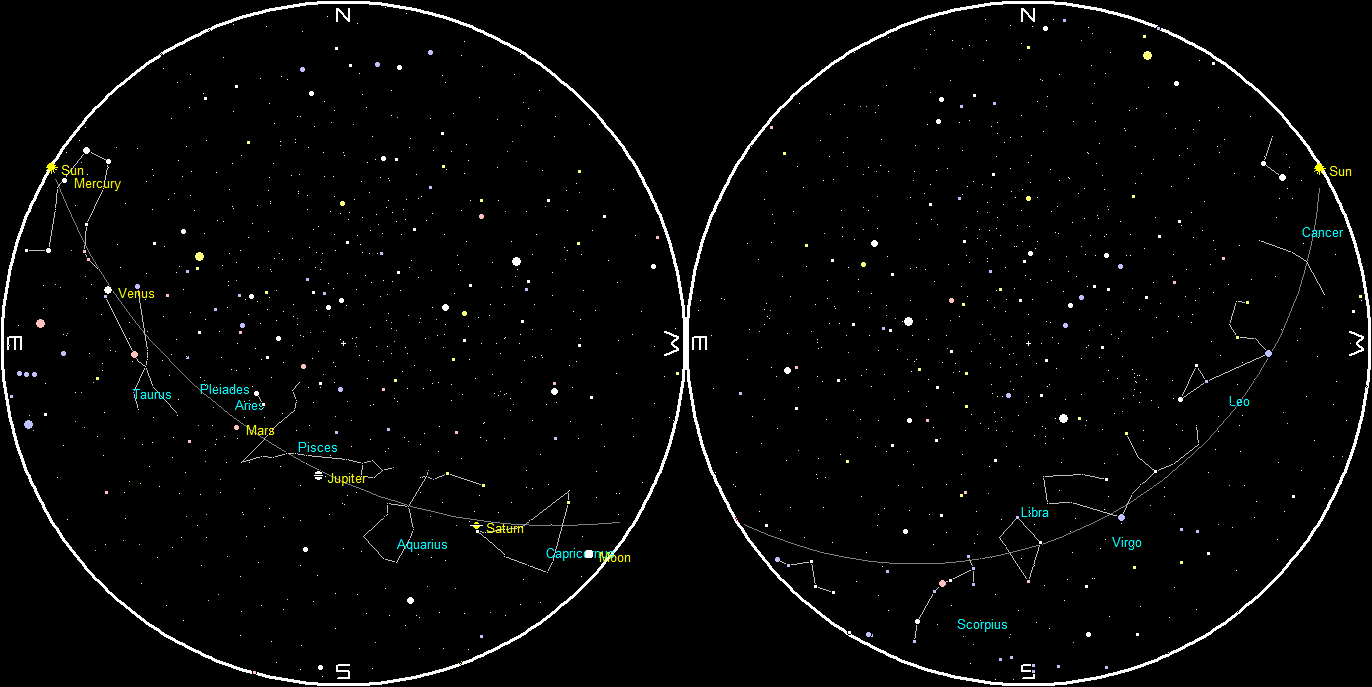
The naked-eye planets and the Moon at sunset and sunrise on a single night, starting with sunset on the right on July 13, 2022. The night ends on the left with sunrise on the 14th. Notice that all the naked-eye planets are in the morning sky now. Click on the image to enlarge it. Created using my LookingUp program.
07/08/2022 – Ephemeris – Polaris the North Star
This is Ephemeris for Friday, July 8th. Today the Sun will be up for 15 hours and 24 minutes, setting at 9:29, and it will rise tomorrow at 6:06. The Moon, 2 days past first quarter, will set at 2:17 tomorrow morning.
The bright star Polaris is a very important star. It is also known as the North Star and the Pole Star. Its unique position is nearly directly at the zenith at the Earth’s North Pole, making it a very important navigational star. It’s about 40 minutes of arc, or about one and a third Moon diameters away from the extension of the Earth’s axis into the sky. As a rule of thumb, its angular altitude above the northern horizon is approximately one’s latitude, and it stands about at the due north compass point. Polaris is found using the Big Dipper, using the two stars at the front of the dipper bowl to point to it. It’s located at the tip of the handle of the very dim Little Dipper which, this time of year in the evening, appears to be standing on its handle.
The astronomical event times given are for the Traverse City/Interlochen area of Michigan (EDT, UT – 4 hours). They may be different for your location.
Addendum
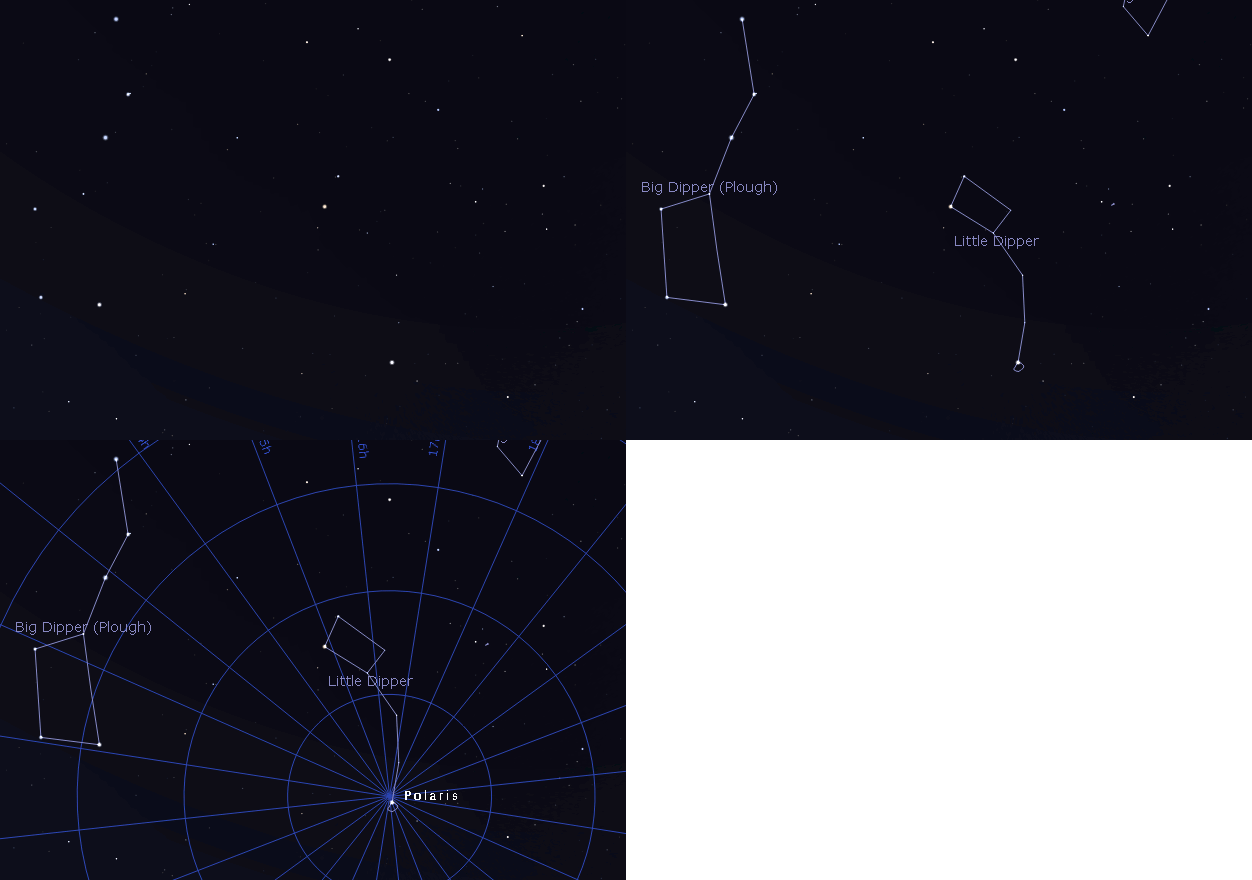
Polaris finder and location animation. Three frames: visual appearance in the sky, lines of the asterisms of the Big and Little Dippers, addition of the equatorial grid of celestial coordinates analogous to longitude and latitude on the Earth. The right ascension (like longitude) lines converge over the Earth’s North Pole, with Polaris close by. Created using Stellarium and GIMP.
The two stars at the front of the Big Dipper’s bowl, at the bottom of the dipper as it appears now in the evening, point to Polaris near the 11-hour right ascension line. Right ascension, though the same as earthly longitude, is measured in hours, rather than degrees. An hour equals 15 degrees, making 24 hours equal 360 degrees.
07/07/2022 – Ephemeris – A closer look at the bright star Vega
This is Bob Moler with Ephemeris for Thursday, July 7th. Today the Sun will be up for 15 hours and 25 minutes, setting at 9:30, and it will rise tomorrow at 6:05. The Moon, 1 day past first quarter, will set at 1:53 tomorrow morning.
Vega, in the constellation Lyra the harp, is the highest star In the east and brightest star of the Summer Triangle also rising in that direction. It is an important and much studied star, first as a standard for brightness for the magnitude scale at almost exactly zero. It also has two fields of debris orbiting it. In 1983 the Infrared Astronomy Satellite, IRAS, discovered an excess of infrared radiation coming from the star. It seems now that there are two orbiting rings, one warm, and the other cold. This is somewhat like the two disks the Sun has: The asteroid belt between Mars and Jupiter and the Kuiper belt, beyond Neptune. No planets have yet been discovered around Vega, but I wouldn’t bet against it.
The astronomical event times given are for the Traverse City/Interlochen area of Michigan (EDT, UT – 4 hours). They may be different for your location.
Addendum
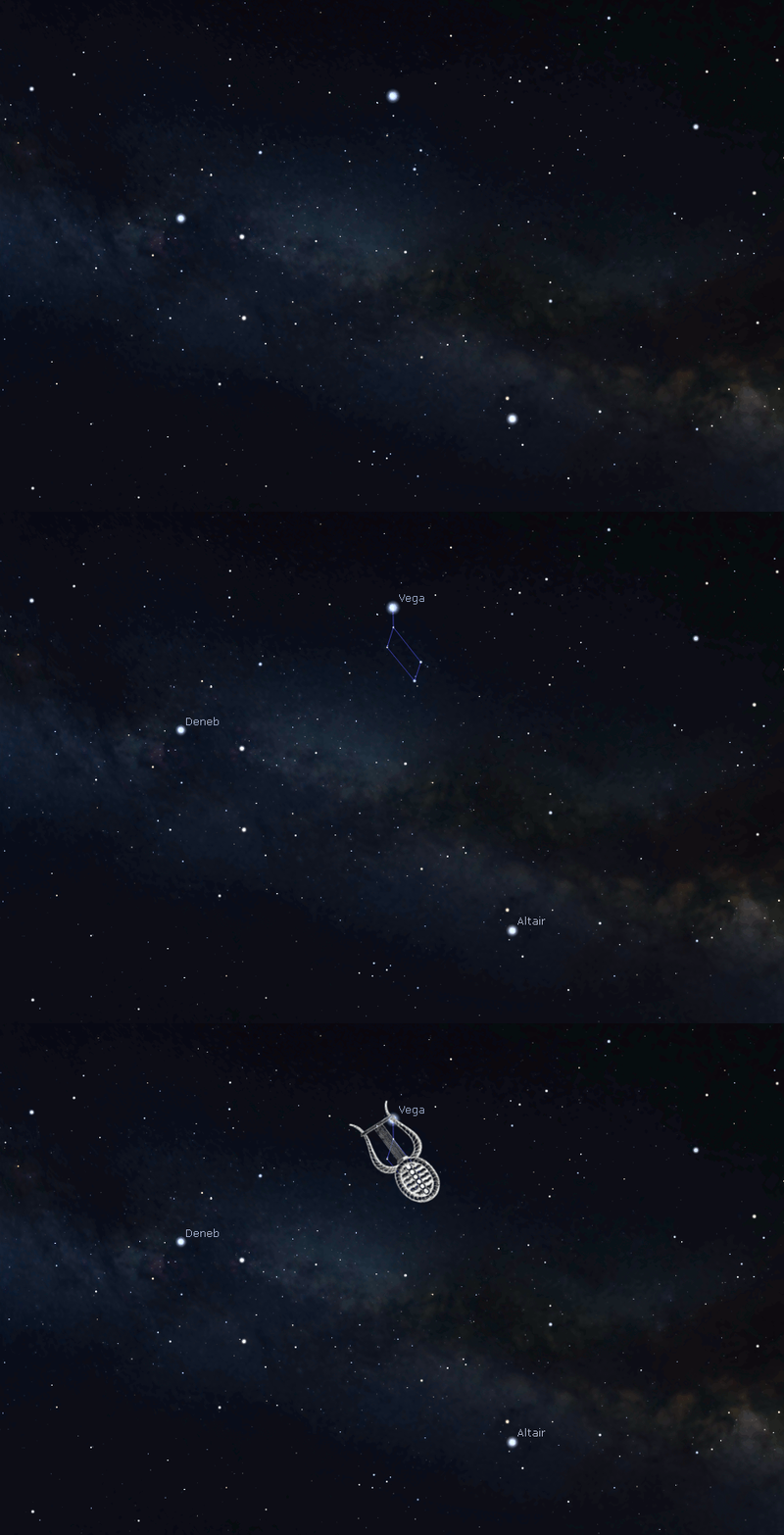
Animated Lyra finder chart. The lyre image not supplied by Stellarium but is from The World’s Earliest Music by Hermann Smith, Figure 60, A Project Gutenberg E-Book, and captioned “The Chelys or Greek Tortoiseshell Lyre”. Vega is the brightest star in Lyra, and the brightest star of the Summer Triangle. The other stars of the triangle are Deneb and Altair. Created using Stellarium.
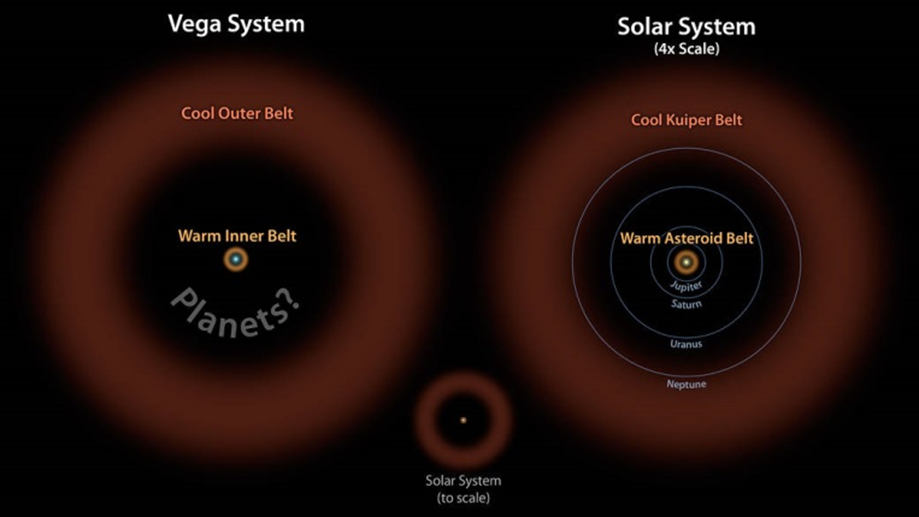
Vega possesses two debris fields, similar to our own solar system’s asteroid and Kuiper belts. Astronomers continue to hunt for planets orbiting Vega, but as of May 2020 none have been confirmed. More info: bit.ly/VegaSystem Credit: NASA/JPL-Caltech
07/06/2022 – Ephemeris – Let’s search for the naked-eye planets for this week
This is Bob Moler with Ephemeris for Wednesday, July 6th. Today the Sun will be up for 15 hours and 26 minutes, setting at 9:30, and it will rise tomorrow at 6:04. The Moon, at first quarter today, will set at 1:32 tomorrow morning.
Let’s search for the naked-eye planets for this week. All the naked-eye planets are in the morning sky, although Mercury is too close to the Sun to be seen. On the 16th, it will leave the morning sky, crossing over to the evening sky. At 5 am tomorrow, the planets will be spread out from brilliant Venus low in the east-northeast to Saturn higher in the south. To the right and above of Venus, in the east-southeast, will be the Mars. Jupiter is a bit higher in the southeast. Mars is dimmer than Jupiter, but is slowly getting brighter as the Earth creeps up on it. Saturn ends the line of planets in the south. Tonight, Saturn will rise about 11:30 pm. It won’t be an official evening planet until it rises before sunset. That won’t happen until mid-August.
The astronomical event times given are for the Traverse City/Interlochen area of Michigan (EDT, UT – 4 hours). They may be different for your location.
Addendum
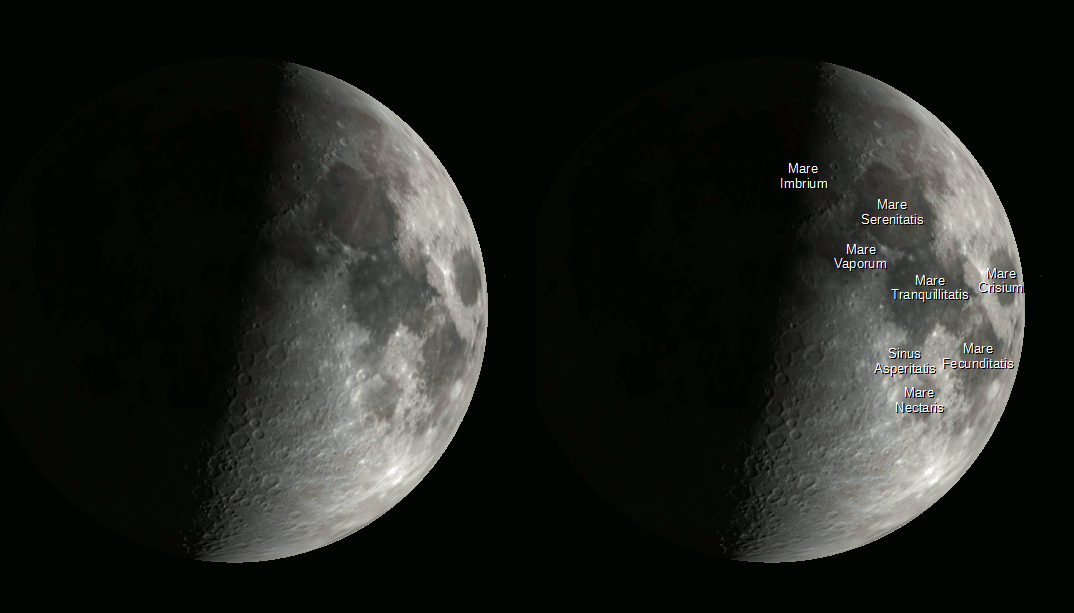
First quarter Moon tonight with prominent features labeled. Created using Stellarium, GIMP and LibreOffice.
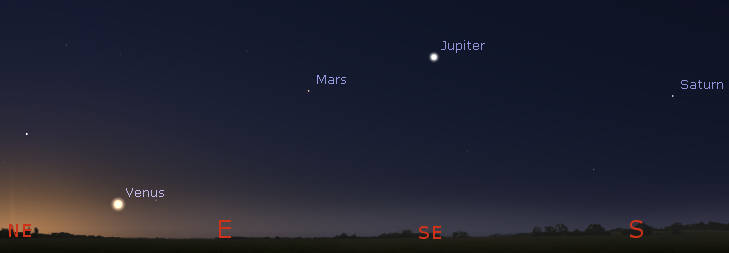
The morning planets at 5 am tomorrow morning, July 7, 2022. The planets actually appear in a straight line in the sky, being placed along the ecliptic, or path of the Sun in the sky. The ecliptic is a great circle on the celestial sphere. Click on the image to enlarge it. The span of the planets from Venus to Saturn is 113 degrees. Click on the image to enlarge it. Created using Stellarium.
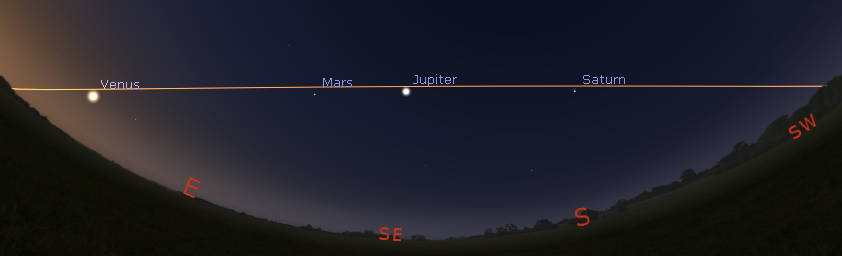
Distortions of rendering a spherical sky on a flat plane. The morning planets as seen in a stereographic view where great circles, like the ecliptic and horizon, are either circles or straight lines. In this image, the ecliptic, orange line, runs through the center of the plot, so it appears straight. In the real sky, both the planets and the horizon appear to be in straight lines. This assumes that your horizon is flat. Click on the image to enlarge it. Created using Stellarium.
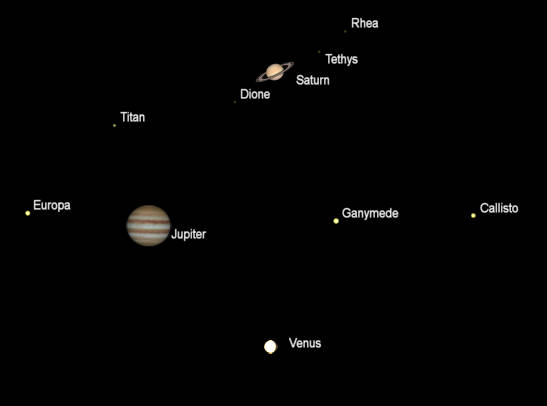
Views of Saturn, Jupiter, and Venus (north up) as they would be seen in a small telescope, with the same magnification, tomorrow morning at 5:00 am, July 7, 2022. I do not show planets less than 10 seconds of arc in diameter. Apparent diameters: Saturn 18.32″, its rings 42.68″; Jupiter 41.68″. Mars is not shown, its apparent diameter is 7.41″ and is 85.4% illuminated; Venus 11.60″, 87.5% illuminated. Jupiter’s 4th Galilean moon, Io, is missing because it is in Jupiter’s shadow. The ” symbol means seconds of arc (1/3600th of a degree.) Created using Cartes du Ciel (Sky Charts).
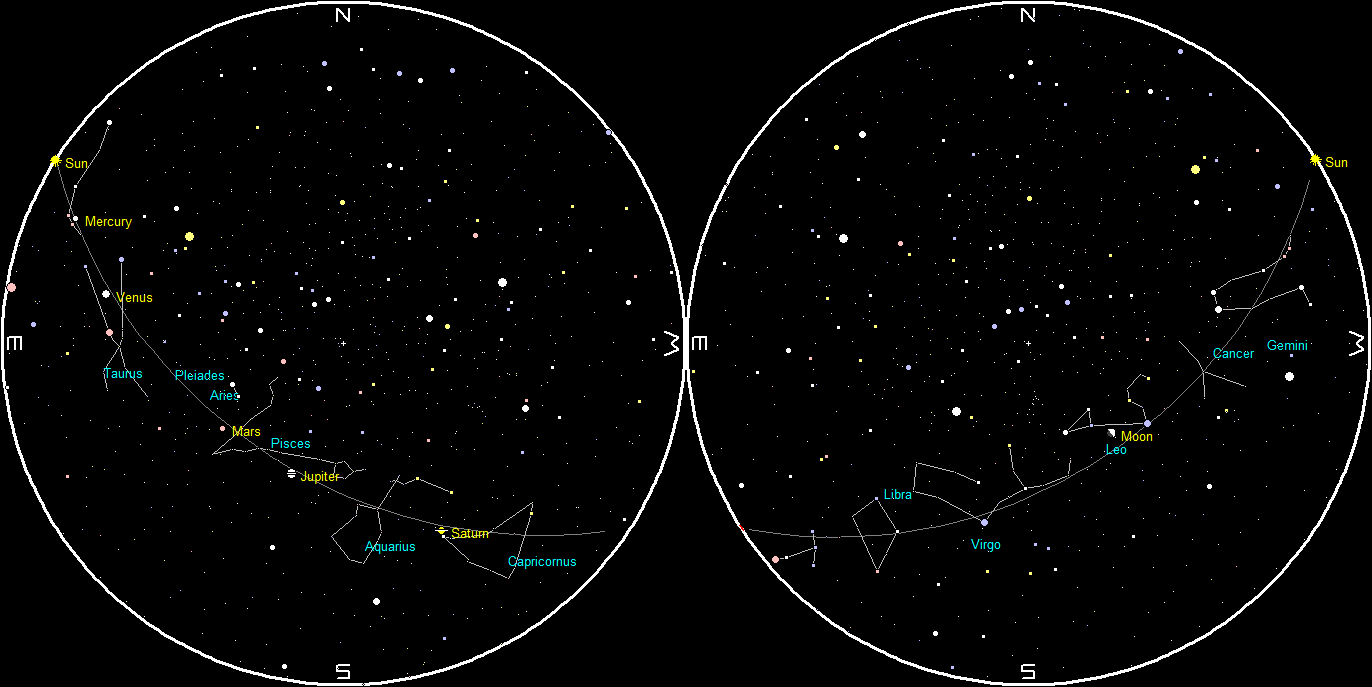
The naked-eye planets and the Moon at sunset and sunrise on a single night, starting with sunset on the right on July 6, 2022. The night ends on the left with sunrise on the 7th. Notice that all the naked-eye planets are in the morning sky now. Click on the image to enlarge it. Created using my LookingUp program.
07/05/2022 – Ephemeris – Taking a close look at Altair
This is Ephemeris for Tuesday, July 5th. Today the Sun will be up for 15 hours and 27 minutes, setting at 9:30, and it will rise tomorrow at 6:04. The Moon, 1 day before first quarter, will set at 1:12 tomorrow morning.
The southernmost star of the Summer Triangle is Altair, high in the east-southeast. The other two stars of the triangle are Vega nearly overhead in the east, and Deneb high in the east-northeast. Altair is the closest of the three at a distance of 16.7 light years away. One light year is nearly 6 trillion miles. Altair is 10 times the brightness of the Sun. If seen at Altair’s distance, the Sun would only be as bright as one of the two stars that flank it. What is rather different about Altair is its rapid rotation. While it’s almost twice the sun’s diameter, it rotates once in about 9 hours, The CHARA Interferometer at Mt. Wilson has actually imaged its squashed disk in the infrared. Our Sun’s a slow poke, taking nearly a month to rotate once.
The astronomical event times given are for the Traverse City/Interlochen area of Michigan (EDT, UT – 4 hours). They may be different for your location.
Addendum
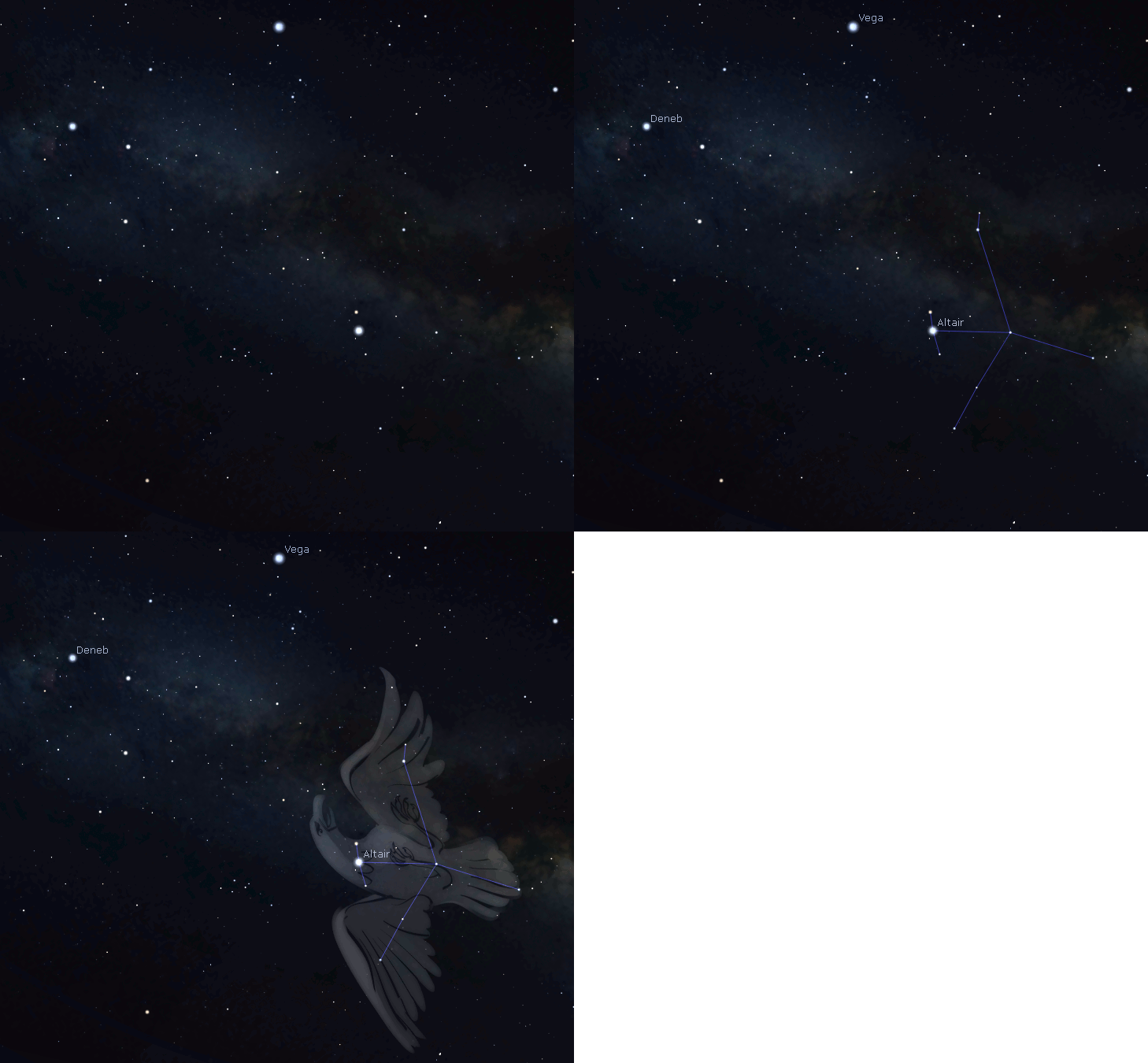
Animated Aquila finder chart with Altair as its brightest star. Also shown are the other two stars of the Summer Triangle, Vega and Deneb. Created using Stellarium.
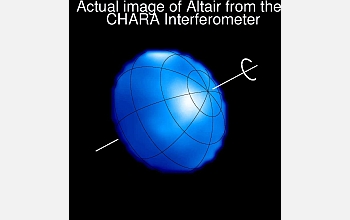
Credit: Zina Deretsky, National Science Foundation
07/01/2022 – Ephemeris – GTAS meeting and star party tonight
This is Ephemeris for Friday, July 1st. Today the Sun will be up for 15 hours and 30 minutes, setting at 9:32, and it will rise tomorrow at 6:01. The Moon, 3 days past new, will set at 11:44 this evening.
Tonight at 9 pm, the Grand Traverse Astronomical Society will have an in-person meeting at Northwestern Michigan College’s Rogers Observatory. The meeting will also be available via Zoom. Becky Shaw returns with a program Famous international and national observatories. I’m not sure which observatories she’s selected, but there are many, not just optical, but radio, infrared, and in space: Hubble, and the soon to become operational James Webb Space Telescope. If it’s clear, there will be a star party following the meeting. The observatory is located south of Traverse City off Birmley Road, between Garfield and Keystone roads. A Zoom link will be available at gtastro.org before the meeting.
The astronomical event times given are for the Traverse City/Interlochen area of Michigan (EDT, UT – 4 hours). They may be different for your location.
06/30/2022 – Ephemeris – Previewing the skies of July
This is Bob Moler with Ephemeris for International Asteroid Day, Thursday, June 30th. On this day in 1908, 114 years ago, a small asteroid exploded over the Tunguska region of Siberia. Today the Sun will be up for 15 hours and 31 minutes, setting at 9:32, and it will rise tomorrow at 6:01. The Moon, 2 days past new, will set at 11:11 this evening.
Let’s preview July’s skies. The Sun, having reached its northern solstice, is beginning to slide southward again, at first imperceptibly, then with greater speed. The daylight hours will decrease from 15 hours and 30 minutes tomorrow to 14 hours 41 minutes at month’s end. The daylight hours will be slightly shorter south of Interlochen, and slightly longer to the north. The altitude of the Sun at local noon, when the Sun is due south, will decrease from 68 degrees today to 63 degrees at month’s end. The Sun will be a degree lower in the Straits area. Despite the warmth, the Earth will reach its greatest distance from the Sun this Sunday the 3rd.
The astronomical event times given are for the Traverse City/Interlochen area of Michigan (EDT, UT – 4 hours). They may be different for your location.
Addendum
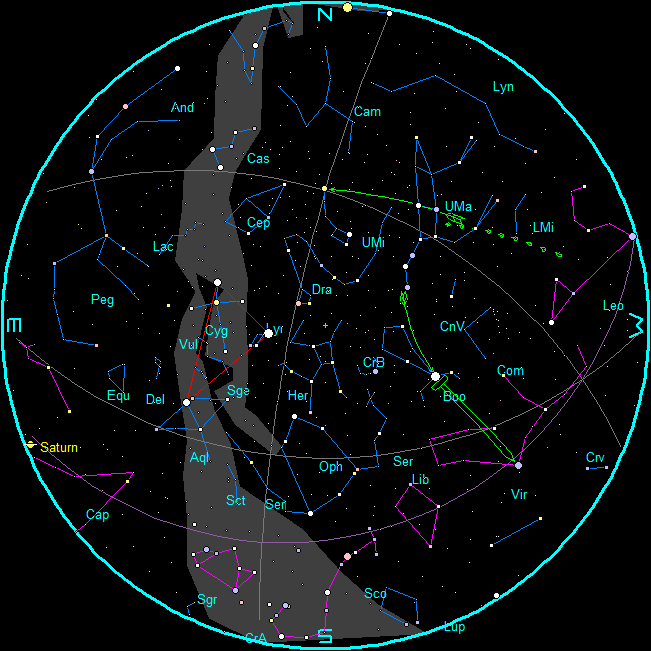
Star Chart for July 2022 (11 p.m. EDT, July 15, 2022). Created using my LookingUp program. Click on image to enlarge.
The planets and stars are plotted for the 15th at 11 p.m. EDT in the evening and 4:30 a.m. for the morning chart. These are the chart times. Note that Traverse City is located approximately 45 minutes behind our time meridian, West 75° longitude. (An hour 45 minutes behind our daylight saving time meridian during EDT). To duplicate the star positions on a planisphere you may have to set it to 1 hour 45 minutes earlier than the current time.
Note the chart times are for the 15th. For each week before the 15th, add ½ hour (28 minutes if you’re picky). For each week after the 15th, subtract ½ hour. The planet positions are updated each Wednesday on this blog. For planet positions on dates other than the 15th.
July Morning Star Chart
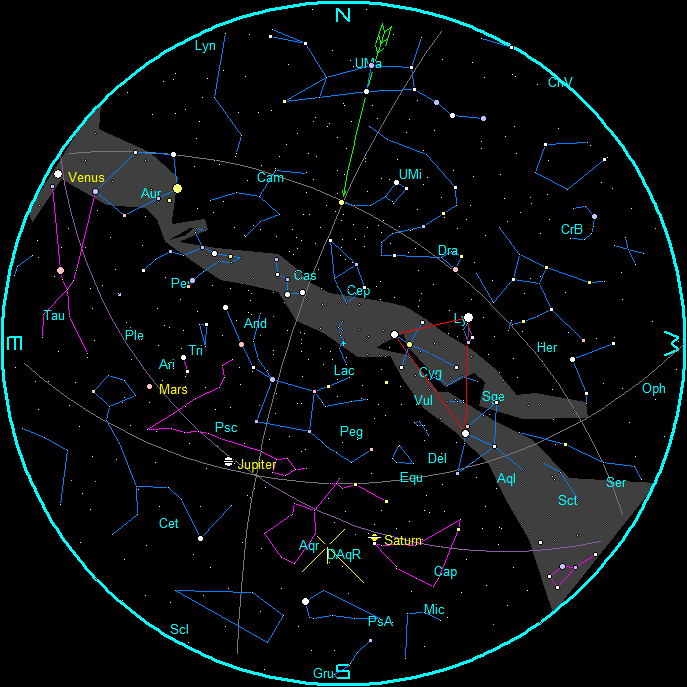
Star Chart for July mornings, 2022 (4:30 a.m. EDT July 15, 2022). Created using my LookingUp program. Click on image to enlarge.
For a list of constellation names to go with the abbreviations, click here.
- Pointer stars at the front of the bowl of the Big Dipper point to Polaris, the North Star.
- Leaky dipper drips on Leo.
- Follow the arc of the handle of the Big Dipper to the star Arcturus, and
- Extend like a spike to Spica.
- The Summer Triangle is in red.
- DAqR is the radiant of the South Delta Aquariid meteor shower (Peaks on the 27th)
Twilight Limits, Nautical and Astronomical
| EDT | |||||||
| Morning | Twilight | Evening | Twilight | Dark | Night | Moon | |
| Date | Astro. | Nautical | Nautical | Astro. | Start | End | Illum. |
| 2022-07-01 | 3h39m | 4h41m | 23h00m | 0h03m | 0h03m | 3h39m | 0.09 |
| 2022-07-02 | 3h40m | 4h42m | 23h00m | 0h02m | 0h02m | 3h40m | 0.15 |
| 2022-07-03 | 3h41m | 4h43m | 22h59m | 0h01m | 0h11m | 3h41m | 0.22 |
| 2022-07-04 | 3h42m | 4h44m | 22h59m | 0h00m | 0h33m | 3h42m | 0.31 |
| 2022-07-05 | 3h43m | 4h45m | 22h58m | 23h59m | 0h54m | 3h43m | 0.41 |
| 2022-07-06 | 3h45m | 4h45m | 22h57m | 23h58m | 1h13m | 3h45m | 0.51 |
| 2022-07-07 | 3h46m | 4h46m | 22h57m | 23h57m | 1h32m | 3h46m | 0.62 |
| 2022-07-08 | 3h47m | 4h47m | 22h56m | 23h56m | 1h53m | 3h47m | 0.72 |
| 2022-07-09 | 3h49m | 4h48m | 22h55m | 23h55m | 2h18m | 3h49m | 0.82 |
| 2022-07-10 | 3h50m | 4h50m | 22h55m | 23h54m | 2h48m | 3h50m | 0.9 |
| 2022-07-11 | 3h52m | 4h51m | 22h54m | 23h52m | 3h27m | 3h52m | 0.96 |
| 2022-07-12 | 3h54m | 4h52m | 22h53m | 23h51m | – | – | 1 |
| 2022-07-13 | 3h55m | 4h53m | 22h52m | 23h50m | – | – | 1 |
| 2022-07-14 | 3h57m | 4h54m | 22h51m | 23h48m | – | – | 0.97 |
| 2022-07-15 | 3h59m | 4h55m | 22h50m | 23h47m | – | – | 0.91 |
| 2022-07-16 | 4h01m | 4h57m | 22h49m | 23h45m | 23h45m | 23h50m | 0.84 |
| 2022-07-17 | 4h02m | 4h58m | 22h48m | 23h43m | 23h43m | – | 0.74 |
| 2022-07-18 | 4h04m | 4h59m | 22h47m | 23h42m | 23h42m | 0h13m | 0.64 |
| 2022-07-19 | 4h06m | 5h01m | 22h45m | 23h40m | 23h40m | 0h33m | 0.54 |
| 2022-07-20 | 4h08m | 5h02m | 22h44m | 23h38m | 23h38m | 0h53m | 0.44 |
| 2022-07-21 | 4h10m | 5h03m | 22h43m | 23h36m | 23h36m | 1h13m | 0.34 |
| 2022-07-22 | 4h12m | 5h05m | 22h42m | 23h35m | 23h35m | 1h36m | 0.25 |
| 2022-07-23 | 4h13m | 5h06m | 22h40m | 23h33m | 23h33m | 2h02m | 0.18 |
| 2022-07-24 | 4h15m | 5h07m | 22h39m | 23h31m | 23h31m | 2h33m | 0.11 |
| 2022-07-25 | 4h17m | 5h09m | 22h38m | 23h29m | 23h29m | 3h11m | 0.06 |
| 2022-07-26 | 4h19m | 5h10m | 22h36m | 23h27m | 23h27m | 3h58m | 0.02 |
| 2022-07-27 | 4h21m | 5h12m | 22h35m | 23h25m | 23h25m | 4h21m | 0 |
| 2022-07-28 | 4h23m | 5h13m | 22h33m | 23h23m | 23h23m | 4h23m | 0 |
| 2022-07-29 | 4h25m | 5h15m | 22h32m | 23h21m | 23h21m | 4h25m | 0.02 |
| 2022-07-30 | 4h27m | 5h16m | 22h30m | 23h19m | 23h19m | 4h27m | 0.06 |
| 2022-07-31 | 4h29m | 5h18m | 22h28m | 23h17m | 23h17m | 4h29m | 0.11 |
Twilight calendar was generated using Cartes du Ciel (Sky Charts).
See my blog post: Twilight Zone for the definitions of the different periods of twilight here: https://bobmoler.wordpress.com/2018/09/27/.
NASA Calendar of Planetary Events
Jul  1  Fr            Venus: 29.6° W
     1  Fr   9:21 am  Moon-Beehive: 3.9° S
     3  Su  10:59 pm  Earth at Aphelion: 1.0167 AU
     6  We  10:14 pm  First Quarter
     9  Sa   1:28 pm  Moon Descending Node
    10  Su   7:50 pm  Moon-Antares: 3° S
    12	Tu  10:30 am  NASA will release 1st full color images from the
                      Webb Space Telescope
    12  Tu   5:16 pm  Moon South Dec.: 26.9° S
    13  We   5:08 am  Moon Perigee: 357,300 km
    13  We   2:37 pm  Full Buck Moon
    15  Fr   4:16 pm  Moon-Saturn: 4° N
    16  Sa   3:30 pm  Mercury Superior Conj.
    18  Mo   8:55 pm  Moon-Jupiter: 2.3° N
    20  We  10:18 am  Last Quarter
    21  Th  12:46 pm  Moon-Mars: 1.1° S
    22  Fr   5:21 am  Moon Ascending Node
    22  Fr  11:29 pm  Moon-Pleiades: 3.7° N
    26  Tu   5:19 am  Moon North Dec.: 26.9° N
    26  Tu   6:22 am  Moon Apogee: 406,300 km
    26  Tu  10:12 am  Moon-Venus: 4.6° S
    28  Th   5:26 am  Delta Aquariid Shower: ZHR = 20
    28  Th   1:55 pm  New Moon
Aug  1  Mo            Venus: 21.7° W
All event times are given for UTC-4 hr: Eastern Daylight Saving Time.
Sky Events Calendar by Fred Espenak and Sumit Dutta (NASA’s GSFC),
http://eclipse.gsfc.nasa.gov/SKYCAL/SKYCAL.html.
If you go to the above site you can print out a list like the above for the entire year or calendar pages for your time zone.
Sun and Moon Rising and Setting Events
LU                  Ephemeris of Sky Events for Interlochen/TC
July, 2022    Local time zone: EDT
+-----------------------------------------------------------------------+
| DATE |  SUN     SUN  DAYLIGHT|   TWILIGHT*    |MOON  RISE OR    ILLUM |
|      |  RISE    SET    HOURS |  END    START  |PHASE SET** TIME FRACTN|
+=======================================================================+
|Fri  1| 06:01a  09:32p  15:30 | 10:57p  04:35a |      Set  11:44p    8%|
|Sat  2| 06:01a  09:31p  15:30 | 10:56p  04:36a |      Set  12:10a   13%|
+------+-----------------------+----------------+-----------------------+
|Sun  3| 06:02a  09:31p  15:29 | 10:56p  04:37a |      Set  12:33a   21%|
|Mon  4| 06:02a  09:31p  15:28 | 10:56p  04:38a |      Set  12:53a   29%|
|Tue  5| 06:03a  09:30p  15:27 | 10:55p  04:38a |      Set  01:12a   39%|
|Wed  6| 06:04a  09:30p  15:26 | 10:54p  04:39a |F Qtr Set  01:32a   49%|
|Thu  7| 06:04a  09:30p  15:25 | 10:54p  04:40a |      Set  01:53a   60%|
|Fri  8| 06:05a  09:29p  15:24 | 10:53p  04:41a |      Set  02:17a   70%|
|Sat  9| 06:06a  09:29p  15:22 | 10:52p  04:42a |      Set  02:47a   80%|
+------+-----------------------+----------------+-----------------------+
|Sun 10| 06:07a  09:28p  15:21 | 10:51p  04:43a |      Set  03:27a   89%|
|Mon 11| 06:08a  09:28p  15:20 | 10:51p  04:44a |      Set  04:19a   95%|
|Tue 12| 06:08a  09:27p  15:18 | 10:50p  04:46a |      Set  05:26a   99%|
|Wed 13| 06:09a  09:26p  15:17 | 10:49p  04:47a |Full  Rise 10:05p  100%|
|Thu 14| 06:10a  09:26p  15:15 | 10:48p  04:48a |      Rise 10:49p   98%|
|Fri 15| 06:11a  09:25p  15:14 | 10:47p  04:49a |      Rise 11:23p   92%|
|Sat 16| 06:12a  09:24p  15:12 | 10:46p  04:50a |      Rise 11:50p   85%|
+------+-----------------------+----------------+-----------------------+
|Sun 17| 06:13a  09:24p  15:10 | 10:44p  04:52a |      Rise 12:12a   76%|
|Mon 18| 06:14a  09:23p  15:08 | 10:43p  04:53a |      Rise 12:33a   66%|
|Tue 19| 06:15a  09:22p  15:07 | 10:42p  04:54a |      Rise 12:52a   56%|
|Wed 20| 06:16a  09:21p  15:05 | 10:41p  04:56a |L Qtr Rise 01:13a   46%|
|Thu 21| 06:17a  09:20p  15:03 | 10:40p  04:57a |      Rise 01:35a   36%|
|Fri 22| 06:18a  09:19p  15:01 | 10:38p  04:58a |      Rise 02:01a   27%|
|Sat 23| 06:19a  09:18p  14:59 | 10:37p  05:00a |      Rise 02:32a   19%|
+------+-----------------------+----------------+-----------------------+
|Sun 24| 06:20a  09:17p  14:57 | 10:35p  05:01a |      Rise 03:11a   12%|
|Mon 25| 06:21a  09:16p  14:55 | 10:34p  05:03a |      Rise 03:57a    7%|
|Tue 26| 06:22a  09:15p  14:53 | 10:33p  05:04a |      Rise 04:51a    3%|
|Wed 27| 06:23a  09:14p  14:50 | 10:31p  05:05a |      Rise 05:52a    1%|
|Thu 28| 06:24a  09:13p  14:48 | 10:30p  05:07a |New   Set  09:46p    0%|
|Fri 29| 06:25a  09:12p  14:46 | 10:28p  05:08a |      Set  10:14p    2%|
|Sat 30| 06:26a  09:10p  14:44 | 10:27p  05:10a |      Set  10:38p    5%|
+------+-----------------------+----------------+-----------------------+
|Sun 31| 06:27a  09:09p  14:41 | 10:25p  05:11a |      Set  10:59p   10%|
+-----------------------------------------------------------------------+
* Nautical Twilight
** Moonrise or moonset, whichever occurs between sunrise and sunset
Created using my LookingUp for DOS output as text.
06/29/2022 Ephemeris – Let’s search for the naked-eye planets for this week
This is Ephemeris for Wednesday, June 29th. Today the Sun will be up for 15 hours and 32 minutes, setting at 9:32, and it will rise tomorrow at 6:00. The Moon, 1 day past new, will set at 10:32 this evening.
Let’s search for the naked-eye planets for this week. All the naked-eye planets are in the morning sky, although Mercury is too close to the Sun to be seen. At 5 am tomorrow the planets will be spread out from Mercury invisible on the horizon, brilliant Venus low in the east-northeast to Saturn higher in the south. To the right and above of Venus, in the east-southeast, will be the Mars. Jupiter is in the southeast. Mars is dimmer than Jupiter, but is slowly getting brighter as the Earth is slowly advancing on it. Saturn ends the line of planets in the south. By tomorrow night, Saturn will rise a minute before midnight. It won’t be an official evening planet until it rises before sunset. That won’t happen until mid-August.
The astronomical event times given are for the Traverse City/Interlochen area of Michigan (EDT, UT – 4 hours). They may be different for your location.
Addendum
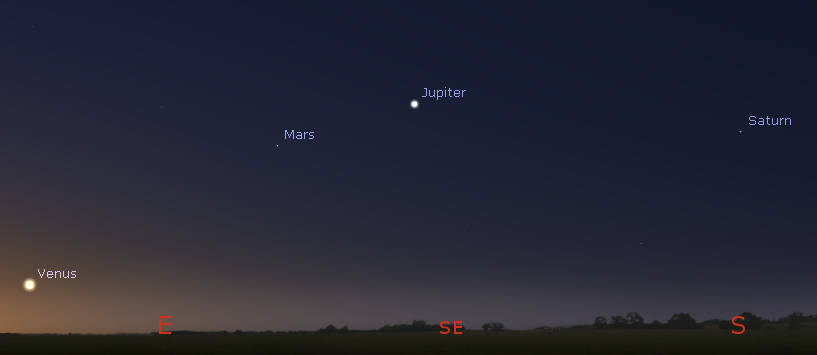
The morning planets at 5 am tomorrow morning, June 30, 2022. The planets actually appear in a straight line in the sky, being placed along the ecliptic, or path of the Sun in the sky. The ecliptic is a great circle on the celestial sphere. Click on the image to enlarge it. The span of the planets from Venus to Saturn is 114 degrees. Click on the image to enlarge it. Created using Stellarium.
The image above was plotted using the Miller cylindrical projection. While the azimuths are correct, the other plots are not. The planets actually appear to be in a straight line in the sky. I’ve finagled a stereographic projection to show that fact, as seen below.
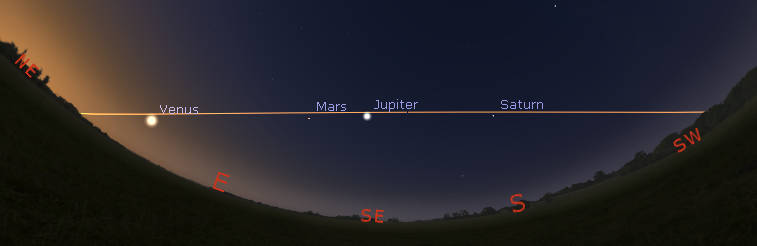
Distortions of rendering a spherical sky on a flat plane. The morning planets as seen in a stereographic view where great circles, like the ecliptic and horizon, are either circles or straight lines. In this image, the ecliptic, orange line, runs through the center of the plot, so it appears straight. In the real sky, both the planets and the horizon appear to be in straight lines. This assumes that your horizon is flat. Created using Stellarium.
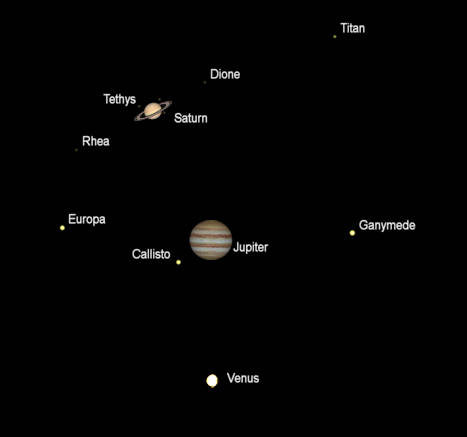
Views of Saturn, Jupiter, and Venus (north up) as they would be seen in a small telescope, with the same magnification, tomorrow morning at 5:00 am, June 30, 2022. I do not show planets less than 10 seconds of arc in diameter. Apparent diameters: Saturn 18.16″, its rings 42.31″; Jupiter 40.75″. Mars is not shown, its apparent diameter is 7.20″ and is 85.7% illuminated; Venus 11.91″, 85.8% illuminated. Jupiter’s moon Io will be behind the planet at that time. The ” symbol means seconds of arc (1/3600th of a degree.) Created using Cartes du Ciel (Sky Charts).
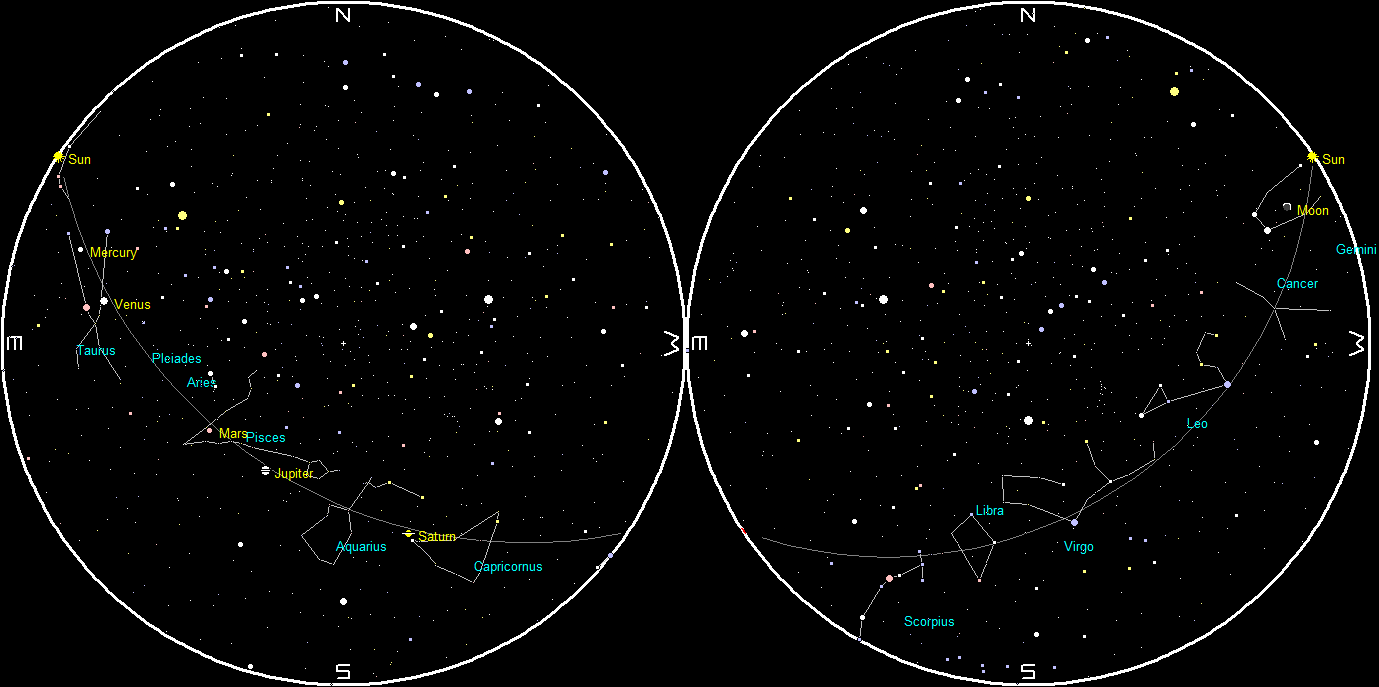
The naked-eye planets and the Moon at sunset and sunrise on a single night, starting with sunset on the right on June 29, 2022. The night ends on the left with sunrise on the 30th. Notice that all the naked-eye planets are in the morning sky now. Click on the image to enlarge it. Created using my LookingUp program.

