Archive
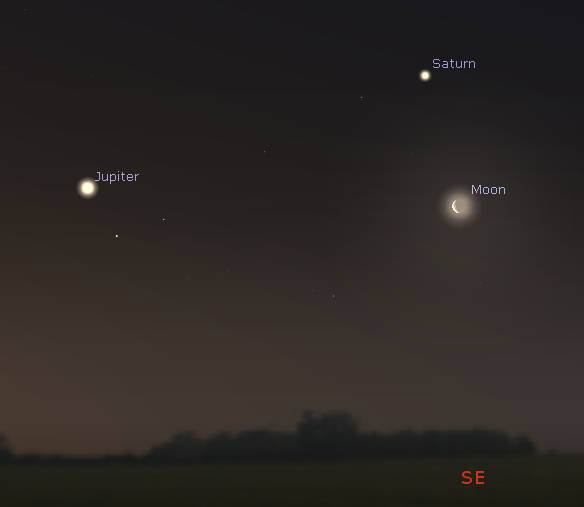
04/05/2021 – Ephemeris – Saturn, Jupiter and the Moon will be seen together tomorrow morning
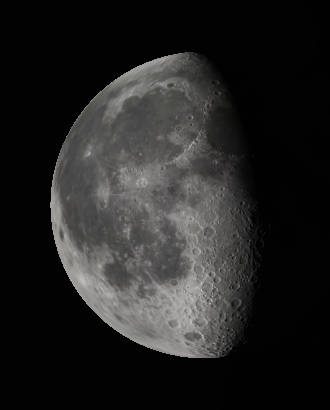
This is Ephemeris for Monday, April 5th. Today the Sun will be up for 13 hours even, setting at 8:15, and it will rise tomorrow at 7:13. The Moon, 1 day past last quarter, will rise at 5:15 tomorrow morning.
By 6:30 am tomorrow morning, if it’s clear the waning crescent Moon will be seen near Saturn and Jupiter low in the southeastern sky. Saturn will be almost directly above the Moon. And Jupiter, which is much brighter than Saturn, will be farther off to the left of the Moon at the same height. At that hour, Saturn will be only 14 degrees above the horizon, while Jupiter will be only 10 degrees up. This will make telescopic viewing tough, since you’re looking through a lot of atmosphere. The planet images won’t be sharp and will be undulating due to atmospheric currents, though they are usually not as bad in the early morning as they are in the evening. Wednesday morning the Moon will be below Jupiter. However, in the coming weeks the planets will be getting higher. Both planets will be in prime evening position by August.
The astronomical event times given are for the Traverse City/Interlochen area of Michigan. They may be different for your location.
Addendum
03/23/2021 – Ephemeris – The Moon tonight: Bay of Rainbows
This is Bob Moler with Ephemeris for Tuesday, March 23rd. Today the Sun will be up for 12 hours and 19 minutes, setting at 7:59, and it will rise tomorrow at 7:37. The Moon, 2 days past first quarter, will set at 5:50 tomorrow morning.
A look at the Moon tonight will reveal that the sunrise line, or terminator has almost completely revealed the large Sea of Showers or Mare Imbrium to the upper left of the center of the gibbous disk. At the extreme upper left nearly completely in sunlight a very popular feature, the Bay of Rainbows or Sinus Iridium. It’s a colorful name for something that’s as gray as the rest of the Moon. It looks like a bay off of Imbrium, and has an arch like a rainbow. Its arch is the Jura Mountains, which jut into Mare Imbrium at Cape Heraclide, just catching sunlight, and Cape Laplace farther into morning. What’s cool is catching it as the sunlight is hitting the mountains while the convex floor, following the Moon’s curvature is only partially illuminated.
The astronomical event times given are for the Traverse City/Interlochen area of Michigan. They may be different for your location.
Addendum
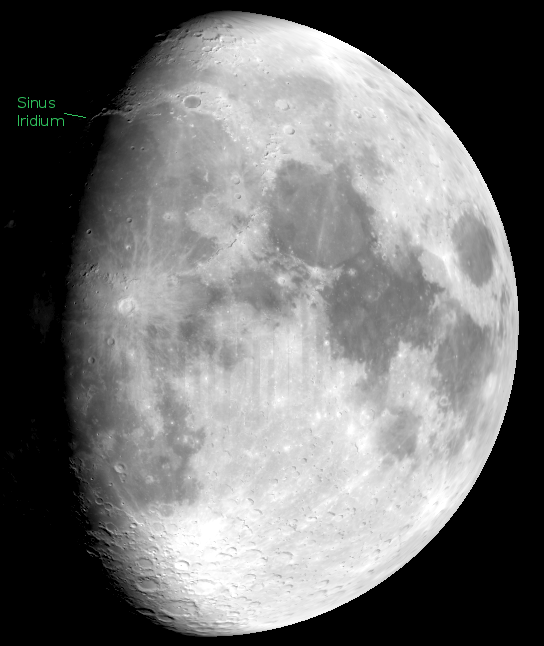
The Moon a little before how it will appear tonight highlighting Sinus Iridium. By tonight the floor of Sinus Iridium should be pretty much sunlit, and the Jura mountains completely lit. Created using Virtual Moon Atlas.
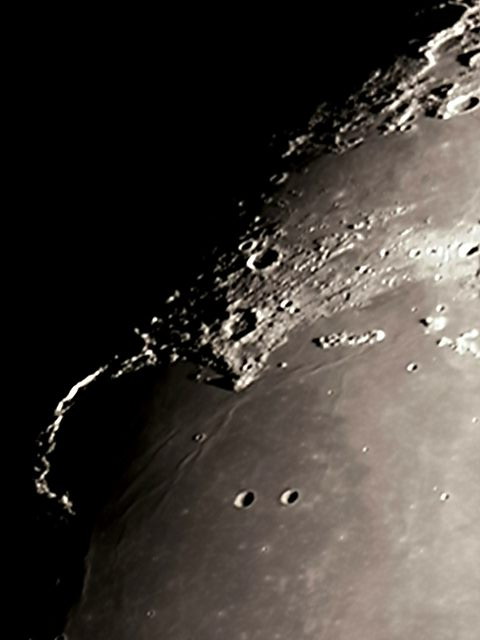
Sinus Iridium at sunrise. Photo by “Seb2003” on http://forums.futura-sciences.com/materiel-astronomique-photos-damateurs/5809-images-de-lune.html.
03/09/2021 – Ephemeris – A celestial warning to keep off thin ice
This is Ephemeris for Tuesday, March 9th. Today the Sun will be up for 11 hours and 35 minutes, setting at 6:41, and it will rise tomorrow at 7:03. The Moon, halfway from last quarter to new, will rise at 6:12 tomorrow morning.
The native Anishinaabe peoples of the Great Lakes Region, which includes the tribes of our area, have one constellation of winter I know of. It is The Wintermaker which uses many of Orion’s stars and whose arms stretch from Aldebaran in Taurus the bull to Procyon the Little Dog Star, embracing the whole of the winter sky. Now that spring is nearly here he is sinking into the west, losing to the heat of the Sun. The first constellation of spring is Curly Tail, or the Great Underwater Panther. It uses the stars of Leo the lion’s backward question mark as its curly tail and the small knot of stars that are the head of Hydra the water snake below Cancer the crab as its head. His warning: Keep off the thinning ice or break through and be snatched by the great panther that lives below.
The astronomical event times given are for the Traverse City/Interlochen area of Michigan. They may be different for your location.
Addendum
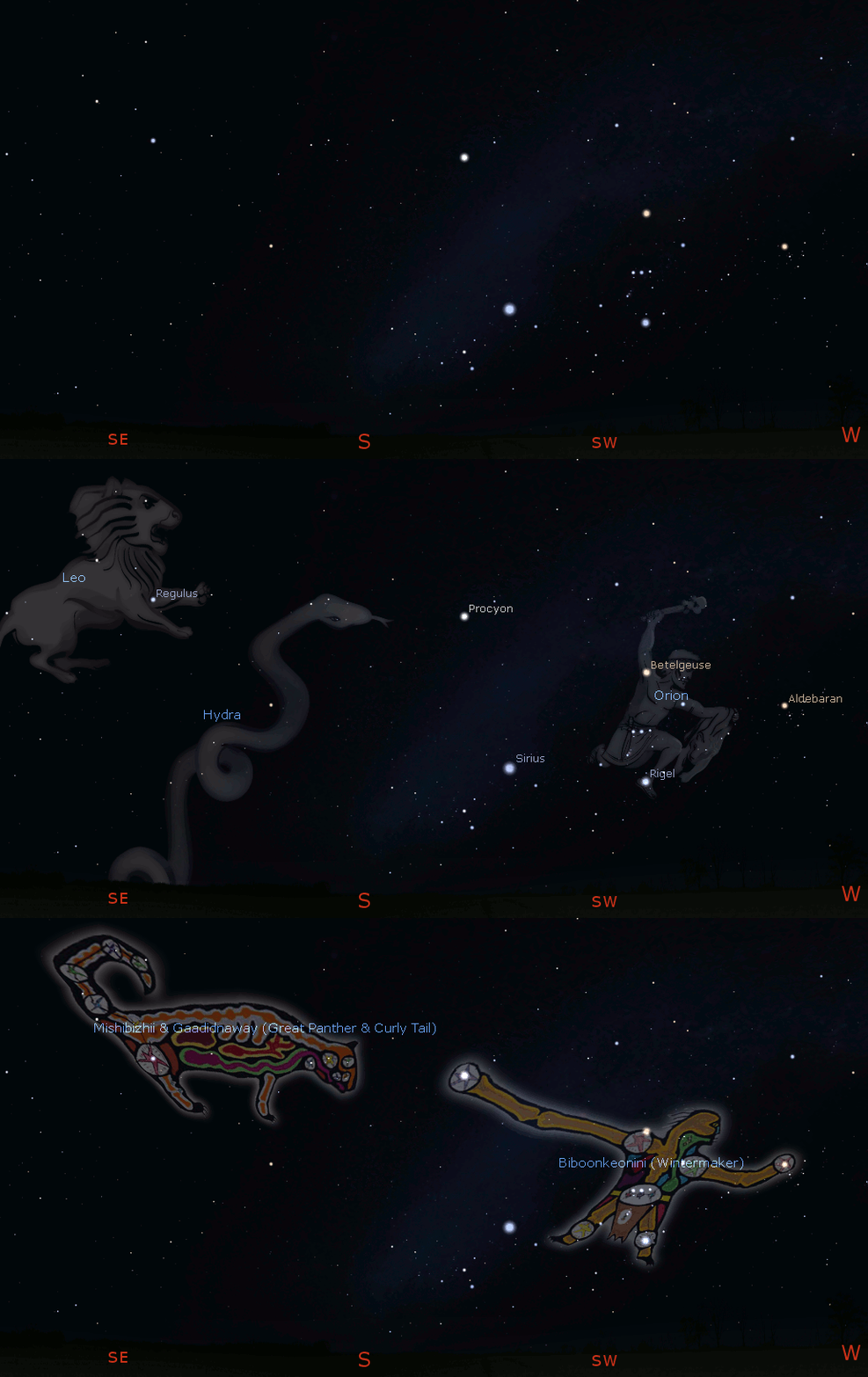
The Great Underwater Panther finder animation. Three frame animation of Unannotated sky, International Astronomical Union constellations, and Anishinaabe (Ojibwe) constellations of Curly Tail and Wintermaker. Click on the image to enlarge. Created using Stellarium and GIMP. Additional credits below.
The time is set for the above image is 10 pm on March 9th.
The constellation art is part of the latest versions of Stellarium. Ojibwe (Anishinaabe) constellation art by Annette S Lee and William Wilson from Ojibwe Sky Star Map Constellation Guide, ISBN 978-0-615-98678-4. There is also an Ojibwe Sky Star Map poster suitable for framing.
03/04/2021 – Ephemeris – A very crabby constellation
Mar 4. This is Ephemeris for Thursday, March 4th. Today the Sun will be up for 11 hours and 20 minutes, setting at 6:34, and it will rise tomorrow at 7:12. The Moon, 1 day before last quarter, will rise at 1:26 tomorrow morning.
Lying between the stars Castor and Pollux in Gemini high in the southeast and the star Regulus in Leo the Lion in the east-southeast is the dimmest constellation of the zodiac, Cancer the crab. To me its 5 brightest stars make an upside down Y. There are the stars in the center of the constellation Asellus Borealis and Asellus Australis, the north and south donkeys. There’s a fuzzy spot between and just west of them called Praesepe, the manger from which they are supposedly eating. In binoculars, it resolves into a cluster of stars called the Beehive star cluster. We amateur astronomers also know it as M 44, the 44th object on 18th century comet hunter Charles Messier’s list of fuzzy objects that might be mistaken for comets.
The astronomical event times given are for the Traverse City/Interlochen area of Michigan. They may be different for your location.
Addendum
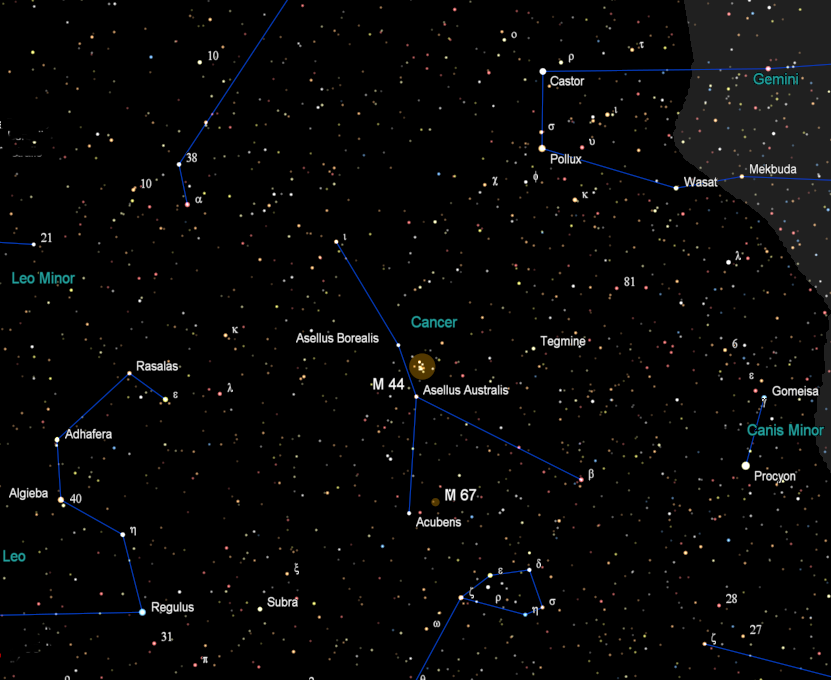
The constellation Cancer finder chart. Created using Cartes du Ciel (Sky Charts).
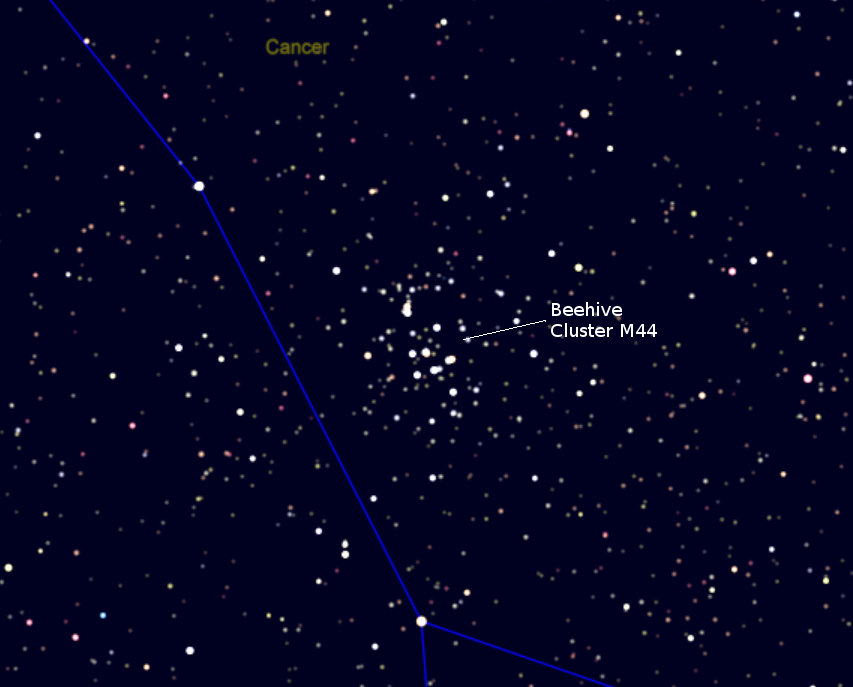
The Beehive star cluster, M44. Its ancient name was the Praesepe or manger when glimpsed by the naked eye. Created using Cartes du Ciel (Sky Charts)
Note in the top image above the star cluster M 67 at the bottom of Cancer, near the star Acubens. M 67 requires a small telescope to spot. They are both open or galactic star clusters which lie in or very near the plane of the Milky Way, denoted by the milky band. Part of the milky band can be seen at the upper right of the chart. M 44 is quite close to us, at only 610 light years away so is physically close to the plane of the Milky Way. M67, however is 2,610 to 2,930 light years away and is quite a bit farther than M 44 from the plane of the Milky Way. It is also much older (4 billion years old) than the stars of the Beehive (600 to 700 years old).
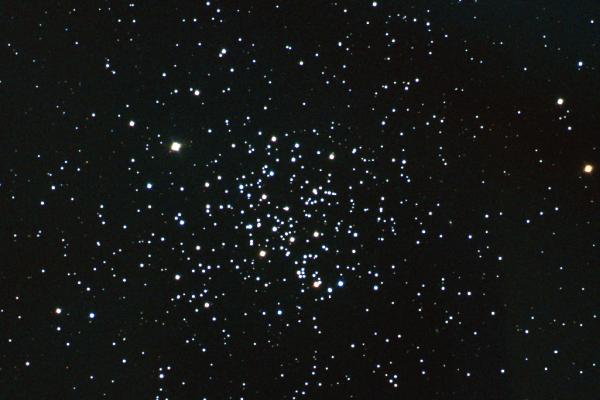
M67 is a beautiful telescopic object. Credit Nigel Sharp, Mark Hanna, AURA/NOAO/NSF.
03/03/2021 – Ephemeris – Let’s search for the naked-eye planets for this week
This is Bob Moler with Ephemeris for Wednesday, March 3rd. Today the Sun will be up for 11 hours and 17 minutes, setting at 6:33, and it will rise tomorrow at 7:14. The Moon, 2 days before last quarter, will rise at 12:09 tomorrow morning.
Let’s search for the naked-eye planets for this week. Unfortunately the only one you’ll find is Mars. The other four are hanging out in the direction of the Sun and won’t be seen for a week or so. Mars can be found high in the west-southwest and below left of the Pleiades at 8 pm tonight. Mars will be due south of the Pleiades tonight, which from our cockeyed view of the heavens, from north of the equator, places Mars below and left of the Pleiades. The Red Planet will set at 1:20 am. Of the outer planets Mars is the fastest, being the nearest to the Sun, and to the Earth. So unlike Jupiter, Saturn, and the stars which rise and set about four minutes earlier each night, Mars sets about a minute earlier each night now.
The astronomical event times given are for the Traverse City/Interlochen area of Michigan. They may be different for your location.
Addendum
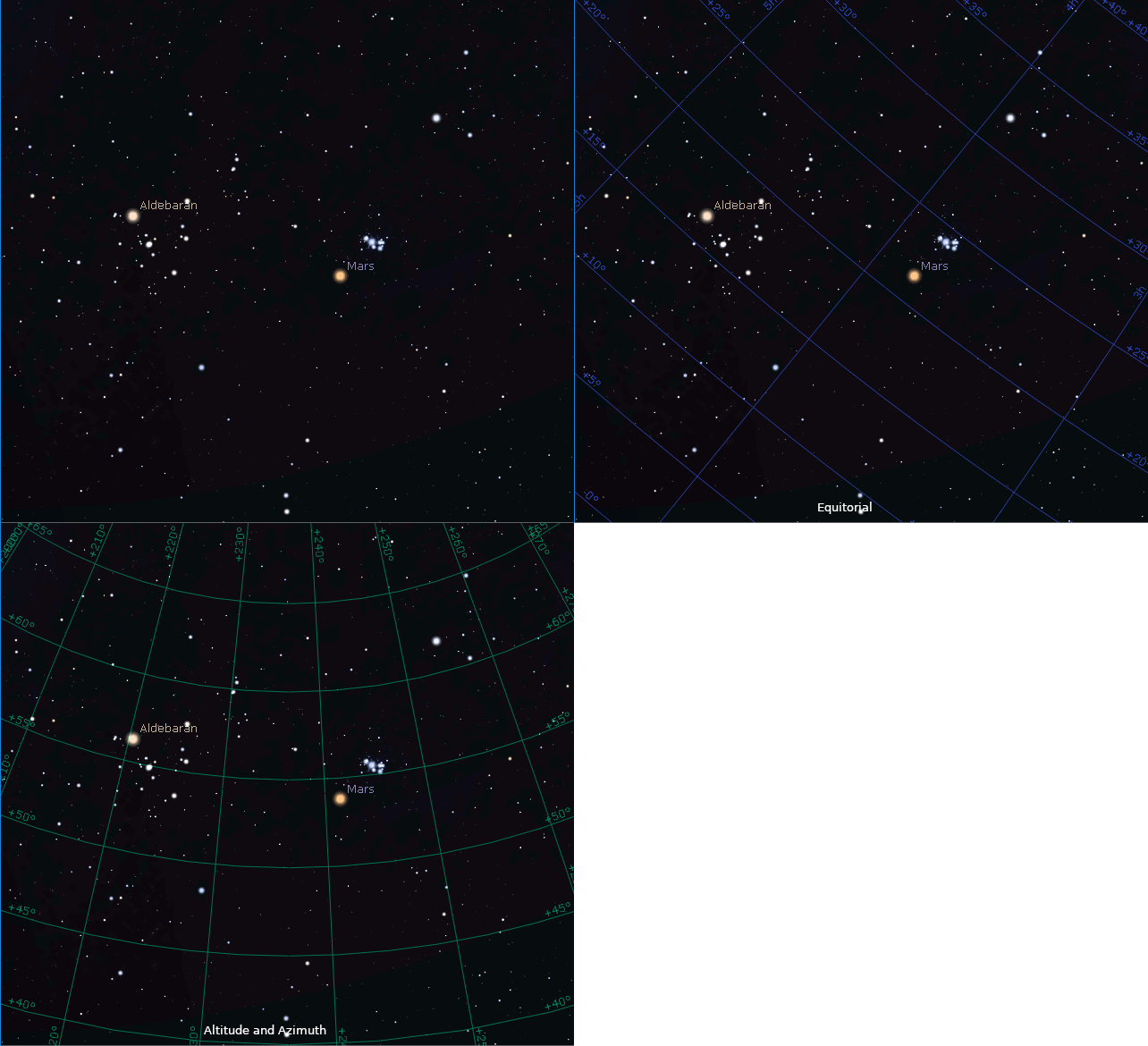
Here’s an animation showing why Mars being south of the Pleiades doesn’t look like it in the sky. This is all about directions on the celestial sphere. This will be the position of Mars at 8 pm on March 3rd, 2021, seen in the west-southwest. It is a three frame animation. The first is without coordinate grids as one would see it from about 45 degrees north latitude. The second frame contains the equatorial grid. The lines to the upper right point to the North Pole of the sky near Polaris, so that’s north. The third frame has an alt-azimuth grid. Its lines run vertically and horizontally. Created using Stellarium and GIMP.
The moon as it might appear in binoculars at 6 am tomorrow morning March 4, 2021. Created using Stellarium.
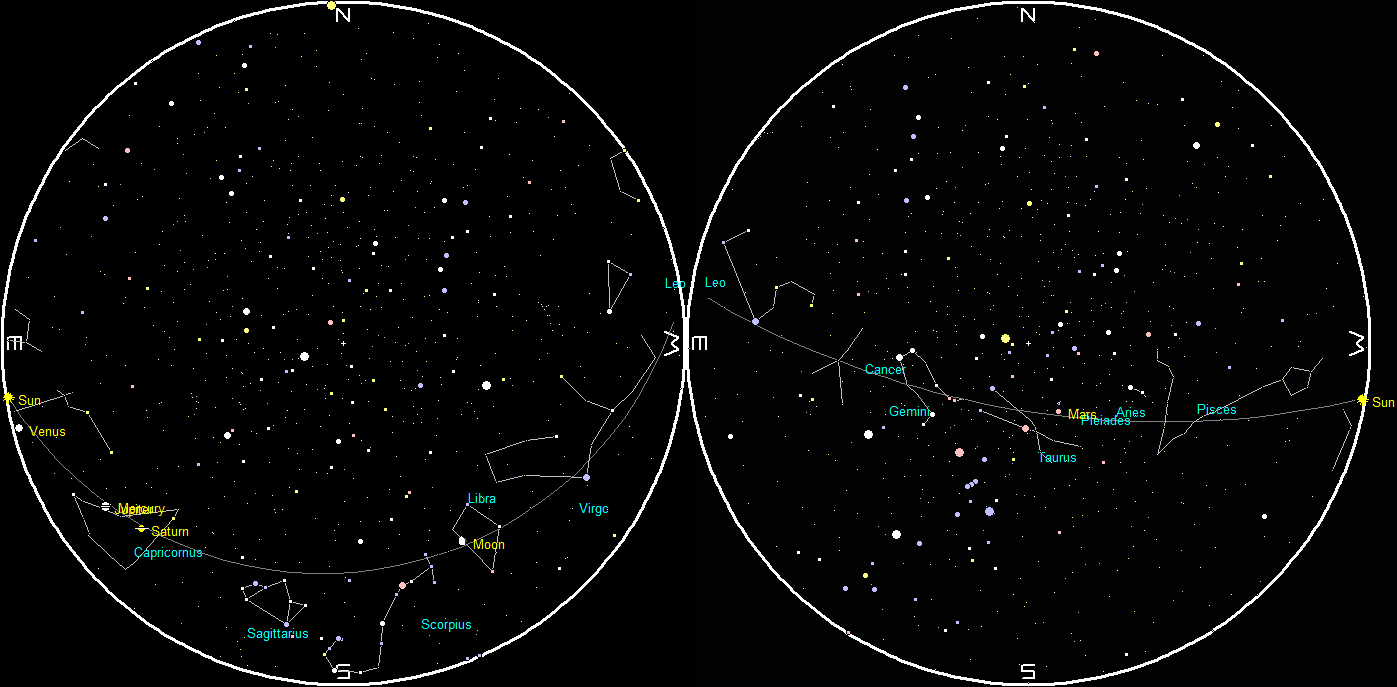
Planets and the Moon at sunset and sunrise of a single night starting with sunset on the right on March 3, 2021. The night ends on the left with sunrise on the 4th. There is a planet traffic jam in the morning and the symbols and labels for Jupiter and Mercury overlap. Unfortunately these planets rise too soon before the Sun to be seen for us up north. It is a great sight for Southern Hemisphere observers. Click on the image to enlarge. Created using my LookingUp program.
02/15/2021 – Ephemeris – For a few months the Earth had two moons
This is Ephemeris for President’s Day, Monday, February 15th. Today the Sun will be up for 10 hours and 29 minutes, setting at 6:11, and it will rise tomorrow at 7:41. The Moon, halfway from new to first quarter, will set at 10:22 this evening.
The Moon tonight is a waxing crescent. A four-day-old moon. In binoculars, it shows one complete lunar sea, the Sea of Crises, or if seen on a moon map, Mare Crisium. Speaking of the Moon, for the last few months the Earth had a second moon, with the asteroid designation 2020 SO. This was traveling slowly behind the Earth, and is suspected to be the Centaur upper stage of the Surveyor 2 lunar landing craft launched in 1966. It ended up orbiting the Sun. 2020 SO took a loop and a half around the Earth and is heading back in solar orbit. The ascent stage, Snoopy, from Apollo 10 is also in solar orbit. I hope one day it can be captured on a close approach and brought back to the Earth or the Moon for display. That would be really cool!
The event times given are for the Traverse City/Interlochen area of Michigan. They may be different for your location.
Addendum
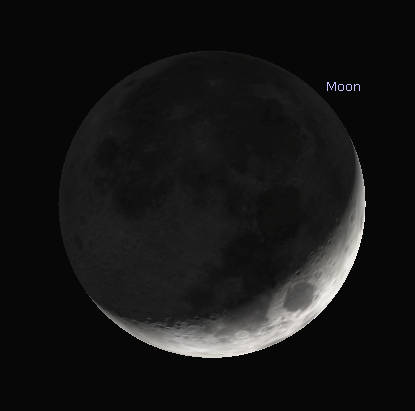
The moon as it might appear tonight, at 8 pm, February 15, 2021. Mare Crisium is the round gray sea near the lower right edge. Created using Stellarium.
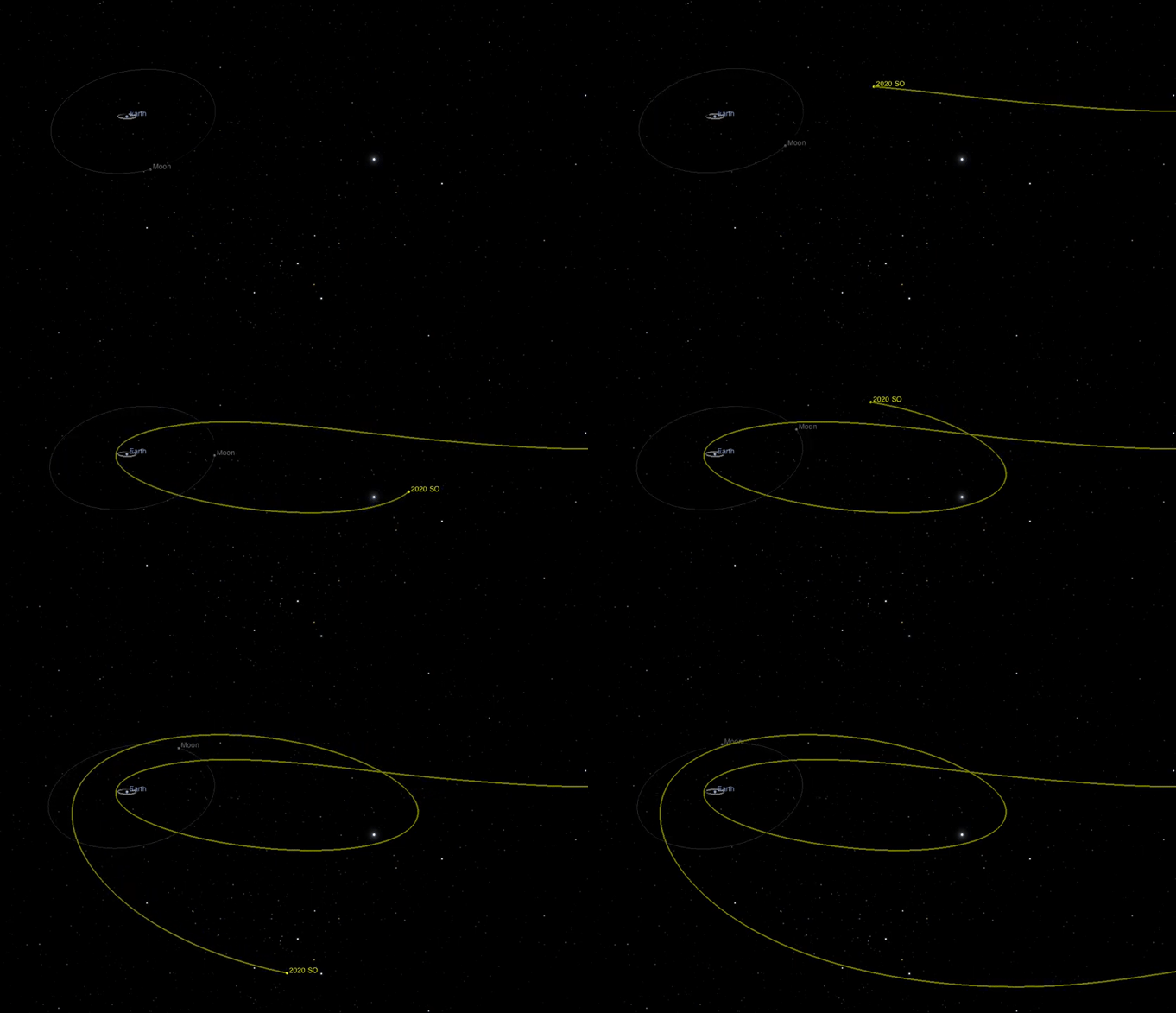
Animation of object 2020 SO as it encounters the Earth. Also shown is the orbit of the Moon and geostationary satellites. Credit: NASA/JPL – Caltech.
02/08/2021 – Ephemeris – A look at Gemini the twins
This is Ephemeris for Monday, February 8th. Today the Sun will be up for 10 hours and 9 minutes, setting at 6:01, and it will rise tomorrow at 7:51. The Moon, 3 days before new, will rise at 6:49 tomorrow morning.
Let’s look at another of the winter constellations, and a member of the Zodiac. The constellation of Gemini the Twins is visible high in the southeast, above and left of Orion the hunter at 9 p.m. The namesake stars of the two lads, will be at the left end of Gemini, are nearly overhead and vertically aligned. Castor is on top, while the slightly brighter Pollux is below. From them come two lines of stars that outline the two extending toward Orion. In Greek mythology the lads were half brothers, Castor was fathered by a mere mortal, while Pollux was fathered by Zeus, but were born together as twins. When Castor was killed during the quest for the Golden Fleece, Pollux pleaded with Zeus to let him die also, so Zeus placed them together in the sky, so they could be together forever.
The event times given are for the Traverse City/Interlochen area of Michigan. They may be different for your location.
Addendum
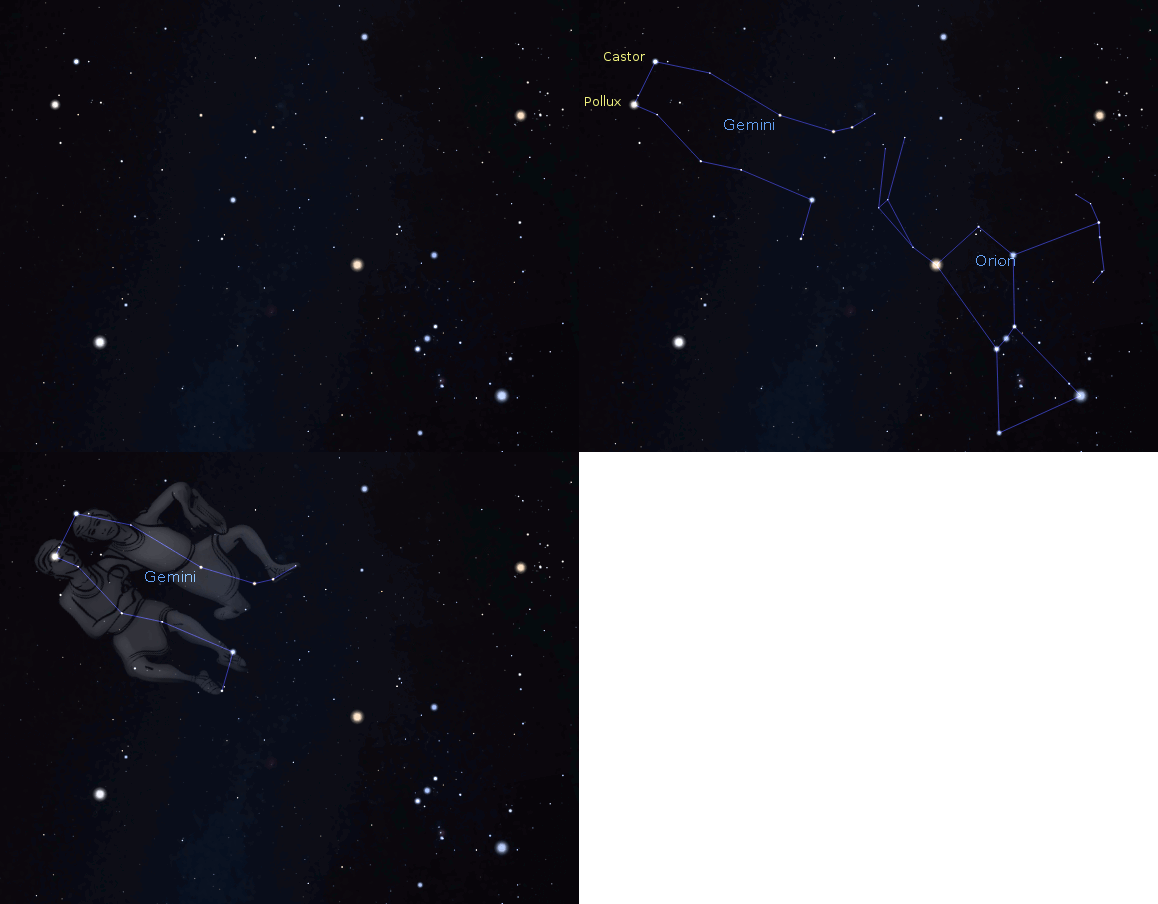
Gemini finder animation for early February at 9 pm (about 3 hours after sunset). Created using Stellarium and GIMP.
02/04/2021 – Ephemeris – Finding Orion’s larger hunting dog
This is Bob Moler with Ephemeris for Thursday, February 4th. Today the Sun will be up for 9 hours and 58 minutes, setting at 5:56, and it will rise tomorrow at 7:56. The Moon, at last quarter today, will rise at 2:19 tomorrow morning.
The great winter constellation or star group Orion the hunter, is located in the southern sky at 9 p.m. His elongated rectangle of a torso is vertical. In the center of the rectangle are three stars in a line that make his belt. As a hunter, especially one of old, he has two hunting dogs. The larger, Canis Major can be found by following the three belt stars of Orion down and to the left. They point to Sirius, the brightest night-time star, also known as the Dog Star. It’s in the heart of a stick figure dog low in the southeast facing Orion that appears to be begging. There’s a fine star cluster, called Messier, or M 41, at the 5 o’clock position from Sirius. It’s easily visible in binoculars or a small telescope.
The event times given are for the Traverse City/Interlochen area of Michigan. They may be different for your location.
Addendum
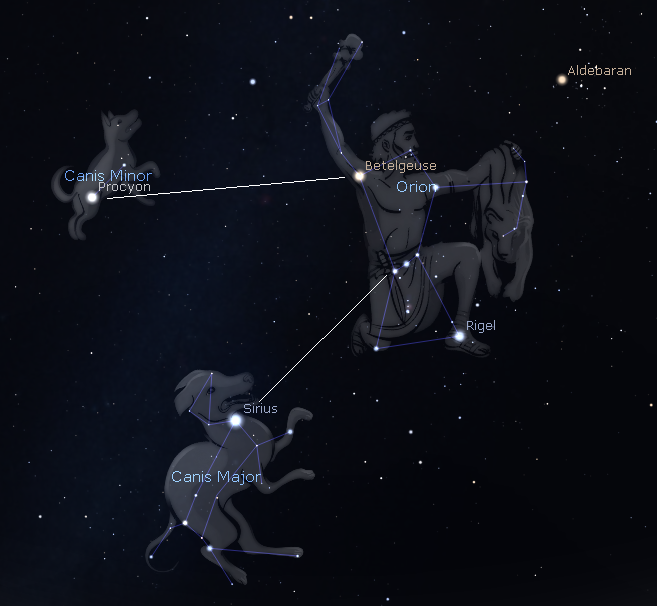
Orion and his hunting dogs with pointers as seen February. I didn’t have time in the program to mention Canis Minor, the little dog. I expect to cover it in the future, or you can search for Canis Minor in the search box above. Created using Stellarium.
I did not have time to talk about Canis Minor in this program due to the inclusion of M 41. I plan to cover Canis Minor soon. I have in the past. Search for Canis Minor in the search box above.
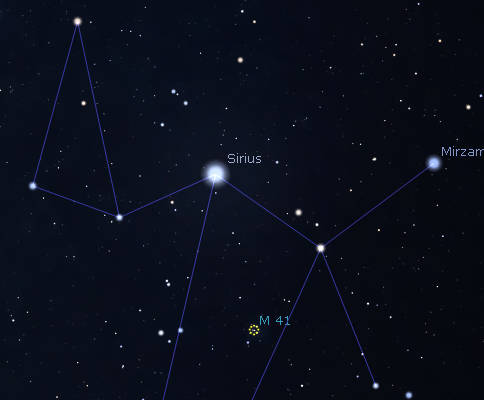
Star cluster M 41 finder chart. Created using Stellarium.
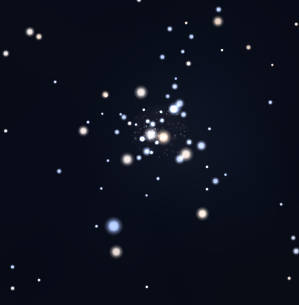
M 41 up close. Image courtesy of Tim Hunter and James McGaha, Grasslands Observatory at http://www.3towers.com
01/29/2021 – Ephemeris – Let’s get Sirius
This is Ephemeris for Friday, January 29th. Today the Sun will be up for 9 hours and 42 minutes, setting at 5:47, and it will rise tomorrow at 8:03. The Moon, 1 day past full, will rise at 6:49 this evening.
In the early evening the great constellation of Orion the hunter can be seen in the southeast. Its large rectangle of bright stars is easily visible, even with a full moon. The three stars in a straight line, his belt, tilt downward to the left to a very bright star merrily twinkling lower in the sky. This star is called Sirius, also known as the Dog Star because it’s in the heart of Orion’s larger hunting dog, Canis Major. It is an arc light white star as seen in binoculars or telescope. It is the brightest star in the night sky, and a neighboring star, just twice the distance of the closest star to the Sun at 8.6 light years. It’s name, Sirius, has nothing to do with a dog, but is from the Greek meaning scorching for its brightness or sparkling, due to its intense twinkling.
The event times given are for the Traverse City/Interlochen area of Michigan. They may be different for your location.
Addendum
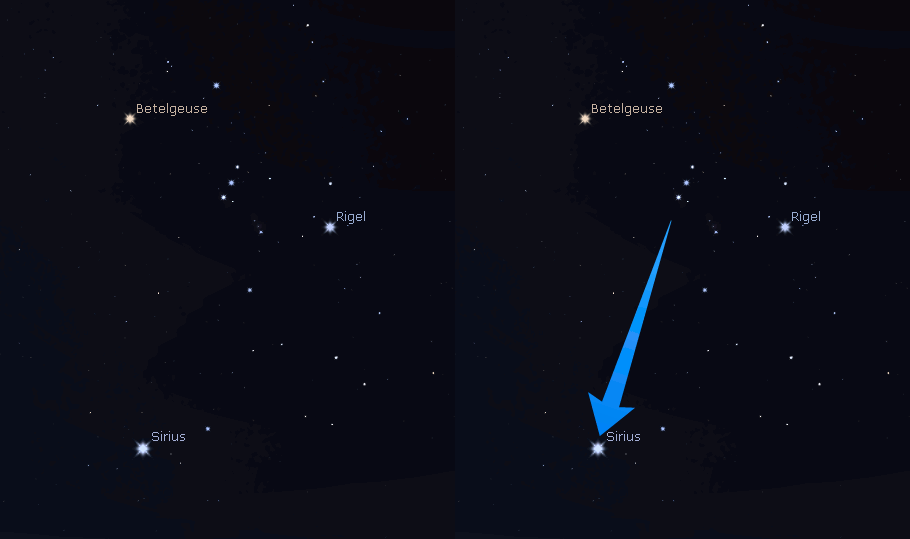
A Sirius finder animation for late January/early February at around 8 pm. Even in bright moonlight the seven bright stars of Orion can be seen. The three stars of Orion’s belt make a great pointer to Sirius. Created using Stellarium, GIMP and Libreoffice (for the arrow).
I’ll come back to Sirius several times this winter. Or search for Sirius for other times I’ve talked about this brightest of the night-time stars.
01/28/2021 – Ephemeris – Checking out the full Moon in binoculars
This is Bob Moler with Ephemeris for Thursday, January 28th. Today the Sun will be up for 9 hours and 40 minutes, setting at 5:46, and it will rise tomorrow at 8:04. The Moon, at full today, will rise at 5:37 this evening.
The winter full moon rises very high in the sky. It follows a path across the sky at night that the Sun will take six months from now in July. On the full moon with binoculars or small telescope most craters are not very visible due to the lack of shadows. There are exceptions, those with dark or bright floors. The lunar seas are the large dark areas. These positions are for the early evening, as the Moon rises. Grimaldi can be seen as a dark ellipse near the lower left edge. Plato another dark ellipse is in the upper left. A bright spot with a darker circle around it on the lower right is the crater Tycho, which has several rays of ejecta laid out over long distances across the face of the Moon. Finally, there’s a bright spot on the left side of the Moon. That is the crater Aristarchus.
The event times given are for the Traverse City/Interlochen area of Michigan. They may be different for your location.
Addendum
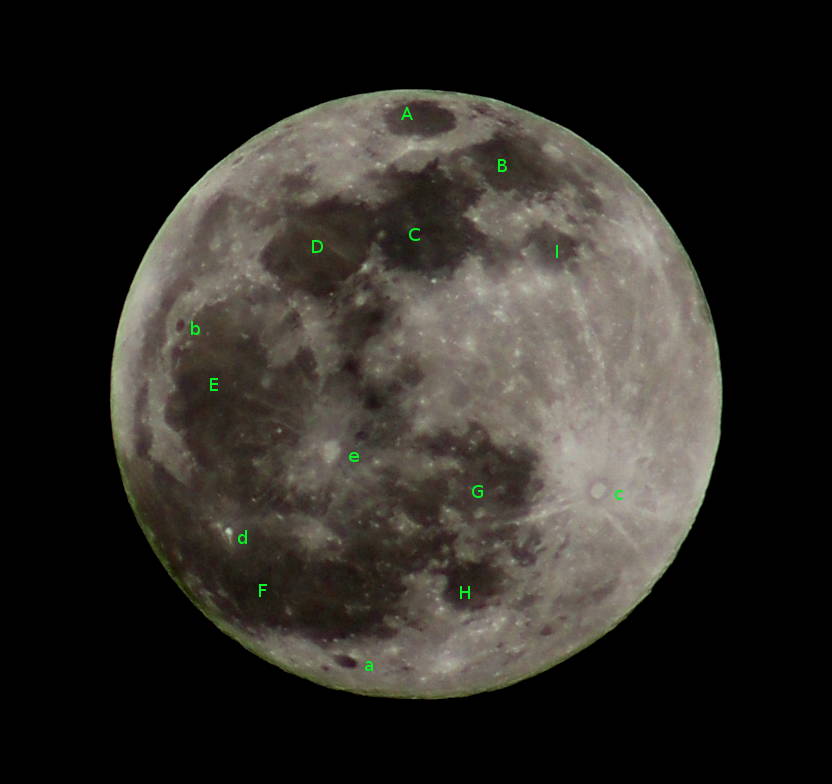
Annotated full Moon. Major seas in upper case. Prominent craters in lower case. See text below. The image is rotated for 8 pm in late January. Credit Bob Moler.
Lunar seas
A – Mare Crisium (Sea of Crises)
B – Mare Fecunditatus (Sea of Fertility)
C – Mare Tranquillitatis (Sea of Tranquility)
D – Mare Serenitatis (Sea of Serenity)
E – Mare Imbrium (Sea of Showers)
F – Oceanus Procellarum (Ocean of Storms)
G – Mare Nubium (Sea of Clouds)
H – Mare Humorum (Sea of Moisture)
I – Mare Nectaris (Sea of Nectar)
Craters
a – Grimaldi
b – Plato
c – Tycho
d – Aristarchus
e – Copernicus (Not mentioned in the program due to time constraints)

