Archive
06/25/2019 – Ephemeris – Weird clouds of the twilight zone
Ephemeris for Tuesday, June 25th. Today the Sun will be up for 15 hours and 34 minutes, setting at 9:32, and it will rise tomorrow at 5:58. The Moon, at last quarter today, will rise at 2:23 tomorrow morning.
This time of year one can see, on rare occasions, some ghostly clouds called noctilucent clouds. Noctilucent means night shining. These are silvery clouds that can be seen near the end of twilight. We’re a bit south of the prime latitudes to see them from 50 to 70 degrees both north and south of the equator. I’ve seen them a few times. They move rather rapidly, even though they’re at an altitude of around 50 miles. The clouds appear to be made of ice crystals that possibly form around meteoric dust. Their appearance cannot be predicted, but show up near the end of twilight and they are white, and are not the usual reddish clouds of twilight. These clouds mostly appear in July and August. But I’ve seen many recent reports of them from Europe.
The times given are for the Traverse City/Interlochen area of Michigan. They may be different for your location.
Addendum

Noctilucent clouds, Kuresoo bog, Soomaa National Park, Estonia. July 26, 2009 by Martin Koitmäe. From Wikimedia Commons.
Spaceweather.com is a great place to learn more and hosts a gallery of recent noctilucent cloud photos.
06/14/2019 – Ephemeris – I’m giving the talk Apollo and the Race to the Moon tonight at the Library in Thompsonville
Ephemeris for Flag Day, Friday, June 14th. Today the Sun will be up for 15 hours and 33 minutes, setting at 9:29, and it will rise tomorrow at 5:56. The Moon, 3 days before full, will set at 4:55 tomorrow morning.
Tonight the Grand Traverse Astronomical Society will host a star party… well a Moon party at the Betsie Valley District Library in Thompsonville, MI. It starts at 8:30 p.m. With what I like to call a twilight talk by yours truly, the title of which is Apollo and the Race to the Moon. I’ll explore the Apollo 11 mission and the events leading up to it both in the United States and the USSR. The bright Moon tonight will uncover all the Apollo landing areas, even though there too small to be seen from the Earth, though they will be shown in the presentation. Twilight talks at the library also involves a slide or planetarium-like presentation, so if it’s cloudy we’ll also explore the starry nights of summer inside. So come out clear or cloudy.
The times given are for the Traverse City/Interlochen area of Michigan. They may be different for your location.
Addendum

Comparison between The United States Saturn V and the Soviet N-1. Click on the Image to enlarge. Credit Karl Tate, Space.com.
06/04/2019 – Ephemeris – The night sky previews summer
Ephemeris for Tuesday, June 4th. Today the Sun will be up for 15 hours and 24 minutes, setting at 9:23, and it will rise tomorrow at 5:58. The Moon, 1 day past new, will set at 10:51 this evening.
The Moon will be visible early this evening. By early I mean by 10 p.m. since the Sun sets so late now. By the time you see it it will be a day and a half old and a thin sliver. Closer inspection will reveal the the whole Moon will be visible due to Earth shine. That’s due to the nearly full Earth shining on the night side of the Moon.
Even though Summer is 17 days away the three bright stars of the Summer Triangle are visible in the eastern sky at 11 p.m. The three stars are Vega highest in the east. Deneb is lower in the northeast. Altair is lower close to the horizon in east. They will rise higher throughout the summer season. Looking close to the horizon in the southeast that bright star at that hour is the planet Jupiter.
The times given are for the Traverse City/Interlochen area of Michigan. They may be different for your location.
Addendum
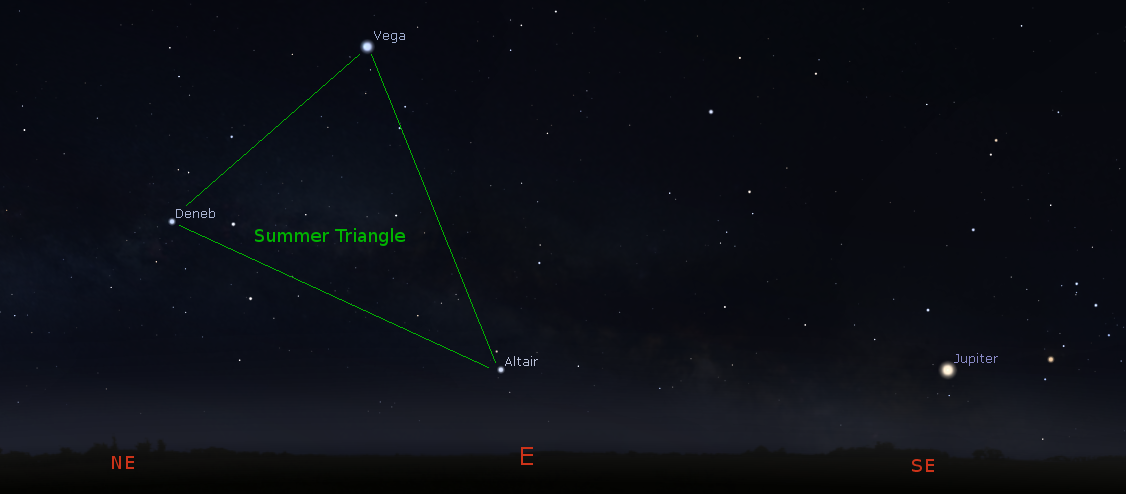
The eastern skies at 11 p.m. June 4, 2019. Click on the image to enlarge. Created using Stellarium and GIMP.
05/27/2019 – Ephemeris – The bright star Spica
Ephemeris for Memorial Day, Monday, May 27th. Today the Sun will be up for 15 hours and 13 minutes, setting at 9:16, and it will rise tomorrow at 6:03. The Moon, 1 day past last quarter, will rise at 3:34 tomorrow morning.
Just about due south at 10:30 p.m. is the bright star Spica which can be found from all the way back overhead to the Big Dipper. Follow the arc of the handle of the Big Dipper to the bright star Arcturus high in the south-southeast. Then straighten the curve of the arc to a straight spike which points to Spica the brightest star in the zodiacal constellation of Virgo the virgin. Arcturus is much brighter than Spica and has an orange tint to Spica’s bluish hue. In fact Spica is the bluest of the 21 first magnitude stars. That means that it is hot. Actually Spica is really two blue stars orbiting each other every 4 days. Spica is 250 light years away, which is reasonably close. Spica was an important star to the ancient Greeks. One temple was built, and aligned to its setting point.
The times given are for the Traverse City/Interlochen area of Michigan. They may be different for your location.
Addendum
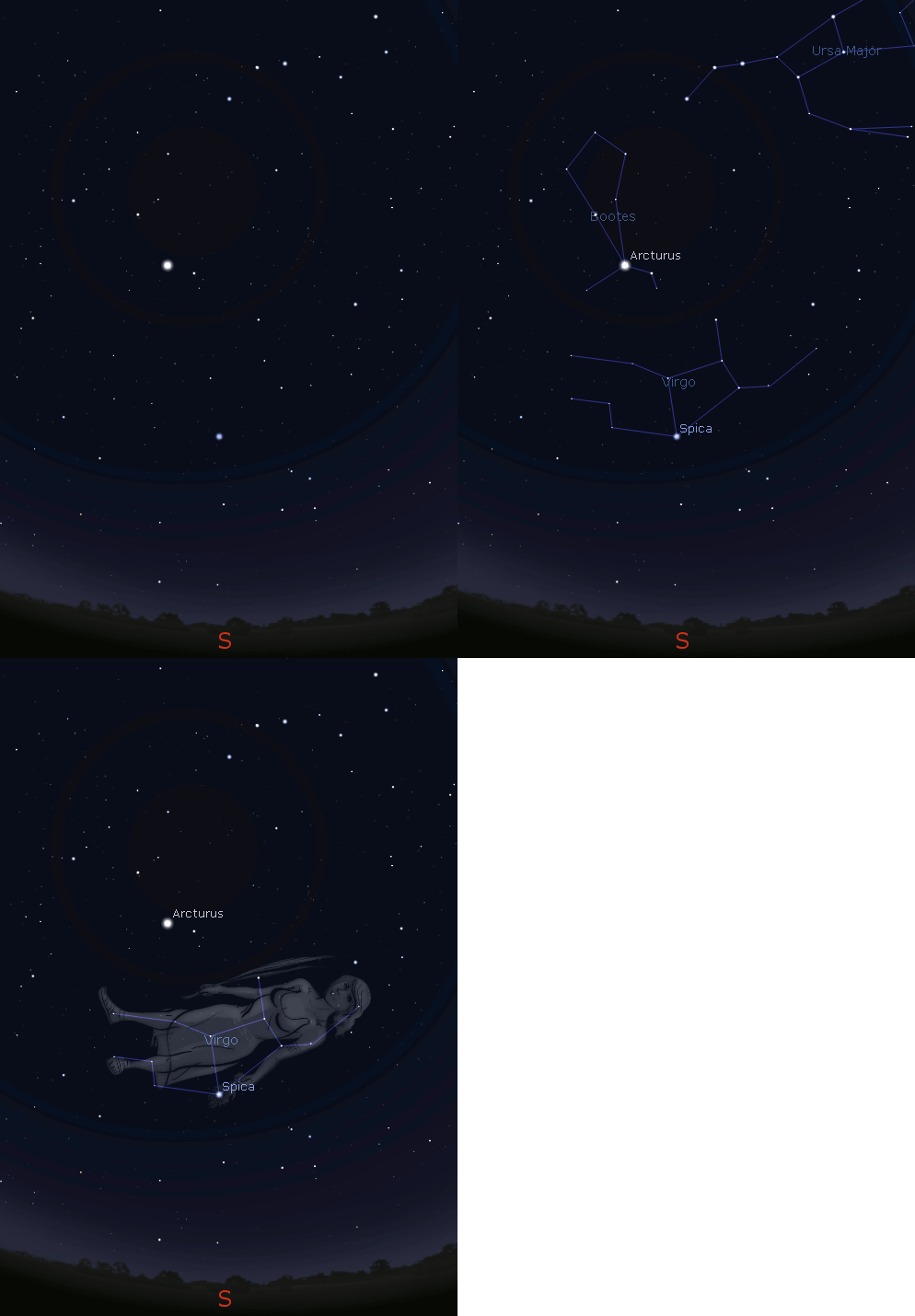
Spica finder animation for 10:30 p.m., May 27th. Click on the image to enlarge. Created using Stellarium and GIMP.
04/08/2019 – Ephemeris – How to find Polaris, the North Star
Ephemeris for Monday, April 8th. Today the Sun will be up for 13 hours and 7 minutes, setting at 8:18, and it will rise tomorrow at 7:09. The Moon, 3 days past new, will set at 11:54 this evening.
The most useful of the navigation stars for the average person is Polaris, the North Star or Pole Star. It is very close to the point in the sky that the Earth’s axis points to in the north. Currently it is about three-quarters of a degree from the pole, about one and a half moon diameters. In 2110 or thereabouts it will approach to slightly less than a moon diameter from the pole before slowly heading away. Polaris is always closer to true north than a magnetic compass in Michigan. To find it use the two stars in front of the Big Dipper’s bowl to point to it. This time of year the Big Dipper is above Polaris, so the pointer stars, that’s what they are called, point down to it. Polaris is at the end of the handle of the faint Little Dipper. The reason for Polaris’ motion is the slow 26,000 year wobbling of the Earth’s axis, called precession.
The times given are for the Traverse City/Interlochen area of Michigan. They may be different for your location.
Addendum
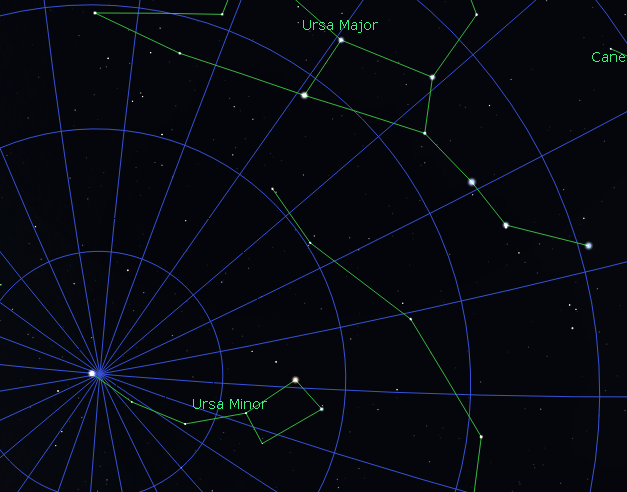
Ursa Major and Minor, the Big and Little Dippers. See how the two stars at the front of the bowl point to Polaris. It happens that the pointer stars are close to the 11th hour of right ascension (longitude in the sky). The right ascension lines converge at the north celestial pole, just as the longitude lines converge at the Earth’s north pole. Created using Stellarium.
The year I was born, 1941, Polaris was a whole degree from the celestial north pole.
If you’ve ever wondered why right ascension is in hours instead of degrees it’s because the Earth rotates within the celestial sphere, so it’s easier to keep track of the east-west position in the sky by using a clock that set to gain 3 minutes and 56 seconds a day. Such a clock keeps sidereal (star) time rather than solar (sun) time. One hour equals 15 angular degrees or 4 minutes a degree.
03/26/2019 – Ephemeris – Mars is approaching the Pleiades this week
Ephemeris for Tuesday, March 26th. Today the Sun will be up for 12 hours and 27 minutes, setting at 8:02, and it will rise tomorrow at 7:33. The Moon, 2 days before last quarter, will rise at 2:38 tomorrow morning.
Daylight time and spring time are catching up with us with the Sun setting now just after 8 p.m. By 9 p.m. tonight the brighter stars appear and most of the well known constellations will be recognizable. Looking off to the west at that time the famous star group of the Pleiades, or Seven Sisters will appear. Folks with good eyesight can see six or maybe even seven of its stars. Tonight, right below the Pleiades is a bright reddish star. It would be the 22nd of the first magnitude stars, except it’s not a star. It’s a wanderer, according to the ancient Greeks, one of seven*. They called it Ares the god of war. The Romans turned it into Mars. Over the week Mars will be closing in and passing by the Pleiades this weekend.
The times given are for the Traverse City/Interlochen area of Michigan. They may be different for your location.
Addendum
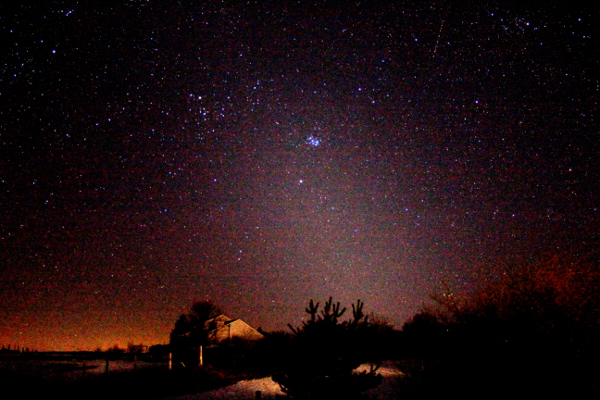
The western sky at 10:22 last night March 25, 2019. Mars appears below the Pleiades in zodiacal light. Credit, mine – Canon EOS Rebel T5 18mm f.l., f/3.5, 8 sec. ISO 12,800.
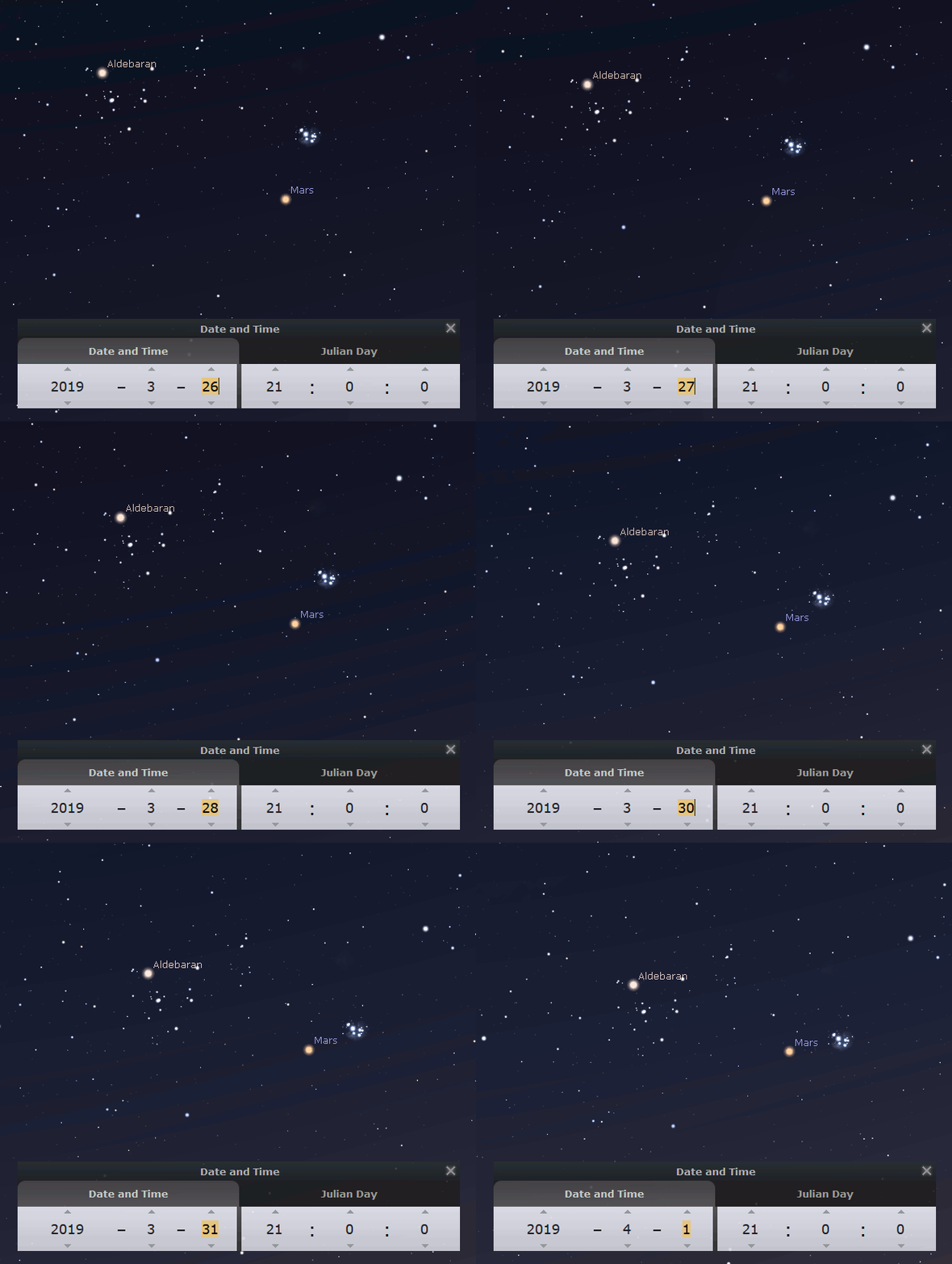
Mars tiptoeing past the Pleiades nightly from March 26th to April 1st, 2019 at 9 p.m. Looking west. Created using Stellarium and GIMP.
The letter V of stars to the left of the Pleiades is the Hyades, in mythology the half sisters to the Pleiades. It is also the face of Taurus the bull.
* We get the word planet from the Greek planētes meaning wander. Five are the classical planets, Mercury, Venus, Mars, Jupiter, and Saturn. The other two are the Sun and Moon. The other celestial objects were the fixed stars. Other things that appear in the sky, like comets, novae and meteors were thought to be in the Earth’s atmosphere.
03/25/2019 – Ephemeris – Zodiacal light is visible in the west again
Ephemeris for Monday, March 25th. Today the Sun will be up for 12 hours and 24 minutes, setting at 8:01, and it will rise tomorrow at 7:35. The Moon, 3 days before last quarter, will rise at 1:37 tomorrow morning.
With the bright moon out of the sky for nearly two weeks it’s time to look for the zodiacal light. It’s is a faint but towering glow that can be seen after the end of astronomical twilight on moonless nights. It is seen in the west in the evening in late winter and early spring and in the east in the morning in late summer and early autumn. The axis of the glow is the ecliptic, the apparent annual path of the Sun in the sky, along which lie the constellations of the zodiac. Right now the end of astronomical twilight is about 9:45 p.m. and advancing at a rate of a minute or two each night. Go to a spot with a dark western sky, no big cities or towns out that way. Zodiacal light is caused by dust spread out around the Sun.
The times given are for the Traverse City/Interlochen area of Michigan. They may be different for your location.
Addendum
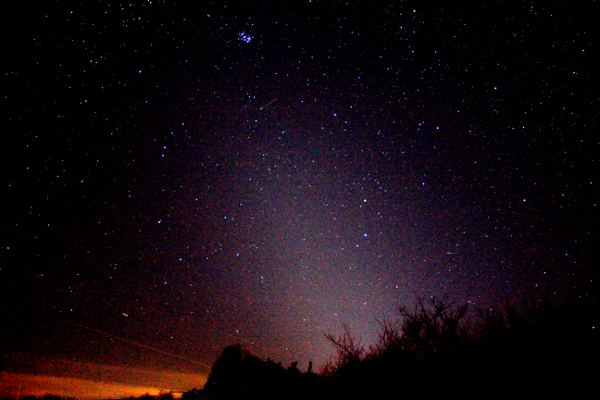
Much enhanced Zodiacal Light from the my back yard at 9:31 p.m. March 16, 2018, 5 minutes after the official end of astronomical twilight. Note the Pleiades top left of center and the constellation of Ares below and right of center. Canon EOS Rebel T5 18mm f.l., f/3.5, 6 sec. ISO 12,800 . The clouds on the left appear to be illuminated by the lights of the towns of Beulah and Frankfort 20+ miles away.
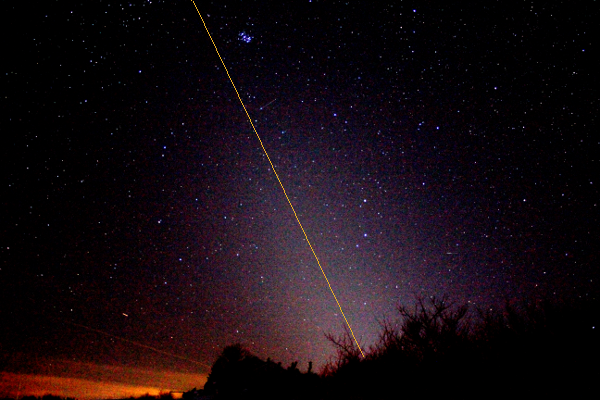
I’ve added the approximate ecliptic line from a Stellarium view of the same date and time.
03/04/2019 – Ephemeris – Zodiacal light is especially visible this time of year
Ephemeris for Monday, March 4th. Today the Sun will be up for 11 hours and 18 minutes, setting at 6:34, and it will rise tomorrow at 7:13. The Moon, 2 days before new, will rise at 7:07 tomorrow morning.
Zodiacal light is a faint but towering glow that can be seen after the end of astronomical twilight on moonless nights. It is seen in the west in the evening in late winter and early spring and in the east in the morning in late summer and early autumn. The axis of the glow is the ecliptic, the apparent annual path of the Sun in the sky, along which lie the constellations of the zodiac. Right now the end of twilight is about 8 p.m. and advancing at a rate of a minute or two each night. The cause of zodiacal light is dust, micron sized dust from comets and asteroids. Most of these lie in the plane of the solar system, centered on the ecliptic and the constellations of the zodiac and increases in brightness and width toward the Sun.
The times given are for the Traverse City/Interlochen area of Michigan. They may be different for your location.
Addendum
Much enhanced Zodiacal Light from the my back yard at 9:31 p.m. March 16, 2018, 5 minutes after the official end of astronomical twilight. Canon EOS Rebel T5 18mm f.l., f/3.5, 6 sec. ISO 12,800 . The clouds on the left appear to be illuminated by the lights of the towns of Beulah and Frankfort 20+ miles away.
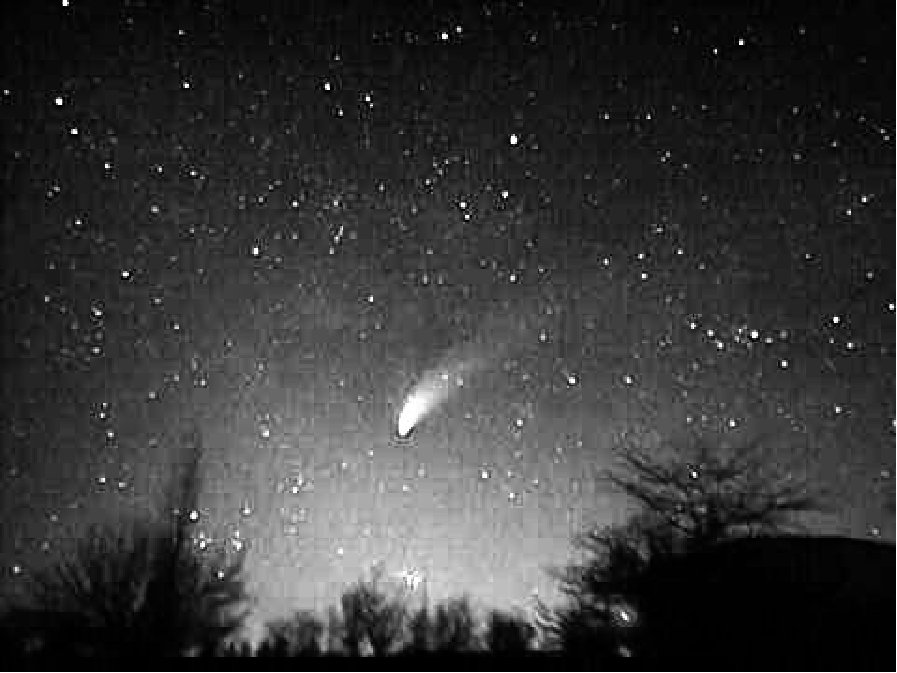
This is my previous best photo of zodiacal light. Zodiacal Light and Comet Hale-Bopp April 1997. Enhanced contrast.
The latest versions of Stellarium also show zodiacal light, but to see it the atmosphere needs to be turned off. That’s keyboard shortcut A.
02/18/2019 – Ephemeris – Super Moon, super math
Ephemeris for President’s Day, Monday, February 18th. Today the Sun will be up for 10 hours and 36 minutes, setting at 6:15, and it will rise tomorrow at 7:37. The Moon, 1 day before full, will set at 7:52 tomorrow morning.
Ready for some math this morning? This will be easy, because you will only have to think about it. Let’s say the Earth’s radius is 4,000 miles. That is pretty close to its actual value. OK, it is 3961 miles (6,378 km) at the equator. The Earth is nearly spherical. At 4 this morning the Moon passed perigee, its closest point to the Earth, making tomorrow’s full moon a super-moon. Let’s say it will be at today’s distance of 221,600 miles (356,800 km). That’s center to center. At moon rise or moon set the Moon is near that center to center distance, but if it moves overhead it’s 4,000 miles closer because we are on the Earth facing the Moon. Even though the Moon looks smaller than when it appears on the horizon. It’s an optical illusion that the Moon appears larger when it is rising. Super moon or not.
The times given are for the Traverse City/Interlochen area of Michigan. They may be different for your location.
Addendum
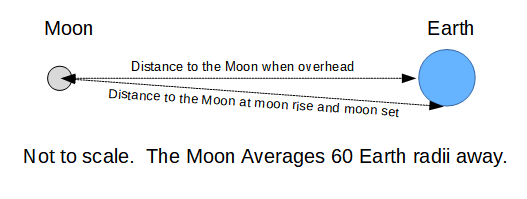
This illustrates the difference in the Moon’s distance at rising (or setting) versus when it is overhead. BTW today’s perigee puts the Moon at only 56 Earth radii from the Earth. The illustration is mine.
02/07/2019 – Ephemeris – Siriusly, folks.
Ephemeris for Friday, February 8th. Today the Sun will be up for 10 hours and 7 minutes, setting at 6:01, and it will rise tomorrow at 7:52. The Moon, half way from new to first quarter, will set at 9:48 this evening.
At 9 in the evening the great constellation of Orion the hunter can be seen in the south. Its large rectangle of bright stars is now upright, while in the center is a row of three stars, his belt. These stars tilt downward to the left to a very bright star merrily twinkling in the south-southeast. This star is called Sirius, also known as the Dog Star because it’s in the heart of Orion’s larger hunting dog, Canis Major. It is an arc light white star as seen in binoculars or telescope. It’s a neighboring star, just twice the distance of the closest star to the sun at 8.6 light years. It’s name, Sirius, has nothing to do with a dog, but is from the Greek meaning scorching for its brightness or sparkling, due to its intense twinkling.
The times given are for the Traverse City/Interlochen area of Michigan. They may be different for your location.
Addendum
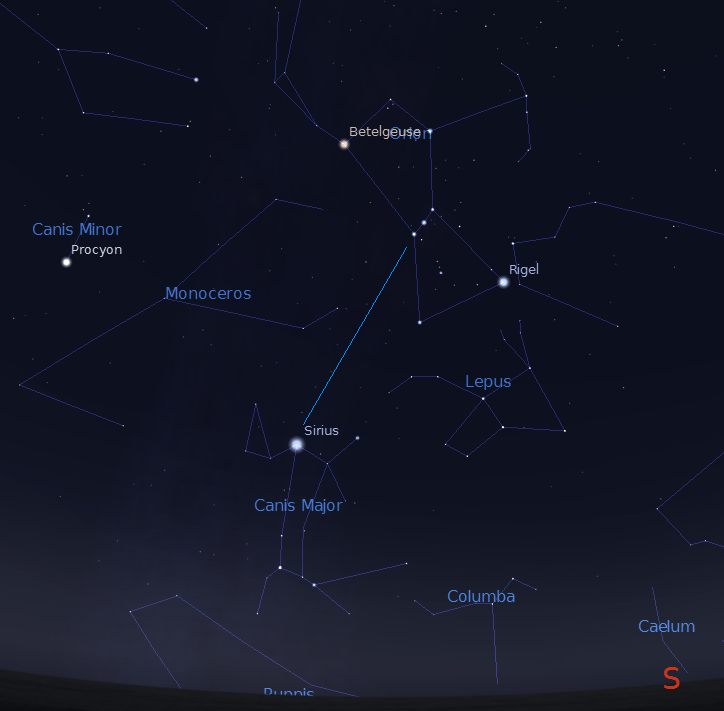
Orion’s Belt points to Sirius. Created using Stellarium.

