Archive
05/30/2016 – Ephemeris – Mars is closest to the Earth of this go around today
Ephemeris for Memorial Day, Monday, May 30th. Today the Sun will be up for 15 hours and 18 minutes, setting at 9:20, and will rise tomorrow at 6:00. The Moon, 1 day past last quarter, will rise at 3:21 tomorrow morning.
Mars is the closest it gets to the Earth in this go-around today. Mars is the next planet out from the Sun. Earth is number 3 and Mars is number 4. Mars has a much more eccentric orbit than the Earth and varies from 128 million miles (207 million km) at its closest to the Sun, called perihelion to 155 million miles (249 million km) at aphelion. So at closest approach of Mars to the Earth the nearest distance can vary by nearly 30 million miles (42 million km). Mars moves slower in its orbit than does the Earth, taking 687 Earth days to orbit the Sun. That’s about 1 year, 10 ½ months. We catch up to Mars every 26 months or so, in a different part of its orbit. This time it will close to 46.7 million miles (75.2 million km) today.
Times are for the Traverse City/Interlochen area of Michigan. They may be different for your location.
Addendum
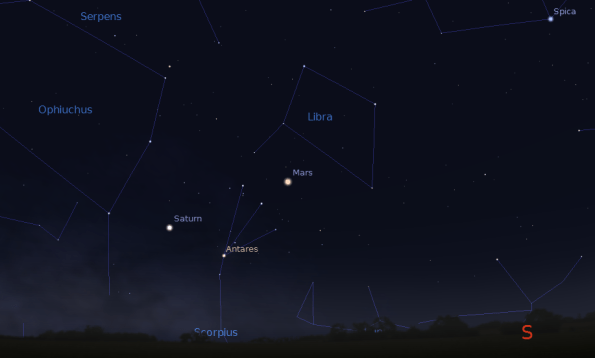
Mars finder chart for 11 p.m. May 30, 2016. Created using Stellarium.
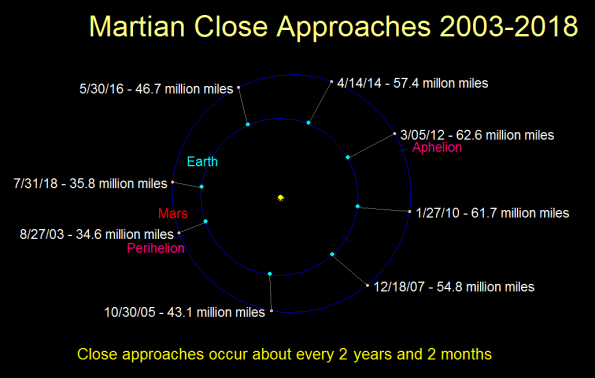
Mars closest approaches from 2003 to 2017. Created by my LookingUp program.
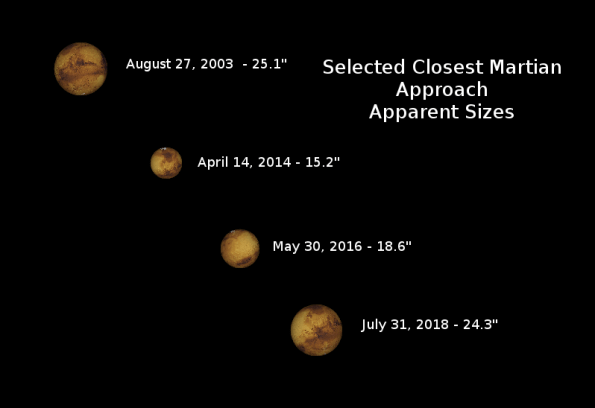
Selected Martian Closest Approaches Apparent sizes from 2003 to 2018. Created using Cartes du Ciel (Sky Charts).
05/23/2016 – Ephemeris – Mars was at opposition yesterday and will be closest next Monday
Ephemeris for Monday, May 23rd. Today the Sun will be up for 15 hours and 7 minutes, setting at 9:13. The Moon, 2 days past full, will rise at 10:45 this evening. Tomorrow the Sun will rise at 6:05.
Yesterday the planet Mars passed a point where it was opposite in the sky from the Sun. Astronomers call it opposition. This is a time when a planet is normally its closest to the Earth, since the Earth is more of less directly between the planet and the Sun. But due to Mars’ quite elliptical orbit, it is still approaching the Sun, and though the Earth is nudging ahead of it a bit, Mars won’t be closest to the Earth until next Monday, the 30th, 8 days after opposition. On that day it will be about 650 thousand miles (1 million, 46 thousand km) closer to the Earth than it was yesterday. On the 30th that will be 46.7 million miles (76.2 million km) away. The next closest approach in 26 months will be a bit closer yet.
Times are for the Traverse City/Interlochen area of Michigan. They may be different for your location.
Addendum
Mars closest approaches from 2003 to 2018. Created by my LookingUp program.
Selected Martian Closest Approaches Apparent Sizes from 2003 to 2018. Created using Cartes du Ciel (Sky Charts). Note that ” is seconds of arc. 1″ = 1/3600 of a degree. The Moon and Sun are about 1,800 seconds of arc in diameter.
Also note that at the star party last Saturday night Mars looked great, even though it was low in the sky.
05/03/2016 – Ephemeris – Halley’s Comet is back… In little bitty pieces
Ephemeris for Tuesday, May 3rd. The Sun rises at 6:29. It’ll be up for 14 hours and 21 minutes, setting at 8:50. The Moon, 3 days before new, will rise at 5:23 tomorrow morning.
There’s a meteor shower happening this week that’s a tough one for observers as far north as we are. It’s the Eta Aquariids: seeming to come from the Water Jar asterism of the constellation Aquarius the water bearer. It will reach peak on Thursday the 5th, however the radiant point rises around 3:30 a.m., and twilight starts an hour and a half later. The radiant is also low in the southeastern part of the sky. The meteors are fast-moving and many of them are bright. They are bits shed by Halley’s Comet and left in its orbit. The Earth passes close to Halley’s orbit twice a year: In late October as the particles come in from the outer solar system, and again in early May as they head back out again. We’ll see souvenirs of Halley’s Comet before it returns in 2061.
Times are for the Traverse City/Interlochen area of Michigan. They may be different for your location.
Addendum
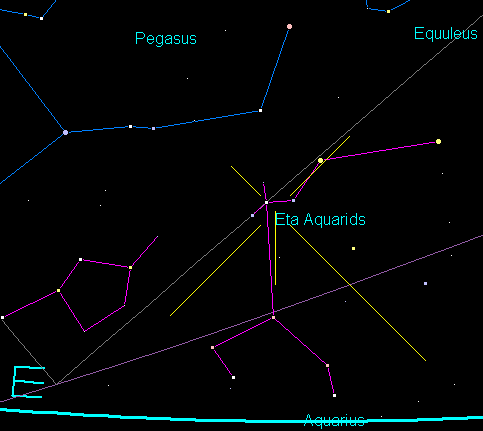
The Eta Aquarid radiant at the peak of the shower. The radiant moves slowly to the east with time. Credit: Bob Moler’s LookingUp program.
This meteor shower is low for us in the Northern Hemisphere, but it will be great for those Down Under. The Moon is even cooperating this year, by getting out of the way. The active dates for the shower are April 19th to May 28th. The velocity of the meteoroids that strike the atmosphere is 66 km/s. Halley’s Comet, and thus its debris is traveling in a retrograde orbit, going the wrong way in a one way solar system, which is why the speed of the particles is so high.
03/11/2016 – Ephemeris – The lunar Sea of Crises
Ephemeris for Friday, March 11th. The Sun will rise at 7:01. It’ll be up for 11 hours and 42 minutes, setting at 6:44. The Moon, 3 days past new, will set at 10:14 this evening.
Tonight the Moon shows one remarkable sea: Mare Crisium or the Sea of Crises. It is a large gray basin. The largest feature visible in binoculars. Because it’s near the Moon’s limb or edge it is foreshortened into an ellipse, with the long axis running north and south. In actuality it is elliptical with the long axis east and west. It looks funny on a geologic map of the whole moon or a Moon globe. Its dimensions are 345 by 375 miles (570 by 620km). It’s really a crater as are all seas whose impact asteroid reached down to the Moon’s magma and caused lava to well up to produce the flat floor. When the sunlight is low as it is now wrinkle ridges will appear showing where successive lava flows have stopped and solidified.
Times are for the Traverse City/Interlochen area of Michigan. They may be different for your location.
Addendum
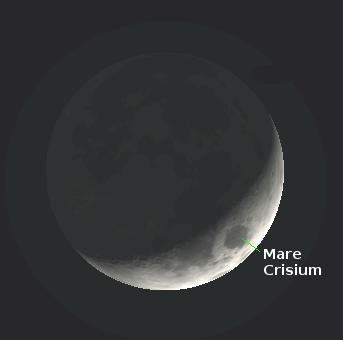
The Moon on its orientation in the southwest at 8 p.m.March 11, 2016. Created using Stellarium.
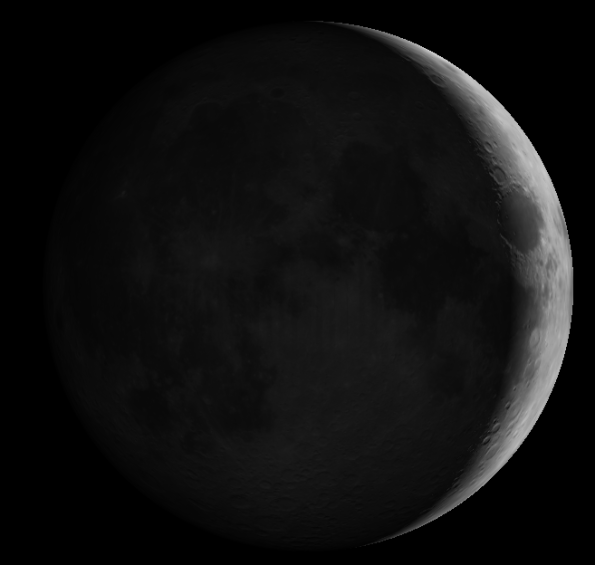
The Moon at 8 p.m. March 11, 2016 via Virtual Moon Atlas. Note that despite the difference in rotation, that the phase is s bit different. We’ll have to see which one is correct.
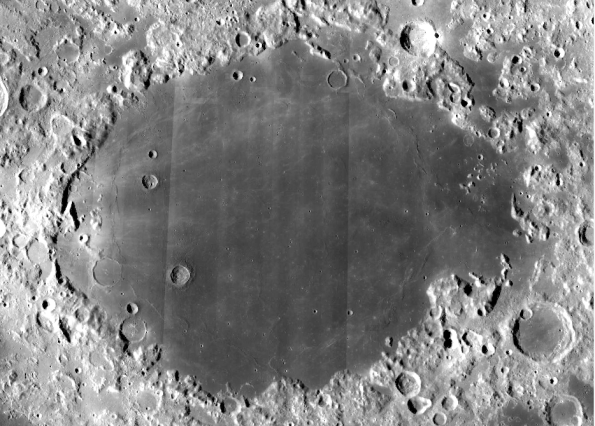
Mare Crisium from overhead with Lunar Reconnaissance Orbiter. The vertical lines are due to the north-south scans by the polar orbiting satellite. Credit: NASA/LRO/Virtual Moon Atlas.
02/26/2016 – Ephemeris – The lion roars into the evening sky
Ephemeris for Friday, February 26th. The Sun will rise at 7:26. It’ll be up for 10 hours and 59 minutes, setting at 6:25. The Moon, half way from full to last quarter, will rise at 10:27 this evening.
Besides the advancing sunset times, there is another sign that spring is coming. That’s the appearance of the constellation Leo the lion rising in the east in the evening. The front of this beast is a backward question mark of stars with the bright star Regulus as the dot at the bottom. That’s his head, mane and chest. His haunches are a triangle of stars to the lower left, the last star is in the east above brilliant planet Jupiter. just clearing the horizon at 9 p.m. One way to find Leo is to remember that cat’s aren’t supposed to like water, though mine have always had a certain fascination with the toilet. Find the Big Dipper standing on its handle and imagine drilling a hole in the bottom of the bowl. The water, falling from the north, will fall on Leo’s back.
Times are for the Traverse City/Interlochen area of Michigan. They may be different for your location.
Addendum
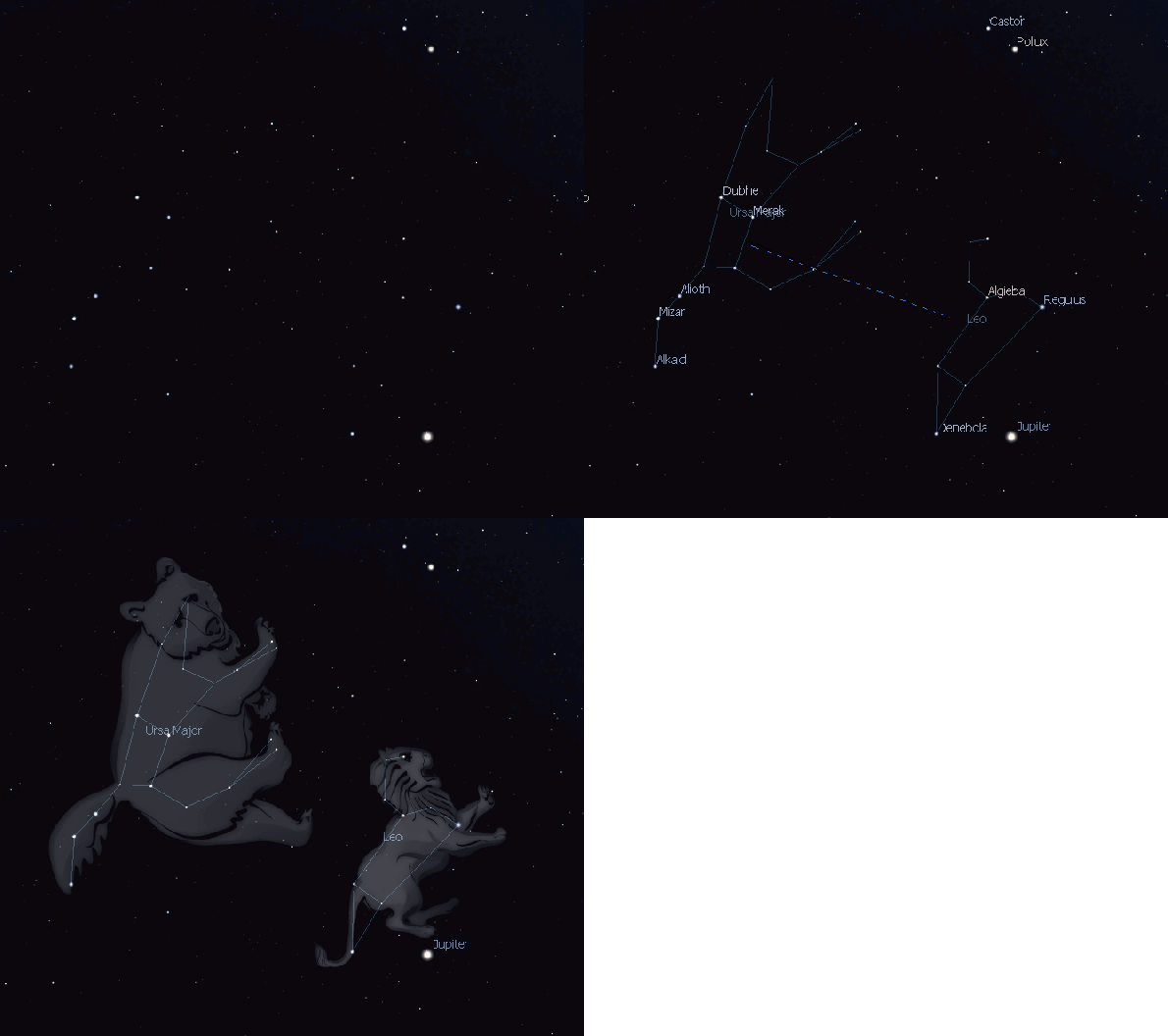
How to find Leo with Jupiter and the Big Dipper. At 10 p.m. on February 26, 2016. Created using Stellarium and GIMP.
02/25/2016 – Ephemeris – The Crab and the Beehive
Ephemeris for Thursday, February 25th. The Sun will rise at 7:27. It’ll be up for 10 hours and 56 minutes, setting at 6:24. The Moon, 3 days past full, will rise at 9:29 this evening.
At 9 this evening, the faint constellation, and member of the Zodiac, Cancer the crab will be located in the southeastern sky half way between the bright stars Castor and Pollux of the constellation Gemini, high in the south and the bright star Regulus in Leo the lion and Jupiter in the east. Cancer is very dim, looking like an upside-down Y. In the center of Cancer is a fuzzy spot to the unaided eye. In binoculars or a low power telescope this fuzzy spot becomes a cluster of stars. It is Messier 44 or the Beehive star cluster. At 577 light years away, it is one of the closest star clusters, but more distant than the Pleiades and Hyades the face of Taurus the bull. Of the three the Pleiades is the youngest at 100 million years. The Beehive is 7 times older.
Times are for the Traverse City/Interlochen area of Michigan. They may be different for your location.
Addendum
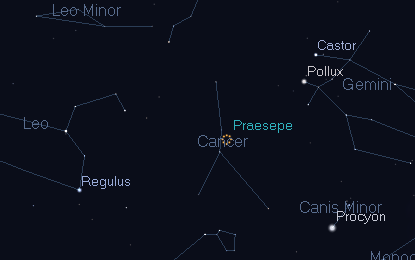
Cancer Finder Chart. Created using Stellarium.
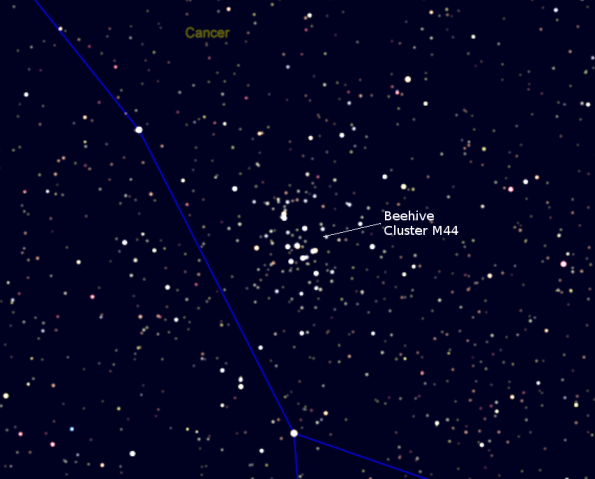
The Beehive star cluster, M44, a great binocular object. Its ancient name was the Praesepe or manger when glimpsed by the naked eye as a fuzzy spot. Created using Cartes du Ciel (Sky Charts)
12/25/2015 – Ephemeris – This year’s Christmas Stars
Merry Christmas. This is Bob Moler with Ephemeris for Christmas Day, Friday, December 25th. The Sun will rise at 8:18. It’ll be up for 8 hours and 48 minutes, setting at 5:07. The Moon, at full today, will rise at 5:53 this evening.
It’s Christmas morning, and if it’s clear the full Moon will low in the west. Venus the brilliant Morning Star will be low in the southeast, Jupiter, second only to Venus in brightness will appear half way up to the zenith in the south. Venus or perhaps Jupiter, take your pick can be this year’s Christmas Star. The bright stars in the evening sky tonight are those of winter, that have looked down on us in their familiar patterns for millennia. The bright planets and stars, or even a brilliant supernova, or the one at the top of our Christmas tree, cannot be, according to those astronomers who accept the Star of Bethlehem as a real phenomenon, as what the star was. The leading contenders for the Star have always involved two planets.
Times are for the Traverse City/Interlochen area of Michigan. They may be different for your location.
Addendum
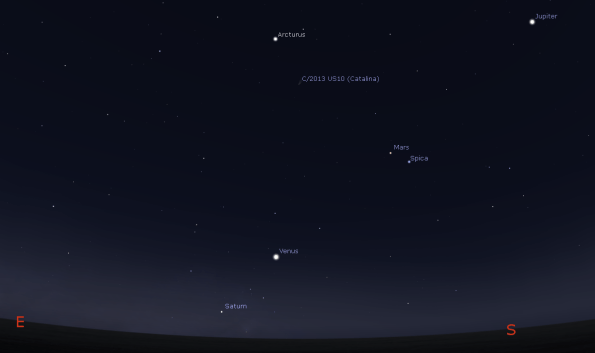
The morning planets, Jupiter, Mars, Venus and Saturn, plus Comet Catalina at 7 a.m. . Created using Stellarium.
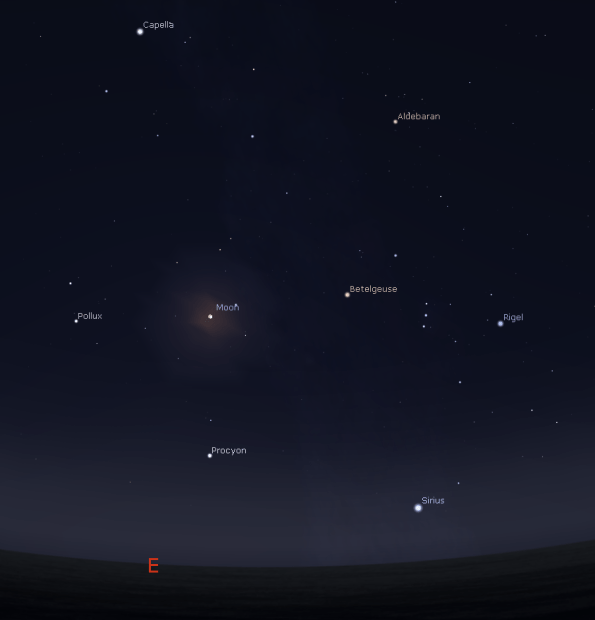
The bright stars of Christmas Night and the full Moon. Created using Stellarium.
12/23/2015 – Ephemeris – Only Mercury is making a stand in the evening sky
Ephemeris for Wednesday, December 23rd. The Sun will rise at 8:17. It’ll be up for 8 hours and 48 minutes, setting at 5:05. The Moon, 2 days before full, will set at 7:04 tomorrow morning.
Let’s check out the whereabouts of the bright naked eye planets. Mercury is becoming marginally visible very low in the southwest before it sets at 6:24 p.m. in the west-southwest. In the morning sky there are four bright planets. Jupiter will be the first to rise, actually at 11:49 p.m., in the east. Mars will rise next at 2:33 a.m. also in the east, Venus will rise at 5 a.m. in the east-southeast. Even as Venus and Jupiter separate Mars still lies almost halfway between the two. Don’t confuse Mars with the star Spica which is brighter and below right of it. Saturn will rise at 6:30 a.m. in the east-southeast. Comet Catalina is a binocular object about three widths of a fist held at arm’s length directly above Venus at 6 a.m.
Times are for the Traverse City/Interlochen area of Michigan. They may be different for your location.
Addendum
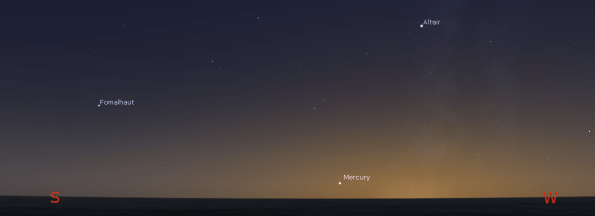
Mercury at 6 p.m., 55 minutes after sunset, December 23, 2015. It may be visible as early as 5:30. Binoculars will help. Created using Stellarium.
The morning planets, Jupiter, Mars, Venus and Saturn, plus Comet Catalina at 7 a.m. December 24, 2015. Created using Stellarium.
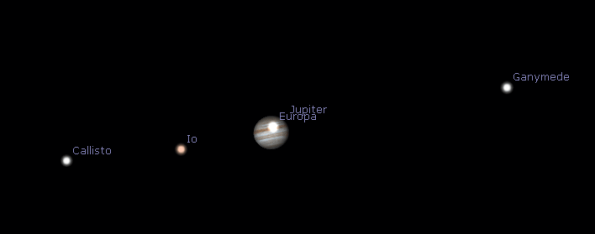
Telescopic view of Jupiter at 7 a.m. December 24, 2015. Note Europa is in transit of Jupiter at that time and would pretty much be invisible. Created using Stellarium.
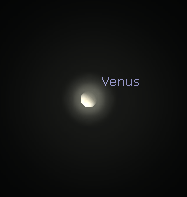
Telescopic view of Venus at 7 a.m. December 24, 2015. Created using Stellarium.
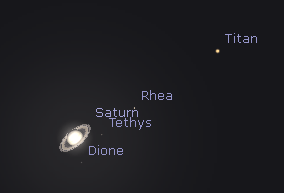
Telescopic view of Saturn at 7 a.m. December 24, 2015. The satellites would be pretty much invisible in the twilight. Created using Stellarium.
Note that the planets shown as they would be seen in telescopes at the same magnification.
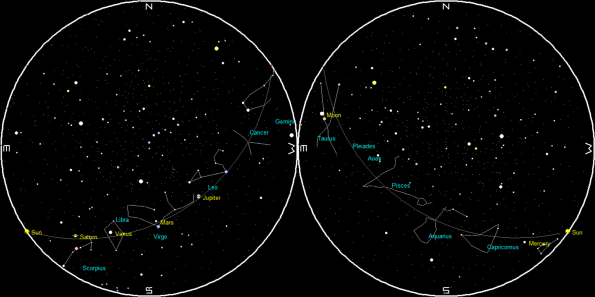
This is a chart showing the sunrise and sunset skies for December 23, 2015 showing the location of the planets and the Moon at that time. Created using my LookingUp program.
A note on enlarging the pictures: Apparently WordPress is not able to enlarge pictures by clicking on them. However if you are using Firefox and you right-click on an image, select View Image to show the image up to full size.
12/16/2015 – Ephemeris – The planet action is still in the morning
Ephemeris for Wednesday, December 16th. The Sun will rise at 8:13. It’ll be up for 8 hours and 49 minutes, setting at 5:02. The Moon, 2 days before first quarter, will set at 10:57 this evening.
Let’s check out the whereabouts of the bright naked eye planets. Mercury is becoming marginally visible very low in the southwest before it sets at 6 p.m. In the morning sky there are three bright planets. Jupiter will be the first to rise, at 12:15 a.m. in the east. Mars will rise next at 2:39 a.m. also in the east, followed by Venus at 4:41 a.m. in the east-southeast. Mars lies in line between Venus below and Jupiter above, almost halfway between the two. Don’t confuse Mars with the star Spica which is brighter and right below it. Saturn will rise at 6:54 a.m. in the east-southeast. Comet Catalina is a telescopic object about one and a half the width of a fist held at arm’s length above Venus and the same amount left of Mars.
Times are for the Traverse City/Interlochen area of Michigan. They may be different for your location.
Addendum
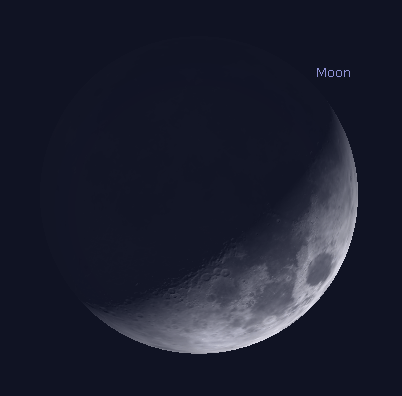
The moon as it might look in binoculars at 8 p.m., December 16, 2015. Created using Stellarium.
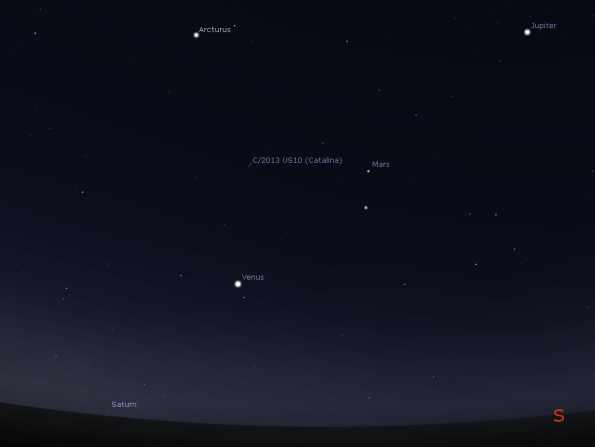
The Morning planets at 7 a.m., December 17, 2015. Created using Stellarium.
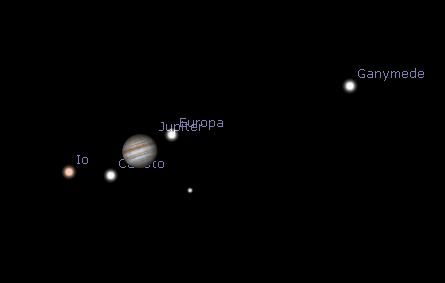
Jupiter and moons in a telescope at 7 a.m. December 17, 2015. Created using Stellarium.
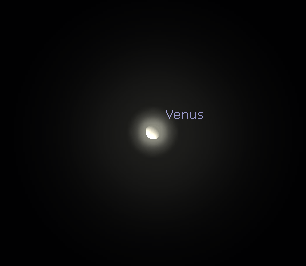
Venus as seen in a telescope as seen at the same magnification as Jupiter above, at 7 a,m. December 17, 2015. Created using Stellarium.
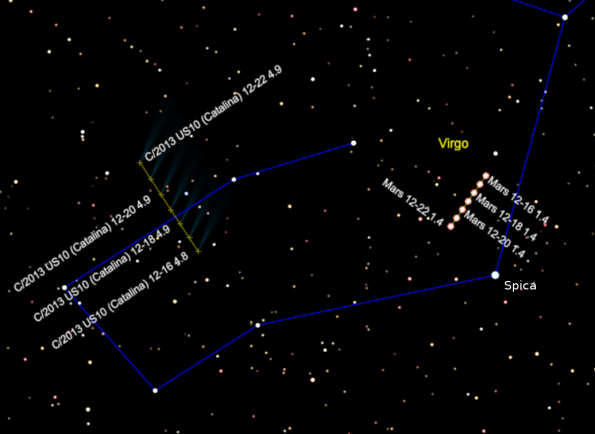
Comet Catalina and Mars for the next week. Note the magnitudes for the comet are about 1 magnitude too bright. It will take binoculars or a small telescope to spot the comet which will not show a tail visually. Created using Cartes du Ciel (Sky Charts).
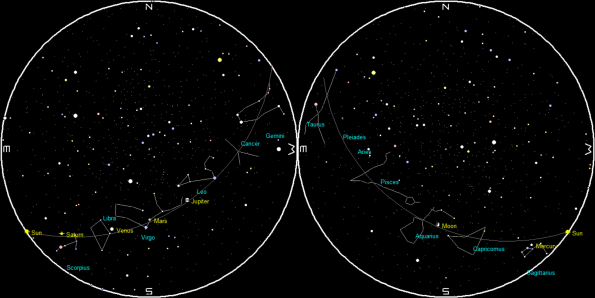
This is a chart showing the sunrise and sunset skies for December 16, 2015 showing the location of the planets and the Moon at that time. Created using my LookingUp program. Click on the image to enlarge.
12/11/2015 – Ephemeris – The Geminid meteor shower will be cranking up this weekend
Ephemeris for Friday, December 11th. The Sun will rise at 8:09. It’ll be up for 8 hours and 52 minutes, setting at 5:02. The Moon is new today, and won’t be visible.
Over the weekend and through Monday night the Geminid Meteor shower will be seen. This shower is actually the bet of the year, with higher hourly counts of meteors than the more famous Perseid meteor shower of August. Around here the cold weather and the more than even chance that it will be cloudy have kept this astronomer from having seen even one. Maybe this year. The Geminids can be seen all night because the radiant point is in the northern sky, well north of the celestial equator at least. At 9 p.m. the constellation Gemini rises sideways with the namesake of the twins, the stars Castor and Pollux vertically aligned in the east with Castor on top. The closest to the peak numbers will be seen Monday early morning and Monday night.
Times are for the Traverse City/Interlochen area of Michigan. They may be different for your location.
Addendum
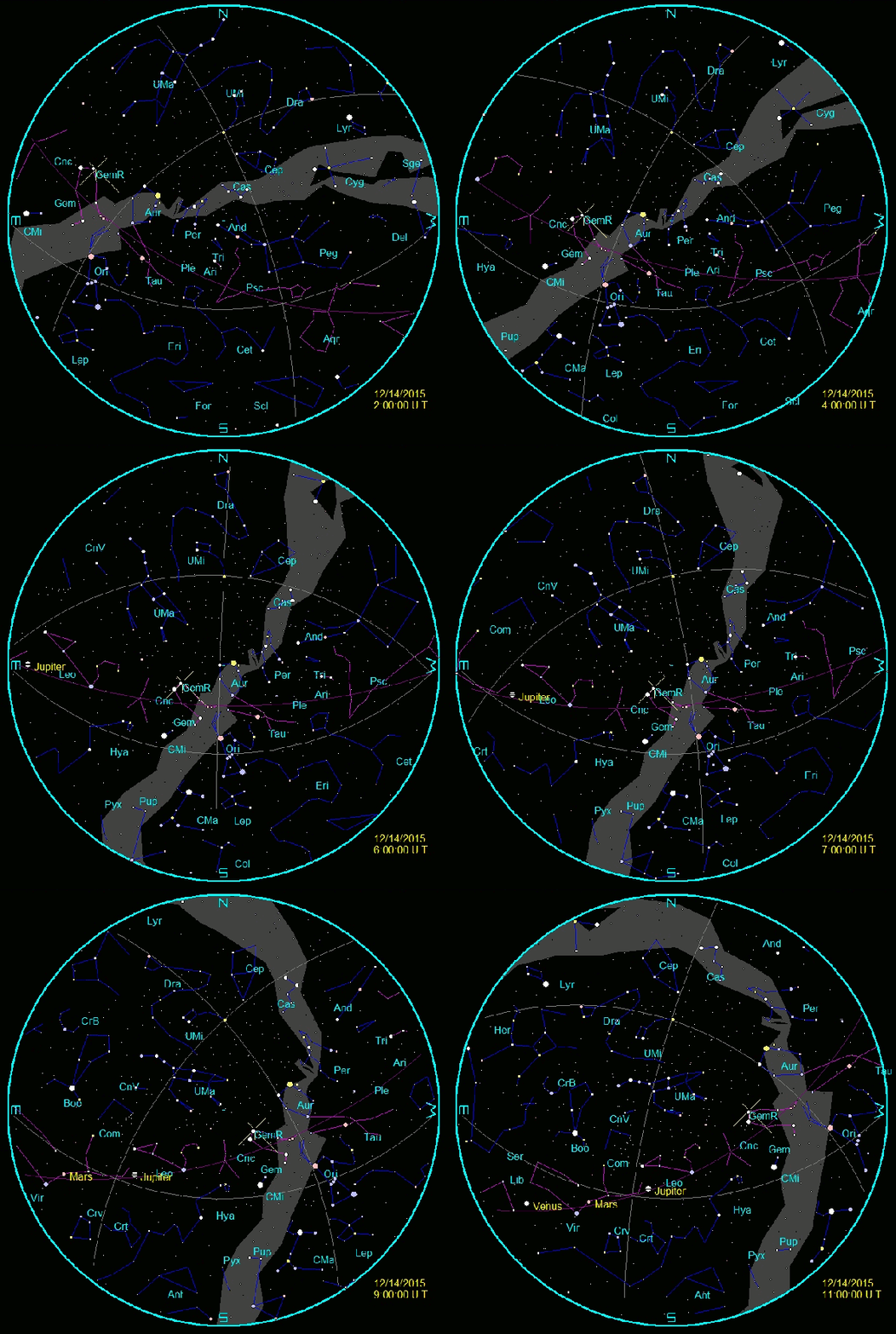
All Sky view one hour intervals for The Geminid meteor shower the night of December 13-14, 2015.. Note the radiant “GemR”. Created with my LookingUp program and GIMP.
Note the times are in Universal time conversion to local time.
 UT     EST
  2     9 p.m.
  3    10 p.m.
  4    11 p.m.
  5    12 m.
  6     1 a.m.
  7     2 a.m.
  8     3 a.m.
  9     4 a.m.
 10     5 a.m.
 11     6 a.m.
For locations other than EST Eastern Standard time (UT – 5 hours), just use EST as your local time. The latitude is set for near 45º north.

