Archive
02/04/2015 – Ephemeris – We have 4 bright planets and a fading comet
Ephemeris for Wednesday, February 4th. The sun will rise at 7:58. It’ll be up for 9 hours and 56 minutes, setting at 5:55. The moon, 1 day past full, will rise at 6:59 this evening.
Lets take a look at the bright planets and a reasonably bright comet for this week. Brilliant Venus is in the west-southwest by 6:30 p.m. It will set at 8 p.m. Mars appears above and left of Venus in the southwest. Both of them are in the constellation of Aquarius. The Red Planet will set tonight at 8:43 p.m. Jupiter, 2 days from being in opposition from the sun, and opposite the sun in the sky, when it will be rising at sunset and setting at sunrise will rise tonight in the east at 5:49 p.m. It’s near the sickle-shaped head of Leo the lion. It will be seen above the Moon at 9 p.m. Early risers will be able to spot Saturn which will rise in the east-southeast at 3:06 a.m. Comet Lovejoy, visible in binoculars, is near the star at the end of Andromeda, called Almaak.
Times are for the Traverse City/Interlochen area of Michigan. They may be different for your location.
Addendum
Evening
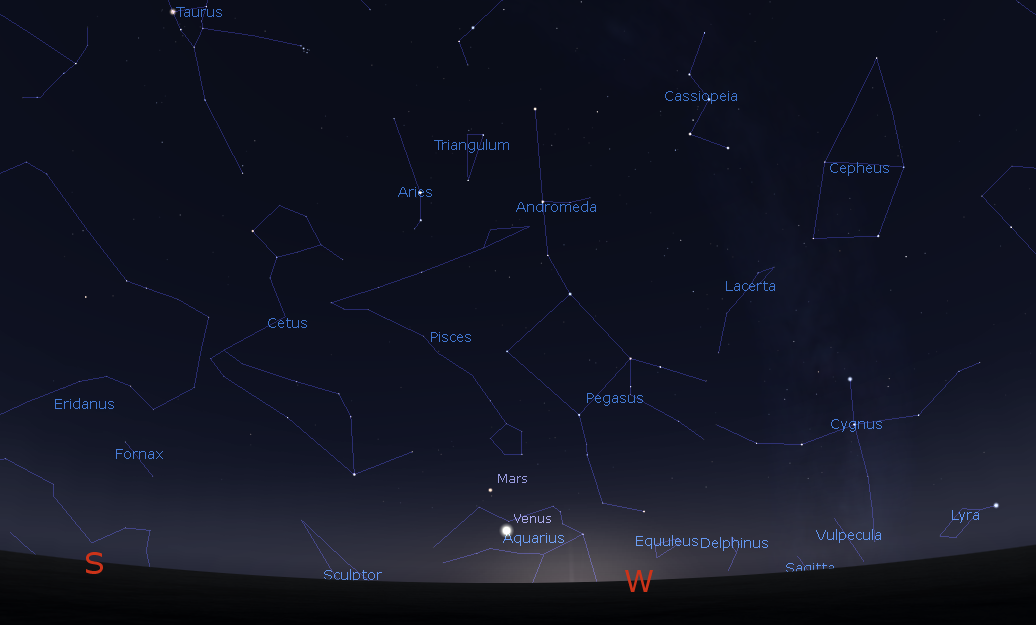
Venus and Mars low in the west with the setting autumn constellations and a few northern summer stars at 7 p.m. on February 4, 2015. Created using Stellarium.
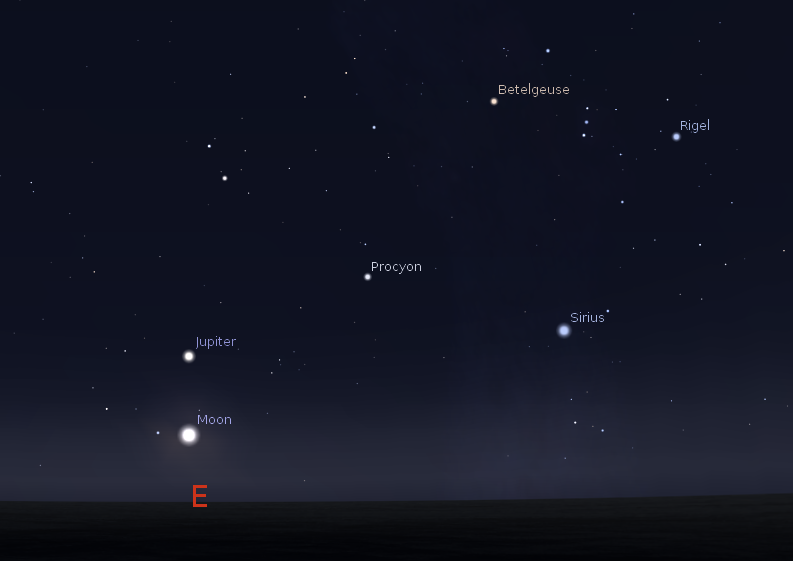
Jupiter the Moon and the bright winter stars at 8 p.m. on February 4, 2015. Created using Stellarium.
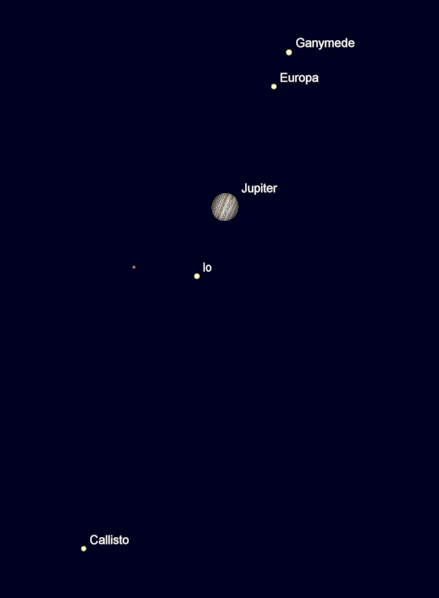
Jupiter and its Galilean moons as they might appear in a telescope. Created using Cartes du Ceil (Sky Charts).
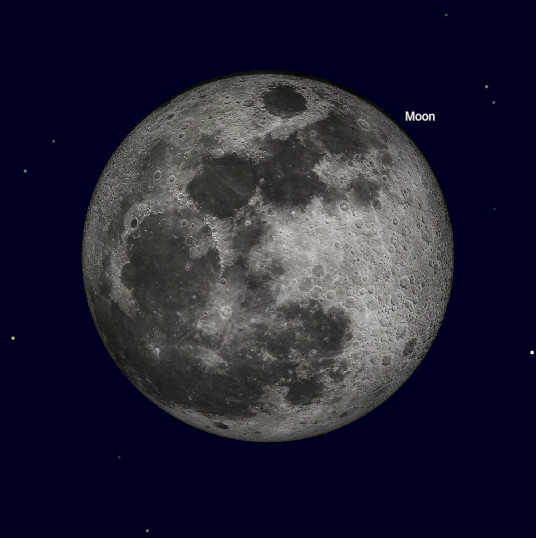
The Moon as it might appear in binoculars at 8 p.m. on February 4, 2015. Created using Cartes du Ceil (Sky Charts).
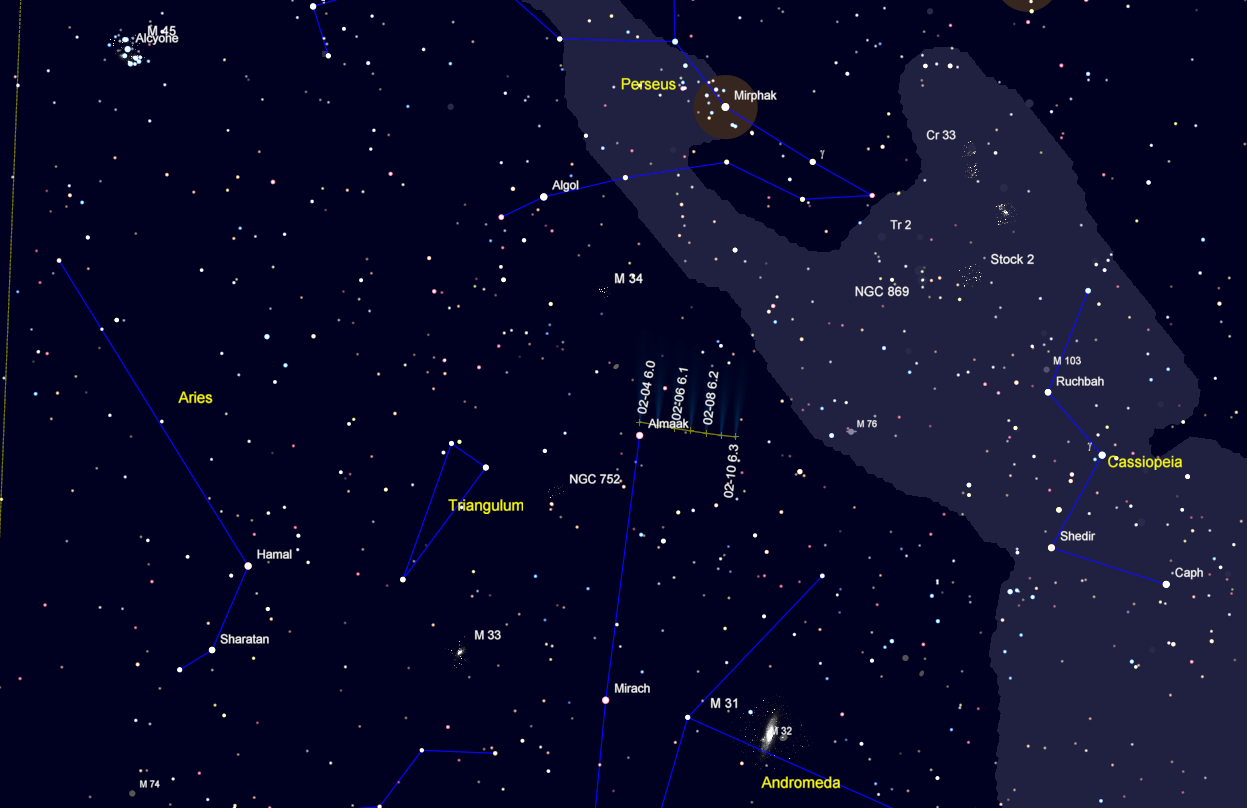
The track of Comet 2014 Q2 (Lovejoy) from 2/04/15 to 02/10/15 which will appear high in the west at 9 p.m. Created using Cartes du Ceil (Sky Charts).
Morning
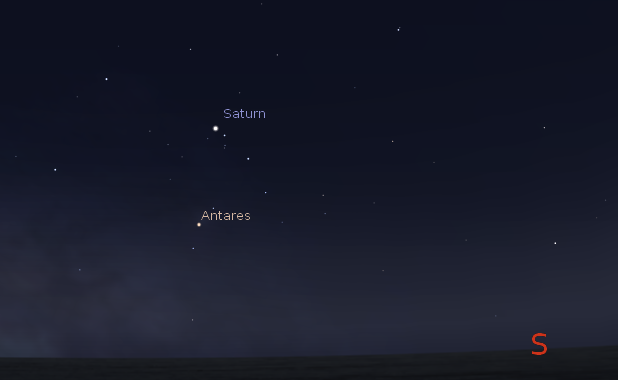
Saturn will appear above the red giant star Antares at 6 a.m. February 5, 2015. At this time Jupiter and the Moon will appear above the western horizon. Created using Cartes du Ceil (Sky Charts).
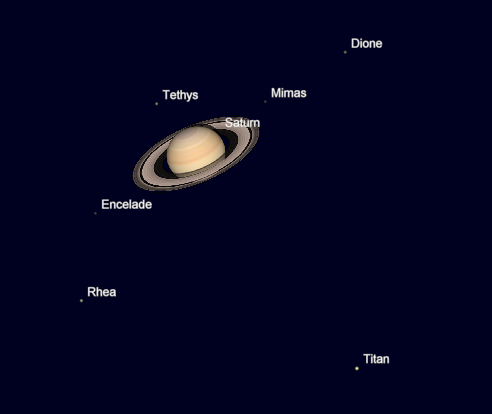
What Saturn and its moons might appear like in a telescope at 6 a.m., February 5, 2015. Small telescopes will show only the moon Titan. Created using Cartes du Ceil (Sky Charts).
01/29/2015 – Ephemeris – The first thing noticed about Jupiter in a telescope
Ephemeris for Thursday, January 29th. The sun will rise at 8:05. It’ll be up for 9 hours and 41 minutes, setting at 5:46. The moon, 3 days past first quarter, will set at 4:33 tomorrow morning.
If it’s clear tonight dress up warmly and take the telescope out to look Jupiter. Jupiter is the brightest star-like object out tonight. It outshines Sirius the brightest night-time star lower in the sky and to its right. Jupiter, being the largest planet most of the time is the biggest planet in the telescope, It’s only challenger is Venus for a couple of months when its closest to us. The first thing one notices about Jupiter in a telescope is that it has companions, up to 4, strung out on either side of the planet. Those are the four moons or satellites discovered by Galileo in 1610. They will shift position from night to night and even as you watch. They can hide behind Jupiter or in its shadow or in front of the planet.
Times are for the Traverse City/Interlochen area of Michigan. They may be different for your location.
Addendum
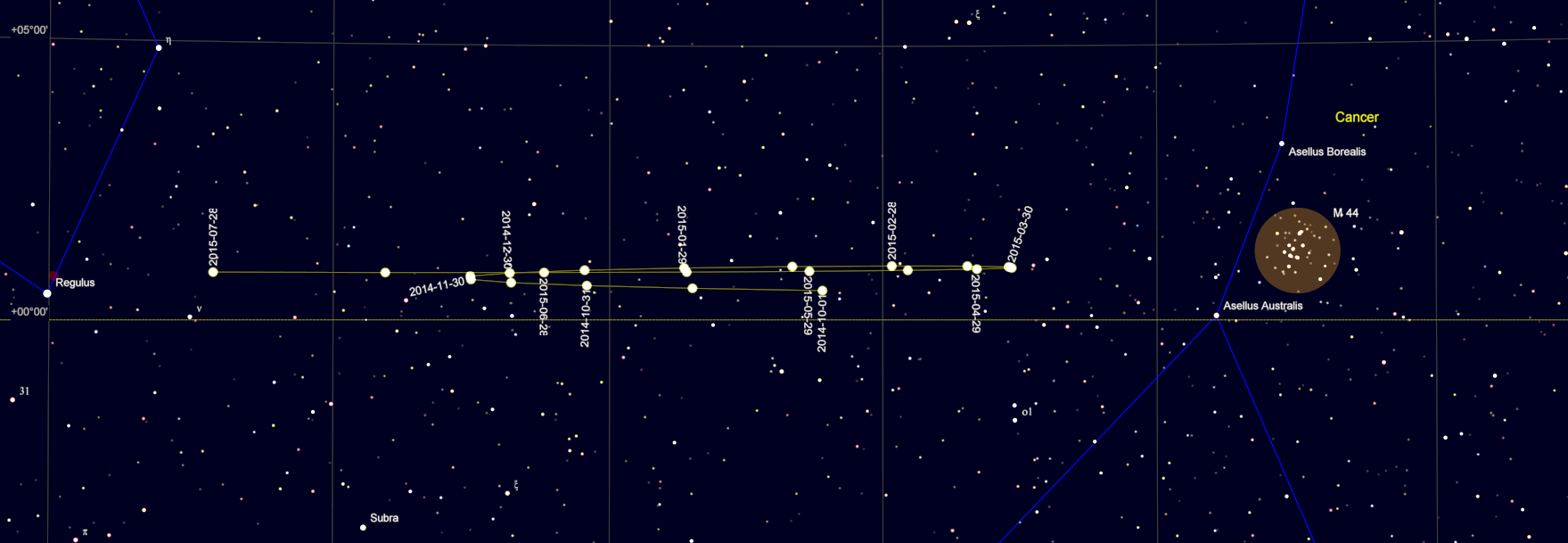
Jupiter’s retrograde path against the stars between Cancer and Leo October 2014 to July 2015. Created using Cartes du Ceil (Sky Charts). Click to enlarge.
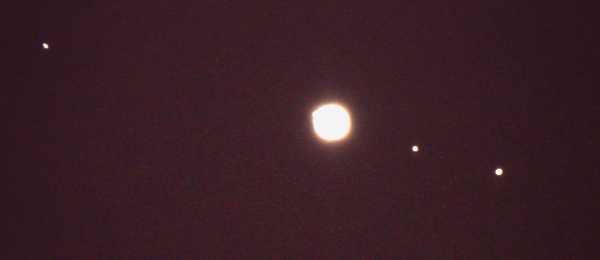
Jupiter and its four Galilean moons. The planet has to be over exposed to pick up the moons. But the eye can handle the brightness difference with no problem. This is one of my old pictures back in the days of film.
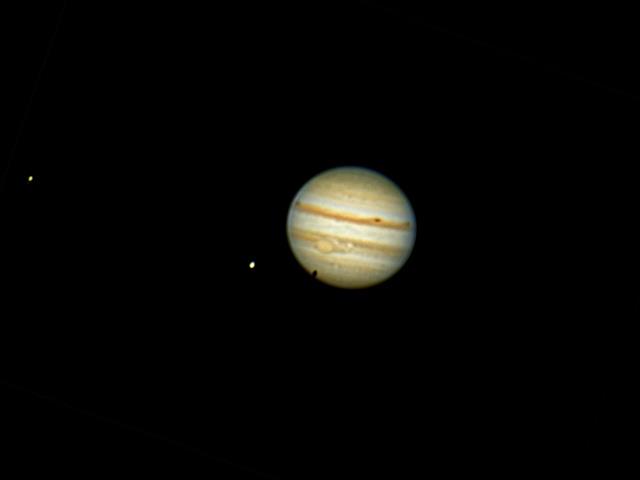
Jupiter with a solar eclipse in progress as Ganymede, lower left, casts its shadow on Jupiter on November 14, 2011. Credit: Scott Anttila.
Check out the Great Red Spot (GRS) above Ganymede’s shadow. It’s not really red. When I first aimed my telescope toward Jupiter back in the late 1950’s the GRS was indeed very red. Nowadays the GRS is very hard to find.
01/26/2015 – Ephemeris – First quarter Moon, a telescopic asteroid misses the Earth tonight and a Jupiter shadow recap
Note: Ephemeris program generally features objects in the sky that are visible to the naked eye or binoculars. However in the blog, with the ability to expand in both content and illustrations I can add information for telescopic observers and expand postings.
Ephemeris for Monday, January 26th. The sun will rise at 8:08. It’ll be up for 9 hours and 34 minutes, setting at 5:42. The moon, at first quarter today, will set at 1:30 tomorrow morning.
The Moon will be perfectly half illuminated by the sun at 11:48 p.m. The gray patches that appear on the Moon’s surface were called by early telescopic astronomers: seas; because they thought they were bodies of water. The Moon is pretty much bone dry, except for some eternally shadowed craters at the poles, which still aren’t wet because the water is frozen. Anyway the seas or maria on the moon are indeed low spots. The seas, from the top center of the moon down to the lower right are Serenity, Tranquility, Nectar and Fertility. To the upper right all by itself is the Sea of Crises. From Serenity to Fertility some can imagine an upside down rabbit, with ears of unequal sizes. In a few more days we’ll see the face of the man in the Moon.
Times are for the Traverse City/Interlochen area of Michigan. They may be different for your location.
Addenda
First Quarter Moon
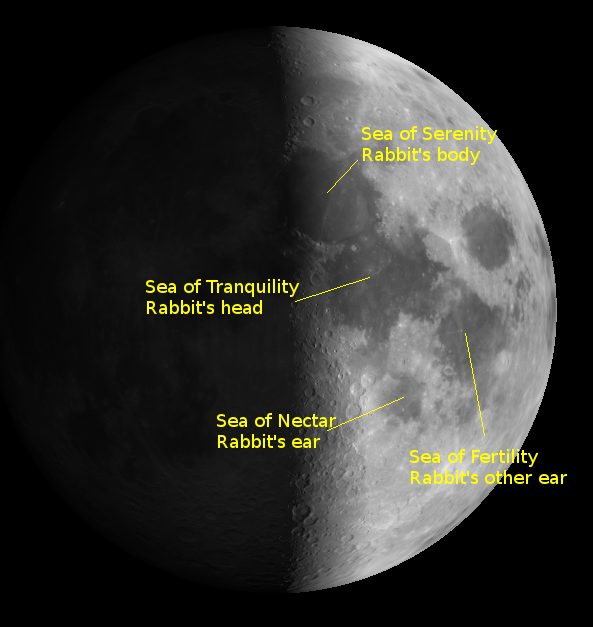
Rabbit in the first quarter Moon. Created using Virtual Moon Atlas.
Tonight Asteroid 2004 BL86 will pass three times the Moon’s distance from the Earth
This evening a rather large asteroid for a Near Earth Object or NEO will pass three-quarters of a million miles from the Earth. The asteroid has the designation 2004 BL86. The cool thing is that this asteroid is half a kilometer or so meters across, that’s 5 soccer or football fields in diameter. Radar from this close passage should nail down the size and shape. Between Goldstone Tracking Station and Arecibo Observatory in Puerto Rico the asteroid should be mapped down to 2 to 4 meters. It would be definitely not cool if this asteroid ever hit the Earth. It will be 9th magnitude, and so will be visible in small telescopes, and it will cross the east or left side of the Beehive star cluster also designated M44 starting about midnight tonight.
If you want to observe the event and don’t have the equipment head on over to www.slooh.com. This is the site for Slooh (pronounced “slew”) Community Observatory which has observatories in the Canary Islands and Chile, and partners with others. Besides these events, members can schedule time and use the telescopes via the internet. Check the above link for more information.
The chart below is from NASA/JPL’s Near Earth Object Program: Updated Charts for Asteroid 2004 BL86 Earth Flyby on Jan 26, 2015
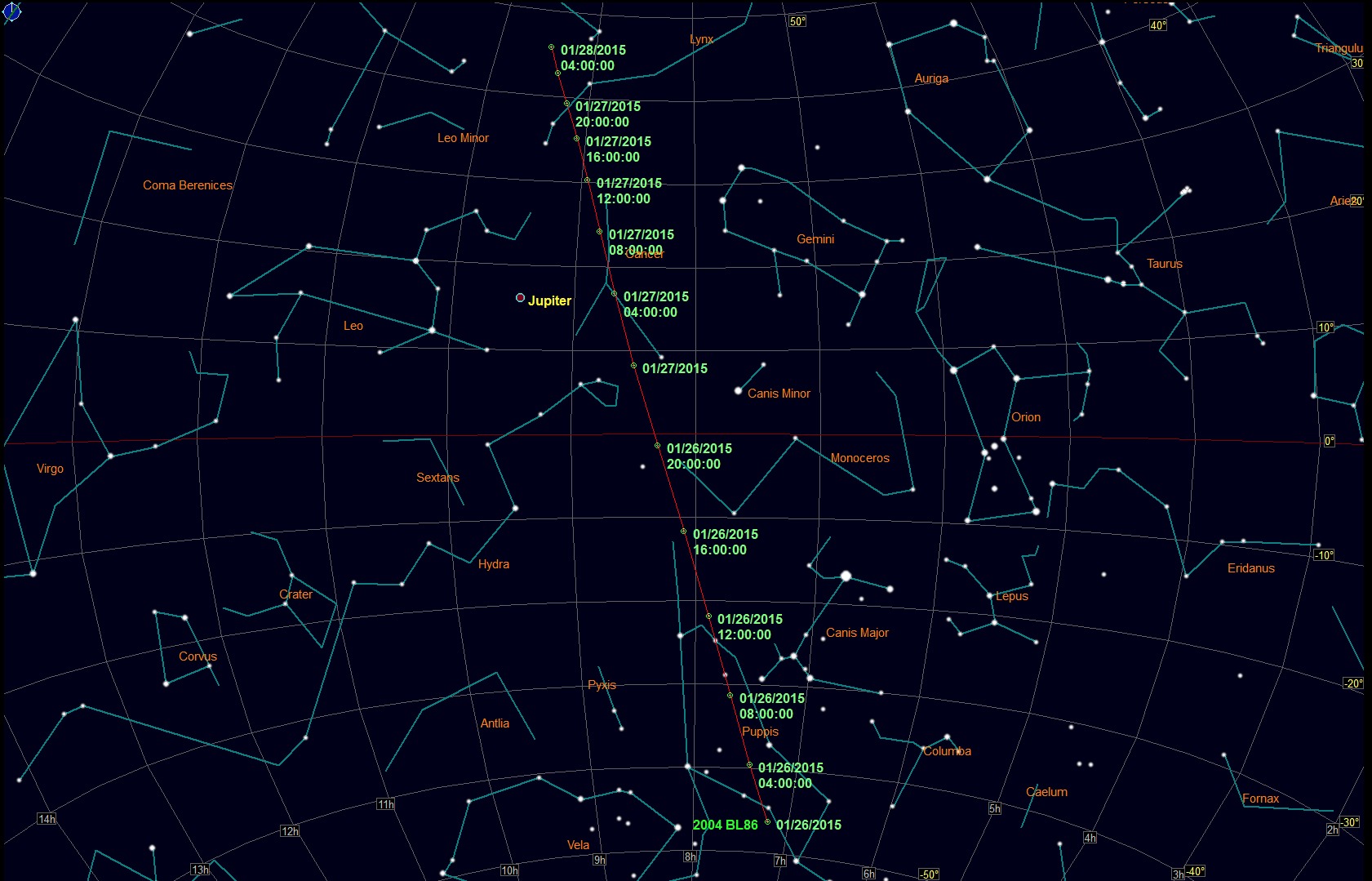
The track of asteroid 2004 BL86 as viewed from the Earth, plotted on a star chart with an equatorial coordinate grid. The asteroid location is shown at four-hour intervals from January 26 to 28. The indicated times are Universal Time; subtract 5 hours for Eastern Standard Time (EST), 6 hours for CST, and 8 hours for PST. On January 26, the asteroid will pass within 11 degrees of Jupiter, now shining brightly in the east in the evening sky. Image and caption credit: NASA/JPL-Caltech. JPL orbit solution #43, with star chart graphics produced using C2A. Click to enlarge.
Below is a chart from Universe Today. Here’s a link to their web page.
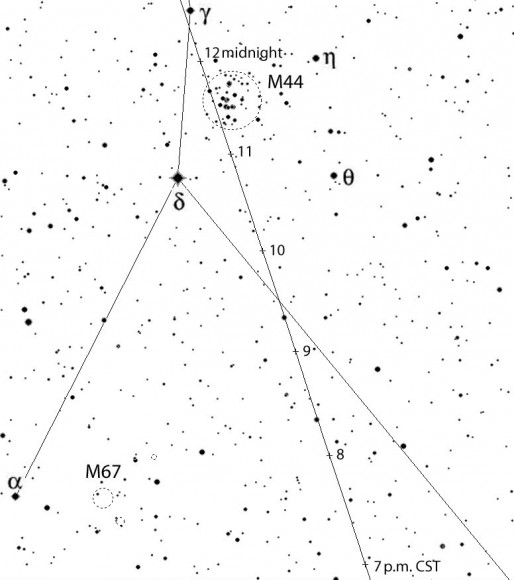
A Black on white chart of asteroid 2004 BL86 crossing to the right of M44. Note that the actual path depends on your location since the chart is based on the center of the Earth. The closer to your horizon the greatest deviation from the path shown. Time Ticks are for CST. Add one hour to them for EST. The Midnight tick mark is 0 h UT or GMT the 27th. Credit Universe Today and created with Chris Marriott’s SkyMap software.
Sky and Telescope has charts that have BL86’s track plotted about 15 minutes ahead of the track above. It is a newer chart, so the asteroid’s position may have been updated. The Sky and Telescope narrative and charts are here.
Results from Jupiter’s early Saturday satellite shadow play
The video live feed from the Griffith Planetarium in Los Angeles was a bust. It suffered from what astronomers call bad seeing. I mean really horrible seeing. Astronomers ascribe at least two qualities to the sky, other than brightness due to the moon or light pollution. That is transparency and seeing. Seeing is the steadiness of the sky. What Jupiter looked like was looking at a small disk at the bottom of a swimming pool while the kids are still playing in it. At first I ascribed it to Jupiter being low in the LA sky, being 3 hours west of here. But it didn’t get better as the night progressed. I could occasionally make out Callisto’s shadow, just because I knew where it’s supposed to be. But that’s it.
However my friend from the Detroit area, Scott Anttila, blessed at least for a while with clearer and calmer skies got some wonderful pictures of the first part of the multiple shadow event.
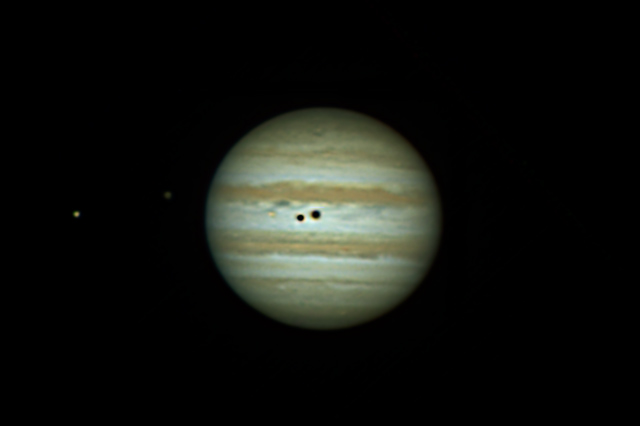
Left to right the shadows of Io and Callisto crossing the face of Jupiter at 12:52 a.m. January 24, 2015. Credit Scott Anttila.
Note that Callisto has a larger shadow than Io. That’s mainly due to it’s greater distance from Jupiter that makes its shadow larger and fuzzier than the closer Io.
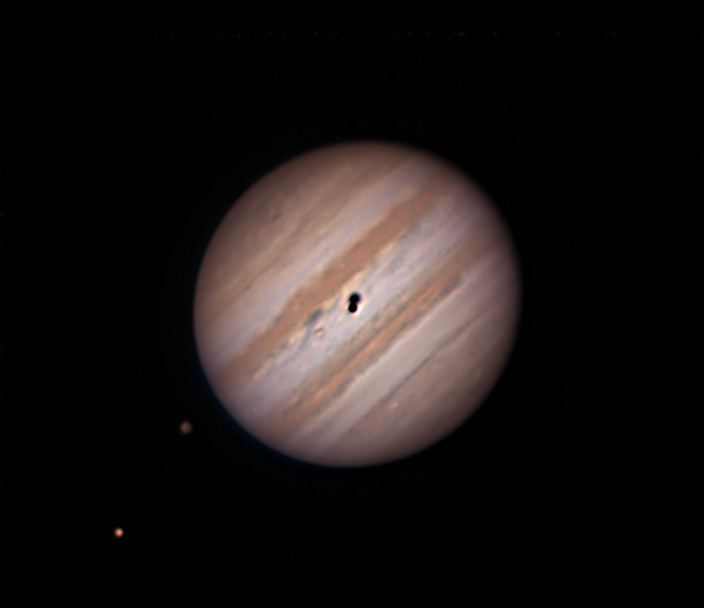
In this picture Io’s shadow has just caught up with Callisto’s shadow. Credit: Scott Anttila.
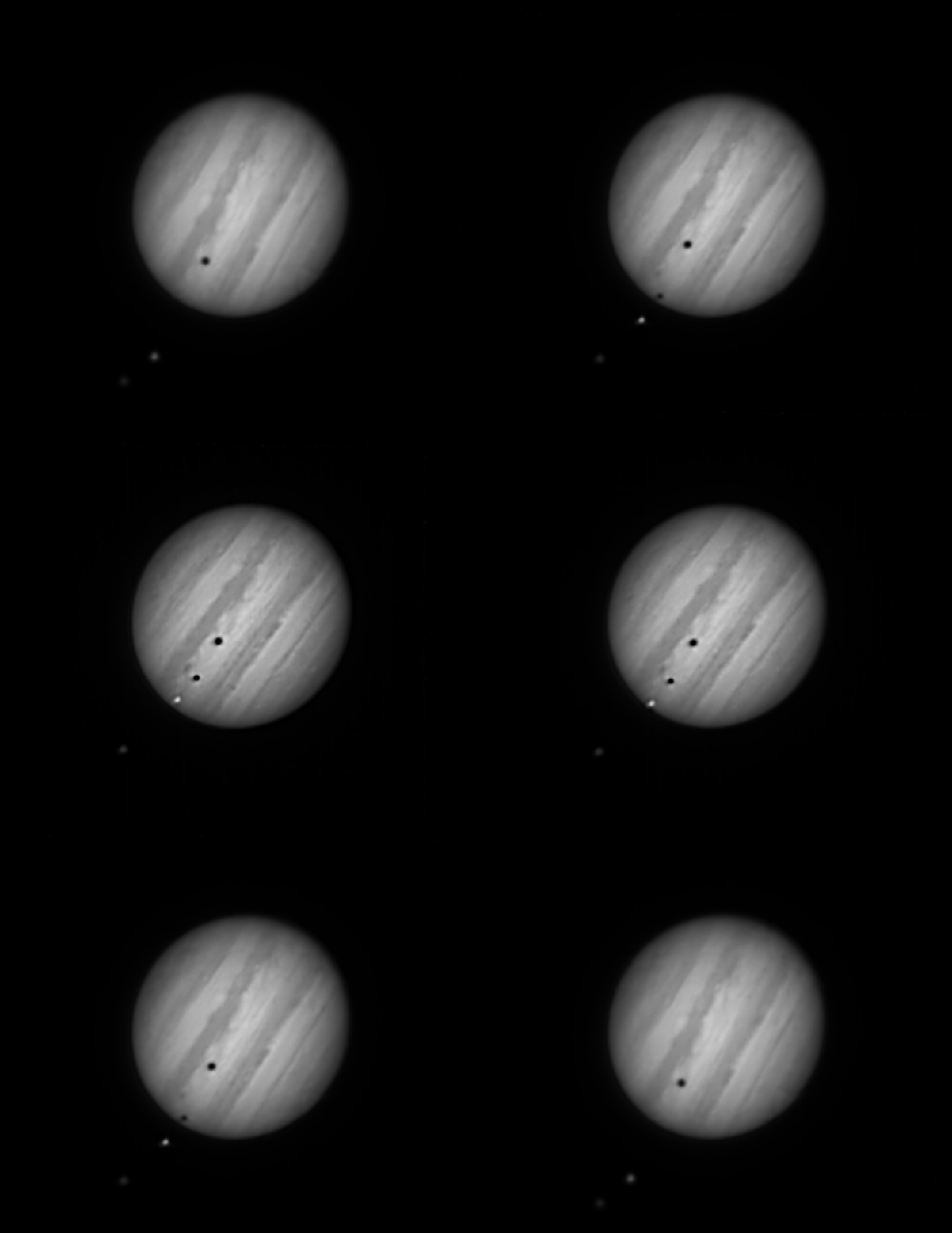
Rocking animation of the early stages of the shadow show on Jupiter. Callisto’s shadow already on the planet while Io’s shadow is just entering. Also Io’s transit is starting, following its shadow on the planet. Credit: Scott Anttila
01/23/2015 – Jupiter will experience three simultaneous total solar eclipses tonight!
Total solar eclipses on Jupiter are nearly a daily occurrence on Jupiter. However what we’ll see is the shadows of the moons crossing the face of the planet. Shadows of the Jovian moons on the fave of Jupiter are difficult to see with small telescopes. The look like tiny inky black dots.
Another way to watch the event is via Griffith Observatory in Los Angeles. The link is here. Their event starts at 11:30 p.m. EST because Jupiter rises later there. The email I received from them says the next triple shadow event on Jupiter won’t occur until 2032,
Here’s the schedule: Moons: I = Io, II = Europa, IV = Callisto; SHA = Shadow, Tra = Transit (a moon crossing disk of Jupiter)
Moon Event      UT Date    hh:mm  EST Date    Time
 IV: Sha start: 24 Jan 2015 3:11  23 Jan 2015  10:11 p.m.
  I: Sha start: 24 Jan 2015 4:36  23 Jan 2015  11:36 p.m.
  I: Tra start: 24 Jan 2015 4:56  23 Jan 2015  11:56 p.m.
 IV: Tra start: 24 Jan 2015 6:20  24 Jan 2015   1:20 a.m.
 II: Sha start: 24 Jan 2015 6:28  24 Jan 2015   1:28 a.m.
 I:  Sha end  : 24 Jan 2015 6:53  24 Jan 2015   1:53 a.m.
 II: Tra start: 24 Jan 2015 7:08  24 Jan 2015   2:08 a.m.
 I:  Tra end  : 24 Jan 2015 7:13  24 Jan 2015   2:13 a.m.
 IV: Sha end  : 24 Jan 2015 8:02  24 Jan 2015   3:02 a.m.
 II: Sha end  : 24 Jan 2015 9:23  24 Jan 2015   4:23 a.m.

Note: All three shadows will be on Jupiter at the same time from 1:28 to 1:53 a.m. EST.
Times provided by the Jevent.exe DOS program downloaded from http://www.projectpluto.com/
Here’s an animation of what the event might look like at half hour intervals look like starting at 9:45 p.m.
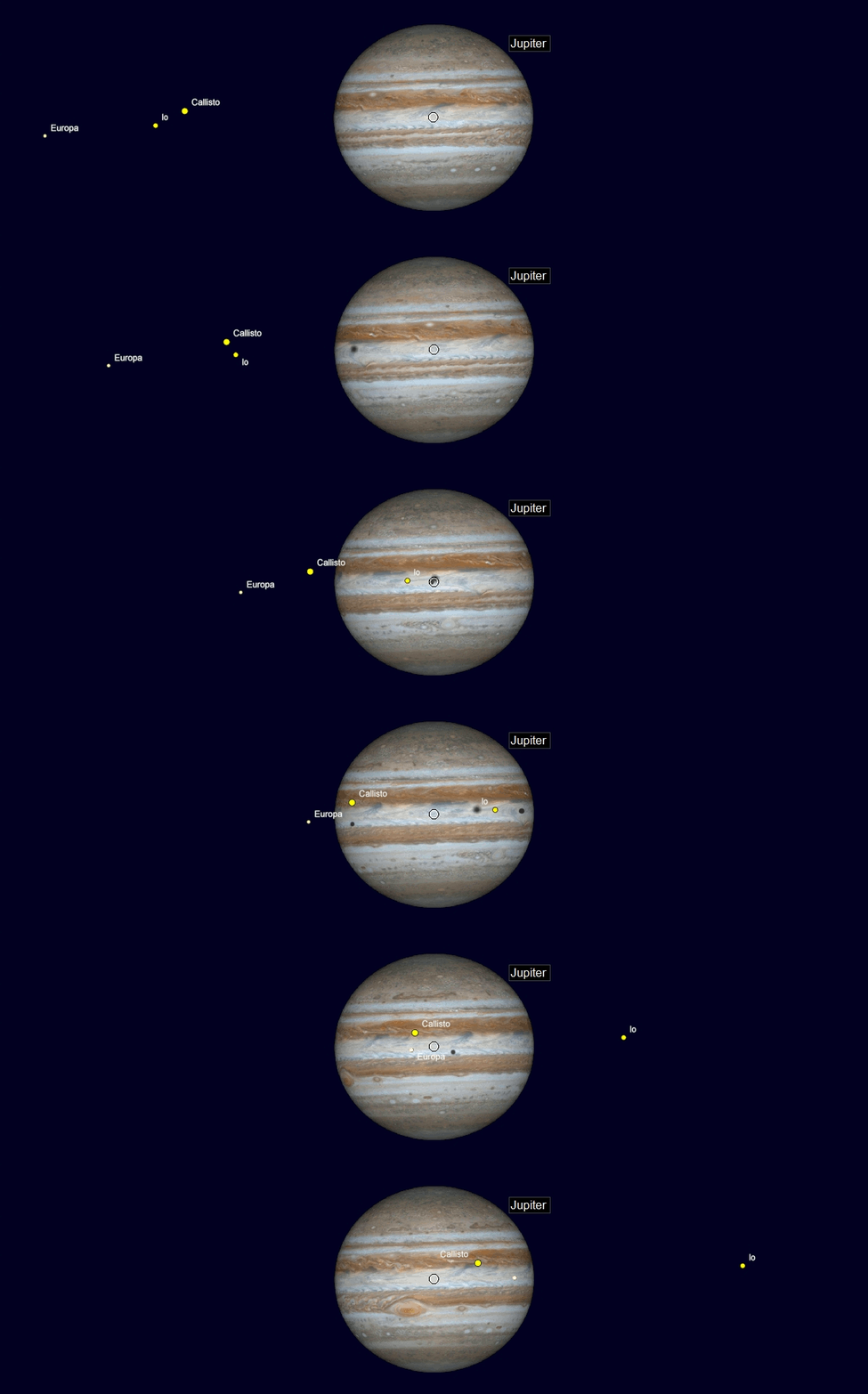
Animation of Jupiter’s satellite shadows starting at 9:45 p.m. and ending at 4:45 a.m. Created using Cartes du Ceil Sky Charts) and GIMP. The circle in the center of Jupiter is an artifact of the program. Click for a larger view.
01/20/2015 – Ephemeris – Keeping track of Comet 2014 Q2 (Lovejoy) and also 15P/Finley unexpectedly brightens
Ephemeris for Tuesday, January 20th. The sun will rise at 8:13. It’ll be up for 9 hours and 21 minutes, setting at 5:34. The moon is new today, and won’t be visible.
Comet 2014 Q2 (Lovejoy) the to use its official name, is now moving through the constellation of Aries the ram, just west or to the right of the Pleiades. Comet Lovejoy is actually visible to the naked eye from a dark location, far from city lights. It appears to be about 4 ½ magnitude, about a bright as the dimmest star in the bowl of the Little Dipper. It’s tail is still only visible in photographs. It appears that Comet Lovejoy is not a very dusty comet. Dust in comets appears to have the size of smoke particles to be affected they way they are by the pressure of sunlight. Larger particles grains are usually invisible and would only become visible then they burn up in the Earth’s atmosphere. No chance with Comet Lovejoy, it will never get closer to the Earth than Mars.
Times are for the Traverse City/Interlochen area of Michigan. They may be different for your location.
Addendum
This is the comet track ending tonight from last Wednesday’s post.
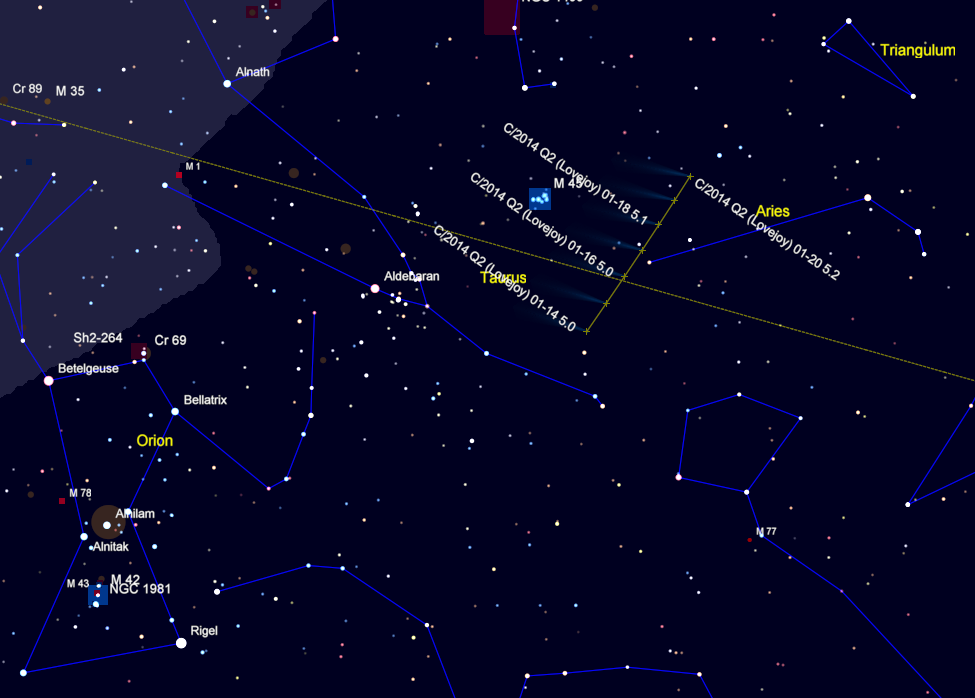
The track of Comet Lovejoy for the week (from 1/14/2015 to 1/20/2015 at 9 p.m.) Created using Cartes du Ceil (Sky Charts).
This is tomorrow’s track for the next week
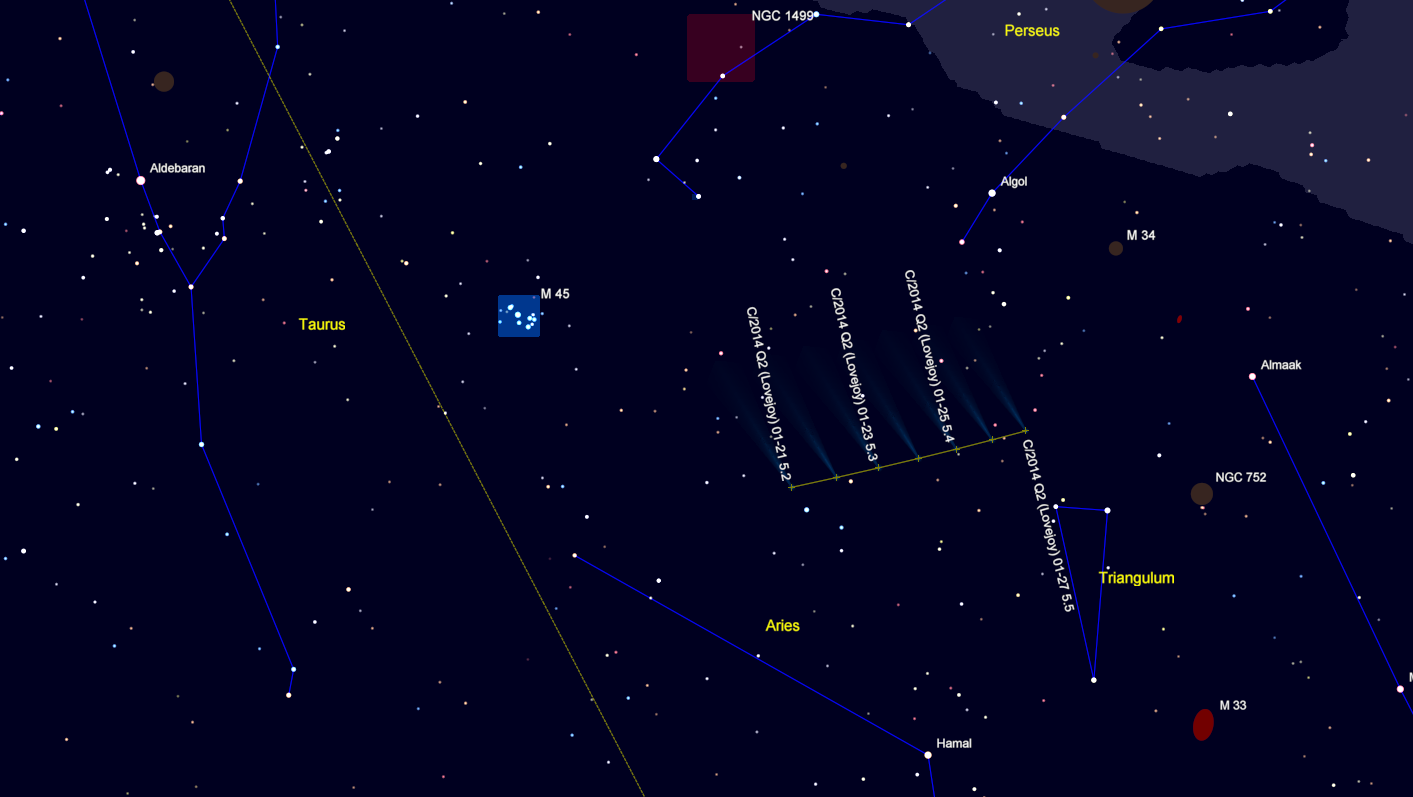
The track of Comet Lovejoy for the next week (from 1/21/2015 to 1/27/2015 at 9 p.m.) Created using Cartes du Ceil (Sky Charts).
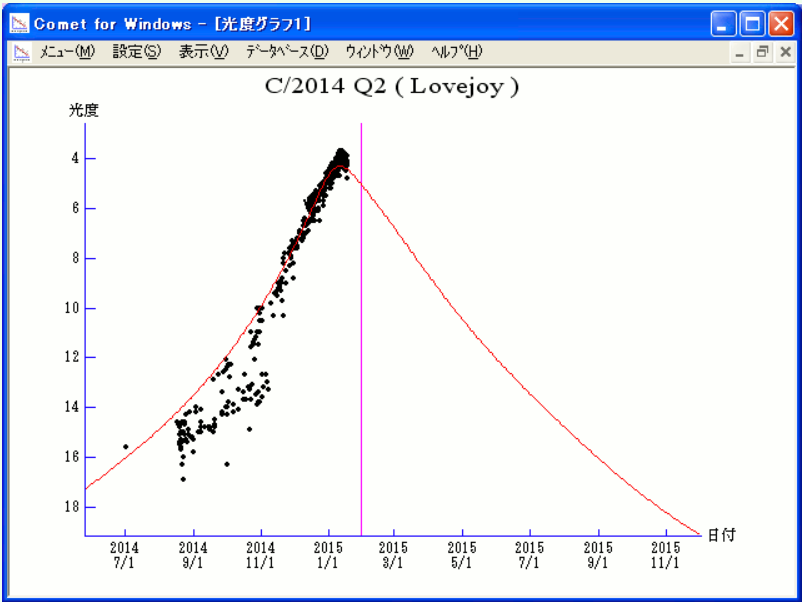
Brightness curve for C/2014 Q2 (Lovejoy). Vertical axis is magnitude, Horizontal axis is date. The orange line is projected magnitude and black dots are actual reported observational estimates of magnitudes. The vertical line in the center is for the date the comet is closest to the sun, perihelion. As of January 18, 2015 Credit: Seiichi Yoshida.
This is a great website for keeping track of observable comets: http://www.aerith.net/comet/weekly/current.html.
Comet 15P/Finley is a very dim comet, usually relegated to large amateur telescopes. However twice on this trip to the inner solar system it has brightened remarkably from being barely visible at magnitude 10 in 3-4 inch telescopes, to 7th magnitude, visible in binoculars. A 3 magnitude jump in brightness means it brightened by some 16 times. Something’s going on!
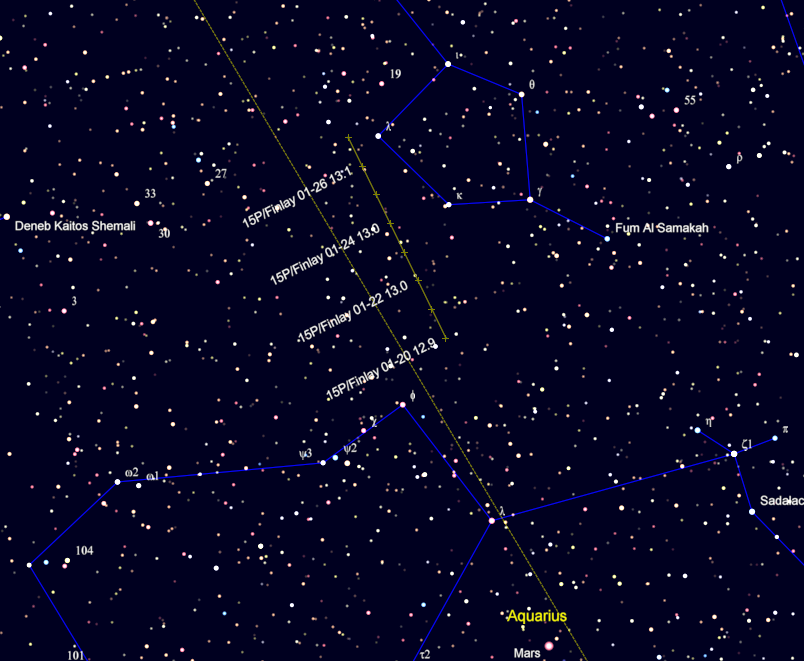
Finder chart for Comet Finley with stars down to 9th magnitude. The 5 sided circle of stars above and right of the track is the “Circlet” of the constellation Pisces. Created using Cartes du Ceil (Sky Charts).
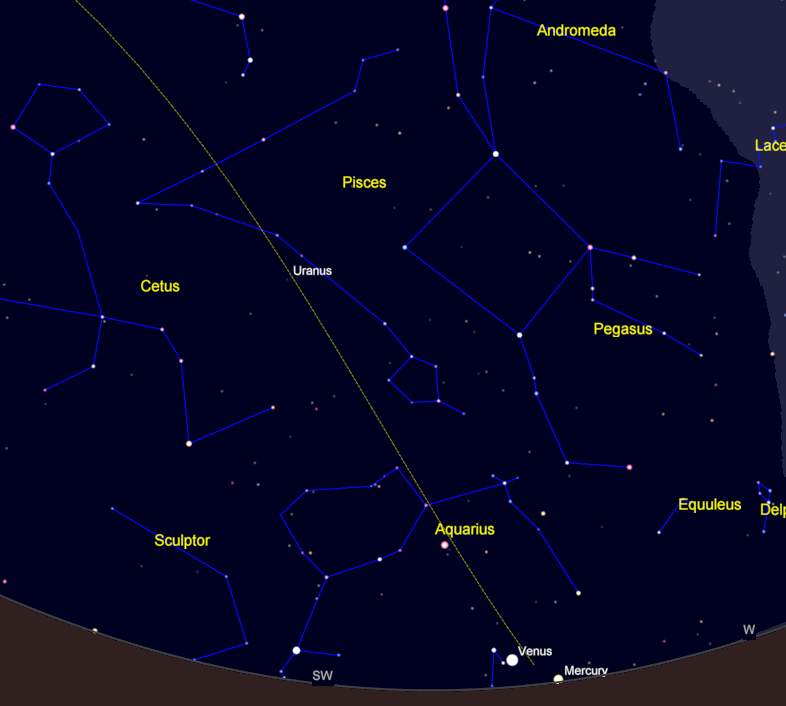
General view of the planets and constellations looking to the southwest at 7 p.m. The comet is not visible in this view. Note that Mars is unmarked under the Aq in Aquarius. Created using Cartes du Ceil (Sky Charts).
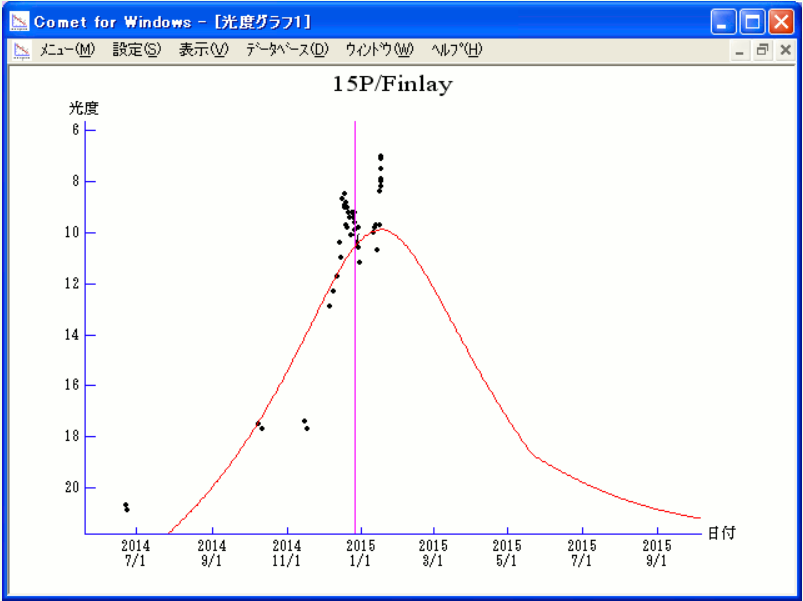
Brightness curve for 15P/Finley. Vertical axis is magnitude, Horizontal axis is date. The orange line is the projected magnitude and black dots are actual reported observational estimates of magnitudes. As of January 18, 2015 Credit: Seiichi Yoshida.
Tip o’ the old observers cap to Universe Today for the heads up.
Here’s your chance to find Neptune – tonight only
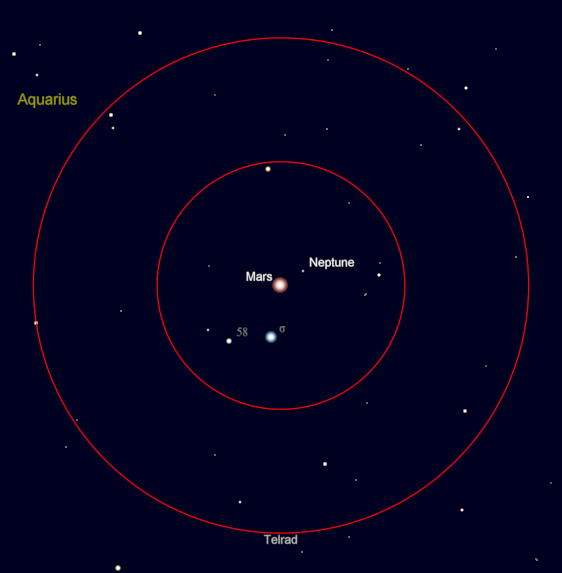
Mars and Neptune tonight only. Here is where Cartes du Ceil (Sky Charts) puts them at 7 p.m. January 19, 2015. They will be low in the southwest. Mars is second magnitude, Neptune is 8th.
The outer red circle matches that of the popular Telrad telescope finder and is a bit smaller (4º) than 7 or 10 power binoculars. The smaller circle is a 2° circle. It will take binoculars at least and a clear sky to spot this outermost planet.
Galileo actually recorded Neptune with his primitive telescope when Jupiter passed it. But to Galileo it was simply a background star.
Note: The 7 p.m. time in the caption is local to western lower Michigan. My location is 43 minutes behind Eastern Standard Time. If you are near your time meridian the time is more likely 6:15 p.m. This normally isn’t a big deal, but These planets are close to setting.
01/13/2015 – Ephemeris – How to find Comet Lovejoy
Ephemeris for Tuesday, January 13th. The sun will rise at 8:17. It’ll be up for 9 hours and 7 minutes, setting at 5:25. The moon, at last quarter today, will rise at 2:03 tomorrow morning.
A new comet has entered the evening sky for northern hemisphere observers. It is best seen in binoculars as a fuzzy blob. Photographs reveals a green comet with a faint wispy tail. It was discovered by Australian amateur astronomer Terry Lovejoy. It’s his 5th comet. Tonight the comet is located in line with the bottom side of the letter V of stars, the head of Taurus the bull, The V is lying on its side and to the right by the width of a fist held at arm’s length will be the fuzzy ball of the head of the comet. Charts for finding the comet can be found on my blog at bobmoler.wordpress.com today and also every Wednesday for the next month or so. Photographs of this beautiful comet can be found on space.com and spaceweather.com among other websites.
Times are for the Traverse City/Interlochen area of Michigan. They may be different for your location.
Addendum
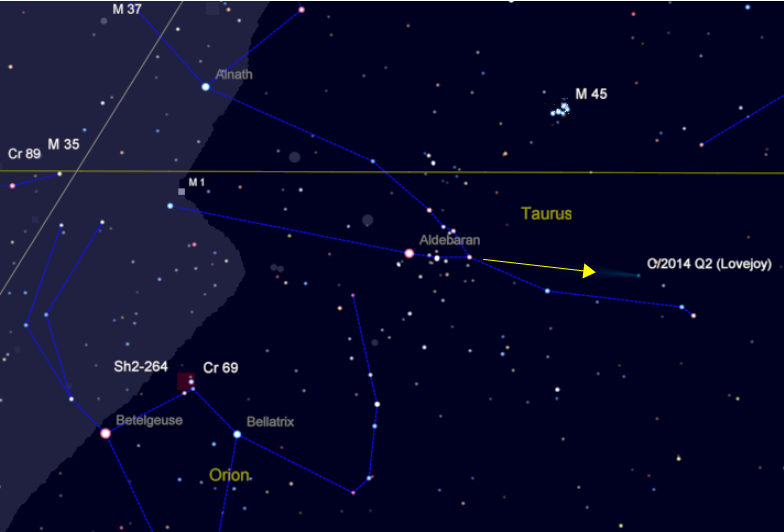
Finding Comet Lovejoy at 9 p.m., January 13, 2015. created using Cartes du Ceil (Sky Charts). Click on image to enlarge.
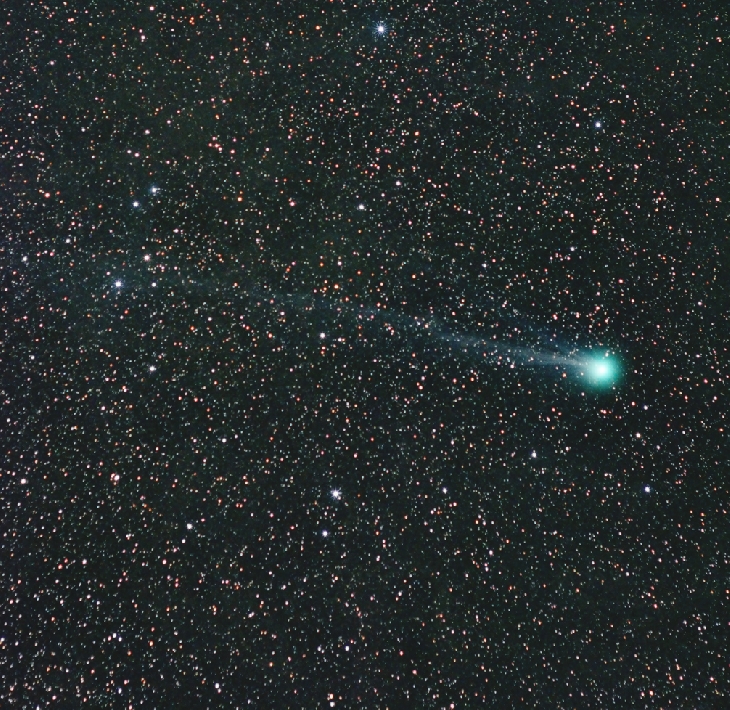
Comet Lovejoy taken by Jan Curtis on January 11, 2015 @ Near Santa Fe, New Mexico. Found on http://www.spaceweather.com. Great photo Jan. Click on image to enlarge.
01/09/2015 – Ephemeris – Tomorrow Mercury almost makes a conjunction with Venus but falls back
Ephemeris for Friday, January 9th. The sun will rise at 8:19. It’ll be up for 9 hours and 1 minute, setting at 5:20. The Moon, 4 days before last quarter, will rise at 10:06 this evening.
Low in the southwest just after sunset, say around 6 to 6:15 in the evening Venus and Mercury can be seen seeming to flirt with one another. Venus has been moving away from the Sun in the evening sky for a couple of month’s not, but hasn’t been all that visible. Mercury, named after the messenger of the gods is fleet of orbit and is almost about to catch up with Venus. Except it can’t, not this time. Tomorrow evening Mercury will appear closest to Venus about 0.6 angular degrees away, a bit more than the width of the Moon. So for another day the two planets will appear close. But after tomorrow night they will separate with Mercury not able to keep up. Next Tuesday it will reach its greatest elongation or separation from the sun and fall back.
Times are for the Traverse City/Interlochen area of Michigan. They may be different for your location.
Addendum
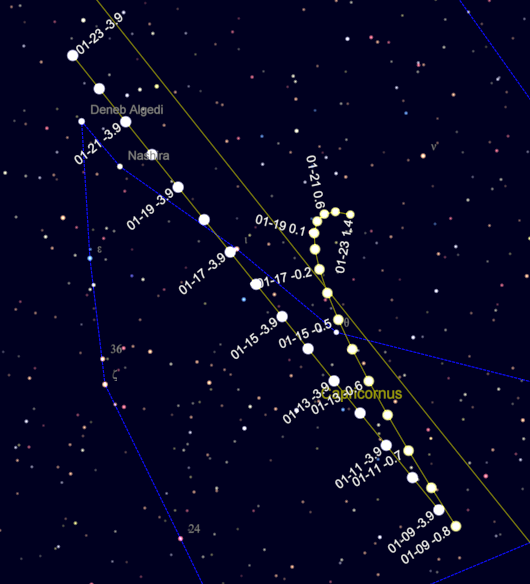
Venus, the straight track, and Mercury are shown for every evening from yesterday 1/08/15 to 01/23/15. The planets are marked for every night at 6 p.m. and tagged every other day. with month-day and magnitude. The higher the magnitude value the dimmer it is. Created using Cartes du Ceil (Sky Charts).
12/31/2014 – Ephemeris – A New Year’s look at the bright planets and a comet
Ephemeris for New Years Eve, Wednesday, December 31st. The sun will rise at 8:19. It’ll be up for 8 hours and 52 minutes, setting at 5:11. The moon, 3 days past first quarter, will set at 4:42 tomorrow morning.
Lets take a last look at the bright planets for 2014. Mercury joins Venus low in the southwest. It will be below and right of Venus and will set at 6:07 p.m. Venus is low in the southwest shortly after sunset. It now sets at 6:26 p.m., an hour and 15 minutes after the sun. It will be seen low in the southwestern twilight by 5:55 p.m. Mars is low in the southwest at 7 p.m. and is in the constellation of Capricornus. The Red Planet will set tonight at 8:36 p.m. Jupiter will rise in the east at 8:33 p.m. It’s near the sickle-shaped head of Leo. Jupiter is now moving slowly westward. This is an effect that happens because the Earth is passing Jupiter, a motion shared by all the planets that baffled the ancients who thought the Earth to be motionless. Early risers will be able to spot Saturn which will rise in the east-southeast at 5:10 a.m.
Times are for the Traverse City/Interlochen area of Michigan. They may be different for your location.
Addendum
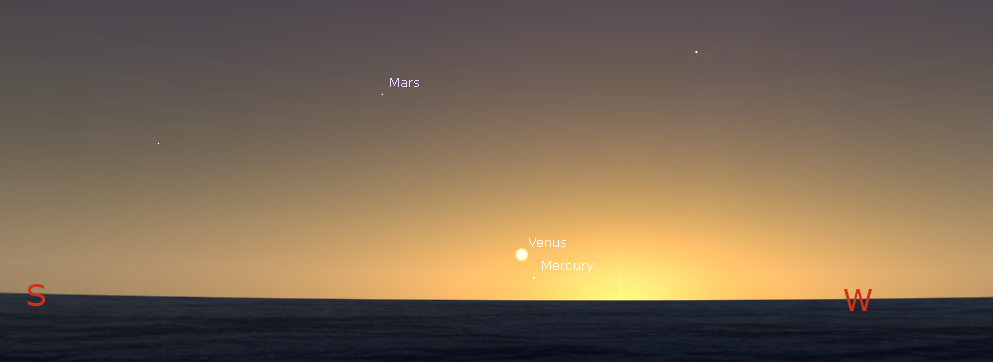
Mercury, Venus and Mars are seen in the southwestern sky shortly after sunset. In this case 5:45 p.m. December 31, 2014, only 34 minutes after sunset. Created using Stellarium.
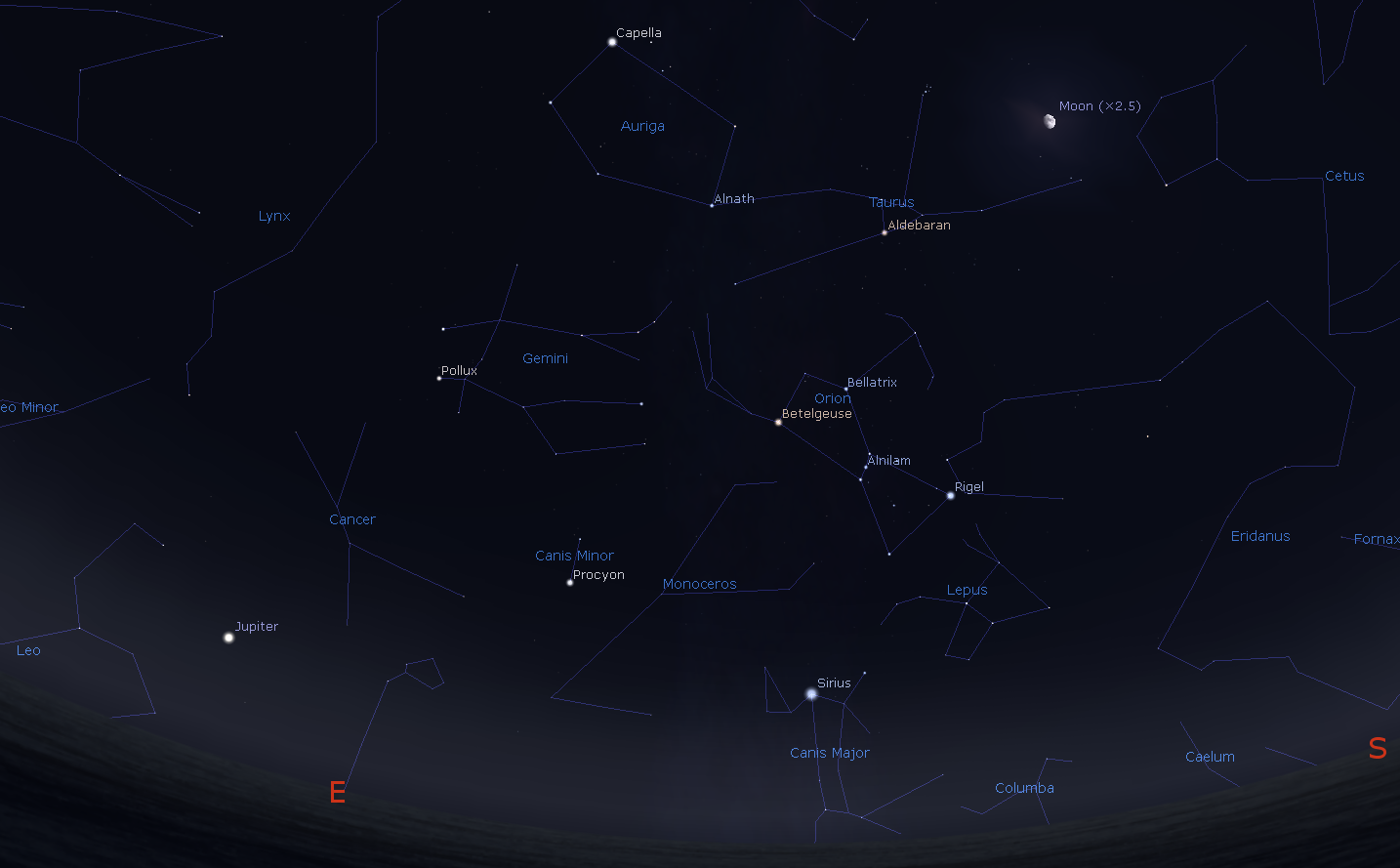
Jupiter, the Moon and the winter constellations at 9:30 p.m. December 31, 2014. Created using Stellarium.
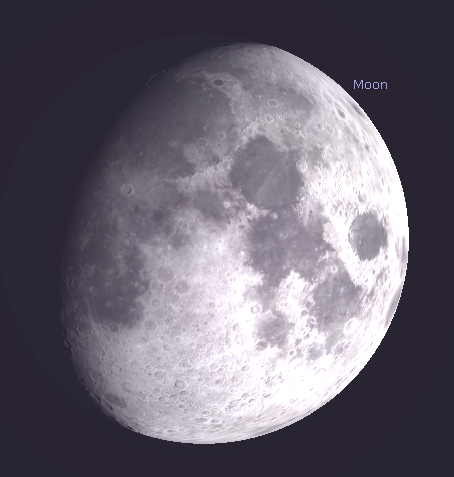
The Moon as it will appear in binoculars at 9:30 p.m. December 31, 2014. Created using Stellarium.
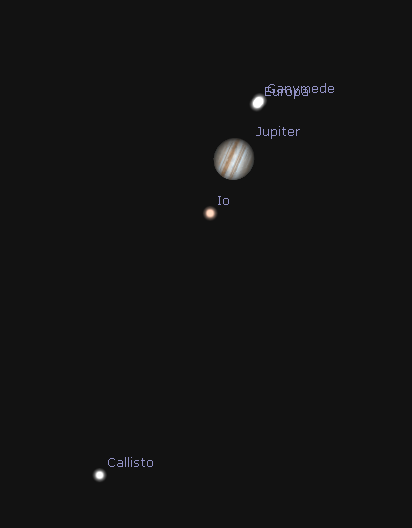
Jupiter seen through a telescope at 9:30 p.m. December 31, 2014. Note that Ganymede and Europa will appear very close to each other. Created using Stellarium.
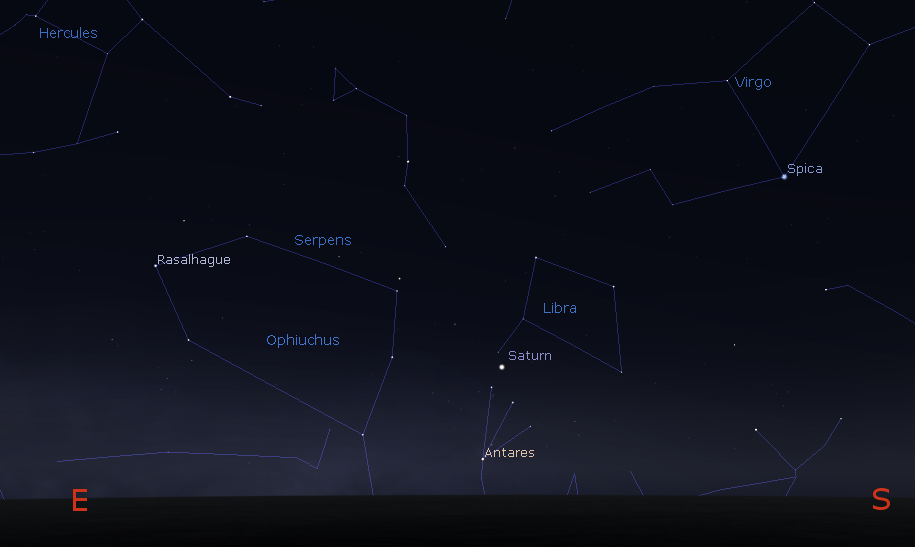
Saturn and the late spring and early summer constellations at 7 a.m. New Year’s Day 2015. Created using Stellarium.
Comet Lovejoy
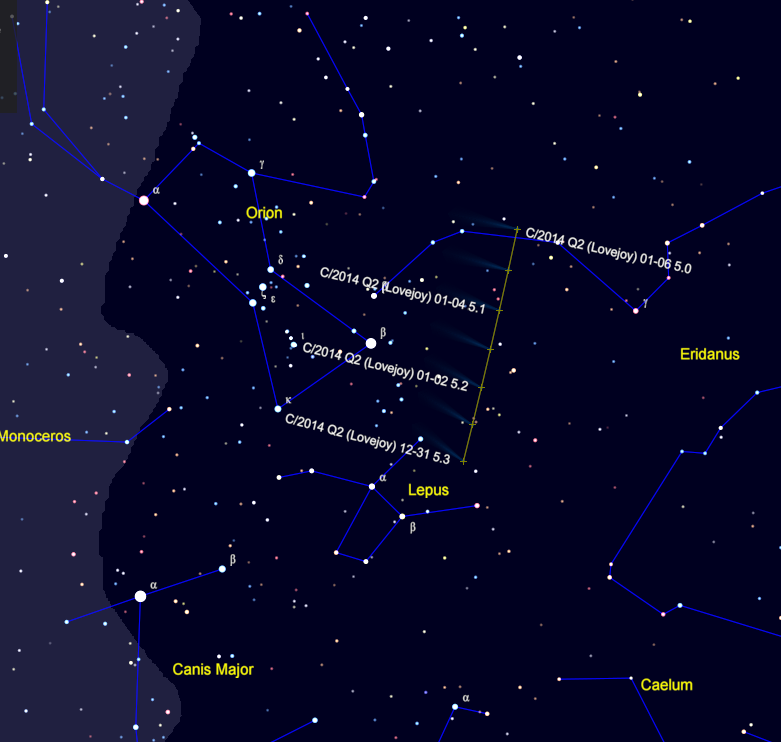
Comet Lovejoy (C/2014 Q2) plotted for 9 p.m. from 12/31/2014 to 1/06/2015. Created using Cartes du Ceil (Sky Charts).
12/12/2014 – Ephemeris – The Geminids will zip through again this weekend
Ephemeris for Friday, December 12th. The sun will rise at 8:10. It’ll be up for 8 hours and 52 minutes, setting at 5:02. The moon, 2 days before last quarter, will rise at 11:19 this evening.
The Geminid meteor shower will reach its peak early Sunday morning, however the bright moon , rising after midnight will interfere. The Geminids, however do have a number of really bright fireballs for which the Moon won’t matter. The good news is that the Geminids will be visible all night. You don’t have to wait until the morning hours to see them. So around midnight Saturday night will probably be the best time to see them. Also the shower has a broad peak and there may be another peak on Monday or Tuesday night and morning. The peak numbers per hour for the Geminids will be close to 120. That’s the best for any year in and year out shower. To bad it occurs in such a cloudy month.
Times are for the Traverse City/Interlochen area of Michigan. They may be different for your location.
Addendum
The numbers of Geminids are already rising.

NASA’s Meteoroid Environment Office plots of fireball orbits for the night of December 10-11, 2014. The large number of yellow orbits oriented toward 2 o’clock are Geminids. Check spaceweather.com for each day’s fireball orbits. This plot includes 22 Geminid fireballs. Credit NASA via Spaceweather.com
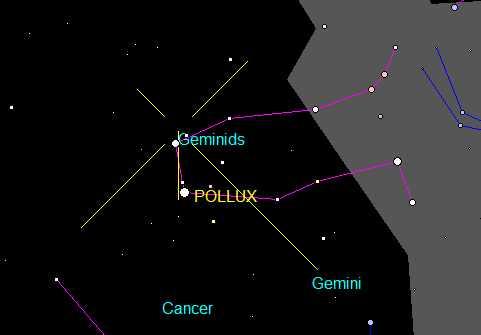
Geminid Radiant
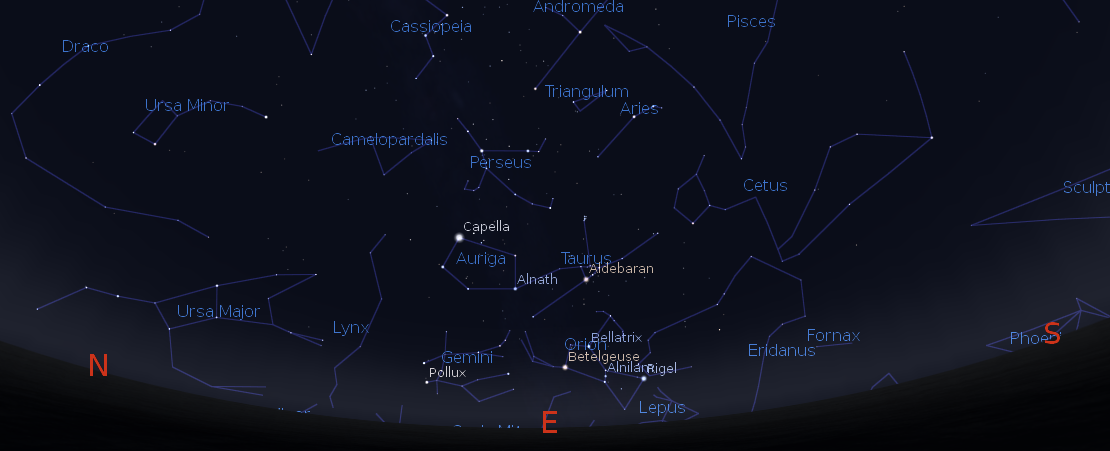
The Eastern sky got the Geminid meteor shower at 8 p.m. December 13, 2014. Created using Stellarium.
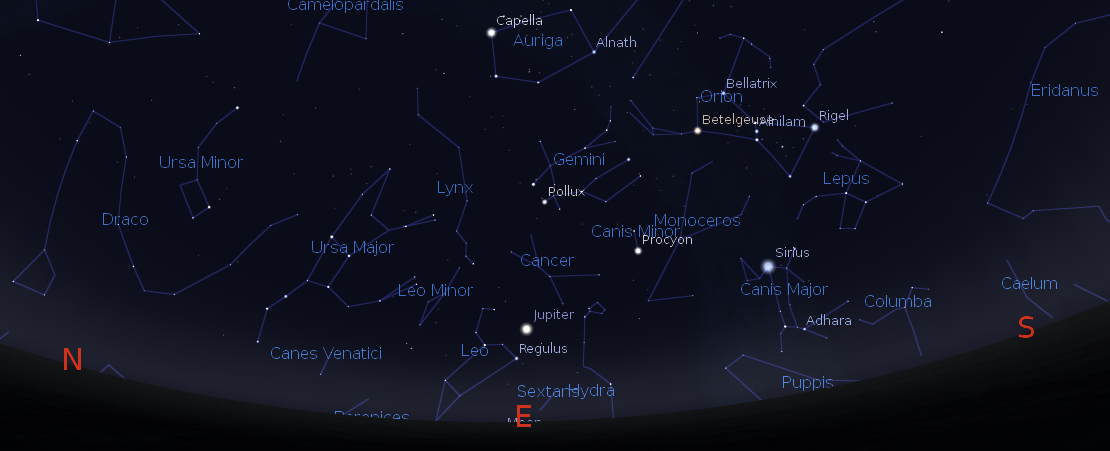
The Eastern sky got the Geminid meteor shower at midnight December 14, 2014. Created using Stellarium.
Remember Geminids can be seen all over the sky. It’s their streaks that can be extended back to the radiant.

