Archive
12/11/2014 – Ephemeris – The Geminid meteors will reach peak numbers Saturday night to Sunday morning
Ephemeris for Thursday, December 11th. The sun will rise at 8:09. It’ll be up for 8 hours and 53 minutes, setting at 5:02. The moon, 3 days before last quarter, will rise at 10:21 this evening.
This weekend is the peak of the Geminid meteor shower. It is the best meteor shower of the year and it is getting more active over the years. The projected peak numbers is 120 meteors an hour spotted by a single observer when the radiant of the shower is overhead. It’s known as the zenithal hourly rate (ZHR). Anyway, the radiant is the point in space where the meteors seem to come from, which is near the star Castor in the constellation Gemini from which the shower gets its name. The meteors will be seen all over the sky, but they all can be traced back to the radiant. The body responsible for this meteor shower is an asteroid rather than a comet. It comes very close to the sun, so may crumble due to heat stress. I suppose I can’t resist this: That’s how the asteroid crumbles.
Times are for the Traverse City/Interlochen area of Michigan. They may be different for your location.
Addendum
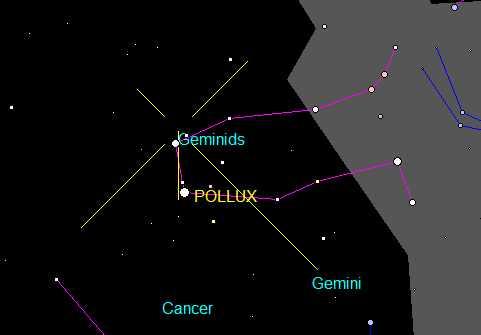
Geminid Radiant. From my LookingUp program.
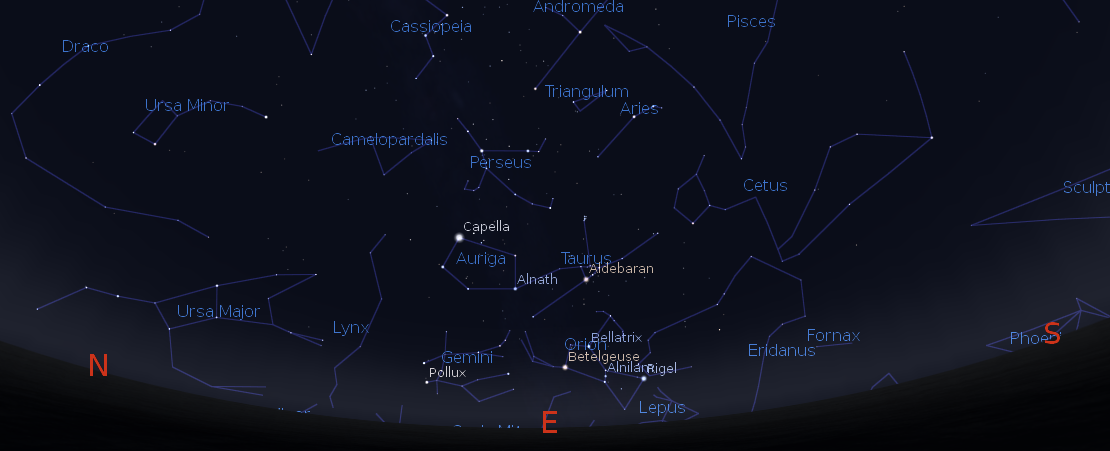
The Eastern sky got the Geminid meteor shower at 8 p.m. December 13, 2014. Created using Stellarium.
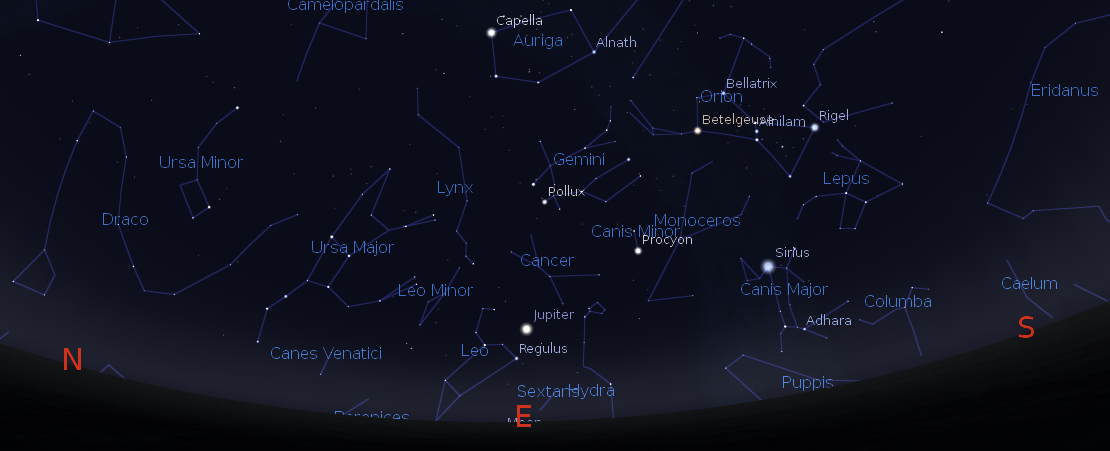
The Eastern sky got the Geminid meteor shower at midnight December 14, 2014. Created using Stellarium.
The Stellarium charts differ from mine at top in how the constellation lines are drawn, especially Gemini. In all charts Castor is not labeled. However it is the bright star above Pollux. The meteors will will appear all over the sky, but true Geminids can be traced back near Castor. Also when the radiant is lowest in the sky, thought the numbers of meteors will be low, the brighter meteors will produce long streaks, since the will hit our atmosphere at a glancing angle.
11/26/2014 – Ephemeris – Where did all the planets go?
Ephemeris for Wednesday, November 26th. The sun will rise at 7:53. It’ll be up for 9 hours and 12 minutes, setting at 5:06. The moon, 3 days before first quarter, will set at 9:41 this evening.
In reviewing which planets are visible tonight, it looks like we’re down to two. Venus, Saturn and Mercury are hanging around near the direction of the Sun. It will be a while before we see them again. However we can see Mars, which will be low in the southwest at 7 p.m. It will set at 8:29 p.m. Mars’ setting time will slowly advance only 6 minutes between now and the end of the year. Jupiter will rise at 10:54 p.m. in the east-northeast. The best telescopic views will have to wait a couple of hours after that. So if you’re more of an early bird rather than a night owl it might be better to view Jupiter with a telescope in the morning. Jupiter has those four bright moons that change position daily, and sometimes while you watch.
Times are for the Traverse City/Interlochen area of Michigan. They may be different for your location.
Addendum
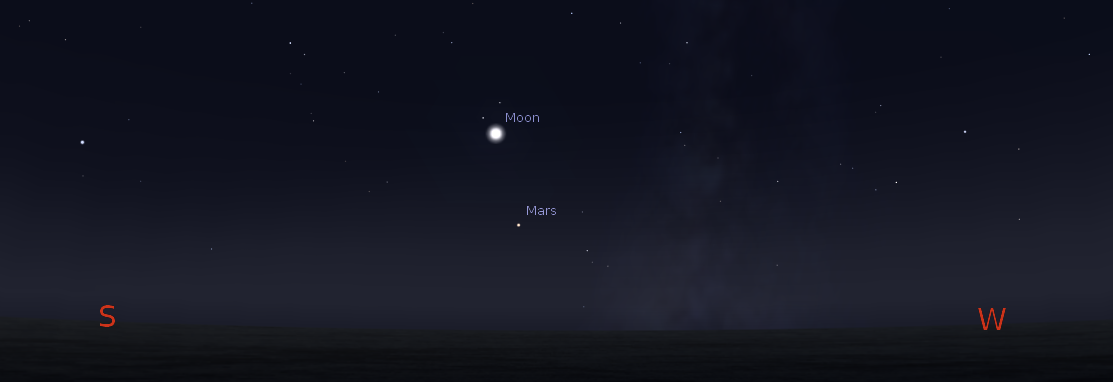
Mars with the crescent Moon at 7 p.m. on November 26, 2014. Created using Stellarium.
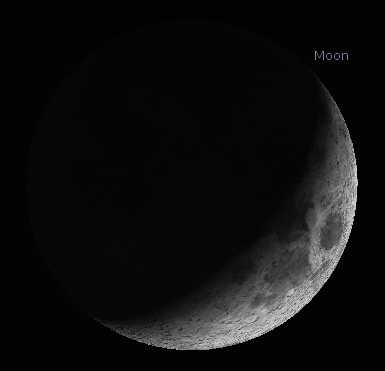
The crescent moon as it would appear in binoculars at 7 p.m. on November 26, 2014. Created using Stellarium.
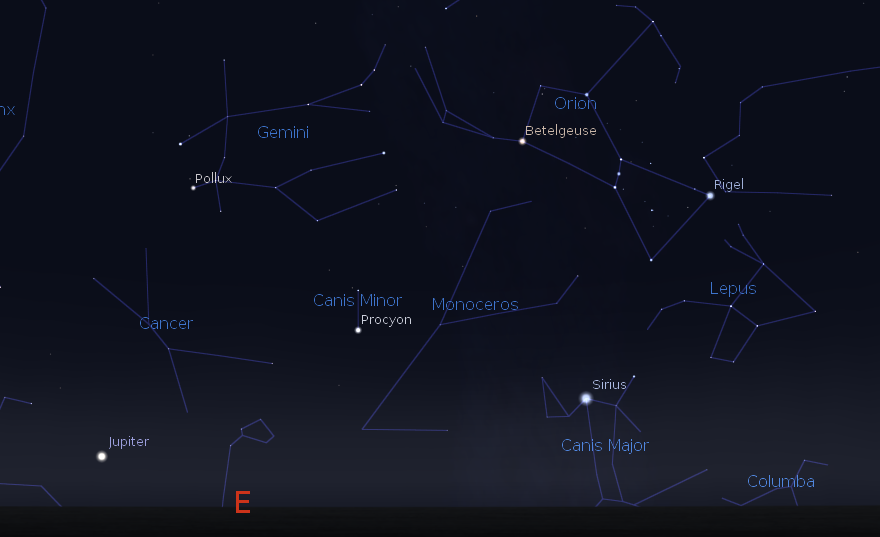
Jupiter rising with the winter constellations at 11:30 p.m. on November 26, 2014. Created using Stellarium.
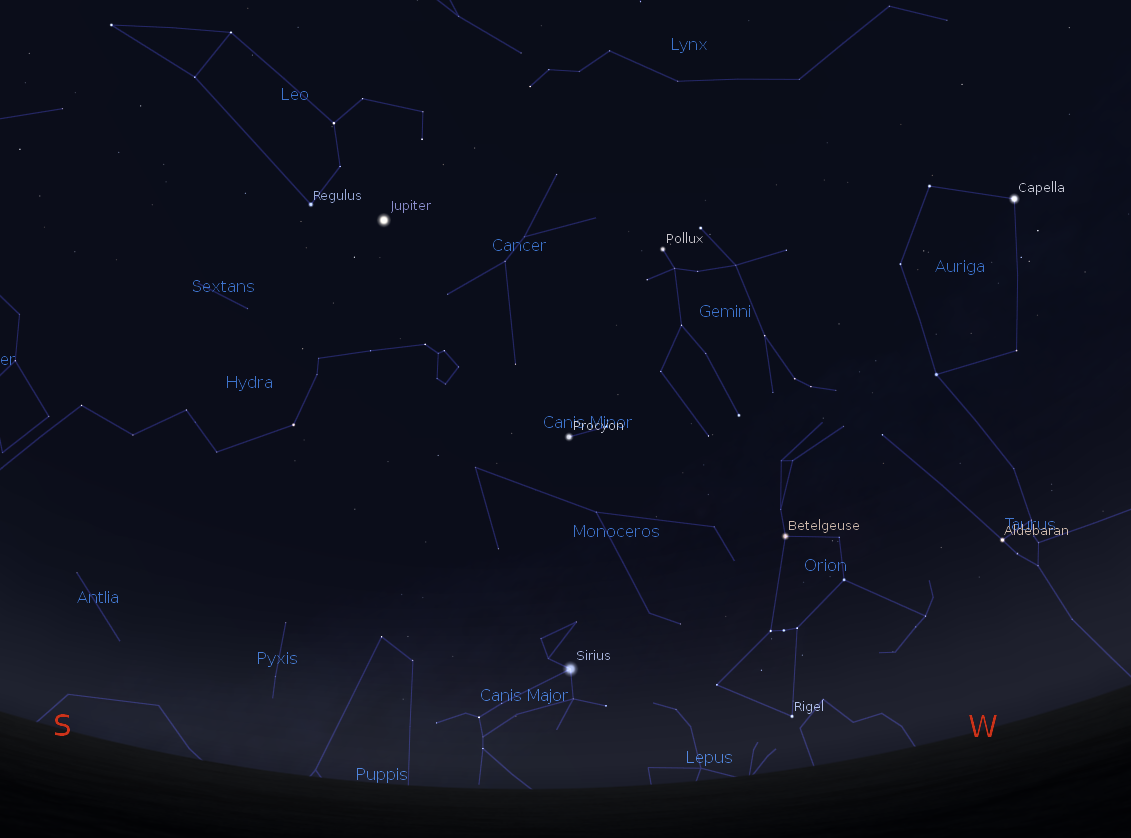
Jupiter with the winter constellations at 6:30 a.m. on November 27, 2014. Created using Stellarium.
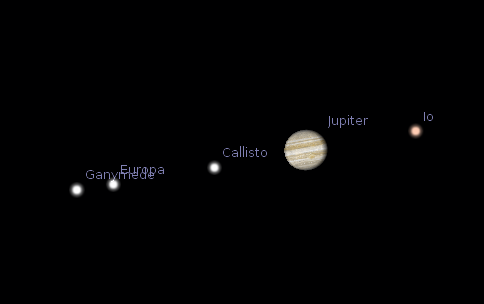
Jupiter as seen in a telescope at 6:30 a.m. on November 27, 2014. Created using Stellarium.
11/03/2014 – Ephemeris – Mercury is now visible in the morning
Ephemeris for Monday, November 3rd. The sun will rise at 7:22. It’ll be up for 10 hours and 5 minutes, setting at 5:28. The moon, 3 days before full, will set at 4:35 tomorrow morning.
When I talk about the planet Mercury I usually use the adjective elusive. There’s a good reason for that. Mercury is always close to the sun, being the innermost planet, and it has the most eccentric orbit of all the planets. Due to our location on the northern hemisphere of the Earth Mercury is best visible on autumn mornings and spring evenings. These two views, 6 months apart, means that we, at both times are looking at the same part of Mercury’s orbit, but from opposite sides. The part of Mercury’s orbit we see is the part of its orbit closest to the sun, so the angular separation is not very wide, 19 degrees this elongation. Observers in the southern hemisphere whose seasons are opposite ours have a much better view. For them Mercury is at its farthest from the sun, and they get elongations of over 25 degrees.
Times are for the Traverse City/Interlochen area of Michigan. They may be different for your location.
Addendum
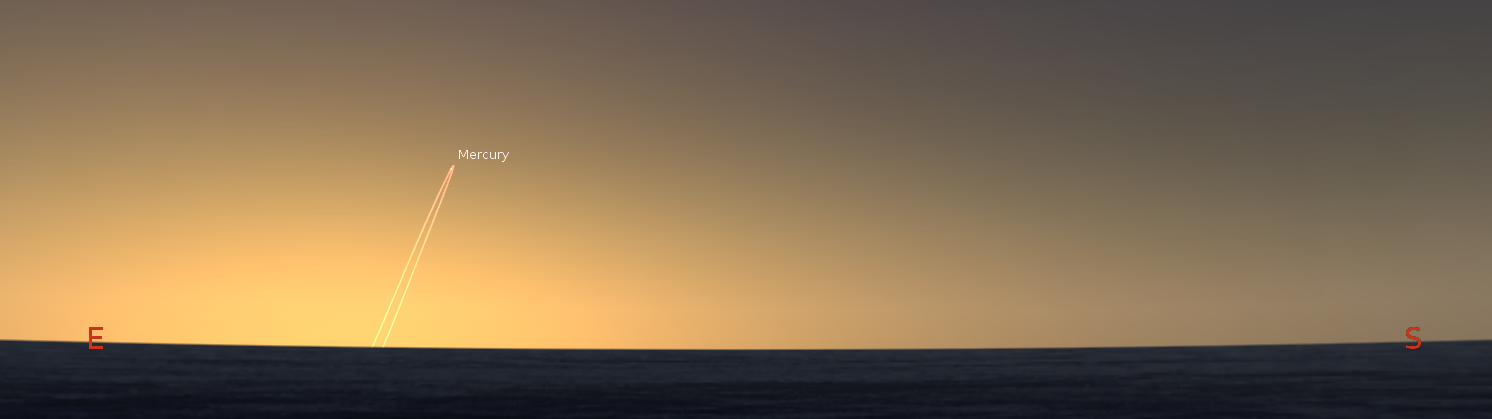
Mercury at 7 a.m. November 3, 2014 showing its orbit. Created using Stellarium.
09/26/2014 – Ephemeris – Mars meets its rival
Ephemeris for Friday, September 26th. The sun will rise at 7:34. It’ll be up for 11 hours and 58 minutes, setting at 7:32. The moon, 2 days past new, will set at 8:45 this evening.
The planet Mars and the bright star Antares will appear at their closest tomorrow night. The name of the star Antares means “Rival of Mars”. “Ant” meaning anti, “Ares”, the Greek equivalent to the Roman god Mars. This is about a 26 month recurrence, give or take. Usually Mars is way brighter than Antares, or way dimmer. This time Mars and Antares are the same brightness. Both planet and star have the same color, kind of a faded orange color, made redder by being low in our sky which drains even more of the blue out. The reason Mars is red is that its surface is rusty. Antares is another matter. It is a cool red giant star. Well, cool on the outside by hotter than the sun’s interior on the inside where it’s changing helium into carbon and oxygen for power. Hint: Mars is always on top. Also tomorrow night the crescent Moon will be just to the right of Saturn.
Times are for the Traverse City/Interlochen area of Michigan. They may be different for your location.
Addenda
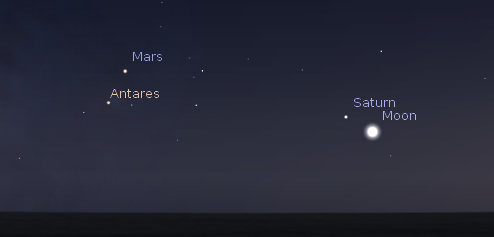
Mars appears its closest to Antares. Here seen low in the southwest at 8:30 p.m. on September 27, 2014. The Moon, near Saturn is too small to show a phase. Created using Stellarium.
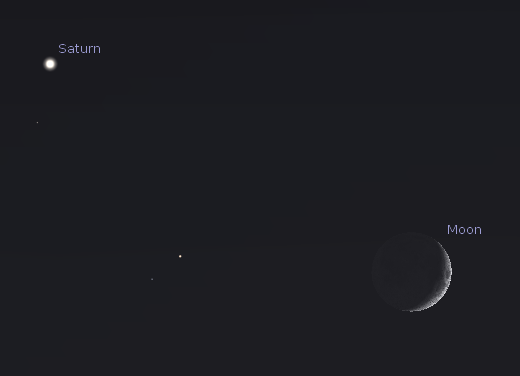
Saturn with the crescent moon. Earthshine may still be visible on the three day old Moon’s night side. Created using Stellarium.
Acme Fall Festival
The Grand Traverse Astronomical Society will be at the Acme Fall Festival at Flintfields Horse Park on Bates Rd, North of M72, which runs from 10 a.m. to 4 p.m. Saturday the 27th. The society will bring telescopes, including the 25 inch Dobsonian telescope and the Solar Telescope to view the Sun in white light and the light of the element hydrogen. There will also be exhibits and free stuff from NASA for the kids.
08/18/2014 – Ephemeris – Scanning the Milky Way in Scutum
Ephemeris for Monday, August 18th. The sun rises at 6:48. It’ll be up for 13 hours and 54 minutes, setting at 8:43. The moon, 1 day past last quarter, will rise at 1:37 tomorrow morning.
The teapot pattern of stars that is the constellation of Sagittarius lies at the southern end of the Milky Way this evening. It appears that the Milky Way is steam rising from the spout. The area above Sagittarius in the brightest part of the Milky Way is the dim constellation of Scutum the shield. Don’t bother looking for the stars that make up the constellation; what’s important is the star clouds of the Milky Way. Scan this area with binoculars or small telescope for star clusters and nebulae or clouds of gas. In binoculars both clusters and nebulae will appear fuzzy, but a small telescope will tell most of them apart. Even if you’ve never been able to find anything in your telescope, use your lowest power and scan.
Times are for the Traverse City/Interlochen area of Michigan. They may be different for your location.
Addendum
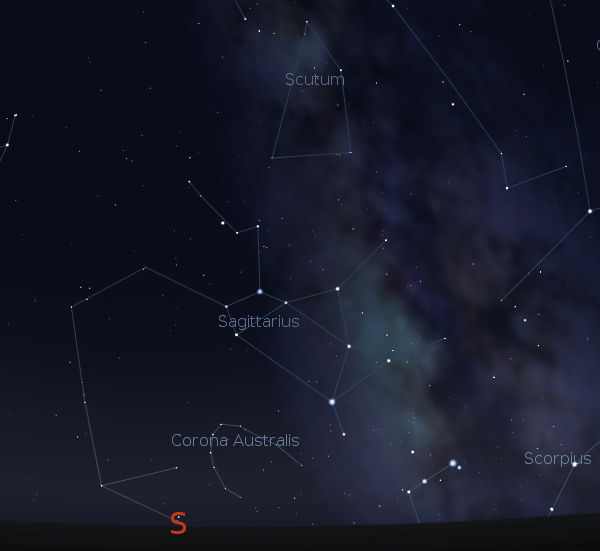
The constellations Sagittarius and Scutum. Created using Stellarium.
08/14/2014 – Ephemeris – The Milky Way now spans the sky in the evening
Ephemeris for Thursday, August 14th. The sun rises at 6:43. It’ll be up for 14 hours and 5 minutes, setting at 8:49. The moon, 3 days before last quarter, will rise at 10:58 this evening.
We’ll get a bit of darkness tonight, but it will be the start of about two weeks of the best sky viewing of the year. Now is the time the summer Milky Way is displayed to its fullest to the southern horizon. City folk come to our area and are sometimes fooled by the brightness and expanse of the Milky Way and think it’s clouding up. Yes those are clouds indeed, but they are star clouds. Binoculars will begin to show them to be millions of stars, each too faint to be seen by themselves to the unaided eye, but whose combined glow give the impression of a luminous cloud. Binoculars are the ideal tool to begin to explore the Milky Way. Objects still too fuzzy can be checked out with a telescope to reveal their true nature.
Times are for the Traverse City/Interlochen area of Michigan. They may be different for your location.
Addendum
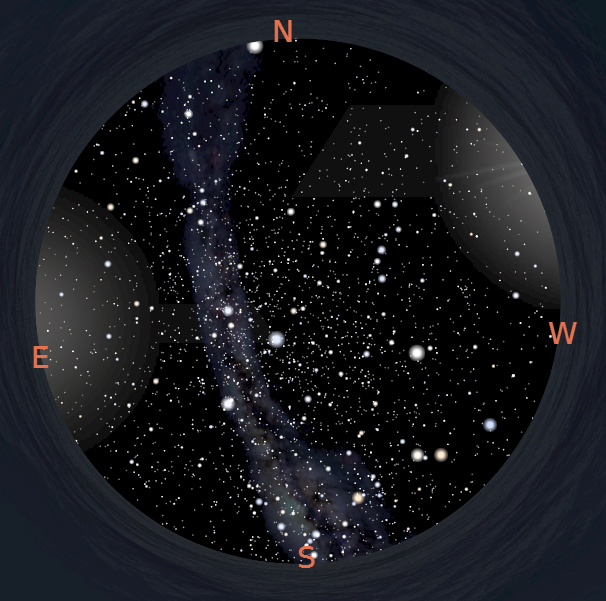
The Milky Way at 10 p.m. on August 14, 2014. Residual glow in the west is from the Sun, to the east is for the Soon to rise Moon. There is also an odd artifact connected to the solar glow. Created using Stellarium.
08/12/2014 – Ephemeris – Comet Swift-Tuttle progenitor of the Perseid meteors
Ephemeris for Tuesday, August 12th. The sun rises at 6:41. It’ll be up for 14 hours and 11 minutes, setting at 8:52. The moon, 2 days past full, will rise at 9:50 this evening.
The Perseid meteor shower will reach its peak later this evening. The moon will still interfere with all but the brightest meteors. The meteors are caused by bits of sand grain to pea sized rubble given off by Comet Swift-Tuttle on past runs through the inner solar system. As comets go Comet Swift-Tuttle is large, with a nucleus of some 16 miles (26 km) in diameter. Comet Halley’s nucleus is half that and Churyumov–Gerasimenko’s nucleus that ESA’s Rosetta spacecraft is now orbiting is half Halley’s. Despite the wear and tear that a comet’s nucleus must endure when coming close to the Sun, the distribution of debris to give us a pretty even annual meteor shower means the comet has been near its present orbit for a very long time.
Times are for the Traverse City/Interlochen area of Michigan. They may be different for your location.
Addendum
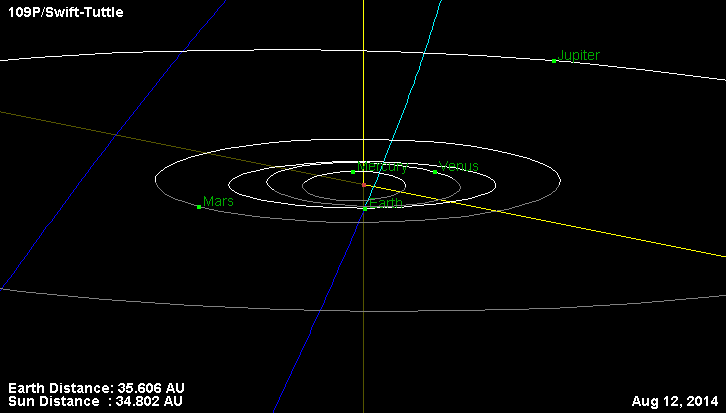
Orbit of Comet 109P/Swift-Tuttle. Blue line is the comet’s orbit, coming from above. Credit NASA / JPL / Applet by Osamu Ajiki (AstroArts), and further modified by Ron Baalke (JPL)
Link to the animation from which the above image was taken and other information on Comet Swift-Tuttle go to http://ssd.jpl.nasa.gov/sbdb.cgi?sstr=109P;cad=1
07/28/2014 – Ephemeris – One meteor shower is at peak and another is ramping up.
Ephemeris for Monday, July 28th. The sun rises at 6:24. It’ll be up for 14 hours and 48 minutes, setting at 9:12. The moon, 2 days past new, will set at 9:46 this evening.
We have a couple of meteor showers of note coming up. The first is the Southern Delta Aquarids which will peak on the 30th. The radiant point for these meteors will rise around midnight in the southeast. Their numbers and their brightness are not very great. The Perseid meteor shower will have the misfortune to coincide with the full moon on August 12th and 13th, drowning out all but the brightest meteors. However the Perseids have a long run up to their peak, so their numbers will grow after the moon sets until the moon sets in morning twilight. The Perseid radiant is circumpolar for Northern Michigan, meaning it never sets, so some Perseid meteors can always be seen at night. Their radiant will be in the northeastern sky in the evening.
Times are for the Traverse City/Interlochen area of Michigan. They may be different for your location.
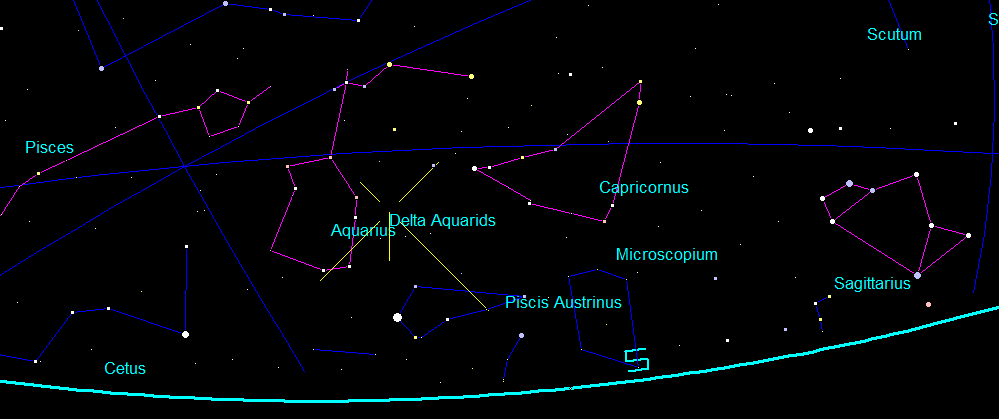
Approximate Radiant of the South Delta Aquarid meteor shower. The radiant does move over the several weeks of the shower to the east. Created using my LookinUp program.
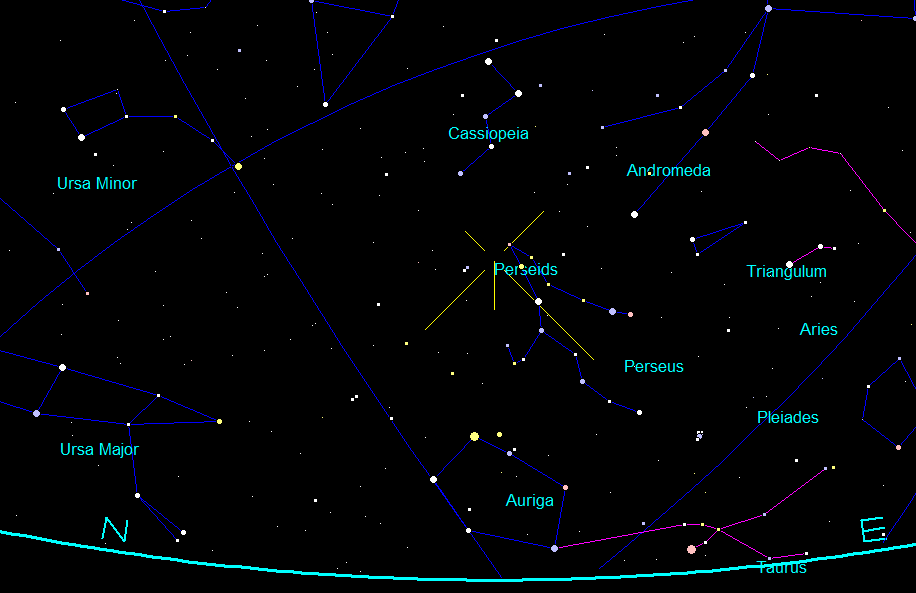
The Perseid meteor shower radiant a about 2 a,m, during the period of the shower. Created using my LookingUp program.
07/10/2014 – Ephemeris – Why is the bright Moon so low in summer and so high in winter?
Ephemeris for Thursday, July 10th. Today the sun will be up for 15 hours and 20 minutes, setting at 9:28. The moon, 2 days before full, will set at 5:22 tomorrow morning. Tomorrow the sun will rise at 6:08.
If you watch the moon for the next few nights, you won’t have to strain your neck because the moon at its highest will be less than 30 degrees above the southern horizon for us in northern Michigan. That’s because the moon closely follows the path of the sun in the sky, called the ecliptic, with a deviation of only 5 degrees maximum. Tonight it’s a couple of degrees north of the ecliptic. Tonight it’s located about where the sun was back last November or will be next November. In winter you’d swear that the full moon at its greatest height was practically overhead. It’s another effect of the Earth’s axial tilt of 23 ½ degrees. Our moon is odd in it doesn’t orbit the Earth’s equator like most large moons do for their planets.
Times are for the Traverse City/Interlochen area of Michigan. They may be different for your location.
Addendum
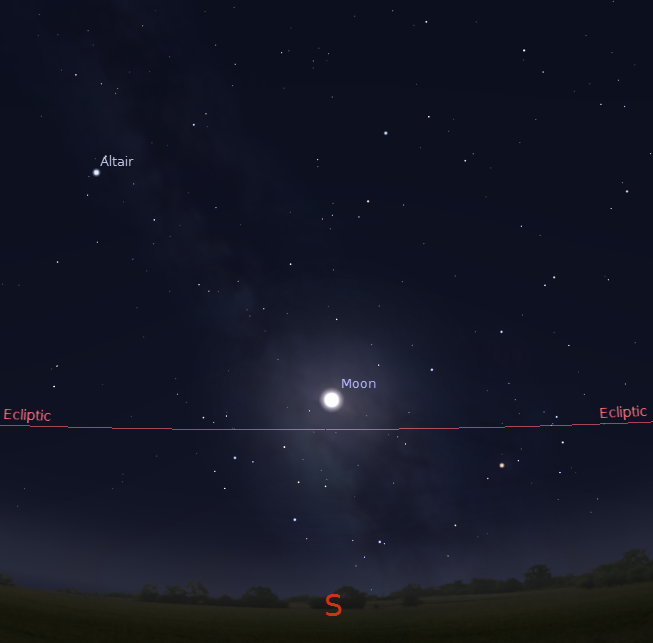
The full Moon on July, 12, 2014. Created using Stellarium.
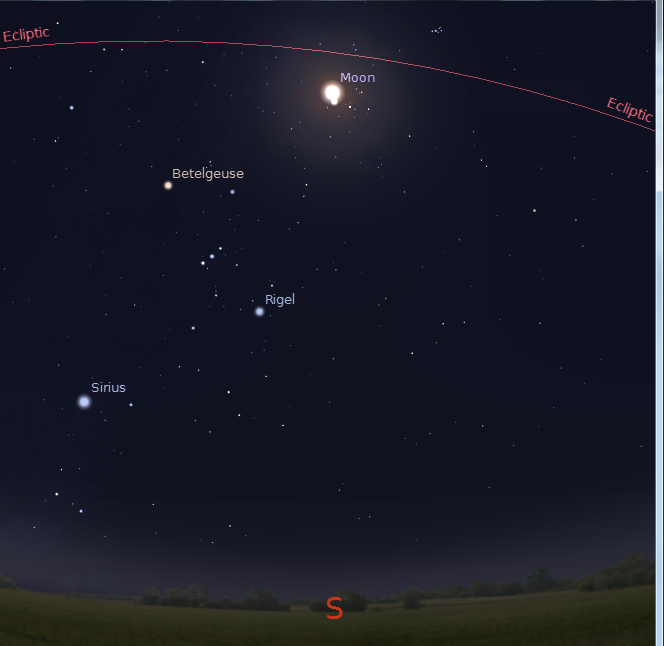
The full Moon on December 6, 2014. Created using Stellarium.
06/13/2014 – Ephemeris – Saturn’s Rings and the Cassini Division
Ephemeris for Friday, June 13th. Today the sun will be up for 15 hours and 31 minutes, setting at 9:28. The moon, at full today, will rise at 9:54 this evening. Tomorrow the sun will rise at 5:56.
Saturn rings are the wonder of the solar system. While we know that Saturn isn’t the only planet with rings. Jupiter, Uranus, and Neptune have them plus at least one asteroid. Nowhere are they as grand as at Saturn. The rings actually outshine the planet. Now they are opening to their widest extent, and will continue to open a bit more until 2017, before closing again for 7 ½ years. Last Friday during the star party at Northwestern Michigan College’s Rogers Observatory, I was able to spot the break in the rings called Cassini’s Division. It’s caused by the orbital resonance of the moon Mimas and the ring particles at that distance from Saturn. Mimas orbits Saturn once to the ring particles at the division orbiting twice.
Times are for the Traverse City/Interlochen area of Michigan. They may be different for your location.
Addendum
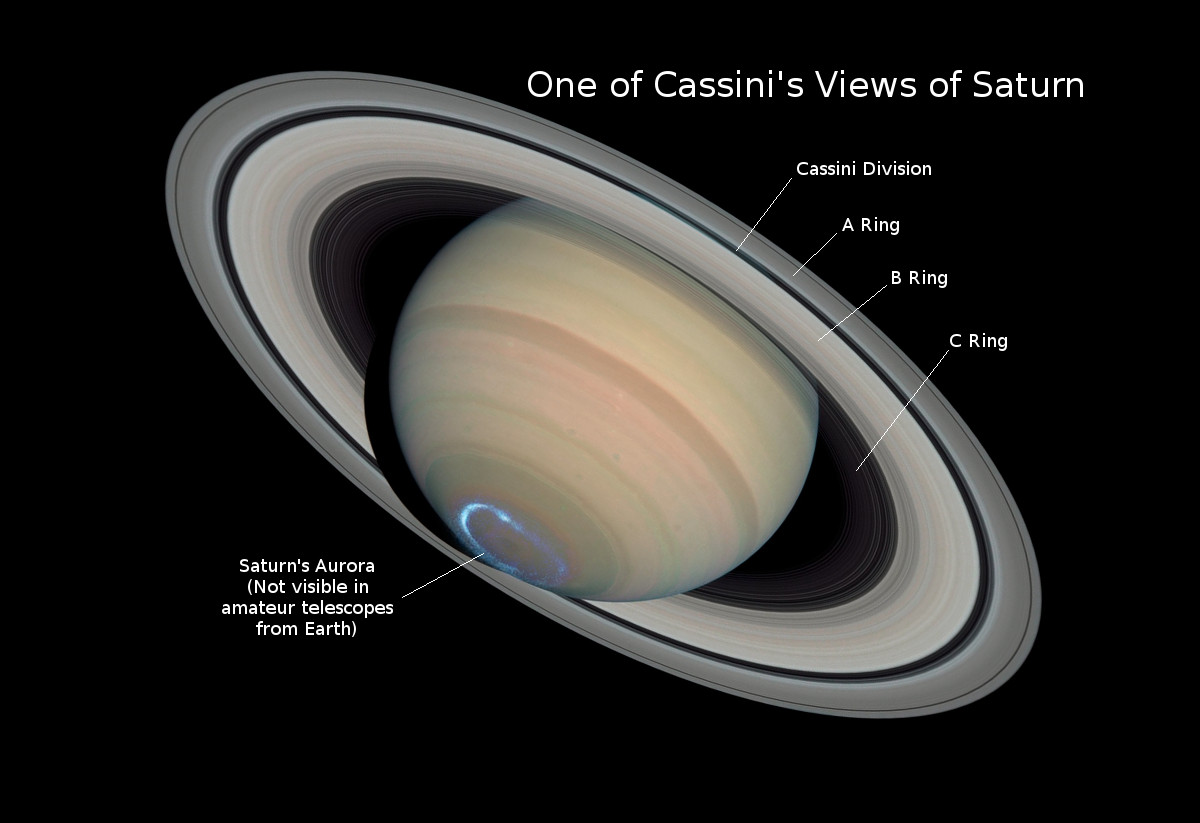
Saturn and rings from the Cassini spacecraft, plus the aurora oval in ultraviolet. Credit: NASA/JPL/Space Science Institute

