Archive
04/21/2015 – Ephemeris – The Moon will pass the Hyades star cluster today to pass near Venus tonight
Apr 21. This is Bob Moler with Ephemeris for Tuesday, April 21st. Today the Sun will be up for 13 hours and 46 minutes, setting at 8:35. The Moon, 3 days past new, will set at midnight. Tomorrow the Sun will rise at 6:47.
The moon, which was new last Saturday passed the face of the constellation Taurus the bull earlier today. The face of Taurus is a letter V shape of stars which is the star cluster called the Hyades. There’s a bright orange star that appears at the left tip of the V called Aldebaran, which actually doesn’t belong to the cluster. At 9:30 the crescent Moon will have also just passed the brilliant planet Venus. By then they will be nearly 8 degrees apart, which is a bit less than the width of a fist held at arm’s length. The Moon, Venus and all the planets move very close along the path of the Sun in the sky, called the ecliptic. Even so the Moon is now about 5 degrees south of the ecliptic and Venus about 2 degrees north of it.
Times are for the Traverse City/Interlochen area of Michigan. They may be different for your location.
Addendum
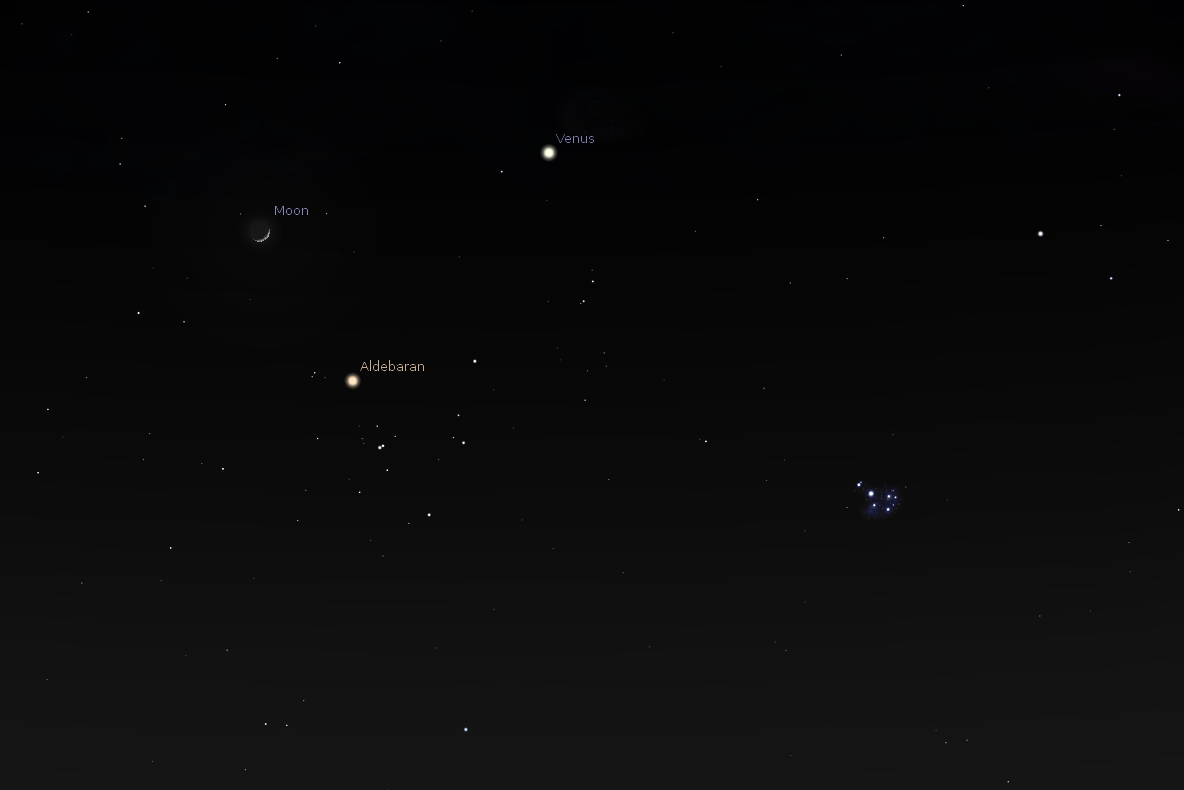
The Moon with Venus and the Hyades at 9:30 p.m. April 21, 2015. Note the Pleiades on the right. Created using Stellarium.
04/20/2015 – Ephemeris – The Lyrid meteor shower will reach peak Wednesday evening
Ephemeris for Monday, April 20th. The Sun rises at 6:50. It’ll be up for 13 hours and 43 minutes, setting at 8:33. The Moon, 2 days past new, will set at 10:57 this evening.
This week the Lyrid meteor shower will reach its peak. The expected peak will be Wednesday the 22nd at 8 p.m. (24 hr UT). Unfortunately the radiant point will not have risen by then. The radiant, near the star Vega in the constellation of Lyra will rise in the northeast by 10 p.m. It will approach the zenith by 6 a.m. as morning twilight brightens. The normal peak hourly rate is about 18 when the radiant is at the zenith, This year it could be as many as 90 per hour. However Europe and Asia will be prime locations to view the shower near the zenith at peak. The shower is caused by the debris of Comet Thatcher, seen only once in 1861. When comets approach the Sun they shed gas, dust and small bits of rock. When the Earth passes through it we get a meteor shower.
Times are for the Traverse City/Interlochen area of Michigan. They may be different for your location.
Addendum
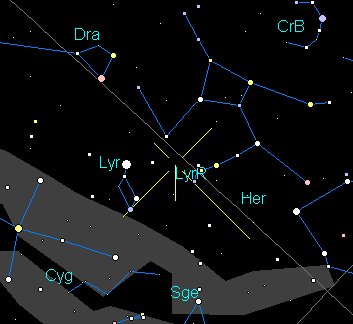
Lyrid meteor radiant is near Lyra and the bright star Vega. Th bright star by “Lyr” is Vega. Create by Bob Moler’s LookingUp program.
03/17/2015 – Ephemeris – Jupiter’s cloud stripes
Ephemeris for St. Patrick’s Day, Tuesday, March 17th. The Sun will rise at 7:51. It’ll be up for 11 hours and 59 minutes, setting at 7:51. The Moon, 3 days before new, will rise at 6:37 tomorrow morning.
Jupiter is the one planet that we can see detail on with telescopes in the evening sky. Venus is so bright that it is hard to even see its gibbous phase. Actually the best way to see Venus is during the day with the blue sky around it. Jupiter is a big planet, 11 times the Earth’s diameter and 1,300 times it volume. Despite this it is only 318 times the Earth’s mass, so much of its mass is the atmosphere. It’s rotation rate is just under 10 hours at its equator. This drops with latitude, so its atmosphere is twisted into alternate belts and zones. The belts are dark brown while the zones are lighter. They move around the planet at different speeds causing storms that their boundaries. The Great Red Spot is a anticyclone in the south.
Times are for the Traverse City/Interlochen area of Michigan. They may be different for your location.
Addendum
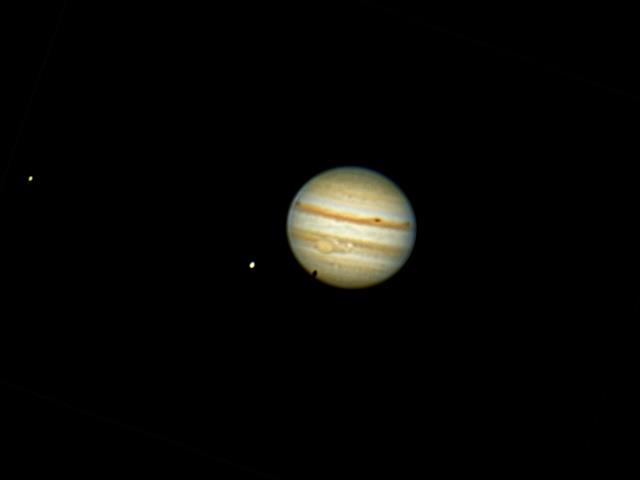
Jupiter by Scott Anttila November 14, 2011. With shadow on the planet and the Great Red Spot.
03/12/2015 – Ephemeris – Tonight’s a big night for Jovian satellite events
Ephemeris for Thursday, March 12th. The Sun will rise at 8:01. It’ll be up for 11 hours and 43 minutes, setting at 7:44. The Moon, 1 day before last quarter, will rise at 2:40 tomorrow morning.
Tonight will be a busy one in Jupiter’s system for those watching with telescopes. As it gets dark Jupiter’s moon Io will be in front of Jupiter and very difficult to spot. It’s shadow may be seen as a tiny inky black dot on the face of the planet. Io will move off the planet at 8:55 p.m., This will be followed by the shadow at 9:42 p.m. The fun isn’t over because the moon Europa will be appearing to approach Jupiter as Io leaves it. Europa will disappear behind Jupiter at 12:06 a.m. It will stay hidden until 4:32 a.m. Europe will clear the planet earlier, but will still be in Jupiter’s shadow until 4:32. When a moon’s in shadow, it is said to be eclipsed. When behind the planet it is occulted and when in front of Jupiter it is in transit.
Times are for the Traverse City/Interlochen area of Michigan. They may be different for your location.
Addendum
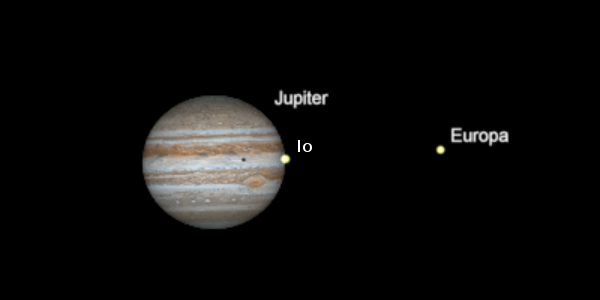
Io transit end at 8:55 p.m., March 12, 2015. Note Io’s shadow will leave the face of Jupiter at 9:32 p.m. Created using Cartes du Ciel (Sky Charts).
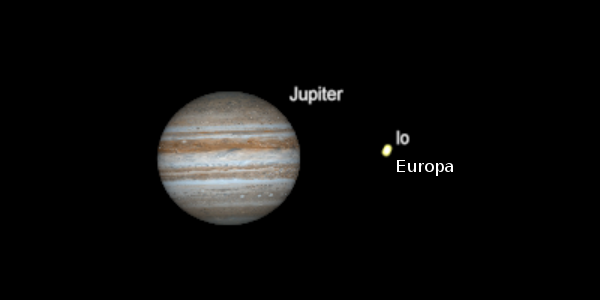
Io passes Europa about 10:20 p.m. March 12, 2015. Created using Cartes du Ciel (Sky Charts).
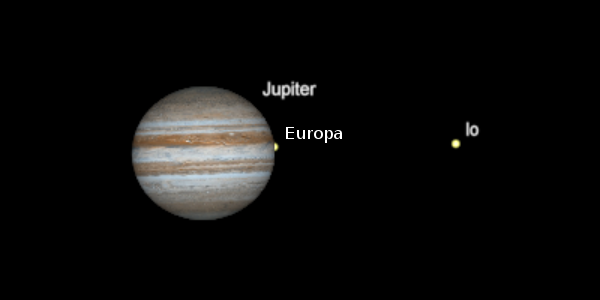
Europa’s occultation begins at 12:06 a.m., March 13, 2015. Created using Cartes du Ciel (Sky Charts).
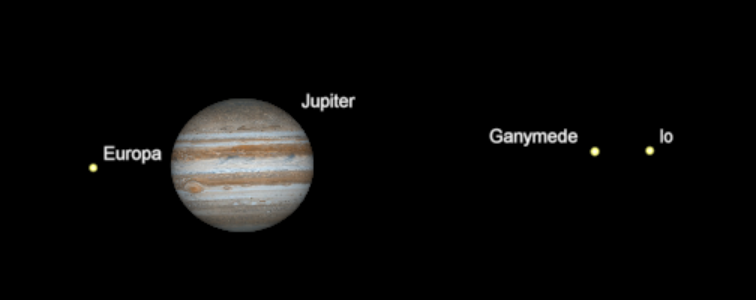
Europa emerges from eclipse by Jupiter’s shadow at 4:32 a.m., March 13, 2015. Note that Ganymede has entered the picture. It appeared to pass Io at about 3:30 a.m. Created using Cartes du Ciel (Sky Charts).
03/10/2015 – Ephemeris – The Great Orion Nebula
Ephemeris for Tuesday, March 10th. The Sun will rise at 8:04. It’ll be up for 11 hours and 37 minutes, setting at 7:42. The Moon, 3 days before last quarter, will rise at 12:43 tomorrow morning.
The constellation of Orion the hunter, now in the south at 9 p.m., contains the most beautiful star forming region in the northern sky. It is the Great Orion Nebula. A nebula is simply a cloud. Back in the early days of telescopes it was anything that appeared fuzzy. Today it’s any cloud, whether of gas or dust, light or dark. The Great Orion Nebula is made up of gas, which is ionized and shines by fluorescence by the ultraviolet light of a clutch of four stars in its heart called the Trapezium. The nebula can be glimpsed with binoculars surrounding what looks like the center star of the vertical line of three stars that appears as the sword hanging from Orion’s belt. It’s the bright end of a large dark cloud that’s behind the bright stars of Orion.
Times are for the Traverse City/Interlochen area of Michigan. They may be different for your location.
Addendum
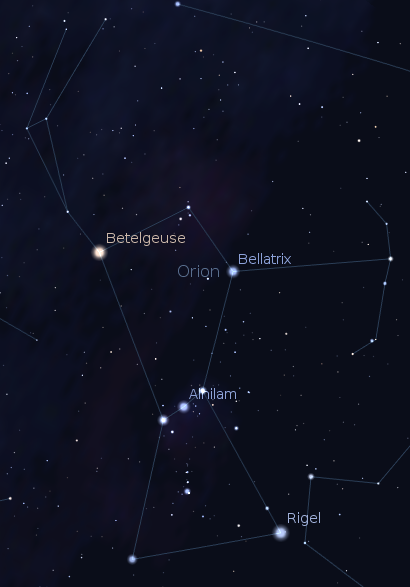
Orion upright and due south. Created using Stellarium.
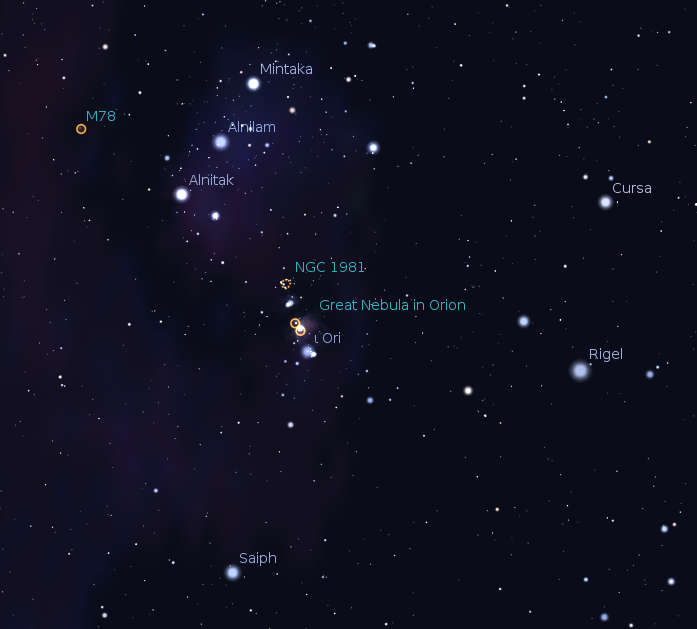
The lower part of Orion with the Great Orion Nebula. Created using Stellarium.
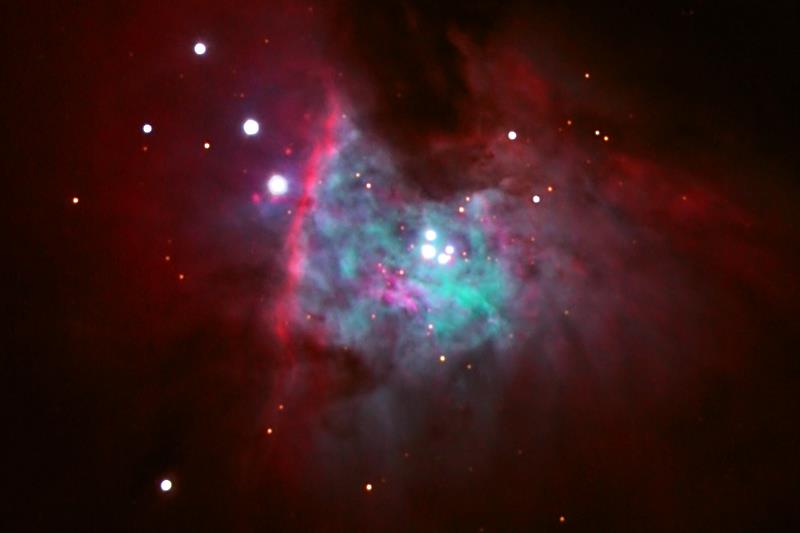
Inner part of the Great Orion Nebula with the Trapezium. Image by Scott Anttila
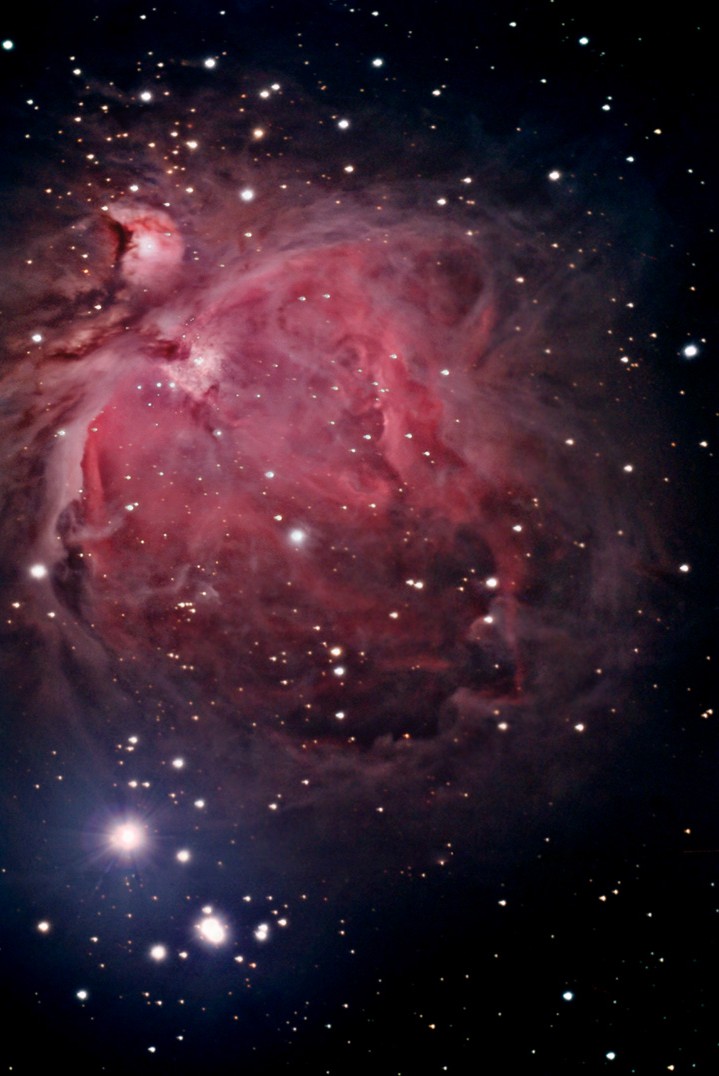
Great Orion Nebula by Scott Anttila
Look quick! A new comet escapes the Sun
A sun grazing comet was discovered in SOHO chronograph images. And unlike Comet ISON 15 months ago which checked in but didn’t check out. This one escaped to possibly become visible in our evening sky. It was the 2875th comet discovered on SOHO chronograph images. Usually it ends there, but the comet, now named C/2015 D1 (SOHO).
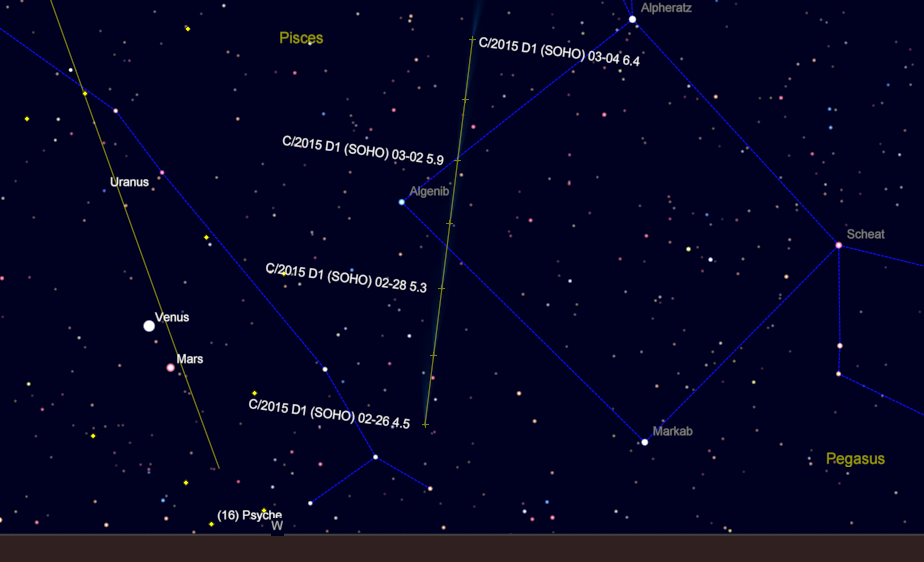
Hot off the press. Comet 2015 D1 was part of the download of comet elements this afternoon. Here’s the track with estimated magnitudes for tonight and the next week. Created using Cartes du Ceil (Sky Charts).
A more comprehensive post from Universe Today is here.
02/17/2015 – Ephemeris – There are no unicorns except in the heavens
Ephemeris for Fat Tuesday, Tuesday, February 17th. The sun will rise at 7:40. It’ll be up for 10 hours and 33 minutes, setting at 6:13. The moon, 1 day before new, will rise at 7:07 tomorrow morning.
Among all the constellations in the sky of animals real and mythical, there is also a unicorn. It’s called Monoceros, and inhabits the southeastern sky at 9 p.m. bounded by Orion on the right, Canis Major, the great dog below and Canis Minor, the little dog to the left. Unfortunately for observers without optical aid Monoceros, though large, is devoid of any but the faintest stars. Maybe that’s why no one sees unicorns anymore. It has many faint stars because the Milky Way runs through it. To the telescope it is a feast of faint nebulae or clouds of gas and dust, the birth place of stars, including the red rose of the Rosette Nebula, and the strange and tiny Hubble’s Variable Nebula. It contains no bright stars, but it has wonders for the telescope.
Times are for the Traverse City/Interlochen area of Michigan. They may be different for your location.
Addendum
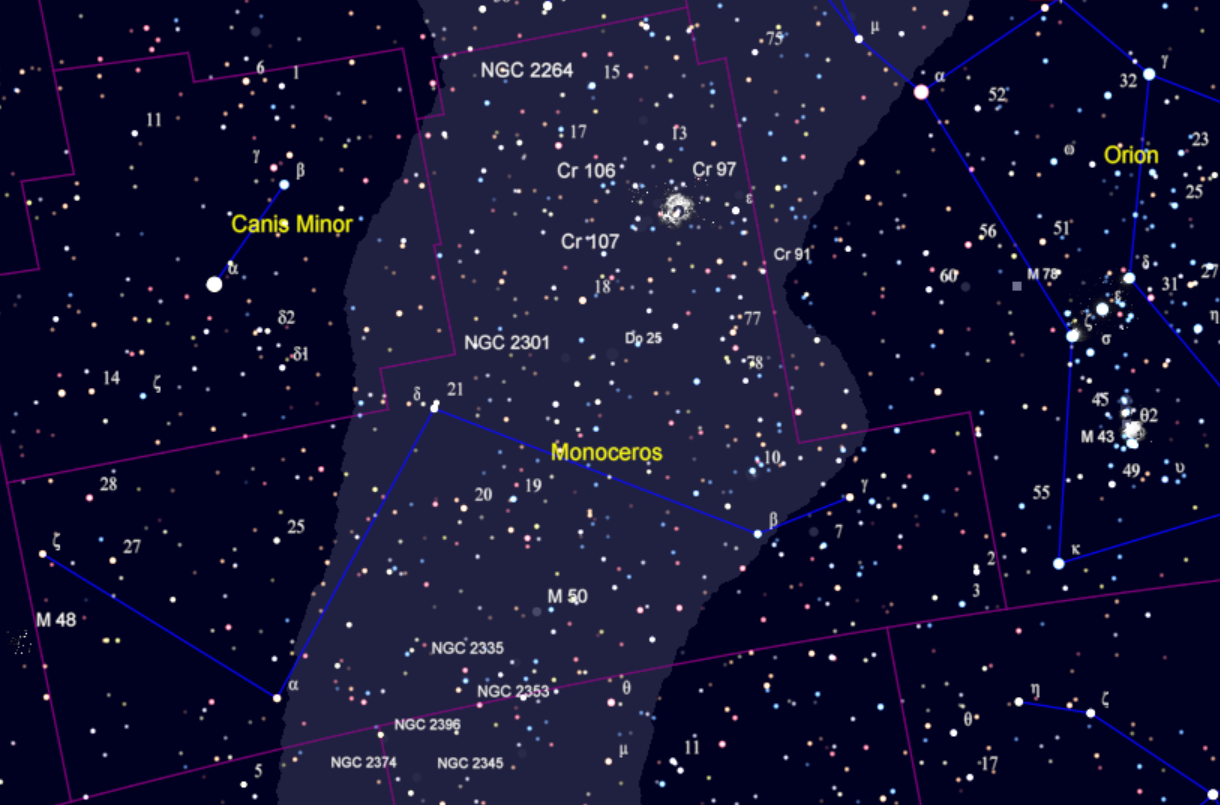
The constellation Monoceros the unicorn. Created using Cartes du Ciel (Sky Charts). Click to enlarge.
Can you see a unicorn here? Me neither.
One thing I didn’t mention in the program is the star labeled β. It is a triple star in telescopes.
Universe Today has a great post on Monoceros by Tammy Plotner, who by sad coincidence passed away a few days ago.
02/12/2015 – Ephemeris – The brilliant blue star in Orion: Rigel
Ephemeris for Thursday, February 12th. The sun will rise at 7:47. It’ll be up for 10 hours and 18 minutes, setting at 6:06. The moon, 1 day past last quarter, will rise at 2:52 tomorrow morning.
Two days ago I talked about the star Betelgeuse the bright red star in the top left of Orion’s upright rectangle. Orion is seen in the south at 9 in the evening. The blue-white star in Orion’s opposite corner is usually brighter. It is Rigel whose longer Arabic name of which Rigel is the first part means Left Leg of the Giant. Rigel is a giant itself, actually a super giant star, which is more a measure of its mass than its size, that of 21 solar masses. Its surface temperature is more than twice as hot as the sun. It is 120 thousand times as bright as the sun and 78 times its diameter. Its distance is around 860 light years. Those with telescopes might be able to spot a close companion star to Rigel, just at the edge of the bright arc light image of Rigel itself.
Times are for the Traverse City/Interlochen area of Michigan. They may be different for your location.
Addendum
Orion upright and due south. Created using Stellarium.
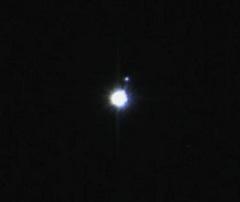
Rigel with its companion star as photographed through a telescope. No attribution. Source: http://washedoutastronomy.com/content/urban-orion?page=1
02/11/2015 – Ephemeris – Wednesday is bright planet day around here
Ephemeris for Wednesday, February 11th. The sun will rise at 7:49. It’ll be up for 10 hours and 16 minutes, setting at 6:05. The moon, at last quarter today, will rise at 1:52 tomorrow morning.
Lets take a look at the bright planets and a binocular comet for this week. Brilliant Venus is in the west-southwest by 7 p.m. It will set at 8:19 p.m. Mars appears above and left of Venus in the southwest. Venus is approaching Mars and they will be at their closest on the 22nd. The Red Planet will set tonight at 8:44 p.m. Jupiter will appear In the southeastern sky in the evening. It will be up all night, and will set just before sunrise. It’s near the sickle-shaped head of Leo the lion, and it’s the brightest star-like object in the sky. Early risers will be able to spot Saturn which will rise in the east-southeast at 2:41a.m. Comet Lovejoy, visible in binoculars, is about the width of a binocular field to the right of the star at the end of Andromeda, called Almaak.
Times are for the Traverse City/Interlochen area of Michigan. They may be different for your location.
Addendum
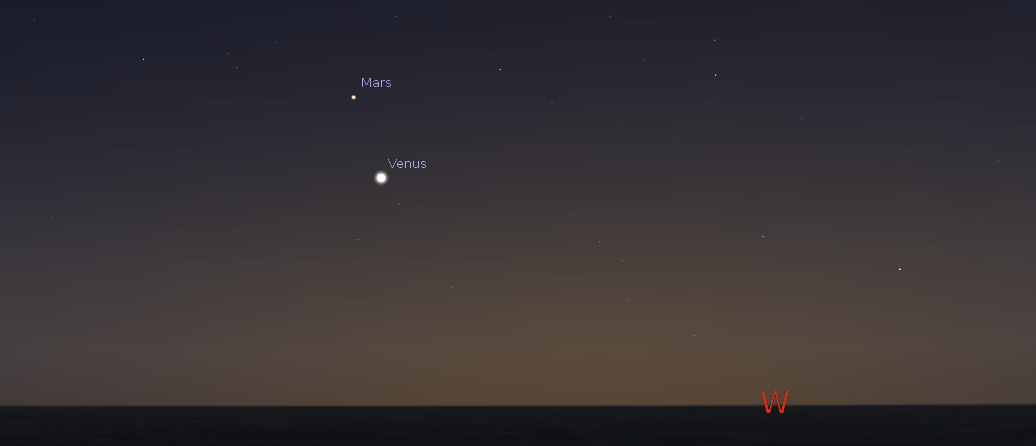
Venus and Mars low in the west at 7 p.m. on February 11, 2015. The crescent moon will be seen with the two planets on the evening of the 20th, and they will be in conjunction on the 22nd. Created using Stellarium.
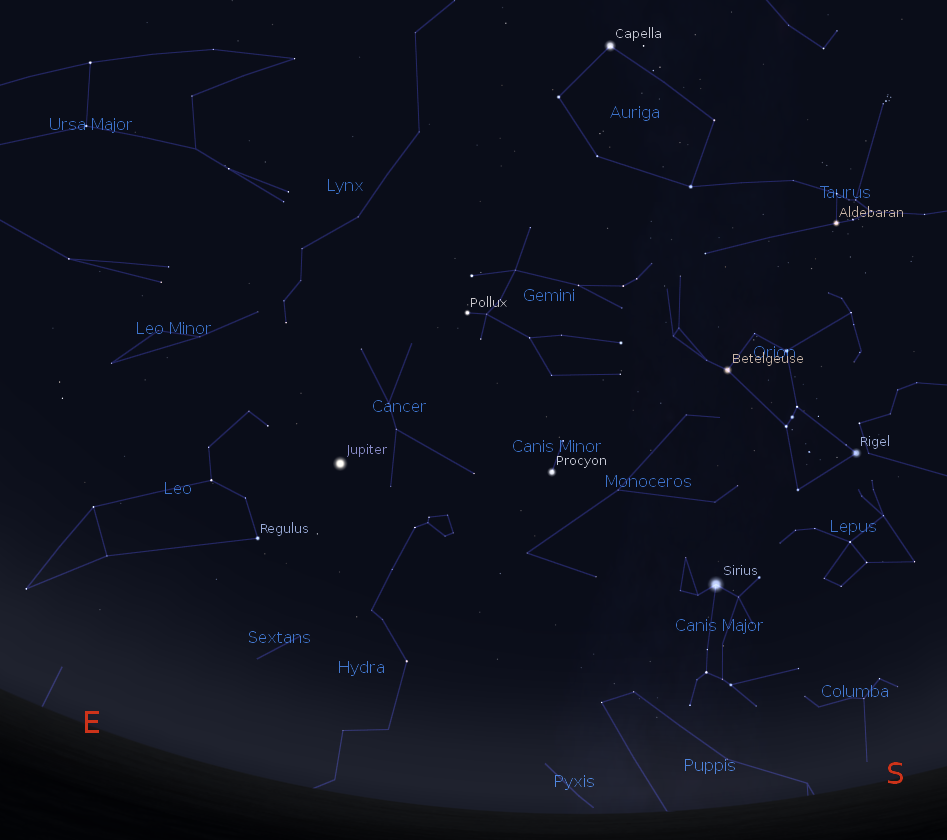
Jupiter and the bright winter stars at 9 p.m. on February 11, 2015. Created using Stellarium.
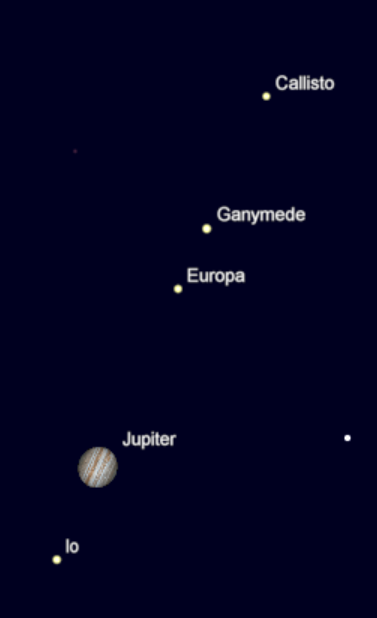
Jupiter and its moons as they might appear in a telescope tonight. Created using Cartes du Ceil (Sky Charts).
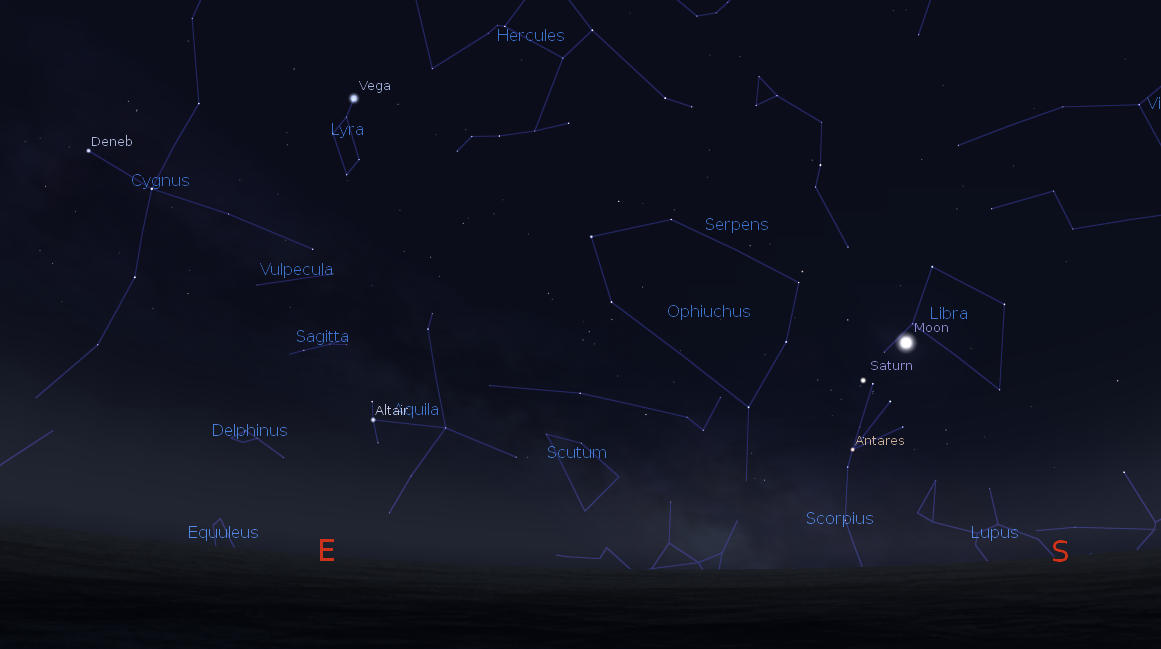
The Moon will appear near Saturn at 6 a.m. February 12, 2015. Created using Stellarium.
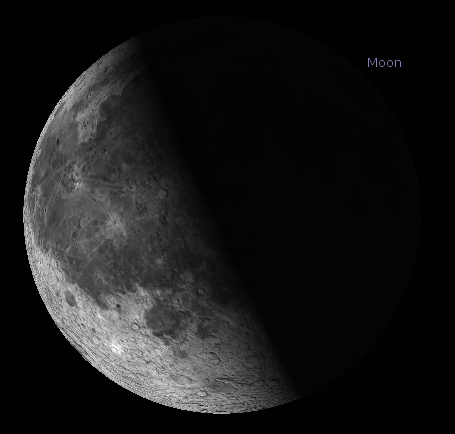
The Moon as it might appear in binoculars at 6 a.m. on February 12, 2015. Created using Stellarium.
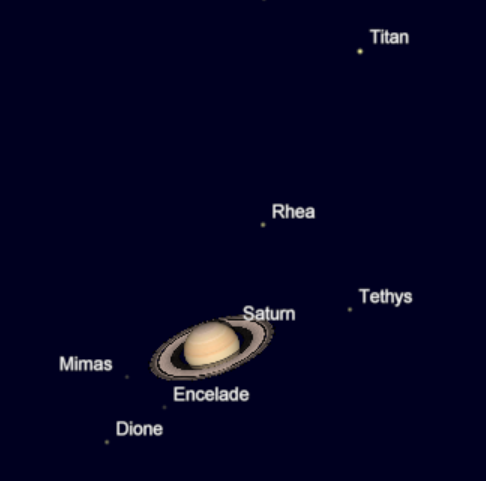
What Saturn and its moons might appear like in a telescope at 6 a.m., February 12, 2015. Small telescopes will show only the moon Titan. Created using Cartes du Ceil (Sky Charts).
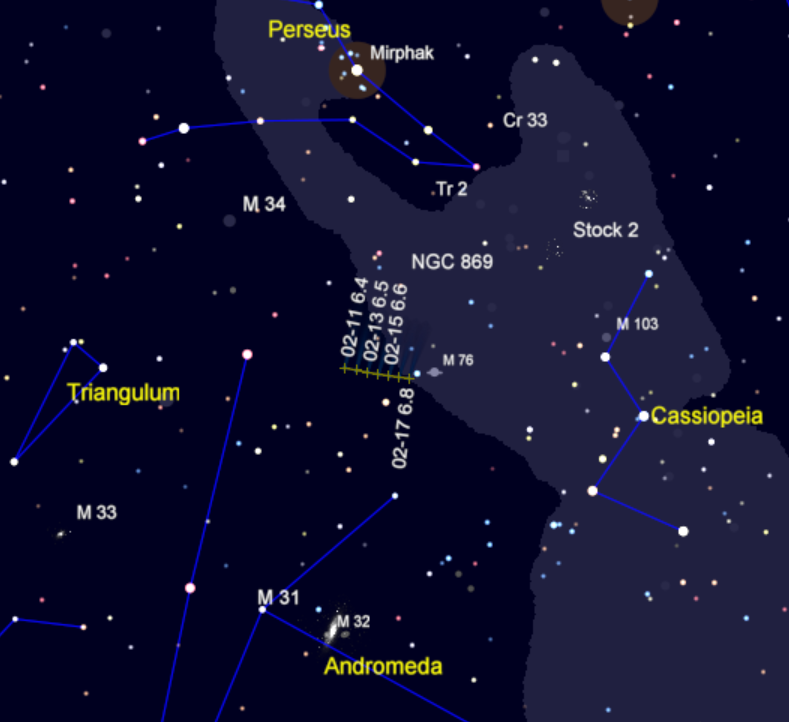
The track of Comet 2014 Q2 (Lovejoy) from 2/11/15 to 02/17/15 which will appear high in the west at 9 p.m. Toward the end of the period the comet will pass near M76, a 10th magnitude planetary nebula. It will be much dimmer than the comet. Created using Cartes du Ceil (Sky Charts).
02/09/2015 – Ephemeris – How to find the constellation of Cancer the crab
Ephemeris for Monday, February 9th. The sun will rise at 7:52. It’ll be up for 10 hours and 10 minutes, setting at 6:02. The moon, 2 days before last quarter, will rise at 11:51 this evening.
A small, dim member of the zodiac is Cancer the crab. It’s dim stars make to my eyes and upside down letter Y. It lies between Gemini to the upper right and Leo to the lower left, especially as it is still rising in the southeastern sky at 9 p.m. Right now the bright planet Jupiter is about half way between it and Leo. It does have a relatively bright fuzzy object to the naked eye amongst it’s stars, positioned roughly in the center. It was discovered as a fuzzy spot before the invention of the telescope and called Praesepe, the manger. With the invention of the telescope it was discovered to be a loose group of stars in an open or galactic star cluster. This easy binocular object is best known now as the Beehive cluster or M44.
Times are for the Traverse City/Interlochen area of Michigan. They may be different for your location.
Addendum
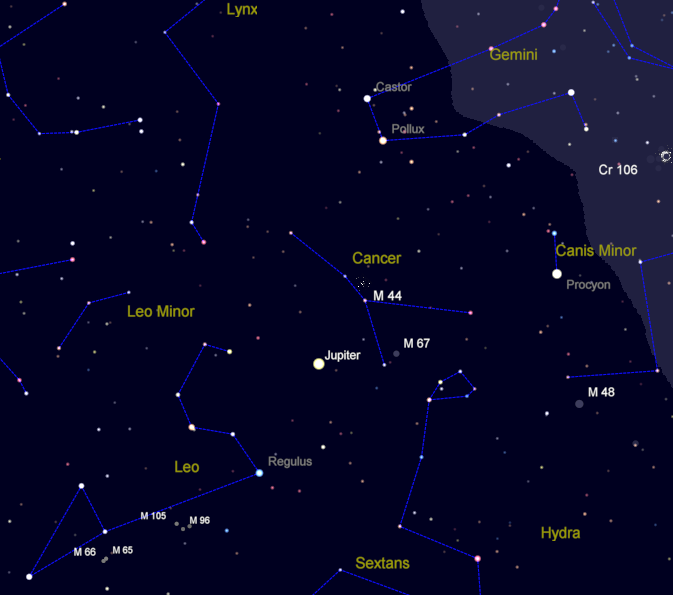
The zodiacal constellation Cancer with Jupiter nearby in the southeast at 9 p.m. February 9, 2015. Created using Cartes du Ceil (Sky Charts).
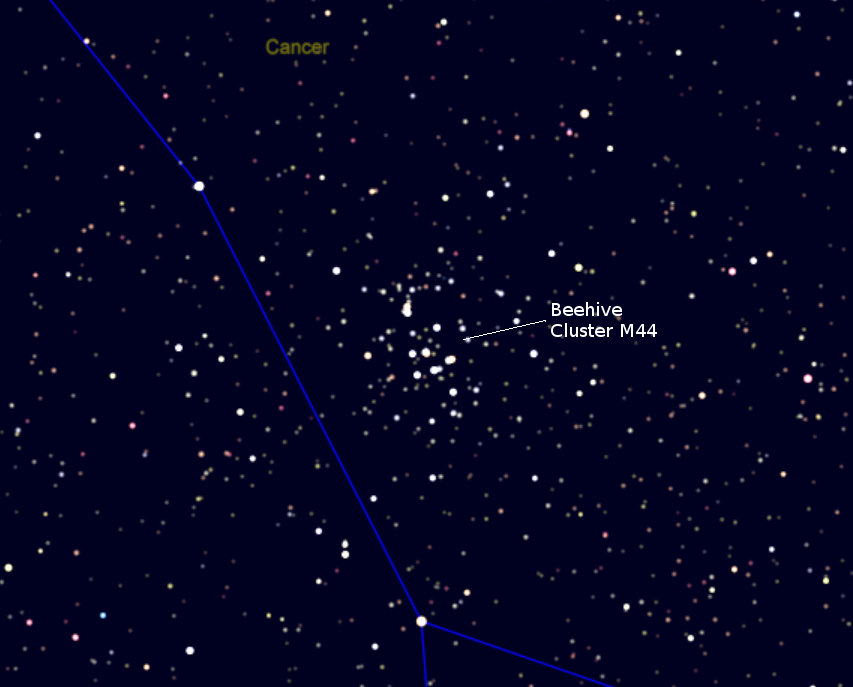
The Beehive star cluster, M44. Its ancient name was the Praesepe or manger when glimpsed by the naked eye. Created using Cartes du Ciel (Sky Charts).
M44 is a young star cluster, perhaps 600-700 million years old and only 577 light years away. It is an open or galactic star cluster. It only appears outside the band of the Milky Way because it’s close to us. The same cannot be said for M67.
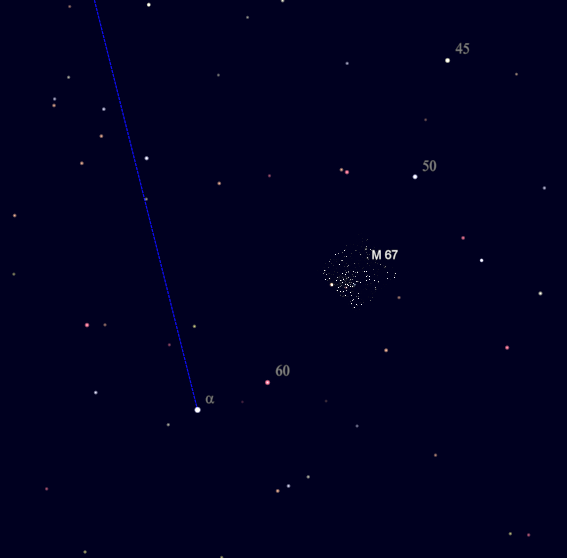
Finder Chart for open cluster M67, found just west of α Cancri, or Acubens. Created using Cartes du Ceil (Sky Charts).
M67 is a fuzzy spot in binoculars but really shows its beauty in telescopes. M67 is pretty old for an open star cluster, one of the oldest known, at about the age of the Sun or a bit younger. It’s nearly 3,000 light years away, so it really is out of the plane of the galaxy.

