Archive
01/10/2018 – Ephemeris – Betelgeuse the red giant star in the giant hunter Orion’s shoulder
Ephemeris for Thursday, January 10th. The Sun will rise at 8:18. It’ll be up for 9 hours and 3 minutes, setting at 5:22. The Moon, 4 days before first quarter, will set at 9:55 this evening.
The bright red star at the upper left corner of the constellation Orion, high in the southeast at 9 p.m. is Betelgeuse. The name is a contraction of an Arabic phrase that means “Armpit of the Central One”. Betelgeuse is a huge star with a diameter four times that of the earth’s orbit of the sun. It is throwing of gas and creating a nebula around itself. It’s distance from us isn’t accurately known, since it doesn’t have a companion star. It’s about 640 light years away, give or take 148 light years or so. Betelgeuse is about 18 times the mass of the sun and 140 thousand times brighter. It is in the latter stages of its short life,of 10 million year so far. Within another million years or so it will probably explode in a supernova.
The times given are for the Traverse City/Interlochen area of Michigan. They may be different for your location.
Addendum
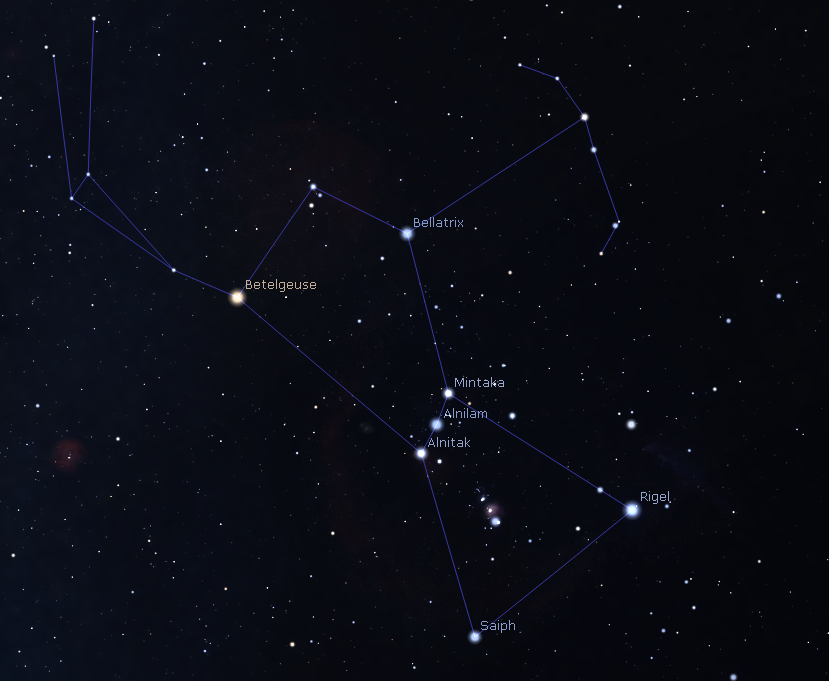
Orion’s brightest stars with their names for 9 p.m. January 7, 2019. Click on the image to make Orion a giant hunter. Created using Stellarium..
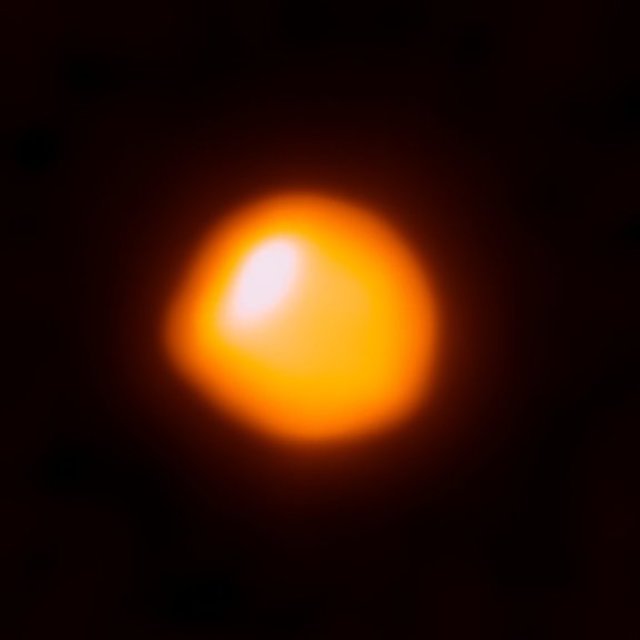
This is the disk of the star Betelgeuse in Orion. It is not an image from an optical telescope of an image created in submillimeter microwaves by the Atacama Large Millimeter/submillimeter Array (ALMA) in Chile. Credit: ALMA (ESO/NAOJ/NRAO)/E. O’Gorman/P. Kervella
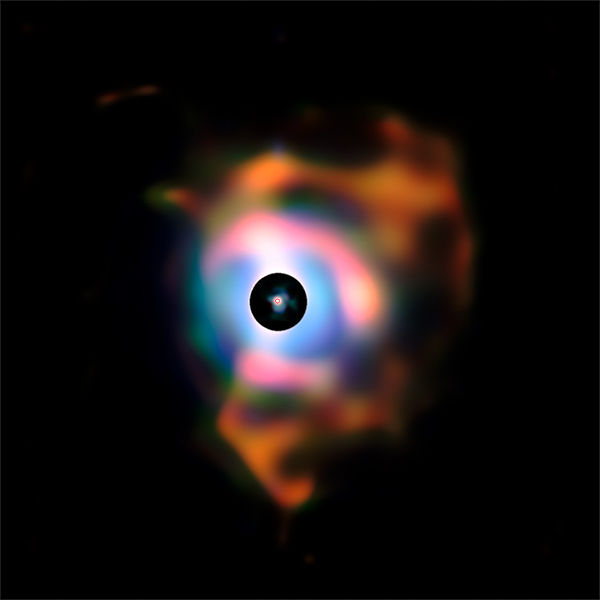
Betelgeuse (inset) and its nebula. From ESO’s Very Large Telescope.
01/07/2019 – Ephemeris – The stars of Orion
Ephemeris for Monday, January 7th. The Sun will rise at 8:19. It’ll be up for 8 hours and 59 minutes, setting at 5:18. The Moon, 2 days past new, will set at 6:57 this evening.
The seven bright stars of Orion now shine in the southeastern sky in the evening. Two shoulder stars, Betelgeuse, and Bellatrix, Two knee stars Saiph, and Rigel, In between are the three belt stars in a row, Alnitak, Alnilam, and Mintaka. Betelgeuse and Rigel are first magnitude stars, among the brightest in the sky, while the others are second magnitude. As far as brightness goes it puts the Big Dipper to shame with its six second magnitude and one third magnitude stars. Of course we in northern Michigan have the Big Dipper always, because it never sets. Orion, only about six months. Due to its position straddling the equator of the sky, Orion is seen by all the people of the world. Parts of him are even seen at the north and south poles.
The times given are for the Traverse City/Interlochen area of Michigan. They may be different for your location.
Addendum
Orion’s brightest stars with their names for 9 p.m. January 7, 2019. Click on the image to make Orion a giant hunter. Created using Stellarium..
12/07/2018 – Ephemeris – The Star of Bethlehem: natural event, miracle, or myth? I’ll be following the clues tonight
Ephemeris for Friday, December 7th. The Sun will rise at 8:06. It’ll be up for 8 hours and 55 minutes, setting at 5:02. The Moon is new today, and won’t be visible.
Tonight at 8 p.m. I will be giving a talk investigating what the Star of Bethlehem may have been. This will be at Northwestern Michigan College’s Rogers Observatory located south of Traverse City on Birmley Road. The talk is a scientific treatment of the matter, rather than a religious one. We’ll look at the usual suspects for what the star was. We’ll see what the Gospel writers may have gotten right and possibly wrong. We’ll look at historical writings and recorded Chinese observations of the heavens around that time. I will be augment this by computer simulations of what might be important celestial events visible around that time. There is no admission charge. There will be viewing of the skies afterward if it’s clear.
The times given are for the Traverse City/Interlochen area of Michigan. They may be different for your location.
11/23/2018 – Ephemeris – The Moon and Aldebaran
Ephemeris for Friday, November 23rd. The Sun will rise at 7:50. It’ll be up for 9 hours and 17 minutes, setting at 5:07. The Moon, at full today, will rise at 5:55 this evening.
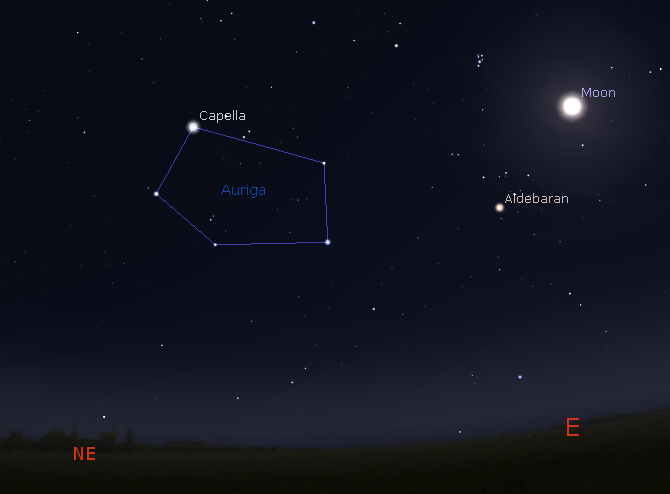
Tonight’s full Moon will be accompanied by the bright star Aldebaran, the angry red eye of the constellation Taurus the Bull. Earlier this year we had the last of nearly two years of the Moon every month passing in front of Aldebaran. The tilt of the Moon’s orbit with respect to the Earth’s own orbit of the Sun slides slowly westward with time, so The Moon won’t pass in front of Aldebaran for those of us on Earth again until 2033. This sliding of the Moon’s orbit is called regression of the nodes. A node is where the Moon’s orbital plane crosses the Earth’s. These are places eclipses of the Sun and Moon occur if lined up with the full or new moons. Why regression? The nodal points are moving westward, backward of most motions in the solar system.
The times given are for the Traverse City/Interlochen area of Michigan. They may be different for your location.
Addendum
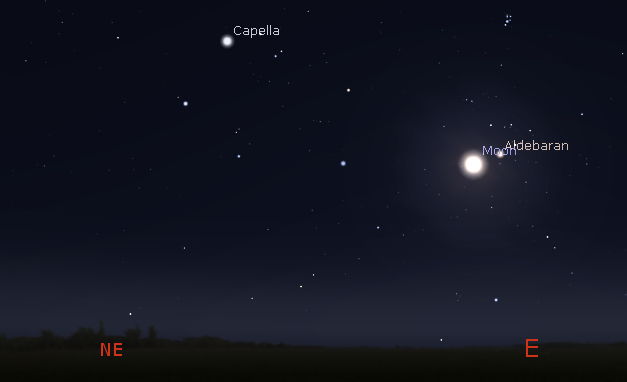
11/22/2018 – Ephemeris – The little goat star, Capella
Ephemeris for Thanksgiving Day, Thursday, November 22nd. The Sun will rise at 7:49. It’ll be up for 9 hours and 19 minutes, setting at 5:08. The Moon, 1 day before full, will set at 7:59 tomorrow morning.
Capella is the northernmost first magnitude stars. Tonight it shines in the northeastern sky. First magnitude stars are the 21 brightest stars in the night sky. Capella is the 6th brightest. The name Capella means little goat, though I’ve always known it as the little she goat. Her three Kids are represented by a narrow triangle of stars positioned to the right of her in tonight’s evening sky, though they may be overpowered by the bright Moon tonight. Capella is in the topmost corner of the pentagonal constellation of Auriga the Charioteer. Capella is actually a system of four stars only 43 light years away. And never sets for listeners in the Interlochen Public Radio transmission area, though all bets are off if you’re listening over the Internet from somewhere else.
The times given are for the Traverse City/Interlochen area of Michigan. They may be different for your location.
Addendum
10/30/2018 – Ephemeris – Algol the spookiest star in the sky
Ephemeris for Tuesday, October 30th. The Sun will rise at 8:18. It’ll be up for 10 hours and 16 minutes, setting at 6:34. The Moon, 1 day before last quarter, will rise at 11:53 this evening.
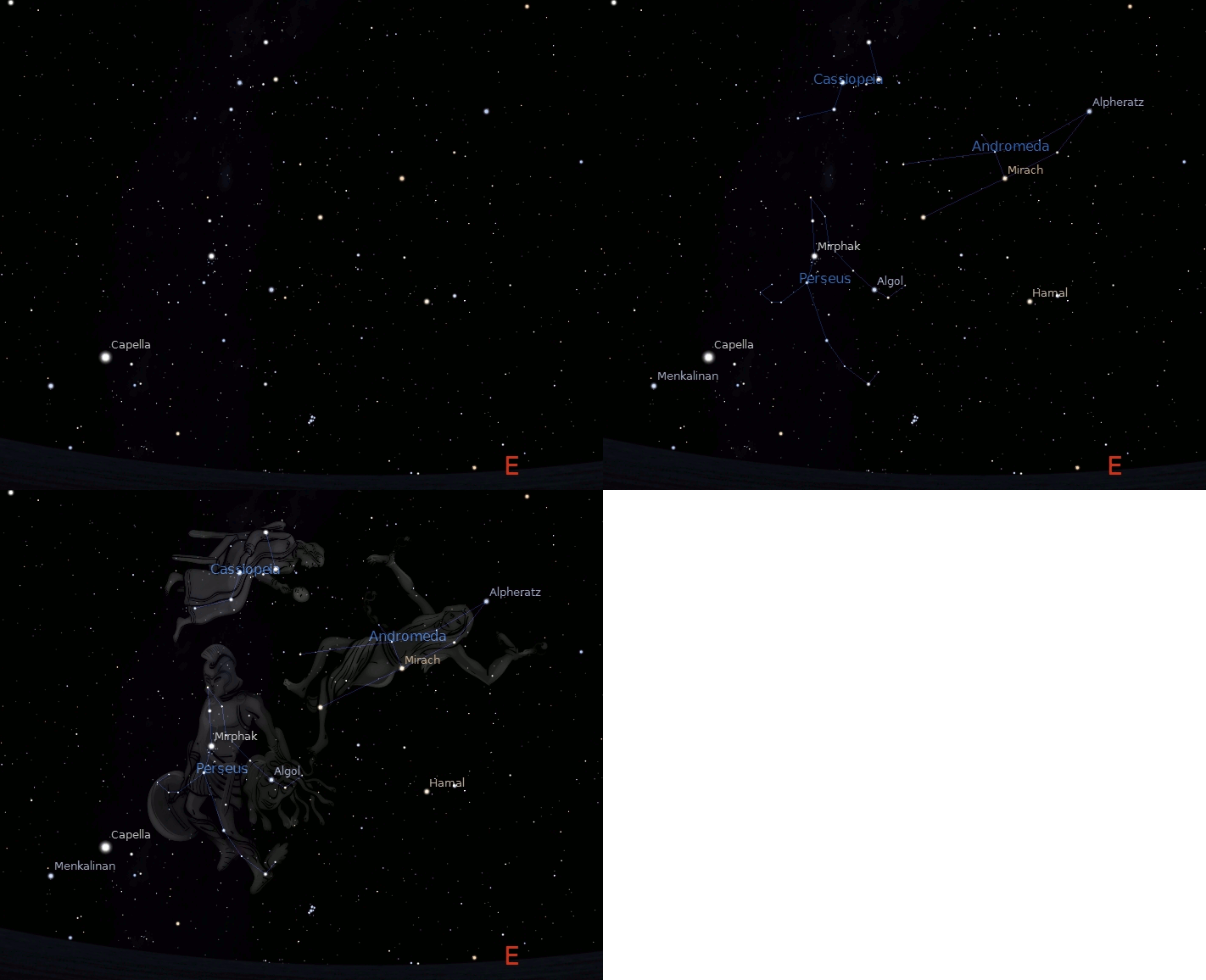
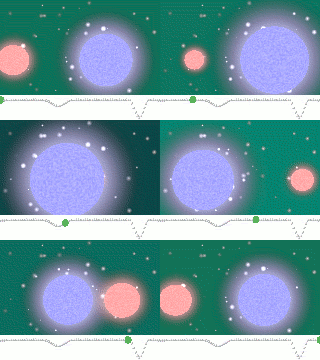
Not all the ghosts and goblins out tomorrow night will be children. One will be out every night because it’s a star. Its name is Algol, from the Arabic for Ghoul Star or Demon Star. The Chinese had a name for it that meant “piled up corpses”. It’s normally the second brightest star in the constellation Perseus the hero, visible in the northeast this evening. The star is located where artists have drawn the severed head of Medusa, whom he had slain. Medusa was so ugly that she turned all who gazed upon her to stone. Algol is her still glittering eye. The star got these names before astronomers found out what was wrong with it. They found out that it does a slow wink every two days, 21 hours. That’s because Algol is two stars that eclipse each other. Her next evening wink will be dimmest at 8:10 p.m. November 13th.
The times given are for the Traverse City/Interlochen area of Michigan. They may be different for your location.
Addendum
.
07/03/2018 – Ephemeris – Antares the sparkler star
Ephemeris for Tuesday, July 3rd. Today the Sun will be up for 15 hours and 29 minutes, setting at 9:31, and it will rise tomorrow at 6:02. The Moon, 3 days before last quarter, will rise at 12:47 tomorrow morning.
There’s going to be a lot of fireworks tomorrow night to celebrate Independence Day, and I may be watching some after the local Beach Bums baseball game. There’s at least one star that is a great sparkler any summer evening. That’s Antares in Scorpius the scorpion low in the south tonight. We in Michigan always see Antares low in the south. It’s a bright red giant star which twinkles mightily, and since it’s low in the sky spits and sputters all kinds of colors due to our atmosphere’s turbulence, and the fact that we’re looking through so much of it at Antares. The more magnification one uses with binoculars or a telescope the greater the sparkler effect. It is even called in sometimes as a UFO.
The times given are for the Traverse City/Interlochen area of Michigan. They may be different for your location.
Addendum
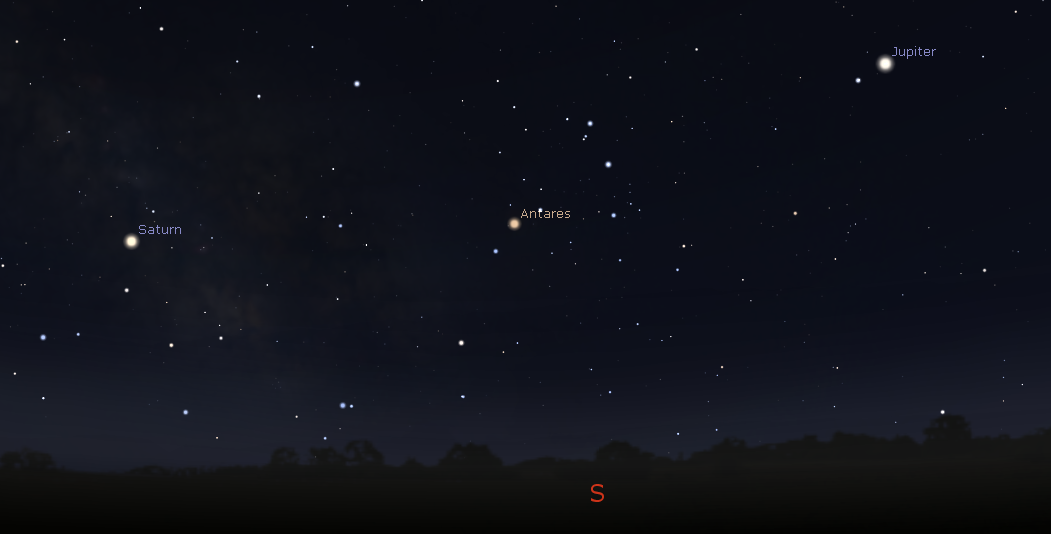
Antares finder chart for 11 p.m., July 3, 2018. Created using Stellarium.
07/02/2018 – Ephemeris – The starry triangle of summer
Ephemeris for Monday, July 2nd. Today the Sun will be up for 15 hours and 30 minutes, setting at 9:31, and it will rise tomorrow at 6:02. The Moon, half way from full to last quarter, will rise at 12:19 tomorrow morning.
Now that it’s summer it’s time to look for the Summer Triangle in the sky. It’s seen rising in the east as it gets dark. Highest of the three bright stars is Vega in the constellation Lyra the harp, whose body is seen in a narrow parallelogram nearby. The second star of the triangle is Deneb lower and left of Vega, It appears dimmer than Vega because it is by far the most distant of the three. The third star of the Summer Triangle is seen farther below and a right of Vega. It is Altair in Aquila the eagle, and the closest. Altair is 16.5 light years away, Vega is 27 light years while Deneb actually one of the brighter stars known, is 1500 or more light years away. It’s distance is not well known.
The times given are for the Traverse City/Interlochen area of Michigan. They may be different for your location.
Addendum
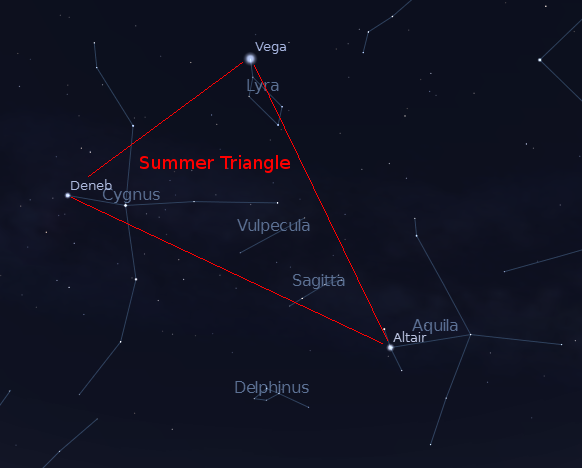
The Summer Triangle. Created using Stellarium.
06/11/2018 – Ephemeris – Jupiter and the claws of the scorpion
Ephemeris for Monday, June 11th. Today the Sun will be up for 15 hours and 31 minutes, setting at 9:28, and it will rise tomorrow at 5:56. The Moon, 2 days before new, will rise at 5:17 tomorrow morning.
Right now the bright planet Jupiter is seen in the south as it gets dark. There is a star visible below Jupiter now. The name of that star is my favorite star name: Zubenelgenubi. It roughly translates from the Arabic, and most star names are Arabic, as “Southern Claw”. This star, also known as Alpha Librae, is in the zodiacal constellation of Libra the scales or balance, a roughly square constellation standing on one corner. The name relates to Scorpius the scorpion to the east who in the Arab’s imagination extended farther to the west. The star farther to the upper left of Jupiter tonight is Zubeneschamali, you guessed it, the northern claw, also part of Libra. It’s the longest star name at 14 letters.
The times given are for the Traverse City/Interlochen area of Michigan. They may be different for your location.
Addendum
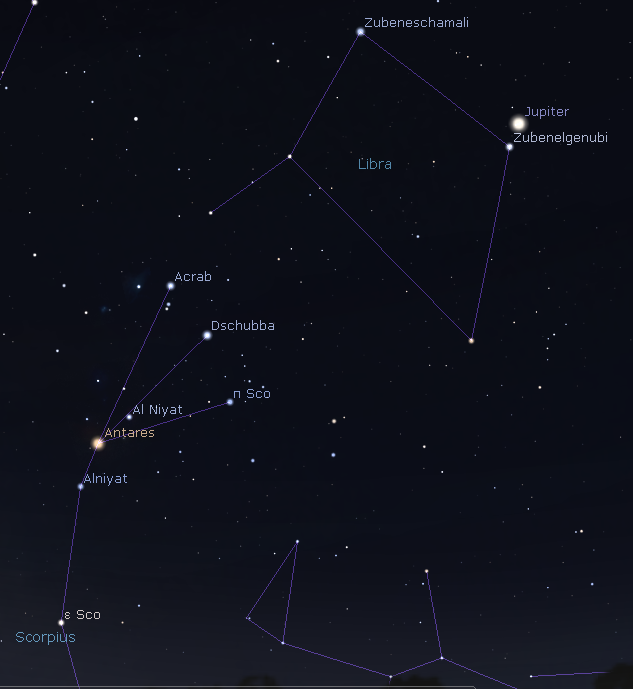
Jupiter with Zubenelgenubi, the South Claw and with nearby Zubeneschamali, the North Claw of Scorpius, still rising at 11 p.m. June 11, 2018. Created using Stellarium.
5/15/2018 – Ephemeris – Two thirds thru spring
Ephemeris for Tuesday, May 15th. Today the Sun will be up for 14 hours and 49 minutes, setting at 9:04, and it will rise tomorrow at 6:13. The Moon is new today, and won’t be visible.
Here we are at the middle of May, nearly two-thirds through spring and in the west only a few winter stars remain. Castor and Pollux of Gemini are horizontal in the west, Procyon the Little Dog Star is below and left of them, Capella in Auriga is in the northwest, but for most of the IPR listening area it will never quite set. At 10:30 Betelgeuse in Orion the hunter will be setting, chased from the skies by Scorpius the scorpion, which is rising in the southeast. In one story it is the sting of this scorpion that killed him. Already at that time two-thirds of the stars of the summer Triangle are up. Bright Vega in Lyra the harp, and Deneb in Cygnus the swan. The Big Dipper reigns overhead as spring is in full bloom.
The times given are for the Traverse City/Interlochen area of Michigan. They may be different for your location.
Addendum
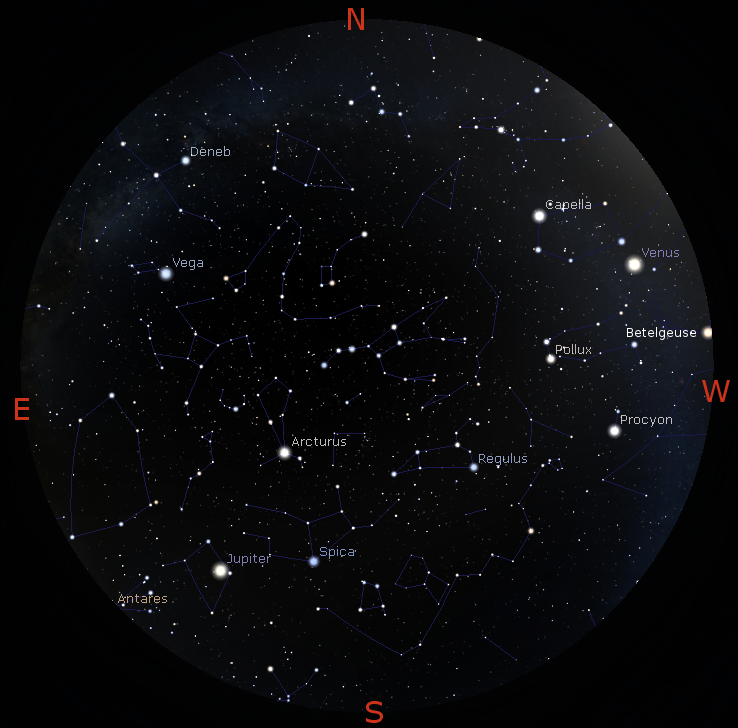
The sky dome for 10:30 p.m. May 15, 2018 showing the stars and constellations. It may not work for any latitude or time, but it works for our location, near 45 degrees north. Created using Stellarium.
 Bob Moler's Ephemeris Blog