Archive
11/20/2017 – Ephemeris – The Moon is near Saturn tonight and the approaching signs of winter
Ephemeris for Monday, November 20th. The Sun will rise at 7:46. It’ll be up for 9 hours and 23 minutes, setting at 5:09. The Moon, 2 days past new, will set at 7:04 this evening.
Tonight the two day old Moon will appear near Saturn. The ringed planet will appear to the left and a bit below the thin crescent Moon before they set about an hour later. The approaching winter season and the resumption of standard time have dropped sunset to 5:09 in the Interlochen/Traverse City area. Our sunset will drop another 11 minutes before slowly recovering 19 days from now. Two to three hours later another sign of the approaching winter season will appear, as the constellation of the giant hunter Orion rises in the east. He is resplendent with his nearly vertical belt of three stars rising, framed to the left and right by the bright stars reddish Betelgeuse and bluish Rigel. He will dominate our evening skies until April.
The times given are for the Traverse City/Interlochen area of Michigan. They may be different for your location.
Addendum
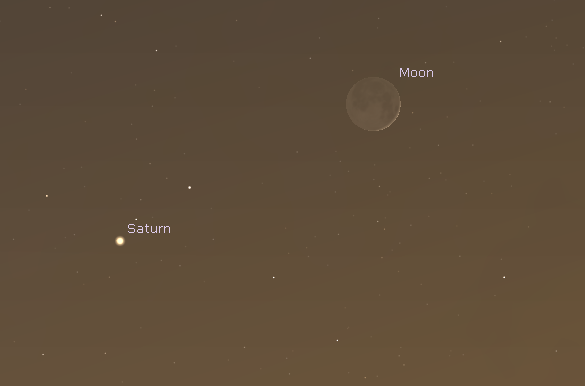
The Moon and Saturn at 6 p.m. November 20, 2017. Created using Stellarium.
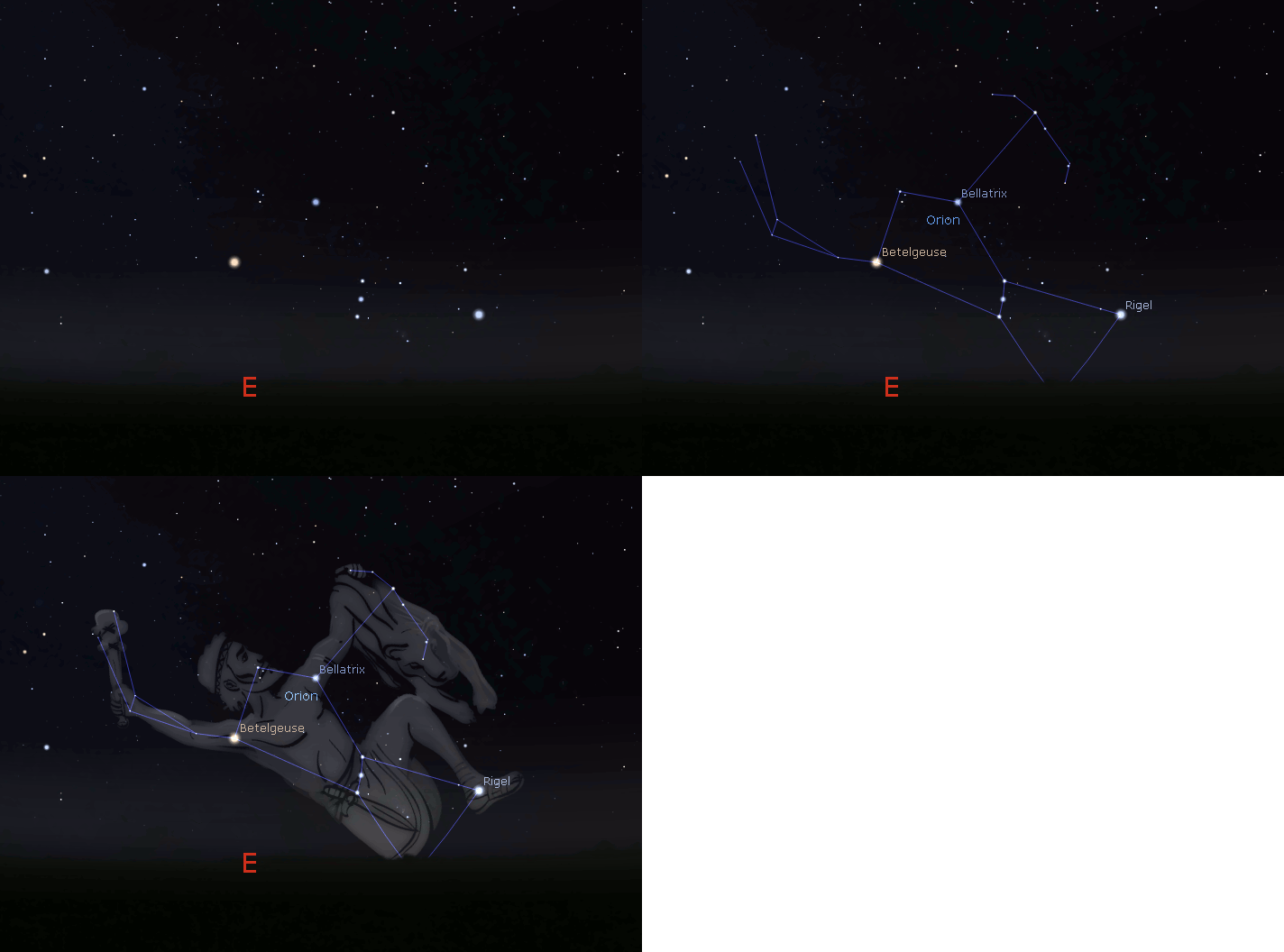
Finder chart for the rising Orion at 9 p.m., November 30, 2017. Created using Stellarium and GIMP.
11/06/2017 – Ephemeris – Taurus’ angry red eye, Aldebaran
Ephemeris for Monday, November 6th. The Sun will rise at 7:27. It’ll be up for 9 hours and 57 minutes, setting at 5:24. The Moon, 3 days past full, will rise at 7:52 this evening.
Last night the Moon passed in front of or occulted the bright star Aldebaran. Above right of Moon tonight is Aldebaran the bright orange star with a V shape of other stars in the face of Taurus the bull. Aldebaran appears at the lower left tip of that letter V laying on it’s side. With the bright Moon, it might take binoculars to pull out the faint stars of the V. Aldebaran isn’t actually part of the group, called the Hyades star cluster. The cluster is about 153 light years away, while Aldebaran is 65 light years away. The star has an orange hue because its surface is cooler than the Sun’s. However Aldebaran is 44 times larger in diameter, and shines 425 times brighter than the Sun. The name Aldebaran means “Follower” because it follows the Pleiades star cluster above it.
The times given are for the Traverse City/Interlochen area of Michigan. They may be different for your location.
Addendum
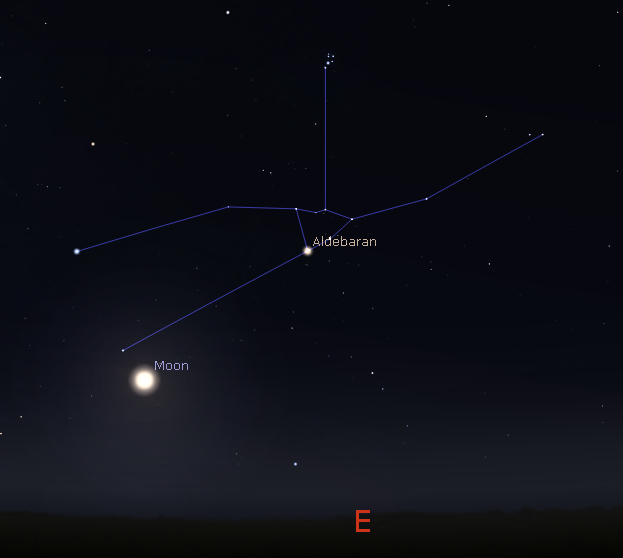
Aldebaran in the Hyades (unlabeled), with also the Pleiades, unlabeled, at the top and the Moon. at 9 p.m., November 6, 2017. Created using Stellarium.
10/30/2017 – Ephemeris – Halloween preview: The Ghoul Star
Ephemeris for Monday, October 30th. The Sun will rise at 8:17. It’ll be up for 10 hours and 15 minutes, setting at 6:33. The Moon, 3 days past first quarter, will set at 3:50 tomorrow morning.
Tomorrow night is the spookiest night of the year, so lets preview the spookiest star of all. It’s Algol, from Ghoul Star or Demon Star. The Chinese had a name for it that meant ‘piled up corpses’. It’s the second brightest star in the constellation Perseus the hero, rising in the northeast this evening. The star is located where artists have drawn the severed head of Medusa, whom he had slain. Medusa was so ugly that she turned all who gazed upon her to stone. Algol is her still glittering eye. Astronomers finally found out what was wrong with Algol. It does a slow 6 hour wink every two days 21 hours, because it is two stars that eclipse each other. It began to dip this morning just before sunrise and it will again centered on 11:41 p.m. Friday night.
The times given are for the Traverse City/Interlochen area of Michigan. They may be different for your location.
Addendum
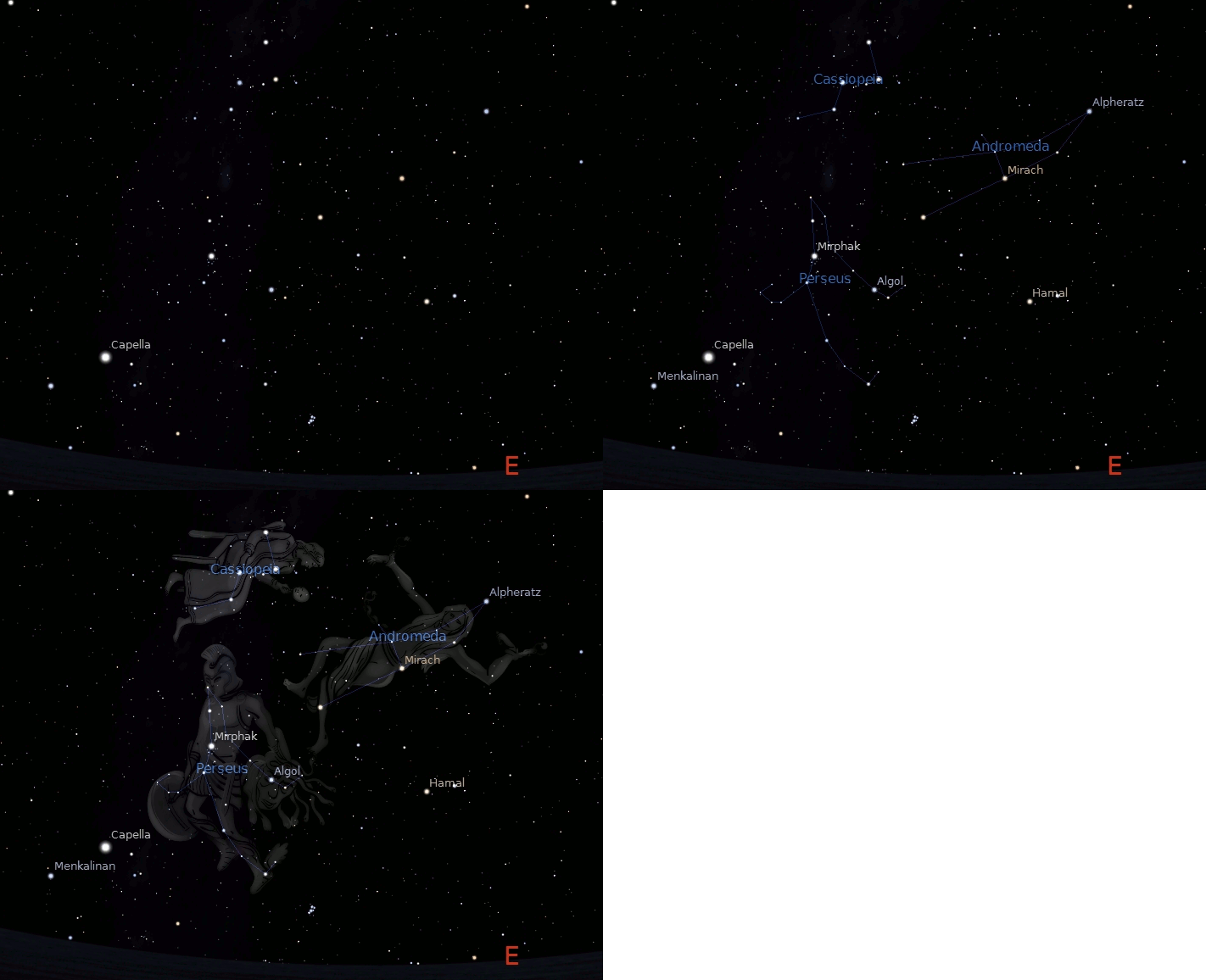
Perseus, Cassiopeia, Andromeda with Algol finder animation for Autumn evenings. Created using Stellarium and GIMP.
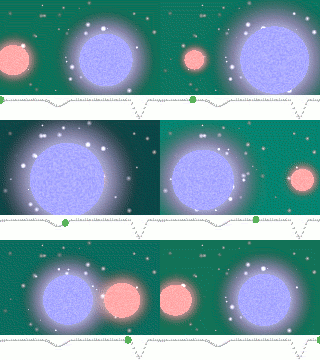
Animation of an eclipsing binary star like Algol. Credit: Wikimedia Commons h/t Earth and Sky
10/23/2017 – Ephemeris – The loneliest star in the sky
Ephemeris for Monday, October 23rd. The Sun will rise at 8:08. It’ll be up for 10 hours and 35 minutes, setting at 6:44. The Moon, half way from new to first quarter, will set at 9:27 this evening.
There’s a bright star that appears for only seven and a half hours on autumn evenings from northern Michigan. It’s appearance, low in the south at around 10:30 p.m. tonight, is a clear indication of the autumn season. The star’s name is Fomalhaut, which means fish’s mouth. That’s fitting because it’s in the constellation of Piscis Austrinus, the southern fish. At our latitude it’s kind of the fish that got away, because Fomalhaut appears to be quite alone low in the sky. The faintness of the constellation’s other stars and location close to the horizon make the dim stars hard to spot. The earth’s thick atmosphere near the horizon reduces their brightness by a factor of two or more, so Fomalhaut, one of the brightest stars in the sky, keeps a lonely vigil in the south.
The times given are for the Traverse City/Interlochen area of Michigan. They may be different for your location.
Addendum
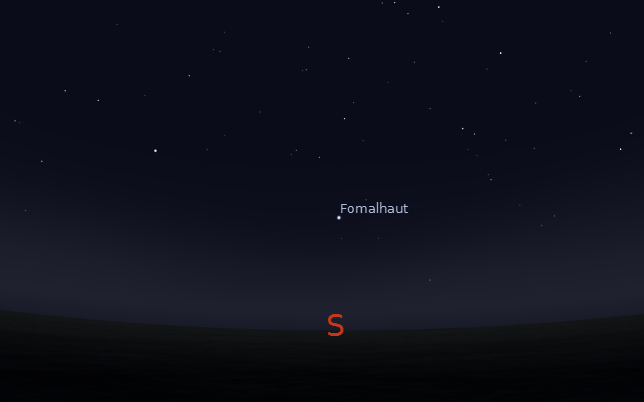
Fomalhaut in the south at 9:30 p.m. on October 23, 2017. Created using Stellarium.
09/07/2017 – Ephemeris – Capella rising
Ephemeris for Thursday, September 7th. The Sun will rise at 7:12. It’ll be up for 12 hours and 55 minutes, setting at 8:07. The Moon, 1 day past full, will rise at 9:08 this evening.
For those with the advantage of a low northern horizon, will see a bright star moving nearly parallel above the horizon over the evening hours or notice its change in position from night to night, moving to the northeast. The star is Capella, northernmost of the bright winter stars. It never quite sets for locations north of the latitude of Ludington (44° N), meaning it’s circumpolar like the Big Dipper. It’s slow motion, due to its position close to the north pole of the sky sometimes makes it seem odd. I’ve gotten several calls about it over the years. Capella is the brightest star in the constellation Auriga the charioteer, a constellation I see as a pentagon, with a small triangle of three stars on one side. I’ll wait until the winter season to talk further about them.
The times given are for the Traverse City/Interlochen area of Michigan. They may be different for your location.
Addendum
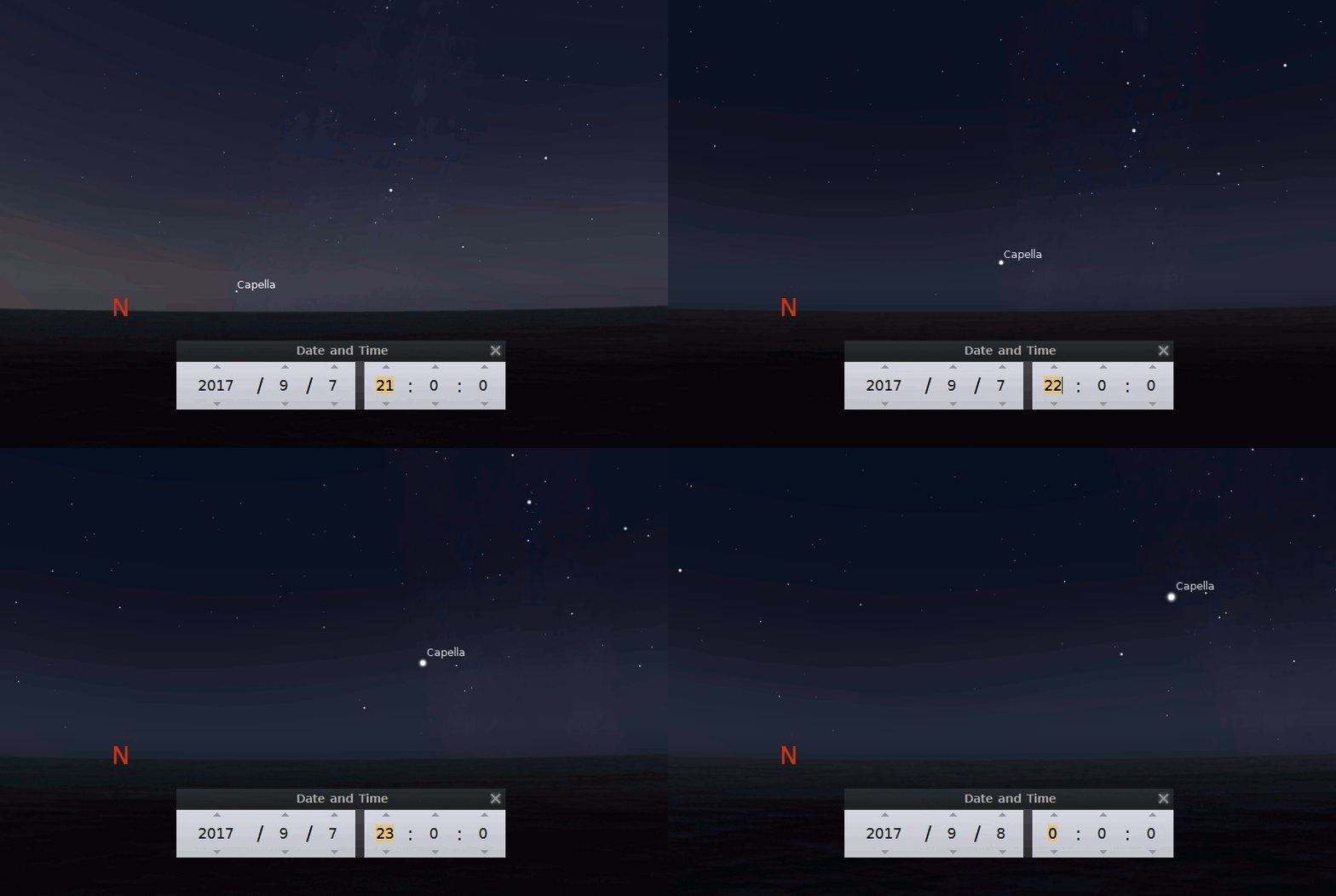
Capella appearing to rise like an aircraft taking off. Shown here at hourly intervals from 9 p.m. to midnight. Created using Stellarium and GIMP.
08/28/2017 – Ephemeris – Polaris the North Star
Ephemeris for Monday, August 28th. The Sun will rise at 7:00. It’ll be up for 13 hours and 25 minutes, setting at 8:25. The Moon, 1 day before first quarter, will set at 12:19 tomorrow morning.
The bright star Polaris is a very important star. It is also known as the North Star and the Pole Star. Its unique position is nearly directly at the zenith at the Earth’s north pole, making it a very important navigational star. It’s about 40 minutes of arc, or about one and a third Moon diameters away from the extension of the Earth’s axis into the sky. As a rule of thumb, it’s angular altitude above the northern horizon is approximately one’s latitude, and it stands about at the due north compass point. Polaris is found using the Big Dipper, using the two stars at the front of the dipper bowl to point to it. It’s located at the tip of the handle of the very dim Little Dipper, which this time of year in the evening appears to standing on its handle.
The times given are for the Traverse City/Interlochen area of Michigan. They may be different for your location.
Addendum
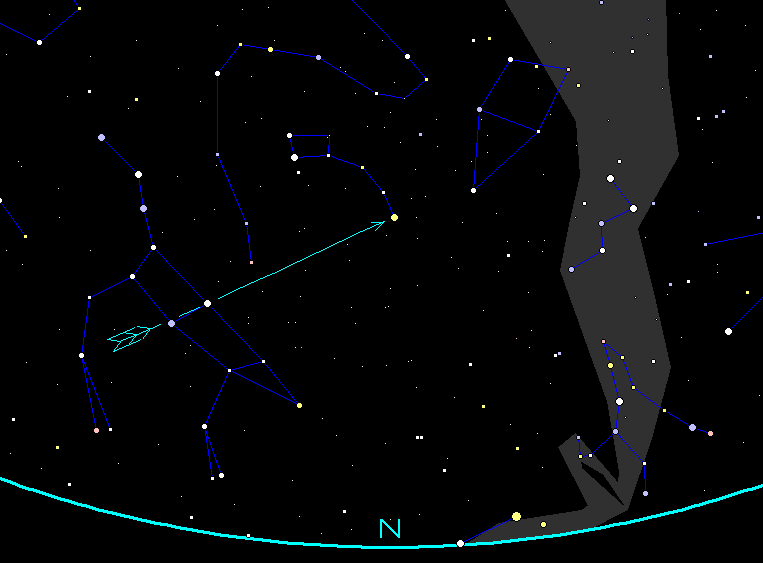
Polaris finder chart for 10 p.m., August 28th. Created using my LookingUp program
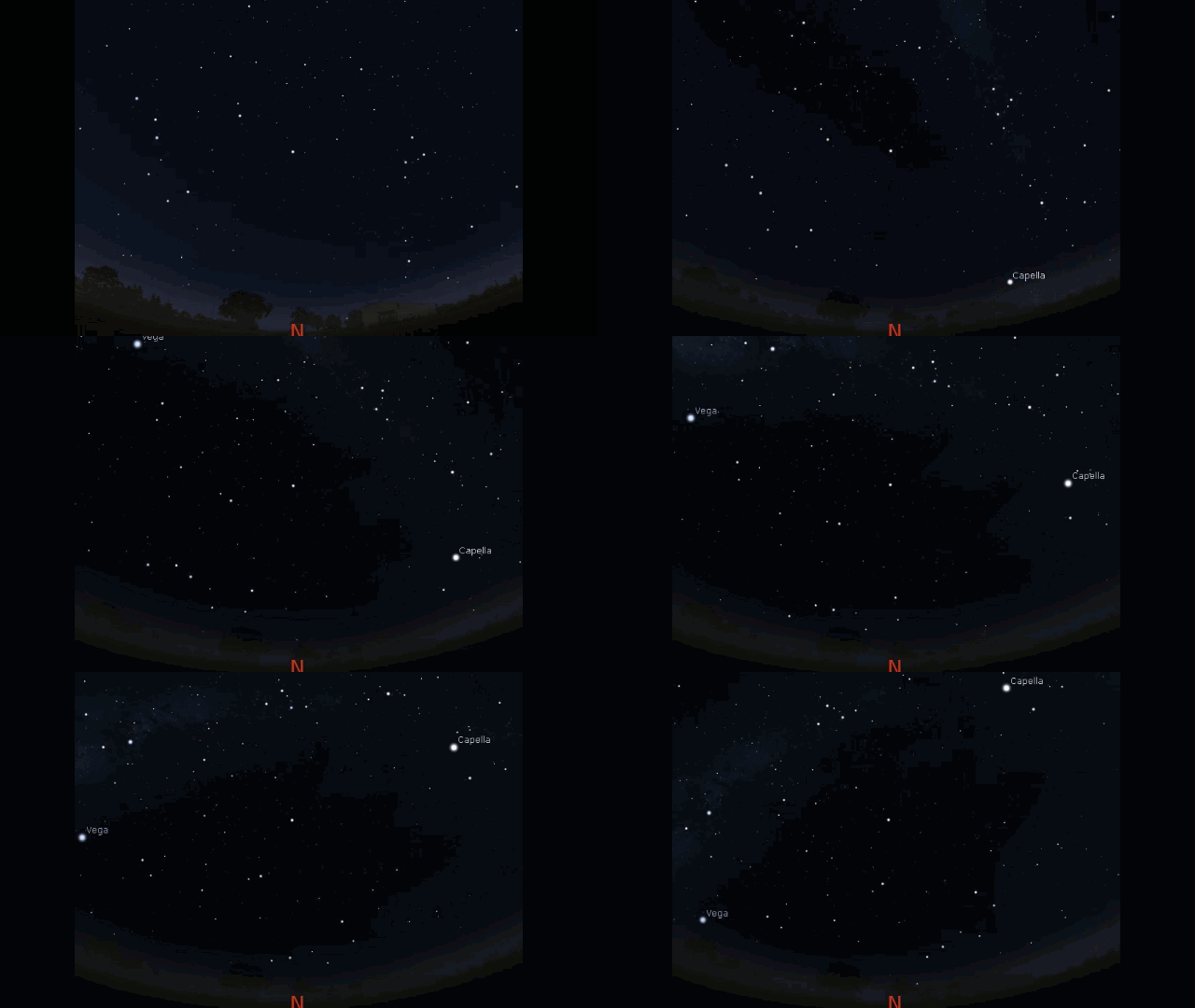
Animation of the rotation of the sky around Polaris on the night of August 28/29, 2017. Created using Stellarium and Filmora.
I’ve left the constellation lines off. The Big Dipper is seen easily as is Cassiopeia’s “W” opposite it around the stationary Polaris.
07/10/2017 – Ephemeris – Deneb, a super bright star
Ephemeris for Monday, July 10th. Today the Sun will be up for 15 hours and 20 minutes, setting at 9:27, and it will rise tomorrow at 6:08. The Moon, 1 day past full, will rise at 10:24 this evening.
This evening when it gets dark the bright star Deneb in Cygnus the swan will be high in the east-northeast. Deneb is the dimmest star of the summer triangle. Of the other stars of the triangle, Vega is higher in the east, while Altair is lower in the southeast. While Deneb’s apparent magnitude, or brightness as seen from Earth, makes it the dimmest of the three bright stars, Deneb’s vast distance of possibly 1,400 light years* makes it over 50 times the distance of Vega. If brought as close as Vega, Deneb would be as bright at least as the quarter moon. It is possibly as bright as 200 thousand Suns; and a huge star, possibly as large in diameter as the orbit of the Earth. For all this it is only 20 to 25 times the mass of the sun.
The times given are for the Traverse City/Interlochen area of Michigan. They may be different for your location.
* Deneb’s distance is not well known. Over the years with the Ephemeris program and this blog I’ve given various distances to the star. Having no companion and being beyond the distance where trigonometric parallax is used, at least from the ground, makes distance measurement difficult. Hipparcos satellite measurements give a distance about twice as great. Estimates of the true brightness of a star are based on its known distance. An error in distance by a factor of two gives an error in terms of intrinsic luminosity by a factor of 4, due to the inverse square law of brightness with distance.
Addendum
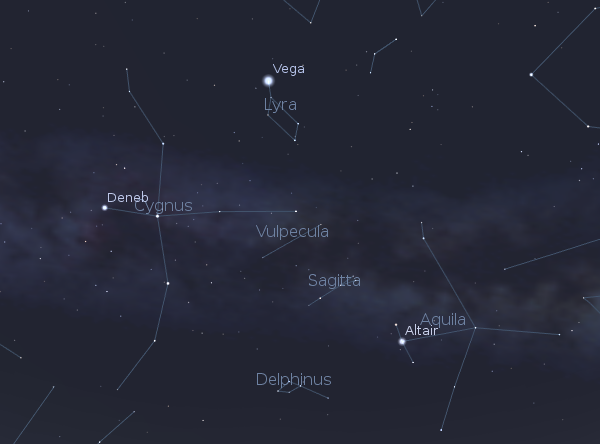
Deneb with the other stars and constellations in the Summer Triangle. Created using Stellarium.
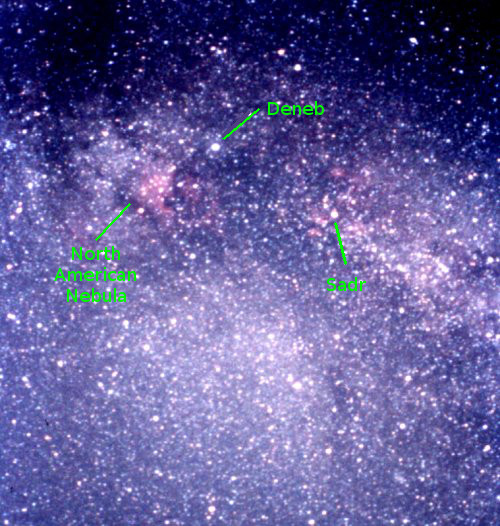
One of my old photographs of Deneb and the North American Nebula digitized from a slide. Deneb’s ultraviolet emissions cause the North American and unnamed here Pelican Nebulae to glow. The red color is due to hydrogen.
06/29/2017 – Ephemeris – A closer look at the star Vega
Ephemeris for Thursday, June 29th. Today the Sun will be up for 15 hours and 31 minutes, setting at 9:31, and it will rise tomorrow at 6:00. The Moon, 1 day before first quarter, will set at 1:21 tomorrow morning.
The bright star high in the east is Vega, one of the stars of the Summer Triangle an informal constellation called an asterism. Vega belongs to the official constellation Lyra the harp, which includes a narrow parallelogram of stars to its south. Vega is regarded by astronomers as a standard calibration star. Though a first magnitude star, its actual magnitude is 0.03. It is a type A0 pure white star, and is 27 light years away. Astronomers however got a shock in 1983 when calibrating the Infrared Astronomy Satellite (IRAS) on it: Vega showed an excess of Infrared radiation that means the star is orbited by a disk of dust, perhaps a Kuiper belt of its own. Due to the slow wobble of the earth’s axis Vega will be our pole star in 14 thousand years.
The times given are for the Traverse City/Interlochen area of Michigan. They may be different for your location.
Addendum
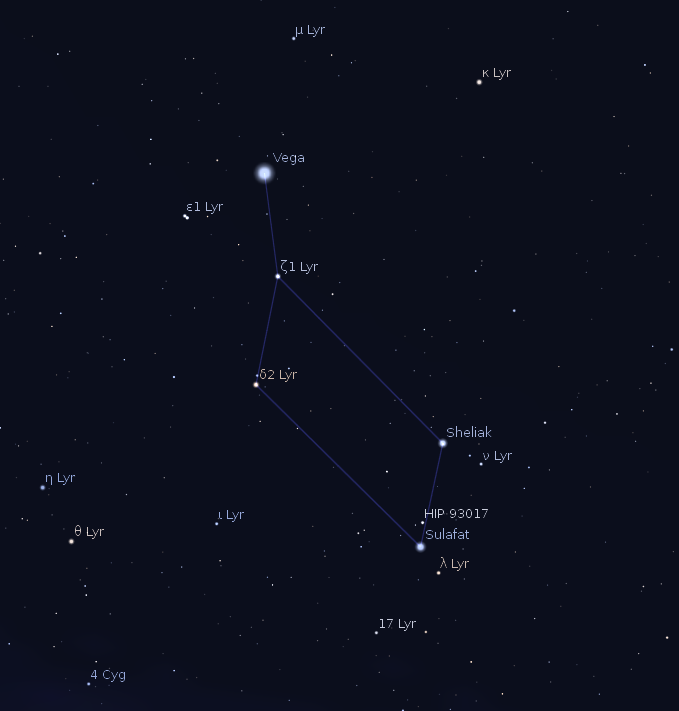
Magnified view of Lyra. Created using Stellarium.
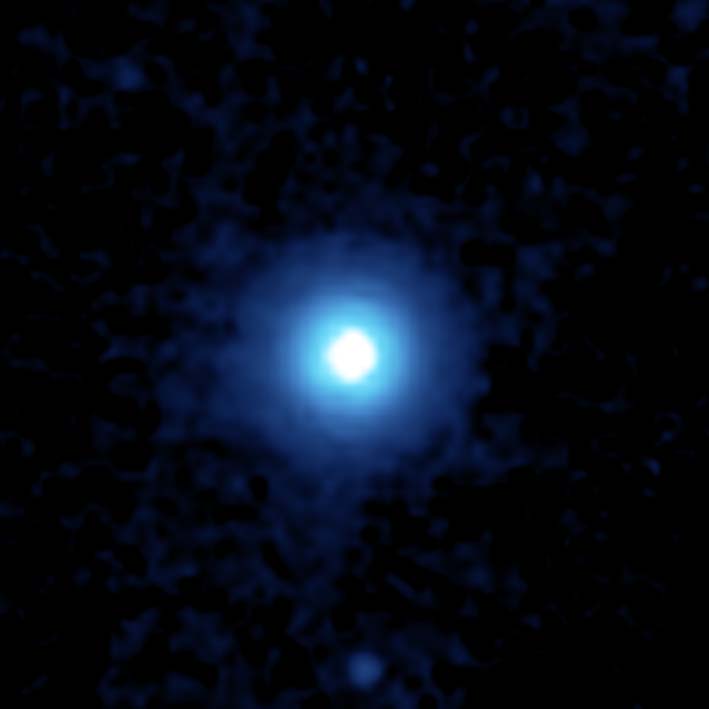
Vega in the mid-infrared from the Spitzer Infrared Satellite. Credit: NASA/JPL-Caltech/University of Arizona.
06/27/2017 – Ephemeris – Arcturus as a look at the Sun’s future
Ephemeris for Tuesday, June 27th. Today the Sun will be up for 15 hours and 32 minutes, setting at 9:31, and it will rise tomorrow at 5:59. The Moon, 3 days before first quarter, will set at 12:18 tomorrow morning.
With the Moon brightening the night sky, let’s take a look at the star Arcturus, which with its pointer, the curve of the Big Dipper’s handle is slipping into the high western sky. Arcturus is the 4th brightest night time star, though some think the star Vega, high in the east is brighter. They are different colors because Arcturus is orange, while Vega is whiter than the Sun. Arcturus is a preview of what the Sun will become in four or five billion years from now. It is only 10% more massive than the Sun and is that much older than the Sun, so it is turning into its red giant stage, after running out of hydrogen to turn into helium in its core to produce energy. The helium is now compressing and heating to begin its reaction.
The times given are for the Traverse City/Interlochen area of Michigan. They may be different for your location.
Addendum
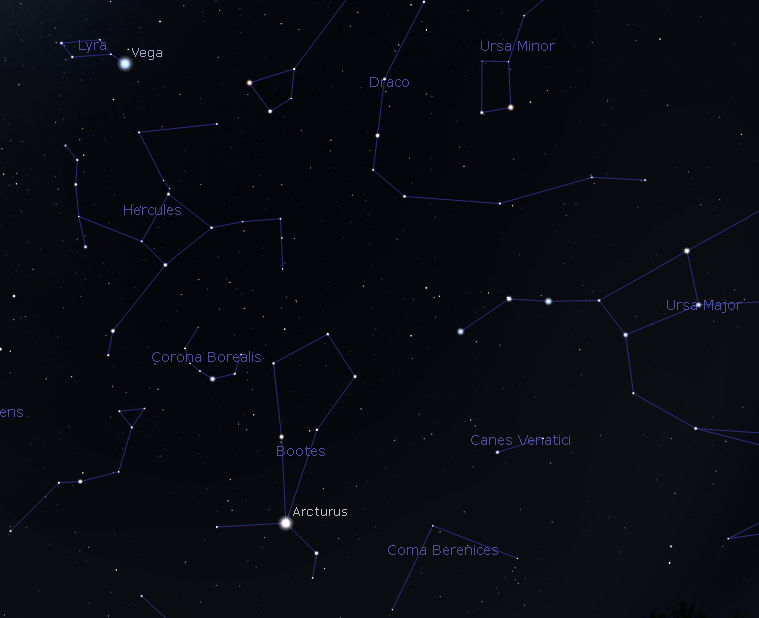
Arcturus finder chart with the Big Dipper and Vega as guide posts. Created using Stellarium.
Here’s one of my prior posts about Arcturus, about its great space velocity: https://bobmoler.wordpress.com/2016/04/26/04262016-ephemeris-arcturus-just-passing-through/
06/26/2017 – Ephemeris – Latest sunset and the apparent positions of the Summer Triangle stars
Ephemeris for Monday, June 26th. Today the Sun will be up for 15 hours and 32 minutes, setting at 9:31, and it will rise tomorrow at 5:59. The Moon, 3 days past new, will set at 11:40 this evening.
Tonight we have the latest sunset of the year. From now on until December sunsets will become earlier. Other than the sunrise and sunset numbers, we’ll begin to notice it for real in a few weeks. At first that realization strikes me a sad note that summer is beginning to end. However the astronomer in me realizes that means more night-time hours, and that the summer Milky Way is coming. Of the three bright stars of the Summer Triangle overhead and in the east, two of its stars are in the milky band. They are Deneb to the north and Altair to the south. Vega, closest to the zenith is not in the band. Actually all the stars we see with the naked eye or small telescopes belong to the Milky Way galaxy.
The times given are for the Traverse City/Interlochen area of Michigan. They may be different for your location.
Addendum
Looking at the stars of the Summer Triangle and their location in and near the Milky Way band. Created using Stellarium.
 Bob Moler's Ephemeris Blog