Archive
02/12/2016 – Ephemeris – A circle of bright stars in winter
Ephemeris for Friday, February 12th. The Sun will rise at 7:48. It’ll be up for 10 hours and 18 minutes, setting at 6:06. The Moon, 3 days before first quarter, will set at 11:19 this evening.
The winter skies are blessed with more first magnitude stars than any other season. With the moon out these stars will stand out even more, as dimmer stars are suppressed. Six of these stars lie in a large circle centered on the seventh, the Winter Circle.
This circle is up at 9 p.m. Starting high nearly overhead is Capella in Auriga the charioteer. Moving clockwise down to the south, we come to Aldebaran in the face of Taurus the Bull. Then down to Orion’s knee we find Rigel. Down and left is the brightest star of all Sirius in Canis Major Orion’s large hunting dog, lowest of these stars in the southeast. Moving up and left there is Procyon in Canis Minor, Above is Pollux in Gemini the twins. All are centered on Betelgeuse the bright red star in Orion’s shoulder.
Times are for the Traverse City/Interlochen area of Michigan. They may be different for your location.
Addendum
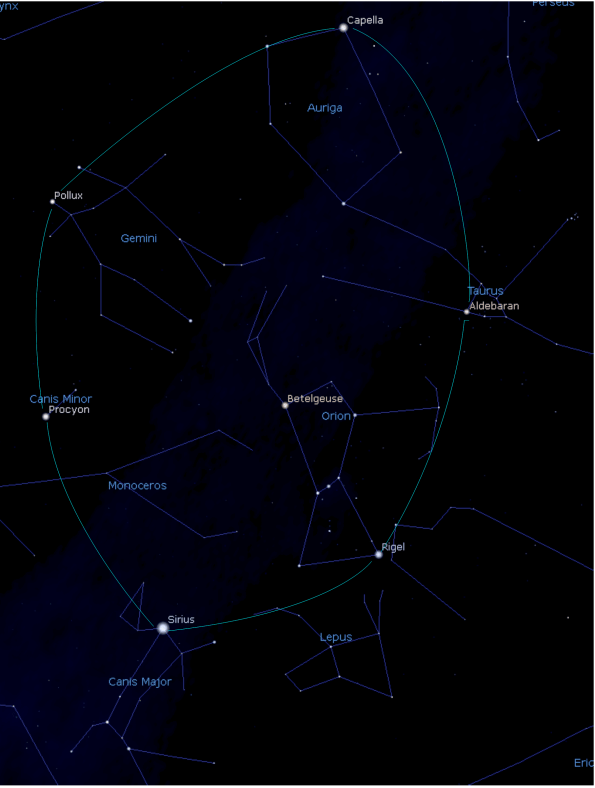
The bright stars of winter arrayed in a circle. Created using Stellarium.
Some also see a Winter Triangle consisting of the stars Betelgeuse, Sirius and Procyon.
02/11/2016 – Ephemeris – What do star colors reveal?
Ephemeris for Thursday, February 11th. The Sun will rise at 7:49. It’ll be up for 10 hours and 15 minutes, setting at 6:05. The Moon, 3 days past new, will set at 10:06 this evening.
The bright stars of winter have subtle differences in color. But what do those colors mean? In stars color is indicative of surface temperature. From coolest to hottest are red, orange, yellow, and white to blue, the hottest. Interior decorators may disagree, but that’s how it is. Coolest of the bright stars is red Betelgeuse in Orion’s shoulder, then orange Aldebaran in the face of Taurus the bull, and Pollux in Gemini. Hotter yet is yellow Capella in Auriga the Charioteer, about the temperature of the Sun. Then we come to the white-hot Procyon and Sirius in the little and big dogs of Orion. Hottest is blue-white Rigel in Orion’s knee. There are hotter stars in Orion, the center and rightmost stars of Orion’s belt are bluer and hotter yet.
Times are for the Traverse City/Interlochen area of Michigan. They may be different for your location.
Addendum
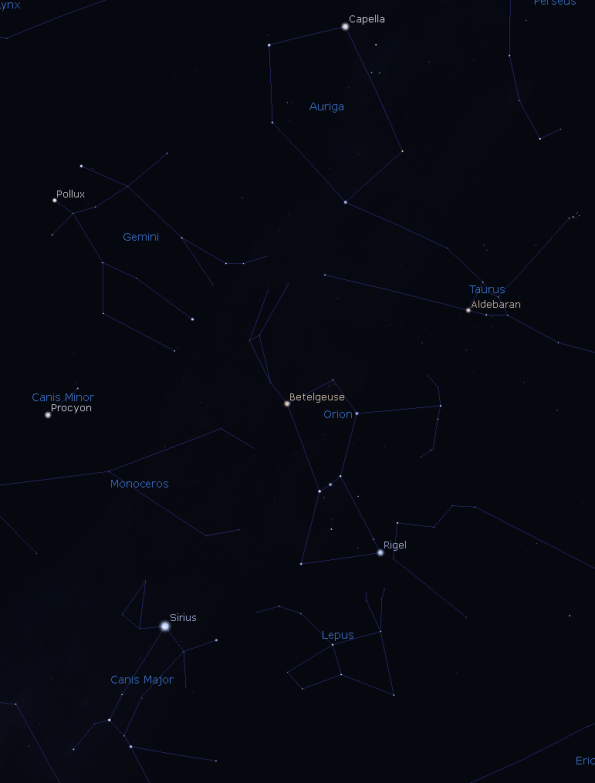
Bright stars of winter with hints as to their colors. The star label is the color of the star. Created using Stellarium.
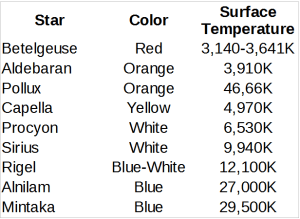
A table of star color and surface temperatures. Created from data in Wikipedia.
The star Alnilam is the center star of Orion’s belt, while Mintaka is the rightmost star of the belt. The temperature scale K is the Kelvin scale which is the Celsius scale plus 273.15. Zero on the Kelvin scale is absolute zero. 1 degree Celsius equals 1 Kelvin. One never says degrees Kelvin.
Betelgeuse is a variable star, so its surface temperature varies.
02/09/2016 – Ephemeris – The Dog Star has a pup
Ephemeris for Fat Tuesday, Tuesday, February 9th. The Sun will rise at 7:52. It’ll be up for 10 hours and 9 minutes, setting at 6:02. The Moon, 1 day past new, will set at 7:39 this evening.
Sirius is the brightest night time star and is located in the southeast at 9 p.m. below and a bit left of Orion the Hunter. We’ve visited Sirius once before this winter. But there is another star in the Sirius system that is practically invisible due to Sirius’ dazzling glare. Its name is Sirius B, nicknamed the Pup, alluding to Sirius’ Dog Star title. The tiny star was suspected as far back as 1834 due to Sirius’ wavy path against the more distant stars. Sirius and the Pup have 50 year orbits of each other. The Pup was first seen by famed 19th century telescope maker Alvan Clark in 1862 while testing a new telescope. The Pup is a white dwarf star, as small as the Earth but with the mass of the sun, out of hydrogen fuel and slowly collapsing.
Times are for the Traverse City/Interlochen area of Michigan. They may be different for your location.
Addendum
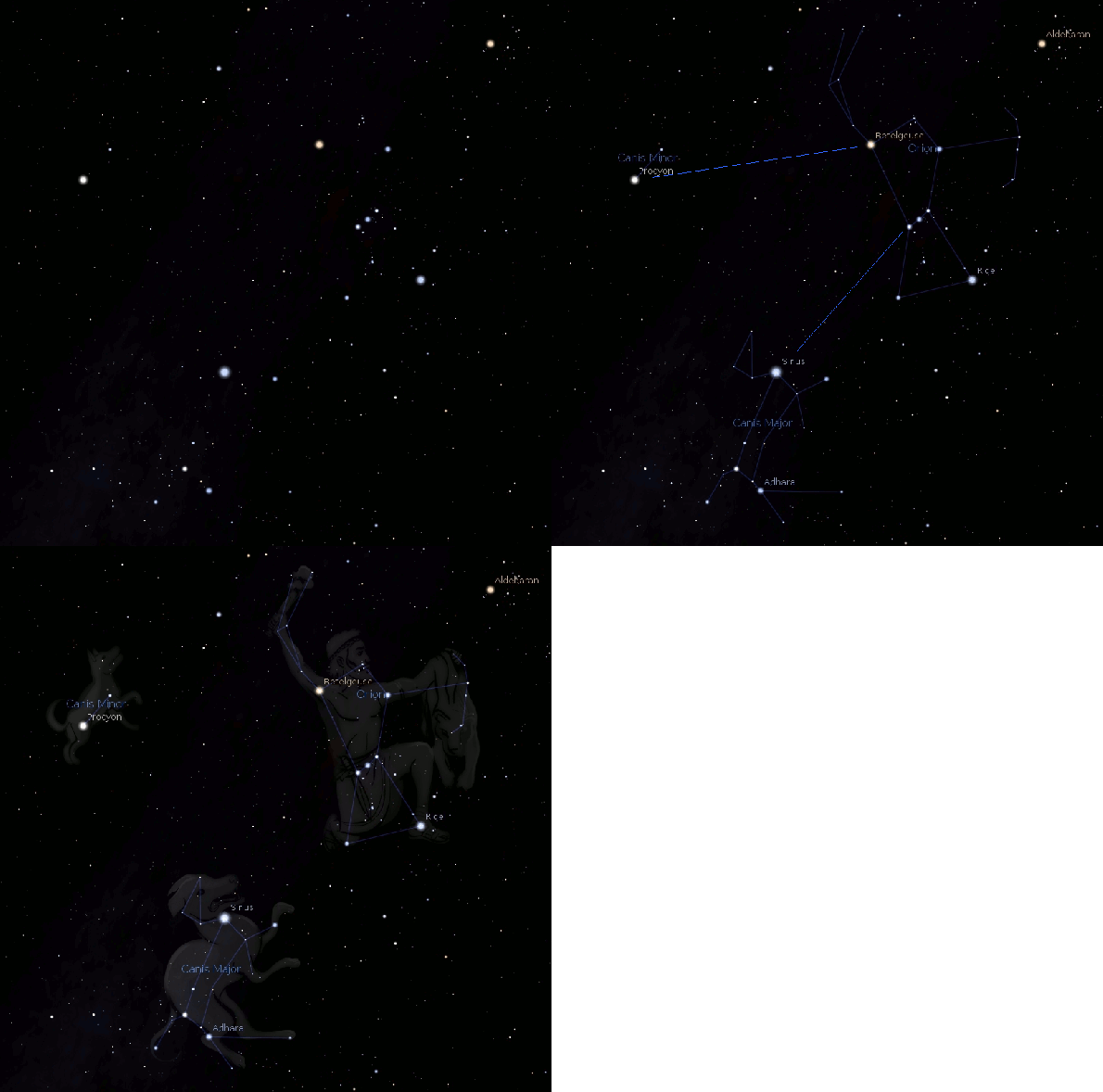
Orion and his hunting dogs revealed in animation. Created with Stellarium and GIMP.
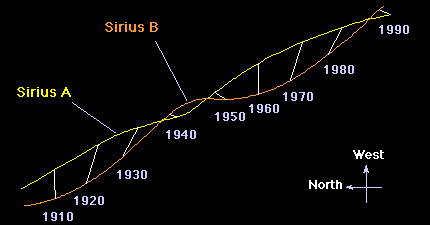
Sirius A & B’s path in the sky showing the wobble that betrayed the Pup’s presence. Credit Mike Guidry, University of Tennessee.
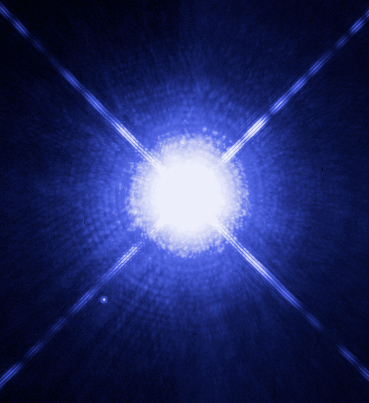
Sirius A and B (near the diffraction spike to the lower left), A Hubble Space Telescope photograph. Credit NASA, ESA.
01/25/2016 – Ephemeris – Sirius the Dog Star
Ephemeris for Monday, January 25th. The Sun will rise at 8:09. It’ll be up for 9 hours and 31 minutes, setting at 5:41. The Moon, 2 days past full, will rise at 7:43 this evening.
While we’re waiting for the bright Moon to leave the evening sky, let’s look at another bright star. This one is the brightest of all, Sirius the Dog Star. The Dog Star name comes from its position at the heart of the constellation Canis Major, the great dog of Orion the hunter. The three stars of Orion’s belt tilt to the southeast and point to Sirius. The name Sirius means ‘Dazzling One’, a reference to its great brilliance and twinkling. The Romans thought Sirius added its heat to that of the Sun in summer to bring on the scorching Dog Days of July and August. Its ancient Egyptian name was Sothis, and its first appearance in the morning twilight in late June signaled the flooding of the Nile, and the beginning of the Egyptian agricultural year.
Times are for the Traverse City/Interlochen area of Michigan. They may be different for your location.
Addendum
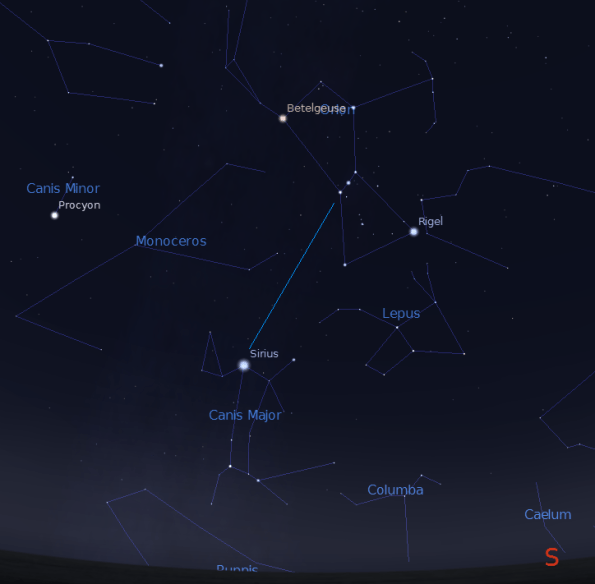
Orion’s Belt points to Sirius. Created using Stellarium.
01/21/2016 – Ephemeris – Rigel, Orion’s other bright star
Ephemeris for Thursday, January 21st. The Sun will rise at 8:12. It’ll be up for 9 hours and 22 minutes, setting at 5:35. The Moon, 2 days before full, will set at 6:44 tomorrow morning.
The bright star at the bottom right corner of the big upright rectangle that is the giant hunter Orion’s body in the south-southeast is Rigel. It is a white star with a bluish tinge. It compares in brightness with Betelgeuse at the opposite end of Orion’s rectangle, though it’s usually a bit brighter. The mismatch in color makes brightness comparisons difficult. Rigel is about 860 light years away, It’s 20 times the mass of the Sun, 120 thousand the times brighter than the Sun, and a diameter about the size of the orbit of Mercury. It’s age is thought to be about 8 million years. It has a visual companion star that can be seen in amateur telescopes. It’s not that dim, but suffers by being close to the arc light brightness of Rigel.
Times are for the Traverse City/Interlochen area of Michigan. They may be different for your location.
Addendum
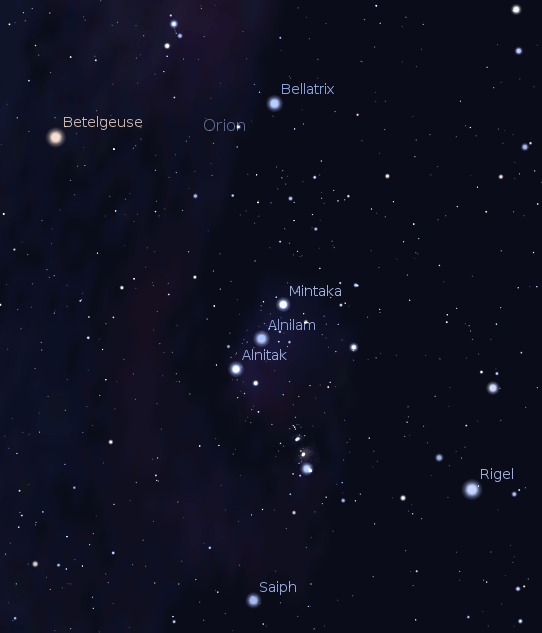
Torso of Orion centered on his belt. Created using Stellarium.
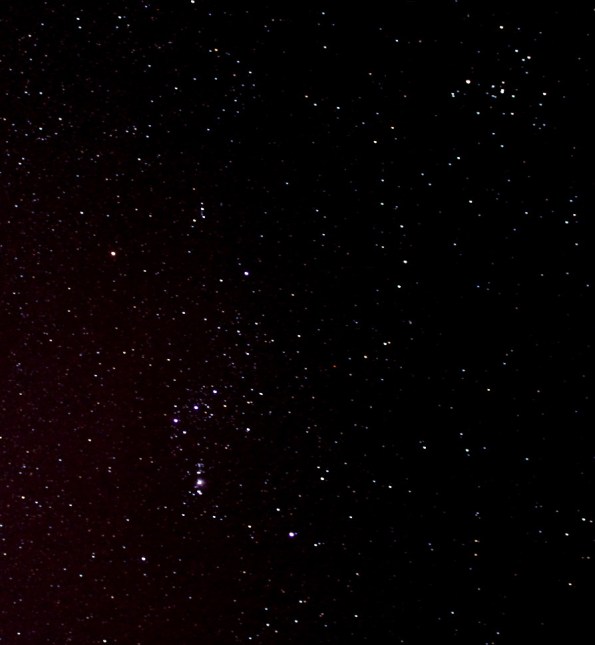
Orion and the head of Taurus photograph by myself January 4, 2016 at 11:30 p.m. It’s a stack of untracked 20 exposures.
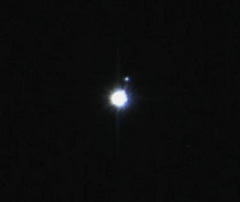
Rigel with its companion star as photographed through a telescope. No attribution. Source: http://washedoutastronomy.com/content/urban-orion?page=1
01/19/2016 – Ephemeris – The Moon will cover Aldebaran tonight!
Ephemeris for Tuesday, January 19th. The Sun will rise at 8:14. It’ll be up for 9 hours and 18 minutes, setting at 5:32. The Moon, 3 days past first quarter, will set at 4:51 tomorrow morning. | Tonight the Moon will pass in front of or occult the bright star Aldebaran, the bright star in Taurus the bull. The bright Moon will making spotting Aldebaran difficult without binoculars, or better yet, a telescope. Aldebaran will wink out at the Moon’s dark eastern or left edge around 9:06 p.m. The exact time depends on your location. It’s within a minute or 2 for the IPR listening area. Aldebaran will be uncovered by the Moon around 10:25 p.m. at the bright lower right edge of the Moon. Today’s posting on bobmoler.wordpress,com will have much more information on the event, and how to calculate times for other locations along the path of the occultation (see below). This is the best of the four Aldebaran occultations visible this year.
Times are for the Traverse City/Interlochen area of Michigan. They may be different for your location.
Addendum
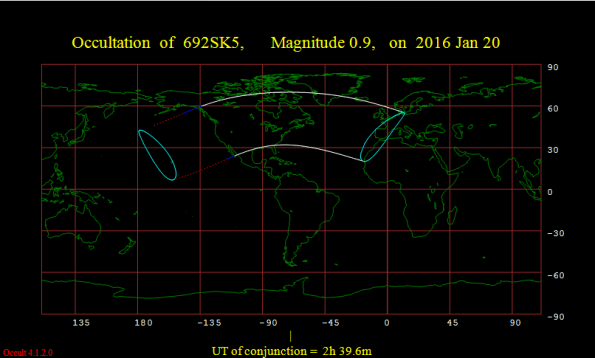
Occultation visibility map for January 19, 2016 EST (January 20 UT). Credit IOTA/Occult4 program. Looks like the followers of this blog in the UK will get a piece of this one too.
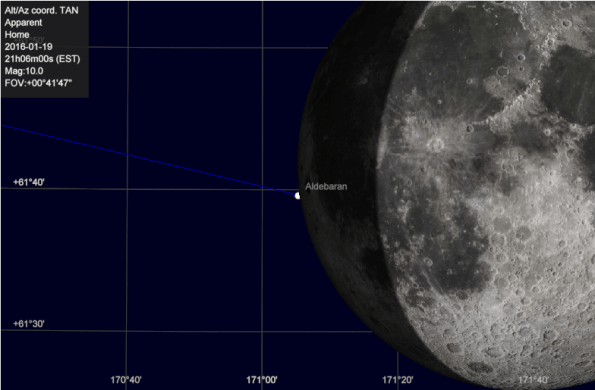
Aldebaran will disappear at the Moon’s dark leading edge at about 9:06 p.m. January 19, 2016. Created using Cartes du Ciel (Sky Charts).
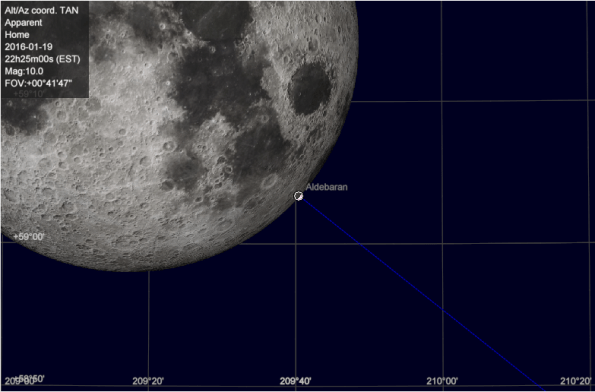
Aldebaran will reappear at the Moon’s bright trailing edge at about 10:25 p.m. January 19, 2016. Created using Cartes du Ciel (Sky Charts).
Estimating timings for your location
I used Cartes du Ciel the free software that I have a link to on the right. Make sure that the program is set for topocentric positions under Setup/Solar System. And you have entered your position under Setup/Observatory. You can find your location in Google Earth.
You can also use Stellarium. Just make sure the Moon is normal sized.
In both programs you can lock the Moon or Aldebaran in the center of the screen Pick a time in advance of the occultation and using the set time window walk the star towards the Moon, mark the time. Then walk the star out from the Moon and record the reappearance time. That’s it.
This should work with other planetarium programs too.
01/18/2015 – Ephemeris – Betelgeuse, a dying star
Ephemeris for Martin Luther King Day, Monday, January 18th. The Sun will rise at 8:15. It’ll be up for 9 hours and 16 minutes, setting at 5:31. The Moon, 2 days past first quarter, will set at 3:47 tomorrow morning.
Now that the Moon is getting brighter and making the fainter tars in the constellations harder to find, let’s look at the bright stars of Winter. Today, let’s look at Betelgeuse the reddish star in Orion the hunter’s shoulder. Lets get the basic facts out first. Betelgeuse is a red giant star 90 thousand to 150 thousand times brighter than the Sun and 7 to 20 times the Sun’s mass. It’s around a thousand times the diameter of the Sun, making it about the diameter of the orbit of Jupiter. It’s about 650 light years away, but that’s a bit uncertain. It is shedding gasses at a prestigious rate. Though only 7 million years old, it may explode as a supernova in the next million years. And yes, we’re far enough away.
Times are for the Traverse City/Interlochen area of Michigan. They may be different for your location.
Addendum
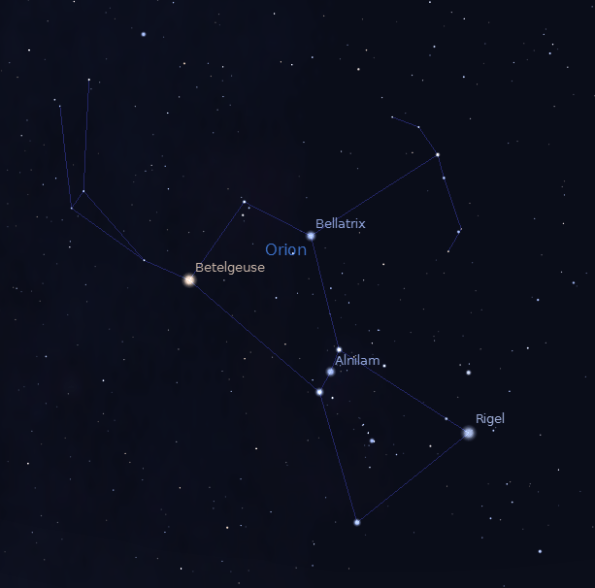
Some of Orion’s named stars, including Betelgeuse. Orion at 8 p.m. Created using Stellarium.
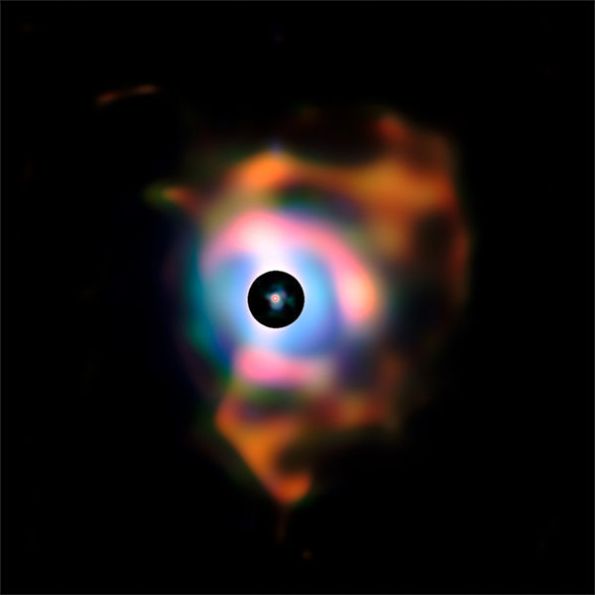
Betelgeuse and its nebula. From ESO’s Very Large Telescope.
12/25/2015 – Ephemeris – This year’s Christmas Stars
Merry Christmas. This is Bob Moler with Ephemeris for Christmas Day, Friday, December 25th. The Sun will rise at 8:18. It’ll be up for 8 hours and 48 minutes, setting at 5:07. The Moon, at full today, will rise at 5:53 this evening.
It’s Christmas morning, and if it’s clear the full Moon will low in the west. Venus the brilliant Morning Star will be low in the southeast, Jupiter, second only to Venus in brightness will appear half way up to the zenith in the south. Venus or perhaps Jupiter, take your pick can be this year’s Christmas Star. The bright stars in the evening sky tonight are those of winter, that have looked down on us in their familiar patterns for millennia. The bright planets and stars, or even a brilliant supernova, or the one at the top of our Christmas tree, cannot be, according to those astronomers who accept the Star of Bethlehem as a real phenomenon, as what the star was. The leading contenders for the Star have always involved two planets.
Times are for the Traverse City/Interlochen area of Michigan. They may be different for your location.
Addendum
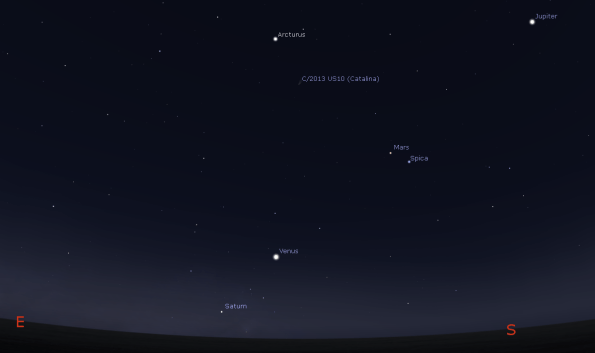
The morning planets, Jupiter, Mars, Venus and Saturn, plus Comet Catalina at 7 a.m. . Created using Stellarium.
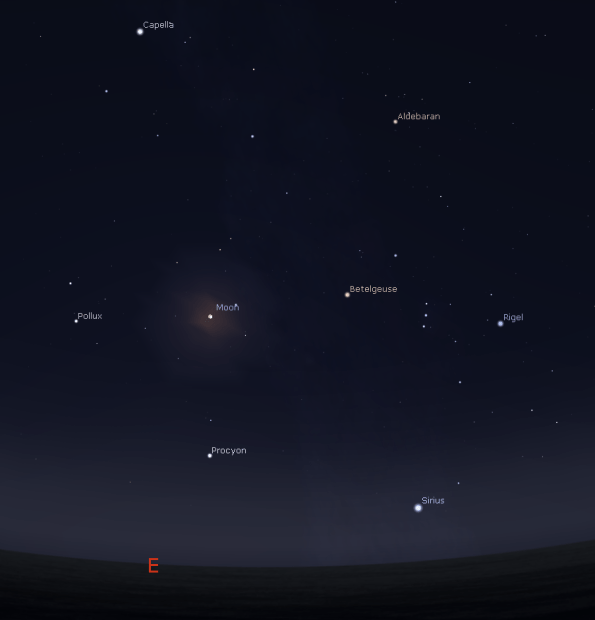
The bright stars of Christmas Night and the full Moon. Created using Stellarium.
12/17/2015 – Ephemeris – The bright star Aldebaran the “follower”
Ephemeris for Thursday, December 17th. The Sun will rise at 8:14. It’ll be up for 8 hours and 48 minutes, setting at 5:03. The Moon, 1 day before first quarter, will set at 12:07 tomorrow morning.
The central constellation of winter Orion, will be rising the east-southeast at 9 p.m. Above it is Taurus the bull. The bright orange star in Taurus is Aldebaran. Aldebaran appears at the lower left tip of a letter V group of stars that is the face of the bull. Aldebaran isn’t actually part of the group, called the Hyades star cluster. The cluster is about 151 light years away, while Aldebaran is 65. The star has an orange hue because its surface is cooler than the sun’s. However Aldebaran is 44 times larger in diameter, and shines 425 times brighter than the sun, if you include the infrared which our eyes can’t detect, or 150 times brighter in visible light. The name Aldebaran means “Follower” because it follows the Pleiades star cluster above through the night.
Times are for the Traverse City/Interlochen area of Michigan. They may be different for your location.
Addendum
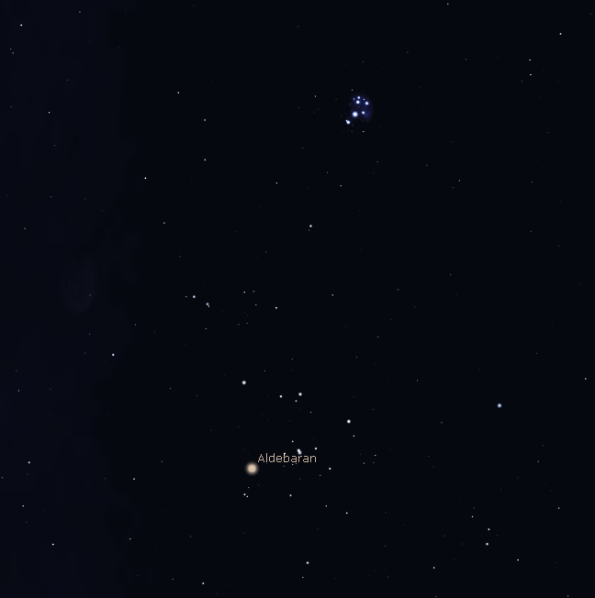
Aldebaran, the Hyades and Pleiades star clusters. Created using Stellarium.
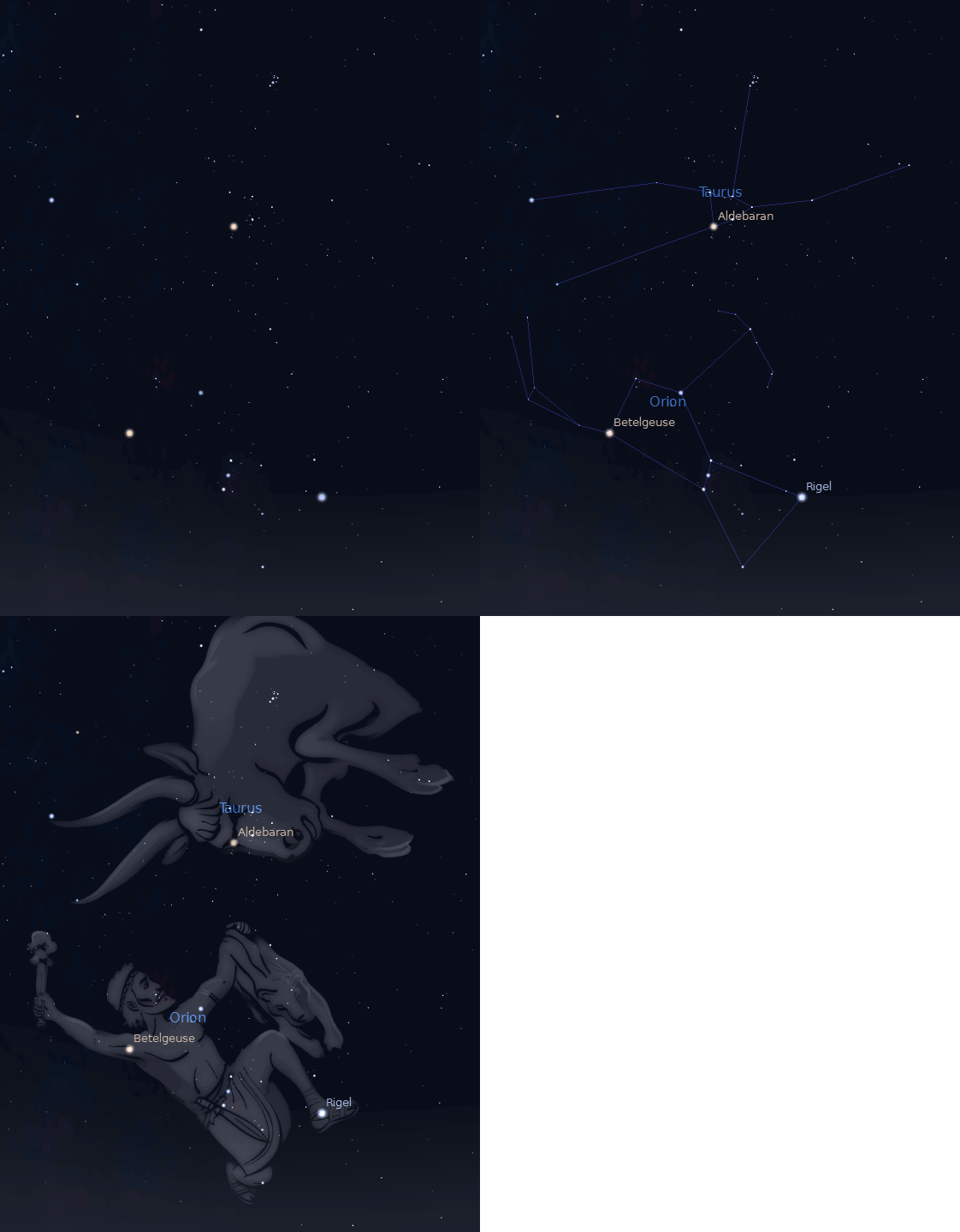
Three views of Taurus the bull and Orion the hunter for 9 p.m. on December 8, 2015. Created using Stellarium and GIMP.
12/15/2015 – Ephemeris – Procyon the star that’s “Before the dog”
Ephemeris for Tuesday, December 15th. The Sun will rise at 8:13. It’ll be up for 8 hours and 49 minutes, setting at 5:02. The Moon, 3 days before first quarter, will set at 9:48 this evening.
Visible low in the east at 9:30 p.m. appears the star Procyon to its lower left is Sirius the brightest night-time star. Procyon is the bright star in the constellation Canis Minor, or lesser dog. I can find only one other star in Canis Minor. Perhaps it’s a hot dog. If Sirius, in Canis major is the Dog Star then Procyon should be the Little Dog Star. However Procyon is an interesting name. It means “Before the dog”, which is an allusion to the fact that Procyon, though east of Sirius actually rises before it. This is due to Procyon’s more northerly position. This effect doesn’t work south of the equator, however. Sirius will rise at about 9 tonight. Procyon is a star much like Sirius but is 32% farther away. It’s 11.4 to Sirius’ 8.6 light years away.
Times are for the Traverse City/Interlochen area of Michigan. They may be different for your location.
Addendum
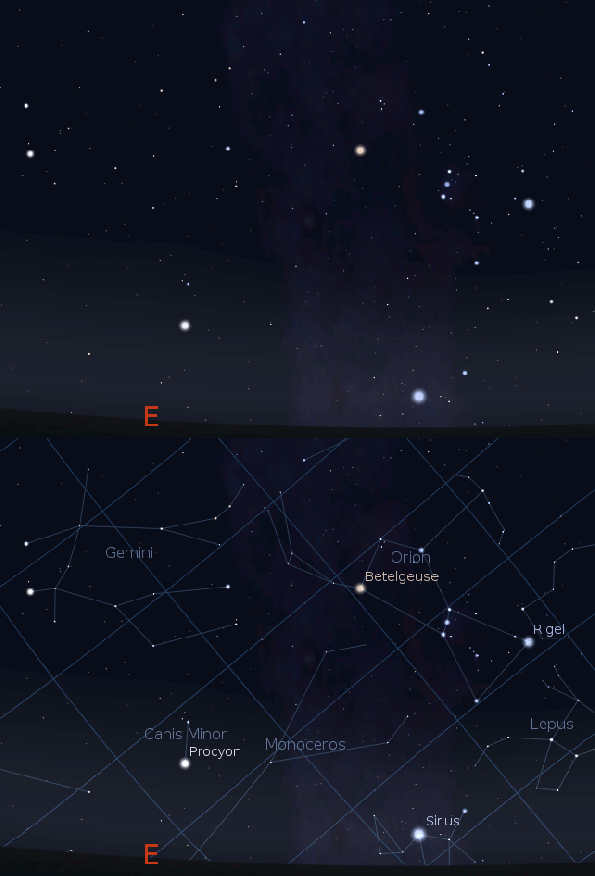
Procyon, Sirius and the stars of winter. Created using Stellarium
In the above chart, beside the constellation lines, we have the grid of right ascension, from lower left to upper right; and declination, from upper left to lower right. right ascension lines are like longitude on the Earth, while declination lines are latitude lines. They are tipped because I don’t live at either the equator or one of the poles. As the Earth rotates the Sun, stars and planets slide westward in the direction of the declination lines. Note that Sirius is closer to the horizon than Procyon. Also that Sirius is west of the 7 hour right ascension line. (Take my word for it.) Procyon is east of that line, thus Sirius is west of Procyon.
Other cool things can be seen in the chart. Note the declination line that touches the horizon at the east compass point and runs just above Orion’s belt. It is 0º declination, or the celestial equator. It extends to the west compass point on the western horizon. The Sun on the equinoxes will rise due east and set due west. The 6 hour right ascension line runs past Betelgeuse in Orion. At 23½º north declination, near Castor’s big toe in Gemini is where the Sun appears on the first day of summer, the summer solstice.
P.S. It was cloudy and rainy the last two days. Didn’t see a Geminid meteor again this year, keeping my record intact.
 Bob Moler's Ephemeris Blog