Archive
01/05/2023 – Ephemeris – I’m Sirius about this being the brightest nighttime star!
Jan 5. This is Bob Moler with Ephemeris for Thursday, January 5th. Today the Sun will be up for 8 hours and 56 minutes, setting at 5:16, and it will rise tomorrow at 8:19. The Moon, 1 day before full, will set at 8:33 tomorrow morning.
The brightest nighttime star, Sirius, rises before 8 pm tonight. It can be found by following the constellation Orion’s three belt stars downward to near the east-southeastern horizon. As far as star-like objects go, Jupiter and Venus can always outshine Sirius. Mars can too, but only when it is near the Earth and this early evening when Mars is high in the sky and Sirius is low in the sky. When the Moon clears out of the evening sky, and Sirius rises higher, the other stars of its constellation will become visible. That constellation is Canis Major, Orion’s great hunting dog, from which it gets its nickname: Dog Star. The name Sirius means Dazzling One, an allusion to its great brightness and, being low in the sky, it twinkles mightily.
The astronomical event times given are for the Traverse City/Interlochen area of Michigan (EST, UT –5 hours). They may be different for your location.
Addendum
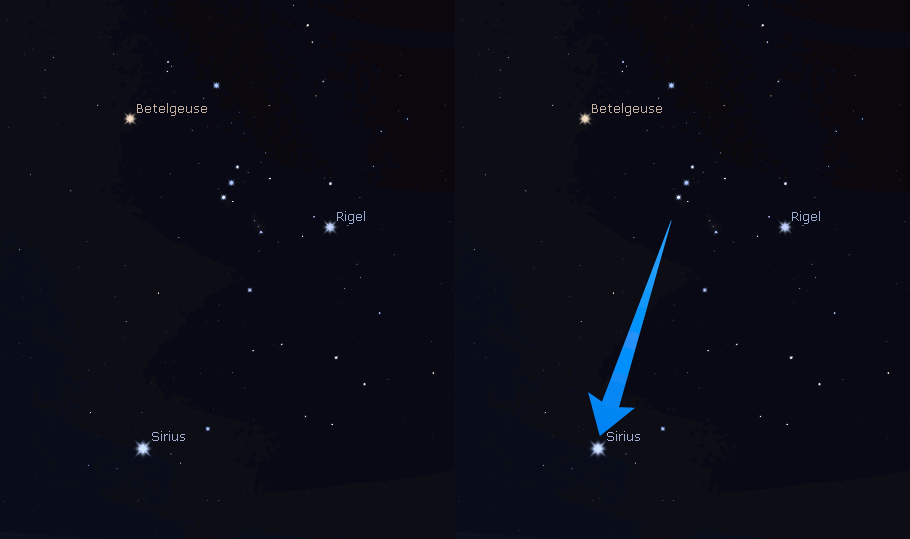
A Sirius finder animation for January/early February at around 8 pm. Even in bright moonlight, the seven bright stars of Orion can be seen. The three stars of Orion’s belt make a great pointer to Sirius. Created using Stellarium, GIMP and LibreOffice (for the arrow).
10/31/2022 – Ephemeris – The perfect Halloween star
This is Bob Moler with Ephemeris for Halloween, Monday, October 31st. Today the Sun will be up for 10 hours and 13 minutes, setting at 6:32, and it will rise tomorrow at 8:20. The Moon, 1 day before first quarter, will set at 12:02 tomorrow morning.
Not all the ghosts and goblins out tonight will be children. One is out just about every night because it’s a star. Its name is Algol, from the Arabic for Ghoul Star or Demon Star. It’s normally the second-brightest star in the constellation Perseus the hero, visible in the northeast this evening. The star is located where artists have drawn the severed head of Medusa, whom he had slain. Medusa was so ugly that she turned all who gazed upon her to stone. Algol is her still glittering eye. The star got the name before astronomers discovered what was really wrong with it. They found out that it does a slow wink about every two days, 21 hours because Algol is two stars that eclipse each other. Her next evening wink will be dimmest at 10:25 p.m. November 19th.*
The astronomical event times given are for the Traverse City/Interlochen area of Michigan (EDT, UT – 4 hours). They may be different for your location.
Addendum
*For the broadcast, the source for the Algol minimum brightness time was the Stellarium app. For whichever date the sky is displayed for and Algol is clicked on, among the data for the star that is displayed is next minimum light. However, in double-checking the times with those posted in Sky & Telescope magazine after I recorded the program, it turns out to be 3 hours 46 minutes early, so minimum light would be at 1:36 am on November 17th. At the time given then, the eclipse would just be starting. The actual first eclipse minimum in the evening in November would be at 10:25 pm on the 19th. I hope it’s clear on the night of the 16/17th to see which prediction is right. In the past, S&T was accurate, or accurate enough.
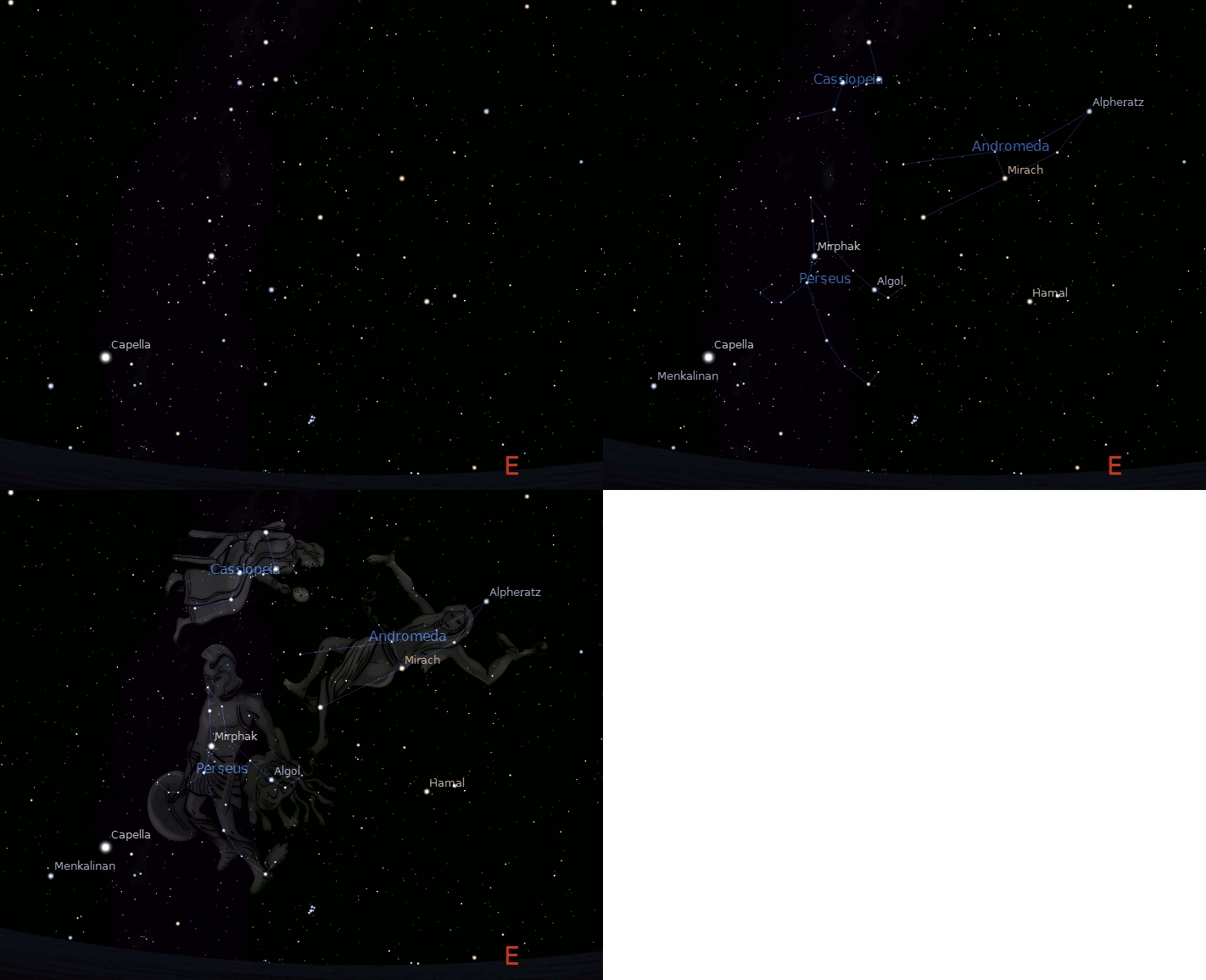
Perseus, Cassiopeia, Andromeda with Algol finder animation for Autumn evenings. Click on the image to enlarge it. Created using Stellarium and GIMP.
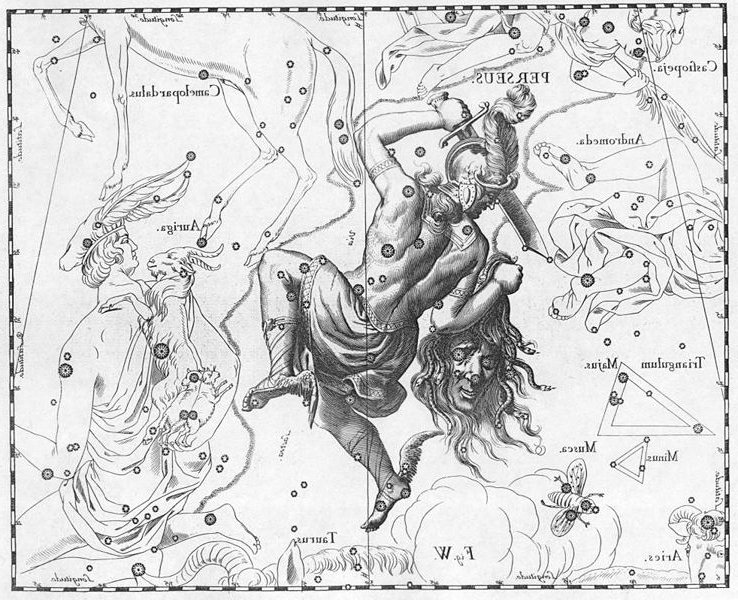
Perseus and the head of Medusa from the 1690 Uranographia by Johannes Hevelius. Note that the captions in the image are as seen in a mirror. Early star representations were painted on a globe, a celestial sphere, so the stars and constellations were shown as seen from the outside. A God’s eye view. Early printed star charts simply kept the convention. I reversed the image, so it is seen from inside the celestial sphere. An Earthly view to match the sky as we see it. The image was found with the article on Algol on Wikipedia.
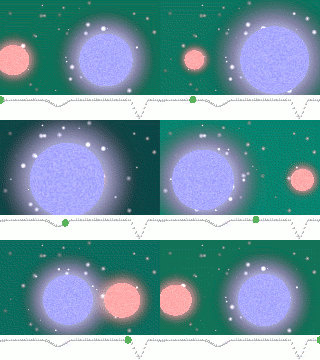
Animation of an eclipsing binary star like Algol. Credit: Wikimedia Commons h/t Earth and Sky
10/14/2022 – Ephemeris – The loneliest star in the sky isn’t so lonely this year, and more
This is Ephemeris for Friday, October 14th. Today the Sun will be up for 11 hours and 2 minutes, setting at 6:59, and it will rise tomorrow at 7:58. The Moon, 3 days before last quarter, will rise at 9:37 this evening.
There’s a bright star that appears for only seven and a half hours on autumn evenings. It’s appearance, low in the south-southeast at 9 p.m., is a clear indication of the autumn season. The star’s name is Fomalhaut, which means fish’s mouth. That’s fitting because it’s in the constellation of Piscis Austrinus, the southern fish. At our latitude it’s kind of the fish that got away, because Fomalhaut appears to be quite alone low in the sky. The other stars of its constellation are dim, and being low in the sky makes them even dimmer. However, this year Fomalhaut has visitors. Above and left of it is the brilliant planet Jupiter. And above and right of it is the bright planet Saturn. Both planets, while not very close to Fomalhaut, will keep it company this year.
The astronomical event times given are for the Traverse City/Interlochen area of Michigan (EDT, UT – 4 hours). They may be different for your location.
Addenda
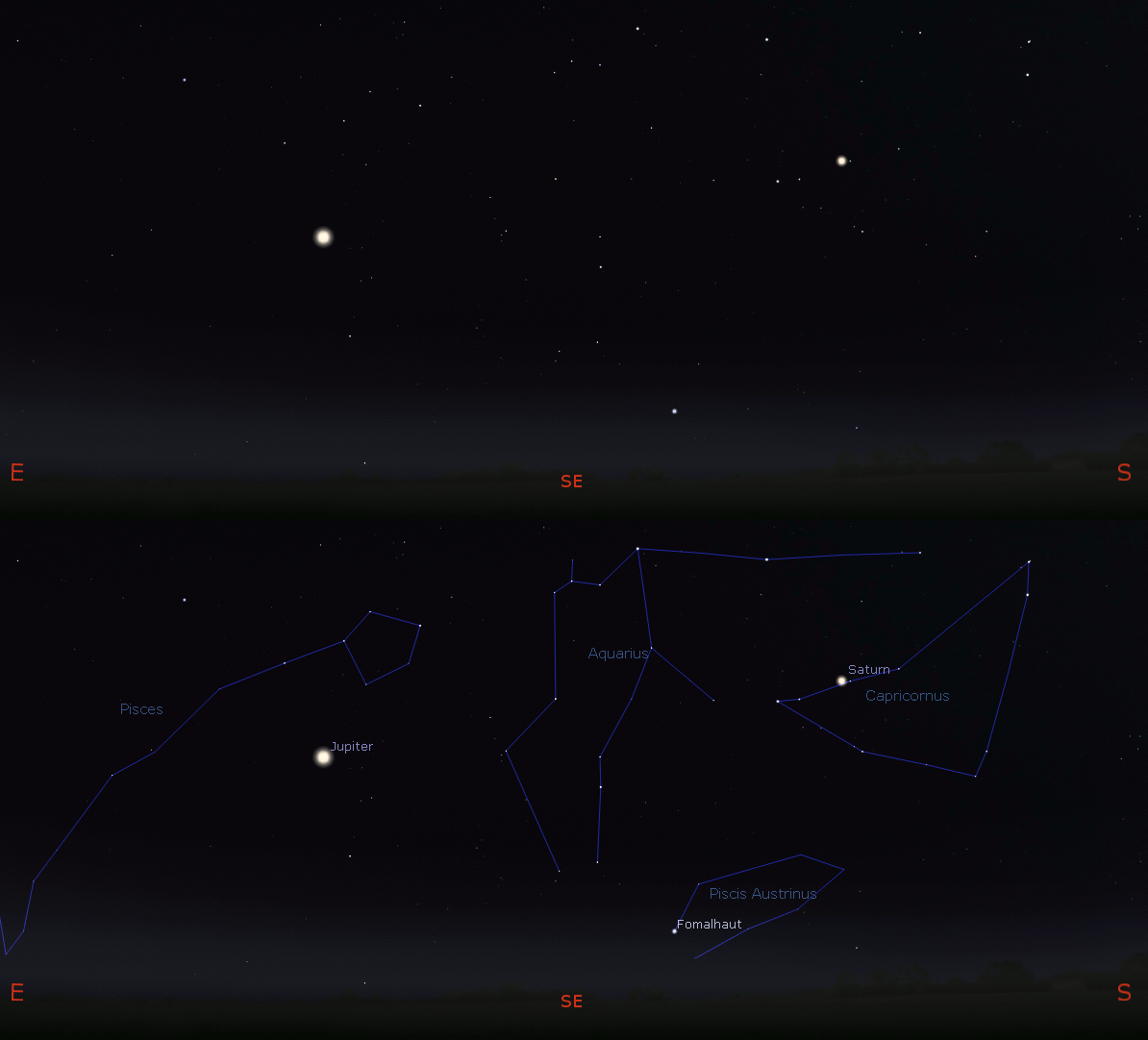
Fomalhaut and friends (Jupiter and Saturn) finder animation for 9 pm tonight, Friday, October 14, 2022. Click on the image to enlarge it. Created using Stellarium and GIMP.
Also at Corson Auditorium on the Interlochen Center for the Arts Campus…

Join Interlochen Public Radio for Kids Commute Live! This family-friendly matinee is brought to you by the Interlochen Arts Academy Wind Symphony and features Interlochen theatre and singer-songwriter students, TCAPS middle school musicians, and special guests from NASA, the Coast Guard, and the International Dark Sky Park. Conductor Matthew Schlomer and Kids Commute host Kate Botello will lead this multi-sensory experience centered on the theme “Space Flight.”
The program will include Gustav Holst’s “Jupiter,” Michael Mogenson’s “Aerial Fantasy,” John Williams’ “Fantasy of Flight,” and more!
Come early for pre-concert activities for kids of all ages, including drone demonstrations and paper airplane contests. Space-themed food will be available for purchase.
I will be there from 12 to 1 pm, having the kids help me make COMETS! I’ll also be part of the program.
For more information and tickets: https://www.interlochen.org/events/kids-commute-live-space-flight-2022-10-15
09/19/2022 – Ephemeris – Finding the constellation Cepheus
This is Ephemeris for Monday, September 19th. Today the Sun will be up for 12 hours and 19 minutes, setting at 7:45, and it will rise tomorrow at 7:27. The Moon, 2 days past last quarter, will rise at 1:30 tomorrow morning.
There’s a faint constellation in the northeast above the W shaped constellation of Cassiopeia. It’s a nearly upside down church steeple of a constellation called Cepheus the king, and husband of queen Cassiopeia. Cepheus’ claim to modern astronomical fame is that one of its stars, Delta (δ) Cephei, is the archetype for the important Cepheid variable stars. Delta is the bottom most of a trio of stars at the right corner of the constellation. In the early 20th century, Henrietta Leavitt discovered that Cepheids in the nearby galaxy the Large Magellanic Cloud varied in brightness with a period that was related to their average brightness. This meant that Cepheids could be used as standard candles to measure the great distances to other galaxies.
The astronomical event times given are for the Traverse City/Interlochen area of Michigan (EDT, UT – 4 hours). They may be different for your location.
Addendum
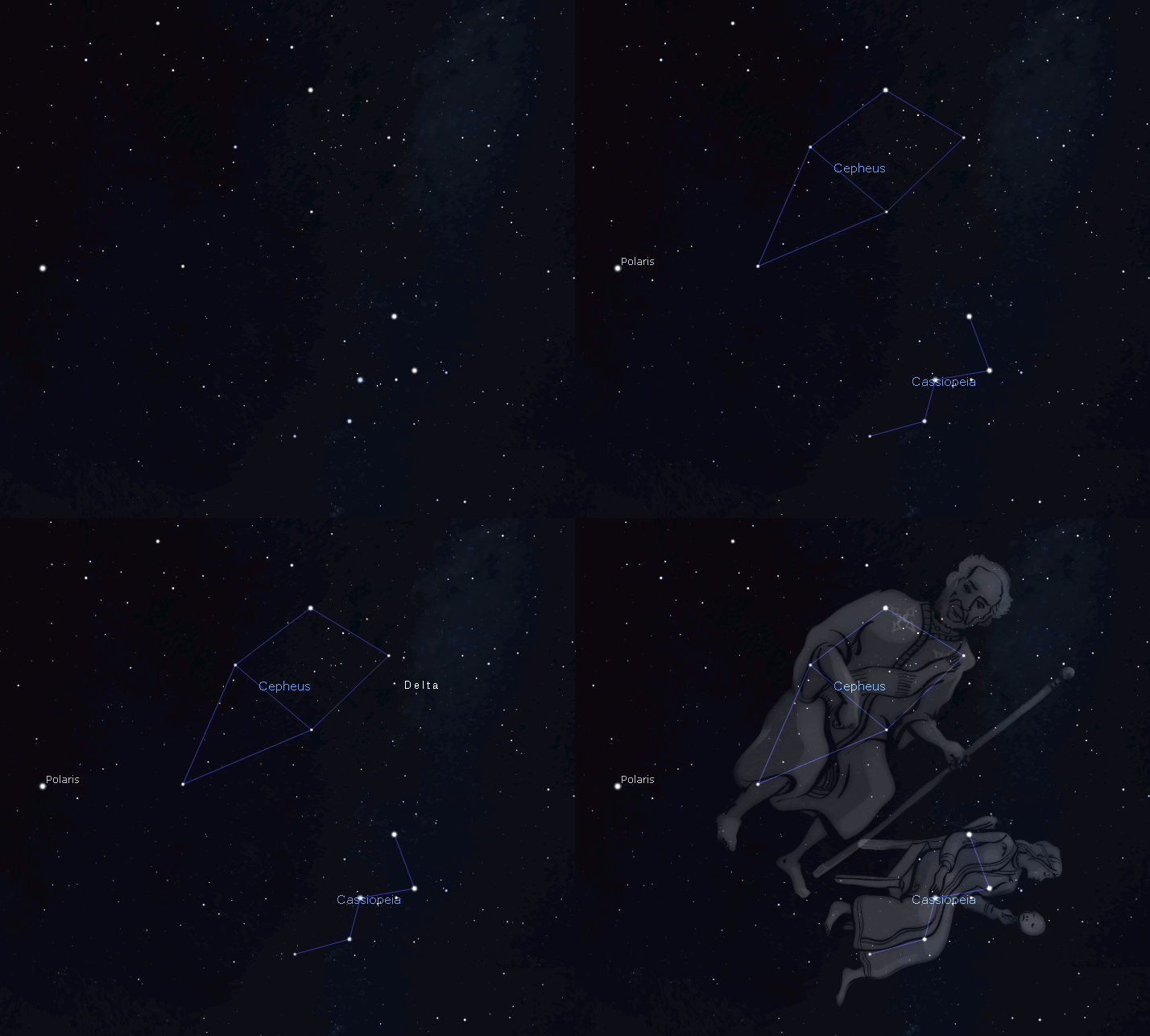
Cassiopeia and Cepheus finder animation looking in the northeast at 9 pm or about an hour after sunset in mid-September. Also labeled is Delta (δ) Cephei. Created using Stellarium and GIMP.
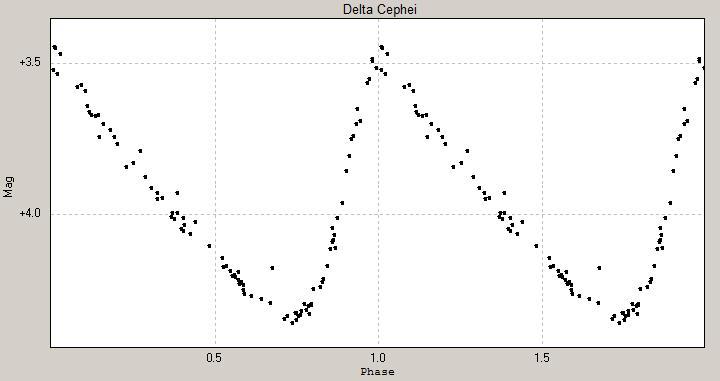
Light Curve of Delta Cephei. The pulsation period is 5.367 days. Note the Magnitude vertical axis, the lower the magnitude the brighter the star is. Blame that on the Greek astronomer Hipparchus, 2nd century BC. It’s like golf scores; the lower the score, the better the golfer, and for magnitudes, the brighter the star. Credit: Thomas K Vbg – Own work, CC BY-SA 3.0, https://commons.wikimedia.org/w/index.php?curid=13887639.
09/16/2022 – Ephemeris – Alberio: a double star that showcases star colors
This is Ephemeris for Friday, September 16th. Today the Sun will be up for 12 hours and 28 minutes, setting at 7:51, and it will rise tomorrow at 7:24. The Moon, 1 day before last quarter, will rise at 11:03 this evening.
Alberio is the name given to the star that is in the head of the constellation of Cygnus the swan, which is high in the east these evenings. It is also at the foot of the asterism or informal constellation of the Northern Cross. To the naked eye Albireo looks like a single star, however even in small telescopes its true nature is revealed. It’s a double star whose individual star colors are strikingly different Its brightest star is yellow, and the dimmer star is blue. While star colors are subtle, these two, due to their apparent closeness, make an obvious color contrast. Unlike what your interior decorator says: In stars, blue is hot, yellow, orange and red are cool. The two stars are too far apart to be considered a binary star system, but appear to move together in space. It is what is called an optical double, though they’re both around 430 light years away.
The astronomical event times given are for the Traverse City/Interlochen area of Michigan (EDT, UT – 4 hours). They may be different for your location.
Addendum
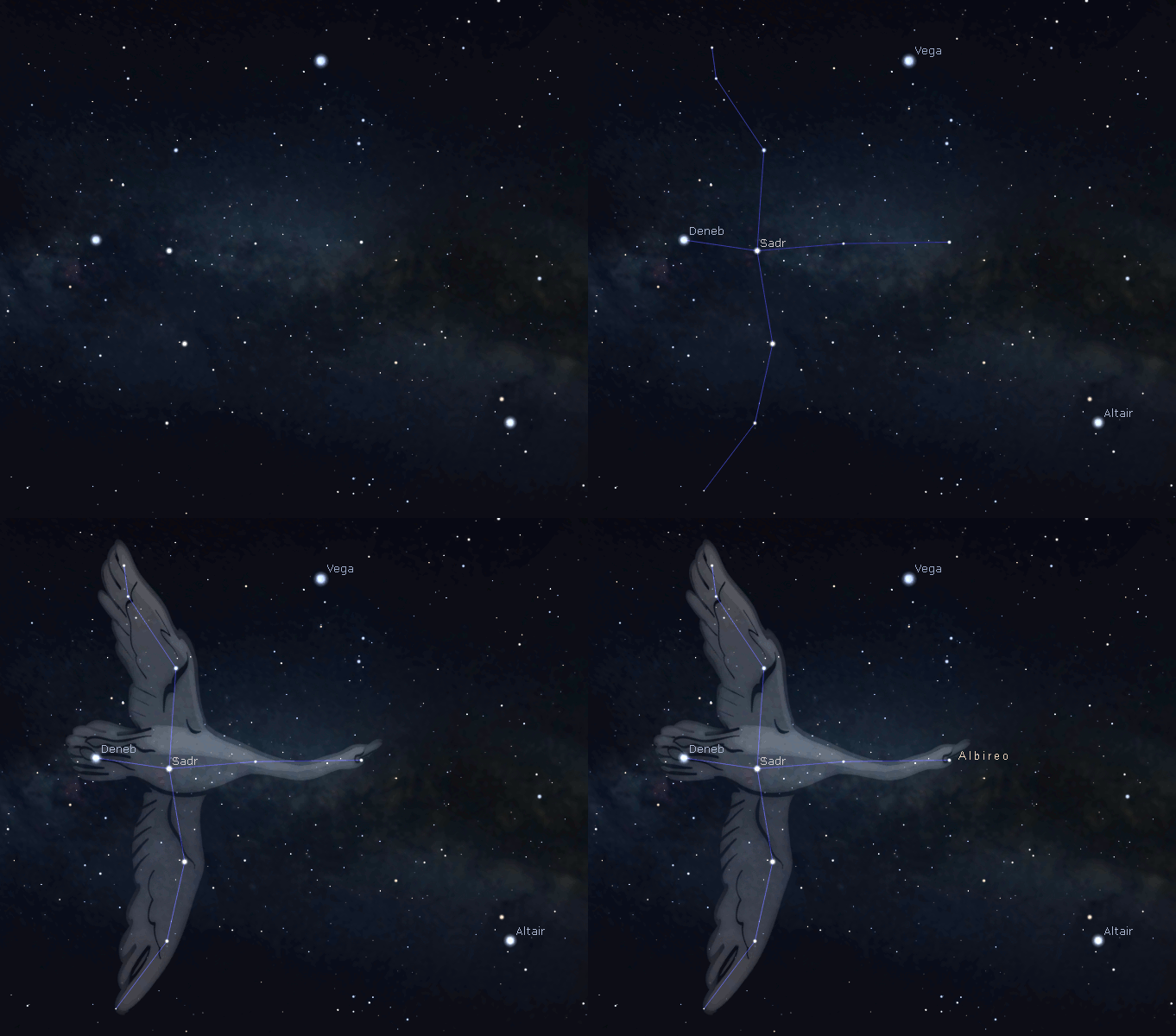
Animated Albireo finder chart. Albireo is located in the head of Cygnus the swan, or at the base of the Northern Cross. Tagged stars are, beside Albireo, the stars of the Summer Triangle: Deneb, Vega and Altair plus the star at the junction of the upright and crosspiece of the cross, Sadr. Created using Stellarium.
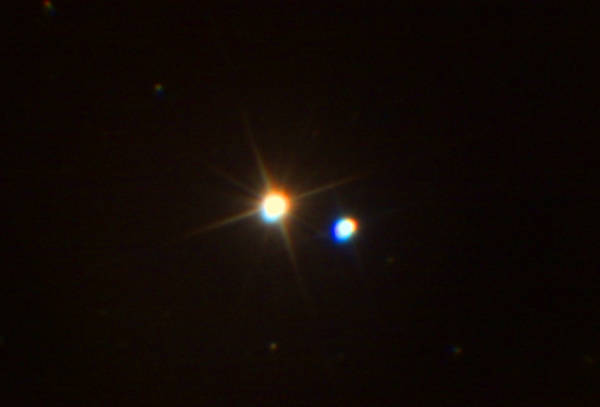
Albireo, captured at high magnification by the staff of the Smithsonian Institution. Informally, at star parties, I call it the U of M Star because it displays the University of Michigan’s Maize and Blue colors.
A note about star colors
The color of a star is dependent on its surface temperature. The term surface is a misnomer, because stars do not have a surface, at least not a solid one, being gaseous in nature. The only exception I can think is a neutron star, which is packed with neutrons. We consider the Sun’s photosphere synonymous with “surface”. The photosphere of the Sun is where the energy transport from the core changes from convection to radiation. The color of the Sun is a measure of the temperature of the photosphere. The color sequence from the coolest to the hottest is: red, orange, yellow, white and blue. The light emitted by a star is not a pure color, but a distribution of colors, whose peak shifts along that range. There is much more to tell, but that’s beyond the scope of this post.
07/14/2022 – Ephemeris – The dimmest Summer Triangle star is actually the brightest
This is Ephemeris for Thursday, July 14th. Today the Sun will be up for 15 hours and 15 minutes, setting at 9:26, and it will rise tomorrow at 6:11. The Moon, 1 day past full, will rise at 10:49 this evening.
This evening, when it gets dark enough, the bright star Deneb in Cygnus the swan will be high in the east-northeast. I’ll cover Cygnus tomorrow when the sky is darker. Deneb is the dimmest star of the summer triangle. Of the other stars of the triangle, Vega is higher in the east, while Altair is lower in the southeast. Deneb’s apparent magnitude, or brightness as seen from Earth, makes it the dimmest of the three bright stars. That’s because of its vast distance of maybe 1,550 light years, 57 times the distance of Vega. If brought as close as Vega, Deneb would be as bright, at least, as the first quarter moon. It is possibly as bright as 196 thousand Suns; and it’s a huge star, possibly as large in diameter as the orbit of the Earth. For all this, it is only 23 or so times the mass of the Sun.
The astronomical event times given are for the Traverse City/Interlochen area of Michigan (EDT, UT – 4 hours). They may be different for your location.
Addendum
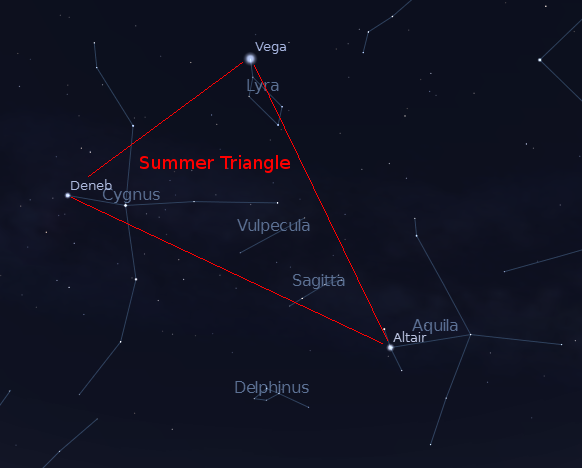
The Summer Triangle. Created using Stellarium and The Gimp.
If you put Deneb in the search box, you will find that the content of the posts, over the years, about the star are nearly identical. However, the distance estimates vary widely. It is too far away for trigonometric parallax measurements by earth based telescopes. Though in the range of ESA’s Hipparcos and Gaia satellites, it is too bright. So other less accurate measurements are used. I don’t think it involves coin flipping. The assumed distance also affects estimates of luminosity, and mass.
07/08/2022 – Ephemeris – Polaris the North Star
This is Ephemeris for Friday, July 8th. Today the Sun will be up for 15 hours and 24 minutes, setting at 9:29, and it will rise tomorrow at 6:06. The Moon, 2 days past first quarter, will set at 2:17 tomorrow morning.
The bright star Polaris is a very important star. It is also known as the North Star and the Pole Star. Its unique position is nearly directly at the zenith at the Earth’s North Pole, making it a very important navigational star. It’s about 40 minutes of arc, or about one and a third Moon diameters away from the extension of the Earth’s axis into the sky. As a rule of thumb, its angular altitude above the northern horizon is approximately one’s latitude, and it stands about at the due north compass point. Polaris is found using the Big Dipper, using the two stars at the front of the dipper bowl to point to it. It’s located at the tip of the handle of the very dim Little Dipper which, this time of year in the evening, appears to be standing on its handle.
The astronomical event times given are for the Traverse City/Interlochen area of Michigan (EDT, UT – 4 hours). They may be different for your location.
Addendum
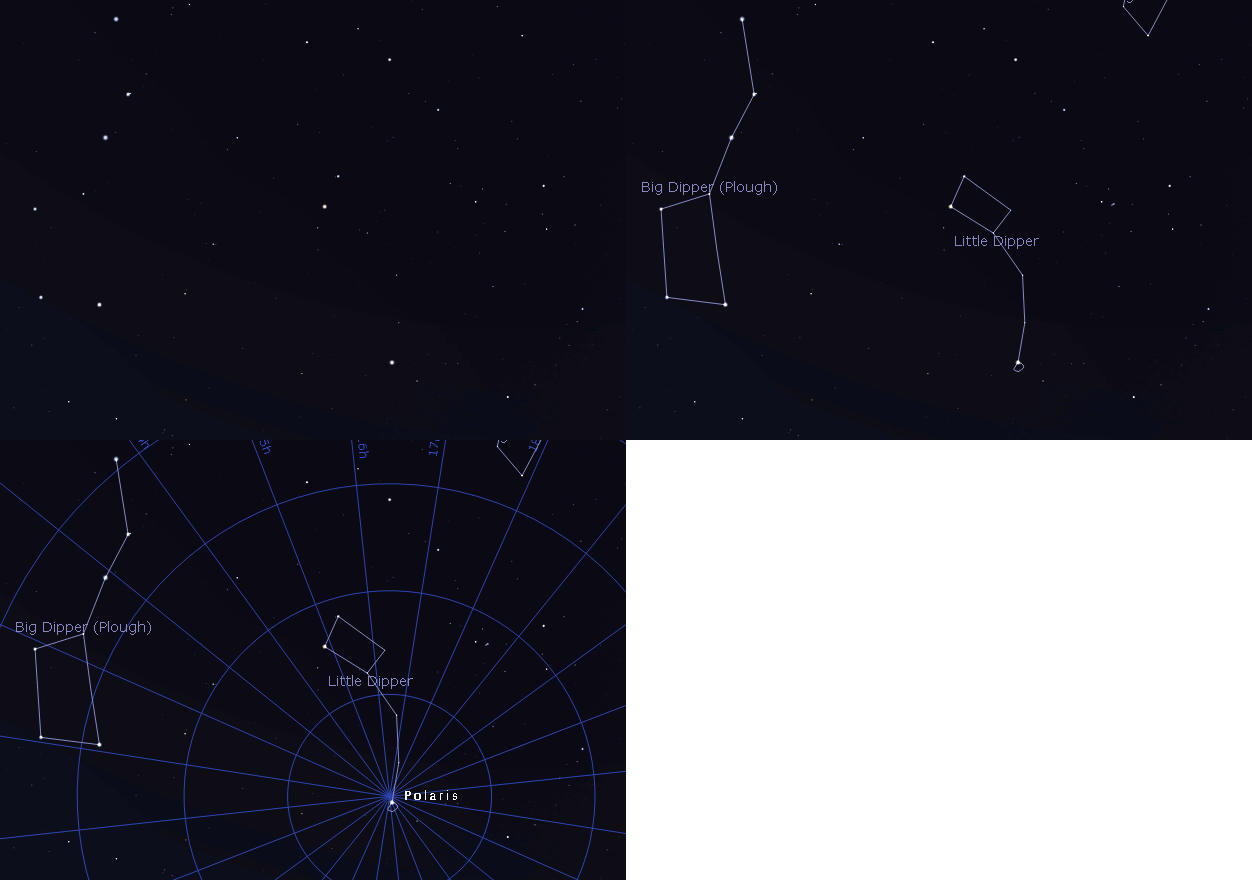
Polaris finder and location animation. Three frames: visual appearance in the sky, lines of the asterisms of the Big and Little Dippers, addition of the equatorial grid of celestial coordinates analogous to longitude and latitude on the Earth. The right ascension (like longitude) lines converge over the Earth’s North Pole, with Polaris close by. Created using Stellarium and GIMP.
The two stars at the front of the Big Dipper’s bowl, at the bottom of the dipper as it appears now in the evening, point to Polaris near the 11-hour right ascension line. Right ascension, though the same as earthly longitude, is measured in hours, rather than degrees. An hour equals 15 degrees, making 24 hours equal 360 degrees.
07/07/2022 – Ephemeris – A closer look at the bright star Vega
This is Bob Moler with Ephemeris for Thursday, July 7th. Today the Sun will be up for 15 hours and 25 minutes, setting at 9:30, and it will rise tomorrow at 6:05. The Moon, 1 day past first quarter, will set at 1:53 tomorrow morning.
Vega, in the constellation Lyra the harp, is the highest star In the east and brightest star of the Summer Triangle also rising in that direction. It is an important and much studied star, first as a standard for brightness for the magnitude scale at almost exactly zero. It also has two fields of debris orbiting it. In 1983 the Infrared Astronomy Satellite, IRAS, discovered an excess of infrared radiation coming from the star. It seems now that there are two orbiting rings, one warm, and the other cold. This is somewhat like the two disks the Sun has: The asteroid belt between Mars and Jupiter and the Kuiper belt, beyond Neptune. No planets have yet been discovered around Vega, but I wouldn’t bet against it.
The astronomical event times given are for the Traverse City/Interlochen area of Michigan (EDT, UT – 4 hours). They may be different for your location.
Addendum
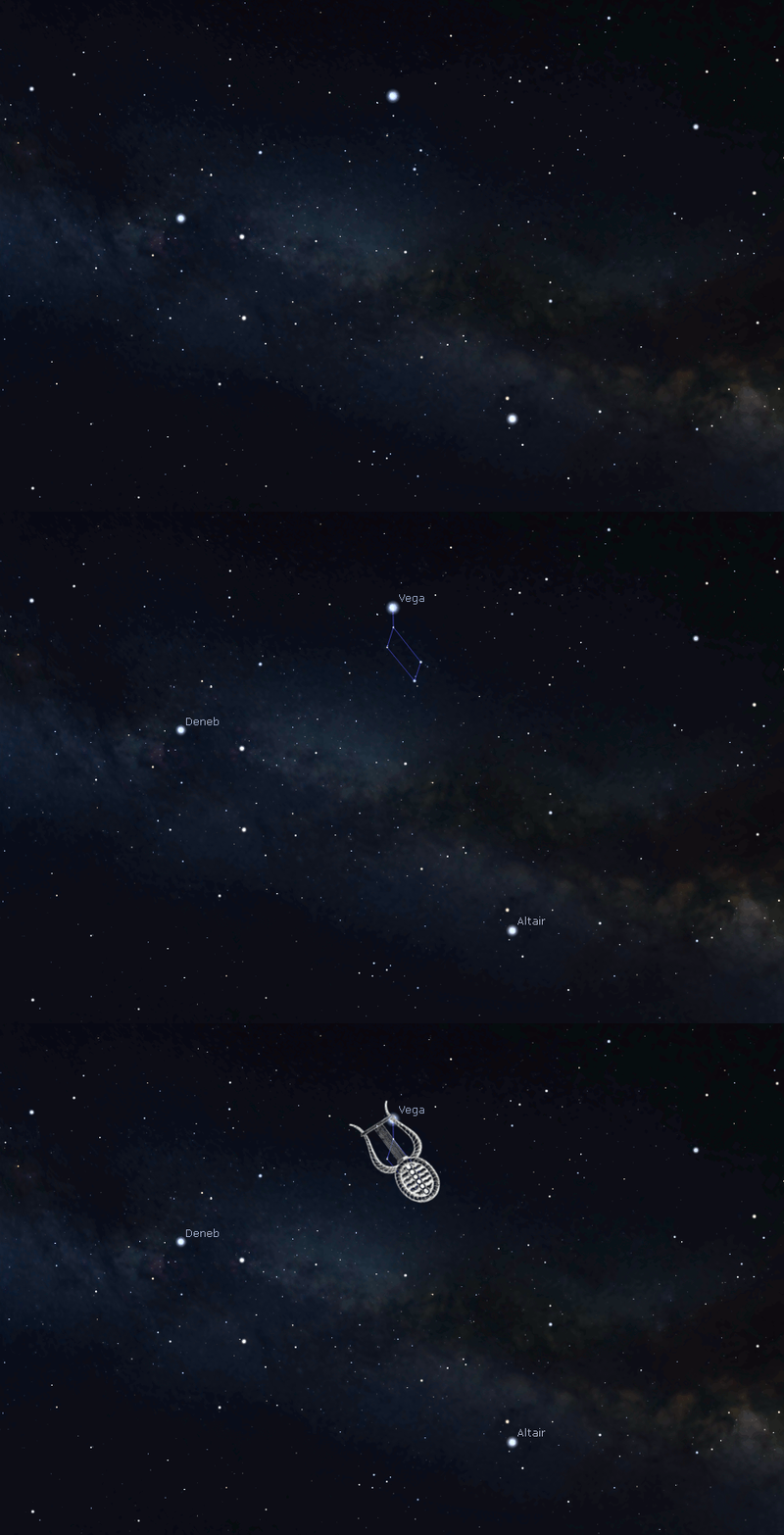
Animated Lyra finder chart. The lyre image not supplied by Stellarium but is from The World’s Earliest Music by Hermann Smith, Figure 60, A Project Gutenberg E-Book, and captioned “The Chelys or Greek Tortoiseshell Lyre”. Vega is the brightest star in Lyra, and the brightest star of the Summer Triangle. The other stars of the triangle are Deneb and Altair. Created using Stellarium.
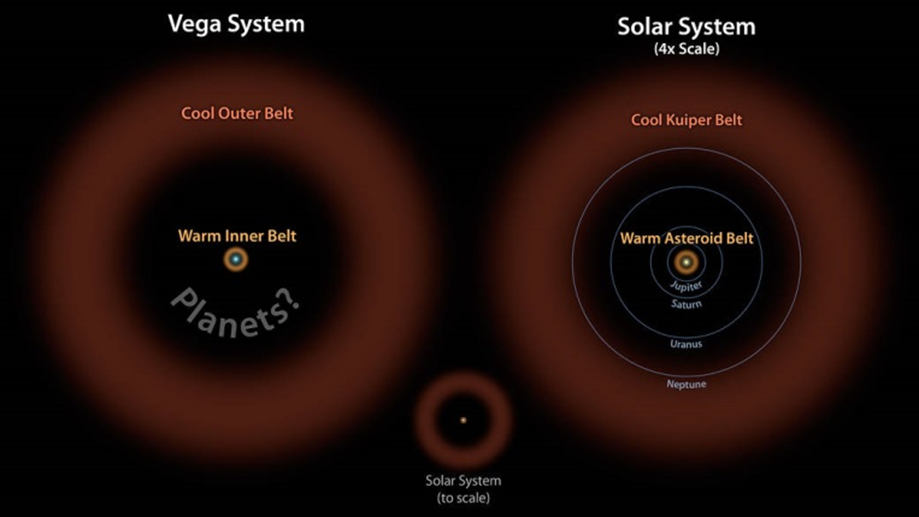
Vega possesses two debris fields, similar to our own solar system’s asteroid and Kuiper belts. Astronomers continue to hunt for planets orbiting Vega, but as of May 2020 none have been confirmed. More info: bit.ly/VegaSystem Credit: NASA/JPL-Caltech
07/05/2022 – Ephemeris – Taking a close look at Altair
This is Ephemeris for Tuesday, July 5th. Today the Sun will be up for 15 hours and 27 minutes, setting at 9:30, and it will rise tomorrow at 6:04. The Moon, 1 day before first quarter, will set at 1:12 tomorrow morning.
The southernmost star of the Summer Triangle is Altair, high in the east-southeast. The other two stars of the triangle are Vega nearly overhead in the east, and Deneb high in the east-northeast. Altair is the closest of the three at a distance of 16.7 light years away. One light year is nearly 6 trillion miles. Altair is 10 times the brightness of the Sun. If seen at Altair’s distance, the Sun would only be as bright as one of the two stars that flank it. What is rather different about Altair is its rapid rotation. While it’s almost twice the sun’s diameter, it rotates once in about 9 hours, The CHARA Interferometer at Mt. Wilson has actually imaged its squashed disk in the infrared. Our Sun’s a slow poke, taking nearly a month to rotate once.
The astronomical event times given are for the Traverse City/Interlochen area of Michigan (EDT, UT – 4 hours). They may be different for your location.
Addendum
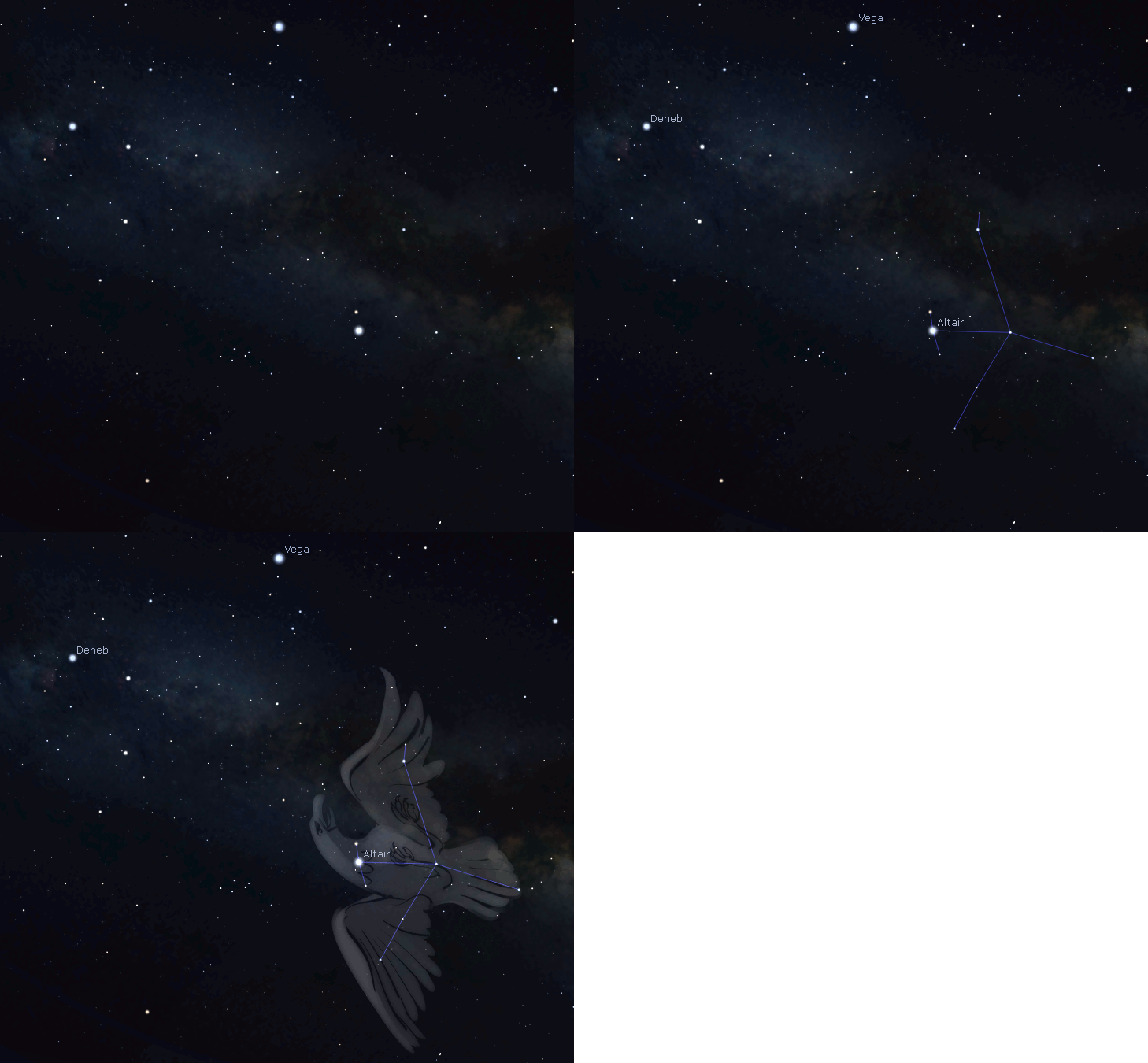
Animated Aquila finder chart with Altair as its brightest star. Also shown are the other two stars of the Summer Triangle, Vega and Deneb. Created using Stellarium.
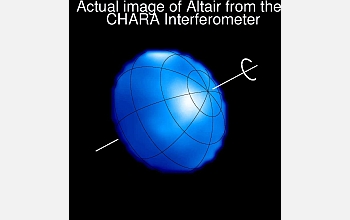
Credit: Zina Deretsky, National Science Foundation
06/28/2022 – Ephemeris – Finding the celestial harp
This is Ephemeris for Tuesday, June 28th. Today the Sun will be up for 15 hours and 32 minutes, setting at 9:32, and it will rise tomorrow at 6:00. The Moon is new today, and won’t be visible.
High in the east at 11 p.m. can be found a bright star just above a small, narrow, but very distinctive parallelogram of stars. They are the stars of the constellation Lyra the harp. The bright star is Vega, the 4th or 5th brightest nighttime star*, and currently the topmost star of the Summer Triangle. To the Romans, the star Vega represented a falling eagle or vulture. Apparently they never made the distinction between the two species. It is a pure white star and serves as a calibration star for color and brightness. In the evening, it is the top-most star of the Summer Triangle. The harp, according to Greek mythology, was invented by the god Hermes. The form of the harp, in the sky, is as he had invented it: by stretching strings across a tortoise shell. Hermes gave it to his half-brother Apollo, who in turn gave it to the legendary musician Orpheus.
The astronomical event times given are for the Traverse City/Interlochen area of Michigan (EDT, UT – 4 hours). They may be different for your location.
*Vega’s rival for the fourth spot on the brightness list is Arcturus to it’s west. Wikipedia’s source says that Arcturus is slightly brighter. Stellarium’s source says Vega is brighter. The difference is a few hundredths of a magnitude. However, they are of different colors. Vega is pure white, while Arcturus is yellow-orange because it has a cooler surface temperature than Vega. Check them out for yourself.
Addendum
Animated Lyra finder chart. The lyre image not supplied by Stellarium but is from The World’s Earliest Music by Hermann Smith, Figure 60, A Project Gutenberg E-Book, and captioned “The Chelys or Greek Tortoiseshell Lyre”. The three names stars are the stars of the Summer Triangle in the eastern sky these evenings of late June. Created using Stellarium.
 Bob Moler's Ephemeris Blog