Archive
07/14/2022 – Ephemeris – The dimmest Summer Triangle star is actually the brightest
This is Ephemeris for Thursday, July 14th. Today the Sun will be up for 15 hours and 15 minutes, setting at 9:26, and it will rise tomorrow at 6:11. The Moon, 1 day past full, will rise at 10:49 this evening.
This evening, when it gets dark enough, the bright star Deneb in Cygnus the swan will be high in the east-northeast. I’ll cover Cygnus tomorrow when the sky is darker. Deneb is the dimmest star of the summer triangle. Of the other stars of the triangle, Vega is higher in the east, while Altair is lower in the southeast. Deneb’s apparent magnitude, or brightness as seen from Earth, makes it the dimmest of the three bright stars. That’s because of its vast distance of maybe 1,550 light years, 57 times the distance of Vega. If brought as close as Vega, Deneb would be as bright, at least, as the first quarter moon. It is possibly as bright as 196 thousand Suns; and it’s a huge star, possibly as large in diameter as the orbit of the Earth. For all this, it is only 23 or so times the mass of the Sun.
The astronomical event times given are for the Traverse City/Interlochen area of Michigan (EDT, UT – 4 hours). They may be different for your location.
Addendum
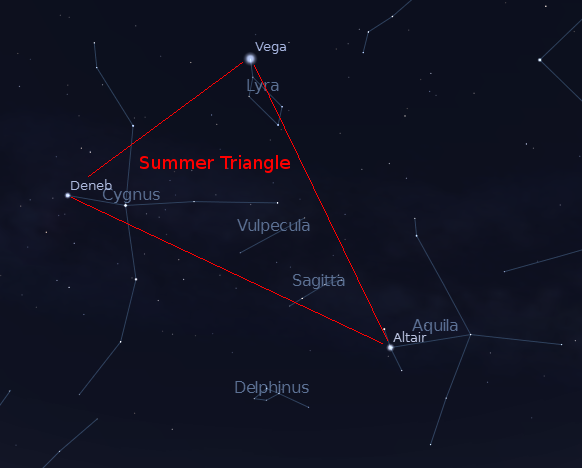
The Summer Triangle. Created using Stellarium and The Gimp.
If you put Deneb in the search box, you will find that the content of the posts, over the years, about the star are nearly identical. However, the distance estimates vary widely. It is too far away for trigonometric parallax measurements by earth based telescopes. Though in the range of ESA’s Hipparcos and Gaia satellites, it is too bright. So other less accurate measurements are used. I don’t think it involves coin flipping. The assumed distance also affects estimates of luminosity, and mass.
07/08/2022 – Ephemeris – Polaris the North Star
This is Ephemeris for Friday, July 8th. Today the Sun will be up for 15 hours and 24 minutes, setting at 9:29, and it will rise tomorrow at 6:06. The Moon, 2 days past first quarter, will set at 2:17 tomorrow morning.
The bright star Polaris is a very important star. It is also known as the North Star and the Pole Star. Its unique position is nearly directly at the zenith at the Earth’s North Pole, making it a very important navigational star. It’s about 40 minutes of arc, or about one and a third Moon diameters away from the extension of the Earth’s axis into the sky. As a rule of thumb, its angular altitude above the northern horizon is approximately one’s latitude, and it stands about at the due north compass point. Polaris is found using the Big Dipper, using the two stars at the front of the dipper bowl to point to it. It’s located at the tip of the handle of the very dim Little Dipper which, this time of year in the evening, appears to be standing on its handle.
The astronomical event times given are for the Traverse City/Interlochen area of Michigan (EDT, UT – 4 hours). They may be different for your location.
Addendum

Polaris finder and location animation. Three frames: visual appearance in the sky, lines of the asterisms of the Big and Little Dippers, addition of the equatorial grid of celestial coordinates analogous to longitude and latitude on the Earth. The right ascension (like longitude) lines converge over the Earth’s North Pole, with Polaris close by. Created using Stellarium and GIMP.
The two stars at the front of the Big Dipper’s bowl, at the bottom of the dipper as it appears now in the evening, point to Polaris near the 11-hour right ascension line. Right ascension, though the same as earthly longitude, is measured in hours, rather than degrees. An hour equals 15 degrees, making 24 hours equal 360 degrees.
07/07/2022 – Ephemeris – A closer look at the bright star Vega
This is Bob Moler with Ephemeris for Thursday, July 7th. Today the Sun will be up for 15 hours and 25 minutes, setting at 9:30, and it will rise tomorrow at 6:05. The Moon, 1 day past first quarter, will set at 1:53 tomorrow morning.
Vega, in the constellation Lyra the harp, is the highest star In the east and brightest star of the Summer Triangle also rising in that direction. It is an important and much studied star, first as a standard for brightness for the magnitude scale at almost exactly zero. It also has two fields of debris orbiting it. In 1983 the Infrared Astronomy Satellite, IRAS, discovered an excess of infrared radiation coming from the star. It seems now that there are two orbiting rings, one warm, and the other cold. This is somewhat like the two disks the Sun has: The asteroid belt between Mars and Jupiter and the Kuiper belt, beyond Neptune. No planets have yet been discovered around Vega, but I wouldn’t bet against it.
The astronomical event times given are for the Traverse City/Interlochen area of Michigan (EDT, UT – 4 hours). They may be different for your location.
Addendum
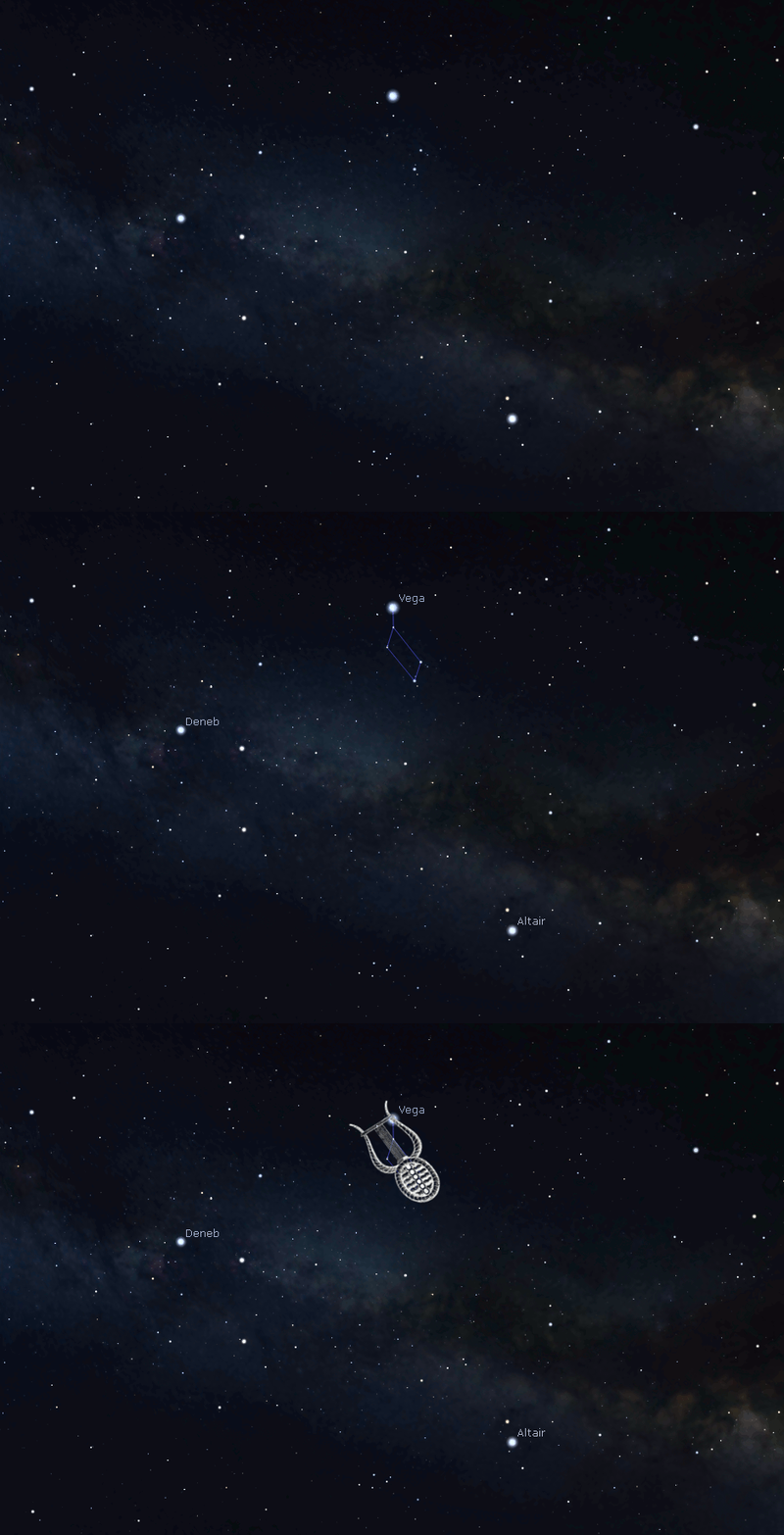
Animated Lyra finder chart. The lyre image not supplied by Stellarium but is from The World’s Earliest Music by Hermann Smith, Figure 60, A Project Gutenberg E-Book, and captioned “The Chelys or Greek Tortoiseshell Lyre”. Vega is the brightest star in Lyra, and the brightest star of the Summer Triangle. The other stars of the triangle are Deneb and Altair. Created using Stellarium.
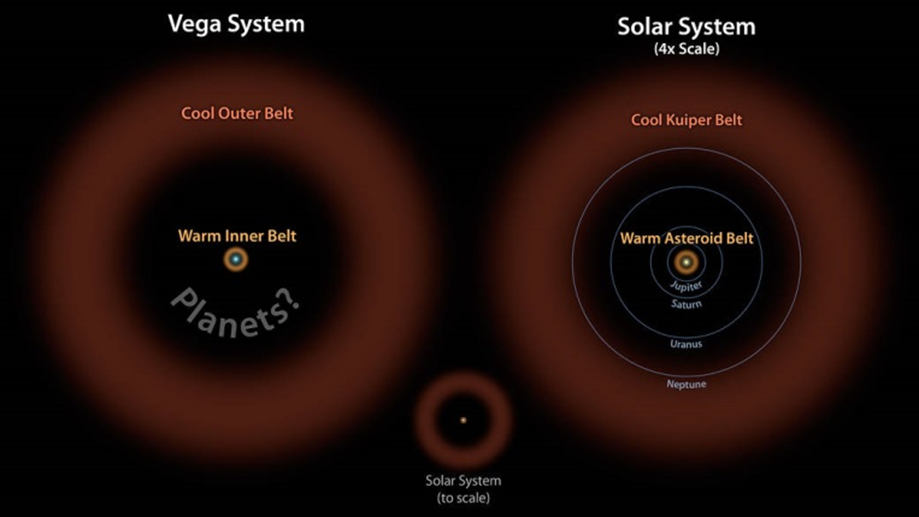
Vega possesses two debris fields, similar to our own solar system’s asteroid and Kuiper belts. Astronomers continue to hunt for planets orbiting Vega, but as of May 2020 none have been confirmed. More info: bit.ly/VegaSystem Credit: NASA/JPL-Caltech
07/05/2022 – Ephemeris – Taking a close look at Altair
This is Ephemeris for Tuesday, July 5th. Today the Sun will be up for 15 hours and 27 minutes, setting at 9:30, and it will rise tomorrow at 6:04. The Moon, 1 day before first quarter, will set at 1:12 tomorrow morning.
The southernmost star of the Summer Triangle is Altair, high in the east-southeast. The other two stars of the triangle are Vega nearly overhead in the east, and Deneb high in the east-northeast. Altair is the closest of the three at a distance of 16.7 light years away. One light year is nearly 6 trillion miles. Altair is 10 times the brightness of the Sun. If seen at Altair’s distance, the Sun would only be as bright as one of the two stars that flank it. What is rather different about Altair is its rapid rotation. While it’s almost twice the sun’s diameter, it rotates once in about 9 hours, The CHARA Interferometer at Mt. Wilson has actually imaged its squashed disk in the infrared. Our Sun’s a slow poke, taking nearly a month to rotate once.
The astronomical event times given are for the Traverse City/Interlochen area of Michigan (EDT, UT – 4 hours). They may be different for your location.
Addendum
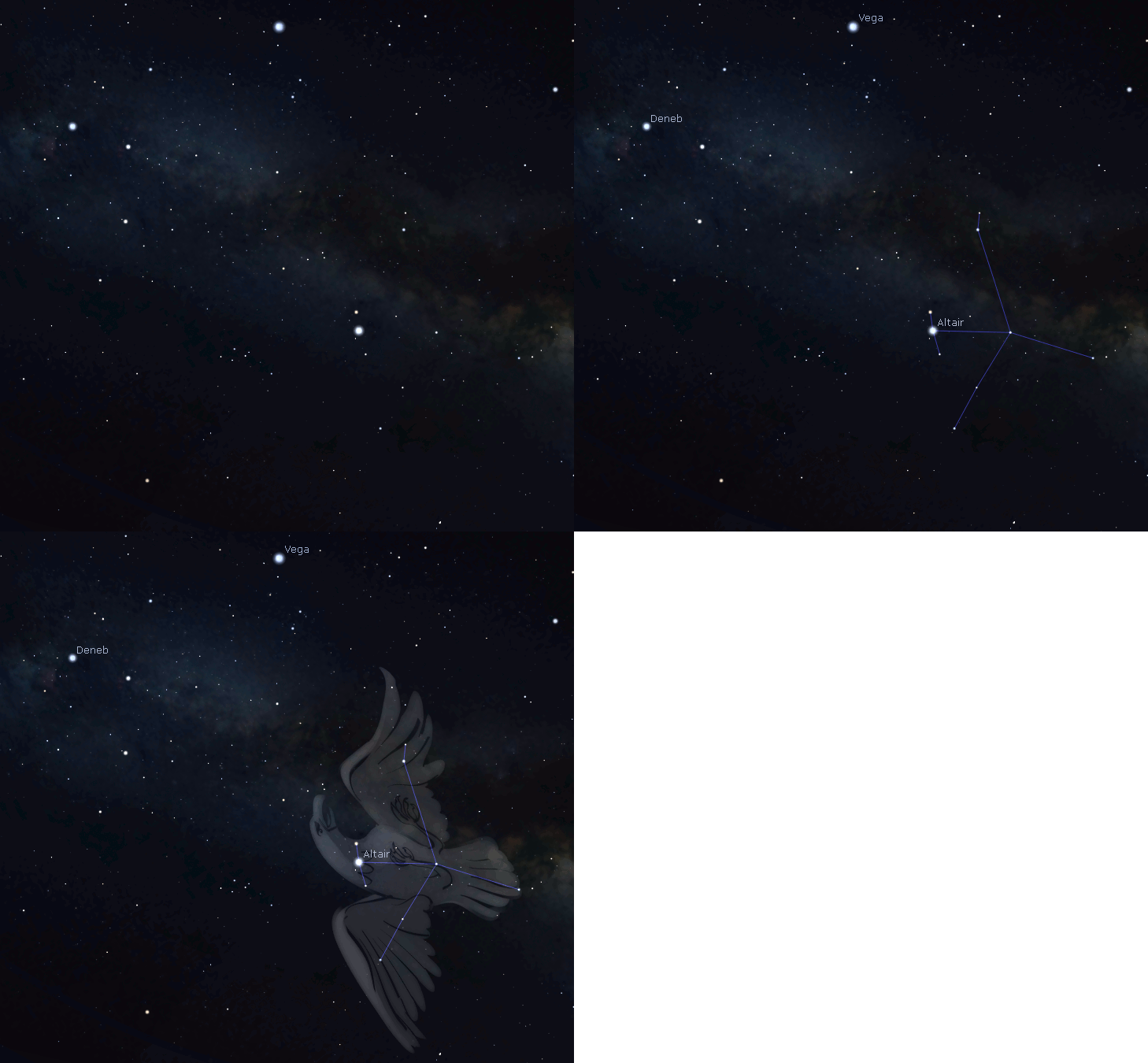
Animated Aquila finder chart with Altair as its brightest star. Also shown are the other two stars of the Summer Triangle, Vega and Deneb. Created using Stellarium.
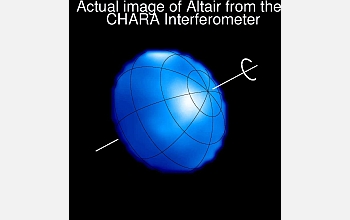
Credit: Zina Deretsky, National Science Foundation
06/28/2022 – Ephemeris – Finding the celestial harp
This is Ephemeris for Tuesday, June 28th. Today the Sun will be up for 15 hours and 32 minutes, setting at 9:32, and it will rise tomorrow at 6:00. The Moon is new today, and won’t be visible.
High in the east at 11 p.m. can be found a bright star just above a small, narrow, but very distinctive parallelogram of stars. They are the stars of the constellation Lyra the harp. The bright star is Vega, the 4th or 5th brightest nighttime star*, and currently the topmost star of the Summer Triangle. To the Romans, the star Vega represented a falling eagle or vulture. Apparently they never made the distinction between the two species. It is a pure white star and serves as a calibration star for color and brightness. In the evening, it is the top-most star of the Summer Triangle. The harp, according to Greek mythology, was invented by the god Hermes. The form of the harp, in the sky, is as he had invented it: by stretching strings across a tortoise shell. Hermes gave it to his half-brother Apollo, who in turn gave it to the legendary musician Orpheus.
The astronomical event times given are for the Traverse City/Interlochen area of Michigan (EDT, UT – 4 hours). They may be different for your location.
*Vega’s rival for the fourth spot on the brightness list is Arcturus to it’s west. Wikipedia’s source says that Arcturus is slightly brighter. Stellarium’s source says Vega is brighter. The difference is a few hundredths of a magnitude. However, they are of different colors. Vega is pure white, while Arcturus is yellow-orange because it has a cooler surface temperature than Vega. Check them out for yourself.
Addendum
Animated Lyra finder chart. The lyre image not supplied by Stellarium but is from The World’s Earliest Music by Hermann Smith, Figure 60, A Project Gutenberg E-Book, and captioned “The Chelys or Greek Tortoiseshell Lyre”. The three names stars are the stars of the Summer Triangle in the eastern sky these evenings of late June. Created using Stellarium.
06/17/2022 – Ephemeris – What’s that weird twinkly star low in the south?
This is Ephemeris for Friday, June 17th. Today the Sun will be up for 15 hours and 34 minutes, setting at 9:30, and it will rise tomorrow at 5:56. The Moon, halfway from full to last quarter, will rise at 12:55 tomorrow morning.
At this time of year, there is a star that appears low in the south-southeast that appears red and twinkles mightily. The twinkling caused by the Earth’s atmosphere is enhanced when viewing it in binoculars. In a telescope, it appears as a virtual sparkler. It’s been called in to authorities as a UFO, unidentified flying object, or as the Defense Department now calls them UAPs, or unidentified aerial phenomena. Anyway, this light is identified. It is the red giant star Antares, in the heart of Scorpius the scorpion, one of the constellations of the zodiac. Antares other claim to fame is embodied in its name. Decoded, Antares means Rival of Mars due to its color and the fact that Mars passes by every couple of years. Ant means anti, and Ares is the Greek god of war that the Romans appropriated as Mars.
The astronomical event times given are for the Traverse City/Interlochen area of Michigan (EDT, UT – 4 hours). They may be different for your location.
Addendum
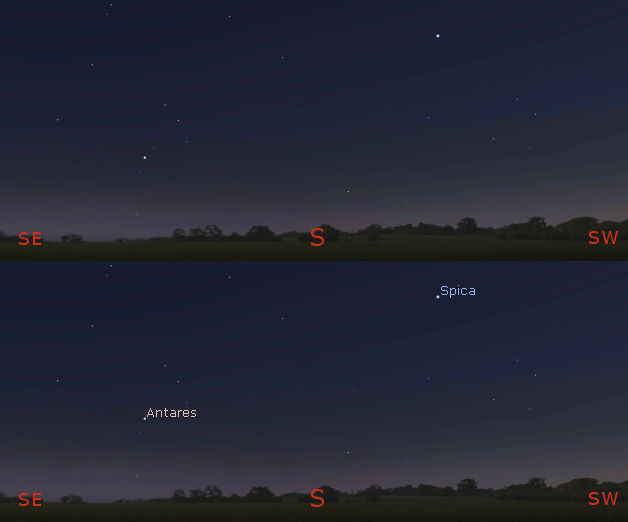
Antares low in the south-southeast at 10:30 pm, June 17, 2022, without Mars for competition. At this time, Antares is only 13 degrees above the horizon. Click on the image to enlarge it. Created Using Stellarium and GIMP.
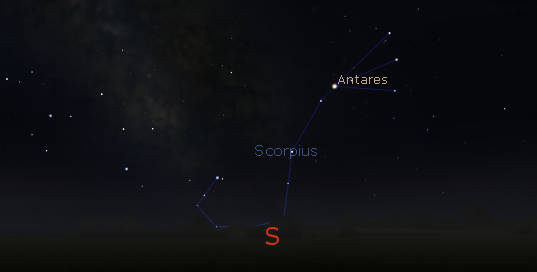
Scorpius at its highest as seen from the Grand Traverse area. Antares at this time is not quite 19 degrees altitude. This is 1 am, June 18th. Perceptive viewers of this image may spot a teapot in the stars to the left of Scorpius. That’s what we modern folk see in the stars of Sagittarius the archer. Created using Stellarium.
05/03/2022 – Ephemeris – Regulus, the “Little King Star”
This is Bob Moler with Ephemeris for Tuesday, May 3rd. Today the Sun will be up for 14 hours and 20 minutes, setting at 8:50, and it will rise tomorrow at 6:28. The Moon, 3 days past new, will set at 12:05 tomorrow morning.
Fairly high in the south-southwest at 10 p.m. is a pattern of stars that’s in the shape of a backward question mark. This informal star group or asterism is also called the sickle. It is the head and mane of the official zodiacal constellation of Leo the lion. To the left is a triangle of stars is his hind end. The bright star at the bottom of the question mark, or end of the sickle’s handle is Regulus, the “Little King Star”, alluding to the lion’s status as the king of the jungle. Regulus is about 79 light years away and is a 4 star system that exists as two star pairs. The bright star Regulus itself and a companion too close to be imaged directly in telescopes, and a nearby pair of dim stars make up the system. The Moon often passes in front of Regulus, since it’s close to the ecliptic. These occultations, as they are called, will occur monthly for a year and a half starting July
The astronomical event times given are for the Traverse City/Interlochen area of Michigan (EDT, UT – 4 hours). They may be different for your location.
Addendum
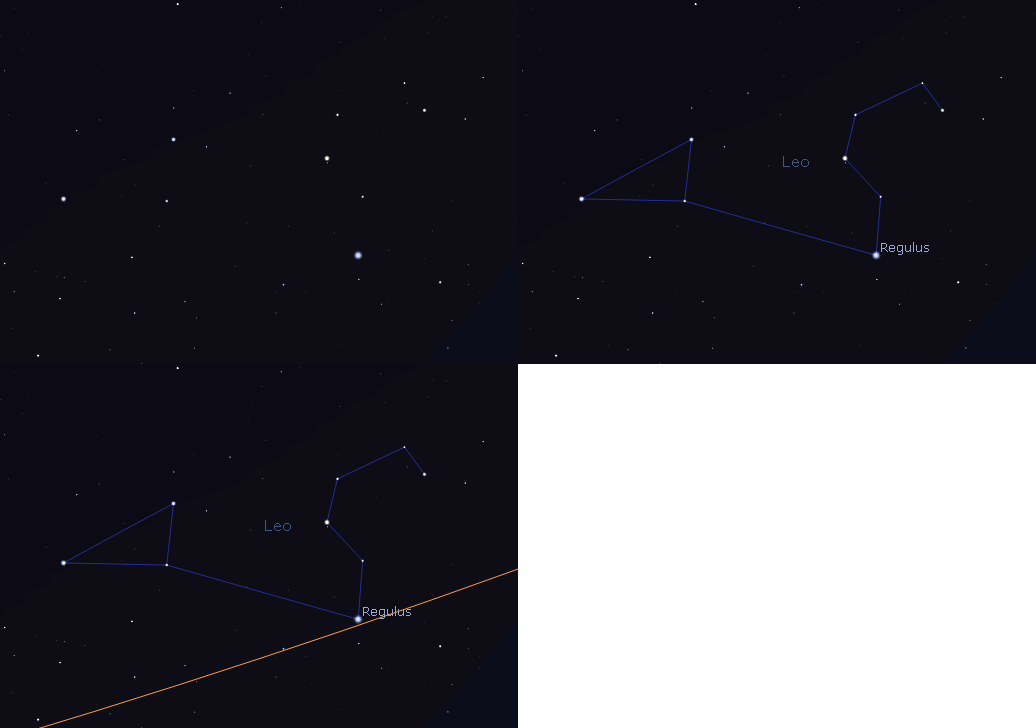
Animated finder chart for Leo and Regulus for early May at 10 pm or an hour after sunset. The orange line that appears is the ecliptic, the path of the Sun in the sky. The path of the Moon is tilted by about 5 degrees to that path. The paths cross at points called nodes. The nodes move slowly westward in an 18.6-year cycle called the regression of the nodes. Occultations of Regulus by the Moon occur during two periods in that cycle. The next period where occultations of Regulus will occur monthly from July 2025 to January 2027. Created using Stellarium and GIMP.
Occultations are like solar eclipses in that they can only be seen from a limited area. That area will shift southward during that period. Of the 21 occultations in that period, only 2 will be visible from the United States: February 3rd, and April 26th 2026.
04/18/2022 – Ephemeris – Arcturus, the fourth-brightest nighttime star*
This is Ephemeris for Monday, April 18th. Today the Sun will be up for 13 hours and 38 minutes, setting at 8:31, and it will rise tomorrow at 6:51. The Moon, 2 days past full, will rise at 11:17 this evening.
The fourth-brightest nighttime star* is now up in the east these evenings. It is Arcturus, a bright star with an orange hue. It can be found otherwise by finding the Big Dipper and tracing out and extending the curve of the handle and saying the phrase “Follow the arc of the handle to Arcturus”, to remember the name of the star and how to find it. Arcturus is about 37 light years from us and is moving quite rapidly across the sky, compared to most stars, but one would not notice it to the naked eye in one’s lifetime. Arcturus is slightly more massive than our Sun, and about 7 billion years old, and is entering its red giant stage of life after using all the hydrogen fuel in its core. Our Sun, being slightly less massive, will survive on hydrogen a bit longer.
The astronomical event times given are for the Traverse City/Interlochen area of Michigan (EDT, UT – 4 hours). They may be different for your location.
*Or 5th brightest star, depending on which list you look at. Arcturus and Vega, which is just above the horizon in the northeast at 10 pm, are nearly the same brightness, however Vega is white while Arcturus is orange, making brightness comparisons difficult visually. Stellarium, however, reports Vega is a slightly brighter magnitude 0.00, while Arcturus is 0.15. My older lists say Arcturus is the 4th brightest star. I’m an older guy, so I’m sticking with it.
Addendum
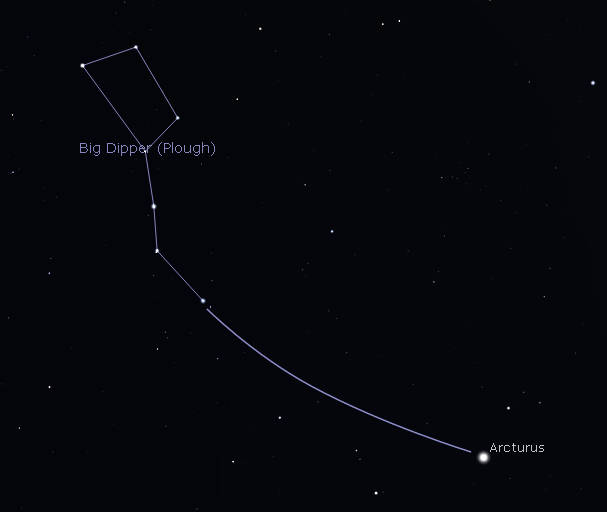
How to find Arcturus nearly a month into spring. Arcturus is in the east in the evening. The Big Dipper is high in the northeast standing on its handle. To find and remember the name of this star, simply follow the arc of the handle to Arcturus. Created using Stellarium and GIMP.
I’ll have more tidbits about this remarkable star throughout the spring and summer. Can’t wait? Search for Arcturus on this blog.
03/03/2022 – Ephemeris – Finding Cancer the crab
This is Ephemeris for Thursday, March 3rd. Today the Sun will be up for 11 hours and 16 minutes, setting at 6:33, and it will rise tomorrow at 7:15. The Moon, 1 day past new, will set at 7:46 this evening.
The constellation of Cancer the crab is made of dim stars, which are generally connected, in constellation charts, with lines that make either the letter K or an upside down Y, which lie directly between the star pair Castor and Pollux in Gemini and Regulus in Leo. In the center of the constellation is, what to the naked-eye is a fuzzy spot called Praesepe, or the manger. The two nearby stars, one to the northeast, and one to the southeast are Asellus Borealis, and Asellus Australis, the northern and southern donkey colts feeding out of the manger. Viewing that fuzzy spot with a pair of binoculars will reveal that it’s not fuzzy at all. It resolves into a cluster of stars, which astronomers, over the years, have called the Beehive cluster. Back in the first and second century CE, the Sun entered Cancer to begin the season of summer. It’s now just a transitional constellation between the winter and spring evening skies.
The astronomical event times given are for the Traverse City/Interlochen area of Michigan (EST, UT – 5 hours). They may be different for your location.
Addendum
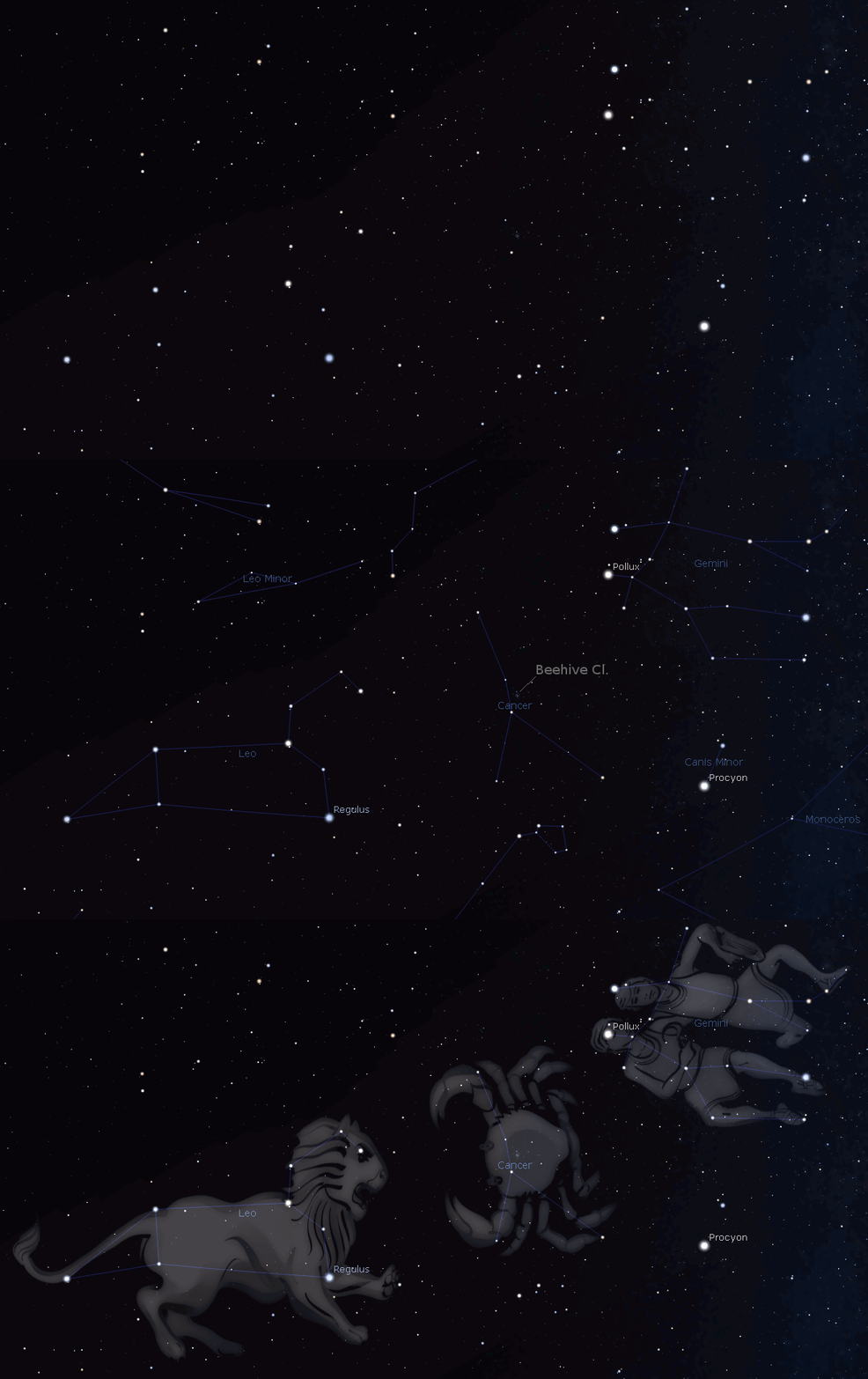
Cancer, the crab finder chart. Note the beehive cluster, also known to amateur astronomers as M44, along with other catalog names. Prior to the invention of the telescope this cluster was known as Praesepe which means “Manger”. Click on the image to enlarge it. Created using Stellarium and GIMP.
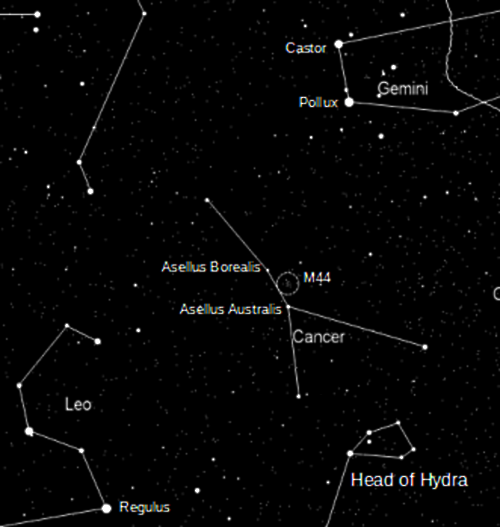
A closer look at Cancer, noting the donkey stars Asellus Borealis and Australis feeding at the manger, Praesepe or M44, aka: the Beehive Cluster. Created using Cartes du Ciel (Sky Charts) and LibreOffice for captions. Adapted from a chart I created for the March 2022 issue of the GTAS newsletter, the Stellar Sentinel.
02/28/2022 – Ephemeris – Ancient Egypt’s most important star
This is Ephemeris for Monday, February 28th. Today the Sun will be up for 11 hours and 7 minutes, setting at 6:29, and it will rise tomorrow at 7:20. The Moon, 2 days before new, will rise at 7:17 tomorrow morning.
The Ancient Egyptian agricultural year began with the flooding of the Nile, which was announced by the heliacal rising of the brightest nighttime star, Sirius. A heliacal rising is the first appearance of a star in the morning twilight after disappearing in evening twilight some months before. The Greeks called the star Sothis, while the ancient Egyptians called the star Sopdet. The heliacal rising would occur on July 20th had our calendar been in use back then. The relationship between the summer solstice and the heliacal rising of Sothis, 29 days later, stayed the same for nearly three millennia, from at least 2900 BCE to 12 CE, despite precession* of the Earth’s axis moving the Sun from the middle of the constellation Leo at the summer solstice to the western edge of Cancer one and a half constellations west. Sopdet was personified by a goddess, who was the consort to Sah, who is what they called Orion.
———-
The astronomical event times given are for the Traverse City/Interlochen area of Michigan (EST, UT – 5 hours). They may be different for your location.
* Precession of the equinoxes. The slow, 26,000 year wobble of the Earth’s axis which causes the Earth, most of the time, to not have a pole star. We’re lucky to live at a time to have a bright star within a degree of the north celestial pole. That star is, of course, Polaris. Precession also changes the point in the sky, along the ecliptic and zodiac, where the Sun appears on the first day of spring, or any season. These points move westward along the ecliptic (the plane of the earth’s orbit of the Sun) one degree every 72 years.
Addendum
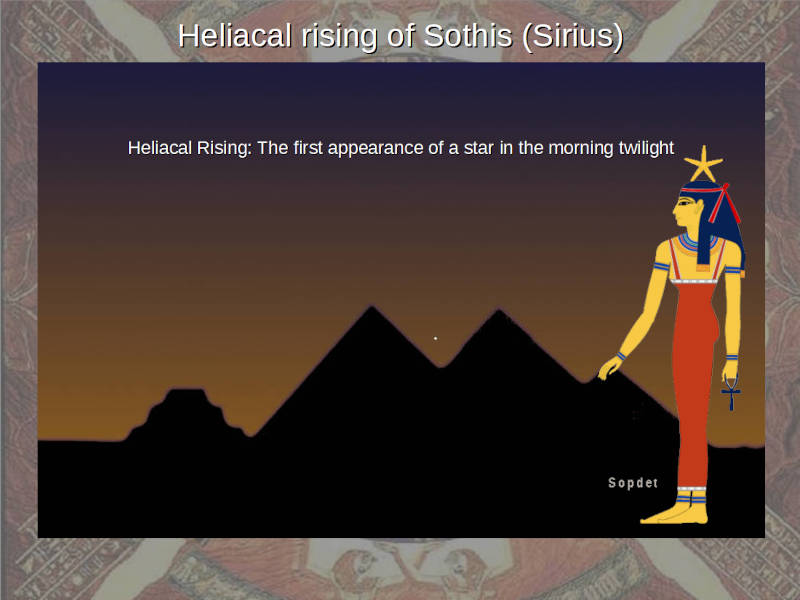
The Egyptian used the heliacal rising of Sirius as a signal that the flooding of the Nile was imminent, starting their agricultural year. The Greeks called the star Sothis, while the Egyptians themselves called it Sopdet, a goddess, and consort of the god Sah, our Orion.
Part of my presentation, December 2021 of Ancient Astronomy of the Egyptians and Babylonians.
 Bob Moler's Ephemeris Blog