Archive
12/03/2019 – Ephemeris – The Moon tonight
Ephemeris for Tuesday, December 3rd. Today the Sun will be up for 9 hours and 1 minute, setting at 5:03, and it will rise tomorrow at 8:02. The Moon, 1 day before first quarter, will set at midnight.
The Moon tonight is a few hours before being at first quarter, when the Moon appears exactly half illuminated. In viewing the Moon with a pair of binoculars or a telescope the observer will notice that the best detail is seen near the terminator, the sunrise line, that’s cutting the Moon in half. That’s where the shadows are longest. The large gray feature at the upper right of the Moon is Mare Serenitatis, which translates to the Sea of Serenity. To me it appears to look like a scallop shell. Serenitatis like most other seas is roughly circular and is actually a crater, the result of an impact of a large asteroid during what is called the late heavy bombardment that happened about 4 billion years ago.
The times given are for the Traverse City/Interlochen area of Michigan. They may be different for your location.
Addendum
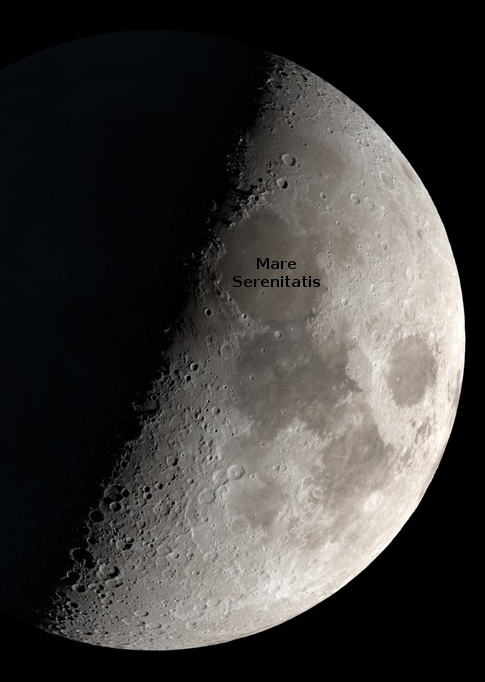
The moon as will appear tonight at 8 p.m. December 3, 2019 EST. Moon image credit NASA Scientific Visualization Studio.
Images of the moon’s phase for the entire year are available from https://svs.gsfc.nasa.gov/4442.
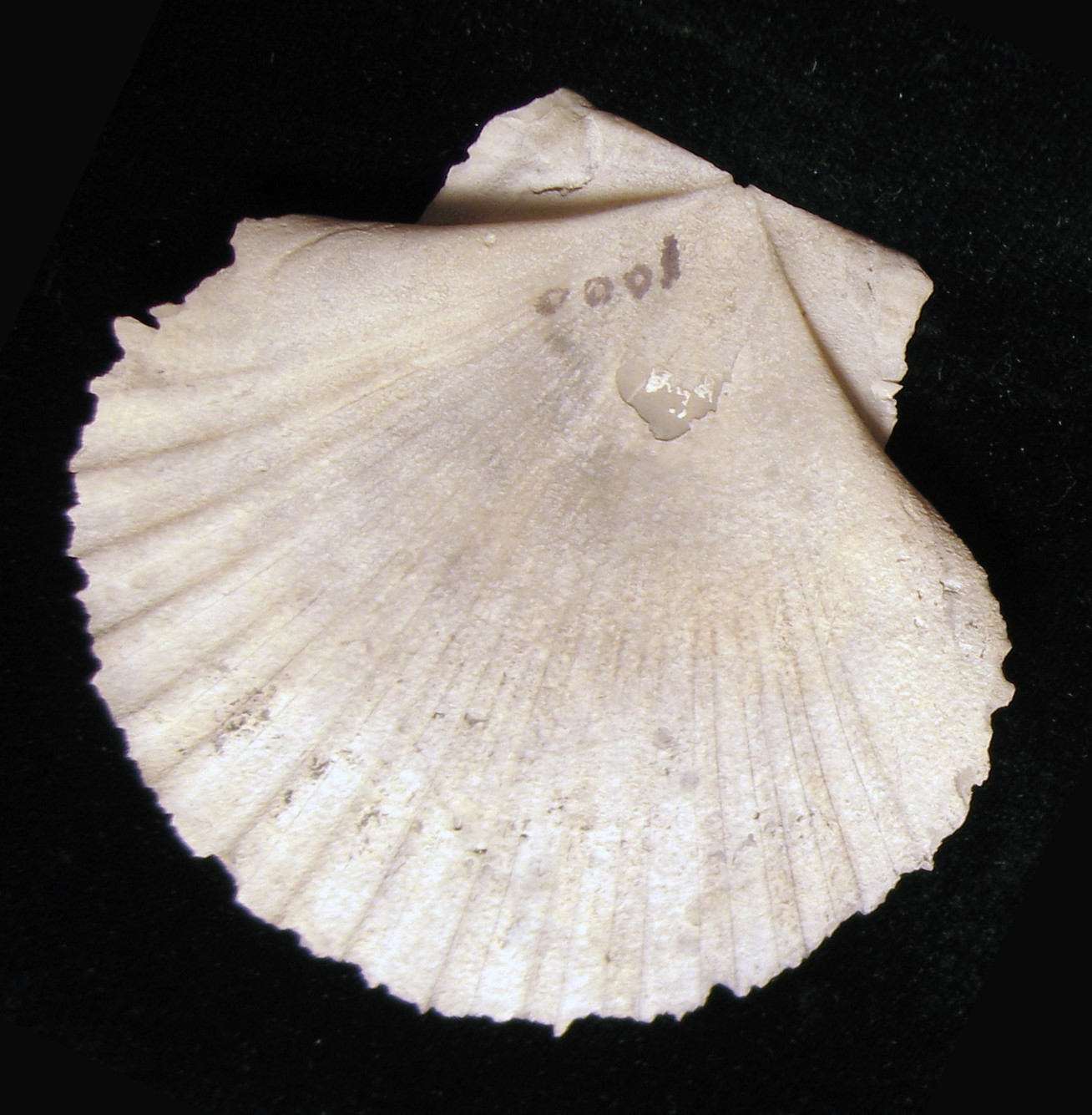
Image of a scallop shell rotated to match the Sea of Serenity. Credit Wikipedia user Kevmin. (Creative Commons)
11/07/2019 – Ephemeris – The gibbous Moon tonight
Ephemeris for Thursday, November 7th. Today the Sun will be up for 9 hours and 55 minutes, setting at 5:23, and it will rise tomorrow at 7:30. The Moon, 3 days past first quarter, will set at 3:13 tomorrow morning.
Every night when we look at the Moon the sunrise terminator has moved farther west on the Moon which is to our east uncovering more landscape. The Moon rotates once in about 29 ½ days in relation with the Sun. This is the same time it orbits the Earth from new Moon to the next. We call that a lunation or lunar month. Near the upper left corner of the Moon is what looks like a half crater. It’s called Sinus Iridium, the Bay of Rainbows. It’s at the edge of Mare Imbrium or Sea of Showers. To the south cut by the terminator is Oceanus Procellarum, the flat Ocean of Storms. South of that is the small Mare Humorum, the Sea of Vapors. South of all that is the odd shaped crater Schiller.
10-11-2016 has images
The times given are for the Traverse City/Interlochen area of Michigan. They may be different for your location.
Addendum
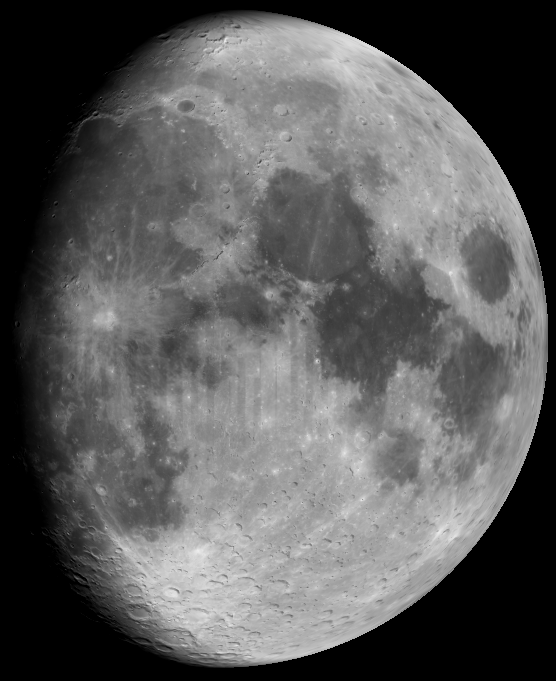
The gibbous Moon tonight at 8 p.m., November 7, 2019. Click on the image to enlarge. Created using Virtual Moon Atlas.
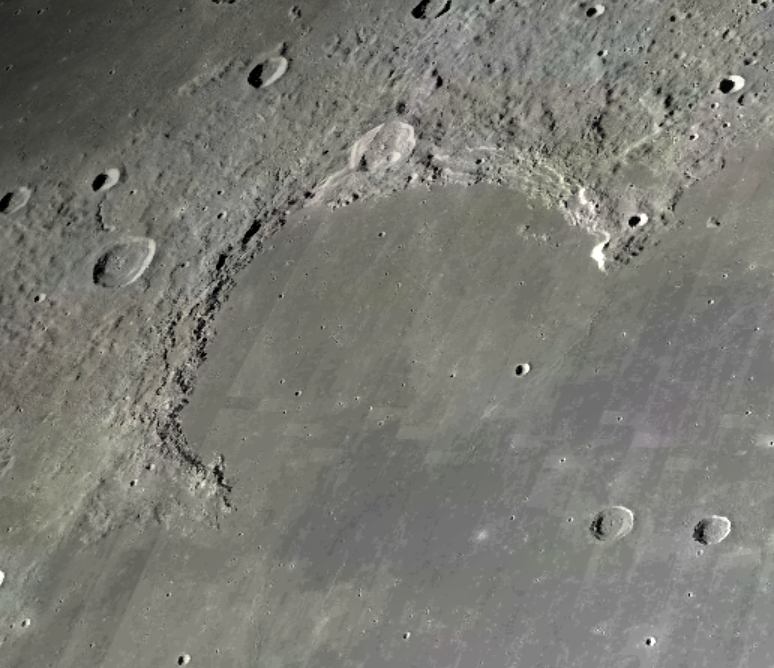
Sinus Iridium photographed by the Lunar Reconnaissance Orbiter as texture mapped on the globe of the Virtual Moon Atlas.
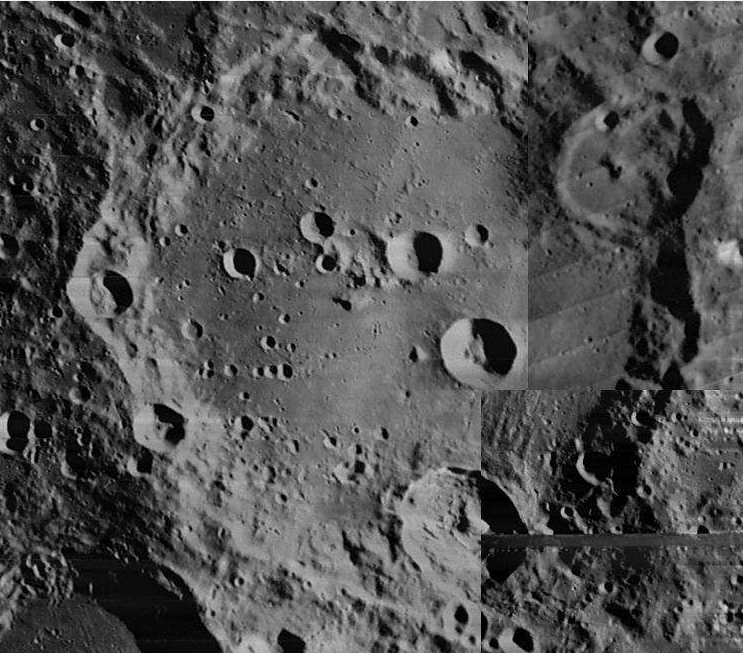
Clavius as photographed by one of the Lunar Orbiter spacecraft in the 1960s From Digital Lunar Orbital Photographic Atlas. This is photographed from overhead. On tonight’s moon it’s near the bottom or south end and is foreshortened.Credit Jeff Gillis, Lunar and Planetary Institute.
10/03/2019 -Ephemeris – The Moon tonight
Ephemeris for Thursday, October 3rd. Today the Sun will be up for 11 hours and 37 minutes, setting at 7:20, and it will rise tomorrow at 7:44. The Moon, 2 days before first quarter, will set at 10:46 this evening.
The planet Jupiter will appear below and right of the crescent Moon tonight. This evening one of the striking lunar craters will be seen at the sunrise line or terminator on the Moon. The crater might just be glimpsed in steadily held or tripod mounted binoculars, and definitely in a small telescope. The crater is Theophilus, some 61 miles (101 km) in diameter located south of the Sea of Tranquility. At lunar sunrise the central peak of the crater catches the Sun of the lunar sunrise way before the floor is illuminated showing a point of light within the circular crater rim against the black floor of the crater. That should happen before the Moon sets at quarter to 11 p.m. The central peak extends 650 feet (200 m) above the crater walls.
The times given are for the Traverse City/Interlochen area of Michigan. They may be different for your location.
Addendum
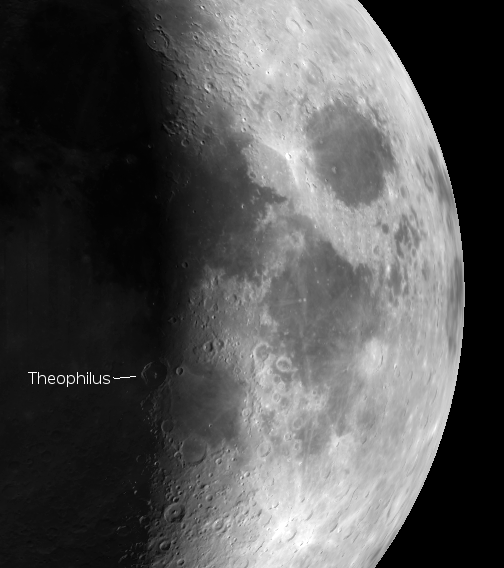
The Crater Theophilus on the Moon’s terminator at10 p.m. October 3, 2019, Created using Virtual Moon Atlas.
09/13/2019 – Ephemeris – Harvest Moon tonight
Ephemeris for Friday, September 13th. Today the Sun will be up for 12 hours and 38 minutes, setting at 7:57, and it will rise tomorrow at 7:20. The Moon, 1 day before full, will rise tonight 8:12.
Tomorrow is the Harvest Moon. In fact the instant of full moon is 12:33 a.m. tonight, so one could consider the Harvest Moon tonight. Funny thing though, this morning the Moon will reach apogee from the Earth, of 252 thousand miles (406 thousand km), making it the opposite of a super moon, a mini moon. I bet you wouldn’t notice if I didn’t tell you. The Harvest Moon is the name given to the nearest full moon to the autumnal equinox. It is a special time of the lunar cycle when the Moon rises much less than the 50 minutes later average each night. This appeared to extend twilight allowing farmers before the advent of electric lights extra time to gather in their crops each day.
The times given are for the Traverse City/Interlochen area of Michigan. They may be different for your location.
Addendum
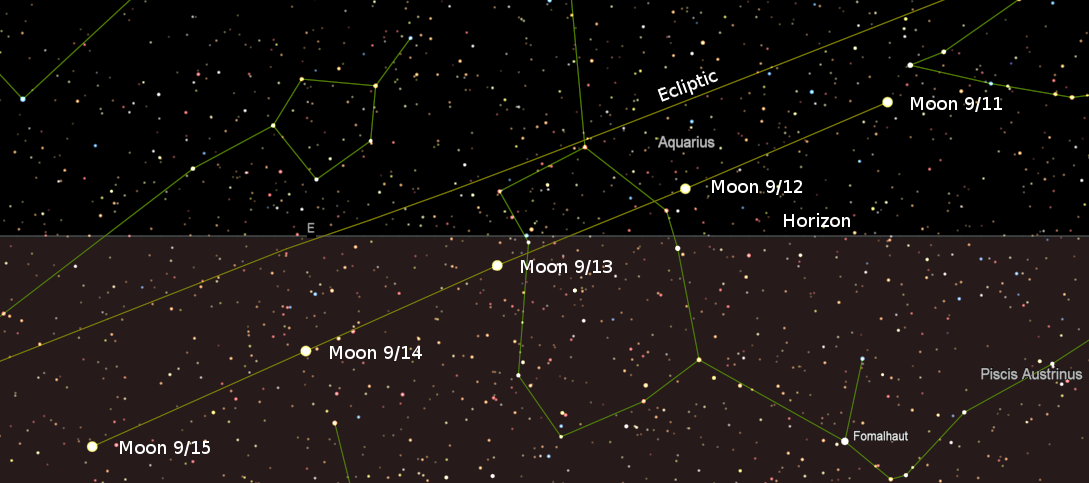
Harvest Moon effect from September 11 to the 15th, 2019. Note the shallowness of the ecliptic and Moon’s motion near sunset in this period. Click on the image to enlarge. Created using Cartes du Ciel (Sky Charts).
09/10/2019 – Ephemeris – India’s second lunar spacecraft
Ephemeris for Tuesday, September 10th. Today the Sun will be up for 12 hours and 47 minutes, setting at 8:03, and it will rise tomorrow at 7:16. The Moon, 4 days before full, will set at 4:29 tomorrow morning.
On July 22nd the Indian Space Research Organization ISRO launched Chandrayaan-2, their second mission to the Moon. India’s Chandrayaan-1 was a lunar orbiter launched 11 years ago. Chandrayaan-2 is much more ambitious spacecraft with an orbiter, a lander with a rover. Last Friday the lander attempted to land within 30 degrees of the Moon’s south pole. Unfortunately contact was lost when the lander was only 2.1 kilometers above the lunar surface. The last data received suggests that the lander’s vertical speed was excessive, and that it likely crashed on the lunar surface. This is the second failed lunar landing attempt this year after the Israeli Beresheet failure in April.
The times given are for the Traverse City/Interlochen area of Michigan. They may be different for your location.
Addendum
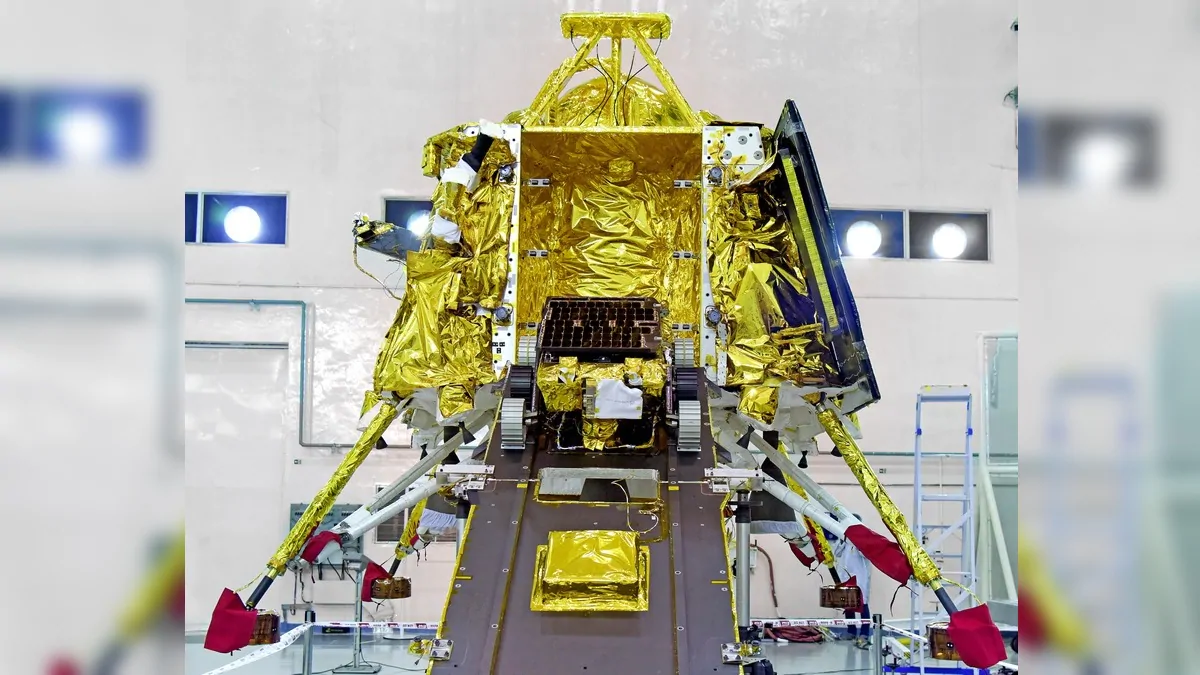
Chanrrayaan’s Vikram lander and Pragyan rover. before launch. The orbiter, not shown, is expected to have a 7 year life. The orbiter has viewed the landing site and has shown that the lander is in one piece. Credit ISRO.
07/16/2019 – Ephemeris – 50 years ago today the Apollo mission left for the Moon
Ephemeris for Tuesday, July 16th. Today the Sun will be up for 15 hours and 12 minutes, setting at 9:25, and it will rise tomorrow at 6:13. The Moon, at full today, will rise at 9:30 this evening.
50 years ago today at 11:32 a.m. Eastern Daylight Time the most powerful rocket ever built roared into life. The Saturn V, a three stage rocket, 363 feet tall, which in turn launched two spacecraft, the Command and Service modules, and the Lunar Module, and three astronauts on their journey to destiny, Neil Armstrong, Edwin (Buzz) Aldrin, and Michael Collins. It was the start of the Apollo 11 mission. It happens that tonight the namesake of the rocket, the planet Saturn is to the right of the Moon. At launch the Moon was two days old, a thin crescent in the west that evening. Four days later they would be orbiting the Moon, and Armstrong and Aldrin would be descending to the Moon’s surface.
The times given are for the Traverse City/Interlochen area of Michigan. They may be different for your location.
Addenda
Apollo 11
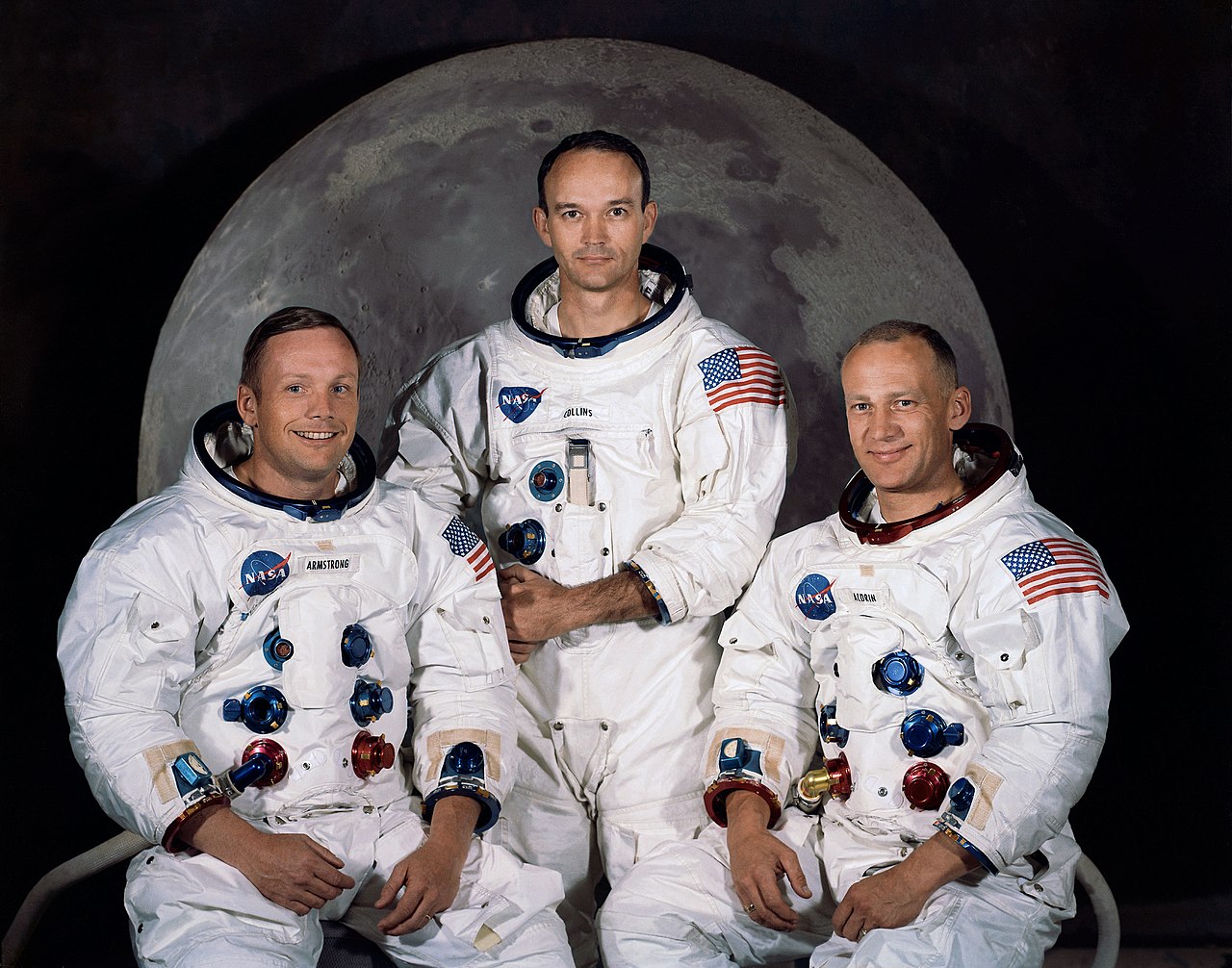
Left to right Neil Armstrong, Mission Commander; Michael Collins, Command Module Pilot; and Buzz Aldrin, Lunar Module Pilot. Credit: NASA.
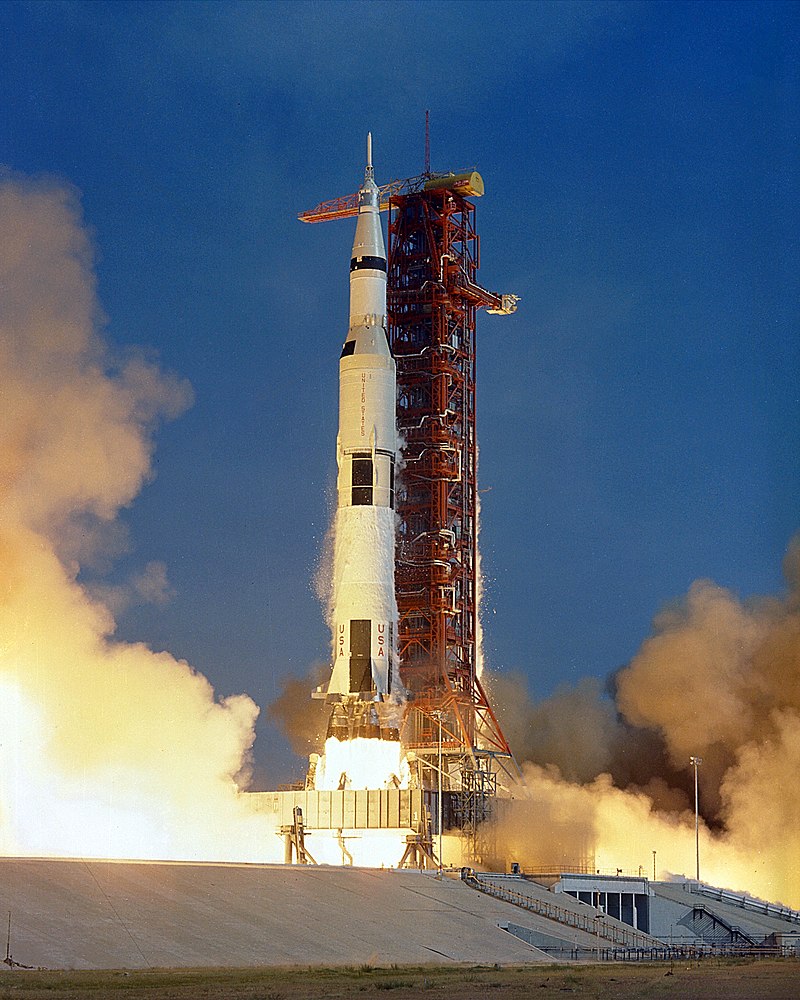
The Saturn V for the Apollo 11 mission lifts of from Pad 39A. Credit: NASA.
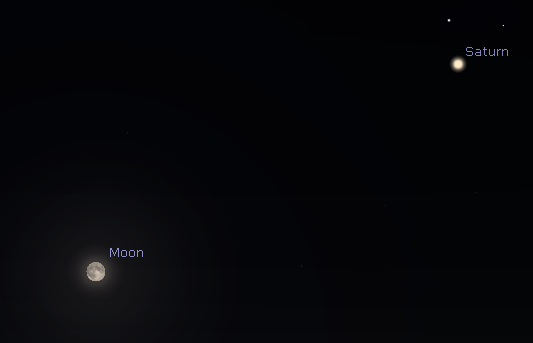
The Moon and Saturn tonight, 11 p.m. July 16, 2019. In reality the Moon will be so bright that Saturn will be almost overwhelmed. Created using Stellarium.
Here’s an excellent podcast series from the BBC: 13 Minutes to the Moon.
Partial Lunar Eclipse
The partial lunar eclipse today is not mentioned in the program because it is not visible locally.
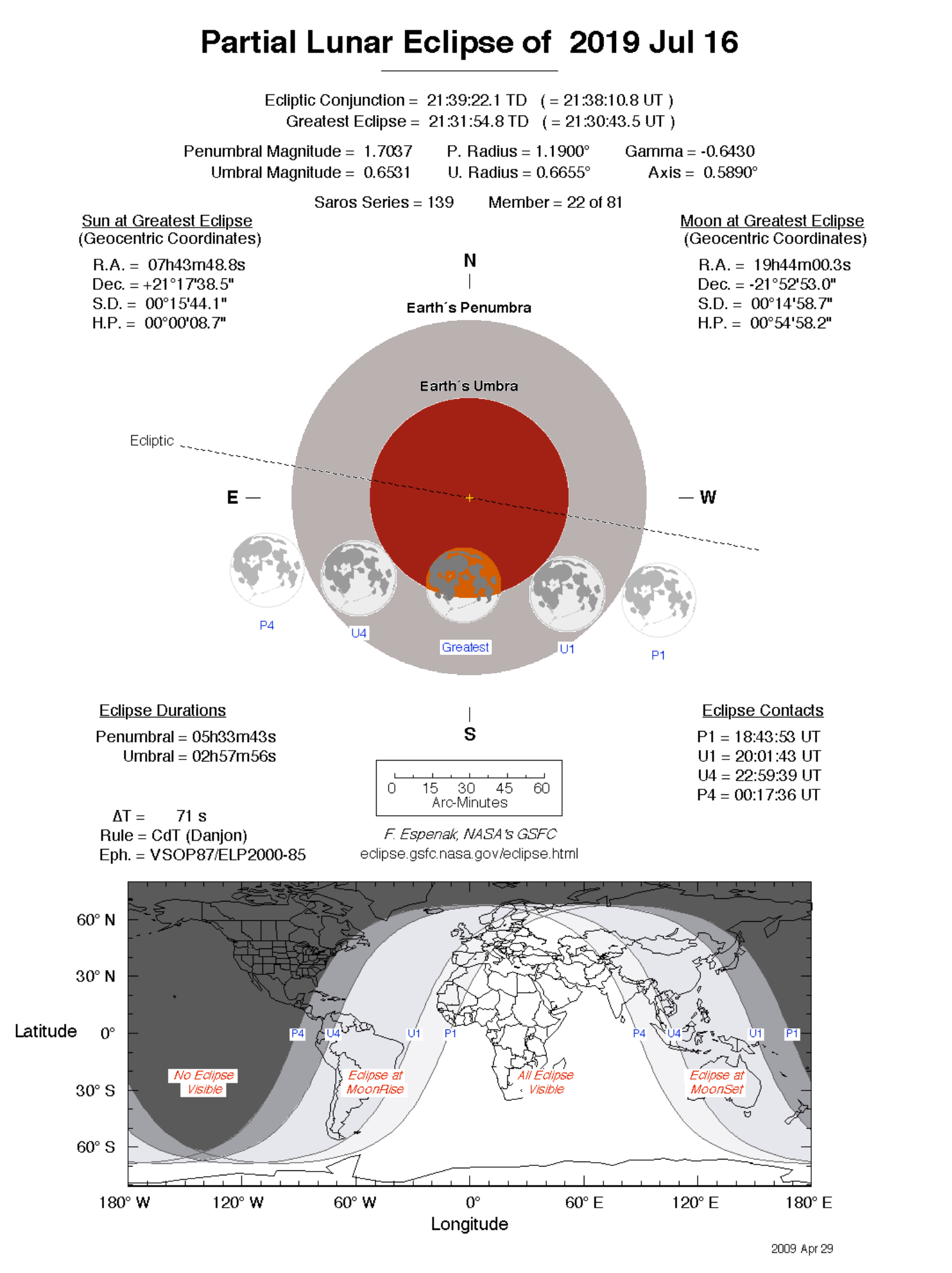
Partial Lunar Eclipse of July 16, 2019. Click on image to enlarge. Credit NASA/GSFC/F. Espenak.
06/14/2019 – Ephemeris – I’m giving the talk Apollo and the Race to the Moon tonight at the Library in Thompsonville
Ephemeris for Flag Day, Friday, June 14th. Today the Sun will be up for 15 hours and 33 minutes, setting at 9:29, and it will rise tomorrow at 5:56. The Moon, 3 days before full, will set at 4:55 tomorrow morning.
Tonight the Grand Traverse Astronomical Society will host a star party… well a Moon party at the Betsie Valley District Library in Thompsonville, MI. It starts at 8:30 p.m. With what I like to call a twilight talk by yours truly, the title of which is Apollo and the Race to the Moon. I’ll explore the Apollo 11 mission and the events leading up to it both in the United States and the USSR. The bright Moon tonight will uncover all the Apollo landing areas, even though there too small to be seen from the Earth, though they will be shown in the presentation. Twilight talks at the library also involves a slide or planetarium-like presentation, so if it’s cloudy we’ll also explore the starry nights of summer inside. So come out clear or cloudy.
The times given are for the Traverse City/Interlochen area of Michigan. They may be different for your location.
Addendum
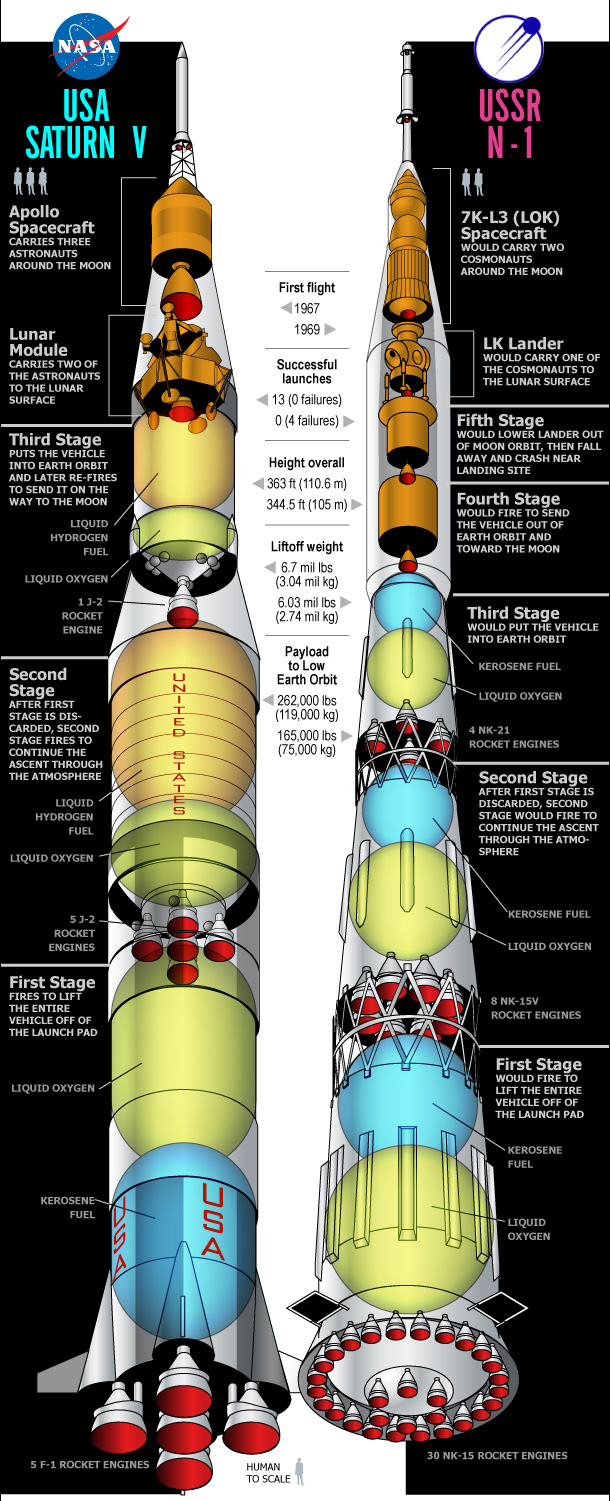
Comparison between The United States Saturn V and the Soviet N-1. Click on the Image to enlarge. Credit Karl Tate, Space.com.
06/06/2019 – Ephemeris – The 75th anniversary of D-Day, the astronomical connection
Ephemeris for Thursday, June 6th. Today the Sun will be up for 15 hours and 26 minutes, setting at 9:25, and it will rise tomorrow at 5:57. The Moon, 3 days past new, will set at 12:40 tomorrow morning.
Today is the 75th anniversary of the greatest battle of World War II was the invasion of Normandy on D-Day, a date governed by the position of the Moon. The full moon on June the 6th, 1944 gave light for the gliders and paratroopers to carry out their operations at midnight. Plus the high tides were near noon and midnight and the low tides near dawn. The idea was to hit the beach at low tide to enable the landing craft to operate without hitting the obstacles the Germans planted in the tidal zone. It was great for the landing craft, but the troops had a lot of open beach to cover to get to some sort of shelter. The best days for the invasion were the 5th, 6th and 7th of June. Bad weather on the 5th caused a one day postponement.
The times given are for the Traverse City/Interlochen area of Michigan. They may be different for your location.
05/09/2019 – Ephemeris – The USA: Step by step to the Moon
Ephemeris for Thursday, May 9th. Today the Sun will be up for 14 hours and 35 minutes, setting at 8:57, and it will rise tomorrow at 6:20. The Moon, 2 days before first quarter, will set at 1:54 tomorrow morning.
The Apollo 11 manned landing on the Moon 50 years ago was the culmination of a series of incremental steps. The Mercury program was in progress when President Kennedy announce the goal to land on the Moon. Following that was Gemini a two man capsule to test long duration flight, rendezvous and docking of two spacecraft, and EVA’s or spacewalks. There was the Ranger program attempted to photograph the Moon close up by sending probes to crash into the Moon. The Lunar Orbiter program to map the entire Moon, the Surveyor program to soft land on the Moon and test its surface. All this leading up to the three man Apollo program to test out the strategy and equipment and to land humans on the Moon.
The times given are for the Traverse City/Interlochen area of Michigan. They may be different for your location.
Addendum
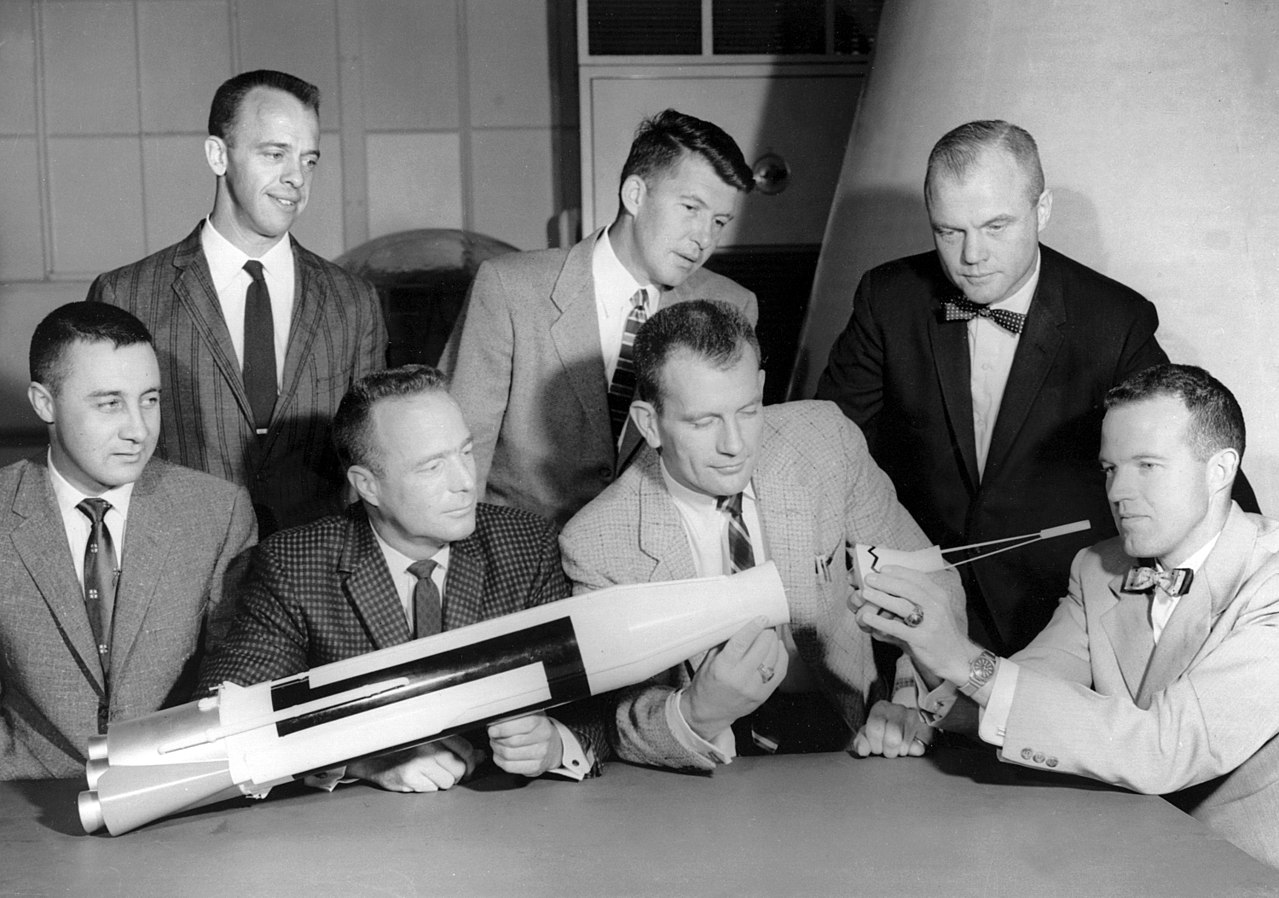
Project Mercury astronauts and a model of the Mercury-Atlas rocket and capsule. Left to right: Grissom, Shepard, Carpenter, Schirra, Slayton, Glenn and Cooper, in 1962. Click on the image to enlarge. Credit NASA.
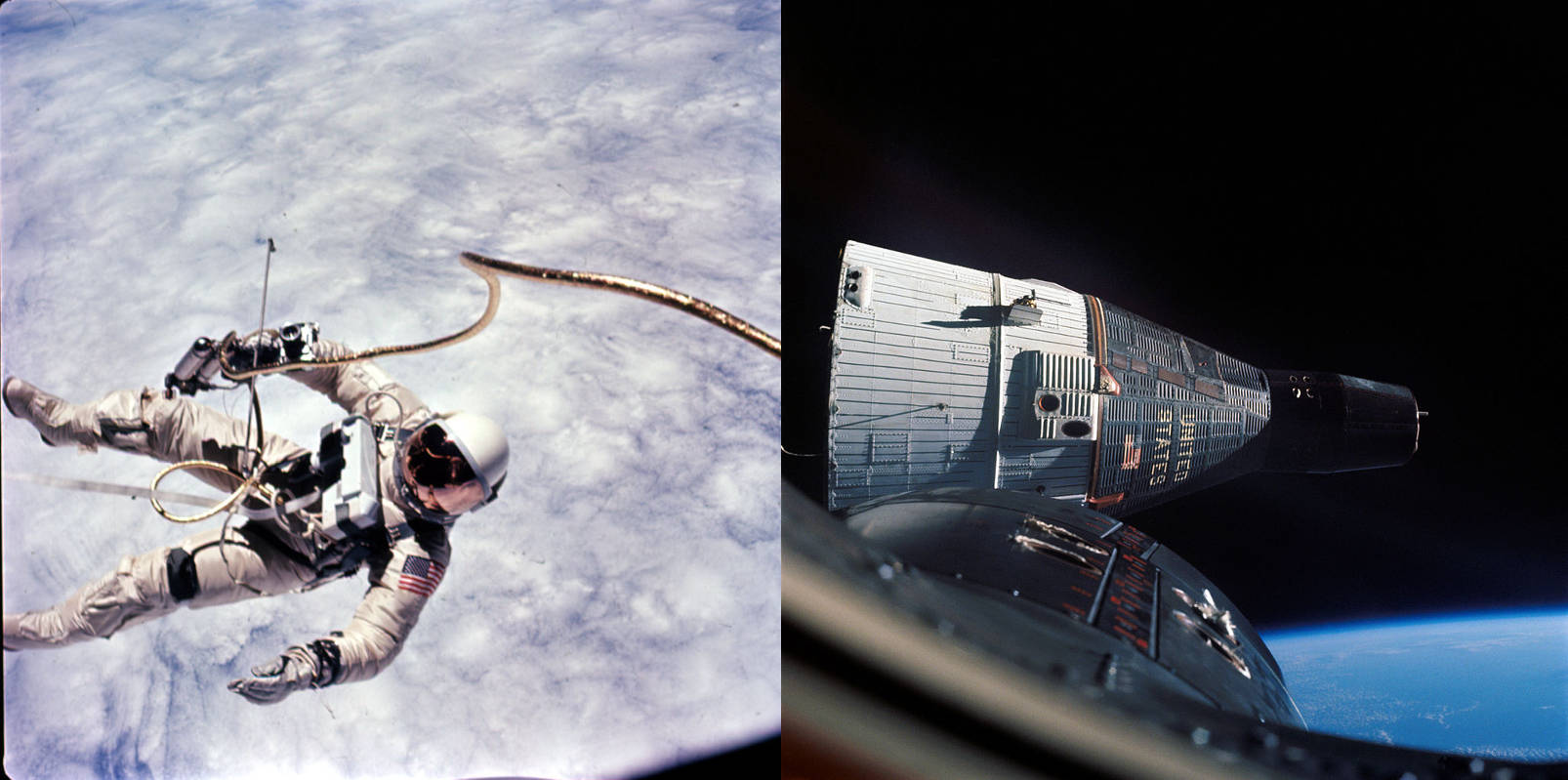
Project Gemini: Left Ed White during the US first space walk during Gemini 4 in June of 1965. Right The rendezvous of Gemini 6 & 7 in December of 1965. Click on the image to enlarge. Credit NASA.
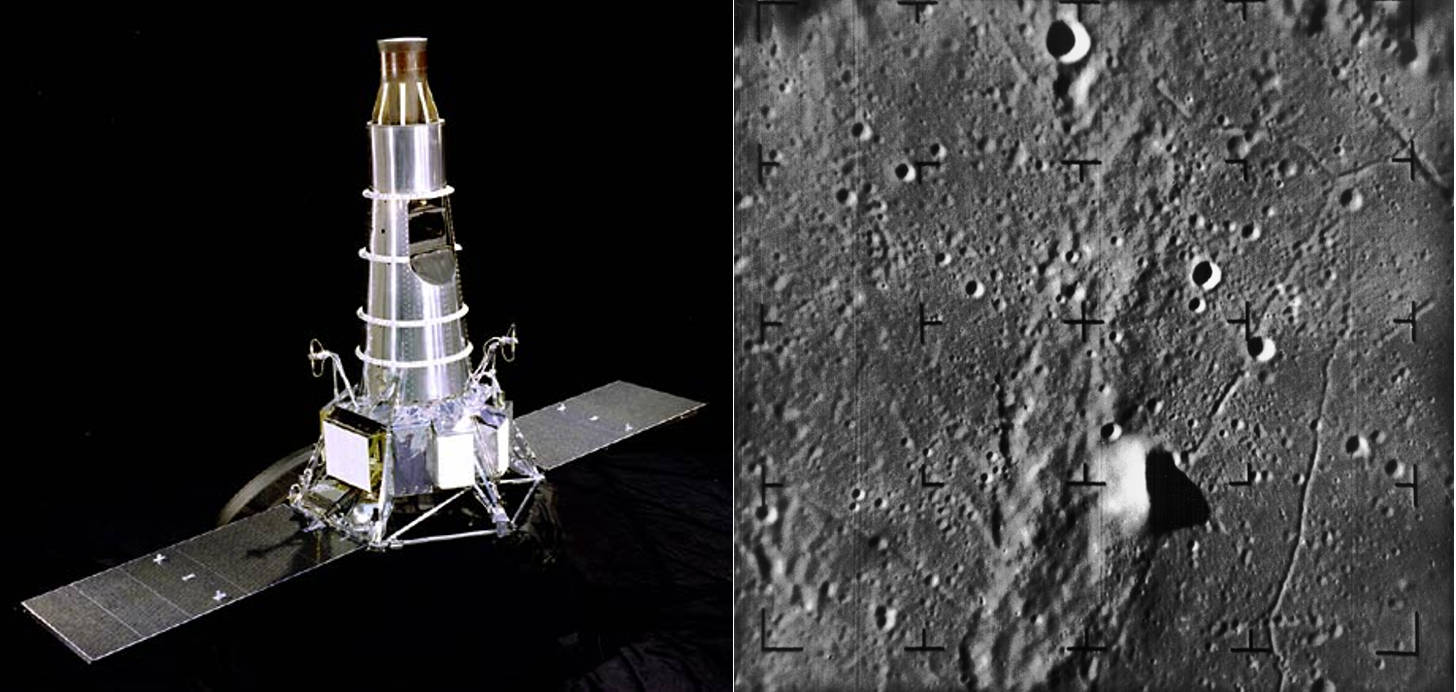
Left: The Ranger spacecraft. Right: The floor of the crater Alphonsus from Ranger 9. Only the last 3 spacecraft were successful. They transmitted images all the way down as they crashed into the Moon. Click on the image to enlarge. Credit NASA.
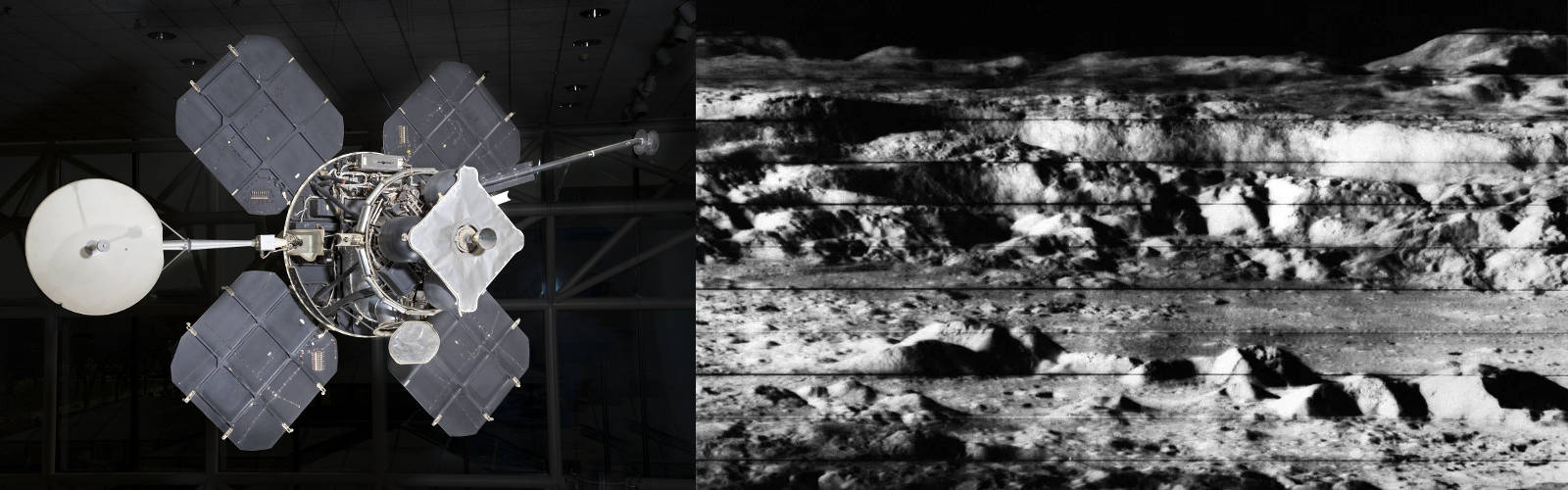
In the most unheralded of the lunar programs the 5 successful Lunar Orbiter satellites photographed 99% of the Moon. from 1966 to 1967. The Moon was photographed on film in strips, developed and the images scanned and transmitted back to Earth. Right: The oblique view of the crater Copernicus was dubbed at the time “The Picture of the Century”. Click on the image to enlarge. Credit NASA.
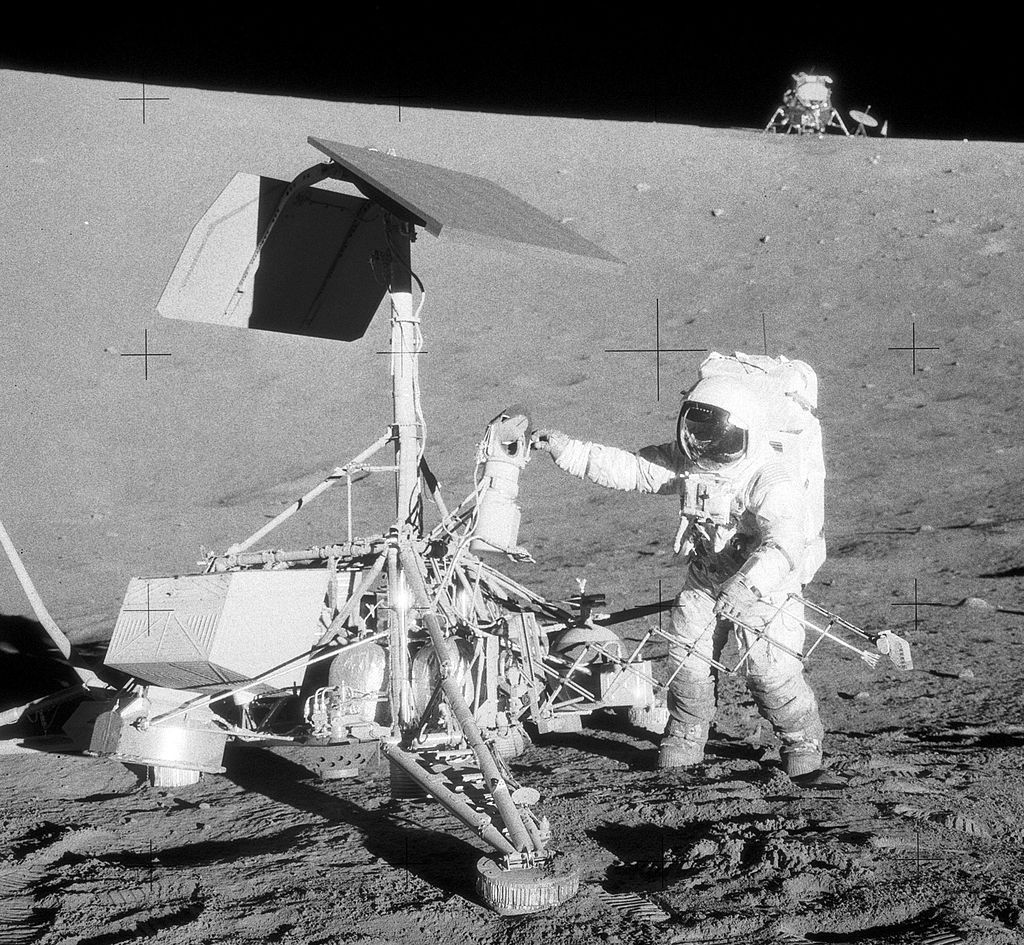
Surveyor 3, visited by astronaut Pete Conrad during the Apollo 12 mission. Click on the image to enlarge. Credit: NASA / Alan Bean.
04/15/2019 – Ephemeris – Why land at the Moon’s south pole?
Ephemeris for Tax Deadline Day Monday, April 15th. Today the Sun will be up for 13 hours and 28 minutes, setting at 8:27, and it will rise tomorrow at 6:57. The Moon, 3 days past first quarter, will set at 5:53 tomorrow morning.
The hottest piece of real estate on the Moon is the south pole. Unlike the Earth’s south pole and the rest of the Moon, except the north pole, there are mountain tops that are always in sunlight. The Moon has a very small axial tilt, only a degree an a half, compared to the Earth’s 23 and a half degrees which plunges the earth’s poles into a 6 month’s night. Another benefit of the small tilt is that the floors of craters at of near the poles never see sunlight, so are hundreds of degrees below zero and can be cold traps for water vapor from passing or colliding comets. Yes, thar’s water in them thar craters. It’s more valuable than gold, providing oxygen to breathe and hydrogen and oxygen for rocket fuel.
The times given are for the Traverse City/Interlochen area of Michigan. They may be different for your location.
Addendum
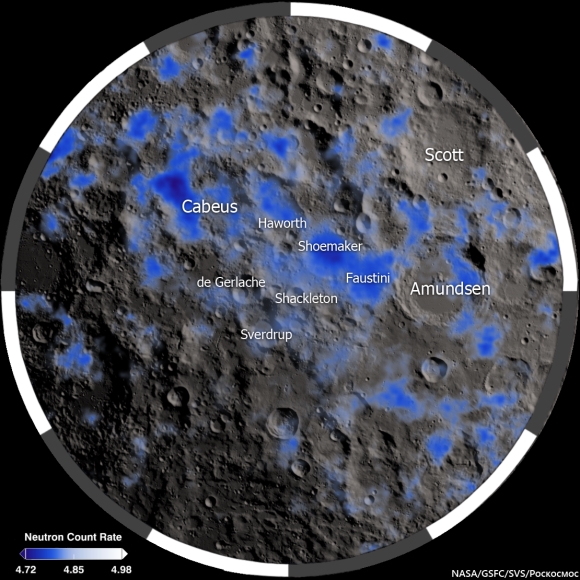
The south pole of the Moon where the presence of water ice is detected by the absorption of neutrons by the hydrogen atoms in the ice. Credit NASA/GSFC/SVS/Roscosmos.
 Bob Moler's Ephemeris Blog