Archive
09/17/2018 – Ephemeris – The Moon Tonight and the Jade Rabbit
Ephemeris for Monday, September 17th. The Sun will rise at 7:24. It’ll be up for 12 hours and 25 minutes, setting at 7:49. The Moon, 1 day past first quarter, will set at 1:03 tomorrow morning.
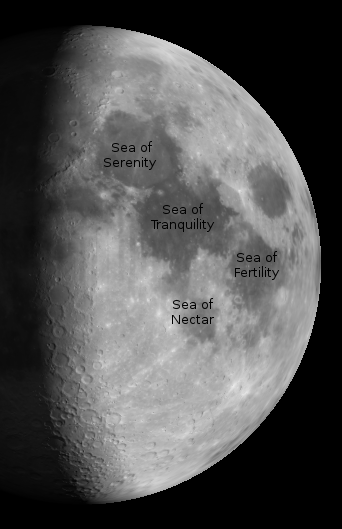
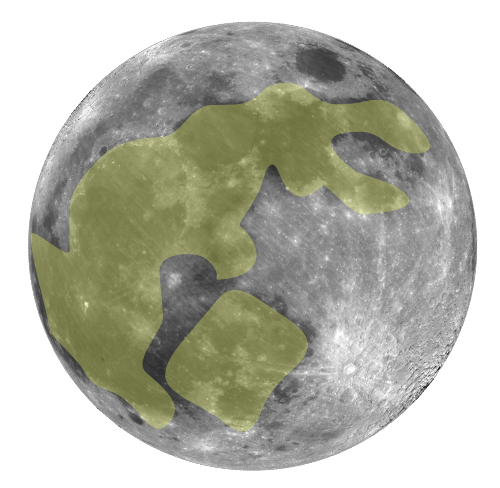
Now is a good time to point that small telescope or binoculars toward the Moon. The gray seas on the right side of the moon depict the neck, head and ears of the Jade Rabbit. It’s curled up body is on the night side of the Moon to the left. The rabbit is upside down as we see him with the naked eye or binoculars. The Sea of Serenity is the upper part of his body, the head is the Sea of Tranquility. A bay south of Tranquility and the Sea of Nectar is one ear and the Sea of Fertility is the other ear. The Jade Rabbit is related to the Chinese Mid-Autumn Festival which occurs at our Harvest Moon. It’s on September 24th this year. Another amateur astronomer and myself brought telescopes to the local festival last year to view the Jade Rabbit on the Moon.
The times given are for the Traverse City/Interlochen area of Michigan. They may be different for your location.
Addendum
09/13/2018 – Ephemeris – The Man in the Moon’s eye
Ephemeris for Thursday, September 13th. The Sun will rise at 7:19. It’ll be up for 12 hours and 37 minutes, setting at 7:57. The Moon, 3 days before first quarter, will set at 10:27 this evening.
The Moon tonight is a 4 day old moon, and appears near the planet Jupiter. Day one is its first appearance in the evening after disappearing from the morning sky. The ancients called it the new moon, but astronomers treat the conjunction of the Moon and the Sun as the new moon. In this program I note the days before or after the nearest quarter phase, as a better representation of the actual appearance of the Moon’s phase. The Moon will be a beautiful crescent tonight. Binoculars will reveal a dark area just above the fattest part of the crescent. It serves as one of the Man in the Moon’s eyes. Its official name is Mare Crisium, or Sea of Crises. Most of the Moon’s seas are connected, or appear to be. This one is definitely not.
The times given are for the Traverse City/Interlochen area of Michigan. They may be different for your location.
Addendum
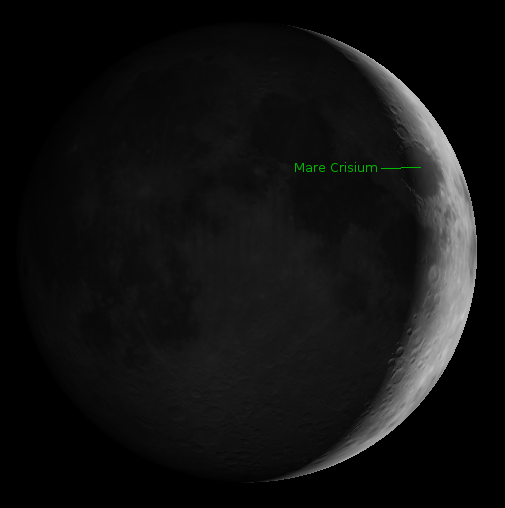
The 4 day old Moon showing Mare Crisium, the Sea of Crises. 9 p.m. September 13, 2018. Created using Virtual Moon Atlas.
09/11/2018 – Ephemeris – Earth shine on the Moon
Ephemeris for Tuesday, September 11th. The Sun will rise at 7:16. It’ll be up for 12 hours and 43 minutes, setting at 8:00. The Moon, 2 days past new, will set at 9:27 this evening.
At around 8:30 this evening Venus will be in the southwest only 9 degrees above the horizon, about the width of a fist held at arm’s length. While viewing Venus the Moon will be to the right and above our evening star. It will be a thin sliver of a crescent and in the twilight there will be the suggestion that there is more than the thin sliver of the Moon visible. Binoculars will confirm that the entire disk of the Moon will be visible. The effect is called earth shine. The nearly full Earth is illuminating the Moon to a much greater degree than the full Moon illuminates the Earth. The Earth is about 4 times the Moons diameter and its surface is about twice as bright and the Moon’s. The ancients called it: “The old Moon in the new Moon’s arms.”
The times given are for the Traverse City/Interlochen area of Michigan. They may be different for your location.
Addendum
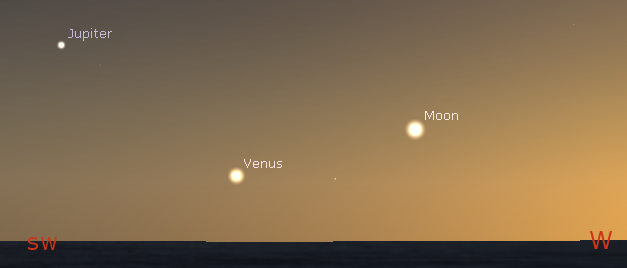
Venus, the Moon and Jupiter at 8:30 p.m. September 11, 2018. Created using Stellarium.
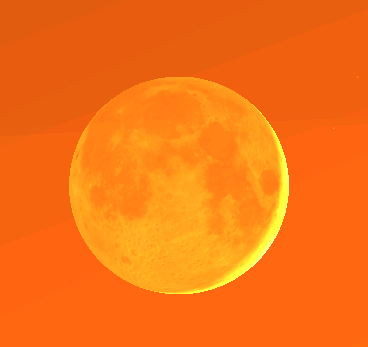
An overly colored Moon to bring out Earth shine on thye evening of September 11, 2018. Created by Stellarium. Overly processed in GIMP.
08/28/2018 – Ephemeris – Water on the Moon
Ephemeris for Tuesday, August 28th. The Sun will rise at 7:00. It’ll be up for 13 hours and 26 minutes, setting at 8:26. The Moon, 2 days past full, will rise at 9:47 this evening.
Ten years ago India launched its lunar orbiting Chandrayaan-1 spacecraft. On it was a NASA instrument the Moon Mineralogy Mapper to study the composition of the Moon’s crust. With it they discovered signatures of water at the Moon’s high latitudes, probably in water-bearing minerals. Water was also confirmed in craters near the Moon’s south pole by the LCROSS probe that was launched with the Lunar Reconnaissance Orbiter in 2009. It crashed near the Moon’s south pole in a crater following a centaur stage which it was observing. Though the expected visual show wasn’t visible from Earth the LCROSS satellite saw and returned its observations before it too crashed. It relayed that the Moon had ice near the south pole.
The times given are for the Traverse City/Interlochen area of Michigan. They may be different for your location.
Addendum
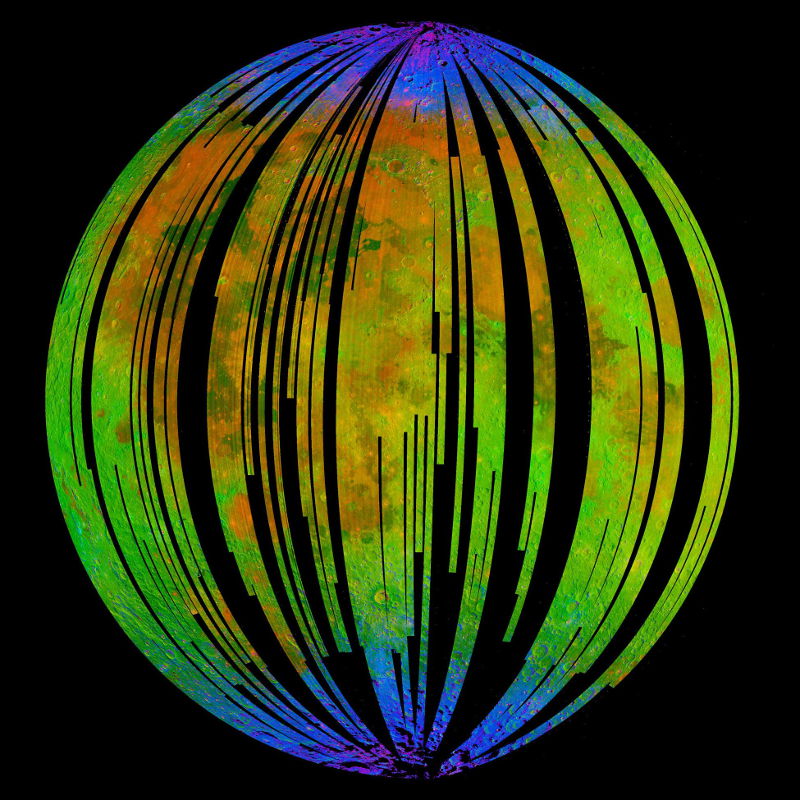
Water Detected at High Latitudes on the Moon by the Moon Mineralogy Mapper The water-bearing minerals are colored blue. Credit ISRO/NASA/JPL-Caltech/Brown Univ./USGS
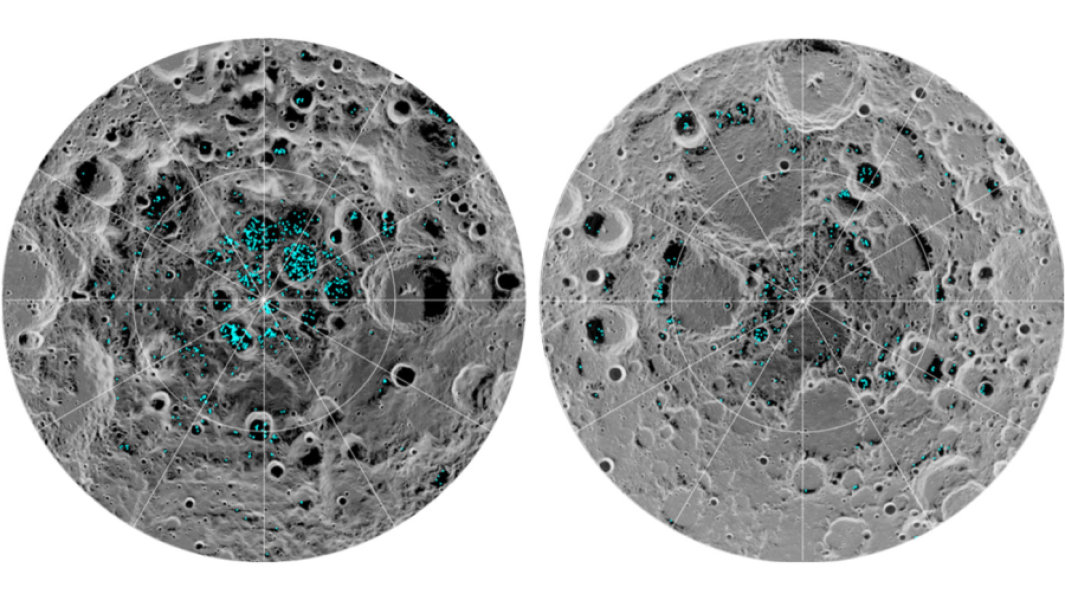
The Moon’s south pole area on the left and north pole on the right. The cyan color shows shadowed areas where ice is located. From data gathered by the Moon Mineralogy Mapper, and instruments on the Lunar Reconnaissance Orbiter, and LCROSS. Click on image to enlarge. Credit NASA.
Finding water is a big deal. It helps Moon colonists live off the land, so to speak. While the poles on Earth are foreboding places, those of the Moon could give colonists an advantage. First, that’s where the water is. The Moon has very little axial tilt so deep craters never see the sunlight, and high peaks see eternal sunlight, a great place to place solar panels for just about continuous energy production.
08/27/2018 – Ephemeris – It wasn’t the Harvest Moon but it has that effect
Ephemeris for Monday, August 27th. The Sun will rise at 6:59. It’ll be up for 13 hours and 29 minutes, setting at 8:28. The Moon, 1 day past full, will rise at 9:21 this evening.
Last night’s full moon wasn’t the Harvest Moon. That’s next month’s full moon. This full moon is the Sturgeon Full Moon. You’d think it should be the Corn Moon, That’s normally the September’s full moon, which is preempted this year by the Harvest Moon, the closest full moon to the autumnal equinox. What’s taking effect now is what I call the harvest moon effect, in that the nearly full Moon stays in the evening sky for almost a week, it seems, after full; while I’m waiting to spot the wonders of the summer Milky Way at a decent hour. On average the Moon rises about 50 minutes later each night. Now it’s decreasing to be less than 30 minutes. It won’t be until Thursday night that we’ll have a whole half hour of dark skies, and up to an hour by Friday night.
The times given are for the Traverse City/Interlochen area of Michigan. They may be different for your location.
Addendum
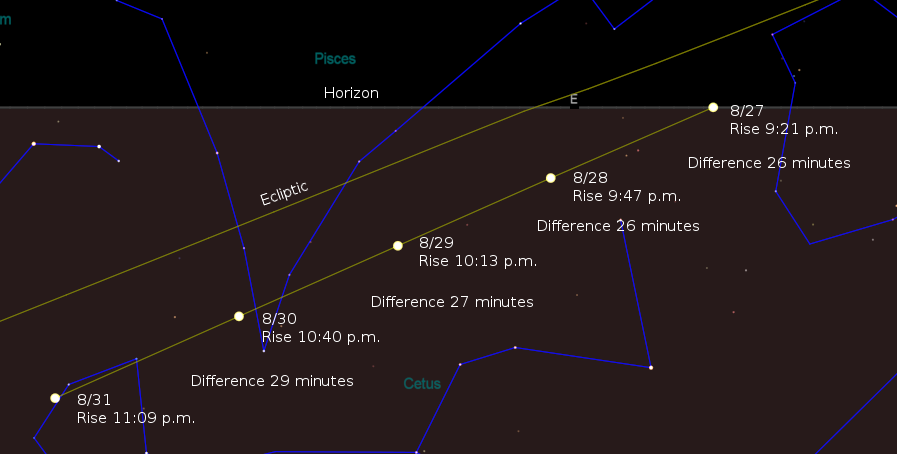
The motion of the Moon with respect to the eastern horizon from August 27 through August 31, 2018. It shows the difference in the rise times that create the harvest moon effect. Created using Cartes du Ciel (Sky Charts).
08/16/2018 -Ephemeris – The Moon’s phase, a closer look
Ephemeris for Thursday, August 16th. The Sun rises at 6:46. It’ll be up for 14 hours exactly, setting at 8:46. The Moon, 2 days before first quarter, will set at 11:59 this evening.
With the Moon at a fat crescent tonight, it’s a good time to turn binoculars or a small telescope toward it. The demarcation between the bright part and the dark part is called the terminator. In the case before full moon, it is the sunrise line. After that the sunset line. The Moon’s entire day lasts about 29 ½ earthly days. I am sometimes asked “What’s blocking the light from the unlit side of the Moon?” It’s the Moon itself. It’s the night side of the Moon, just as when we are in night. The Earth itself is blocking the Sun’s light from us. The Moon, like the Earth and all the other planets are spheres lit on one side by the Sun. It’s near the terminator of the Moon where the most detail is revealed by the long shadows cast by the Moon’s features.
The times given are for the Traverse City/Interlochen area of Michigan. They may be different for your location.
Addendum
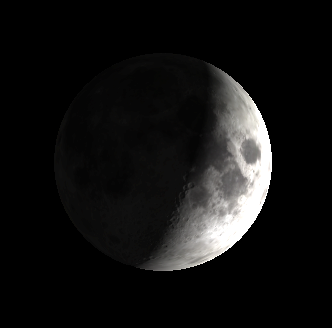
The crescent moon as it should appear tonight. Created using Stellarium. Stellarium always shows details on the night side of the Moon. The crescent phase of the Moon is now too fat to really see earthshine on it’s night side.
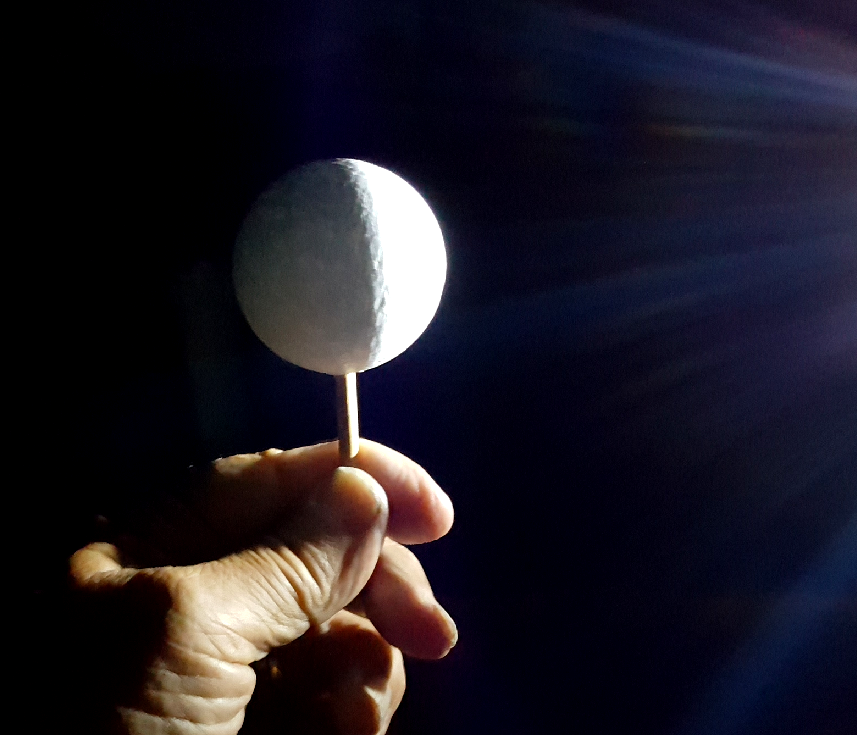
Demonstration of the Moon’s crescent phase with the Styrofoam moon ball we use for Project Astro held up to a light off frame to the right. The night side of the ball is illuminated a bit by the translucency of the ball, and the reflection off my hand. Note the roughness of the ball is visible only at the terminator.
07/19/2018 – Ephemeris – The Moon passes the evening planets one by one over the next week
Ephemeris for Thursday, July 19th. Today the Sun will be up for 15 hours and 7 minutes, setting at 9:22, and it will rise tomorrow at 6:16. The Moon, at first quarter today, will set at 1:29 tomorrow morning.
The Moon is making its monthly journey around the sky. Tonight it will be west or to the right of Jupiter. Tomorrow night Jupiter will be directly below the Moon. Next Tuesday night Saturn will appear below and left of the Moon. Next Thursday night Mars will appear below and to the left of the Moon. Mars at that time will be actually far south of the Moon, so that event usually doesn’t show in almanacs. Mars, being very close to us is in a part of its orbit that takes it south of the Earth’s orbital plane. We see that plane as the ecliptic or path of the Sun. We see the same situation when Venus is close to the Earth, and it is north or south of the ecliptic. The Moon can pass them without being listed as a conjunction.
The times given are for the Traverse City/Interlochen area of Michigan. They may be different for your location.
Addendum
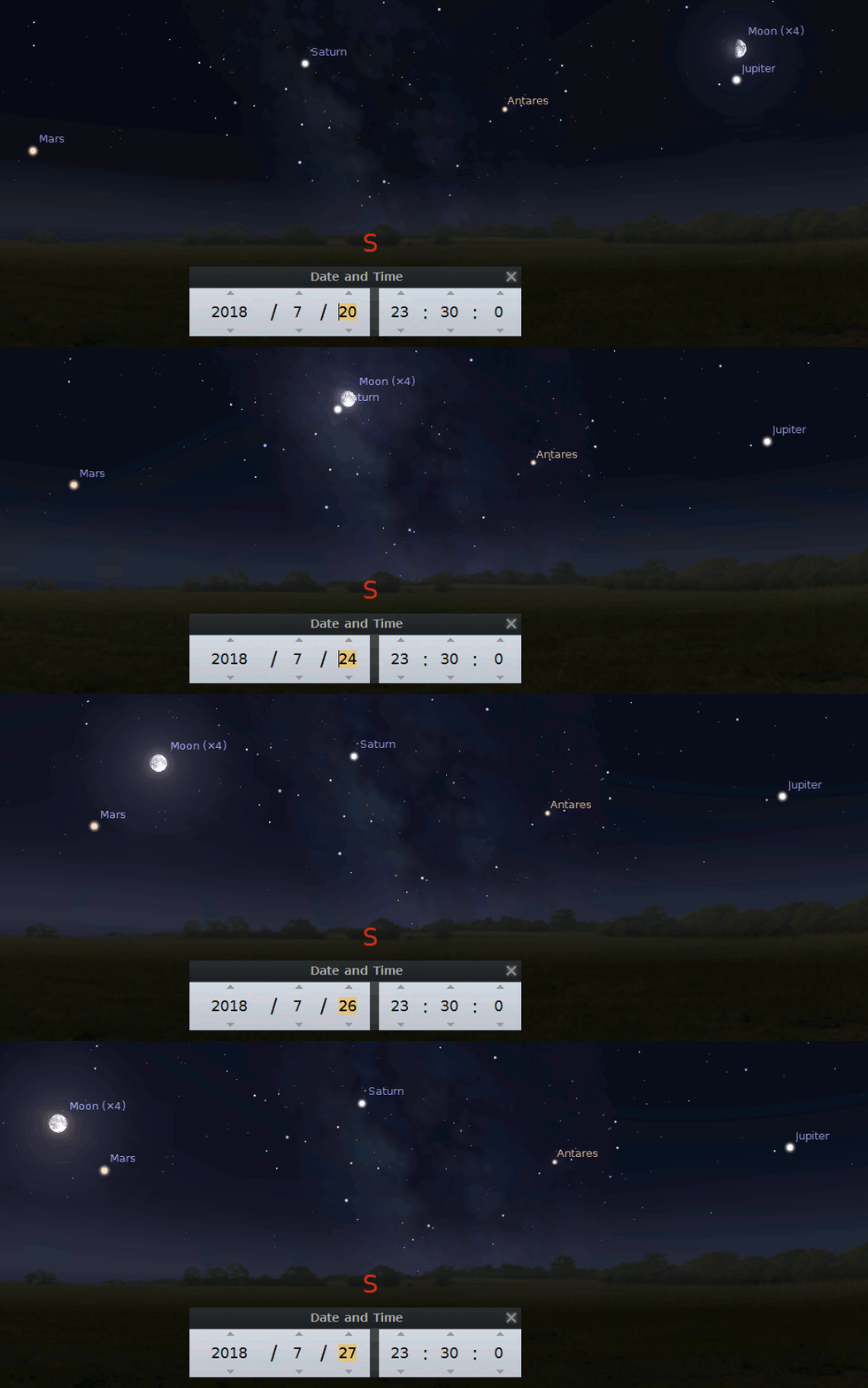
Here’s the Moon passing each of the superior evening planets in the 8 days from July 20 to July 27 2018. By the time the Mon will pass Mars it will truly be an evening planet. Mars will be at opposition with the Sun that day. Note that the Moon’s size is exaggerated by a factor of 4 to show its phase at this scale. Created using Stellarium and GIMP.
06/08/2018 – Ephemeris – A second Moon race?
Ephemeris for Monday, June 18th. Today the Sun will be up for 15 hours and 34 minutes, setting at 9:31, and it will rise tomorrow at 5:56. The Moon, 2 days before first quarter, will set at 1:30 tomorrow morning.
The Moon as a destination is becoming a hot topic among the space faring nations. Who will land humans first in this second wave since the United States landed there in the late 1960s and early 1970s: The Chinese, Russians, us? Or maybe someone else? Next year July 20th will be the 50th anniversary of Neil Armstrong’s first step onto the lunar surface. The goal this time is not to just visit, but to stay. The lunar surface is a harsh environment of extremes in temperatures and radiation from the Sun, and from the universe beyond. There is shelter beneath the surface, in lava tubes. There is one lava tube with a collapsed roof, a skylight, which could provide access in a place called the Marius Hills.
The times given are for the Traverse City/Interlochen area of Michigan. They may be different for your location.
Addendum
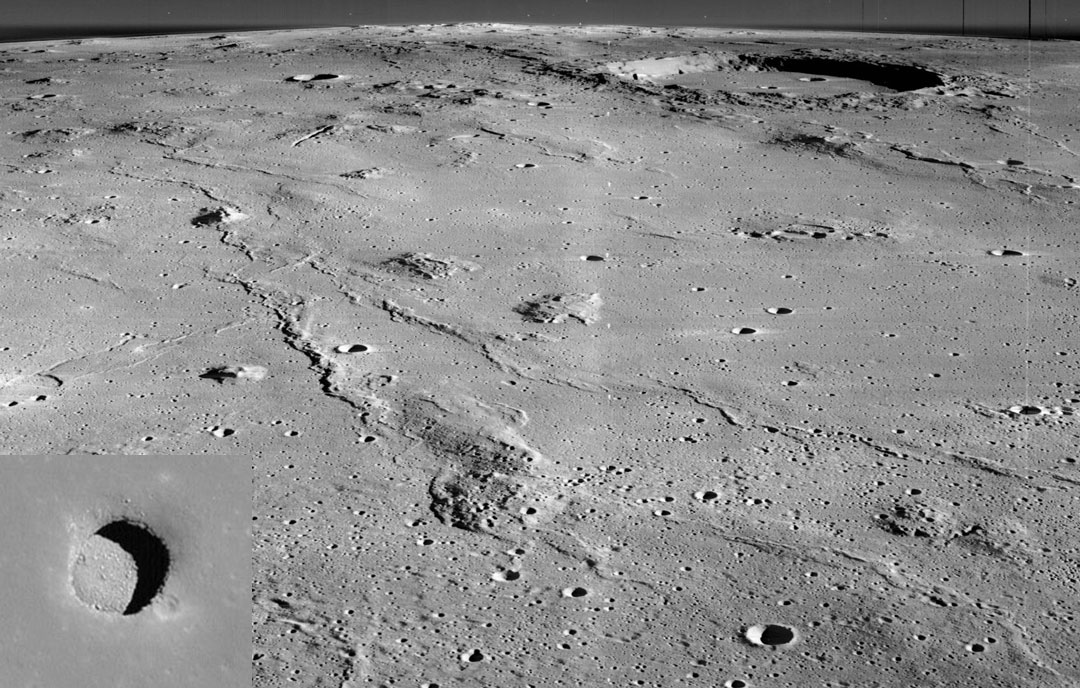
An oblique view of the Marius Hills from the Lunar Orbiter 2, with an inset look into a skylight into a lava tube from the Lunar Reconnaissance Orbiter at the lower left. Click on image to enlarge. Credit NASA, Lunar Orbiter 2, Lunar Reconnaissance Orbiter.
The picture above was posted on Astronomy Picture of the Day (APOD) 2017 October 2017: https://apod.nasa.gov/apod/ap171025.html, where there is more information.
05/17/2018 – Ephemeris – Venus and the Moon tonight and viewing Venus in the daytime
Ephemeris for Thursday, May 17th. Today the Sun will be up for 14 hours and 54 minutes, setting at 9:06, and it will rise tomorrow at 6:11. The Moon, 2 days past new, will set at 11:40 this evening.
This afternoon at 2:11 the Moon will appear to pass Venus. This will be impossible to see since the Moon is going to be much dimmer than Venus. Venus can indeed be seen in the daylight. I’ve seen it many times with binoculars or a telescope, but only once with the naked eye. The latter time was not long before sunset. It is essential that to spot Venus in the daytime by any of these means that one is in the shade, by putting the Sun behind a building, and knowing where Venus is supposed to be using a program on a smart phone. By tonight the Moon will have moved eastward past Venus by up to 13 of its diameters and will also be displaying earthshine, the reflection of the Earth off its night side.
The times given are for the Traverse City/Interlochen area of Michigan. They may be different for your location.
Addendum
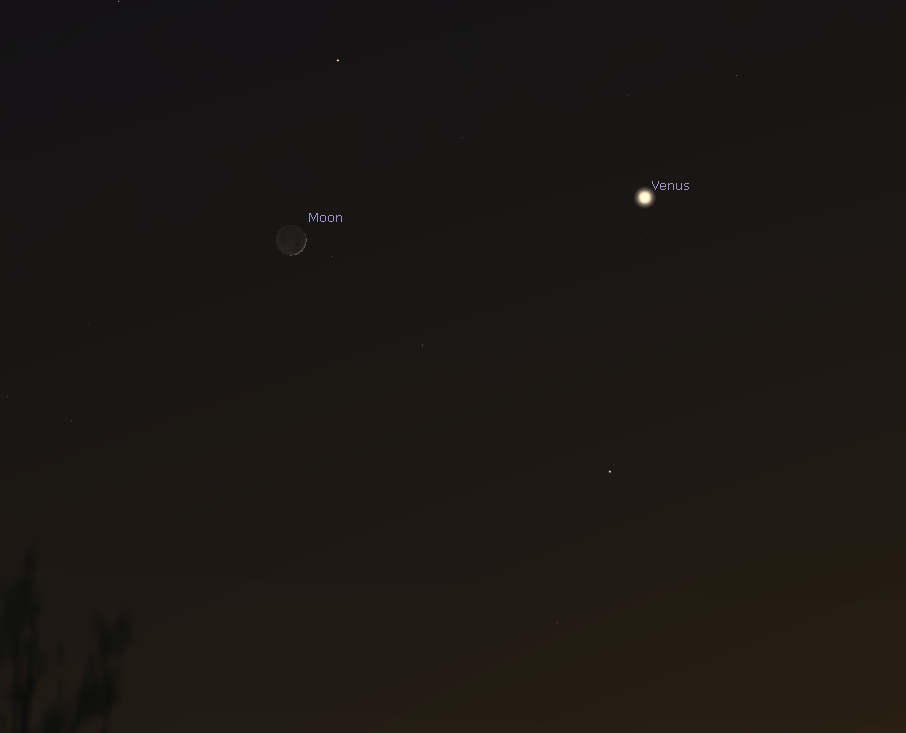
Venus and the Moon at 10 p.m. May 17, 2018. Created using Stellarium.
04/30/2018 – Ephemeris – Venus-Earth resonances, and Jupiter & the Moon tonight
Ephemeris for Monday, April 30th. The Sun rises at 6:34. It’ll be up for 14 hours and 12 minutes, setting at 8:46. The Moon, 1 day past full, will rise at 9:30 this evening.
Jupiter will be near the moon tonight. The gravitational force between the planets produces some interesting resonances in their orbital periods. Venus has three different kinds with the Earth. First, Venus orbits the Sun 13 times in the same time it takes the Earth to orbit the Sun 8 times. This is a 13 to 8 resonance. This sets up the 5 Venus Cycles equaling 8 years resonance the Mayan’s discovered. A Venus cycle of 584 days takes Venus to go from Morning Star to Evening Star and back again. The next one wasn’t discovered until we started to bounce radar signals off Venus. We found it rotates backwards, and very slowly at that. Its rotation with respect to the stars is longer than its year. And it so happens that every passage near the Earth the same side of Venus is facing us.
The times given are for the Traverse City/Interlochen area of Michigan. They may be different for your location.
Addendum
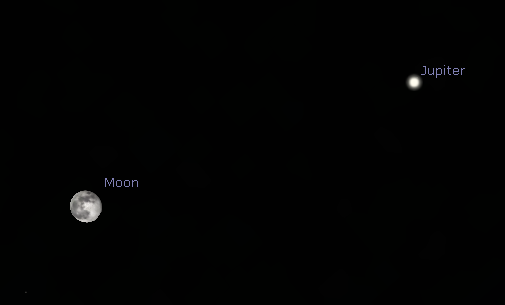
The Moon and Jupiter at 10 p.m. tonight, April 30, 2018. Created using Stellarium.
 Bob Moler's Ephemeris Blog