Archive
02/20/2018 – Ephemeris – Tonight’s the night to spot a chain of three of my favorite craters
Ephemeris for Tuesday, February 20th. The Sun will rise at 7:35. It’ll be up for 10 hours and 43 minutes, setting at 6:18. The Moon, 3 days before first quarter, will set at 11:29 this evening.
I was a day off in my Moon calculations yesterday. The three of my favorite craters, just south of the partially illuminated Sea of Tranquility will be visible tonight. From north to south or top to bottom, near the terminator or sunrise line is Theophilus, which slightly overlaps the crater wall of Cyrillus, then a bit farther south another older crater Catharina. These craters were named by a Jesuit astronomer Giovanni Battista Riccioli (Ri’cholli). He even named a crater Copernicus, even though he followed the Church teachings of the time he didn’t believe in the Copernican Sun centered system, but the system put forth by Danish astronomer Tycho Brahe where the Moon and Sun circled the Earth, but the other planets circled the Sun.
The times given are for the Traverse City/Interlochen area of Michigan. They may be different for your location.
Addendum
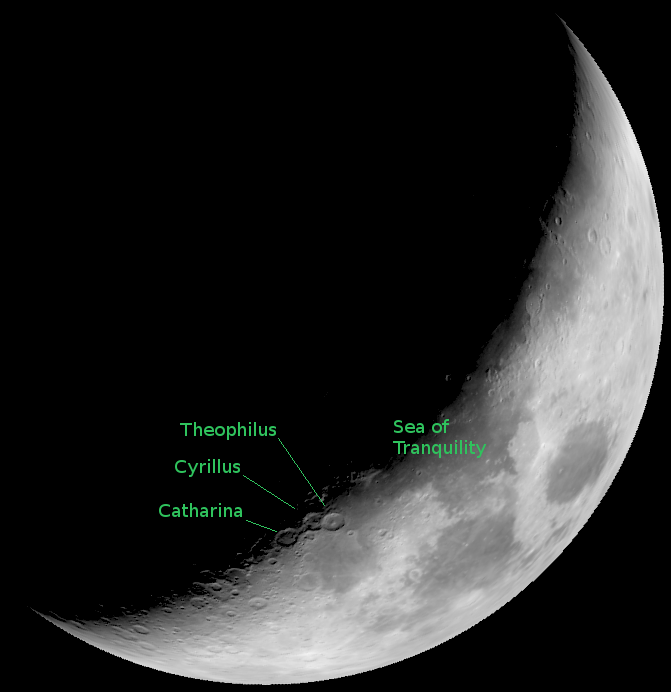
The crescent Moon on the evening of February 20th, 2018. showing the craters discussed in the test. Created using Virtual Moon Atlas and rotated to approximate its orientation in the sky after sunset.
Repeating from yesterday: For anyone east of here who can see the Moon at 19:00 UT, on the 20th should see Theophilus shadow filled with the crater rim and the central peak poking into sunlight. It should be visible from Europe and the Mid East. Let me know with a comment if I guessed right.
02/19/2018 – Ephemeris – A trio of craters emerge into sunlight on the moon tomorrow night
Whoops, I set my Virtual Moon Atlas app to the 20th instead of the 19th. I’m fixing the transcript for the blog readers, but the original program will go out as is. Tomorrow’s program will be substantially the same.
Ephemeris for President’s Day, Monday, February 19th. The Sun will rise at 7:36. It’ll be up for 10 hours and 40 minutes, setting at 6:16. The Moon, half way from new to first quarter, will set at 10:23 this evening.
The crescent Moon tomorrow will be revealing a trio of my favorite craters, just south of the partially illuminated Sea of Tranquility. From north to south or top to bottom, near the terminator or sunrise line is Theophilus, which slightly overlaps the crater wall of Cyrillus, than a bit farther south another older crater Catharina. These craters were named by a Jesuit astronomer Giovanni Battista Riccioli in his book New Almagest in 1651. Most of his crater names have stuck. He didn’t believe in the Copernican Sun centered system or the strict Earth centered system of Ptolemy, but the system put forth by Danish astronomer Tycho Brahe where the Moon and Sun circled the Earth, but the other planets circled the Sun.
The times given are for the Traverse City/Interlochen area of Michigan. They may be different for your location.
Addendum
The crescent Moon on the evening of February 20th, 2018. showing the craters discussed in the test. Created using Virtual Moon Atlas and rotated to approximate its orientation in the sky after sunset.
For anyone east of here who can see the Moon at 19:00 UT, on the 20th should see Theophilus shadow filled with the crater rim and the central peak poking into sunlight.
02/09/2018 – Ephemeris – Morning planet high jinx
Ephemeris for Friday, February 9th. The Sun will rise at 7:51. It’ll be up for 10 hours and 11 minutes, setting at 6:02. The Moon, 2 days past last quarter, will rise at 4:05 tomorrow morning.
This past Wednesday morning the Moon passed Jupiter, Earlier this morning the Moon passed north of Mars, and on Sunday morning Saturn will appear south of The Moon. There is a once in about 2 year event, that is red Mars passing Antares, the red giant star in Scorpius, one of the easiest constellations to spot because it actually resembles a scorpion. The name Antares means “Rival of Mars” because they have the same color: Ant meaning anti and Ares is the Greek god of war and counterpart of the Roman god Mars. Mars will pass Antares on average of
every 22 ½ months, its period around the Sun. Since we are viewing it from a moving Earth, it varies. Mars will pass Antares next on January 19th, 2020.
The times given are for the Traverse City/Interlochen area of Michigan. They may be different for your location.
Addendum
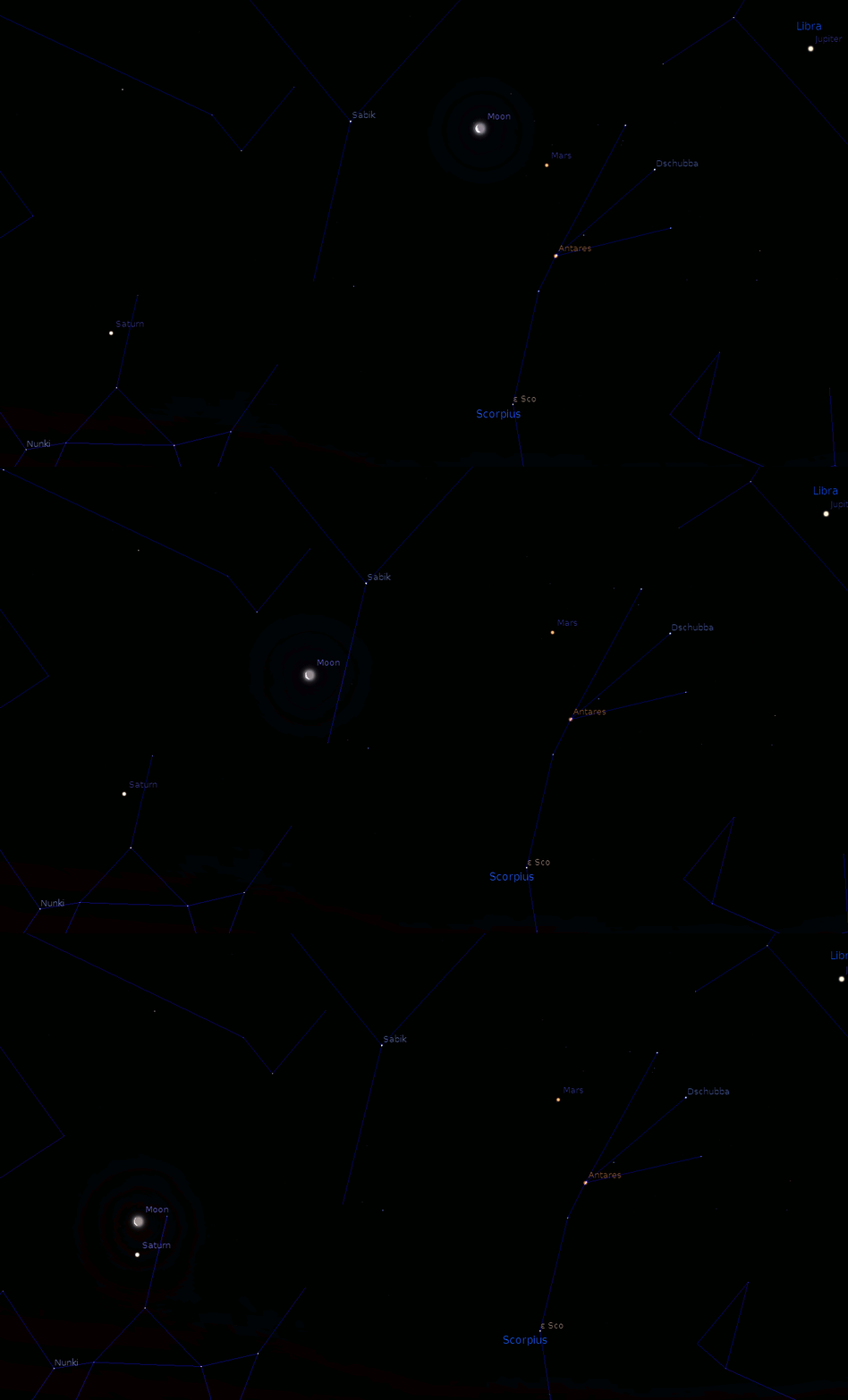
Morning planets and the Moon at 7 a.m. on the mornings of February 9, 10 and 11, 2018. See Mars changing position compared to Antares. Click on image to enlarge. Created using Stellarium and GIMP.
01/26/2018 – Ephemeris – The Moon tonight: The Bay of Rainbows
Ephemeris for Friday, January 26th. The Sun will rise at 8:08. It’ll be up for 9 hours and 34 minutes, setting at 5:43. The Moon, 2 days past first quarter, will set at 3:59 tomorrow morning.
A look at the Moon tonight will reveal that the sunrise line, or terminator has almost completely revealed the large sea of Showers or Mare Imbrium to the upper left of center of the gibbous disk. At the extreme upper left straddling the terminator is one of my favorite features, the Bay of Rainbows or Sinus Iridium. It’s a colorful name for something that’s as gray as the rest of the Moon. It looks like a bay off of Imbrium, and has an arch like a rainbow. It’s arch is the Jura Mountains, which jut into Mare Imbrium at Cape Heraclide, just catching sunlight, and Cape Laplace farther into morning. What’s cool is catching it as the sunlight is hitting the mountains while the convex floor, following the Moon’s curvature is only partially illuminated.
The times given are for the Traverse City/Interlochen area of Michigan. They may be different for your location.
Addendum
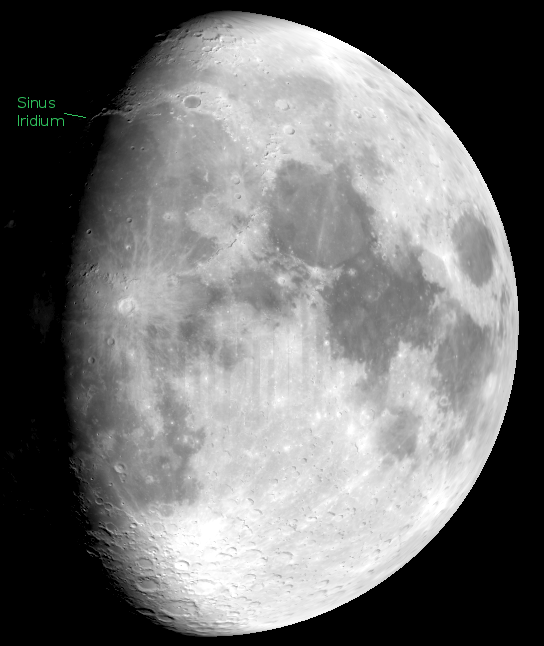
The Moon at 8 p.m. January 26, 2018 highlighting Sinus Iridium. Created using Virtual Moon Atlas.
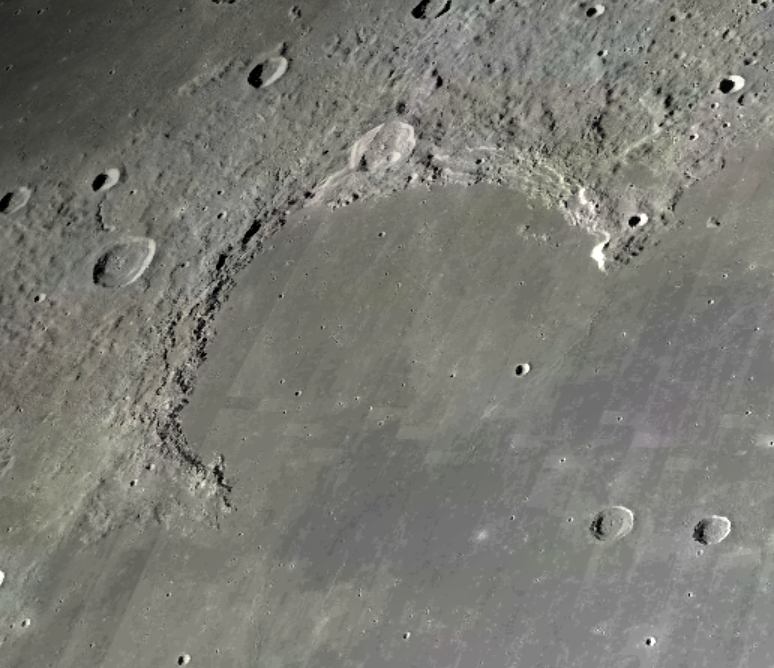
Sinus Iridium photographed by the Lunar Reconnaissance Orbiter as texture mapped on the globe of the Virtual Moon Atlas.
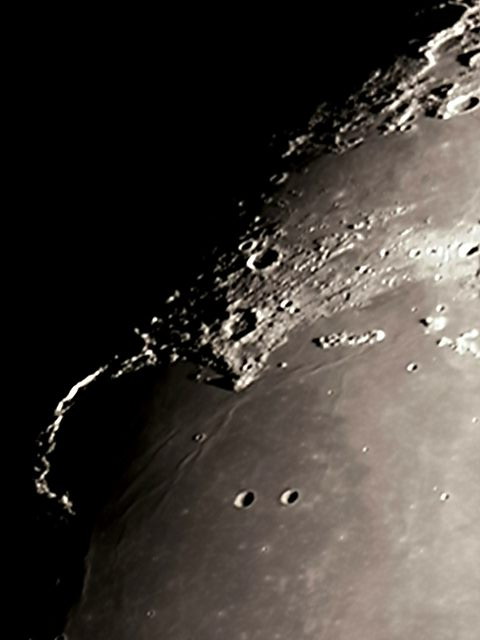
Sinus Iridium at sunrise. Photo by “Seb2003” on http://forums.futura-sciences.com/materiel-astronomique-photos-damateurs/5809-images-de-lune.html.
01/25/2018 – Ephemeris – The Moon tonight: Copernicus on the terminator
Ephemeris for Thursday, January 25th. The Sun will rise at 8:09. It’ll be up for 9 hours and 32 minutes, setting at 5:41. The Moon, 1 day past first quarter, will set at 2:48 tomorrow morning.
Let’s take a look at our slightly gibbous moon, just a day past first quarter with binoculars or a small telescope. The terminator, in this case the sunrise line will appear to cross the crater Copernicus to the right of the Moon’s center if you’re viewing it right side up. To the North across the Sea of Showers, or Mare Imbrium is the large flat floored crater Plato. South of Copernicus is a recently named sea, Mare Cognitum, the Known Sea, after the first successful close photography by the Ranger 7 spacecraft in 1964. South of the is Mare Nubium, the Sea of Clouds. South of that are the lunar highlands with the stark crater Tycho and the huge crater Clavius with an arc of craters of decreasing size within it.
The times given are for the Traverse City/Interlochen area of Michigan. They may be different for your location.
Addendum
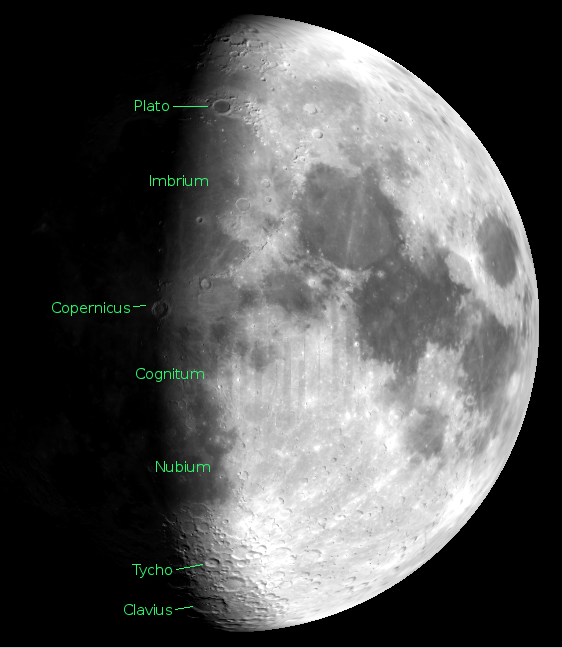
The waxing gibbous Moon tonight at 8 p.m., January 25, 2018. Created using Virtual Moon Atlas.
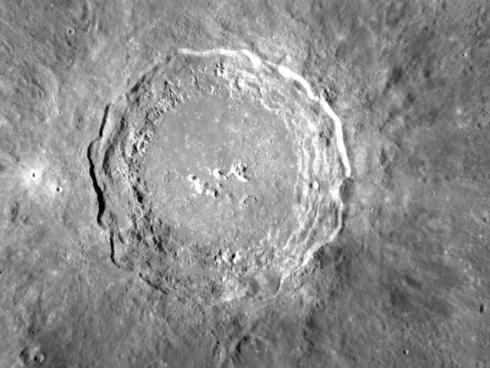
The crater Copernicus. Credit: NASA/GSFC/Arizona State University.
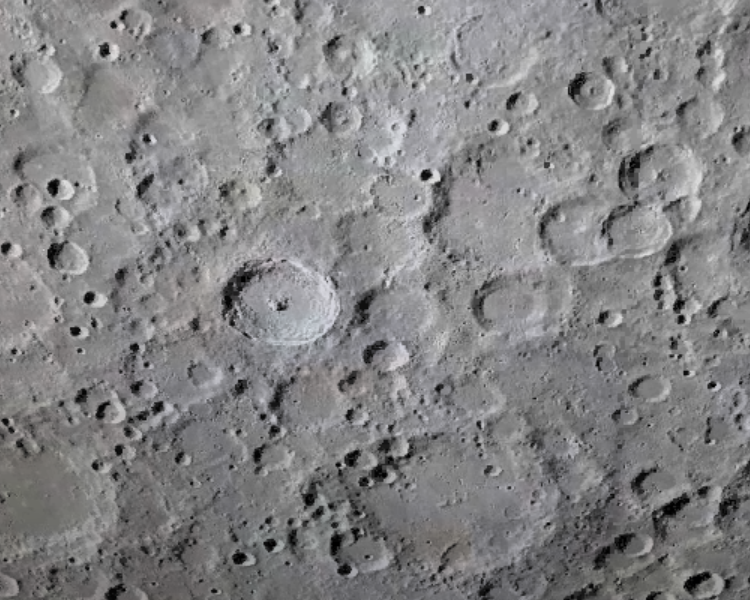
The Lunar highlands near the crater Tycho showing a surface saturated with craters. Credit: Virtual Moon Atlas with the texture from NASA’s Lunar Reconnaissance Orbiter. The lunar phase was omitted.
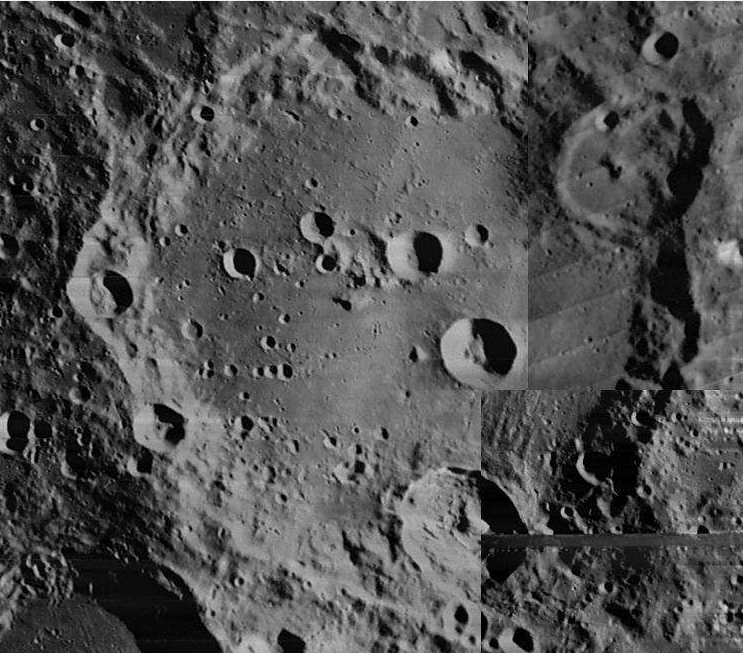
Clavius as photographed by one of the Lunar Orbiter spacecraft in the 1960s From Digital Lunar Orbital Photographic Atlas. Credit Jeff Gillis, Lunar and Planetary Institute.
01/23/2018 – Ephemeris – The Moon tonight: the Sea of Tranquility and a crater named for Julius Caesar
Ephemeris for Tuesday, January 23rd. The Sun will rise at 8:10. It’ll be up for 9 hours and 28 minutes, setting at 5:38. The Moon, 1 day before first quarter, will set at 12:30 tomorrow morning.
Let’s take a look at the Moon tonight with binoculars or a small telescope. The crescent Moon tonight has completely revealed the Sea of Tranquility, or Mare Tranquillitatis. Right on the western edge, east to us, of the sea is a ruined crater called Julius Caesar. It seems to have formed by a small asteroid collision in the first half billion years of the Moon’s existance. It’s shape was distorted by the impact that created the Sea of Tranquility. The Moon’s so-called seas are all pretty much impact craters, just really big ones. North of Tranquility is the Sea of Serenity which will be completely in sunlight tomorrow night. By the way, the Grand Traverse Astronomical Society telescope clinic that was scheduled for January has been moved to February 2nd.
The times given are for the Traverse City/Interlochen area of Michigan. They may be different for your location.
Addendum
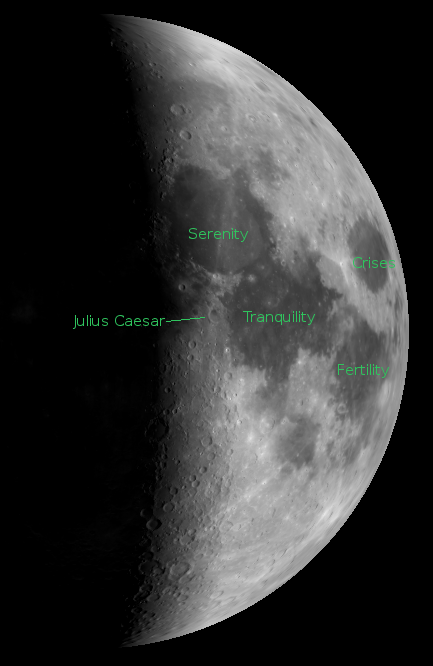
The fat crescent Moon at 8 p.m. January 23, 2018. Created using Virtual Moon Atlas.
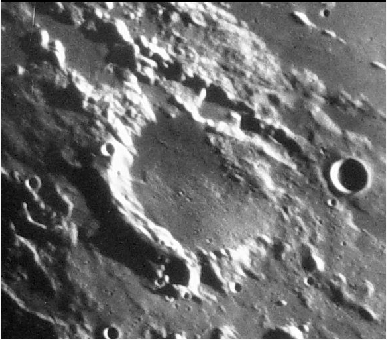
The crater Julius Caesar from photographs supplied with Virtual Moon Atlas.
01/11/2018 – Ephemeris – This morning the Moon passes Jupiter and Mars
Jan 11. This is Bob Moler with Ephemeris for Thursday, January 11th. The Sun will rise at 8:18. It’ll be up for 9 hours and 5 minutes, setting at 5:23. The Moon, 3 days past last quarter, will rise at 4:19 tomorrow morning.
This morning the thin crescent Moon will be poised over Jupiter and Mars in the east southeast at 7 a.m. It will make a pretty sight for the eye and camera. I follow many amateur astronomers on Twitter with clearer skies than ours who take many great pictures of planetary conjunctions, the Moon and other wonders of the heavens.
There is space mission orbiting Jupiter right now. It doesn’t make great discoveries that shake up the astronomical world enough to make the national news. The Juno mission skims close and then away from Jupiter in order to ferret out its internal structure. It does contain a camera for the public that reveals the spectacular cloud formations of Jupiter’s polar cloudscapes.
The times given are for the Traverse City/Interlochen area of Michigan. They may be different for your location.
Addendum
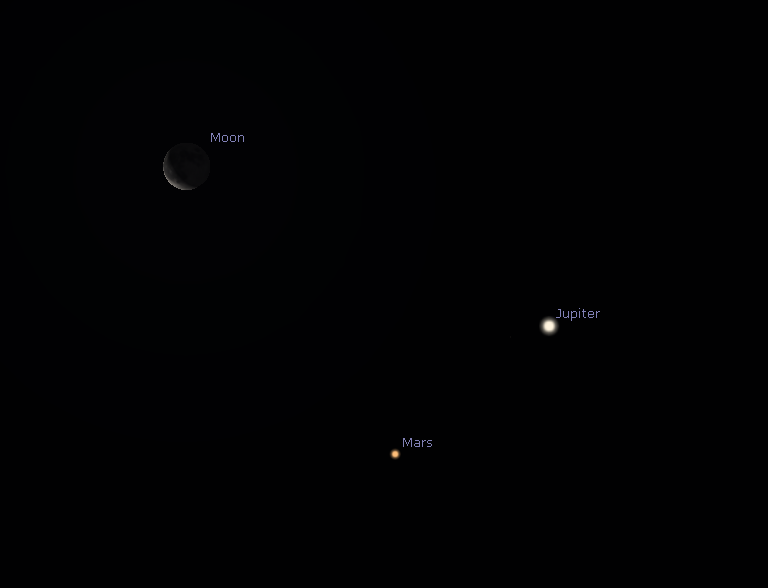
The Moon with Jupiter and Mars this morning January 11, 2018 at 7 a.m. Created using Stellarium.
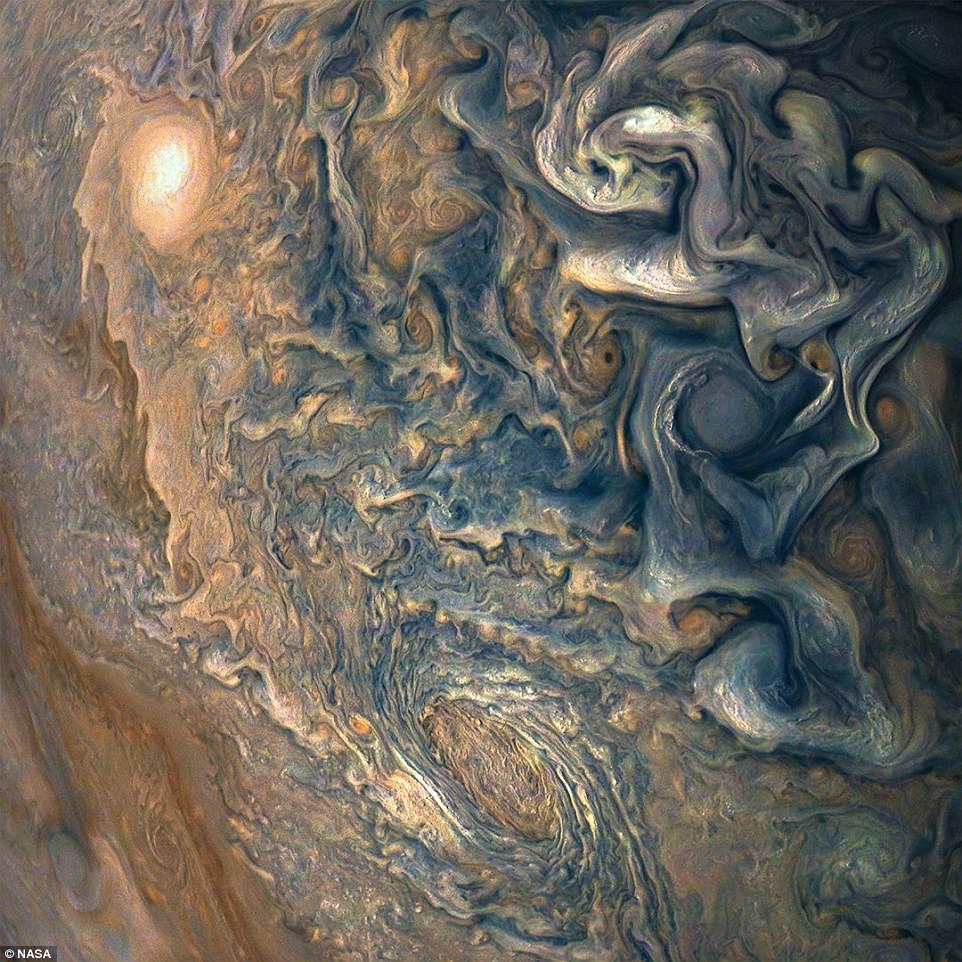
Some of Jupiter’s clouds photographed by NASA’s Juno spacecraft.
Ride along with Juno on its 6th close encounter (perijove 6) with Jupiter. Jove is another Roman name for Jupiter, by Jove!
Jupiter: Juno Perijove 06 from Seán Doran on Vimeo.
01/01/2018 – Ephemeris – The difference between the winter full moon and the summer one
Happy New Year, this is Bob Moler with Ephemeris for New Years Day, Monday, January 1st. 2018. The Sun will rise at 8:19. It’ll be up for 8 hours and 53 minutes, setting at 5:13. The Moon, at full today, will rise at 5:11 this evening.
The exact time that the Moon will be fill, at least to the nearest minute is 9:24 tonight. Ever notice the placement of the full moon in the sky between winter and summer? The Full moon near the winter solstice moves very high at midnight, while the full moon near the summer solstice is seen quite low in the south. For the Moon to be full, it most be nearly opposite the Sun in the sky, so we see it fully illuminated as the Sun does. The Moon’s orbit is close to the Sun’s apparent path in the sky, the ecliptic, which is the projection of the Earth’s orbit of the Sun. So the Moon now is near where the Sun will be 6 months from now in late June, high in the sky. Next full moon we will see a lunar eclipse.
The times given are for the Traverse City/Interlochen area of Michigan. They may be different for your location.
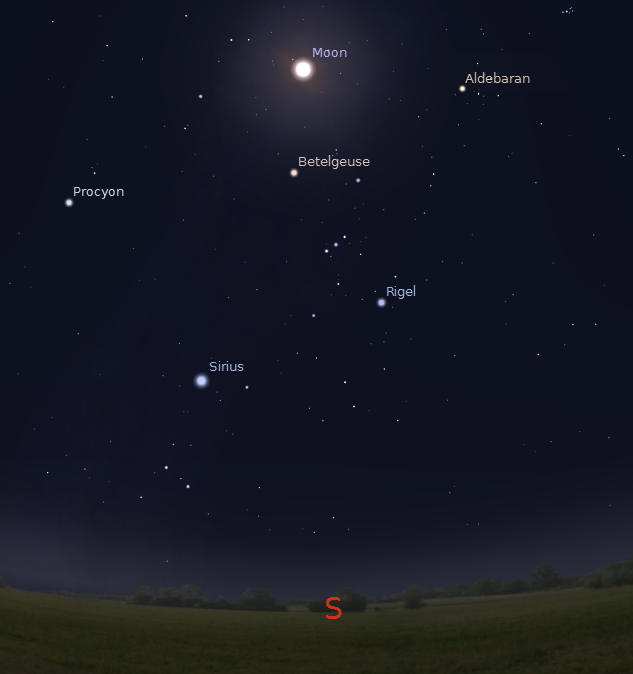
The winter full moon at its highest. Created using Stellarium.
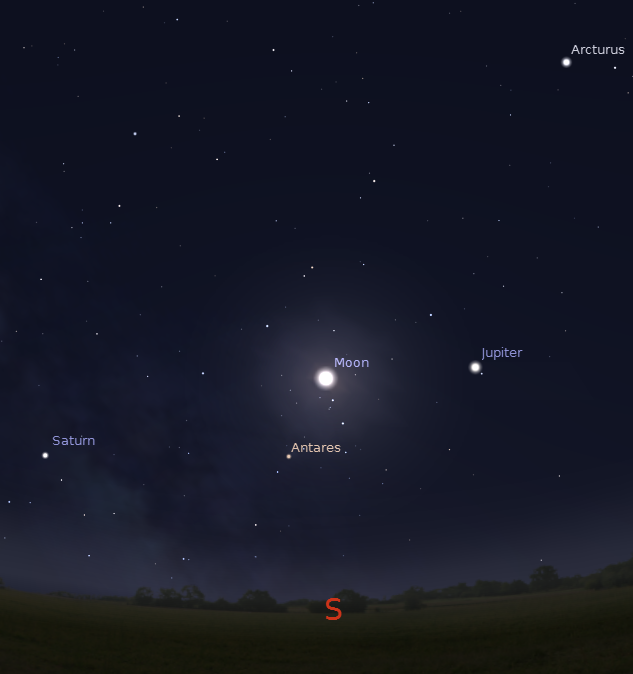
The summer full moon at its lowest. Created using Stellarium.
11/28/2017 – Ephemeris – Though it appears bright, the Moon is pretty dirty
Ephemeris for Tuesday, November 28th. The Sun will rise at 7:56. It’ll be up for 9 hours and 8 minutes, setting at 5:04. The Moon, 2 days past first quarter, will set at 2:44 tomorrow morning.
The Moon tonight is a waxing gibbous phase, and each night until it’s full it will get brighter and brighter, drowning out the fainter stars. The Moon is almost too bright to comfortably view in a telescope. One can get a moon filter for the eyepiece, or wear sunglasses or opt for higher magnification. It is after all daytime on the Moon and it’s essentially the same distance from the Sun as we are. A saving grace is that the Moon isn’t white. It’s a dirty gray, reflecting on average only 13.6 percent of the light it gets from the Sun. Just think how bright it would appear if it were 100% reflective, over 7 times brighter than it appears now. The face of the Moon hasn’t appeared to change at all since before we landed there 48 years ago.
The times given are for the Traverse City/Interlochen area of Michigan. They may be different for your location.
Addendum
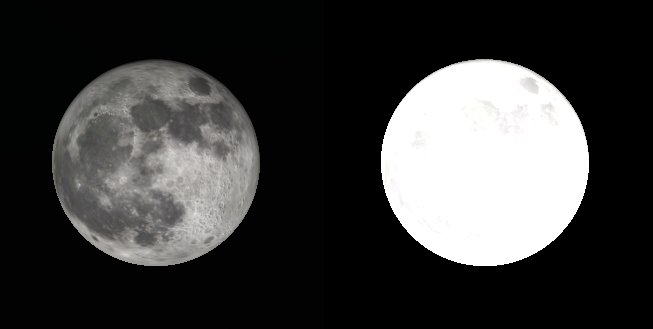
Moon albedo comparison. Actually about 50% vs. 100%. The Moon is less reflectant than that.. Sunday’s super moon image created via Stellarium.
11/06/2017 – Ephemeris – Taurus’ angry red eye, Aldebaran
Ephemeris for Monday, November 6th. The Sun will rise at 7:27. It’ll be up for 9 hours and 57 minutes, setting at 5:24. The Moon, 3 days past full, will rise at 7:52 this evening.
Last night the Moon passed in front of or occulted the bright star Aldebaran. Above right of Moon tonight is Aldebaran the bright orange star with a V shape of other stars in the face of Taurus the bull. Aldebaran appears at the lower left tip of that letter V laying on it’s side. With the bright Moon, it might take binoculars to pull out the faint stars of the V. Aldebaran isn’t actually part of the group, called the Hyades star cluster. The cluster is about 153 light years away, while Aldebaran is 65 light years away. The star has an orange hue because its surface is cooler than the Sun’s. However Aldebaran is 44 times larger in diameter, and shines 425 times brighter than the Sun. The name Aldebaran means “Follower” because it follows the Pleiades star cluster above it.
The times given are for the Traverse City/Interlochen area of Michigan. They may be different for your location.
Addendum
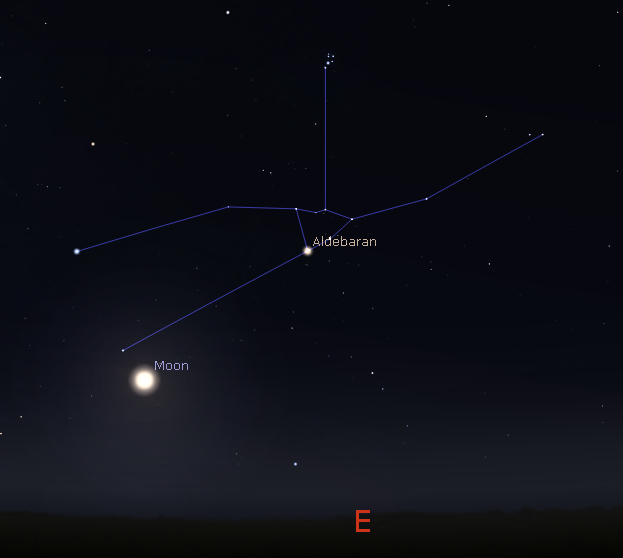
Aldebaran in the Hyades (unlabeled), with also the Pleiades, unlabeled, at the top and the Moon. at 9 p.m., November 6, 2017. Created using Stellarium.
 Bob Moler's Ephemeris Blog