Archive
01/25/2018 – Ephemeris – The Moon tonight: Copernicus on the terminator
Ephemeris for Thursday, January 25th. The Sun will rise at 8:09. It’ll be up for 9 hours and 32 minutes, setting at 5:41. The Moon, 1 day past first quarter, will set at 2:48 tomorrow morning.
Let’s take a look at our slightly gibbous moon, just a day past first quarter with binoculars or a small telescope. The terminator, in this case the sunrise line will appear to cross the crater Copernicus to the right of the Moon’s center if you’re viewing it right side up. To the North across the Sea of Showers, or Mare Imbrium is the large flat floored crater Plato. South of Copernicus is a recently named sea, Mare Cognitum, the Known Sea, after the first successful close photography by the Ranger 7 spacecraft in 1964. South of the is Mare Nubium, the Sea of Clouds. South of that are the lunar highlands with the stark crater Tycho and the huge crater Clavius with an arc of craters of decreasing size within it.
The times given are for the Traverse City/Interlochen area of Michigan. They may be different for your location.
Addendum
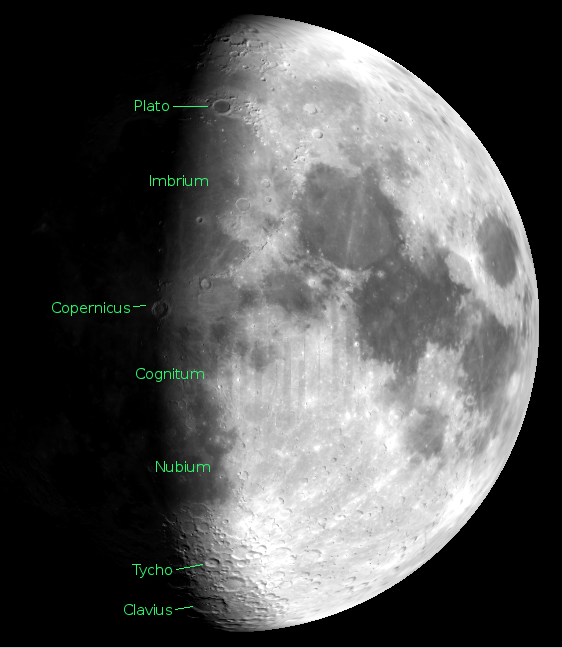
The waxing gibbous Moon tonight at 8 p.m., January 25, 2018. Created using Virtual Moon Atlas.
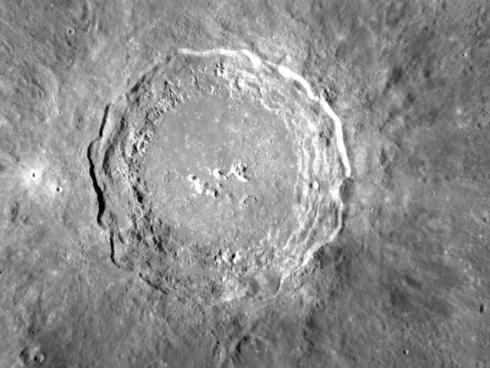
The crater Copernicus. Credit: NASA/GSFC/Arizona State University.
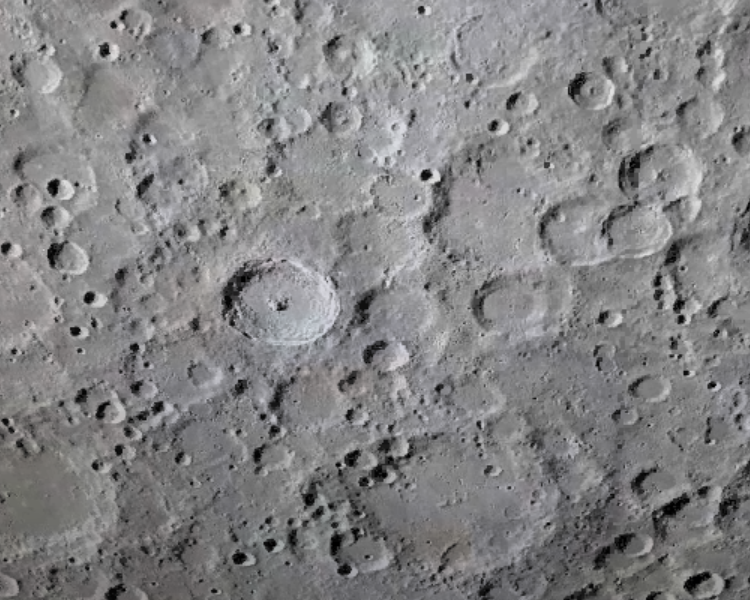
The Lunar highlands near the crater Tycho showing a surface saturated with craters. Credit: Virtual Moon Atlas with the texture from NASA’s Lunar Reconnaissance Orbiter. The lunar phase was omitted.
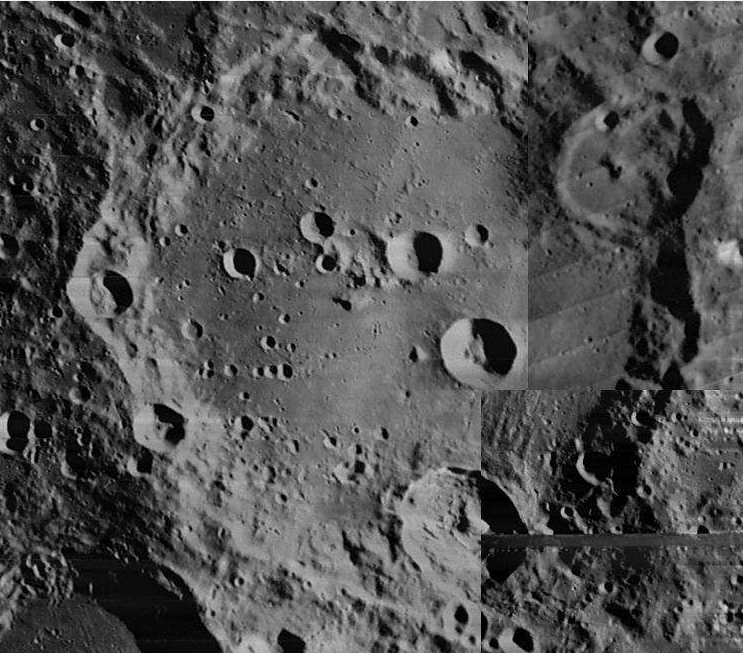
Clavius as photographed by one of the Lunar Orbiter spacecraft in the 1960s From Digital Lunar Orbital Photographic Atlas. Credit Jeff Gillis, Lunar and Planetary Institute.
01/23/2018 – Ephemeris – The Moon tonight: the Sea of Tranquility and a crater named for Julius Caesar
Ephemeris for Tuesday, January 23rd. The Sun will rise at 8:10. It’ll be up for 9 hours and 28 minutes, setting at 5:38. The Moon, 1 day before first quarter, will set at 12:30 tomorrow morning.
Let’s take a look at the Moon tonight with binoculars or a small telescope. The crescent Moon tonight has completely revealed the Sea of Tranquility, or Mare Tranquillitatis. Right on the western edge, east to us, of the sea is a ruined crater called Julius Caesar. It seems to have formed by a small asteroid collision in the first half billion years of the Moon’s existance. It’s shape was distorted by the impact that created the Sea of Tranquility. The Moon’s so-called seas are all pretty much impact craters, just really big ones. North of Tranquility is the Sea of Serenity which will be completely in sunlight tomorrow night. By the way, the Grand Traverse Astronomical Society telescope clinic that was scheduled for January has been moved to February 2nd.
The times given are for the Traverse City/Interlochen area of Michigan. They may be different for your location.
Addendum
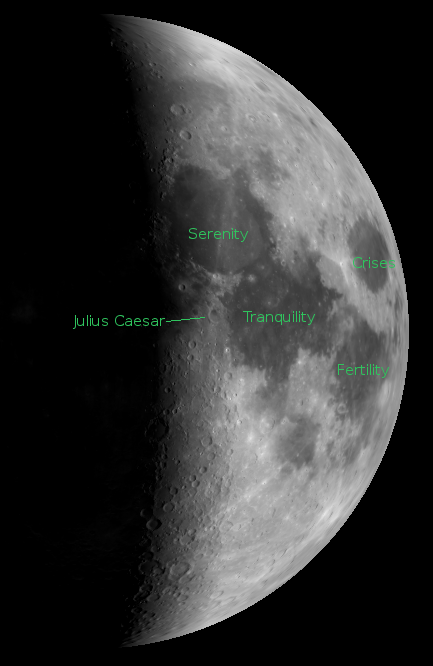
The fat crescent Moon at 8 p.m. January 23, 2018. Created using Virtual Moon Atlas.
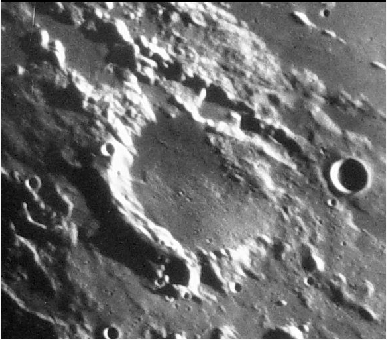
The crater Julius Caesar from photographs supplied with Virtual Moon Atlas.
01/11/2018 – Ephemeris – This morning the Moon passes Jupiter and Mars
Jan 11. This is Bob Moler with Ephemeris for Thursday, January 11th. The Sun will rise at 8:18. It’ll be up for 9 hours and 5 minutes, setting at 5:23. The Moon, 3 days past last quarter, will rise at 4:19 tomorrow morning.
This morning the thin crescent Moon will be poised over Jupiter and Mars in the east southeast at 7 a.m. It will make a pretty sight for the eye and camera. I follow many amateur astronomers on Twitter with clearer skies than ours who take many great pictures of planetary conjunctions, the Moon and other wonders of the heavens.
There is space mission orbiting Jupiter right now. It doesn’t make great discoveries that shake up the astronomical world enough to make the national news. The Juno mission skims close and then away from Jupiter in order to ferret out its internal structure. It does contain a camera for the public that reveals the spectacular cloud formations of Jupiter’s polar cloudscapes.
The times given are for the Traverse City/Interlochen area of Michigan. They may be different for your location.
Addendum
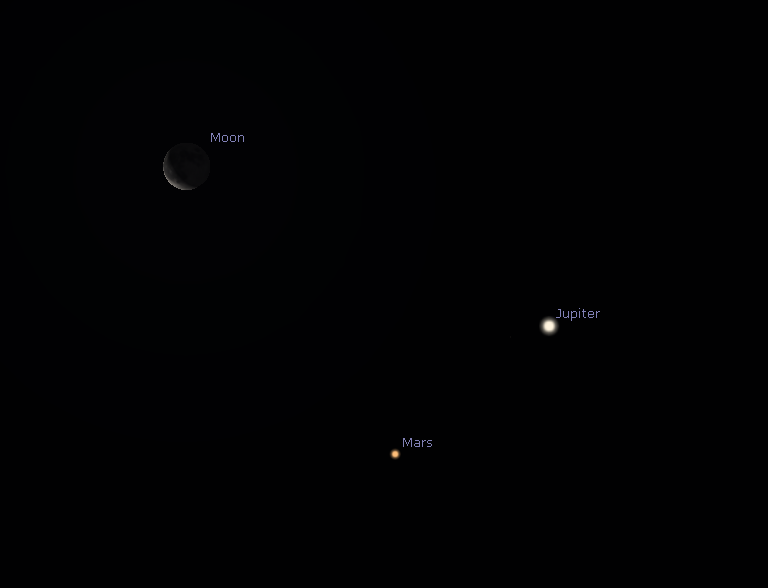
The Moon with Jupiter and Mars this morning January 11, 2018 at 7 a.m. Created using Stellarium.
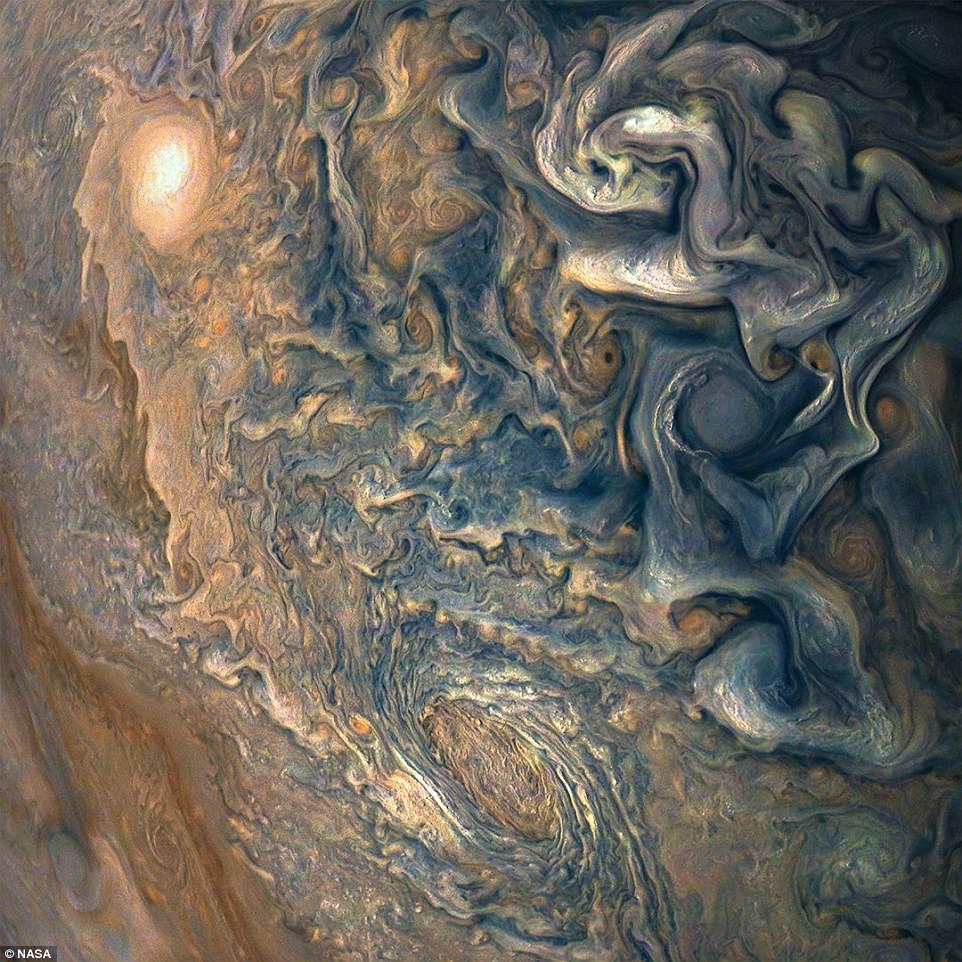
Some of Jupiter’s clouds photographed by NASA’s Juno spacecraft.
Ride along with Juno on its 6th close encounter (perijove 6) with Jupiter. Jove is another Roman name for Jupiter, by Jove!
Jupiter: Juno Perijove 06 from Seán Doran on Vimeo.
01/01/2018 – Ephemeris – The difference between the winter full moon and the summer one
Happy New Year, this is Bob Moler with Ephemeris for New Years Day, Monday, January 1st. 2018. The Sun will rise at 8:19. It’ll be up for 8 hours and 53 minutes, setting at 5:13. The Moon, at full today, will rise at 5:11 this evening.
The exact time that the Moon will be fill, at least to the nearest minute is 9:24 tonight. Ever notice the placement of the full moon in the sky between winter and summer? The Full moon near the winter solstice moves very high at midnight, while the full moon near the summer solstice is seen quite low in the south. For the Moon to be full, it most be nearly opposite the Sun in the sky, so we see it fully illuminated as the Sun does. The Moon’s orbit is close to the Sun’s apparent path in the sky, the ecliptic, which is the projection of the Earth’s orbit of the Sun. So the Moon now is near where the Sun will be 6 months from now in late June, high in the sky. Next full moon we will see a lunar eclipse.
The times given are for the Traverse City/Interlochen area of Michigan. They may be different for your location.
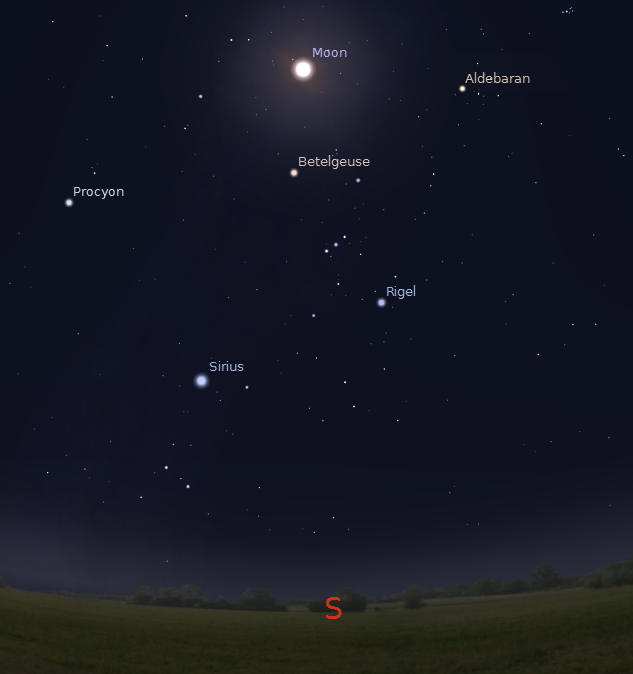
The winter full moon at its highest. Created using Stellarium.
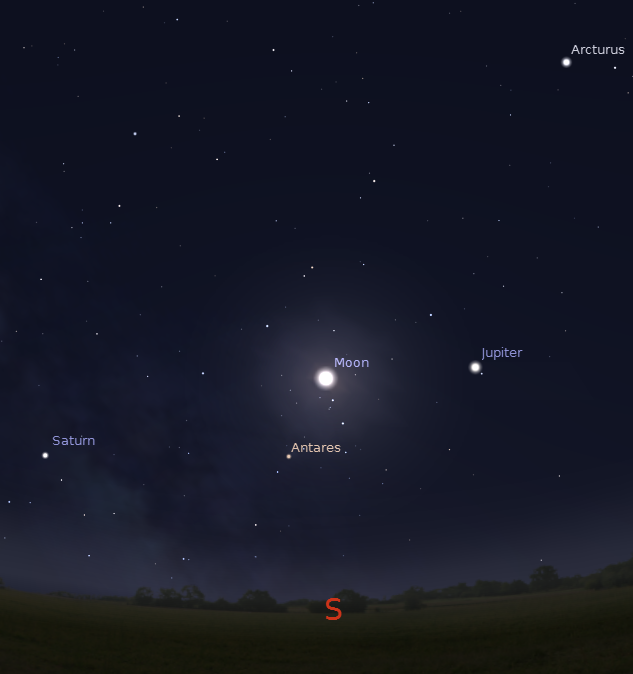
The summer full moon at its lowest. Created using Stellarium.
11/28/2017 – Ephemeris – Though it appears bright, the Moon is pretty dirty
Ephemeris for Tuesday, November 28th. The Sun will rise at 7:56. It’ll be up for 9 hours and 8 minutes, setting at 5:04. The Moon, 2 days past first quarter, will set at 2:44 tomorrow morning.
The Moon tonight is a waxing gibbous phase, and each night until it’s full it will get brighter and brighter, drowning out the fainter stars. The Moon is almost too bright to comfortably view in a telescope. One can get a moon filter for the eyepiece, or wear sunglasses or opt for higher magnification. It is after all daytime on the Moon and it’s essentially the same distance from the Sun as we are. A saving grace is that the Moon isn’t white. It’s a dirty gray, reflecting on average only 13.6 percent of the light it gets from the Sun. Just think how bright it would appear if it were 100% reflective, over 7 times brighter than it appears now. The face of the Moon hasn’t appeared to change at all since before we landed there 48 years ago.
The times given are for the Traverse City/Interlochen area of Michigan. They may be different for your location.
Addendum
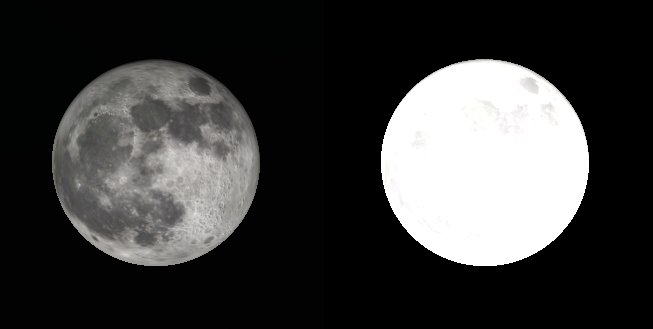
Moon albedo comparison. Actually about 50% vs. 100%. The Moon is less reflectant than that.. Sunday’s super moon image created via Stellarium.
11/06/2017 – Ephemeris – Taurus’ angry red eye, Aldebaran
Ephemeris for Monday, November 6th. The Sun will rise at 7:27. It’ll be up for 9 hours and 57 minutes, setting at 5:24. The Moon, 3 days past full, will rise at 7:52 this evening.
Last night the Moon passed in front of or occulted the bright star Aldebaran. Above right of Moon tonight is Aldebaran the bright orange star with a V shape of other stars in the face of Taurus the bull. Aldebaran appears at the lower left tip of that letter V laying on it’s side. With the bright Moon, it might take binoculars to pull out the faint stars of the V. Aldebaran isn’t actually part of the group, called the Hyades star cluster. The cluster is about 153 light years away, while Aldebaran is 65 light years away. The star has an orange hue because its surface is cooler than the Sun’s. However Aldebaran is 44 times larger in diameter, and shines 425 times brighter than the Sun. The name Aldebaran means “Follower” because it follows the Pleiades star cluster above it.
The times given are for the Traverse City/Interlochen area of Michigan. They may be different for your location.
Addendum
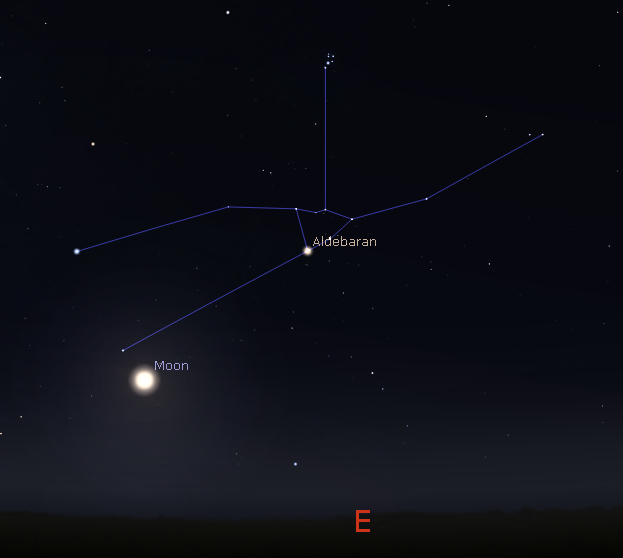
Aldebaran in the Hyades (unlabeled), with also the Pleiades, unlabeled, at the top and the Moon. at 9 p.m., November 6, 2017. Created using Stellarium.
11/05/2017 – Ephemeris Extra – There will be an Occultation of Aldebaran tonight*
This posting will not be broadcast.
* Or tomorrow morning, depending where you are.
Ephemeris extra for Sunday, November 5th. The Sun will rise at 7:25. It’ll be up for 10 hours and 5 minutes, setting at 5:25. The Moon, 2 days past full, will rise at 7:01 this evening.
Tonight just after 8 p.m. the bright star Aldebaran will disappear at the left edge of the Moon. Aldebaran is angry red eye of Taurus the bull. The star will reappear at the dark upper right edge of the Moon. Start looking at 8 p.m. or before. Use binoculars or a small telescope to spot the star against the glare of the bright Moon. The star is nowhere as bright as shown in the illustrations below. Star appearances and disappearances appear instantaneous, unlike what the illustrations show.
Aldebaran Occultation begins at 8:07 p.m. EST (1:07 UTC Nov 6th)
Aldebaran Occultation ends at 9:00 p.m. EST (02:00 UTC Nov 6th)
Note the times are for the Traverse City/Interlochen area. It will vary by a few minutes for northern lower Michigan. The position angles of the entrance and exit points of Aldebaran will also be different.
Otherwise use a planetarium program like Stellarium to preview the event. However, set the program for topocentric coordinates. In Stellarium that’s in the Configuration window, Tools Tab and check the Topocentric coordinates box. Topocentric coordinates are the apparent positions for your location on the Earth. So also make sure your location is correct. The geocentric conjunction of the two bodies will be November 6, 2:42.9 UTC, so it will occur after midnight on the morning of November 6th for locations in northern Europe and Asia.
Addendum
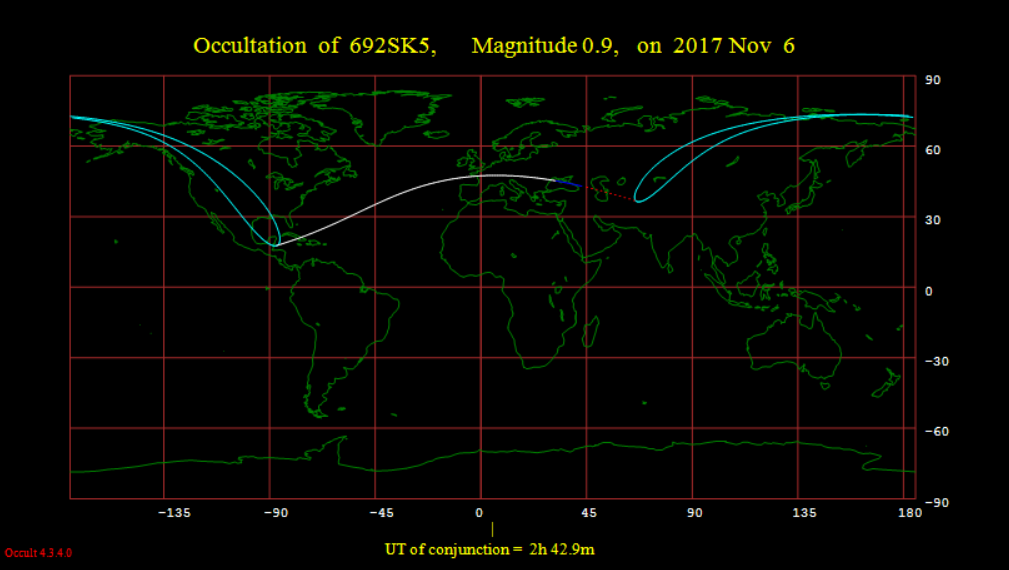
Occultation Map for the occultation of Aldebaran by the Moon . Credit Occult 4 program from IOTA.org.
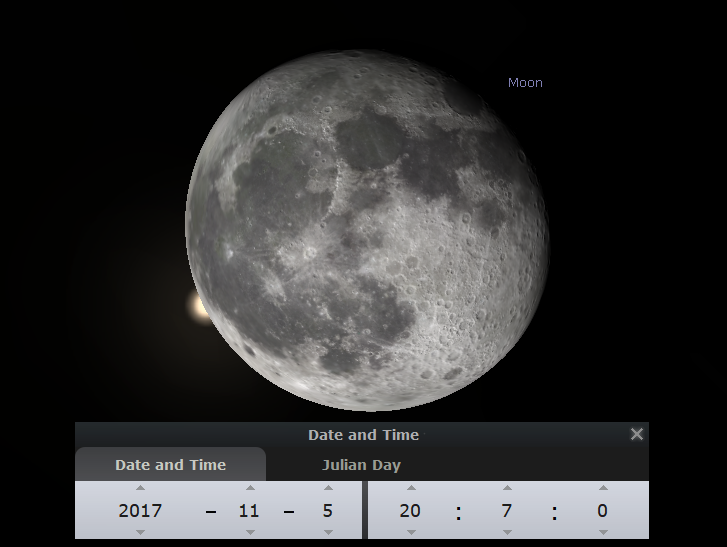
Aldebaran at the start of the occultation at 8:07 p.m. for the Traverse City/Interlochen area. Created using Stellarium.
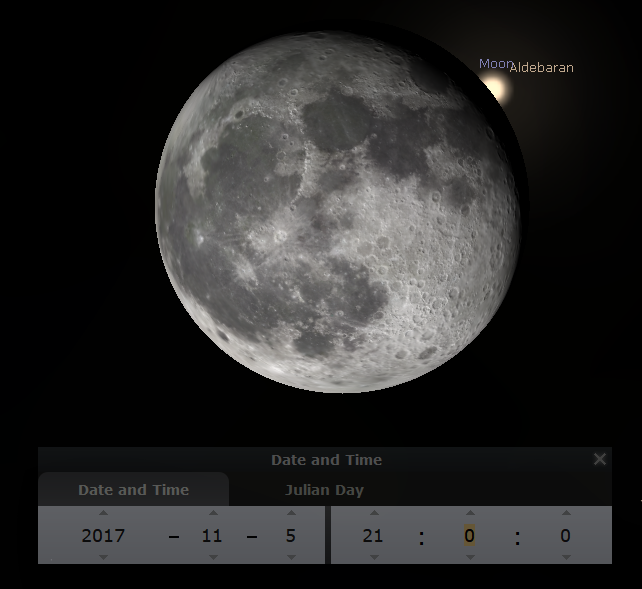
Aldebaran at the end of the occultation at 9:00 p.m. for the Traverse City/Interlochen area. Created using Stellarium.
10/27/2017 – Ephemeris – Tomorrow night is International Observe the Moon Night in downtown Traverse City
Ephemeris for Friday, October 27th. The Sun will rise at 8:13. It’ll be up for 10 hours and 24 minutes, setting at 6:38. The Moon, at first quarter today, will set at 12:44 tomorrow morning.
The annual International Observe the Moon Night will be observed this Saturday evening. Members of the Grand Traverse Astronomical Society will be stationed on the north side of the 200 block of East Front Street. Starting at 7 p.m. near Orvis Streamside and will be moving our telescopes eastward from time to time to keep up with the westward sinking motion of the Moon over the single story buildings to the south as long as we can. The moon will be a day past first quarter with lots of craters and lunar seas visible in telescopes. The society will also have some giveaway items from NASA for the young and not so young. The event will be canceled due to heavy overcast or other inclement weather.
The times given are for the Traverse City/Interlochen area of Michigan. They may be different for your location.
Addendum
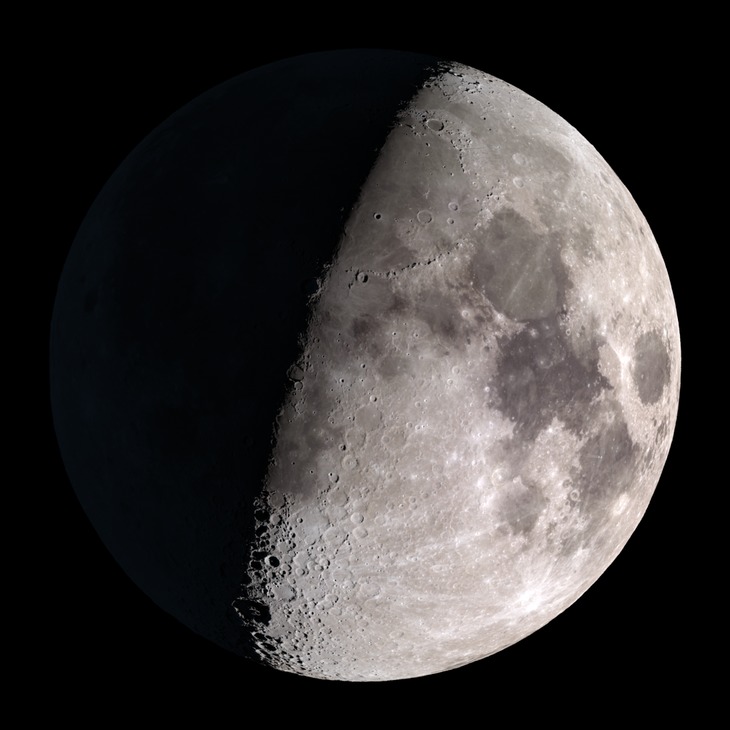
The Moon about as it would appear tomorrow night, October 28, 2017 at 8 p.m. Credit: NASA/Ernie Wright.
10/24/2017 – Ephemeris – Saturn and the Moon tonight
Ephemeris for Tuesday, October 24th. The Sun will rise at 8:09. It’ll be up for 10 hours and 32 minutes, setting at 6:42. The Moon, 3 days before first quarter, will set at 10:09 this evening.
The crescent Moon will be in the southwest as it gets dark tonight. The planet Saturn will appear below and to the right of our satellite. Saturn has those gorgeous rings, which are visible at as low as 20 power scopes and hinted at lower magnifications. The Moon shows a fat crescent with two whole gray seas, Crises, nearest the limb, and below Fertility. Partially illuminated are Tranquility above and the small sea of Nectar. At the bottom end of that small sea is a horse shoe shaped crater called Fracastorius. It looks like the lava welling up from the Nectar asteroid impact washed down the walls of Fracastorius. The bottom part of the Moon is the lunar highlands of brighter rugged craters.
The times given are for the Traverse City/Interlochen area of Michigan. They may be different for your location.
Addendum
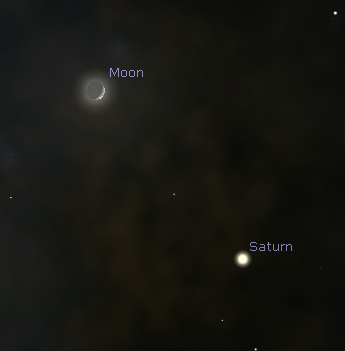
The Moon and Saturn at 8 p.m. October 24, 2017. Created using Stellarium.
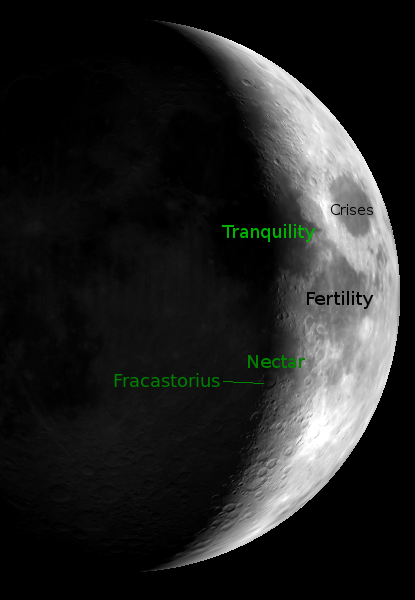
The Moon at 8 p.m. October 24, 2017 as it might be seen in binoculars. Created using Virtual Moon Atlas.
10/13/2017 – Ephemeris – The bright star Regulus dips behind the Moon Sunday morning
Note: The original program recorded for this day was erroneous in the timing and appearance of this event. Occurring about an hour later than reported here. The Interlochen personnel may or may not replace the original program with the one below. Also those who downloaded the audio from ephemeris.bjmoler.org before late Thursday night may have downloaded the incorrect mp3.
Ephemeris for Friday, October 13th. The Sun will rise at 7:55 a.m.. It’ll be up for 11 hours and 5 minutes, setting at 7:00 p.m. The Moon, 1 day past last quarter, will rise at 2:08 tomorrow morning.
On Sunday morning the Moon will pass in front of, or occult the bright star Regulus, the brightest star in Leo the lion. This will happen as morning twilight starts. Regulus will disappear at the left edge of the crescent Moon at around 5:47 a.m. A telescope or binoculars may be needed to spot Regulus. Go out at least 5 or 10 minutes early to make sure you can spot the star. Regulus will reemerge at 6:25 at the 11 o’clock position on the dark part of the Moon. Earth shine on the night side of the Moon may be bright enough to see its dark edge. Observers west of us in the United States except the northern most states west of Minnesota will also get a view. Those in specific locations in the northern tier of states will get to see Regulus just graze the north edge of the Moon.
The times given are for the Traverse City/Interlochen area of Michigan. They may be different for your location.
Addendum
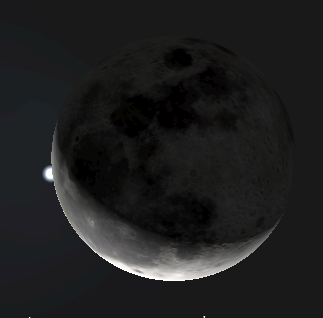
Occultation of Regulus by the Moon disappearance at around 5:47 a.m. for northern Michigan. Created using Stellarium.
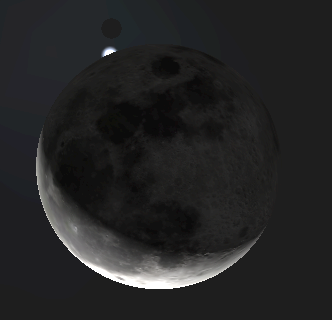
Occultation of Regulus by the Moon reappearance at around 6:25 a.m. for northern Michigan. Created using Stellarium.
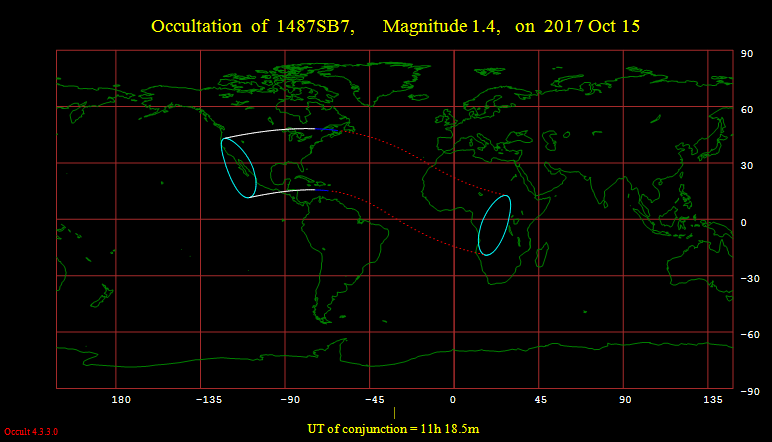
Map showing the locations where the occultation of Regulus will be visible. For the area bounded by heavy lines the occultation will occur at night. Click on image to enlarge. Credit: Occult4 by IOTA.
 Bob Moler's Ephemeris Blog