03/28/2022 – Ephemeris – Finding the Great Bear
This is Ephemeris for Monday, March 28th. Today the Sun will be up for 12 hours and 34 minutes, setting at 8:05, and it will rise tomorrow at 7:29. The Moon, 3 days past last quarter, will rise at 6:47 tomorrow morning.
The Big Dipper is now reaching for the zenith in the northeast at 10 p.m. The seven bright stars are second to Orion in the west as the seven brightest stars in a constellation. If you looked up a list of constellations, you’d find that the Big Dipper isn’t there. Ursa Major or the Great Bear is the constellation of which the Big Dipper is a part. The seven bright stars of the dipper are the rump and long tail of this constellation. The rest of the bear, including his head and legs, are delineated by dimmer stars. An anatomical problem is its long tail, which was drawn in by the ancients of the old world. Their explanation was that a god had grabbed the bear’s stubby tail, whirled the bear around his head, and threw it into the sky, thus stretching its tail.
The astronomical event times given are for the Traverse City/Interlochen area of Michigan (EDT, UT – 4 hours). They may be different for your location.
Addendum
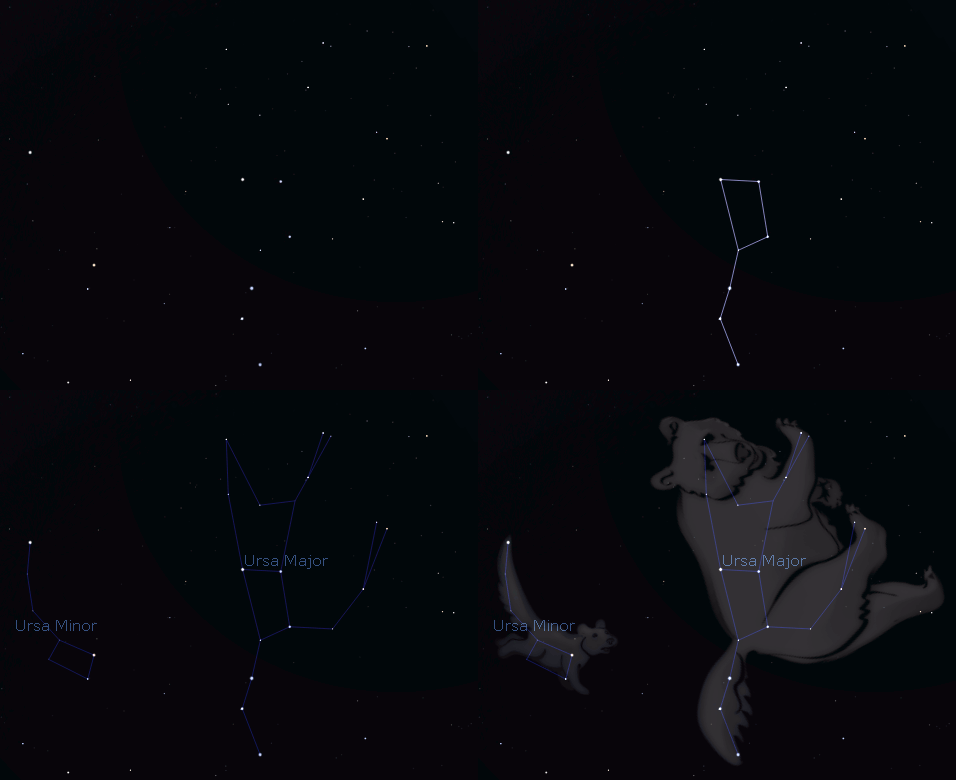
The Great Bear (Ursa Major) finder animation. It shows the stars only, then the Big Dipper, Then the lines of the constellations Ursa Major and Ursa Minor (Lesser Bear and Little Dipper) as a bonus, and finally the constellation artwork. The orientation is for about 9:30 pm on the latter days of March. We are looking high in the northeast. In Northern Michigan, the bear’s front paw is near the zenith at that time. Created using Stellarium and GIMP.
03/25/2022 – Ephemeris – Over the weekend there will be the continued gathering of morning planets
This is Bob Moler with Ephemeris for Friday, March 25th. Today the Sun will be up for 12 hours and 25 minutes, setting at 8:01, and it will rise tomorrow at 7:34. The Moon, at last quarter today, will rise at 4:56 tomorrow morning.
Over the weekend there will be the continued gathering of morning planets, Venus, Mars and Saturn, culminating on Monday morning when the waning crescent Moon will join the group by slipping beneath them. During the three day period between Saturday and Monday mornings at a specific time, like 6:45 am, about 45 minutes before sunrise, these planets will be in the east southeast and quite low in the sky. A low horizon in that direction will help, especially when the Moon joins the group, because it will be lower than the three planets. Over the weekend Venus and Mars will keep their separation with Mars to the right and a bit below Venus. Saturn will scoot below Venus, moving to the right. The Moon will move below the group Monday morning.
The astronomical event times given are for the Traverse City/Interlochen area of Michigan (EDT, UT – 4 hours). They may be different for your location.
Addendum
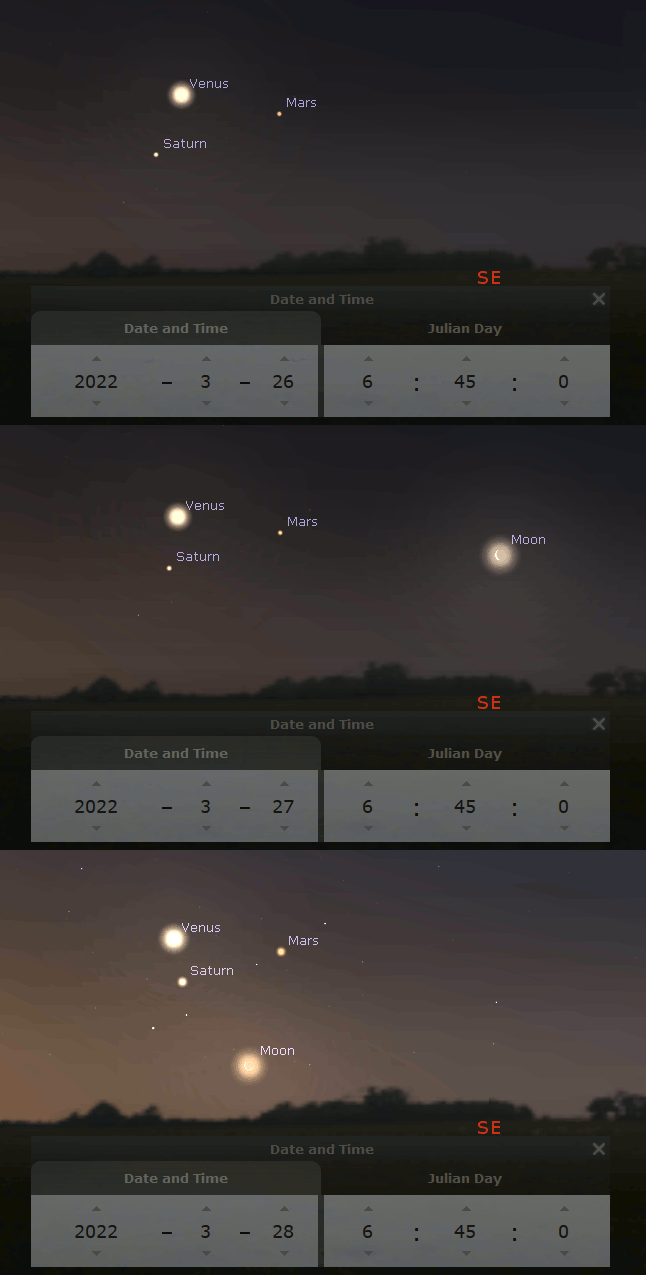
The grouping of Venus, Mars, Saturn and the Moon which will develop over the mornings of Saturday, March 26th through Monday, March 28, 2022. Created using Stellarium and GIMP.
03/24/2022 – Ephemeris – A native constellation that’s a warning
This is Bob Moler with Ephemeris for Thursday, March 24th. Today the Sun will be up for 12 hours and 22 minutes, setting at 8:00, and it will rise tomorrow at 7:36. The Moon, 1 day before last quarter, will rise at 3:59 tomorrow morning.
The Anishinaabe peoples of the Great Lakes Region, which include the Ottawa and Chippewa Indians, have several constellations of spring. The first of them is Curly Tail, or the Great Underwater Panther, who lurks under the ice in lakes. It uses the stars of Leo the lion’s backward question mark, in the southeast at 9:30 in the evening, as its curved tail and the small knot of stars that are the head of Hydra the water snake as its head. The head of Hydra is below the constellation of Cancer, and in the south-southwest and to the right of the backwards question mark of Leo. The warning he gives is to keep off the thinning ice or break through and be snatched by the great panther that lives below.
The astronomical event times given are for the Traverse City/Interlochen area of Michigan (EDT, UT – 4 hours). They may be different for your location.
Addendum
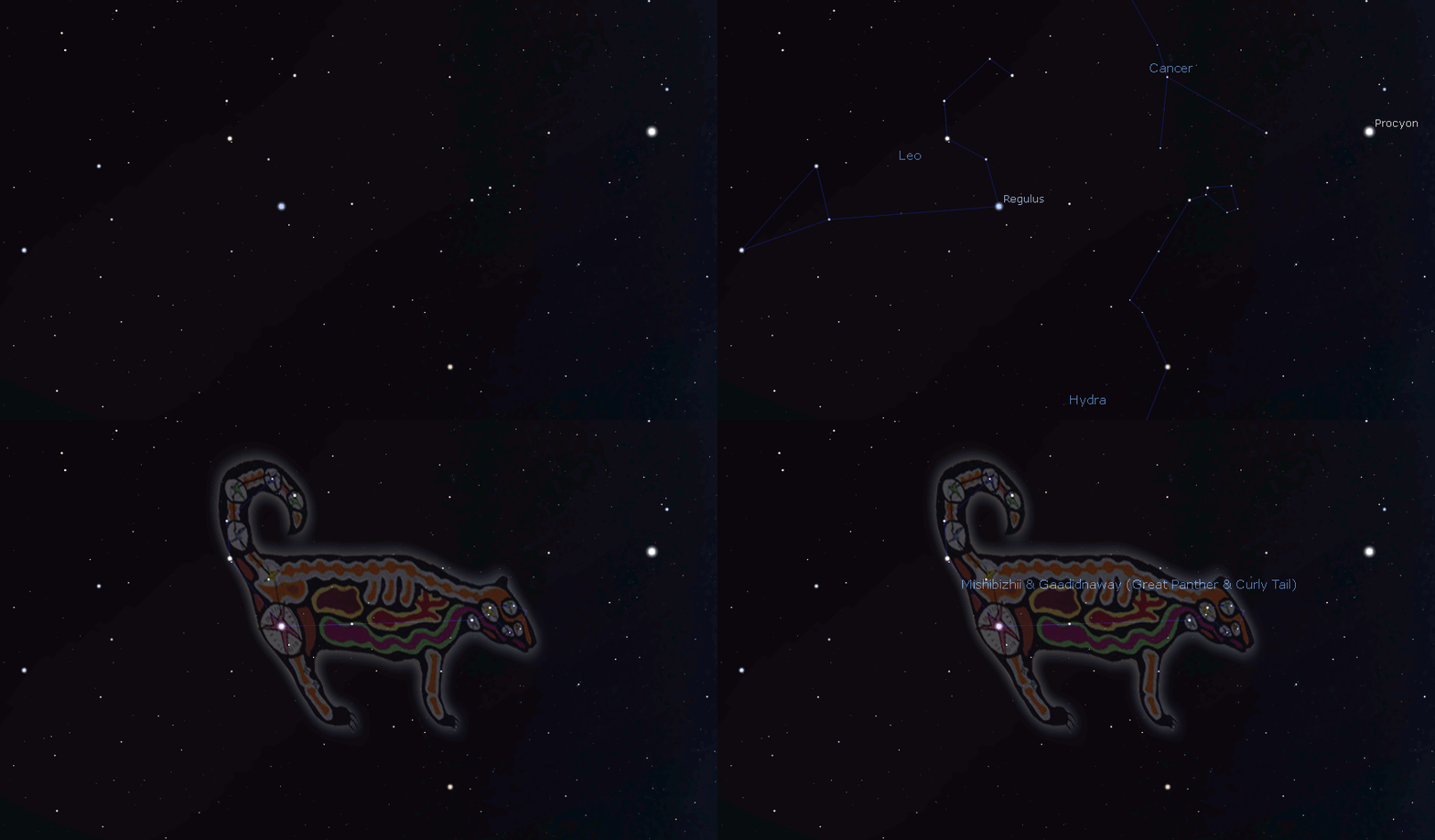
An animation showing the stars centered in the southeastern skies, the “official” constellations and the Anishinaabe constellation of Curly Tail and the Great (Underwater) Panther. Approximate time is 9:30 pm March 24th. Click on the image to enlarge. Created using Stellarium and GIMP.
03/23/2022 – Ephemeris – The search for the naked-eye planets moves to the morning sky
This is Bob Moler with Ephemeris for Wednesday, March 23rd. Today the Sun will be up for 12 hours and 18 minutes, setting at 7:59, and it will rise tomorrow at 7:38. The Moon, 2 days before last quarter, will rise at 2:50 tomorrow morning.
Let’s search for the naked-eye planets for this week. There are no bright planets in the evening sky. The planet action shifts to the morning sky. All five naked-eye planets are there, though Jupiter and Mercury are too close to the Sun to be seen. Late winter and early spring mornings aren’t the best for spotting planets close to the Sun, since they tend to lie low in the southeastern sky. Venus will rise at 5:46 tomorrow morning, Mars will rise at 5:51, and Saturn will rise at 6:10. By 7 am, they will be low in the southeast with much dimmer Mars at the 4 o’clock position below Venus, with Saturn lower, and at between the 7 and 8 o’clock position. Jupiter is just rising at that time.
The astronomical event times given are for the Traverse City/Interlochen area of Michigan (EDT, UT – 4 hours). They may be different for your location.
Addendum
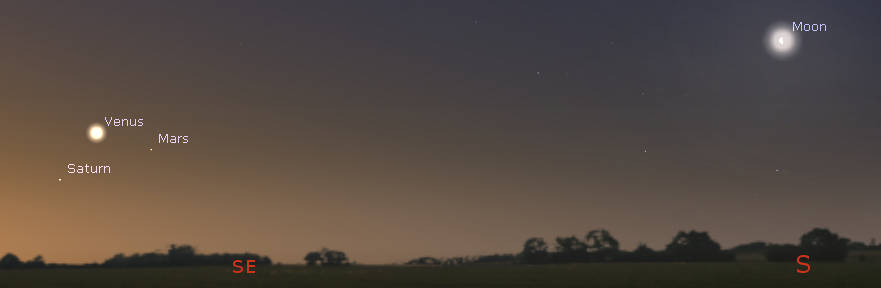
Morning planets and Moon at 7 am tomorrow morning, March 24, 2022. At that time Mars and Saturn may require binoculars to spot, however a quarter or a half an hour earlier they should be visible to the naked-eye.
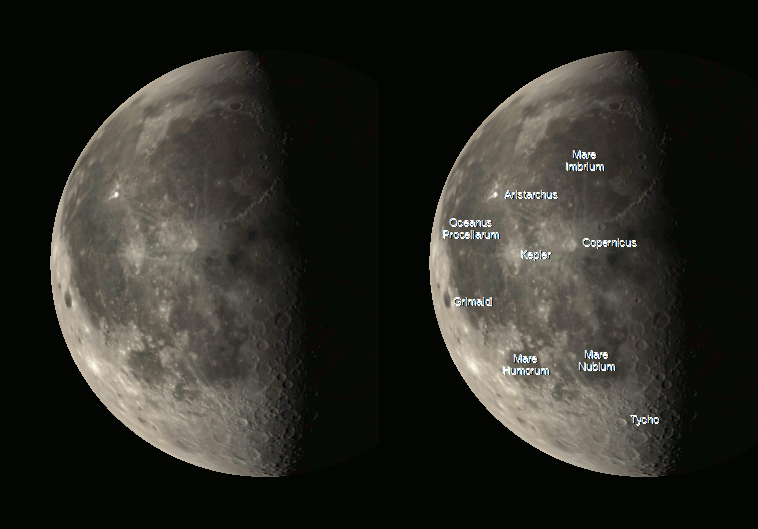
Waning gibbous Moon with animated labels. The Moon as it might appear in binoculars or a small telescope, with prominent lunar seas and craters labeled. I’ve retained the sea’s Latin names. Click on the image to enlarge it. Created using Stellarium, GIMP and LibreOffice.
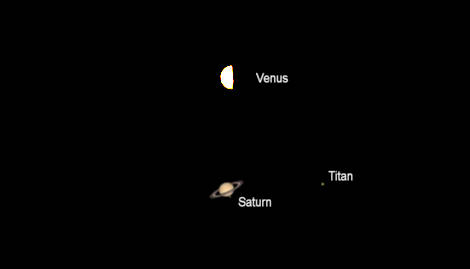
Telescopic views of the Venus and Saturn (north up) as they would be seen in a small telescope, with the same magnification, tomorrow morning at 7 am, March 24, 2022. I do not show planets less than 10 seconds of arc in diameter. Apparent diameters: Venus 23.52″, 51.6% illuminated; Saturn 15.66″, its rings 36.47″. Mars is not shown, its apparent diameter is 5.06″ and is 92.3% illuminated. The ” symbol means seconds of arc (1/3600th of a degree.) Created using Cartes du Ciel (Sky Charts).
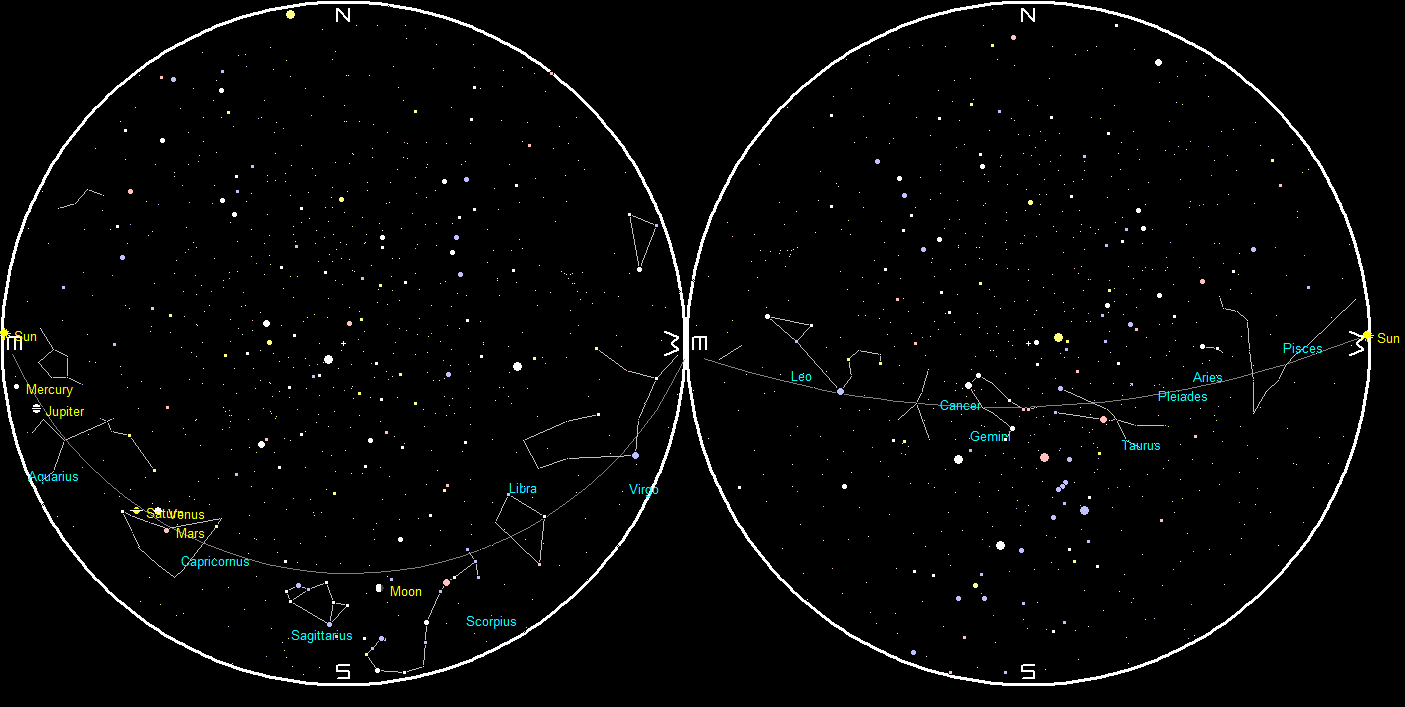
The naked-eye planets and the Moon at sunset and sunrise on a single night, starting with sunset on the right on March 23, 2022. The night ends on the left with sunrise on the 24th. Notice that all the naked-eye planets and the Moon are in the morning sky now. The labels for Saturn and Venus overlap. Click on the image to enlarge it. Created using my LookingUp program.
03/22/2022 – Ephemeris – James Webb Space Telescope has aligned its 18 segment mirror to act as one
This is Ephemeris for Tuesday, March 22nd. Today the Sun will be up for 12 hours and 15 minutes, setting at 7:57, and it will rise tomorrow at 7:40. The Moon, 3 days before last quarter, will rise at 1:34 tomorrow morning.
Last week, NASA and the Space Telescope Science Institute (STScI) released a photograph of the star they had been using to align the mirrors of the James Webb Space Telescope. What started a couple of months ago as a scattering of in and out of focus images of that star, are now coalesced into a single image. The six spikes on the very overexposed star are called diffraction spikes, caused by the straight edges of the hexagonal mirrors. The other objects in the field are distant galaxies. So even this calibration image appears to meet or exceed expectations. There is more work to be done in getting the other three instruments that will receive light from the telescope aligned and calibrated. We’re probably two months away from the first scientific image.
The astronomical event times given are for the Traverse City/Interlochen area of Michigan (EDT, UT – 4 hours). They may be different for your location.
Addendum
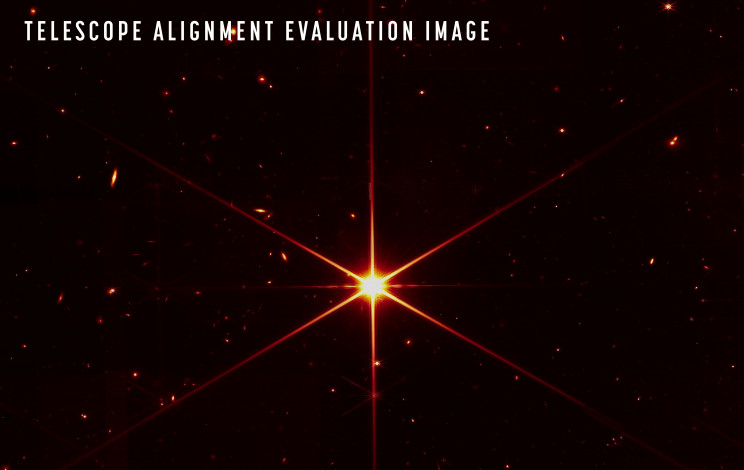
The alignment image of the James Webb Space Telescope after the 18 primary mirror segments have been aligned to act as a single mirror. Beside the alignment star showing its overexposed diffraction spikes, many faint galaxies can be seen. The alignment star, near the Big Dipper, is almost too faint to be seen in binoculars. Credit: NASA, Space Telescope Science Institute (STScI).
03/21/2022 – Ephemeris – Finding the celestial lion
This is Ephemeris for Monday, March 21st. Today the Sun will be up for 12 hours and 12 minutes, setting at 7:56, and it will rise tomorrow at 7:42. The Moon, 3 days past full, will rise at 12:15 tomorrow morning.
At 10 p.m. the spring constellation of Leo the lion will be fairly high in the southeast. It can be found by locating the Big Dipper high in the northeast and imagining that a hole were drilled in the bowl to let the water leak out. It would drip on the back of this giant cat. The Lion is standing or lying facing westward. His head and mane are seen in the stars as a backwards question mark. This group of stars is also called the Sickle. The bright star Regulus is at the bottom, the dot at the bottom of the question mark. A triangle of stars, to the left of Regulus, is the lion’s haunches. Leo contains some nice galaxies visible in moderate sized telescopes. The stars in Leo’s part of the sky are fewer than those in the winter sky.
The astronomical event times given are for the Traverse City/Interlochen area of Michigan (EDT, UT – 4 hours). They may be different for your location.
Addendum
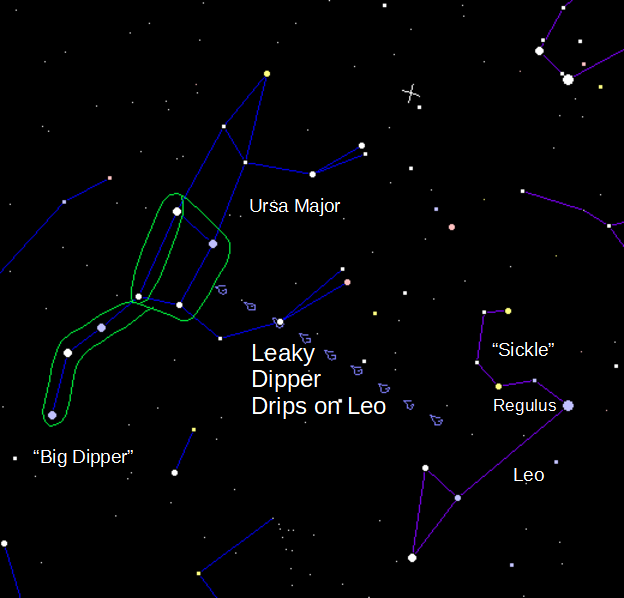
Leaky Big Dipper drips on Leo. The positions in the sky are for 10 pm local time, or about 2 hours after sunset. The little distorted cross at the top of the image marks the zenith. Look high in the east and southeast to see these stars. Created using my LookingUp program, GIMP and LibreOffice.
03/18/2022 – Ephemeris – Spring is two days away!
This is Ephemeris for Friday, March 18th. Today the Sun will be up for 12 hours and 3 minutes, setting at 7:52, and it will rise tomorrow at 7:47. The Moon, at full today, will rise at 8:28 this evening.
Sunday morning March 20th, at 11:33 am the Sun will cross overhead at the earth’s equator as it appears to head north, starting for us, the season of spring. It will be the vernal equinox. As you can tell from my intro, we’re already above 12 hours of daylight, and we’ll add another 3 plus hours of daylight before summer begins in three months. We are already adding about 3 minutes a day of daylight to that goal now, the maximum rate. With the Sun out longer and its ascension higher in the sky each day, it is rapidly adding energy to the Northern Hemisphere. We won’t feel that immediately. While the land rapidly absorbs heat, the oceans and lakes, especially the Great Lakes, are big heat sinks, taking much longer to warm up.
The astronomical event times given are for the Traverse City/Interlochen area of Michigan (EDT, UT – 4 hours). They may be different for your location.
Addendum
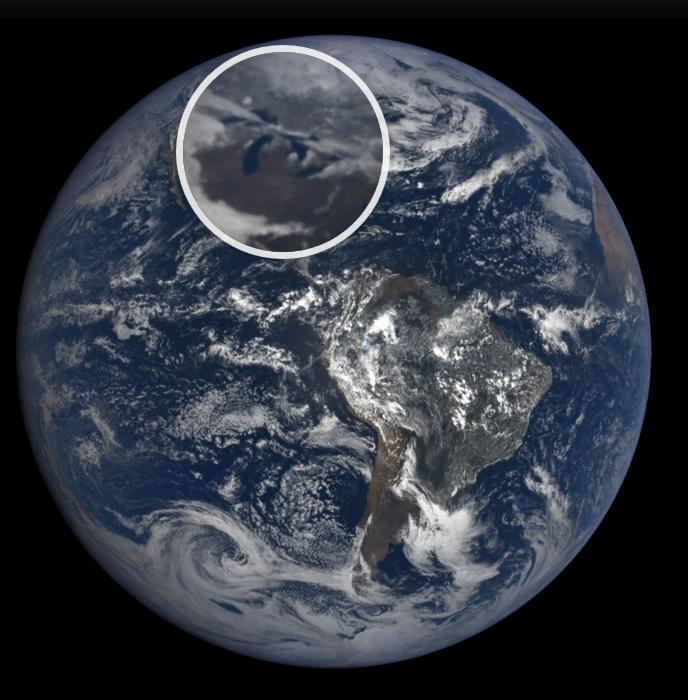
The Earth from 2 days before the vernal equinox 2018, with the North Pole not quite in sunlight. I’ve added a magnifying spot showing Michigan. It was a rare clear day when this image was taken. Credit NOAA/DSCOVR satellite/EPIC camera. The DSCOVR satellite is located in a halo orbit around the Sun-Earth Lagrange L1 point nearly a million miles sunward of the Earth.
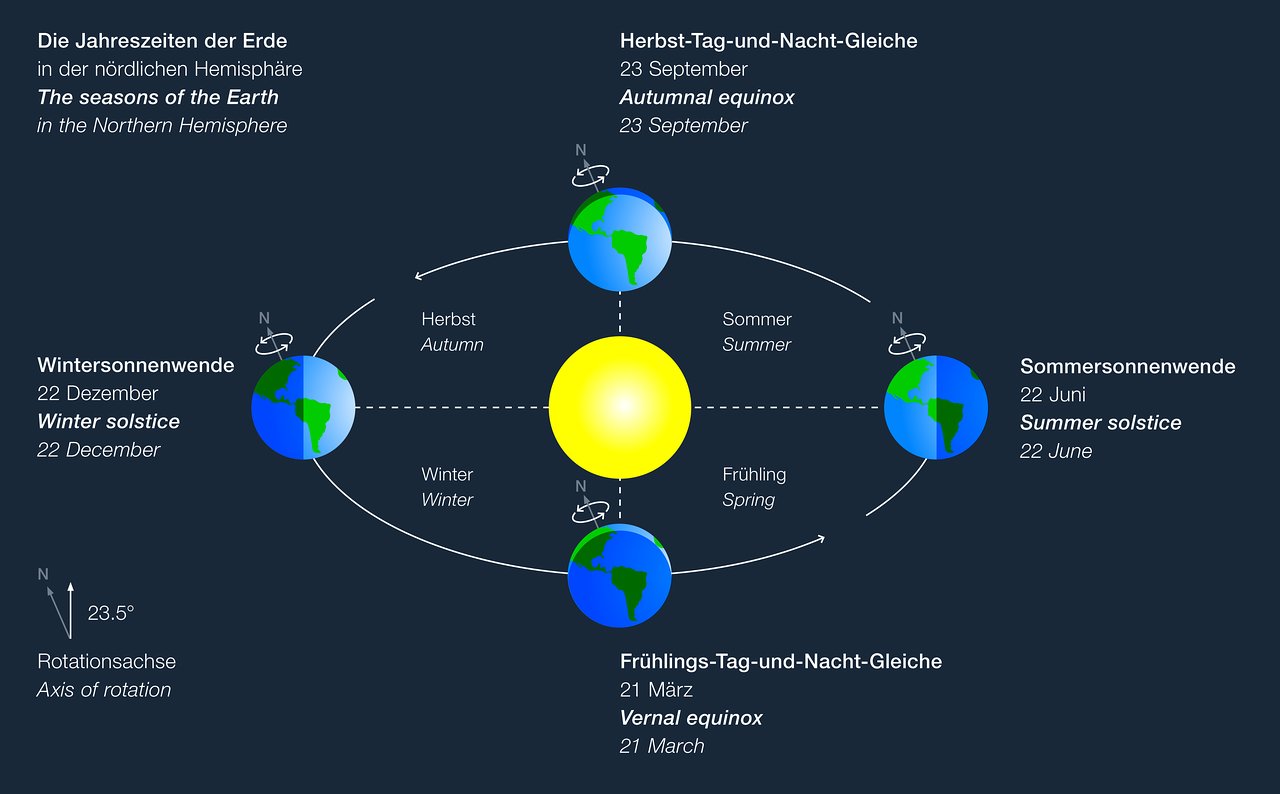
Earth’s position at the solstices and equinoxes. This is a not to scale oblique look at the Earth’s orbit, which is nearly circular. The Earth is actually farthest from the Sun on July 4th. The dates for the equinoxes and solstices are shown one day later than it is actually. Click on the image to enlarge. Credit: ESO (European Southern Observatory), which explains the captions in German and English.
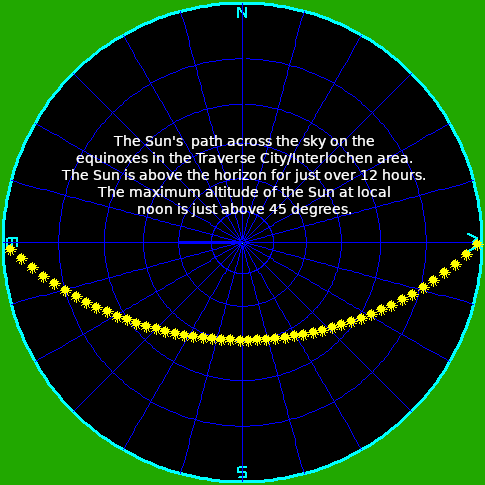
The Sun’s path through the sky on an equinox day from the Traverse City/Interlochen area in Michigan. The Sun is plotted every 15 minutes. This is a stereographic projection which compresses the image near the zenith and enlarges the image towards the horizon. Created using my LookingUp program.
03/17/2022 – Ephemeris – We have 12 hours of daylight and night today, three days early
This is Ephemeris for St. Patrick’s Day, Thursday, March 17th. Today the Sun will be up for 12 hours even, setting at 7:51, and it will rise tomorrow at 7:49. The Moon, 1 day before full, will set at 8:20 tomorrow morning.
Why is this the day of equal day and night, when the vernal equinox, which means “equal night” is still three days away? The difference is due to our atmosphere and our definition of sunrise and sunset. Our atmosphere makes objects near the horizon appear higher than they actually are, which hastens sunrise and retards sunset. Also, the instant of sunrise and sunset is when the top of the sun appears to touch the horizon, rather than when the Sun bisects the horizon. Plus, it’s moving about a degree a day (twice its diameter) against the stars. So by the time of the equinox, on Sunday the 20th, the time between sunrise and sunset will have progressed to 12 hours and 9 minutes. But it was close enough for the ancients who coined the term.
The astronomical event times given are for the Traverse City/Interlochen area of Michigan (EDT, UT – 4 hours). They may be different for your location.
Addendum
This works for the Interlochen area. It may be a different by a day for other locations, but for the northern latitudes, it will be before the true equinox day, March 20th here.
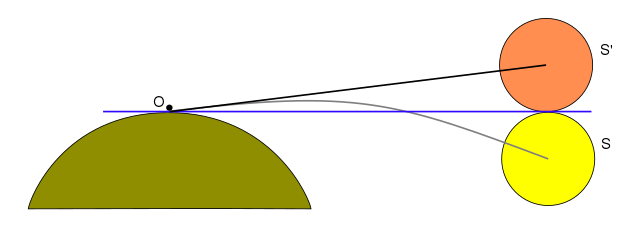
How the atmosphere bends the light of the Sun or Moon rising or setting to appear higher than it actually is. S is the actual position of the Sun, S’ is the apparent position of the Sun. The blue line is the observer O’s horizon. The gray line is the actual, though much exaggerated, light path bent or refracted by the Earth’s atmosphere. The black line is the apparent sight line to the Sun. Credit Francisco Javier Blanco González, 2017
03/16/2022 – Ephemeris – Let’s search for the naked-eye planets for this week
This is Ephemeris for Wednesday, March 16th. Today the Sun will be up for 11 hours and 57 minutes, setting at 7:50, and it will rise tomorrow at 7:51. The Moon, 2 days before full, will set at 7:59 tomorrow morning.
Let’s search for the naked-eye planets for this week. There are no bright planets in the evening sky. Jupiter, the last to leave, will stay too close to the direction of the Sun to be visible in the morning sky for at least a month. So that’s where the action shifts to. Jupiter joins Mercury, Saturn, Venus and Mars. Late winter and early spring mornings aren’t the best for spotting planets close to the Sun, since they tend to lie low in the southeastern sky. Venus will rise at 5:51 tomorrow morning and Mars will rise at 6:04. Saturn will rise at 6:40. By 7:15, they will be low in the southeast with much dimmer Mars at the 5 o’clock position below Venus, with Saturn much lower at the 8 o’clock position.
The astronomical event times given are for the Traverse City/Interlochen area of Michigan (EDT, UT – 4 hours). They may be different for your location.
Addendum
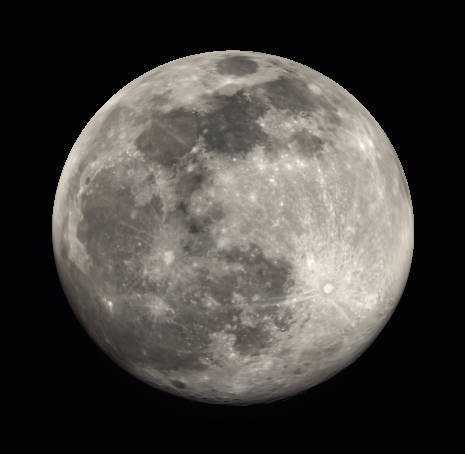
The Moon 2 days before full as it might appear in binoculars or small telescope, tonight, at 9 pm, March 16, 2022. Created using Stellarium.
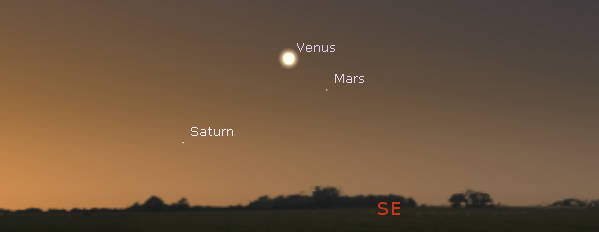
Morning planets Venus, Saturn and Mars at 7:15 am, or about 36 minutes before sunrise tomorrow, March 17, 2022. Binoculars may help in spotting Mars and Saturn. Over the week, these planets will continue to move away from the rising Sun. Well, all except Venus which will reach its greatest elongation, meaning separation from the Sun on Sunday, before beginning to slip back toward the Sun. Created using Stellarium.
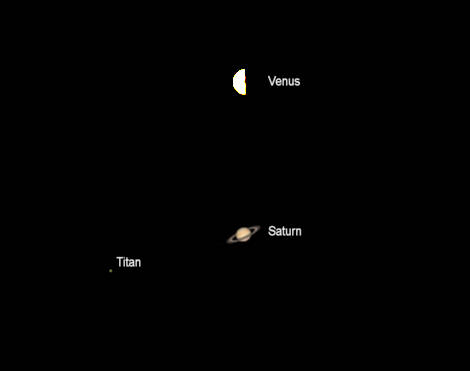
Telescopic views of the Venus and Saturn (north up) as they would be seen in a small telescope, with the same magnification, tomorrow morning at 7 15 am, March 17, 2022. I do not show planets less than 10 seconds of arc in diameter. Apparent diameters: Venus 25.49″, 48.0% illuminated; Saturn 15.55″, its rings 36.22″. Mars is not shown, its apparent diameter is 4.94″ and is 92.8% illuminated. The ” symbol means seconds of arc (1/3600th of a degree.) Created using Cartes du Ciel (Sky Charts).
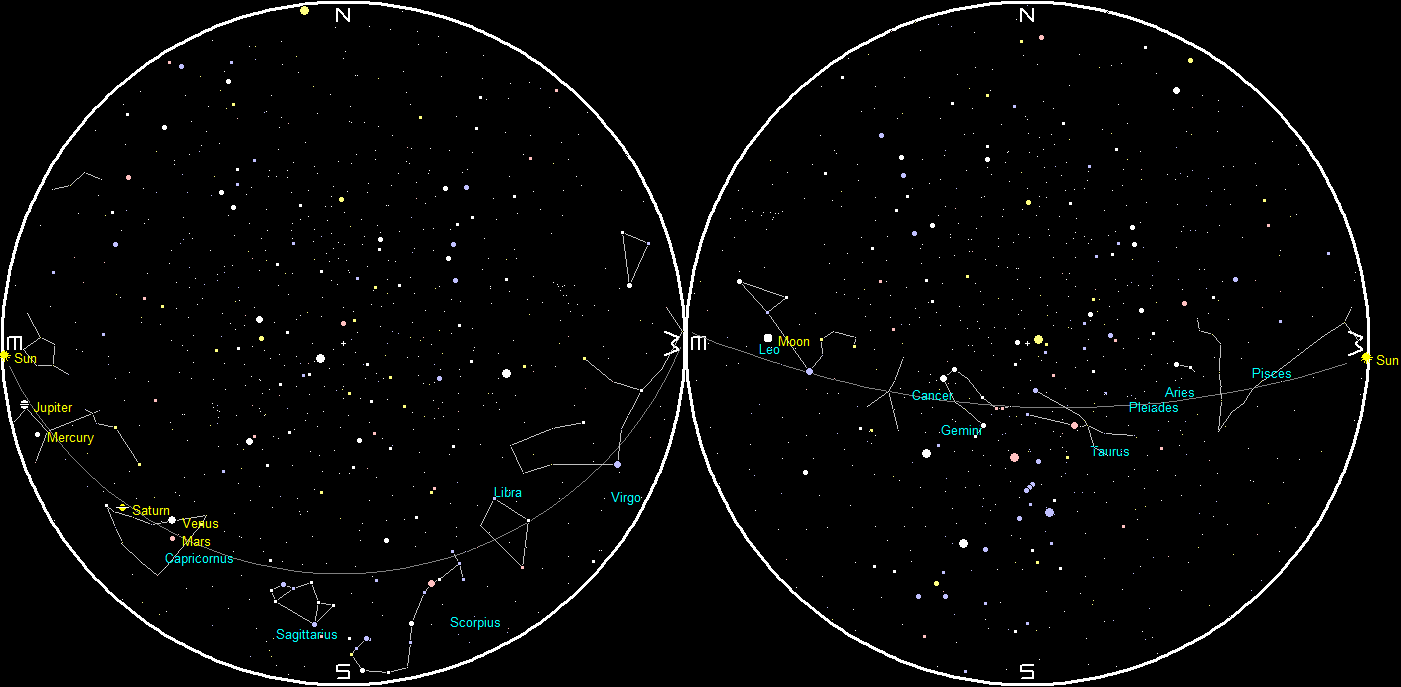
The naked-eye planets and the Moon at sunset and sunrise on a single night, starting with sunset on the right on March 16, 2022. The night ends on the left with sunrise on the 17th. Notice that all the naked-eye planets are in the morning sky now, with the Moon still hanging out in the evening sky. Click on the image to enlarge it. Created using my LookingUp program.
03/15/2022 – Ephemeris – The Ides of March and our calendar
This is Ephemeris for Ides of March, Tuesday, March 15th. Today the Sun will be up for 11 hours and 53 minutes, setting at 7:49, and it will rise tomorrow at 7:53. The Moon, 3 days before full, will set at 7:36 tomorrow morning.
The first day of spring is the vernal equinox, which occurs in our time zone on March 20th. The Ides of March, the 15th, is pretty close to the vernal equinox and was the start of the year for a time with the Romans. It was the date in 44 BC that Julius Caesar was assassinated. March, named after the god Mars, was also for a long time the first month of the year, even to the point of starting the year on the Ides of March. They, for a time, had 10 months in their year, and consigned the winter months to sixty nondescript days. Later, they added January and February in front of March, which is why our 9th through 12th months are named September the 7th to December the 10th month.
The astronomical event times given are for the Traverse City/Interlochen area of Michigan (EDT, UT – 4 hours). They may be different for your location.
 Bob Moler's Ephemeris Blog