04/08/2022 – Ephemeris – Landing a spacecraft at the Moon’s South Pole will be a tricky prospect
This is Ephemeris for Friday, April 8th. Today the Sun will be up for 13 hours and 8 minutes, setting at 8:19, and it will rise tomorrow at 7:09. The Moon, 1 day before first quarter, will set at 3:58 tomorrow morning.
The Artemis missions are to land near the South Pole of the Moon. Unlike the Earth’s 23 and a half degree axial tilt the Moon’s is only a degree and a half, so there is little month long variation of the Sun angle, though the Sun’s direction along the horizon revolves 360 degrees over 29 and a half days, the length of its orbit of the Earth. It should make for quite a challenge to land the human lander safely near the lunar South Pole. The lander has to choose a spot in sunlight to land that’s relatively smooth. The reason for the attraction of the lunar South Pole is the presence of water ice in permanently shadowed craters near and at the pole. The Moon’s North Pole isn’t as heavily cratered, with fewer permanently shadowed craters.
The astronomical event times given are for the Traverse City/Interlochen area of Michigan (EDT, UT – 4 hours). They may be different for your location.
Addendum
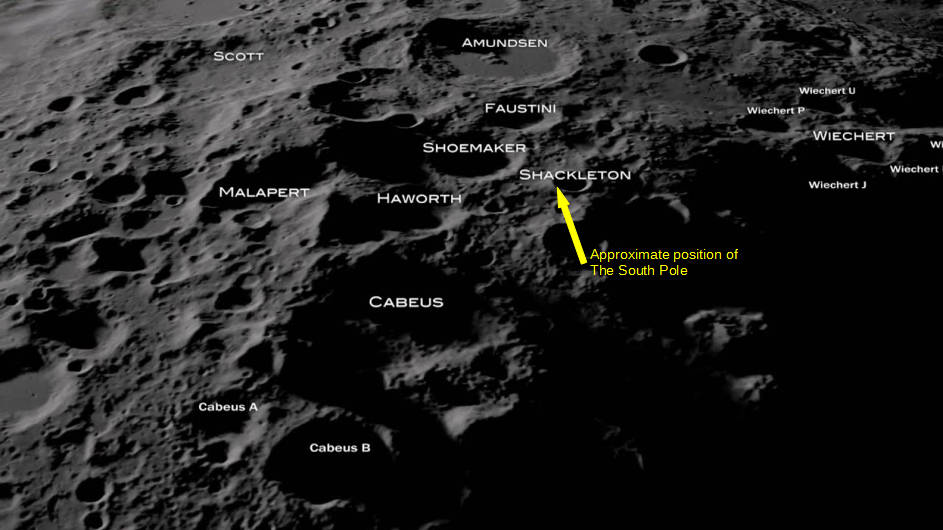
Lunar South Pole Flyover area with approximate South Pole marked based on Virtual Moon Atlas. Did you note a theme in some crater names? Click on the image to enlarge it. Credit: NASA/LRO.
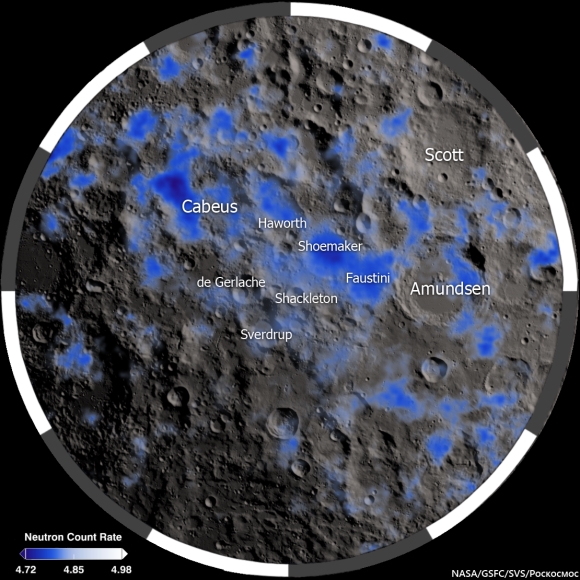
The South Pole of the Moon, where the presence of water ice is detected by the absorption of neutrons by the hydrogen atoms in the ice. Credit NASA/GSFC/SVS/Roscosmos.
04/07/2022 – Ephemeris – The Sun is getting active again
This is Ephemeris for Thursday, April 7th. Today the Sun will be up for 13 hours and 5 minutes, setting at 8:17, and it will rise tomorrow at 7:10. The Moon, 2 days before first quarter, will set at 3:11 tomorrow morning.
For the last year and a half, the Sun has entered a new sunspot cycle, solar cycle 25. It had been predicted to be a rather mild cycle with an average peak in sunspot numbers of around 120 in 2025, three years from now. Last Sunday’s daily sunspot number was 118. Sunspot numbers are not just the numbers of individual sunspots on the Sun. Groups of spots count for 10 before the individual spots are counted. These counts are averaged, from many observatories, over a month to chart the progress of the approximately 11 year sunspot cycle. The more sunspots, the more solar flares. The more flares, the more CMEs or coronal mass ejections. If CMEs are aimed toward the Earth, we get northern lights, and headaches for satellite operators and electric power companies.
The astronomical event times given are for the Traverse City/Interlochen area of Michigan (EDT, UT – 4 hours). They may be different for your location.
Addendum
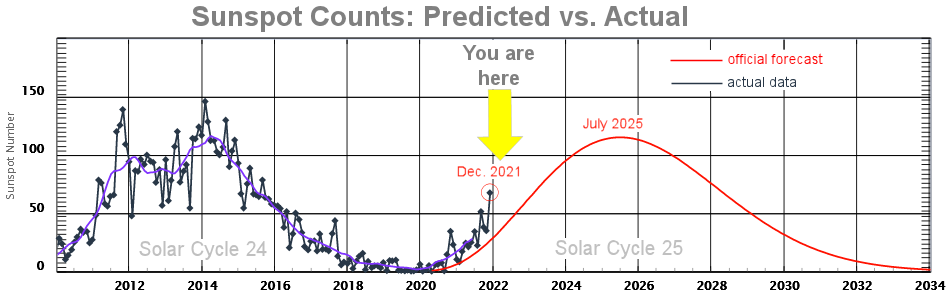
Current and last solar cycle sunspot plot. The current trend in sunspots is increasing much faster than what was predicted. Click on the image to enlarge it. Credit NOAA.
Go to spaceweather.com to keep up with what’s happening between the Sun and the Earth.
04/06/2022 – Ephemeris – Let’s search for the naked-eye planets for this week
This is Bob Moler with Ephemeris for Wednesday, April 6th. Today the Sun will be up for 13 hours and 2 minutes, setting at 8:16, and it will rise tomorrow at 7:12. The Moon, 3 days before first quarter, will set at 2:16 tomorrow morning.
Let’s search for the naked-eye planets for this week. There is one bright planet in the evening sky, but too close to the Sun to be seen. Mercury passed behind the Sun last Saturday and will be visible later this month, so the planet action still shifts to the morning sky. The other 4 naked-eye planets are there, though Jupiter is too close to the Sun to be seen. Late winter and early spring mornings aren’t the best for spotting planets close to the Sun, since they tend to lie low in the southeastern sky. Venus, Mars, and Saturn will rise within 16 minutes of each other by 5:35. By 6:30, they will be low in the east-southeast with dim Saturn to the right and a bit above Venus, and much dimmer Mars to the left and below Saturn.
The astronomical event times given are for the Traverse City/Interlochen area of Michigan (EDT, UT – 4 hours). They may be different for your location.
Addendum
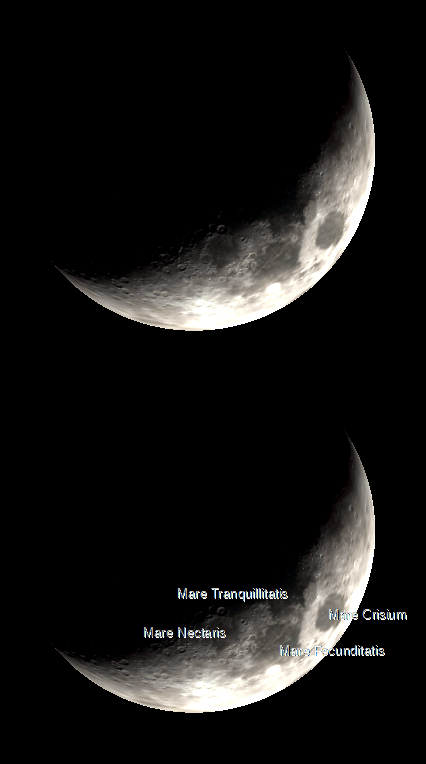
Annotated crescent Moon animation of the Moon tonight, April 6, 2022. The annotations are the official names in Latin of the seas of Tranquility, Crises, Nectar, and Fertility. Created using Stellarium.
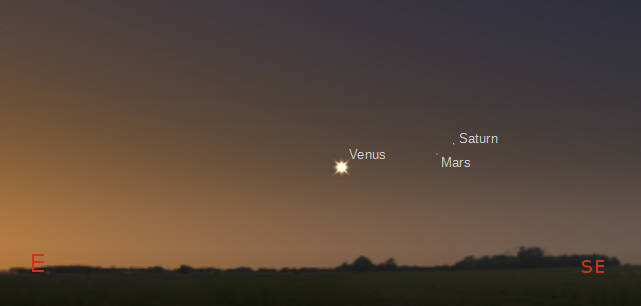
Venus, Mars and Saturn as they might be seen around 6:30 tomorrow morning, April 7, 2022. Created using Stellarium.
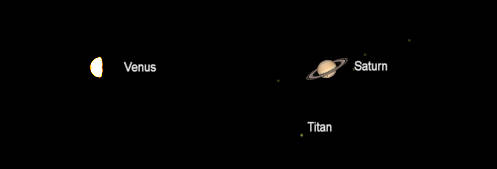
Views of Venus and Saturn (north up) as they would be seen in a small telescope, with the same magnification, tomorrow morning at 6:30 am, April 7, 2022. I do not show planets less than 10 seconds of arc in diameter. Apparent diameters: Venus 20.38″, 58.2% illuminated; Saturn 15.92″, its rings 37.08″. Mars is not shown, its apparent diameter is 5.30″ and is 91.2% illuminated. The ” symbol means seconds of arc (1/3600th of a degree.) Created using Cartes du Ciel (Sky Charts).
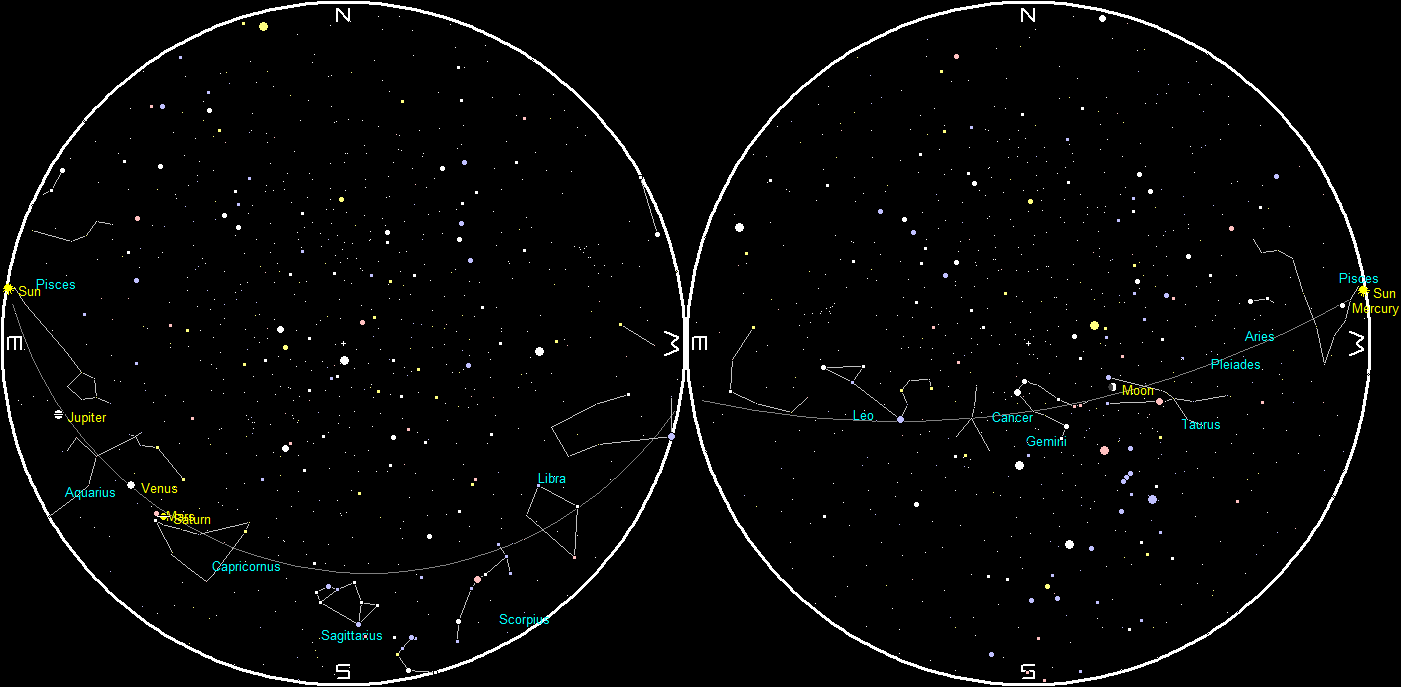
The naked-eye planets and the Moon at sunset and sunrise on a single night, starting with sunset on the right on April 6, 2022. The night ends on the left with sunrise on the 7th. Notice that all the naked-eye planets are in the morning sky now, with the Moon still hanging out in the evening sky. Click on the image to enlarge it. Created using my LookingUp program.
04/05/2022 – Ephemeris – The first Axiom Space mission to the ISS amid a busy April
This is Bob Moler with Ephemeris for Tuesday, April 5th. Today the Sun will be up for 12 hours and 59 minutes, setting at 8:15, and it will rise tomorrow at 7:14. The Moon, halfway from new to first quarter, will set at 1:15 tomorrow morning.
One of the commercial entities working to launch their own space station is Axiom Space, founded in 2016. The first Axiom mission is Ax-1, an 8-day mission to the International Space Station that, as of when I am recording this last Sunday night, is scheduled for tomorrow on a SpaceX Falcon 9/Crew Dragon from launch pad 39A at Cape Canaveral. The Artemis-1 wet dress rehearsal was halted earlier Sunday due to a pressurization problem with the mobile launch tower. That’s on pad 39B, a bit over a mile and a half away. I’m assuming that Artemis-1 has priority over the Axiom mission. Plus, there’s the SpaceX Crew-5 launch later this month to the space station, which also has president. It could be an interesting time at the Cape.
The astronomical event times given are for the Traverse City/Interlochen area of Michigan (EDT, UT – 4 hours). They may be different for your location.
Addendum
April 4, 2022: The SpaceX Axiom-1 launch is now scheduled for no earlier than Friday, April 8, for an 8-day mission to the International Space Station (ISS). The SpaceX Crew-4 launch had previously been pushed back to April 20. The Crew-3 return from the ISS was to be 5 days later.
The Artemis-1 Wet Dress Rehearsal was scrubbed April 4th with a malfunctioning vent valve. A successful test will have fuel and oxidizer loaded and all prelaunch functions completed, and counted down to a bit over 9 seconds to launch.
Axiom Space: space station plan
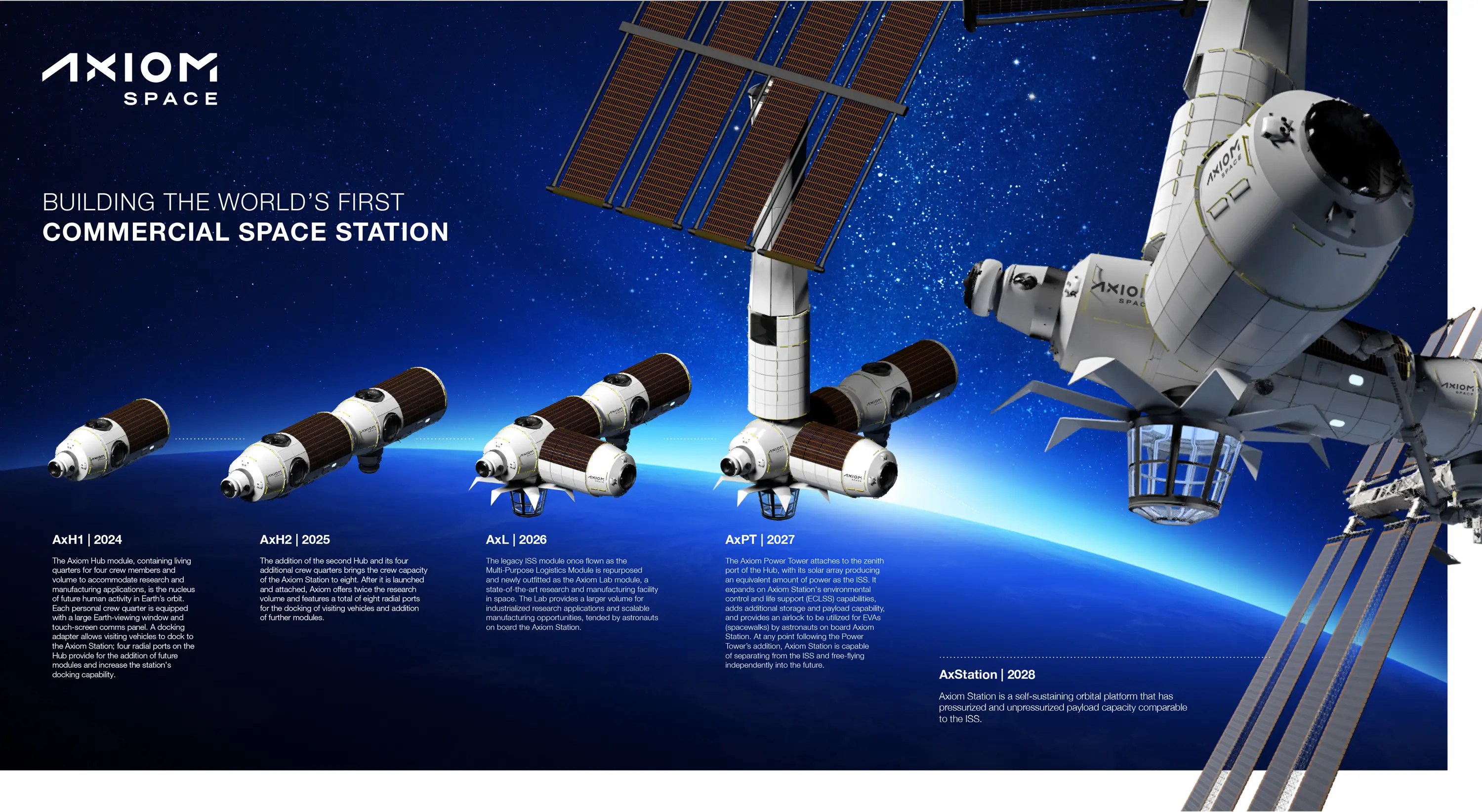
The planned evolution of the Axiom commercial space station. It will start being a module attached to the ISS starting in 2024, according to the current plan. Various modules will be attached. After the power tower containing solar panels is attached, it can be detached from the ISS to fly free. Click on the image to enlarge. Credit: Axiom Space.
04/04/2022 – Ephemeris – Two apparent planetary encounters tonight and tomorrow morning
This is Ephemeris for Monday, April 4th. Today the Sun will be up for 12 hours and 56 minutes, setting at 8:14, and it will rise tomorrow at 7:16. The Moon, 3 days past new, will set at 12:10 tomorrow morning. | We have action at both end of the night tonight. This evening the Pleiades, or Seven Sisters star cluster, will be seen just above and right of the three-day old crescent Moon. The cluster will be at the one o’clock position from the Moon at 9 pm. At the other side of night, at 6:30 tomorrow morning, Venus will be shining brilliantly in the east-southeast and the planets Mars and Saturn will be very close together. This type of appearance is called a conjunction. Mars will appear about three-quarters of a moon diameter below and left of the slightly brighter Saturn. Mars is getting slowly brighter as the Earth creeps up on it, to overtake it this December. It’s currently 165 million miles (266 million kilometers) away.
The astronomical event times given are for the Traverse City/Interlochen area of Michigan (EDT, UT – 4 hours). They may be different for your location.
Addendum
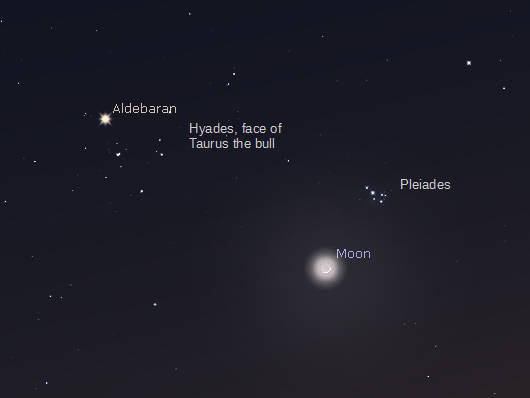
The Moon and the Pleiades and Hyades tonight at 9 pm EDT, April 4, 2022. The Moon appears near the stepsister star clusters tonight. In Greek mythology, these two star clusters were indeed stepsisters, fathered by the god Atlas with different mothers. Created using Stellarium with additional captions in LibreOffice.
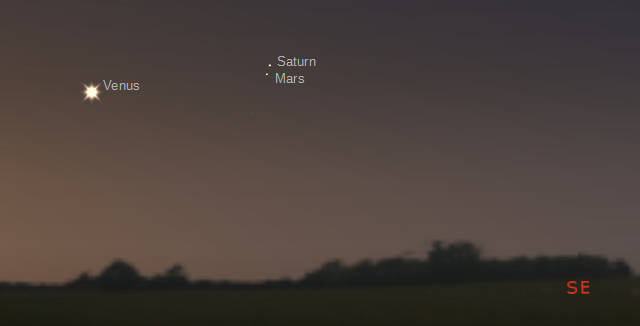
A Saturn-Mars conjunction with brilliant Venus nearby as it might look like tomorrow morning, April 5, 2022. Created using Stellarium with labels added in LibreOffice.
04/01/2022 – Ephemeris – Astro meeting tonight – astronomy meets geology
This is Bob Moler with Ephemeris for April Fools’ Day, Friday, April 1st. Today the Sun will be up for 12 hours and 46 minutes, setting at 8:10, and it will rise tomorrow at 7:21. The Moon is new today, and won’t be visible.
Tonight at 8 pm, the Grand Traverse Astronomical Society will have our first in-person meeting in two years at Northwestern Michigan College’s Rogers Observatory. The meeting will also be available via Zoom. The program will be presented by Debbie Bull, from the Grand Traverse Rock and Mineral Club. Her topic will be: Impactite from the Sudbury, Ontario Impact Event. Sudbury is only 260 miles northeast from Traverse City, more if you drive it. 1.85 billion years ago, a small asteroid or comet hit there, making the 3rd largest crater discovered on the Earth. If it’s clear, there will be a star party following the meeting. More information on the observatory location and a Zoom link, go to gtastro.org.
The astronomical event times given are for the Traverse City/Interlochen area of Michigan (EDT, UT – 4 hours). They may be different for your location.
Addendum
The Northwestern Michigan College’s Rogers Observatory is located south of Traverse City on Birmley Road. It’s south of Hammond Road between Garfield and Keystone roads. The observatory has limited seating and masks may be required. This will be the first in-person meeting that will also be covered by Zoom, so technical problems may occur.
03/31/2022 – Ephemeris – Previewing April Skies
This is Ephemeris for Thursday, March 31st. Today the Sun will be up for 12 hours and 43 minutes, setting at 8:09, and it will rise tomorrow at 7:23. The Moon, 1 day before new, will rise at 7:51 tomorrow morning.
The 4th month of the year begins tomorrow. Daylight hours in the Interlochen/Traverse City area will increase from 12 hours and 46 minutes tomorrow to 14 hours and 12 minutes on April 30th. The altitude, or angle, of the Sun above the southern horizon at local noon will be 50 degrees tomorrow and will ascend to 60 degrees on April 30th. The altitude of the Sun in the Straits area will be a degree lower, but their daylight hours will be a bit longer. The actual time of local apparent noon, when the Sun passes due south, will be about 1:43 p.m. The Lyrid meteor shower will reach its peak on the afternoon of the 22nd. So the hours from 10 pm and 3am on the 21st and 22nd will be the best time to see them in dark skies.
The astronomical event times given are for the Traverse City/Interlochen area of Michigan (EDT, UT – 4 hours). They may be different for your location.
Addendum
April Evening Star Chart
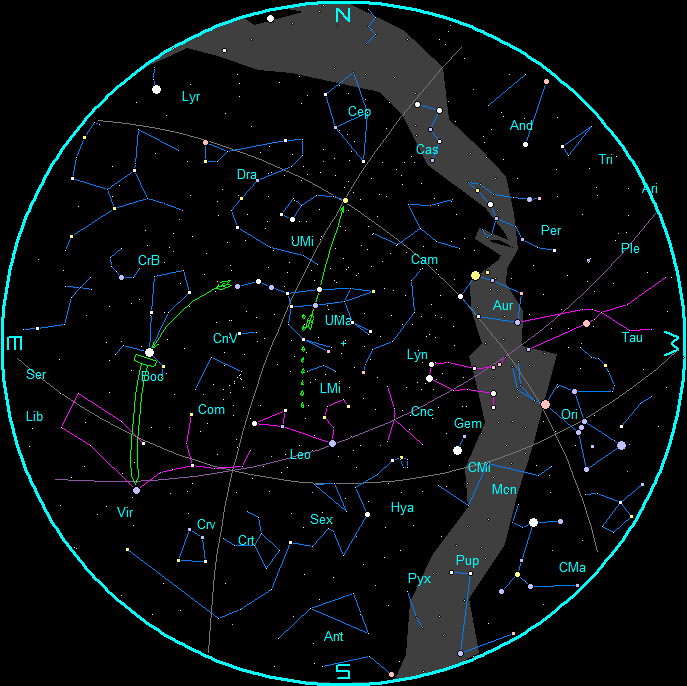
Star Chart for April 2022 (10 p.m. EDT, April 15, 2022). Click on image to enlarge. Created using my LookingUp program. Click on image to enlarge. Created using my LookingUp program.
April Morning Star Chart
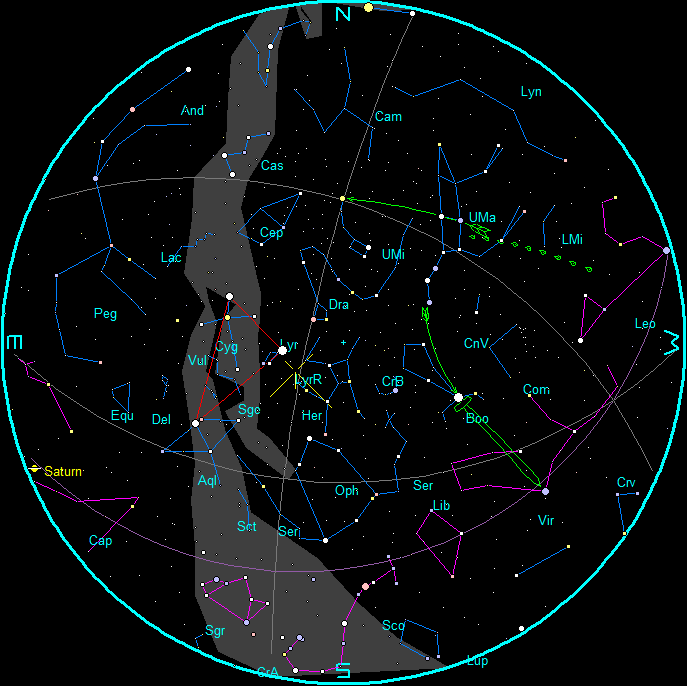
Star Chart for April mornings, 2022 (5 a.m. EDT, April 15, 2022). Click on image to enlarge. Created using my LookingUp program.
For a list of constellation names to go with the abbreviations, click here.
- Pointer stars at the front of the bowl of the Big Dipper point to Polaris, the North Star.
- The leaky bowl of the Big Dipper drips on Leo.
- Follow the arc of the handle of the Big Dipper to the star Arcturus, then
- Follow the spike to Spica.
- The Summer Triangle appears in red.
- LyrR is the radiant of the Lyrid meteor shower, which will reach peak on the afternoon of the 22nd.
Twilight Limits, Nautical and Astronomical
| EDT | |||||||
| Morning | Twilight | Evening | Twilight | Dark | Night | Moon | |
| Date | Astro. | Nautical | Nautical | Astro. | Start | End | Illum. |
| 2021-04-01 | 5h46m | 6h23m | 21h18m | 21h54m | 21h54m | 0h11m | 0.74 |
| 2021-04-02 | 5h44m | 6h21m | 21h19m | 21h56m | 21h56m | 1h29m | 0.64 |
| 2021-04-03 | 5h42m | 6h19m | 21h20m | 21h57m | 21h57m | 2h42m | 0.52 |
| 2021-04-04 | 5h39m | 6h17m | 21h22m | 21h59m | 21h59m | 3h44m | 0.42 |
| 2021-04-05 | 5h37m | 6h15m | 21h23m | 22h01m | 22h01m | 4h35m | 0.31 |
| 2021-04-06 | 5h35m | 6h13m | 21h25m | 22h02m | 22h02m | 5h16m | 0.22 |
| 2021-04-07 | 5h33m | 6h11m | 21h26m | 22h04m | 22h04m | 5h33m | 0.14 |
| 2021-04-08 | 5h31m | 6h09m | 21h27m | 22h05m | 22h05m | 5h31m | 0.08 |
| 2021-04-09 | 5h28m | 6h07m | 21h29m | 22h07m | 22h07m | 5h28m | 0.03 |
| 2021-04-10 | 5h26m | 6h05m | 21h30m | 22h09m | 22h09m | 5h26m | 0.01 |
| 2021-04-11 | 5h24m | 6h03m | 21h32m | 22h10m | 22h10m | 5h24m | 0 |
| 2021-04-12 | 5h22m | 6h01m | 21h33m | 22h12m | 22h12m | 5h22m | 0.01 |
| 2021-04-13 | 5h20m | 5h59m | 21h35m | 22h14m | 22h14m | 5h20m | 0.04 |
| 2021-04-14 | 5h17m | 5h57m | 21h36m | 22h16m | 23h12m | 5h17m | 0.08 |
| 2021-04-15 | 5h15m | 5h55m | 21h38m | 22h17m | – | 5h15m | 0.14 |
| 2021-04-16 | 5h13m | 5h53m | 21h39m | 22h19m | 0h14m | 5h13m | 0.22 |
| 2021-04-17 | 5h11m | 5h51m | 21h41m | 22h21m | 1h15m | 5h11m | 0.3 |
| 2021-04-18 | 5h09m | 5h49m | 21h42m | 22h23m | 2h12m | 5h09m | 0.39 |
| 2021-04-19 | 5h06m | 5h47m | 21h44m | 22h24m | 3h03m | 5h06m | 0.49 |
| 2021-04-20 | 5h04m | 5h45m | 21h45m | 22h26m | 3h47m | 5h04m | 0.59 |
| 2021-04-21 | 5h02m | 5h43m | 21h47m | 22h28m | 4h25m | 5h02m | 0.7 |
| 2021-04-22 | 5h00m | 5h41m | 21h48m | 22h30m | 4h56m | 5h00m | 0.79 |
| 2021-04-23 | 4h57m | 5h39m | 21h50m | 22h32m | – | – | 0.88 |
| 2021-04-24 | 4h55m | 5h37m | 21h51m | 22h34m | – | – | 0.94 |
| 2021-04-25 | 4h53m | 5h35m | 21h53m | 22h35m | – | – | 0.99 |
| 2021-04-26 | 4h51m | 5h34m | 21h55m | 22h37m | – | – | 1 |
| 2021-04-27 | 4h49m | 5h32m | 21h56m | 22h39m | – | – | 0.98 |
| 2021-04-28 | 4h46m | 5h30m | 21h58m | 22h41m | 22h41m | 23h06m | 0.94 |
| 2021-04-29 | 4h44m | 5h28m | 21h59m | 22h43m | 22h43m | – | 0.87 |
| 2021-04-30 | 4h42m | 5h26m | 22h01m | 22h45m | 22h45m | 0h25m | 0.78 |
Twilight calendar was generated using Cartes du Ciel (Sky Charts).
See my blog post: Twilight Zone for the definitions of the different periods of twilight here: https://bobmoler.wordpress.com/2018/09/27/.
NASA Calendar of Planetary Events
   Date     Time      Event
Apr  1  Fr            Venus: 46.1° W
     1  Fr   2:24 am  New Moon
     2  Sa   7:05 pm  Mercury Superior Conj.
     4  Mo   9:05 am  Moon Ascending Node
     4  Mo   9:16 pm  Moon-Pleiades: 4° N
     4  Mo   9:45 pm  Mars-Saturn: 0.3° N
     7  Th   3:11 pm  Moon Apogee: 404400 km
     8  Fr   4:15 am  Moon North Dec.: 26.9° N
     9  Sa   2:48 am  First Quarter
     9  Sa  11:14 am  Moon-Pollux: 2.4° N
    10  Su  12:27 pm  Moon-Beehive: 3.9° S
    16  Sa   2:55 pm  Full Pink Moon
    18  Mo  10:01 am  Moon Descending Node
    19  Tu  11:16 am  Moon Perigee: 365100 km
    21  Th   1:41 pm  Moon South Dec.: 26.9° S
    22  Fr   2:25 pm  Lyrid Shower: ZHR = 20
    23  Sa   7:56 am  Last Quarter
    24  Su   4:56 pm  Moon-Saturn: 4.6° N
    25  Mo   6:06 pm  Moon-Mars: 4.1° N
    26  Tu   9:51 pm  Moon-Venus: 4° N
    27  We   4:23 am  Moon-Jupiter: 3.8° N
    29  Fr   3:59 am  Mercury Elongation: 20.6° E
    29  Fr   3:29 pm  Mercury-Pleiades: 1.4° S
    30  Sa   3:56 pm  Venus-Jupiter: 0.2° N
    30  Sa   4:28 pm  New Moon
    30  Sa   4:42 pm  Partial Solar Eclipse (South Pacific and
                          Southern South America)
May  1  Su            Venus: 42.4° W
Sky Events Calendar by Fred Espenak and Sumit Dutta (NASA’s GSFC),
http://eclipse.gsfc.nasa.gov/SKYCAL/SKYCAL.html.
Sun and Moon Rising and Setting Events
     LU                  Ephemeris of Sky Events for Interlochen/TC
April, 2022    Local time zone: EDT
+-----------------------------------------------------------------------+
| DATE |  SUN     SUN  DAYLIGHT|   TWILIGHT*    |MOON  RISE OR    ILLUM |
|      |  RISE    SET    HOURS |  END    START  |PHASE SET** TIME FRACTN|
+=======================================================================+
|Fri  1| 07:23a  08:10p  12:46 | 09:15p  06:18a |New   Set  08:47p    1%|
|Sat  2| 07:21a  08:11p  12:50 | 09:16p  06:16a |      Set  09:55p    3%|
+------+-----------------------+----------------+-----------------------+
|Sun  3| 07:19a  08:12p  12:53 | 09:18p  06:14a |      Set  11:03p    8%|
|Mon  4| 07:18a  08:14p  12:56 | 09:19p  06:13a |      Set  12:10a   14%|
|Tue  5| 07:16a  08:15p  12:59 | 09:20p  06:11a |      Set  01:15a   21%|
|Wed  6| 07:14a  08:16p  13:02 | 09:22p  06:09a |      Set  02:16a   29%|
|Thu  7| 07:12a  08:17p  13:05 | 09:23p  06:07a |      Set  03:11a   38%|
|Fri  8| 07:10a  08:19p  13:08 | 09:25p  06:05a |      Set  03:58a   47%|
|Sat  9| 07:09a  08:20p  13:11 | 09:26p  06:03a |F Qtr Set  04:37a   57%|
+------+-----------------------+----------------+-----------------------+
|Sun 10| 07:07a  08:21p  13:14 | 09:28p  06:01a |      Set  05:10a   66%|
|Mon 11| 07:05a  08:22p  13:17 | 09:29p  05:59a |      Set  05:37a   75%|
|Tue 12| 07:03a  08:24p  13:20 | 09:31p  05:57a |      Set  06:01a   83%|
|Wed 13| 07:01a  08:25p  13:23 | 09:32p  05:55a |      Set  06:22a   90%|
|Thu 14| 07:00a  08:26p  13:26 | 09:34p  05:53a |      Set  06:43a   96%|
|Fri 15| 06:58a  08:27p  13:29 | 09:35p  05:51a |      Set  07:04a   99%|
|Sat 16| 06:56a  08:29p  13:32 | 09:37p  05:49a |Full  Rise 08:36p  100%|
+------+-----------------------+----------------+-----------------------+
|Sun 17| 06:55a  08:30p  13:35 | 09:38p  05:47a |      Rise 09:56p   98%|
|Mon 18| 06:53a  08:31p  13:38 | 09:40p  05:45a |      Rise 11:17p   93%|
|Tue 19| 06:51a  08:32p  13:41 | 09:41p  05:43a |      Rise 12:37a   86%|
|Wed 20| 06:49a  08:34p  13:44 | 09:43p  05:41a |      Rise 01:51a   77%|
|Thu 21| 06:48a  08:35p  13:47 | 09:44p  05:39a |      Rise 02:54a   67%|
|Fri 22| 06:46a  08:36p  13:50 | 09:46p  05:37a |      Rise 03:43a   56%|
|Sat 23| 06:45a  08:37p  13:52 | 09:47p  05:35a |L Qtr Rise 04:22a   44%|
+------+-----------------------+----------------+-----------------------+
|Sun 24| 06:43a  08:39p  13:55 | 09:49p  05:33a |      Rise 04:52a   33%|
|Mon 25| 06:41a  08:40p  13:58 | 09:50p  05:31a |      Rise 05:16a   24%|
|Tue 26| 06:40a  08:41p  14:01 | 09:52p  05:29a |      Rise 05:37a   15%|
|Wed 27| 06:38a  08:42p  14:04 | 09:53p  05:28a |      Rise 05:56a    8%|
|Thu 28| 06:37a  08:44p  14:06 | 09:55p  05:26a |      Rise 06:16a    4%|
|Fri 29| 06:35a  08:45p  14:09 | 09:57p  05:24a |      Rise 06:36a    1%|
|Sat 30| 06:34a  08:46p  14:12 | 09:58p  05:22a |New   Set  08:49p    0%|
+-----------------------------------------------------------------------+
* Nautical Twilight
** Moonrise or moonset, whichever occurs between sunrise and sunset
Generated using my LookingUp for DOS program.
03/30/2022 – Ephemeris – Let’s search for the naked-eye planets for this week
This is Ephemeris for Wednesday, March 30th. Today the Sun will be up for 12 hours and 40 minutes, setting at 8:07, and it will rise tomorrow at 7:25. The Moon, 2 days before new, will rise at 7:31 tomorrow morning.
Let’s search for the naked-eye planets for this week. There are no bright planets in the evening sky, so the planet action shifts to the morning sky. All five naked-eye planets are there, though Jupiter and Mercury are too close to the Sun to be seen. Late winter and early spring mornings aren’t the best for spotting planets close to the Sun, since they tend to lie low in the southeastern sky. Venus, Mars, and Saturn will rise within 6 minutes of each other by 5:46. By 6:30, they will be low in the east-southeast with much dimmer Mars to the left of Venus, with Saturn between and a bit below them. Monday, April 4th Mars will appear closest to Saturn, scooting below the ringed planet that evening, so they will appear close together both Monday and Tuesday mornings.
The astronomical event times given are for the Traverse City/Interlochen area of Michigan (EDT, UT – 4 hours). They may be different for your location.
Addendum
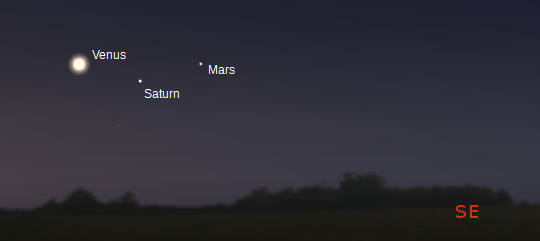
What the morning planets might appear as at 6:30 tomorrow morning, March 31, 2022. They may be brighter than they actually appear. Created using Stellarium.
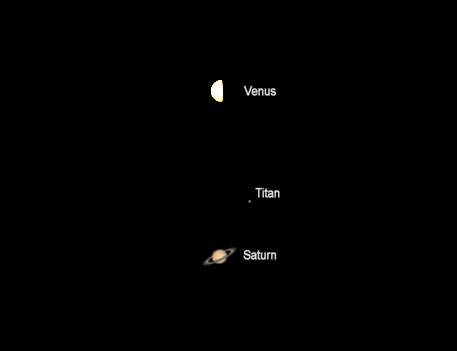
Telescopic views of the Venus and Saturn (north up) as they would be seen in a small telescope, with the same magnification, tomorrow morning at 6:30 am, March 31, 2022. I do not show planets less than 10 seconds of arc in diameter. Apparent diameters: Venus 23.52″, 55.0% illuminated; Saturn 15.78″, its rings 36.76″. Mars is not shown, its apparent diameter is 5.18″ and is 91.7% illuminated. The ” symbol means seconds of arc (1/3600th of a degree.) Created using Cartes du Ciel (Sky Charts).
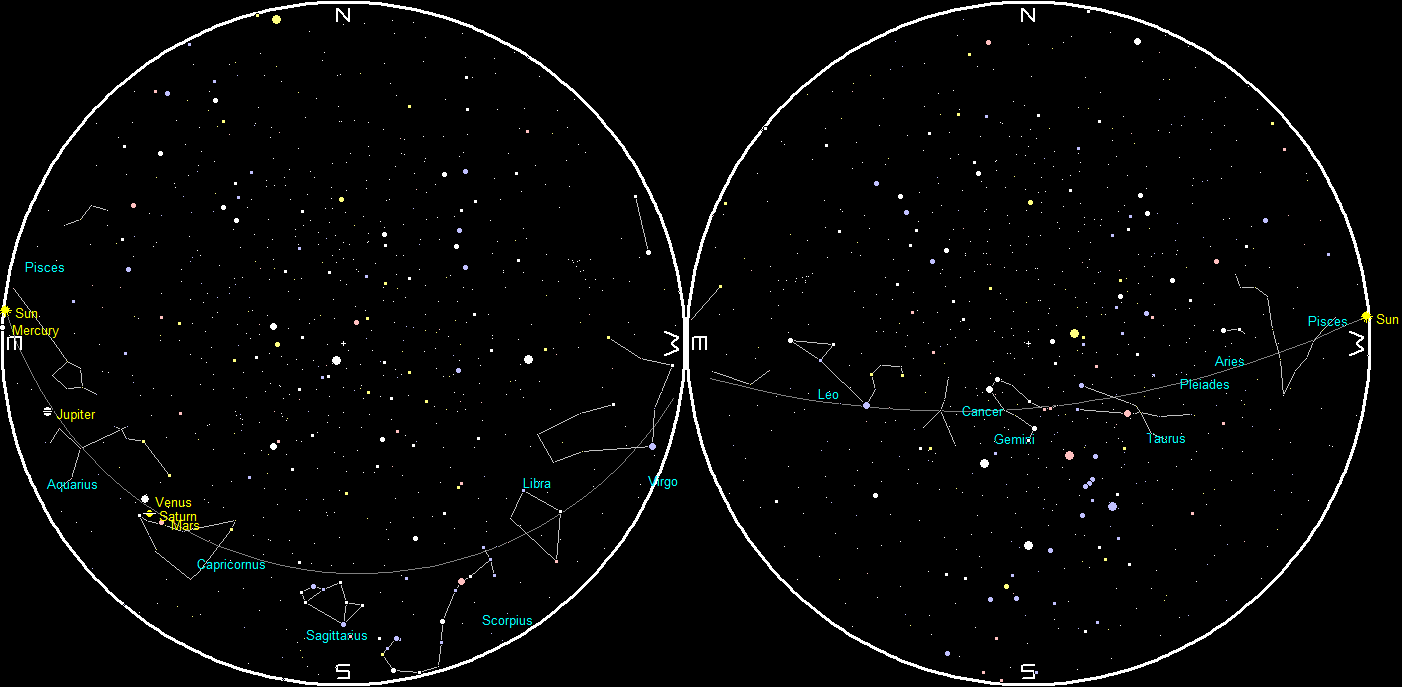
The naked-eye planets and the Moon at sunset and sunrise on a single night, starting with sunset on the right on March 30, 2022. The night ends on the left with sunrise on the 31st. Notice that all the naked-eye planets are in the morning sky now, with the Moon still hanging out in the evening sky. Click on the image to enlarge it. Created using my LookingUp program.
03/08/2022 – Ephemeris – It’s International Women’s Day
03/29/2022 – Ephemeris – Finding zodiacal light
This is Ephemeris for Tuesday, March 29th. Today the Sun will be up for 12 hours and 37 minutes, setting at 8:06, and it will rise tomorrow at 7:27. The Moon, 3 days before new, will rise at 7:10 tomorrow morning.
The evening sky will stay dark for the rest of the week, so it’s time to look for the zodiacal light in the evening. It is a faint but towering glow that can be seen after the end of astronomical twilight on moonless nights. It is seen in the west in the evening in late winter and early spring. The axis of the glow is the ecliptic, the apparent annual path of the Sun in the sky, along which lie the constellations of the zodiac. It’s a glow whose wide base is in the west that extends upwards and to the left. Right now, the end of astronomical twilight is about 9:49 p.m. and advancing at a rate of a minute or two each night. Go to a spot with a dark western sky, no big cities or towns out that way. Zodiacal light is caused by dust spread out around the Sun.
The astronomical event times given are for the Traverse City/Interlochen area of Michigan (EDT, UT – 4 hours). They may be different for your location.
Addendum
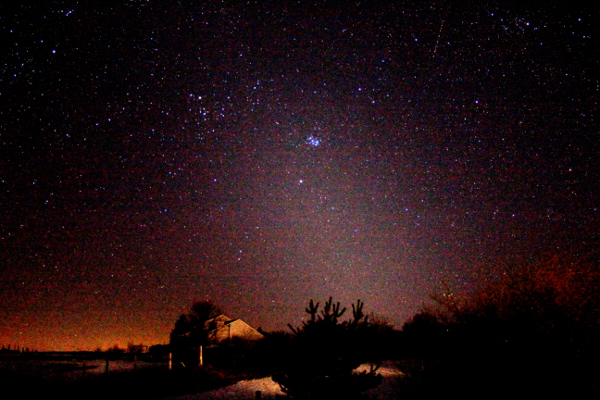
The western sky at 10:22 pm, March 25, 2019. Mars appears below the Pleiades in zodiacal light. Credit, mine – Canon EOS Rebel T5, 18mm f.l., f/3.5, 8 sec. ISO 12,800.
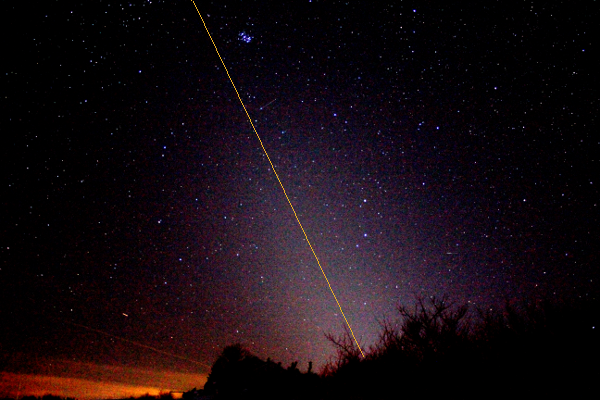
I’ve added the approximate ecliptic line from an image I took from a year earlier.
My article in April’s Stellar Sentinel, the newsletter of the Grand Traverse Astronomical Society, about zodiacal light.
One of the hardest of the night sky phenomena to spot is zodiacal light. The top picture above is my last photo of the zodiacal light. The photo is showing it brighter than it looks to the naked eye.
Zodiacal light is seen in the west in the evening in late winter and early spring and in the east in the morning in late summer and early autumn. The axis of the glow is near the ecliptic, the plane of the Earth’s orbit, along which lie the constellations of the zodiac.
This glow seems to have been first recorded by the Arabs around 630 CE. It was first recognized as a morning phenomenon as a false dawn, appearing before the first real glow of astronomical twilight. This false dawn was a big deal for the Islamic faithful, whose morning prayers must be made after the true dawn, or astronomical twilight, when the center of the Sun is 18° below the horizon.
How I usually recognize that I’m looking at the zodiacal light is kind of like not seeing the forest for the trees. That is, in certain parts of the sky, the sky doesn’t seem as dark as other parts. It helps to know where the zodiacal light is supposed to be. Once found, you’ll know what to look for, so finding it in the future will be easier.
In February 2017, on a relatively warm, but clear night, I went out to the Dune Climb at the Sleeping Bear Dunes. Part of the parking lot was plowed. I set up my tracking mount with my 5” scope that had a camera mount to photograph Orion and the Milky Way around Cassiopeia, Perseus and Taurus.
Having not thought about zodiacal light at the time, but while examining and processing the images later on, I began to notice that parts of the sky background not associated with the Milky Way were not as dark as I expected. It was on the side of the Milky Way closest to the ecliptic. These were telephoto shots, so the pyramidal shape of zodiacal light was not apparent. However, in recreating the sky at the time of the observations using Stellarium, it confirmed that it was the area where zodiacal light would be present.
What causes zodiacal light? The cause is dust, micron sized dust from comets and asteroids. Most of these lie in and near the plane of the solar system, which is why zodiacal light is centered on the ecliptic and the constellations of the zodiac and increases in brightness toward the Sun.
The free planetarium program Stellarium (stellarium.org) has added a zodiacal light effect in recent releases. Click on the Sky and viewing options icon at the left edge of the window, In the Sky tab there is a checkbox for zodiacal light and an intensity value to be selected. In order to see the effect, the Atmosphere icon at the bottom of the viewing window must be turned off. The effect is very subtle.
It is best seen around the vernal equinox in the evening and autumnal equinox tn the morning because at these times the ecliptic is closest to vertical. In the evening it tilts to the left, in the morning it tilts to the right. The closer one is to the equator, the more vertical the zodiacal light will appear. It would be a year-round phenomenon for observers in the tropics.
As an aside, Brian May, lead guitarist for the rock band Queen, with an uncanny resemblance to Sir Isaac Newton, earned a PhD in astrophysics in 2007 with his dissertation: A Survey of Radial Velocities in the Zodiacal Dust Cloud. It analyzed the motions of the particles of dust that make up the zodiacal dust cloud, which produces zodiacal light.
The best time to see this phenomenon will be the last week of March to the first few days of April 2022, before the Moon is a couple of days old.
 Bob Moler's Ephemeris Blog