12/21/2021 – Ephemeris – Winter starts today as the Sun starts coming back up north
This is Ephemeris for Tuesday, December 21st. Today the Sun will be up for 8 hours and 48 minutes, setting at 5:05, and it will rise tomorrow at 8:17. The Moon, 3 days past full, will rise at 7:11 this evening.
The thermometer and snowfall tell us that winter ought to be here. Well, it will be at 10:59 this morning. At that point, the Sun will be directly over the Tropic of Capricorn at 23 ½ degrees south latitude. It’s an odd name because 2,000 years ago the Sun was in indeed entering Capricornus. Now it’s entering Sagittarius, right above the spout of the teapot asterism we know so well in summer. From then on the Sun will be climbing up the sky each noon until June 21st next year when summer will start. To which I say Go Sun Go! The Sun will almost make it up to 22 degrees above the southern horizon at local noon, which is 12:40 pm, in Interlochen and be out for only 8 hours and 48 minutes. If it stayed that low all year, we’d be in a deep freeze, possibly colder than Antarctica.
The astronomical event times given are for the Traverse City/Interlochen area of Michigan (EST, UT – 5 hours). They may be different for your location.
Addendum
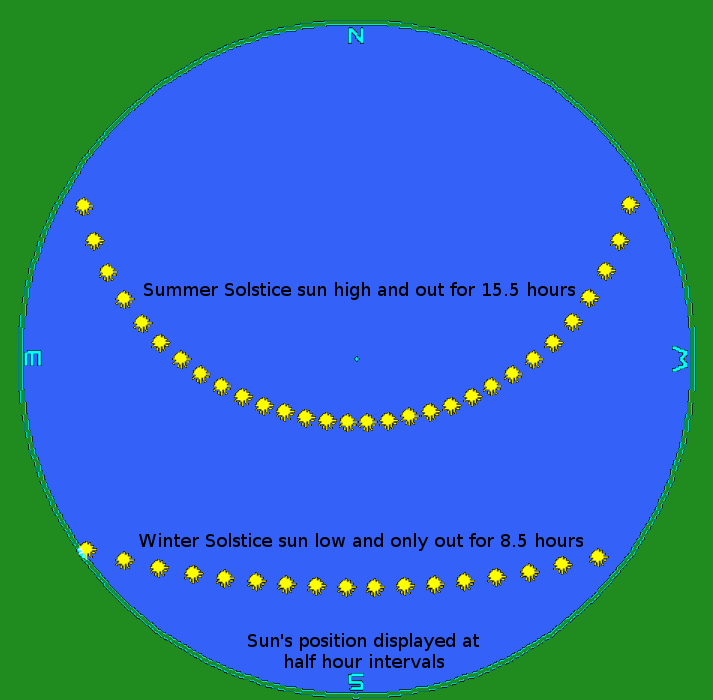
Comparing the sun’s path at the summer and winter solstices in Traverse City, MI, located near 45 degrees north latitude. This is a stereographic representation of the whole sky, which distorts the sky and magnifies the size of the sun’s path near the horizon.
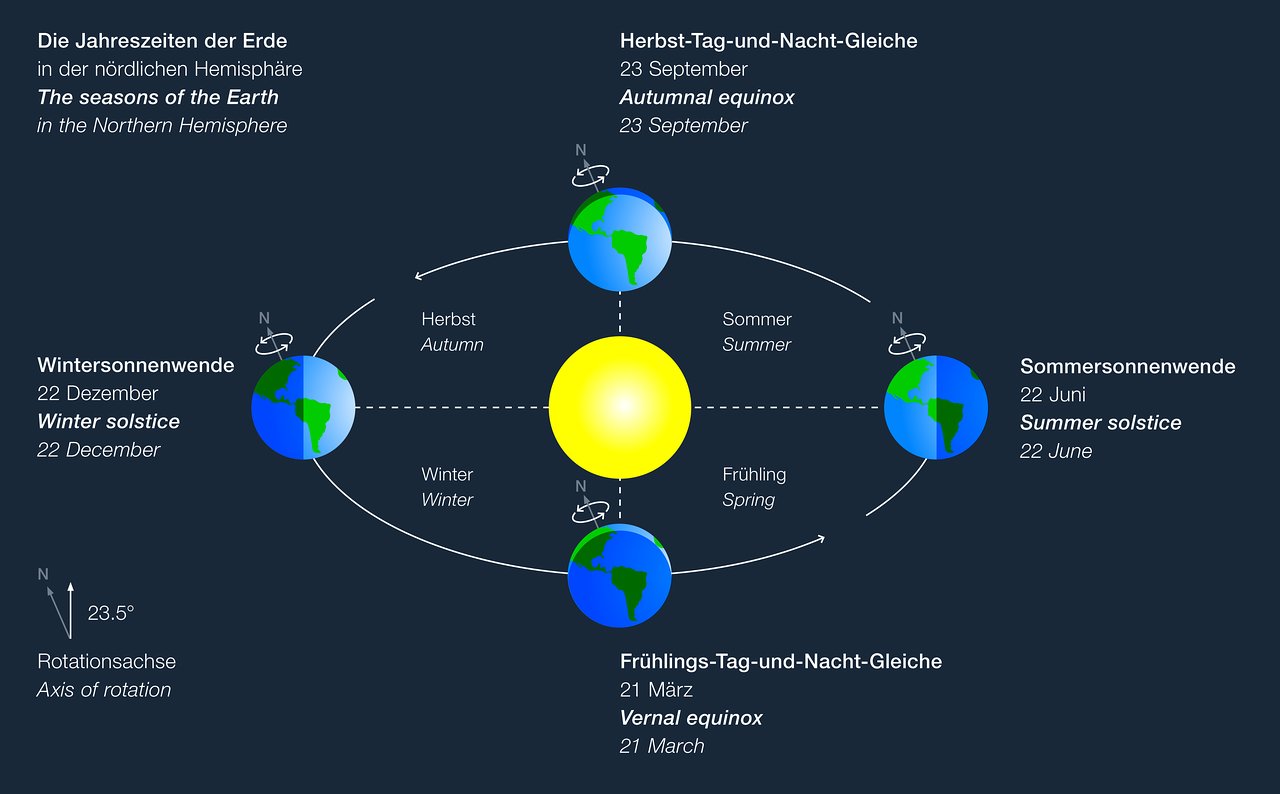
Earth’s position at the solstices and equinoxes. This is a not to scale oblique look at the Earth’s orbit, which is nearly circular. The Earth is actually farthest from the Sun on July 4th, and closest on January 3, next year. Click on the image to enlarge. Credit: ESO (European Southern Observatory), which explains the captions in German and English.
Of course, the winter solstice for us is the summer solstice for folks in the Southern Hemisphere. Solstice is “Sun stand still”. The Sun has been moving southward in the sky at noon since June, and today has stopped, and will now start heading northward again.
12/20/2021 – Ephemeris – Could the Star of Bethlehem have been a triple conjunction of Jupiter and Saturn in 7 BCE?
This is Ephemeris for Monday, December 20th. Today the Sun will be up for 8 hours and 48 minutes, setting at 5:04, and it will rise tomorrow at 8:17. The Moon, 2 days past full, will rise at 6:12 this evening.
This year we have two bright evening Christmas stars, Venus and Jupiter. But what about the one described in the Bible, in the Gospel of Matthew? We will look today at the first of two events that may have been recorded as the Star of Bethlehem. In 7 BCE there was a rare event over 6 months when three times the planet Jupiter passed Saturn against the stars of the constellation Pisces. Could the Persian astrologer priests, called Magi, have read into the event enough significance to start the journey to Jerusalem in search of the newborn King of the Jews? It was the scribe’s readings that sent them to Bethlehem. Jupiter, Saturn and Pisces all may have had significance to the Magi.
The astronomical event times given are for the Traverse City/Interlochen area of Michigan (EST, UT – 5 hours). They may be different for your location.
Addendum
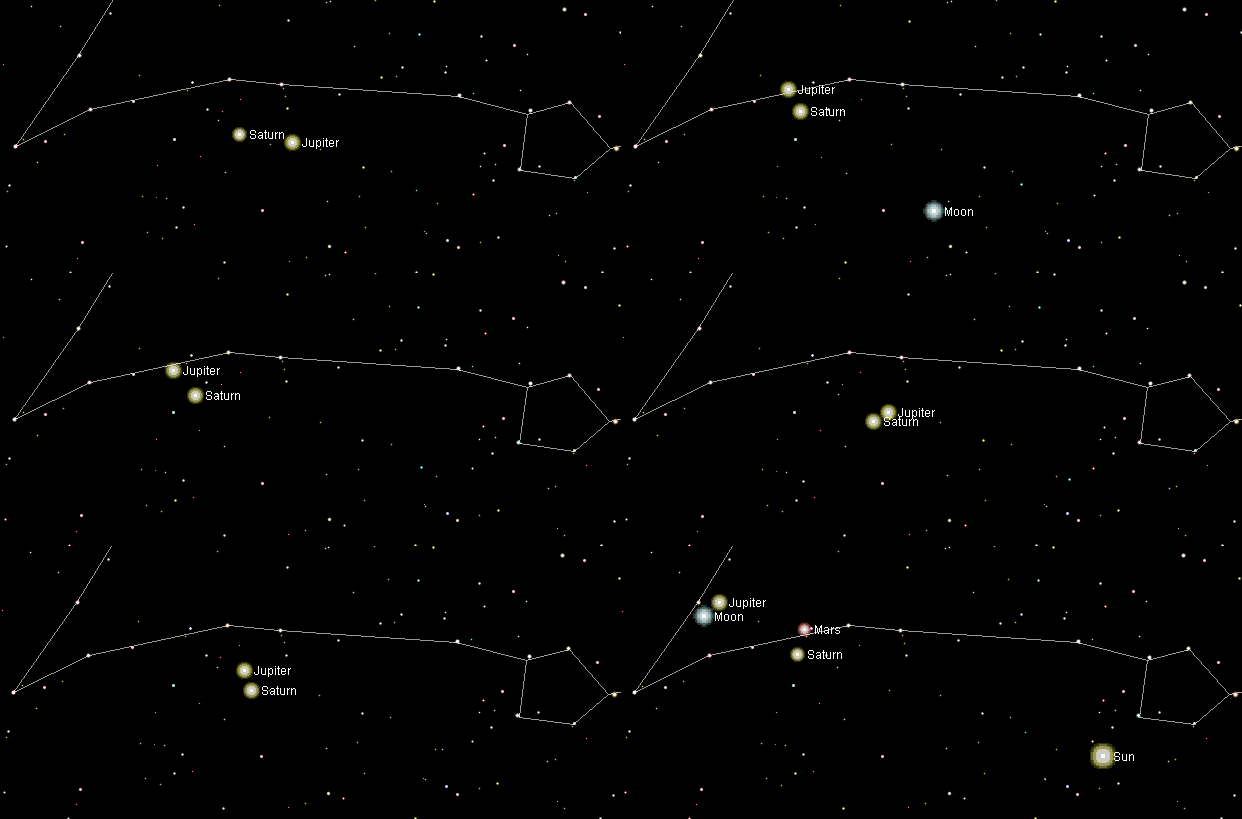
Jupiter and Saturn pass each other three times from May to December in 7 BC. Created using Cartes du Ciel (Sky Charts) and GIMP.
This timing of the Star is based on the Jewish historian Josephus, dating the death of Herod the Great just before a lunar eclipse. The eclipse most historians accept was the one on March 13, 4 BCE. So Jesus could have been born in 6 BCE.
I have been giving a presentation to the Grand Traverse Astronomical Society every other December since the 1980s on the Star of Bethlehem, tweaking it each time, and completely rewriting it a few times. Below is my script from my 2020 program In Search of the Star of Bethlehem for the Grand Traverse Astronomical Society. It has small thumbnails of the slides. The name says notes, but it evolved into a complete script, and is laid out to be read that way.
Star of Bethlehem 2020 Notes (PDF)
In the presentation, I cover another possibility for the “Star”, which I happen to like more. I’ll talk about that on Christmas Eve. If you can’t wait, check out the PDF, or a prior December program in the Archives.
12/17/2021 – Ephemeris – Artemis-1 mission may launch in less than 2 months
This is Ephemeris for Friday, December 17th. Today the Sun will be up for 8 hours and 48 minutes, setting at 5:03, and it will rise tomorrow at 8:15. The Moon, 1 day before full, will set at 7:56 tomorrow morning.
In a little less than two months, a fifteen-day launch window opens up to launch Artemis one, the first and hopefully only uncrewed Artemis mission to the Moon in the NASA’s program to land the next man and first woman on the Moon. The uncrewed Orion capsule and the ESA contributed Service Module will orbit the Moon in a very elongated distant orbit of the Moon, retreating out to 38,000 miles (61,000 kilometers) further than the Moon once or twice before heading within 60 miles of the Moon’s surface on its way back to the Earth. The upper stage, that sends Orion on its way to the Moon, will release some CubeSats as it follows Orion to the Moon, where it will whip around the Moon to orbit the Sun.
The astronomical event times given are for the Traverse City/Interlochen area of Michigan (EST, UT – 5 hours). They may be different for your location.
Addendum
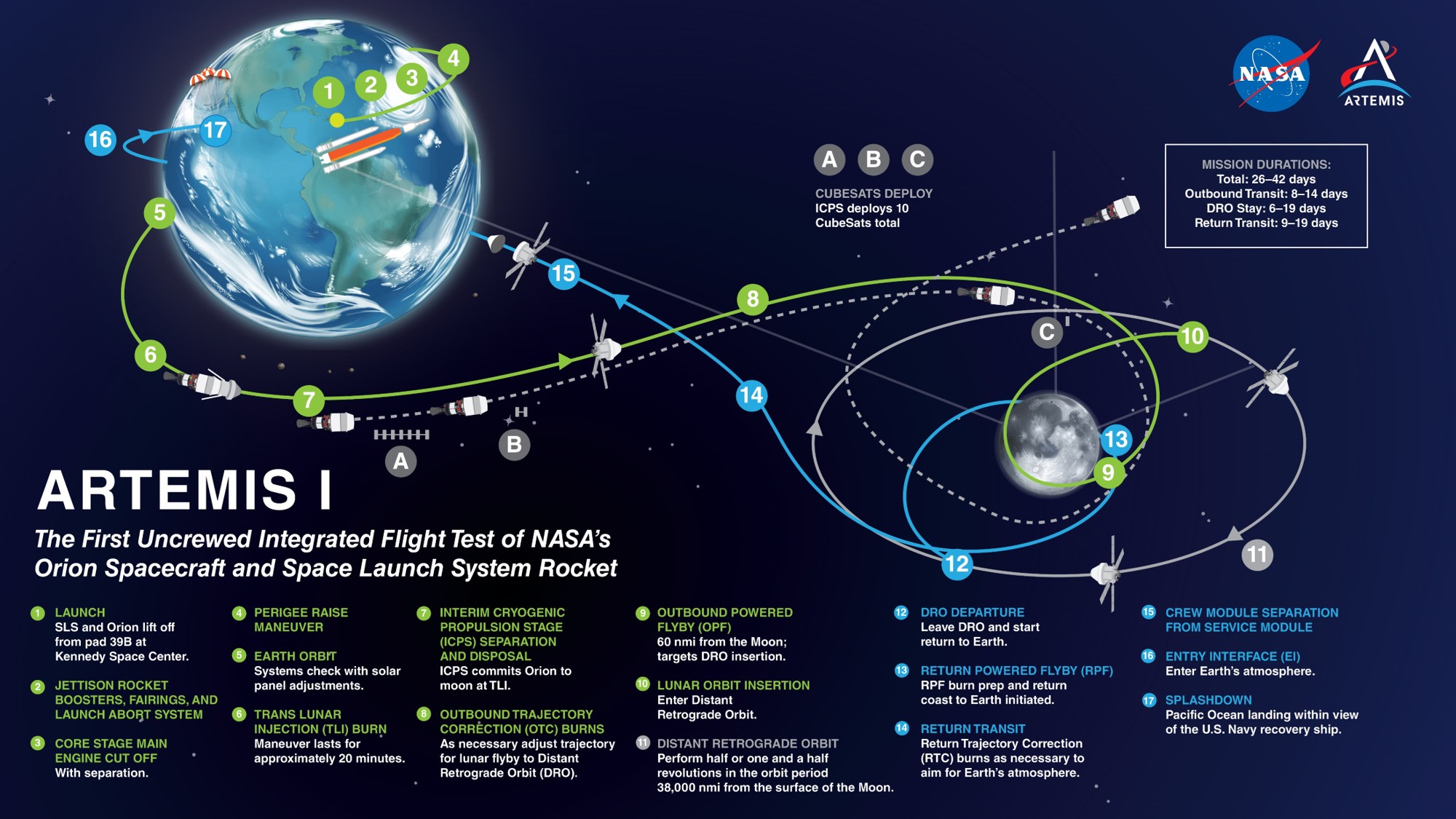
Artemis-1 orbital plan. Click on the image to enlarge it. Credit NASA.

The Earth and Moon to scale. Source Wikipedia.
12/16/2021 – Ephemeris – The brightest spot on the Moon
This is Ephemeris for Thursday, December 16th. Today the Sun will be up for 8 hours and 49 minutes, setting at 5:03, and it will rise tomorrow at 8:14. The Moon, 2 days before full, will set at 6:53 tomorrow morning.
The Moon tonight is bright. The sunrise line or terminator on the moon is crossing the large gray plain called Oceanus Procellarum, the largest of the moon’s seas. These seas were figments of the first telescopic observers imagination. They are really huge impact basins into which interior lava flowed. On the upper left edge of the moon near the terminator is a bright spot visible in binoculars. In a telescope, it is a crater called Aristarchus. It is a fairly new crater, probably less than a billion years old. As a rule the brighter the crater the newer it is. Aristarchus is the brightest spot on the moon. Over the years, visual astronomers have seen hazes and bright spots from time to time in and near Aristarchus. Their cause is still a mystery.
The astronomical event times given are for the Traverse City/Interlochen area of Michigan (EST, UT – 5 hours). They may be different for your location.
Addendum
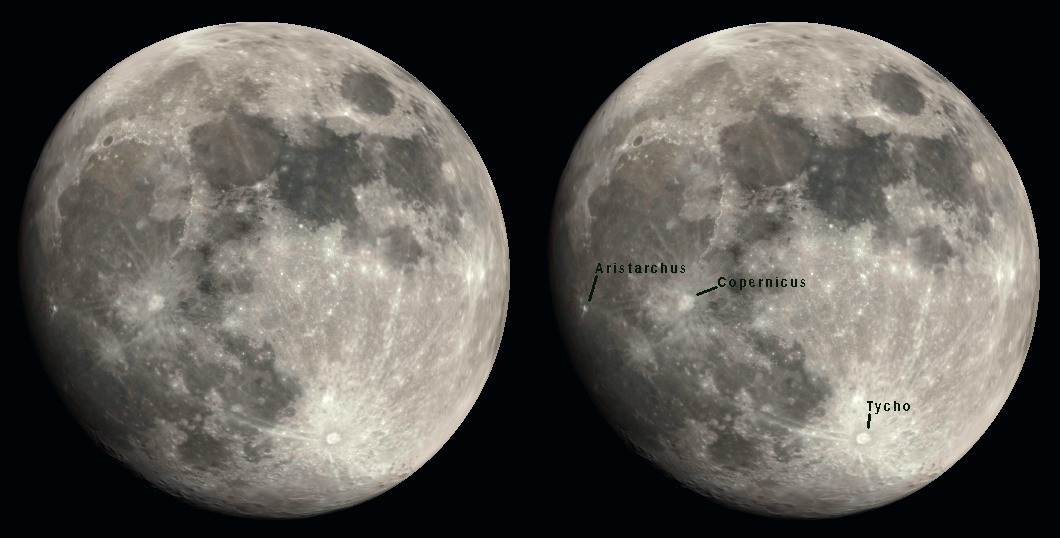
The brightest spots on the Moon as they might appear tonight, December 16, 2021. This is not a photograph. But created using Stellarium, presumably from lunar satellite photographs that simulate the phase and shadows.
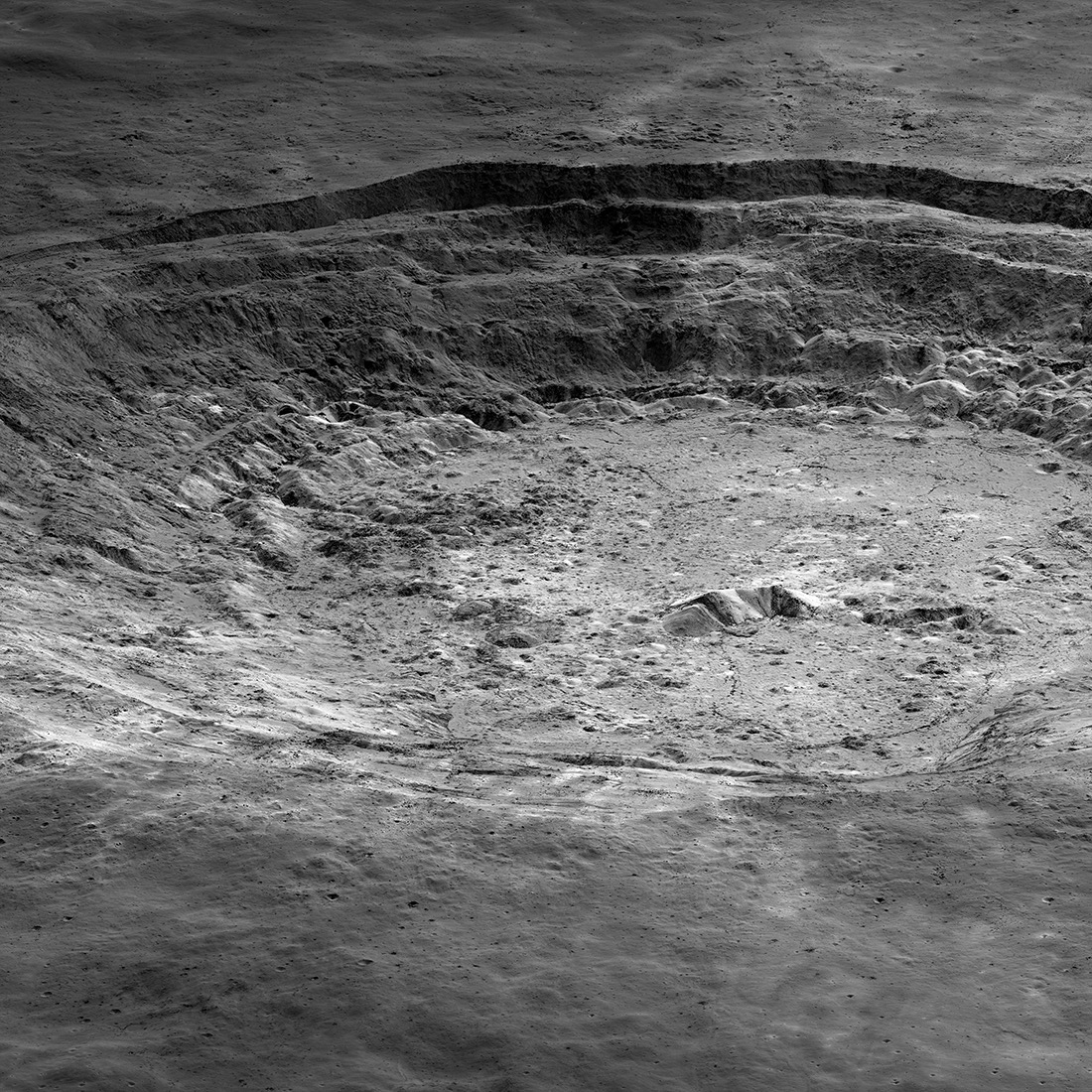
Oblique view of the crater Aristarchus from a lunar orbiting satellite. Credit: NASA/GSFC/Arizona State University.
12/15/2021 – Ephemeris – Let’s search for the naked-eye planets for this week
This is Ephemeris for Wednesday, December 15th. Today the Sun will be up for 8 hours and 49 minutes, setting at 5:02, and it will rise tomorrow at 8:14. The Moon, 3 days before full, will set at 5:50 tomorrow morning.
Let’s search for the naked-eye planets for this week. Venus will be visible in the southwestern evening twilight by 5:30 tonight. It’s a crescent in telescopes, and even binoculars now. It is moving closer to us, and now appears larger than Jupiter in telescopes. Venus will set at 7:27 pm, 14 minutes earlier than it set a week ago, which means that the Sun is catching up with it faster and faster. It has only 24 days left in the evening sky, though it might be hard to spot by the end of the month. By 5:45 pm, both Jupiter and Saturn should be able to be spotted in the southwestern sky. Saturn will be dimmer, and to its lower right, halfway between it and Venus. Saturn will set at 8:41 pm, with Jupiter following an hour and a half later at 10:12 pm.
The astronomical event times given are for the Traverse City/Interlochen area of Michigan (EST, UT – 5 hours). They may be different for your location.
Addendum
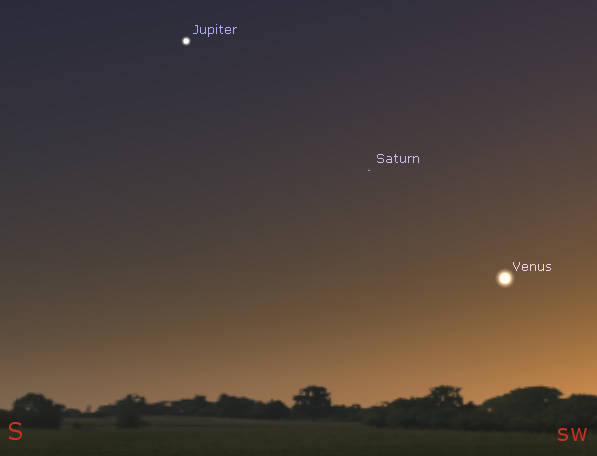
The evening planets, Venus, Saturn and Jupiter in the southwestern at 5:45 pm Tonight, December 15, 2021. Created using Stellarium.
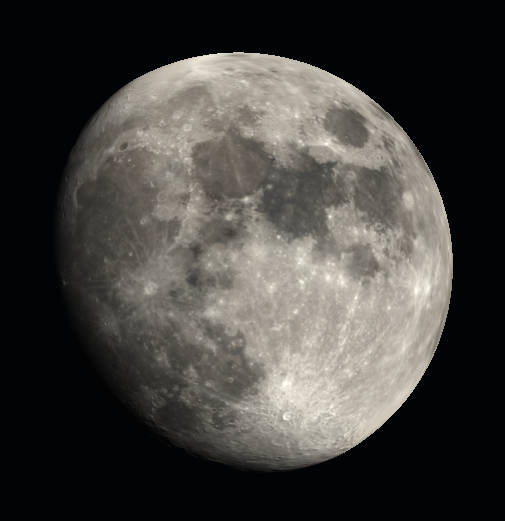
The waxing gibbous Moon, seen at 6 pm tonight, December 15, 2021. Created using Stellarium.
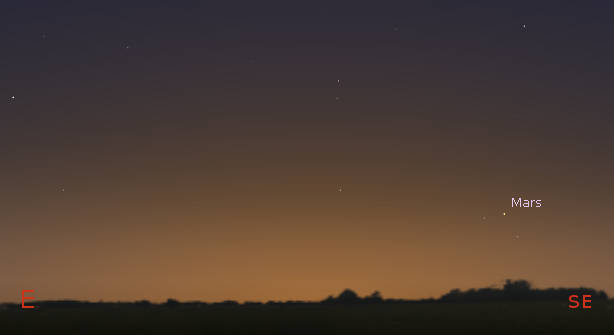
Mars, seen low in the southeast at 7:20 am tomorrow morning, December 16, 2021. Mars was not covered in the recorded program due to time constraints and the fact that Mars, still far away on the other side of the Sun, is only second magnitude and difficult to spot. It will rise at 6:25 am. Created using Stellarium.
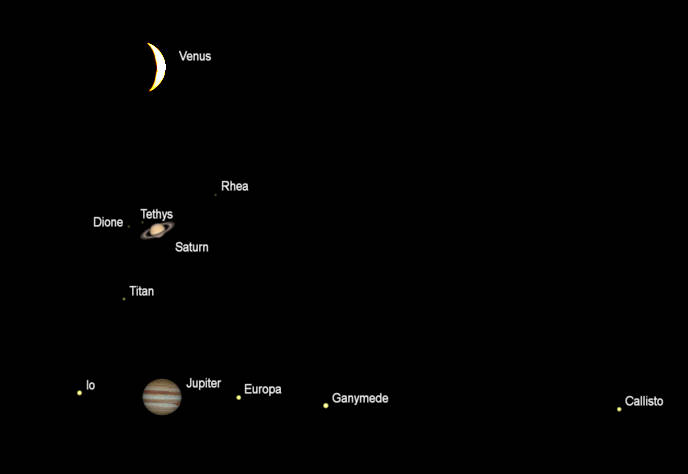
Telescopic views of the bright planets and their brighter moons (north up) as they would be seen in a small telescope, with the same magnification, this evening at 7 pm, December 15, 2021. Apparent diameters: Venus, 49.50″, 15.5% illuminated; Saturn 15.71″, its rings 36.59″; Jupiter, 36.80″. Mars is not shown, its apparent diameter is 3.87″. The ” symbol means seconds of arc (1/3600th of a degree.) Created using Cartes du Ciel (Sky Charts).
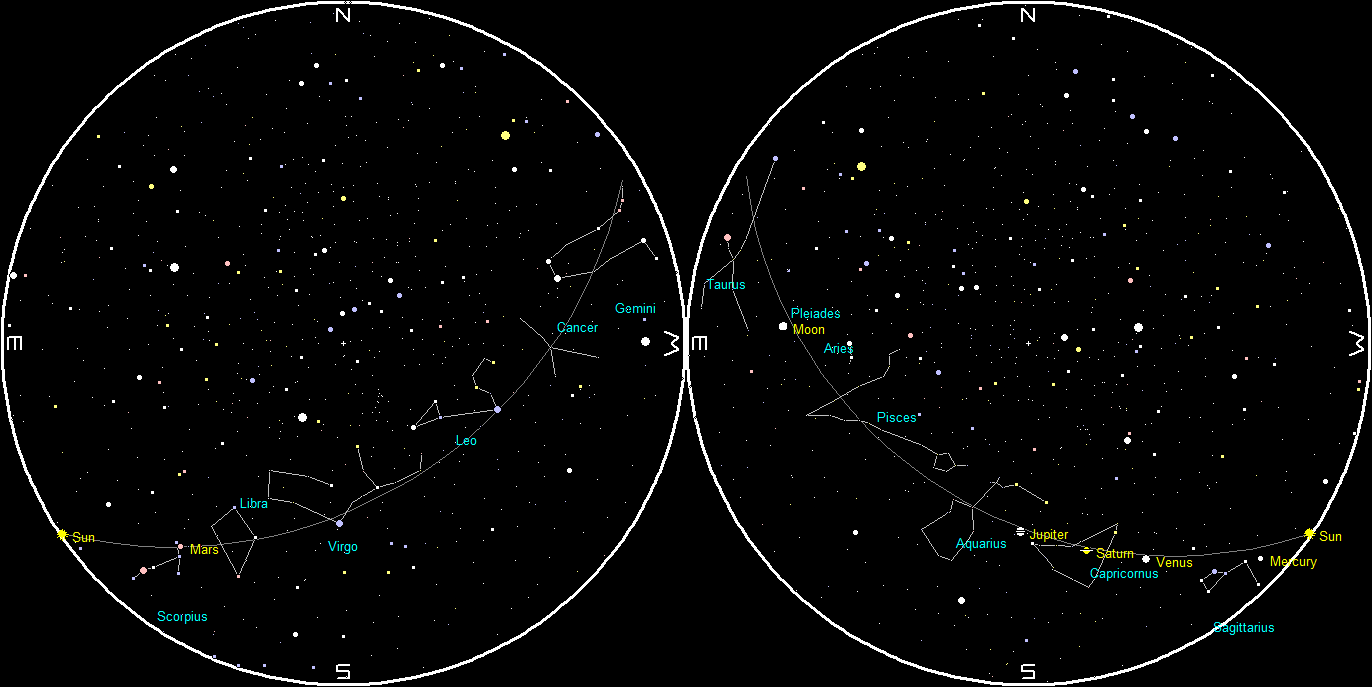
The naked-eye planets and the Moon at sunset and sunrise on a single night, starting with sunset on the right on December 15, 2021. The night ends on the left with sunrise on the 16th. Click on the image to enlarge it. Created using my LookingUp program.
12/14/2021 – Ephemeris – The Moon tonight will reveal more than you think
This is Ephemeris for Tuesday, December 14th. Today the Sun will be up for 8 hours and 49 minutes, setting at 5:02, and it will rise tomorrow at 8:13. The Moon, halfway from first quarter to full, will set at 4:45 tomorrow morning.
The gibbous Moon tonight is revealing a bit more of itself. In binoculars the dark oval spot visible on the Moon’s right side is the Sea of Crises or Mare Crisium a small dark lava plain. The Moon’s rotation is quite uniform, however its orbit isn’t circular, so the Moon’s face seems to rock a bit back and forth over the month. It’s an effect called libration. And one way to track that is to note how close the Sea of Crises is to the edge of the Moon. Right now that sea is as far from the Moon’s right edge or limb as it gets, and reveals two other seas in the edge: Mare Marginis, the Border Sea, and Mare Smythi, Smith’s Sea.
The astronomical event times given are for the Traverse City/Interlochen area of Michigan (EST, UT – 5 hours). They may be different for your location.
Addendum
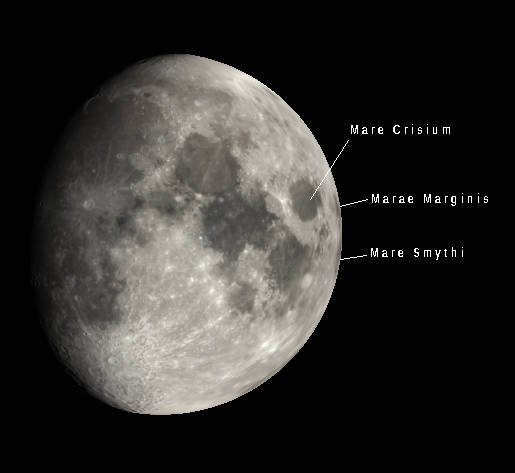
The Moon showing Maria Marginis and Smythi past Mare Crisium at 9 pm tonight, December 14, 2021. Created using Stellarium.
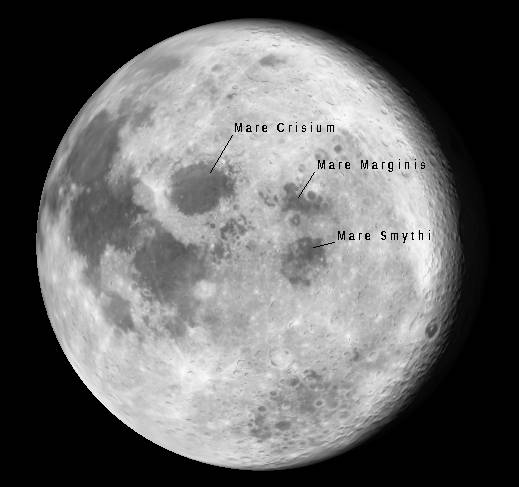
The Moon, seen as if flying over the border area of what we could see from the Earth. To the left is the Moon’s near side. To the right is the far side to the terminator or sunset line. Created using Virtual Moon Atlas.
Both the Stellarium and Virtual Moon Atlas apps are free. Links to them are elsewhere on this page.
12/13/2021 – Ephemeris – The Geminid Meteor Shower reaches its peak tomorrow morning
This is Ephemeris for Monday, December 13th. Today the Sun will be up for 8 hours and 50 minutes, setting at 5:02, and it will rise tomorrow at 8:12. The Moon, 3 days past first quarter, will set at 3:41 tomorrow morning.
Tomorrow morning we will have the chance to see near the peak of the Geminid meteor shower after the Moon sets. Some of its members can be seen tonight, in the bright moonlight. This shower is currently besting the Perseid meteor shower of August, with a predicted 120 meteors per hour tomorrow morning. The problems for us in viewing this fabulous shower, beside the bright Moon this year, are the cold temperatures and usually cloudy skies. The source of the Geminids was discovered in 1983. It is a probably burnt out comet with the asteroid designation 3200 Phaethon, which swoops down to only 13 million miles of the Sun. Some call it a rock comet. The Geminids were first seen in 1862.
The astronomical event times given are for the Traverse City/Interlochen area of Michigan (EST, UT – 5 hours). They may be different for your location.
Addendum
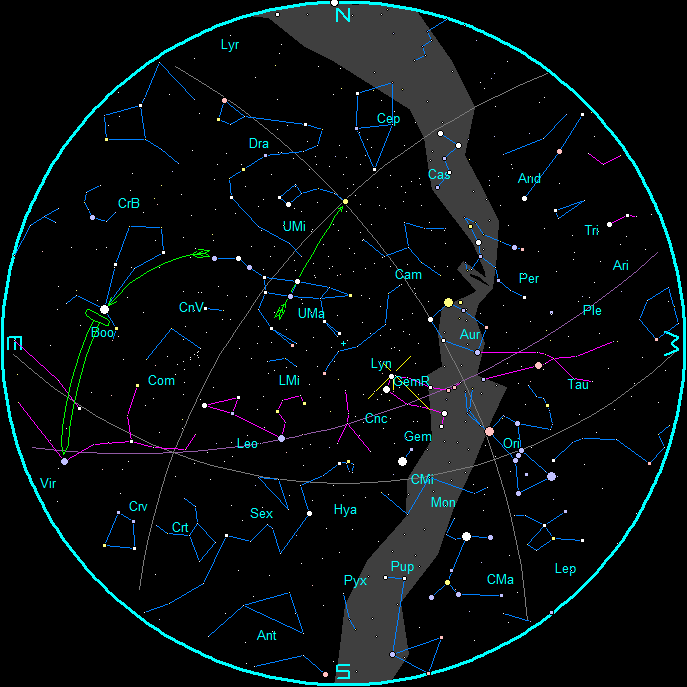
An all sky view at 4 am, December 14th, 2021, showing the radiant for the Geminid meteor shower. The meteors will be seen all over the sky. Their trails, however, can be traced back to their radiant. The radiant is marked on the chart as GemR, near the star Castor in Gemini. The sky at that hour is that of the evening sky of early spring. Created using my LookingUp program.
For a list of constellation names to go with the abbreviations, click here.
- Pointer stars at the front of the bowl of the Big Dipper point to Polaris, the North Star.
- Follow the arc of the handle of the Big Dipper to the star Arcturus, then
- Follow the spike to Spica.
12/10/2021 – Ephemeris – Our last look at Comet Leonard before it leaves forever*
This is Ephemeris for Friday, December 10th. Today the Sun will be up for 8 hours and 52 minutes, setting at 5:02, and it will rise tomorrow at 8:10. The Moon, at first quarter today, will set at 12:25 tomorrow morning.
This is the day of the earliest sunset of the year. It doesn’t coincide with the shortest day because the Earth is moving faster in its orbit than average and getting ahead of its rotation a bit. Comet Leonard’s last appearance in the morning sky is tomorrow or Sunday before twilight overwhelms it. At 6:30 am it will be just a bit south of due east at azimuth 93 degrees and an altitude of 9 degrees, a bit less than the width of a fist held at arm’s length. When it gets into the evening sky, its track will take will be along the horizon from the southwest to the south. It will come very close to Venus, and I suspect that is what will alter its orbit slightly, so it will never return and end up becoming an interstellar comet.
The astronomical event times given are for the Traverse City/Interlochen area of Michigan (EST, UT – 5 hours). They may be different for your location.
* After this weekend, the comet will enter the evening sky, but will hang quite low to the horizon in evening twilight as it passes Venus, heads southward and fades. It would best be viewed by observers in the Southern Hemisphere. It’s headed out of the solar system in a hyperbolic orbit.
Addendum
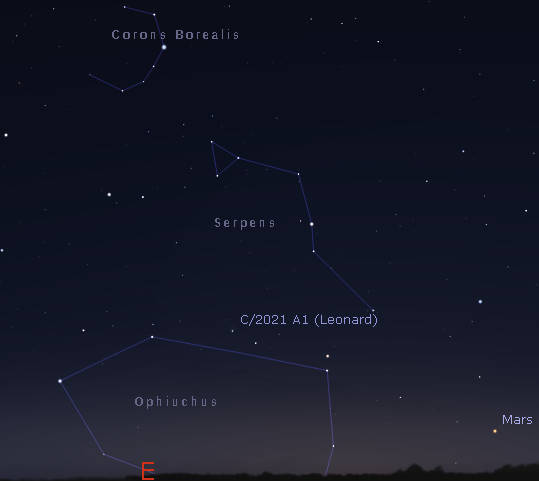
Comet Leonard (C/2021 A1) finder chart for 7:00 am, December 11, 2021. The comet’s tail may not be visible visually. The comet’s head, what astronomers call a coma, may appear as a large fuzzy spot. At that time it will be 22.1 million miles away, and will come within 21.7 million miles at its closest to us on the 12th. Created using Stellarium.
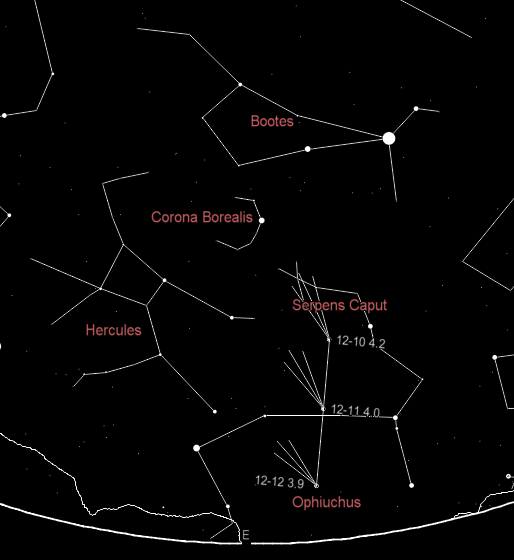
Comet Leonard’s positions at 7:15 am on the dates indicated. The labels are Month-Day Total Magnitude. The star’s position relative to the horizon and the position of Mars are for December 10th. The star field will be shifting to the upper right each morning at 7:15 from the December 10th date at 7:15. Comets always appear dimmer than their magnitude suggests because they are extended objects, not points like stars. Also, comet magnitudes can be unpredictable. Created using Cartes du Ciel (Sky Charts).
12/09/2021 – Ephemeris – Comet Leonard and the Oort Cloud
This is Ephemeris for Thursday, December 9th. Today the Sun will be up for 8 hours and 53 minutes, setting at 5:02, and it will rise tomorrow at 8:09. The Moon, 1 day before first quarter, will set at 11:14 this evening.
Comet Leonard will only be available to be spotted for the next two mornings. After that, it will be too close to the direction of the Sun to be spotted. It came in from hundreds of times the Earth’s distance from the Sun from a spherical area around the solar system call the Oort cloud. This area, proposed as a source of comets, was named after Dutch astronomer, Jan Oort, who hypothesized its existence. Near as we can tell, Comet Leonard had been falling toward the Sun for 40,000 years. Tomorrow morning the comet will be nearly 30 degrees below and a bit left of the bright star Arcturus from 6:00 to 7 am tomorrow morning. 30 degrees is three times the width of one’s fist held at arm’s length.
The astronomical event times given are for the Traverse City/Interlochen area of Michigan (EST, UT – 5 hours). They may be different for your location.
Addendum
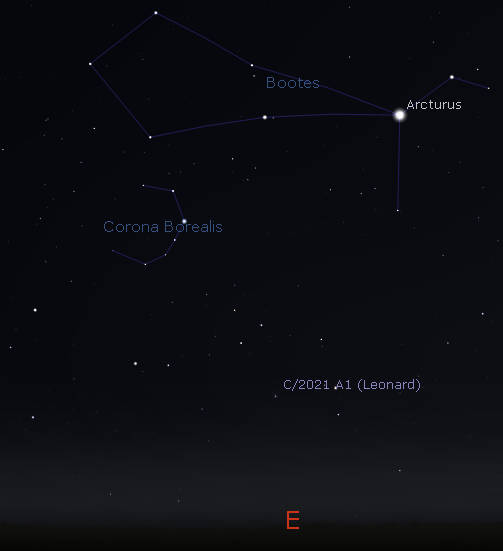
Comet Leonard (C/2021 A1) finder chart for 6:00 am, December 10, 2021. The comet’s tail may not be visible visually. The comet’s head, what astronomers call a coma, may appear as a large fuzzy spot. At that time it will be 23.1 million miles away, and will come within 21.7 million miles at its closest to us on the 12th. Created using Stellarium.
Comet Leonard’s positions at 7:15 am on the dates indicated. The labels are Month-Day Total Magnitude. The star’s position relative to the horizon and the position of Mars are for December 10th. The star field will be shifting to the upper right each morning at 7:15 from the December 10th date at 7:15. Comets always appear dimmer than their magnitude suggests because they are extended objects, not points like stars. Also, comet magnitudes can be unpredictable. The tails shown here simply show the direction of the tail, which will be very short, if visible at all visually. Created using Cartes du Ciel (Sky Charts).
12/08/2021 – Ephemeris – Let’s search for the naked-eye planets and a comet for this week
This is Ephemeris for Wednesday, December 8th. Today the Sun will be up for 8 hours and 54 minutes, setting at 5:02, and it will rise tomorrow at 8:08. The Moon, 2 days before first quarter, will set at 10:00 this evening.
Let’s search for the naked-eye planets for this week. Venus will be visible in the southwestern evening twilight by 5:30 tonight. It’s a crescent in telescopes. It is moving closer to us, and now appears larger than Jupiter in telescopes. Venus will set at 7:41 pm. By 5:45 pm, both Jupiter and Saturn should be able to be spotted in the southwestern sky. Saturn will be dimmer, and to its lower right, between it and Venus. It will set at 9:05 pm, with Jupiter following an hour and a half later at 10:34 pm. Comet Leonard can be spotted with binoculars about 19 degrees below and a bit left of the bright star Arcturus in the east from 6 to 7am tomorrow morning. 19 degrees is a bit less than two widths of a fist held at arm’s length. The comet will move lower each morning.
The astronomical event times given are for the Traverse City/Interlochen area of Michigan (EST, UT – 5 hours). They may be different for your location.
Addendum
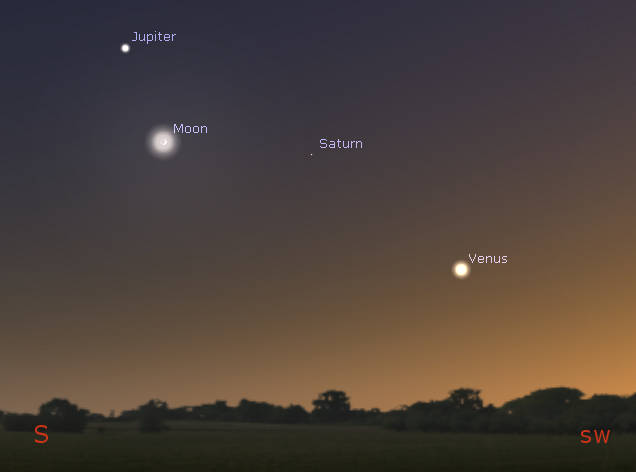
The evening planets Venus, Saturn, the Moon and Jupiter at 5:45 pm this evening, December 8, 2021. Created using Stellarium.
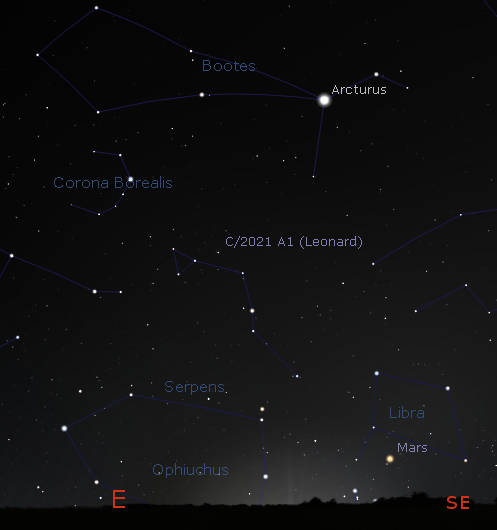
Comet Leonard and Mars at 7:15 am tomorrow morning, December 9, 2021. Though technically visible to the naked eye, binoculars will be needed for most of us. Mars is now visible low in the southeast at that time. Created using Stellarium.
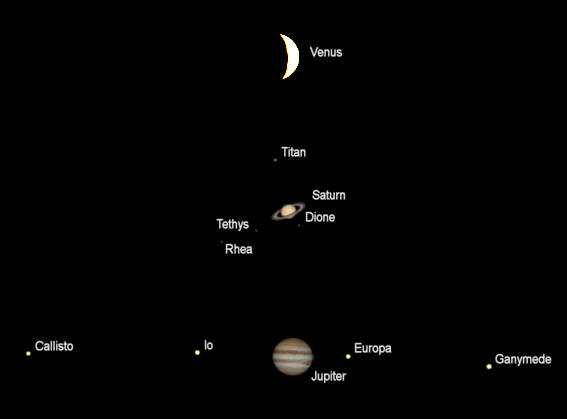
Telescopic views of the bright planets (north up) as they would be seen in a small telescope, with the same magnification, this evening at 6 pm, December 8, 2021. Apparent diameters: Venus, 44.08″, 21.5% illuminated; Saturn 15.84″, its rings 36.90″; Jupiter, 37.51″. Mars is not shown, its apparent diameter is 3.82″. The ” symbol means seconds of arc (1/3600th of a degree.) Created using Cartes du Ciel (Sky Charts).
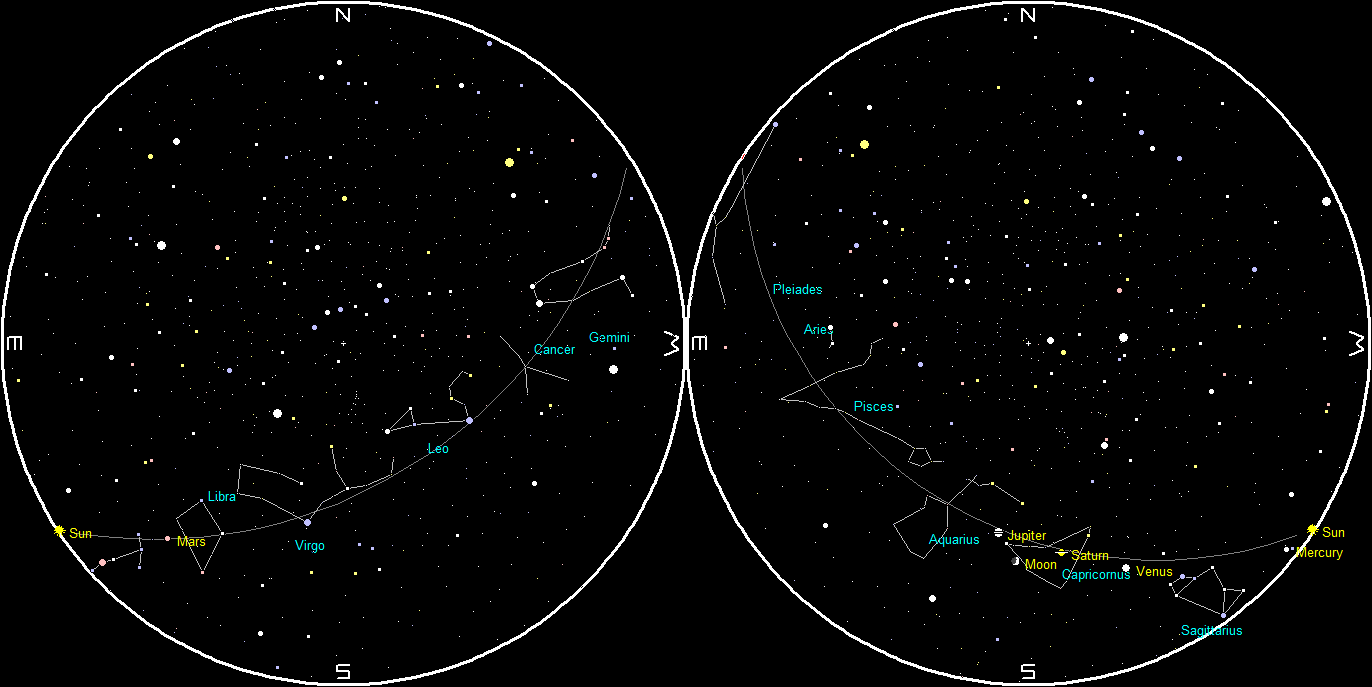
The naked-eye planets and the Moon at sunset and sunrise on a single night, starting with sunset on the right on December 8, 2021. The night ends on the left with sunrise on the 9th. Click on the image to enlarge it. Created using my LookingUp program.
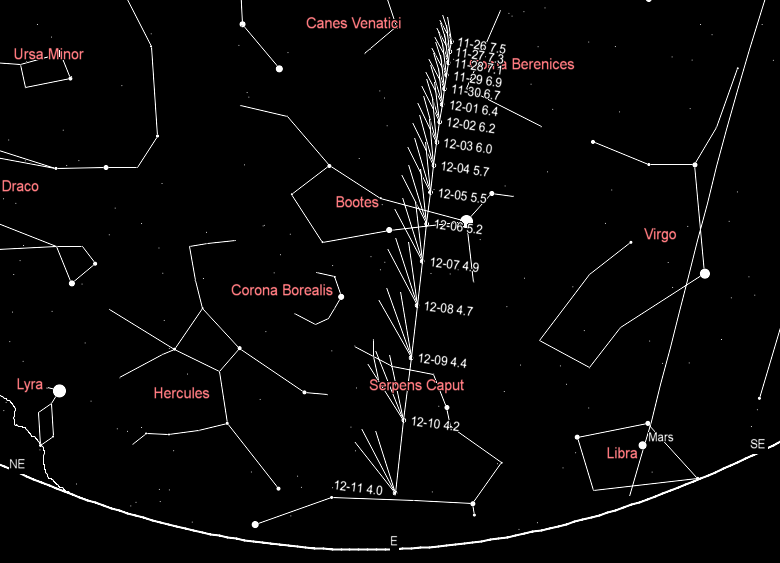
Comet Leonard’s positions at 6:30 am on the dates indicated. The labels are Month-Day Total Magnitude. The star’s position relative to the horizon and the position of Mars are for November 27th. The star field will be shifting to the upper right each morning at 6:30 from the November 27th date at 6:30. Comets always appear dimmer than their magnitude suggests because they are extended objects, not points like stars. Also, comet magnitudes can be unpredictable. Created using Cartes du Ciel (Sky Charts). I’ve reversed the colors from previous printings of this image. Reprinted from my article in the Stellar Sentinel, the newsletter for the Grand Traverse Astronomical Society.

