09/11/2020 – Ephemeris – A virtual star party tonight
This is Ephemeris for Friday, September 11th. Today the Sun will be up for 12 hours and 42 minutes, setting at 7:59, and it will rise tomorrow at 7:18. The Moon, 1 day past last quarter, will rise at 1:19 tomorrow morning.
The Grand Traverse Astronomical Society will host a virtual star party at 9 pm tonight. It is via the Zoom app for the smart phone, tablet or computer at zoom (dot) us. Instructions and a link can be found on the society’s website gtastro.org. It will be hosted by Dr. Jerry Dobek, astronomy professor at Northwestern Michigan College. During a virtual star party the images are produced real time or near real time using a telescope mounted CCD camera. That is if it’s clear. Images of dimmer objects like star clusters or nebulae, what we call DSOs or deep sky objects may take exposures of several seconds or minutes to build up an image. But have the advantage of being in color. If cloudy we’ll have a virtual, virtual star party.
The event times given are for the Traverse City/Interlochen area of Michigan. They may be different for your location.
09/10/2020 – Ephemeris – The bright star Deneb will pass overhead tonight, what does that mean?
This is Ephemeris for Thursday, September 10th. Today the Sun will be up for 12 hours and 45 minutes, setting at 8:01, and it will rise tomorrow at 7:17. The Moon, at last quarter today, will rise at 12:29 tomorrow morning.
Around 11 pm tonight the bright star Deneb in Cygnus the Swan and the northernmost star of the Summer Triangle will be overhead, or just about at the zenith. Just as on the Earth we have a coordinate system of longitude and latitude for position east-west and north-south, we have the same for the celestial sphere the imaginary sphere of the heavens east-west is called right ascension and north-south is declination. I’m going to ignore right ascension’s relation to longitude. Declination directly relates to latitude in that a star the with the same declination as your latitude will pass directly overhead. Deneb’s Declination is about 44 degrees 20 minutes north. Check the GPS on your smart phone to see how close your latitude is to that.
The event times given are for the Traverse City/Interlochen area of Michigan. They may be different for your location.
Addendum
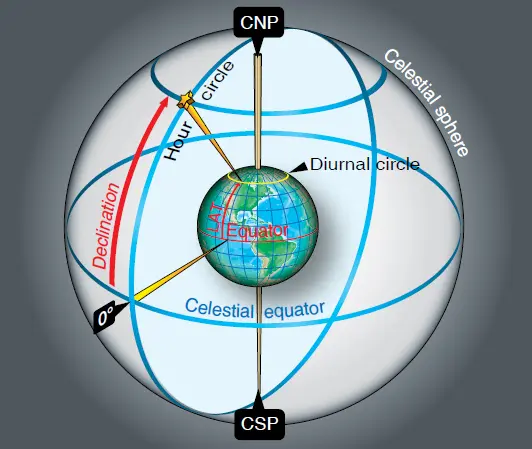
Celestial coordinates are actual projections of earthly coordinates. CNP = Celestial North Pole, CSP = Celestial South Pole are directly above the earthly poles. Same with Celestial Equator. Therefore a star or any celestial object passes overhead or at the zenith for locations with the same latitude on the Earth. That’s what the diurnal or daily circle is as the Earth rotates.
09/09/2020 – Ephemeris – Let’s look at a the naked-eye planets for this week
This is Bob Moler with Ephemeris for Wednesday, September 9th. Today the Sun will be up for 12 hours and 48 minutes, setting at 8:03, and it will rise tomorrow at 7:16. The Moon, 1 day before last quarter, will rise at 11:48 this evening.
Let’s look at a the naked-eye planets for this week. Jupiter and Saturn are both low in the southern sky at 10 pm. Jupiter is the very bright one. To the left of it will be the somewhat dimmer Saturn. They seem to be separating a teeny bit due to the Earth’s motion now, but they will cross paths in December. Both planets will be up until the morning hours with Jupiter setting first at 2:05 tomorrow morning and Saturn following at 2:47 am. The next planet visible will be Mars which will rise at 9:44 pm. Its now down to 43.3 million miles (69.7 million km) away, as the Earth slowly overtakes it at the rate of about 2.3 million miles (3.8 million km) a week as the Earth begins to pull abreast of it. Brilliant Venus will rise at 3:30 am as it retreats toward the Sun.
The event times given are for the Traverse City/Interlochen area of Michigan. They may be different for your location.
Addendum
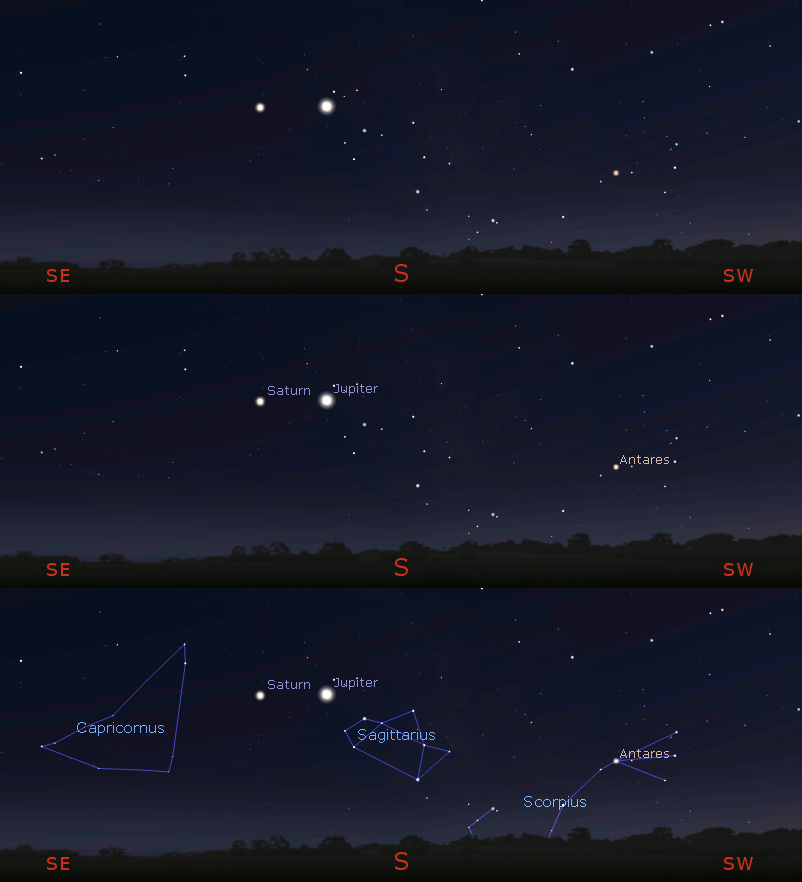
Jupiter and Saturn with the zodiacal constellations at 9 pm tonight September 9, 2020. Click on the image to enlarge. Created using Stellarium and GIMP.
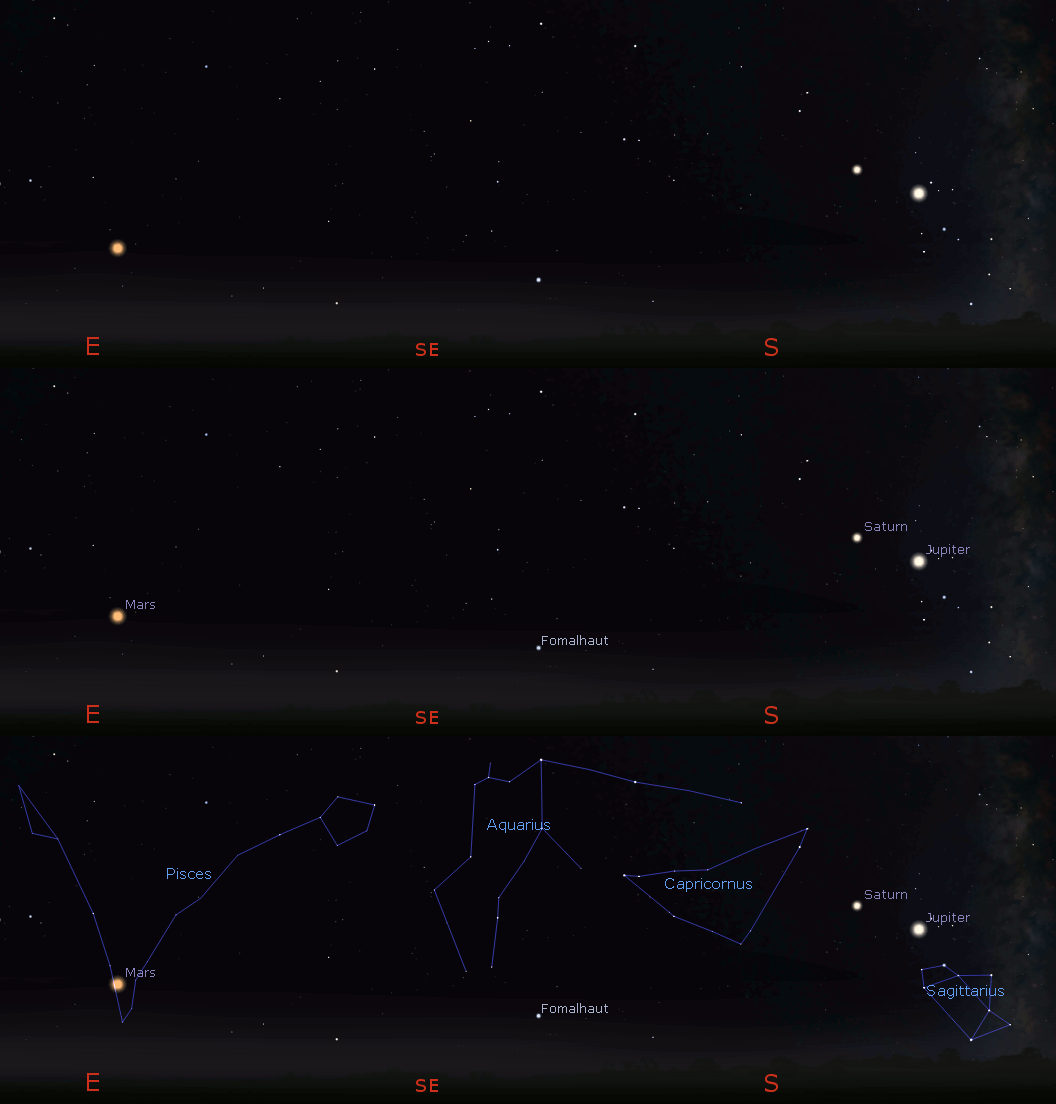
Jupiter, Saturn and Mars with the zodiacal constellations at 11 pm tonight September 9, 2020. Click on the image to enlarge. Created using Stellarium and GIMP.
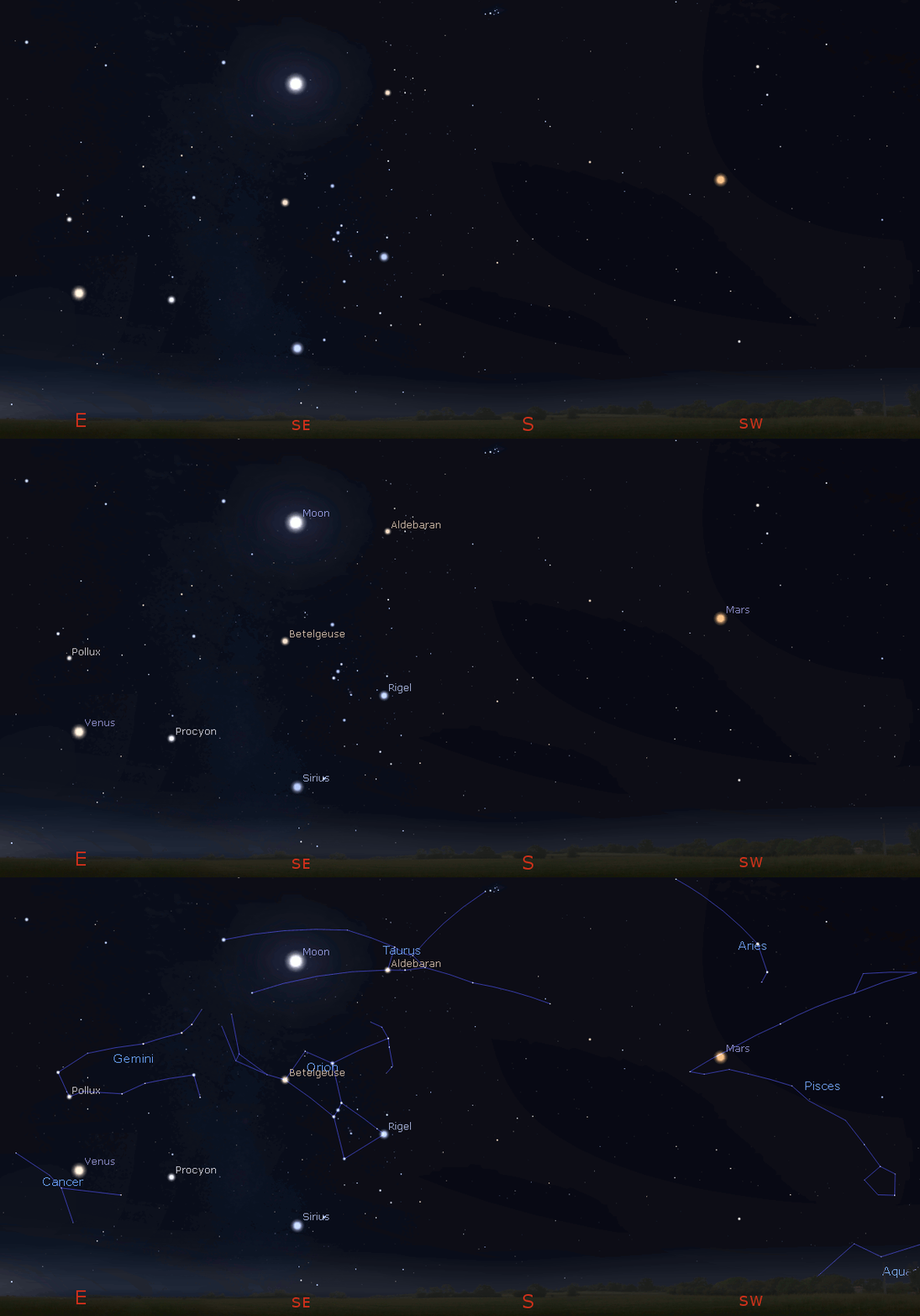
Mars, the Moon, Venus and the zodiacal constellations and Orion at 6 am tomorrow morning September 10, 2020. Click on the image to enlarge. Created using Stellarium and GIMP.
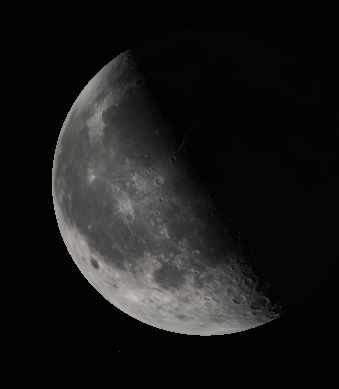
The last quarter Moon as it might be seen in binoculars at 6 am tomorrow September 10, 2020. Created using Stellarium.
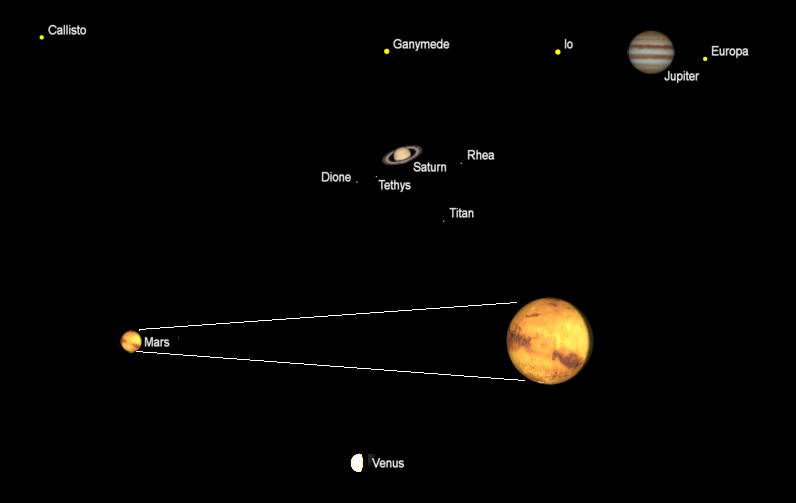
The planets as seen in a telescope (north up) with the same magnification for the night of September 9/10, 2020. Times of the display are: Jupiter and Saturn, 9 pm; Mars, Midnight; Venus, 6 am. Apparent diameters: Jupiter, 43.21″; Saturn, 17.77″, rings, 41.39″. Mars, 20.26″, and Venus 18.04″. Mars also displays an enlargement showing surface detail. The ” symbol means seconds of arc (1/3600th of a degree.) Created using Cartes du Ciel (Sky Charts).
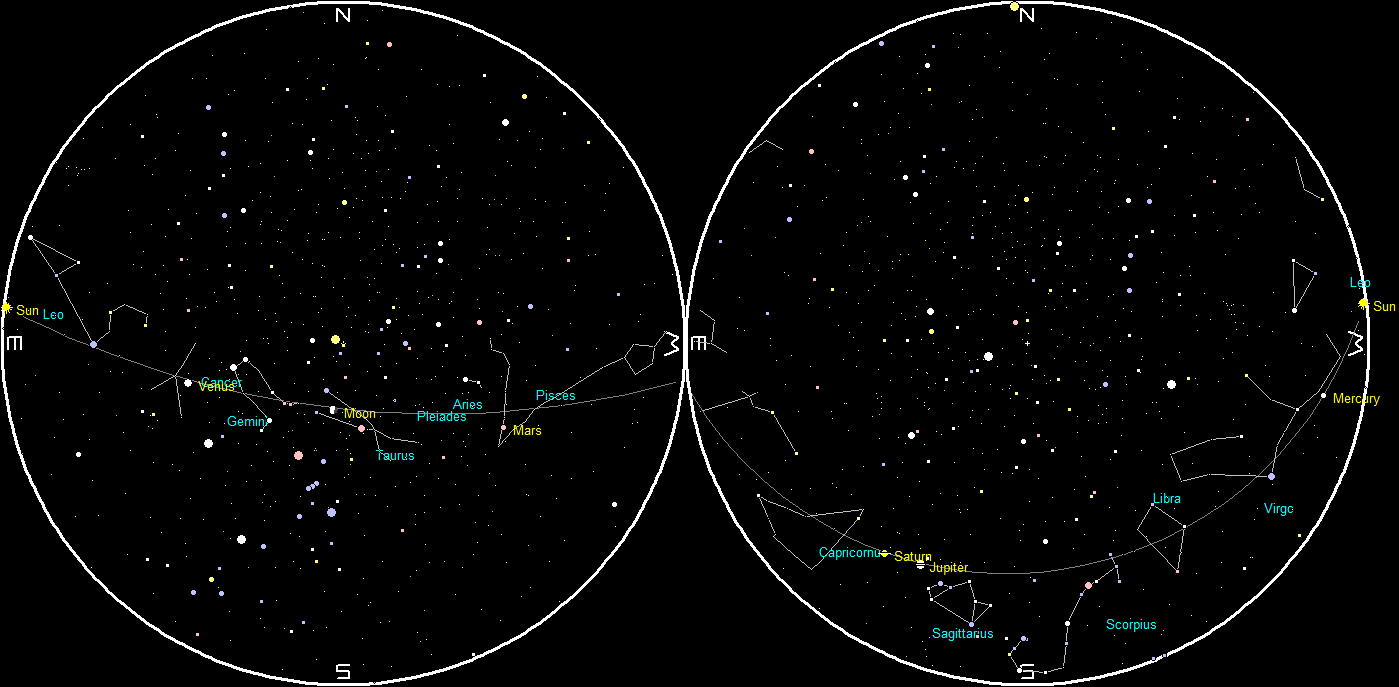
Planets and the Moon at sunset and sunrise of a single night starting with sunset on the right on September 9, 2020. The night ends on the left with sunrise on the 10th. Click on the image to enlarge. Created using my LookingUp program.
09/08/2020 – Ephemeris – The Anishinaabe folk saw a moose where we see Pegasus
This is Ephemeris for Tuesday, September 8th. Today the Sun will be up for 12 hours and 51 minutes, setting at 8:05, and it will rise tomorrow at 7:15. The Moon, 2 days before last quarter, will rise at 11:14 this evening.
Yesterday I talked a bit about the constellation of Pegasus the flying horse ascendant in the east these September evenings. The Anishinaabe peoples of our area had no horses until after the Europeans arrived, but they did imagine a large four legged mammal here, the Mooz or Moose, spelled M-o-o-z and pronounced something like Moonz*. The Moose is upright, or will be when he is in the south. In the evening now he is in the east, his body is a large square of stars we call the Great Square of Pegasus standing on one corner. From the top star extend his neck and head. His great antlers cover the official constellation of Lacerta the lizard made of a zigzag of unremarkable faint stars. Unlike Pegasus the whole moose made it into the sky.
The event times given are for the Traverse City/Interlochen area of Michigan. They may be different for your location.
Addendum
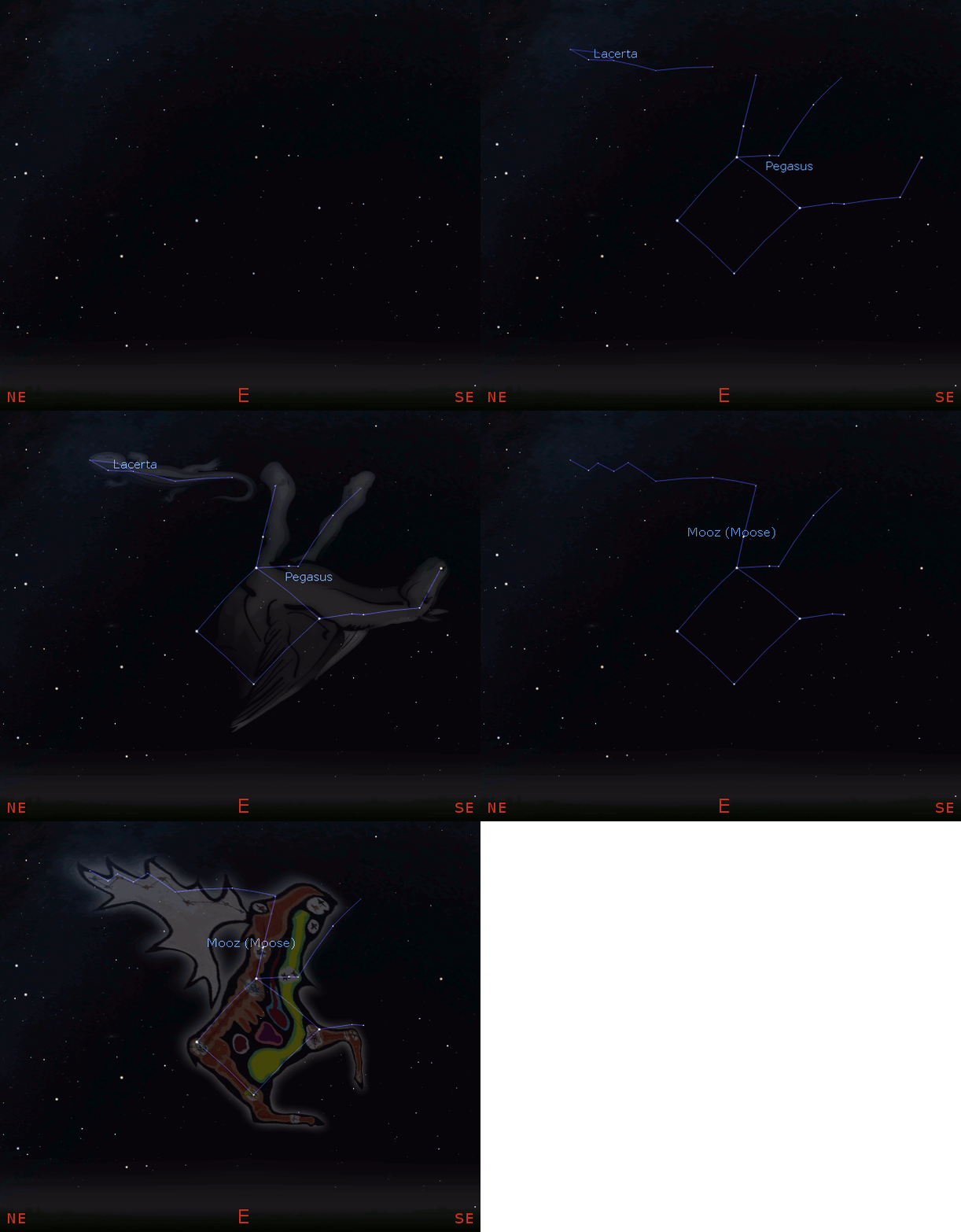
Mooz finder animation displaying both Western Pegasus and Lacerta constellations and Anishinaabe Mooz constellation for 10 pm in early September. Credit Stellarium (both star lore images are embedded in Stellarium). The Anishinaabe image is from Ojibwe Giizhig Anung Masinaaigan – Ojibiwe Sky Star Map created by A. Lee, W. Wilson, and C. Gawboy.
*Information on Mooz and its pronunciation can be found in the Ojibwe Peoples Dictionary at https://ojibwe.lib.umn.edu/main-entry/mooz-na. The language of the Ojibwe, Ojibwemowin is another name for Anishinaabemowin, the language of the Anishinaabe peoples.
09/07/2020 – Ephemeris – A first look at the autumn stars arriving: Cassiopeia and Pegasus
This is Ephemeris for Labor Day, Monday, September 7th. Today the Sun will be up for 12 hours and 54 minutes, setting at 8:07, and it will rise tomorrow at 7:14. The Moon, 3 days before last quarter, will rise at 10:46 this evening.
In the evening as summer wanes and the Sagittarius teapot tips its contents on the southwestern horizon the constellations of autumn rise in the east. There’s the W shape of Cassiopeia in the northeast, which is so far north it never really leaves us in northern Michigan. Pegasus the flying horse of Greek mythology is perhaps the most famous of the autumn constellations, and easiest to find. Its body, a large square of four stars, is in the east, standing on one corner. It is known as the Great Square of Pegasus. Only the front half of the horse is in the sky, and he’s flying upside down with his neck and head extending to the right from the rightmost star. His galloping front legs extend upward from the top star.
The event times given are for the Traverse City/Interlochen area of Michigan. They may be different for your location.
Addendum
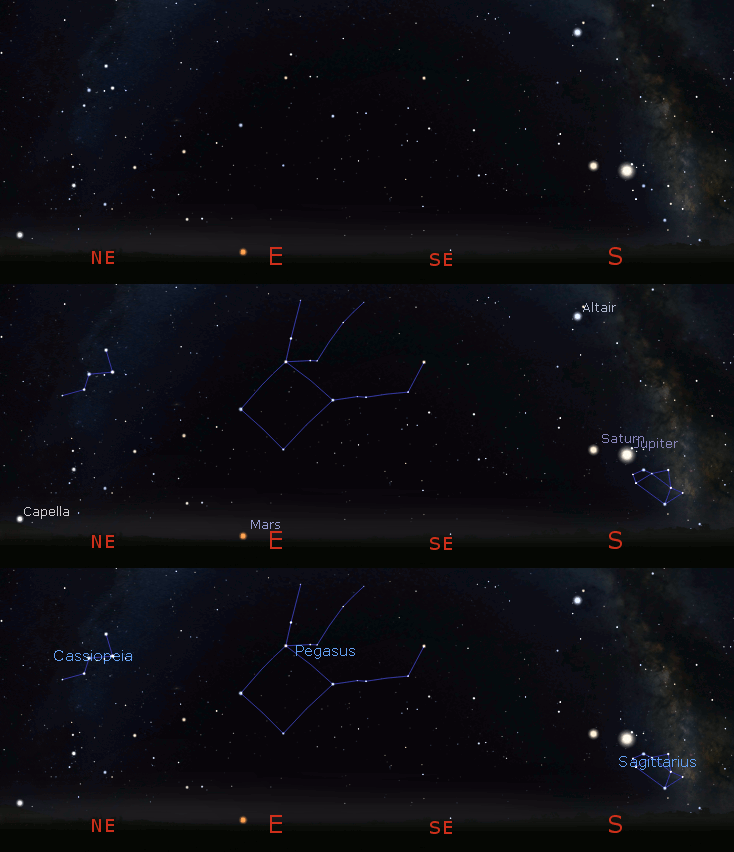
Northeast to southwest Panorama around the horizon at 10 pm tonight, September 7, 2020 showing the constellations discussed. Click on the image to enlarge. Created using Stellarium and GIMP.
09/04/2020 – Ephemeris – What area of the Moon is the Artemis program interested in?
This is Ephemeris for Friday, September 4th. Today the Sun will be up for 13 hours and 3 minutes, setting at 8:13, and it will rise tomorrow at 7:10. The Moon, 2 days past full, will rise at 9:40 this evening.
Where will Artemis missions land when they get to the Moon? The Apollo missions mostly landed on the flat lunar seas which were really lava plains. The Artemis missions are headed to the Moon’s south polar regions. The Moon, unlike the Earth has very little axial tilt, so some of the crater floors at the poles are forever in shadow and near absolute zero, so are cold traps for volatile matter like water. Satellites over the years have found hydrogen over the south pole of the moon hinting that there is water ice there from impacting comets. There’s also crater peaks that are always in sunlight where solar panels can be erected to provide power throughout the month long lunar day. On the Moon, water is more precious than gold. There’s water in them thar craters!
The event times given are for the Traverse City/Interlochen area of Michigan. They may be different for your location.
Addendum
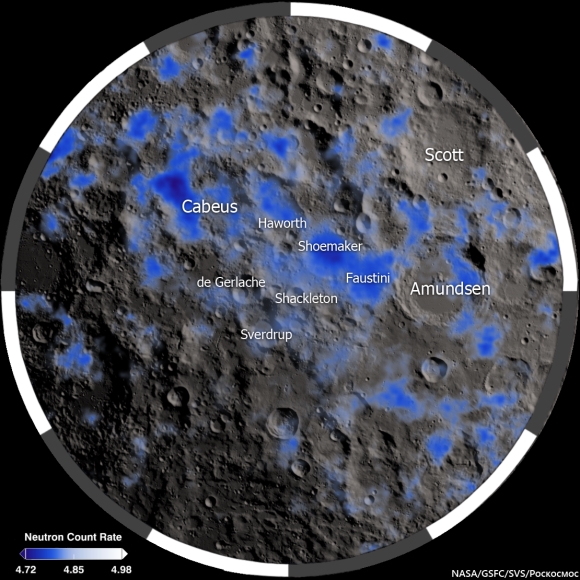
The south pole of the Moon where the presence of water ice is detected by the absorption of neutrons by the hydrogen atoms in the ice. Credit NASA/GSFC/SVS/Roscosmos. Notice a theme in the crater names here?
09/03/2020 – Ephemeris – Why is the new NASA Moon landing program called Artemis?
This is Ephemeris for Thursday, September 3rd. Today the Sun will be up for 13 hours and 6 minutes, setting at 8:14, and it will rise tomorrow at 7:09. The Moon, 1 day past full, will rise at 9:20 this evening.
Why is the new NASA crewed Moon landing program called Artemis? And why is it crewed, and not manned? Artemis was a Greek deity and Apollo’s twin sister. He was the god of the Sun and she was goddess, among other things, of the Moon. So she has a greater connection to the Moon than Apollo did. Spacecraft now-a-days are crewed, rather than manned to denote that both sexes are chosen to be astronauts in nearly equal numbers now. Of course that’s crewed spelled c-r-e-w-e-d, not c-r-u-d-e, though they sound the same. Deities of the Moon tend to be female be they Artemis, Cynthia, Luna, Selene, or Chang’e. Astronomers use Cynthia, Luna, and Selene (pronounced Sel-e-nae) in naming various aspects of the Moon and Chang’e is the goddess that the Chinese name their lunar landers after.
The event times given are for the Traverse City/Interlochen area of Michigan. They may be different for your location.
Addendum

The logo chosen by NASA for the Artemis Program. The blue crescent at the bottom represents the earth. The gray ball at the top is the Moon. The curved red path is the stylized return path from the Moon to the Earth of the Orion capsule. Credit: NASA.
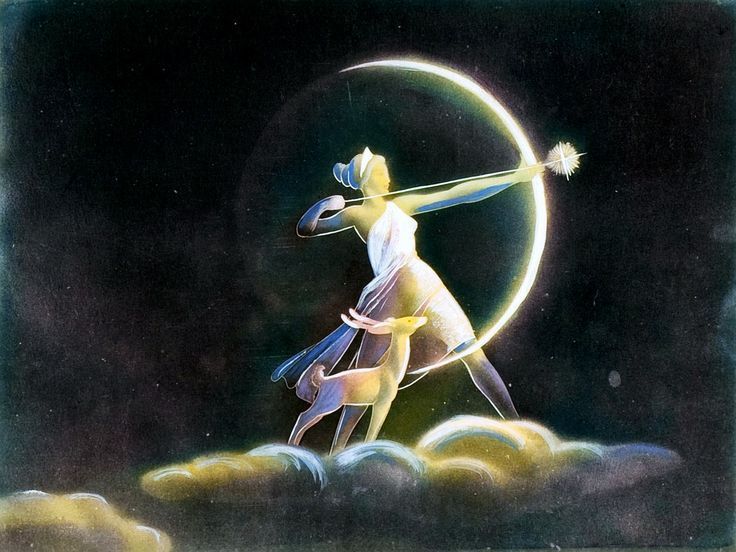
Artemis, goddess of the hunt and the Moon. Credit: Disney (Fantasia) source Daily Kos.
09/02/2020 – Ephemeris – Let’s look at a the naked-eye planets for this week
This is Ephemeris for Wednesday, September 2nd. Today the Sun will be up for 13 hours and 9 minutes, setting at 8:16, and it will rise tomorrow at 7:08. The Moon, at full today, will rise at 8:58 this evening.
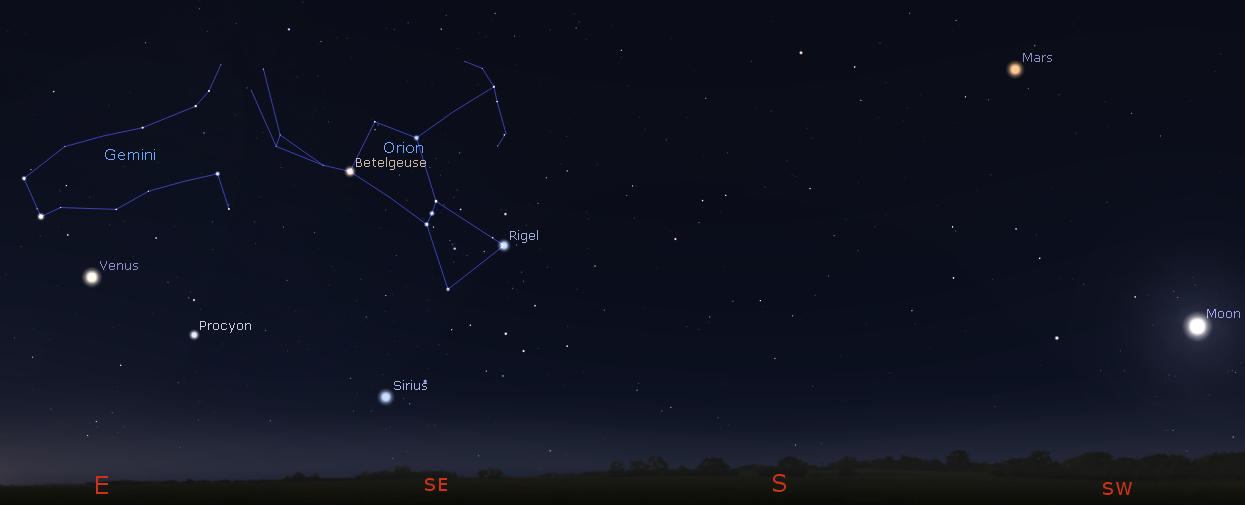
Let’s look at a the naked-eye planets for this week. Jupiter and Saturn are both low in the south-southeastern sky at 10 pm. Jupiter is the very bright one. To the left of it will be Saturn. They now seem to be separating a bit due to the Earth’s motion now, but they will cross paths in December. Both planets will be up until the morning hours with Jupiter setting first at 2:33 tomorrow morning and Saturn following at 3:16 am. The next planet visible will be Mars which will rise at 10:11 pm. Its now down to 45.6 million miles (73.5 million kilometers) away, as the Earth slowly overtakes it at the rate of about 2.7 million miles (4.3 million kilometers) a week as the Earth begins to pull abreast of it. Brilliant Venus will rise at 3:14 am.
The event times given are for the Traverse City/Interlochen area of Michigan. They may be different for your location.
Addendum
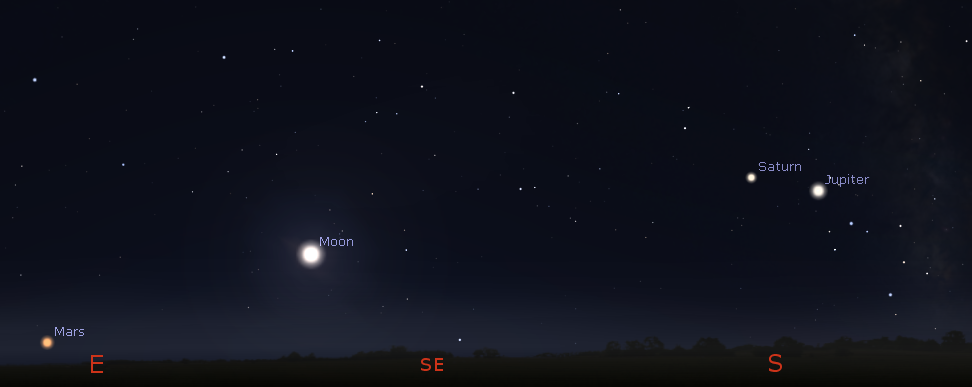
Planets and the Moon in the evening at 10:30 tonight, September 2, 2020. Click on the image to enlarge. Created using Stellarium.
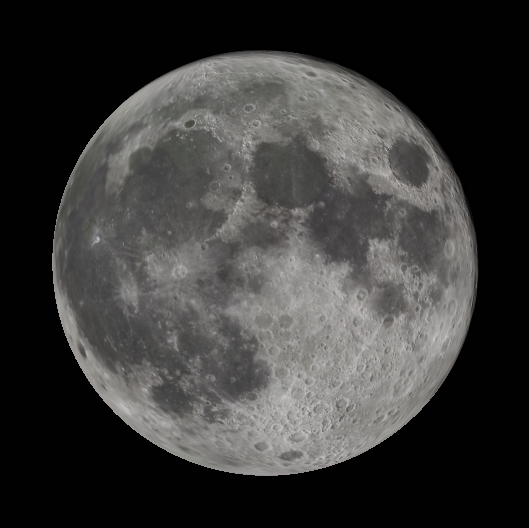
The full Moon tonight September 2, 2020 as it might appear at 10 pm in a low power telescope. Created using Stellarium.
Planets and the Moon in the morning tomorrow, September 3, 2020. Click on the image to enlarge. Created using Stellarium.
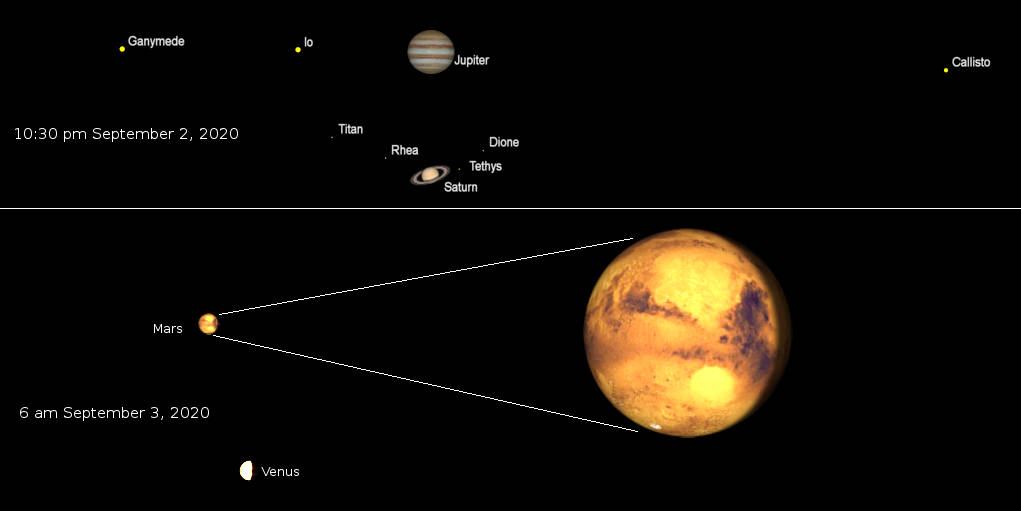
The planets as seen in a telescope (north up) with the same magnification Apparent diameters: Jupiter, 44.07″; Saturn, 17.93″, rings, 41.77″. Mars, 19.26″, and Venus 19.12″. At 6 am. Mars also displays an enlargement showing surface detail. The ” symbol means seconds of arc (1/3600th of a degree.) Created using Cartes du Ciel (Sky Charts).
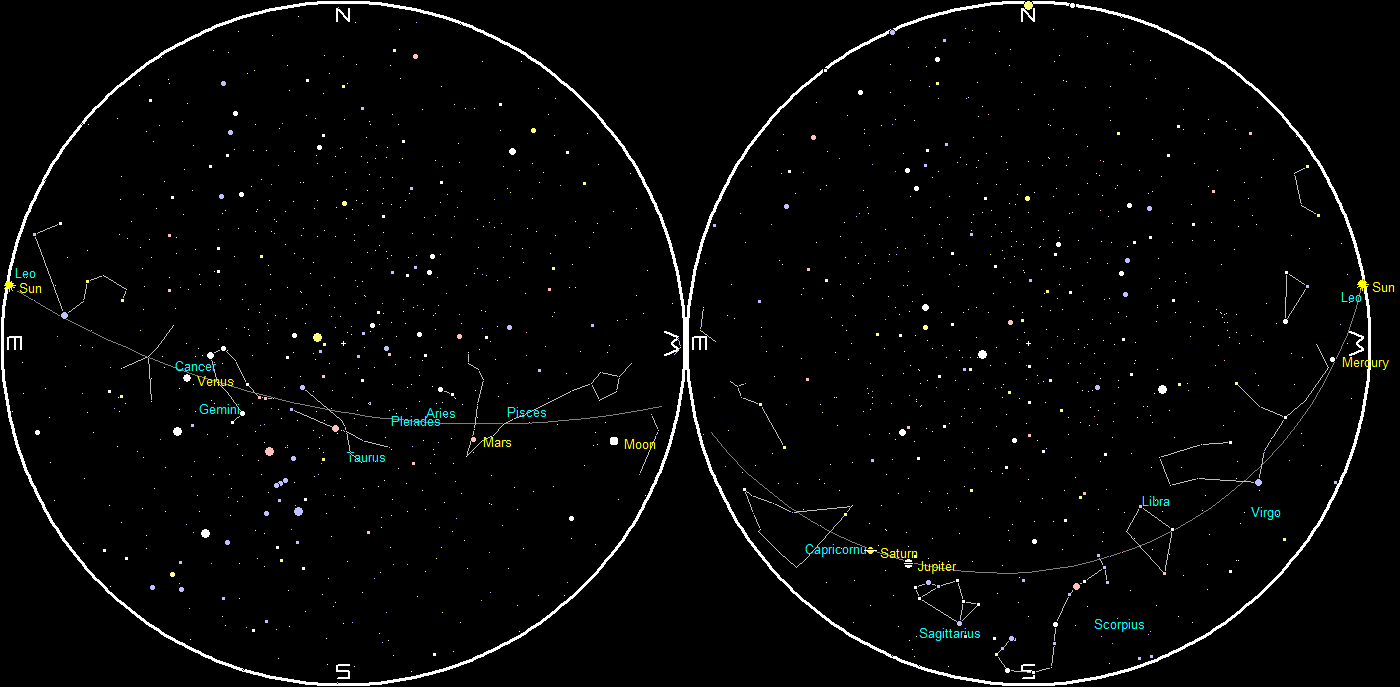
Planets and the Moon at sunset and sunrise of a single night starting with sunset on the right on September 2, 2020. The night ends on the left with sunrise on the 3rd. Click on the image to enlarge. Created using my LookingUp program.
09/01/2020 – Ephemeris – Previewing September skies
This is Ephemeris for Tuesday, September 1st. Today the Sun will be up for 13 hours and 12 minutes, setting at 8:18, and it will rise tomorrow at 7:07. The Moon, 1 day before full, will set at 7:15 tomorrow morning.
Let’s look at the skies for September. Daylight hours in the Interlochen/Traverse City area and will drop from 13 hours and 12 minutes today to 11 hours 43 minutes on the 30th. The altitude of the sun above the southern horizon at local noon will be 53 degrees today, and will descend to 42 degrees on the 30th. The official season of summer is getting short too, so enjoy it while you can. Summer will end and autumn will begin at 9:31 a.m. on the 22nd as the Sun will pass overhead at the equator heading southward. It will also mark sunset at the north pole and sunrise at the south pole. Southern hemisphere dwellers will see the start of spring. The summer Milky way is still visible to explore with binoculars or telescope.
The event times given are for the Traverse City/Interlochen area of Michigan. They may be different for your location.
Addendum
September Star Chart
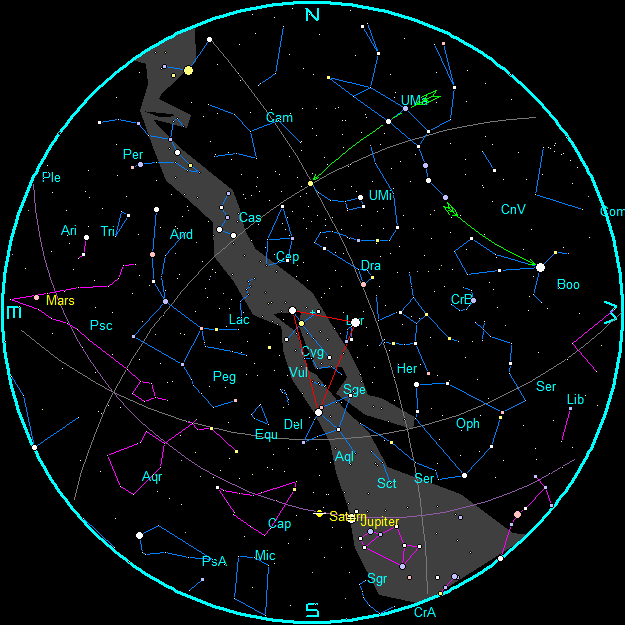
Star Chart for September 2020. Created using my LookingUp program. Click on the image to enlarge. Created using my LookingUp program.
The planets and stars are plotted for the 15th at 10 p.m. EDT in the evening and 6 a.m. for the morning chart. These are the chart times. Note that Traverse City is located approximately 45 minutes behind our time meridian, West 75° longitude. (An hour 45 minutes behind our daylight saving time meridian during EDT). To duplicate the star positions on a planisphere you may have to set it to 1 hour 45 minutes earlier than the current time.
September Morning Star Chart
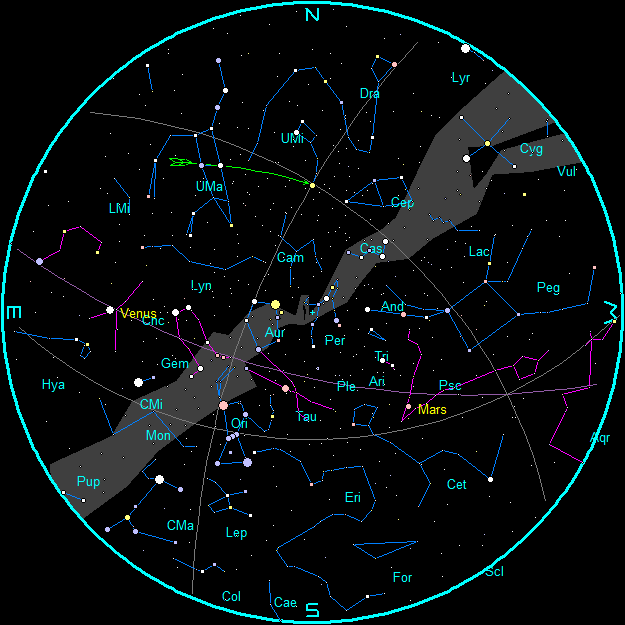
Star Chart for September 2020 (10 p.m. EDT September 15, 2019). Click on image to enlarge.Created using my LookingUp program. Click on image to enlarge.
For a list of constellation names to go with the abbreviations click here.
- Pointer stars at the front of the bowl of the Big Dipper point to Polaris the North Star.
- Leaky dipper drips on Leo.
- Follow the arc of the handle of the Big Dipper to the star Arcturus.
- The Summer Triangle is in red.
Twilight Limits, Nautical and Astronomical
| EDT | |||||||
| Morning twilight | Evening twilight | Dark night | Moon | ||||
| Date | Astro. | Nautical | Nautical | Astro. | Start | End | Illum. |
| 2020-09-01 | 5h26m | 6h05m | 21h28m | 22h06m | – | – | 0.99 |
| 2020-09-02 | 5h28m | 6h06m | 21h26m | 22h04m | – | – | 1 |
| 2020-09-03 | 5h30m | 6h07m | 21h24m | 22h01m | – | – | 0.99 |
| 2020-09-04 | 5h31m | 6h09m | 21h22m | 21h59m | – | – | 0.96 |
| 2020-09-05 | 5h33m | 6h10m | 21h20m | 21h57m | 21h57m | 22h01m | 0.91 |
| 2020-09-06 | 5h34m | 6h11m | 21h18m | 21h55m | 21h55m | 22h22m | 0.85 |
| 2020-09-07 | 5h36m | 6h13m | 21h16m | 21h53m | 21h53m | 22h46m | 0.77 |
| 2020-09-08 | 5h37m | 6h14m | 21h13m | 21h50m | 21h50m | 23h14m | 0.69 |
| 2020-09-09 | 5h39m | 6h15m | 21h11m | 21h48m | 21h48m | 23h47m | 0.59 |
| 2020-09-10 | 5h40m | 6h17m | 21h09m | 21h46m | 21h46m | – | 0.49 |
| 2020-09-11 | 5h42m | 6h18m | 21h07m | 21h44m | 21h44m | 0h28m | 0.39 |
| 2020-09-12 | 5h43m | 6h19m | 21h05m | 21h42m | 21h42m | 1h19m | 0.29 |
| 2020-09-13 | 5h45m | 6h21m | 21h03m | 21h39m | 21h39m | 2h19m | 0.19 |
| 2020-09-14 | 5h46m | 6h22m | 21h01m | 21h37m | 21h37m | 3h27m | 0.11 |
| 2020-09-15 | 5h47m | 6h23m | 20h59m | 21h35m | 21h35m | 4h42m | 0.05 |
| 2020-09-16 | 5h49m | 6h24m | 20h57m | 21h33m | 21h33m | 5h49m | 0.01 |
| 2020-09-17 | 5h50m | 6h26m | 20h55m | 21h31m | 21h31m | 5h50m | 0 |
| 2020-09-18 | 5h52m | 6h27m | 20h53m | 21h29m | 21h29m | 5h52m | 0.03 |
| 2020-09-19 | 5h53m | 6h28m | 20h51m | 21h27m | 21h27m | 5h53m | 0.08 |
| 2020-09-20 | 5h54m | 6h30m | 20h49m | 21h25m | 21h50m | 5h54m | 0.16 |
| 2020-09-21 | 5h56m | 6h31m | 20h47m | 21h23m | 22h25m | 5h56m | 0.26 |
| 2020-09-22 | 5h57m | 6h32m | 20h46m | 21h20m | 23h05m | 5h57m | 0.38 |
| 2020-09-23 | 5h59m | 6h33m | 20h44m | 21h18m | 23h54m | 5h59m | 0.49 |
| 2020-09-24 | 6h00m | 6h35m | 20h42m | 21h16m | – | 6h00m | 0.6 |
| 2020-09-25 | 6h01m | 6h36m | 20h40m | 21h14m | 0h49m | 6h01m | 0.71 |
| 2020-09-26 | 6h03m | 6h37m | 20h38m | 21h12m | 1h51m | 6h03m | 0.8 |
| 2020-09-27 | 6h04m | 6h38m | 20h36m | 21h10m | 2h55m | 6h04m | 0.87 |
| 2020-09-28 | 6h05m | 6h40m | 20h34m | 21h08m | 4h01m | 6h05m | 0.93 |
| 2020-09-29 | 6h06m | 6h41m | 20h32m | 21h06m | 5h06m | 6h06m | 0.93 |
| 2020-09-30 | 6h08m | 6h42m | 20h30m | 21h04m | – | – | 0.97 |
Twilight calendar was generated using Cartes du Ciel (Sky Charts).
See my blog post: Twilight Zone for the definitions of the different periods of twilight here: https://bobmoler.wordpress.com/2018/09/27/.
NASA Calendar of Planetary Events
      Date   Time    Event
Sep 1  Tu            Venus: 44.7° W
    2  We  01:22 am  Full Moon
    6  Su  12:42 am  Moon-Mars: 0°
    6  Su  02:31 am  Moon Apogee: 405,600 km
   10  Th  05:26 am  Last Quarter
   10  Th  07:05 pm  Moon Ascending Node
   11  Fr  03:15 pm  Neptune Opposition
   12  Sa  01:25 am  Moon North Dec.: 24.4° N
   12  Sa  08:10 pm  Venus-Beehive: 2.6° S
   13  Su  11:19 pm  Moon-Beehive: 1.9° S
   14  Mo  12:43 am  Moon-Venus: 4.6° S
   17  Th  07:00 am  New Moon
   18  Fr  09:44 am  Moon Perigee: 359,100 km
   22  Tu  02:06 am  Mercury-Spica: 0.3° N
   22  Tu  09:31 am  Autumnal Equinox
   23  We  08:33 am  Moon Descending Node
   23  We  09:55 pm  First Quarter
   24  Th  03:11 pm  Moon South Dec.: 24.5° S
   25  Fr  02:46 am  Moon-Jupiter: 1.7° N
   25  Fr  04:46 pm  Moon-Saturn: 2.5° N
Oct 1  Th            Venus: 40.3° W
All event times are given for UTC-4 hr: Eastern Daylight Saving Time.
Sky Events Calendar by Fred Espenak and Sumit Dutta (NASA’s GSFC),
http://eclipse.gsfc.nasa.gov/SKYCAL/SKYCAL.html.
If you go to the above site you can print out a list like the above for the entire year or calendar pages for your time zone.
Sun and Moon Rising and Setting Events
     LU                  Ephemeris of Sky Events for Interlochen/TC
September, 2020    Local time zone: EDT
+-----------------------------------------------------------------------+
| DATE |  SUN     SUN  DAYLIGHT|   TWILIGHT*    |MOON  RISE OR    ILLUM |
|      |  RISE    SET    HOURS |  END    START  |PHASE SET** TIME FRACTN|
+=======================================================================+
|Tue  1| 07:05a  08:18p  13:12 | 09:24p  05:59a |      Set  07:15a  100%|
|Wed  2| 07:07a  08:16p  13:09 | 09:22p  06:00a |Full  Rise 08:58p   99%|
|Thu  3| 07:08a  08:14p  13:06 | 09:20p  06:02a |      Rise 09:20p   97%|
|Fri  4| 07:09a  08:13p  13:03 | 09:18p  06:03a |      Rise 09:40p   93%|
|Sat  5| 07:10a  08:11p  13:00 | 09:16p  06:04a |      Rise 10:00p   87%|
+------+-----------------------+----------------+-----------------------+
|Sun  6| 07:11a  08:09p  12:57 | 09:14p  06:06a |      Rise 10:22p   80%|
|Mon  7| 07:12a  08:07p  12:54 | 09:12p  06:07a |      Rise 10:46p   72%|
|Tue  8| 07:14a  08:05p  12:51 | 09:10p  06:09a |      Rise 11:14p   63%|
|Wed  9| 07:15a  08:03p  12:48 | 09:08p  06:10a |      Rise 11:48p   54%|
|Thu 10| 07:16a  08:01p  12:45 | 09:06p  06:11a |L Qtr Rise 12:29a   44%|
|Fri 11| 07:17a  07:59p  12:42 | 09:04p  06:12a |      Rise 01:19a   34%|
|Sat 12| 07:18a  07:58p  12:39 | 09:02p  06:14a |      Rise 02:19a   25%|
+------+-----------------------+----------------+-----------------------+
|Sun 13| 07:19a  07:56p  12:36 | 09:00p  06:15a |      Rise 03:27a   16%|
|Mon 14| 07:21a  07:54p  12:33 | 08:58p  06:16a |      Rise 04:42a    9%|
|Tue 15| 07:22a  07:52p  12:30 | 08:56p  06:18a |      Rise 06:01a    3%|
|Wed 16| 07:23a  07:50p  12:27 | 08:54p  06:19a |      Rise 07:20a    1%|
|Thu 17| 07:24a  07:48p  12:24 | 08:52p  06:20a |New   Set  08:25p    1%|
|Fri 18| 07:25a  07:46p  12:20 | 08:50p  06:22a |      Set  08:52p    4%|
|Sat 19| 07:27a  07:44p  12:17 | 08:48p  06:23a |      Set  09:19p   10%|
+------+-----------------------+----------------+-----------------------+
|Sun 20| 07:28a  07:42p  12:14 | 08:46p  06:24a |      Set  09:50p   18%|
|Mon 21| 07:29a  07:41p  12:11 | 08:44p  06:25a |      Set  10:24p   27%|
|Tue 22| 07:30a  07:39p  12:08 | 08:42p  06:27a |      Set  11:05p   38%|
|Wed 23| 07:31a  07:37p  12:05 | 08:40p  06:28a |F Qtr Set  11:53p   49%|
|Thu 24| 07:32a  07:35p  12:02 | 08:38p  06:29a |      Set  12:49a   60%|
|Fri 25| 07:34a  07:33p  11:59 | 08:36p  06:30a |      Set  01:51a   70%|
|Sat 26| 07:35a  07:31p  11:56 | 08:34p  06:32a |      Set  02:55a   79%|
+------+-----------------------+----------------+-----------------------+
|Sun 27| 07:36a  07:29p  11:53 | 08:32p  06:33a |      Set  04:01a   86%|
|Mon 28| 07:37a  07:27p  11:50 | 08:30p  06:34a |      Set  05:06a   92%|
|Tue 29| 07:38a  07:26p  11:47 | 08:28p  06:35a |      Set  06:09a   97%|
|Wed 30| 07:40a  07:24p  11:43 | 08:27p  06:37a |      Set  07:11a   99%|
+-----------------------------------------------------------------------+
* Nautical Twilight
** Moonrise or moonset, whichever occurs between sunrise and sunset
Generated using my LookingUp for DOS program.
08/31/2020 – Ephemeris – Artemis, NASAs new program to land men and women on the Moon
This is Ephemeris for Monday, August 31st. Today the Sun will be up for 13 hours and 15 minutes, setting at 8:20, and it will rise tomorrow at 7:05. The Moon, 2 days before full, will set at 6:10 tomorrow morning.
The Artemis program is the United States follow on, after more than 50 years, to return to the Moon. It’s main rocket, the Space Launch System or SLS uses components of the Space Shuttle that include the main engines, using 4 instead of three, and two longer solid boosters. The Orion capsule sits atop the second stage. Unlike Apollo, the lunar lander will be sent up on a separate rocket into lunar orbit. Eventually there will be a lunar orbiting space station called the Lunar Gateway as a way point. But not for the first attempt. NASA has accepted three bids for commercial landers, Dynetics with a squat lander with drop-tanks. The National team of several companies with an Apollo-like lander on steroids, and SpaceX’s Starship.
The event times given are for the Traverse City/Interlochen area of Michigan. They may be different for your location.
Addendum
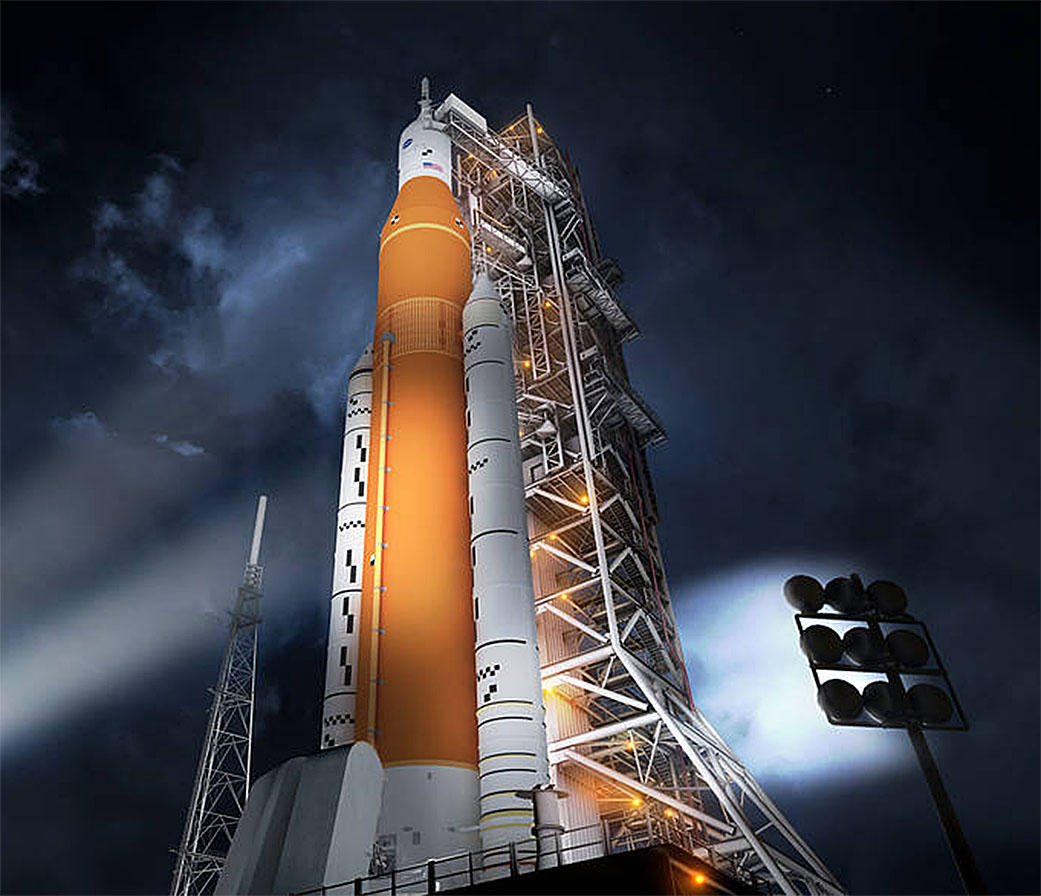
Block 1 Space Launch System with Orion Capsule. Credit NASA.

Three Lunar Lander proposals. Credit Dynetics, SpaceX, and Blue Origin.
 Bob Moler's Ephemeris Blog