07/03/2020 – Ephemeris – Grand Traverse Astronomical Society virtual meeting tonight
This is Bob Moler with Ephemeris for Friday, July 3rd. Today the Sun will be up for 15 hours and 28 minutes, setting at 9:31, and it will rise tomorrow at 6:03. The Moon, 2 days before full, will set at 5:18 tomorrow morning.
The Grand Traverse Astronomical Society will host a virtual meeting tonight at 8 pm. It is via the Zoom app for the smart phone, tablet or going to zoom.us with a browser on your computer. Instructions and a link can be found on the society’s website gtastro.org. With the Sun out so long now, I will be giving the presentation: The Sun and the Earth, about the relationship between the two bodies. I’ll talk about all the energy the Sun puts out and how the atmosphere protects us from some of it. We’ll look at the cause of the seasons, and why, in early July as summer is getting going the Earth is at its farthest from the Sun, and what effect that has on the our summers. And lots more.
07/02/2020 – Ephemeris – The star Deneb in Cygnus the swan
This is Ephemeris for Thursday, July 2nd. Today the Sun will be up for 15 hours and 29 minutes, setting at 9:31, and it will rise tomorrow at 6:02. The Moon, 3 days before full, will set at 4:29 tomorrow morning.
This evening when it gets dark enough the bright star Deneb in Cygnus the swan will be high in the east-northeast. Deneb is the dimmest star of the summer triangle. Of the other stars of the triangle, Vega is higher in the east, while Altair is lower in the southeast. Deneb’s apparent magnitude, or brightness as seen from Earth, makes it the dimmest of the three bright stars. Its vast distance of possibly 2,600 light years is over 100 times the distance of Vega. If brought as close as Vega, Deneb would be as bright at least as the quarter moon. It is possibly as bright as 200 thousand Suns; and a huge star, possibly as large in diameter as the orbit of the Earth. For all this it is only 19 or so times the mass of the Sun.
The event times given are for the Traverse City/Interlochen area of Michigan. They may be different for your location.
Addendum
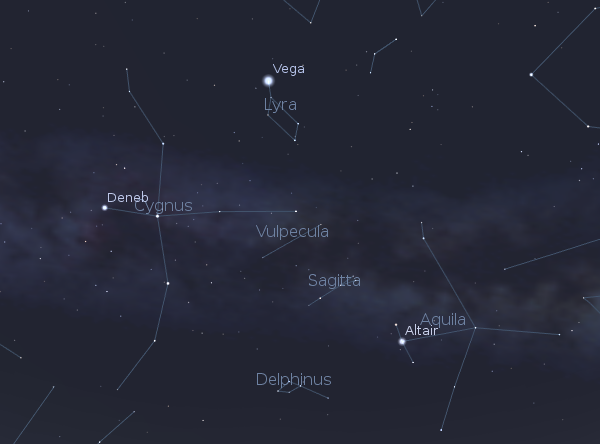
Deneb with the other stars and constellations in the Summer Triangle. Created using Stellarium.
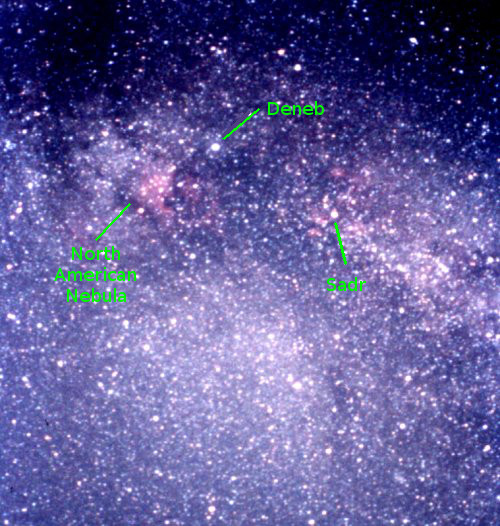
One of my old photographs of Deneb and the North American Nebula digitized from a slide.
07/01/2020 – Ephemeris – Let’s look at the naked-eye planets for this week
This is Ephemeris for Wednesday, July 1st. Today the Sun will be up for 15 hours and 30 minutes, setting at 9:31, and it will rise tomorrow at 6:01. The Moon, 3 days past first quarter, will set at 3:49 tomorrow morning.
Let’s look at the naked-eye planets for this week. Jupiter now rises in the evening, tonight it’s at 10:08 pm in the east-southeast. Saturn will rise 19 minutes later at 10:27 pm right behind Jupiter. Mars, is stretching its lead left of Saturn and will rise at 1:18 am in the east. Its now down to 75.4 million miles (121.5 million km) away, as the Earth slowly overtakes it at the rate of about 4 million miles (6.4 million km) a week. Jupiter and Saturn will be hanging out between Sagittarius and Capricornus this year while Mars is slowing its rapid eastward motion now two constellations over in Pisces. Finally, Venus will rise at 4:05 am in the east-northeast in the twilight as our Morning Star.
The event times given are for the Traverse City/Interlochen area of Michigan. They may be different for your location.
Addendum
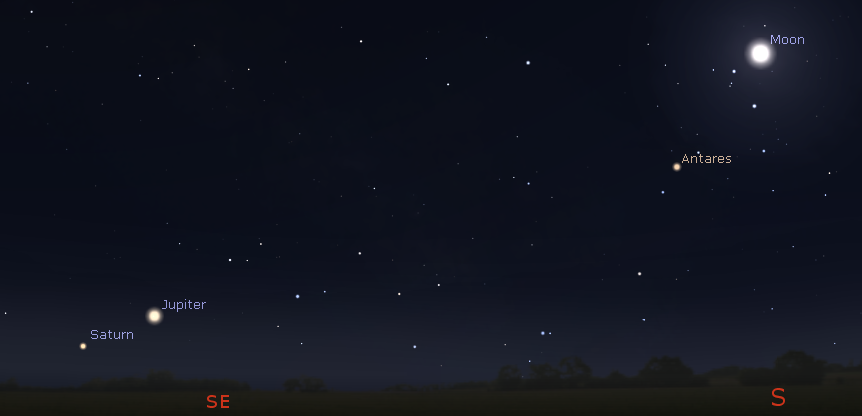
Almost evening planets Jupiter and Saturn, and the Moon at 11 pm on July 1st, 2020. Both Jupiter and Saturn are still officially morning planets since they rise after sunset. Click on the image to enlarge. Created using Stellarium.
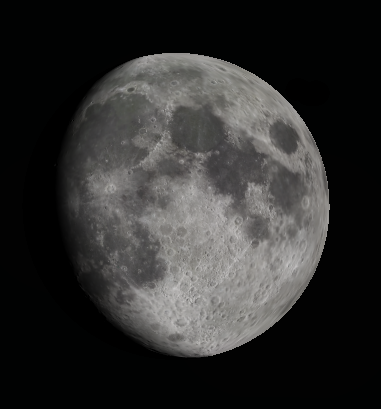
The gibbous Moon as it might appear this evening, July 1st, 2020, in a pair of binoculars or small telescope. Created using Stellarium.
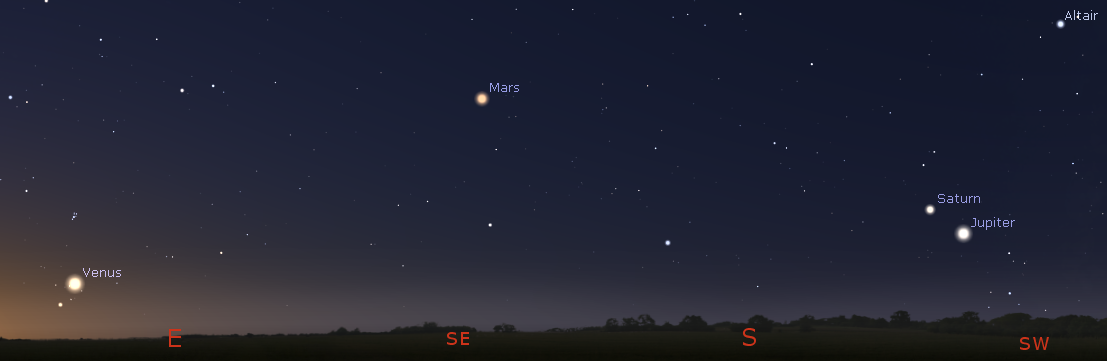
The morning planets, including Jupiter and Saturn which are also visible in the late evening. Click on the image to enlarge. Created using Stellarium.
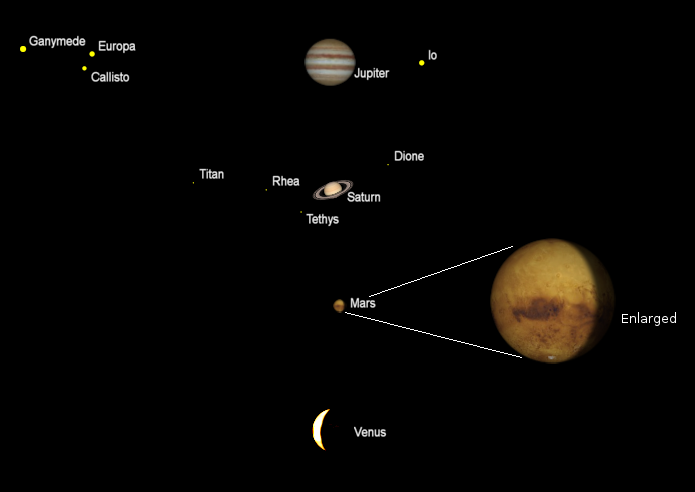
The planets as seen in a telescope (north up) with the same magnification tomorrow morning July 2, 2020. Apparent diameters: Jupiter, 47.34″; Saturn, 18.37″, rings, 42.79″, Mars, 11.57″, and Venus 42.15″. Mars also displays an enlargement showing surface detail. The ” symbol means seconds of arc (1/3600th of a degree.) Created using Cartes du Ciel (Sky Charts).
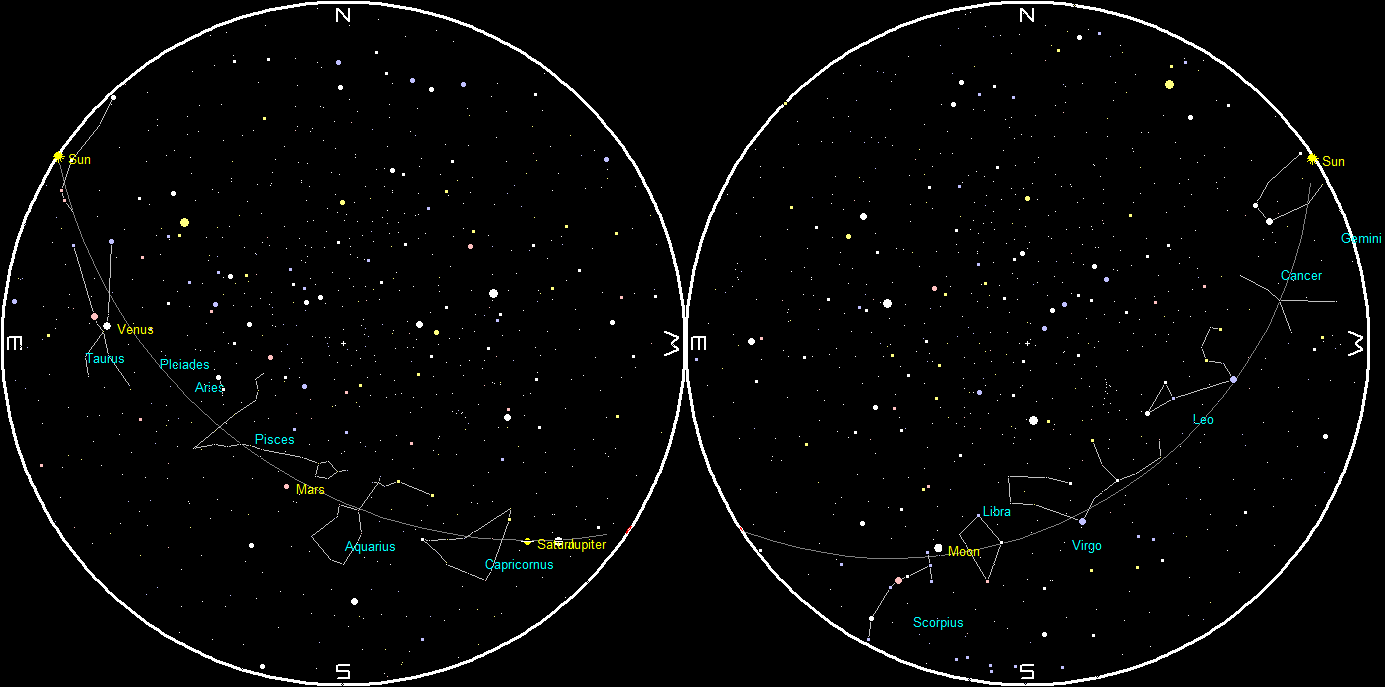
Planets and the Moon at sunset and sunrise of a single night starting with sunset on the right on July 1, 2020. The night ends on the left with sunrise on the 2nd. The closeness of Jupiter and Saturn in the morning sky unfortunately overlays planets and labels. Click on the image to enlarge. Created using my LookingUp program.
06/30/2020 – Ephemeris – Previewing the skies of July 2020
This is Ephemeris for Tuesday, June 30th. Today the Sun will be up for 15 hours and 31 minutes, setting at 9:32, and it will rise tomorrow at 6:01. The Moon, 2 days past first quarter, will set at 3:15 tomorrow morning.
Lets preview July’s skies. The Sun, having reached its northern solstice, is beginning to slide southward again, at first imperceptibly, then with greater speed. The daylight hours will decrease from 15 hours and 30 minutes tomorrow to 14 hours 40 minutes at month’s end. The daylight hours will be slightly shorter south of Interlochen, and slightly longer to the north. The altitude of the Sun at local noon, when it is due south will decrease from 68 degrees tomorrow to 63 degrees at month’s end. Despite the warmth, the Earth will reach its greatest distance from the Sun on Saturday the 4th. Both Jupiter and Saturn reach opposition from the Sun this month and officially become evening planets.
The event times given are for the Traverse City/Interlochen area of Michigan. They may be different for your location.
Addendum
July Evening Star Chart
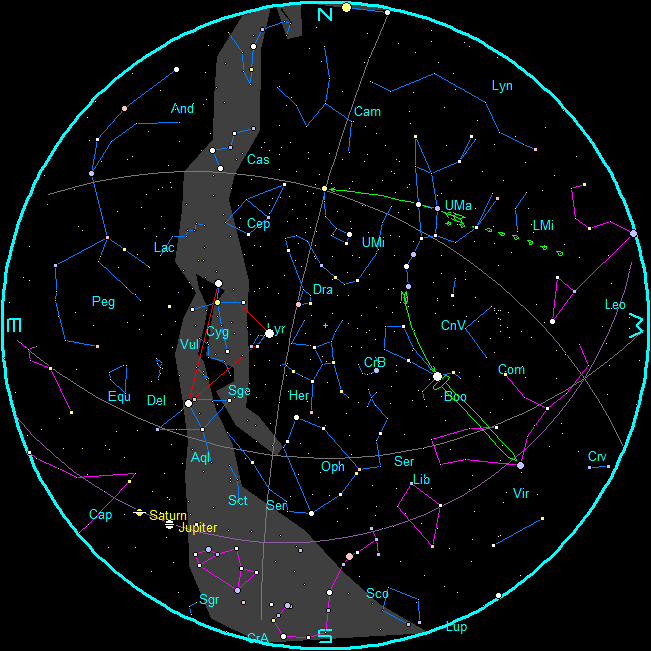
Star Chart for July 2020 (11 p.m. EDT July 15, 2019). Created using my LookingUp program. Click on image to enlarge.
The planets and stars are plotted for the 15th at 11 p.m. EDT in the evening and 4:30 a.m. for the morning chart. These are the chart times. Note that Traverse City is located approximately 45 minutes behind our time meridian, West 75° longitude. (An hour 45 minutes behind our daylight saving time meridian during EDT). To duplicate the star positions on a planisphere you may have to set it to 1 hour 45 minutes earlier than the current time.
Note the chart times are for the 15th. For each week before the 15th add ½ hour (28 minutes if you’re picky). For each week after the 15th subtract ½ hour. The planet positions are updated each Wednesday on this blog. For planet positions on dates other than the 15th.
July Morning Star Chart
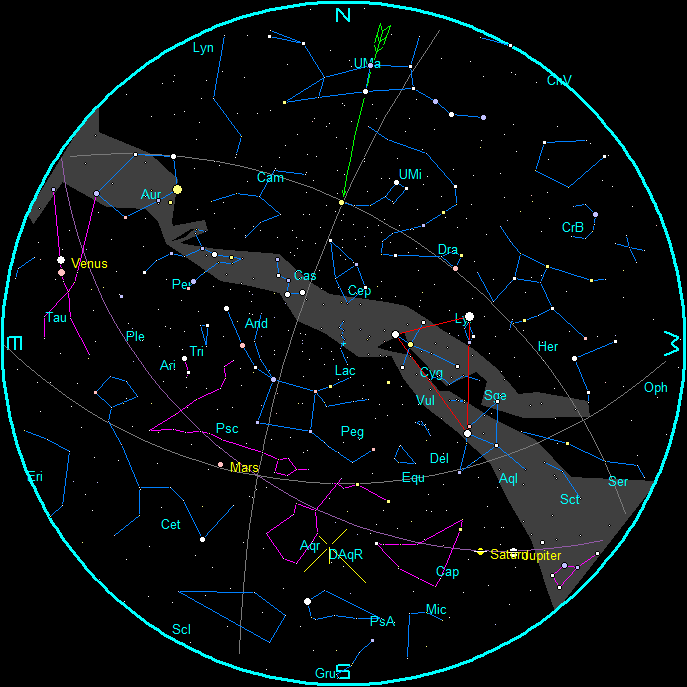
Star Chart for July mornings 2020 (4:30 a.m. EDT July 15, 2019). Created using my LookingUp program. Click on image to enlarge.
For a list of constellation names to go with the abbreviations click here.
- Pointer stars at the front of the bowl of the Big Dipper point to Polaris the North Star.
- Leaky dipper drips on Leo.
- Follow the arc of the handle of the Big Dipper to the star Arcturus, and
- Extend like a spike to Spica.
- The Summer Triangle is in red.
- DAqR is the radiant of the South Delta Aquariid meteor shower (Peaks on the 27th)
Twilight Limits, Nautical and Astronomical
| EDT | |||||||
| Morning twilight | Evening twilight | Dark night | Moon | ||||
| Date | Astro. | Nautical | Nautical | Astro. | Start | End | Illum. |
| 2020-07-01 | 3h38m | 4h41m | 23h00m | 0h03m | 3h15m | 3h38m | 0.88 |
| 2020-07-02 | 3h39m | 4h42m | 22h59m | 0h02m | – | – | 0.95 |
| 2020-07-03 | 3h40m | 4h43m | 22h59m | 0h01m | – | – | 0.95 |
| 2020-07-04 | 3h42m | 4h43m | 22h58m | 0h00m | – | – | 0.99 |
| 2020-07-05 | 3h43m | 4h44m | 22h58m | 23h59m | – | – | 1 |
| 2020-07-06 | 3h44m | 4h45m | 22h57m | 23h58m | – | – | 0.99 |
| 2020-07-07 | 3h46m | 4h46m | 22h56m | 23h57m | – | – | 0.95 |
| 2020-07-08 | 3h47m | 4h47m | 22h56m | 23h56m | 23h56m | – | 0.89 |
| 2020-07-09 | 3h49m | 4h48m | 22h55m | 23h54m | 23h54m | 0h05m | 0.82 |
| 2020-07-10 | 3h50m | 4h49m | 22h54m | 23h53m | 23h53m | 0h30m | 0.74 |
| 2020-07-11 | 3h52m | 4h51m | 22h53m | 23h52m | 23h52m | 0h52m | 0.65 |
| 2020-07-12 | 3h54m | 4h52m | 22h52m | 23h50m | 23h50m | 1h13m | 0.55 |
| 2020-07-13 | 3h55m | 4h53m | 22h51m | 23h49m | 23h49m | 1h33m | 0.45 |
| 2020-07-14 | 3h57m | 4h54m | 22h50m | 23h47m | 23h47m | 1h55m | 0.36 |
| 2020-07-15 | 3h59m | 4h55m | 22h49m | 23h46m | 23h46m | 2h19m | 0.26 |
| 2020-07-16 | 4h01m | 4h57m | 22h48m | 23h44m | 23h44m | 2h47m | 0.18 |
| 2020-07-17 | 4h02m | 4h58m | 22h47m | 23h43m | 23h43m | 3h20m | 0.11 |
| 2020-07-18 | 4h04m | 4h59m | 22h46m | 23h41m | 23h41m | 4h01m | 0.05 |
| 2020-07-19 | 4h06m | 5h01m | 22h45m | 23h39m | 23h39m | 4h06m | 0.01 |
| 2020-07-20 | 4h08m | 5h02m | 22h44m | 23h38m | 23h38m | 4h08m | 0 |
| 2020-07-21 | 4h10m | 5h03m | 22h42m | 23h36m | 23h36m | 4h10m | 0.01 |
| 2020-07-22 | 4h12m | 5h05m | 22h41m | 23h34m | 23h34m | 4h12m | 0.06 |
| 2020-07-23 | 4h14m | 5h06m | 22h40m | 23h32m | 23h32m | 4h14m | 0.12 |
| 2020-07-24 | 4h16m | 5h08m | 22h38m | 23h30m | 23h58m | 4h16m | 0.21 |
| 2020-07-25 | 4h17m | 5h09m | 22h37m | 23h28m | – | 4h17m | 0.32 |
| 2020-07-26 | 4h19m | 5h10m | 22h35m | 23h26m | 0h24m | 4h19m | 0.44 |
| 2020-07-27 | 4h21m | 5h12m | 22h34m | 23h24m | 0h50m | 4h21m | 0.56 |
| 2020-07-28 | 4h23m | 5h13m | 22h32m | 23h22m | 1h18m | 4h23m | 0.67 |
| 2020-07-29 | 4h25m | 5h15m | 22h31m | 23h20m | 1h49m | 4h25m | 0.77 |
| 2020-07-30 | 4h27m | 5h16m | 22h29m | 23h18m | 2h27m | 4h27m | 0.86 |
| 2020-07-31 | 4h29m | 5h18m | 22h28m | 23h16m | 3h11m | 4h29m | 0.93 |
Twilight calendar was generated using Cartes du Ciel (Sky Charts).
See my blog post: Twilight Zone for the definitions of the different periods of twilight here: https://bobmoler.wordpress.com/2018/09/27/.
NASA Calendar of Planetary Events
Date       Time      Event
Jul 1  We            Venus: 34.3° W
    3  Fr  11:18 pm  Moon Descending Node
    4  Sa  10:59 am  Aphelion: 1.0167 AU
    4  Sa  09:37 pm  Moon South Dec.: 24.1° S
    5  Su  12:30 am  Penumbral Lunar Eclipse
	                    (Americas, sw Europe, Africa)
    5  Su  12:44 am  Full Moon
    5  Su  05:37 pm  Moon-Jupiter: 1.9° N
    6  Mo  04:45 am  Moon-Saturn: 2.6° N
   11  Sa  08:17 am  Venus-Aldebaran: 1° N
   11  Sa  03:36 pm  Moon-Mars: 2.2° N
   12  Su  03:27 pm  Moon Apogee: 404200 km
   12  Su  07:29 pm  Last Quarter
   14  Tu  03:03 am  Jupiter Opposition
   17  Fr  03:26 am  Moon-Venus: 3.4° S
   18  Sa  08:33 am  Moon Ascending Node
   19  Su  07:51 am  Moon North Dec.: 24.1° N
   20  Mo  01:33 pm  New Moon
   20  Mo  05:33 pm  Saturn Opposition
   22  We  10:59 am  Mercury Greatest Elongation: 20.1° W
   25  Sa  12:54 am  Moon Perigee: 368400 km
   27  Mo  08:32 am  First Quarter
   27  Mo  05:08 pm  Delta Aquarid Meteor Shower: ZHR = 20
   31  Fr  05:32 am  Moon Descending Node
Aug 1  Sa            Venus: 45.2° W
All event times are given for UTC-4 hr: Eastern Daylight Saving Time.
Sky Events Calendar by Fred Espenak and Sumit Dutta (NASA’s GSFC),
http://eclipse.gsfc.nasa.gov/SKYCAL/SKYCAL.html.
If you go to the above site you can print out a list like the above for the entire year or calendar pages for your time zone.
Sun and Moon Rising and Setting Events
     LU                  Ephemeris of Sky Events for Interlochen/TC
July, 2020    Local time zone: EDT
+-----------------------------------------------------------------------+
| DATE |  SUN     SUN  DAYLIGHT|   TWILIGHT*    |MOON  RISE OR    ILLUM |
|      |  RISE    SET    HOURS |  END    START  |PHASE SET** TIME FRACTN|
+=======================================================================+
|Wed  1| 06:01a  09:31p  15:30 | 10:57p  04:35a |      Set  03:49a   87%|
|Thu  2| 06:01a  09:31p  15:29 | 10:56p  04:36a |      Set  04:29a   94%|
|Fri  3| 06:02a  09:31p  15:28 | 10:56p  04:37a |      Set  05:18a   98%|
|Sat  4| 06:03a  09:31p  15:27 | 10:55p  04:38a |      Set  06:15a  100%|
+------+-----------------------+----------------+-----------------------+
|Sun  5| 06:03a  09:30p  15:26 | 10:55p  04:39a |Full  Rise 10:19p   99%|
|Mon  6| 06:04a  09:30p  15:25 | 10:54p  04:40a |      Rise 11:02p   96%|
|Tue  7| 06:05a  09:29p  15:24 | 10:53p  04:41a |      Rise 11:37p   91%|
|Wed  8| 06:06a  09:29p  15:23 | 10:53p  04:42a |      Rise 12:05a   85%|
|Thu  9| 06:06a  09:29p  15:22 | 10:52p  04:43a |      Rise 12:30a   77%|
|Fri 10| 06:07a  09:28p  15:20 | 10:51p  04:44a |      Rise 12:52a   68%|
|Sat 11| 06:08a  09:27p  15:19 | 10:50p  04:45a |      Rise 01:12a   59%|
+------+-----------------------+----------------+-----------------------+
|Sun 12| 06:09a  09:27p  15:17 | 10:49p  04:46a |L Qtr Rise 01:33a   50%|
|Mon 13| 06:10a  09:26p  15:16 | 10:48p  04:47a |      Rise 01:55a   40%|
|Tue 14| 06:11a  09:25p  15:14 | 10:47p  04:49a |      Rise 02:19a   31%|
|Wed 15| 06:11a  09:25p  15:13 | 10:46p  04:50a |      Rise 02:47a   23%|
|Thu 16| 06:12a  09:24p  15:11 | 10:45p  04:51a |      Rise 03:20a   15%|
|Fri 17| 06:13a  09:23p  15:09 | 10:44p  04:52a |      Rise 04:01a    8%|
|Sat 18| 06:14a  09:22p  15:08 | 10:43p  04:54a |      Rise 04:52a    4%|
+------+-----------------------+----------------+-----------------------+
|Sun 19| 06:15a  09:21p  15:06 | 10:41p  04:55a |      Rise 05:52a    1%|
|Mon 20| 06:16a  09:21p  15:04 | 10:40p  04:56a |New   Set  09:45p    0%|
|Tue 21| 06:17a  09:20p  15:02 | 10:39p  04:58a |      Set  10:26p    2%|
|Wed 22| 06:18a  09:19p  15:00 | 10:38p  04:59a |      Set  11:01p    7%|
|Thu 23| 06:19a  09:18p  14:58 | 10:36p  05:00a |      Set  11:31p   14%|
|Fri 24| 06:20a  09:17p  14:56 | 10:35p  05:02a |      Set  11:58p   22%|
|Sat 25| 06:21a  09:16p  14:54 | 10:33p  05:03a |      Set  12:24a   33%|
+------+-----------------------+----------------+-----------------------+
|Sun 26| 06:22a  09:15p  14:52 | 10:32p  05:05a |      Set  12:50a   44%|
|Mon 27| 06:24a  09:13p  14:49 | 10:30p  05:06a |F Qtr Set  01:18a   55%|
|Tue 28| 06:25a  09:12p  14:47 | 10:29p  05:08a |      Set  01:49a   67%|
|Wed 29| 06:26a  09:11p  14:45 | 10:27p  05:09a |      Set  02:27a   77%|
|Thu 30| 06:27a  09:10p  14:42 | 10:26p  05:11a |      Set  03:11a   85%|
|Fri 31| 06:28a  09:09p  14:40 | 10:24p  05:12a |      Set  04:04a   92%|
+-----------------------------------------------------------------------+
* Nautical Twilight
** Moonrise or moonset, whichever occurs between sunrise and sunset
06/29/2020 – Vega, brightest star of the Summer Triangle
This is Ephemeris for Monday, June 29th. Today the Sun will be up for 15 hours and 31 minutes, setting at 9:32, and it will rise tomorrow at 6:00. The Moon, 1 day past first quarter, will set at 2:46 tomorrow morning.
Vega is the highest star In the east and brightest star of the Summer Triangle also rising in that direction. It is an important and much studied star, first as a standard for brightness for thr star brightness magnitude scale at magnitude of almost exactly zero. It also has two fields of debris orbiting it. In 1983 the Infrared Astronomy Satellite discovered an excess of infrared radiation coming from the star. It seems now that there are two orbiting rings, one warm, and the other cold orbiting the star. This is somewhat like the two disks the Sun has: The asteroid belt between Mars and Jupiter and the Kuiper belt, beyond Neptune. No planets have been discovered around Vega, but I wouldn’t bet against it.
The event times given are for the Traverse City/Interlochen area of Michigan. They may be different for your location.
Addendum
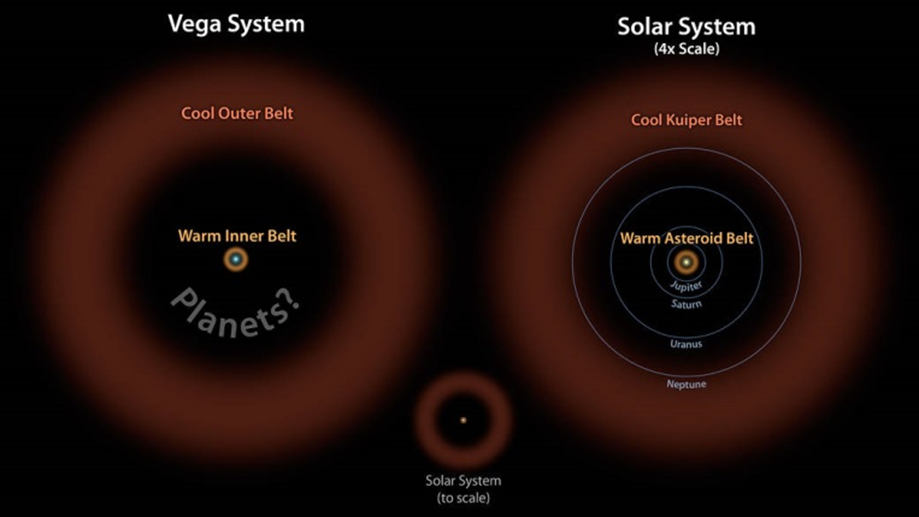
Vega possesses two debris fields, similar to our own solar system’s asteroid and Kuiper belts. Astronomers continue to hunt for planets orbiting Vega, but as of May 2020 none have been confirmed. More info: bit.ly/VegaSystem Credit: NASA/JPL-Caltech.
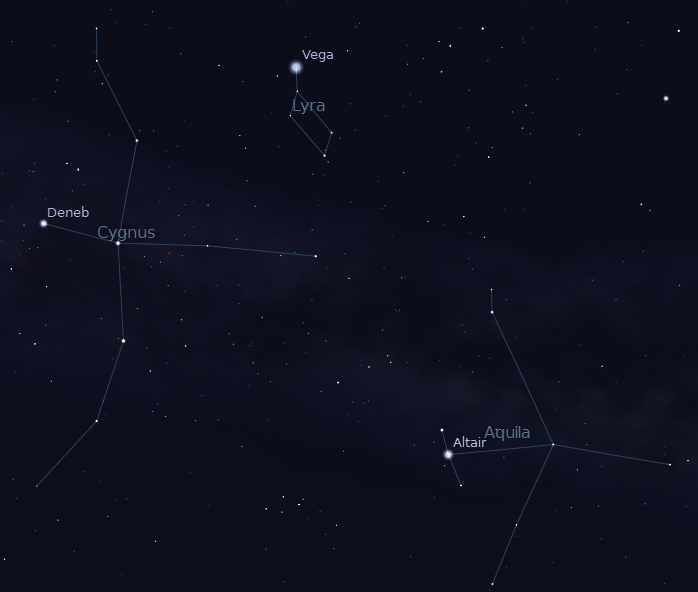
Summer Triangle. Created using Stellarium.
06/26/2020 – Ephemeris – The stars known as the Horse and Rider
Jun 26. This is Bob Moler with Ephemeris for Friday, June 26th. Today the Sun will be up for 15 hours and 33 minutes, setting at 9:32, and it will rise tomorrow at 5:59. The Moon, 2 days before first quarter, will set at 1:28 tomorrow morning.
The most interesting star in the Big Dipper is Mizar and its dim companion Alcor. It is the second star from the end of the handle, where the bend in the handle takes place. Folks with good vision can see the dimmer star right next to Mizar. In ancient times it was used as an eye test for visual acuity for warriors. As such it was known as the “Horse and the Rider”. Mizar is second magnitude, in the second rank of star brightness invented by the Greek astronomer Hipparchus in the 2nd century BC. He ranked stars in 6 classes, from first magnitude for the brightest to 6th for the dimmest visible to the naked eye. Alcor comes in at 4th magnitude. It does suffer a bit by being very close to Mizar which is 6 times brighter.
The event times given are for the Traverse City/Interlochen area of Michigan. They may be different for your location.
Addendum

Mizar finder animation for the Big Dipper’s orientation in late June at 11 pm where I live or an hour and a half after sunset. Created using Stellarium and GIMP.
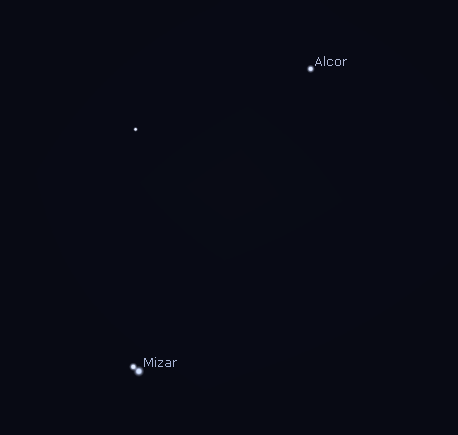
Mizar and Alcor as they might appear in a telescope. Mizar is a binary star in a telescope. The other star in the field is apparently a background star. The brighter star of Mizar is Mizar A, while the dimmer is Mizar B. It turns out that Mizar A and B plus Alcor are all spectroscopic binaries, meaning the companion stars are too close to resolve in telescopes, but whose motion shows up in the spectra of the stars. Mizar and Alcor are around 80 light years away. Created using Stellarium.
06/25/2020 – Ephemeris – The bright star Spica
This is Ephemeris for Thursday, June 25th. Today the Sun will be up for 15 hours and 33 minutes, setting at 9:32, and it will rise tomorrow at 5:58. The Moon, 3 days before first quarter, will set at 12:59 tomorrow morning.
Low in the southwest at 11 p.m. is the bright star Spica which can be found from all the way back overhead to the Big Dipper. Follow the arc of the handle of the Big Dipper to the bright star Arcturus high in the southwest. Then straighten the curve of the arc to a straight spike which points to Spica. Arcturus is much brighter than Spica and has an orange tint to Spica’s bluish hue. In fact Spica is the bluest of the 21 first magnitude stars. That means that it is hot. Actually Spica is really two blue stars orbiting each other in 4 days. Spica is 250 light years away, which is reasonably close. Spica was an important star to the ancient Greeks. One temple was built, and aligned to its setting point.
The event times given are for the Traverse City/Interlochen area of Michigan. They may be different for your location.
Addendum
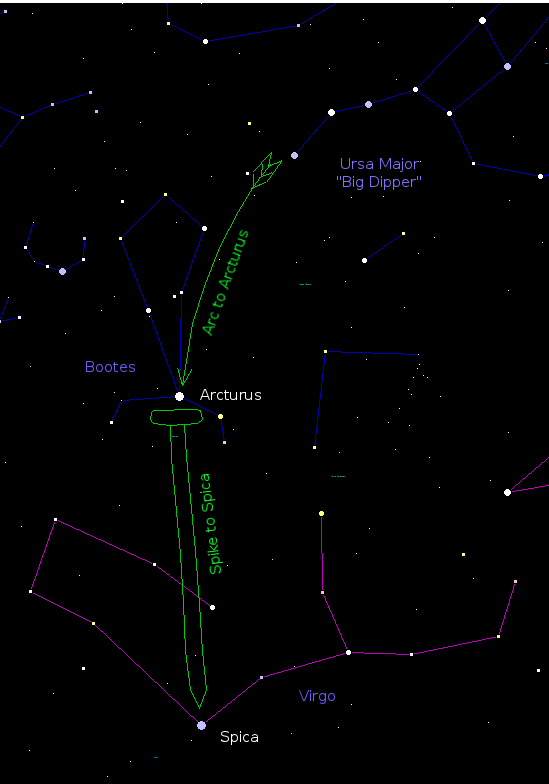
Spica finder chart using my LookingUp program fo 11 p.m. tonight June 25.
06/24/2020 – Ephemeris – Let’s look at the naked-eye planets for this week
This is Bob Moler with Ephemeris for Wednesday, June 24th. Today the Sun will be up for 15 hours and 34 minutes, setting at 9:32, and it will rise tomorrow at 5:58. The Moon, 3 days past new, will set at 12:27 tomorrow morning.
Let’s look at the naked-eye planets for this week. Jupiter now rises in the evening, tonight it’s at 10:42 pm in the east-southeast. Saturn will rise 18 minutes later at 11pm right behind Jupiter. Mars, is stretching its lead left of Saturn and will rise at 1:36 am in the east. Its now down to 83.4 million miles (134.3 million km) away, as the Earth slowly overtakes it at the rate of about 4 million miles (6.4 million km) a week. Jupiter and Saturn will be hanging out between Sagittarius and Capricornus this year while Mars is slowing its rapid eastward motion now two constellations over in Pisces. Finally, Venus will rise at 4:26 am in the east-northeast low in the twilight as our Morning Star.
The event times given are for the Traverse City/Interlochen area of Michigan. They may be different for your location.
Addendum
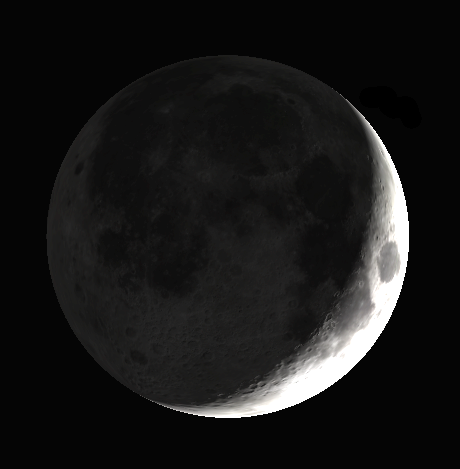
The Moon as seen through binoculars or small telescope tonight June 24, 2020. Note earthshine on the night side of the Moon. Created using Stellarium.
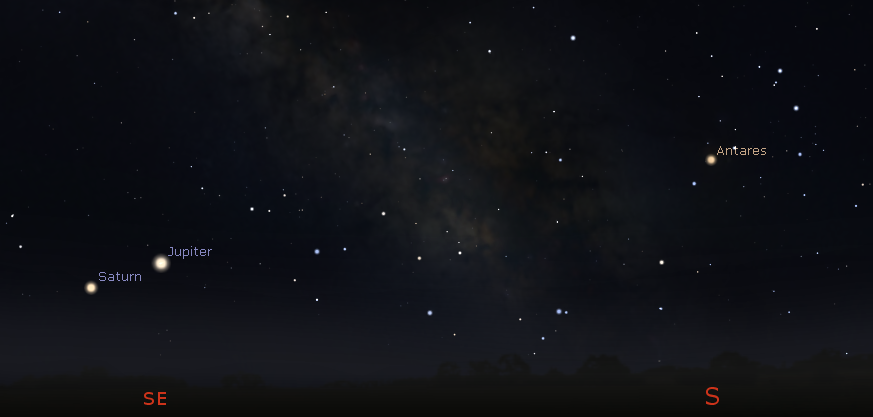
Jupiter & Saturn at midnight. Note the Teapot of Sagittarius to the right of Jupiter and the stars of Scorpius including Antares farther right. Click on the image to enlarge. Created using Stellarium.
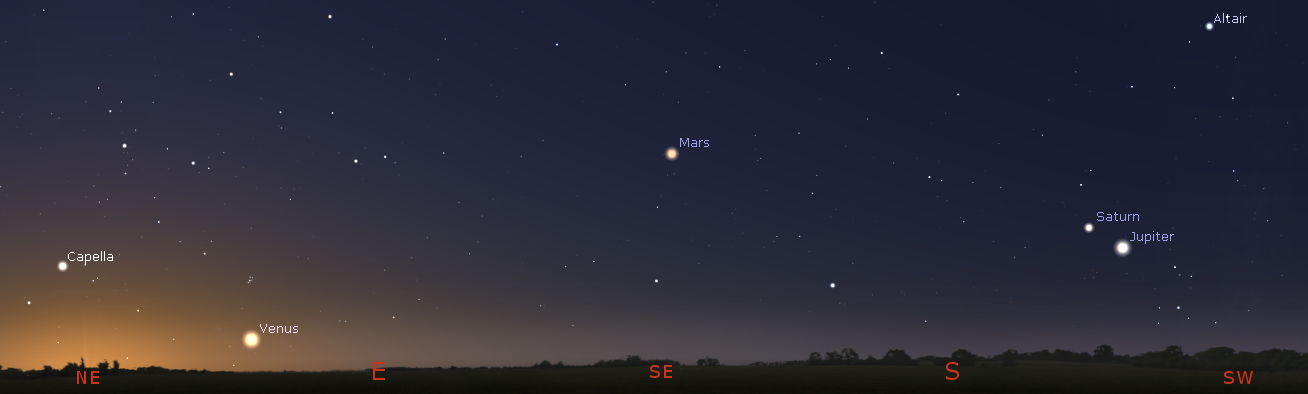
Four of the five naked-eye planets stretched out on this panorama from northeast to southwest at 5 am tomorrow morning June 25, 2020. Click on the image to enlarge. Created using Stellarium.
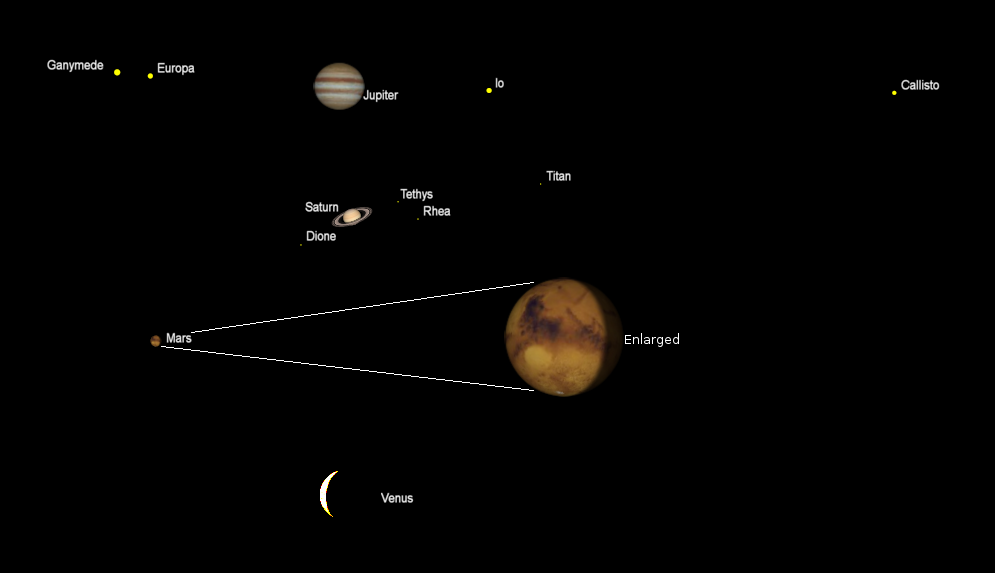
The planets as seen in a telescope (north up) with the same magnification tomorrow morning June 25, 2020. Apparent diameters: Jupiter, 46.96″; Saturn, 18.28″, rings, 42.58″, Mars, 10.99″, and Venus 47.10″. Mars also shows an enlargement showing surface detail. The ” symbol means seconds of arc (1/3600th of a degree.) Click on the image to enlarge. Created using Cartes du Ciel (Sky Charts).
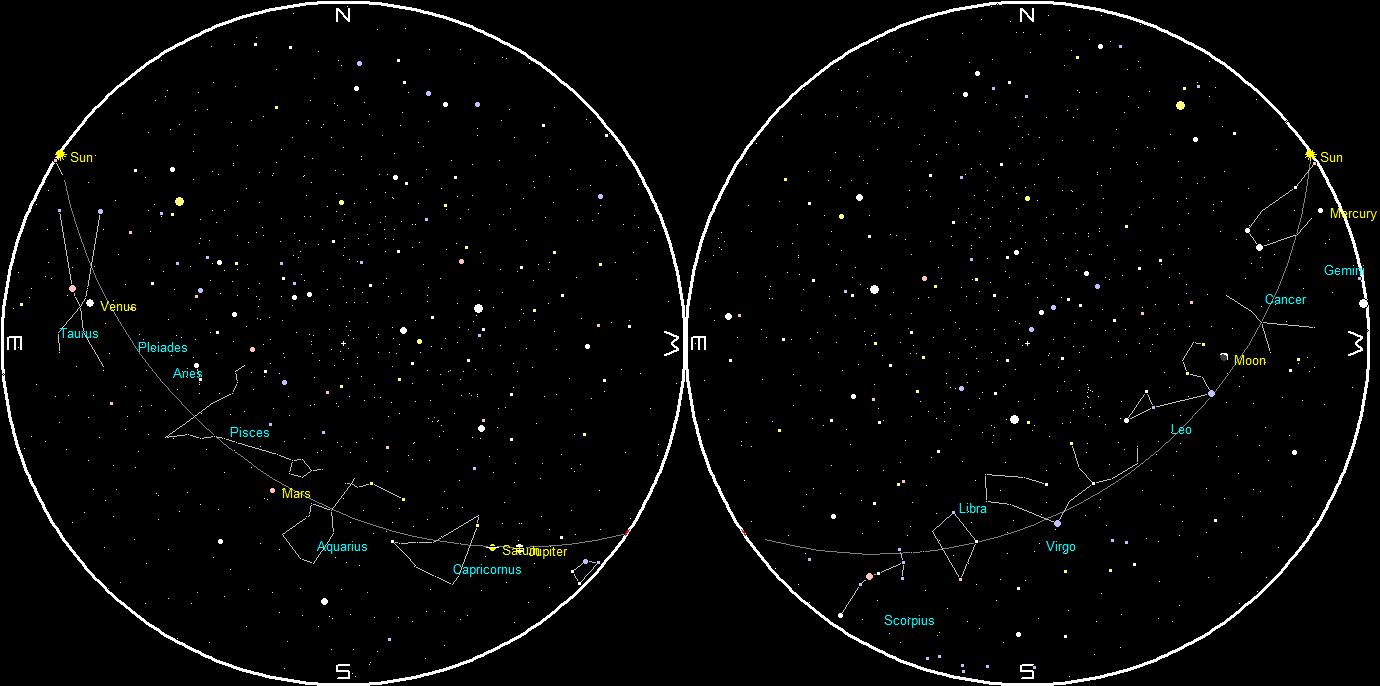
Planets and the Moon at sunset and sunrise of a single night starting with sunset on the right on June 24, 2020. The night ends on the left with sunrise on the 25th. The closeness of Jupiter and Saturn in the morning sky unfortunately overlays planets and labels. Click on the image to enlarge. Created using my LookingUp program.
06/23/2020 – Ephemeris – Arcturus: a look at the Sun’s future
This is Ephemeris for Tuesday, June 23rd. Today the Sun will be up for 15 hours and 34 minutes, setting at 9:32, and it will rise tomorrow at 5:58. The Moon, 2 days past new, will set at 11:49 this evening.
Arcturus, a red giant star is about two thirds the way up the sky in the southwest at 11 p.m. It’s one of the earliest stars to appear in twilight, being nearly tied in brightness with Vega, a white star nearly as high in the east. A pointer to Arcturus is the handle of the Big Dipper, following the arc of the handle to Arcturus. Though only 37 light years away, it’s not from around here. It’s passing through the galactic disk from north to south. Arcturus is about 7 billion years old, and is about 8% more massive than our Sun. It appears to be starting its red giant phase, after running out of hydrogen to fuse to helium in its core and is beginning to fuse helium. It’s a preview of coming attractions for our Sun when it gets that old.
The event times given are for the Traverse City/Interlochen area of Michigan. They may be different for your location.
Addendum
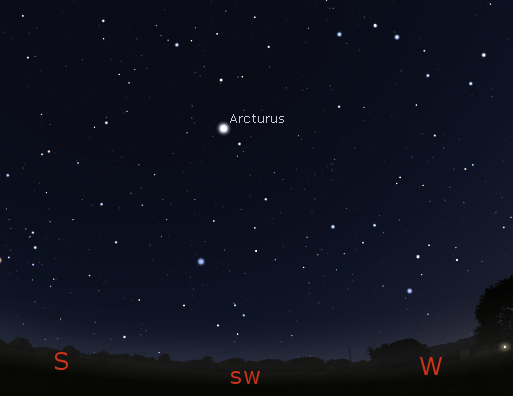
Arcturus is easy to find. It’s the brightest star in the southwest in the evening. This is 11 pm tonight June 23, 2020. Note the Big Dipper and its handle to the upper right. Created using Stellarium.
06/22/2020- Ephemeris – Summer has begun
This is Ephemeris for Monday, June 22nd. Today the Sun will be up for 15 hours and 34 minutes, setting at 9:32, and it will rise tomorrow at 5:57. The Moon, 1 day past new, will set at 11:04 this evening.
On Friday’s program I was way too busy with the summer solstice and the annular eclipse in Asia to properly give summer its due, so here goes. Last Saturday the northern end of the Earth’s axis was tilted toward the Sun to its maximum extent, giving the northern hemisphere its most direct sunlight, and the longest daylight hours. North of the arctic circle of 66 ½ degrees latitude got 24 hours of daylight, and the north pole midday in its six months of continuous sunlight. At the south pole it’s literally midnight of its six months night. The northern hemisphere got its greatest amount of heat from the Sun that day, however this part of the Earth is still warming up, so our hottest days average in late July when the shortening daylight hours and the lowering of the Sun in the south can’t maintain the heat anymore and we begin to cool.
The event times given are for the Traverse City/Interlochen area of Michigan. They may be different for your location.
Addendum
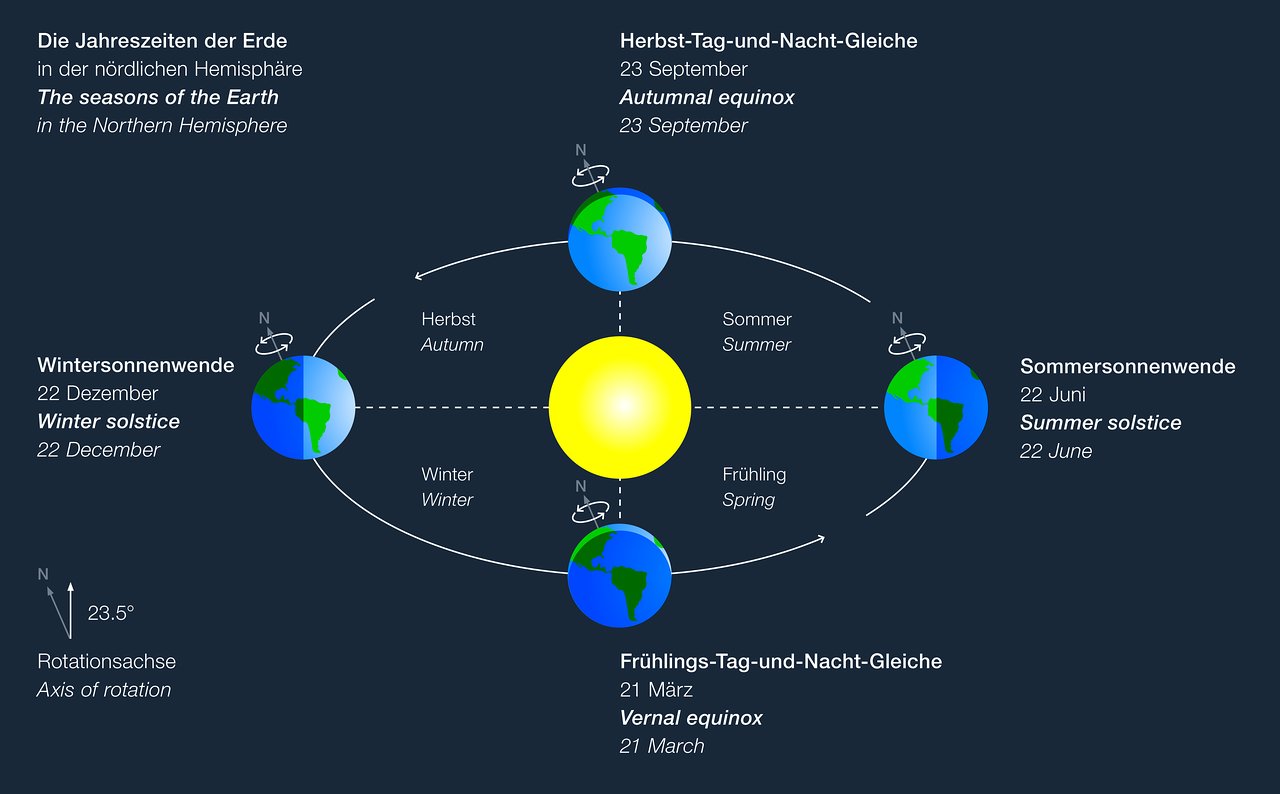
Earth’s position at the solstices and equinoxes. This is an not to scale oblique look at the Earth’s orbit, which is nearly circular. The Earth is actually farthest from the Sun on July 4th. Click on the image to enlarge. Credit: ESO (European Southern Observatory which explains the captions in German and English.
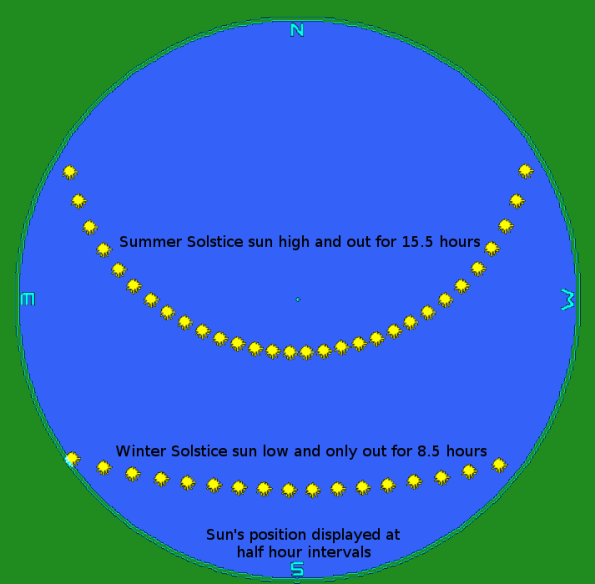
Comparing the sun’s path at the summer and winter solstices. This is a stereographic representation of the whole sky which distorts the sky and magnifies the size of the sun’s path near the horizon.
 Bob Moler's Ephemeris Blog