06/05/2020 – Ephemeris – A penumbral eclipse of the Moon for the eastern hemisphere of Earth today
This is Ephemeris for Friday, June 5th. Today the Sun will be up for 15 hours and 26 minutes, setting at 9:24, and it will rise tomorrow at 5:57. The Moon, at full today, will rise at 9:32 this evening.
There will be a penumbral eclipse of the Moon this afternoon. We won’t get to see it because the Moon won’t be up yet. The eclipse, such as it is, will be only visible from the eastern hemisphere of the Earth like Asia. Even then there won’t be much to see. In a penumbral eclipse the Moon only enters the Earth’s outer shadow, called the penumbra where sunlight is only partially cut off. Observers on the affected parts of the Moon would see the Sun only partially eclipsed. And anyone whose seen a partial solar eclipse will tell you that it doesn’t get that dark. So most penumbral eclipses go unnoticed unless one is told about them. This one less than 60% of the Moon will be immersed in the Earth’s penumbral shadow.
There will be two more penumbral lunar eclipses this year, both visible from the United States: July 5th when only 35% of the Moon’s diameter is immersed in the penumbra, and November 30th when 83% is immersed.
The event times given are for the Traverse City/Interlochen area of Michigan. They may be different for your location.
Addendum
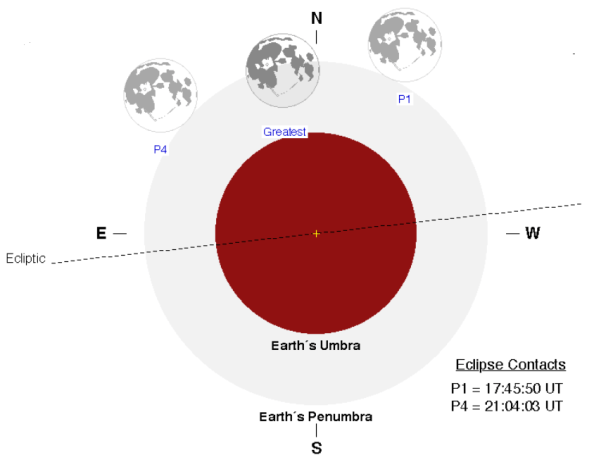
Lunar eclipse chart for the penumbral lunar eclipse of July 5th, 2020. Unfortunately for Michigan it will occur between 1:45 and 5:04 pm before the Moon rises tonight. Click on the image to see the original pdf page from NASA. Credit NASA GSFC/Fred Espenak.
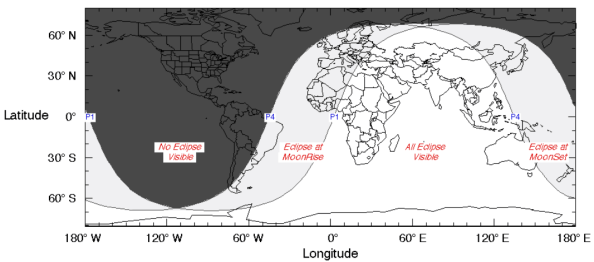
Eclipse visibility map. Areas on the Earth where the eclipse is visible. Credit NASA GSFC/Fred Espenak.
06/04/2020 – Ephemeris – Mercury is at it’s greatest separation from the Sun today
This is Ephemeris for Thursday, June 4th. Today the Sun will be up for 15 hours and 25 minutes, setting at 9:24, and it will rise tomorrow at 5:58. The Moon, 1 day before full, will set at 5:53 tomorrow morning.
Today at 9 am the planet Mercury will be at its greatest eastern elongation. That’s what astronomers call it. Implied is that it is at its greatest angular separation east of the Sun. Mercury, and also Venus have orbits inside Earth’s orbit of the Sun. For that reason they are called inferior planets. Therefore they never stray far from the position of the Sun in the sky. From around our latitude near 45 degrees north, we never see Mercury outside of twilight. Mercury has a remarkably elliptical orbit ranging from 29 million miles (47 million km) to 43 million miles (70 million km) from the Sun. In both spring and fall at favorable elongations, we see Mercury near perihelion, that close point. Southern hemisphere observers get a better view of it. Having a late spring greatest eastern elongation we get to see Mercury farther from the Sun than the same elongation earlier in the year.
The event times given are for the Traverse City/Interlochen area of Michigan. They may be different for your location.
Addendum
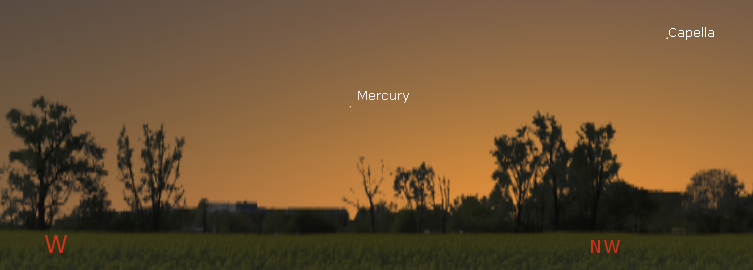
Mercury in the evening tonight at 10 pm June 3, 2020 (About 45 minutes after sunset). Click on the image to enlarge. Created using Stellarium.
06/03/2020 – Ephemeris – Let’s look at the naked-eye planets for this week
This is Ephemeris for Wednesday, June 3rd. Today the Sun will be up for 15 hours and 24 minutes, setting at 9:23, and it will rise tomorrow at 5:58. The Moon, 2 days before full, will set at 5:15 tomorrow morning.
Let’s look at the naked-eye planets for this week. This afternoon Venus will pass between the Earth and the Sun and head toward the morning sky. It’s only 26.8 million miles (43.2 million km) away, and quite invisible. Mercury is visible in the northwest after sunset, coming to greatest separation or elongation from the Sun of 23.6 degrees It will set tonight at 11:16 pm. In the morning sky there are three planets in the south and southeast. Bright Jupiter will rise first at 12:10 am, followed by Saturn at 12:26 am. Mars, is stretching its lead left of Saturn and will rise at 2:27 a.m. Its now down to 91.9 million miles (148.0 million km) away, as the Earth slowly overtakes it at the rate of about 4.4 million miles (7.0 million km) a week.
The event times given are for the Traverse City/Interlochen area of Michigan. They may be different for your location.
Addendum
Mercury in the evening tonight at 10 pm June 3, 2020. This is 11 hours before greatest eastern elongation, 23.6° east of the Sun. Click on the image to enlarge. Created using Stellarium.
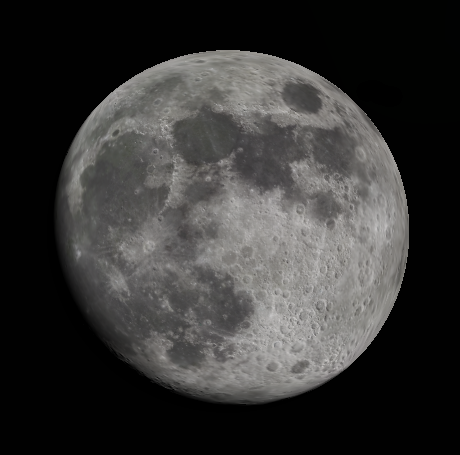
The Moon in binoculars or a low power telescope. Created using Stellarium.
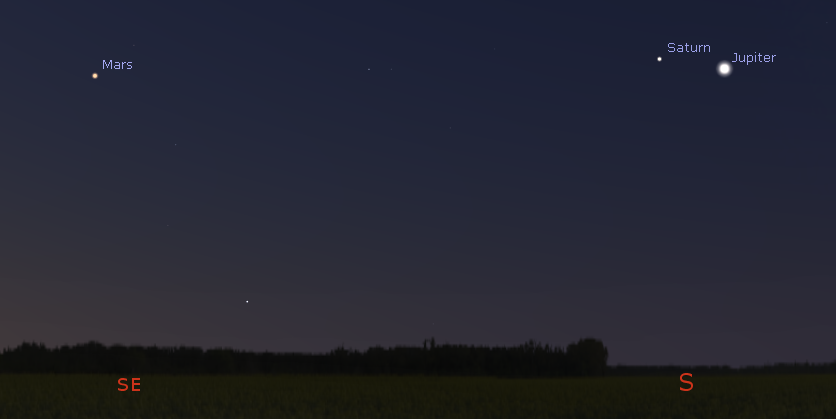
Jupiter, Saturn and Mars in the growing twilit skies of 5 am tomorrow morning, June 4, 2020. Click on image to enlarge. Created using Stellarium.
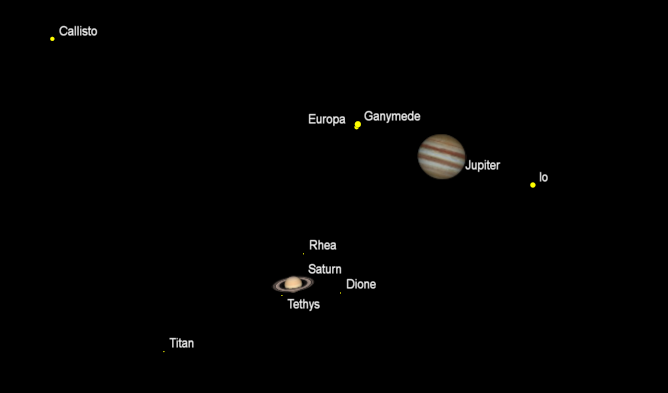
The planets as seen in a telescope with the same magnification. Jupiter and Saturn tomorrow morning of June 4, 2020. Apparent diameters: Jupiter, 45.06″; Saturn, 17.87″, rings, 41.62″. Mars at 9.49″ won’t be added until it reaches 10″, which looks like next week. The ” symbol means seconds of arc (1/3600th of a degree). Created using Cartes du Ciel (Sky Charts).
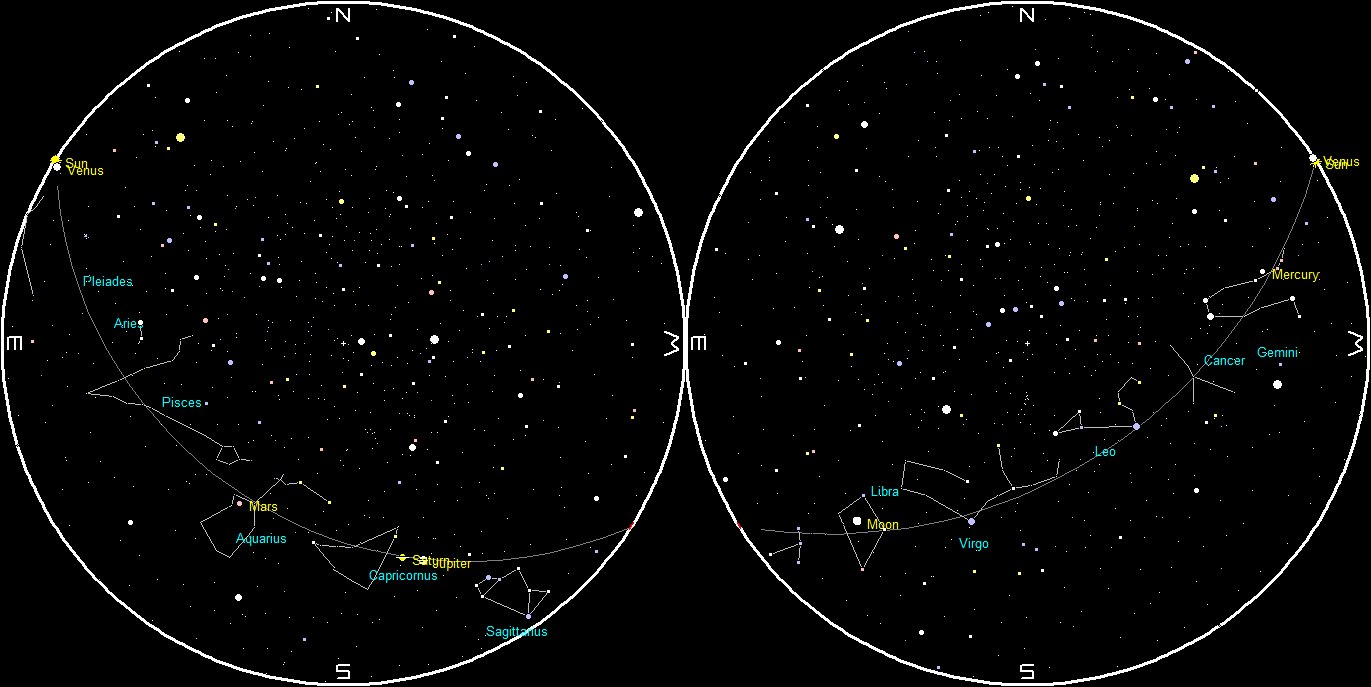
Planets and the Moon at sunset and sunrise of a single night starting with sunset on the right on June 3, 2020. The night ends on the left with sunrise on the 4th. The closeness of Jupiter and Saturn in the morning sky unfortunately overlays planets and labels. Click on the image to enlarge. Created using my LookingUp program.
06/02/2020 – Ephemeris – It’s 1968 all over again
A nod to the disturbing events happening back on Earth…
This is Ephemeris for Tuesday, June 2nd. Today the Sun will be up for 15 hours and 23 minutes, setting at 9:22, and it will rise tomorrow at 5:59. The Moon, 3 days before full, will set at 4:44 tomorrow morning. | It seems that we’re back to 1968 again. Civil unrest, an election year with an unpopular president, advances in space. In 1968, it was Apollo 8’s triumphant journey to and around the Moon. This year’s first commercial Crew Dragon flight to the International Space Station, after 9 years of bumming rides from the Russians, whom we supposedly beat in the space race back in the 1960s, is our Apollo 8. Our unpopular wars in the Middle East now hardly make the news, unlike the Vietnam War, but the racial strife seems as bad as ever. To top it off, this year we have the COVID-19 pandemic that is destroying the economy and our way of life. No wonder I seek the solace of the stars in the universe beyond.
The event times given are for the Traverse City/Interlochen area of Michigan. They may be different for your location.
Addendum
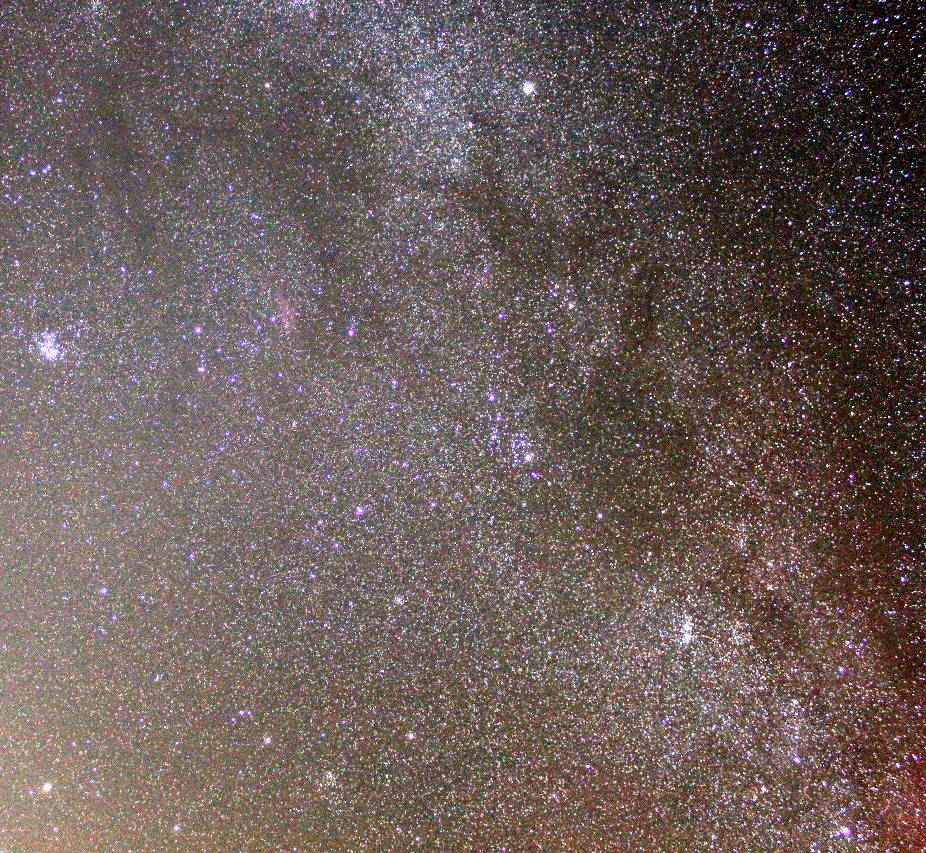
Stars and the Milky Way centered on Perseus. Credit Bob Moler.
06/01/2020 – Ephemeris – Let’s preview June’s bright skies (Long days and short nights)
This is Bob Moler with Ephemeris for Monday, June 1st. Today the Sun will be up for 15 hours and 21 minutes, setting at 9:21, and it will rise tomorrow at 5:59. The Moon, 3 days past first quarter, will set at 4:15 tomorrow morning.
Ephemeris start’s its 46th orbit of the Sun today, so let’s preview June skies. There will be a lot of sunlight in June. The daylight hours will increase a bit from 15 hours and 21 minutes today to 15 hours and 34 minutes on the 20th, the solstice, retreating back to 15 hours 31 minutes at month’s end. At this time of the year the sunset times for Ludington, Interlochen, Petoskey and Mackinaw City are very nearly the same. However the sunrise times are at their most divergent. With Ludington’s sunrise being 14 minutes later than Mackinaw City’s. The altitude of the Sun above the southern horizon at local noon will increase from about 67 and a half degrees to 68 and three-quarters on the 20th. Local noon, when the Sun is actually due south in the Interlochen area will occur at about 1:43 p.m.
The event times given are for the Traverse City/Interlochen area of Michigan. They may be different for your location.
Addendum
June Evening Star Chart
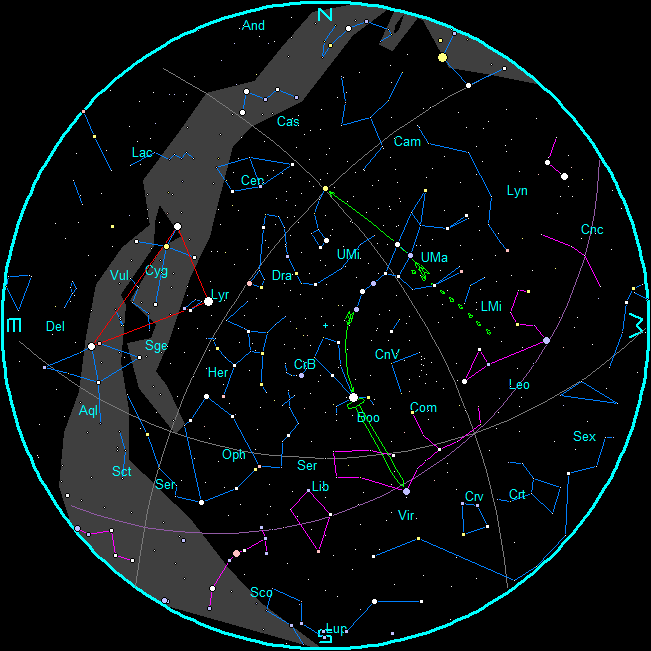
Star Chart for June 2020 (11 p.m. EDT June 15, 2020). Created using my LookingUp program. Click on image to enlarge.
The planets and stars are plotted for the 15th at 11 p.m. EDT in the evening and 4 a.m. for the morning chart. These are the chart times. Note that Traverse City is located approximately 45 minutes behind our time meridian, West 75° longitude. (An hour 45 minutes behind our daylight saving time meridian during EDT). To duplicate the star positions on a planisphere you may have to set it to 1 hour 45 minutes earlier than the current time.
Note the chart times of 11 p.m. and 4 a.m. are for the 15th. For each week before the 15th add ½ hour (28 minutes if you’re picky). For each week after the 15th subtract ½ hour. The planet positions are updated each Wednesday on this blog. For planet positions on dates other than the 15th, check the Wednesday planet posts on this blog.
June Morning Star Chart
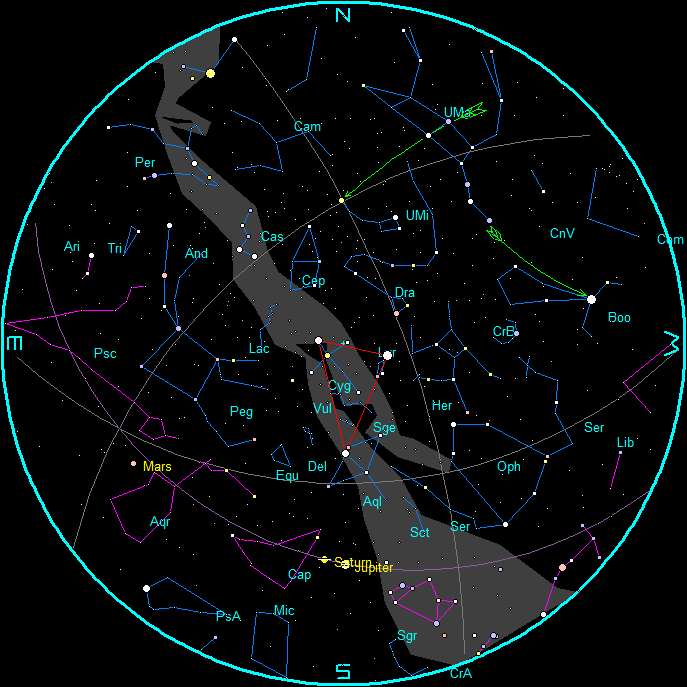
Star Chart for June mornings 2020 (4 a.m. EDT June 15, 2020). Created using my LookingUp program. Click on image to enlarge.
For a list of constellation names to go with the abbreviations click here.
- Pointer stars at the front of the bowl of the Big Dipper point to Polaris the North Star.
- Leaky dipper drips on Leo.
- Follow the arc of the handle of the Big Dipper to the star Arcturus, and
- Extend like a spike to Spica.
- The Summer Triangle is in red.
Twilight Limits, Nautical and Astronomical
| EDT | |||||||
| Morning twilight | Evening twilight | Dark night | Moon | ||||
| Date | Astro. | Nautical | Nautical | Astro. | Start | End | Illum. |
| 2020-06-01 | 3h42m | 4h41m | 22h47m | 23h47m | – | – | 0.82 |
| 2020-06-02 | 3h41m | 4h41m | 22h48m | 23h48m | – | – | 0.9 |
| 2020-06-03 | 3h40m | 4h40m | 22h49m | 23h50m | – | – | 0.9 |
| 2020-06-04 | 3h39m | 4h39m | 22h50m | 23h51m | – | – | 0.96 |
| 2020-06-05 | 3h37m | 4h39m | 22h51m | 23h52m | – | – | 1 |
| 2020-06-06 | 3h36m | 4h38m | 22h52m | 23h54m | – | – | 1 |
| 2020-06-07 | 3h36m | 4h37m | 22h53m | 23h55m | – | – | 0.97 |
| 2020-06-08 | 3h35m | 4h37m | 22h54m | 23h56m | 23h56m | – | 0.92 |
| 2020-06-09 | 3h34m | 4h37m | 22h55m | 23h58m | 23h58m | 0h28m | 0.85 |
| 2020-06-10 | 3h33m | 4h36m | 22h56m | 23h59m | 23h59m | 1h07m | 0.77 |
| 2020-06-11 | 3h33m | 4h36m | 22h56m | 0h00m | 0h00m | 1h38m | 0.67 |
| 2020-06-12 | 3h32m | 4h36m | 22h57m | 0h01m | 0h01m | 2h04m | 0.58 |
| 2020-06-13 | 3h32m | 4h35m | 22h58m | 0h01m | 0h01m | 2h27m | 0.48 |
| 2020-06-14 | 3h31m | 4h35m | 22h58m | 0h02m | 0h02m | 2h48m | 0.38 |
| 2020-06-15 | 3h31m | 4h35m | 22h59m | 0h03m | 0h03m | 3h09m | 0.29 |
| 2020-06-16 | 3h31m | 4h35m | 22h59m | 0h04m | 0h04m | 3h30m | 0.21 |
| 2020-06-17 | 3h31m | 4h35m | 23h00m | 0h04m | 0h04m | 3h31m | 0.13 |
| 2020-06-18 | 3h31m | 4h35m | 23h00m | 0h05m | 0h05m | 3h31m | 0.07 |
| 2020-06-19 | 3h31m | 4h35m | 23h00m | 0h05m | 0h05m | 3h31m | 0.03 |
| 2020-06-20 | 3h31m | 4h36m | 23h01m | 0h05m | 0h05m | 3h31m | 0 |
| 2020-06-21 | 3h31m | 4h36m | 23h01m | 0h05m | 0h05m | 3h31m | 0 |
| 2020-06-22 | 3h31m | 4h36m | 23h01m | 0h06m | 0h06m | 3h31m | 0.03 |
| 2020-06-23 | 3h32m | 4h36m | 23h01m | 0h06m | 0h06m | 3h32m | 0.07 |
| 2020-06-24 | 3h32m | 4h37m | 23h01m | 0h05m | 0h05m | 3h32m | 0.15 |
| 2020-06-25 | 3h33m | 4h37m | 23h01m | 0h05m | 0h28m | 3h33m | 0.24 |
| 2020-06-26 | 3h34m | 4h38m | 23h01m | 0h05m | 1h00m | 3h34m | 0.34 |
| 2020-06-27 | 3h34m | 4h38m | 23h01m | 0h05m | 1h28m | 3h34m | 0.46 |
| 2020-06-28 | 3h35m | 4h39m | 23h01m | 0h04m | 1h54m | 3h35m | 0.58 |
| 2020-06-29 | 3h36m | 4h40m | 23h00m | 0h04m | 2h19m | 3h36m | 0.69 |
| 2020-06-30 | 3h37m | 4h40m | 23h00m | 0h03m | 2h46m | 3h37m | 0.69 |
Twilight calendar was generated using Cartes du Ciel (Sky Charts).
See my blog post: Twilight Zone for the definitions of the different periods of twilight here: https://bobmoler.wordpress.com/2018/09/27/.
NASA Calendar of Planetary Events
Date       Time    Event
Jun 1  Mo            Venus: 3.7° E
    2  Tu  11:36 pm  Moon Perigee: 364400 km
    3  We  01:42 pm  Venus Inferior Solar Conjunction
    4  Th  08:59 am  Mercury Greatest Elongation: 23.6° E
    5  Fr  03:12 pm  Full Moon
    5  Fr  03:25 pm  Penumbral Lunar Eclipse
	                 (Europe, Africa, Asia, Aus.)
    6  Sa  02:10 pm  Moon Descending Node
    7  Su  12:22 pm  Moon South Dec.: 24.1° S
    8  Mo  01:19 pm  Moon-Jupiter: 2.3° N
    8  Mo  10:19 pm  Moon-Saturn: 2.8° N
   12  Fr  07:53 pm  Moon-Mars: 3° N
   13  Sa  02:24 am  Last Quarter
   14  Su  08:56 pm  Moon Apogee: 404600 km
   19  Fr  04:52 am  Moon-Venus: 0.8° S
   20  Sa  05:43 pm  Summer Solstice
   21  Su  12:24 am  Moon Ascending Node
   21  Su  02:40 am  Annular Solar Eclipse
                         (Africa, Asia)
   21  Su  02:41 am  New Moon
   21  Su  11:56 pm  Moon North Dec.: 24.1° N
   23  Tu  08:33 pm  Moon-Beehive: 1.8° S
   28  Su  04:16 am  First Quarter
   29  Mo  10:09 pm  Moon Perigee: 369000 km
   30  Tu  10:45 pm  Mercury Inferior Solar Conjunction
All event times are given for UTC-4 hr: Eastern Daylight Saving Time.
Sky Events Calendar by Fred Espenak and Sumit Dutta (NASA’s GSFC),
http://eclipse.gsfc.nasa.gov/SKYCAL/SKYCAL.html.
If you go to the above site you can print out a list like the above for the entire year or calendar pages for your time zone.
Sun and Moon Rising and Setting Events
                Ephemeris of Sky Events for Interlochen/TC
June, 2020    Local time zone: EDT
+-----------------------------------------------------------------------+
| DATE |  SUN     SUN  DAYLIGHT|   TWILIGHT*    |MOON  RISE OR    ILLUM |
|      |  RISE    SET    HOURS |  END    START  |PHASE SET** TIME FRACTN|
+=======================================================================+
|Mon  1| 06:00a  09:21p  15:21 | 10:45p  04:36a |      Set  04:15a   81%|
|Tue  2| 05:59a  09:22p  15:23 | 10:46p  04:36a |      Set  04:44a   89%|
|Wed  3| 05:59a  09:23p  15:24 | 10:47p  04:35a |      Set  05:15a   95%|
|Thu  4| 05:58a  09:24p  15:25 | 10:48p  04:34a |      Set  05:53a   99%|
|Fri  5| 05:58a  09:24p  15:26 | 10:49p  04:34a |Full  Rise 09:32p  100%|
|Sat  6| 05:57a  09:25p  15:27 | 10:50p  04:33a |      Rise 10:41p   98%|
+------+-----------------------+----------------+-----------------------+
|Sun  7| 05:57a  09:26p  15:28 | 10:51p  04:32a |      Rise 11:39p   94%|
|Mon  8| 05:57a  09:26p  15:29 | 10:52p  04:32a |      Rise 12:28a   88%|
|Tue  9| 05:57a  09:27p  15:30 | 10:52p  04:32a |      Rise 01:06a   80%|
|Wed 10| 05:56a  09:28p  15:31 | 10:53p  04:31a |      Rise 01:38a   71%|
|Thu 11| 05:56a  09:28p  15:31 | 10:54p  04:31a |      Rise 02:04a   62%|
|Fri 12| 05:56a  09:29p  15:32 | 10:54p  04:31a |      Rise 02:27a   53%|
|Sat 13| 05:56a  09:29p  15:32 | 10:55p  04:30a |L Qtr Rise 02:48a   43%|
+------+-----------------------+----------------+-----------------------+
|Sun 14| 05:56a  09:30p  15:33 | 10:56p  04:30a |      Rise 03:09a   34%|
|Mon 15| 05:56a  09:30p  15:33 | 10:56p  04:30a |      Rise 03:30a   25%|
|Tue 16| 05:56a  09:30p  15:34 | 10:57p  04:30a |      Rise 03:52a   17%|
|Wed 17| 05:56a  09:31p  15:34 | 10:57p  04:30a |      Rise 04:18a   11%|
|Thu 18| 05:56a  09:31p  15:34 | 10:57p  04:30a |      Rise 04:48a    5%|
|Fri 19| 05:56a  09:31p  15:34 | 10:58p  04:30a |      Rise 05:25a    2%|
|Sat 20| 05:57a  09:31p  15:34 | 10:58p  04:30a |      Rise 06:09a    0%|
+------+-----------------------+----------------+-----------------------+
|Sun 21| 05:57a  09:32p  15:34 | 10:58p  04:30a |New   Set  10:12p    1%|
|Mon 22| 05:57a  09:32p  15:34 | 10:58p  04:31a |      Set  11:04p    3%|
|Tue 23| 05:57a  09:32p  15:34 | 10:58p  04:31a |      Set  11:49p    8%|
|Wed 24| 05:58a  09:32p  15:34 | 10:58p  04:31a |      Set  12:27a   16%|
|Thu 25| 05:58a  09:32p  15:33 | 10:58p  04:32a |      Set  12:59a   24%|
|Fri 26| 05:58a  09:32p  15:33 | 10:58p  04:32a |      Set  01:28a   35%|
|Sat 27| 05:59a  09:32p  15:33 | 10:58p  04:33a |      Set  01:54a   46%|
+------+-----------------------+----------------+-----------------------+
|Sun 28| 05:59a  09:32p  15:32 | 10:58p  04:33a |F Qtr Set  02:19a   58%|
|Mon 29| 06:00a  09:32p  15:31 | 10:57p  04:34a |      Set  02:46a   69%|
|Tue 30| 06:00a  09:32p  15:31 | 10:57p  04:35a |      Set  03:15a   79%|
+-----------------------------------------------------------------------+
* Nautical Twilight
** Moonrise or moonset, whichever occurs between sunrise and sunset
05/29/2020 – Ephemeris is completing 45 trips around the Sun
This is Bob Moler with Ephemeris for Friday, May 29th. Today the Sun will be up for 15 hours and 17 minutes, setting at 9:19, and it will rise tomorrow at 6:01. The Moon, at first quarter today, will set at 2:55 tomorrow morning. This is the last program of Ephemeris’ 45th orbit of the Sun. Monday we start the 46th orbit. In case you’re confused, one orbit of the Sun equals one year. I consider the Earth a space station orbiting the Sun in roughly 365 and a quarter days. The orbital time is also marked by the seasons due to the Earth’s axial tilt, seeing the Sun from different directions, and also looking out in space at night to the procession of stars and constellations that slowly change throughout the year giving us the parade of the seasonal constellations. Now in the evening the winter stars have moved behind the Sun. The spring constellations are in the south in the evening, and some of the summer stars are rising in the eastern sky at the same time. The planets that orbit the Sun with us are the wild card: their complex gyrations baffled the ancients who thought the Earth to be stationary.
The event times given are for the Traverse City/Interlochen area of Michigan. They may be different for your location.
Addendum
I got extremely busy Thursday evening getting our astronomy club newsletter out that I forgot to post this item, which is why this post is a day late. Not much astro news in it anyway. However at this moment the SpaceX dragonship Endeavour is on its way to the International Space Station.
05/28/2020 – Ephemeris – The Moon tonight and the origin of the lunar seas
This is Ephemeris for Thursday, May 28th. Today the Sun will be up for 15 hours and 15 minutes, setting at 9:18, and it will rise tomorrow at 6:01. The Moon, 1 day before first quarter, will set at 2:25 tomorrow morning.
Tonight’s Moon is a fat crescent. The lower or southern part of the Moon are brighter. These are the lunar highlands, the more rugged crater filled part of the Moon. The darker areas are the so-called lunar seas, huge lava filled craters. Note that they appear to be roughly circular. They are thought to be the result of large asteroid impacts that occurred four billion years ago during what is known as the late heavy bombardment. The late heavy bombardment is still controversial. One theory has that the outer planets changed their orbits in time disrupting the two areas of small bodies, the asteroid belt inside Jupiter’s orbit and the Kuiper belt beyond Neptune, sending some of them into the inner solar system.
The event times given are for the Traverse City/Interlochen area of Michigan. They may be different for your location.
Addendum
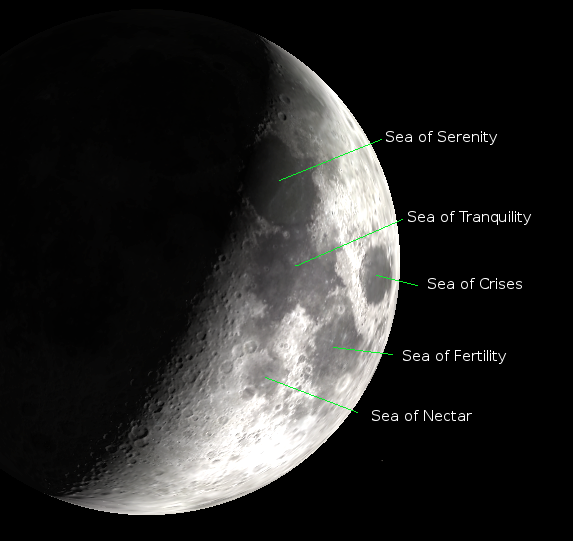
The Moon at low magnification this evening, May 28, 2020 with the English names for the visible lunar seas. Created using Stellarium.
05/27/2020 – Ephemeris – Let’s look at the naked-eye planets for this week
This is Ephemeris for Wednesday, May 27th. Today the Sun will be up for 15 hours and 14 minutes, setting at 9:17, and it will rise tomorrow at 6:02. The Moon, 2 days before first quarter, will set at 1:49 tomorrow morning.
Let’s look at the naked-eye planets for this week. Venus is our evening star shining brightly in the northwest. It will be our evening star for only another week and defeated by twilight for most of that time. A tiny crescent can now be seen in binoculars. It will cross between the Earth and the Sun on June 3rd. It will set tonight at 10:16 p.m. It’s only 27.6 million miles (44.5 million km) away. Mercury is making an appearance above and left of Venus now. In the morning sky there are three planets in the south and southeast. Bright Jupiter will rise first at 12:39 a.m. Followed by Saturn at 12:54 a.m. Mars, is stretching its lead left of Saturn and will rise at 2:44 a.m. Its now down to 96 million miles (155 million km) away, as the Earth slowly overtakes it at the rate of about 5 million miles (8 million km) a week.
The event times given are for the Traverse City/Interlochen area of Michigan. They may be different for your location.
Addendum
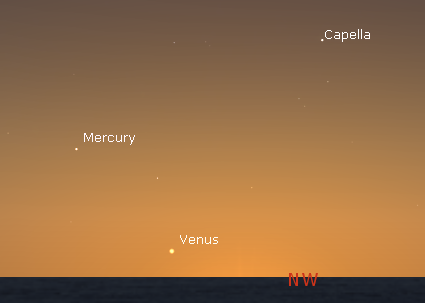
Venus & Mercury in twilight tonight at 10 p.m. May 27, 2020. Created using Stellarium.
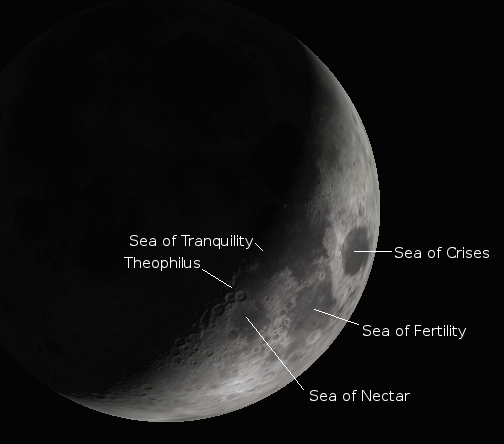
The Moon in a small telescope this evening May 27, 2020 with some seas and craters labeled. Created using Stellarium.
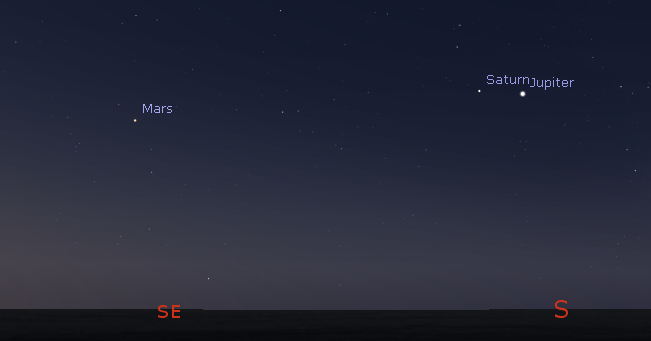
The Morning planets at 5 am. Created using Stellarium.
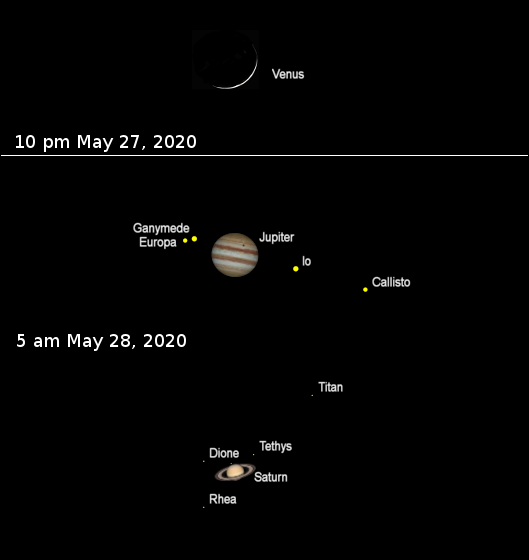
The planets as seen in a telescope with the same magnification. Venus, Jupiter and Saturn on the night of May 27/28, 2020. Apparent diameters: Venus, 56.49″. larger than Jupiter, at 44.24″; Saturn, 17.70″, rings, 41.22″. Mars at 9.06″ won’t be added until it reaches 10″. The ” symbol means seconds of arc (1/3600th of a degree.) Created using Cartes du Ciel (Sky Chart).
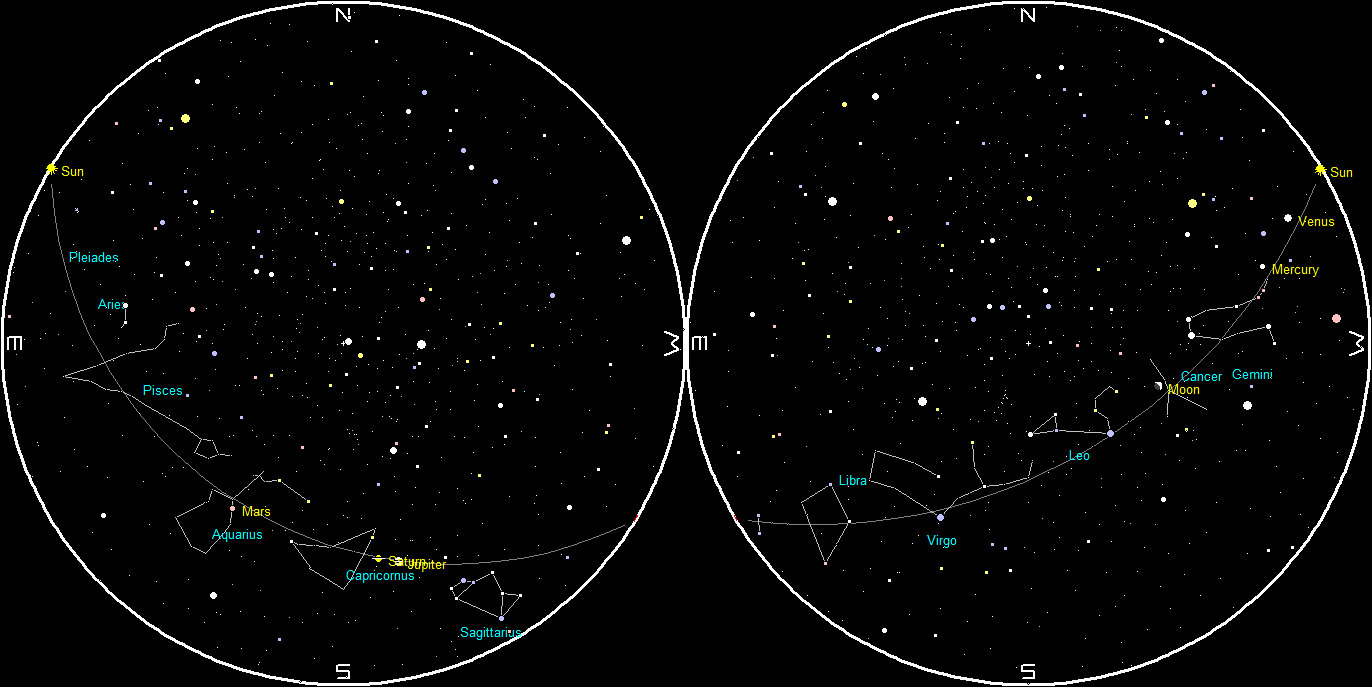
Planets and the Moon at sunset and sunrise of a single night starting with sunset on the right on May 27, 2020. The night ends on the left with sunrise on the 29th. The closeness of Jupiter and Saturn in the morning sky unfortunately overlays planets and labels. Click on the image to enlarge. Created using my LookingUp program.
05/26/2020 – Ephemeris – The first launch of humans to orbit from American soil in 9 years could happen tomorrow
This is Ephemeris for Tuesday, May 26th. Today the Sun will be up for 15 hours and 12 minutes, setting at 9:16, and it will rise tomorrow at 6:03. The Moon, 3 days before first quarter, will set at 1:07 tomorrow morning.
As of Sunday when I’m recording this NASA and SpaceX are still GO for the launch of two American astronauts to the International Space Station tomorrow. This will be the first human launch from the United States since Space Shuttle Atlantis left this same launch pad 39a left on July 8th, 2011. On that flight Doug Hurley was pilot, and he will command this flight. He visited the ISS twice, however his wife Karen Nyberg also visited the ISS twice, however the last time she stayed nearly 6 months. Bob Behnken the second astronaut is also a space shuttle veteran with two construction flights to the ISS and like Hurley is married to an astronaut, Megan McArthur who flew on the last Hubble Space Telescope repair mission.
The event times given are for the Traverse City/Interlochen area of Michigan. They may be different for your location.
Addendum

SpaceX Demo-2 astronauts Bob Behnken (left) and Doug Hurley. Credit: SpaceX.
05/25/2020 – Ephemeris – Comet SWAN is in our skies in evening twilight
When I recorded this program on the evening of the17th there was hope that Comet SWAN would have achieved naked-eye visibility. It did earlier this month when it was too far south for us to see from 45° North latitude. Predictions now are for it to be 7th magnitude, 2.5 times dimmer than the faintest star visible to the unaided eye.
This is Ephemeris for Memorial Day, Monday, May 25th. Today the Sun will be up for 15 hours and 10 minutes, setting at 9:15, and it will rise tomorrow at 6:03. The Moon, 3 days past new, will set at 12:18 tomorrow morning.
Comet SWAN just might be visible in binoculars tonight by about 10:30 p.m. with binoculars or a small telescope low in the northwestern sky. A pointer to it is the bright star Capella also in that direction. Comet SWAN will be located in the direction of 4 o’clock (to the right and a bit down) by 10 degrees angle, the width of your fist held at arms length. It will be a small fuzzy spot. I doubt you would spot the comet’s tail. It is a thin ion or gaseous tail that is revealed in photographs only. Over the next week it will be moving toward Capella and on June 1st will be just below Capella but half as bright as it is now. There’s another comet coming. Comet NeoWISE will be visible in our skies by late July if it holds up.
The event times given are for the Traverse City/Interlochen area of Michigan. They may be different for your location.
Addenda
Comet SWAN
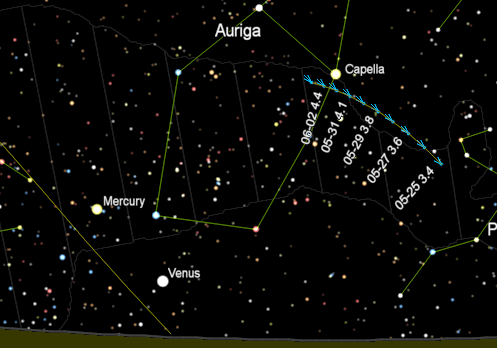
Comet SWAN track against the stars for 10 pm May 25 to June 3, 2020 with Mercury and Venus for the 25th They will be moving too. Comet labels show month-day and magnitude. However add 4 to the magnitude to get the approximate actual magnitude. The comet would be hard to spot in binoculars even in a dark sky. But who knows, the comet might flare up and be visible. Created using Cartes du Ciel (Sky Charts).
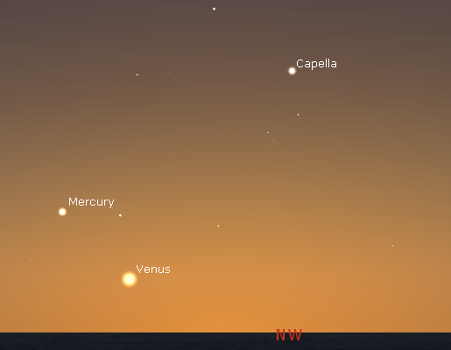
Northwestern horizon tonight at 10 pm May 25, 2020 with a scale that’s close to that of the image above. The comet is not bright enough to show here. Created using Stellarium.
In Memoriam
Today as we prepare to send humans into space from American soil for the first time in 9 years we pause to remember those who gave their lives for our country. For purposes of this program that includes those courageous enough to sit on top of or beside a million pounds of explosives to be launched into space. From the three astronauts who died in the Apollo one file in 1967, the explosion of the Space Shuttle Challenger in 1986, to the disintegration of the Columbia in 2003, 17 Americans and other nationals have died in NASA space accidents. The Russians too have lost cosmonauts in the exploration of space. Brothers and sisters in the quest for knowledge and to expand the horizons of human habitation. Per aspera, ad astra, Through difficulties to the stars!
A listing of Astronaut and Cosmonaut deaths: http://www.aerospaceweb.org/question/history/q0114.shtml
The Vatican Observatory Calendar
Being Catholic, I occasionally check the Vatican Observatory Foundation website. Besides the director of the Vatican Observatory is Brother Guy Consolmagno SJ, a fellow Michigander, born in Detroit. There were a couple of items on the May calendar that caught my eye.
Today, was marked as Memorial Day, but also Towel Day. Towel Day? It’s the 42nd anniversary of the first BBC Radio broadcast of Douglas Adams’ Hitchhiker’s Guide to the Galaxy. And if you don’t know the significance of a towel or the number 42, I won’t spoil it for you.
Also May 15th was the 300th birthday of Maximilian Hell SJ, first director of the Vienna Observatory, who also observed the transit of Venus in1769 from northern Norway. The crater on the Moon Hell is named for him. I’ve always had fun showing the crater a day or two after first quarter and mentioning that the crater Hell is named after a priest.
 Bob Moler's Ephemeris Blog