12/12/2019 – Ephemeris – Previewing the Geminids this weekend
Ephemeris for Thursday, December 12th. Today the Sun will be up for 8 hours and 51 minutes, setting at 5:02, and it will rise tomorrow at 8:11. The Moon, at full today, will rise at 5:38 this evening.
This upcoming weekend is the weekend of the greatest annual meteor shower of the year. They’re the Geminids. I confess to never having seen a Geminid. The reason is that it’s generally too cloudy, and for me too cold and this year is another problem, a bright Moon. In dark skies they have a 120 per hour peak, when the radiant point in Gemini is overhead. The body that was discovered to produce these meteors doesn’t appear to be a comet. It is designated as an asteroid 3200 Phaethon. Phaethon gets extremely close to the sun at 13 million miles (21 million km) and one of the STEREO Sun monitoring satellites caught it developing a tail when close to the Sun. Phaethon may then be the first known rock comet. I’ll have more on it tomorrow. (12/08/2014)
The times given are for the Traverse City/Interlochen area of Michigan. They may be different for your location.
Addendum
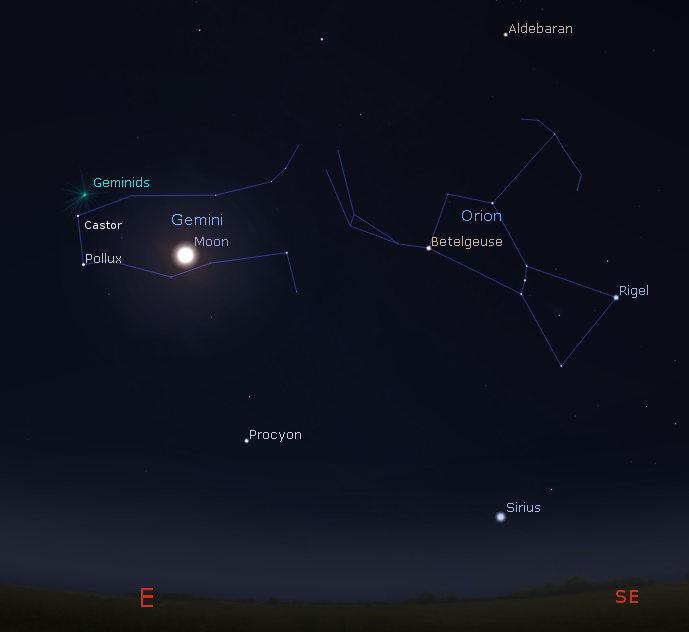
Eastern sky for Geminids at 10 p.m. December 13, 2019. On the 14th the Moon will be the same distance from Pollux but below it. Remember that the Geminid meteors will be seen all over the sky. It might help to hide the moon behind a building so as to better see the brighter meteors. Created using Stellarium.
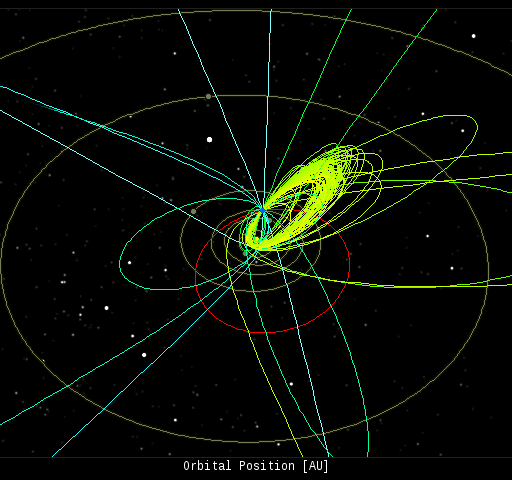
Orbits of Fireballs on the night of December 13-14 as recorded by NASA’s All Sky Cameras six years ago. The preponderance of fireballs in yellow (bright meteors) are Geminids. These are published daily on Spaceweather.com. Credit: NASA and Spaceweather.com
12/11/2019 – Ephemeris – Where are the naked-eye planets now
Ephemeris for Wednesday, December 11th. Today the Sun will be up for 8 hours and 52 minutes, setting at 5:02, and it will rise tomorrow at 8:10. The Moon, 1 day before full, will set at 8:28 tomorrow morning.
Let’s look at the naked-eye planets for this week. Venus will be briefly visible low in the southwest before it sets at 7:06 p.m. Jupiter is lost in twilight. It will pass behind the Sun on the 27th and will enter the morning sky. Saturn, the ringed planet, will be in the southwestern sky in the evening, and will set at 7:13 p.m. Tonight Saturn will be about 2 degrees or 4 moon widths to the upper right of the much brighter Venus. Mars is in the morning sky and will rise in the east-southeast at 5:13 a.m. It’s not very bright because it’s 215 million (346 million km) miles away, but it’s getting slowly closer to the Earth. Mercury is now too close to the Sun to be seen in morning twilight.
The times given are for the Traverse City/Interlochen area of Michigan. They may be different for your location.
Addendum
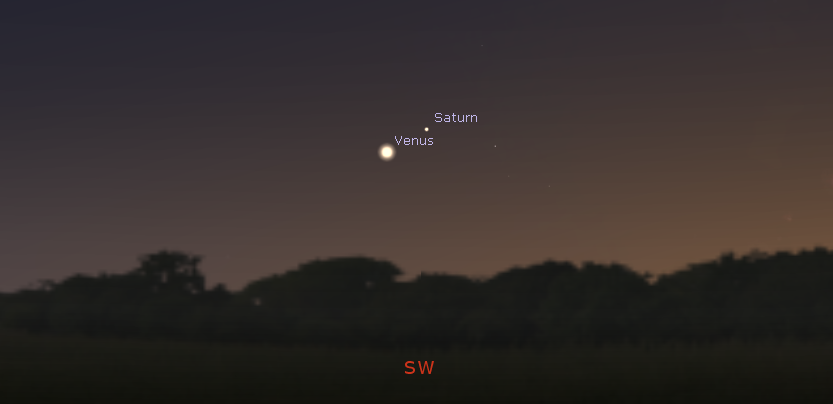
Venus and Saturn low ion the southwest tonight at 6 p.m. December11, 2019. Click on the image to enlarge. Created using Stellarium.
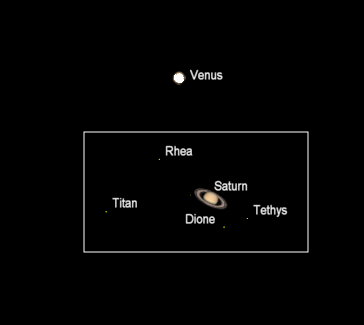
Telescopic views of Venus and Saturn with the same magnification at 6 p.m. tonight December 11, 2019. In the morning, I will show Mars here when it reaches an apparent diameter of 10″ (seconds of arc). It’s currently 4.0″. By the way Venus is 11.8″. Created using Cartes du Ciel (Sky Charts).
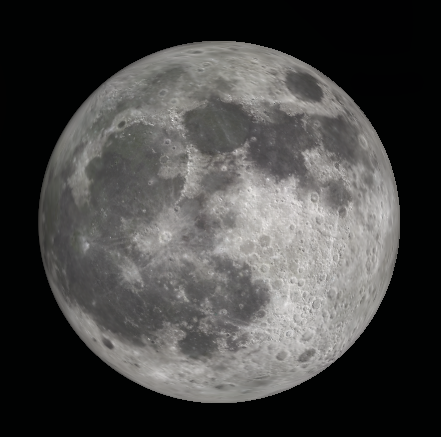
The nearly full Moon at 6 p.m. tonight December 11, 2019. Created using Stellarium.
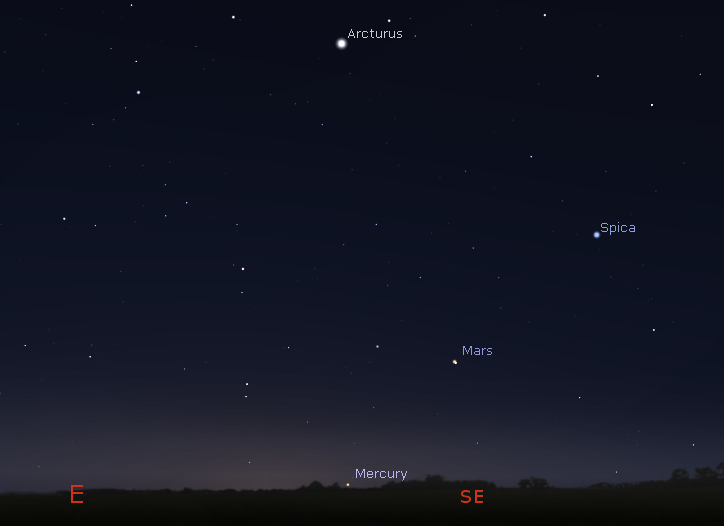
Mars in the morning with the bright stars at 7 a.m. December 12, 2019. Mercury is on the horizon and most likely invisible. Click on the image to enlarge. Created using Stellarium.
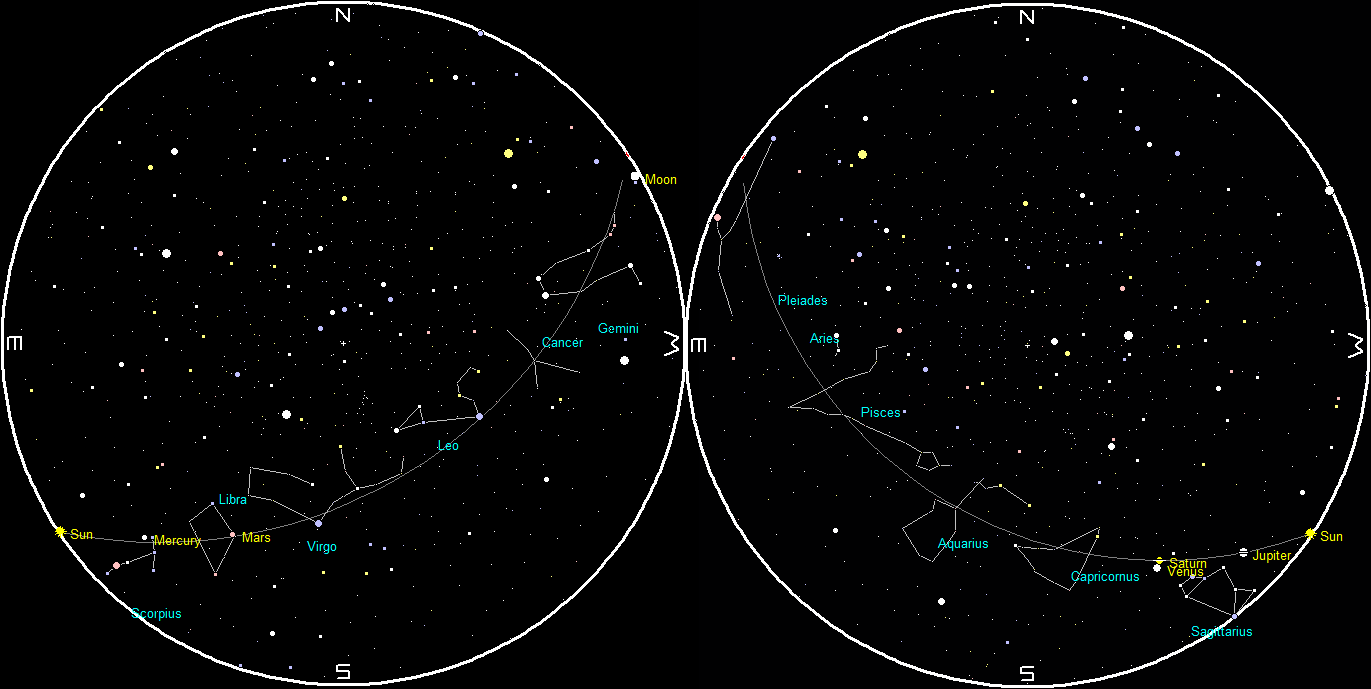
Planets and the Moon at sunset and sunrise of a single night starting with sunset on the right on December 11, 2019. The night ends on the left with sunrise on the 12th. Click on the image to enlarge. Created using my LookingUp program.
12/10/2019 – Ephemeris – The Moon’s natural resource more precious than gold
Ephemeris for Tuesday, December 10th. Today the Sun will be up for 8 hours and 53 minutes, setting at 5:02 the earliest sunset, and it will rise tomorrow at 8:09. The Moon, 2 days before full, will set at 7:22 tomorrow morning.
The Moon is attracting the attention of NASA and the Chinese for crewed landings. The attraction is a natural resource the Moon has. It’s water, or rather ice. There are known water reserves in the Moon’s south polar craters, whose floors never see sunlight. That means they’re very cold. Cold traps they’re called. The Moon has a very little axial tilt so the crater floors are forever cold. They would collect water vapor from passing and colliding comets over the millennia. 10 years ago the second stage of the rocket that placed the Lunar Reconnaissance Orbiter in lunar orbit was crashed into one of the south polar craters followed by a satellite to analyze the ejecta. Water vapor was kicked up by the impact in Cabeus crater.
The times given are for the Traverse City/Interlochen area of Michigan. They may be different for your location.
Addendum
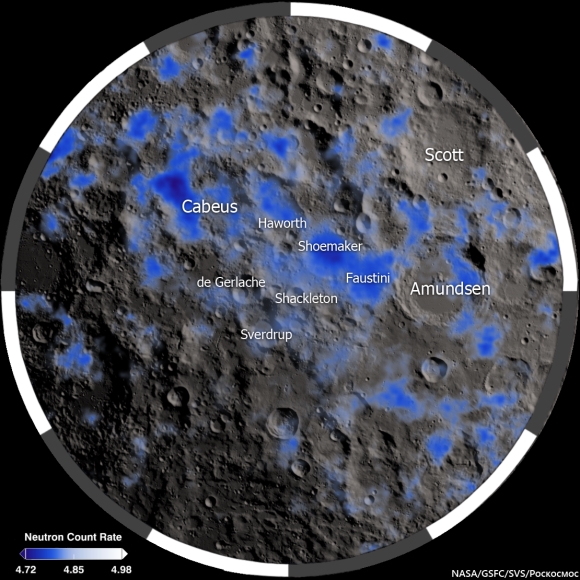
The south pole of the Moon where the presence of water ice is detected by the absorption of neutrons by the hydrogen atoms in the ice. Credit NASA/GSFC/SVS/Roscosmos.
You’ll notice that the craters on the the Moon’s south pole are named for Antarctic explorers. Besides water other volatiles were found: methane, ammonia, hydrogen gas, carbon dioxide and carbon monoxide.
12/09/2019 – Ephemeris – Tomorrow is the earliest sunset
Ephemeris for Monday, December 9th. Today the Sun will be up for 8 hours and 54 minutes, setting at 5:02, and it will rise tomorrow at 8:08. The Moon, 3 days before full, will set at 6:15 tomorrow morning.
In twelve days we will have the shortest day in terms of daylight hours. But the change isn’t uniformly distributed in the morning and evening. Tonight we will have the earliest sunset. Sunset times have been within the same minute for the last few days and will continue for the next few. The latest sunrise will occur on January second. The reason is that the Sun is traveling faster eastward than average because the Earth is closer to it now, so the Earth’s rotation takes a little longer each day to catch up with it. Near the solstice the Sun is at a higher latitude, where the longitude lines are closer together so it crosses them faster. A smaller effect exists in June because the Sun is farther away and its slowness subtracts from the higher latitude effects.
The times given are for the Traverse City/Interlochen area of Michigan. They may be different for your location.
Addendum
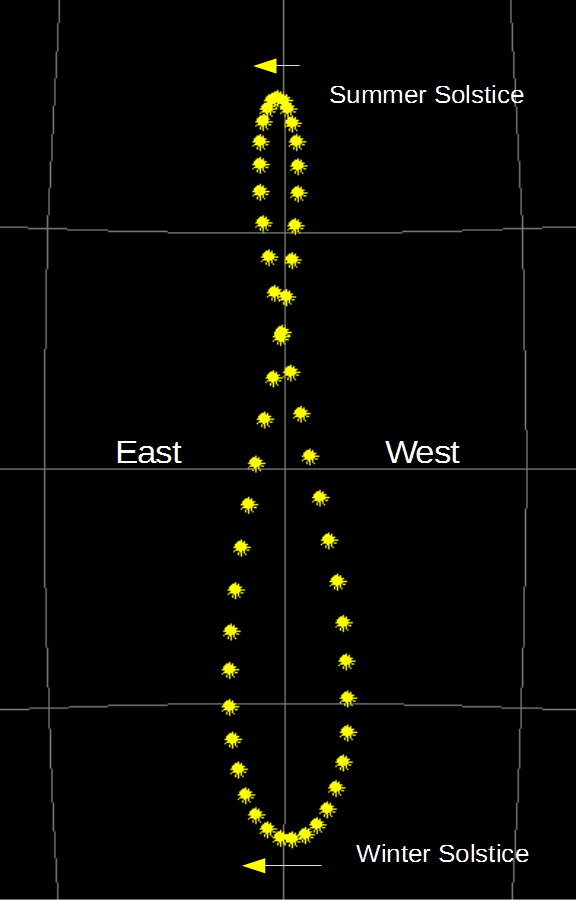
This figure 8 is called an analemma. One can find it on old globes in the Pacific Ocean. Explanation below. Created using my LookingUp program.
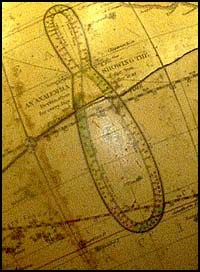
An Analemma graphically demonstrating the actual Sun’s relation to the mean Sun during the year.
From my December 2nd 2014 post with updates:
The analemma is a graphical representation of a daily value called the Equation of Time. It’s best known use is in corrections to sundial time. The vertical axis is the sun’s declination or north-south position. It is highest at summer solstice and lowest at winter solstice. It is the result of two effects: the tilt of the Earth’s axis to the plane of the Earth’s orbit around the Sun, and the change in the Earth’s velocity around the Sun as the Earth moves from perihelion, its closest to the Sun in early January to aphelion, its most distant in July.
If the Earth’s orbit were circular, and it orbited the Sun at the same speed. The analemma would be skinnier and the north and south lobes would be of equal size. Since we’re closer to the Sun in the winter, we move faster than average around the Sun, so it appears to move faster eastward. That combines with the faster appearing movement of the sun crossing the closer hour lines at higher and lower declinations (latitudes). In the diagram above note that the vertical hour lines are slightly closer together at the bottom and the top, so the Sun, moving eastward each day crosses them quicker. Near the winter solstice the two effects work together making sunrise and sunset trending to be later than normal. For the summer solstice the eastward speed of the sun is slower than normal, because we’re farther from the Sun. This works against the effect of the earth’s tilt but cannot completely negate it, making the top of the loop smaller than the one at the bottom. The arrows show the speed and direction of the Sun at the solstices.
In my month preview posts I generally mention the time of local noon for mid month. I didn’t do it for this month. If the equation of time is zero our local solar noon, in the Interlochen/Traverse City area, the Sun is due south at 12:43 p.m. during Eastern Standard Time, because that time meridian of 75 degrees longitude runs through Philadelphia PA. During daylight time it’s 60 degrees longitude, which clips the eastern edge of Nova Scotia. On the top figure of the analemma, if the Sun is west of center, the Sun is fast and to the east is slow. It changes rapidly in December, at the bottom end of the figure 8 when the Sun is farthest south. Local solar noon on the first is at 12:31 p.m., and it will slow to 12:45 p.m. on the 31st.
To see real analemmas in the sky search for analemma images on the Internet. It takes a year to photograph one.
12/06/2019 – Ephemeris – I’m giving a talk tonight: Cosmology and Astronomy in the Bible
Ephemeris for Friday, December 6th. Today the Sun will be up for 8 hours and 57 minutes, setting at 5:02, and it will rise tomorrow at 8:06. The Moon, 2 days past first quarter, will set at 3:02 tomorrow morning.
This evening yours truly will present one of his annual Christmas programs at Northwestern Michigan College’s Rogers Observatory starting at 8 p.m., the monthly meeting of the Grand Traverse Astronomical Society. The talk is Cosmology and Astronomy in the Bible. In Genesis and elsewhere we have descriptions of the earth and the heavens. We’ll look at what the ancient Hebrews thought of the structure of the universe from the Bible and other writings. Tomorrow evening we will also have a Star Party from 9 to 11 p.m. This will be the last viewing night of the year. If it’s clear we’ll look at the Moon and Great Orion Nebula. The observatory is located south of Traverse City on Birmley Road between Garfield and Keystone roads.
The times given are for the Traverse City/Interlochen area of Michigan. They may be different for your location.
Addendum
Let there be light slide from the program
12/05/2019 – Ephemeris – Artemis the new Moon program
Ephemeris for Thursday, December 5th. Today the Sun will be up for 8 hours and 58 minutes, setting at 5:02, and it will rise tomorrow at 8:05. The Moon, 1 day past first quarter, will set at 2:01 tomorrow morning. | NASA has a new program to return to the Moon, perhaps to stay. The program is called Artemis, named after the Greek god Apollo’s twin sister. NASA is building a massive rocket called the Space Launch System, or SLS, and the Orion
, which I’m sure will guarantee European astronauts a ride. This is not going to be an Apollo type one rocket up and back. There will be a space station called the Lunar Gateway of International partners that will orbit the Moon. There the crew of the Orion Spacecraft will transfer to a Lunar Lander for the trip to and from the surface of the Moon. It’s a heavy push to accomplish by 2024.
The times given are for the Traverse City/Interlochen area of Michigan. They may be different for your location.
Addendum
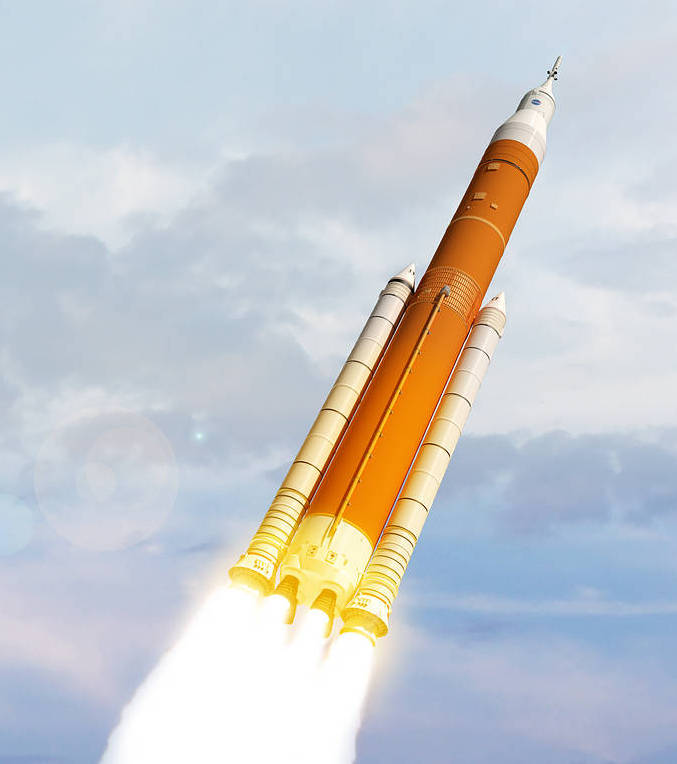
The Block 1b vrsion of the Space Launch System (SLS) which uses elongated Space Shuttle boosters and a core stage with 4 Space Shuttle main engines for the first stage. Credit NASA.
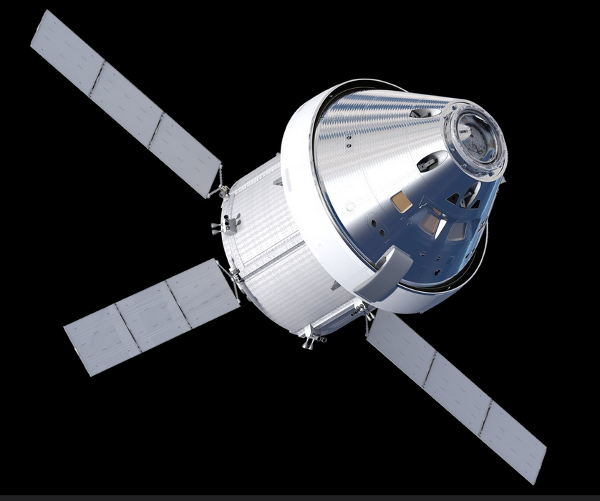
Cone-shaped Orion Multi-Purpose Crew Vehicle with a European Service Module. Credit NASA.
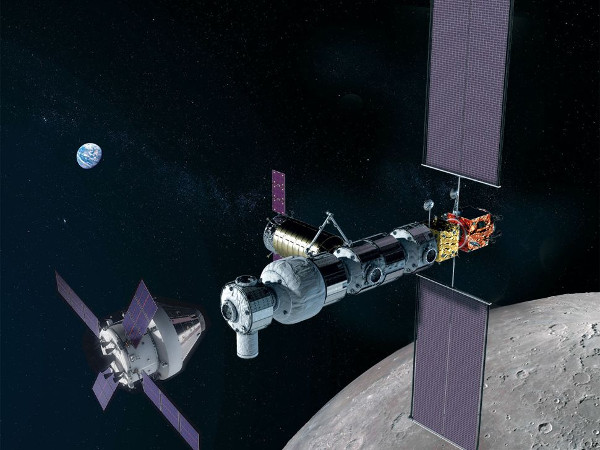
Lunar Gateway supplied by the same partners that built the International Space Station. It will orbit the Moon, Credit NASA.
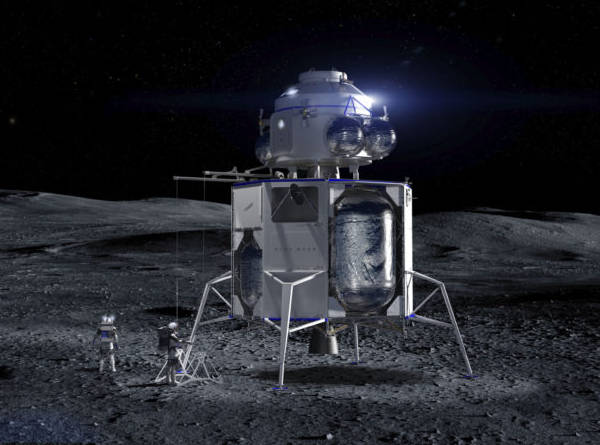
Lunar Lander. This vehicle has not been designed yet. This is Blue Origin’s Ascent Module on top of a yet to be designed propulsion module. Credit Blue Origin.
12/04/2019 – Ephemeris – Where are the naked-eye planets this week?
Ephemeris for Wednesday, December 4th. Today the Sun will be up for 8 hours and 59 minutes, setting at 5:02, and it will rise tomorrow at 8:04. The Moon, at first quarter today, will set at 1:01 tomorrow morning.
Let’s look at the naked-eye planets for this week. Venus will be briefly visible low in the southwest before it sets at 6:54 p.m. Jupiter will be very difficult to spot below and right of Venus. It will set at 6:13 p.m. Saturn, the ringed planet, will be in the southwestern sky in the evening, and will set at 7:37 p.m. Mars is in the morning sky and will rise in the east-southeast at 5:16 a.m. It’s not very bright because it’s 219 million (353 million km) miles away, but it’s getting slowly closer to the Earth. Mercury can be spotted after it rises in the east at 6:25 a.m. This is pretty much the end of its morning visibility, as the planet is moving around and behind the Sun. These oscillations from one side to the other of the Sun take on average of 116 days.
The times given are for the Traverse City/Interlochen area of Michigan. They may be different for your location.
Addendum
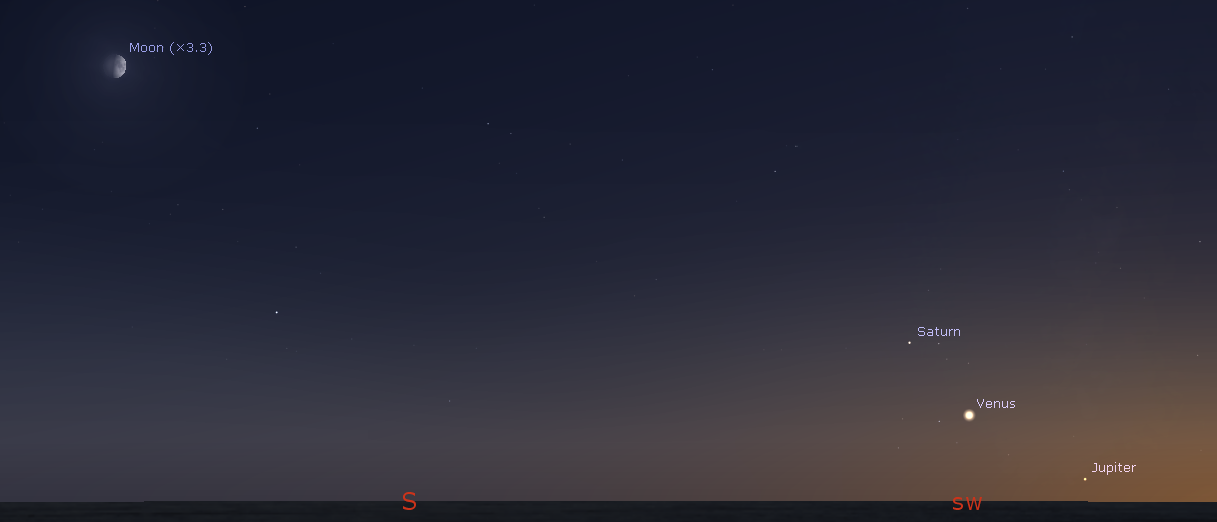
Jupiter, Venus and Saturn against a flat horizon tonight at 6 p.m. December 4, 2019. Click on the image to enlarge. Created using Stellarium.
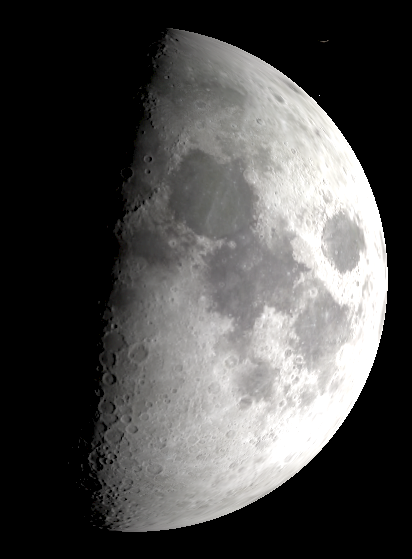
The slightly gibbous Moon as it might appear in binoculars at 6 p.m. December 4, 2019. Created using Stellarium.
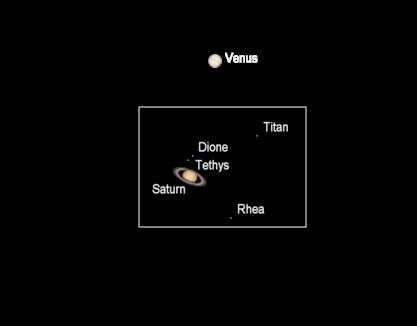
Telescopic views of Venus and Saturn with the same magnification at 6 p.m. tonight December 4, 2019. In the morning, I will show Mars here when it reaches an apparent diameter of 10″ (seconds of arc). It’s currently 4.0″. By the way Venus is 11.8″. Created using Cartes du Ciel (Sky Charts).
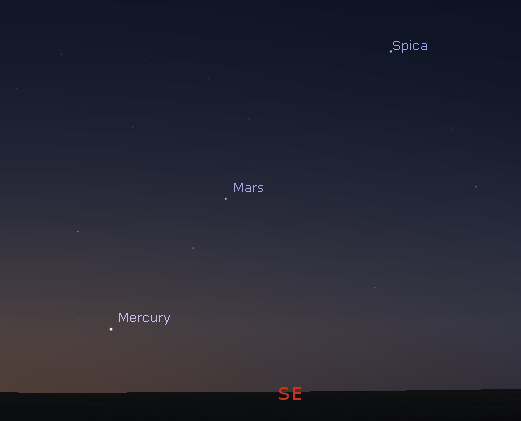
Mars and Mercury in the morning with the star Spica at 7 a.m. December 4, 2019. Created using Stellarium.
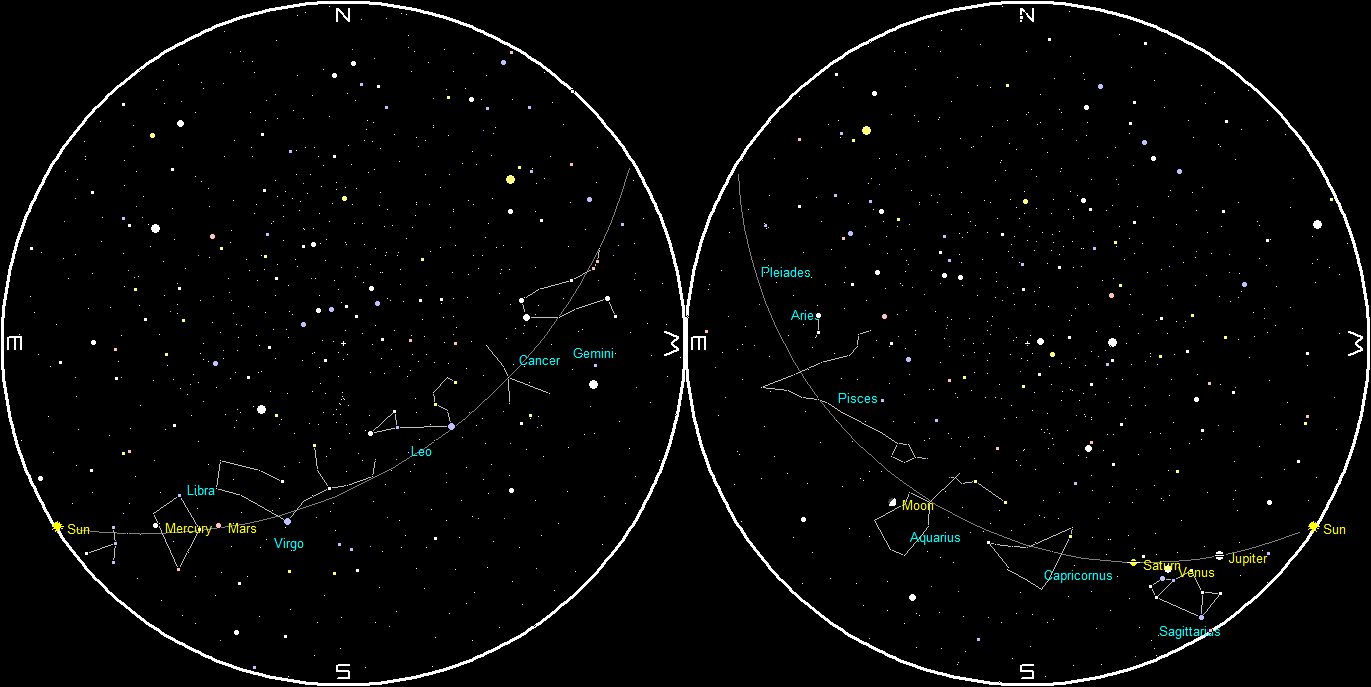
Planets and the Moon at sunset and sunrise of a single night starting with sunset on the right on December 4, 2019. The night ends on the left with sunrise on the 5th. Click on the image to enlarge. Created using my LookingUp program.
78 orbits
12/03/2019 – Ephemeris – The Moon tonight
Ephemeris for Tuesday, December 3rd. Today the Sun will be up for 9 hours and 1 minute, setting at 5:03, and it will rise tomorrow at 8:02. The Moon, 1 day before first quarter, will set at midnight.
The Moon tonight is a few hours before being at first quarter, when the Moon appears exactly half illuminated. In viewing the Moon with a pair of binoculars or a telescope the observer will notice that the best detail is seen near the terminator, the sunrise line, that’s cutting the Moon in half. That’s where the shadows are longest. The large gray feature at the upper right of the Moon is Mare Serenitatis, which translates to the Sea of Serenity. To me it appears to look like a scallop shell. Serenitatis like most other seas is roughly circular and is actually a crater, the result of an impact of a large asteroid during what is called the late heavy bombardment that happened about 4 billion years ago.
The times given are for the Traverse City/Interlochen area of Michigan. They may be different for your location.
Addendum
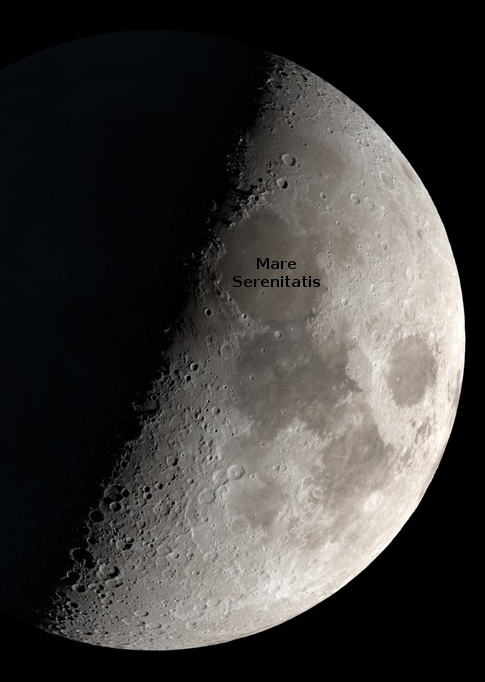
The moon as will appear tonight at 8 p.m. December 3, 2019 EST. Moon image credit NASA Scientific Visualization Studio.
Images of the moon’s phase for the entire year are available from https://svs.gsfc.nasa.gov/4442.
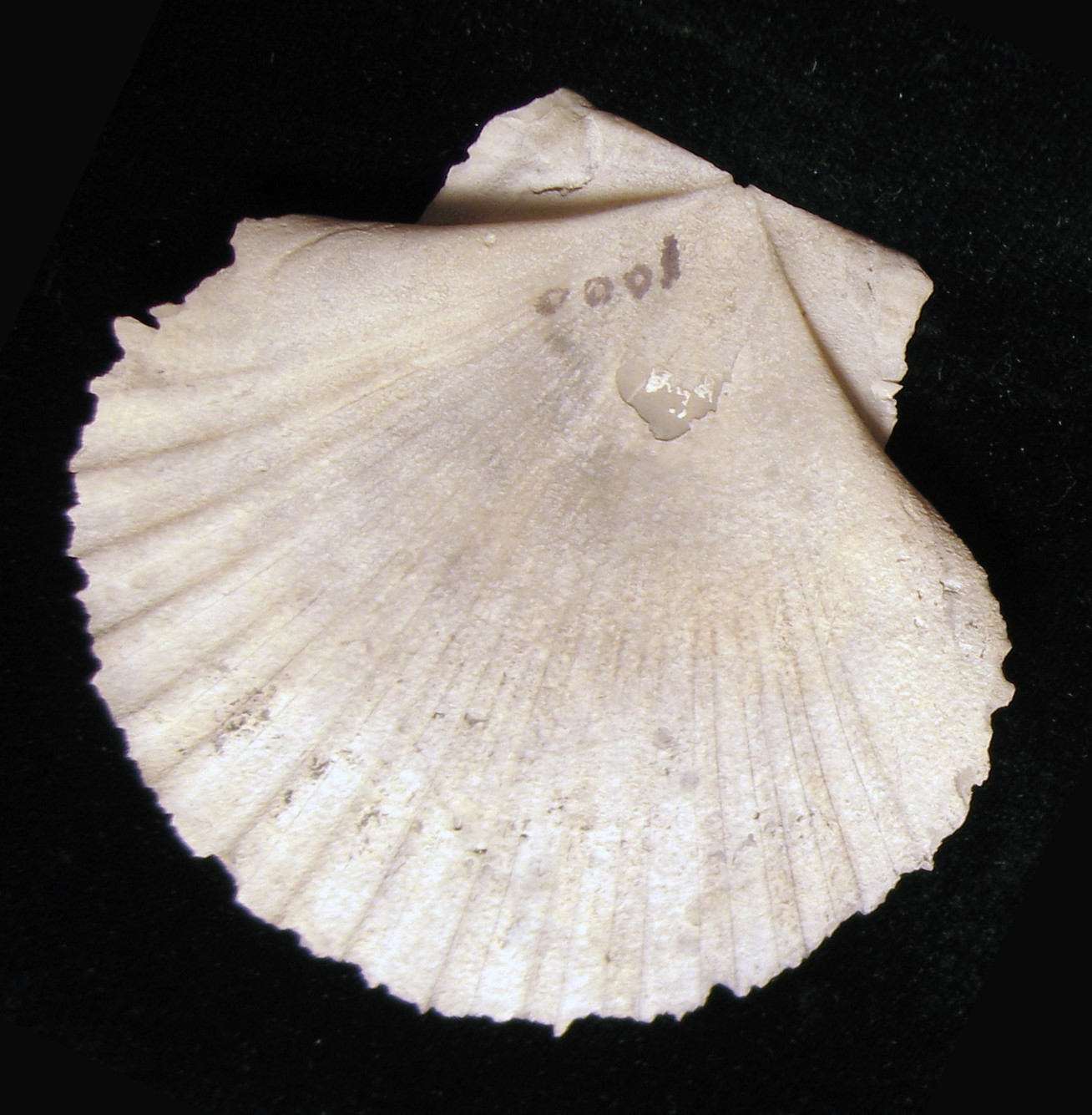
Image of a scallop shell rotated to match the Sea of Serenity. Credit Wikipedia user Kevmin. (Creative Commons)
12/02/2019 – Ephemeris – Orion rising
Ephemeris for Monday, December 2nd. Today the Sun will be up for 9 hours and 2 minutes, setting at 5:03, and it will rise tomorrow at 8:01. The Moon, 2 days before first quarter, will set at 10:58 this evening.
We have a fat crescent of a Moon tonight. However it shouldn’t affect the constellation now rising. In the east the central winter constellation Orion the hunter throws a leg over the horizon between 8 and 9 p.m. as Robert Frost told in his poem Star-Splitter. The upright rectangle that is his body on December evenings is tilted to the left as he rises, with bright red star Betelgeuse at the top left of the rectangle, his shoulder. At the opposite corner is blue-white Rigel, a knee. In the center of the rectangle is a line of three stars nearly vertically aligned, which represents Orion’s belt. Above Orion is another bright orange star at one end of a letter V shape of stars. That’s Aldebaran the angry eye in the face of Taurus the bull who apparently is none too happy with Orion.
The times given are for the Traverse City/Interlochen area of Michigan. They may be different for your location.
Addendum
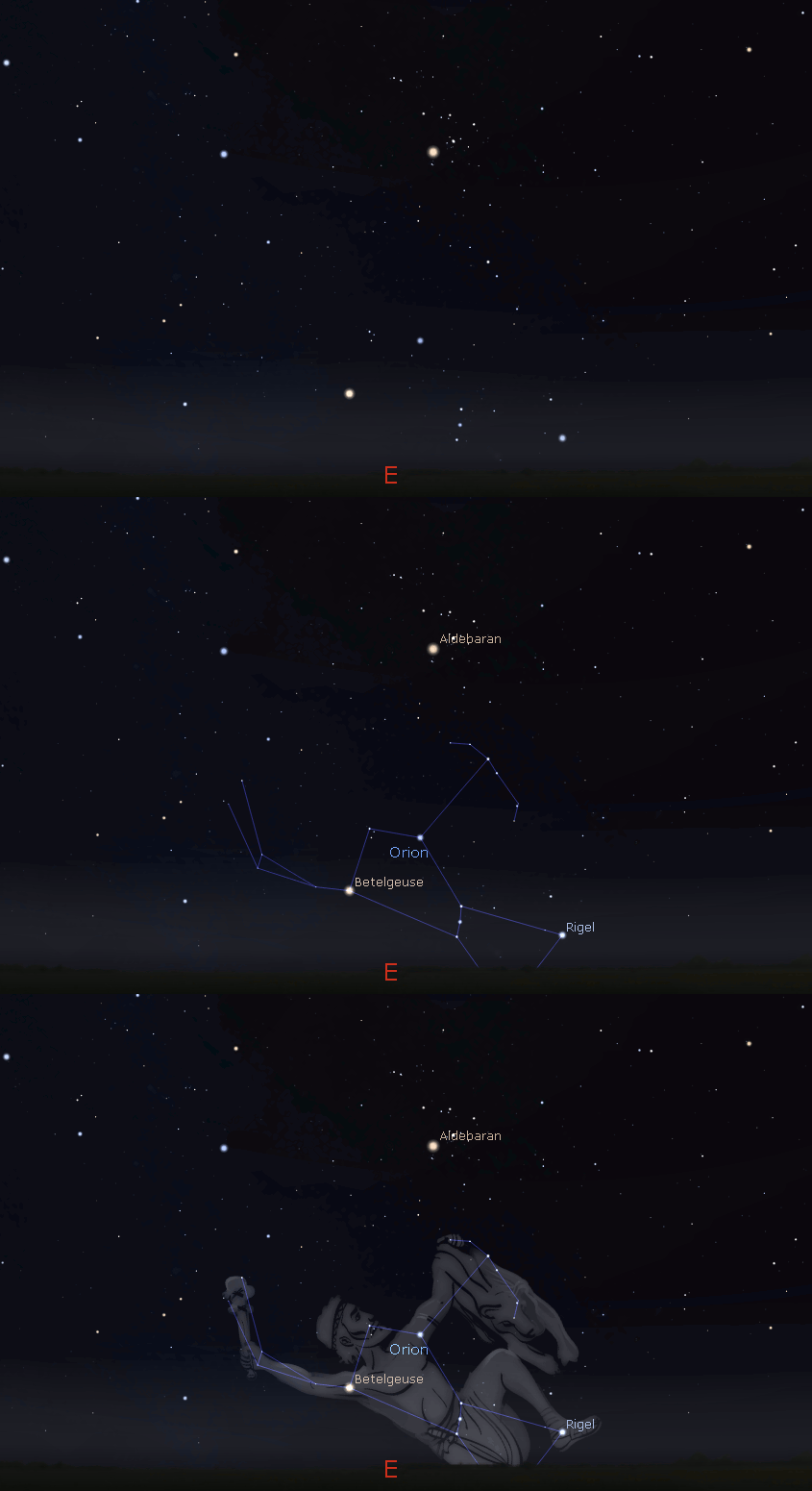
Finder chart for the rising Orion at 8 p.m. December 2nd. Click on the image to enlarge. Created using Stellarium and GIMP.
11/29/2019 – Ephemeris – Previewing December skies
Ephemeris for Friday, November 29th. Today the Sun will be up for 9 hours and 7 minutes, setting at 5:04, and it will rise tomorrow at 7:58. The Moon, 3 days past new, will set at 7:54 this evening.
December is the month with the shortest daylight hours. Winter will officially arrive at the winter solstice on the 21st at 11:19 p.m. There will be little movement in the sunset times: In the Traverse City/Interlochen area this will be from 5:03 Sunday, down to 5:02 and then advancing to 5:11 at the end of the month. There is more movement in the sunrise times which will advance from 7:59 Sunday to 8:20 on the 31st. There is also little movement of daylight hours. The noontime Sun will hang around 22 to 23 degrees above the southern horizon all month. The Geminid meteors on the 14th will have competition with the nearly full moon. And to change the subject, tonight the planet Saturn will appear just above the crescent Moon.
The times given are for the Traverse City/Interlochen area of Michigan. They may be different for your location.
Addendum
December Evening Star Chart
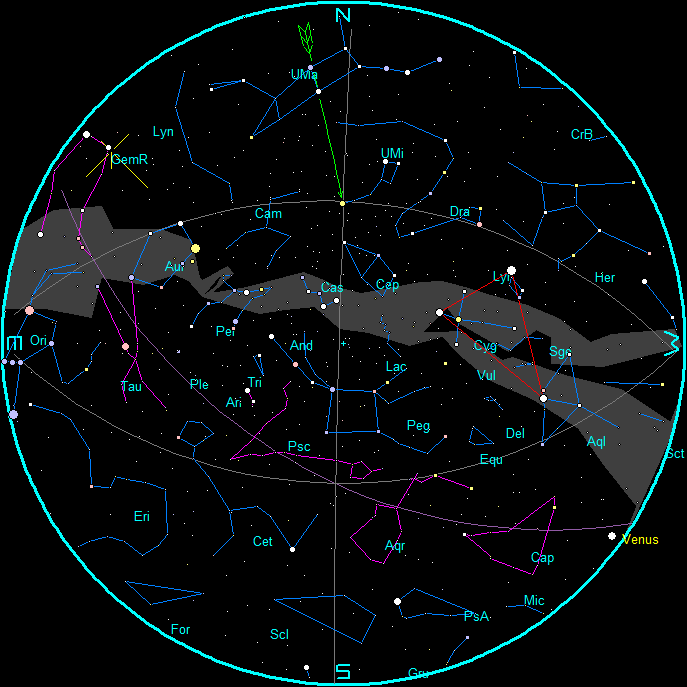
Star Chart for December 2019 (9 p.m. EST December 15, 2019). Click on image to enlarge.Created using my LookingUp program. Click on image to enlarge.
Credit my LookingUp program.
The planets and stars are plotted for the 15th at 9 p.m. EST in the evening and 6 a.m. for the morning chart. These are the chart times. Note that Traverse City is located approximately 45 minutes behind our time meridian, West 75° longitude. (An hour 45 minutes behind our daylight saving time meridian during EDT).
December Morning Star Chart
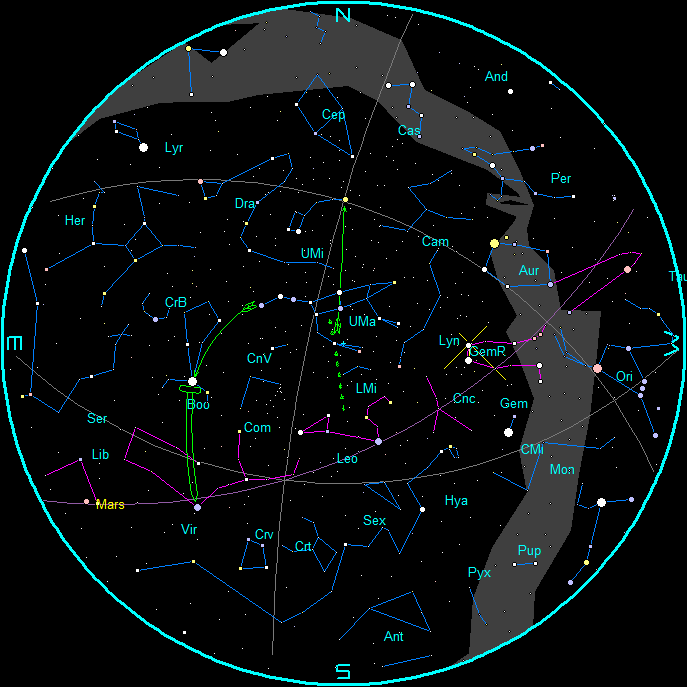
Star Chart for December mornings 2019 (6 a.m. EST December 15, 2019). Click on image to enlarge. Created using my LookingUp program. Credit my LookingUp program.
For a list of constellation names to go with the abbreviations click here.
- Pointer stars at the front of the bowl of the Big Dipper point to Polaris the North Star.
- The leaky bowl of the Big Dipper drips on Leo.
- Follow the arc of the handle of the Big Dipper to the star Arcturus, then
- Follow the spike to Spica.
- The Summer Triangle is in red.
- GemR on the star charts is the radiant of the Geminid meteor shower which peaks on the 14th.
Twilight Limits, Nautical and Astronomical
| EST | |||||||
| Traverse City | Morning twilight | Evening twilight | Dark night | Moon | |||
| Date | Astro. | Nautical | Nautical | Astro. | Start | End | Illum. |
| 2019-12-01 | 6h20m | 6h55m | 18h16m | 18h51m | 21h56m | 6h20m | 0.28 |
| 2019-12-02 | 6h21m | 6h56m | 18h15m | 18h51m | 22h58m | 6h21m | 0.38 |
| 2019-12-03 | 6h22m | 6h57m | 18h15m | 18h50m | 0h00m | 6h22m | 0.47 |
| 2019-12-04 | 6h23m | 6h58m | 18h15m | 18h50m | – | 6h23m | 0.57 |
| 2019-12-05 | 6h24m | 6h59m | 18h15m | 18h50m | 1h01m | 6h24m | 0.66 |
| 2019-12-06 | 6h25m | 7h00m | 18h15m | 18h50m | 2h02m | 6h25m | 0.75 |
| 2019-12-07 | 6h25m | 7h01m | 18h15m | 18h50m | 3h03m | 6h25m | 0.83 |
| 2019-12-08 | 6h26m | 7h02m | 18h15m | 18h50m | 4h05m | 6h26m | 0.9 |
| 2019-12-09 | 6h27m | 7h02m | 18h15m | 18h50m | 5h09m | 6h27m | 0.95 |
| 2019-12-10 | 6h28m | 7h03m | 18h15m | 18h50m | 6h15m | 6h28m | 0.99 |
| 2019-12-11 | 6h29m | 7h04m | 18h15m | 18h50m | – | – | 0.99 |
| 2019-12-12 | 6h29m | 7h05m | 18h15m | 18h51m | – | – | 1 |
| 2019-12-13 | 6h30m | 7h06m | 18h15m | 18h51m | – | – | 0.99 |
| 2019-12-14 | 6h31m | 7h06m | 18h15m | 18h51m | 18h51m | 19h36m | 0.95 |
| 2019-12-15 | 6h32m | 7h07m | 18h16m | 18h51m | 18h51m | 20h46m | 0.89 |
| 2019-12-16 | 6h32m | 7h08m | 18h16m | 18h52m | 18h52m | 21h59m | 0.8 |
| 2019-12-17 | 6h33m | 7h08m | 18h16m | 18h52m | 18h52m | 23h14m | 0.7 |
| 2019-12-18 | 6h30m | 7h05m | 18h13m | 18h48m | 18h48m | – | 0.59 |
| 2019-12-19 | 6h30m | 7h06m | 18h13m | 18h49m | 18h49m | 0h28m | 0.47 |
| 2019-12-20 | 6h31m | 7h06m | 18h14m | 18h49m | 18h49m | 1h42m | 0.35 |
| 2019-12-21 | 6h31m | 7h07m | 18h14m | 18h50m | 18h50m | 2h55m | 0.24 |
| 2019-12-22 | 6h32m | 7h07m | 18h15m | 18h50m | 18h50m | 4h09m | 0.15 |
| 2019-12-23 | 6h32m | 7h08m | 18h15m | 18h51m | 18h51m | 5h22m | 0.08 |
| 2019-12-24 | 6h33m | 7h08m | 18h16m | 18h51m | 18h51m | 6h33m | 0.03 |
| 2019-12-25 | 6h33m | 7h09m | 18h16m | 18h52m | 18h52m | 6h33m | 0 |
| 2019-12-26 | 6h33m | 7h09m | 18h17m | 18h52m | 18h52m | 6h33m | 0 |
| 2019-12-27 | 6h34m | 7h09m | 18h18m | 18h53m | 18h53m | 6h34m | 0.03 |
| 2019-12-28 | 6h34m | 7h10m | 18h18m | 18h54m | 19h40m | 6h34m | 0.07 |
| 2019-12-29 | 6h34m | 7h10m | 18h19m | 18h54m | 20h43m | 6h34m | 0.13 |
| 2019-12-30 | 6h35m | 7h10m | 18h20m | 18h55m | 21h46m | 6h35m | 0.21 |
| 2019-12-31 | 6h35m | 7h10m | 18h20m | 18h56m | 22h47m | 6h35m | 0.29 |
Twilight calendar was generated using Cartes du Ciel (Sky Charts).
See my blog post: Twilight Zone for the definitions of the different periods of twilight here: https://bobmoler.wordpress.com/2018/09/27/.
NASA Calendar of Planetary Events
     Date     Time    Event
Dec  1  Su            Venus: 27.9° E
     4  We   1:58 am  First Quarter
     4  We  11:09 pm  Moon Apogee: 404400 km
    11  We   6:03 am  Venus-Saturn: 1.8° N
    12  Th  12:12 am  Full Moon
    13  Fr   9:15 am  Moon Ascending Node
    13  Fr   3:57 pm  Moon North Dec.: 23.2° N
    14  Sa   1:25 pm  Geminid Shower: ZHR = 120
    15  Su  10:54 am  Moon-Beehive: 1° S
    18  We   3:30 pm  Moon Perigee: 370300 km
    18  We  11:57 pm  Last Quarter
    21  Sa  11:19 pm  Winter Solstice
    22  Su   8:49 pm  Moon-Mars: 3.6° S
    22  Su  10:00 pm  Ursid Shower: ZHR = 10
    26  Th  12:13 am  New Moon
    26  Th  12:18 am  Annular Solar Eclipse  (Asia, Australia)
    26  Th   8:01 am  Moon Descending Node
    26  Th   3:11 pm  Moon South Dec.: 23.2° S
    27  Fr   1:06 pm  Jupiter Conjunction
    28  Sa   8:32 pm  Moon-Venus: 1.1° N
Jan  1  We            Venus: 34.6° E
All event times are given for UTC-5 Eastern Standard Time.
Sky Events Calendar by Fred Espenak and Sumit Dutta (NASA’s GSFC),
http://eclipse.gsfc.nasa.gov/SKYCAL/SKYCAL.html.
If you go to the above site you can print out a list like the above for the entire year or calendar pages for your time zone.
Sun and Moon Rising and Setting Events
LU                  Ephemeris of Sky Events for Interlochen/TC
December, 2019    Local time zone: EST
+-----------------------------------------------------------------------+
| DATE |  SUN     SUN  DAYLIGHT|   TWILIGHT*    |MOON  RISE OR    ILLUM |
|      |  RISE    SET    HOURS |  END    START  |PHASE SET** TIME FRACTN|
+=======================================================================+
|Sun  1| 07:59a  05:03p  09:04 | 06:13p  06:50a |      Set  09:56p   29%|
|Mon  2| 08:00a  05:03p  09:02 | 06:12p  06:51a |      Set  10:58p   38%|
|Tue  3| 08:01a  05:03p  09:01 | 06:12p  06:52a |      Set  12:00a   47%|
|Wed  4| 08:02a  05:02p  08:59 | 06:12p  06:53a |F Qtr Set  01:01a   57%|
|Thu  5| 08:04a  05:02p  08:58 | 06:12p  06:54a |      Set  02:01a   66%|
|Fri  6| 08:05a  05:02p  08:57 | 06:12p  06:55a |      Set  03:02a   75%|
|Sat  7| 08:06a  05:02p  08:56 | 06:12p  06:56a |      Set  04:05a   82%|
+------+-----------------------+----------------+-----------------------+
|Sun  8| 08:07a  05:02p  08:55 | 06:12p  06:56a |      Set  05:09a   89%|
|Mon  9| 08:07a  05:02p  08:54 | 06:12p  06:57a |      Set  06:15a   95%|
|Tue 10| 08:08a  05:02p  08:53 | 06:12p  06:58a |      Set  07:22a   98%|
|Wed 11| 08:09a  05:02p  08:52 | 06:12p  06:59a |      Set  08:28a  100%|
|Thu 12| 08:10a  05:02p  08:51 | 06:12p  07:00a |Full  Rise 05:38p   99%|
|Fri 13| 08:11a  05:02p  08:50 | 06:12p  07:01a |      Rise 06:33p   96%|
|Sat 14| 08:12a  05:02p  08:50 | 06:13p  07:01a |      Rise 07:36p   91%|
+------+-----------------------+----------------+-----------------------+
|Sun 15| 08:13a  05:02p  08:49 | 06:13p  07:02a |      Rise 08:46p   83%|
|Mon 16| 08:13a  05:03p  08:49 | 06:13p  07:03a |      Rise 09:59p   74%|
|Tue 17| 08:14a  05:03p  08:48 | 06:13p  07:03a |      Rise 11:14p   64%|
|Wed 18| 08:15a  05:03p  08:48 | 06:14p  07:04a |      Rise 12:28a   52%|
|Thu 19| 08:15a  05:04p  08:48 | 06:14p  07:05a |L Qtr Rise 01:42a   41%|
|Fri 20| 08:16a  05:04p  08:48 | 06:15p  07:05a |      Rise 02:55a   30%|
|Sat 21| 08:16a  05:04p  08:48 | 06:15p  07:06a |      Rise 04:09a   20%|
+------+-----------------------+----------------+-----------------------+
|Sun 22| 08:17a  05:05p  08:48 | 06:16p  07:06a |      Rise 05:22a   12%|
|Mon 23| 08:17a  05:05p  08:48 | 06:16p  07:07a |      Rise 06:34a    6%|
|Tue 24| 08:18a  05:06p  08:48 | 06:17p  07:07a |      Rise 07:41a    2%|
|Wed 25| 08:18a  05:07p  08:48 | 06:17p  07:07a |      Rise 08:42a    0%|
|Thu 26| 08:18a  05:07p  08:48 | 06:18p  07:08a |New   Set  05:40p    1%|
|Fri 27| 08:19a  05:08p  08:49 | 06:19p  07:08a |      Set  06:38p    3%|
|Sat 28| 08:19a  05:09p  08:49 | 06:19p  07:08a |      Set  07:40p    8%|
+------+-----------------------+----------------+-----------------------+
|Sun 29| 08:19a  05:10p  08:50 | 06:20p  07:09a |      Set  08:43p   14%|
|Mon 30| 08:19a  05:10p  08:50 | 06:21p  07:09a |      Set  09:45p   22%|
|Tue 31| 08:20a  05:11p  08:51 | 06:22p  07:09a |      Set  10:47p   30%|
+-----------------------------------------------------------------------+
* Nautical Twilight
** Moonrise or moonset, whichever occurs between sunrise and sunset
Generated using my LookingUp for DOS program.
 Bob Moler's Ephemeris Blog