09/19/2019 – Ephemeris – The celestial upside down flying horse
Ephemeris for Thursday, September 19th. Today the Sun will be up for 12 hours and 20 minutes, setting at 7:46, and it will rise tomorrow at 7:27. The Moon, 2 days before last quarter, will rise at 10:42 this evening.
Rising and almost half way up the sky in the east at as it gets dark around 9 p.m. can be found one of the great autumn constellations: Pegasus the flying horse of Greek myth. Its most visible feature is a large square of four stars, now standing on one corner. This feature, called the Great Square of Pegasus, represents the front part of the horse’s body. The horse is quite aerobatic, because it is seen flying upside down. Remembering that fact, the neck and head is a bent line of stars emanating from the right corner star of the square. Its front legs can be seen in a gallop extending to the upper right from the top star of the square. From the left star extend, not hind legs but the constellation of Andromeda, rescued with the help of Pegasus.
For my retelling of the Greek myth that links these two and other autumn constellations click here.
The times given are for the Traverse City/Interlochen area of Michigan. They may be different for your location.
Addendum
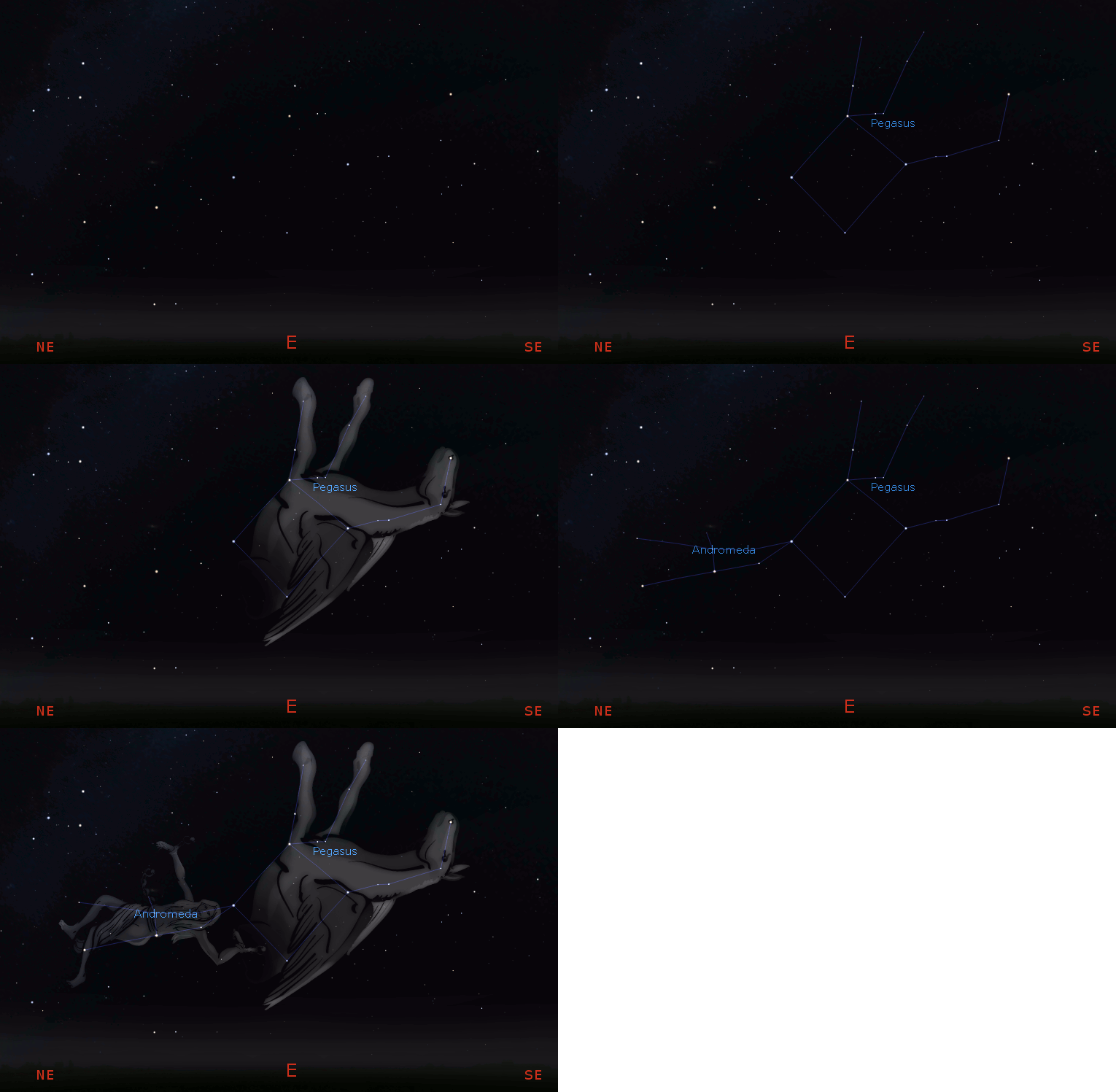
Pegasus & Andromeda animated finder chart for 9 p.m. September 19, 2019. Click on the iamge to enlarge. Created using Stellarium and GIMP.
Ephemeris Extra – The Great Star Story of Autumn
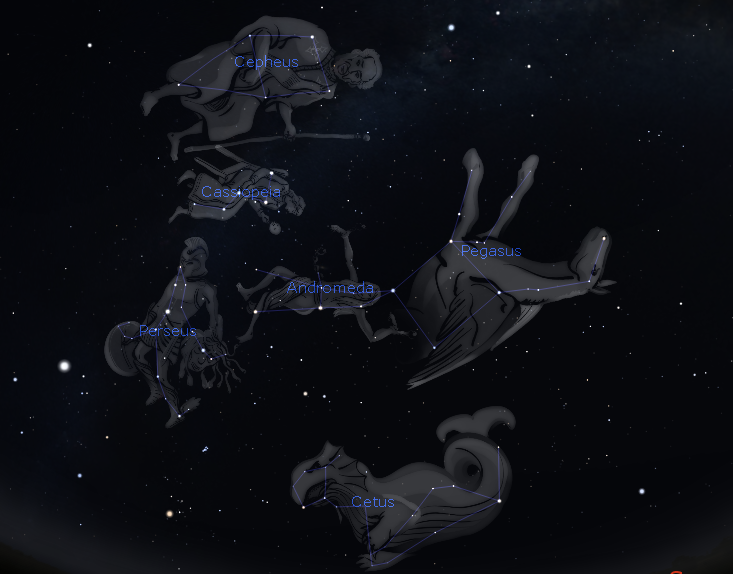
The constellations of the great star story of autumn. Looking southeast on October 31 at 10 p.m. Created using Stellarium.
The great star wheel of the sky rolls on. In the evening sky gone are the stars of spring, and going are the southern stars of summer. In the morning sky before sunrise the stars of an early winter evening.
A constant in both skies are the stars of autumn: rising in the evening and setting in the morning. In no other part of the sky do so many constellations take part in a single story
The constellations, as seen above are Cepheus, Cassiopeia, Andromeda, Perseus, Pegasus, and Cetus. And their story goes like this:
In distant Ethiopia a crisis was brewing. King Cepheus and Queen Cassiopeia were at wits end as how to stop it. A giant sea monster named Cetus was ravaging the country’s coastal cities destroying them and devouring the inhabitants.
The king and queen consulted the temple oracle as to what happened and what could be done to save their country. The oracle intoned gravely that the fault was Cassiopeia’s. Suddenly the queen knew what happened. Cassiopeia was very beautiful and she had vainly boasted to all who could hear that she was more beautiful than even the sea nymphs, the lovely daughters of the sea god Poseidon.
The sea nymphs had heard of Cassiopeia’s boast and complained to their father. Poseidon, like any father, was angered, and being a god was able to do something about. Being a god means never having to say your sorry when you do something really mean. He loosed the monster Cetus upon the Ethiopians.
The oracle said that to appease the monster and Poseidon Cassiopeia would have to sacrifice her daughter the Princess Andromeda to the monster. That is how young Andromeda was chained to the rocks on the sea shore to await her doom…
Far away in ancient Greece a wedding was about to take place between the beautiful Princess Danaë and King Polydectes. Danaë’s son Perseus, fathered by Zeus, but that’s another story, wasn’t too happy about the proposed union, and Polydectes wanted the boy gone.
When Perseus asked Polydectes what he wanted for a wedding gift, he said, “I want the head of Medusa.” The boy immediately and foolhardedly agreed to get it for him.
Merdusa, it turns out, was one of three sisters, the Gorgons, who had snakes for hair. They were so ugly that one glimpse of them would turn the beholder to stone. Medusa was the only mortal one.
Luckily Perseus had the favor of the god Hermes and Athene. They armed him with Hermes’ winged sandals, a helmet that made him invisible, a pouch that would expand to hold an object of any size, a shiny mirror shield, and a sword.
Thus armed Perseus was told to find the Graiae or the gray women, who could tell him where the lair of the Gorgons was. They were three in number and shared but one eye and one tooth among them which they passed from one to another to use.
The Graiae refused to help Perseus. But he was able to force them to help by snatching their one eye while it was being passed from one to another. They told him that the Gorgons dwelt in the shore of the river Ocean at the edge of the world in perpetual twilight.
In approaching the lair of the Gorgons Perseus put on the helmet of invisibility. He approached Medusa stepping backwards, cautiously peering only at Medusa’s indistinct image in his shield. Perseus then swept his sword in a backhanded way and managed to sever Medusa’s head. It is said that Athene guided his hand.
Amazingly, springing full grown from Medusa’s blood was the winged white stallion Pegasus. After placing Medusa’s head in the pouch, Perseus mounted Pegasus for the trip home.
Cruising high in the sky over the Ethiopian coast Perseus spotted a horrific sight. There far below the beautiful Andromeda, in chains; her screams reaching his ears. Then he spotted why she was screaming. A short distance away, crawling out of the surf was the monster Cetus, heading towards Andromeda. Perseus immediately sizes up the situations and swooped with Pegasus down to a spot between Andromeda and the monster. Then, burying his head in his shoulder drew out the head of Medusa from the pouch and held it in front of Cetus. The head was as lethal in death as in life, and the monster was promptly turned to stone. Replacing the head in the pouch, Perseus freed Andromeda. They flew off to, well supposedly, live happily ever after.
Oh yes. Perseus did present the head of Medusa to his step father Polydectes. He, of course, was also turned to stone when he laid eyes on it.
There you have it a story connecting the autumn constellations of Cepheus, Cassiopeia, Andromeda, Perseus, Pegasus and Cetus.
Cepheus is a dim church steeple of a constellation. Its dim star Delta is a variable star, the prototype of an important class of distance measuring stars called Cephieds in its honor. Cassiopeia is the famous W shaped constellation that along with Cepheus doesn’t set at our latitude.
Perseus looks to me more like the cartoon roadrunner than a hero. As the ancients saw him, he is holding the head of Medusa, whose still glittering eye is the star Algol, a variable star which ghastly winks at us every 2 days and 21 hours.
Andromeda’s modern claim to fame is the great galaxy that lies beyond her stars, the Great Andromeda Galaxy which has the designation M31. The galaxy is faintly visible to the unaided eye on dark nights. The farthest you can see without optical aid. The galaxy lies some 2.5 million light years away.
Pegasus can be easily found by the square of stars the form his body. It’s called the Great Square of Pegasus.
What can be said about Cetus. It now represents a whale, not a monster. Its star Mira, which means “Wonderful”, slowly varies in brightness over 330 days from a star barely visible in binoculars to a 2nd or 3rd magnitude star.
Look up on an autumn evening and recapture the wonder the ancients had as they looked upward at the stars.
09/18/2019 – Ephemeris – Checking out the whereabouts of the bright planets
Ephemeris for Wednesday, September 18th. Today the Sun will be up for 12 hours and 23 minutes, setting at 7:48, and it will rise tomorrow at 7:26. The Moon, 3 days before last quarter, will rise at 10:11 this evening.
Let’s look at the planets for this week. Mars, Venus and Mercury are too close to the Sun to be seen. Venus and Mercury are on the evening or east side of the Sun, Mars is on the west or morning side. Bright Jupiter will be low in the southwestern sky as it gets dark. With steadily held binoculars a few of the 4 largest satellites of Jupiter can be seen. Three of the four Jupiter’s Galilean satellites can be easily spotted in telescopes this evening. The moon Europa will appear very close to the planet. Jupiter will set at 11:21 p.m. Saturn, the ringed planet, will be in the southern sky in the evening. It will pass the meridian, due south at 8:52 p.m. and will set at 1:19 a.m.
The times given are for the Traverse City/Interlochen area of Michigan. They may be different for your location.
Addendum
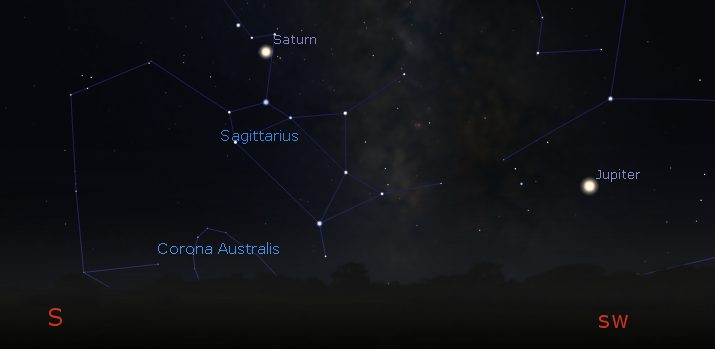
Jupiter and Saturn with the constellations of the southern summer sky at 10 p.m. September 18, 2019. Created using Stellarium.
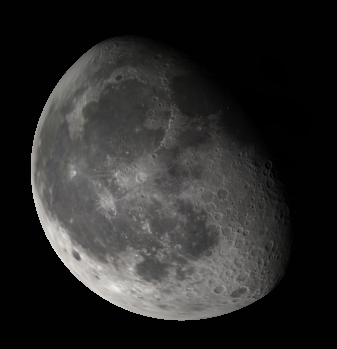
The waning gibbous Moon at 11 p.m. September 18, 2019. Created using Stellarium.
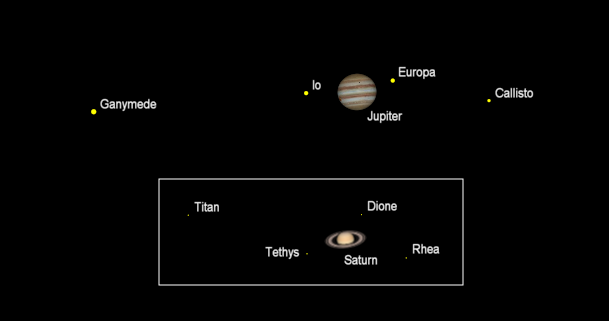
Telescopic views of Jupiter and Saturn with the same magnification at 10 p.m. September 18, 2019. Created using Cartes du Ciel (Sky Charts).
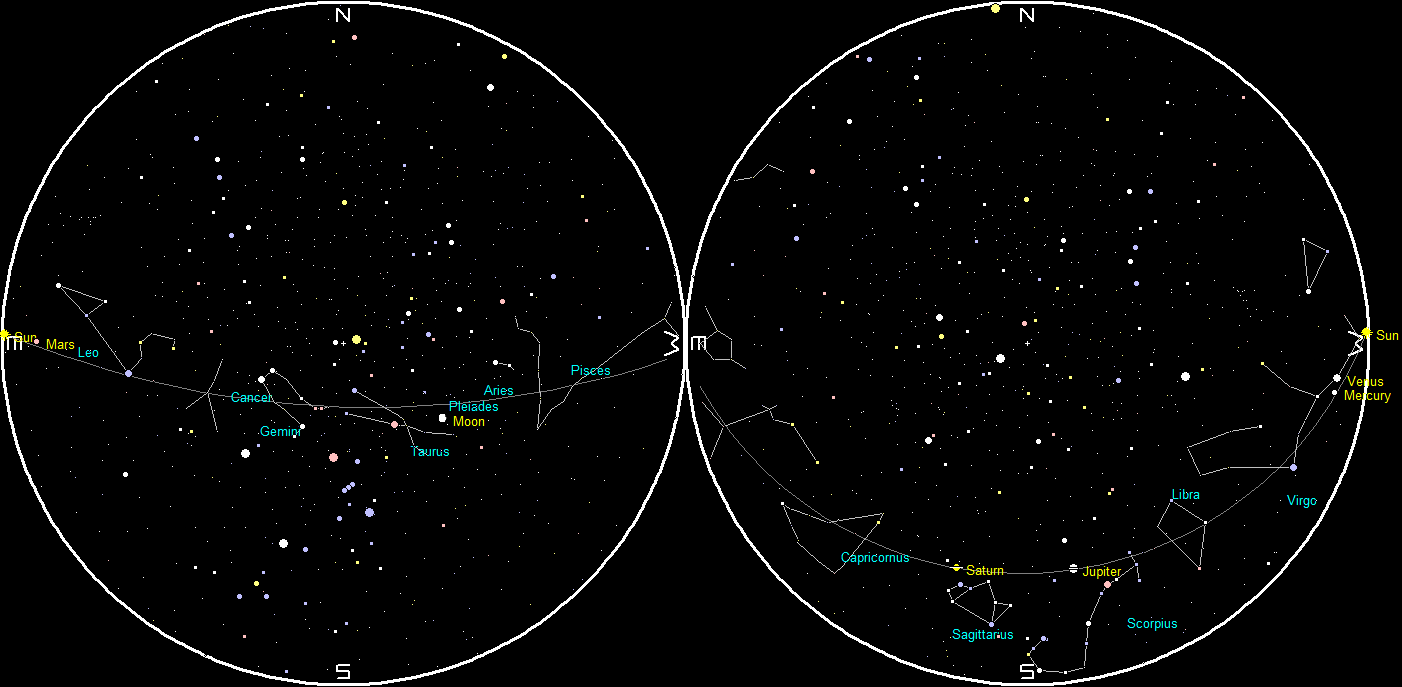
Planets and the Moon at sunset and sunrise of a single night starting with sunset on the right on September 18, 2019. The night ends on the left with sunrise on the 19th. Click on the image to enlarge. Created using my LookingUp program.
09/17/2019 – Ephemeris – It looks like another interstellar object has been found passing through the solar system
Ephemeris for Tuesday, September 17th. Today the Sun will be up for 12 hours and 26 minutes, setting at 7:50, and it will rise tomorrow at 7:24. The Moon, 3 days past full, will rise at 9:45 this evening.
Last week Monday I talked about a project to detect interstellar meteoroids that hit the Moon. It turns out we don’t have to wait that long. This past August 30th, Gennady Borisov of the Crimean Astrophysical Observatory discovered apparent comet since designated C/2019 Q4 (Borisov). It will approach the Sun just outside Mars orbit in December. It’s moving at over 25 miles per second (41 km/s) or nearly 92 thousand miles an hour (150,000 km/hr). In 2017 the first interstellar body discovered to enter our solar system was spotted, ‘Oumuamua. It was already past its closest to the Sun when found. This one is still approaching and visibly out gassing, so we’ll find out much more of its composition.
Addendum
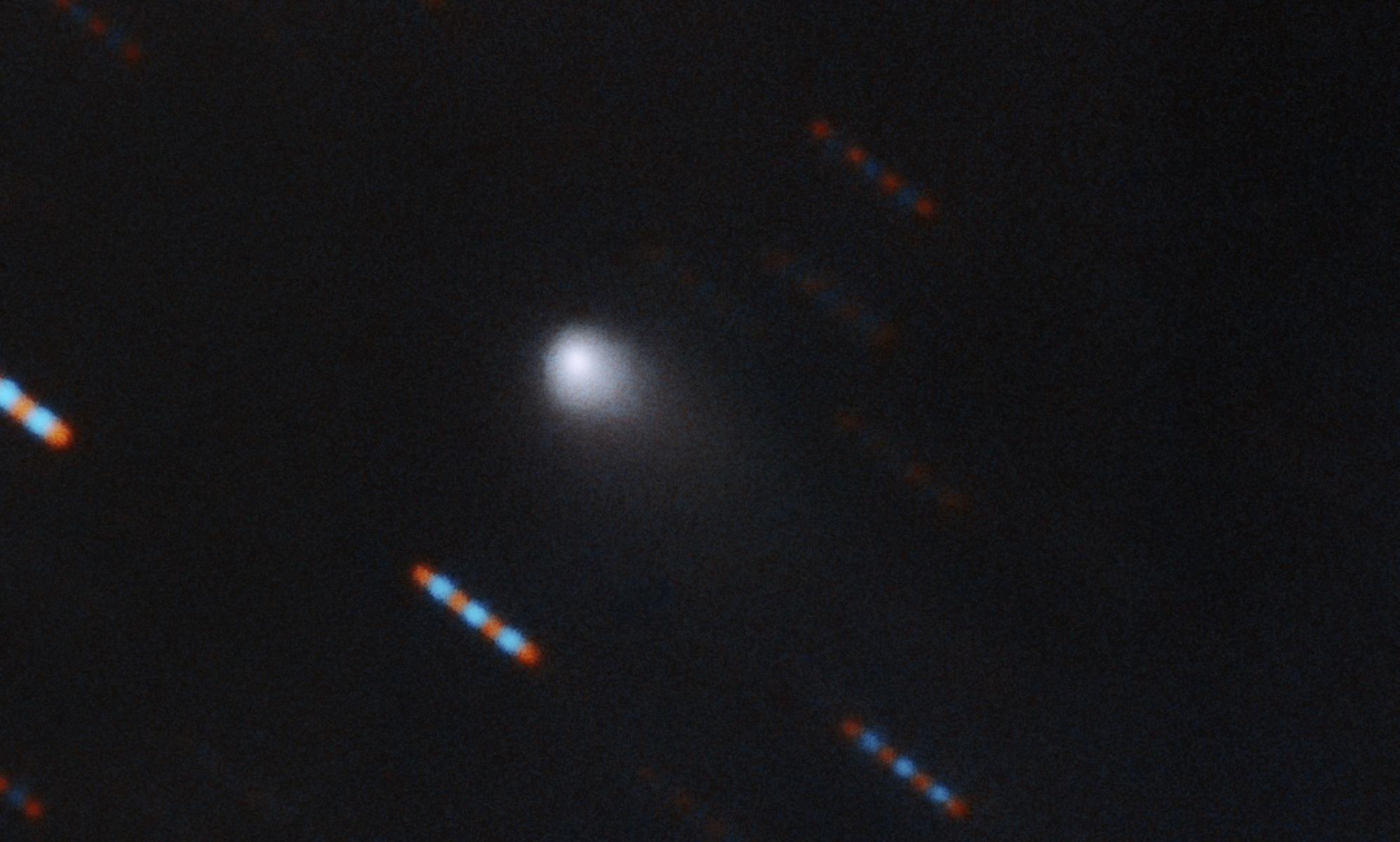
Color photograph of C/2019 Q4. Image Credit: Gemini Observatory/NSF/AURA
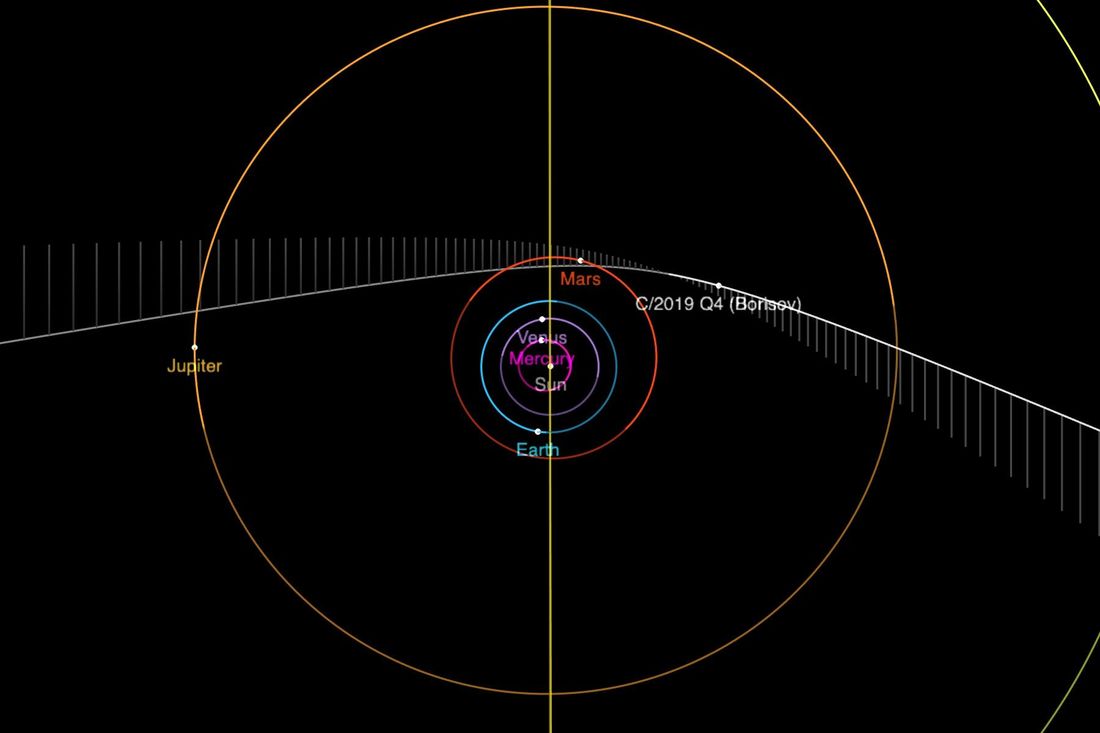
Orbit of C/2019 Q4 (Borisov). Credit: NASA/JPL-Caltech
Check out these links:
https://www.syfy.com/syfywire/wait-another-interstellar-object-is-passing-through-the-solar-system
09/16/2019 – Ephemeris Extra – I’ll be giving my presentation “Apollo and the Moon Race” tonight
I’ll be giving my illustrated talk Apollo and the Moon Race tonight at 7 p.m. at the Traverse Area District Library on Woodmere Avenue in Traverse City. The 1960s were a heady time with the space race between the US and the USSR in achieving space firsts. I will look at the competition, and the incremental steps that had to be made to finally send astronauts to the surface of the Moon on July 20th 1969.
If you miss this presentation, there will be another on Friday September 27, at 7 p.m. at the Betsie Valley District Library in Thompsonville.
Both events will have viewing of the skies with the Grand Traverse Astronomical Society including Jupiter and Saturn afterward if it’s clear.
09/16/2019 – Ephemeris – Astronomers view a supernova that completely destroyed its star
Ephemeris for Monday, September 16th. Today the Sun will be up for 12 hours and 29 minutes, setting at 7:51, and it will rise tomorrow at 7:23. The Moon, 2 days past full, will rise at 9:21 this evening.
When a star explodes in a supernova due to being very massive, it generally leaves a tiny compact remnant called a neutron star or a black hole within an expanding cloud of gas and dust. However in the early universe there was only hydrogen and helium. It turns out that stars could get much more massive, maybe several hundred times the mass of the Sun, rather than tens of times more massive that the Sun that exist now. Theoreticians suggest that when these stars explode, there was no core to collapse into a black hole or neutron star, but the whole star ignites in a thermonuclear reaction spewing its entire self, and newly created elements into the universe. Astronomers are studying a supernova suspect discovered in 2016: SN 2016iet.
The times given are for the Traverse City/Interlochen area of Michigan. They may be different for your location.
Addendum
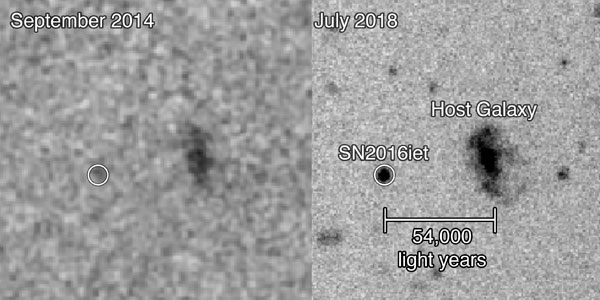
The discovery image (right) shows SN 2016iet and its most likely host galaxy. It was taken with the Low Dispersion Survey Spectrograph on the Magellan Clay 6.5-m telescope at Las Campanas Observatory on July 9, 2018. On the left is a pre-discovery image of the area wit a circle of where the supernova would appear.
The article I gleaned this information from: https://www.skyandtelescope.com/astronomy-news/supernova-that-destroyed-its-star/
It contains a link to the publication preprint.
09/13/2019 – Ephemeris – Harvest Moon tonight
Ephemeris for Friday, September 13th. Today the Sun will be up for 12 hours and 38 minutes, setting at 7:57, and it will rise tomorrow at 7:20. The Moon, 1 day before full, will rise tonight 8:12.
Tomorrow is the Harvest Moon. In fact the instant of full moon is 12:33 a.m. tonight, so one could consider the Harvest Moon tonight. Funny thing though, this morning the Moon will reach apogee from the Earth, of 252 thousand miles (406 thousand km), making it the opposite of a super moon, a mini moon. I bet you wouldn’t notice if I didn’t tell you. The Harvest Moon is the name given to the nearest full moon to the autumnal equinox. It is a special time of the lunar cycle when the Moon rises much less than the 50 minutes later average each night. This appeared to extend twilight allowing farmers before the advent of electric lights extra time to gather in their crops each day.
The times given are for the Traverse City/Interlochen area of Michigan. They may be different for your location.
Addendum
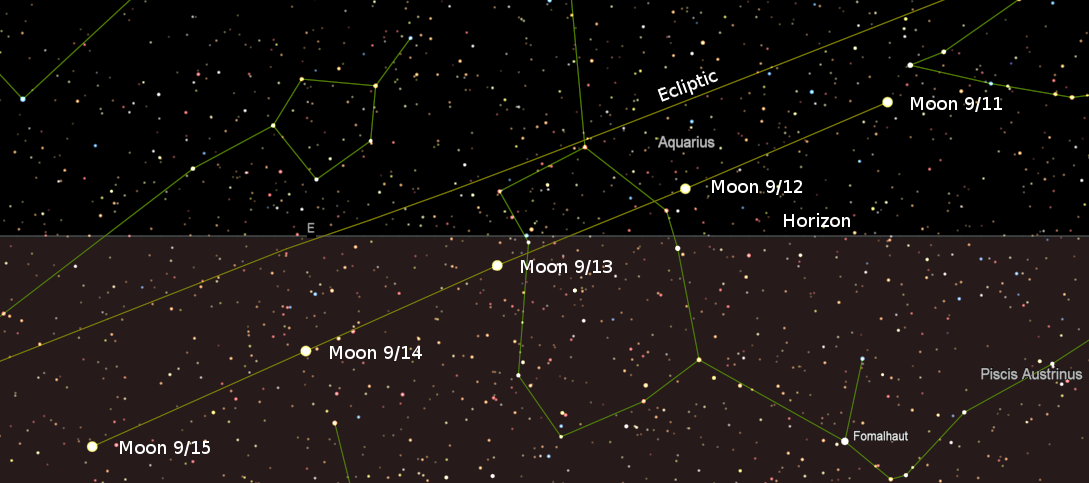
Harvest Moon effect from September 11 to the 15th, 2019. Note the shallowness of the ecliptic and Moon’s motion near sunset in this period. Click on the image to enlarge. Created using Cartes du Ciel (Sky Charts).
09/12/2019 – Ephemeris – NASA and the Europeans plan to deflect an asteroid
Ephemeris for Thursday, September 12th. Today the Sun will be up for 12 hours and 41 minutes, setting at 7:59, and it will rise tomorrow at 7:19. The Moon, 2 days before full, will set at 6:30 tomorrow morning.
Meeting now in Rome is the AIDA International Conference. It has nothing to do with the opera, but a tortured acronym for Asteroid Impact Deflection Assessment. NASA and the European Space Agency are going to target the satellite of a binary near Earth asteroid Didymos. NASA will supply DART, the impactor, The Italians, a cube sat to fly along and record the impact. Later the Europeans will launch a probe to assess the asteroid deflection. Didymos itself is a half mile in diameter (2560 ft, 780 m), its satellite, a bit more than 500 feet (525 ft, 160 m). The impact should make a marked change in the small body’s orbit of its parent. DART’s launch should come in the summer of 2021 with impact in 2022.
The times given are for the Traverse City/Interlochen area of Michigan. They may be different for your location.
Addendum
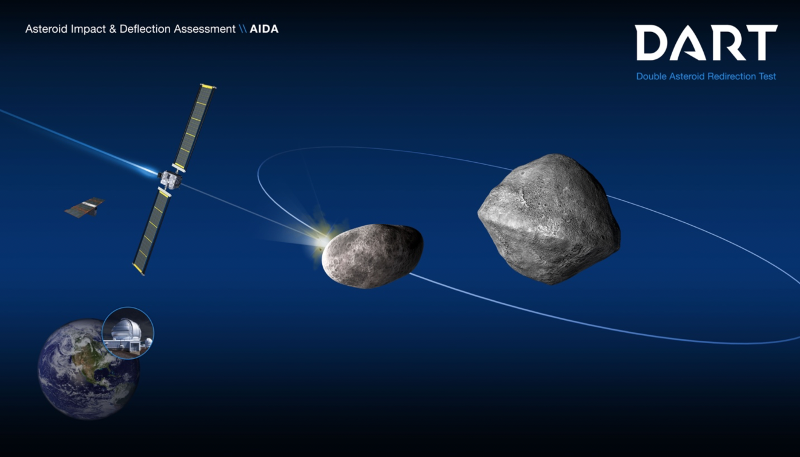
Schematic of the DART mission shows the impact on the moonlet of asteroid (65803) Didymos. Post-impact observations from Earth-based optical telescopes and planetary radar would, in turn, measure the change in the moonlet’s orbit about the parent body. Credits and caption: NASA/Johns Hopkins Applied Physics Lab.
More information: https://www.universetoday.com/143313/europe-and-us-are-going-to-try-and-deflect-an-asteroid/
09/11/2019 – Ephemeris – Let’s check out the bright planets or this week
Ephemeris for Wednesday, September 11th. Today the Sun will be up for 12 hours and 44 minutes, setting at 8:01, and it will rise tomorrow at 7:17. The Moon, 3 days before full, will set at 5:29 tomorrow morning.
Let’s look at the planets for this week. Mars, Venus and Mercury are too close to the Sun to be seen. Venus and Mercury are on the evening or east side of the Sun, Mars is on the west or morning side. Bright Jupiter will be in the south-southwestern sky as it gets dark. With steadily held binoculars a few of the 4 largest satellites of Jupiter can be seen. All four of Jupiter’s Galilean satellites can be spotted in telescopes before 10 this evening. The innermost moon Io will move in front of the planet until after midnight. Jupiter will set before then at 11:46 p.m. Saturn, the ringed planet, will be in the southern sky in the evening. It will pass the meridian, due south at 9:20 p.m. and will set at 1:46 a.m.
The times given are for the Traverse City/Interlochen area of Michigan. They may be different for your location.
Addendum
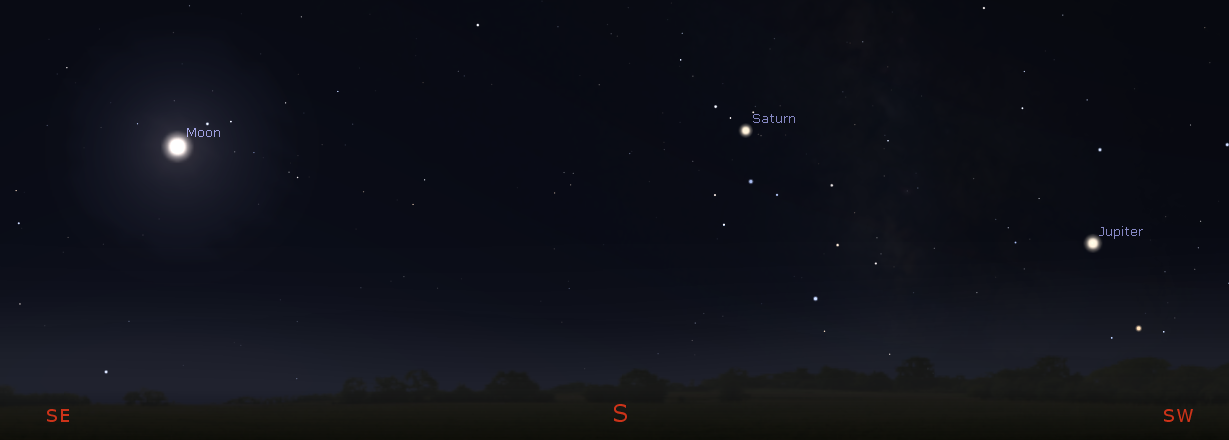
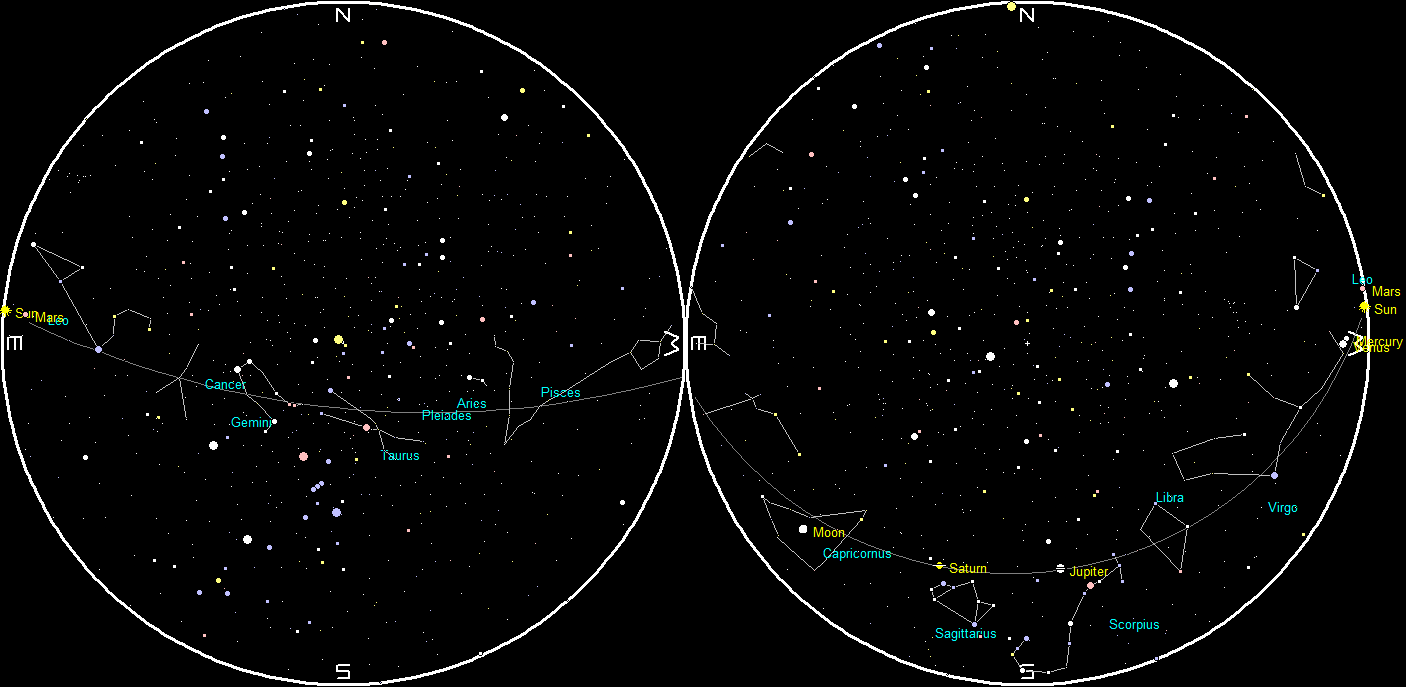
Jupiter, Saturn and the Moon with the bright stars of the southern summer sky at 10 p.m. September 11, 2019. Click on the image to enlarge. Created using Stellarium.
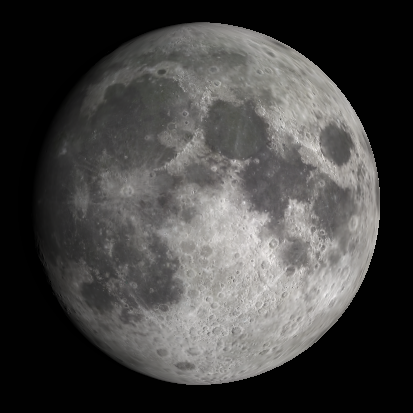
The gibbous Moon as it might appear in binoculars at 10 p.m. September 11, 2019. Created using Stellarium.,
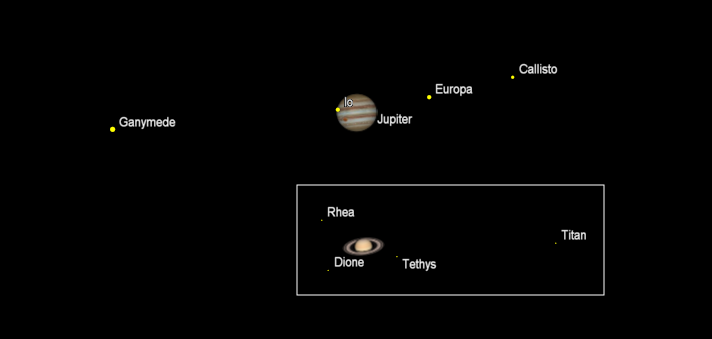
Telescopic views of Jupiter and Saturn with the same magnification at 10 p.m. September 11, 2019. Io starts a transit at 9:58 p.m. or 1:58 tomorrow UT. The shadow begins to cross at 11:15 p.m., 03:15 UT. The transit ends at 12:10 a.m., 4:10 UT, after Jupiter sets for observers in the listening area. The moons are much dimmer than what shows here so spotting the moon against the face of Jupiter is difficult. Created using Cartes du Ciel (Sky Charts).
Planets and the Moon at sunset and sunrise of a single night starting with sunset on the right on September 11, 2019. The night ends on the left with sunrise on the 12th. Click on the image to enlarge. Created using my LookingUp program.
09/10/2019 – Ephemeris – India’s second lunar spacecraft
Ephemeris for Tuesday, September 10th. Today the Sun will be up for 12 hours and 47 minutes, setting at 8:03, and it will rise tomorrow at 7:16. The Moon, 4 days before full, will set at 4:29 tomorrow morning.
On July 22nd the Indian Space Research Organization ISRO launched Chandrayaan-2, their second mission to the Moon. India’s Chandrayaan-1 was a lunar orbiter launched 11 years ago. Chandrayaan-2 is much more ambitious spacecraft with an orbiter, a lander with a rover. Last Friday the lander attempted to land within 30 degrees of the Moon’s south pole. Unfortunately contact was lost when the lander was only 2.1 kilometers above the lunar surface. The last data received suggests that the lander’s vertical speed was excessive, and that it likely crashed on the lunar surface. This is the second failed lunar landing attempt this year after the Israeli Beresheet failure in April.
The times given are for the Traverse City/Interlochen area of Michigan. They may be different for your location.
Addendum
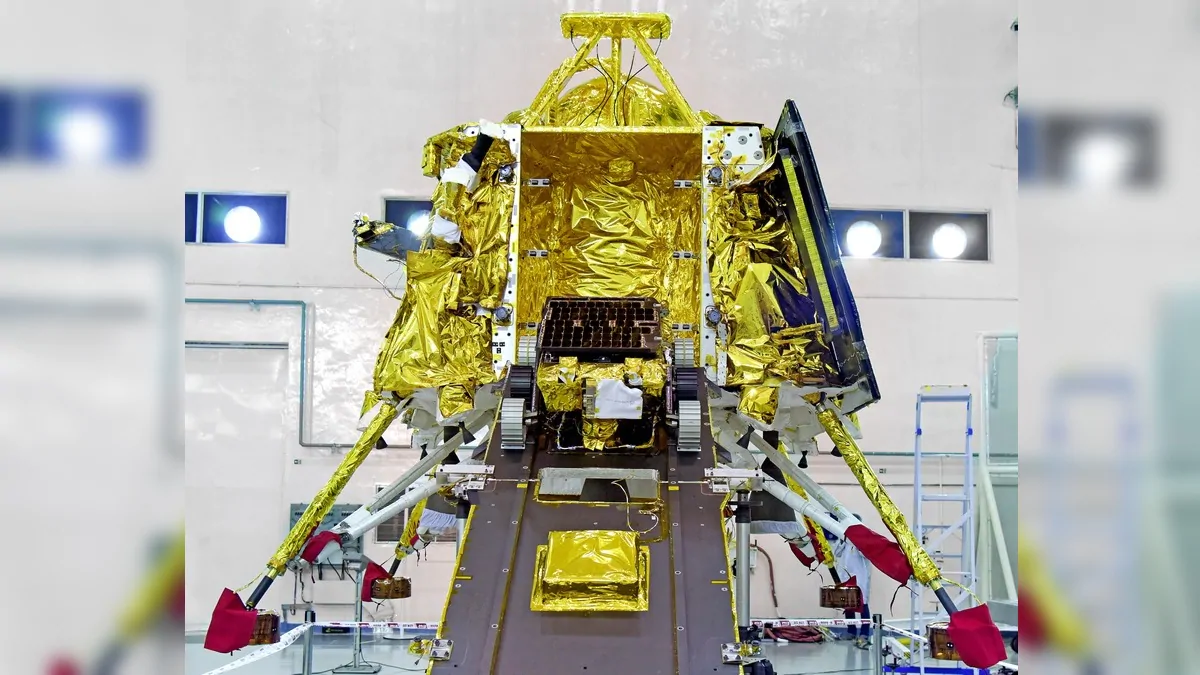
Chanrrayaan’s Vikram lander and Pragyan rover. before launch. The orbiter, not shown, is expected to have a 7 year life. The orbiter has viewed the landing site and has shown that the lander is in one piece. Credit ISRO.

