08/12/2019 – Ephemeris – Apollo 8’s giant leap to the Moon
Ephemeris for Monday, August 12th. Today the Sun will be up for 14 hours and 12 minutes, setting at 8:53, and it will rise tomorrow at 6:42. The Moon, 3 days before full, will set at 4:38 tomorrow morning. | On the road to the Apollo 11 landing on the Moon 50 years ago was Apollo 8’s Christmas orbiting of the Moon in 1968. Apollo 7’s shakedown of the Command and service modules in October that year meant that they had a good spacecraft. However on September 28th that year a US spy satellite photographed a giant rocket of approximately the same size as the Saturn V on a launch pad at the Tyuratam Missile Test Center in the Soviet Union. Were they going to get to the Moon before us? Also Grumman was behind schedule with producing the Lunar Module for Apollo 8’s scheduled shakedown of that module in Earth orbit. NASA then decided to send Apollo 8 to the Moon instead and not miss a launch opportunity.
The times given are for the Traverse City/Interlochen area of Michigan. They may be different for your location.
Addendum
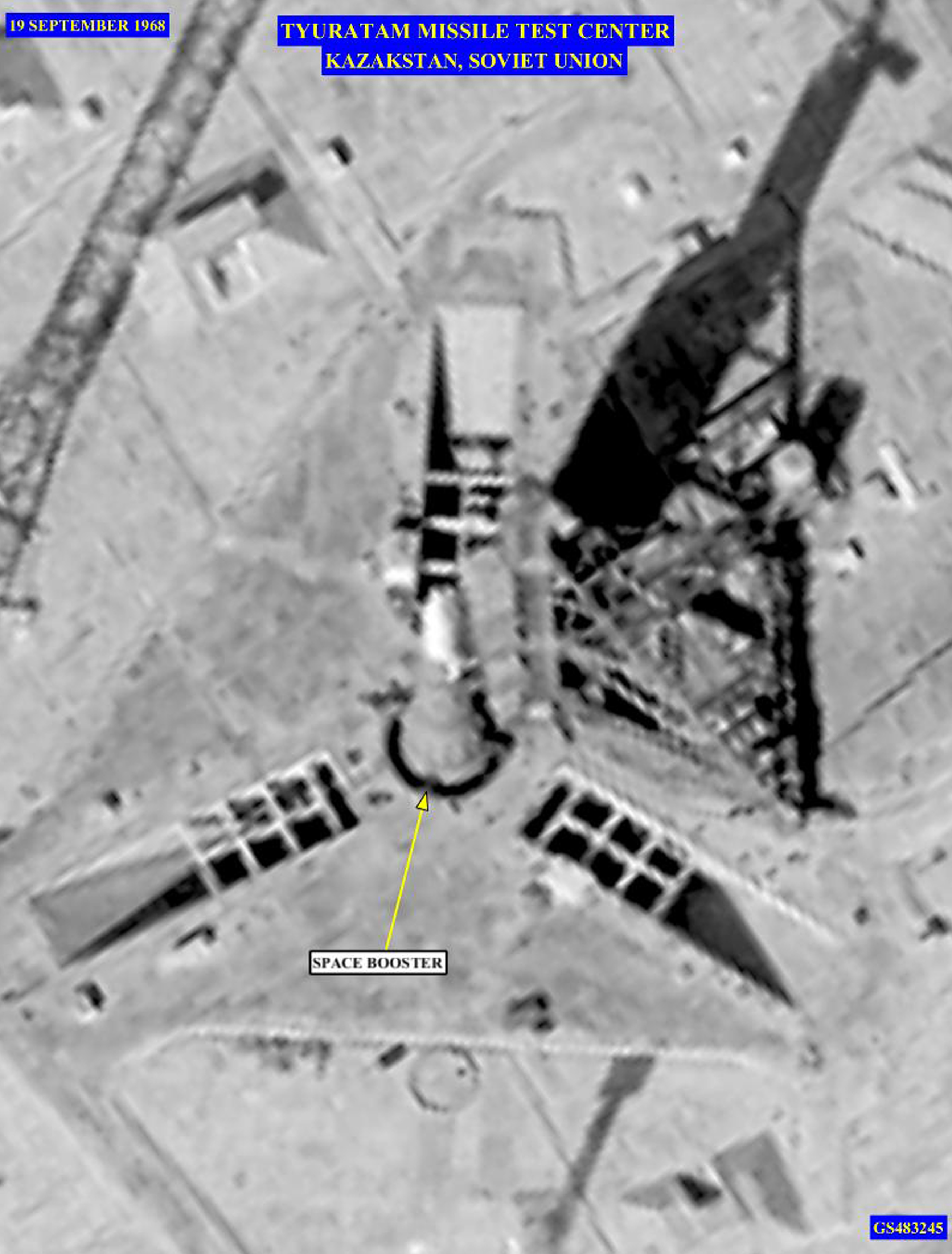
KH-8 spy satellite photo of an N-1 rocket on the launch pad on September 28, 1968.

Apollo 8 crew from he left: Frank Borman, Bill Anders, and Jim Lovell.
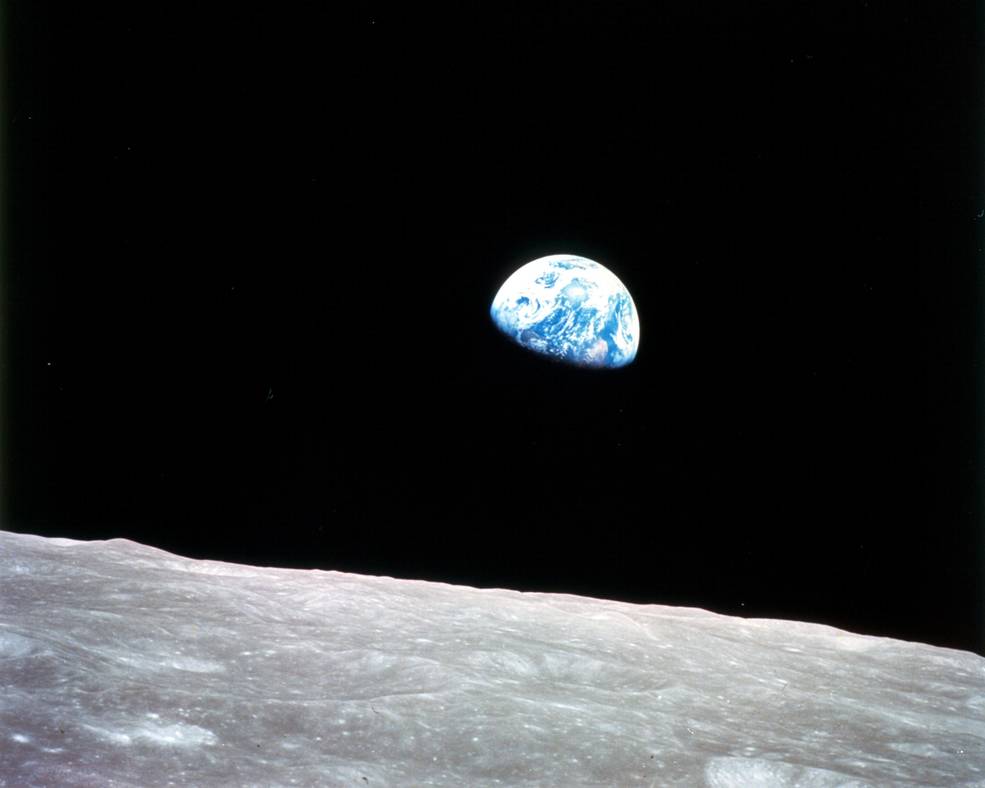
The famous Earthrise photograph: ”We went to the Moon and Discovered the Earth.” Credit NASA/Apollo 8/Bill Anders.
08/09/2019 – Ephemeris – Sun and Star Party tomorrow at the Sleeping Bear Dunes
Ephemeris for Friday, August 9th. Today the Sun will be up for 14 hours and 20 minutes, setting at 8:57, and it will rise tomorrow at 6:39. The Moon, 2 days past first quarter, will set at 2:11 tomorrow morning.
Tomorrow The Grand Traverse Astronomical Society will be part of the Port Oneida Rural Arts and Culture Fair, an event sponsored by the Sleeping Bear Dunes National Lakeshore. The society will bring their telescopes to the Thoreson Farm on Thoreson Road off M22 North of Glen Arbor for a Sun ‘n Star party beginning at 4 p.m. The evening events start at 9 p.m. Thoreson Road is a loop off M22. On tap will be the waxing gibbous Moon with the feature called Bay of Rainbows thrust into sunlight at the edge of the Moon, Jupiter and Saturn. Even though the moonlit skies will be bright, there are plenty of wonders still visible in the telescopes. There will also be a few bright Perseid meteors to wow the viewer.
The times given are for the Traverse City/Interlochen area of Michigan. They may be different for your location.
Addendum

Viewing the Sun at Thoreson Farm 2018. Credit: Eileen Carlisle.

Twilight at Thoreson Farm 2017. Credit: Eileen Carlisle.
08/08/2019 – Ephemeris – Astronomy at the next three Friday Night Lives
Ephemeris for Thursday, August 8th. Today the Sun will be up for 14 hours and 22 minutes, setting at 8:59, and it will rise tomorrow at 6:37. The Moon, 1 day past first quarter, will set at 1:33 tomorrow morning.
Starting tomorrow evening and the next two Fridays members of the Grand Traverse Astronomical Society will bring their telescopes to Friday Night Live on Front Street in Traverse City. From 5:30 to 9 p.m. the members will be in the streets with their telescopes showing the Sun and other objects of interest. The newest society telescope is a new solar telescope that shows the Sun in the light of the element hydrogen revealing a thin region of the Sun above the bright ball we see, and clouds of hydrogen above this layer. After 9 p.m., if it’s clear, the telescopes will be pulled back to the sidewalk to view and show the Moon this Friday, and Jupiter and Saturn all of the Fridays.
The times given are for the Traverse City/Interlochen area of Michigan. They may be different for your location.
Addendum

Viewing the Sun with a while light filter at Friday Night Live using Ron Uthe’s telescope at Friday Night Live. Credit Bob Moler.
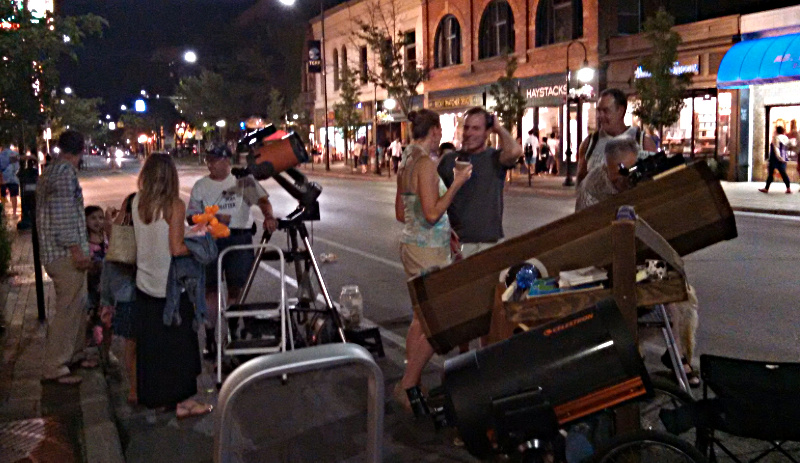
After Friday Night Live is over we pull the telescopes back to the sidewalk to view the Moon and planets. Credit: Bob Moler.
08/07/2019 – Ephemeris – Let’s check out the bright planets for this week
Ephemeris for Wednesday, August 7th. Today the Sun will be up for 14 hours and 25 minutes, setting at 9:00, and it will rise tomorrow at 6:36. The Moon, at first quarter today, will set at 1:00 tomorrow morning.
Let’s look at the planets for the first full week in August. Mars, Mercury and Venus are all too close to the Sun to be seen. Mars is still on the evening or east side of the Sun. Mercury and Venus are on the west or morning side of the Sun. Bright Jupiter will be in the southern sky as it gets dark. It will pass the meridian, due south at 9:30 p.m. With steadily held binoculars a few of the 4 largest satellites of Jupiter can be seen. Four of Jupiter’s largest satellites can be spotted in telescopes tonight. Two, on the east and two west of Jupiter. Jupiter will set at 1:58 a.m. Saturn, the ringed planet, will be in the south-southeast in the evening, the brightest star-like object in that direction, but significantly dimmer than Jupiter. It will set at 4:10 a.m.
The times given are for the Traverse City/Interlochen area of Michigan. They may be different for your location.
Addendum
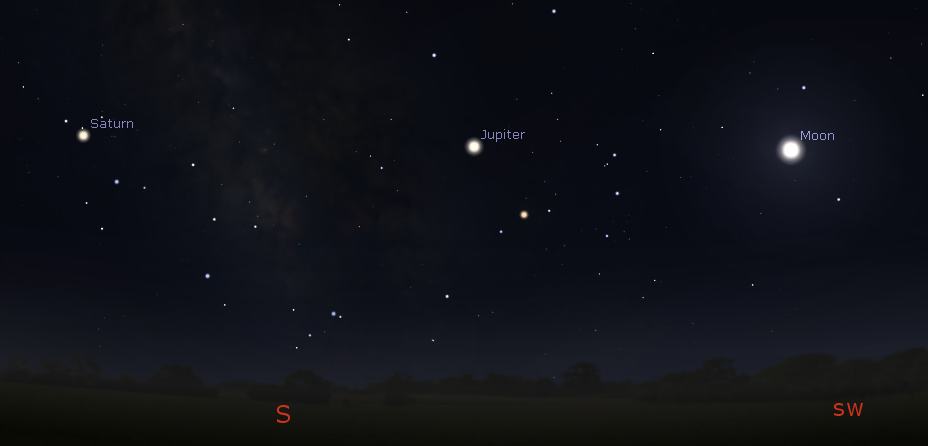
Jupiter, Saturn and the Moon with the bright stars of the southern summer sky at 10:30 p.m. August 7, 2019. Click on the image to enlarge. Created using Stellarium.
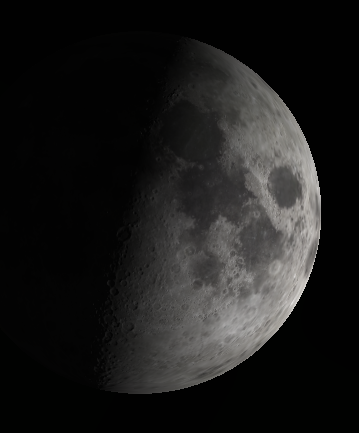
The first quarter Moon as it might appear in binoculars or a small telescope tonight at 10:30 p.m. August 7, 2019. Created using Stellarium.
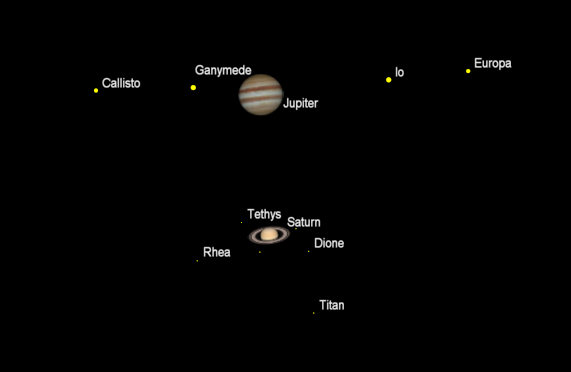
Jupiter and Saturn with the same magnification at 1o:30 p.m.August 7, 2019. Created using Cartes du Ciel (Sky Charts).
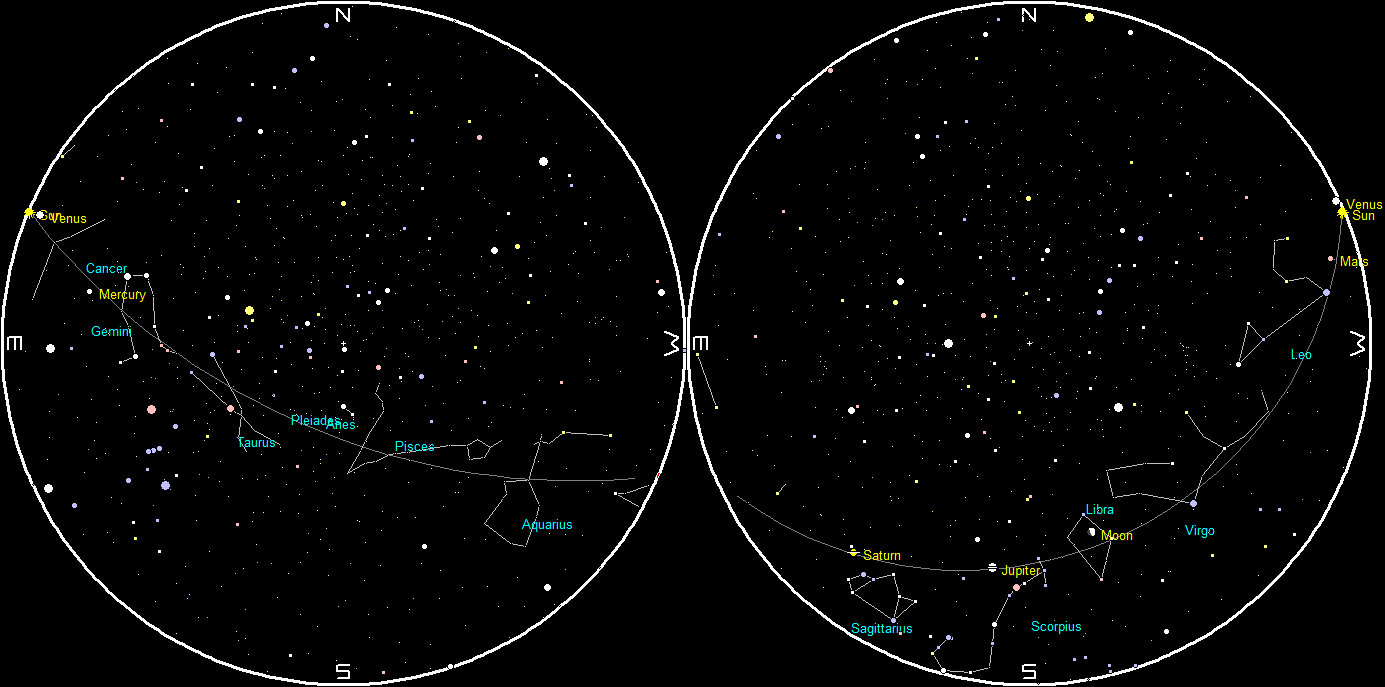
Planets and the Moon at sunset and sunrise of a single night starting with sunset on the right on August 7, 2019. The night ends on the left with sunrise on the 8th. Click on the image to enlarge. Created using my LookingUp program.
08/06/2019 – Ephemeris – More about viewing the Perseid meteor shower: Meteor trains
Ephemeris for Tuesday, August 6th. Today the Sun will be up for 14 hours and 27 minutes, setting at 9:02, and it will rise tomorrow at 6:35. The Moon, 1 day before first quarter, will set at 12:29 tomorrow morning.
The Perseid meteor shower has to compete this years with the bright waxing Moon, so only the brightest meteors will be visible, However even though this cuts down on the meteors visible, it happens that some of the brightest of meteors leave smokey trains, which can be seen in binoculars. Unlike aircraft contrails which are created the same altitude, meteor trains descend through the atmosphere where the winds at the different altitudes slowly bend and twist the train, tearing it up. The same occurs with any really bright meteor, Perseid or not. So remember to add binoculars to your meteor viewing kit along with a blanket, warm coat, mosquito spray and hot coffee or other beverage.
The times given are for the Traverse City/Interlochen area of Michigan. They may be different for your location.
Addendum
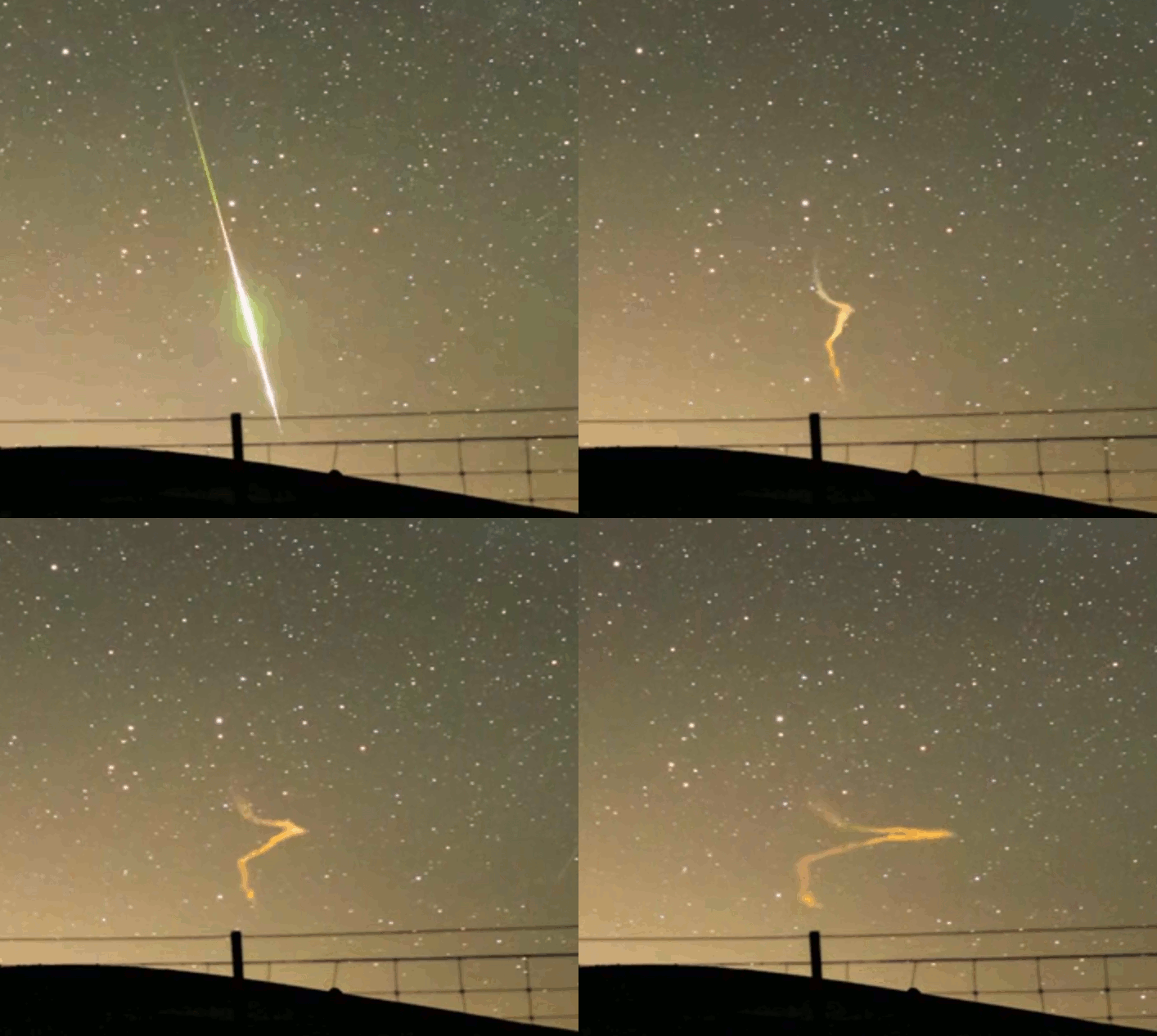
These are screen caps from a time lapse video by Australian Phil Hart of a meteor train being torn apart by upper level winds. Credit Phil Plait’s Bad Astronomy/Phil Hart. This was not a Perseid meteor.
The actual video and much more about meteor trains are located here: https://www.syfy.com/syfywire/catching-meteor-train.
08/05/2019 – Ephemeris – Previewing the Perseid meteor shower
Ephemeris for Monday, August 5th. Today the Sun will be up for 14 hours and 30 minutes, setting at 9:03, and it will rise tomorrow at 6:34. The Moon, 2 days before first quarter, will set at 12:01 tomorrow morning.
After the Moon sets in the morning hours for the next week and a half the numbers of meteors visible will increase each night. These are members of the Perseid meteor shower of August. The peak this year is expected to be during the morning of the 13th. However by then the Moon will be nearly full. These meteors are the result of debris left along the orbit of Comet 109P/Swift-Tuttle shed by innumerable visits to the inner solar system. Every year at this time the Earth passes through this trail of debris which intersects its orbit giving rise to the meteor shower. We call them the Perseids, because they appear to come from the direction of the constellation Perseus the hero, which is first seen in the early evening low in the northeast.
The times given are for the Traverse City/Interlochen area of Michigan. They may be different for your location.
Addendum
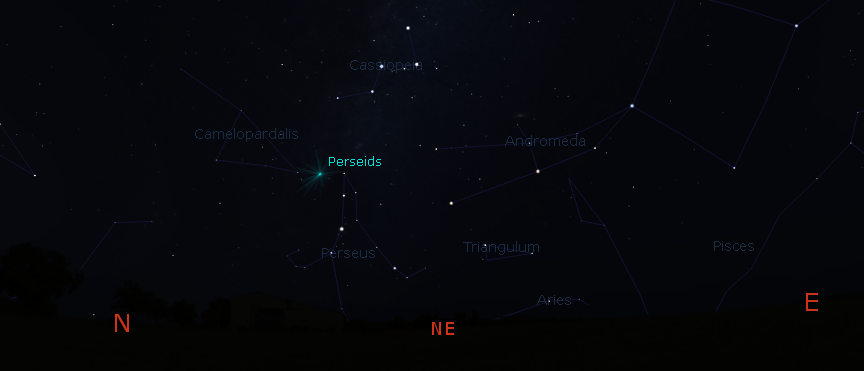
The Perseid radiant is located off the highest star in Perseus as it ascends the sky at about 10:30 p.m. The Perseid radiant is circumpolar for observers in northern Michigan. Click on the image to enlarge. Created using Stellarium.
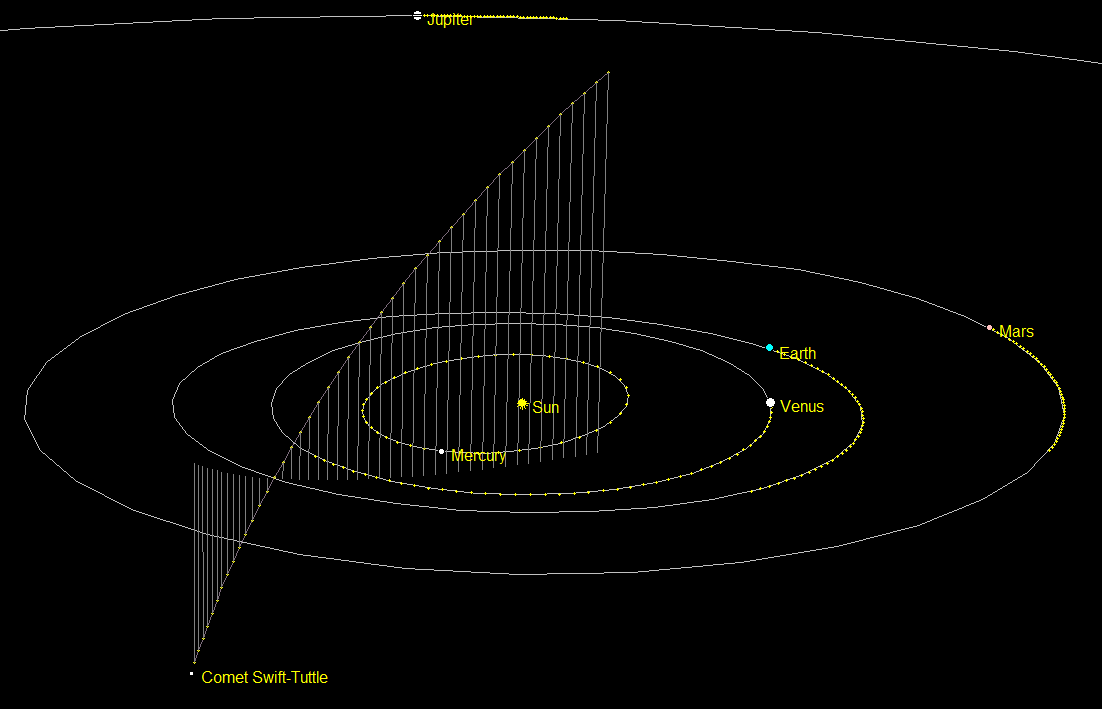
The passage of Comet 109P/Swift-Tuttle through the inner solar system November 1, 1992 to January 30, 1993. The meteoroids shed by the comet on its numerous trips close to the Sun lie close to that orbit. Note that its orbit intersects with the Earth’s orbit. That’s where the Earth will be around August 12-13 every year. Created using my LookingUp program.
08/02/2019 – Ephemeris – The Milky Way
Ephemeris for Friday, August 2nd. Today the Sun will be up for 14 hours and 37 minutes, setting at 9:07, and it will rise tomorrow at 6:31. The Moon, 2 days past new, will set at 10:31 this evening.
We’ll get darkness tonight, but that will erode night by night as the Moon waxes in our evening sky. At mid month this month and September will be the start of about two weeks of the best evening sky viewing of the year. This is the period the summer Milky Way is displayed to its fullest to the southern horizon. City folk come to our area and are sometimes fooled by the brightness and expanse of the Milky Way and think it’s clouding up. Yes those are indeed clouds, but they are star clouds. Binoculars will begin to show them to be millions of stars, each too faint to be seen by themselves to the naked eye, but whose combined glow give the impression of a luminous cloud. Binoculars are the ideal tool to begin to explore the Milky Way. Objects still too fuzzy can be checked out with a telescope to reveal their true nature.
The times given are for the Traverse City/Interlochen area of Michigan. They may be different for your location.
Addendum
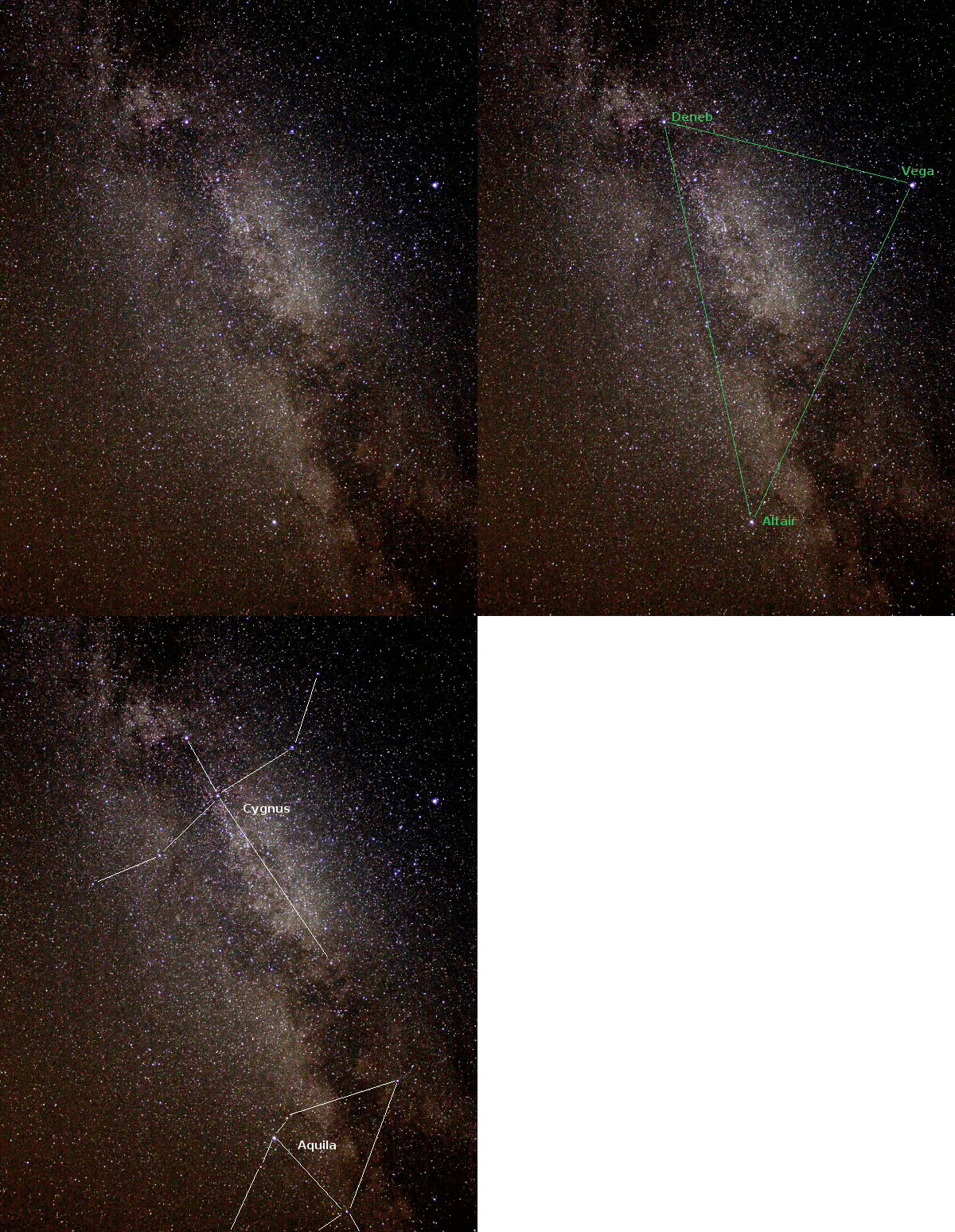
The Milky Way in the Summer Triangle, also showing the constellations of Cygnus the swan and the the northern part of Aquila the Eagle. This image a stack of 5 30 second exposures taken the morning of the Perseid meteor shower the is year in a vain attempt to capture some meteors. I was hampered by a smoky haze blown in all the way from the West Coast from forest files out there.
08/01/2019 – Ephemeris – Previewing August skies
Ephemeris for Thursday, August 1st. Today the Sun will be up for 14 hours and 40 minutes, setting at 9:08, and it will rise tomorrow at 6:29. The Moon, 1 day past new, will set at 9:54 this evening.
Let’s look ahead at the month of August. Daylight hours will decrease from 14 hours and 40 minutes today to 13 hours 17 minutes on the 31st. The altitude of the Sun at local noon, that is degrees of angle above the horizon will decrease from 63 degrees today to just over 53 degrees on the 31st. Straits area listeners can subtract one degree from those angles. Local noon, when the Sun is due south, is about 1:43 p.m. The Perseid meteor shower will reach its peak during the morning hours of the 13th, by then the Moon will be nearly full. On the nights between now and then when the moon has set these meteor numbers will be building to the peak. Jupiter and Saturn will be our easily visible evening planets.
The times given are for the Traverse City/Interlochen area of Michigan. They may be different for your location.
Addendum
August Evening Star Chart
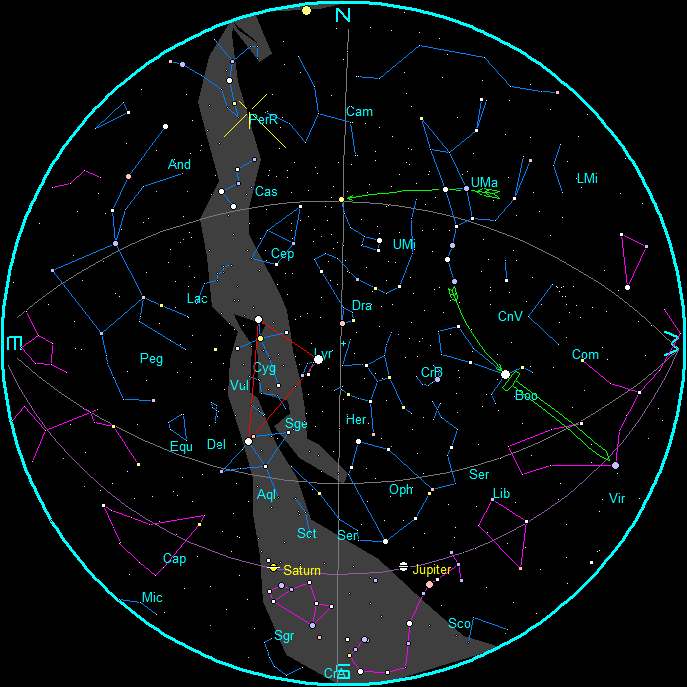
Star Chart for August 2019 (10 p.m. EDT August 15, 2019). Click on image to enlarge.Created using my LookingUp program. Click on image to enlarge.
The planets and stars are plotted for the 15th at 10 p.m. EDT in the evening and 5 a.m. for the morning chart. These are the chart times. Note that Traverse City is located approximately 45 minutes behind our time meridian, West 75° longitude. (An hour 45 minutes behind our daylight saving time meridian during EDT). To duplicate the star positions on a planisphere you may have to set it to 1 hour 45 minutes earlier than the current time.
Note the chart times are for the 15th. For each week before the 15th add ½ hour (28 minutes if you’re picky). For each week after the 15th subtract ½ hour. The planet positions are updated each Wednesday on this blog. For planet positions on dates other than the 15th.
August Morning Star Chart
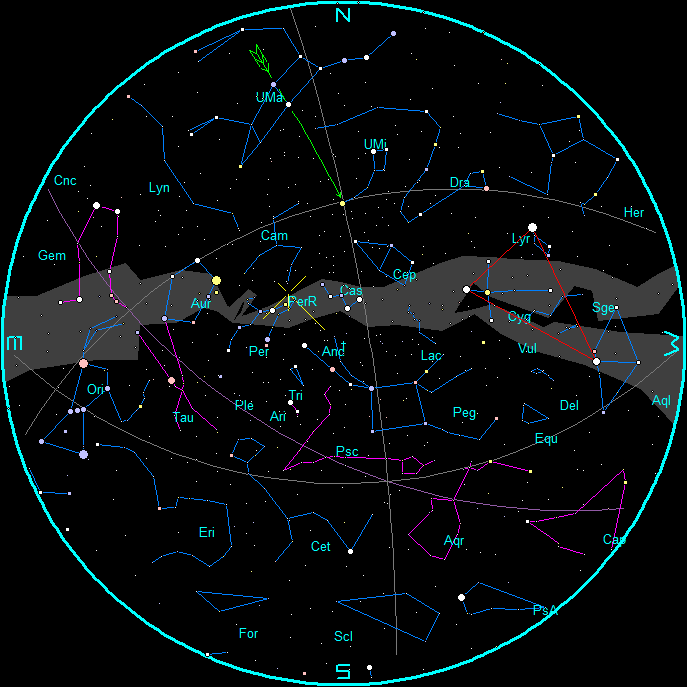
Star Chart for August mornings 2019 (5 a.m. EDT August 15, 2019). Click on image to enlarge. Created using my LookingUp program.
For a list of constellation names to go with the abbreviations click here.
- Pointer stars at the front of the bowl of the Big Dipper point to Polaris the North Star.
- Leaky dipper drips on Leo.
- Follow the arc of the handle of the Big Dipper to the star Arcturus, and
- Extend like a spike to Spica.
- The Summer Triangle is in red.
- PerR is the radiant of the Perseid meteor shower (Peaks on the 13th)
Twilight Limits, Nautical and Astronomical
| EDT | |||||||
| Traverse City |
Morning twilight | Evening twilight | Dark night | Moon | |||
| Date | Astro. | Nautical | Nautical | Astro. | Start | End | Illum. |
| 2019-08-01 | 4h30m | 5h18m | 22h27m | 23h16m | 23h16m | 4h30m | 0.01 |
| 2019-08-02 | 4h31m | 5h20m | 22h26m | 23h14m | 23h14m | 4h31m | 0.04 |
| 2019-08-03 | 4h33m | 5h21m | 22h24m | 23h12m | 23h12m | 4h33m | 0.11 |
| 2019-08-04 | 4h35m | 5h23m | 22h22m | 23h10m | 23h33m | 4h35m | 0.2 |
| 2019-08-05 | 4h37m | 5h24m | 22h21m | 23h07m | – | 4h37m | 0.3 |
| 2019-08-06 | 4h39m | 5h26m | 22h19m | 23h05m | 0h01m | 4h39m | 0.42 |
| 2019-08-07 | 4h41m | 5h27m | 22h17m | 23h03m | 0h30m | 4h41m | 0.53 |
| 2019-08-08 | 4h43m | 5h29m | 22h15m | 23h01m | 1h00m | 4h43m | 0.64 |
| 2019-08-09 | 4h45m | 5h30m | 22h14m | 22h59m | 1h33m | 4h45m | 0.74 |
| 2019-08-10 | 4h47m | 5h32m | 22h12m | 22h57m | 2h11m | 4h47m | 0.83 |
| 2019-08-11 | 4h49m | 5h33m | 22h10m | 22h54m | 2h54m | 4h49m | 0.9 |
| 2019-08-12 | 4h51m | 5h35m | 22h08m | 22h52m | 3h44m | 4h51m | 0.9 |
| 2019-08-13 | 4h52m | 5h36m | 22h06m | 22h50m | 4h38m | 4h52m | 0.95 |
| 2019-08-14 | 4h54m | 5h38m | 22h04m | 22h48m | – | – | 0.98 |
| 2019-08-15 | 4h56m | 5h39m | 22h03m | 22h46m | – | – | 1 |
| 2019-08-16 | 4h58m | 5h41m | 22h01m | 22h43m | – | – | 0.99 |
| 2019-08-17 | 5h00m | 5h42m | 21h59m | 22h41m | – | – | 0.97 |
| 2019-08-18 | 5h01m | 5h43m | 21h57m | 22h39m | – | – | 0.93 |
| 2019-08-19 | 5h03m | 5h45m | 21h55m | 22h37m | 22h37m | 22h53m | 0.87 |
| 2019-08-20 | 5h05m | 5h46m | 21h53m | 22h34m | 22h34m | 23h16m | 0.8 |
| 2019-08-21 | 5h07m | 5h48m | 21h51m | 22h32m | 22h32m | 23h41m | 0.72 |
| 2019-08-22 | 5h08m | 5h49m | 21h49m | 22h30m | 22h30m | – | 0.62 |
| 2019-08-23 | 5h10m | 5h51m | 21h47m | 22h28m | 22h28m | 0h10m | 0.52 |
| 2019-08-24 | 5h12m | 5h52m | 21h45m | 22h25m | 22h25m | 0h43m | 0.41 |
| 2019-08-25 | 5h14m | 5h54m | 21h43m | 22h23m | 22h23m | 1h23m | 0.3 |
| 2019-08-26 | 5h15m | 5h55m | 21h41m | 22h21m | 22h21m | 2h13m | 0.2 |
| 2019-08-27 | 5h17m | 5h56m | 21h39m | 22h19m | 22h19m | 3h13m | 0.11 |
| 2019-08-28 | 5h19m | 5h58m | 21h37m | 22h16m | 22h16m | 4h23m | 0.05 |
| 2019-08-29 | 5h20m | 5h59m | 21h35m | 22h14m | 22h14m | 5h20m | 0.01 |
| 2019-08-30 | 5h22m | 6h01m | 21h33m | 22h12m | 22h12m | 5h22m | 0 |
| 2019-08-31 | 5h24m | 6h02m | 21h31m | 22h10m | 22h10m | 5h24m | 0.03 |
Twilight calendar was generated using Cartes du Ciel (Sky Charts).
See my blog post: Twilight Zone for the definitions of the different periods of twilight here: https://bobmoler.wordpress.com/2018/09/27/.
NASA Calendar of Planetary Events
Aug	1	Th			Venus: 3.6° W
 	2	Fr	 3:08 am	Moon Perigee: 359400 km
 	7	We	 1:31 pm	First Quarter
 	9	Fr	 6:53 pm	Moon-Jupiter: 2.6° S
 	9	Fr	 6:59 pm	Mercury Elongation: 19° W
 	12	Mo	12:28 am	Moon South Dec.: 22.4° S
 	12	Mo	 6:05 am	Moon-Saturn: 0°
 	12	Mo	10:45 am	Moon Descending Node
 	12	Mo	12:29 pm	Jupiter-Antares: 6.9° N
 	13	Tu	 2:53 am	Perseid Shower: ZHR = 90
 	14	We	 1:44 am	Venus Superior Conj.
 	15	Th	 8:29 am	Full Moon
 	17	Sa	12:24 am	Mercury-Beehive: 1.2° S
 	17	Sa	 6:50 am	Moon Apogee: 406200 km
 	23	Fr	10:56 am	Last Quarter
 	24	Sa	 5:24 am	Moon-Aldebaran: 2.5° S
 	26	Mo	 1:53 pm	Moon North Dec.: 22.5° N
 	26	Mo	 9:50 pm	Moon Ascending Node
 	28	We	 7:31 am	Moon-Beehive: 0.2° S
 	30	Fr	 6:37 am	New Moon
 	30	Fr	11:57 am	Moon Perigee: 357200 km
Sep	1	Su				Venus: 5.2° E
All event times are given for UTC-4 hr: Eastern Daylight Saving Time.
Sky Events Calendar by Fred Espenak and Sumit Dutta (NASA’s GSFC),
http://eclipse.gsfc.nasa.gov/SKYCAL/SKYCAL.html.
If you go to the above site you can print out a list like the above for the entire year or calendar pages for your time zone.
Sun and Moon Rising and Setting Events
     LU                  Ephemeris of Sky Events for Interlochen/TC
     August, 2019    Local time zone: EDT
     +-----------------------------------------------------------------------+
     | DATE |  SUN     SUN  DAYLIGHT|   TWILIGHT*    |MOON  RISE OR    ILLUM |
     |      |  RISE    SET    HOURS |  END    START  |PHASE SET** TIME FRACTN|
     +=======================================================================+
     |Thu  1| 06:28a  09:08p  14:40 | 10:24p  05:12a |      Set  09:54p    1%|
     |Fri  2| 06:29a  09:07p  14:37 | 10:22p  05:14a |      Set  10:31p    5%|
     |Sat  3| 06:31a  09:06p  14:35 | 10:20p  05:15a |      Set  11:03p   12%|
     +------+-----------------------+----------------+-----------------------+
     |Sun  4| 06:32a  09:04p  14:32 | 10:19p  05:17a |      Set  11:33p   21%|
     |Mon  5| 06:33a  09:03p  14:30 | 10:17p  05:18a |      Set  12:01a   31%|
     |Tue  6| 06:34a  09:02p  14:27 | 10:15p  05:20a |      Set  12:29a   42%|
     |Wed  7| 06:35a  09:00p  14:25 | 10:14p  05:21a |F Qtr Set  01:00a   53%|
     |Thu  8| 06:36a  08:59p  14:22 | 10:12p  05:23a |      Set  01:33a   64%|
     |Fri  9| 06:37a  08:57p  14:20 | 10:10p  05:24a |      Set  02:11a   73%|
     |Sat 10| 06:39a  08:56p  14:17 | 10:08p  05:26a |      Set  02:54a   82%|
     +------+-----------------------+----------------+-----------------------+
     |Sun 11| 06:40a  08:55p  14:14 | 10:06p  05:27a |      Set  03:44a   89%|
     |Mon 12| 06:41a  08:53p  14:12 | 10:05p  05:29a |      Set  04:38a   94%|
     |Tue 13| 06:42a  08:51p  14:09 | 10:03p  05:30a |      Set  05:36a   98%|
     |Wed 14| 06:43a  08:50p  14:06 | 10:01p  05:32a |      Set  06:36a  100%|
     |Thu 15| 06:44a  08:48p  14:03 | 09:59p  05:33a |Full  Rise 09:17p  100%|
     |Fri 16| 06:46a  08:47p  14:01 | 09:57p  05:35a |      Rise 09:44p   98%|
     |Sat 17| 06:47a  08:45p  13:58 | 09:55p  05:36a |      Rise 10:08p   94%|
     +------+-----------------------+----------------+-----------------------+
     |Sun 18| 06:48a  08:44p  13:55 | 09:53p  05:38a |      Rise 10:31p   89%|
     |Mon 19| 06:49a  08:42p  13:52 | 09:51p  05:39a |      Rise 10:53p   83%|
     |Tue 20| 06:50a  08:40p  13:49 | 09:49p  05:41a |      Rise 11:16p   75%|
     |Wed 21| 06:51a  08:39p  13:47 | 09:47p  05:42a |      Rise 11:41p   66%|
     |Thu 22| 06:53a  08:37p  13:44 | 09:46p  05:44a |      Rise 12:10a   56%|
     |Fri 23| 06:54a  08:35p  13:41 | 09:44p  05:45a |L Qtr Rise 12:43a   46%|
     |Sat 24| 06:55a  08:34p  13:38 | 09:42p  05:47a |      Rise 01:24a   36%|
     +------+-----------------------+----------------+-----------------------+
     |Sun 25| 06:56a  08:32p  13:35 | 09:40p  05:48a |      Rise 02:13a   26%|
     |Mon 26| 06:57a  08:30p  13:32 | 09:38p  05:50a |      Rise 03:13a   16%|
     |Tue 27| 06:59a  08:28p  13:29 | 09:36p  05:51a |      Rise 04:23a    9%|
     |Wed 28| 07:00a  08:27p  13:26 | 09:34p  05:52a |      Rise 05:40a    3%|
     |Thu 29| 07:01a  08:25p  13:23 | 09:32p  05:54a |      Rise 07:00a    0%|
     |Fri 30| 07:02a  08:23p  13:20 | 09:30p  05:55a |New   Set  08:59p    1%|
     |Sat 31| 07:03a  08:21p  13:17 | 09:28p  05:57a |      Set  09:31p    4%|
     +-----------------------------------------------------------------------+
     * Nautical Twilight
     ** Moonrise or moonset, whichever occurs between sunrise and sunset
Generated using my LookingUp for DOS program.
07/31/2019 – Ephemeris – Looking at the bright planets on this last day of July
Ephemeris for Wednesday, July 31st. Today the Sun will be up for 14 hours and 42 minutes, setting at 9:10, and it will rise tomorrow at 6:28. The Moon is new today, and won’t be visible.
Let’s look at the planets for the last day of July. Mars, Mercury and Venus are all too close to the Sun to be seen. Mars is still on the evening or east side of the Sun. Mercury and Venus are on the west or morning side of the Sun. Bright Jupiter will be in the southern sky as it gets dark. It will pass the meridian, due south at 9:58 p.m. With steadily held binoculars a few of the 4 largest satellites of Jupiter can be seen. Three of Jupiter’s largest satellites can be spotted in telescopes tonight. One, Ganymede will be passing in front of the planet tonight. Jupiter will set at 2:26 a.m. Saturn, the ringed planet, will be lower down in the southeast in the evening, the brightest star-like object in that direction, but significantly dimmer than Jupiter. It will set at 4:40 a.m.
The times given are for the Traverse City/Interlochen area of Michigan. They may be different for your location.
Addendum
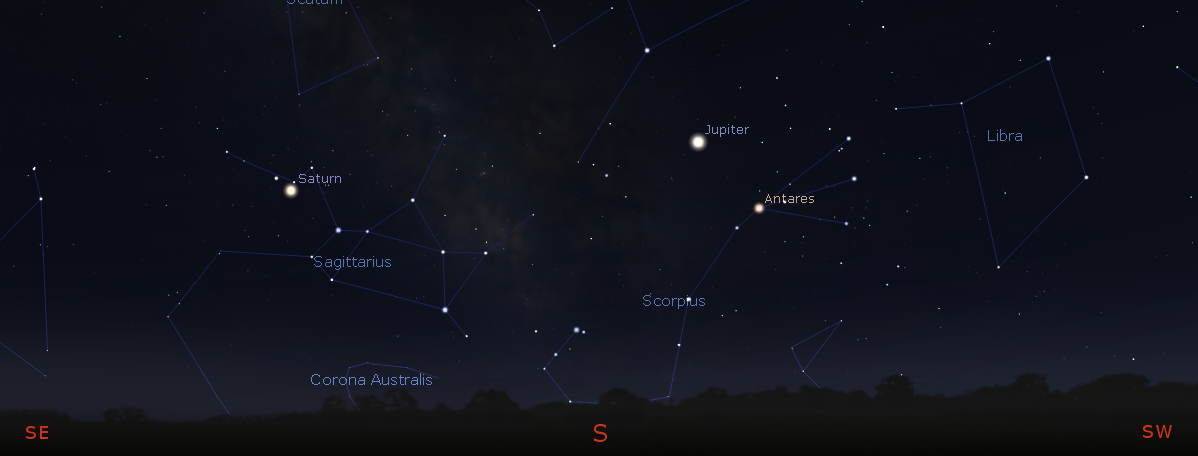
Jupiter and Saturn with the constellations of the southern summer sky at 10:30 p.m. July 31, 2019. Click on the image to enlarge. Created using Stellarium.
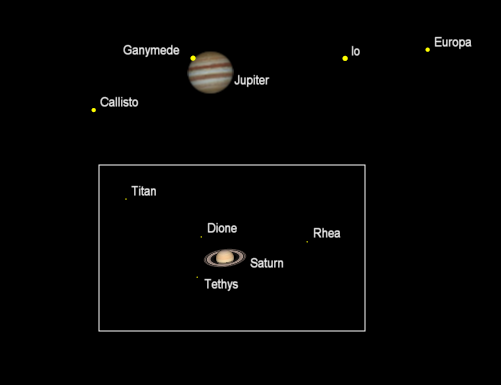
Jupiter and Saturn with the same magnification at 11p.m. July 31, 2019. Jupiter’s moon Ganymede is about to transit the face of Jupiter. The transit starts at 11:11 p.m. and ends at 1:32 a.m. Despite how they appear here Jupiter’s moons are dimmer than the planet. The same is true for Saturn’s moons, however Titan is much brighter than the other moons. Created using Cartes du Ciel (Sky Charts).
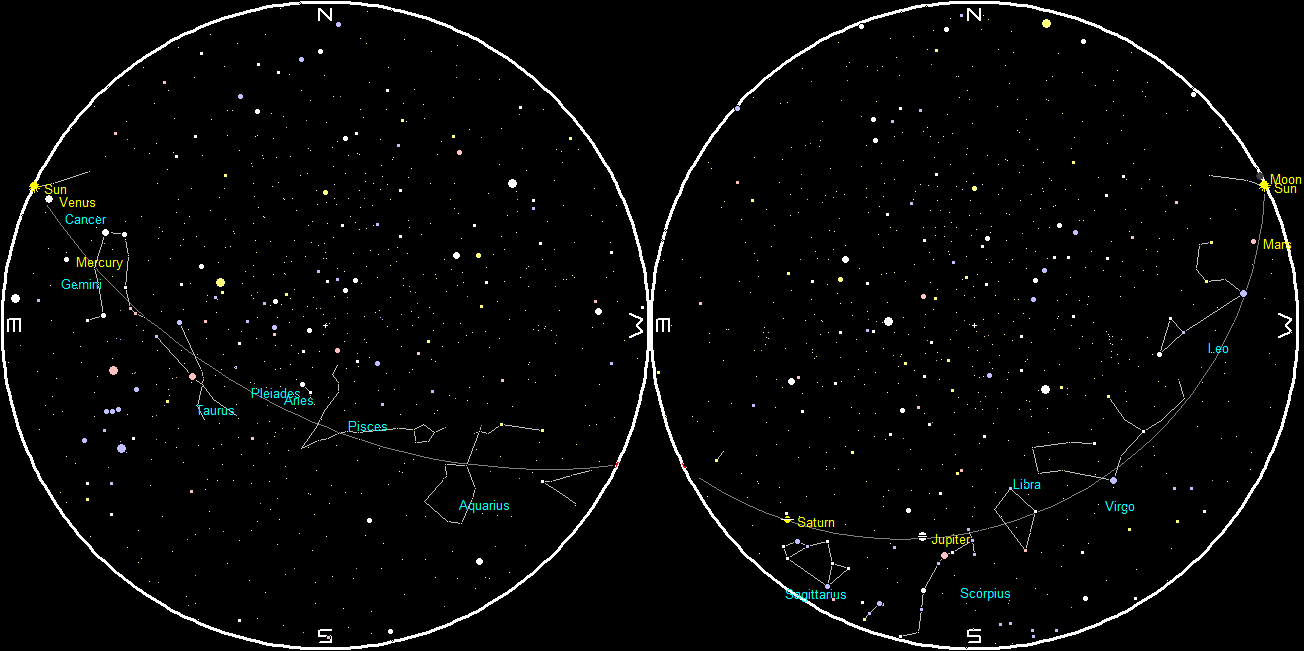
Planets and the Moon at sunset and sunrise of a single night starting with sunset on the right on July 31, 2019. The night ends on the left with sunrise on August 1st. Click on the image to enlarge. Created using my LookingUp program.
07/30/2019 – Ephemeris – Finding the Little Dipper
Ephemeris for Tuesday, July 30th. Today the Sun will be up for 14 hours and 44 minutes, setting at 9:11, and it will rise tomorrow at 6:27. The Moon, 1 day before new, will rise at 5:37 tomorrow morning.
11 p.m. is the best time now to spot the Little Dipper. It is difficult to spot, being much smaller and dimmer than the Big Dipper. However it is the Big Dipper that points to it, by the two stars at the front of the bowl of the Big Dipper to point to the North Star, Polaris, the star that doesn’t appear to move. That is the tip of the handle of the Little Dipper. The handle is seen in a curve of the stars upwards and a bit to the left to a small box of stars that is its bowl. The two brighter stars at the front of the bowl are called the Guard Stars because they guard the pole. The Little Dipper is not an official constellation, but is Ursa Minor the lesser bear. To the Anishinaabe native peoples of this area it represents a loon.
The times given are for the Traverse City/Interlochen area of Michigan. They may be different for your location.
Addendum
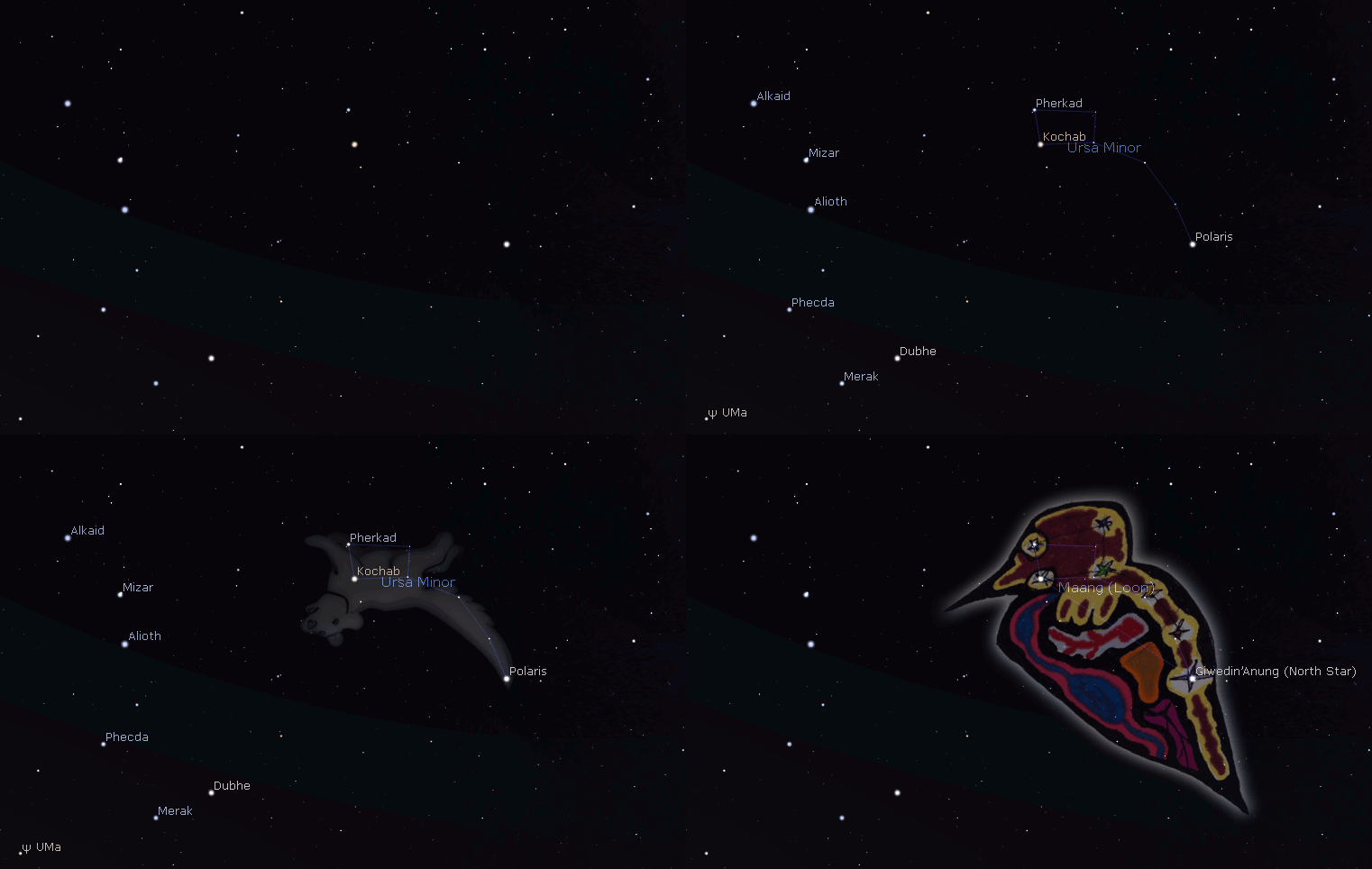
Little Dipper finder animation. The Little Dipper is also Ursa Minor and the Loon. Polaris is the Pole Star and North Star. The Guard Stars are Kochab and Pherkad. Except for the named stars, the Little Dipper stars are quite faint and require moonless skies away from the city to spot. Chick on the image to enlarge. Created using Stellarium and GIMP.
The loon image constellation art is part of the latest versions of Stellarium. Ojibwe (Anishinaabe) constellation art by Annette S Lee and William Wilson from Ojibwe Sky Star Map Constellation Guide, by A. Lee, W Wilson, C Gawboy, J. Tibbetts. ISBN 978-0-615-98678-4.

