07/13/2018 – Ephemeris – Sun ‘n Star Party set for tomorrow at the Sleeping Bear Dunes National Lakeshore
Ephemeris for Friday, July 13th. Today the Sun will be up for 15 hours and 17 minutes, setting at 9:26, and it will rise tomorrow at 6:10. The Moon, 1 day past new, will set at 10:04 this evening.
Tomorrow afternoon and evening will be what we call a Sun & Star Party at the Sleeping Bear Dunes National Lakeshore Hosted by the Grand Traverse Astronomical Society and the rangers of the park. This event will be held at the Dune Climb. From 4 to 6 p.m., the Sun will be featured using two types of telescopes, one showing the Sun’s photosphere in what we call white light, looking for sunspots, and another showing the chromosphere above it in the light of hydrogen giving a completely different view.
Starting at 9 p.m. will be a star party, actually mostly a planet party, viewing the planets Venus, Jupiter and Saturn, plus near the end of the night, Mars. There will be other celestial wonders visible in the deepening twilight. If cloudy one or both events will be cancelled. The astronomers will be back Sunday night if that night is clear.
The times given are for the Traverse City/Interlochen area of Michigan. They may be different for your location.
Addendum
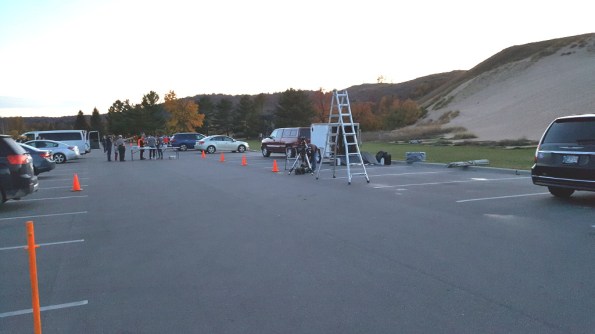
This in the beginning of setup for the October 21, 2917 star party at the dune climb. Taken early while there was enough light. The dune blocks up to 12 degrees from the southwest to northwest, but the rest of the horizon is quite low. Venus will be high enough to clear the dune for during the day and early evening.
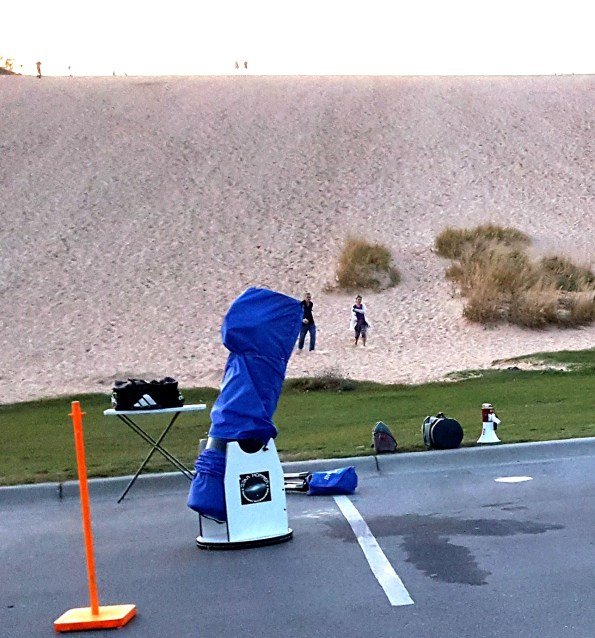
My equipment at the Dune Climb on October 21, 2017. My 11″ Dobsonian is in the foreground. The tripod for my Celestron 8 is laying on the ground behind it yet to be set up.
I pointed the Dobsonian at a variety of deep sky objects, while the C8 was pointed to Saturn and tracking that night.
07/12/2018 – Ephemeris – A partial solar eclipse today will be visible from south Australia
Ephemeris for Thursday, July 12th. Today the Sun will be up for 15 hours and 18 minutes, setting at 9:27, and it will rise tomorrow at 6:09. The Moon is new today, and won’t be visible.
There’s a minor partial solar eclipse late tonight our time
for extreme southern Australia and Tasmania. This will be followed in two weeks with a total lunar eclipse for mostly Africa and Asia. Two weeks and a day after that their will be a partial solar eclipse from northeastern Canada to Asia. When is the next solar eclipse visible here in northern Michigan? That would be June 10, 2021. The Sun will rise with the eclipse more than half over with the Moon taking a big bite out of the left side of the Sun. It will be all over by 6:40 a.m. However, for Canada north of Minnesota, the Sun will rise as a ring of fire because the Moon won’t be big enough to block the entire disk of the Sun. But on April 8, 2024 the Sun will be totally eclipsed in the US from Texas to Maine.
The times given are for the Traverse City/Interlochen area of Michigan. They may be different for your location.
Addendum
Maps for the solar eclipses discussed captured from the calendar function of Cartes du Ciel (Sky Charts):
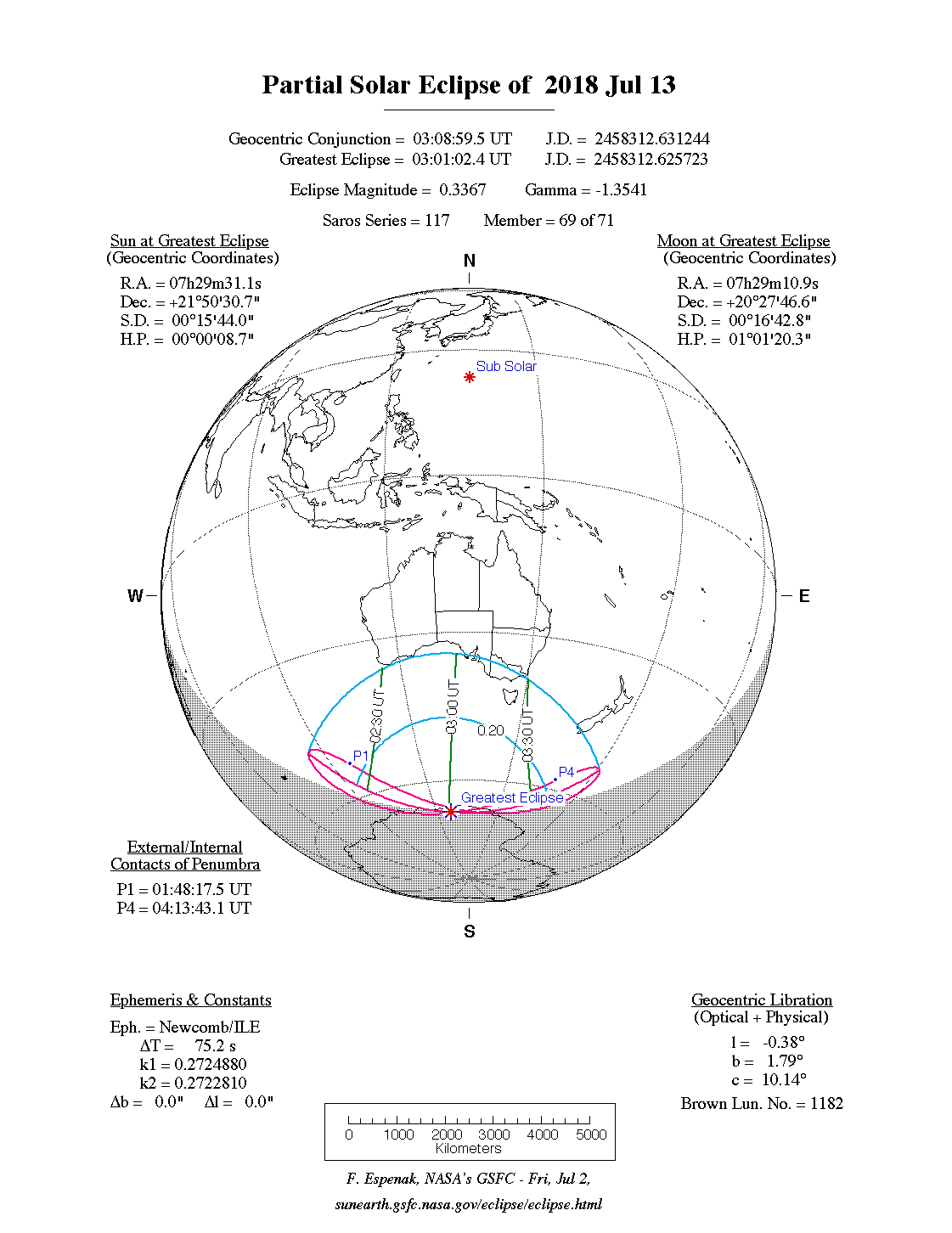
Partial Solar Eclipse Map for July 13, 2018. Mid eclipse 11 p.m. EDT July 12. Click on image for the actual NASA full size image. Eclipse predictions by Fred Espenak NASA/GSFC.
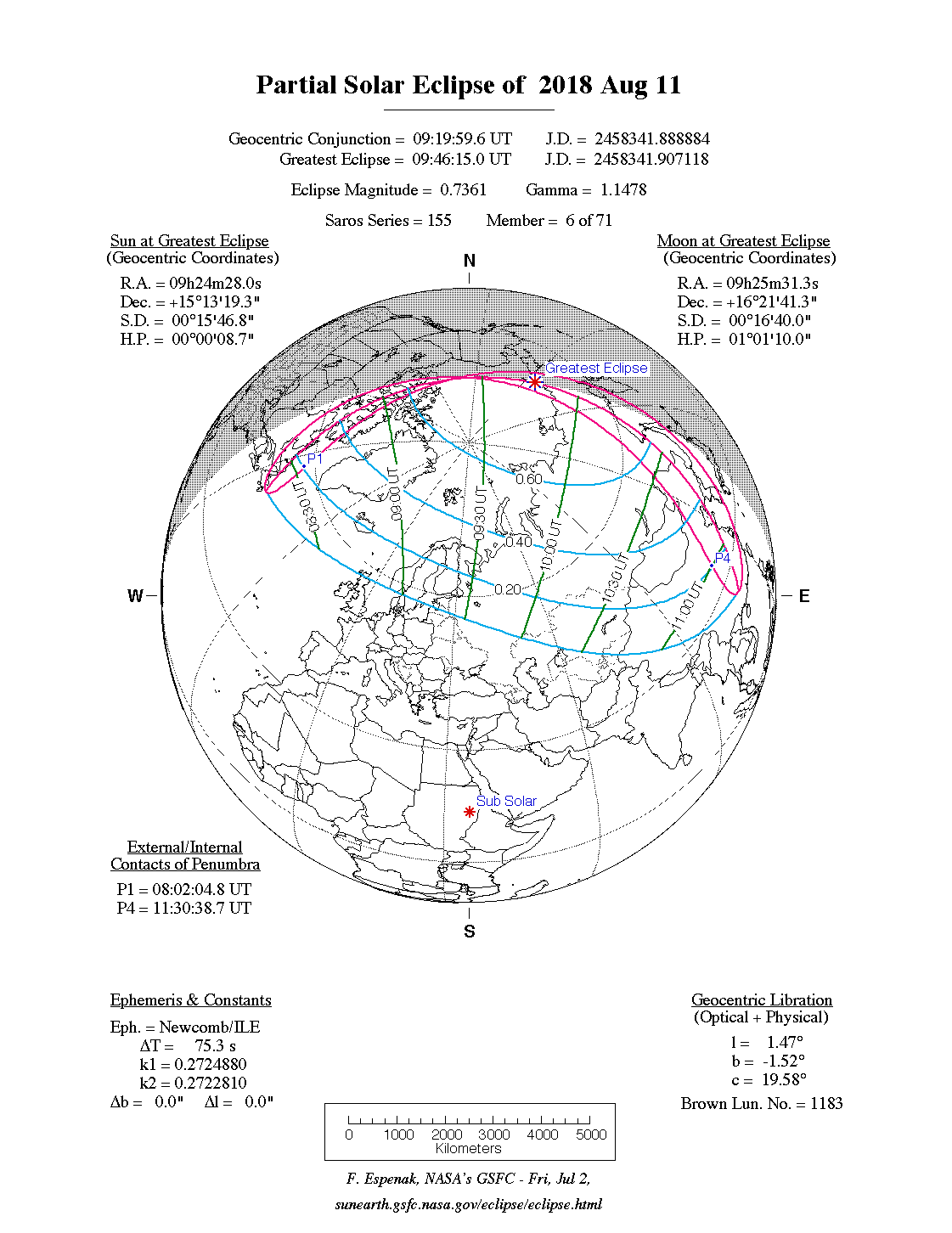
Partial Solar Eclipse Map for August 11, 2018. Click on image for the actual NASA full size image. Eclipse predictions by Fred Espenak NASA/GSFC.
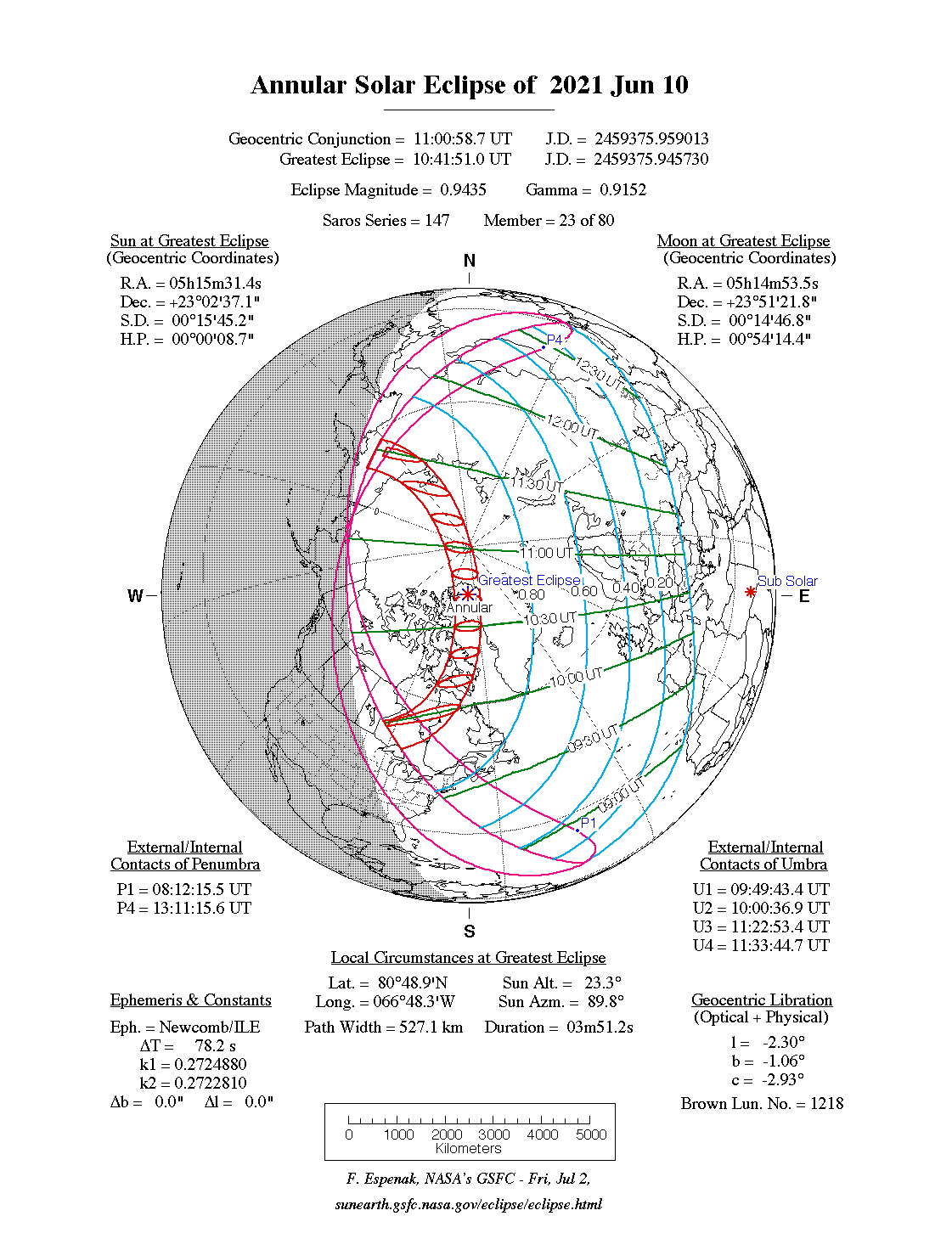
Annular Solar Eclipse Map for June 10, 2021. Click on image for the actual NASA full size image. Eclipse predictions by Fred Espenak NASA/GSFC.
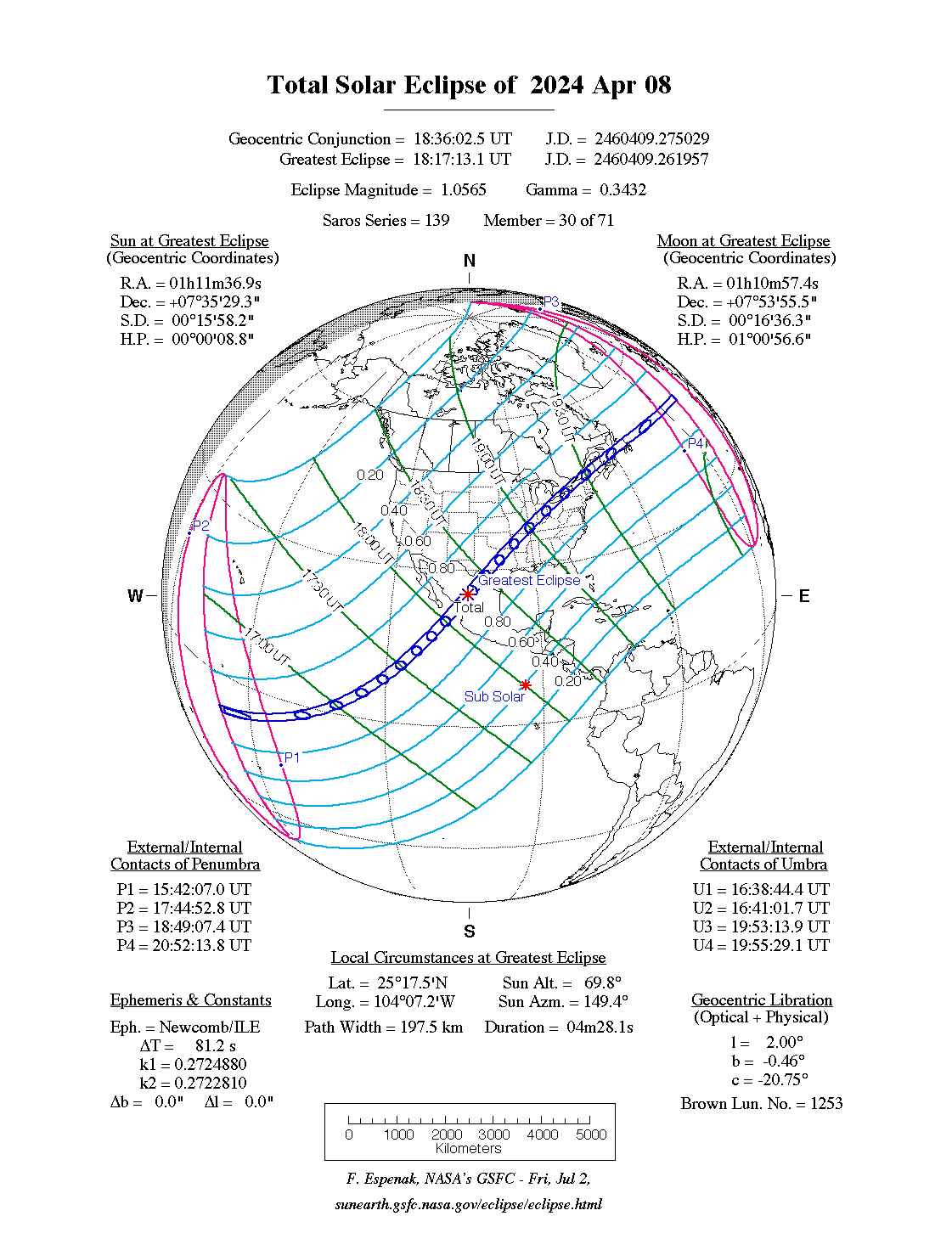
Total Solar Eclipse Map for April 8, 2014. Click on image for the actual NASA full size image. Eclipse predictions by Fred Espenak NASA/GSFC.
Here’s a link to NASA’s table of the solar eclipses of the 2020s which has links to global and interactive Google maps for each eclipse: https://eclipse.gsfc.nasa.gov/SEgoogle/SEgoogle2021.html.
07/11/2018 – Ephemeris – The bright planets for this week
Ephemeris for Wednesday, July 11th. Today the Sun will be up for 15 hours and 20 minutes, setting at 9:28, and it will rise tomorrow at 6:08. The Moon, 1 day before new, will rise at 5:36 tomorrow morning.
It’s Wednesday and time to look for and at the bright planets. Four of them are in the evening sky. The brilliant beacon of Venus will be visible in the western twilight from about 9:50 p.m. until it sets at 11:33 p.m. Mercury, reaching its greatest separation from the Sun just after midnight, is far below and right of it, setting at 10:44 p.m. Jupiter will be in the south as it gets dark. Jupiter is only outshone by Venus and the Moon, though Mars will outshine it later this month at its closest. Jupiter will set at 2:09 a.m. Saturn will start the evening low in the southeast will stay relatively low, above the Teapot of Sagittarius and will set at 5:10 a.m.. Mars will rise at 10:46 p.m. and is now outshining Saturn.
The times given are for the Traverse City/Interlochen area of Michigan. They may be different for your location.
Addendum
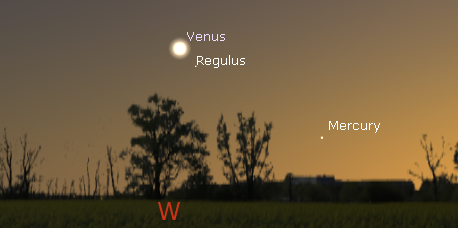
Venus and Mercury at 10 p.m. July 11, 2018. Created using Stellarium.
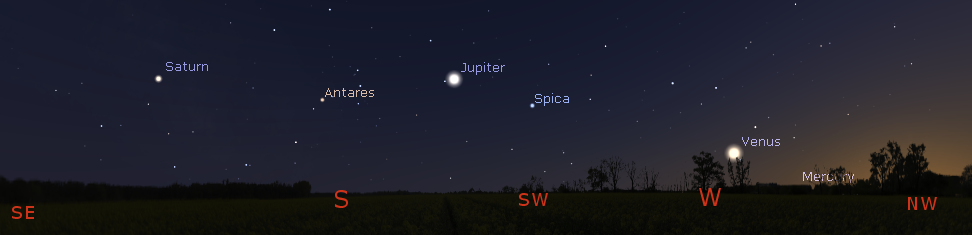
The evening planets except Mercury at 10:30 p.m. July 11, 2018. Click on the image to enlarge. Created using Stellarium.
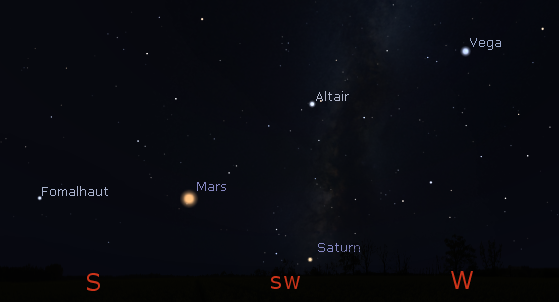
Mars and Saturn in the morning at 4:30 a.m. July 12, 2018. Created using Stellarium.
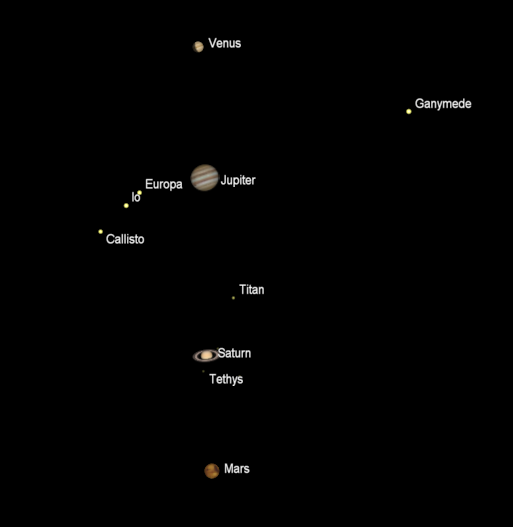
Telescopic views of Venus, Jupiter and Saturn at 10:30 p.m. on July 11, and Mars at 4:30 a.m. on July 12. All images are at the same magnification. Created using Cartes du Ciel (Sky Charts)
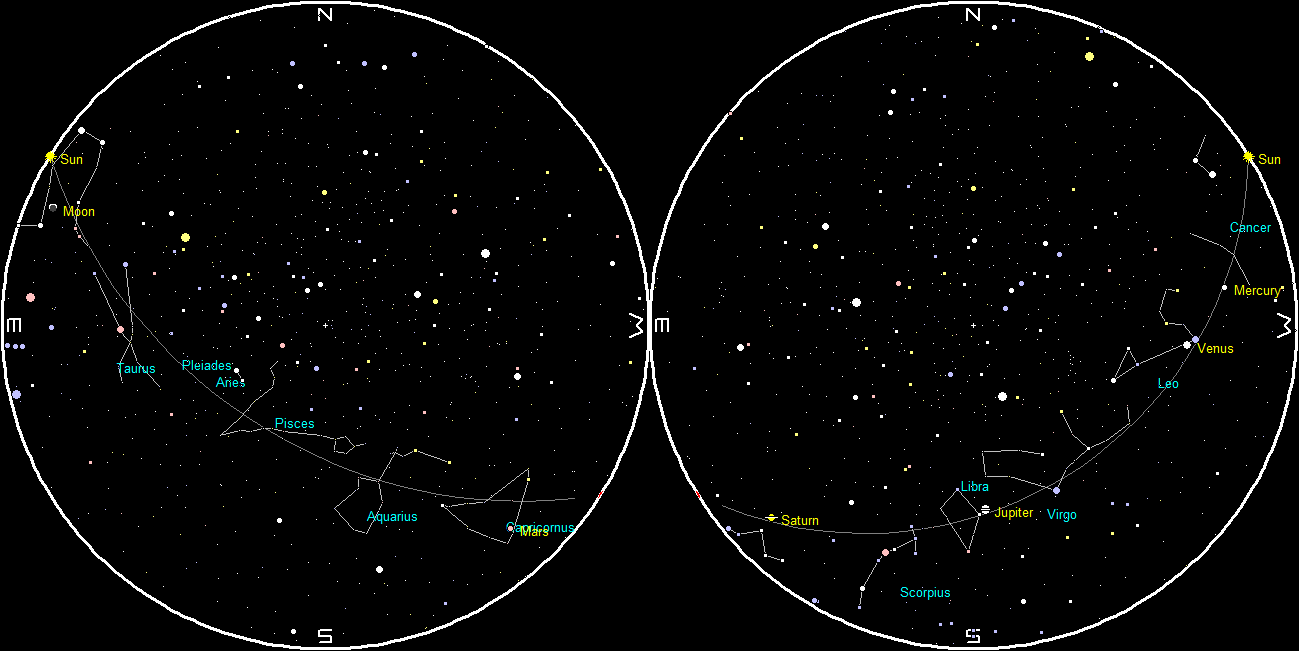
Planets and the Moon at sunset and sunrise of a single night starting with sunset on the right on July 11, 2018. The night ends on the left with sunrise on the 12th. Click on the image to enlarge. Created using my LookingUp program.
07/10/2018 – Ephemeris – The celestial scorpion
Ephemeris for Tuesday, July 10th. Today the Sun will be up for 15 hours and 21 minutes, setting at 9:28, and it will rise tomorrow at 6:08. The Moon, 2 days before new, will rise at 4:38 tomorrow morning.
For most of the year I’ve been referencing the constellation of Scorpius the scorpion in passing. Let’s take a good look at this creature. There are no scorpions in Michigan, unless someone imported some. However the one celestial scorpion now seen in the south near 11 p.m. is a beautiful example of one. His heart is the red giant star Antares. Another to the upper right leads to a trio of stars in a bit of a vertical bow. It’s claws extend into the next constellation over, Libra and the stars Zubenelgenubi, near Jupiter and Zubeneschamali, the south and north claws. From Antares the body droops down and curves just at the horizon, before making that distinctive curved tail with two stars at the stinger.
The times given are for the Traverse City/Interlochen area of Michigan. They may be different for your location.
Addendum
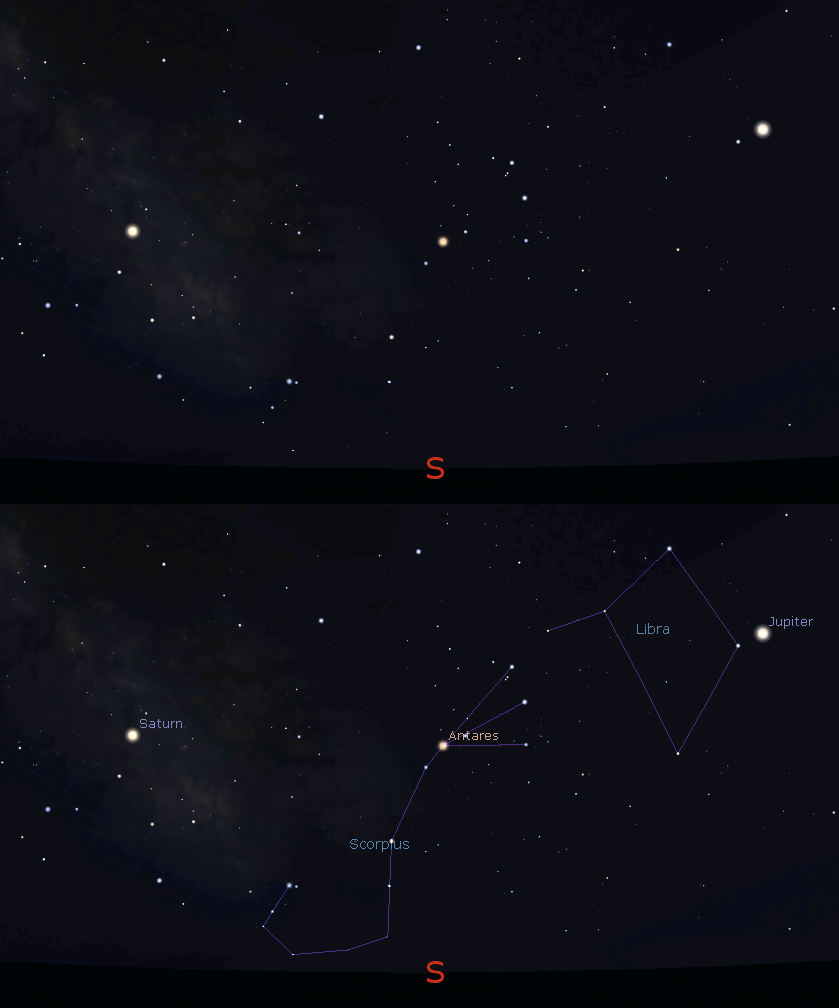
Scorpius finder animation. I’m leaving the artwork to another image, since I really don’t see the scorpion as Stellarium’s artist sees it. Animation created using Stellarium and GIMP.
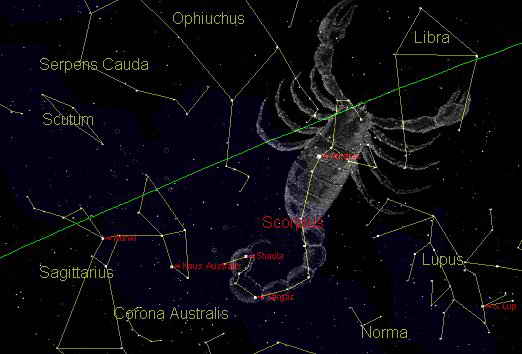
Scorpius artwork closer to how I see it with the claws extending into Libra. I was able to find the image using a Google search, but was unable to find the original source.
07/09/2018 – Ephemeris – Ophiuchus. the serpent bearer in the sky
Ephemeris for Monday, July 9th. Today the Sun will be up for 15 hours and 22 minutes, setting at 9:29, and it will rise tomorrow at 6:07. The Moon, half way from last quarter to new, will rise at 3:50 tomorrow morning.
The red star Antares shines in the south at 11 p.m. In the constellation of Scorpius. In the area of sky above and a little to the left lies a large constellation of faint stars called Ophiuchus, the serpent bearer. The constellation shape is like a large bell, which reminds me of the head, shoulders and arms of a fellow that’s holding the snake-like a weight lifter pulling up a heavy barbell. The serpent he’s holding is Serpens, the only two-part constellation in the heavens. The head rises to Ophiuchus’ right and the tail extends up to the left. In Greek legend Ophiuchus was a great physician, educated by the god Apollo, and the centaur Chiron, also found in the stars as Sagittarius, now rising below and left of him.
The times given are for the Traverse City/Interlochen area of Michigan. They may be different for your location.
Addendum
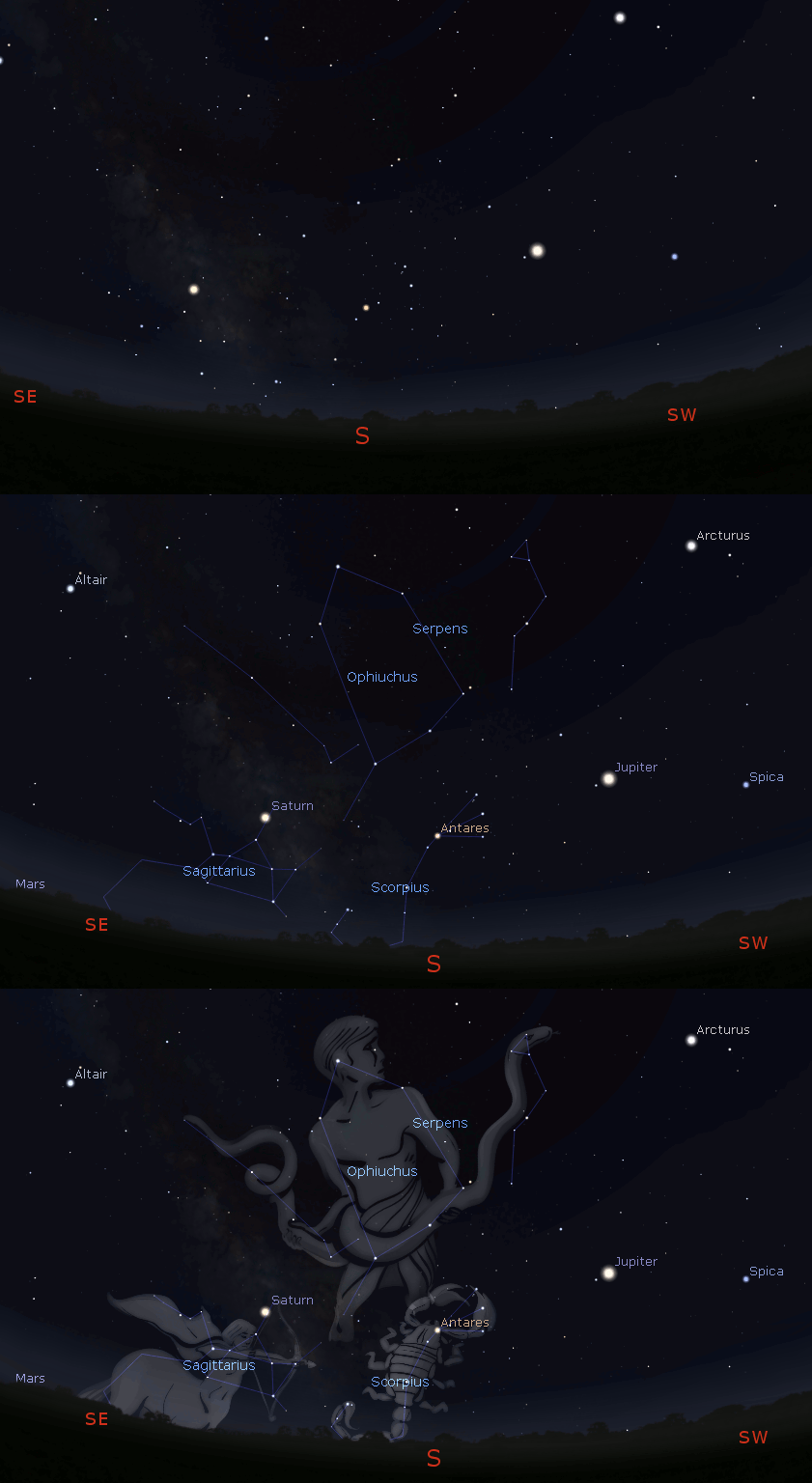
Ophiuchus finder animation plus constellations discussed. Created using Stellarium and GIMP.
Ephemeris Extra – Occultation of Aldebaran visible from the Upper Peninsula and the tip of northern lower Michigan
In the early morning hours of July 10th the very northern part of the IPR listening area will have a chance to see the last occultation of the bright star Aldebaran for at last 15 years. An occultation is where the Moon in this case passes in front of or occults a planet or a star. In astronomy occult means to hide. The event is an occultation. There is no black magic involved. It will be a grazing event, with Aldebaran popping in and out of view at the mountains and valleys at the southern edge of the Moon along a line running south of Mackinaw City and across the eastern tip of the Upper Peninsula.
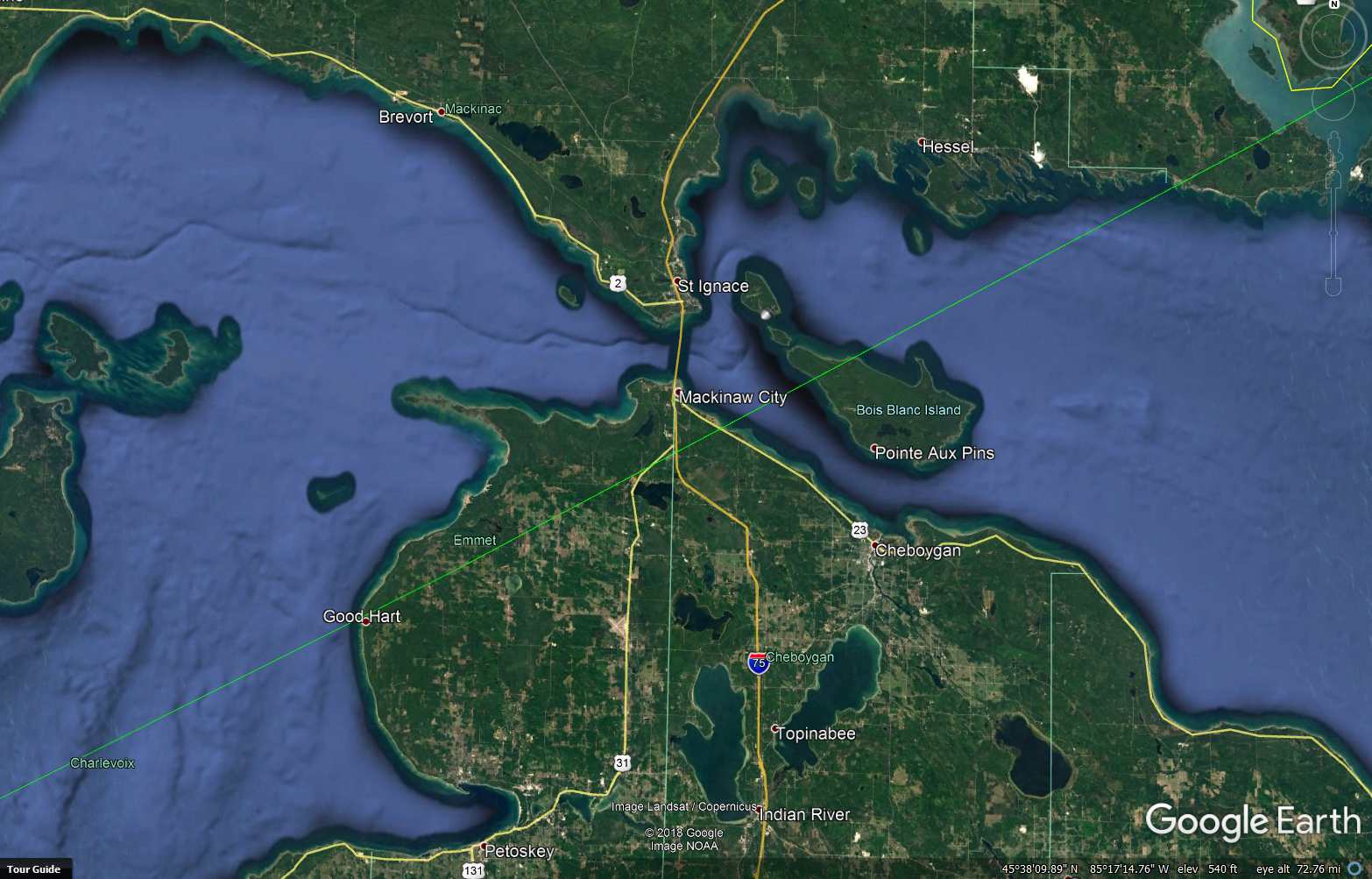
The Straits of Mackinac area showing the green southern graze line of the Occultation of Aldebaran. Credit Map Google Earth, Graze line by Occult 4.
It’s a clear miss for the Interlochen area, with the star skirting the Moon at it’s 5 o’clock position. The time of the event will be near 4:38 a.m. with the maximum time of the event increasing from west to east at nearly 2,000 miles an hour. At that time the Moon and Aldebaran will be low in the east-northeast and only 7 degrees above the horizon.
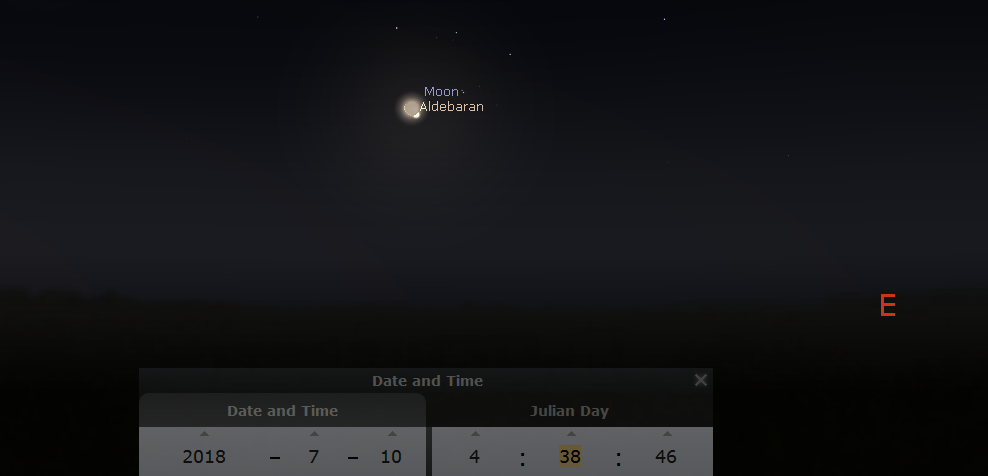
Location of the Moon and Aldebaran in the sky at 4:38 a.m. July 10, 2018 from the Interlochen/Traverse City area.
More information on this occultation from Sky and Telescope is here.
This will be the last occultation of Aldebaran visible from around here for the next 15 years. However starting in 5 years there will be a monthly series of occultations of the bright star Regulus, and the next year a series of occultations of the star Spica will begin. That’s just for the Moon with bright stars. The Moon occults many dimmer stars a month. A very important field of occultations is the observation of occultations of asteroids and Kuiper belt objects to discover their size, shape, any satellites and whether they have rings. Go to the International Occultation Timing Association https://occultations.org for more information.
Hat tip to Jerry Dobek, Director of the Joseph H. Rogers Observatory
07/06/2018 – Ephemeris – Learn about meteorites tonight
Ephemeris for Friday, July 6th. Today the Sun will be up for 15 hours and 26 minutes, setting at 9:30, and it will rise tomorrow at 6:04. The Moon, at last quarter today, will rise at 2:06 tomorrow morning.
Meteorites will be the topic given by Joe Brooks local meteorite expert and collector at this evening’s meeting of the Grand Traverse Astronomical Society at 8 p.m. at Northwestern Michigan College’s Rogers Observatory. He even has a meteorite of a type called a Howardite that the Dawn spacecraft that orbited the asteroid Vesta has determined to be from the there. Today we are all too aware that stones and even bigger asteroids can collide with the Earth, so studying meteorites and the asteroids they come from is important. Everyone is welcome. Also at 9 p.m. there will be a star party at the observatory. The observatory is located south of Traverse City on Birmley Road between Garfield and Keystone roads.
The times given are for the Traverse City/Interlochen area of Michigan. They may be different for your location.
Addendum
A Howardite meteorite is a chip off this old block.
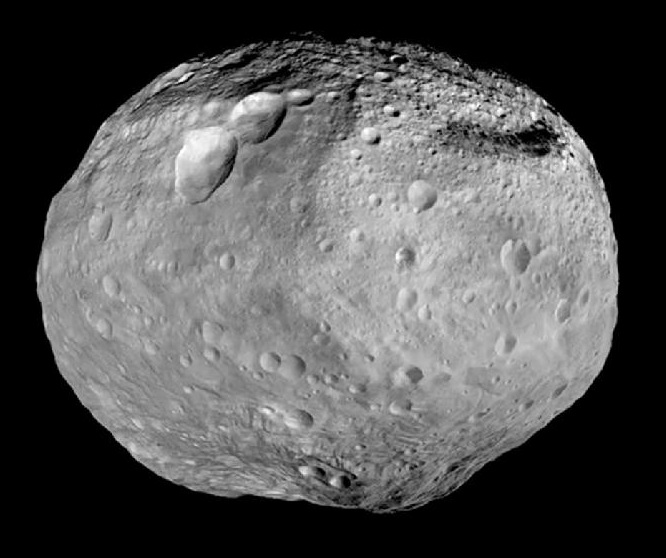
Looking back at Vesta as Dawn headed off to Ceres. Credit: NASA/JPL-Caltech/UCAL/MPS/DLR/IDA
07/05/2018 – Ephemeris – Earth will be the farthest from the Sun in its orbit tomorrow
Ephemeris for Thursday, July 5th. Today the Sun will be up for 15 hours and 27 minutes, setting at 9:30, and it will rise tomorrow at 6:04. The Moon, 1 day before last quarter, will rise at 1:39 tomorrow morning.
At just before noon tomorrow the Earth will reach the aphelion point in its orbit of the Sun reaching 94.48 million miles from our star. The is a bit farther than the Earth was at its perihelion point in early January of 91.32 million miles. This doesn’t affect the total amount of heat the Earth gets from the Sun, as could be felt in the last week. The big temperature differences are due to the seasons, which are caused by the tilt of the Earth’s axis with respect to its orbit. However having aphelion in summer, when the Earth moves it slowest around the Sun makes summer the longest season. It’s 4 days longer than winter. I know it doesn’t feel like it in northern Michigan, especially with the April we had this year.
The times given are for the Traverse City/Interlochen area of Michigan. They may be different for your location.
Addendum
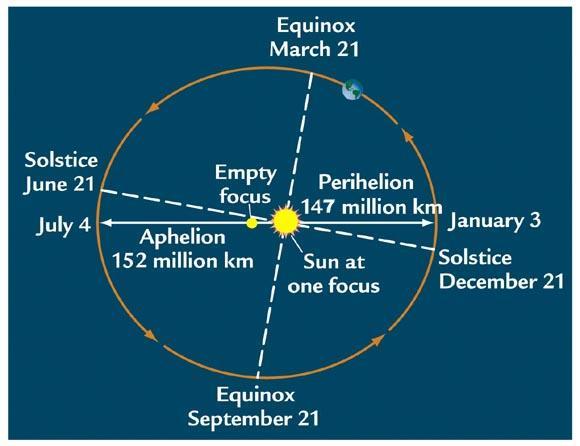
The Earth’s orbit, somewhat exaggerated, showing aphelion and the seasons. Credit “Starts with a Bang” blog by Ethan Siegel.
The exact date and distance of aphelion and perihelion change by a few days and a few thousand miles every year. The Earth’s orbit of the Sun is also affected by the other planets of the solar system, principally Venus and Jupiter.
07/04/2018 – Ephemeris – The bright planets for the week of Independence Day
Ephemeris for Independence Day, Wednesday, July 4th. Today the Sun will be up for 15 hours and 28 minutes, setting at 9:31, and it will rise tomorrow at 6:03. The Moon, 2 days before last quarter, will rise at 1:13 tomorrow morning.
It’s Wednesday again and time to look for and at the bright planets. Four of them are in the evening sky. The brilliant beacon of Venus will be visible in the western twilight from about 9:50 p.m. until it sets at 11:42 p.m. Mercury is far below and right of it, setting at 10:57 p.m. Jupiter will be in the south as it gets dark. Jupiter is only outshone by Venus and the Moon, though Mars will outshine it next month at its closest. Jupiter will set at 2:37 a.m. Binoculars will show it to be bigger than star-like in size. Saturn will start the evening low in the southeast will stay relatively low, above the Teapot of Sagittarius and will set at 5:39 a.m.. Mars will rise at 11:17 p.m. and is now outshining Saturn.
The times given are for the Traverse City/Interlochen area of Michigan. They may be different for your location.
Addendum
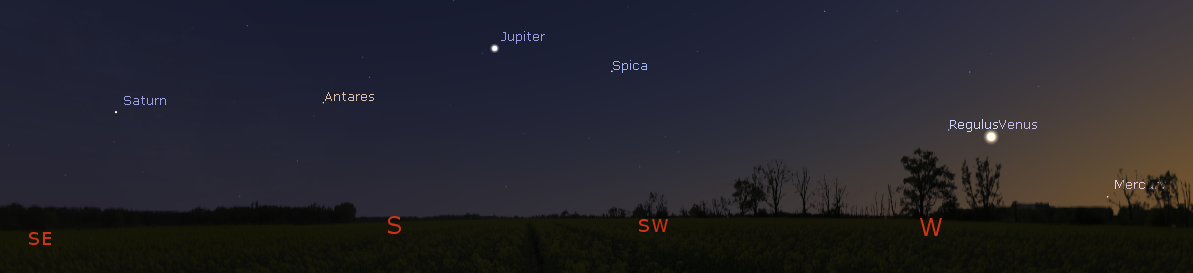
All the evening planets for July 4, 2018 at 10:30 p.m. Click on the image to enlarge. Created using Stellarium.
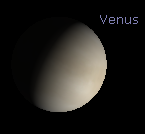
Telescopic appearance of Venus on July, 4, 2018. A moon filter helps cut down the glare to be able to more easily see the phase. Created using Stellarium.
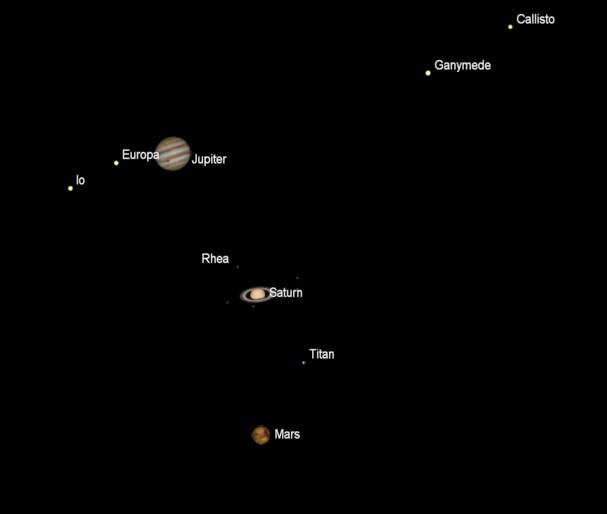
Telescopic views of Jupiter and Saturn at 10:30 p.m. on July 4, and Mars at 12 midnight on July 5, 2018 at the same magnification. Created using Cartes du Ciel (Sky Charts).
Europa’s transit of the face of Jupiter starts at 1:55 a.m. July 5th. The Great Red Spot will cross the central meridian of Jupiter at 11:19 p.m.
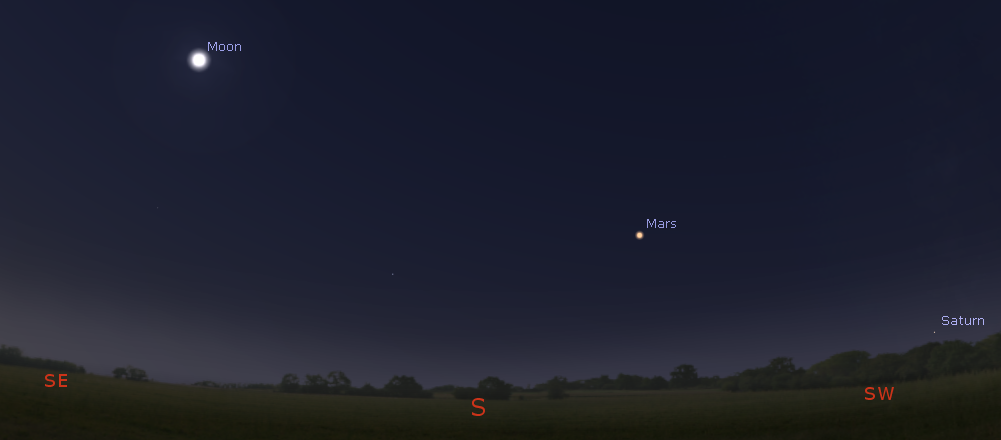
Mars Saturn and the Moon at 5 a.m. July 5, 2018. Click on the image to enlarge. Created using Stellarium.
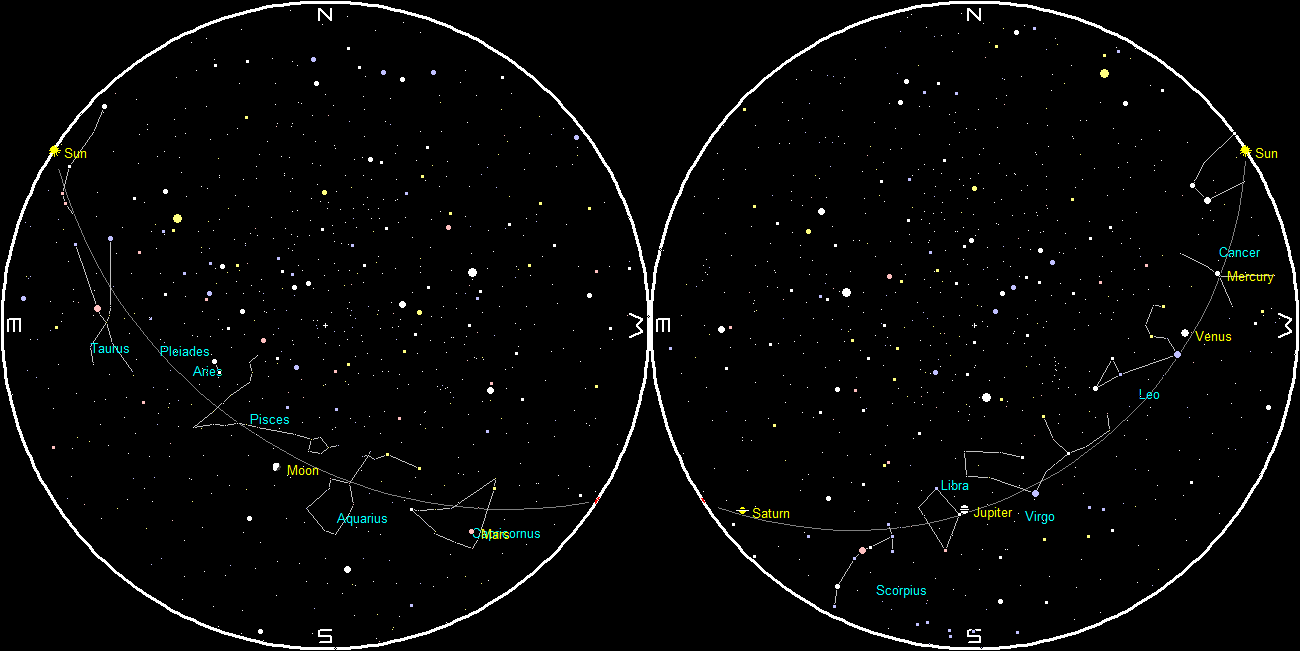
Planets and the Moon at sunset and sunrise of a single night starting with sunset on the right on July 4, 2018. The night ends on the left with sunrise on the 5th. Click on the image to enlarge. Created using my LookingUp program.
07/03/2018 – Ephemeris – Antares the sparkler star
Ephemeris for Tuesday, July 3rd. Today the Sun will be up for 15 hours and 29 minutes, setting at 9:31, and it will rise tomorrow at 6:02. The Moon, 3 days before last quarter, will rise at 12:47 tomorrow morning.
There’s going to be a lot of fireworks tomorrow night to celebrate Independence Day, and I may be watching some after the local Beach Bums baseball game. There’s at least one star that is a great sparkler any summer evening. That’s Antares in Scorpius the scorpion low in the south tonight. We in Michigan always see Antares low in the south. It’s a bright red giant star which twinkles mightily, and since it’s low in the sky spits and sputters all kinds of colors due to our atmosphere’s turbulence, and the fact that we’re looking through so much of it at Antares. The more magnification one uses with binoculars or a telescope the greater the sparkler effect. It is even called in sometimes as a UFO.
The times given are for the Traverse City/Interlochen area of Michigan. They may be different for your location.
Addendum
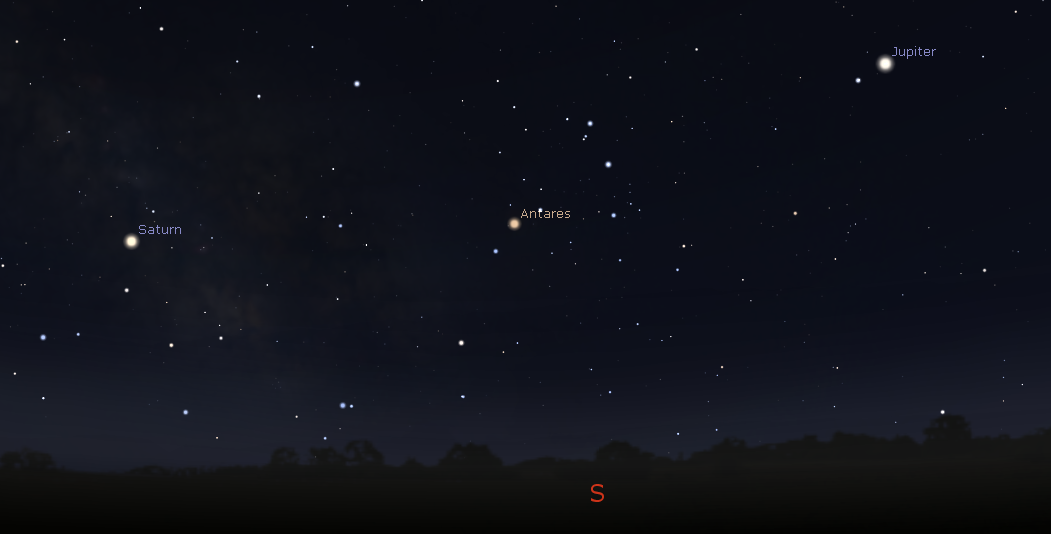
Antares finder chart for 11 p.m., July 3, 2018. Created using Stellarium.

