12/29/2014 – Ephemeris – More events from 2014
Ephemeris for Monday, December 29th. The sun will rise at 8:19. It’ll be up for 8 hours and 51 minutes, setting at 5:10. The moon, 1 day past first quarter, will set at 2:32 tomorrow morning.
2014 has been a year of eclipses for northern Michigan. A total lunar eclipse on the morning of April 15th, another on the morning of October 8th. Plus we had a partial solar eclipse at sunset on October 23rd. All of them were hampered by clouds, for this observer. One of the cool events of this year was the close approach of Comet Siding Spring with Mars. The five functioning orbiters and two rovers were not able to get any spectacular pictures of the comet, but there was one heck of a meteor shower on Mars when the planet was closest to the comet’s path. None of the satellites could see it because they were hiding behind the planet at the time. But later the martian atmosphere was filled with the chemical signatures of the meteors.
Times are for the Traverse City/Interlochen area of Michigan. They may be different for your location.
Addendum
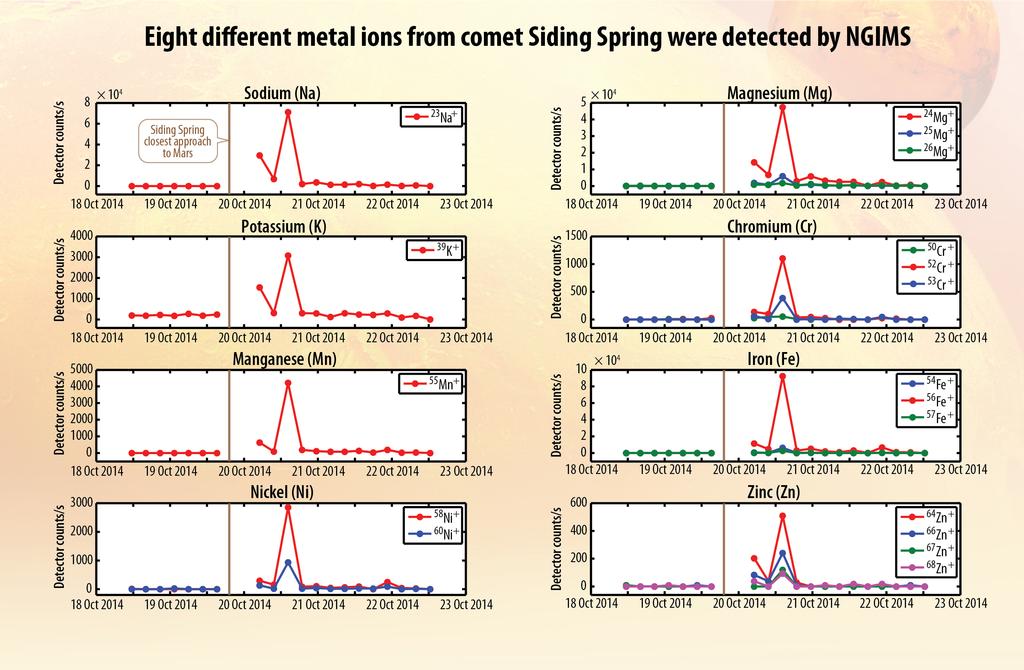
Metals in the atmosphere of Mars before and after the passage of Comet Siding Spring by Mars measured by the MAVEN spacecraft. Credit NASA.
12/26/2014 – Ephemeris – Tragedies and triumphs of 2014
Ephemeris for Friday, December 26th. The sun will rise at 8:18. It’ll be up for 8 hours and 49 minutes, setting at 5:08. The moon, 2 days before first quarter, will set at 11:02 this evening.
2014 was a year of personal tragedy and also tragedy and triumph in space. The Space tragedies came in October with the destruction and loss of Orbital Science’s third supply mission to the International Space Station when the their Antares rocket blew up right after launch. A few days later Virgin Galactic’s SpaceShipTwo disintegrated on a test flight killing a pilot. In the Triumph department the European Space Agency’s Rosetta caught up and orbited its comet 67P, for short, in August and bounced down its lander Philae in November. It wasn’t supposed to bounce, but stick the landing. Bruised and battered Philae delivered its science before its batteries died. And this month an unmanned Orion capsule made its maiden voyage into space.
Times are for the Traverse City/Interlochen area of Michigan. They may be different for your location.
Addendum

Orbital Sciences Antares rocket explodes seconds after liftoff on October 28, 2014. Credit NASA.
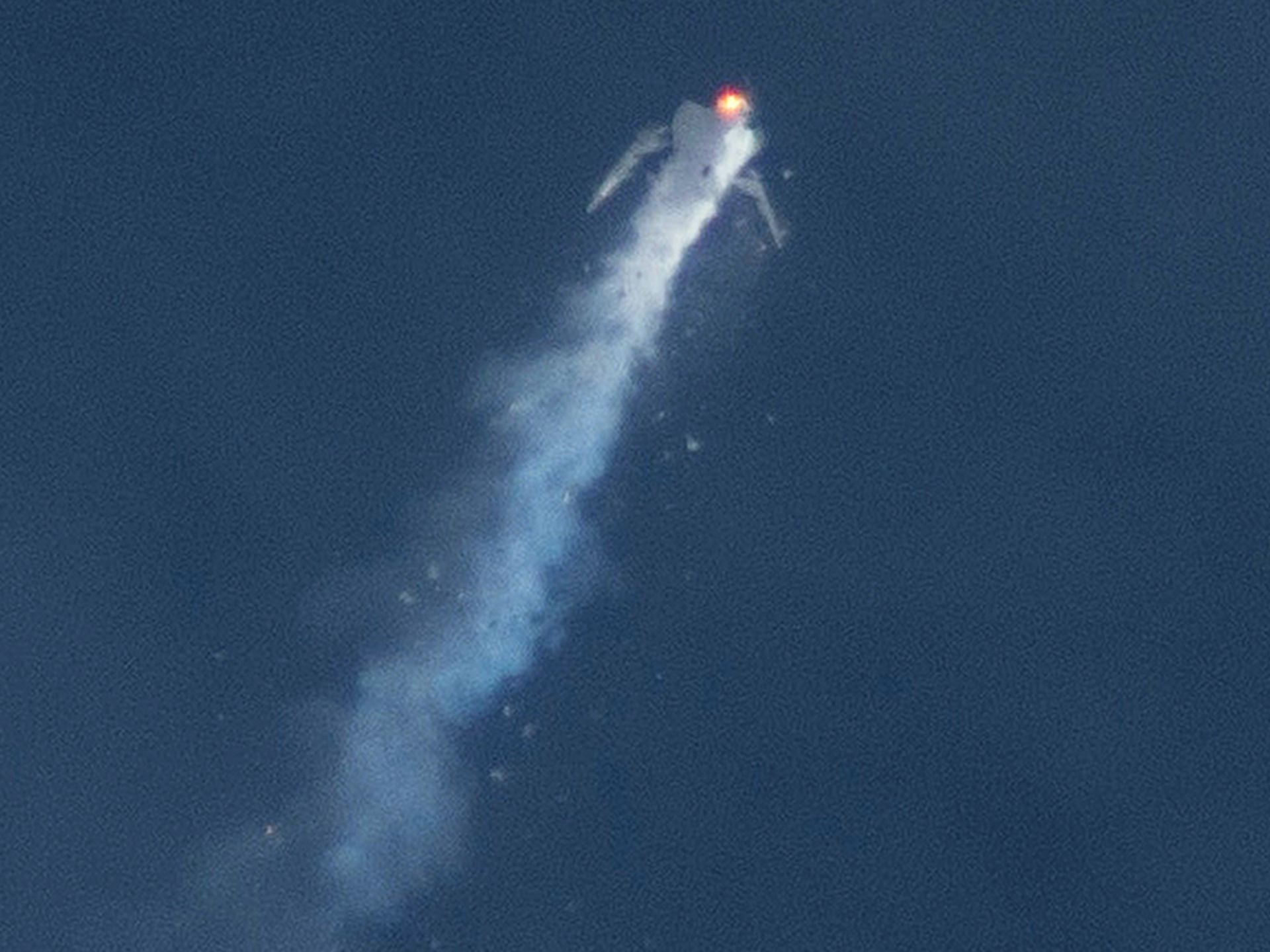
SpaceShipTwo disintegrates October 31, 2014 killing a pilot. Credit USA Today.
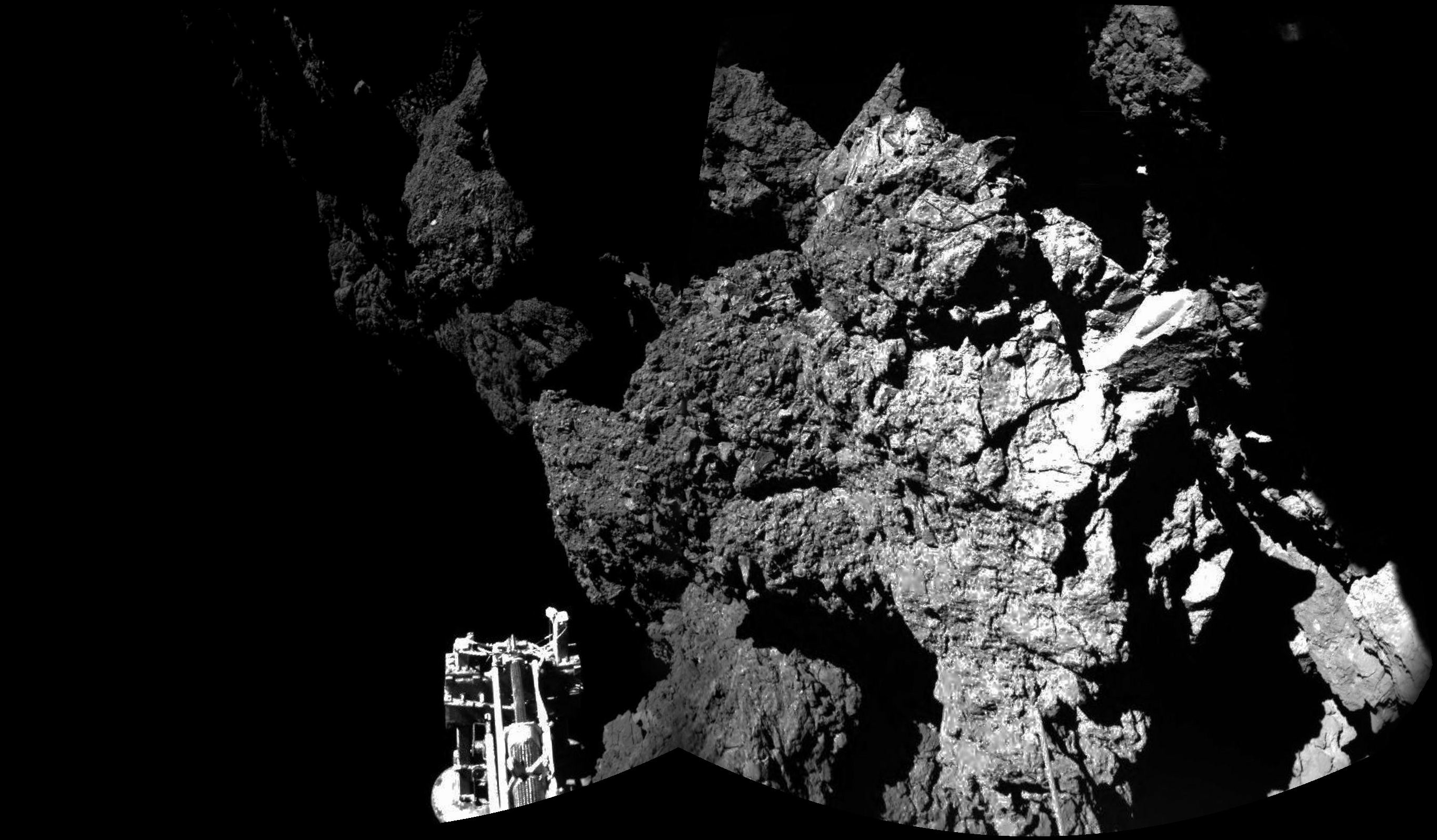
After a second bounce on the Comet 67P the Philae lander ended up sideways apparently on the base of a cliff. Researchers were able to get data from just about all the instruments before the battery discharged. The team hopes and the comet gets closer to the sun and the sun angle changes they can revive Philae. Credit: ESA.
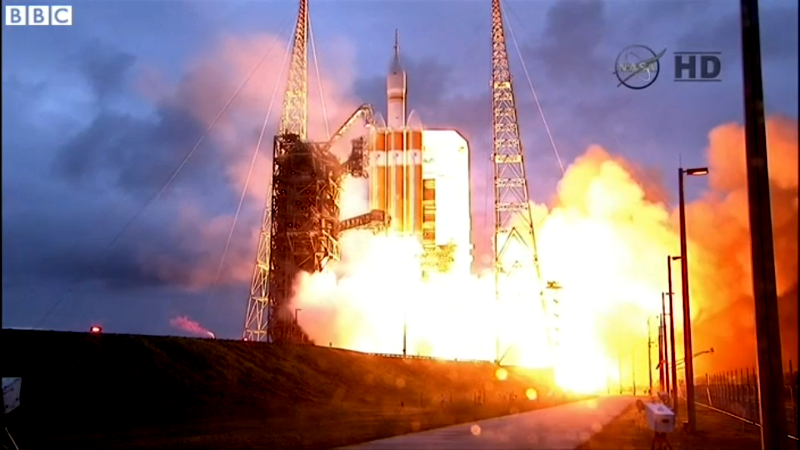
Screen capture of Delta IV Heavy rocket liftoff carrying the Orion test article into orbit on December 4, 2014. Credit .NASA via BBC
Ride back to the earth with Orion via a camera mounted in a window. The window is facing aft as the capsule re-enters the atmosphere heat shield first at 20,000 miles per hour. You’ll experience everything except the G forces. It comes with appropriate spacey music. It’s as close as I’ll ever get to ride in one of these things.
12/25/2014 – Ephemeris – My recollections of spotting the Southern Cross for the first time.
Merry Christmas. This is Ephemeris for Christmas Day, Thursday, December 25th. The sun will rise at 8:17. It’ll be up for 8 hours and 49 minutes, setting at 5:07. The moon, 3 days before first quarter, will set at 9:50 this evening.
My one and only sighting of the constellation the Southern Cross came two and a half years ago from a cruise ship traveling between the Hawaiian island of Maui and Hilo on the Big Island. I had plotted it out before the trip. Our ship would be traveling in a south-southeasterly direction and at 3 a.m., the Southern Cross would be low above the southern horizon from our latitude which I surmised would be about 20 degrees north. The southern cross would be visible from the bow of the ship. The only really dark location to view it was on Deck 14 with an unobstructed view with some subdued lights behind me. I easily found it, and verified it with the fifth star of the cross. Nearby was Alpha Centauri the closest star to the sun.
Times are for the Traverse City/Interlochen area of Michigan. They may be different for your location.
Addendum
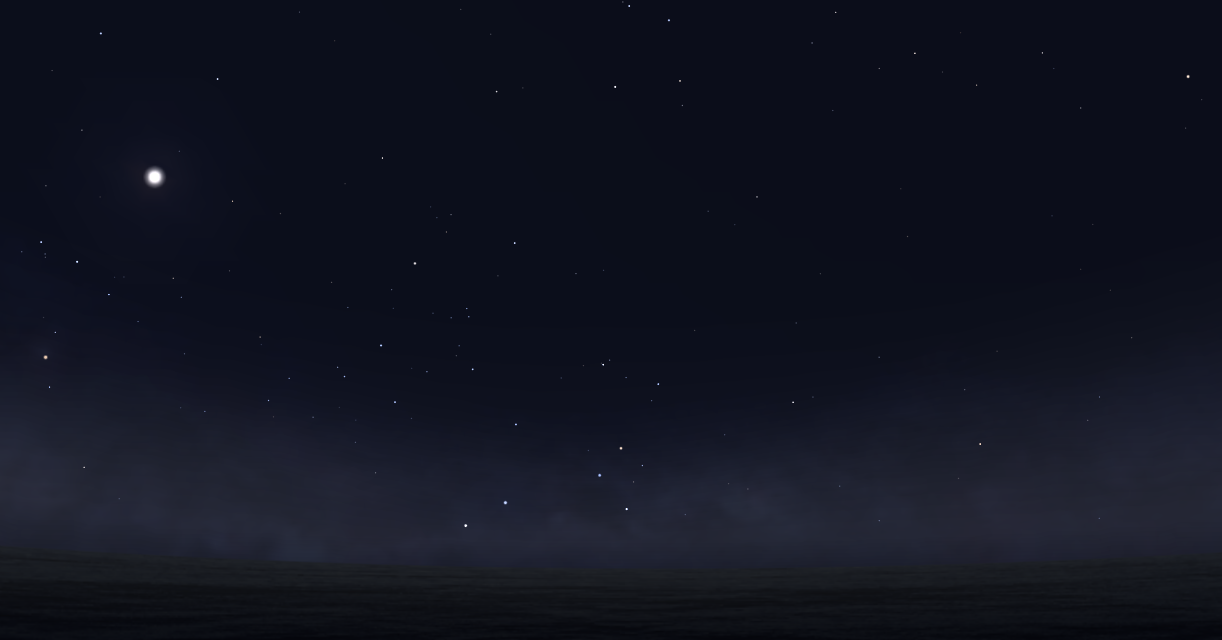
The approximate sky that I saw from the bow of the ship at 3:15 a.m. HST February 14, 2012. The moon was a slight gibbous phase. Recreated using Stellarium.
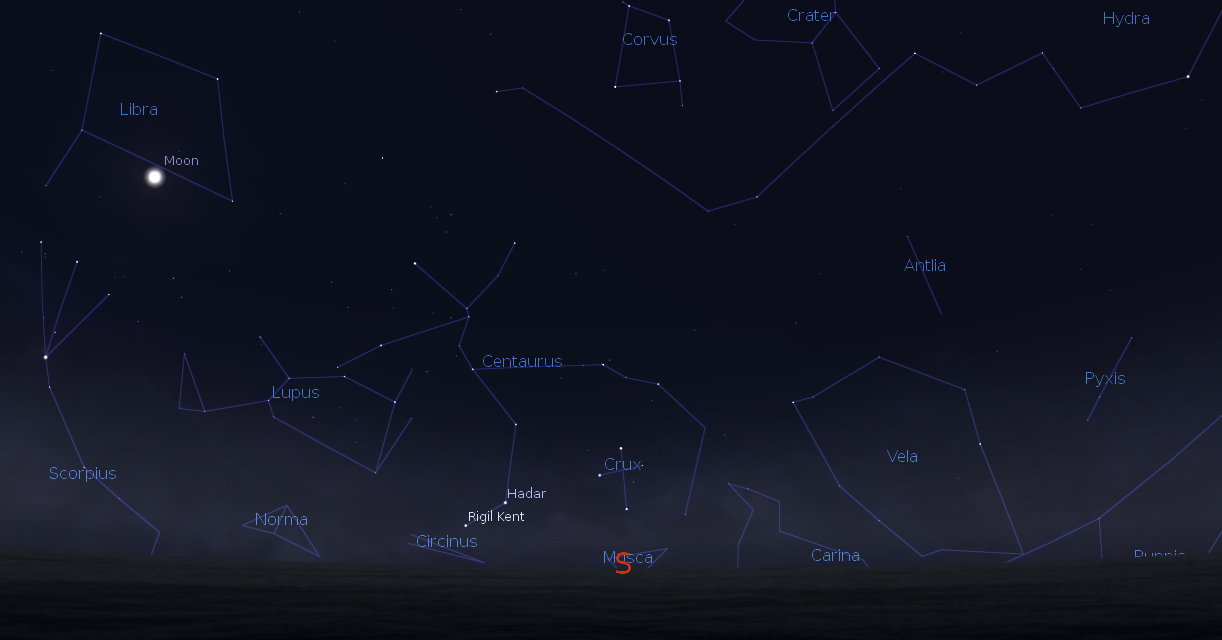
The approximate sky that I saw from the bow of the ship at 3:15 a.m. HST February 14, 2012, annotated. The moon was a slight gibbous phase. Recreated using Stellarium.
Note that the star named Rigil Kent is truncated. It’s Rigil Kentaurus, better known by its catalog name Alpha Centauri. The fifth star of the cross, my check star, is on the right side of the cross, just below the crosspiece. The Southern Cross’s real name is Crux, which simply means cross. The Northern Cross is not an official constellation. It’s part of Cygnus the swan.
I’ve heard folks say the Beta Centauri is Alpha Centauri’s companion star. That is not true. Beta Centauri is Hadar, seen near Alpha in the sky, but is much farther away. There are three stars in the Alpha Centauri system: Alpha Centauri A, Alpha Centauri B, and Proxima Centauri, a telescopic red dwarf, a bit away from the other two. Alpha Centauri A & B are a wide double, visible in a telescope. I saw and photographed them when on Key Largo in April 1986 for Halley’s Comet’s closest approach to the Earth. Note it wasn’t all that close, some 40 million miles, and it had a tail disconnection that week. Bummer.
Stupid Internet posts: No, gravity won’t be canceled January 4th.
Looks like the hoaxsters are at it again. Seems someone dusted off Sir. Patrick Moore’s April Fool’s joke from long ago and dressed it up as a phony NASA tweet and sent it out 9 days ago. Supposedly on January 4th, 2015 an alignment of Jupiter and Pluto will cancel gravity on the Earth for a few minutes that day. Both Newton and Einstein would be ticked off at that. Neither of their theories of gravity would predict anything so stupid. Besides Jupiter and Pluto are at nearly opposite parts of the sky. They don’t align with anything.
Don’t take my word for it as a lowly amateur astronomer. Check out the (A real astrophysics PhD) Bad Astronomer Phil Plait’s post: http://www.slate.com/blogs/bad_astronomy/2014/12/24/zero_g_day_nope.html.
Here’s a post from EarthSky with the same sentiments.
However January 4th, 2014 is special. It’s Perihelion Day, the day of the year the Earth is closest to the Sun. So break out the sunscreen, especially if you live in the southern hemisphere, where it’s summer now. The biggest effect we’ll see is that winter is the shortest season for us by a couple of days compared to summer, the longest season. The Earth moves its fastest in it’s orbit of the Sun at perihelion.
12/24/2014 – Ephemeris – Twas the night before Christmas and only the planets and a comet were stirring
Ephemeris for Christmas Eve, Wednesday, December 24th. The sun will rise at 8:17. It’ll be up for 8 hours and 49 minutes, setting at 5:06. The moon, 3 days past new, will set at 8:37 this evening.
Twas the night before Christmas and only the planets were stirring. Venus is low in the southwest shortly after sunset. It now sets at 6:09 p.m., 63 minutes after the sun. It will be tough to spot at all. New Year’s Eve might be a good time to start to see it. Mars, low in the southwest at 7 p.m. has the Moon just to the right of it tonight. Mars will set tonight at 8:34 p.m. Jupiter, which will be our Christmas Star this year will rise in the east at 8:59 p.m. It’s near the sickle shaped head of Leo. Jupiter is now moving slowly westward. This is an effect that happens because the Earth is passing Jupiter, a motion shared by all the planets that baffled the ancients who thought the Earth to be motionless. Saturn will rise in the east-southeast at 5:34 a.m.
Times are for the Traverse City/Interlochen area of Michigan. They may be different for your location.
Addenda
The Planets tonight
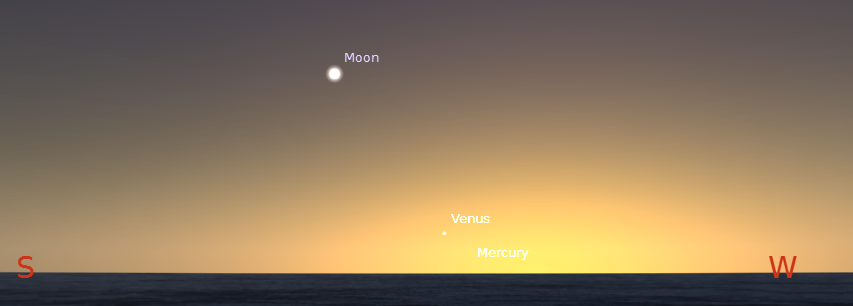
Venus low on the horizon, and the Moon, at 5 30 p.m. on December 24, 2014. Created using Stellarium.
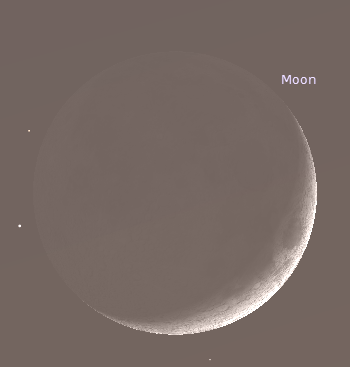
The crescent Moon through binoculars, at 5 30 p.m. on December 24, 2014. Created using Stellarium.
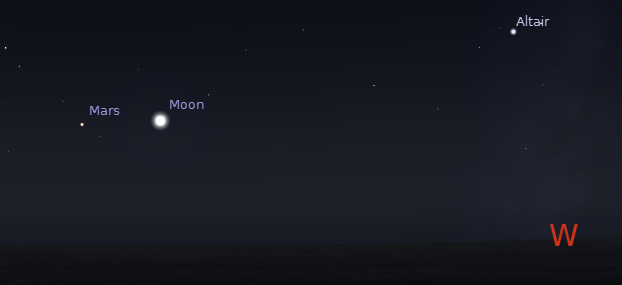
Mars and the Moon at 7:30 p.m. on December 24, 2014. Created using Stellarium.
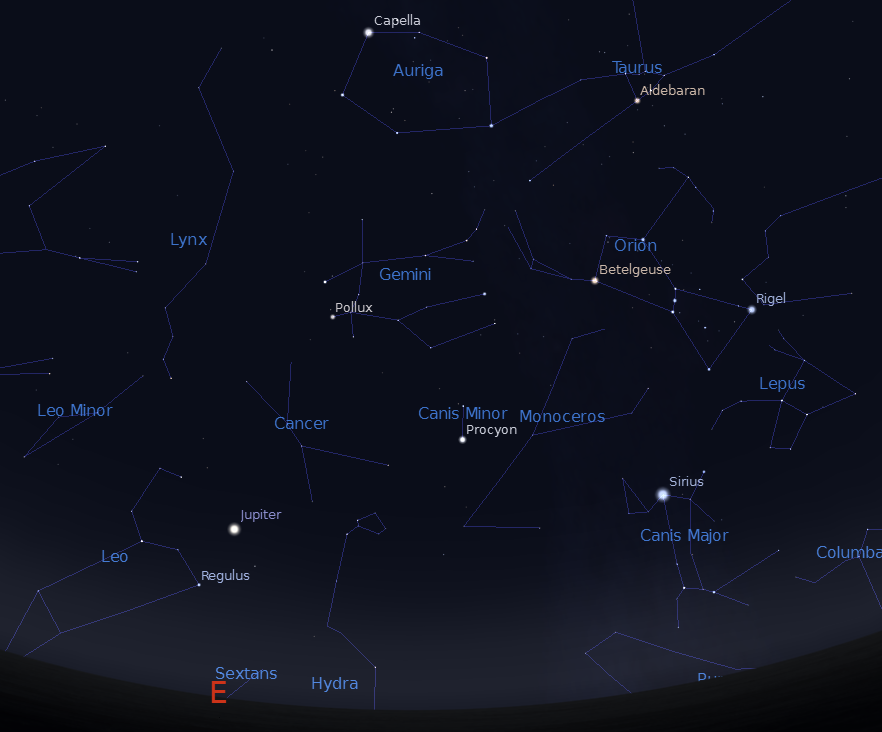
Jupiter and the winter constellations at 11 p.m. on December 24, 2014. Created using Stellarium.
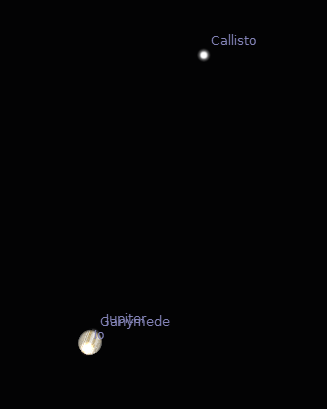
Jupiter with three hidden satellites, with only Callisto showing at 11 p.m. on December 24, 2014. See blow by blow of the satellite disappearances below. Created using Stellarium.
Jovian satellite events of the night of December 24-25, 2014
Ganymede starts eclipse (enters Jupiter’s shadow) 6:20 p.m.
Europa starts eclipse 8:27p.m.
Io’s shadow starts crossing Jupiter 9:32 p.m.
Ganymede leaves Jupiter’s shadow 10:00 p.m.
Ganymede starts being occulted by Jupiter 10:11 p.m.
Io’s transit across the face of Jupiter starts 10:29 p.m.
Io’s shadow leaves the face of Jupiter 11:50 p.m.
Io’s transit of Jupiter ends 12:46 a.m.
Europa’s occultation by Jupiter ends 1:10 a.m.
Ganymede’s occultation by Jupiter ends 1:50 a.m.
Note that Europa’s occultation by Jupiter starts before its eclipse ends, so unlike the more distant Ganymede there isn’t an interval of visibility between the two.
Jovian satellite event timings provided by Project Pluto www.projectpluto.com
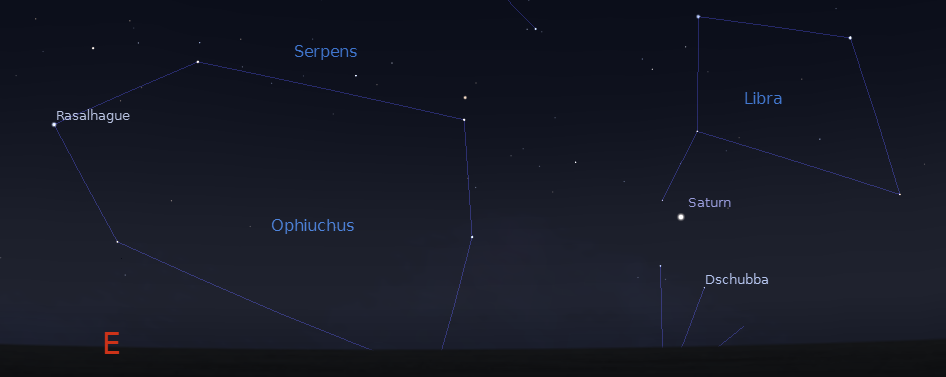
Saturn low in the east-southeast among the constellations of late spring and early summer at 6:30 a.m. on Christmas morning 2014 . Created using Stellarium.
Comet C/2014 Q2 (Lovejoy)
Normally my Ephemeris program deals with celestial objects that are visible to the naked eye. While Comet Lovejoy will, for a few weeks become brighter than 6th magnitude the normal limit for the unaided human eye, a comet is a diffuse object and always looks dimmer than a star of the same magnitude. This comet was discovered August 17, 2014 by Australian amateur astronomer Terry Lovejoy. He has discovered 5 comets. His most famous find was C/2011 W3 (Lovejoy) that buzzed the Sun and survived becoming a magnificent comet for southern hemisphere observers.
Recently Comet Lovejoy became brighter than expected. The data for the charts below are from Minor Planet Center and do not include new brightness estimates that include the outburst. They have the comet reaching magnitude 4.9. The aerith.net website gives the maximum brightness next month of 4. (Magnitudes are like golf scores the lower the magnitude the brighter the object). Each magnitude step is a brightness difference of about 2 and a half times. To check on the comet go to http://www.aerith.net/comet/weekly/current.html. Currently Comet Lovejoy is the brightest comet now visible and is the first comet on the list. Clicking on the comet ‘s name will give you the comet’s page. The last chart on the page is a chart tracking the comet’s brightness from reports vs. prediction. That chart predicts a magnitude of 4 just after the first of the year.
Photographs of the comet show a gaseous coma (head) and a very faint ion tail, which may not be visible visually in binoculars and telescopes. Right now the comet is highest around midnight.
The finder charts below designate the comet by month-day and the predicted magnitude
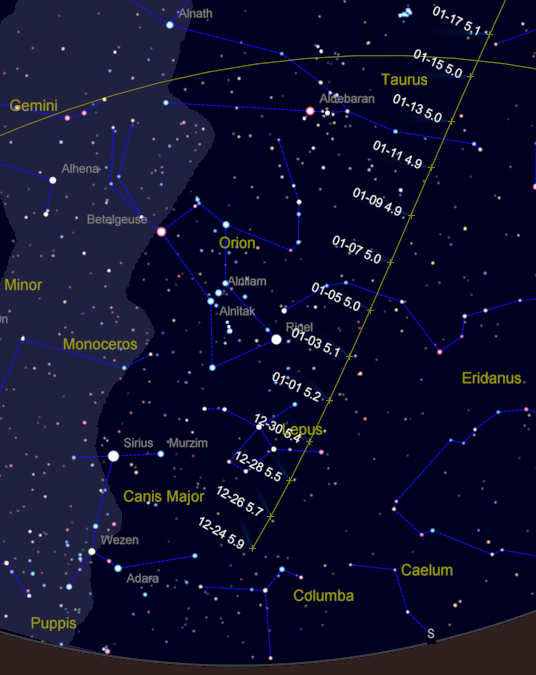
Comet C/2014 Q2 (Lovejoy) at 11 p.m. at 2 day intervals from tonight 12/24/2014 to 1/17/2015. Created using Cartes du Ceil (Sky Charts).
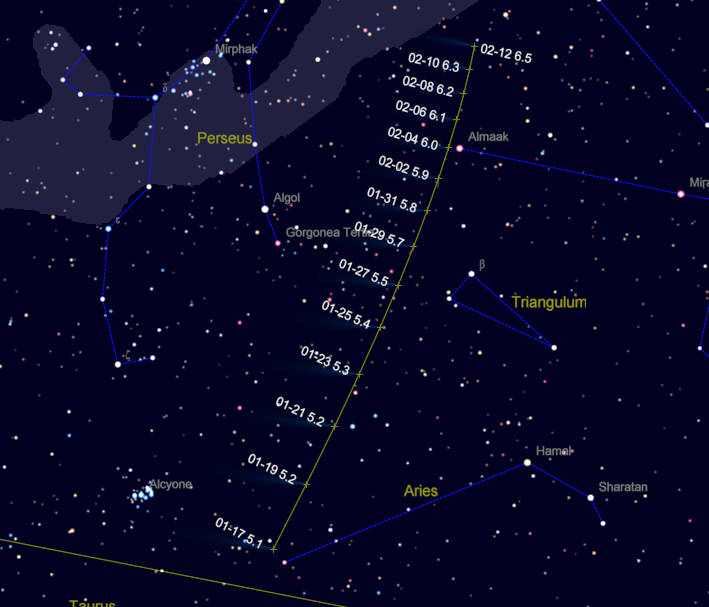
Comet C/2014 Q2 (Lovejoy) at 8 p.m. at 2 day intervals from tonight 1/17/2015 to 2/12/2015. Created using Cartes du Ceil (Sky Charts).
On December 28th Comet Lovejoy will appear to pass the globular cluster M79.
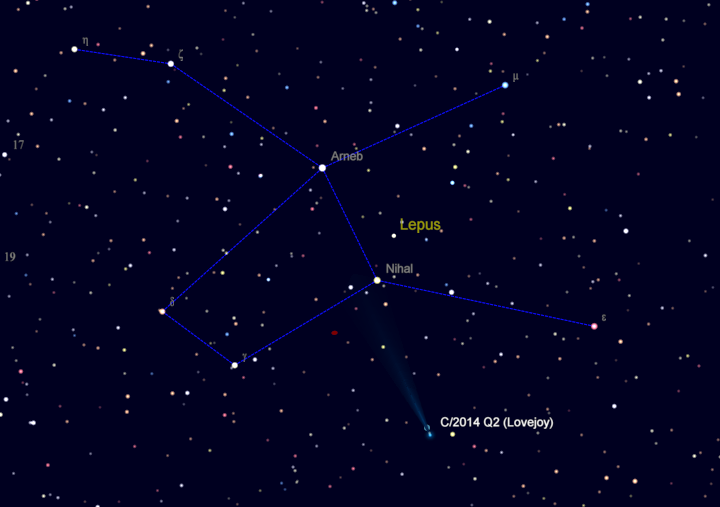
Comet Lovejoy and M79 a distant globular star cluster, in the constellation of Lepus the hare, will appear together at 11 p.m. December 28th, 2014. Note the that M79 is the unlabeled blue dot in the tail of the comet, next to the head. Created using Cartes du Ceil (Sky Charts).
12/23/2014 – Ephemeris – Is the constellation of Cetus a whale or a sea monster?
Ephemeris for Tuesday, December 23rd. The sun will rise at 8:17. It’ll be up for 8 hours and 49 minutes, setting at 5:06. The moon, 2 days past new, will set at 7:25 this evening.
The identity of the constellation Cetus is a bit mixed up. Officially it’s a whale, but in the story of the constellations above it, (Cassiopeia, Pegasus, Andromeda, Perseus and Cepheus) it is the monster sent to ravage the Ethiopian coast, and to whom the sacrifice of Andromeda was to stop. Either can be seen in the stars in the south at 8 p.m. It is a large constellation of dim stars below and left of the Great Square of Pegasus and Pisces. The whale can be seen diving, its tail of 5 stars in a squished pentagon, is seen to the upper left. If you see the stars differently and put the head of the sea monster where the tail of whale is the dreaded Cetus of the story appears. One of its stars is variable and will not be visible without a telescope, it’s Mira, the wonderful.
Times are for the Traverse City/Interlochen area of Michigan. They may be different for your location.
Addendum
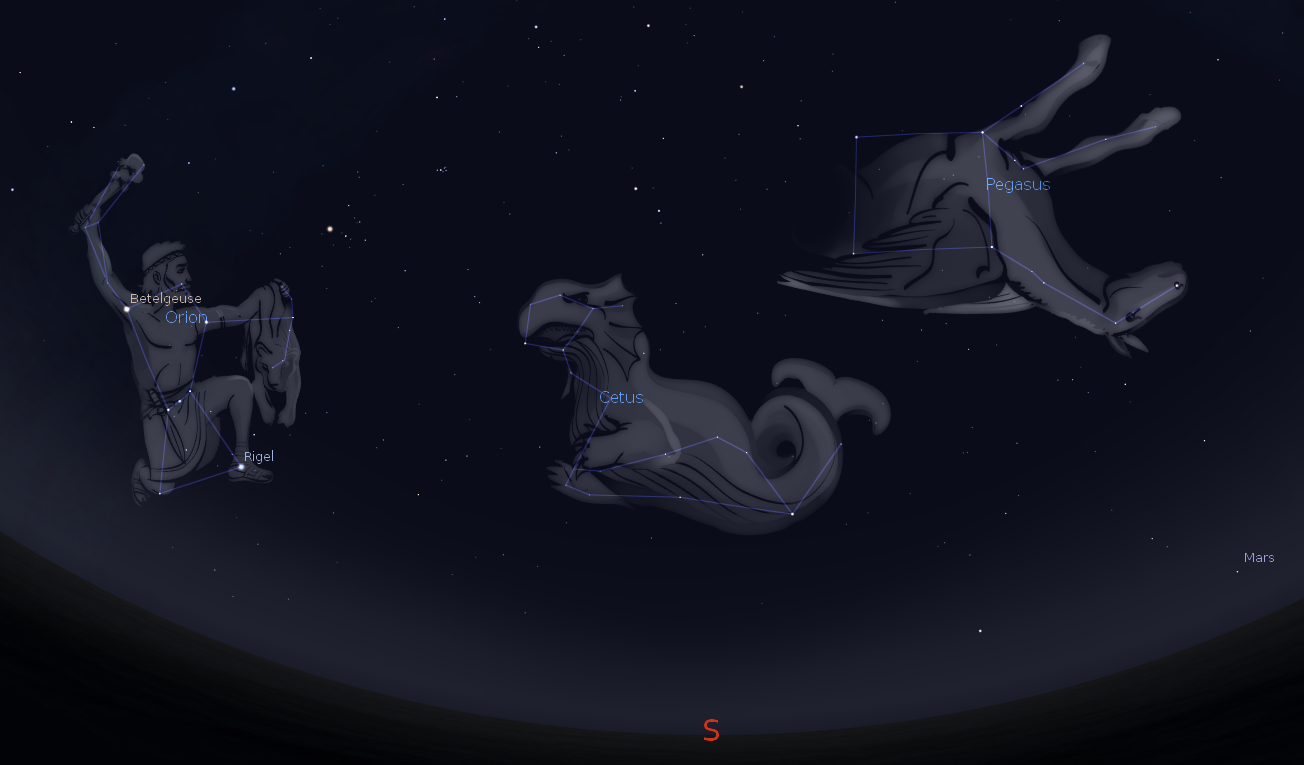
Cetus with Pegasus and Orion displaying mythological images at 8 p.m. on December 23, 2014. Created using Stellarium.
12/22/2014 – Ephemeris Extra – New broadcast time on IPR News Radio
As of December 1st National Public Radio has changed the format for their morning news program Morning Edition. As a result Interlochen Public Radio has moved my Ephemeris program to around 6:49 a.m., a half hour later.
Here’s the current schedule
Ephemeris Radio Schedule Monday – Friday
Ephemeris air times (ET)
6:49 a.m. – News stations (New as of December 1, 2104)
6:59 a.m.- Classical stations
The Stations of Interlochen Public Radio
Classical:
WIAA 88.7 FM Interlochen
94.7 FM Traverse City
WIAB 88.5 FM Mackinaw City
WICV 100.9 FM East Jordan, Charlevoix
News:
WICA 91.5, FM Traverse City
WLNM 89.7 FM Manistee
WHBP 90.1 FM Harbor Springs, Petoskey
There’s another local program on astronomy on the News stations. It’s a 2 minute weekly program on about 6:30 a.m. Mondays. It’s producer is Mary Stewart Adams, Program Director Headlands International Dark Sky Park, near Mackinaw City, MI. She tends more toward folklore than science which is fun and entertaining. On her Linked In page she lists herself as an Astrosopher/Program Director Headlands Internat’l Dark Sky Park. Near as I could find out astrosophy is a kind of new age astrology. Astronomy broke the link to astrology some 400 years ago. So as long as the program doesn’t drift into astrology, or astrosophy as being real. I’ll enjoy the program.
12/22/2014 – Ephemeris – Roman solstice festivals that seem like our holiday season
Ephemeris for Monday, December 22nd. The sun will rise at 8:16. It’ll be up for 8 hours and 48 minutes, setting at 5:05. The moon, 1 day past new, will set at 6:17 this evening.
The Romans, around the time of Christ knew that the Sun would turn northward after the winter solstice. Their ancestors may not have been. They had two festivals around this time of year. Saturnalia, from the 17th to the 23rd. A time of gift giving, parties, kind of like now. The feast of Sol Invictus or the Unconquerable Sun was set on December 25th the then date to have thought to be the winter solstice. I’m not sure if the Roman calendars were off 4 days or that it was the date they detected northward movement in the Sun. Anyway that’s the date the Christians decided to celebrate Christ’s birth. The Gospel of Luke with its shepherds being out all night guarding the sheep suggests that the birth was actually in the spring.
Times are for the Traverse City/Interlochen area of Michigan. They may be different for your location.
Addendum
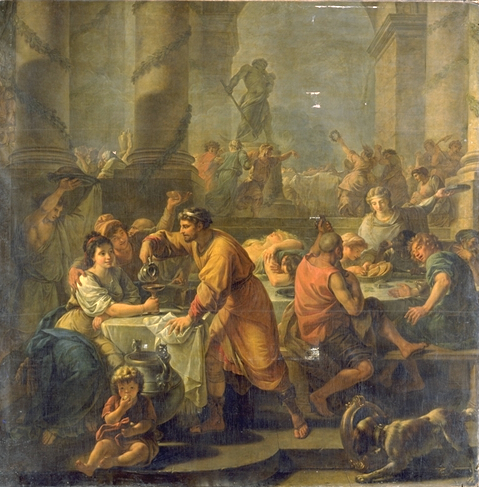
Saturnalia depiction.
Here’s your chance to name some craters on Mercury
Here’s a message from Heather Weir at NASA’s Goddard Space Center:
“TO HONOR THE ASTOUNDING ACHIEVEMENTS OF THE MESSENGER MISSION, THERE WILL BE AN INTERNATIONAL COMPETITION TO NAME A CRATER ON MERCURY!
“OPENS DECEMBER 15, 2014 (00:00 UTC) CLOSES JANUARY 15, 2015 (11:59 UTC)
“The MESSENGER Team is seeking help from all Earthlings to suggest names for five impact craters on Mercury. This is a chance to immortalize an important person in the Arts and Humanities from any nation or cultural group by having a crater on the planet Mercury named in their honor! We will accept submissions beginning midnight (00:00 UTC) December 15, 2014 until January 15, 2015 (23:59 UTC). All entries will be reviewed by Team representatives and expert panels. Then, 15 finalist names will be submitted to the International Astronomical Union (IAU) for selection of the 5 winners. Winning submissions will be announced by the IAU to coincide with MESSENGER’s End of Mission Operations in late March/April 2015. Full details are available on the MESSENGER web site http://namecraters.carnegiescience.edu/.”
As the MESSENGER mission to orbit and study the solar system’s innermost planet Mercury is coming to an end when the spacecraft runs out of fuel in a few more months, the MESSENGER team has selected five small but important craters that need names.
The link above will provide all the information needed to enter including rules, pictures, descriptions of the craters to be named and a list of craters already named.
The official naming rules for craters are these: “Deceased artists, musicians, painters, and authors who have made outstanding or fundamental contributions to their field and have been recognized as art historically significant figures for more than 50 years.”
Tip of the old astronomer’s observing cap to the NASA/JPL Solar System Ambassadors.Program.
12/19/2014 – Ephemeris – Winter starts on Sunday
Ephemeris for Friday, December 19th. The sun will rise at 8:15. It’ll be up for 8 hours and 49 minutes, setting at 5:04. The moon, 2 days before new, will rise at 6:27 tomorrow morning.
It’s looking like November and December should trade places in the calendar this year. And whatever the prognosis for a white Christmas this year winter will arrive on time at 6:03 p.m. Sunday the 21st. At that moment the Sun will hover over the Tropic of Capricorn before slowly beginning its journey northward. It is the winter of December solstice. In the sky the Sun will be moving about its fastest eastward near the border between Ophiuchus and Sagittarius along the great circle in the sky called the ecliptic that will bring it northward. The Sun’s motion will slowly bring longer daylight hours and a higher altitude that will counteract the cold generated in the last month or so, and will start to warm the northern hemisphere up again.
Times are for the Traverse City/Interlochen area of Michigan. They may be different for your location.
Addendum
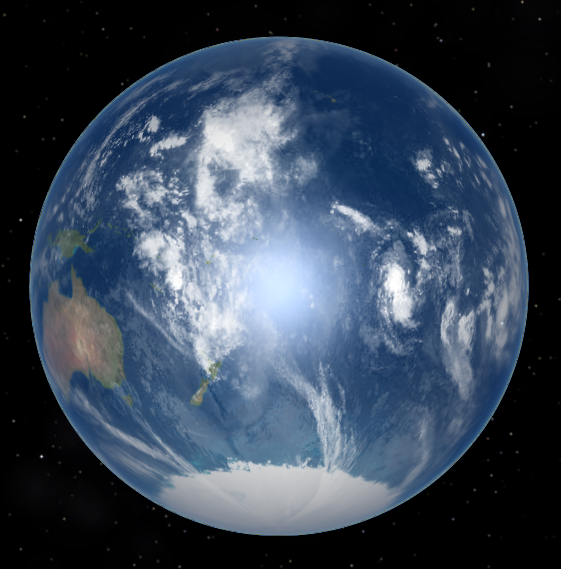
The Earth as seen from the direction of the Sun at 6:03 p.m. EST (23:03 UT) December 21, 2014. The sun would be overhead at 23.5 degrees south latitude in the South Pacific. Created using Celestia.

