11/20/2014 – Ephemeris – Constellation rotation from rise to set
Ephemeris for Thursday, November 20th. The sun will rise at 7:45. It’ll be up for 9 hours and 24 minutes, setting at 5:10. The moon, 2 days before new, will rise at 6:38 tomorrow morning.
At 9 p.m., if it’s clear tonight look to the east to see the bright winter constellation Orion the hunter mostly risen over the eastern horizon as Robert Frost told in his poem Star-Splitter. Orion’s throwing a leg up over the horizon, climbing into the sky. The three stars of Orion’s belt are nearly vertical as the mighty hunter rises. When in the spring he sets those stars will be horizontal. The same is true on the two namesake stars of the twins of Gemini Castor and Pollux to Orion’s left rising in then east-northeast. They rise vertically aligned and set horizontally. It’s due to our latitude and the fact that these stars are near the equator of the sky. At the poles the stars don’t change attitude, and don’t rise or set. Here they flip about 90 degrees, and at the equator they do a 180. Interesting.
Times are for the Traverse City/Interlochen area of Michigan. They may be different for your location.
Addendum
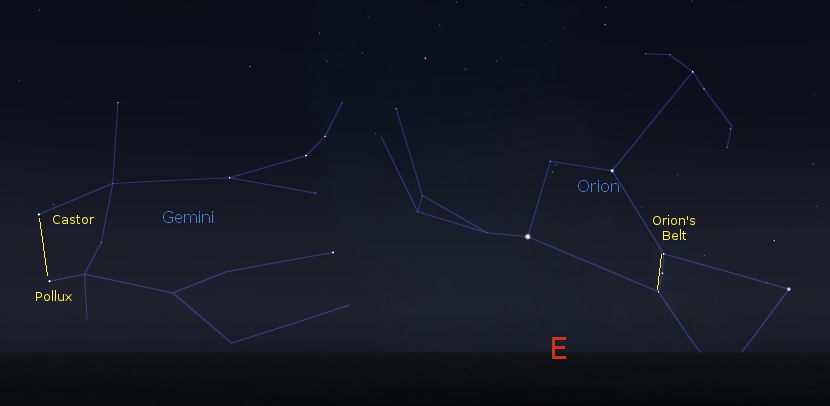
Orion rising at 9 p.m. on November 20, 2014. Note that Orion’s Belt stars and Gemini’s namesake stars are nearly vertically aligned. Created using Stellarium.
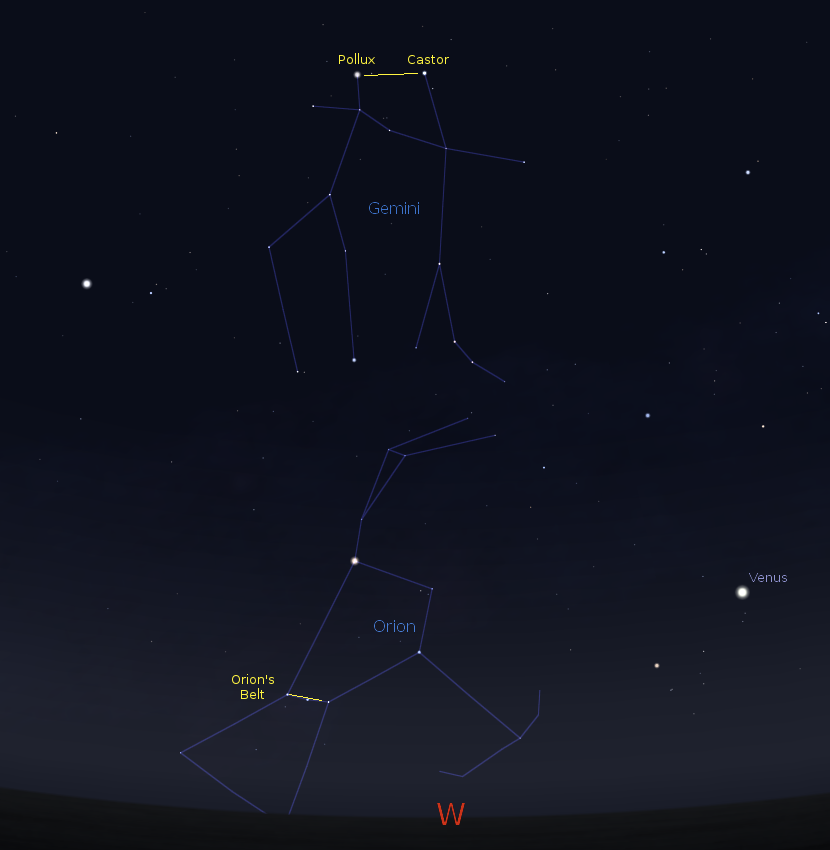
Orion setting near the end of twilight in April 2015. Note that Orion’s Belt stars and Gemini’s namesake stars are now nearly horizontally aligned. Created using Stellarium.
11/19/2014 – Ephemeris – Where did all the bright planets go?
Ephemeris for Wednesday, November 19th. The sun will rise at 7:44. It’ll be up for 9 hours and 26 minutes, setting at 5:10. The moon, 3 days before new, will rise at 5:34 tomorrow morning.
In reviewing which planets are visible tonight, it looks like we’re down to two. Venus, Saturn and Mercury are hanging around near the direction of the Sun. It will be a while before we see them again. However we can see Mars, which will be low in the southwest at 7 p.m. It will set at 8:29 p.m. Jupiter will rise at 11:20 p.m. in the east-northeast. The best telescopic views will have to wait a couple of hours after that. So if you’re more of an early bird rather than a night owl it might be better to view Jupiter with a telescope in the morning. Jupiter has those four bright moons that change position daily, and sometimes while you watch if they appear close enough to each other. On the planet are cloud bands and the elusive Great Red Spot.
Times are for the Traverse City/Interlochen area of Michigan. They may be different for your location.
Addendum
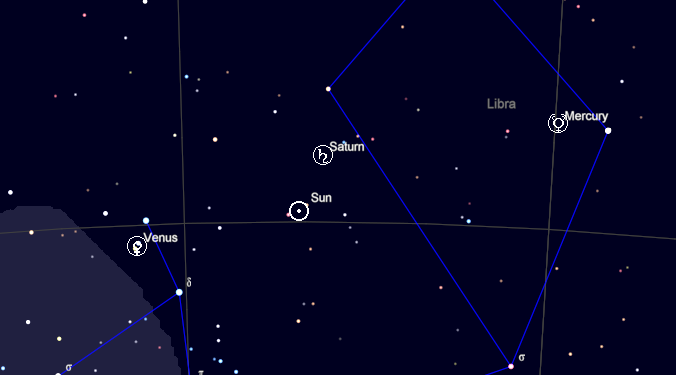
Mercury, Saturn and Venus appear near the Sun near sunset at 5 p.m. on November 19, 2014. Displayed planets as their symbols. Created using Cartes du Ciel (Sky Charts).
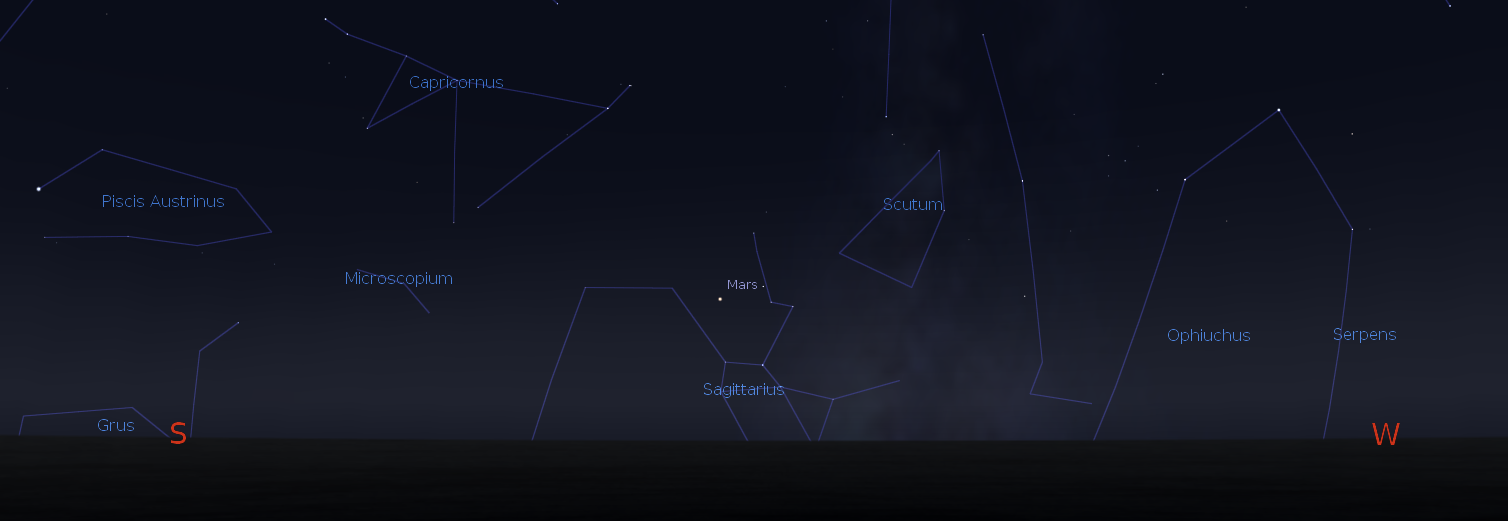
Mars and the setting summer constellations at 7 p.m. on November 19, 2014. Created using Stellarium.
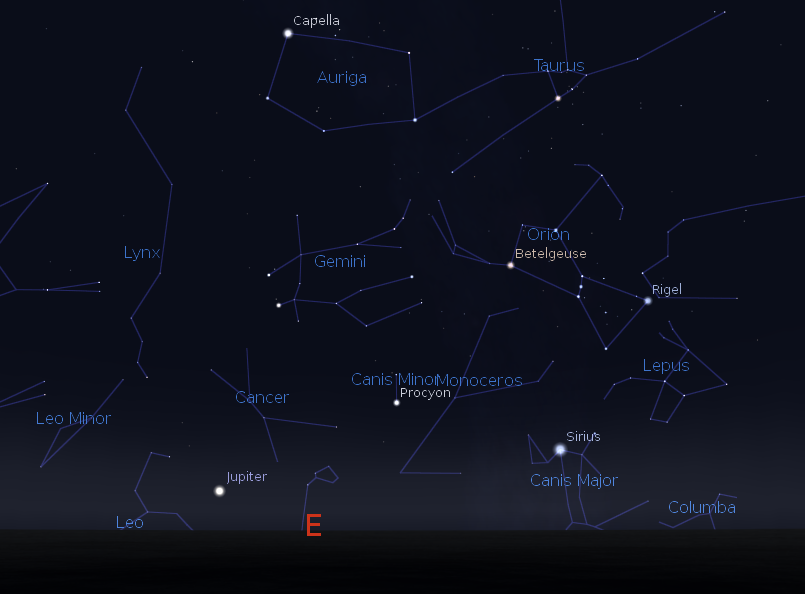
Jupiter and the rising winter constellations at midnight November 20, 2014. Created using Stellarium.
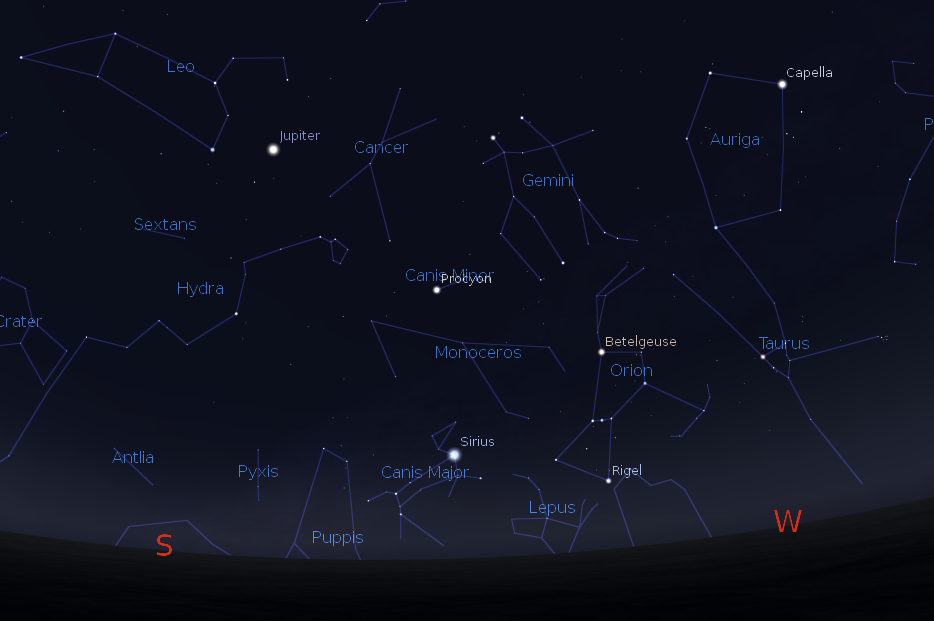
Jupiter with winter and spring constellations at 6:30 a.m. on November 20, 2014. Created using Stellarium.
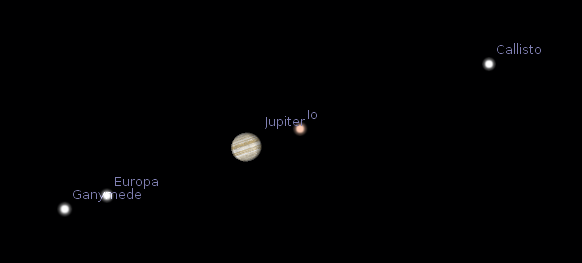
Jupiter and moons through a telescope at 6:30 a.m. on November 20, 2014. Created using Stellarium.
11/18/2014 – Ephemeris – Rosetta, Philae with Comet 67P and Maven’s discovery of the effects of it’s comet encounter
Ephemeris for Tuesday, November 18th. The sun will rise at 7:43. It’ll be up for 9 hours and 28 minutes, setting at 5:11. The moon, half way from last quarter to new, will rise at 4:31 tomorrow morning.
Last week the Philae lander bounced down on Comet 67P/Churyumov-Gerasimenko, its harpoons not able to fire to hold the lander down. “Where is Captain Ahab when you need him?” I Twittered at the time. We were lucky it didn’t bounce off the comet entirely. It ended against a cliff and in a shadow, so it couldn’t recharge its batteries from sunlight. The ESA controllers had it perform all its possible experiments quickly before its batteries died. Philae was still an amazing success. News from last month’s encounter Mars encounter with Comet Siding Spring. The Maven satellite detected the aftermath of a great martian meteor shower when it peaked around the planet from where it was hiding.
Times are for the Traverse City/Interlochen area of Michigan. They may be different for your location.
Addendum
Philae
If I’m understanding the spacecraft controllers at the European Space Agency (ESA) correctly Philae was launched toward the comet with a velocity of something like .7 meters per second (m/s). It would have accelerated to 1 m/s by the time it hit the comet. So it was pushed into the comet at more than the comet’s escape velocity. One meter per second is only 2.2 miles per hour. So to bounce and not escape the comet either the lander, the surface of the comet or both would have to have a lot of give to it. On this comet one could jump faster than escape velocity and go floating off into space.
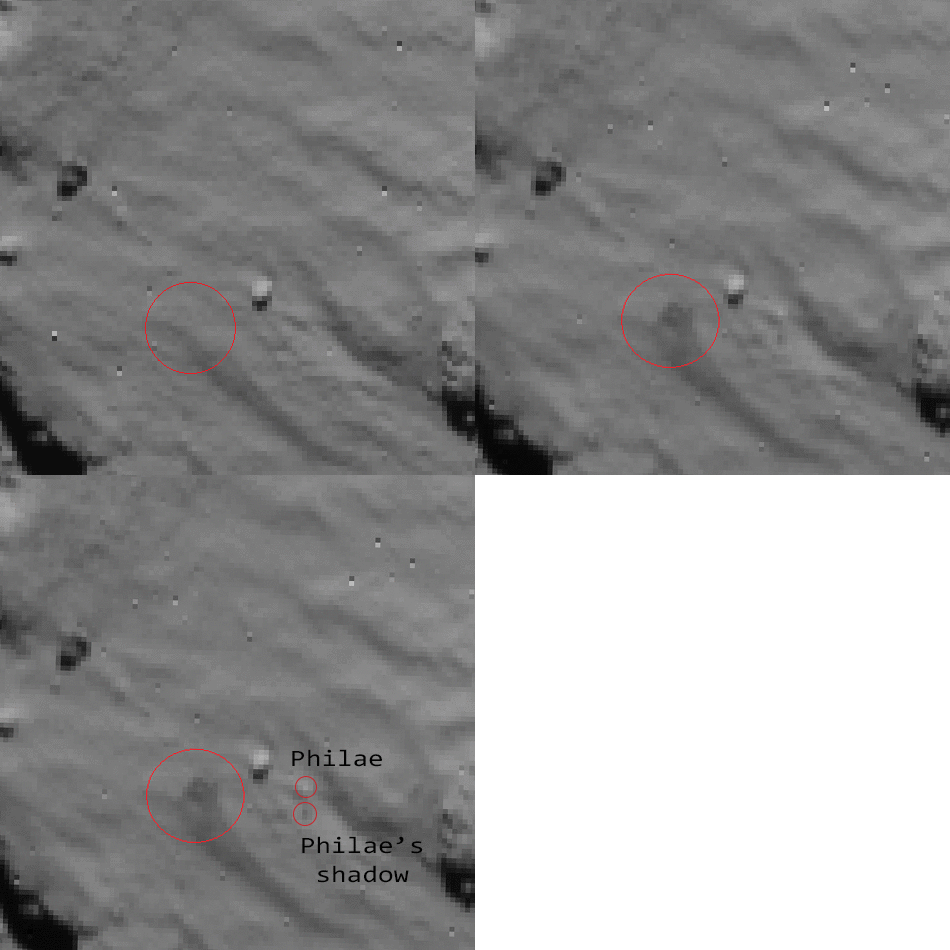
The Rosetta spacecraft spotted Philae and its shadow shortly after the lander touched down on Comet 67P/Churyumov–Gerasimenko and bounced up again. The first image is taken on Nov. 12, 2014 at 10:30 a.m. EDT (3:30 p.m. UTC) and the second five minutes later. Credit: ESA/Rosetta/NAVCAM; pre-processed by Mikel Catania. Hat tip to and credit for the caption to Universe Today.
Maven
Maven detected the aftermath of a meteor storm in the upper martian atmosphere with the signatures of eight metals. It looks like it was prudent to hide all the satellites when Mars came closest to the comet’s path. Here’s a link to Bob King’s post about it in Universe Today blog from 11 days ago.
11/17/2014 – Ephemeris – The Leonid meteor shower peaks this week
Ephemeris for Monday, November 17th. The sun will rise at 7:41. It’ll be up for 9 hours and 30 minutes, setting at 5:12. The moon, 3 days past last quarter, will rise at 3:30 tomorrow morning.
This week the Leonid meteor shower will again be seen. This is an unremarkable shower most years, but about every 33 years can be spectacular. This year we could see two peaks to the shower. Problem is that the peak activity for the Leonids last only an hour of so. The first is in the afternoon our time today. The radiant rises at midnight and one may be able to spot a few meteors after that. There is another peak calculated to be centered on 4:17 a.m. on Friday the 21st. It is supposed to be debris left by the comet responsible for the Leonids, Tempel-Tuttle back in 1567. Every once in a while the Leonids surprise us. Meteors are the streaks we see when grain sized particles shed by comets zip through the atmosphere at interplanetary speeds.
Times are for the Traverse City/Interlochen area of Michigan. They may be different for your location.
Addendum
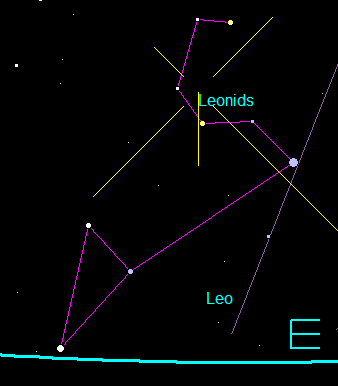
Leo rising at around 2 a.m. on the morning of November 20. Note the radiant in the sickle asterism of Leo. Created using Looking Up, my own program.

A famous woodcut of the 1833 Leonid meteor storm.
11/14/2014 – Ephemeris – When Galaxies collide… With ours (Gulp)
Ephemeris for Friday, November 14th. The sun will rise at 7:37. It’ll be up for 9 hours and 37 minutes, setting at 5:15. The moon, at last quarter today, will rise at 12:33 tomorrow morning.
Yesterday we looked at the closest spiral galaxy to our own Milky Way, the Great Andromeda Galaxy. I said that it would collide with the Milky Way in about 4 billion years. Usually no stars are harmed by such a collision. What does collide are the dust and gasses in each galaxy, that will trigger a burst of star formation. Over the next several billion years the two galaxies will probably merge into one giant elliptical galaxy. The sun at that time will see some changes of life the too. The Earth would by then be uninhabitable because the sun would be too hot, and by then would begin to bloat out into a red giant star. It would be a great spectacle, but no one would be around to watch it. However there are many distant colliding galaxies to watch.
Closer to home, Saturday night there will be a star party at NMC’s Rogers Observatory starting at 9 p.m.
Times are for the Traverse City/Interlochen area of Michigan. They may be different for your location.
Addendum
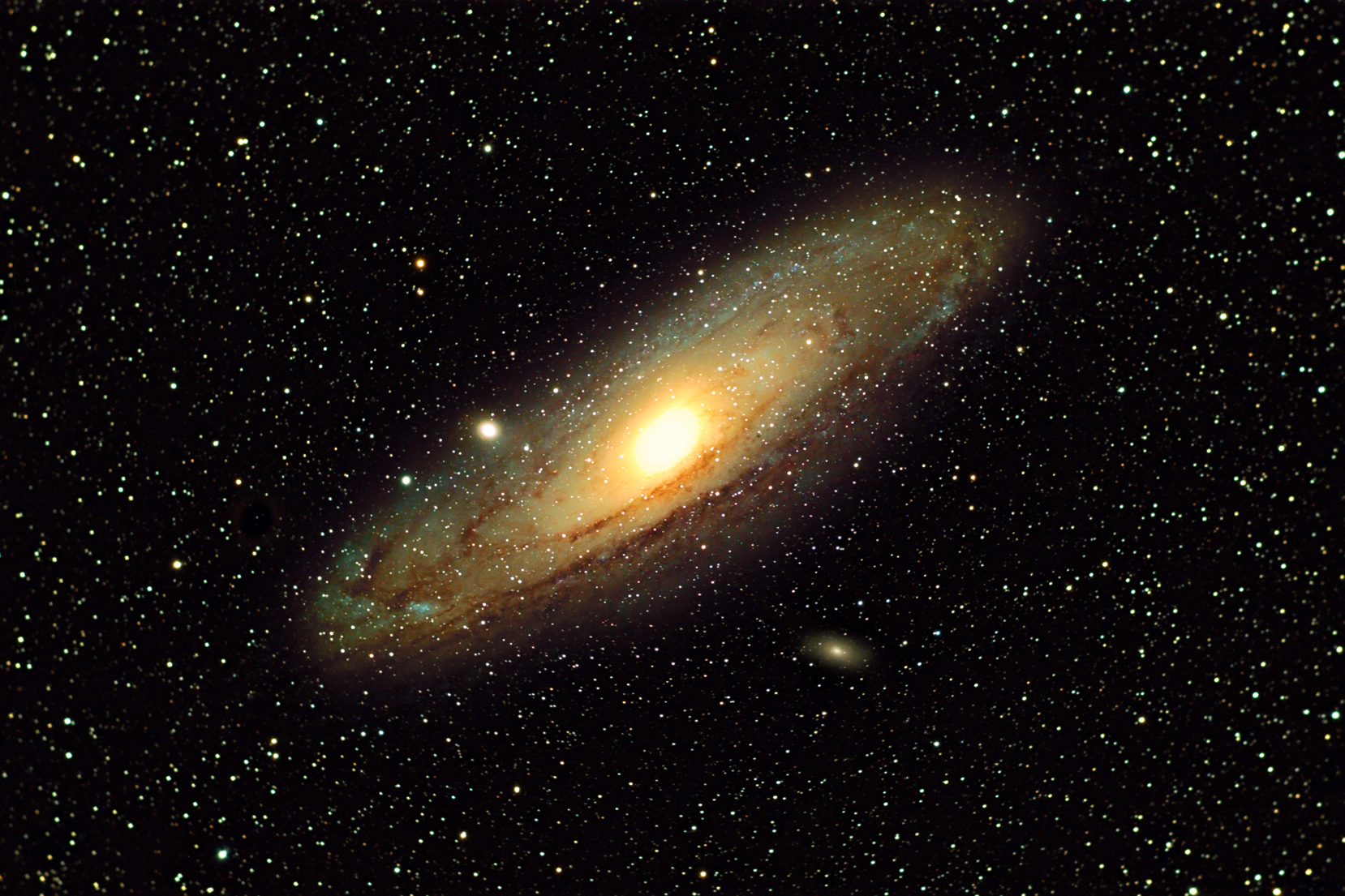
The Great Andromeda Galaxy (M31). Image taken by Scott Anttila.
Here’s a link to a YouTube video of a computer simulation of the collision of the Andromeda galaxy with our Milky Way galaxy.
11/13/2014 – Ephemeris – The Great Andromeda Galaxy
Ephemeris for Thursday, November 13th. The sun will rise at 7:36. It’ll be up for 9 hours and 40 minutes, setting at 5:16. The moon, 1 day before last quarter, will rise at 11:36 this evening.
The Great Andromeda Galaxy that we amateur astronomers usually call M31 is the closest spiral galaxy to our own Milky Way Galaxy. It is actually visible to keen-eyed observers to the naked eye. To locate it, first find the Great Square of Pegasus, 4 stars high in the south that make a pretty good square. From the top left star, Alpheratz, direct your gaze to the first two stars in a slightly curved line to the left to Mirach. Then go two stars up. The last one is a bit dim. But just to the upper right of that last star is a little fuzzy spot. That is the core of the Great Andromeda Galaxy. In binoculars it looks elongated. Photographs show the galaxy to span 6 Moon widths. It is somewhat larger than our galaxy and will collide with the Milky Way in about 4 billion years.
Times are for the Traverse City/Interlochen area of Michigan. They may be different for your location.
Addendum
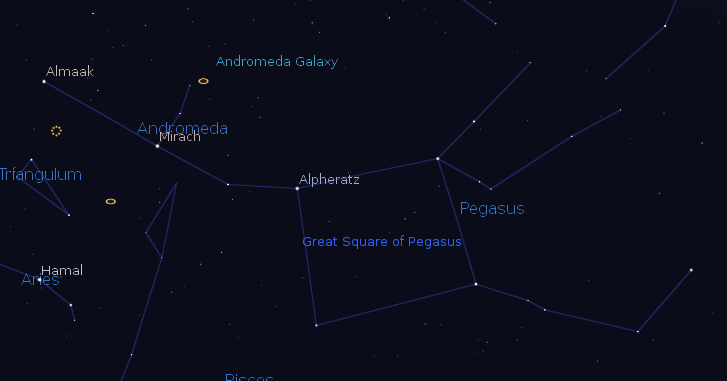
Great Andromeda Galaxy finder chart. Created using Stellarium and GIMP.
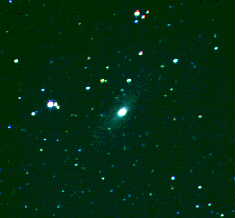
The Great Andromeda Galaxy (M31) as seen in binoculars. Visually even in a telescope the hub of this galaxy is all that is seen. However it also can be seen with the naked eye. My photograph.
The Great Andromeda Galaxy (M31). Satellite galaxy M32 is located at the edge of the disk at 9 o’clock, and another, M110 is located at 5 o’clock. Both can be seen in telescopes, but some distance from the core of M31 and seen visually. Image taken by Scott Anttila.
11/12/2014 – Ephemeris – A look at the bright planets for this week.
Ephemeris for Wednesday, November 12th. The sun will rise at 7:35. It’ll be up for 9 hours and 42 minutes, setting at 5:17. The moon, 2 days before last quarter, will rise at 10:38 this evening.
Tonight Mars will be low in the southwest at 7 p.m. It will set at 8:30 p.m. Jupiter now rises before midnight at 11:45 p.m. The best telescopic views will have to wait a couple of hours. Better to view Jupiter in the morning. The planet Mercury is making its autumn morning appearance now, rising in the east-southeast at 6:19 a.m. By 6:45 or so it should be visible low in the eastern sky, below and left of the star Spica, of about the same brightness, but has a bluish tinge in binoculars. Mercury is brightening as moves away from us and its phase appears fuller. Being close in to the sun its distance doesn’t vary by much so its brightness is governed more by its phase. Its separation from the sun is now down to 14.5 degrees.
Times are for the Traverse City/Interlochen area of Michigan. They may be different for your location.
Addendum
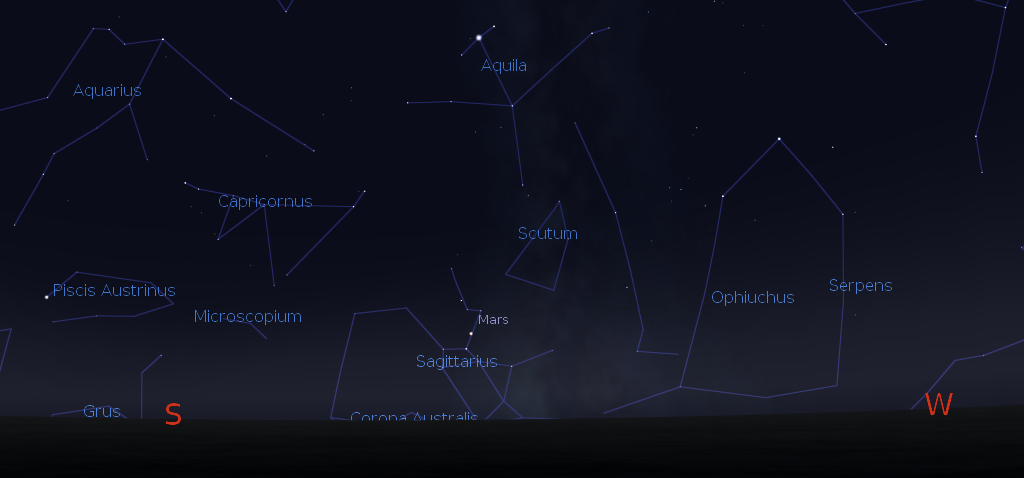
Mars and setting summer constellations at 7 p.m. on November 12, 2014. Created using Stellarium.
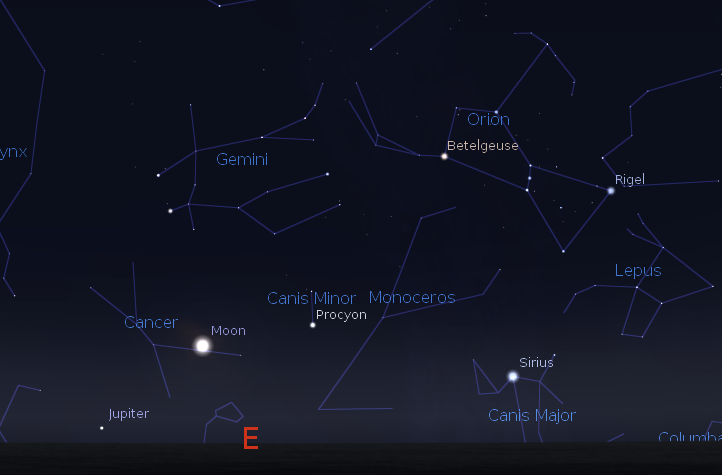
Jupiter and the Moon rising at midnight on November 13, 2014. Created using Stellarium.
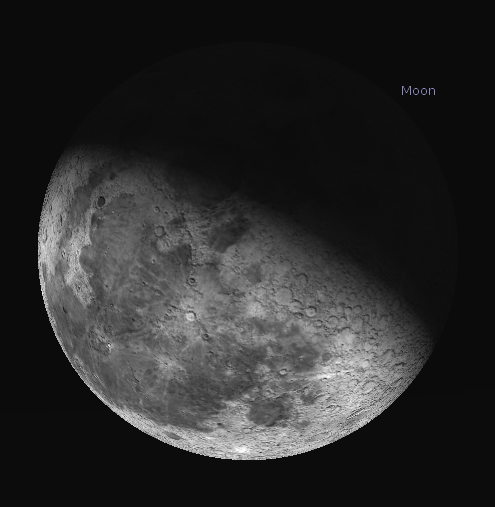
The Moon as seen in binoculars at midnight November 13, 2014. Created using Stellarium.
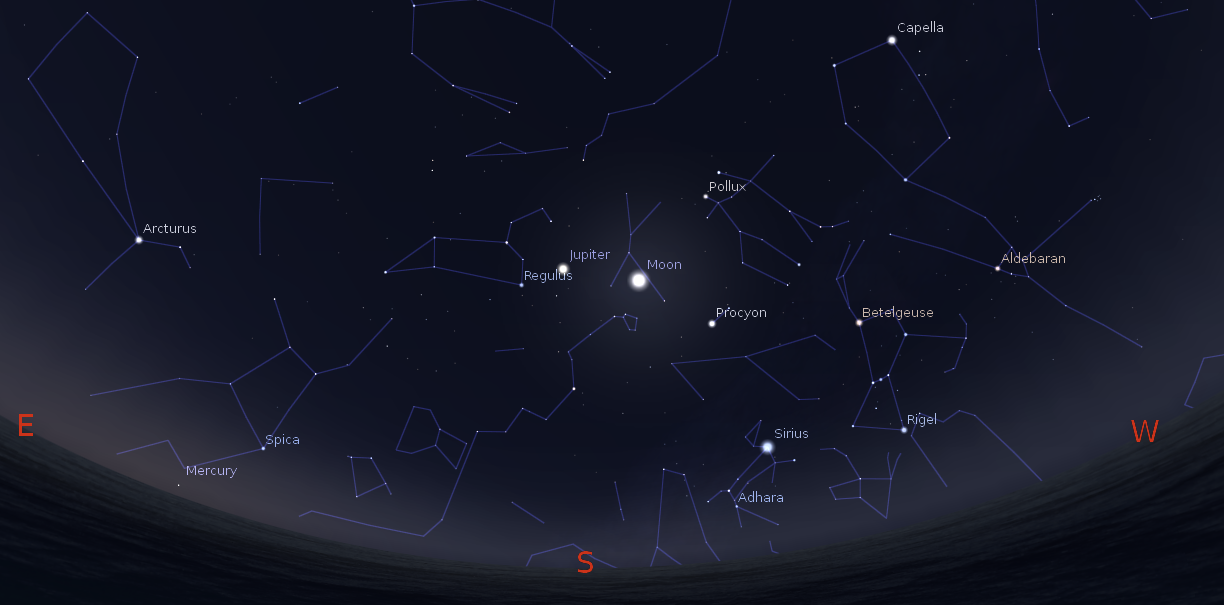
The morning sky including the Moon, Jupiter and Mercury at 6:30 a.m. on November 13, 2014.
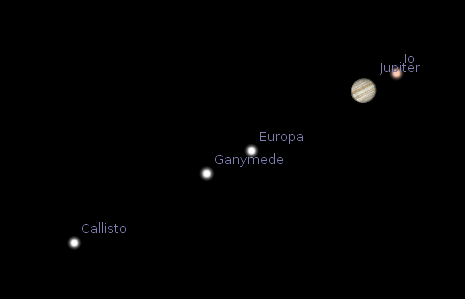
Jupiter and moons through a telescope at 6:30 a.m. November 13, 2014. Created using Stellarium.
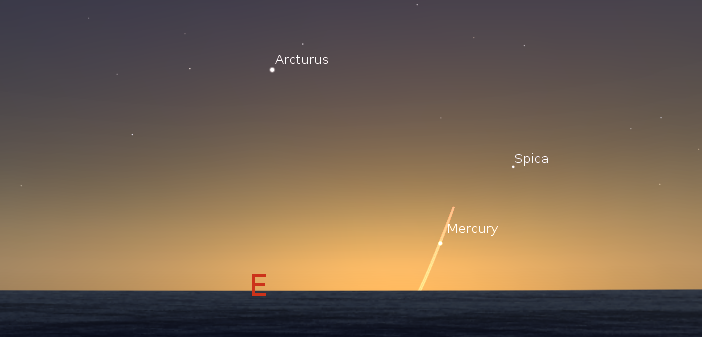
Mercury in twilight showing also its orbit. No, you won’t see that in the real sky. Mercury is sliding back from its peak a couple of weeks ago. 7 a.m. on November 13, 2014. Created using Stellarium.
Philae will attempt to land on comet 67P C-G today (updated)
Today’s the big event when the European Space Agency’s Rosetta spacecraft will release Philae the lander to land on the head of the rubber ducky shaped comet.
Go to the Rosetta landing mission site for links to the live stream feed and other blog and Twitter links.
The times given are CET (Central European Time) and GMT (Greenwich Mean Time or Universal time) Subtract 5 hours for Eastern Standard Time. I’ll convert them below.
Final Go/NoGo decision will be between 1:35 and 2:35 a.m. EST. As of the time of this posting that’s an hour and a half from now.
The release of Philae will be at 4:03 a.m. EST
Landing of Philae will occur around 11:02 a.m. EST. The Philae lander will fall over 7 hours to the comet.
Updated 8:46 EST: Philae has been released. Live update expected at 9 a.m.
Below is a link to the live feed from the Rosetta operations center
Also follow on Twitter #CometLanding
Update 11:05 a.m. EST: The Philae has landed! From the happy faces and celebration in he control center. No announcement yet.
Update 11:08 a.m. EST: The official announcement came from the flight director. The harpoons were fired and cables reeled back to attach the lander to the surface.
Update 11:48 a.m. EST: It is reported that Philae may not be anchored to the surface Stay tuned.
11/11/14 – Ephemeris – Something fishy in the stars
Ephemeris for Veteran’s Day, Tuesday, November 11th. The sun will rise at 7:33. It’ll be up for 9 hours and 45 minutes, setting at 5:18. The moon, 3 days before last quarter, will rise at 9:41 this evening.
High in the south at 9 p.m. are the four bright stars of the Great Square of Pegasus, the upside down flying horse. Lying along the left and bottom sides of the great square is the constellation of Pisces the fish, one of the 12 constellations of the Zodiac that lie along the path of the sun, moon and planets. Even though Pisces is called the fish, the fish themselves are not seen in the stars. What can be traced in the stars is the rope, that’s tied to their tails, anchored at the extreme southeastern part of the constellation far below and left of the lower left corner of the Great Square. The right end of Pisces is the asterism, or informal constellation, of the Circlet. It’s the loop of 5 stars, the rope around the tail of one of the two fish.
Times are for the Traverse City/Interlochen area of Michigan. They may be different for your location.
Addendum
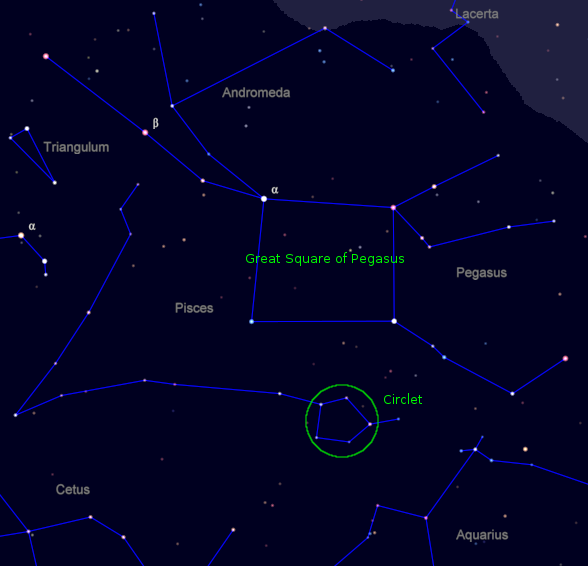
Pisces below the Great Square of Pegasus in the south at 9 p.m.
11/10/2014 – Ephemeris – Where is the constellation of Aquarius the water bearer
Ephemeris for Monday, November 10th. The sun will rise at 7:32. It’ll be up for 9 hours and 47 minutes, setting at 5:19. The moon, half way from full to last quarter, will rise at 8:45 this evening.
One of the constellations of the zodiac is in the southern sky at 8 in the evening. It’s the constellation of Aquarius the water bearer. The image that is supposed to be depicted in the stars is that of a hapless fellow spilling a stone jar of water across the sky. Aquarius is fairly hard to spot because it is made of faint stars. One part of Aquarius is easy to spot, the Water Jar, an asterism or informal constellation. It’s a distinctive small nearly equilateral triangle of stars with another star in the center. Stars extending to the right from the water jar are that stream of water in some depictions. The body of Aquarius is below, a misshapen balloon of stars that is seen above the bright star Fomalhaut, low in the south.
Times are for the Traverse City/Interlochen area of Michigan. They may be different for your location.
Addendum
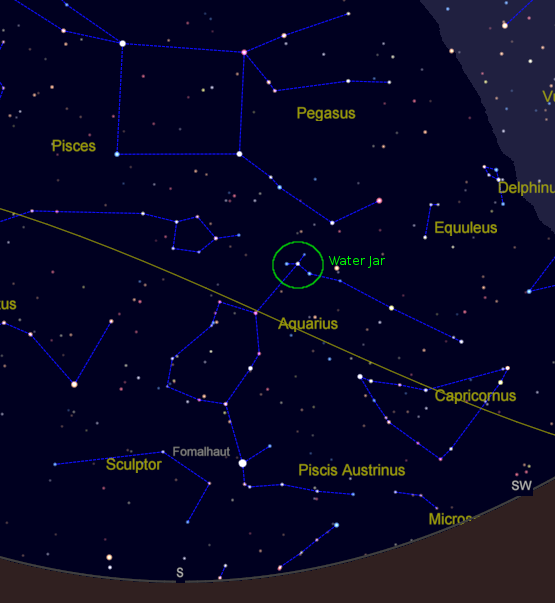
Aquarius highlighting the Water Jar. Created using Stellarium.

