11/07/2014 – Ephemeris – GTAS meeting tonight and Star Party
Ephemeris for Friday, November 7th. The sun will rise at 7:28. It’ll be up for 9 hours and 55 minutes, setting at 5:23. The moon, 1 day past full, will rise at 6:15 this evening.
Tonight the Grand Traverse Astronomical Society will hold their monthly meeting at he Northwestern Michigan College’s Rogers Observatory at 8 p.m. featuring yours truly presenting the Hitchhikers Guide to the Solar System. I have found, what NASA and other space agencies have found, that once orbiting the Sun in the solar system. One can go anywhere in the solar system with a minimum of energy, if one has the time. We’ll start by looking at orbits about the Earth and how they can be changed. We’ll look at escape velocity and those seemingly strange Lagrangian points, plus stealing energy from the planets. At 9 p.m. there will be a star party featuring the Moon and some of the brighter deep sky objects. The observatory is located on Birmley road.
Times are for the Traverse City/Interlochen area of Michigan. They may be different for your location.
Addendum
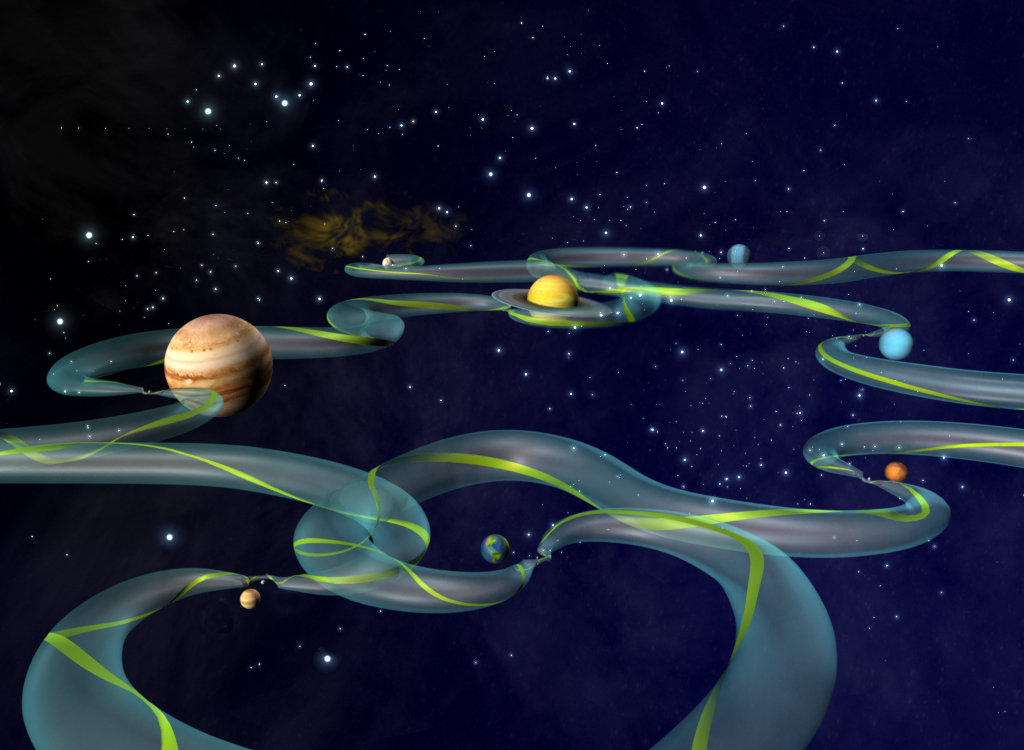
Artist’s concept of interplanetary superhighway or Interplanetary Transport Network. Credit: NASA/JPL.
11/06/2014 – Ephemeris – New Horizons headed toward the 9th planet will pass a dwarf planet instead
Ephemeris for Thursday, November 6th. The sun will rise at 7:26. It’ll be up for 9 hours and 57 minutes, setting at 5:24. The moon, at full today, will rise at 5:32 this evening.
The New Horizons spacecraft is 9 months from reaching the dwarf planet Pluto. After a 9 and a half years journey it will zip past Pluto and its moons in a day. At launch Pluto was designated as planet number 9. In less than a year later Pluto was demoted to a dwarf planet. The authority was the International Astronomical Union. It was a vote taken at the end of the last day of the meeting that year after most members have left. The definitions only pertain to the solar system, and not exoplanets orbiting other stars. Besides we cannot detect anything as small as Pluto orbiting another star…yet. The asteroid Ceres was once a planet too, it was demoted to asteroid 75 years after discovery. It was promoted to a dwarf planet with Pluto.
Times are for the Traverse City/Interlochen area of Michigan. They may be different for your location.
Addendum

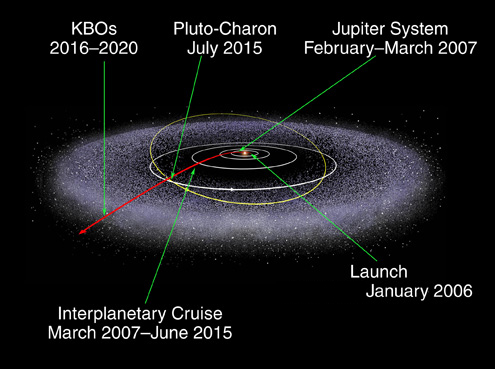
New Horizon’s trajectory through the solar system. Credit: NASA/JHAPL.
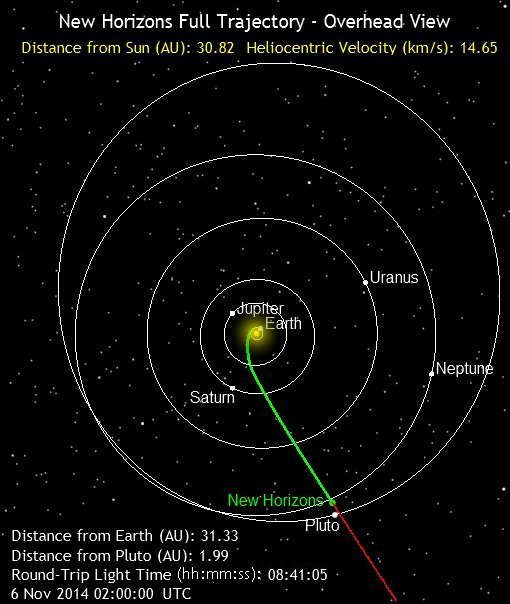
Where is New Horizons on November 6, 2014? Credit NASA/JHAPL.
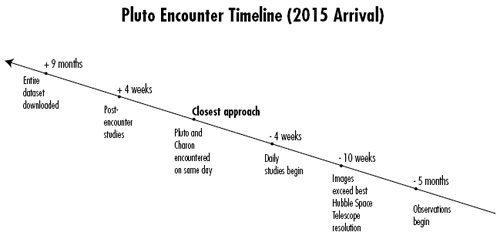
New Horizons Encounter Timeline. Credit: NASA/JHAPL.
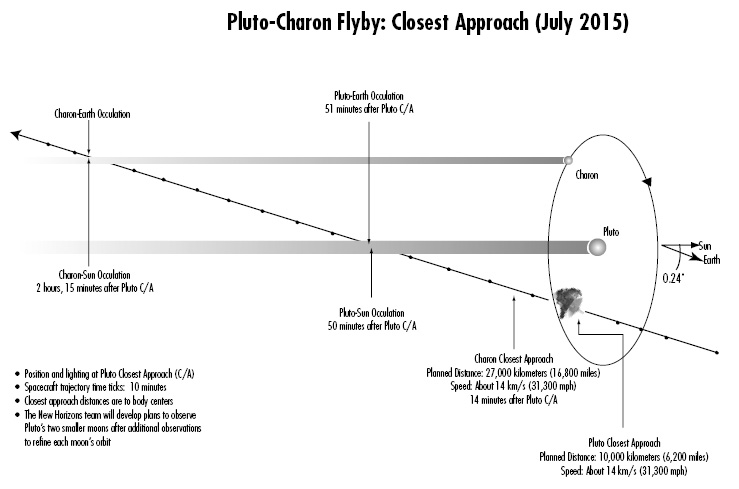
New Horizons at closest approach to Pluto. Credit: NASA/JHAPL.
11/05/2014 – Ephemeris – This week there’s one bright planet in the early evening and two in the morningf
Ephemeris for Wednesday, November 5th. The sun will rise at 7:25. It’ll be up for 10 hours and 1 minute, setting at 5:26. The moon, 1 day before full, will set at 6:56 tomorrow morning.
Tonight Mars will be low in the southwest at 7 p.m. It will set at 8:32 p.m. The sky will stay devoid of bright planets until Jupiter rises at 12:13 a.m. Jupiter is visible this morning in twilight an hour earlier than last week, in the south-southeast along with the brighter stars of winter, a preview of colder evenings to come. The planet Mercury is making its autumn morning appearance now, rising in the east-southeast at 5:48 a.m. By 6:20 or so it should be visible low in the sky. Mercury is brightening as moves away from us and its phase becomes fuller. Being close in to the sun its distance doesn’t vary by much so its brightness is governed more by its phase. Its separation from the sun is now an 18 degree angle and slowly decreasing.
Times are for the Traverse City/Interlochen area of Michigan. They may be different for your location.
Addendum
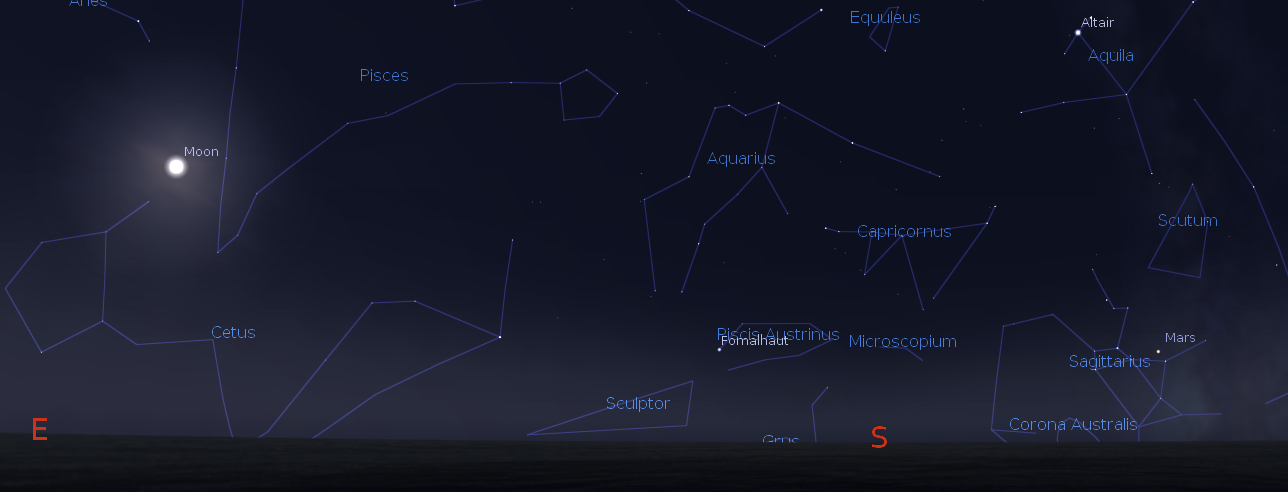
Mars and the bright Moon at 7 p.m. on November 5, 2014. Created using Stellarium.
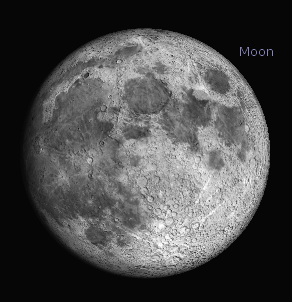
The nearly full Moon as it would be seen in binoculars at 7 p.m. on November 5, 2014. Created using Stellarium.
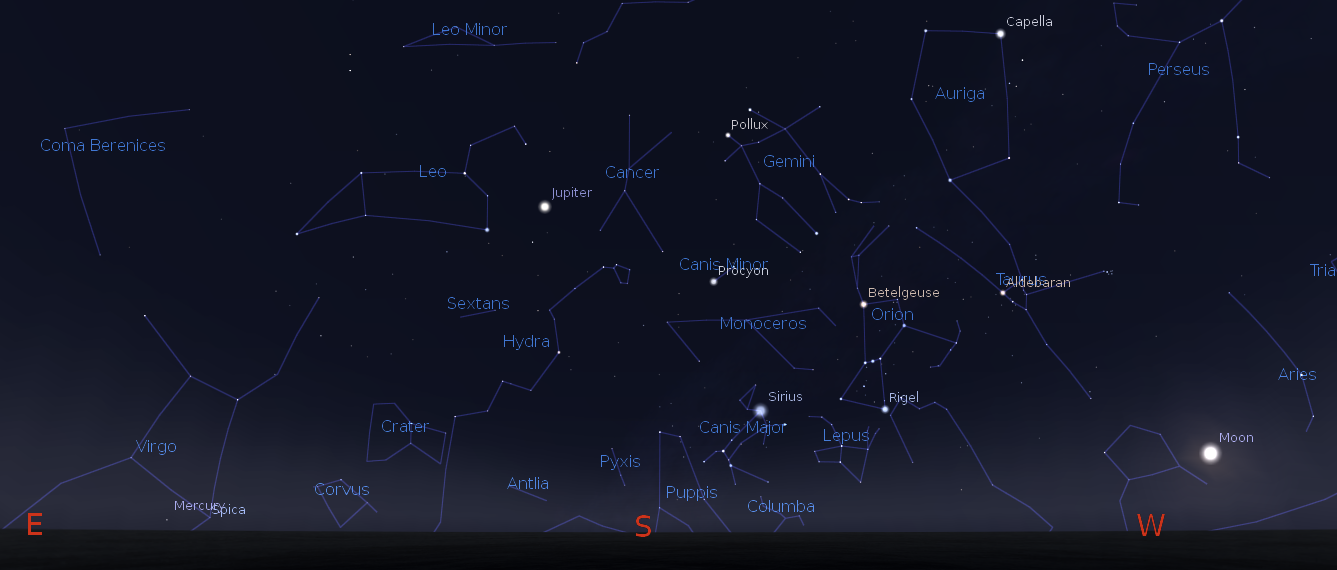
Panorama of the morning sky at 6 a.m. with Jupiter and the just risen Mercury, with the Moon hanging on in the west. Created using Stellarium.
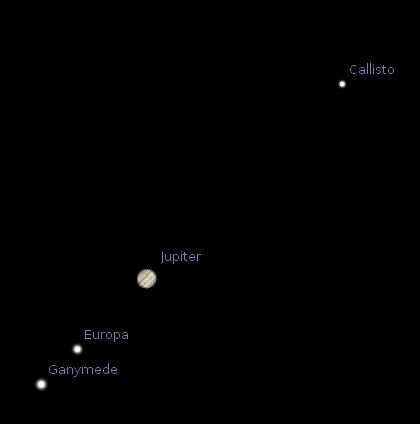
Jupiter and moons as seen in a telescope at 6 a.m., November 6, 2014. The moon Io, visible earlier in the morning, is hiding behind the planet. Created using Stellarium.
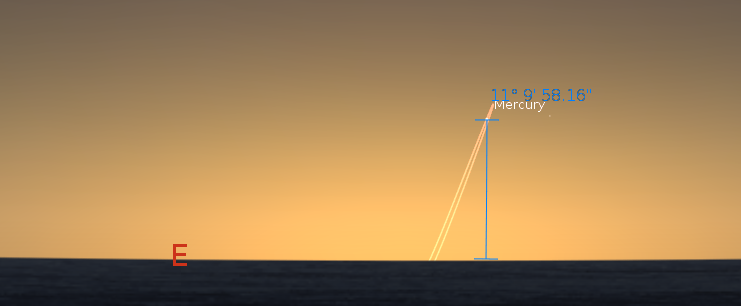
Mercury low in the east at 7 a.m., November 6, 2014. Note its altitude is 11 degrees above the flat horizon. Also shown is Mercury’s orbit. Created using Stellarium.
11/04/2014 – Ephemeris – Last week was a bad one for commercial space
Ephemeris for Election Day, Tuesday, November 4th. The sun will rise at 7:24. It’ll be up for 10 hours and 3 minutes, setting at 5:27. The moon, 2 days before full, will set at 5:46 tomorrow morning.
Last week was not a happy one for commercial space companies. First, last Tuesday the Orbital Science’s Antares blew up (or in space-talk: “Suffered an anomaly”) attempting to deliver it’s third contracted commercial cargo to the International Space Station. No one was killed because it was an unmanned rocket and the spectators were kept at a safe distance. Then on Friday an anomaly occurred during a test flight of Virgin Galactic’s SpaceShipTwo. In that mishap the co-pilot, Michael Alsbury, was killed. “Space is hard.” was the phrase heard quite often last week. And it’s true. I’ve found that the natural state of any mechanism is not to work. The more complicated the device is, like a rocket, the harder it is to get it to work.
Times are for the Traverse City/Interlochen area of Michigan. They may be different for your location.
Addendum

The initial signs that the Antares rocket was in trouble. Credit: Parabolic Arc.

A sequence of photos of the flight and breakup of SpaceShipTwo. Credit: Kenneth Brown/Reuters.
11/03/2014 – Ephemeris – Mercury is now visible in the morning
Ephemeris for Monday, November 3rd. The sun will rise at 7:22. It’ll be up for 10 hours and 5 minutes, setting at 5:28. The moon, 3 days before full, will set at 4:35 tomorrow morning.
When I talk about the planet Mercury I usually use the adjective elusive. There’s a good reason for that. Mercury is always close to the sun, being the innermost planet, and it has the most eccentric orbit of all the planets. Due to our location on the northern hemisphere of the Earth Mercury is best visible on autumn mornings and spring evenings. These two views, 6 months apart, means that we, at both times are looking at the same part of Mercury’s orbit, but from opposite sides. The part of Mercury’s orbit we see is the part of its orbit closest to the sun, so the angular separation is not very wide, 19 degrees this elongation. Observers in the southern hemisphere whose seasons are opposite ours have a much better view. For them Mercury is at its farthest from the sun, and they get elongations of over 25 degrees.
Times are for the Traverse City/Interlochen area of Michigan. They may be different for your location.
Addendum
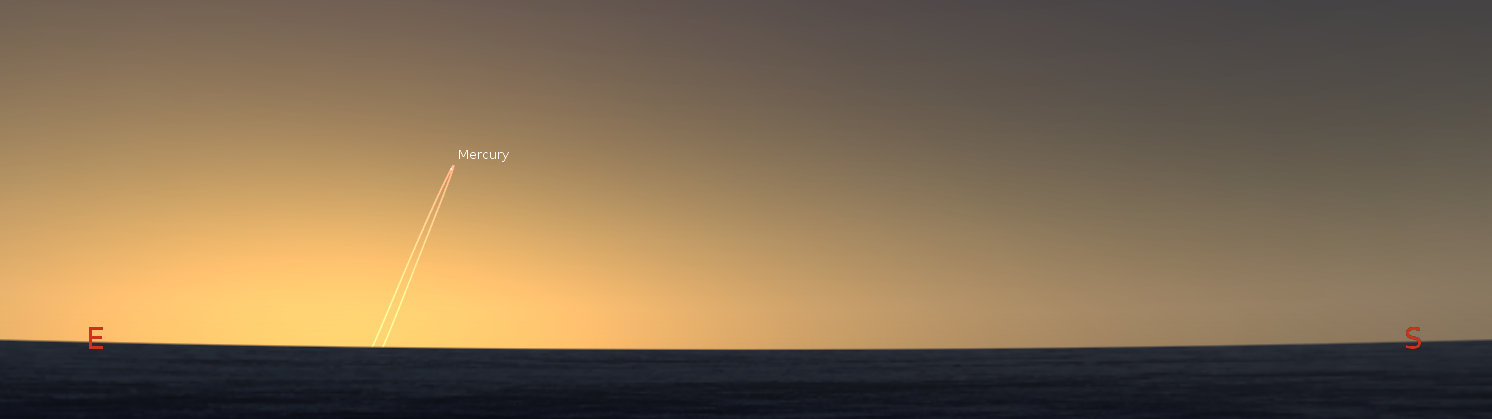
Mercury at 7 a.m. November 3, 2014 showing its orbit. Created using Stellarium.
10/31/2014 – Ephemeris – The spookiest star
Ephemeris for Halloween, Friday, October 31st. The sun will rise at 8:18. It’ll be up for 10 hours and 13 minutes, setting at 6:32. The moon, 1 day past first quarter, will set at 1:59 tomorrow morning.
Not all the ghosts and goblins out Sunday will be children. One will be out every night, because it’s a star. Its name is Algol, from the Arabic for Ghoul Star or Demon Star. The Chinese had a name for it that meant “piled up corpses”. It’s the second brightest star in the constellation Perseus the hero, rising in the northeast this evening. The star is located where artists have drawn the severed head of Medusa, whom he had slain. Medusa was so ugly that she turned all who gazed upon her to stone. Algol is her still glittering eye. Astronomers finally found out what was wrong with Algol. It does a slow 6 hour wink every two days 21 hours, because it is two stars that eclipse each other. Her next wink will be 10 p.m. Sunday night.
Times are for the Traverse City/Interlochen area of Michigan. They may be different for your location.
Addendum
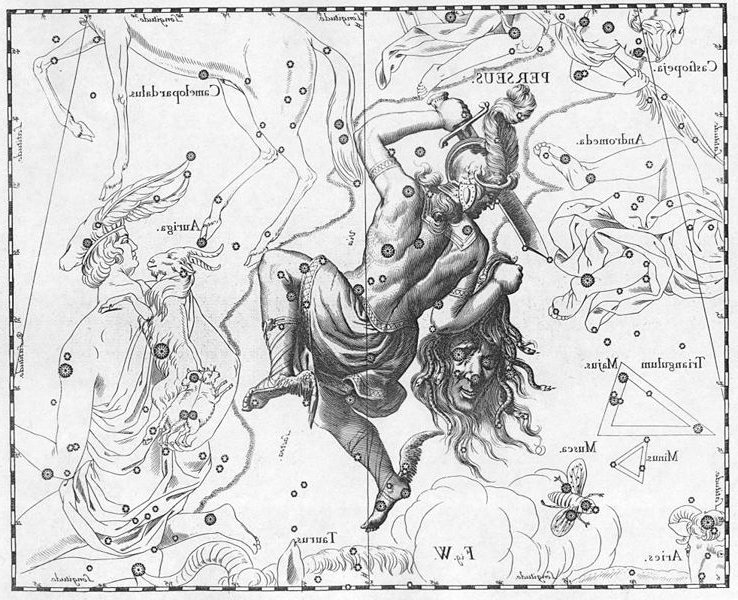
Perseus and the head of Medusa from the 1690 Uranographia by Johannes Hevelius. Image found with the article on Algol in Wikipedia.
Celestial globes of the day showed the celestial sphere from the outside, so the constellations appeared reversed. The star atlases of the day kept the trend. I reversed the image to correspond with the actual sky.
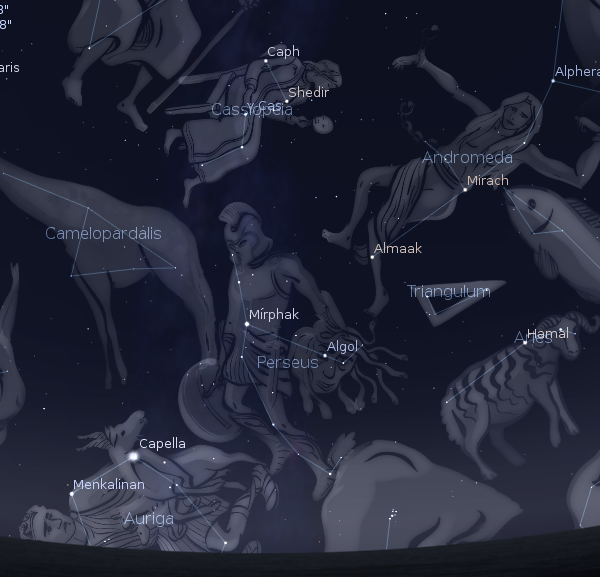
Algol at 7:30 p.m. on Halloween, in a modern portrayal. Created using Stellarium.
Update
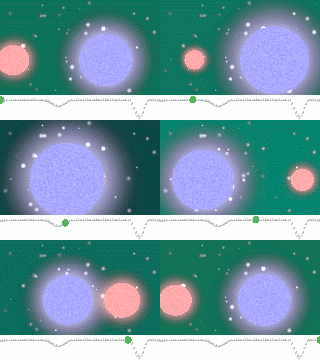
Animation of an eclipsing binary star like Algol. Credit: Wikimedia Commons. H/T EarthSky
Here’s a link to EarthSky’s post on Algol.
10/30/2014 – Ephemeris – Previewing November’s skies
Ephemeris for Thursday, October 30th. The sun will rise at 8:17. It’ll be up for 10 hours and 16 minutes, setting at 6:34. The moon, at first quarter today, will set at 12:49 tomorrow morning.
Let’s look at the skies for the month of November a couple of days early. The sun is still moving south rapidly. Daylight hours in the Interlochen/Traverse City area and will drop from 10 hours and 11 minutes i\on the 1st to 9 hours 6 minutes on the 30th. The altitude, or angle, of the sun above the southern horizon at local noon will be just under 31 degrees Saturday and will descend to 23 and a half degrees on the 30th. The altitude of the sun in the Straits area will be a degree lower. Local noon, this month, will be about 12:30 p.m. when we go back to standard time this weekend. The Leonid meteors have two possible dates this month, the 17th and the 21st. Those on the 21st seem to be best timed for our location on the Earth.
Times are for the Traverse City/Interlochen area of Michigan. They may be different for your location.
Addendum
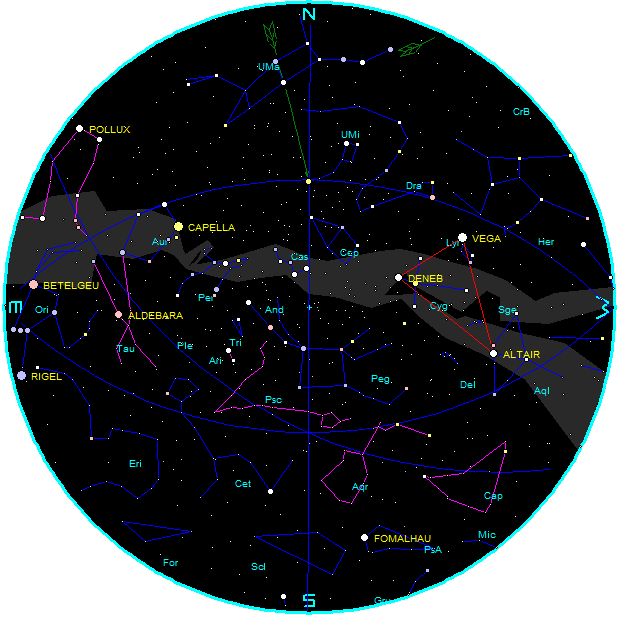
Star Chart for November 2014. Created using my LookingUp program. Created using my LookingUp program.
The Moon is not plotted. The planets and stars are plotted for the 15th at 9 p.m. That is chart time.
Astronomical twilight ends at 7:08 p.m. on November 2nd, decreasing to 6:48 on the 31st.
Add a half hour to the chart time every week before the 15th and subtract and hour for every week after the 15th.
For a list of constellation names to go with the abbreviations click here.
Also shown is the Summer Triangle in red. Clockwise from the top star is Deneb in Cygnus, Vega in Lyra and Altair in Aquila.
The green pointers from the Big Dipper are:
- Pointer stars at the front of the bowl of the Big Dipper point to Polaris the North Star.
10/29/2014 – Ephemeris – A last look at the bright planets for October
Ephemeris for Wednesday, October 29th. The sun will rise at 8:16. It’ll be up for 10 hours and 19 minutes, setting at 6:35. The moon, 1 day before first quarter, will set at 11:41 this evening.
Tonight Mars will be low in the southwest at 8 p.m. below and right of the Moon in the constellation of Sagittarius, and will set at 9:35 p.m. The sky will stay devoid of bright planets until Jupiter rises at 1:33 a.m. Jupiter is visible this morning in twilight in the south-southeast along with the brighter stars of winter, a preview of colder evenings to come. The planet Mercury makes its autumn morning appearance for the next week or so, rising in the east-southeast at 6:38. By 7:20 or so it should be visible low in the sky. It’s greatest western elongation will be this Saturday, and it will pass perihelion, its closest to the Sun, this Sunday, so despite its greatest elongation, it’s less than a 19 degree angle from the Sun.
Times are for the Traverse City/Interlochen area of Michigan. They may be different for your location.
Ephemeris
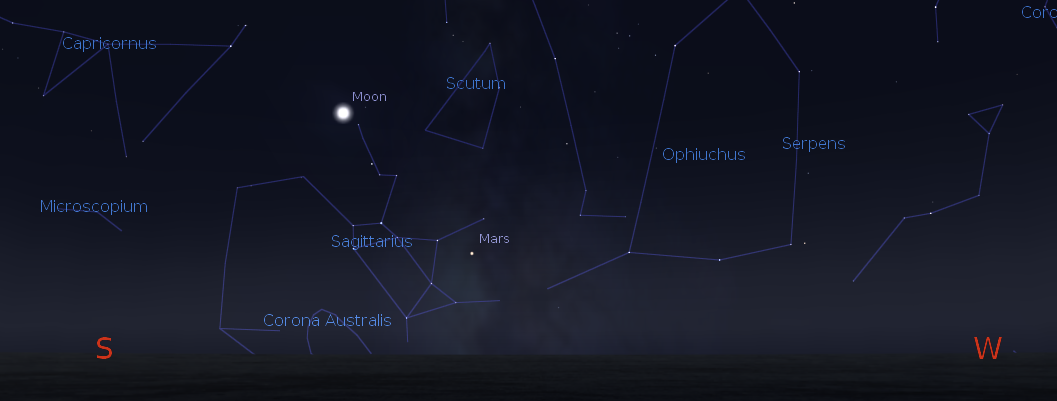
Mars, the Moon and the setting stars of summer at 8 p.m. on October 29, 2014. Created using Stellarium.
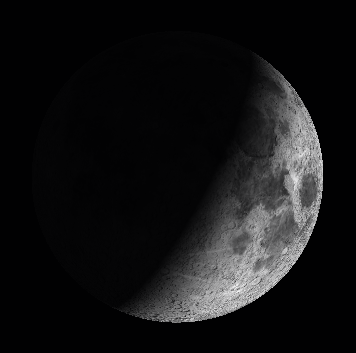
The Moon as it would appear in binoculars at 8 p.m. October 29, 2014. Created using Stellarium.
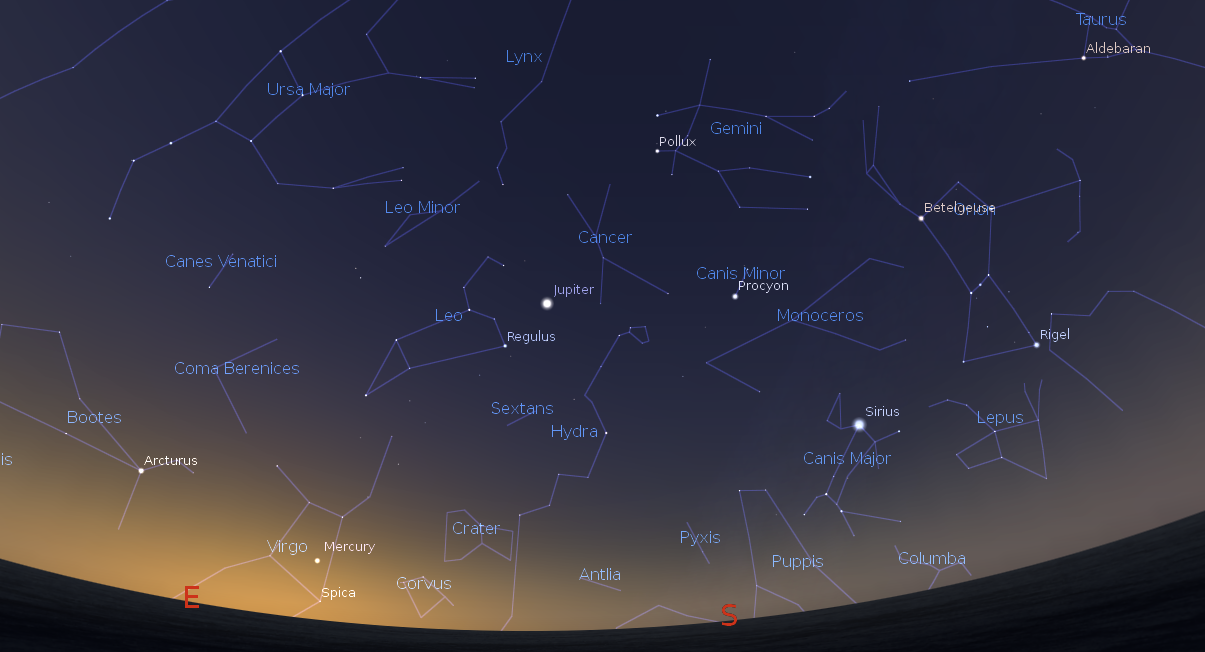
The morning planets and constellations at 7:30 a.m. October 30, 2014. Created using Stellarium.
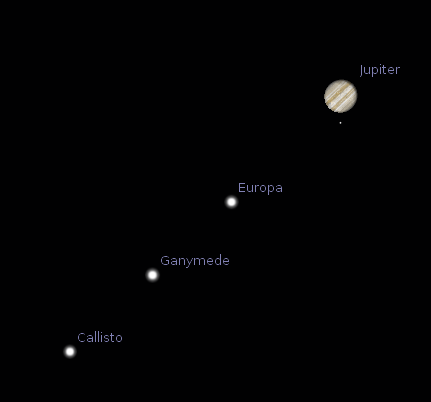
Jupiter and its moons as seen in a telescope at 7:30 a.m. October 30, 2014. Io is behind Jupiter. Created using Stellarium.
10/28/2014 – Ephemeris – The Pleiades Distance Controversy
Ephemeris for Tuesday, October 28th. The sun will rise at 8:14. It’ll be up for 10 hours and 22 minutes, setting at 6:37. The moon, 2 days before first quarter, will set at 10:37 this evening.
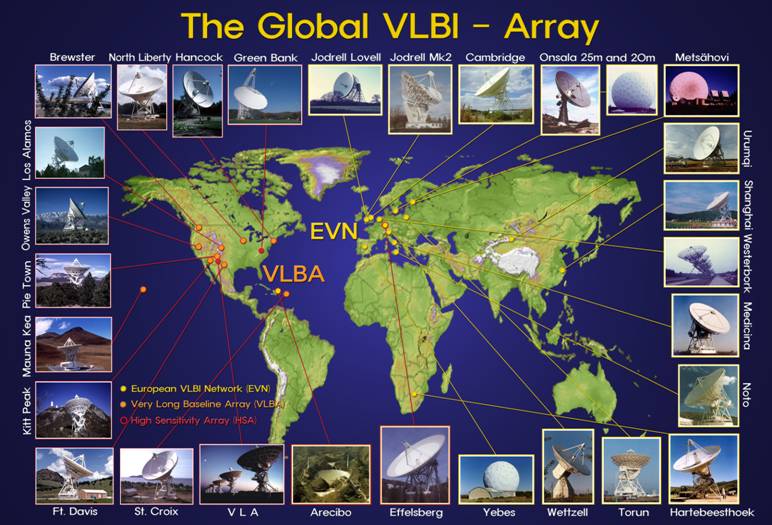
Yesterday we looked at the Pleiades or Seven Sisters star cluster. The Pleiades is nearby. For a long time the Pleiades distance was calculated to be about 435 light years. It was beyond the distance that could be determined from the Earth by triangulation or parallax. In the early 1990s the European Space Agency satellite Hipparcos was launched to improve and extend the parallax measurement of nearby stars. However the distance determined to the Pleiades was 392 light years, 90 percent of the previous value. A lot of what we have determined about stars and their evolution was based on the original distance to the Pleiades. It meant that the Pleiades stars were dimmer than first calculated, affecting our ideas of stellar evolution. Many astronomers were wary of the supposed more accurate Hipparcos result. However recently using a network of radio telescopes that span the diameter of the Earth in a Very Long Base Interferometry Array, a new distance was determined, a more agreeable 444 light years.
Times are for the Traverse City/Interlochen area of Michigan. They may be different for your location.
Addendum
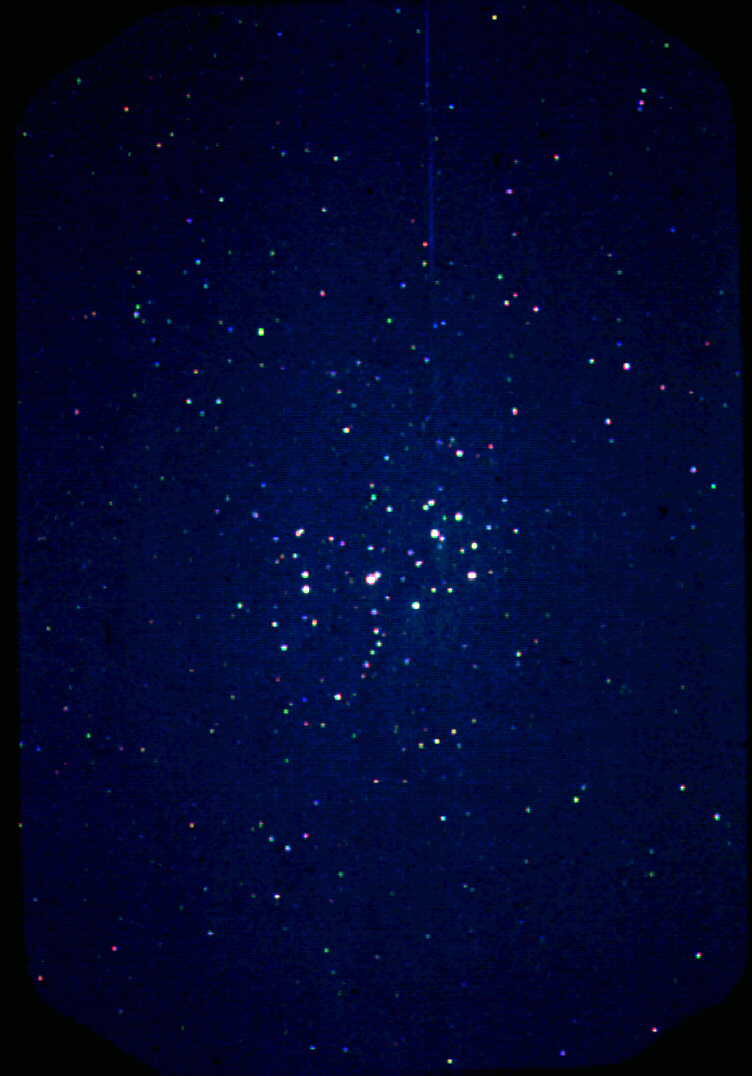
The Pleiades, about what you’d see in binoculars.
10/27/2014 – Ephemeris – The Pleiades in Greek and Native American mythology
Ephemeris for Monday, October 27th. The sun will rise at 8:13. It’ll be up for 10 hours and 25 minutes, setting at 6:38. The moon, 3 days before first quarter, will set at 9:38 this evening.
Visible low in the east at 10 in the evening sky can be spotted a small group of stars. It’s called the Pleiades or Seven Sisters. The Pleiades are really spectacular when seen in binoculars. It is remarkable that both the Greeks and the American Plains Indians saw this group as female stars fleeing from danger. In the former case they were fleeing the constellation Orion the giant hunter of the winter sky who will soon rise over the eastern horizon, and in the latter case a giant bear. Legend has it that the maidens fled to the top of Devils Tower in Wyoming. It’s said that the claw marks of this bear are seen in the walls of the tower. The maidens were then spirited from the top of the tower to the heavens, where we see them today. Whichever story you like the Pleiades is worth searching for.
Times are for the Traverse City/Interlochen area of Michigan. They may be different for your location.
Addendum
The Pleiades, about what you’d see in binoculars.
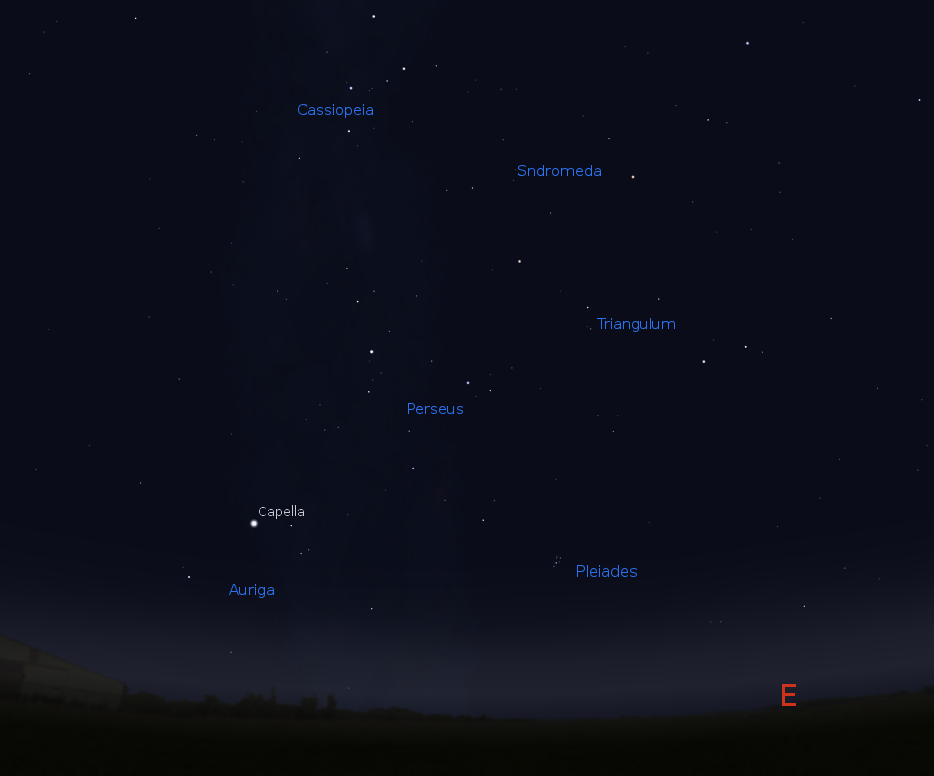
Looking to the east northeast at the Pleiades: 9 p.m. on October 27th. Created using Stellarium,
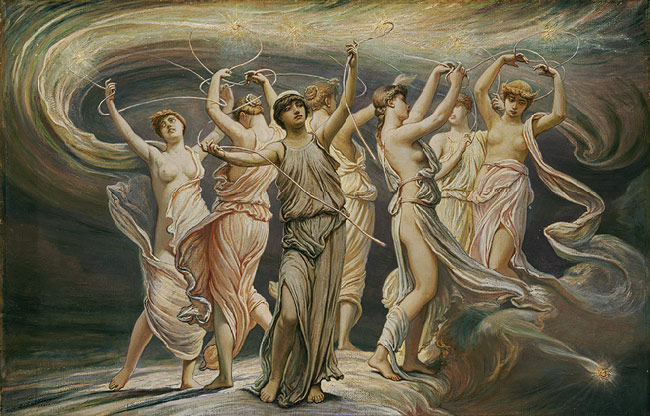
The Greek Pleiades a painting by Elihu Vedder in the Metropolitan Museum of Art, New York City. Public Domain.

Legend of Devils Tower Credit: Indian Country Today Media Network
This is the illustration from http://indiancountrytodaymedianetwork.com/article/the-legend-of-devils-tower-3273

