06/22/11 – Ephemeris – The bright planets visible this week
Wednesday, June 22nd. Today the sun will be up for 15 hours and 33 minutes, setting at 9:31. The moon, 1 day before last quarter, will rise at 1:07 tomorrow morning. Tomorrow the sun will rise at 5:57.
It’s Wednesday and time again to take a look at the whereabouts of the bright planets. The ringed planet Saturn will be visible in the south southwest as it gets dark. It’s near the bright star Spica to its lower left. Spica has a blue tinge, while Saturn is yellowish. It will set at 2:21 a.m. Saturn is a wonderful sight is a telescope with its rings. The shadows of the rings on the planet and planet on the rings are now near their maximum extent. Its bright moon Titan is also visible. Folks with good telescopes and good eyesight can also see up to four of Saturn’s fainter moons. Jupiter will rise at 2:55 a.m. in the east. Mars will rise at 4:06. Venus now rises too close to sunrise to be seen in the twilight as is Mercury.
* Times are for the Traverse City/Interlochen area of Michigan. They may be different for your location.
06/21/11 – Ephemeris – Summer solstice is today
Tuesday, June 21st. Today the sun will be up for 15 hours and 33 minutes, setting at 9:31. The moon, 2 days before last quarter, will rise at 12:46 tomorrow morning. Tomorrow the sun will rise at 5:57.
At 1:16 this afternoon the sun will reach its greatest angle north of the celestial equator or 23 ½ degrees. The date and the point in the sky where the sun is at that instant is called the summer solstice, or summer sun standstill. It means the point at which the sun seems poised farthest north before heading southward. This would be most noticeable if you were monitoring the height of the sun at noon or the sun’s rising or setting point day by day as the ancients did. Besides being the day with the longest sunlight we, in the northern hemisphere, are also receiving more intense heat from the sun than any other day of the year. Still hotter weather is in store as the northern hemisphere continues to warm up.
* Times are for the Traverse City/Interlochen area of Michigan. They may be different for your location.
06/20/11 – Ephemeris – The constellation Libra the scales
Monday, June 20th. Today the sun will be up for 15 hours and 33 minutes, setting at 9:30. The moon, 3 days before last quarter, will rise at 12:24 tomorrow morning. Tomorrow the sun will rise at 5:57.
One of the constellations of the Zodiac or circle of animals isn’t either animal or human. It is Libra the Scales or balance. It lies low in the southern sky at 11 p.m., just to the right of the rising Scorpius the scorpion. Libra, it seems, is an afterthought, a simple diamond shape of four stars.. Its two brightest stars Zubeneschamali and Zubenelgenubi translate to the north and south claw respectively, of Scorpius to the left of it. The Arabs, at least, seemed to view this as part of Scorpius. The balance was perhaps to signify the equality of day and night, at the time the sun was in this part of the sky at the start of autumn, over 2000 years ago. Nowadays the sun is one constellation west, in Virgo at the start of autumn.
* Times are for the Traverse City/Interlochen area of Michigan. They may be different for your location.
Addendum
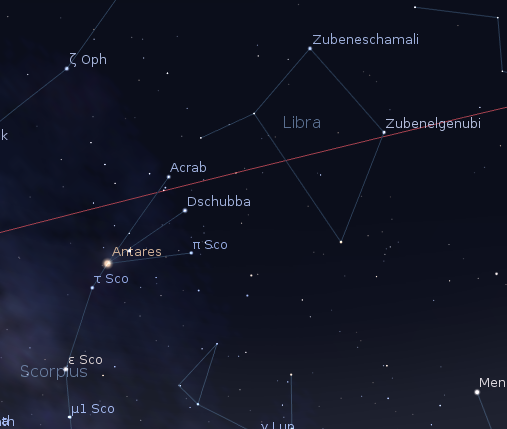
Libra the scales. Created using Stellarium
06/17/11 – Ephemeris – Viewing at the Sleeping Bear Dunes National Lakeshore
Friday, June 17th. Today the sun will be up for 15 hours and 33 minutes, setting at 9:30. The moon, 2 days past full, will rise at 11:02 this evening. Tomorrow the sun will rise at 5:56.
Tomorrow, that’s Saturday night the 18th, Grand Traverse Astronomical Society will host the first of five viewing nights at the Sleeping Bear Dunes National Lakeshore. This one will be held at Platte River Point, at the mouth of the Platte River. We’ll be setting up telescopes around 8:30. Sunset will be about 9:30 and we expect to see Saturn and the first stars about 10 to 10:15 p.m. We’ll be there up to midnight depending on the crowds, and clear skies. Our next viewing opportunity at the Dunes will be July 30th at the Dunes overlook, stop 3 on Pierce Stocking Drive. We’ll also have evenings in August at the Port Oneida Fair, September, and October for the Lakeshore’s 41st Anniversary.
* Times are for the Traverse City/Interlochen area of Michigan. They may be different for your location.
Note: Platte River Point can be googled for the location.
06/16/11 – Ephemeris – Supernova in the Whirlpool Galaxy
Thursday, June 16th. Today the sun will be up for 15 hours and 33 minutes, setting at 9:29. The moon, 1 day past full, will rise at 10:23 this evening. Tomorrow the sun will rise at 5:56.
One of the coolest galaxies visible in a telescope is the Whirlpool Galaxy, also known as M51, near the handle of the Big Dipper. With a large enough amateur telescope, the spiral pattern can just be glimpsed. Usually it takes long exposure photographs to reveal the spiral structures of the galaxies that have them. A few weeks ago a supernova appeared in the outer spiral arm of the Whirlpool galaxy, visible in medium size telescopes of 8 inch diameter and up. Based on the study of the light given off by the supernova it appears that this is was a massive star whose core collapsed allowing the rest of the star to explode briefly making the star billions of times brighter than the sun. The supernova will gradually fade in an expanding cloud of gas.
* Times are for the Traverse City/Interlochen area of Michigan. They may be different for your location.
06/15/11 – Ephemeris – The bright planets for this week and a Lunar Eclipse
Wednesday, June 15th. Today the sun will be up for 15 hours and 32 minutes, setting at 9:29. The moon, at full today, will rise at 9:35 this evening. Tomorrow the sun will rise at 5:56.
It’s Wednesday and time again to take a look at the whereabouts of the bright planets. The ringed planet Saturn will be visible in the south southwest as it gets dark. It’s near the bright star Spica to its lower left. Spica has a blue tinge, while Saturn is yellowish. It will set at 2:44 a.m. Saturn is a wonderful sight is a telescope with its rings. Jupiter will rise at 3:19 a.m. in the east. Mars will rise at 4:19. Venus now rises too close to sunrise to be seen in the twilight as is Mercury. There will be a total lunar eclipse this afternoon our time, making it completely invisible from here. However it will be perfectly visible from Asia where among others my grandson Chris is serving as a Marine. I’ve emailed him the times which are also available on the Ephemeris Blog.
* Times are for the Traverse City/Interlochen area of Michigan. They may be different for your location.
Addendum
Here’s the poop on the Total Lunar Eclipse on the night of the 15th-16th.
I’m giving the timings in both Universal Time (UT), also known as Greenwich Mean Time (GMT) or Zulu and Afghanistan Standard Time (AST) (UT+4.5 hours).
Event                             UT            AST
Partial Eclipse Starts        15th 18:22     15th 22:52
Total Phase Starts            15th 19:22     15th 23:52
Total Phase Ends              15th 21:03     16th 01:33
Partial Eclipse Ends          15th 02:02     16th 02:32
The moon will enter the earth’s shadow from right to left.
During the total phase of the eclipse (we call it totality), the moon will probably appear red in color with gray near the edge of the earth’s shadow.
If you were on the moon, looking back at the earth at maximum eclipse the earth will appear as a red ring, the total of all the sunrises and sunsets around the earth.
06/14/11 – Ephemeris – Fate of the Apollo lunar flags
Flag Day, Tuesday, June 14th. Today the sun will be up for 15 hours and 32 minutes, setting at 9:28. The moon, 1 day before full, will set at 5:35 tomorrow morning. Tomorrow the sun will rise at 5:56
Whatever happened to the flags left on the moon by the Apollo astronauts? Forty or so years after the landings the sun’s harsh unfiltered light, especially in the ultraviolet has bleached and degraded the nylon fabric of the flags. Also the lunar soil, called regolith contains small jagged particles that are very compact and hard to pound a flag pole in. Apparently the flags of all but Apollo 11 and 15 are still standing, while the rocket blast of the lunar module ascent stage blew down the other two. The flag of the United States is carried on two spacecraft that are about to leave the magnetic bubble around the sun that is the heliosphere. The farthest, Voyager 1 is 117 times the earth’s distance from the sun, nearly 11 billion miles away.
* Times are for the Traverse City/Interlochen area of Michigan. They may be different for your location.
06/13/11 – Ephemeris – The lunar crater Aristarchus
Monday, June 13th. Today the sun will be up for 15 hours and 31 minutes, setting at 9:28. The moon, 2 days before full, will set at 4:39 tomorrow morning. Tomorrow the sun will rise at 5:56.
The moon tonight is bright. The sunrise line or terminator on the moon is crossing the large gray plain called Oceanus Procellarum, the largest of the moon’s seas. These seas were figments of the first telescopic observers imagination. They are really huge impact basins into which interior lava flowed. On the upper left edge of the moon near the terminator is a bright spot on the moon visible in binoculars. In a telescope it is a crater called Aristarchus. It is a fairly new crater, probably less than a billion years old. As a rule the brighter the crater the newer it is. Aristarchus is the brightest spot on the moon. Over the years visual astronomers have seen hazes and bright spots from time to time in and near Aristarchus.
* Times are for the Traverse City/Interlochen area of Michigan. They may be different for your location.
Addendum
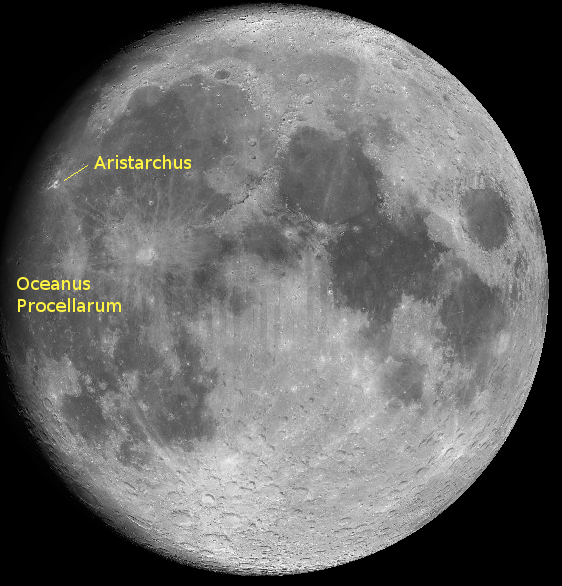
The moon with Aristarchus. Created with Virtual Moon Atlas.
06/15/11 – Ephemeris – The bright planets this week and a total lunar eclipse for Asia
Wednesday, June 15th. Today the sun will be up for 15 hours and 32 minutes, setting at 9:29. The moon, at full today, will rise at 9:35 this evening. Tomorrow the sun will rise at 5:56.
It’s Wednesday and time again to take a look at the whereabouts of the bright planets. The ringed planet Saturn will be visible in the south southwest as it gets dark. It’s near the bright star Spica to its lower left. Spica has a blue tinge, while Saturn is yellowish. It will set at 2:44 a.m. Saturn is a wonderful sight is a telescope with its rings. Jupiter will rise at 3:19 a.m. in the east. Mars will rise at 4:19. Venus now rises too close to sunrise to be seen in the twilight as is Mercury. There will be a total lunar eclipse this afternoon our time, making it completely invisible from here. However it will be perfectly visible from Asia where among others my grandson Chris is serving as a Marine. I’ve emailed him the times which are also available on the Ephemeris Blog.
* Times are for the Traverse City/Interlochen area of Michigan. They may be different for your location.
Addendum
See http://eclipse.gsfc.nasa.gov/OH/OHfigures/OH2011-Fig03.pdf.
I’m giving the timings in both Universal Time (UT), also known as Greenwich Mean Time (GMT) or Zulu and Afghanistan Standard Time (AST) (UT+4.5 hours)
Event                         UT                  AST
Partial Eclipse Starts    15th 18:22            15th 22:52
Total Phase Starts        15th 19:22            15th 23:52
Total Phase Ends          15th 21:03            16th 01:33

Partial Eclipse Ends      15th 02:02            16th 02:32
The moon will enter the earth’s shadow from right to left.
During the total phase of the eclipse (we call it totality), the moon will probably appear red in color with gray near the edge of the earth’s shadow.
If you were on the moon, looking back at the earth at maximum eclipse the earth will appear as a red ring, the total of all the sunrises and sunsets around the earth.
06/10/11 – Ephemeris – The moon tonight
Friday, June 10th. Today the sun will be up for 15 hours and 29 minutes, setting at 9:26. The moon, 2 days past first quarter, will set at 2:40 tomorrow morning. Tomorrow the sun will rise at 5:57.
Tonight the moon is in its gibbous phase. Gibbous means hump backed. One crater that came into light in the last 24 hours is the crater Copernicus, named for the Polish astronomer and cleric who removed the earth from the center of the universe. The crater Copernicus is on the center left on the moon. Its halo of rays will show up better when the moon is full, but now the crater itself can be appreciated. In a telescope its is quite a sight. It has a complex triple central peak, and terraced walls. The small asteroid that hit it less than a billion years ago, struck the moon, gouging out the 56 mile diameter crater we see today. Rebound created the central peaks. An oblique image of it by a Lunar Orbiter in the late 60s was a famous picture of the time.
* Times are for the Traverse City/Interlochen area of Michigan. They may be different for your location.

