05/08/2023 – Ephemeris – How to find Leo the lion in the sky
This is Ephemeris for Monday, May 8th. Today the Sun will be up for 14 hours and 32 minutes, setting at 8:56, and it will rise tomorrow at 6:22. The Moon, 3 days past full, will rise at 12:57 tomorrow morning.
At 10 p.m. the spring constellation of Leo the lion will be high in the south. It can be found by locating the Big Dipper high overhead and imagining that a hole were drilled in the bottom of the bowl to let the water leak out. It would drip on the back of this giant cat. The Lion is standing or lying facing westward. His head and mane are seen in the stars as a backwards question mark. This group of stars is also called the sickle. The bright star Regulus is at the bottom, the dot at the bottom of the question mark. A triangle of stars, to the left of Regulus, is the lion’s haunches. Leo contains some nice galaxies visible in moderate sized telescopes. The stars in Leo’s part of the sky are fewer than those in the winter sky.
The astronomical event times given are for the Traverse City/Interlochen area of Michigan (EDT, UT –4 hours). They may be different for your location.
Addendum

Finding Leo the lion from the Big Dipper with no lines. The orientation is for 10 pm, May 8th. Can you find Leo? The Big Dipper? Created using Cartes du Ciel (Sky Charts).
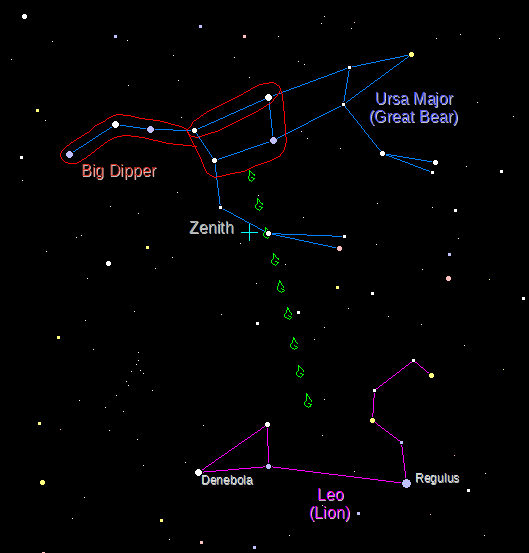
Using the Big Dipper to find Leo. The orientation is for 10 pm on May 8th. For any other time, the orientation would be different, as would the position of the zenith (overhead point). Created using my LookingUp app.
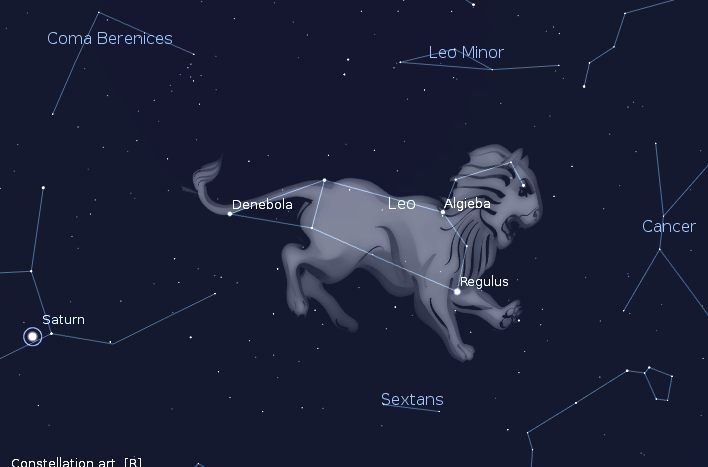
Leo, with drawing of a lion. Created using Stellarium.
Note the star at the left end of Leo is named Denebola. There are several stars that start with “Deneb”. Deneb must mean tail in Arabic because most star names are Arabic in origin. Denebola is the tail of the lion. Deneb Kaitos is the tail of the autumn constellation of Cetus the whale, and Deneb itself is the tail of the summer constellation of Cygnus the swan.
05/05/2023 – Ephemeris – Learn about the upcoming total solar eclipse tonight
This is Ephemeris for Cinco de Mayo, Friday, May 5th. Today the Sun will be up for 14 hours and 25 minutes, setting at 8:52, and it will rise tomorrow at 6:25. The Moon, at full today, will rise at 9:13 this evening.
Eleven months is not too early to plan for a total solar eclipse. On April 8th next year there will be such an eclipse whose path of totality clips the southeastern corner of Michigan. Indianapolis, Toledo and Cleveland also lie in the path of totality. The path runs from Texas to Maine. Member Dan Dall’Olmo will have all the particulars at this month’s meeting of the Grand Traverse Astronomical Society, starting at 8 pm tonight at Northwestern Michigan College’s Joseph H. Rogers Observatory. For those staying home, the Sun for this eclipse will be a bit more covered by the Moon than the 2017 August solar eclipse. We’ll also have another partial solar eclipse to practice on this October 14th.
The astronomical event times given are for the Traverse City/Interlochen area of Michigan (EDT, UT –4 hours). They may be different for your location.
Addendum
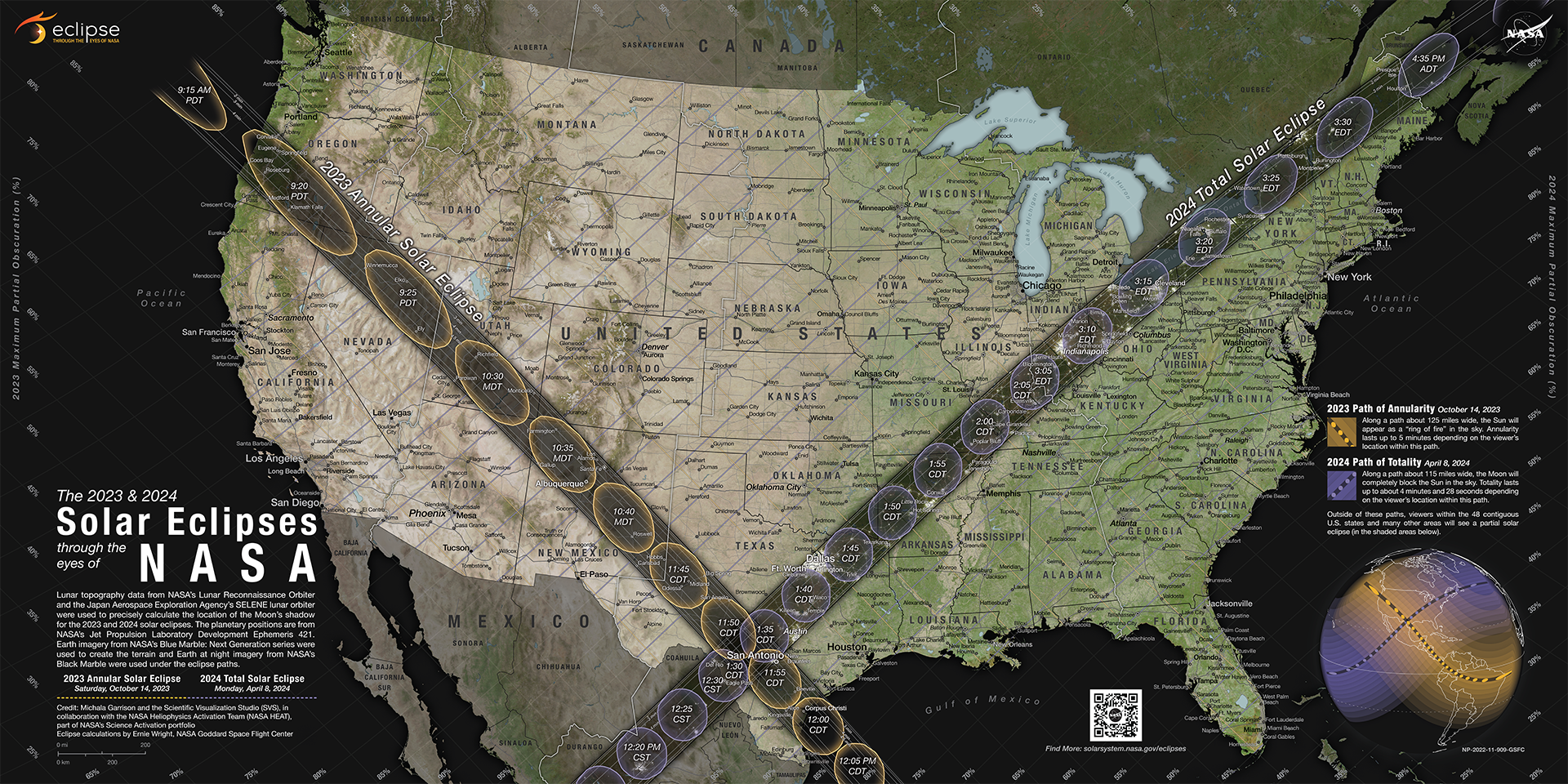
The paths of maximum eclipse of the October 14, 2023, and April 8, 2024. Click or tap on the image to enlarge it. Credit: NASA/Scientific Visualization Studio/Michala Garrison; eclipse calculations by Ernie Wright, NASA Goddard Space Flight Center.
05/04/2023 – Ephemeris – The Moon is not quite as dry as we thought
This is Ephemeris for Thursday, May 4th. Today the Sun will be up for 14 hours and 22 minutes, setting at 8:51, and it will rise tomorrow at 6:27. The Moon, 1 day before full, will set at 6:18 tomorrow morning.
The Moon appears to be bone dry. The Apollo astronauts found no rocks with any water in them, or bound to them chemically. However, remote sensing satellites and an infrared flying observatory have detected hints that water does indeed exist on the Moon. Indeed, water would be worth its weight in gold if discovered there. The South Pole of the Moon has permanently shadowed craters which seem to have water ice in them. Recently the, since decommissioned, SOFIA aircraft, sporting an infrared telescope detected water on the daytime side of the Moon, in quantities, to mix units of measurement, 12 ounces of water per cubic meter of soil in the crater Clavius. It’s a large crater in the Southern Hemisphere of the Moon, and incidentally one of my favorite craters.
Also, recently, the Chinese Chang’e 5 lunar sample return mission detected water in the tiny glass beads that were part of the soil it brought back. The beads were the result of meteorite impacts. Maybe NASA might have another look at the lunar soil the Apollo astronauts brought back.
The astronomical event times given are for the Traverse City/Interlochen area of Michigan (EDT, UT –4 hours). They may be different for your location.
Addendum
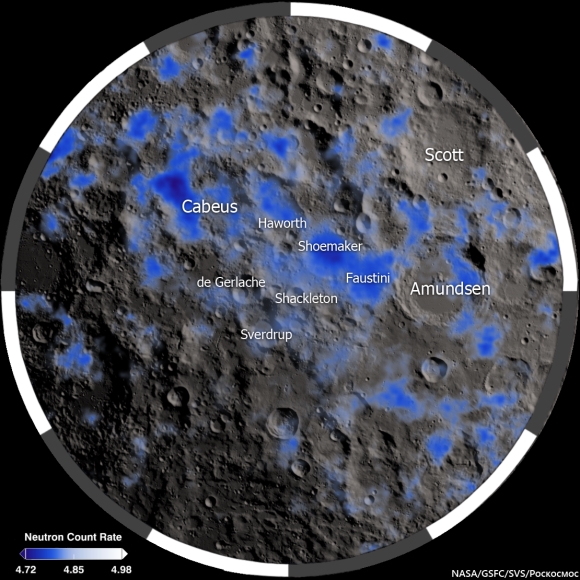
The South Pole of the Moon, where the presence of water ice is detected by the absorption of neutrons by the hydrogen atoms in the ice. Credit NASA/GSFC/SVS/Roscosmos.
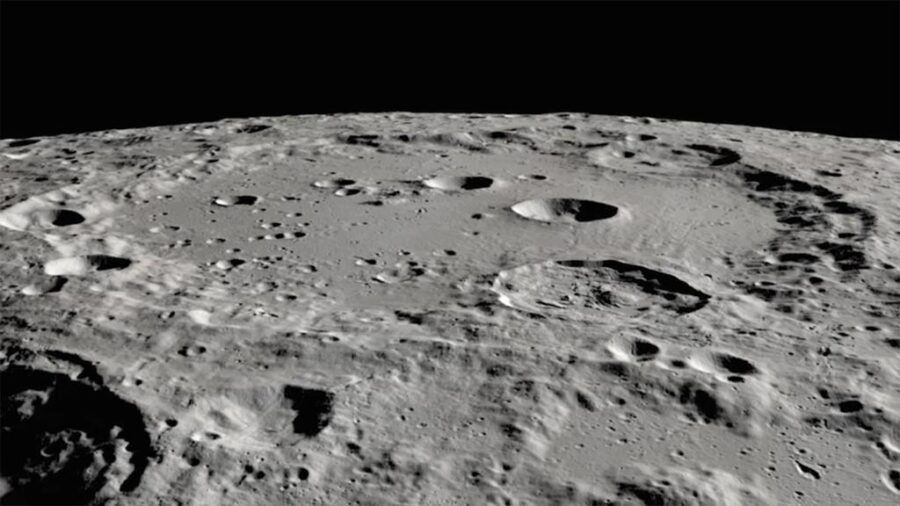
Closeup of Clavius from the Lunar Reconnaissance Orbiter. Credit: NASA/LRO.
05/03/2023 – Ephemeris – Let’s find where the naked-eye planets have wandered off to this week
This is Ephemeris for Wednesday, May 3rd. Today the Sun will be up for 14 hours and 19 minutes, setting at 8:49, and it will rise tomorrow at 6:28. The Moon, 2 days before full, will set at 5:56 tomorrow morning.
Let’s find where the naked-eye planets have wandered off to this week. Venus is our blazing Evening Star, seen in the west all evening. It will set after midnight. The red planet Mars is in Gemini, below Pollux, left of Castor, the namesake stars of the twins. Mars is above and left of Venus by 24 degrees, or almost two and a half times the width of one’s fist held at arm’s length. Venus is closing the gap between them, but will never quite reach Mars while they are in the evening sky. The closest they will get is three and a half degrees or 7 moon diameters apart, before Venus pulls back toward the Sun faster than Mars will. Saturn, low in the southeast by 6 am, is emerging from morning twilight, rising at 4:07 am. Both Jupiter and Mercury are too close to the direction of the Sun to be seen.
The astronomical event times given are for the Traverse City/Interlochen area of Michigan (EDT, UT –4 hours). They may be different for your location.
Addendum
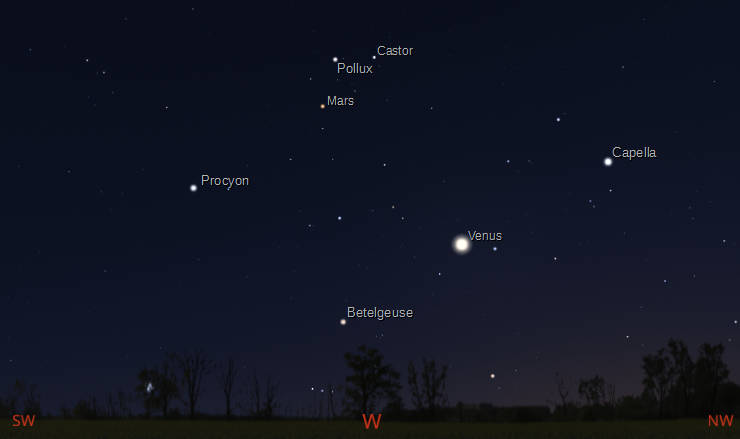
Venus and Mars among the setting winter stars tonight, at 10 pm, May 3rd, 2023. Click or tap on the image to enlarge it. Created using Stellarium, Libreoffice Draw and GIMP.
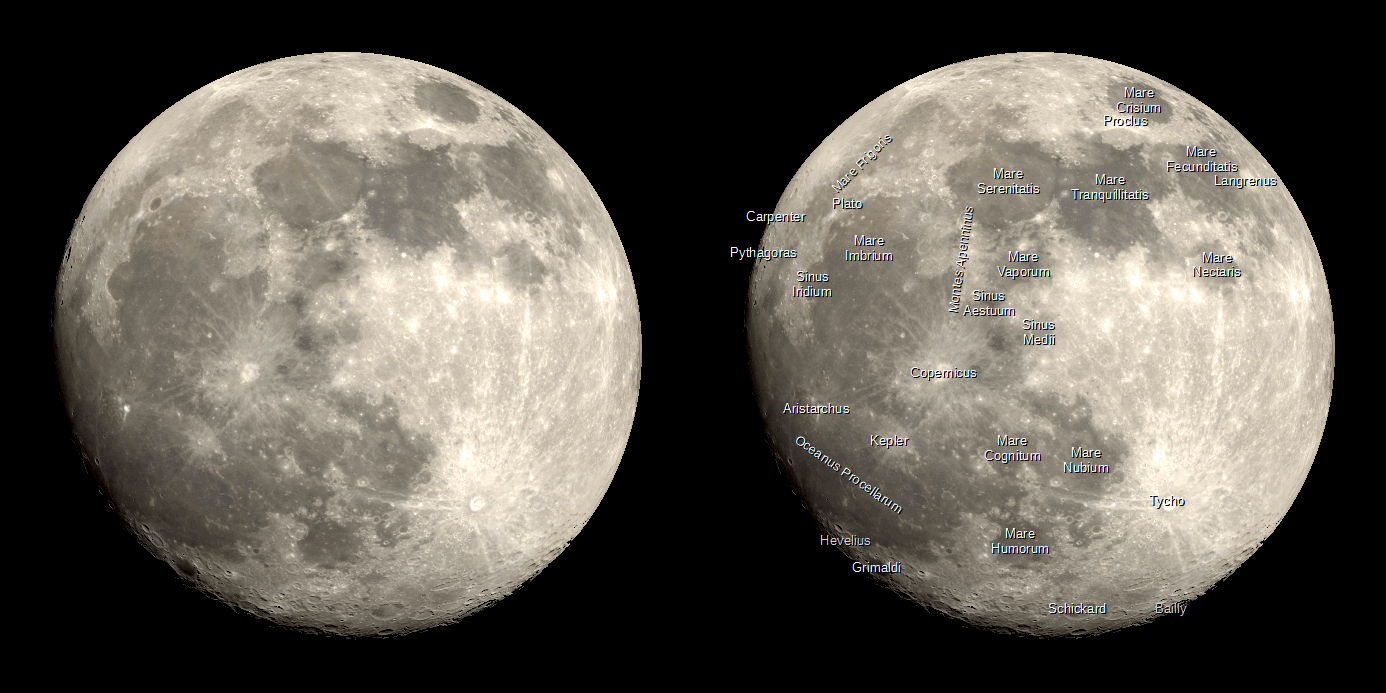
Moon 2 days before full, annotated for 10 pm, May 3, 2023. Created using Stellarium, LibreOffice Draw, and GIMP.
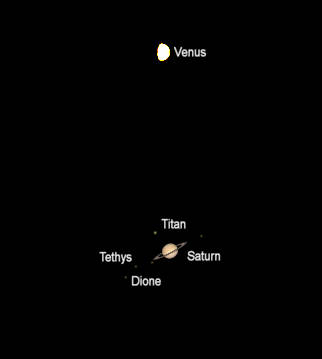
Telescopic Venus and Saturn (north up) as they would be seen in a small telescope, with the same magnification. Apparent diameters: Venus 17.43″ and is 65.2% illuminated; Saturn 16.39″, its rings 38.19″. Mars, too small to be represented here, is 5.30″ in diameter. Created using Cartes du Ciel (Sky Charts).
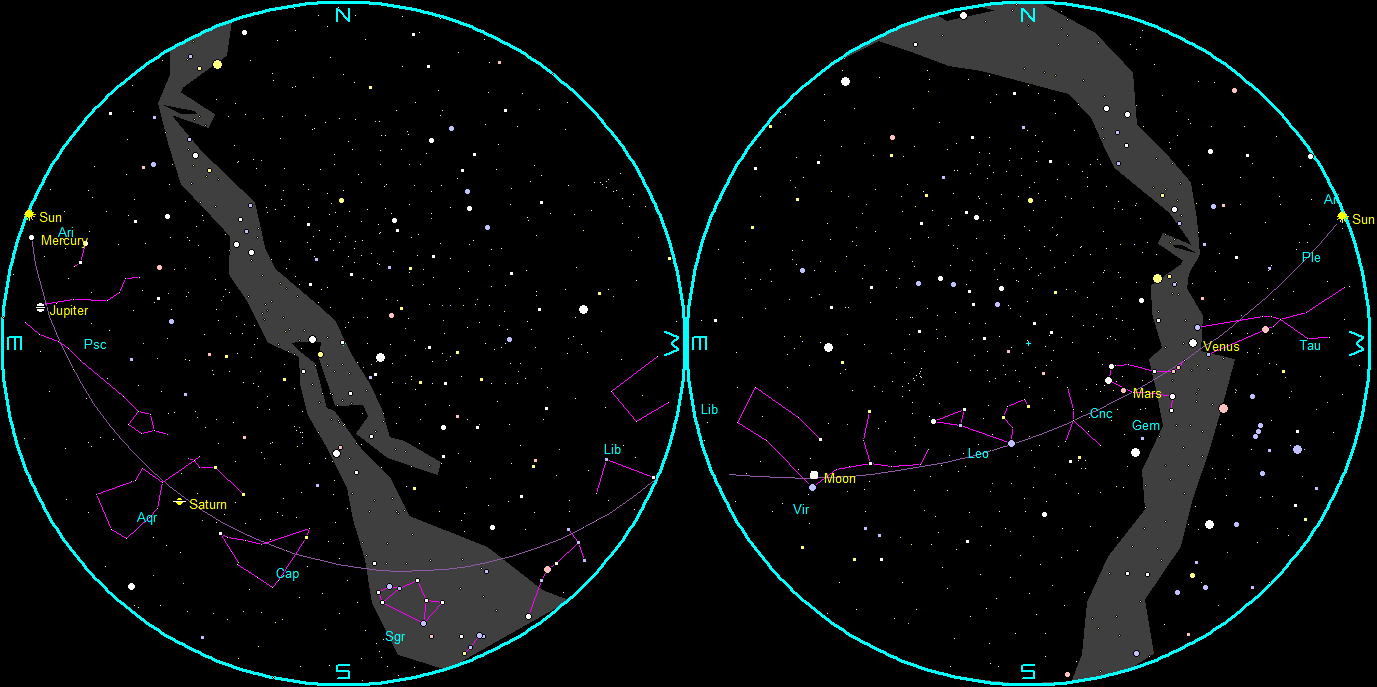
The naked-eye planets and the Moon at sunset and sunrise on a single night, starting with sunset on the right on May 3, 2023. The night ends on the left with sunrise on the 4th. Click or tap on the image to enlarge it. Created using my LookingUp app and GIMP.
05/02/2023 – Ephemeris – SpaceX finally launched its Super Heavy/Starship rocket
This is Ephemeris for Tuesday, May 2nd. Today the Sun will be up for 14 hours and 17 minutes, setting at 8:48, and it will rise tomorrow at 6:30. The Moon, 3 days before full, will set at 5:37 tomorrow morning.
On April 20th SpaceX finally launched their Starship atop the Super Heavy, which is the booster for the Starship for an attempted orbital test flight, from Star Base at Boca Chica, Texas. As we all know, it did not reach orbit. It made it about 36 kilometers up or about 22 miles before it lost control and had to be destroyed, however what it did to the launchpad and its surroundings is rather disheartening Elon Musk thought he could get away with not having a flame diverter underneath the launch mount. The Super heavy, which is undoubtedly the most powerful rocket in the world, dug a hole underneath the launch mount and threw big chunks of concrete all over the place damaging their launch infrastructure, and raining debris on a neighboring town. SpaceX will have to make lots of changes before they can launch again.
The astronomical event times given are for the Traverse City/Interlochen area of Michigan (EDT, UT –4 hours). They may be different for your location.
Addendum

Super Heavy and Starship, beginning to climb amid clouds of dust and debris. Screen grab from Sky News video.
05/01/2023 – Ephemeris – Previewing May Skies
This is Ephemeris for Monday, the first of May. Today the Sun will be up for 14 hours and 14 minutes, setting at 8:47, and it will rise tomorrow at 6:31. The Moon, halfway from first quarter to full, will set at 5:20 tomorrow morning.
Let’s look ahead at the month of May, the month when the promise of spring is finally fulfilled. Daylight hours in the Interlochen/Traverse City area will increase from 14 hours and 14 minutes today to 15 hours 19 minutes on the 31st. The altitude, or angle, of the Sun above the southern horizon at local noon will ascend from 60 degrees today to 67 degrees at month’s end. The altitude of the Sun in the Straits area will be a degree lower than that. Local apparent noon this month, when the Sun passes due south, will be about 1:38 p.m. Early this month we’ll have The Eta Aquariid meteor shower early in the morning, though it will be hindered by a bright Moon. Venus and Mars are our evening planets. Venus will continue to approach Mars all month.
The astronomical event times given are for the Traverse City/Interlochen area of Michigan (EST, UT –4 hours). They may be different for your location.
Addendum
May Evening Star Chart
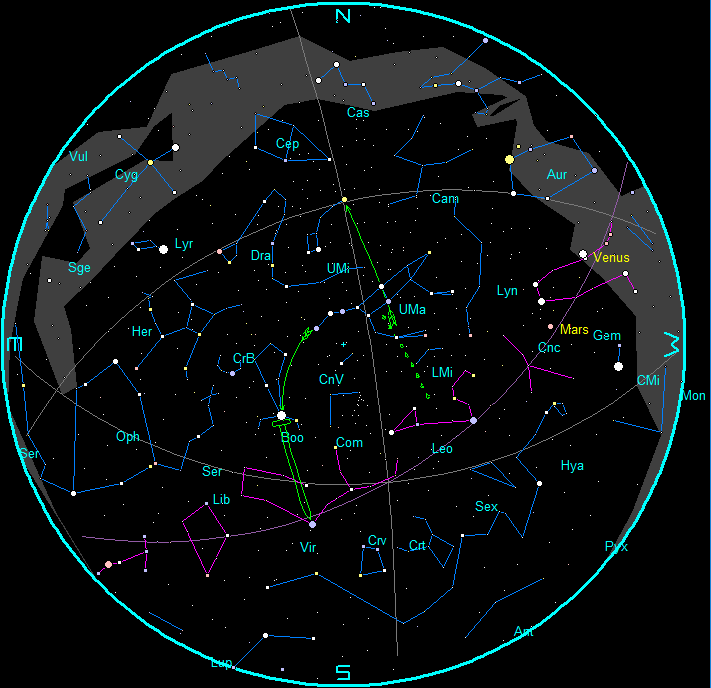
Star Chart for May 2023 (11 p.m. EDT, May 15, 2023). Click or tap on image to enlarge it. Created using my LookingUp program.
The planets and stars are plotted for the 15th at 11 p.m. EDT in the evening and 4 a.m. for the morning chart. These are the chart times. Note that Traverse City is located approximately 45 minutes behind our time meridian, West 75° longitude. (An hour 45 minutes behind our daylight saving time meridian during EDT). To duplicate the star positions on a planisphere you may have to set it to 1 hour 45 minutes earlier than the current time.
Note, the chart times of 11 p.m. and 4 a.m. are for the 15th. For each week before the 15th, add ½ hour (28 minutes if you’re picky). For each week after the 15th, subtract ½ hour or 28 minutes. The planet positions are updated each Wednesday on this blog. For planet positions on dates other than the 15th, check the Wednesday planet posts on this blog for weekly positions.
May Morning Star Chart
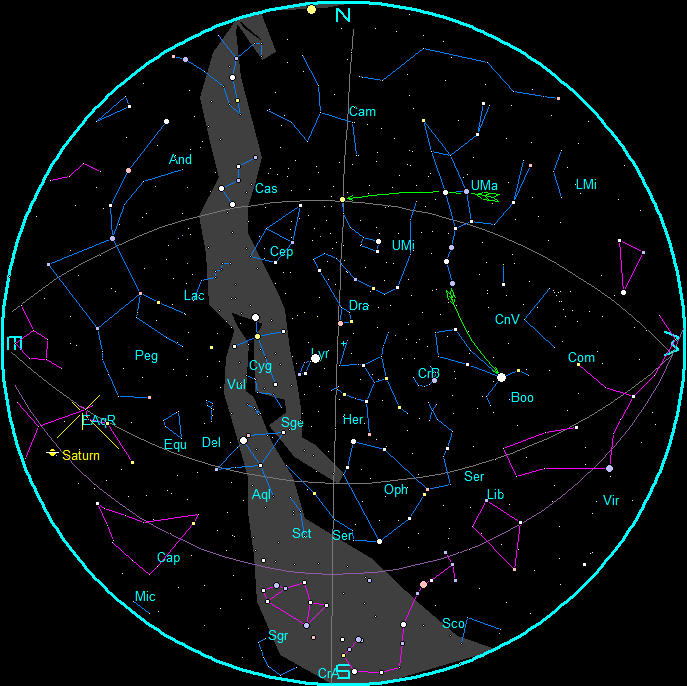
Star Chart for May mornings, 2023 (4 a.m. EDT, May 15, 2023). Click or tap on image to enlarge it. Created using my LookingUp program.
For a list of constellation names to go with the abbreviations, click here.
- Pointer stars at the front of the bowl of the Big Dipper point to Polaris, the North Star.
- Leaky dipper drips on Leo
- Follow the arc of the handle of the Big Dipper to the star Arcturus, and
- Extend like a spike to Spica,
- EaqR is the radiant of the Eta Aquariid meteor shower that peaks on the 5th.
Twilight Limits, Nautical and Astronomical
| EDT | |||||||
| Morning | Twilight | Evening | Twilight | Dark | Night | Moon | |
| Date | Astro. | Nautical | Nautical | Astro. | Start | End | Illum. |
| 2023-05-01 | 4h41m | 5h26m | 22h02m | 22h46m | – | – | 0.87 |
| 2023-05-02 | 4h39m | 5h24m | 22h03m | 22h48m | – | – | 0.93 |
| 2023-05-03 | 4h37m | 5h22m | 22h05m | 22h50m | – | – | 0.97 |
| 2023-05-04 | 4h35m | 5h20m | 22h06m | 22h52m | – | – | 1.00 |
| 2023-05-05 | 4h33m | 5h19m | 22h08m | 22h54m | – | – | 1.00 |
| 2023-05-06 | 4h31m | 5h17m | 22h10m | 22h56m | – | – | 0.97 |
| 2023-05-07 | 4h29m | 5h15m | 22h11m | 22h58m | 22h58m | 23h48m | 0.93 |
| 2023-05-08 | 4h27m | 5h14m | 22h13m | 23h00m | 23h00m | – | 0.85 |
| 2023-05-09 | 4h24m | 5h12m | 22h14m | 23h02m | 23h02m | 0h58m | 0.76 |
| 2023-05-10 | 4h22m | 5h10m | 22h16m | 23h04m | 23h04m | 1h56m | 0.66 |
| 2023-05-11 | 4h20m | 5h09m | 22h17m | 23h06m | 23h06m | 2h42m | 0.55 |
| 2023-05-12 | 4h18m | 5h07m | 22h19m | 23h08m | 23h08m | 3h17m | 0.43 |
| 2023-05-13 | 4h16m | 5h06m | 22h20m | 23h10m | 23h10m | 3h45m | 0.32 |
| 2023-05-14 | 4h14m | 5h04m | 22h22m | 23h12m | 23h12m | 4h08m | 0.22 |
| 2023-05-15 | 4h12m | 5h03m | 22h23m | 23h14m | 23h14m | 4h12m | 0.14 |
| 2023-05-16 | 4h10m | 5h01m | 22h25m | 23h16m | 23h16m | 4h10m | 0.07 |
| 2023-05-17 | 4h09m | 5h00m | 22h26m | 23h18m | 23h18m | 4h09m | 0.02 |
| 2023-05-18 | 4h07m | 4h58m | 22h28m | 23h20m | 23h20m | 4h07m | 0.00 |
| 2023-05-19 | 4h05m | 4h57m | 22h29m | 23h22m | 23h22m | 4h05m | 0.00 |
| 2023-05-20 | 4h03m | 4h56m | 22h31m | 23h23m | 23h23m | 4h03m | 0.03 |
| 2023-05-21 | 4h01m | 4h54m | 22h32m | 23h25m | 23h51m | 4h01m | 0.07 |
| 2023-05-22 | 3h59m | 4h53m | 22h34m | 23h27m | – | 3h59m | 0.12 |
| 2023-05-23 | 3h58m | 4h52m | 22h35m | 23h29m | 0h43m | 3h58m | 0.20 |
| 2023-05-24 | 3h56m | 4h51m | 22h36m | 23h31m | 1h26m | 3h56m | 0.28 |
| 2023-05-25 | 3h54m | 4h49m | 22h38m | 23h33m | 1h59m | 3h54m | 0.37 |
| 2023-05-26 | 3h53m | 4h48m | 22h39m | 23h35m | 2h26m | 3h53m | 0.46 |
| 2023-05-27 | 3h51m | 4h47m | 22h40m | 23h37m | 2h48m | 3h51m | 0.55 |
| 2023-05-28 | 3h49m | 4h46m | 22h42m | 23h38m | 3h07m | 3h49m | 0.65 |
| 2023-05-29 | 3h48m | 4h45m | 22h43m | 23h40m | 3h25m | 3h48m | 0.74 |
| 2023-05-30 | 3h47m | 4h44m | 22h44m | 23h42m | 3h42m | 3h47m | 0.82 |
| 2023-05-31 | 3h45m | 4h43m | 22h45m | 23h44m | – | – | 0.90 |
The twilight calendar was generated using Cartes du Ciel (Sky Charts), with some corrections.
See my blog post: Twilight Zone for the definitions of the different periods of twilight here: https://bobmoler.wordpress.com/2018/09/27/.
NASA Calendar of Planetary Events
LU              Ephemeris of Sky Events for Interlochen/TC
May 2023    Local time zone: EDT
+-----------------------------------------------------------------------+
| DATE |  SUN     SUN  DAYLIGHT|   TWILIGHT*    |MOON  RISE OR    ILLUM |
|      |  RISE    SET    HOURS |  END    START  |PHASE SET** TIME FRACTN|
+=======================================================================+
|Mon  1| 06:33a  08:47p  14:14 | 09:59p  05:21a |      Set  05:20a   86%|
|Tue  2| 06:31a  08:48p  14:17 | 10:01p  05:19a |      Set  05:37a   92%|
|Wed  3| 06:30a  08:49p  14:19 | 10:02p  05:17a |      Set  05:56a   97%|
|Thu  4| 06:28a  08:51p  14:22 | 10:04p  05:15a |      Set  06:18a   99%|
|Fri  5| 06:27a  08:52p  14:25 | 10:06p  05:14a |Full  Rise 09:13p  100%|
|Sat  6| 06:25a  08:53p  14:27 | 10:07p  05:12a |      Rise 10:31p   98%|
+------+-----------------------+----------------+-----------------------+
|Sun  7| 06:24a  08:54p  14:30 | 10:09p  05:10a |      Rise 11:47p   94%|
|Mon  8| 06:23a  08:56p  14:32 | 10:10p  05:08a |      Rise 12:57a   87%|
|Tue  9| 06:22a  08:57p  14:35 | 10:12p  05:07a |      Rise 01:56a   78%|
|Wed 10| 06:20a  08:58p  14:37 | 10:13p  05:05a |      Rise 02:42a   68%|
|Thu 11| 06:19a  08:59p  14:40 | 10:15p  05:04a |      Rise 03:17a   57%|
|Fri 12| 06:18a  09:00p  14:42 | 10:16p  05:02a |L Qtr Rise 03:44a   45%|
|Sat 13| 06:17a  09:01p  14:44 | 10:18p  05:00a |      Rise 04:07a   34%|
+------+-----------------------+----------------+-----------------------+
|Sun 14| 06:15a  09:03p  14:47 | 10:19p  04:59a |      Rise 04:28a   24%|
|Mon 15| 06:14a  09:04p  14:49 | 10:21p  04:57a |      Rise 04:47a   15%|
|Tue 16| 06:13a  09:05p  14:51 | 10:23p  04:56a |      Rise 05:08a    8%|
|Wed 17| 06:12a  09:06p  14:53 | 10:24p  04:54a |      Rise 05:30a    3%|
|Thu 18| 06:11a  09:07p  14:55 | 10:25p  04:53a |      Rise 05:56a    1%|
|Fri 19| 06:10a  09:08p  14:58 | 10:27p  04:52a |New   Set  09:38p    0%|
|Sat 20| 06:09a  09:09p  15:00 | 10:28p  04:50a |      Set  10:48p    2%|
+------+-----------------------+----------------+-----------------------+
|Sun 21| 06:08a  09:10p  15:02 | 10:30p  04:49a |      Set  11:50p    6%|
|Mon 22| 06:07a  09:11p  15:04 | 10:31p  04:48a |      Set  12:43a   11%|
|Tue 23| 06:06a  09:12p  15:05 | 10:33p  04:46a |      Set  01:25a   18%|
|Wed 24| 06:06a  09:13p  15:07 | 10:34p  04:45a |      Set  01:59a   26%|
|Thu 25| 06:05a  09:14p  15:09 | 10:35p  04:44a |      Set  02:26a   35%|
|Fri 26| 06:04a  09:15p  15:11 | 10:37p  04:43a |      Set  02:48a   44%|
|Sat 27| 06:03a  09:16p  15:13 | 10:38p  04:42a |F Qtr Set  03:07a   53%|
+------+-----------------------+----------------+-----------------------+
|Sun 28| 06:02a  09:17p  15:14 | 10:39p  04:41a |      Set  03:24a   63%|
|Mon 29| 06:02a  09:18p  15:16 | 10:40p  04:40a |      Set  03:41a   72%|
|Tue 30| 06:01a  09:19p  15:17 | 10:42p  04:39a |      Set  03:59a   81%|
|Wed 31| 06:01a  09:20p  15:19 | 10:43p  04:38a |      Set  04:19a   88%|
+-----------------------------------------------------------------------+
* Nautical Twilight
** Moonrise or moonset, whichever occurs between sunset and the next
   sunrise
05/29/2023 – Ephemeris Extra – Clouds will cause the Star Party, tonight, to be canceled, however…
The Grand Traverse Astronomical Society members will not come out this afternoon and evening to The Dune Climb at Sleeping Bear Dunes National Lakeshore if it stays cloudy. However, the park rangers will be there unless it is raining with alternate activities.
The next scheduled Sun & Star Party will be May 27, the Saturday of the Memorial Day weekend.
04/28/2023 – Ephemeris – International Astronomy Day is tomorrow
This is Bob Moler with Ephemeris for Arbor Day, Friday, April 28th. Today the Sun will be up for 14 hours and 6 minutes, setting at 8:43, and it will rise tomorrow at 6:36. The Moon, 1 day past first quarter, will set at 4:23 tomorrow morning.
Tomorrow is International Astronomy Day. The Grand Traverse Astronomical Society (GTAS) will celebrate the event with a Sun and Star Party at the Dune Climb area of the Sleeping Bear Dunes National Lakeshore. There will be a solar viewing period from 6 pm to about 7:30 pm or so, when the Sun will set over the dune. The society has two hydrogen alpha solar telescopes, and members have another two, to view the Sun’s chromosphere and prominences. Plus, other members have white light filtered telescopes to view sunspots on the face of the Sun. Night viewing will start at 9 pm with the Moon and Venus featured, along with the brighter telescopic wonders of spring. But only if the skies are clear or mostly clear.
The next GTAS event at the Sleeping Bear Dunes will be Saturday, May 27th, with a program like this Saturday’s. What we call a Sun ‘n Star Party.
The astronomical event times given are for the Traverse City/Interlochen area of Michigan (EST, UT –4 hours). They may be different for your location.
Addendum
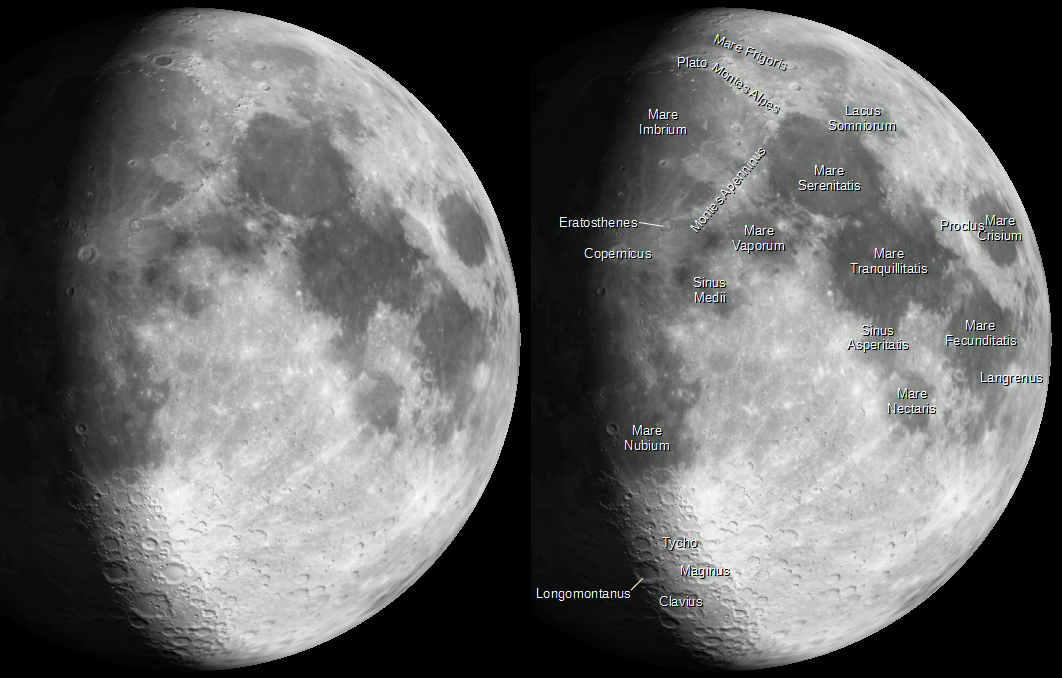
The Moon for Astronomy Day, 2023, two days after first quarter or 9 days old. Some of the more prominent features labeled. Created using Virtual Moon Atlas, GIMP and LibreOffice Draw.
04/27/2023 – Ephemeris – Astronomy Day is this Saturday, April 29, 2023
This is Bob Moler with Ephemeris for Thursday, April 27th. Today the Sun will be up for 14 hours and 3 minutes, setting at 8:42, and it will rise tomorrow at 6:37. The Moon, at first quarter today, will set at 3:59 tomorrow morning.
It is the latter part of April or first part of May that the spring celebration of International Astronomy Day occurs. It’s generally the Saturday closest to first quarter moon. That puts it to this Saturday, two days hence. This year, the Grand Traverse Astronomical Society will celebrate the event with a Sun and Star Party at the Sleeping Bear Dunes National Lakeshore, more specifically at the Dune Climb. More on the schedule tomorrow, but only if weather permits. The time around first quarter is the best time to view the Moon, if you aren’t out to view a specific lunar feature. The rugged highlands to the south and the smooth maria or seas to the north are seen at their best near the sunrise line, we call the terminator, due to the long shadows that are cast.
The astronomical event times given are for the Traverse City/Interlochen area of Michigan (EST, UT –4 hours). They may be different for your location.
Addendum
The Moon for Astronomy Day, 2023, two days after first quarter or 9 days old. Some of the more prominent features labeled. Created using Virtual Moon Atlas, GIMP and LibreOffice Draw.
Translations of some lunar feature names according to Virtual Moon Atlas
Lacus Somniorum – Lake of Dreams
Mare Crisium – Sea of Crises
Mare Frigoris – Sea of Cold
Mare Humorum – Sea of Moisture
Mare Imbrium – Sea of Showers
Mare Nubium – Sea of Clouds
Mare Serenitatis – Sea of Serenity
Mare Tranquillitatis – Sea of Tranquility
Mare Vaporum – Sea of Vapors
Montes Alpes – Alps Mountains
Montes Apenninus – Apennines Mountains
Oceanus Procellarum – Ocean of Storms
Sinus Asperitatis – Golfe des Asperites
Sinus Iridium – Bay of Rainbows
Sinus Medii – Central Bay
04/26/2023 – Ephemeris – Let’s find where the naked-eye planets have wandered off to this week
This is Ephemeris for Wednesday, April 26th. Today the Sun will be up for 14 hours even, setting at 8:41, and it will rise tomorrow at 6:39. The Moon, 1 day before first quarter, will set at 3:28 tomorrow morning.
Let’s find where the naked-eye planets have wandered off to this week. Venus is our blazing Evening Star, seen in the west all evening. It will set after midnight. It’s in Gemini, below the namesake stars of the twins Castor on the right and Pollux on the left. Pollux is a bit below and to the right of the Moon tonight. Mars is above and left of Venus. Venus is closing the gap between them, but will never quite reach Mars while they are in the evening sky. The closest they will get is three and a half degrees or 7 moon diameters apart, before Venus pulls back toward the Sun faster than Mars. They won’t cross paths until February of next year. Saturn is emerging from morning twilight, rising at 4:33 am in the east-southeast. Both Jupiter and Mercury are too close to the direction of the Sun to be seen.
The astronomical event times given are for the Traverse City/Interlochen area of Michigan (EST, UT –4 hours). They may be different for your location.
Addendum
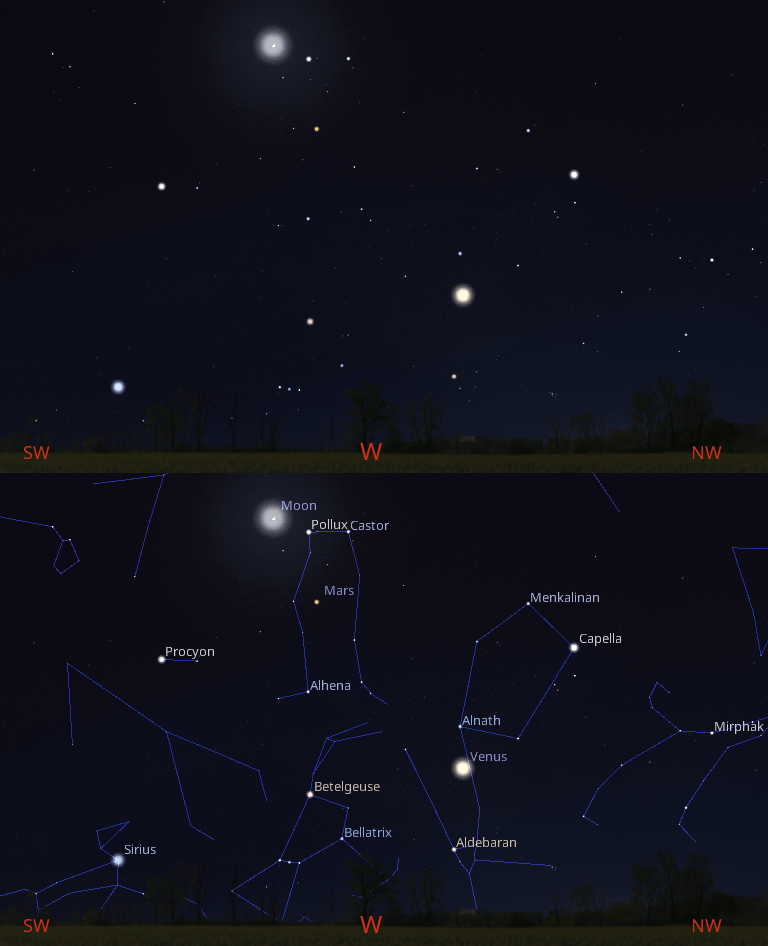
Evening planets and stars looking westward at 10 pm tonight, April 26, 2023. Click or tap on the image to enlarge it. Created using Stellarium and GIMP.
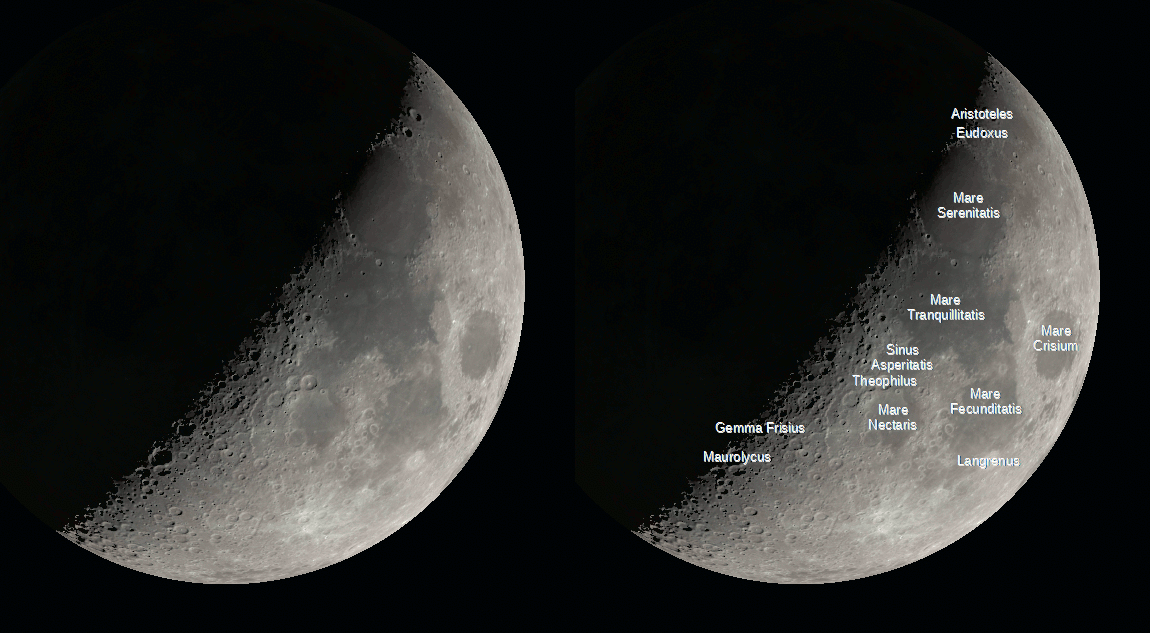
The Moon, one day before first quarter tonight, April 26, 2023, with prominent features labeled. Created using Stellarium, GIMP and LibreOffice Draw.
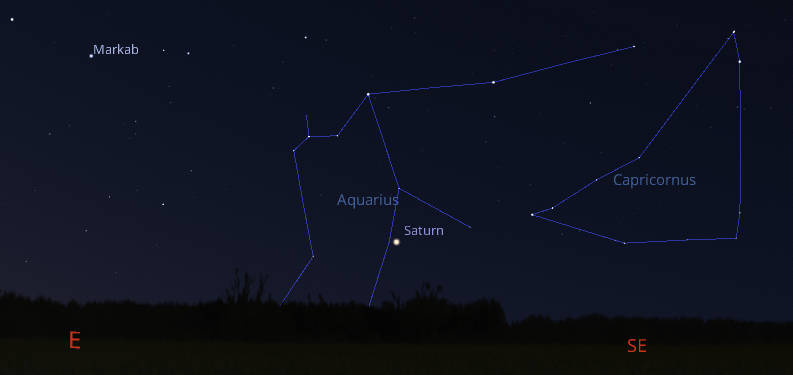
Saturn, low in the east-southeast at 5:30 am, April 27, 2023. Created using Stellarium.
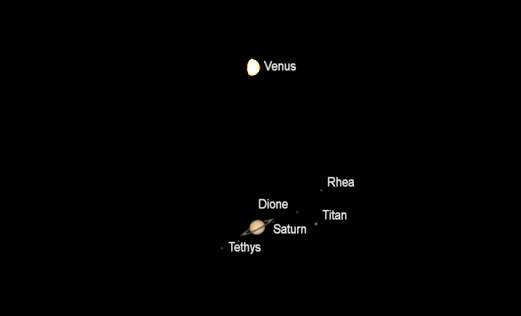
Telescopic Venus and Saturn (north up) as they would be seen in a small telescope, with the same magnification. Apparent diameters: Venus 16.51″ and is 68.1% illuminated; Saturn 16.23″, its rings 37.80″. Mars is too small to be represented here. It is 5.5″ in diameter. Created using Cartes du Ciel (Sky Charts).
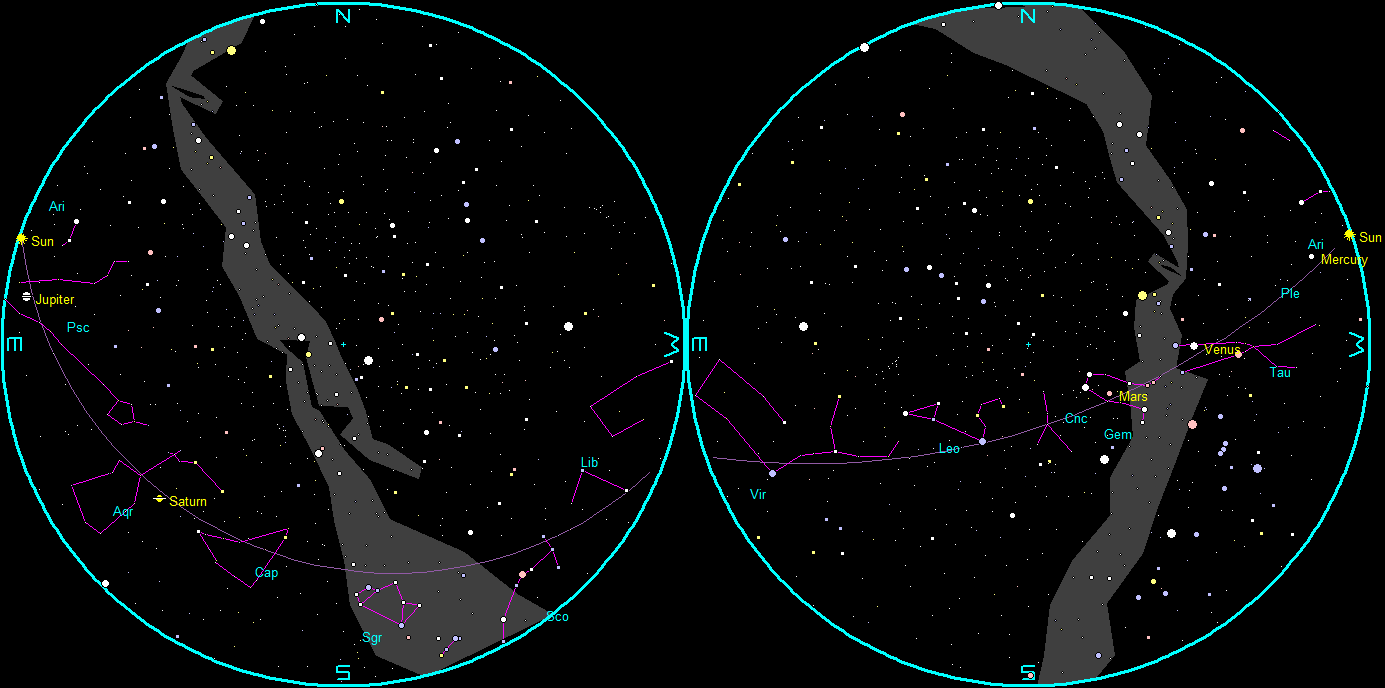
The naked-eye planets and the Moon at sunset and sunrise on a single night, starting with sunset on the right on April 26, 2023. The night ends on the left with sunrise on the 27th. Click or tap on the image to enlarge it. Created using my LookingUp app and GIMP.
 Bob Moler's Ephemeris Blog