04/25/2023 – Ephemeris – The Moon is passing Mars today
This is Bob Moler with Ephemeris for Tuesday, April 25th. Today the Sun will be up for 13 hours and 57 minutes, setting at 8:40, and it will rise tomorrow at 6:40. The Moon, 2 days before first quarter, will set at 2:50 tomorrow morning.
Tonight, the Moon and the planet Mars will appear close to each other. The Red Planet will appear just below and left of the waxing crescent Moon. Mars is a lot dimmer than it was last December. That’s because it is a lot farther away than it was back then, 157 versus 51 million miles (253 versus 82 million kilometers). Mars is the planet with the greatest distance variation percentage over its synodic period, that is, from opposition to the next opposition. It also has the longest synodic period, at 26 months on average. That’s why opportunities to launch spacecraft only occur every 26 months. The least energy it takes to get to Mars occurs when a spacecraft is launched a few months before opposition, when Mars is at its closest, to arrive several months after opposition.
The astronomical event times given are for the Traverse City/Interlochen area of Michigan (EST, UT –4 hours). They may be different for your location.
Addendum
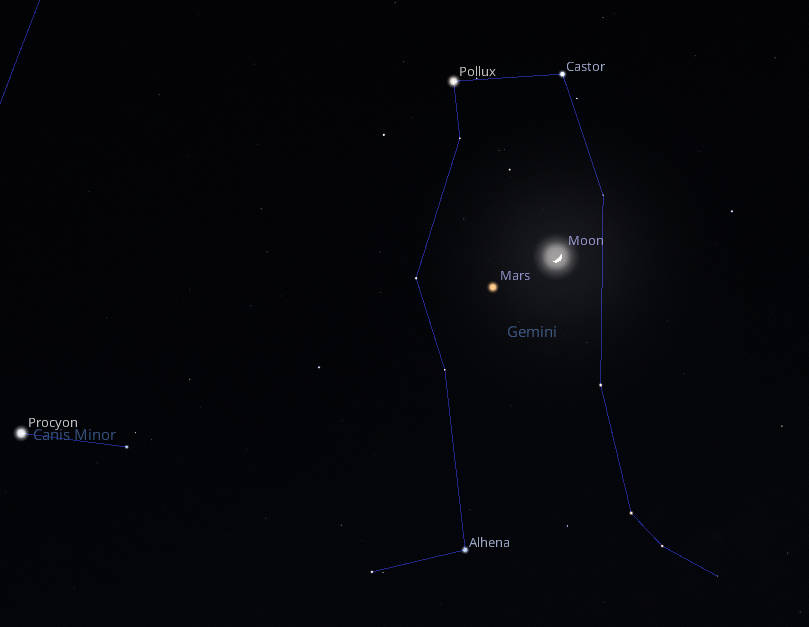
The Moon and Mars as they should appear in the west tonight, April 25, 2023, at 10 pm. Created using Stellarium.
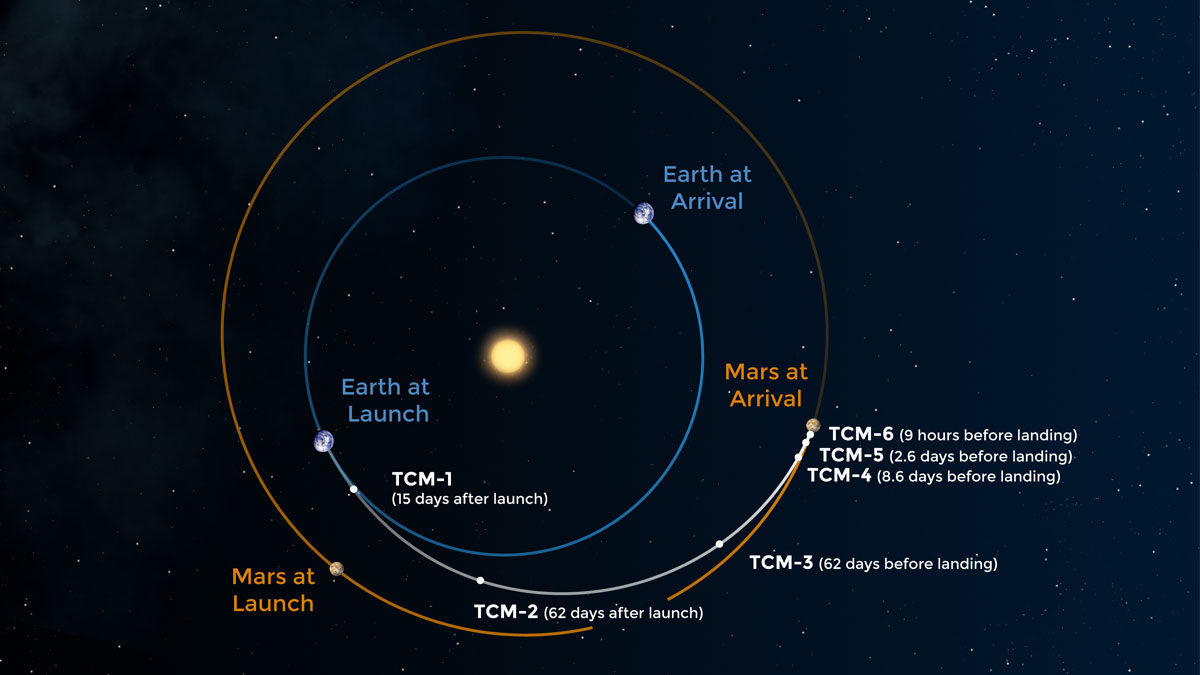
Illustration of the route Mars 2020 (Perseverance) took to arrive at the Red Planet, including several trajectory correction maneuvers (TCMs) to adjust its flight path. Credit NASA/JPL.
04/24/2023 – Ephemeris – The reason for the Moon’s phases
This is Bob Moler with Ephemeris for Monday, April 24th. Today the Sun will be up for 13 hours and 55 minutes, setting at 8:38, and it will rise tomorrow at 6:42. The Moon, 3 days before first quarter, will set at 2:02 tomorrow morning.
The Moon’s changing appearance over the month may seem to be mysterious at first glance. Maybe because one may think that the objects in the sky are somehow different from the familiar objects we see around us on the Earth. In ancient times, especially the Greeks, thought that everything in the heavens was perfect and spotless. They explained the definite markings we see as the man-in-the-moon as a reflection of the Earth by a spotless Moon. The Moon’s phases are simply light and shadow on a ball in the sunlight. Sometime, when the Moon appears in the daytime, take a small ball, like a golf ball and hold it up to the Moon, while the ball is also in sunlight, and the small ball will exhibit the same phase as the Moon.
The astronomical event times given are for the Traverse City/Interlochen area of Michigan (EST, UT –4 hours). They may be different for your location.
Addendum
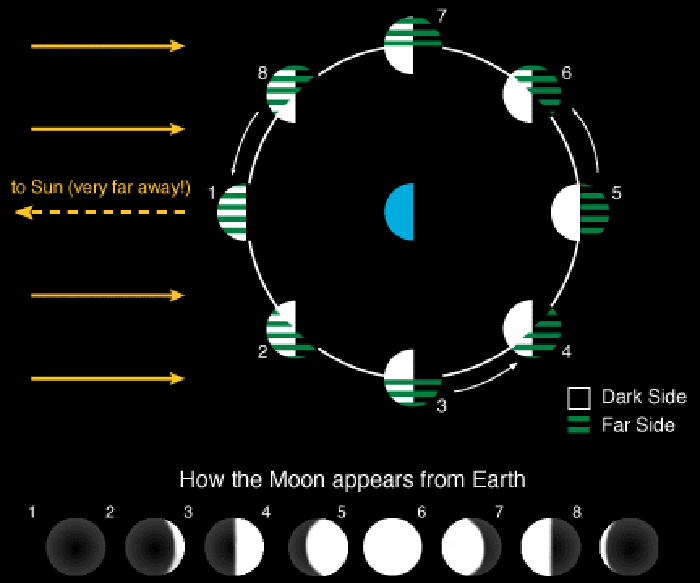
This is the best diagram of the Moon’s phases and how the it appears from the Earth. Credit http://planetfacts.org/phases-of-the-moon/ which I recommend.
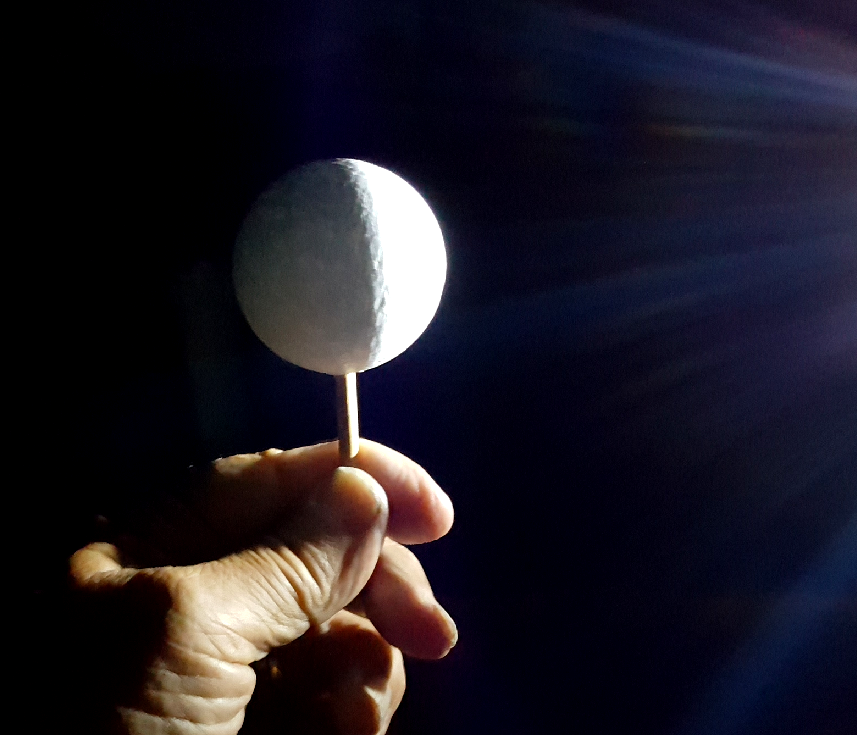
A demonstration of the Moon’s crescent phase with the styrofoam moon ball we use for Project Astro held up to a light off frame to the right. The line between the bright (day) and dark (night) side of the ball, moon or planet is called the terminator. The night side of the ball is illuminated a bit by the translucency of the ball, and the reflection off my hand. Note the roughness of the ball is visible only at the terminator, where the shadows are longest. I photographed this outside at night to minimize the ball’s nighttime illumination.
04/21/2023 – Ephemeris – The first major meteor shower of spring reaches peak this weekend
This is Ephemeris for Friday, April 21st. Today the Sun will be up for 13 hours and 46 minutes, setting at 8:35, and it will rise tomorrow at 6:47. The Moon, 1 day past new, will set at 10:44 this evening.
Saturday night and Sunday morning will see the peak of the Lyrid meteor shower. This is the first of two major meteor showers of spring. The other one in two weeks will have to compete with a full Moon. This meteor shower will be visible all night. At the end of twilight the radiant of the shower, where the meteors will seem to come from, will be low in the northeast, to the right of the bright star Vega in the constellation of Lyra the harp, for which the meteor shower is named. The radiant point is actually between the constellations of Lyra and Hercules. Only 15 to 20 meteors an hour will be expected when the radiant is nearly overhead as morning twilight starts in the 5 am hour. The most famous meteor shower, for us, is the Perseids of August reaching peak on the morning of the 13th of August which will be seen in dark skies for most of the night.
The astronomical event times given are for the Traverse City/Interlochen area of Michigan (EST, UT –4 hours). They may be different for your location.
Addendum
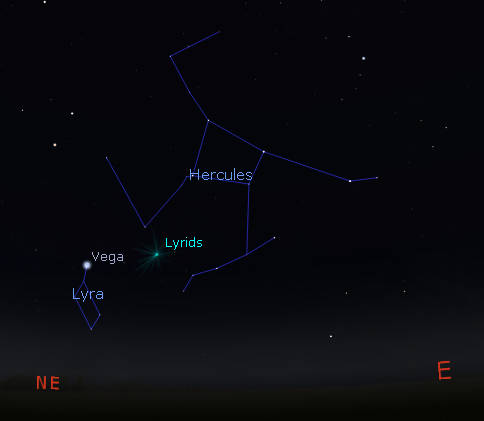
Lyrid radiant at 11 pm, looking to the east-northeast. The meteors will be seen all over the sky, but their tracks can be traced back to the radiant point, like the parallel rails of a train track recede to a point in the distance. Created using Stellarium.
04/20/2023 – Ephemeris – There’s a hybrid solar eclipse happening today*
This is Ephemeris for Thursday, April 20th. Today the Sun will be up for 13 hours and 43 minutes, setting at 8:33, and it will rise tomorrow at 6:48. The Moon is new today, and won’t be visible.
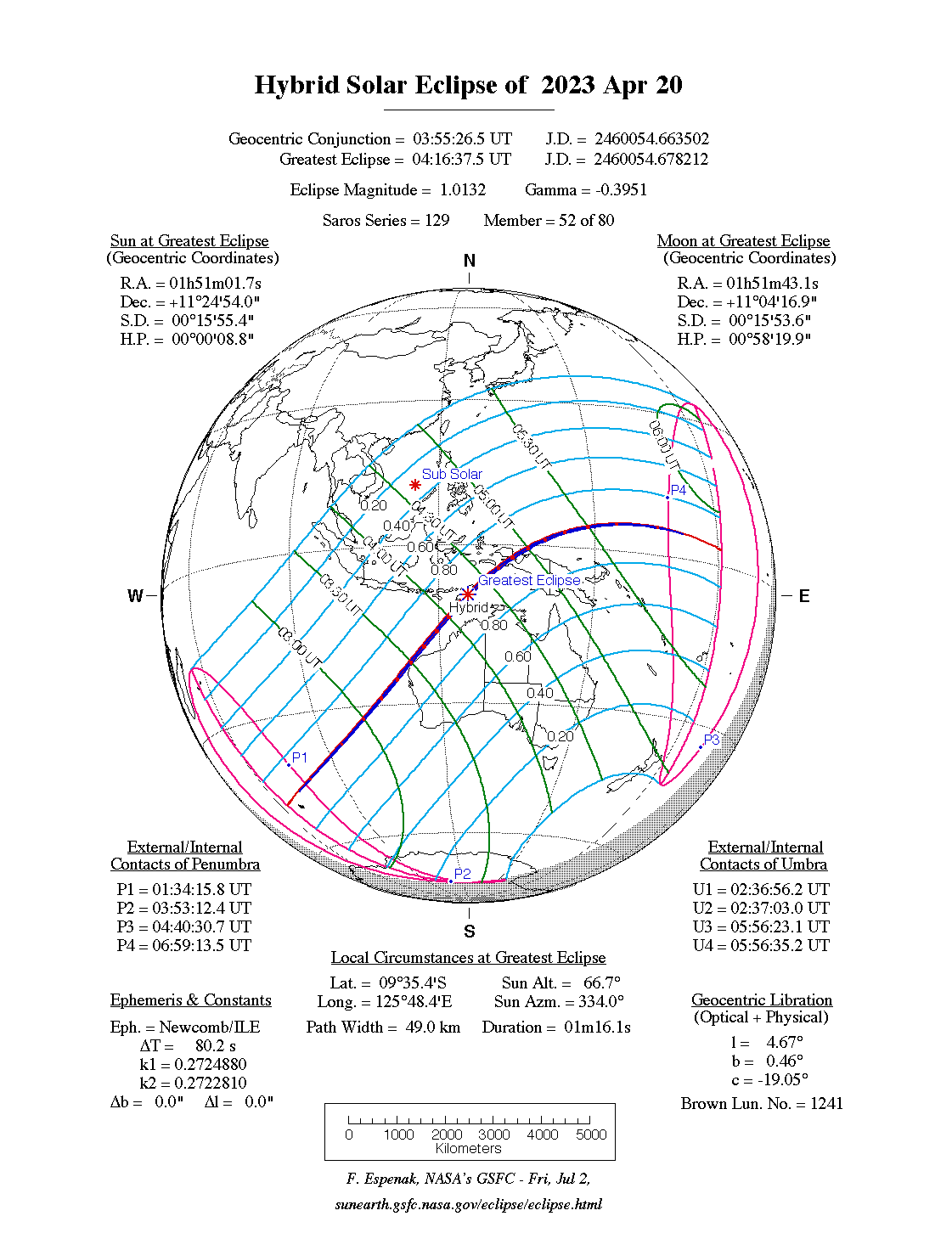
Last night and in the early morning hours this morning, for us, there was a solar eclipse visible from the Indian Ocean, through Indonesia and ending in the Pacific Ocean. This was a type of eclipse that I haven’t talked about before, a hybrid eclipse. It started at sunrise with the Moon too far away to completely cover the face of the Sun, as an annular eclipse. The central part of the eclipse path, due to the fact that the Earth is a sphere, was nearly four thousand miles closer to the Moon than at sunrise and sunset, evolves into a total eclipse. As the Moon’s shadow falls off toward the limb of the Earth, the increasing distance of the shadow to the Earth’s surface, causes the Moon to shrink enough to revert to an annular eclipse once again.
Next eclipse season, more specifically October 14th, there will be an annular eclipse, whose path crosses the US from the Oregon-California border to Texas. We will get a partial eclipse out of it. The big event will occur in the next eclipse season when a total solar eclipse will occur to cross the US from Texas to Maine on April 8, 2024. The path of totality will clip the southeast corner of Michigan.
The astronomical event times given are for the Traverse City/Interlochen area of Michigan (EST, UT –4 hours). They may be different for your location.
* By the time you read this, the eclipse is either happening right now, or it’s over.
Addendum
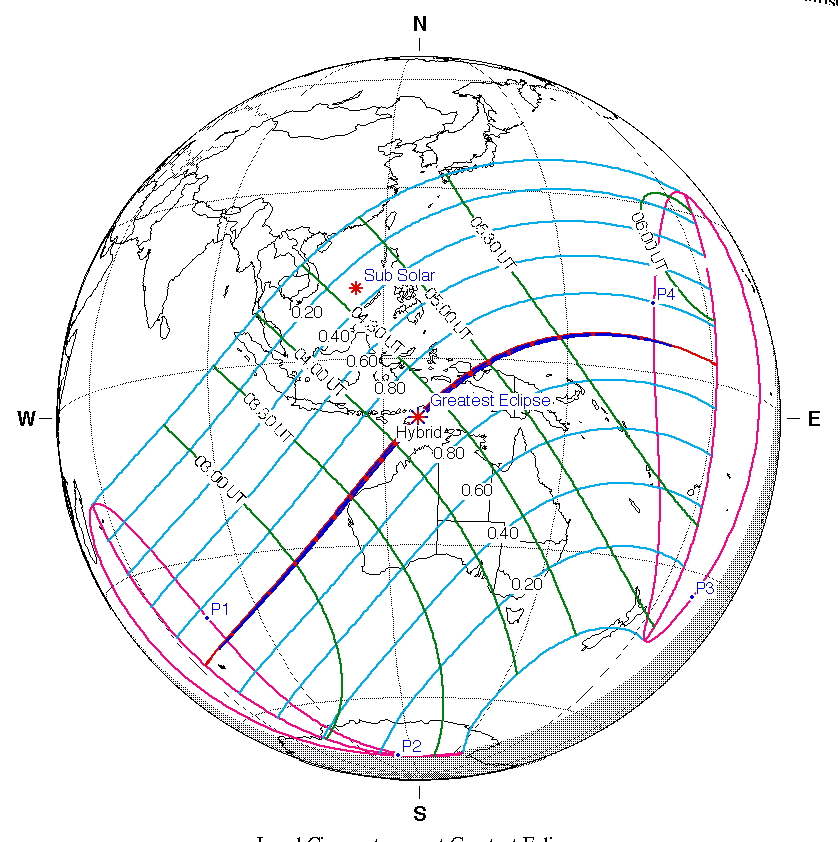
World solar eclipse map for the hybrid eclipse, April 20, 2023. The central path is in red, while the total eclipse part of the path is highlighted in blue. The image is of the world solar eclipse map for the hybrid eclipse, April 20, 2023. Taken from https://eclipse.gsfc.nasa.gov/SEplot/SEplot2001/SE2023Apr20H.GIF. Credit: NASA’s GSFC, Fred Espenak.
04/19/2023 – Ephemeris – Let’s find where the naked-eye planets have wandered off to this week
This is Ephemeris for Wednesday, April 19th. Today the Sun will be up for 13 hours and 40 minutes, setting at 8:32, and it will rise tomorrow at 6:50. The Moon, 1 day before new, will rise at 7:04 tomorrow morning.
Let’s find where the naked-eye planets have wandered off to this week. Since I left you in February, Jupiter passed behind the Sun 8 days ago and moved to the morning side of the Sun. Though it will be more than a month before it is far enough from the Sun to be spotted before sunrise. Venus is our blazing Evening Star, seen in the west all evening. It will set shortly after midnight. It’s in Taurus, with the bright star Aldebaran below and left of it and the Pleiades below and right of it. Mars is above and left of Venus. Venus is closing the gap, but will never quite reach Mars while they are in the evening sky. The closest they will get is three and a half degrees or 7 moon diameters apart, but won’t cross paths until February of next year. In the morning sky, Saturn is now visible by 6 am in the east-southeast.
Addendum
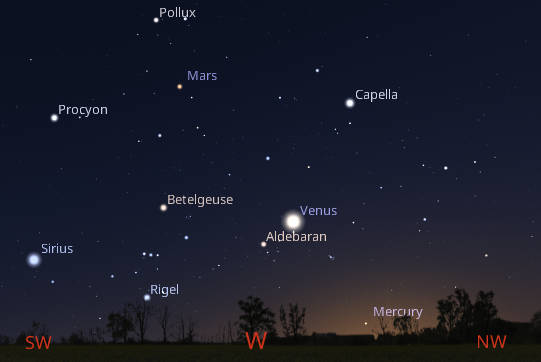
Evening planets Venus and Mars among the bright stars of winter at 9:30 pm with Mercury about to set, April 19, 2023. Created using Stellarium.
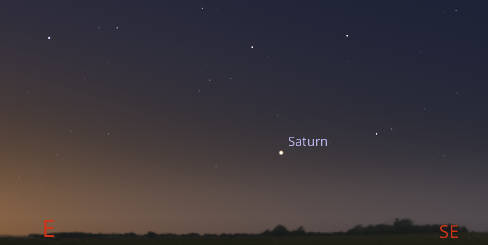
Saturn in morning twilight at 6 am on April 20, 2023. Created using Stellarium.
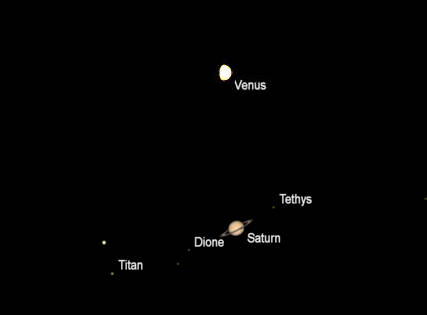
Telescopic Venus and Saturn (north up) as they would be seen in a small telescope, with the same magnification. Apparent diameters: Venus 15.72″, and is 70.8% illuminated; Saturn 16.07″, its rings 37.43″. Created using Cartes du Ciel (Sky Charts).
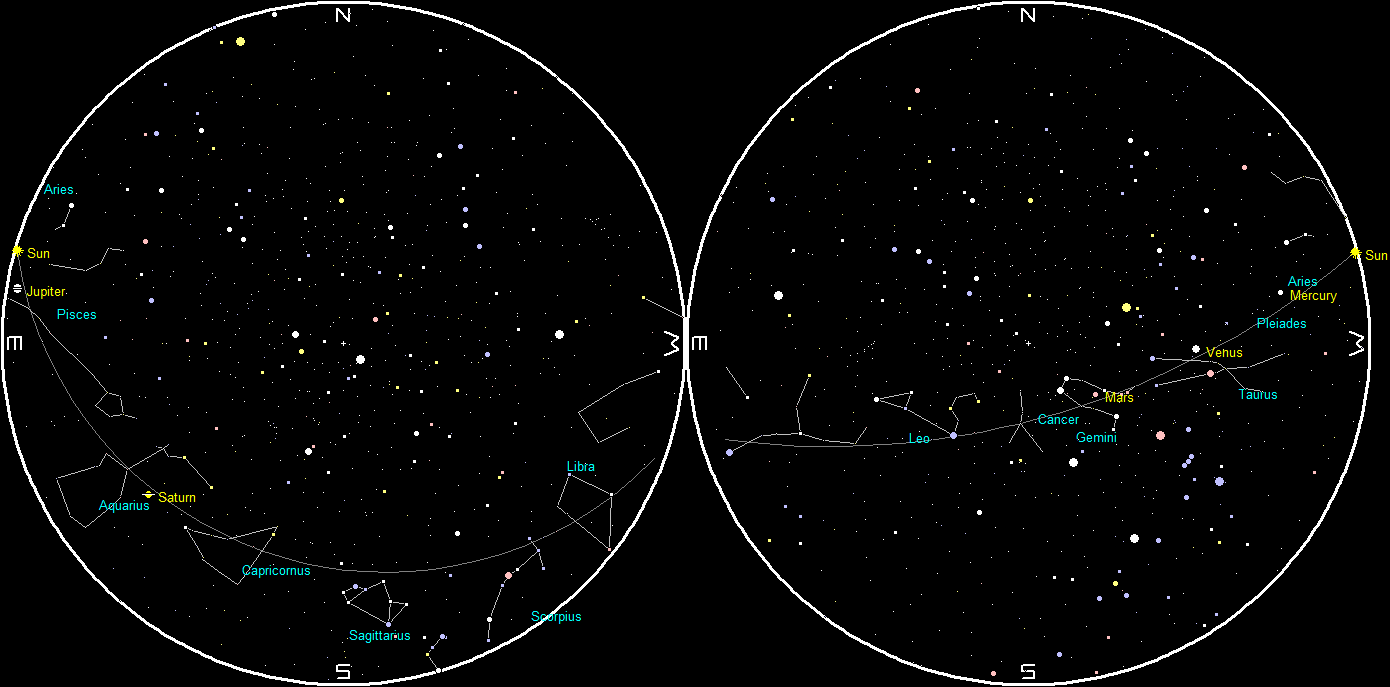
The naked-eye planets and the Moon at sunset and sunrise on a single night, starting with sunset on the right on April 19, 2023. The night ends on the left with sunrise on the 20th. Click on the image to enlarge it. Created using my LookingUp app and GIMP.
04/18/2023 – Ephemeris – Orion rotates 90 degrees from rising to setting
This is Bob Moler with Ephemeris for Tuesday, April 18th. Today the Sun will be up for 13 hours and 37 minutes, setting at 8:31, and it will rise tomorrow at 6:52. The Moon, 2 days before new, will rise at 6:43 tomorrow morning.
As the constellation of Orion the hunter, that dominated our winter skies, moves into the west in the evening, it will have rotated 90 degrees from its rising orientation. As we saw it rising last November, its three belt stars were nearly vertically aligned. Now, as Orion nears the western horizon, those belt stars have rotated to be almost horizontal. The same is true of Gemini’s two brightest stars, Castor and Pollux. They are the two stars above red Mars, which is now halfway through Gemini on its eastward travels. Orion, a minor Greek hero, is most famous for how he died. I know of three versions, all different. The one that fits Orion’s current setting is that he was killed by the sting of a giant scorpion. So he must flee the sky before Scorpius the scorpion rises, which is around midnight tonight.
This amount of rotation between rising and setting is only true for latitudes near 45 degrees north or south, such as Northern Michigan, and objects near the celestial equator. The rotation for other latitudes would be 2 x (90 – latitude) for equatorial celestial objects. The name given for the term (90 – latitude) is colatitude. 90 degrees is the latitude of the Earth’s poles.
The astronomical event times given are for the Traverse City/Interlochen area of Michigan (EST, UT –4 hours). They may be different for your location.
Addendum
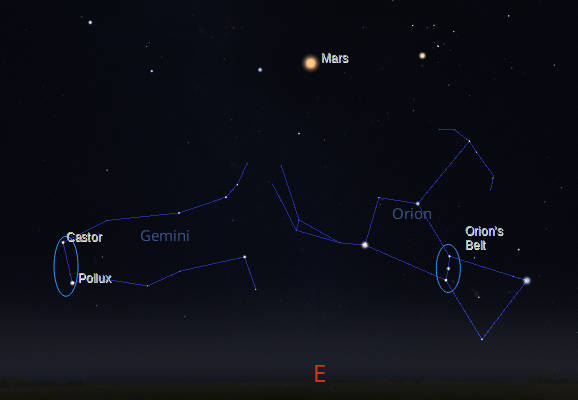
When Orion is rising, its belt stars are nearly vertically aligned. Castor and Pollux, too, appear nearly vertically aligned. This was for November 30, 2022, at 9 pm. Mars was near opposition then and quite close to the Earth, so it had shown quite brightly. Created using Stellarium and LibreOffice Draw.
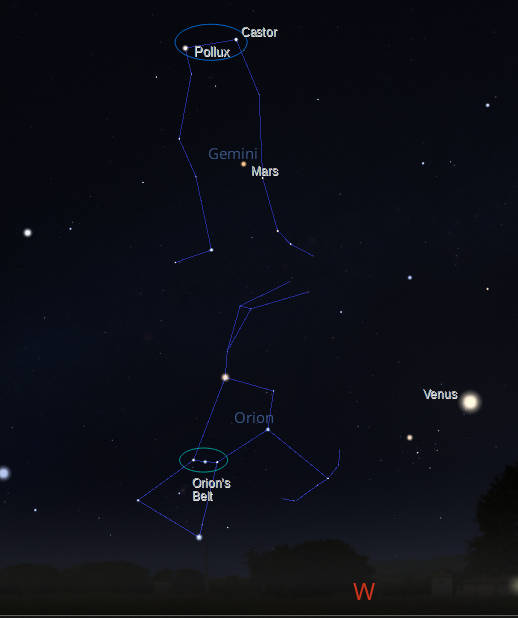
Orion’s belt stars show that the constellation has rotated about 90 degrees from their rising orientation. This is for 10 pm, April 18, 2023. Note that Venus is the Evening Star now, and Mars is much dimmer, as the Earth has moved ahead and away from it. Created using Stellarium and LibreOffice Draw, for the added labels.
04/17/2023 – Ephemeris – I’m back. And a look ahead
This is Ephemeris for Monday, April 17th. Today the Sun will be up for 13 hours and 34 minutes, setting at 8:30, and it will rise tomorrow at 6:53. The Moon, 3 days before new, will rise at 6:23 tomorrow morning.
I’m back, still in physical therapy, but hopefully to stay. The next year and a half will see some spectacular celestial events, plus the Sun is getting unusually active this solar cycle, which means more displays of the northern lights or aurora borealis. For us, the first event will be a partial eclipse of the Sun on Saturday, October 14th. It’s an annular or ring eclipse, where the Moon is too far away to completely block the Sun, leaving a ring of light at its peak for a narrow path in the southwestern US. Then next April, a total solar eclipse will occur. Much more of the Sun will be blocked for us. Then the following October we might get to see a bright comet, if it performs as expected. Comet Tsuchinshan-ATLAS was discovered three months ago.
The astronomical event times given are for the Traverse City/Interlochen area of Michigan (EST, UT –4 hours). They may be different for your location.
Addendum
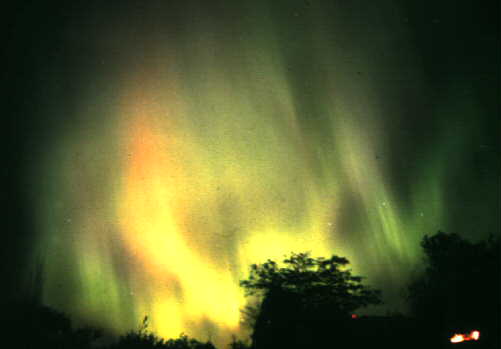
An aurora display from a couple of sunspot cycles ago. Credit: Bob Moler.
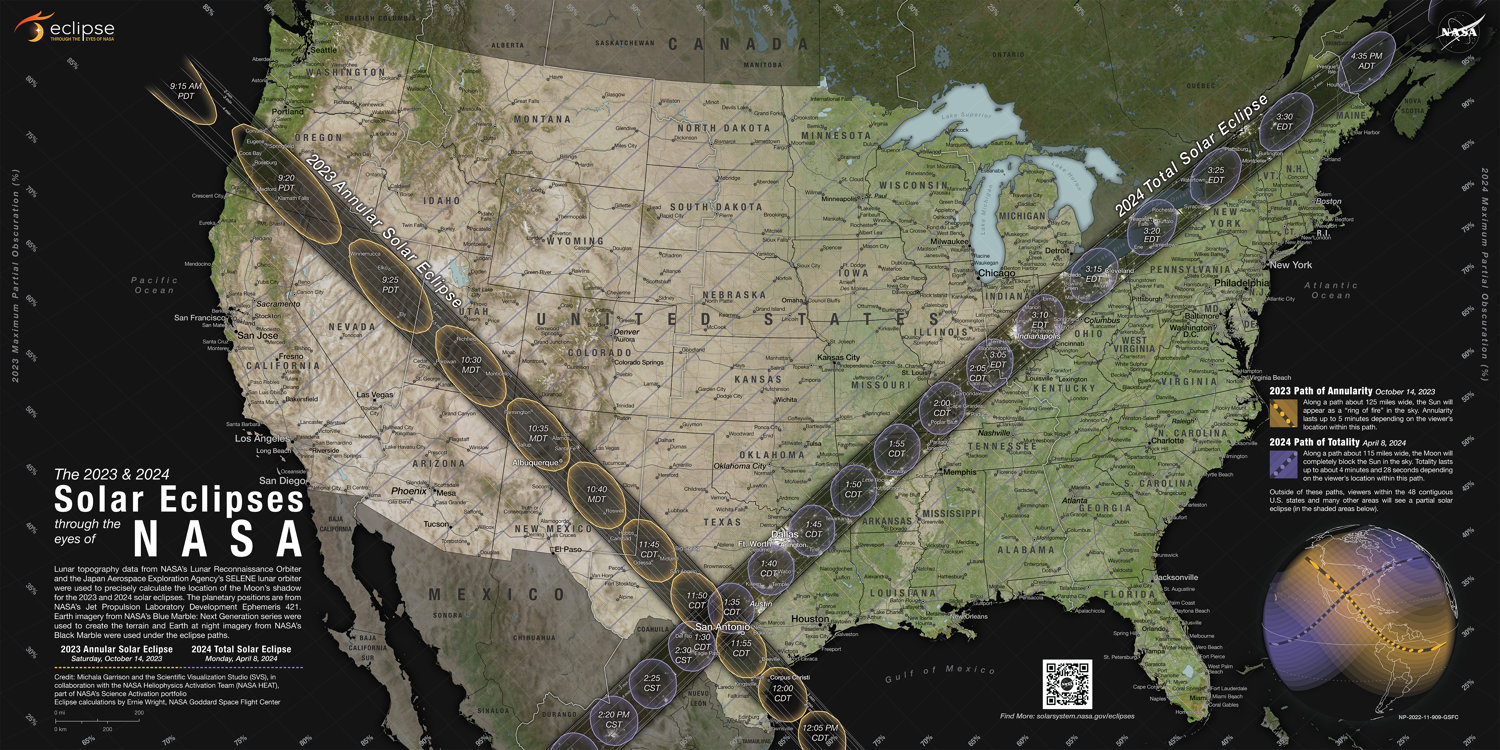
NASA Eclipse Map for the United States for the annular eclipse of October 14, 2023, and total eclipse of April 8, 2024. The tracks are the path of annularity, where the ring of light around the Moon is seen, and the path of totality, where the Sun’s face is completely covered by the Moon. Subtract 4 hours from the times given to convert to Eastern Daylight Saving Time. Click on the image to enlarge it. Credit NASA.
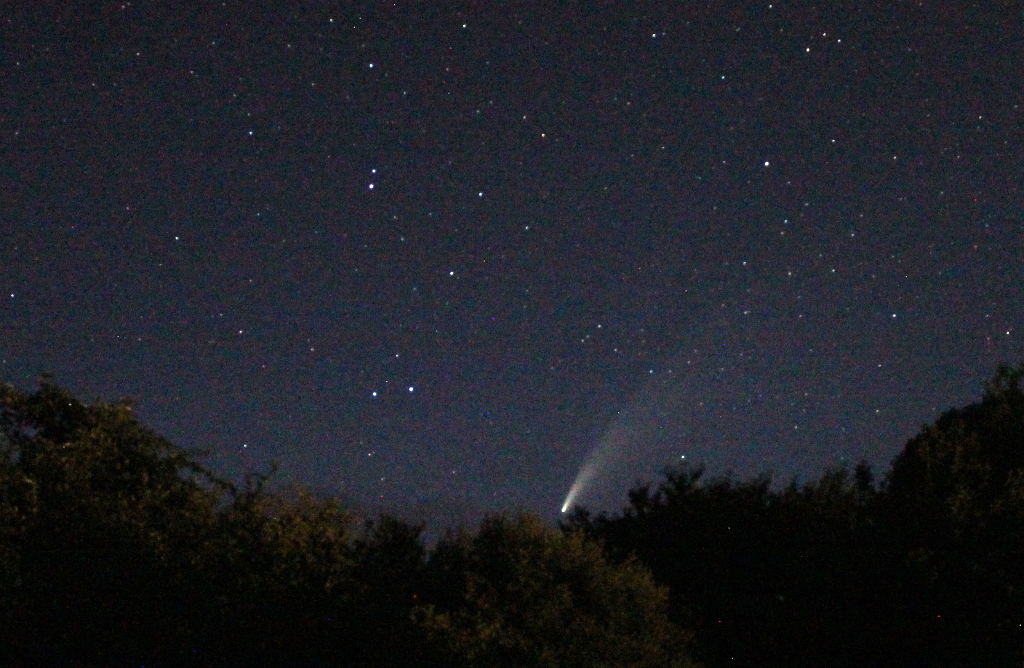
Comet NEOWISE from backyard over tall shrubbery 11:18 pm, July 16, 2020. I didn’t have time to focus properly, which actually accentuates the stars. Comet Tsuchinshan-ATLAS has the potential of being many times brighter. It was seen in the northeast before sunrise and in the northwest after sunset. Our new comet will be best seen low in the southwest in the evening.
03/21/2023 – Ephemeris Extra – Spring has sprung without me
Being in the hospital and now in inpatient rehab one loses a sense of time. So the vernal equinox snuck by me unnoticed. My view of the outside world is another part of the hospital, a part of the HVAC system, and a piece of sky.
Yesterday, the Sun passed over the Earth’s equator, heading northward. The Sun is gradually setting at the South Pole and rising at the North Pole. Folks like me who live in the Northern Hemisphere are experiencing longer daylight than those south of the equator, who are beginning autumn. The daylight hours will increase daily until June 21st, the summer solstice. In the Interlochen/Traverse City area, that will be 15 hours and 34 minutes.
The cause of the Earth’s seasons is not our varying distance from the Sun in our eliptical orbit of the Sun of 93 million plus or minus a million and a half miles.By the way, the Earth is currently moving away from the Sun. It will be farthest from the Sun around July 4th or 5th.
Our perception of the advance of spring, besides the gradully warming temperatures and increasing daylight hours, will be the height of the Sun’s path in the sky, and the position of the Sun’s rise and set points on the horizon. All these annual changes are angles having to do with one’s latitude (an angle), Earth’s position in orbit (an angle), and the tilt of the Earth’s axis to it’s orbit (more angles).
Bob
03/19/2023 – Ephemeris Extra – Zodiacal light
This is the time of year when the faint glow can be seen in the west at the end of asttronomical twilight in the evening. It’s called zodiacal light. It is difficult to spot the first time. The final twilight glow tends to be horizontal, along the horizon, while źodiacal light has a thin pyramidal shape tilted to the left along the constellations of the zodiac. Right now, Venus appears in the heart of the glow.
Some of my older blog posts also cover zodiacal light with images of it I’ve taken, so search for zodiacal light in the spot provided.
On a personal note: I’m expected to be discharged from rehab by month’s end. I’m hoping that a couple of weeks after that, I can get back to a regular schedule. Here’s hoping.
Bob
03/17/2023 – Ephemeris Extra – I’m now in Rehab
I’m hoping to be home by the end of the month. My daughter wants me to take some additional time before plunging back in. I don’t actually disagree with her.
A local event I’d like to preview is the Grand Traverse Astronomical Society’s part in International Astronomy Day, Saturday, April 29th. This annual event will be held at the Sleeping Bear Dunes National Lakeshore. I’ve been out of the loop on this, but the GTAS may be offering solar and night viewing. The sun has been unexpectedly active this year, and it is our star. Stay tuned.
Bob
 Bob Moler's Ephemeris Blog