Archive
03/12/2018 – Ephemeris – The Fisher is rising as spring approaches
Ephemeris for Monday, March 12th. The Sun will rise at 8:00. It’ll be up for 11 hours and 44 minutes, setting at 7:45. The Moon, 4 days past last quarter, will rise at 6:05 tomorrow morning.
Now in the evening the Big Dipper has moved up in the northeast. The Anishinaabek peoples around the Great Lakes, like the Ottawa and Chippewa saw instead of a dipper or a bear: Ojiig the Fisher. It’s a magical weasel-like creature who, with some animal friends, brought summer to the Earth. The story is too long to relay here, but my telling of it is here. For his trouble he was slain, and was placed among the stars of the sky by the Great Spirit Manitou where we see him today. His blood is said to paint the trees with the fall colors. However as the Fisher rises in the northeast in late winter and early spring it is a signal for the maple trees to bring forth their sweet sap.
The times given are for the Traverse City/Interlochen area of Michigan. They may be different for your location.
Addendum
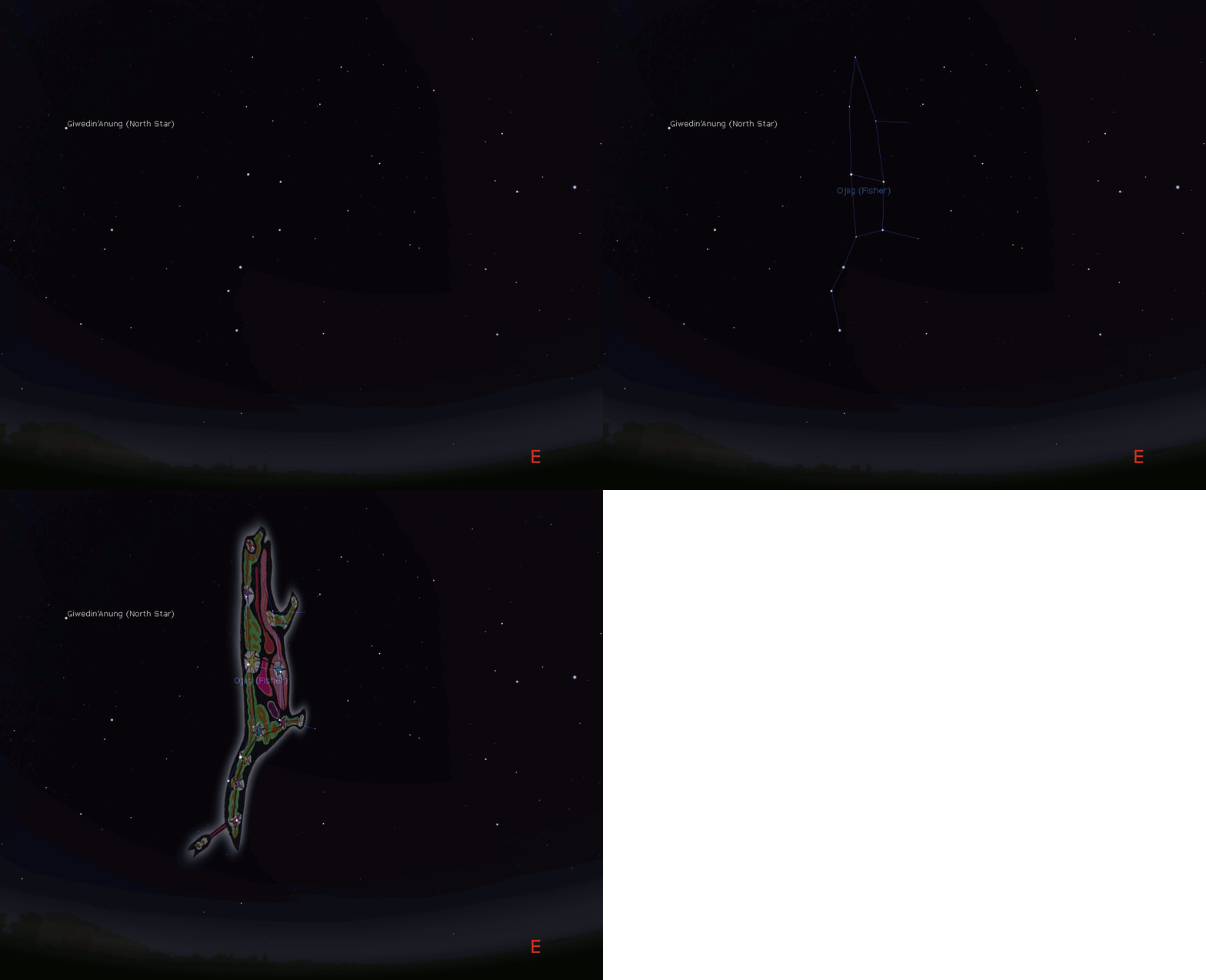
Finding the Big Dipper and the Fisher at 9 p.m., March 12, 2018. Click on the image to enlarge. Created using Stellarium and GIMP.
The Anishinaabek constellation drawings are from Ojibwe Sky Star Map Constellation Guide by Annette S. Lee, William Wilson, Jeffrey Tibbets and Carl Gawboy available locally and online. They are part of the latest editions of Stellarium, a free planetarium program. Links to it are on the left. Other information and links are available within the Sky Lore tab.
Here’s one of the links: http://www.nativeskywatchers.com/. It also contains links to Lakota star maps and lore.
02/13/2018 – Ephemeris – Looking out the thin side of the Milky Way’s disk
Ephemeris for Fat Tuesday, February 13th. The Sun will rise at 7:46. It’ll be up for 10 hours and 22 minutes, setting at 6:08. The Moon, 2 days before new, will rise at 7:07 tomorrow morning.
With Orion and the winter stars grabbing our attention in the south, let’s look to the northeast to southeast where the stars are not as many, and with the exception of the Big Dipper and some other stars, not as bright. The inner stars of the Big Dipper are part of a sparse star cluster only about 80 light years away. The reason for the sparseness is that here we are looking out the thin side of the Milky Way’s disk. It will be our spring sky. To the west is the autumn evening skies. The thick part of the disk runs from the south-southeastern horizon, to just west of the zenith to the northwestern horizon. The reason the Milky Way isn’t as bright as the summer sections, is that we are looking away from the center to the outer spiral arms. We are in a small arm with the Great Orion Nebula.
The times given are for the Traverse City/Interlochen area of Michigan. They may be different for your location.
Addendum
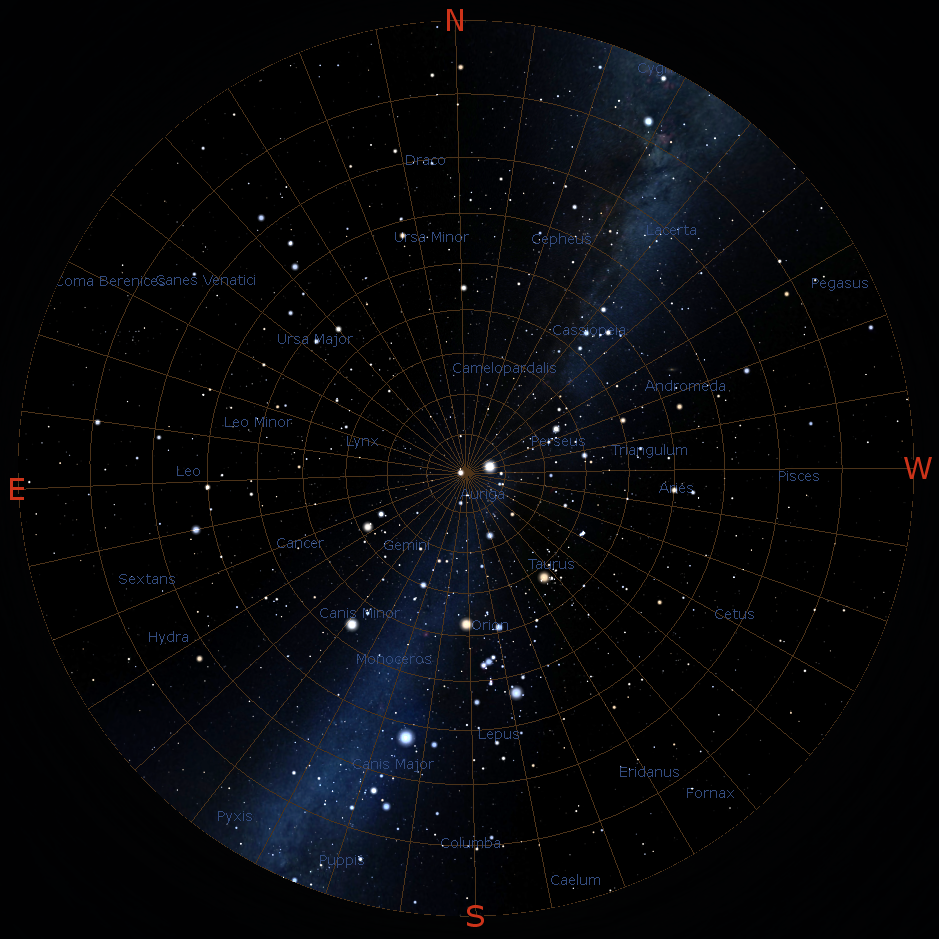
The dome of the sky at 9 p.m. February 13, 2018 showing an enhanced Milky Way. Showing also the drop off in stars off that band to the east and west. Click on image to enlarge. Created using Stellarium.
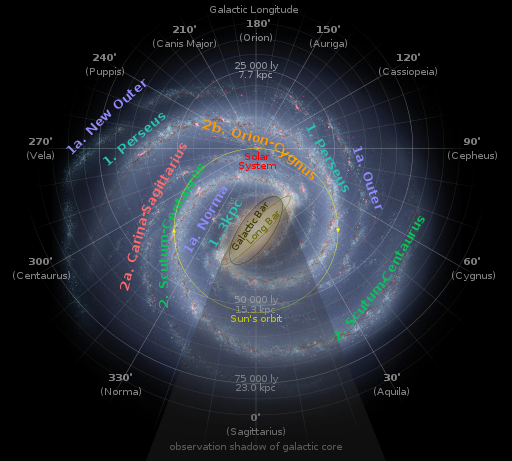
Our place in the Milky Way. Note that we appear to be in a barred spiral galaxy. The arms are numbered and named. 3kpc is the 3 kiloparsec arm. 1 parsec = 3.26 light years. The Sun is about 27,000 light years from the center. Credit NASA and Wikimedia Commons, via EarthSky.org
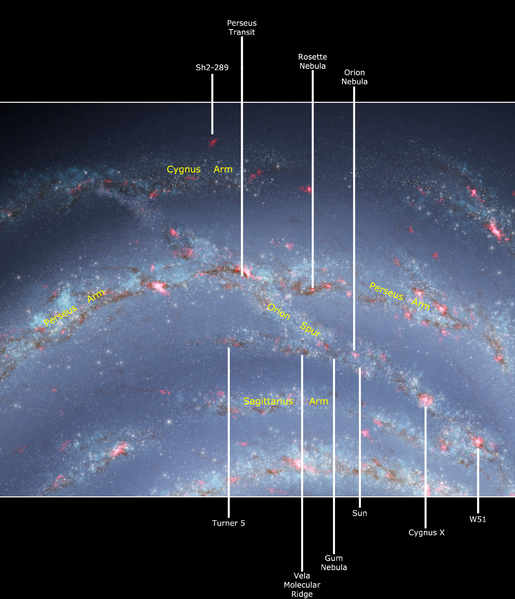
Our galactic neighborhood on the Orion spur or arm. Credit R. Hurt on Wikimedia Commons, via EarthSky.org.
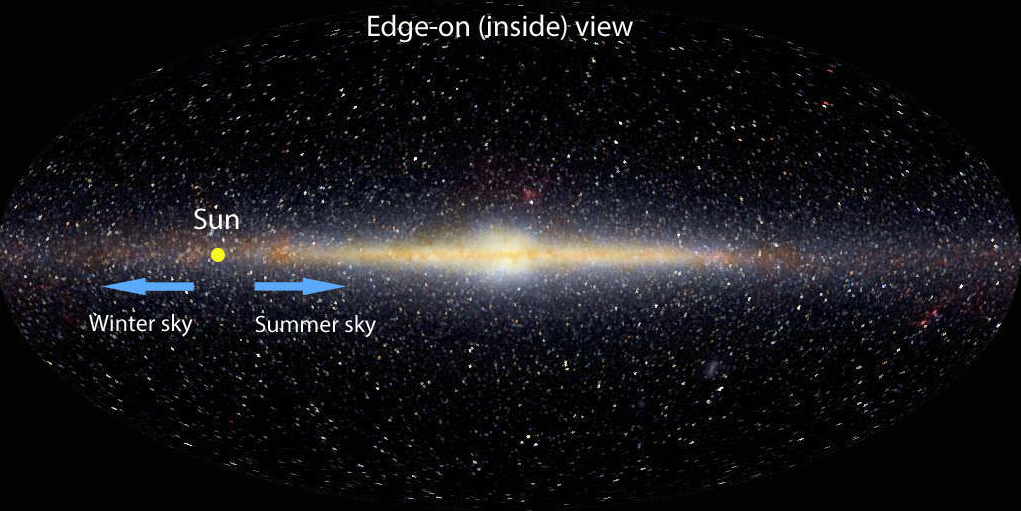
The summer and winter Milky Way viewing directions. During Spring and Autumn, we look out the sides to the universe beyond. Credit: NASA with annotations by Bob King at Universe Today.
11/09/2017 – Ephemeris – Cassiopeia the queen and her husband
Ephemeris for Thursday, November 9th. The Sun will rise at 7:31. It’ll be up for 9 hours and 49 minutes, setting at 5:20. The Moon, 1 day before last quarter, will rise at 10:59 this evening.
The stars of the autumn skies hold forth now, but one prominent autumn constellation never leaves us, here in northern Michigan. Look high in the northeastern sky by 8 p.m. and you can find the W shaped constellation of Cassiopeia the queen. It is opposite the pole star Polaris from the Big Dipper, slinking low in the north-northwest. There’s a dim star that appears above the middle star of the W which turns the W into a very crooked backed chair. Above and left of Cassiopeia is a dim upside down church steeple shaped constellation of Cepheus the king. The Milky Way flows through a corner of Cepheus and Cassiopeia toward the northeastern horizon and through the constellation of Perseus the hero, and the bright star Capella in Auriga the Charioteer.
The times given are for the Traverse City/Interlochen area of Michigan. They may be different for your location.
Addendum
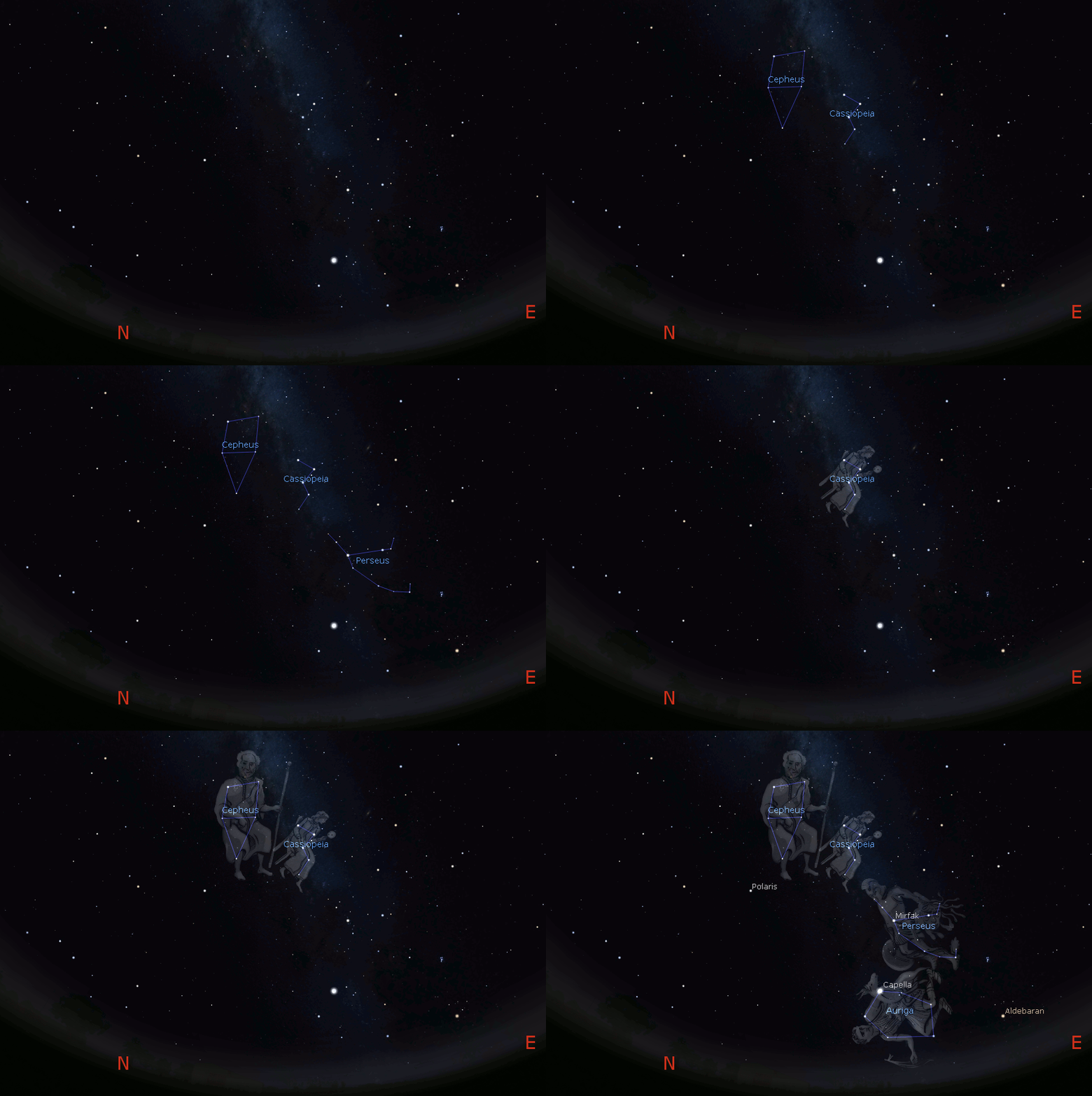
Cassiopeia and constellations along the Milky Way in the northeast these autumn evenings. (8 p.m. November 9, 2017). Click on image to enlarge. Created using Stellarium and GIMP.
10/17/2017 – Ephemeris – The Fisher paints the autumn leaves red
Ephemeris for Tuesday, October 17th. The Sun will rise at 8:00. It’ll be up for 10 hours and 53 minutes, setting at 6:54. The Moon, 2 days before new, will rise at 6:35 tomorrow morning.
This morning, if it’s clear the red planet Mars will appear just to the right of the thin crescent Moon. Mars isn’t the only thing that’s red now. So are the maple leaves as we advance into autumn. The native Anishinaabek peoples have a story about how that came to be. Of how a magical weasel-like creature called the Fisher or Ojiig brought summer to the Earth from Skyland. For his trouble he was shot with an arrow in his only vulnerable spot, the tip of his tail. As he fell to Earth the Great Spirit, Manitou caught him and placed him in the sky where we see the Great Bear (Ursa Major) and the Big Dipper. Every autumn we see his tail swoop down to the ground where his tail paints the leaves red with his blood.
The times given are for the Traverse City/Interlochen area of Michigan. They may be different for your location.
Addenda
The Moon and the morning planets this morning
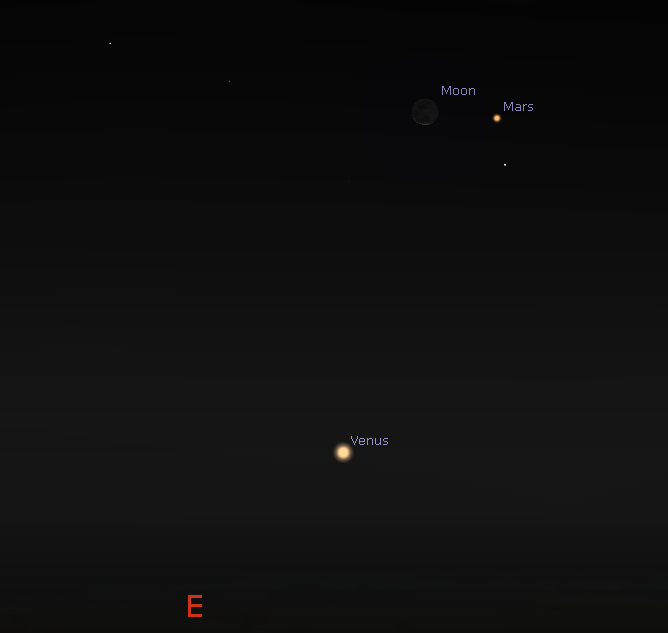
The Moon and Mars at 6:30 this morning October 17, 2017. Click on image to enlarge. Created using Stellarium.
At 00:21 UTC on the 18th Venus will be south of the Moon. It will be visible from Asia.
The Fisher (Ojiig) paints the trees with the autumn colors

Autumn colors. My image.
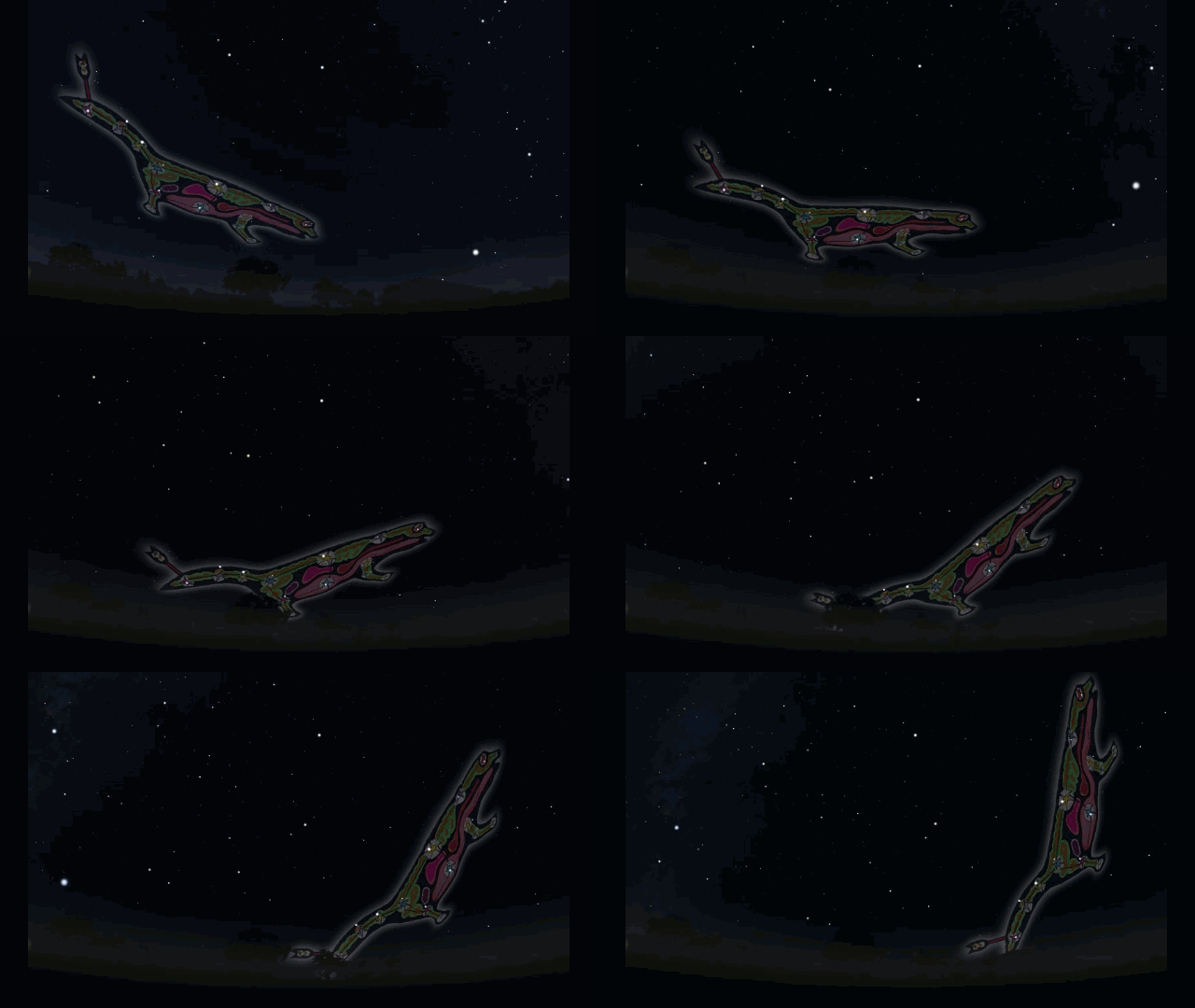
An animation of Fisher brushing his tail along the horizon on autumn nights. Click on image to enlarge. Created using Stellarium.
The constellation art is part of the latest versions of Stellarium. Ojibwe (Anishinaabek) constellation art by Annette S Lee and William Wilson from Ojibwe Sky Star Map Constellation Guide, ISBN 978-0-615-98678-4.
See the version of the story I learned: The story of the Fisher Star.
There are other variations of the story, and other adventures of the Fisher. Perform an Internet search for: Fisher or Fisher Star or Ojiig.
08/28/2017 – Ephemeris – Polaris the North Star
Ephemeris for Monday, August 28th. The Sun will rise at 7:00. It’ll be up for 13 hours and 25 minutes, setting at 8:25. The Moon, 1 day before first quarter, will set at 12:19 tomorrow morning.
The bright star Polaris is a very important star. It is also known as the North Star and the Pole Star. Its unique position is nearly directly at the zenith at the Earth’s north pole, making it a very important navigational star. It’s about 40 minutes of arc, or about one and a third Moon diameters away from the extension of the Earth’s axis into the sky. As a rule of thumb, it’s angular altitude above the northern horizon is approximately one’s latitude, and it stands about at the due north compass point. Polaris is found using the Big Dipper, using the two stars at the front of the dipper bowl to point to it. It’s located at the tip of the handle of the very dim Little Dipper, which this time of year in the evening appears to standing on its handle.
The times given are for the Traverse City/Interlochen area of Michigan. They may be different for your location.
Addendum
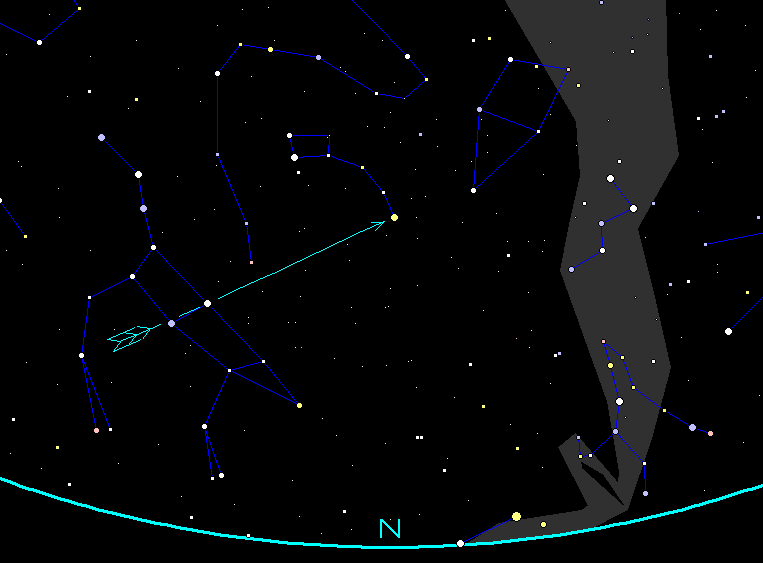
Polaris finder chart for 10 p.m., August 28th. Created using my LookingUp program
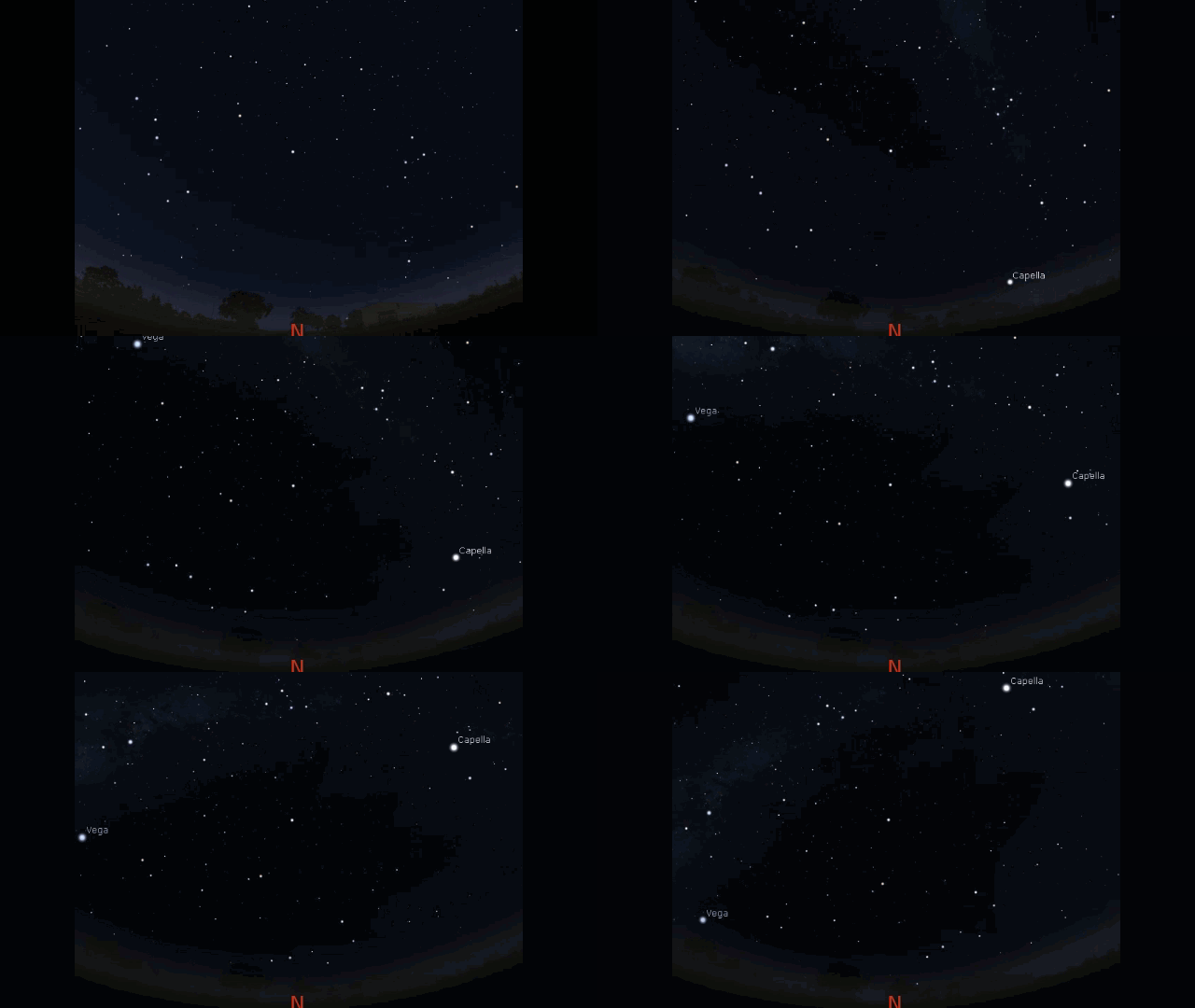
Animation of the rotation of the sky around Polaris on the night of August 28/29, 2017. Created using Stellarium and Filmora.
I’ve left the constellation lines off. The Big Dipper is seen easily as is Cassiopeia’s “W” opposite it around the stationary Polaris.
06/27/2017 – Ephemeris – Arcturus as a look at the Sun’s future
Ephemeris for Tuesday, June 27th. Today the Sun will be up for 15 hours and 32 minutes, setting at 9:31, and it will rise tomorrow at 5:59. The Moon, 3 days before first quarter, will set at 12:18 tomorrow morning.
With the Moon brightening the night sky, let’s take a look at the star Arcturus, which with its pointer, the curve of the Big Dipper’s handle is slipping into the high western sky. Arcturus is the 4th brightest night time star, though some think the star Vega, high in the east is brighter. They are different colors because Arcturus is orange, while Vega is whiter than the Sun. Arcturus is a preview of what the Sun will become in four or five billion years from now. It is only 10% more massive than the Sun and is that much older than the Sun, so it is turning into its red giant stage, after running out of hydrogen to turn into helium in its core to produce energy. The helium is now compressing and heating to begin its reaction.
The times given are for the Traverse City/Interlochen area of Michigan. They may be different for your location.
Addendum
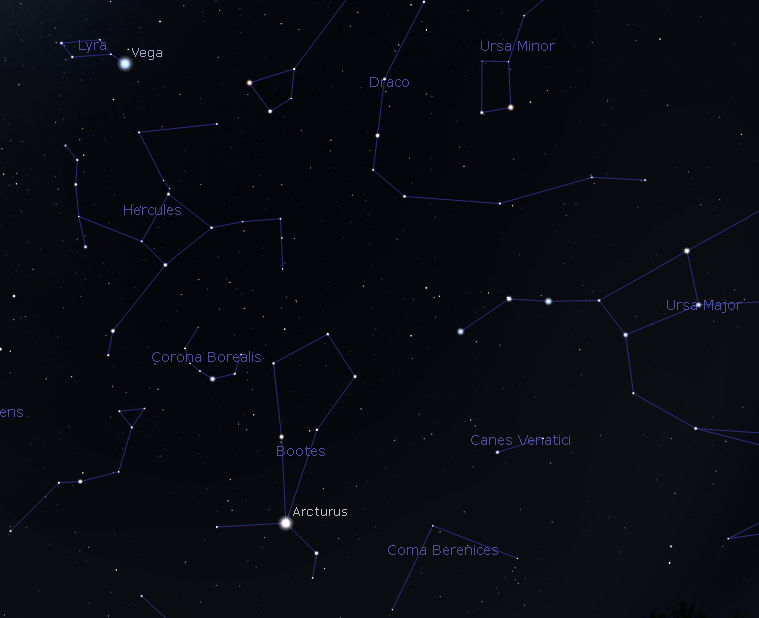
Arcturus finder chart with the Big Dipper and Vega as guide posts. Created using Stellarium.
Here’s one of my prior posts about Arcturus, about its great space velocity: https://bobmoler.wordpress.com/2016/04/26/04262016-ephemeris-arcturus-just-passing-through/
05/25/2017 – Ephemeris – Another look at Leo the lion
Ephemeris for Ascension Thursday, Thursday, May 25th. Today the Sun will be up for 15 hours and 9 minutes, setting at 9:14, and it will rise tomorrow at 6:04. The Moon is new today, and won’t be visible.
The constellation Leo the lion is now high in the southwest at 10:30 pm. It’s below the Big Dipper higher up near the zenith. Leo is marked by two sets of easily recognizable stars. The front of him is a backward question mark of stars, also known as the Sickle that mark his head and mane, along with the front part of his body. Regulus is the star at the bottom of that backwards question mark. It’s the Little King Star. The hind end of him is a triangle of stars ending with another bright star, but not as bright as Regulus. It’s Denebola which means Lion’s tail. It was thought when the sun was in this constellation long ago that the lions were driven by the heat to quench their thirst in the Nile river. Ancient physicians thought medicines were poison when the Sun was here too.
The times given are for the Traverse City/Interlochen area of Michigan. They may be different for your location.
Addendum
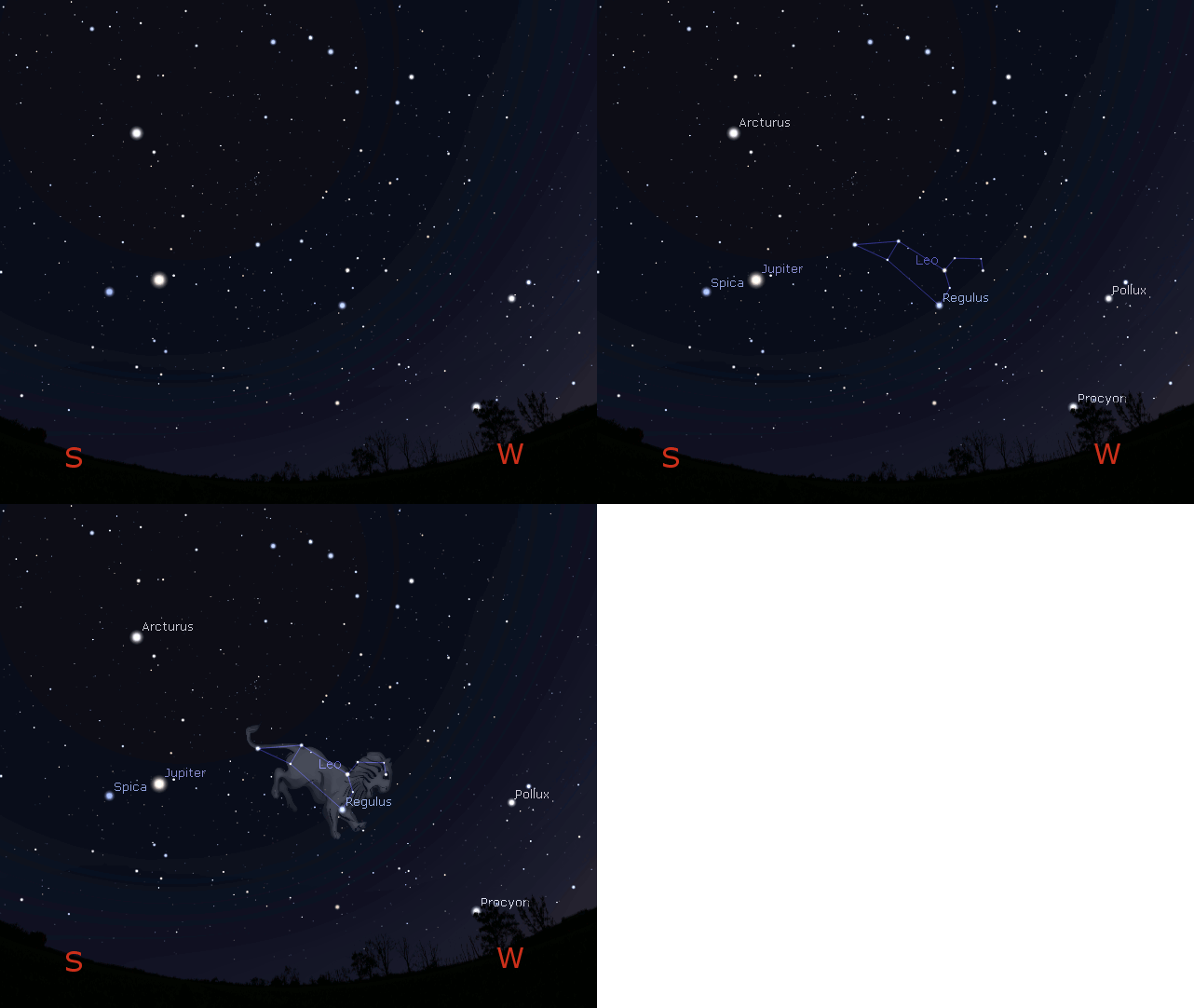
Animation on how to find Leo the lion at 10:30 p.m., May 25, 2017. Created using Stellarium and GIMP. Click on image to enlarge if necessary.
05/23/2017 – Ephemeris – The Big Dipper as seen in many lands
Ephemeris for Tuesday, May 23rd. Today the Sun will be up for 15 hours and 6 minutes, setting at 9:12, and it will rise tomorrow at 6:05. The Moon, 2 days before new, will rise at 5:38 tomorrow morning.
The Big Dipper is overhead at 10 in the evening, it’s seven stars shining brightly. The Big Dipper is not an actual constellation, recognized internationally. It’s part, the hind part, of Ursa Major, the great bear. The Big Dipper is an asterism or informal constellation. It is a distinctly North American constellation. For fugitive slaves, fleeing the southern states in the days before the Civil War, the Drinking Gourd, as they called it, showed the direction north to freedom. In England the dipper stars become the Plough, or Charles’ Wain (Charlemagne’s Wagon), In France, known for culinary delights it was the saucepan, or the cleaver. So many cultures saw what was familiar to them in these seven bright stars.
The times given are for the Traverse City/Interlochen area of Michigan. They may be different for your location.
Addendum
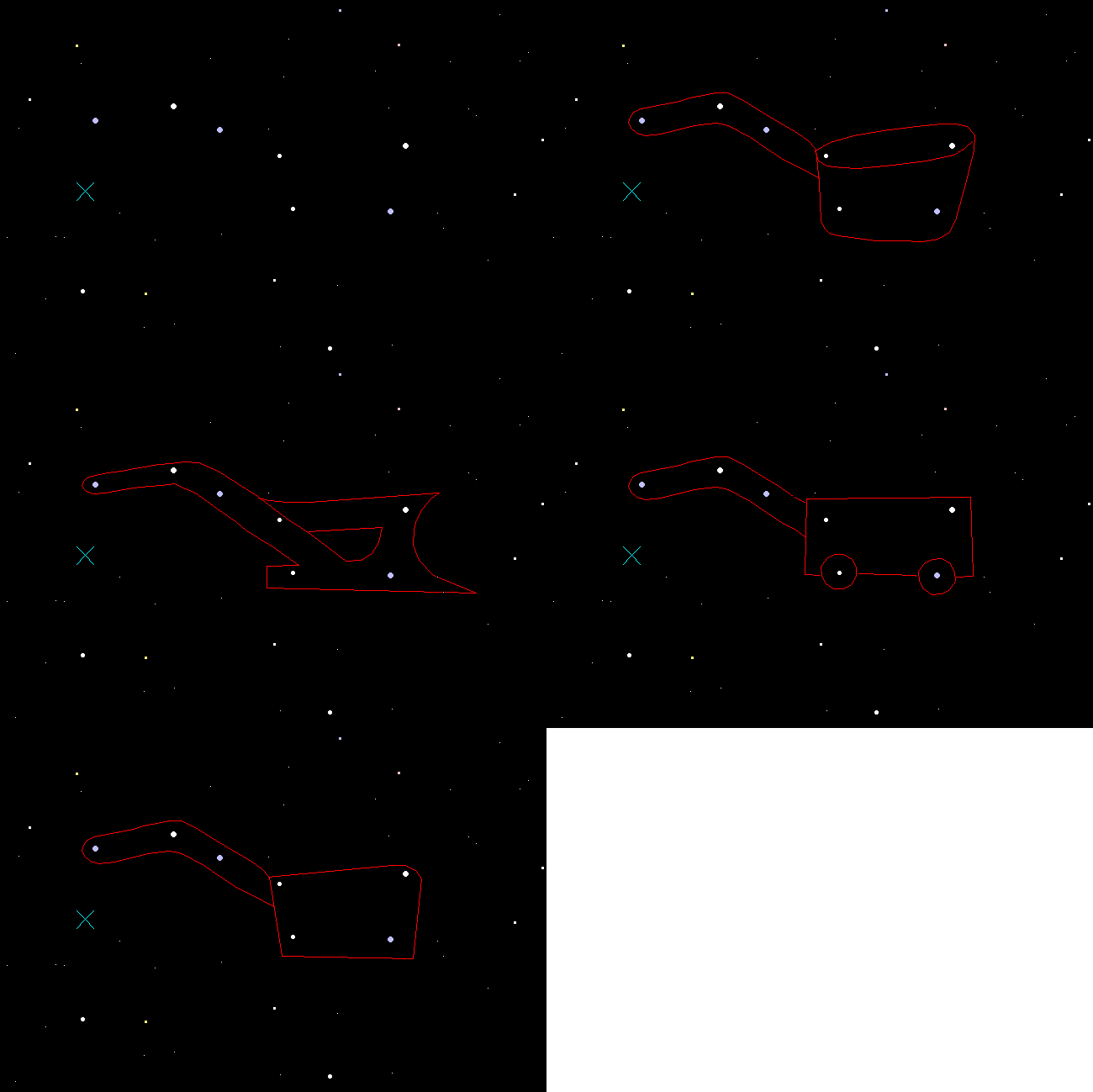
The Big Dipper as I imagine it from some lands facing southwest and looking straight up. The X in the picture is the zenith point. We cycle through the stars only, the Big Dipper or the Saucepan, The Plough (plow in the U.S.), Charles Wain, and finally the Cleaver. Created using my LookingUp program.
Do you know any other asterisms or informal constellations assigned to these stars, add a comment.
05/22/2017 – Ephemeris – Why does the Great Bear have a long tail?
Ephemeris for Monday, May 22nd. Today the Sun will be up for 15 hours and 4 minutes, setting at 9:11, and it will rise tomorrow at 6:06. The Moon, 3 days before new, will rise at 5:01 tomorrow morning.
The Great Bear, or Ursa Major as the Greeks, Romans and others saw it, has been handed down to us to this day. We see the Great Bear as the Big Dipper overhead in the evening now, which is just his hind end, with a long very unbearlike tail. The ancient Greek story goes that a god, not wishing to grab the end with the teeth, grabbed instead her stubby tail and in hurling her into the sky, and stretched the tail. Native Americans who also saw a bear here, saw the three stars of the dipper handle as three hunters following the bear. The local Anishinaabek people saw here instead the Fisher, a magical weasel-like animal who had a long tail naturally. He brought summer to the Earth, and was killed for his efforts, but was placed in the sky to show us the seasons.
The times given are for the Traverse City/Interlochen area of Michigan. They may be different for your location.
Addendum

The Big Dipper/Great Bear/Fisher as seen by western and Anishinaabek people. Created using Stellarium and GIMP.
Western art is by Johan Meuris.
The source for the Ojibwe constellation art in Stellarium is from Ojibwe Sky Star Map Constellation Guide (An introduction to Ojibwe Star Knowledge) by Annette S. Lee, William Wilson, Jeffrey Tibbetts, and Carl Gawboy, ISBN 978-0-615-98678-4. The illustrations are by Annette S. Lee and William Wilson. There is also a poster sized star map available. It should be available in book stores locally, or on Amazon. I found my copy at Enerdyne in Suttons Bay.
My retelling of the Fisher or Fisher Star is here: https://bobmoler.wordpress.com/2012/10/11/the-story-of-the-fisher-star/
04/17/2017 – Ephemeris – How to find the stars Arcturus and Spica from the Big Dipper
Ephemeris for Monday, April 17th. The Sun rises at 6:54. It’ll be up for 13 hours and 35 minutes, setting at 8:30. The Moon, 2 days before last quarter, will rise at 2:21 tomorrow morning.
The Big Dipper, now nearing the zenith at 10 p.m. points to several stars and constellations. It’s handle points to two bright stars. First we follow the arc of the handle to the bright orange star Arcturus, the 4th brightest night-time star. The reason I say night-time is that the sun is a star also but by definition is not out at night. The arc to Arcturus is a how to find Arcturus and a clue to its name. Arcturus, midway up the sky in the east, lies at the base point of the kite shaped constellation of Boötes the herdsman. From Arcturus, straighten out the arc to a spike and one soon arrives at Spica a blue-white star in Virgo the virgin, now low in the southeast. It is below Jupiter this year. Spica is also sometimes pronounced ‘Speeka’.
The times given are for the Traverse City/Interlochen area of Michigan. They may be different for your location.
Addendum
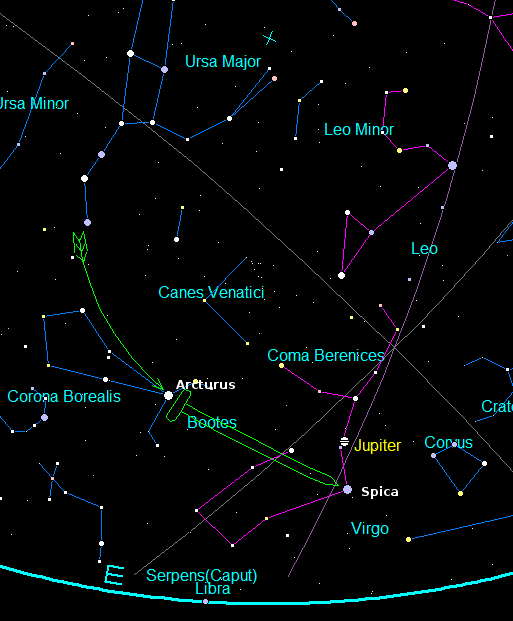
How to find the stars Arcturus and Spica from the Big Dipper in April 2017. Created using my LookingUp program.
 Bob Moler's Ephemeris Blog